
Life, 1927-05-12 · page 28 of 43
Life — May 12, 1927 — page 28: what you’re looking at
What you’re looking at
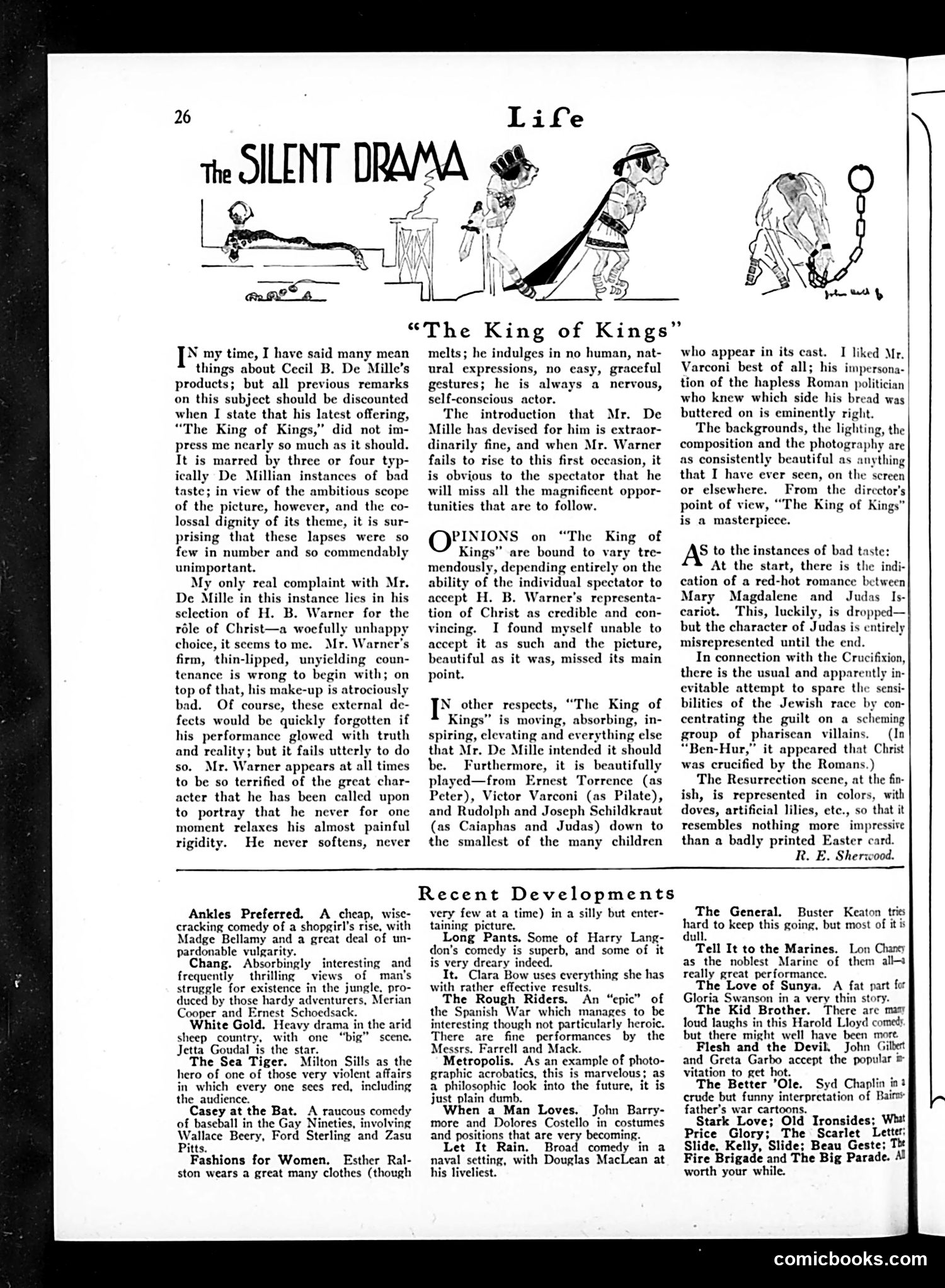
This page reviews Cecil B. DeMille's 1927 film *The King of Kings*, a major religious epic about Christ's life. The reviewer praises the film's ambition and production values but criticizes H.B. Warner's casting as Jesus, describing his performance as rigid, terrified, and lacking natural human expression. Warner's thin-lipped, unyielding appearance and poor makeup undermine the character's credibility, the critic argues. The reviewer acknowledges that audience reactions will depend on their willingness to accept Warner's portrayal. Despite this central flaw, the film is praised as "moving, absorbing, inspiring" with strong supporting performances from Ernest Torrence, Victor Varconi, and others. The page also briefly reviews other current films including *Ankles Preferred*, *Chang*, and *Metropolis*, typical of Life's regular cinema criticism section.
📄 Transcribed text from this page (OCR, searchable)
Machine-transcribed from the original scan — historical spelling and the odd misread are preserved.
“The King of Kings” IX my time, I have said many mean things about Cecil B. De Mille’s products; but all previous remarks on this subject should be discounted when I state that his latest offering, he King of Kings,” did not im- press me nearly so much as it should. It is marred by three or four typ- ically De Millian instances of bad taste; in view of the ambitious scope of the picture, however, and the co- lossal dignity of its theme, it is sur- prising that these lapses were so few in number and so commendably unimportant. My only real complaint with Mr. De Mille in this instance lies in his selection of H. B. Warner for the réle of Christ—a woefully unhappy choice, it seems to me. Mr. Warner's firm, thin-lipped, unyielding coun- tenance is wrong to begin with; on top of that, his make-up is atrociously bad. Of course, these external de- fects would be quickly forgotten if his performance glowed with truth and reality; but it fails utterly to do so. Mr. Warner appears at all times to be so terrified of the great char- acter that he has been called upon to portray that he never for one moment relaxes his almost painful rigidity. He never softens, never Ankles Preferred. A cheap, wise- cracking comedy of a shopgirl’s rise, with Madge Bellamy and a great deal of un- pardonable vulgarity. Chang. Absorbingly interesting and frequently thrilling views of man’s struggle for existence in the jungle. pro- duced by those hardy adventurers, Merian Cooper and Ernest Schoedsack. White Gold. Heavy drama in the arid sheep country, with one “big” scene. Jetta Goudal is the star. The Sea Tiger. Milton Sills as the hero of one of those very violent affairs in which every one sees red, including the_audience. Casey at the Bat. A raucous comedy of baseball in the Gay Nineties, involving ace Beery, Ford Sterling and Zasu itts. Fashions for Women. Esther Ral- ston wears a great many clothes (though “ie SILENT DRAMA & Life melts; he indulges in no human, nat- ural expressions, no easy, graceful gestures; he is always a nervous, self-conscious actor. The introduction that Mr. De Mille has devised for him is extraor- dinarily fine, and when Mr. Warner fails to rise to this first occasion, it is obvious to the spectator that he will miss all the magnificent oppor- tunities that are to follow. OPINIONS on “The King of Kings” are bound to vary tre- mendously, depending entirely on the ability of the individual spectator to accept H. B. Warner's representa- tion of Christ as credible and con- vineing. I found myself unable to accept it as such and the picture, beautiful as it was, missed its main point. IX other respects, “The King of Kings” is moving, absorbing, in- spiring, clevating and everything else that Mr. De Mille intended it should be. Furthermore, it is beautifully played—from Ernest Torrence (as Peter), Victor Varconi (as Pilate), and Rudolph and Joseph Schildkraut (as Caiaphas and Judas) down to the smallest of the many children Recent Developments very few at a time) in a silly but enter- taining picture. Long Pants. Some of Harry Lang- don’s comedy is superb, and some of it is very dreary indeed. It. Clara Bow uses everything she has with rather effective results. The Rough Riders. An “epic” of the Spanish War which manages to be interesting though not particularly heroic. There are fine performances by the Messrs. Farrell and Mack. Metropolis. As an example of photo- graphic acrobatics, this is marvelous; as a philosophic look into the future, it is just plain dumb. then a Man Loves. John Barry- more and Dolores Costello in costumes and positions that are very becoming. Let It Rain. Broad comedy in a naval setting, with Douglas MacLean at his liveliest. who appear in its cast. I liked Mr. Varconi best of all; his impersona- tion of the hapless Roman politician who knew which side his bread was | buttered on is eminently right. The backgrounds, the lighting, the composition and the photography are as consistently beautiful as anything that I have ever seen, on the screen or elsewhere. From the dircctor's point of view, “The King of Kings” is a masterpiece. S to the instances of bad taste: At the start, there is the indi- cation of a red-hot romance between Mary Magdalene and Judas Is- cariot. This, luckily, is dropped— but the character of Judas is entirely misrepresented until the end. In connection with the Crucifixion, there is the usual and apparently in- evitable attempt to spare the sensi- bilities of the Jewish race by con- centrating the guilt on a scheming group of pharisean villains. (In “Ben-Hur,” it appeared that Christ was crucified by the Romans.) The Resurrection scene, at the fin- ish, is represented in colors, with doves, artificial lilies, ete., so that it resembles nothing more impressive than a badly printed Easter card. R. E. Sherwood. The General. Buster Keaton tries bard to keep this going, but most of it is dull Tell It to the Marines. Lon Chaney as the noblest Marine of them all-a really great performance. The Love of Sunya, A fat part for Gloria Swanson in a very thin story. The Kid Brother. There are may loud laughs in this Harold Lloyd comedy but_there might well have been more. Flesh and the Devil. John Gilbet and Greta Garbo accept the popular vitation to get hot. The Better ’Ole. Syd Chaplin in? crude but funny interpretation of Bairs father’s war cartoons. Stark Love; Old Ironsides; Wht Price Glory; The Scarlet Lettet: Slide, Kelly, Slide; Beau Geste; Tht Fire Brigade and The Big Parade. A! worth your while. comicbooks.com