
A complete issue · 59 pages · 1927
Life — April 7, 1927
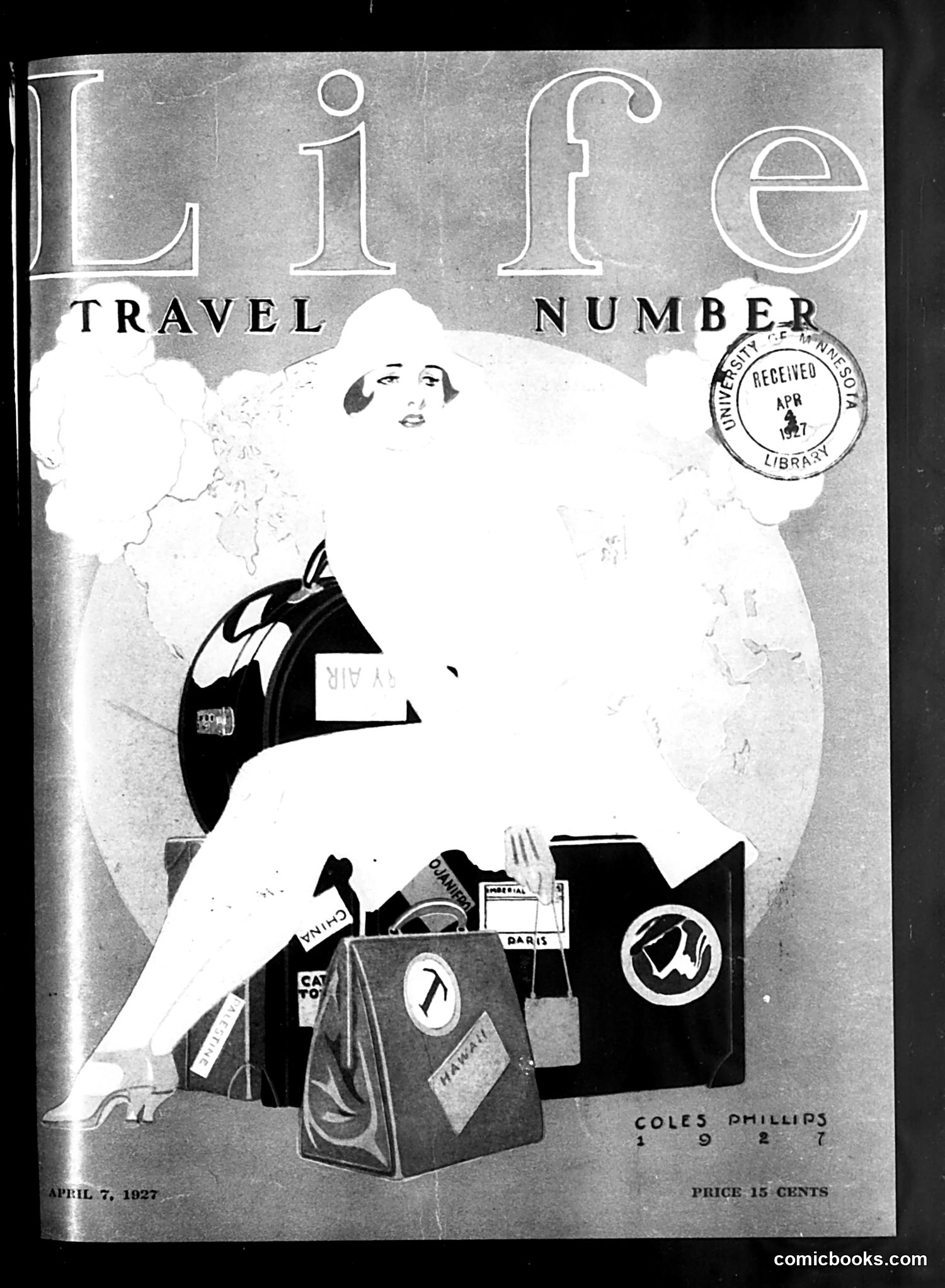
This is the cover of *Life* magazine's "Travel Number" issue. The illustration depicts a fashionable woman in 1920s style—wearing a white fur coat and cloche hat—surrounded by travel luggage and accessories labeled with destinations like "Paris," "Cairo," and "Hawaii." Various travel items and guidebooks are scattered around her. The satire celebrates the "Travel Number" theme by portraying leisure travel as a luxury pursuit for wealthy Americans. The woman's elegant appearance and abundance of luggage suggest both the aspirational glamour of international travel and perhaps a gentle mockery of the excessive baggage and preparations wealthy travelers undertook. The design epitomizes 1920s Art Deco style and reflects the era's fascination with exotic destinations and consumer lifestyle.
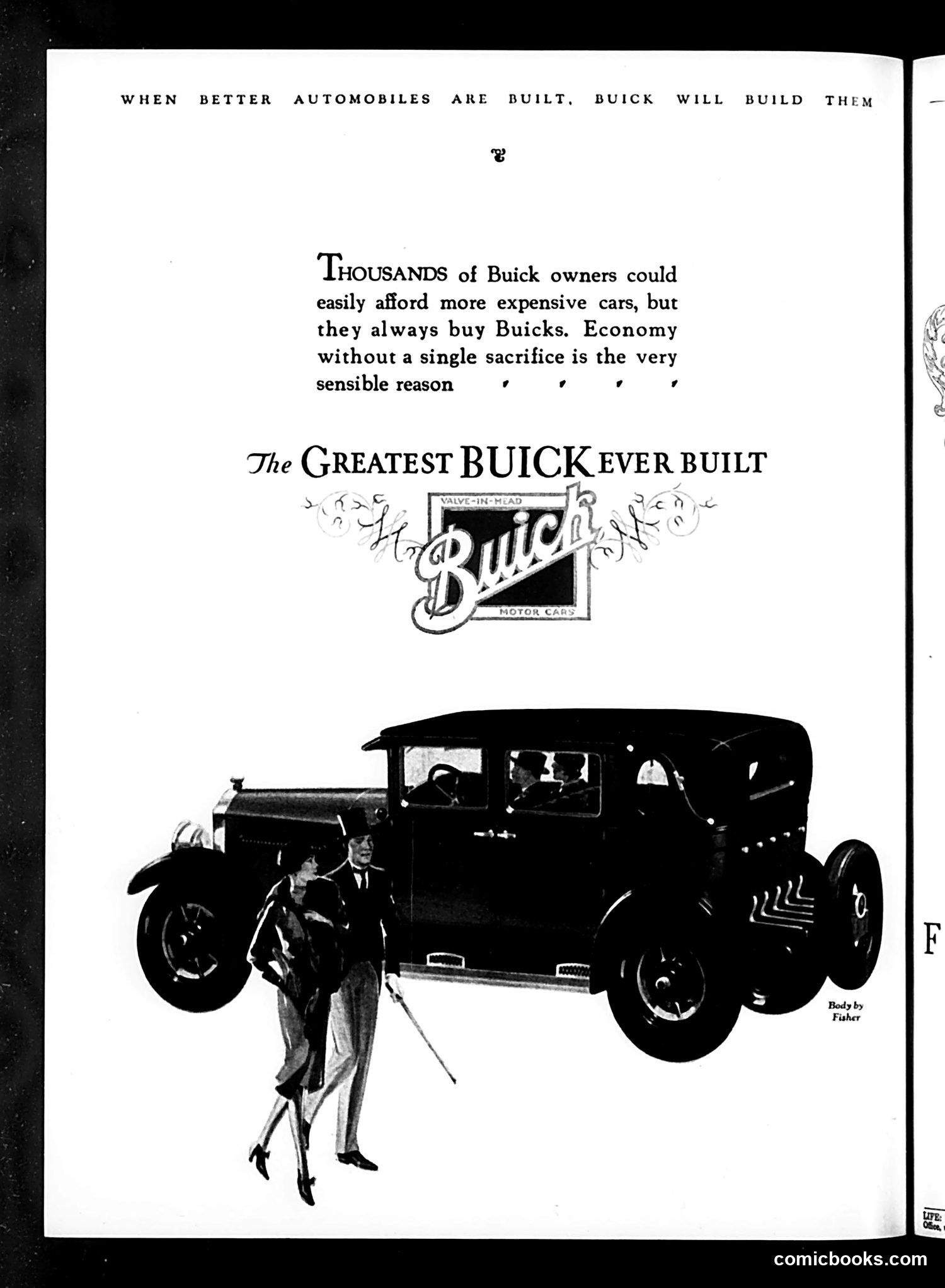
This is a **Buick automobile advertisement**, not a political cartoon. The page promotes Buick cars through straightforward marketing messaging rather than satire. The ad claims that Buick owners choose the brand for "economy without a single sacrifice"—suggesting buyers get value and quality simultaneously. The illustration shows a well-dressed couple admiring a Buick sedan, with the tagline "The Greatest Buick Ever Built." The opening statement—"Thousands of Buick owners could easily afford more expensive cars, but they always buy Buicks"—positions Buick as a choice of rational, affluent consumers who prioritize sensible value over luxury brand names. This was typical 1920s-era automotive advertising, appealing to middle-class aspirations and practical judgment.
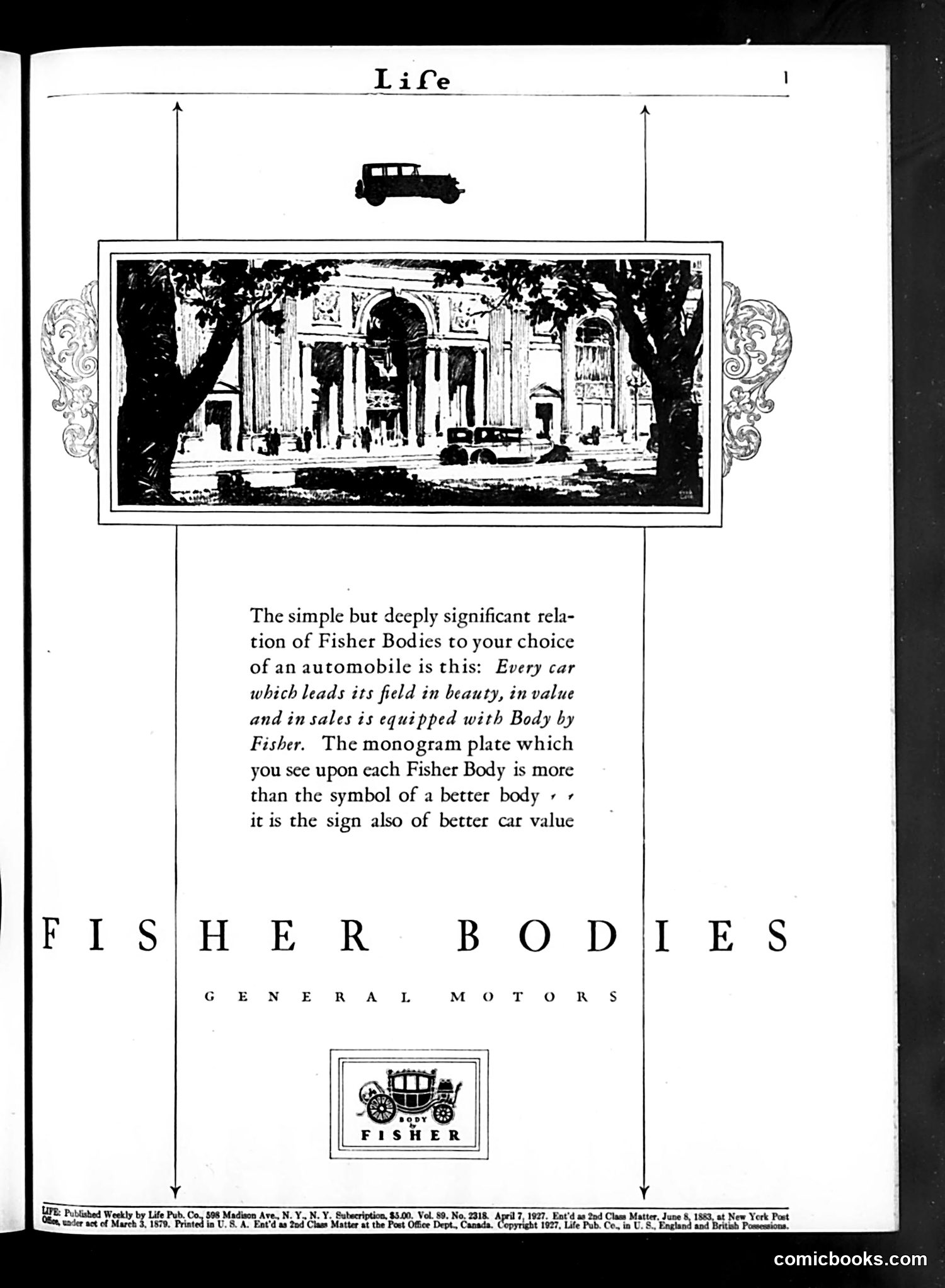
This page is **primarily advertising**, not satirical content. It promotes Fisher Bodies, a General Motors division that manufactured automobile bodies. The advertisement makes a straightforward commercial argument: Fisher Bodies represent superior quality and value. The text claims that "every car which leads its field in beauty, in value and in sales is equipped with Body by Fisher," and that the Fisher monogram indicates both better body construction and better overall car value. The classical architectural image (showing columns and an arched entrance) and decorative ornamental designs frame the message to convey sophistication and permanence. The Fisher logo at bottom reinforces brand identity. This is typical 1920s automotive advertising positioning a components supplier as a mark of quality and prestige.
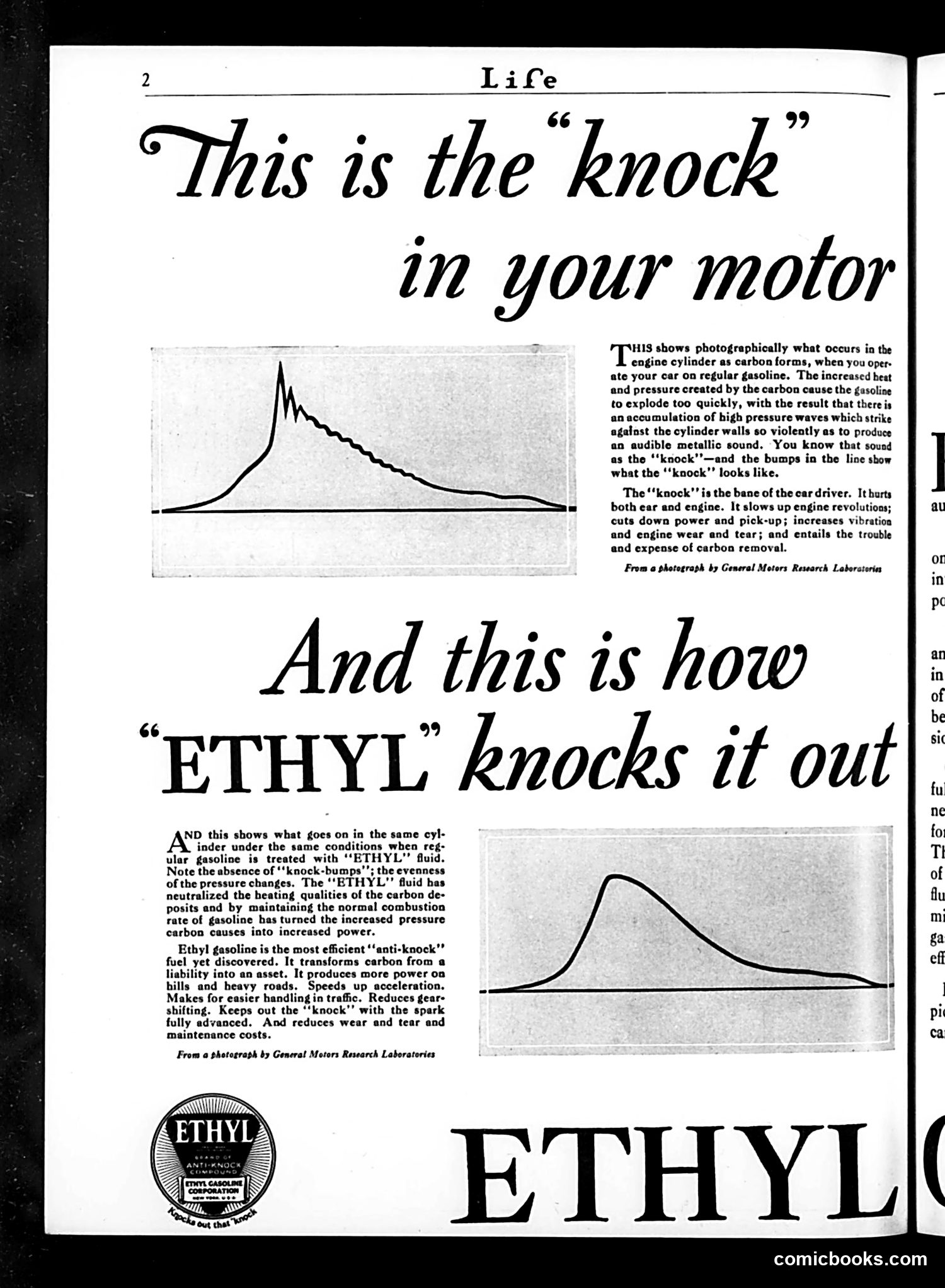
This is **not satire or political commentary**, but rather **advertising for Ethyl gasoline** presented as educational content. The page uses two pressure-curve graphs to demonstrate a technical problem: engine "knock" (pre-ignition caused by carbon buildup in cylinders). The top graph shows irregular pressure spikes when using regular gasoline. The bottom graph shows smooth, controlled pressure when using Ethyl-treated fuel. The ad claims Ethyl gasoline eliminates knock by preventing carbon formation, delivering benefits like improved power, easier handling, reduced wear, and faster acceleration. This represents early automotive advertising strategy: using General Motors Research Laboratory photographs and scientific-looking data to establish product credibility and educate consumers about a relatively new fuel additive technology.
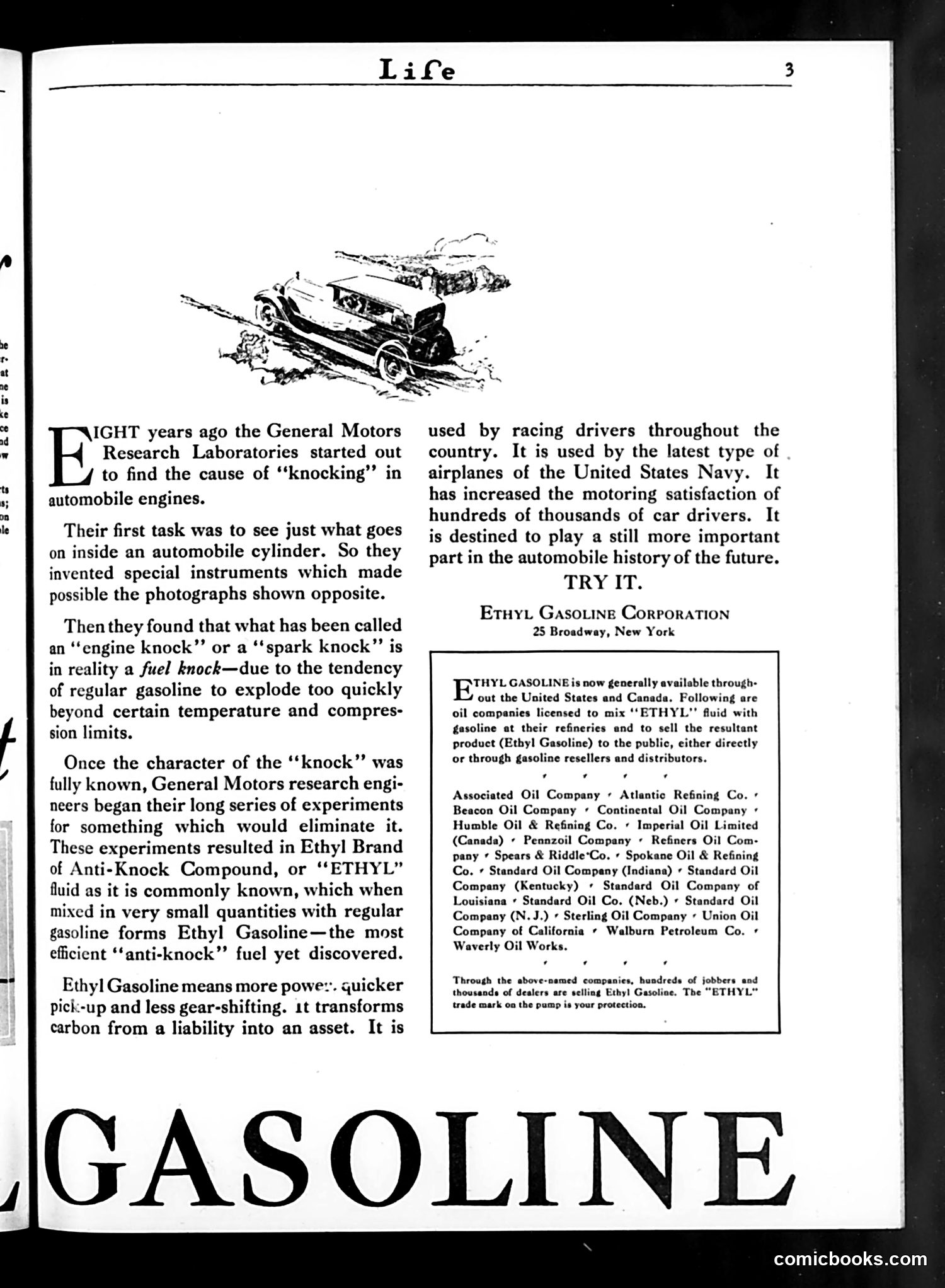
This page is **primarily advertising**, not satire or political commentary. The content describes Ethyl Gasoline, an anti-knock fuel additive developed by General Motors Research Laboratories eight years prior (suggesting a publication date around 1931-1932). The illustration at top shows a car with mechanical stress lines, representing engine "knocking"—a technical problem where fuel detonates improperly. The text explains that GM researchers identified this as a "fuel knock" caused by temperature and compression, then developed Ethyl Brand anti-knock compound to solve it. The bottom half is a straightforward product advertisement listing oil companies licensed to sell Ethyl Gasoline, promoting it as superior fuel that delivers "more power, quicker pick-up and less gear-shifting." There is **no political satire or social commentary** present on this page.
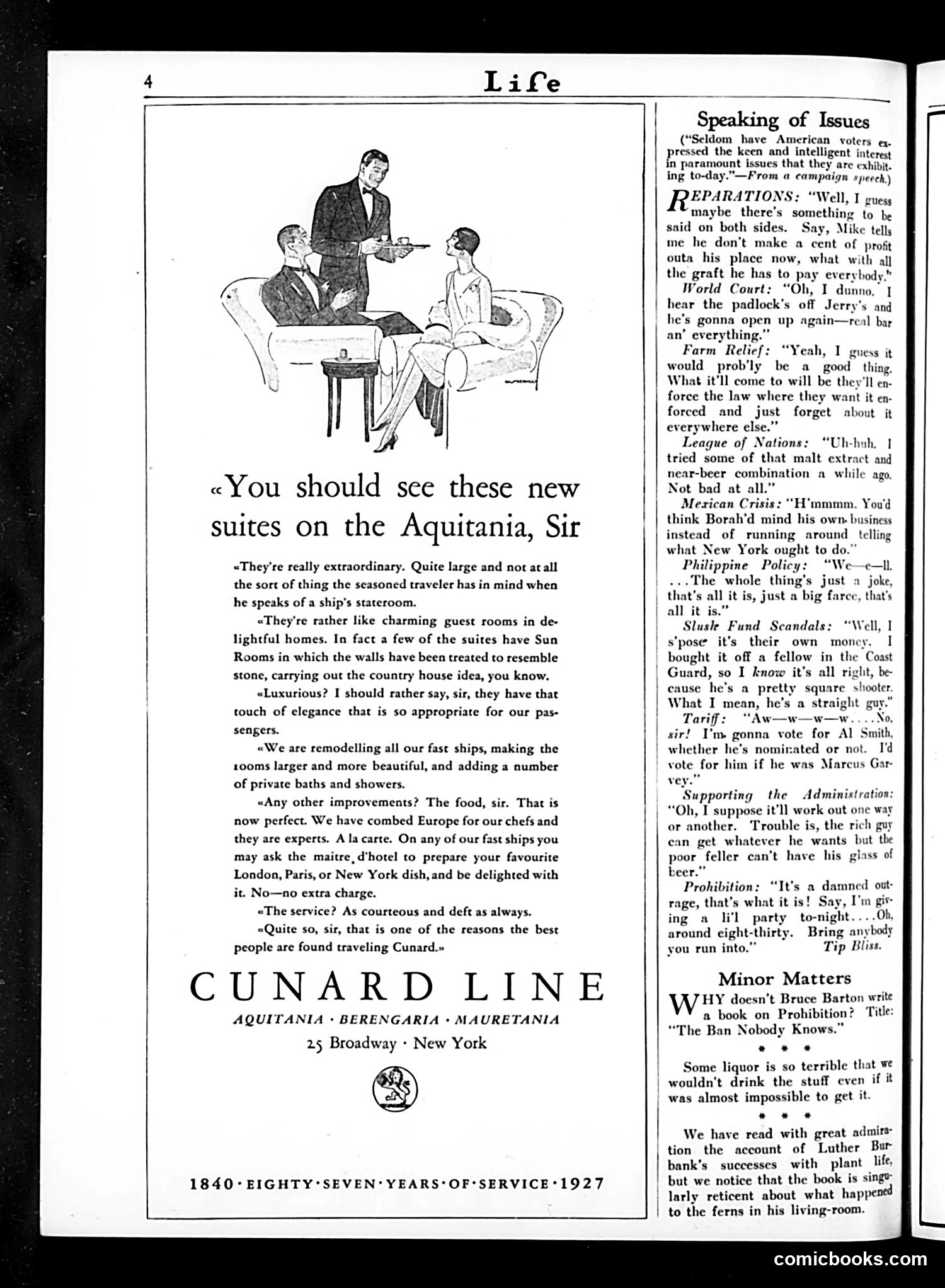
This page is primarily a **Cunard Line advertisement** (left side) disguised as editorial content, promoting luxury ocean liner accommodations on ships like the Aquitania. The right column, "Speaking of Issues," contains brief satirical comments on contemporary political topics. References include: - **Farm Relief**: Agricultural assistance programs - **World Court**: International judicial disputes - **Prohibition**: Alcohol ban enforcement (multiple references mock its ineffectiveness) - **League of Nations**: International cooperation skepticism - **Mexican Crisis**: Foreign policy concerns - **Slush Fund Scandals**: Campaign finance corruption The tone is dismissive and cynical toward government initiatives, typical of Life's satirical stance in the 1920s. The "Minor Matters" section continues with light jabs at Prohibition and social observation, reflecting post-WWI American political anxieties and the magazine's sophisticated, urban readership's worldview.
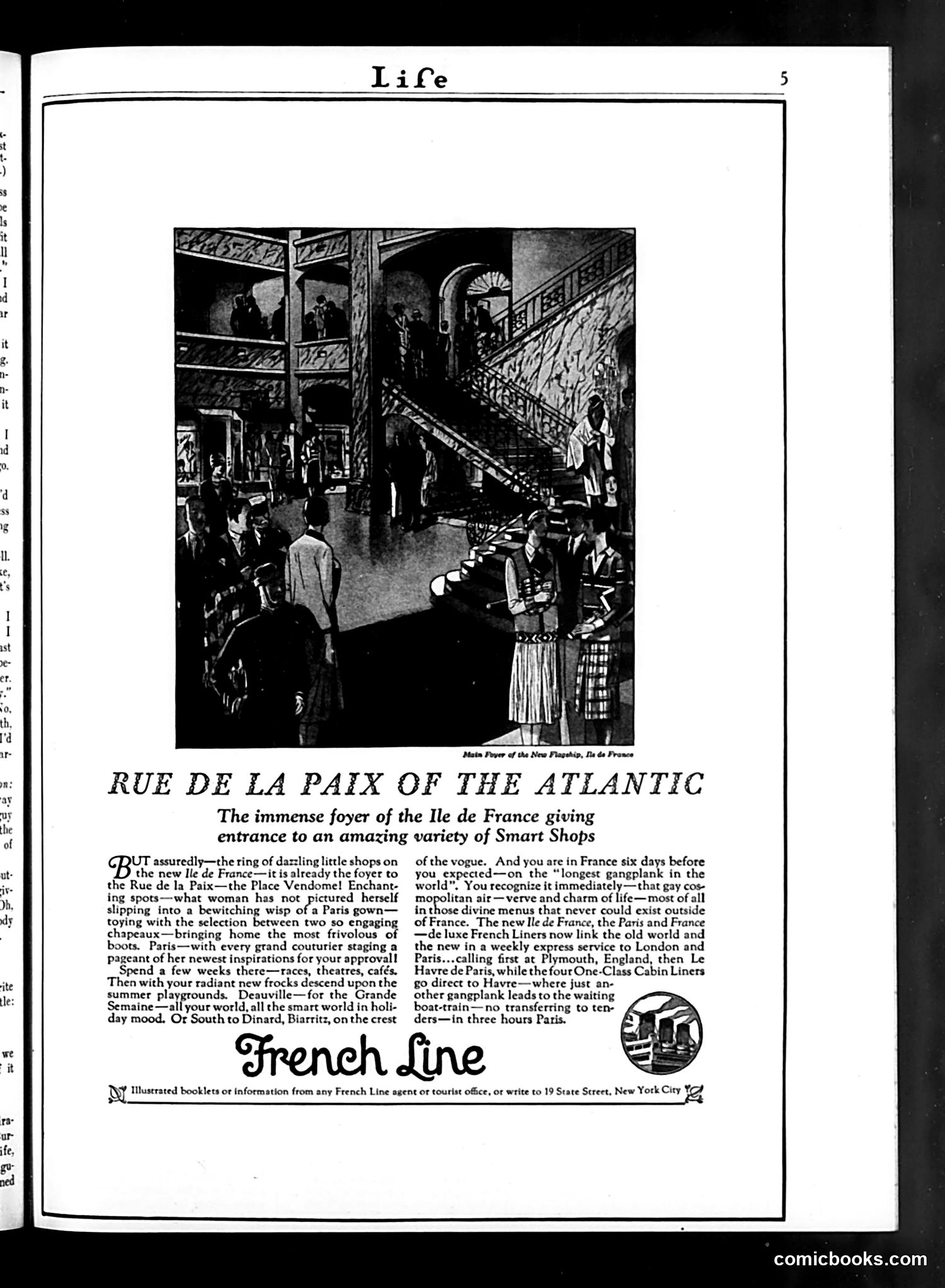
This is **not a political cartoon or satirical comic**, but rather a **luxury travel advertisement** for the French Line shipping company. The page promotes the "Rue de la Paix of the Atlantic"—a glamorous ocean liner service. The photograph shows an ornate ship's foyer with well-dressed passengers, emphasizing elegance and sophistication. The ad targets wealthy American travelers, highlighting weekly express service from Paris to London and New York. It contrasts the "divine interiors" of French liners with the practical efficiency of modern ocean travel, appealing to aspirational consumers seeking both luxury and convenience during the interwar period. The "French Line" branding appears at bottom with contact information for booking passage—this is commercial advertising, not satire.
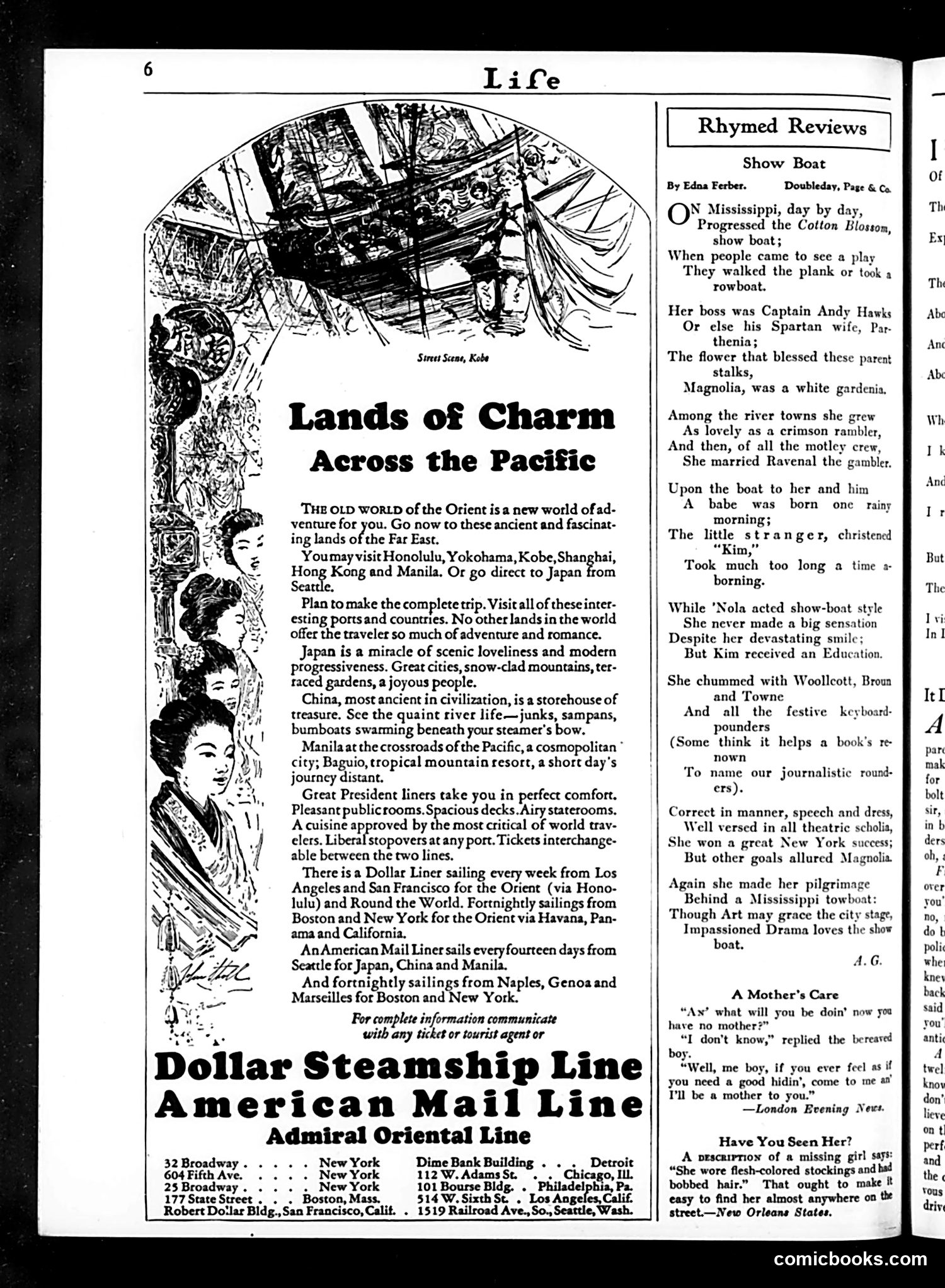
This page is primarily **travel advertising** for steamship and mail lines serving Asia and the Pacific. The large left-side advertisement promotes Dollar Steamship Line, American Mail Line, and Admiral Oriental Line, offering passage to destinations like Honolulu, Shanghai, Hong Kong, and Japan. The decorative illustration features **stylized Asian women's faces** in a romanticized "Oriental" aesthetic typical of early 20th-century Western marketing. This reflects period attitudes toward Asia as an exotic, desirable destination for Western travelers. The right column contains unrelated poetry reviews, including "Show Boat" and other literary pieces, suggesting this is a standard magazine layout mixing advertising with editorial content.
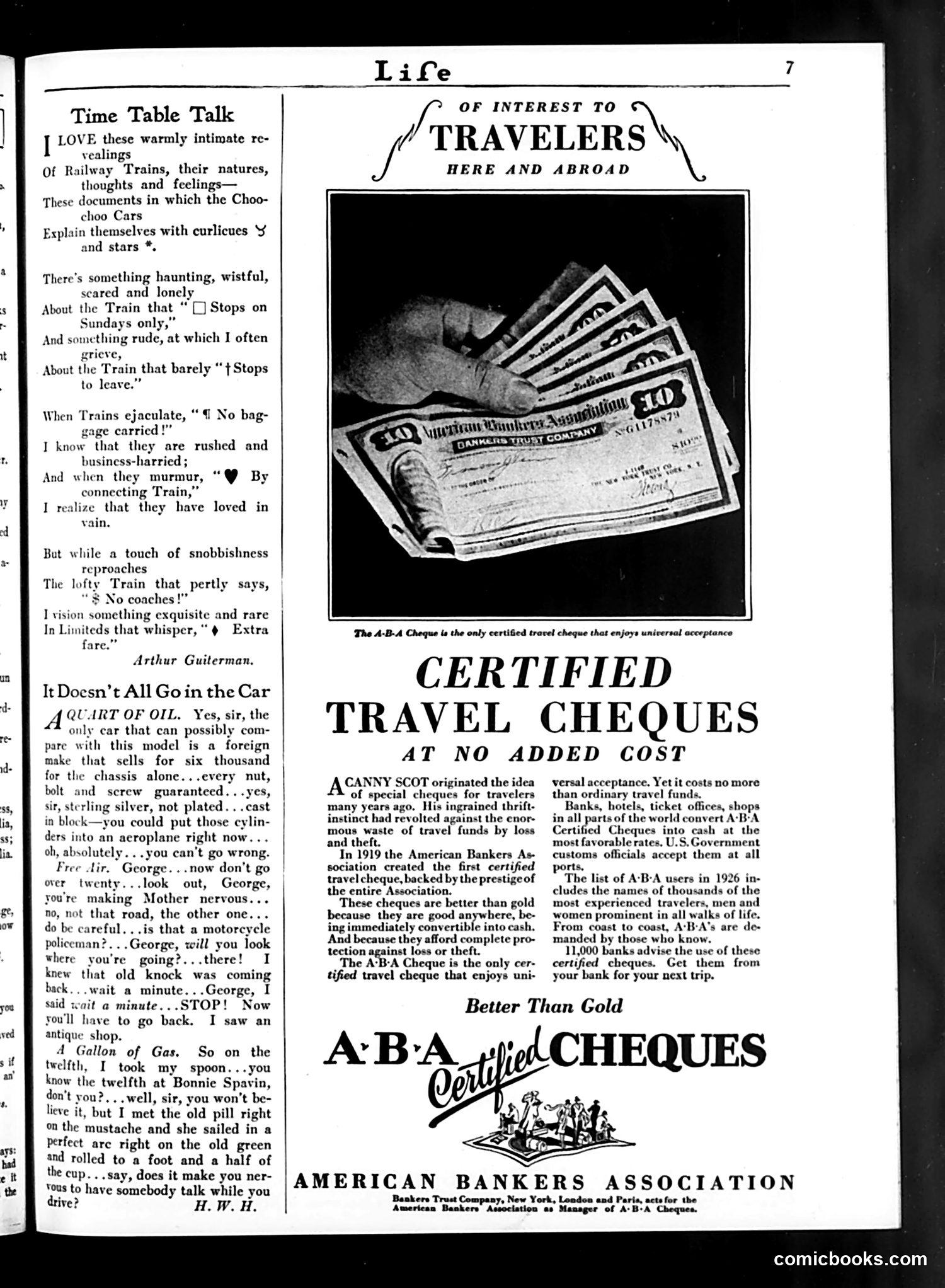
This page contains **two distinct sections**: poetry/prose on the left, and an advertisement on the right. **Left side:** Arthur Guiterman's poems—"Time Table Talk" and "It Doesn't All Go in the Car"—are nostalgic, humorous observations about railway travel and automobiles. They're satirical complaints about train schedules, baggage handling, and car mechanics, using colloquial dialogue to mock modern inconveniences. **Right side:** A full-page advertisement for **A·B·A Certified Travel Cheques**, presented by the American Bankers Association. The ad features a photograph of traveler's checks fanned in a hand, promoting them as superior to cash—"Better Than Gold"—and emphasizing their universal acceptance and convertibility. This reflects 1920s travel culture where such financial instruments were novel innovations for international tourists.
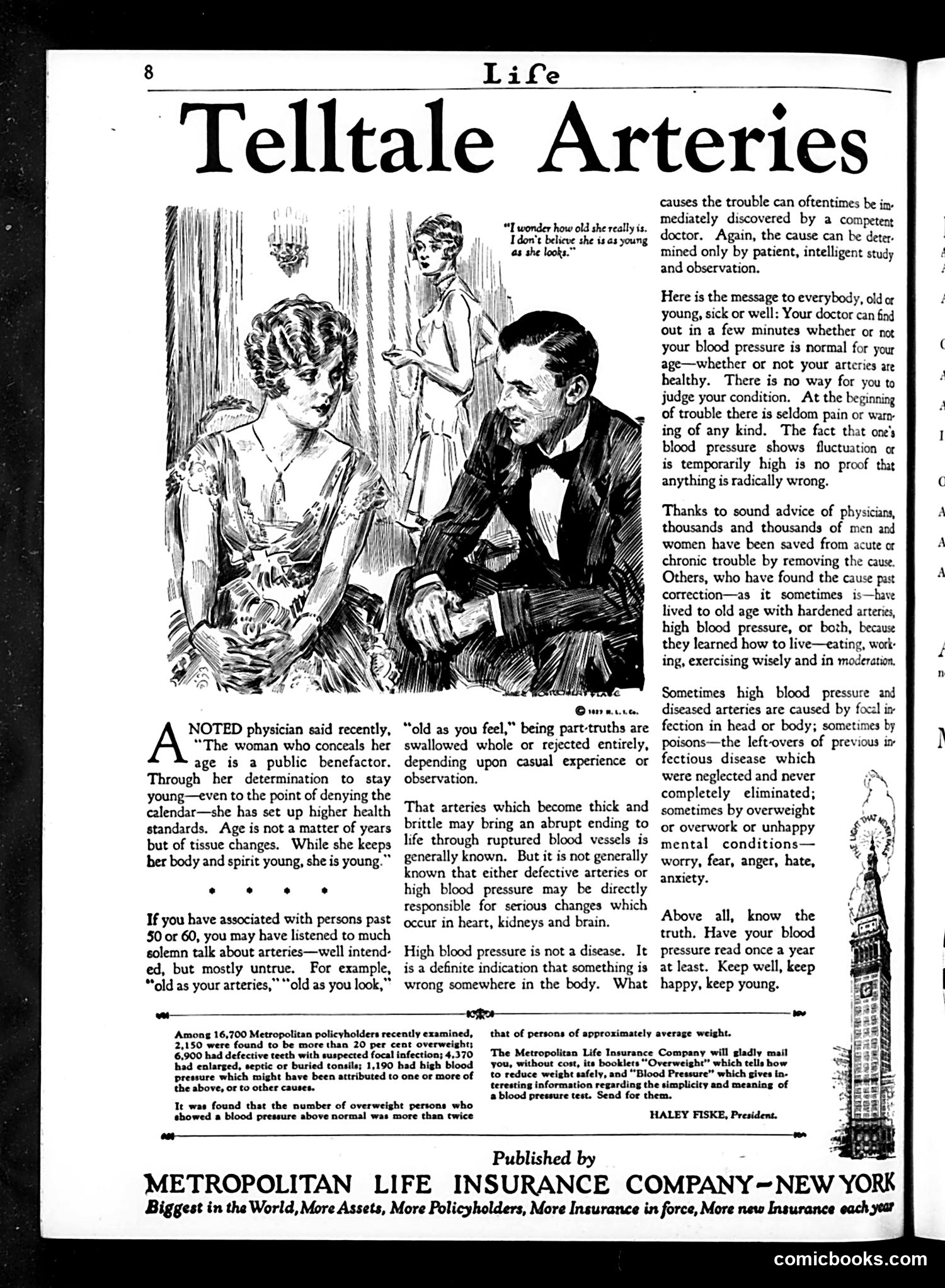
This page is primarily **educational content**, not satire. It's a health article published by Metropolitan Life Insurance Company promoting preventive medicine—specifically, the importance of regular blood pressure checks. The illustration shows a **doctor examining a patient** (likely an older woman), with the article arguing that aging doesn't automatically mean poor health. The key message: high blood pressure is "a definite indication that something is wrong somewhere in the body," but it's often correctable through lifestyle changes (diet, exercise, moderation) rather than inevitable decline. The article emphasizes that insurance company interests align with public health—identifying arterial problems early saves lives and reduces costly chronic illness claims. This represents early 20th-century corporate health advocacy as good business practice.
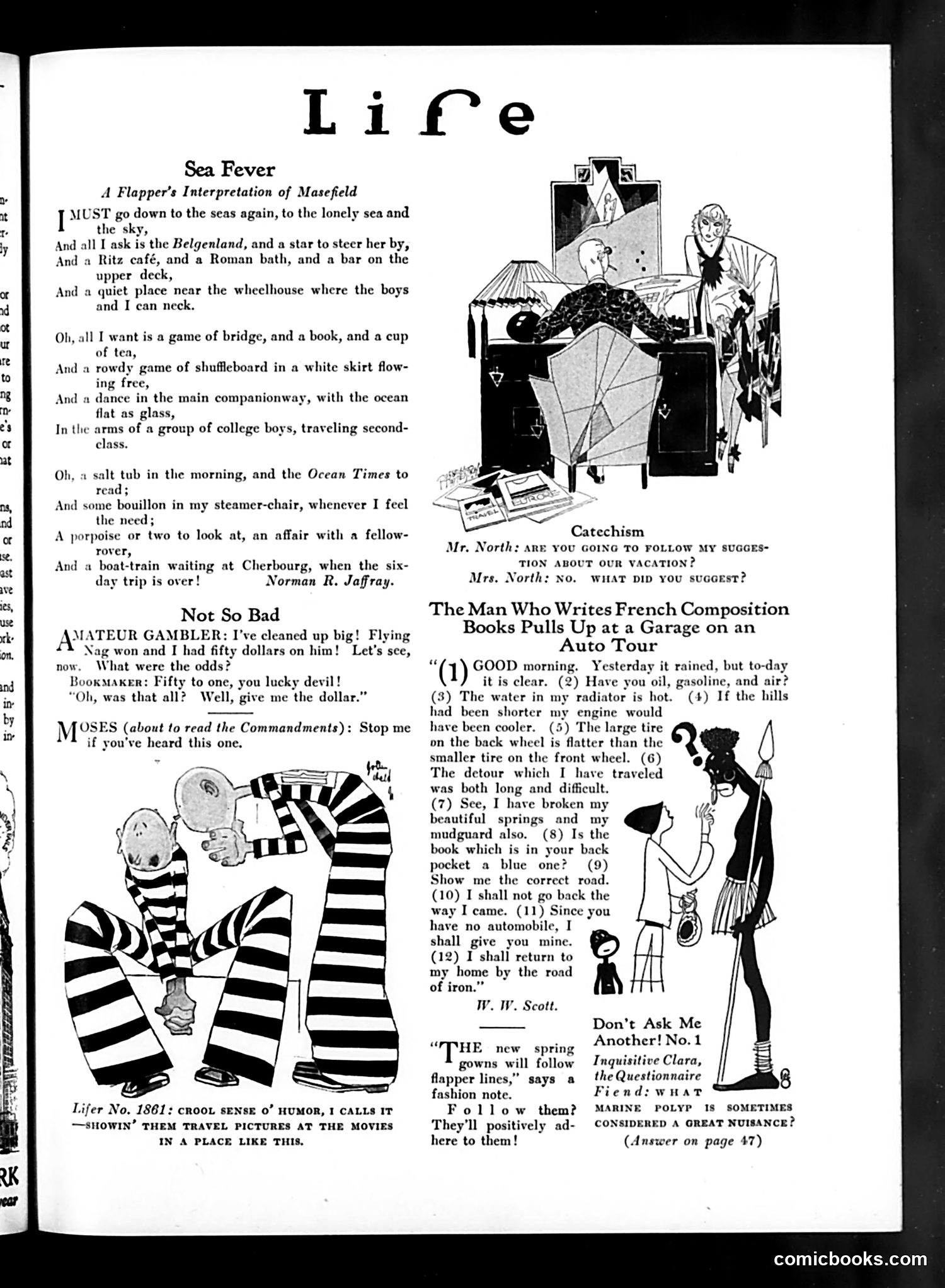
This page contains three distinct humor pieces from what appears to be the 1920s: **"Sea Fever"** is a poem riffing on Masefield's famous work, humorously listing desires for seaside leisure—bridge games, shuffleboard, ocean-view dancing, and college boys—rather than authentic seafaring adventure. **"Not So Bad"** mocks a gambler's luck: a character wins fifty dollars on a horse named "Nag," then loses it all, prompting darkly comic banter about accepting defeat. **"The Man Who Writes French Composition Books"** satirizes a pedantic author by depicting him as an impractical intellectual who pulls his car into a garage, then delivers absurdly formal, numbered instructions about automotive maintenance—poking fun at educational manuals' disconnect from real-world common sense. The illustrations use exaggerated, cartoonish styles typical of 1920s satire.
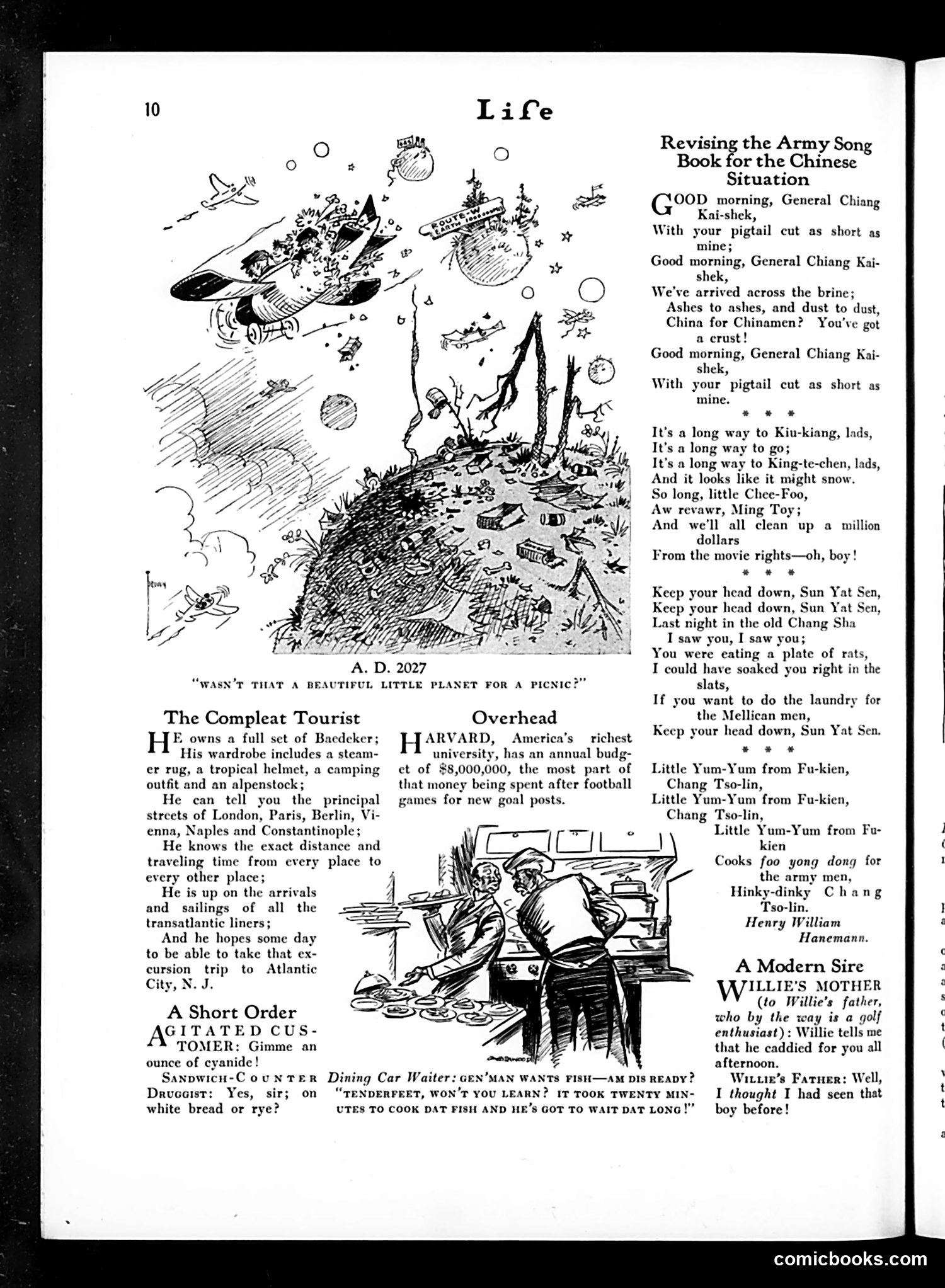
This cartoon satirizes the destruction wrought by modern warfare, likely referencing World War I. The illustration shows a devastated landscape—shell craters, broken trees, debris, and military wreckage—viewed from above by aircraft. The caption's cheerful irony ("beautiful little planet for a picnic") contrasts sharply with the hellish scene below, mocking both the detachment of those directing warfare from above and the absurdity of romanticizing such destruction. The surrounding page content includes humorous pieces like "The Compleat Tourist" and war-related satire, typical of Life magazine's approach to contemporary issues through dark comedy during the World War I era.
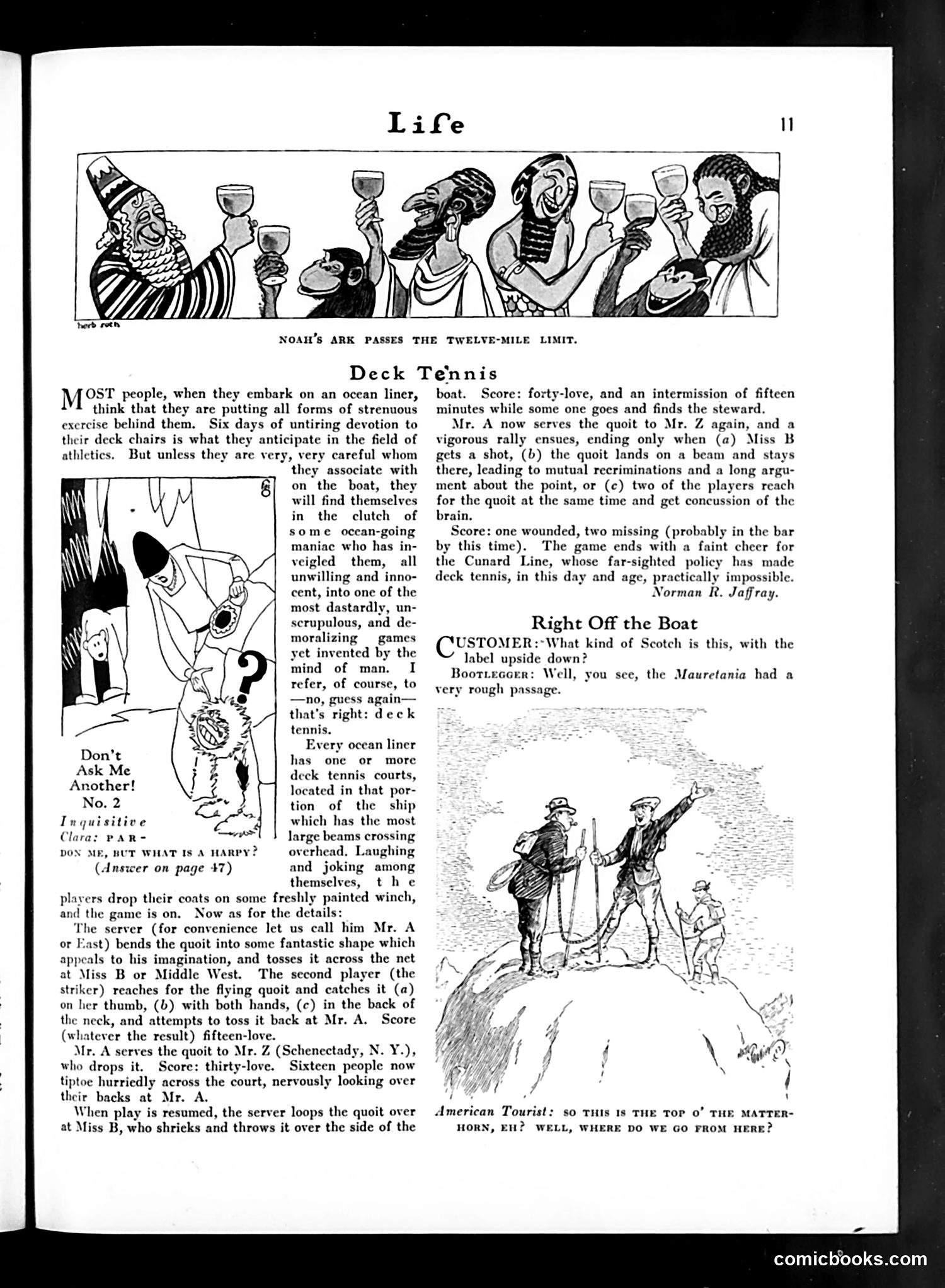
This page satirizes deck tennis, a leisure game played aboard ocean liners. The main article describes the absurdly complicated scoring system and rules of the game—described as one of "the most astonishing, unscrupulous, and demoralizing games yet invented by the mind of man." The accompanying cartoon titled "Don't Ask Me Another!" shows a confused passenger unable to understand the game's rules, humorously depicting the bewilderment deck tennis inspires. A second cartoon, "Right Off the Boat," jokes about American tourists' ignorance, showing travelers at a coastal location asking directions while clearly lost. The satire targets both the pretentiousness of ocean liner leisure culture and American tourists' stereotypical confusion abroad.
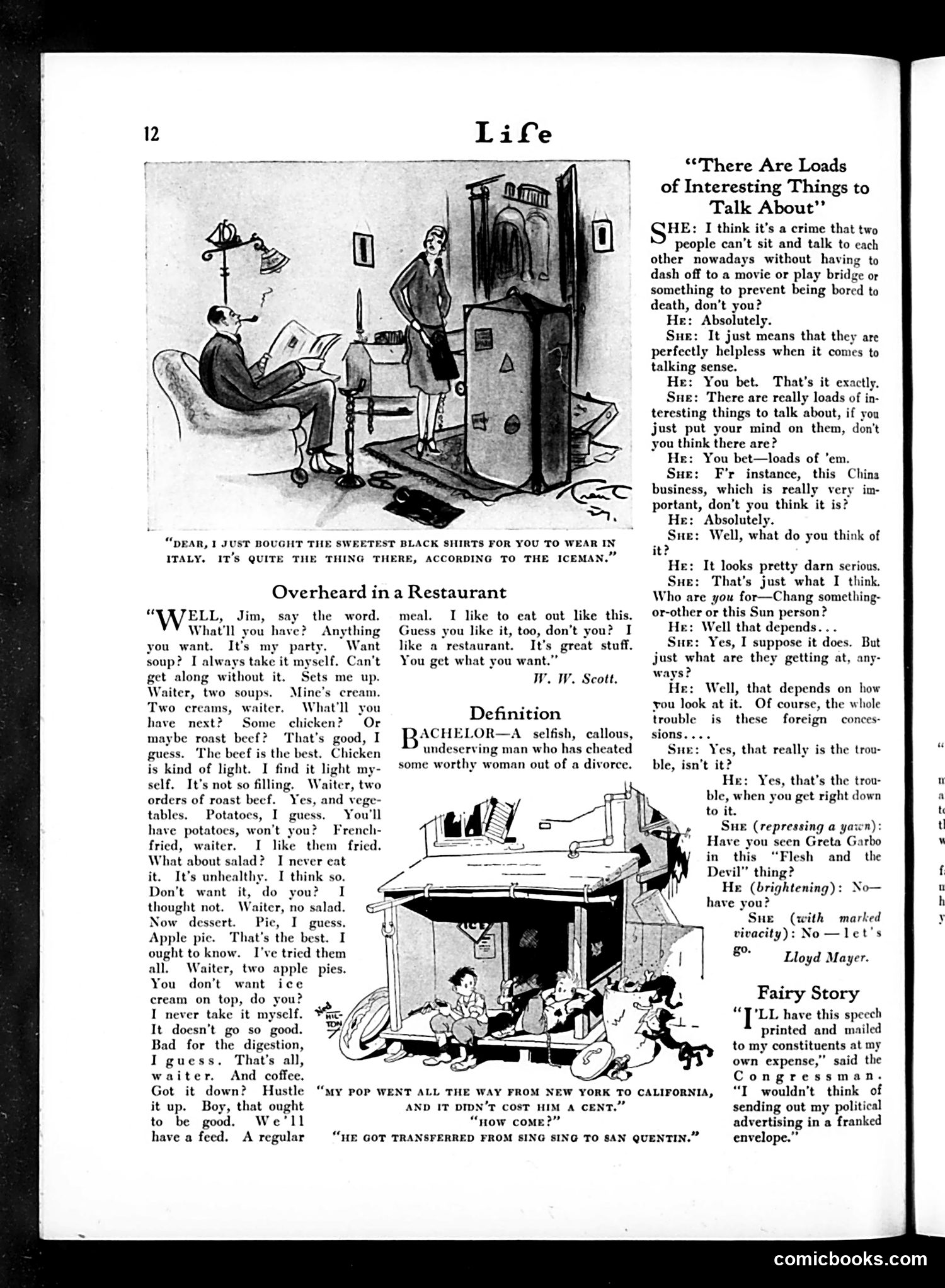
This page contains three satirical pieces typical of Life magazine's humor: 1. **"Overheard in a Restaurant"**: A waiter takes a verbose customer's complicated order, parodying pretentious dining culture and indecisive patrons who make excessive demands while claiming they "don't want anything." 2. **"Definition"**: Defines "Bachelor" as "a selfish, callous, undeserving man who has cheated some worthy woman out of a divorce"—satirizing marriage cynicism and depicting bachelor life negatively. 3. **"Fairy Story"**: A congressman boasts about sending political advertising via franking privilege (government-subsidized mail), mocking how politicians exploit taxpayer resources for self-promotion. The cartoons are simple line drawings accompanying jokes about everyday American social pretension, relationship dynamics, and political corruption—hallmarks of Life's satirical approach to contemporary culture.
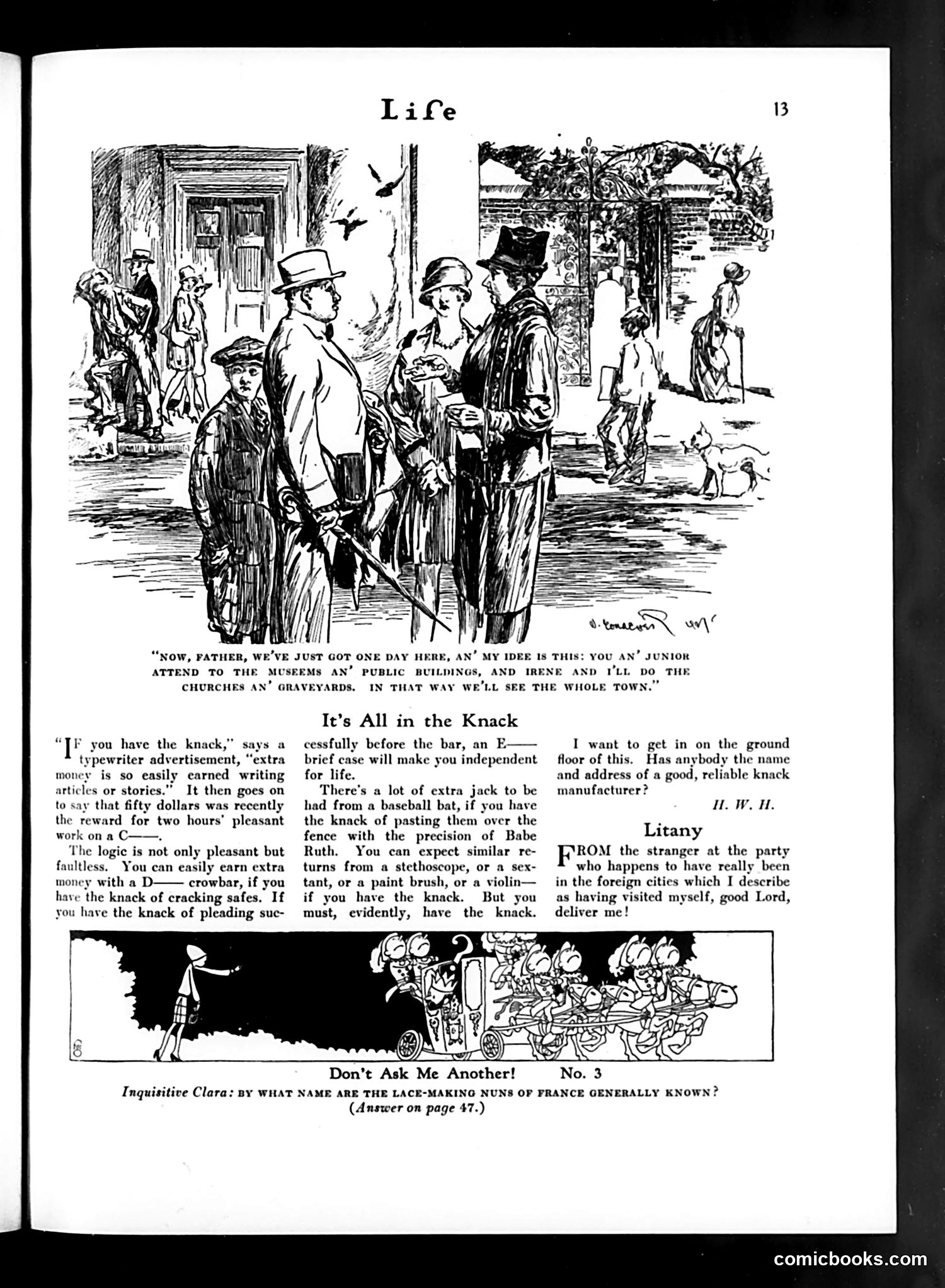
This page contains three distinct pieces: 1. **Main Cartoon**: A street scene showing well-dressed men and a boy discussing sightseeing plans. The caption suggests dividing tourist attractions—museums, public buildings, churches, and graveyards—to efficiently "see the whole town." The satire mocks systematic tourism and the assumption that graveyards are tourist destinations worthy of planned visits. 2. **"It's All in the Knack"**: A humorous article about earning extra money through various skills (safe-cracking, baseball expertise, etc.), playing on the then-popular typewriter advertisement slogan about "the knack" for writing. 3. **"Don't Ask Me Another! No. 3"**: A cartoon showing a crowded vehicle, with an inquisitive reader's question below about French lace-making nuns. This appears to be early 20th-century satirical content mixing humor with advertising.
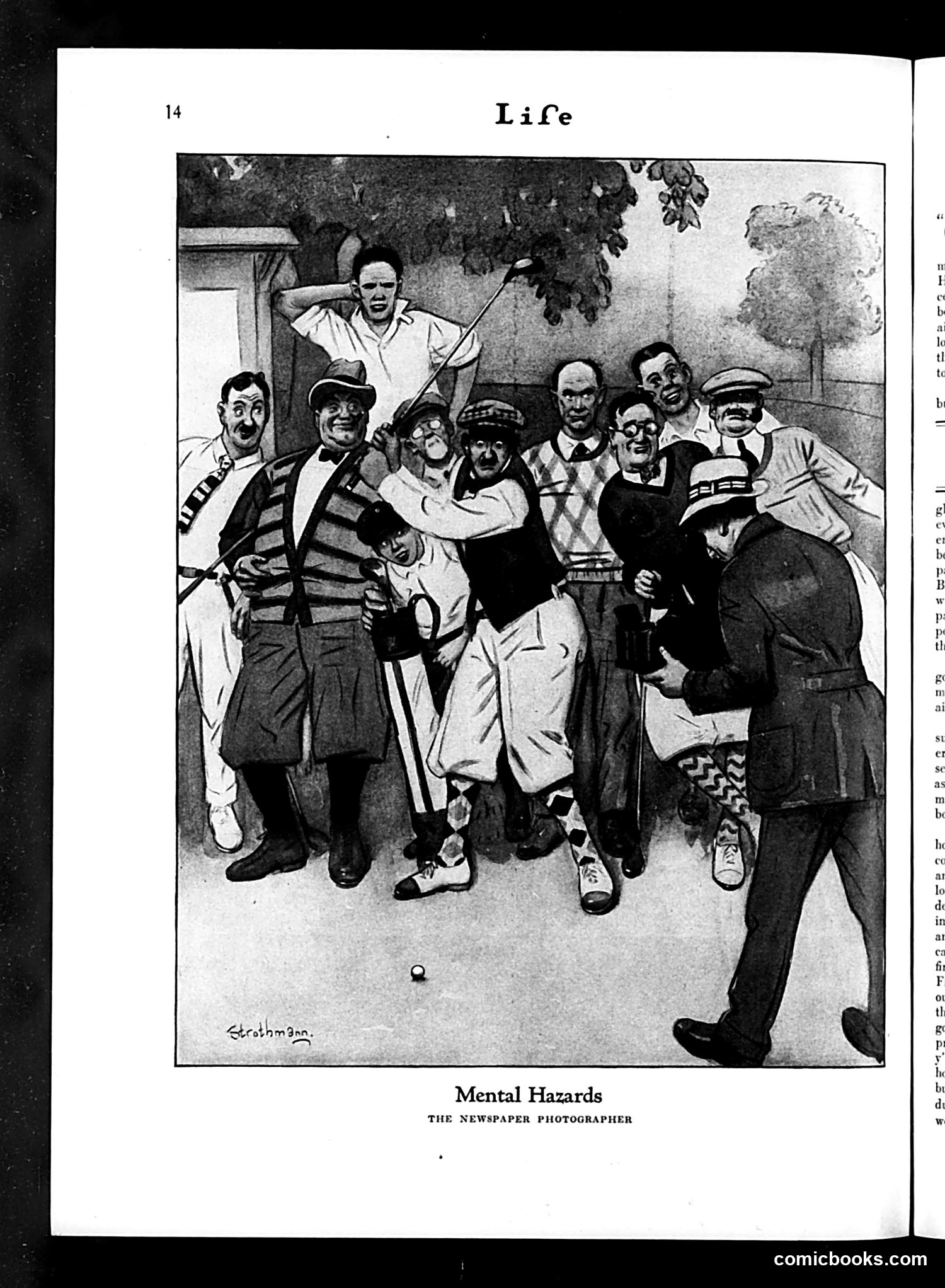
This cartoon satirizes the occupational hazards faced by newspaper photographers in the early 20th century. The image depicts a photographer (right, operating a camera on a tripod) attempting to capture a candid shot of what appears to be a group of criminals or suspects being escorted by police officers and officials (the uniformed and suited men on the left). The title "Mental Hazards" suggests the psychological strain of the job—the photographer must navigate dangerous situations, uncooperative subjects, and physical obstacles to obtain publishable images. The chaotic scene, with various figures in period attire (some in striped prison garb), illustrates the unpredictable, potentially violent environments photographers routinely encountered while documenting crime scenes and police activities.
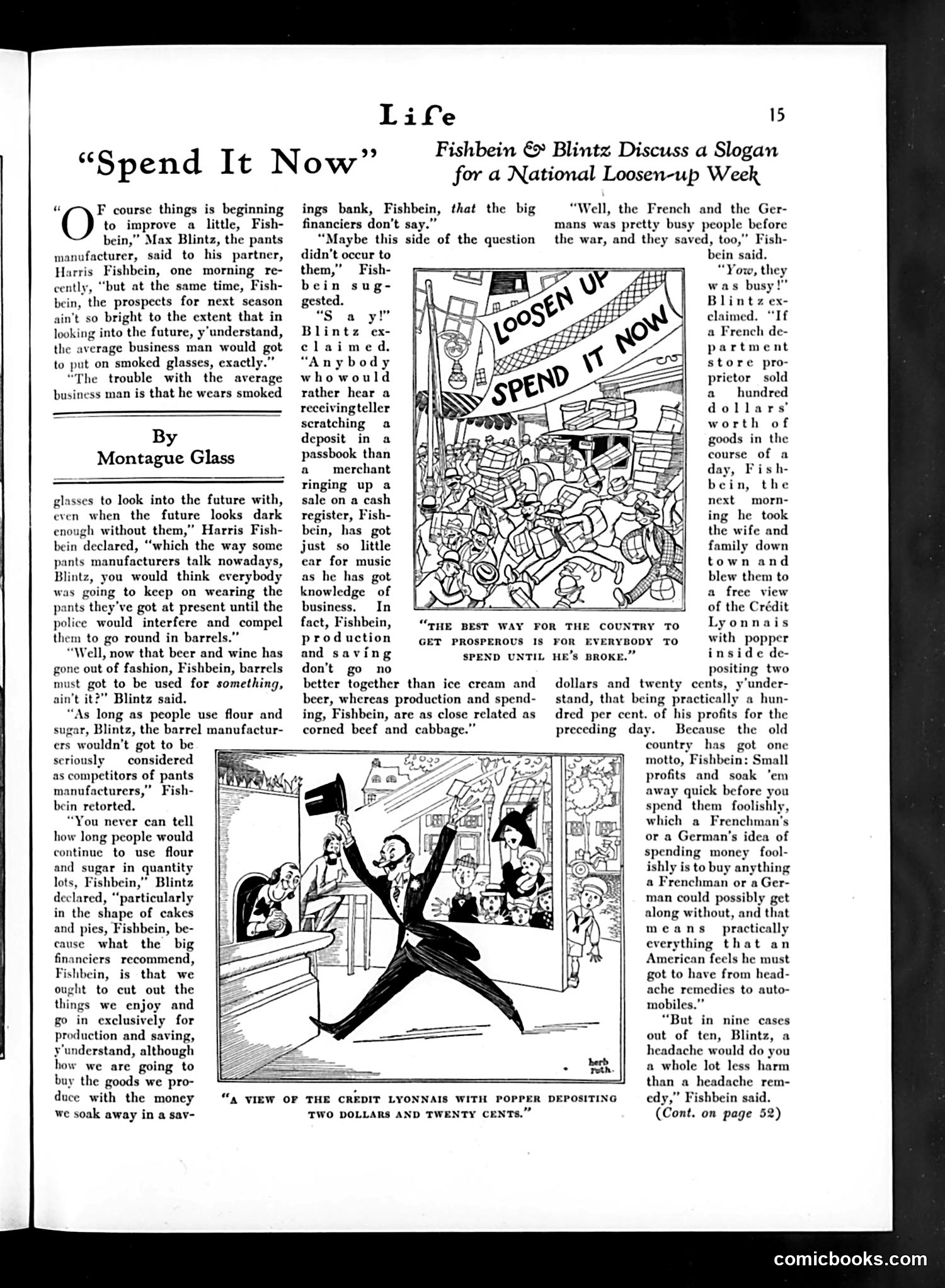
This article by Montague Glass satirizes economic debate during what appears to be a post-WWI recession. Two businessmen, **Fishbein and Blintz**, discuss whether Americans should spend money or save it. **The satire's point**: Fishbein argues spending stimulates the economy and benefits the country, claiming "The best way for the country to get prosperous is for everybody to spend until he's broke." Blintz counters that saving is prudent, likening spending to unnecessary expenses. The accompanying cartoons mock both positions: one shows a man recklessly spending at shops; another depicts someone depositing meager savings. **The joke**: The piece ridicules conflicting economic philosophies without endorsing either extreme—Americans are caught between contradictory expert advice about consumption versus thrift, a debate that remained relevant throughout subsequent economic cycles.
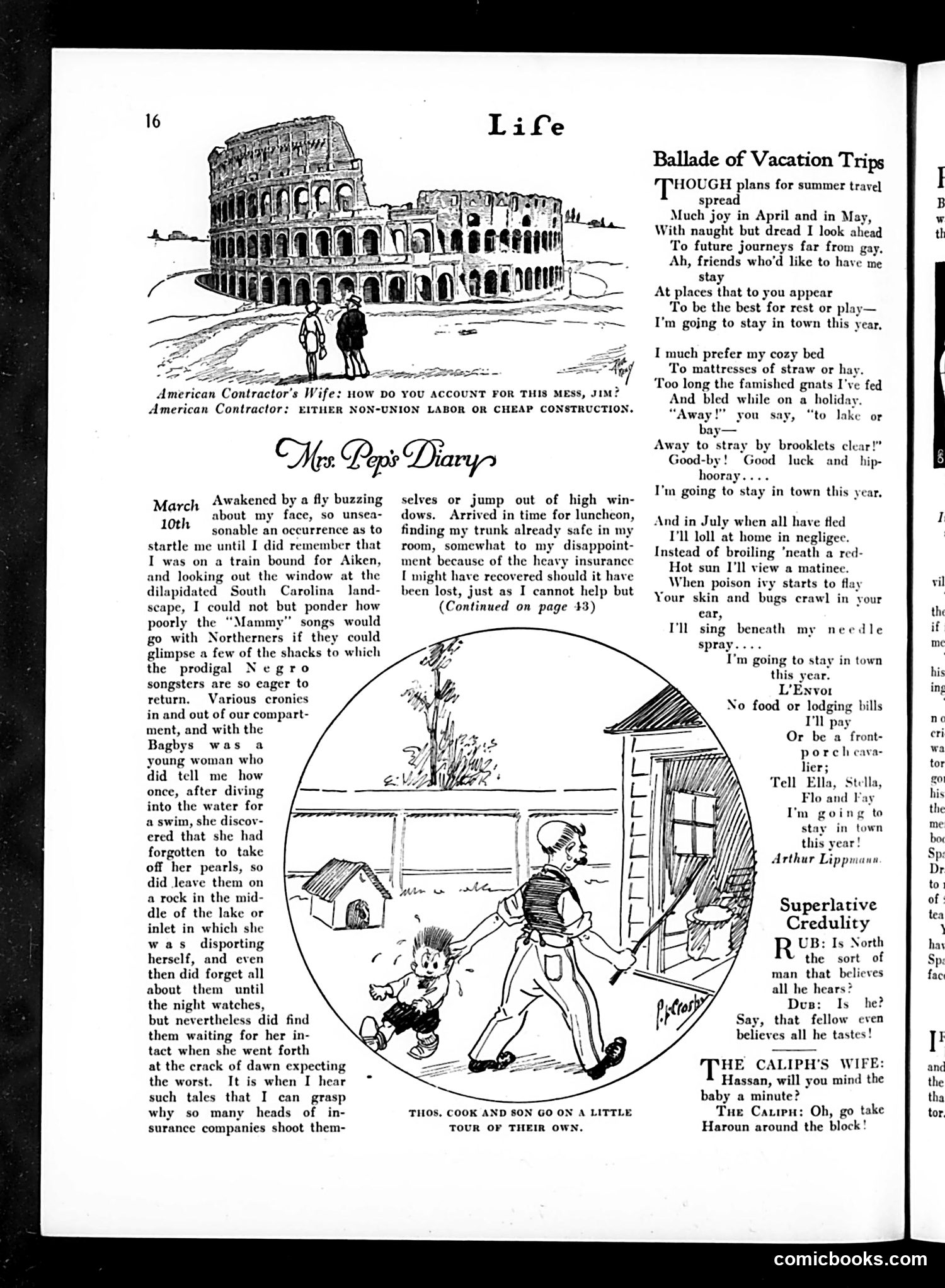
The top cartoon depicts the Colosseum in Rome with two figures, captioned "American Contractor's Wife: how do you account for this mess, Jim? American Contractor: either non-union labor or cheap construction." This satirizes American construction practices and labor disputes of the era—suggesting that either cutting corners with cheap labor OR avoiding unionized workers produces inferior, crumbling results. The ironic comparison to Rome's ancient ruins implies American construction is comparably shoddy. The right column contains "Ballade of Vacation Trips" and "Mrs. Peps Diary," which humorously document a woman's decision to stay home rather than travel, avoiding the hassles and expenses of vacation. Below is a domestic scene captioned "Thos. Cook and Son go on a little tour of their own," showing a father and child at the seaside—likely mocking commercial travel companies.
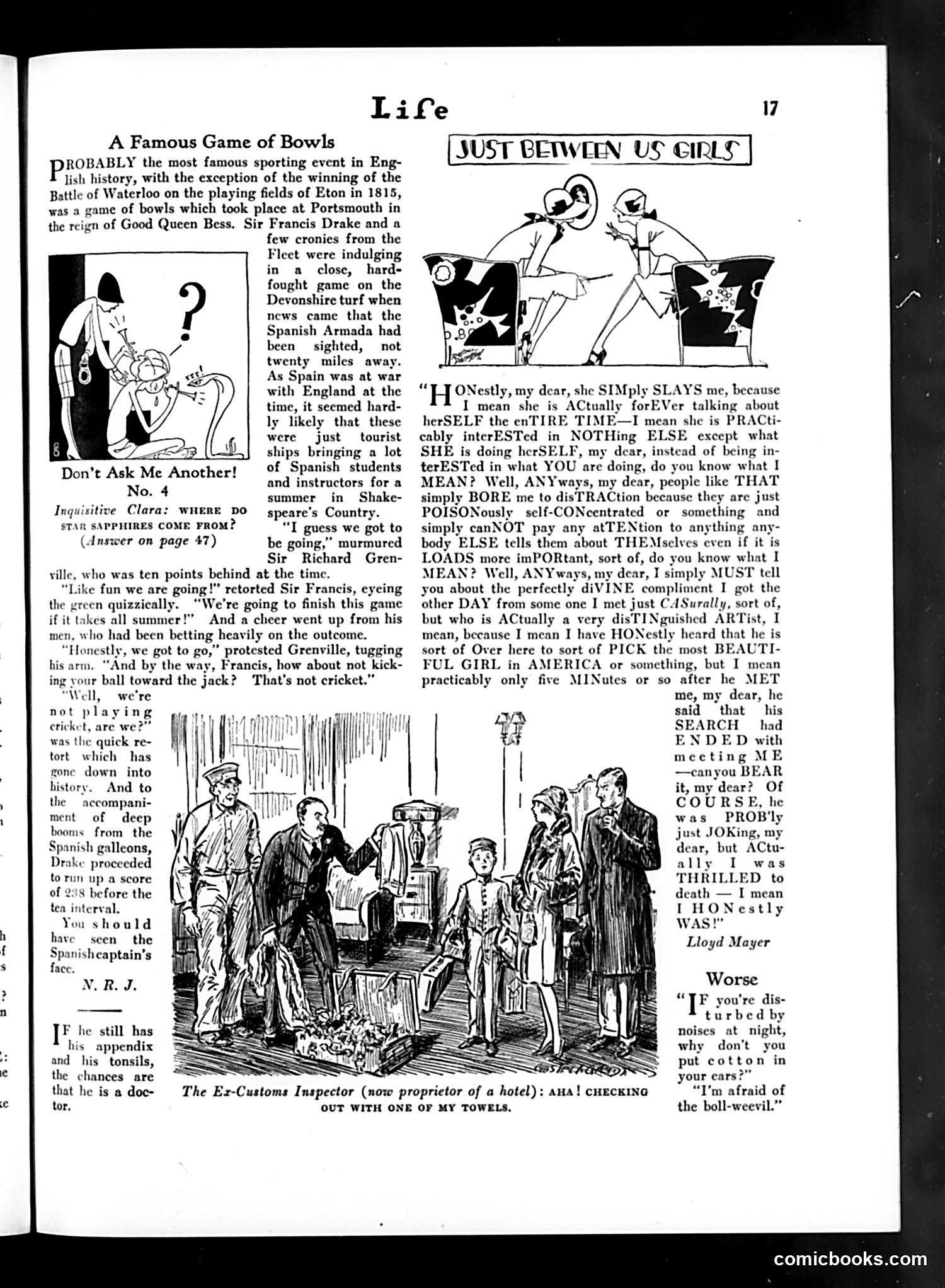
This page contains three distinct satirical pieces: **"A Famous Game of Bowls"** recounts a historical anecdote about Sir Francis Drake and English naval officers playing bowls on the Devonshire turf when news arrived of the Spanish Armada's approach in 1588. The satire mocks the casualness of the account. **"Don't Ask Me Another! No. 4"** is a riddle asking where star sapphires originate—a humorous trivia item. **"Just Between Us Girls"** features a lengthy monologue by a woman complaining that her friend talks excessively about herself, employing exaggerated capitalization for emphasis. It's social satire on female gossip and self-absorption. **"The Ex-Customs Inspector"** cartoon depicts a hotel proprietor checking out guests with towels—likely satirizing petty theft or corruption among officials.
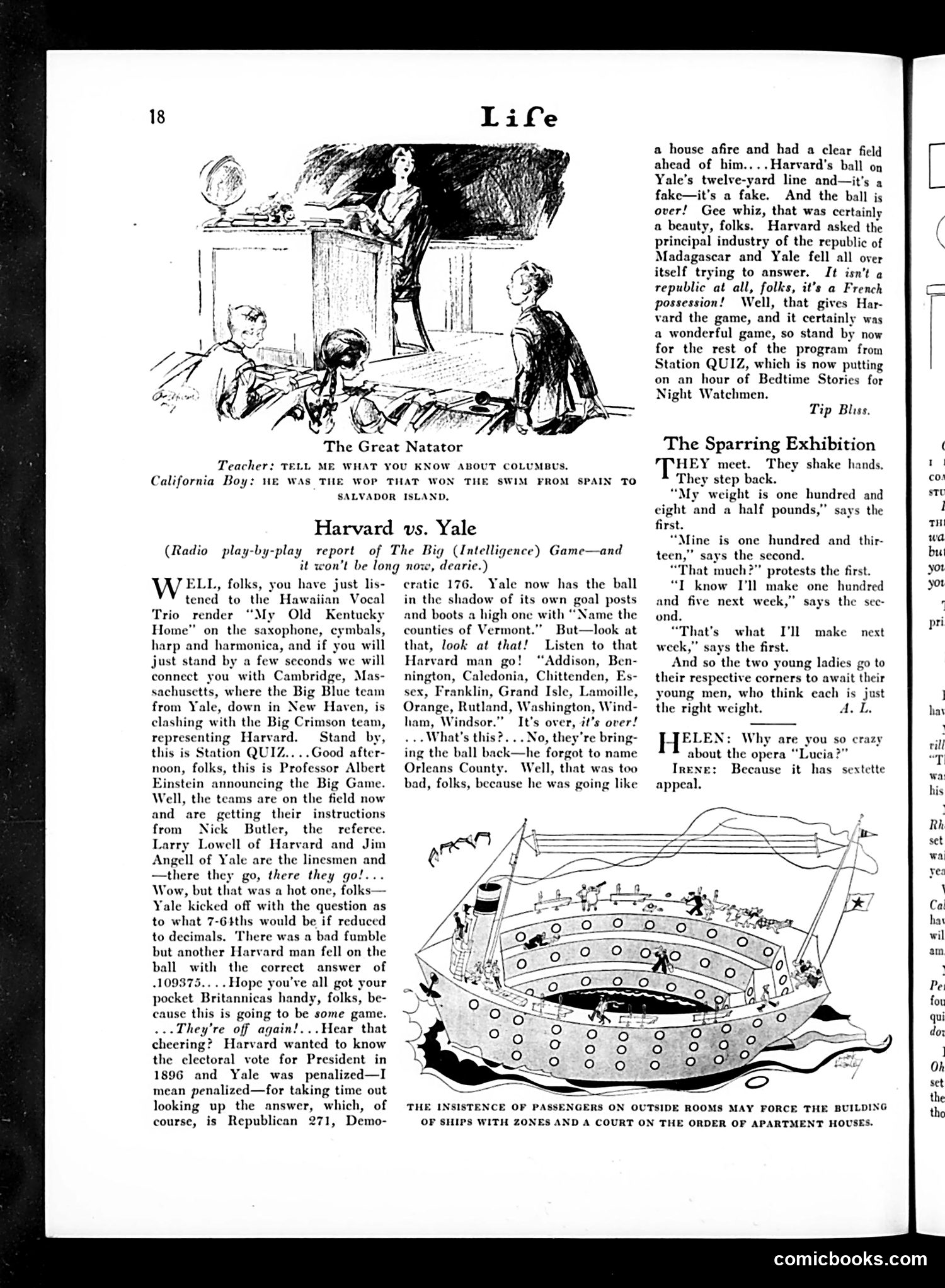
This page contains three satirical pieces from *Life* magazine: **"The Great Natator"**: A one-liner joke mocking a California schoolboy's garbled knowledge of history. He confuses Columbus with a swimmer, using offensive ethnic slur ("wop") and nonsensical geography. The satire targets educational gaps and regional stereotypes. **"Harvard vs. Yale"**: A mock radio broadcast where a football game is replaced entirely with trivia questions—testing knowledge of Vermont counties, the 1896 electoral vote, Madagascar's political status. The satire skewers the intellectual pretension of Ivy League schools, suggesting their "big game" rivalry is really about academic oneupmanship rather than athletics. **"The Sparring Exhibition"**: Young women claim different weights to different audiences, each adjusting expectations for their male suitors. The satire critiques female vanity and dishonesty in romantic contexts—a common theme in period humor. The page also includes a ship diagram captioned about passenger demands for outside cabins forcing novel apartment-house-like designs—architectural satire on luxury travel.
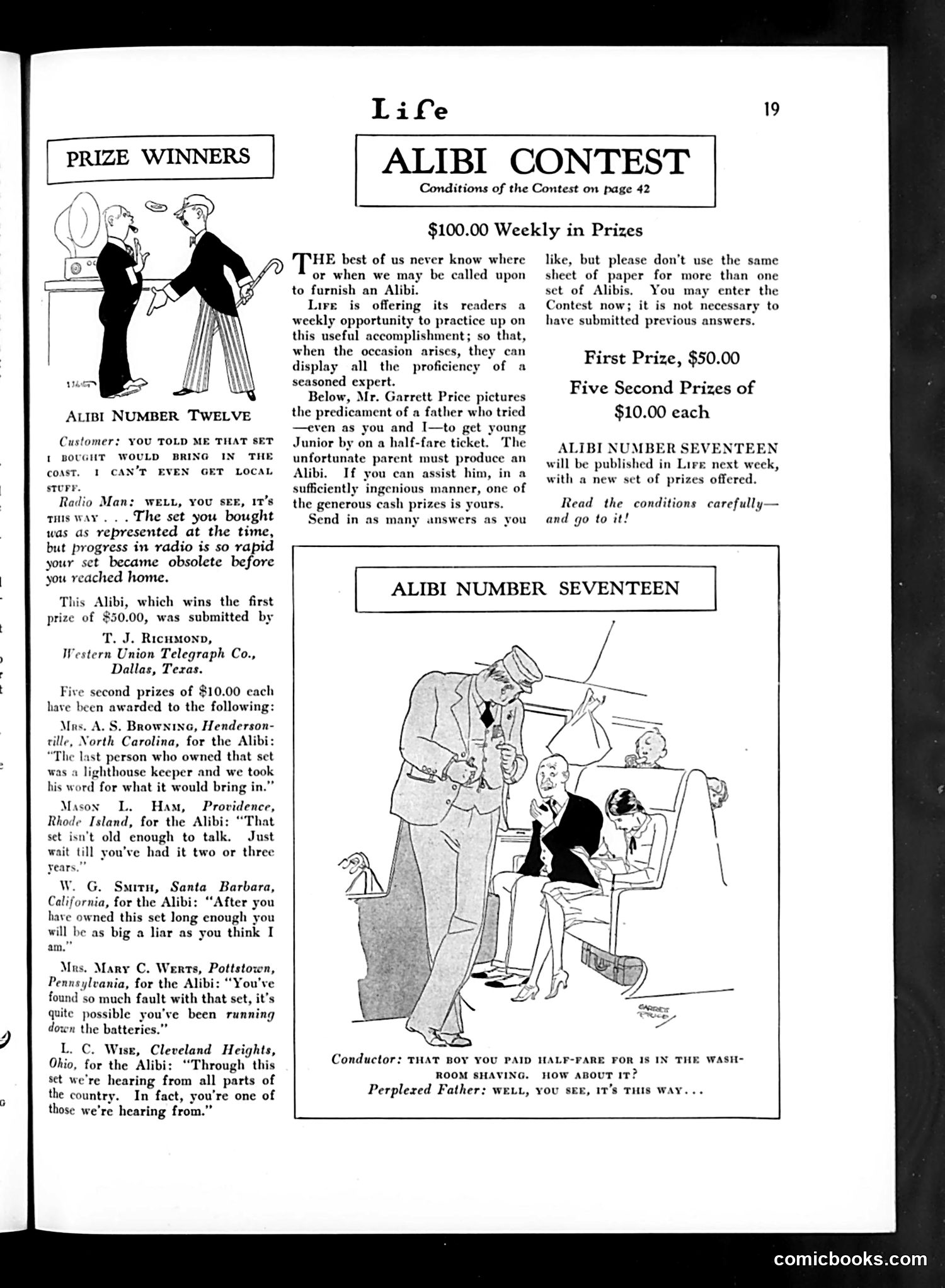
This page showcases Life magazine's weekly "Alibi Contest," where readers submit creative excuses for everyday predicaments. The humor relies on the gap between honest admission and clever rationalization. **Alibi #12** (Prize Winner): A radio salesman explains that a customer's newly-purchased radio set became "obsolete before you reached home"—satirizing both rapid technological change and flimsy sales excuses. **Alibi #17** (main cartoon): A conductor confronts a father who paid half-fare for his clearly full-sized son. The father must improvise an excuse on the spot. The cartoon depicts the absurd social pressure to justify obvious rule-breaking with creativity rather than honesty. The contest invited readers to submit witty alibis for common situations, with cash prizes rewarding ingenious dishonesty. This reflects 1920s-30s American humor celebrating quick-witted deflection and smooth-talking as social skills—gently mocking both human tendency to rationalize and the culture's tolerance for minor deceptions.
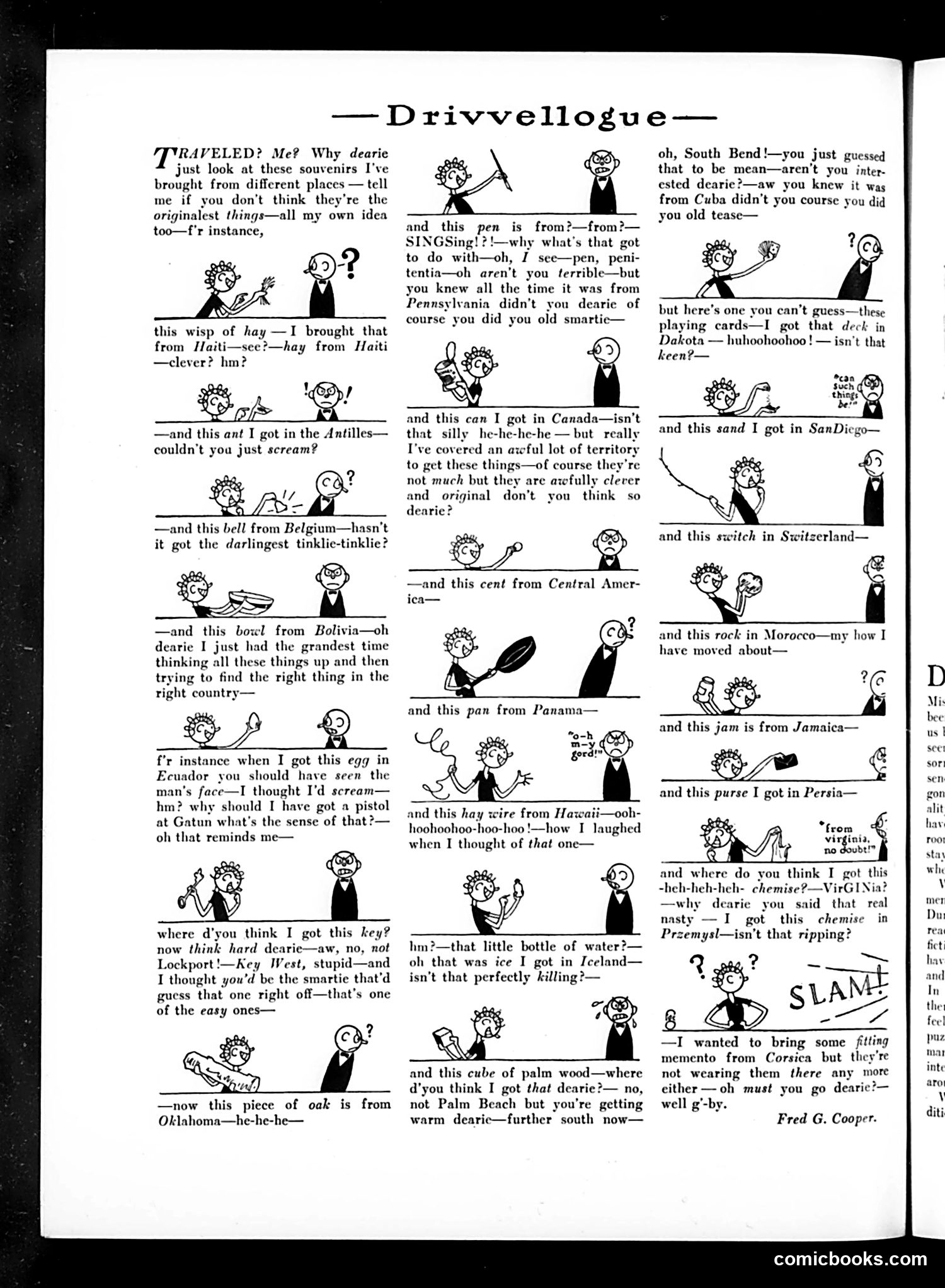
This satirical comic mocks a tedious traveler—a wealthy woman who collects trivial souvenirs and insists on explaining contrived wordplay connecting each object to its origin. The humor relies on puns: a "key" from Key West, a "pen" from Sing Sing penitentiary, "hay wire" from Hawaii, "sand" from San Diego, a "switch" from Switzerland, and so forth. The satire targets upper-class tourism and social pretension circa the early 20th century. The character boasts about her travels while subjecting her listener to exhausting, groan-worthy jokes she clearly invented herself. Her repetitive "dearie" and self-satisfied tone emphasize shallow materialism masquerading as worldliness and wit. The exasperated listener's silence communicates what modern readers understand: this woman is insufferable.
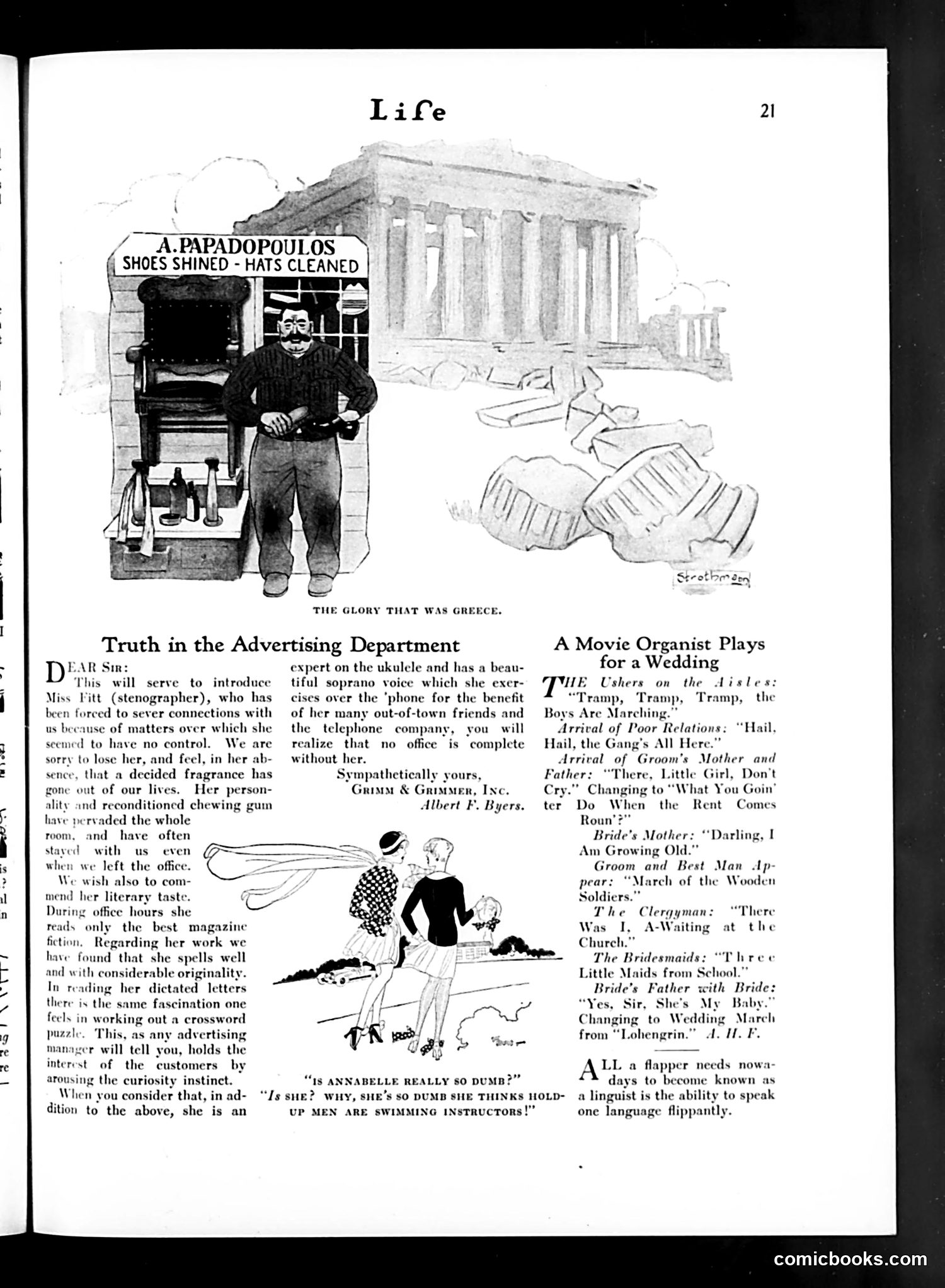
This page contains three satirical pieces from *Life* magazine (circa 1920s, based on references to "flappers" and ukuleles): **"Truth in the Advertising Department"** mocks corporate hypocrisy through a fake recommendation letter for a departing stenographer. The joke: the company praises her incompetence ("spells well...with considerable originality" means she misspells creatively) and annoying habits as office assets. It satirizes how businesses use flattering language to obscure unflattering truths. **The cartoon below** features two women, one calling another "dumb" because she mistakes "hold-up men" (robbers) for "swimming instructors"—a visual gag playing on the era's flapper stereotype of ditzy young women. **"A Movie Organist Plays for a Wedding"** lists incongruous silent-film accompaniment: playing "Tramp, Tramp, Tramp" (a marching song) when guests arrive, or "Don't Cry" for the groom's mother. It satirizes the absurdity of fitting pre-recorded music to weddings without regard for context. All three pieces target 1920s social pretension and disconnect between appearance and reality.
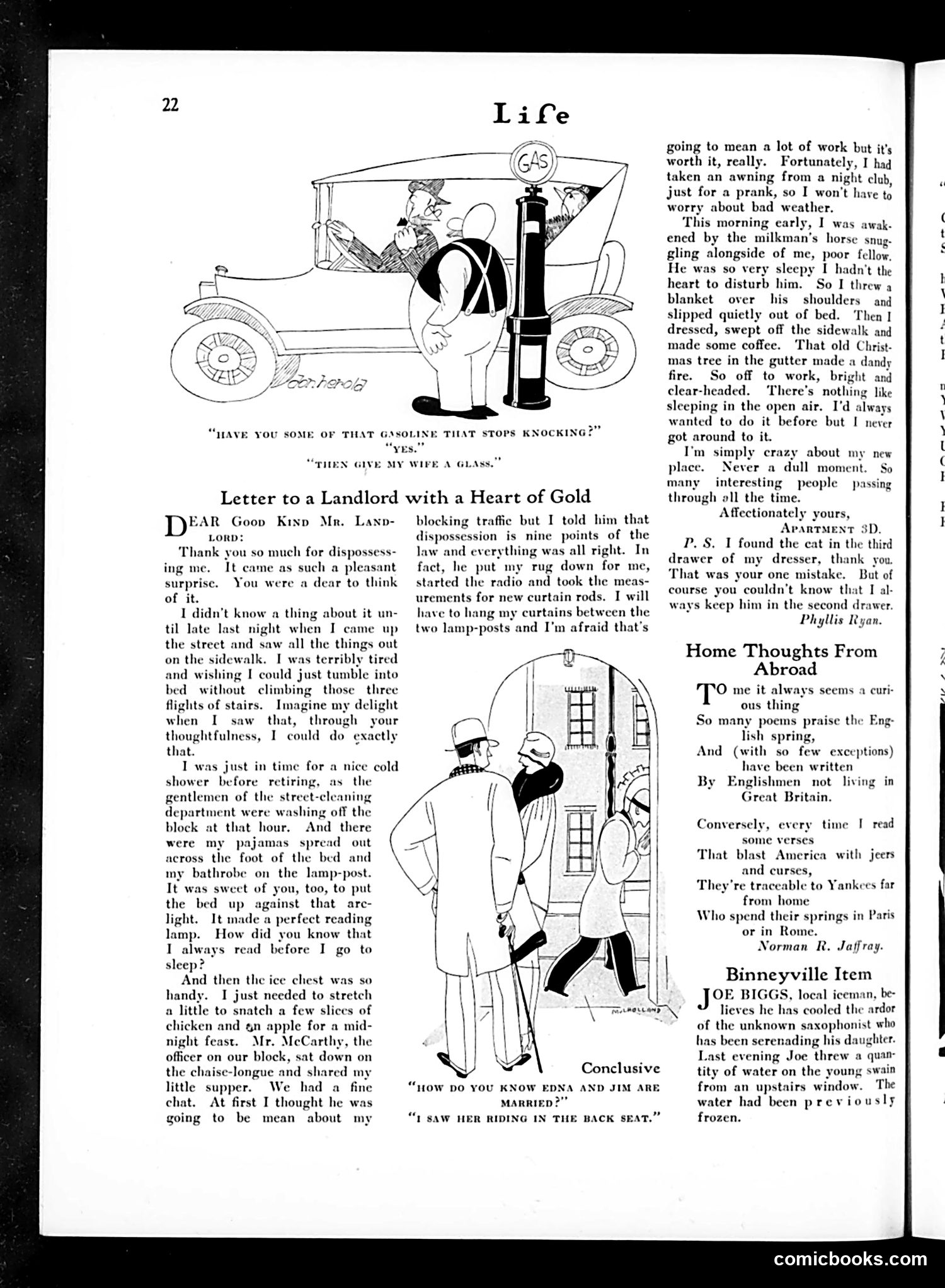
The top cartoon satirizes eviction during the Depression era. A man at a gas pump asks for gasoline "that stops knocking" (engine trouble), then requests his wife be given "a glass"—darkly joking that cheap liquor might ease their hardship. The main piece is a sardonic "letter" from an evicted tenant thanking his landlord with exaggerated cheerfulness. The satire lies in the tenant's ironic gratitude for homelessness: his furniture on the sidewalk becomes a bed, street cleaners' water a shower, an arc light a reading lamp. A sympathetic police officer even helps. This biting humor critiques both landlord indifference and the desperation of those facing dispossession—the tenant's forced optimism highlights the actual tragedy. The page reflects 1920s-30s economic anxiety when evictions were common and housing precarious. The humor's edge comes from the tenant's refusal to show bitterness, instead performing cheerfulness about catastrophic loss.
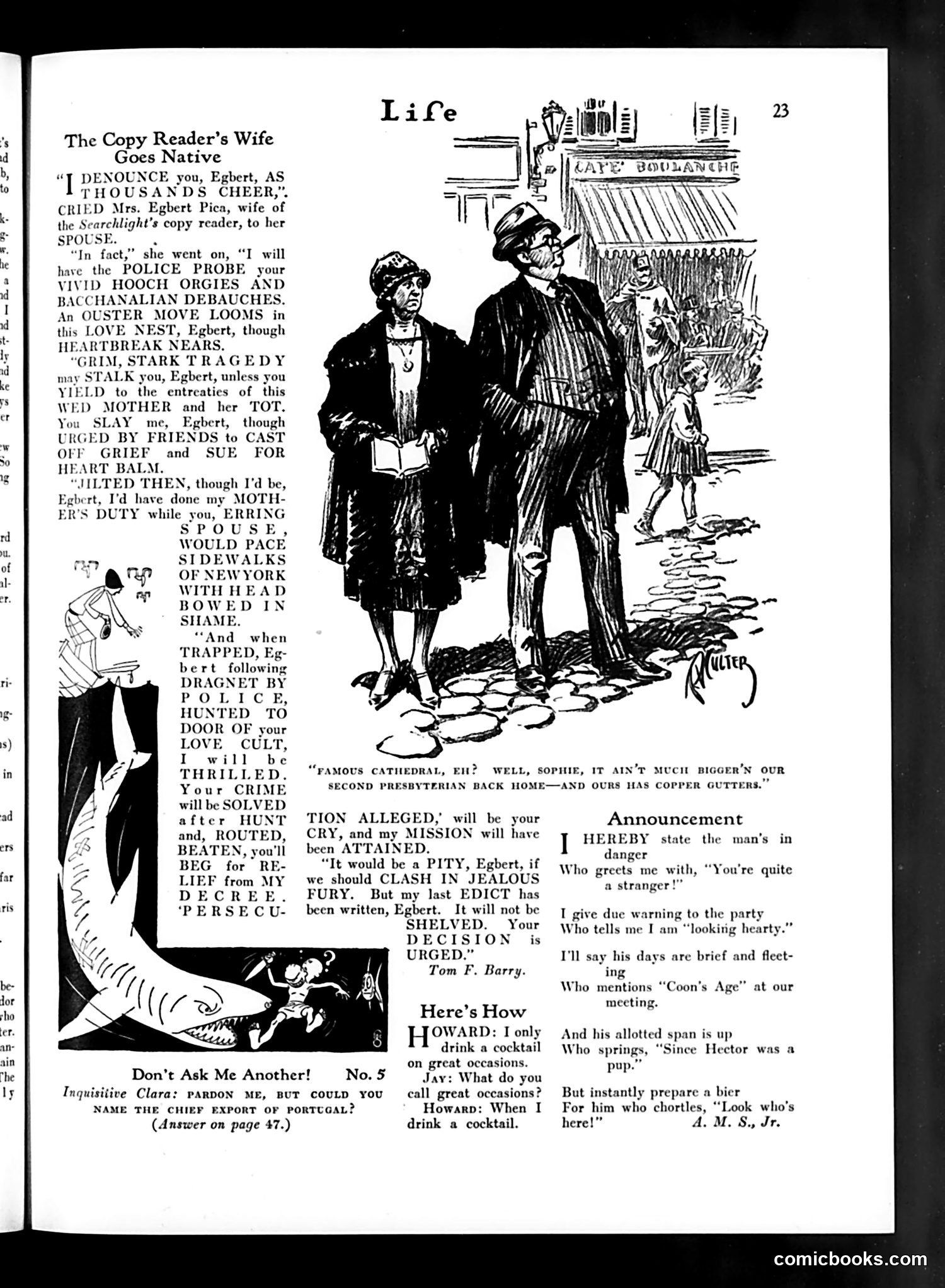
This satirical piece mocks tabloid journalism and dramatic domestic disputes of the era. Mrs. Egbert Pica, wife of a newspaper copy reader, delivers an over-the-top denunciation of her husband using sensationalist newspaper language—"VIVID HOOCH ORGIES," "DRAGNET," "OUSTER MOVE LOOMS"—the breathless, capitalized style typical of 1920s tabloids covering scandals. The satire targets two things: first, how newspapers sensationalize minor domestic quarrels into lurid crimes; second, how wives weaponized public scandal and "heart balm" suits (divorce lawsuits seeking damages) against husbands. The wife threatens police investigation, public humiliation, and legal action, speaking in exaggerated newspaper-ese rather than normal language. The joke is that she's adopted the melodramatic tone of the very publication her husband works for, turning their marriage into a tabloid story complete with "DRAGNET," "PERSECUTION," and threatened "CRIME" charges for what appears to be drinking.
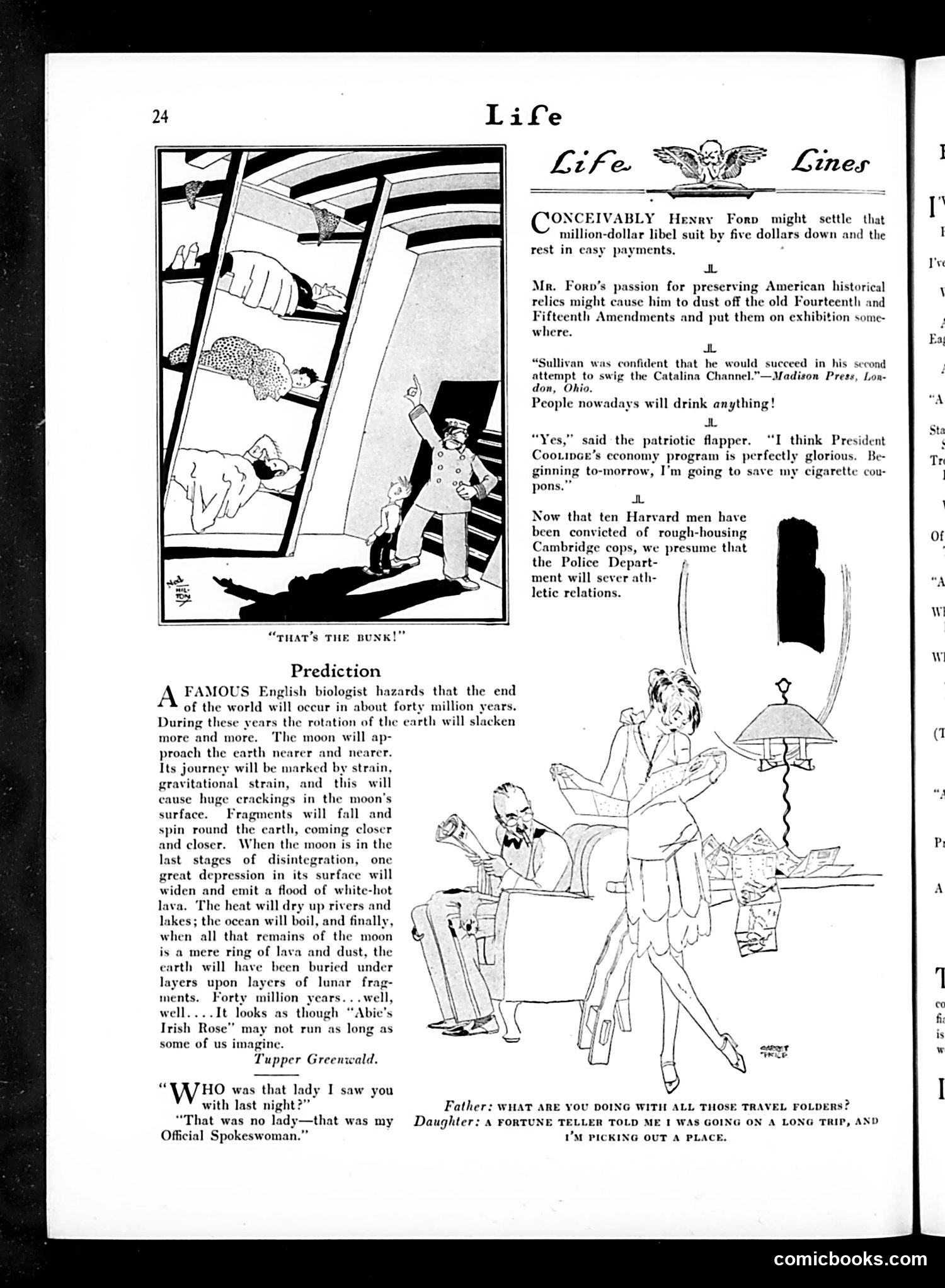
This page contains several satirical pieces targeting 1920s American figures and trends: **"That's the Bunk!"** depicts Henry Ford's libel suit, mocking his willingness to settle via installment payments—a joke about Ford's own mass-production financing methods. The reference to the Fourteenth and Fifteenth Amendments suggests Ford's controversial views on race. **The "Life Lines"** section offers brief satirical quips: one mocks a flapper's patriotic economy by saving cigarette coupons (trivial savings); another jokes about Harvard students roughhousing with police. **"Prediction"** parodies English biologist predictions of Earth's doom in 40 million years, comparing the inevitability to the endless run of the popular play "Abie's Irish Rose." **The bottom cartoon** uses a classic vaudeville joke format (the "that was no lady" setup) but applies it to a female "Official Spokeswoman"—satirizing official female spokespeople, a relatively new phenomenon in the 1920s. The overall tone reflects Jazz Age skepticism toward authority, modern figures, and grand predictions.
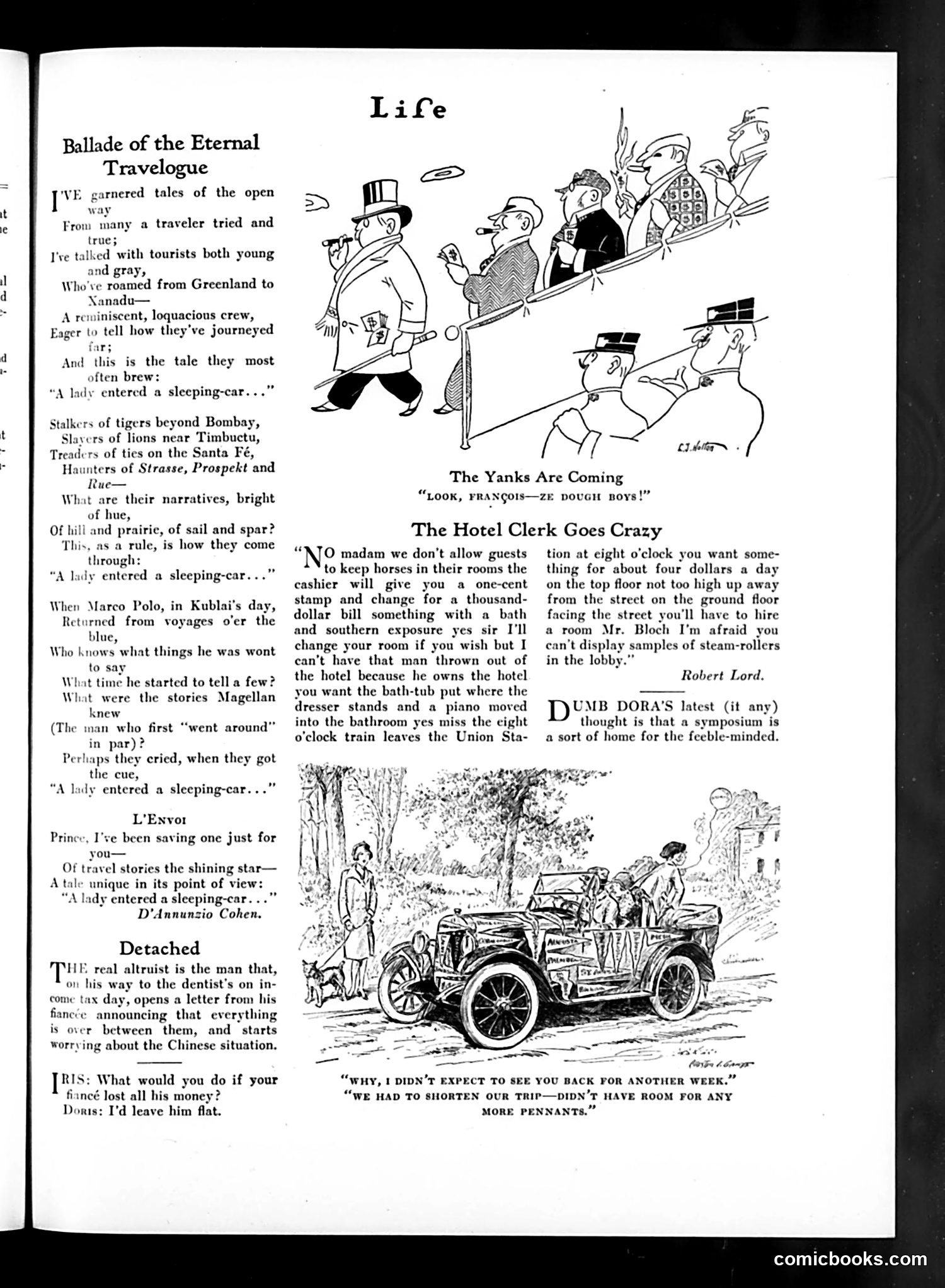
This page satirizes travelers and their tedious stories. The "Ballad of the Eternal Travelogue" mocks how tourists—from Marco Polo onward—inevitably bore listeners with the same clichéd anecdote: "A lady entered a sleeping-car." The poem suggests that despite exotic travels to Bombay, Timbuctu, and distant lands, travelers reduce everything to this single, repetitive tale. The cartoons reinforce this theme: 1. **"The Yanks Are Coming"**: French observers react to American tourists arriving with their characteristic tackiness. 2. **"The Hotel Clerk Goes Crazy"**: A frantic monologue capturing the absurd demands of difficult hotel guests—unreasonable requests, complaints, and general chaos—satirizing both tourist entitlement and hospitality worker exhaustion. 3. **"Dumb Dora's" bit**: A final jab at vacuous tourists who collect "pennants" (souvenirs) rather than genuine experiences. The overall message: modern tourism produces shallow, interchangeable experiences and insufferable travelers.
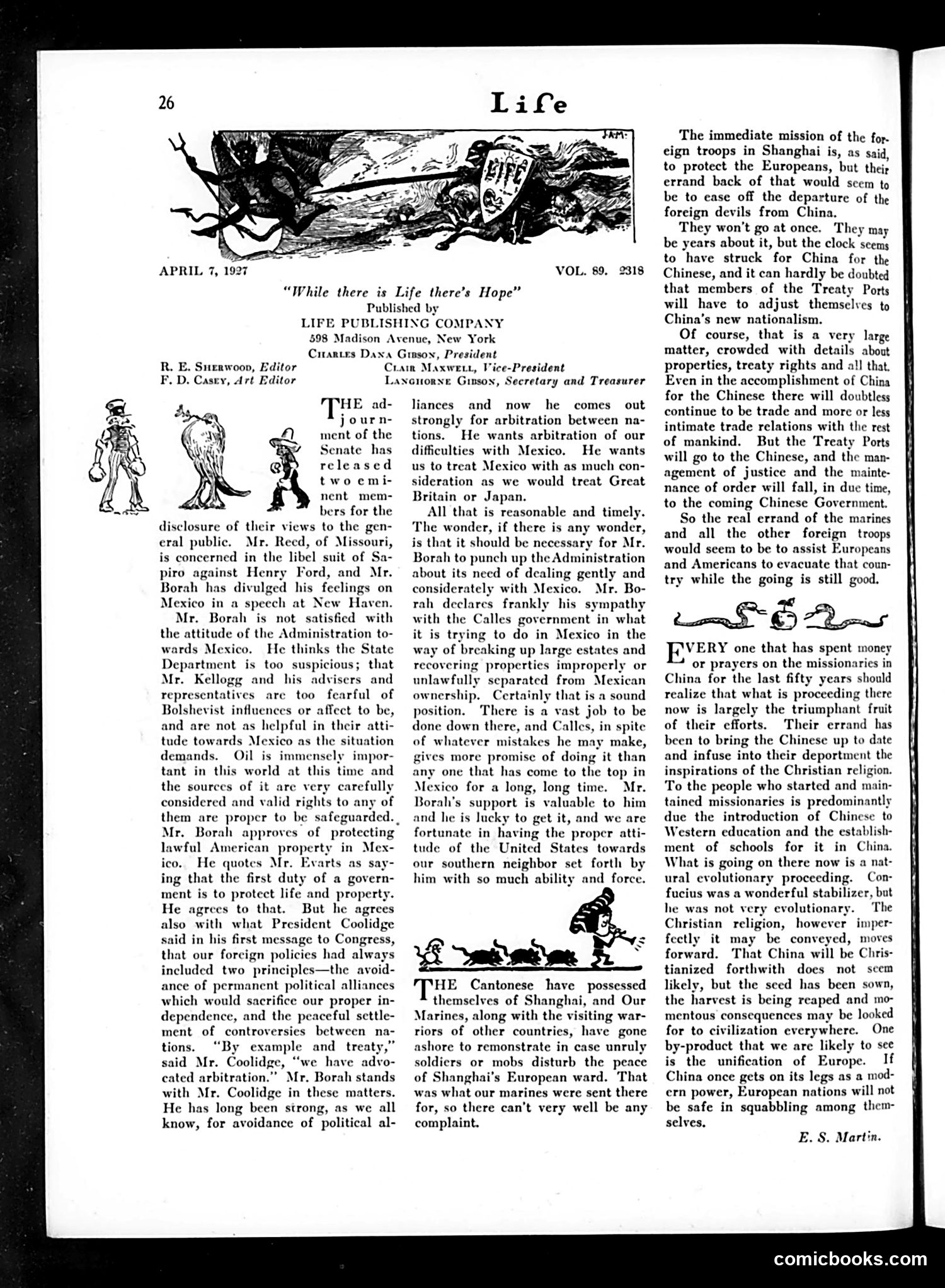
This page contains editorial commentary on two major foreign policy issues: **Mexico:** Senator Borah criticizes the Coolidge administration for being overly suspicious of Mexico and insufficiently supportive of President Calles's land reform efforts. The writer praises Borah's calls for arbitration and respectful treatment of Mexico, arguing the administration should match this diplomatic approach rather than appearing fearful of Bolshevik influence. **China:** The commentary addresses foreign troop presence in Shanghai following Cantonese forces taking the city. While officially protecting European residents, the writer suggests the deeper agenda is managing the "departure of the foreign devils from China"—acknowledging that Western imperial dominance in China is ending, though the transition will be prolonged. The cartoons (spider and figures) appear to illustrate these entangling foreign complications, though their specific meaning is unclear from the image alone.
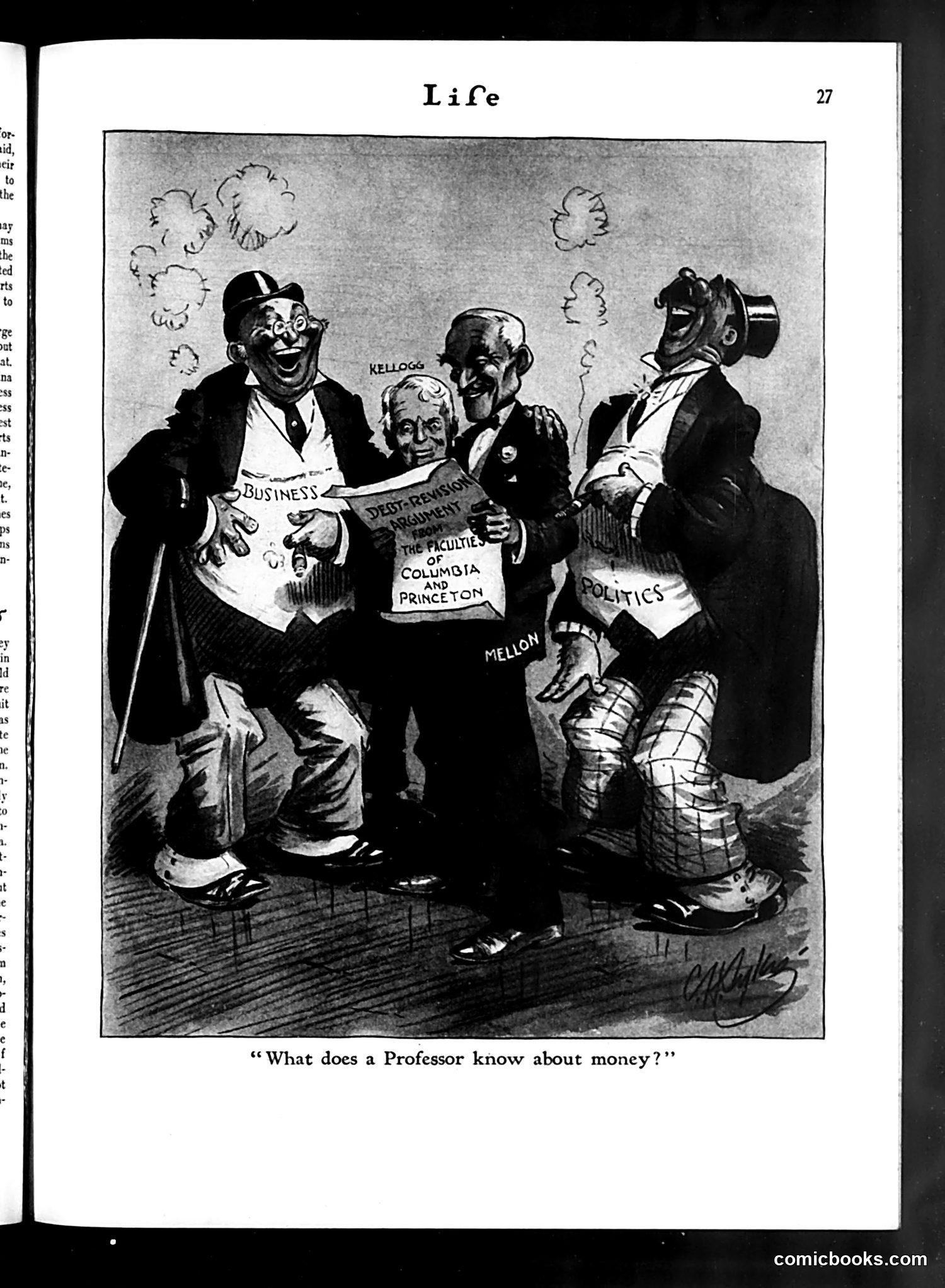
This political cartoon satirizes academics' perceived ignorance of finance. Four caricatured figures—labeled "Business," "Kellogg" (likely referring to diplomat Frank Kellogg), "Mellon" (Treasury Secretary Andrew Mellon), and "Politics"—surround a central professor figure. The professor holds a newspaper about "Disarmament Agreement" involving Columbia and Princeton universities, suggesting naive idealism. The cartoon mocks the disconnect between theoretical academia and practical financial/political expertise. The businessmen and politicians mock the professor's naïveté, implying that professors lack real-world economic understanding. This reflects 1920s American attitudes skepticism toward intellectuals influencing policy matters, particularly regarding international diplomacy and financial matters.
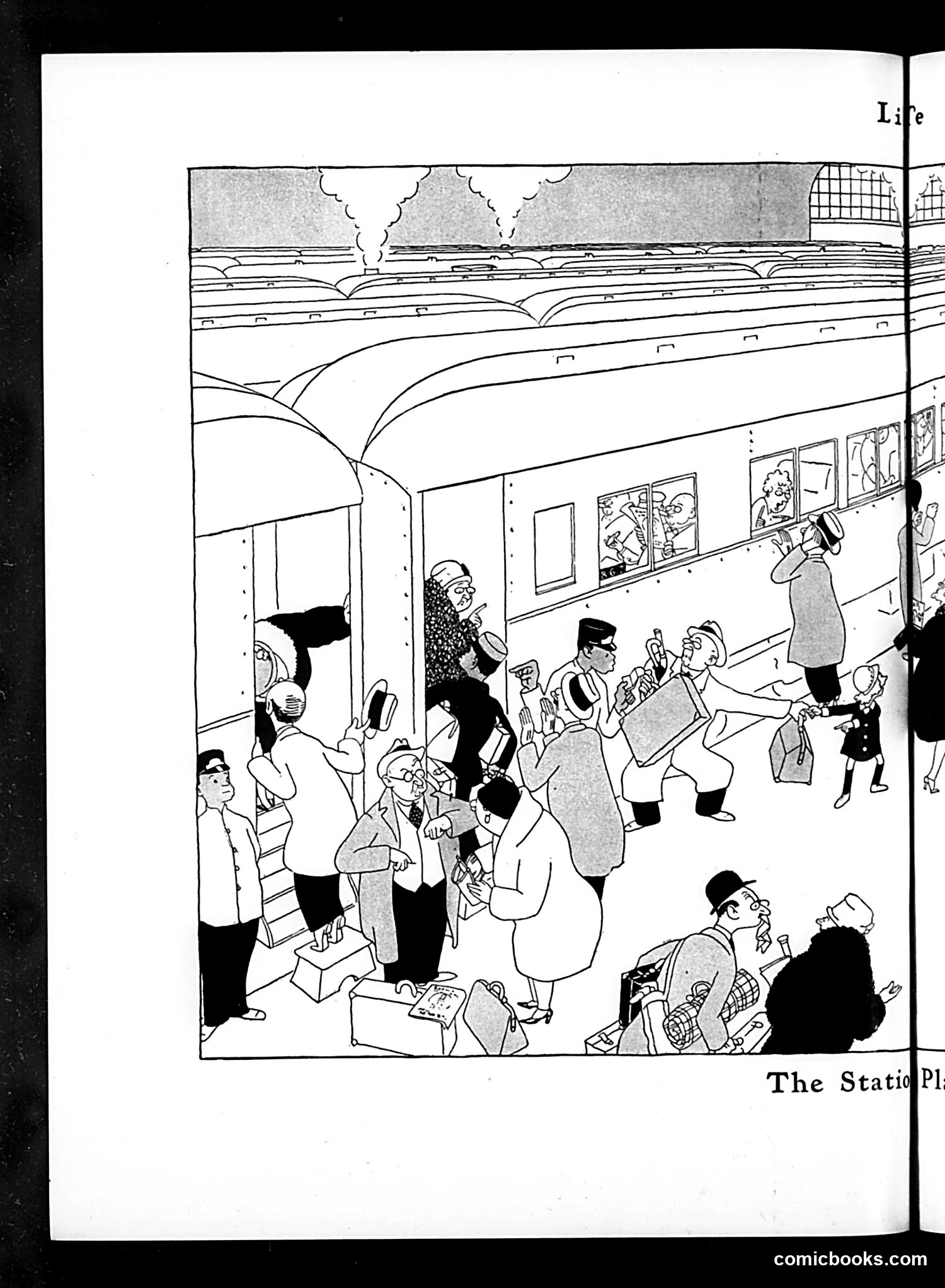
This cartoon depicts a crowded railway station scene with passengers boarding or waiting near a train. The illustration captures early-to-mid 20th century travel, showing men in hats and suits, women in period dress, and children amid luggage and parcels. The satire appears to target the chaos and congestion of station life—porters, vendors, and ordinary travelers jostle in disorganized fashion. The humor likely derives from social observation: the mix of classes, the frantic energy, and the humor inherent in mass transit situations. Without additional context or clearer captions, specific political references aren't apparent. This appears to be general social satire about modern transportation rather than commentary on particular figures or events.
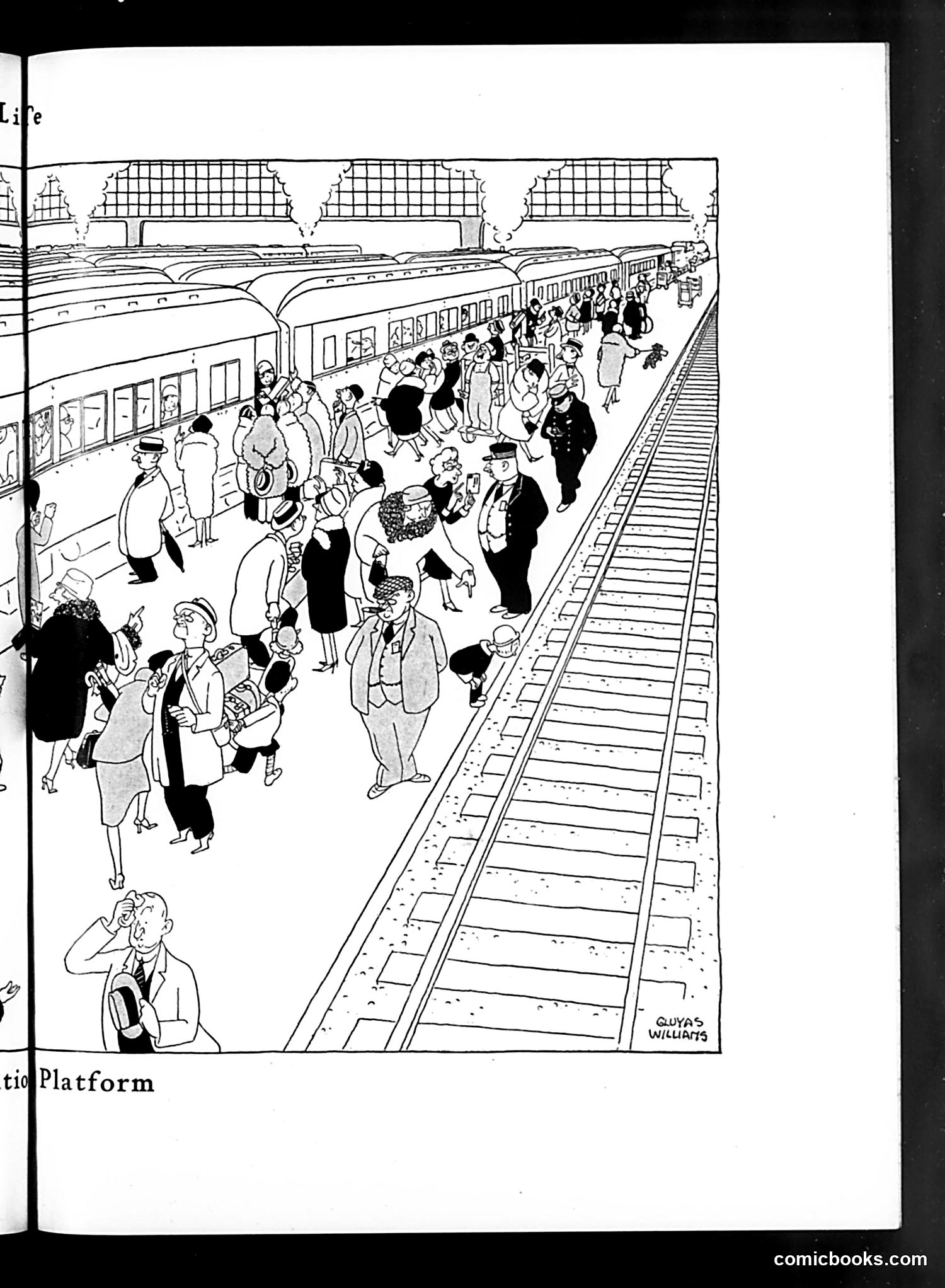
This cartoon by Gluyas Williams depicts a crowded railway station platform during what appears to be a busy travel period. The satirical point seems to center on the chaos and congestion of modern rail travel—numerous passengers of various classes and types mill about with luggage, children, and belongings in apparent disorder. The humor likely targets the inefficiency or absurdity of contemporary train station operations, a common subject for early-to-mid 20th century satire in *Life* magazine. The detailed cross-section perspective emphasizes the overwhelming number of people competing for space and attention, suggesting social commentary on mass transit's growing pains or passenger behavior during peak travel times.
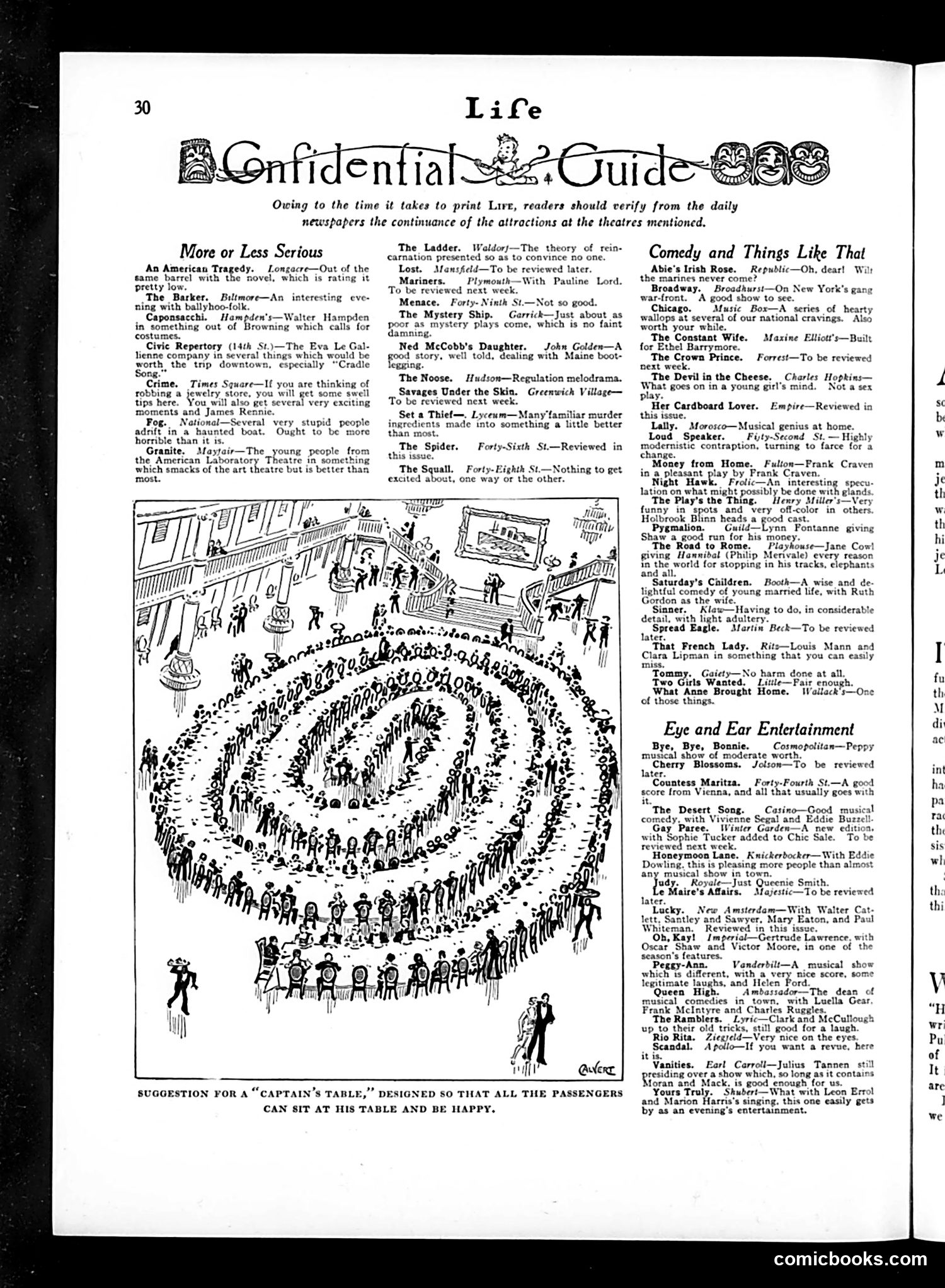
This page is a **theatre review section** from Life magazine, not a political cartoon. It lists Broadway and other theatrical productions with brief critical assessments, organized by tone ("More or Less Serious" and "Comedy and Things Like That"). The single illustration—credited to artist Culbertson—depicts a humorous "Captain's Table" seating arrangement where concentric spiral rings of passengers all face toward a central captain's table. The caption explains this is a satirical "suggestion" solving the social problem of ship dining: traditionally, sitting at the captain's table was prestigious, creating hierarchies among passengers. This design allows everyone to claim that honor simultaneously, solving the seating-arrangement friction that historically plagued passenger ships. The reviews themselves are snappy, often dismissive (calling some shows "stupid" or "poor"), reflecting Life's satirical editorial voice toward entertainment of the 1920s era.
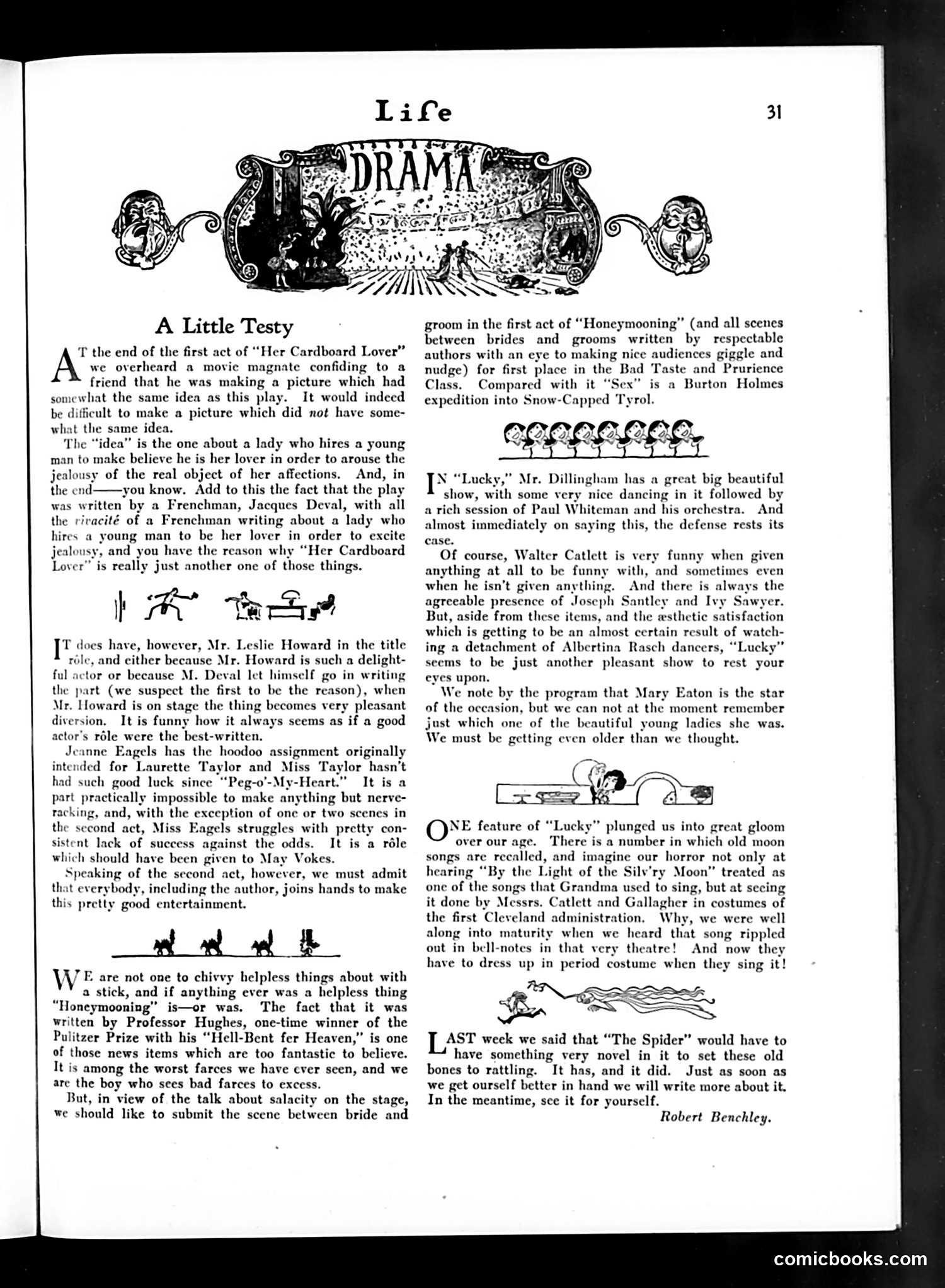
This is a theater review column titled "A Little Testy," critiquing three Broadway productions. The writer—identified at the end as Robert Benchley—employs satirical commentary on contemporary stage fare. **Key References:** - "Her Cardboard Lover": A French play by Jacques Deval about a woman hiring a man to pose as her lover to provoke jealousy—dismissed as derivative Hollywood fare - "Honeymooning": Written by Professor Hughes (Pulitzer Prize winner of "Hell-Bent fer Heaven"), yet deemed among "the worst farces we have ever seen" - "Lucky": A musical revue featuring dancer Mary Eaton, Paul Whiteman's orchestra, and comic Walter Catlett **The Satire:** Benchley mocks both the predictable plots plaguing theater and cinema, and the pretentiousness of claiming moral concern about stage "salacity" while producing genuinely bad entertainment. The humor lies in his bemused observation that good acting cannot redeem poor material, and that audiences—including himself—keep attending anyway.
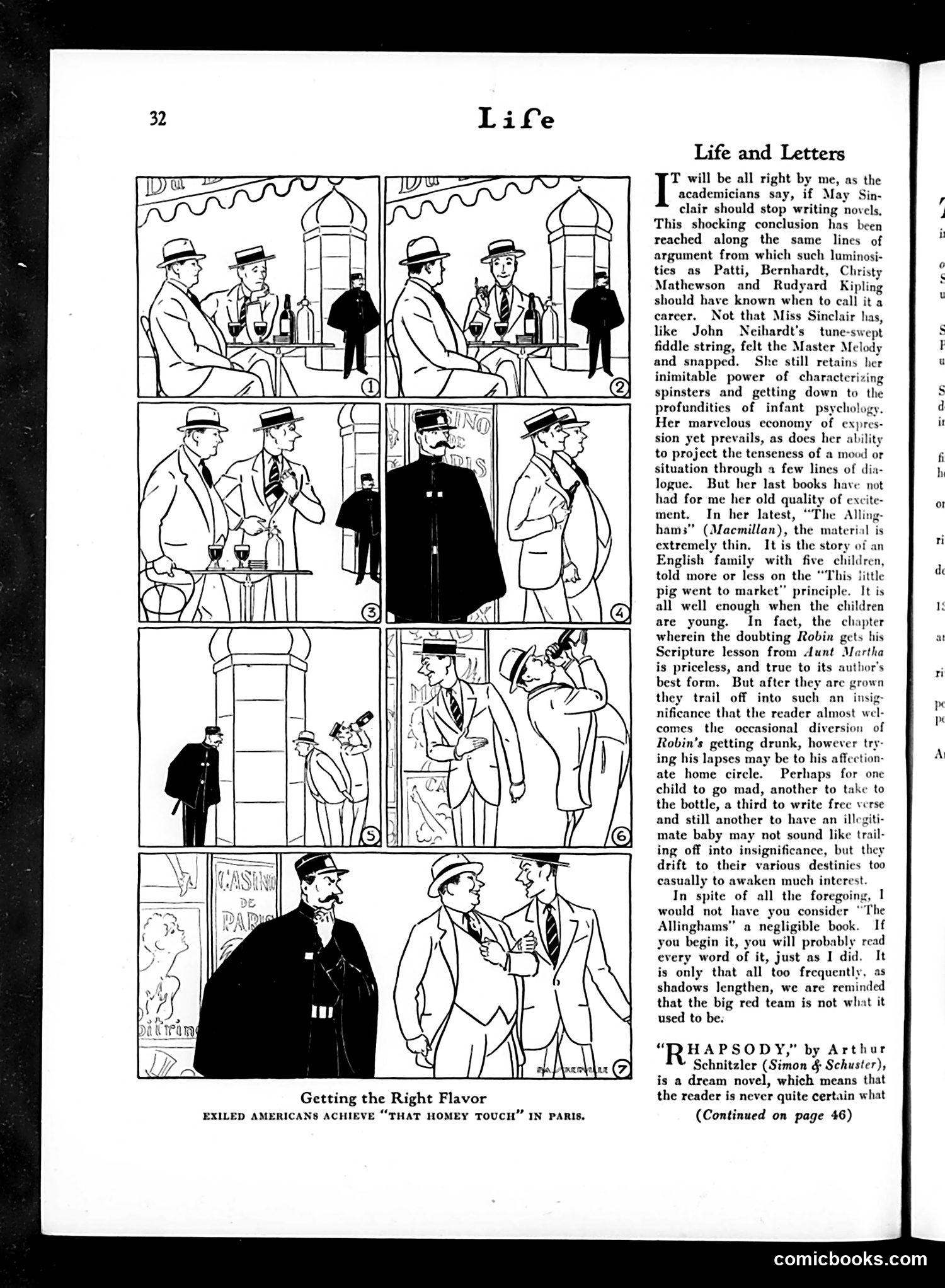
This comic strip satirizes American expatriates in Paris during the 1920s-1930s. The seven panels show exiled Americans attempting to recreate familiar "homey" American experiences—dining, socializing, conducting business—while physically located in Paris (indicated by the Parisian architecture). The humor derives from the contrast between their setting and their behavior: despite being abroad, they cling to American mannerisms, dress, and social rituals. The caption's phrase "that homey touch" is ironic—these expatriates cannot escape their Americanness even when trying to embrace European culture. The accompanying essay critiques author May Sinclair's declining literary output, noting that even celebrated writers (Patti, Bernhardt, Kipling) know when to retire. Her latest novel *The Allinghams* is dismissed as thin material about an English family, though competently written. The page reflects broader 1920s-era fascination with American expatriate communities abroad and debates about artistic decline.
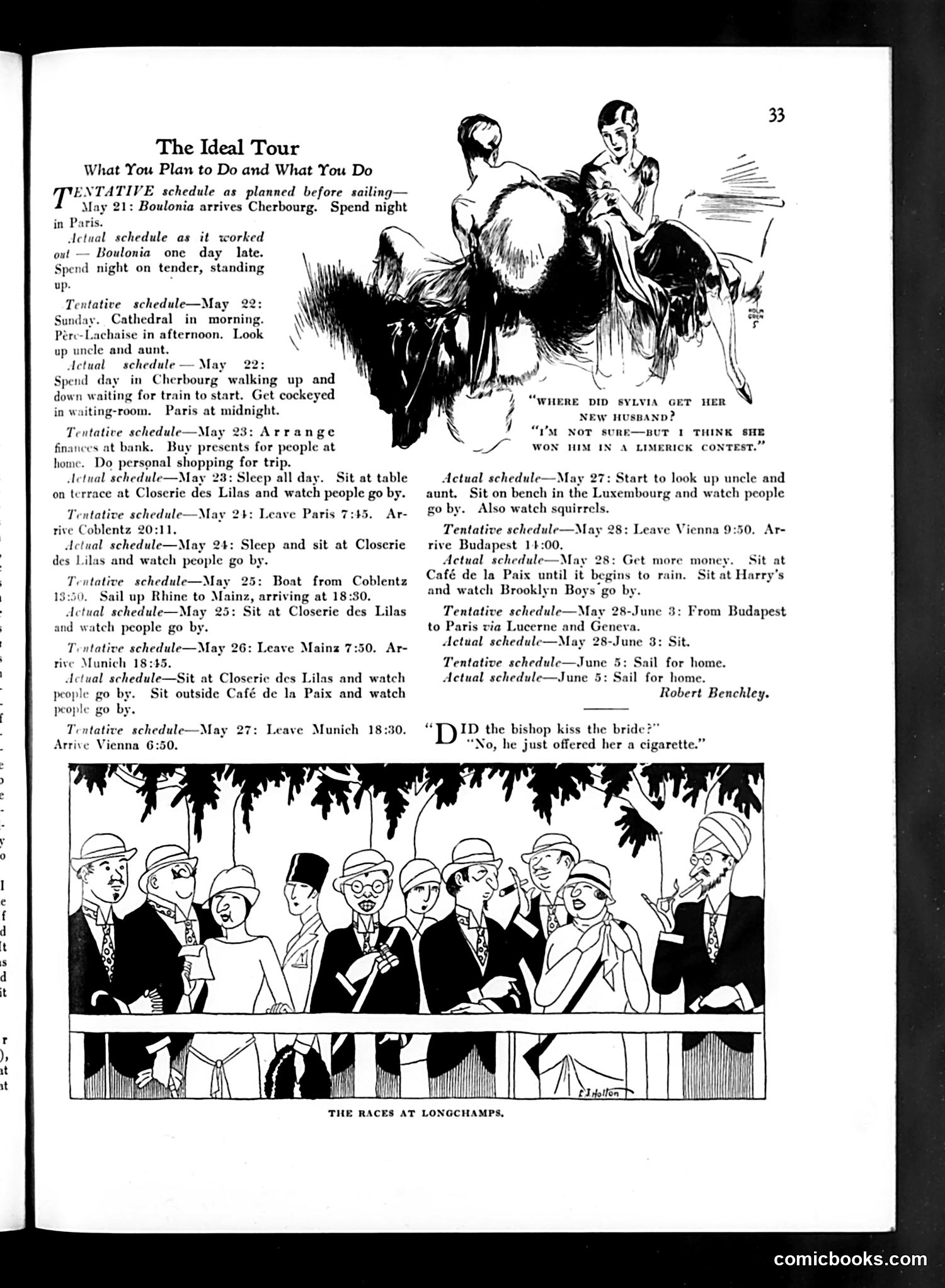
This humorous piece satirizes tourists' unrealistic travel expectations. The column contrasts what visitors *plan* to accomplish (visiting cathedrals, shopping, sightseeing across European cities) with what they *actually* do—primarily sitting at cafés like Closerie des Lilas and Café de la Paix, watching passersby and getting drunk. The joke exposes the gap between grand travel ambitions and lazy reality: instead of touring Vienna, Budapest, and the Rhine, tourists idle away days people-watching and socializing. The cartoon below shows well-dressed tourists at Longchamps races. A separate brief joke mocks modern social trends: a groom doesn't kiss his bride at the wedding—he offers her a cigarette, suggesting changing courtship customs among the upper classes. The piece gently ridicules both tourists and the leisure-class lifestyle of the era.
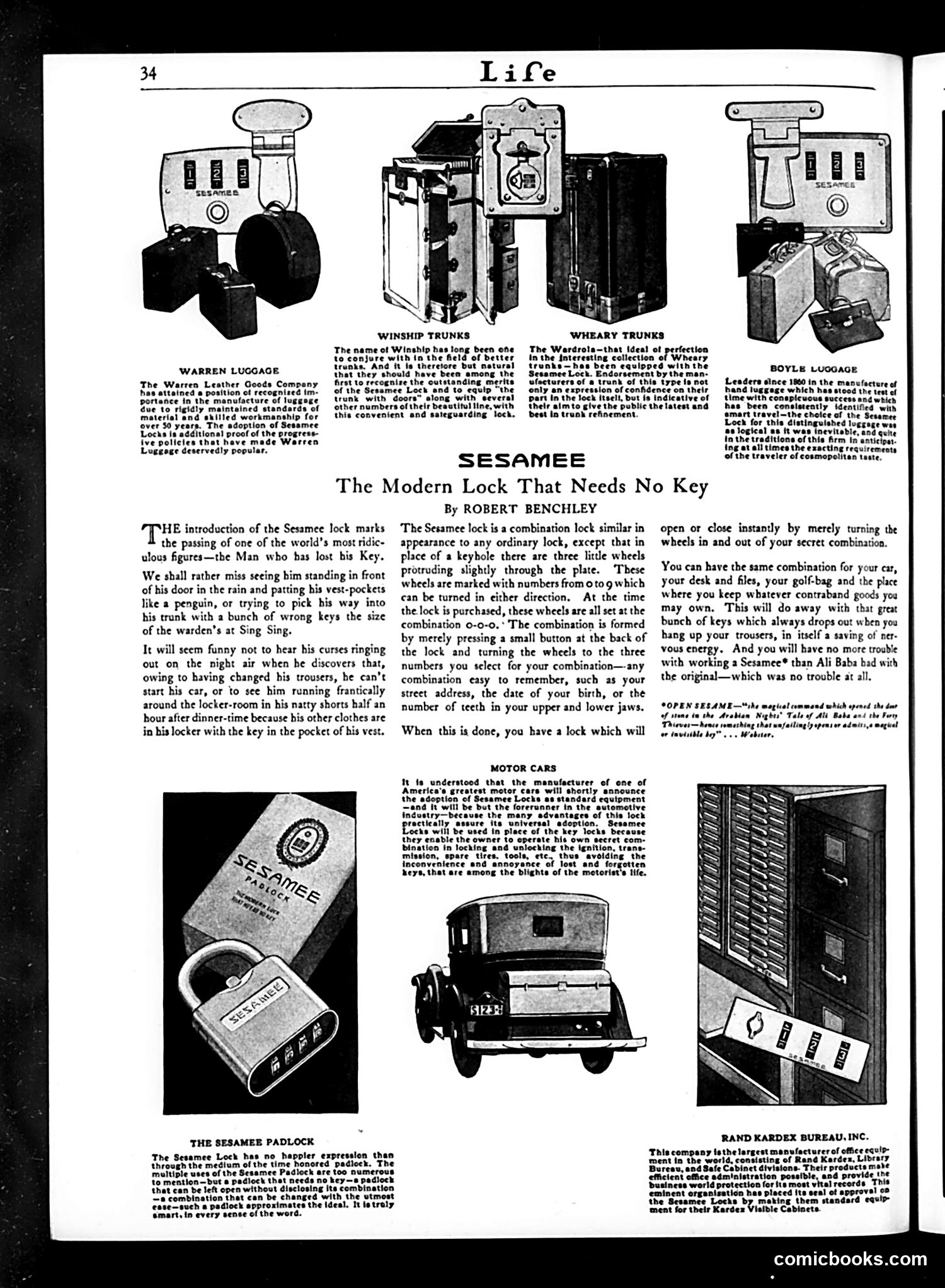
This page is primarily **advertising and product promotion**, not political satire. It showcases the Sesamee combination lock, a keyless locking mechanism. The humorous essay by Robert Benchley (a well-known humorist of the era) opens by satirizing "the Man who has lost his Key"—a universal figure of comedy. Benchley jokes about the awkward situations created by lost keys: standing in the rain patting pockets, fumbling with wrong keys, or searching frantically in gym locker rooms in one's underwear. The advertisement promotes the Sesamee lock's practical advantages: combination-based rather than key-dependent, with customizable codes (using birthdates, addresses, or other memorable numbers). The lock could be applied to trunks, luggage, padlocks, and notably, automobiles. There is **no political content**. This is straightforward commercial promotion dressed in entertaining editorial writing—typical of Life magazine's blend of humor and advertising in this period. The "satire" targets only human forgetfulness and inconvenience, not social or political issues.
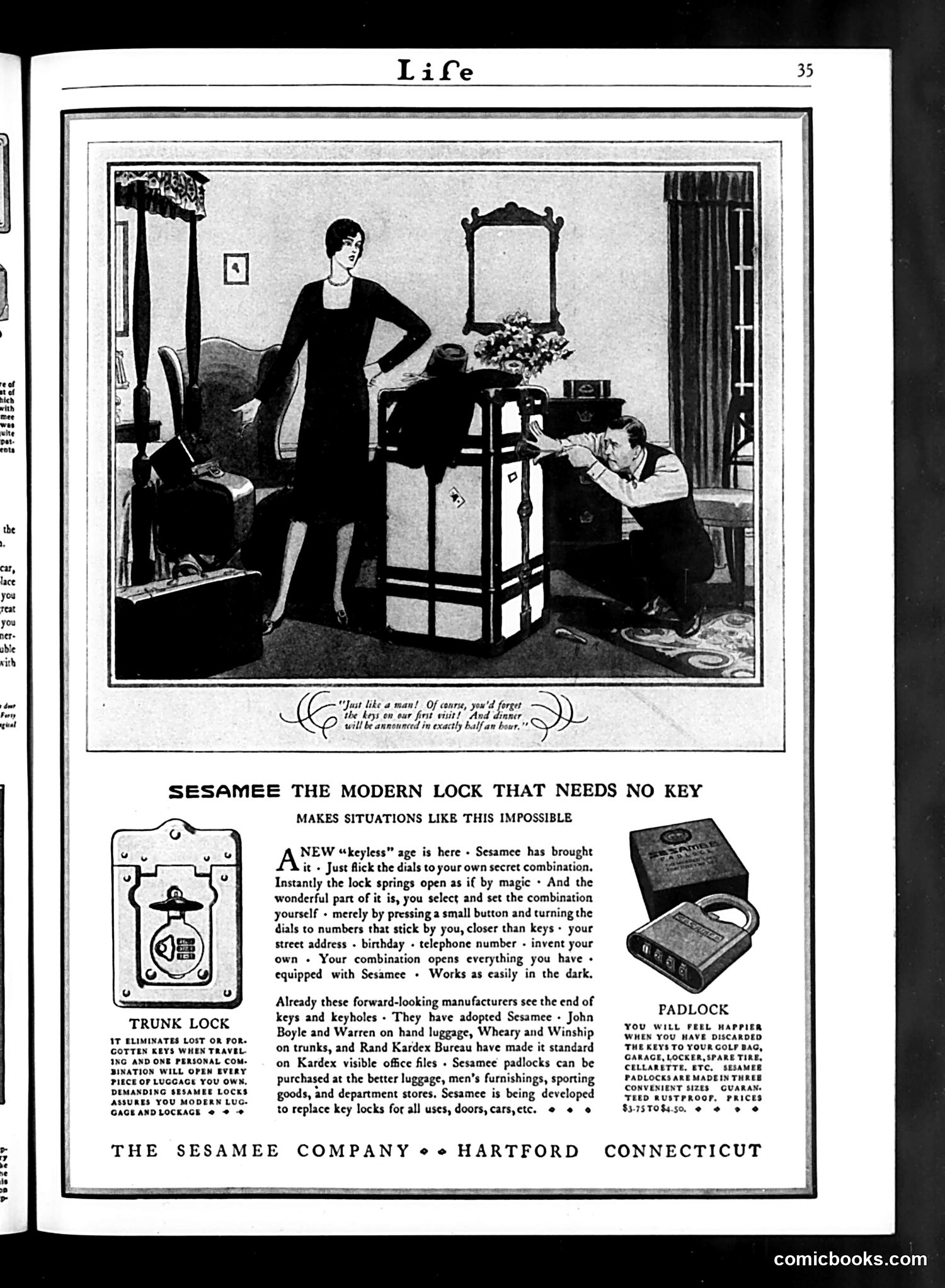
This is primarily a **full-page advertisement** for the Sesamee combination lock, not political satire. The cartoon at top depicts a domestic scene meant to humorously illustrate the lock's selling point: a woman stands confidently while a man searches frantically through luggage, unable to open it without the combination. The caption jokes that forgetting keys won't happen anymore—the husband literally cannot access the locked trunk. **The actual satire is subtle**: the ad gently mocks traditional masculine anxiety about lost keys and travel mishaps, positioning the keyless lock as liberation from this modern inconvenience. The "keyless age" framing suggests technological progress replacing outdated methods. **Context for modern readers**: This reflects 1920s-30s optimism about mechanical innovation solving everyday problems. The advertisement emphasizes security through personal numeric codes rather than physical keys—a genuinely novel concept at the time, positioning Sesamee as forward-thinking technology adopted by major manufacturers.
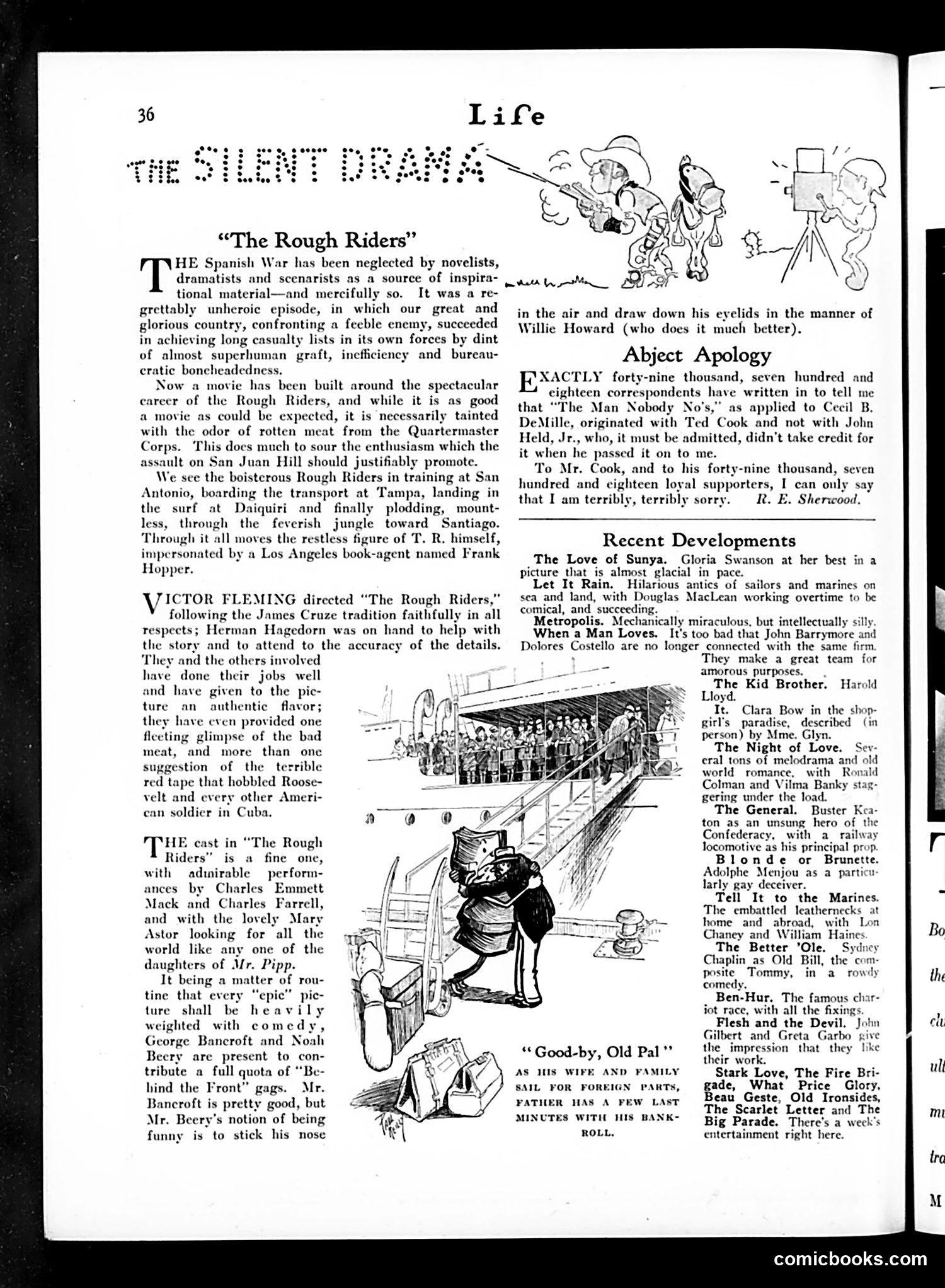
This page reviews a silent film called "The Rough Riders" about Theodore Roosevelt's famous cavalry unit in the Spanish-American War (1898). The critic argues the subject matter was inherently unheroic—America defeated a weak enemy while suffering excessive casualties due to military bungling and corruption ("rotten meat from the Quartermaster Corps"). The film itself, directed by Victor Fleming and starring Frank Hopper as Roosevelt, is praised as competently made, though necessarily tainted by its subject. The cast includes Charles Emmett Mack and Mary Astor. The critic notes George Bancroft and Noah Beery provide comic relief, though Beery's humor (pulling a face "in the manner of Willie Howard") is considered inferior. The page also includes brief reviews of other contemporary films starring Gloria Swanson, Douglas MacLean, and Buster Keaton. An apology corrects attribution of "The Man Nobody Knows" to Ted Cook rather than John Held Jr.
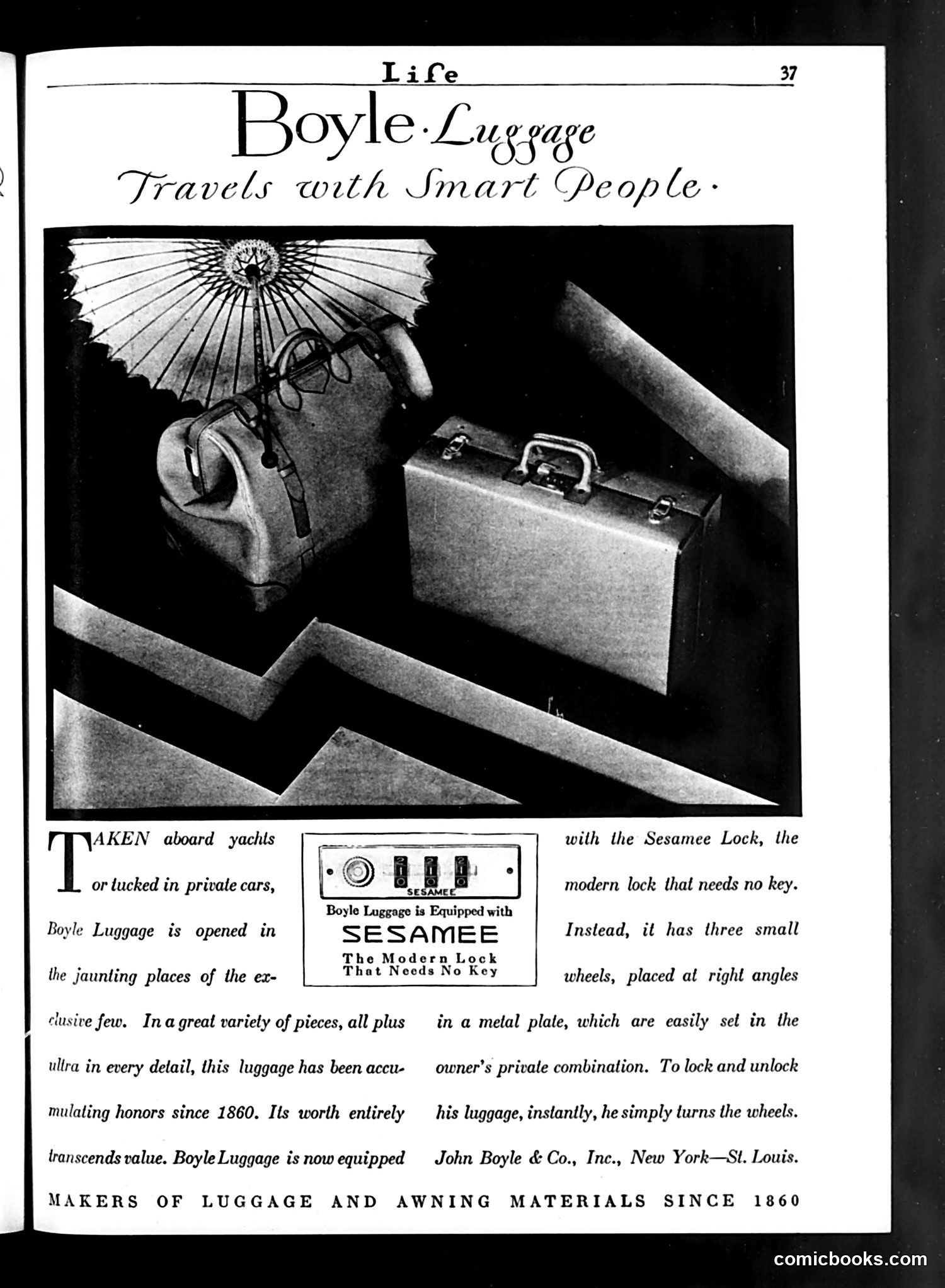
This is primarily a **product advertisement**, not political satire. It promotes Boyle Luggage, a company established in 1860, emphasizing luxury and exclusivity. The advertisement uses aspirational imagery—a gentleman traveler with a parasol and briefcase—to appeal to wealthy consumers ("the exclusive few") who travel by yacht or private car. The humor is gentle and indirect: the phrase "Travels with Smart People" plays on the idea that using this luggage signals sophistication and intelligence. The main innovation being advertised is the **Sesamee Lock**, a combination lock requiring no key—three small wheels that the owner sets in a private combination. This was a genuine technological advancement for the era, offering security without the vulnerability of a physical key. There is **no political cartoon or satire here**—just a period advertisement using class aspiration and wit to market premium luggage to affluent readers of Life magazine.
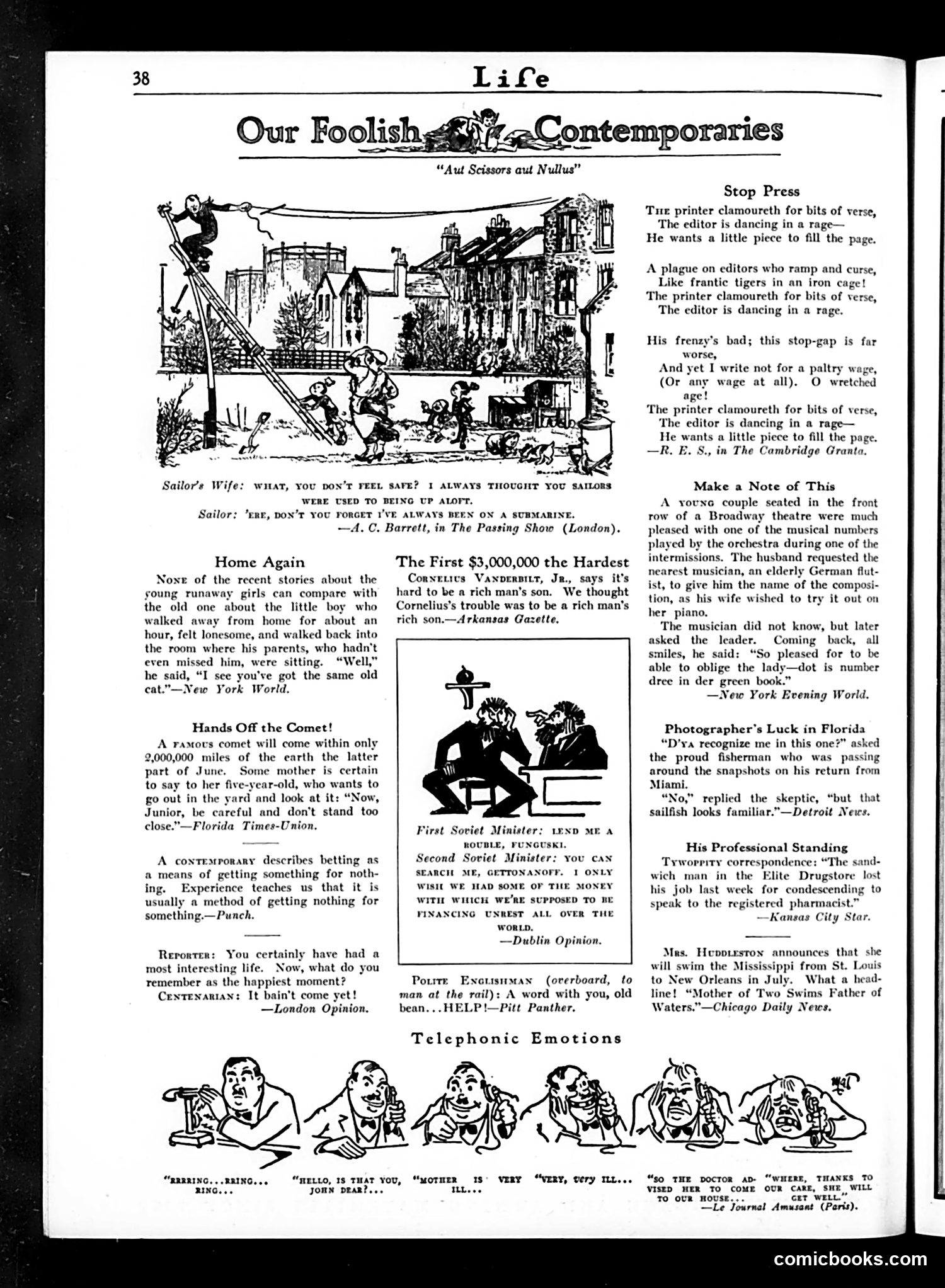
This is a humor page from *Life* magazine featuring several short satirical pieces and cartoons about contemporary early-20th-century life. **Key items:** - **"Stop Press"**: A meta-joke about magazine production—printers demanding content and editors frantically rushing to fill pages. - **"Telephonic Emotions"**: A series of cartoon faces illustrating exaggerated expressions during phone conversations, capturing the anxiety of early telephone communication before visual contact was possible. - **Soviet Ministers joke**: References the newly-formed Soviet Union's claim to fund global communist uprisings while apparently having no money themselves—Cold War-era satire. - **Cornelius Vanderbilt reference**: A quip about wealth dynasties—even being a rich man's son is difficult, implying generational privilege creates its own problems. - **Various anecdotes**: Gentle humor about runaway children, comets, betting, and seafaring mishaps, reflecting period concerns and social observations. The overall tone is lighthearted social commentary typical of 1920s American satirical magazines.
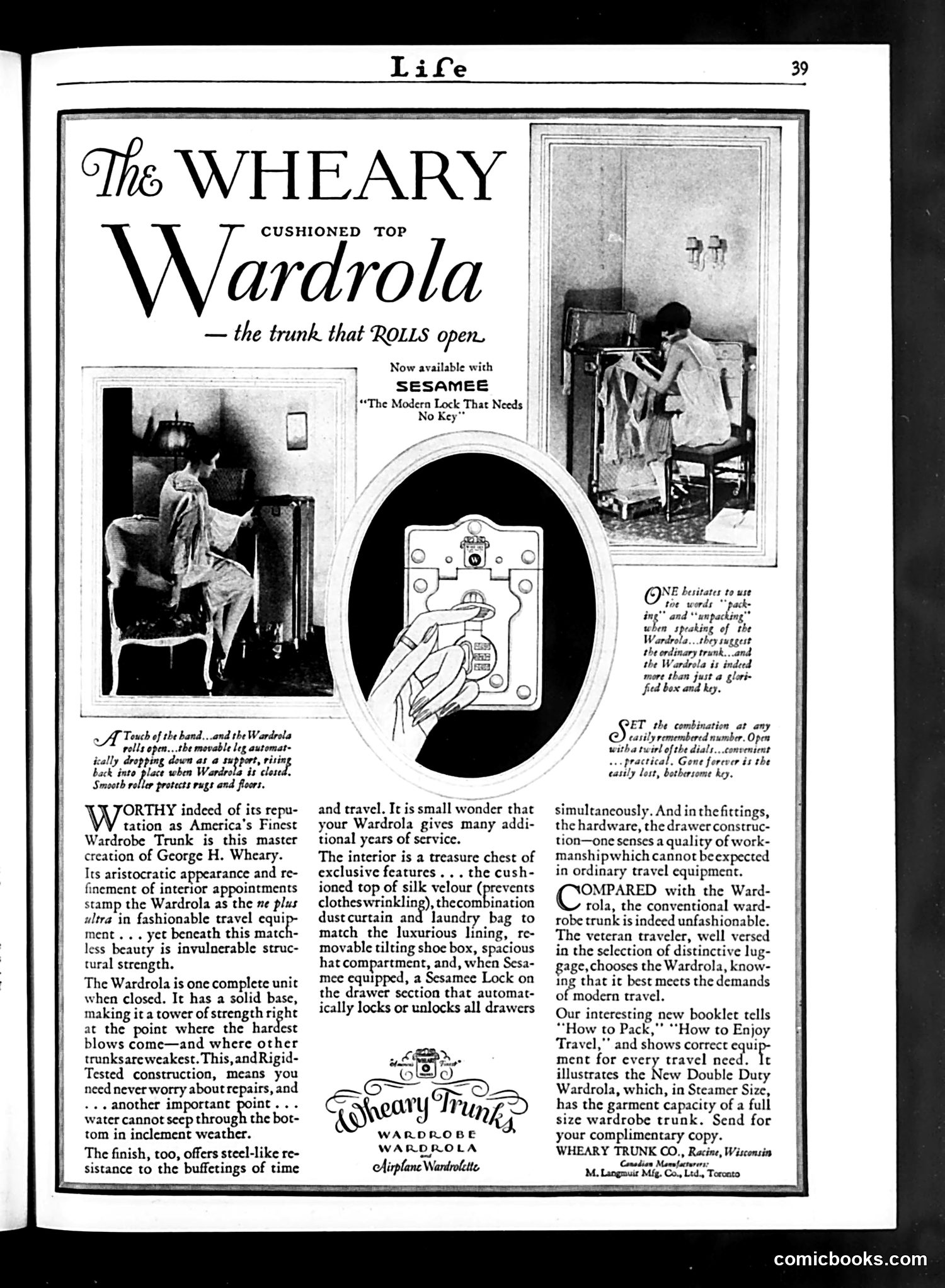
This is a **full-page advertisement**, not political satire. It promotes the "Wardrola," a luxury travel trunk manufactured by the Wheary Trunk Company of Racine, Wisconsin. The ad targets wealthy travelers of the era (likely 1920s), emphasizing the trunk's aristocratic design and engineering features: a cushioned silk-velour top, rolling base, removable shoe box, and (notably) a modern Sesamee keyless lock system. The photographs show fashionable women accessing the trunk's contents. The copy uses deliberately elevated language—calling packing "unpacking" rather than the mundane "packing"—to position this as a status symbol for "veteran travelers" who demand distinction. The ad contrasts the Wardrola favorably against ordinary trunks, appealing to class consciousness and modern convenience. This reflects early-20th-century marketing: luxury goods pitched through lifestyle aspiration rather than practical utility alone.
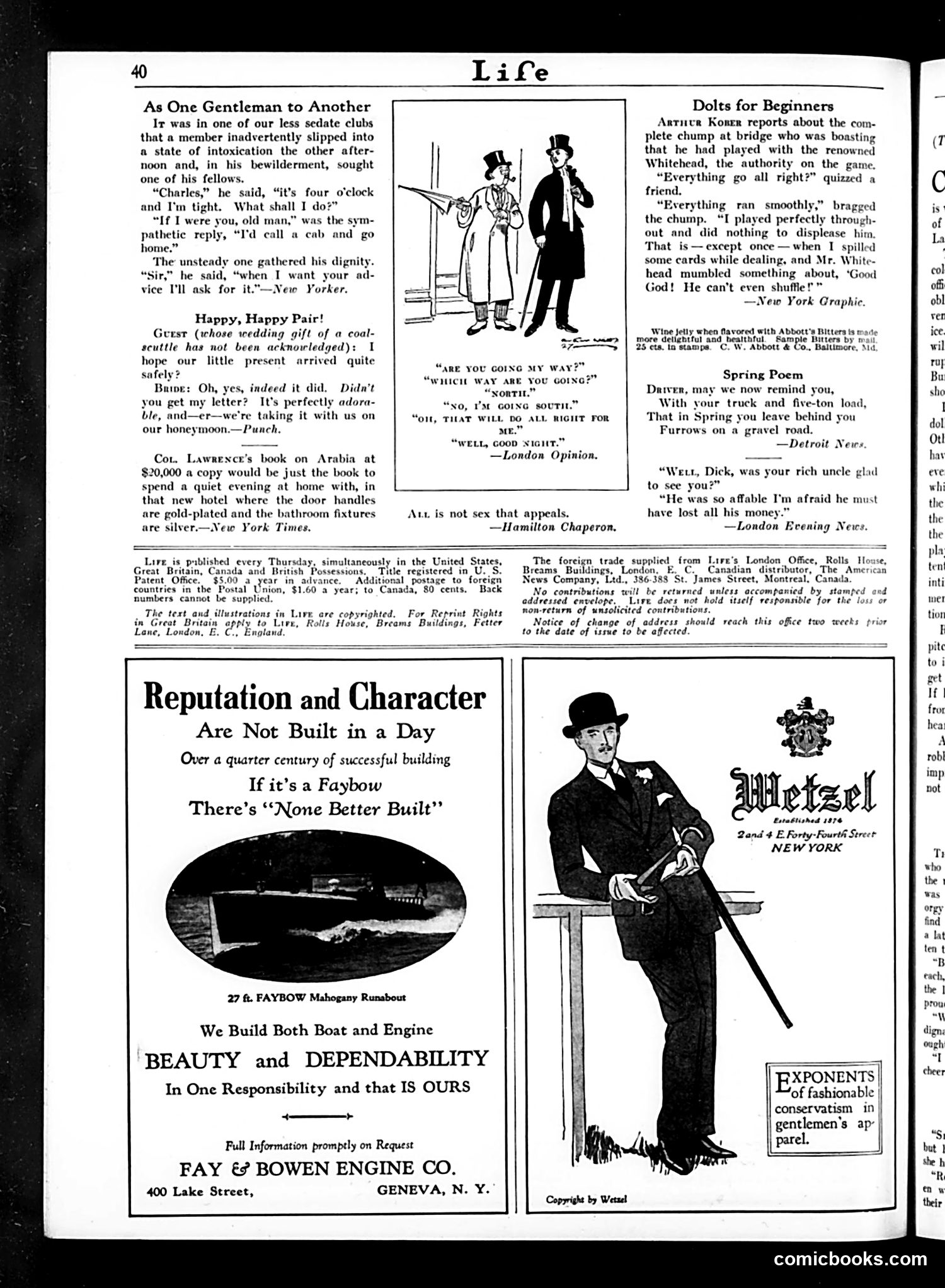
This page from *Life* magazine comprises several brief humorous pieces targeting early 20th-century social conventions and human foibles. **"As One Gentleman to Another"** mocks drunk gentlemen in exclusive clubs. A intoxicated member seeks advice from a fellow club-goer, who sensibly suggests calling a cab—only to be rebuffed with offended dignity. The joke targets male pride and absurd social hierarchies. **"Happy, Happy Pair!"** ridicules newlyweds and bad gift-giving etiquette. A guest's coal-scuttle wedding gift goes unacknowledged; the recipient admits they're taking it on their honeymoon (implying it's useless). The humor highlights social pretense and forced politeness. **"Dolts for Beginners"** features an incompetent bridge player boasting about playing with authority Whitehead—who found him so inept he couldn't even shuffle cards properly. It satirizes social climbing and false confidence. The remaining items are brief one-liners about intoxicated club members, spring road damage, and a nephew's wasted inheritance—typical *Life* humor targeting manners, excess, and stupidity.
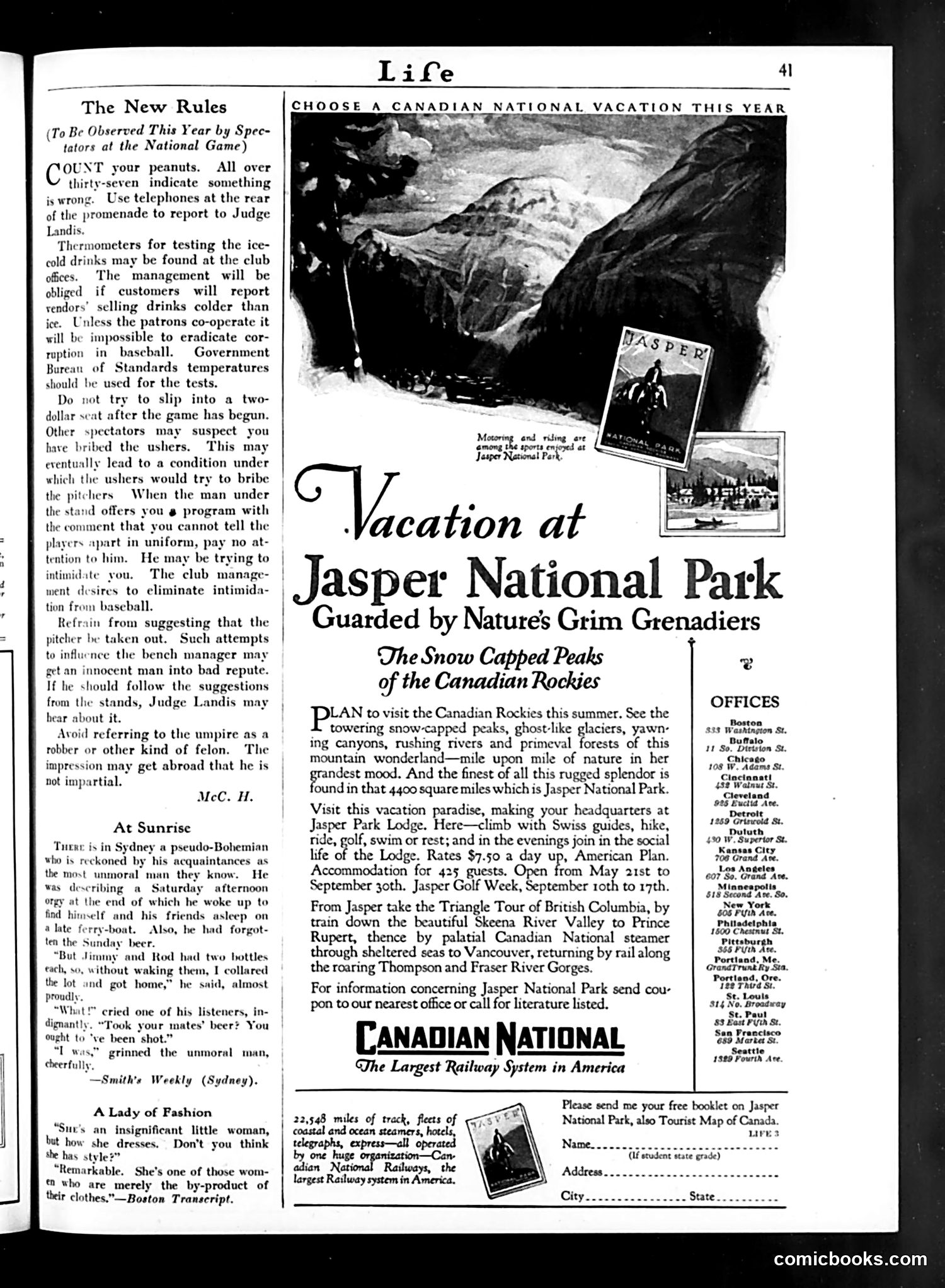
This page contains a **satirical sports column** and **vacation advertisement**, both reflecting early-20th-century concerns. "The New Rules" mocks **1920s baseball corruption**. Judge Landis (baseball's first commissioner, appointed 1920) was fighting widespread game-fixing scandals. The satire presents absurd rules ostensibly to prevent bribery—counting peanuts, measuring drink temperatures, regulating seat access—suggesting the corruption is so endemic that ridiculous oversight has become necessary. References to bribing ushers, pitchers, and umpires reflect real gambling and match-fixing scandals that plagued the era. The page also includes two brief humorous anecdotes and an advertisement for Jasper National Park in Canadian Rockies, promoting rail travel and vacation amenities. The satire's point: institutional corruption in baseball has become so normalized that prevention requires comically excessive bureaucratic control.
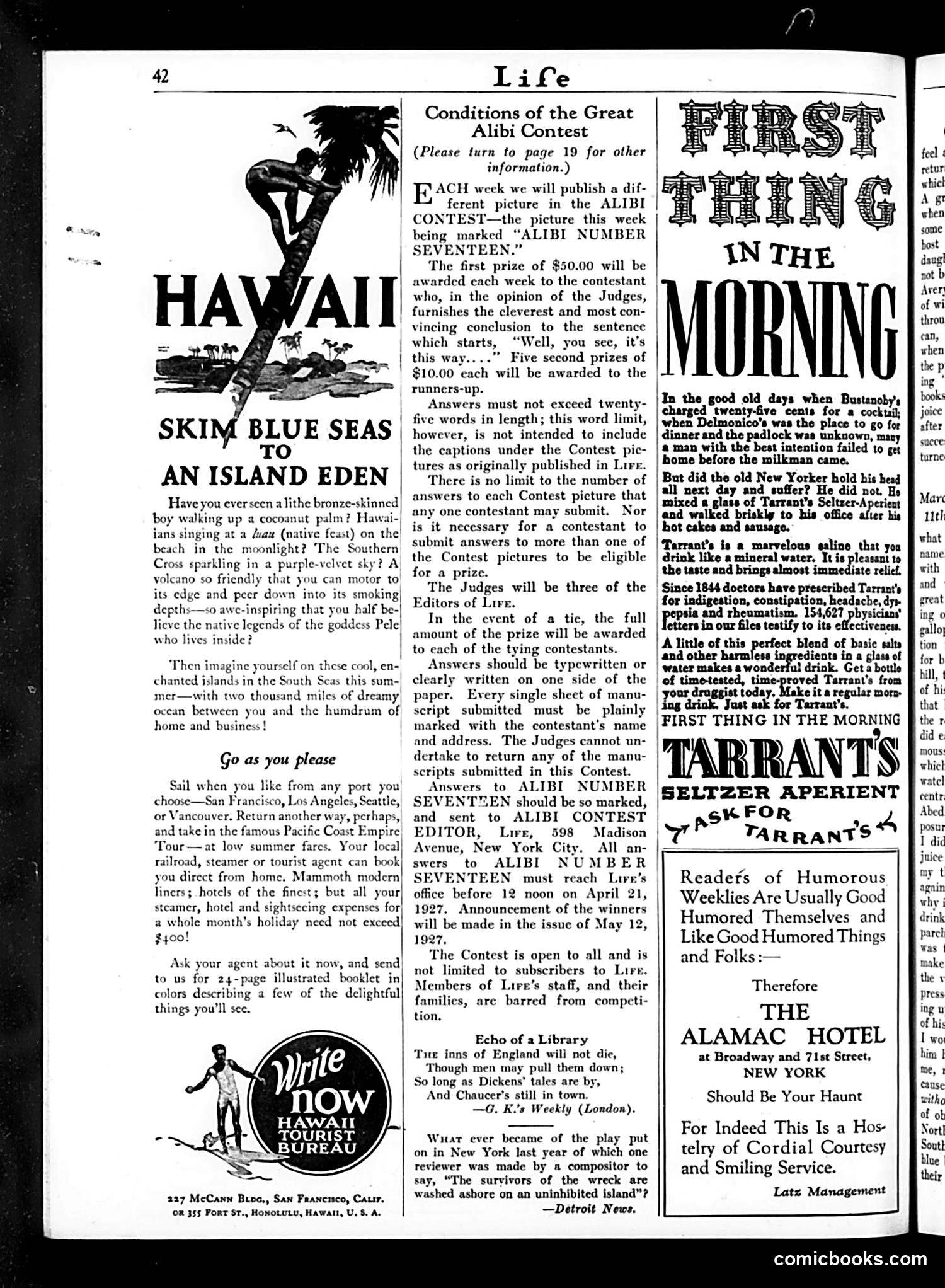
This page is primarily **advertising and contest information** rather than political satire. The left side contains a **Hawaii tourism advertisement** promoting travel by ship to Hawaiian islands, appealing to leisure travelers with romanticized imagery of "bronze-skinned" Hawaiians, native feasts, and volcanoes. This reflects early 1920s tourism marketing. The center details the **"Alibi Contest"** — a reader participation feature where Life's editors would publish pictures weekly and readers submitted humorous captions completing the phrase "Well, you see, it's this way...." Prizes were $50 for first place and $10 for runners-up, with answers due April 21, 1927. The right side contains advertisements for **Tarrant's Seltzer Aperient** (a laxative) and the **Alamac Hotel** in New York City. At the bottom, brief literary filler appears, including a quote from a Detroit newspaper poking fun at a compositor's error changing "uninhabited" to "uninhibited." The page reflects Life as a satirical weekly mixing travel advertising, reader contests, and light humor.
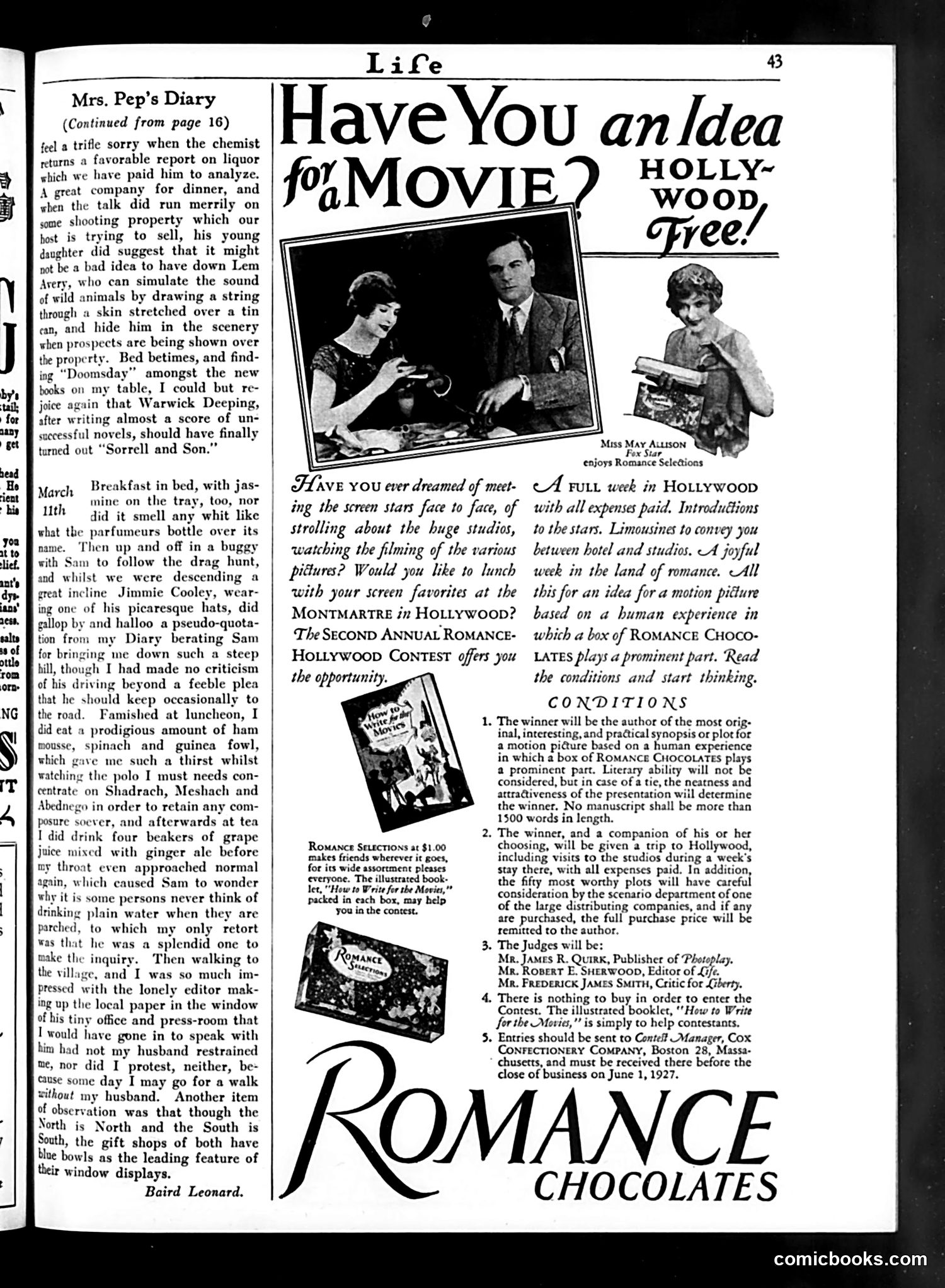
This page combines a society diary column with a major advertising promotion. "Mrs. Pep's Diary" (left) is a gossipy, lighthearted account of upper-class social activities—country house visits, polo matches, drag hunts—written in a deliberately arch, affected style that gently mocks the pretensions of the wealthy. The dominant content is **Romance Chocolates' movie-idea contest**. This was a marketing gimmick offering a week-long Hollywood trip (with studio visits and meetings with film stars) to whoever submitted the best movie synopsis featuring their product. The contest reflects 1920s consumer culture: corporations sponsored creative competitions to boost brand loyalty. The judges listed—including the editor of *Life* magazine itself—gave the contest legitimacy and tied it to the magazine's satirical mission of commentary on American society and commerce. The overall effect is satirical: Life simultaneously publishes society gossip mocking the wealthy while hosting an advertisement that exemplifies the commercial, product-placement-driven culture those same wealthy people inhabited.
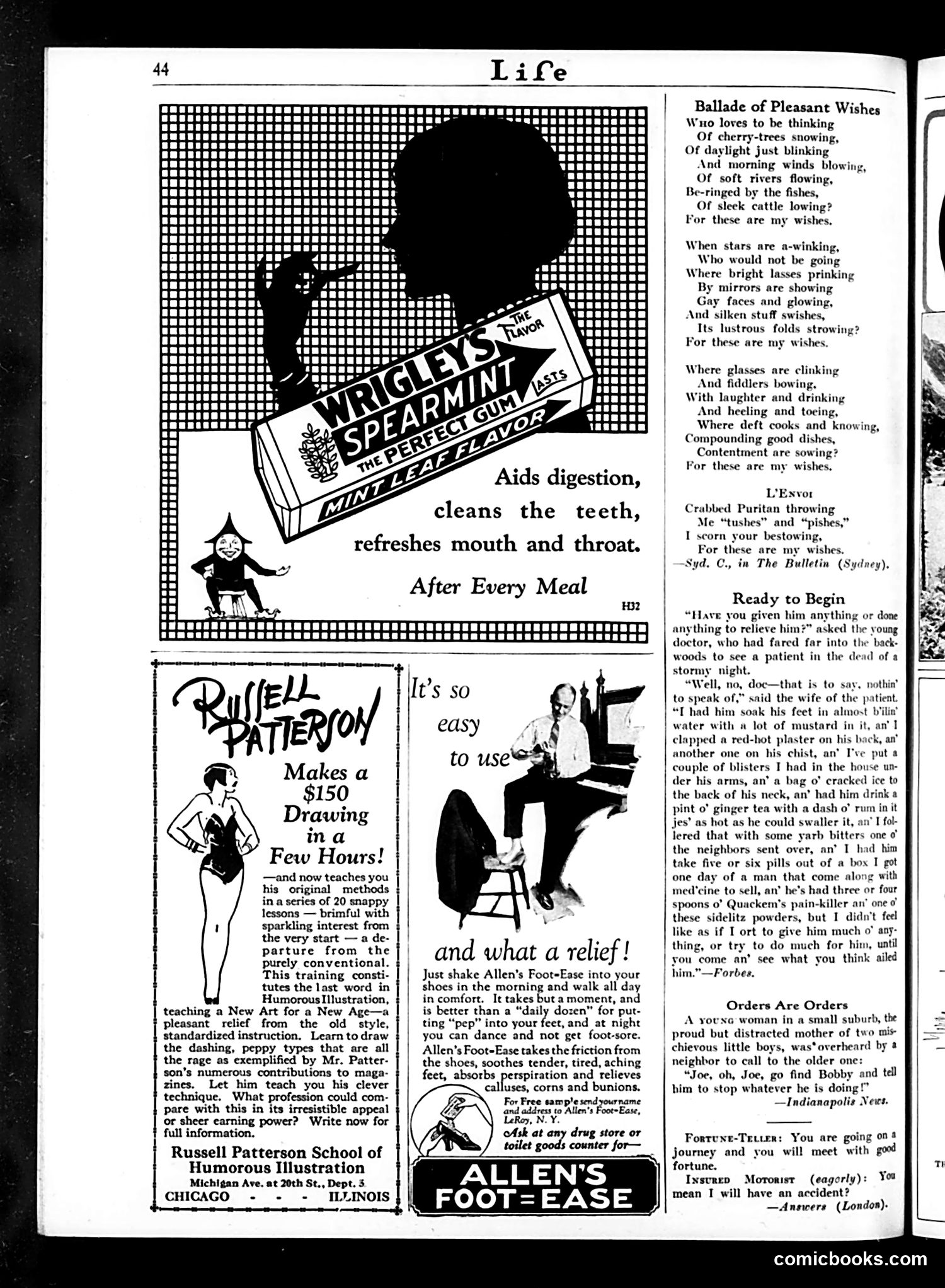
This is primarily an **advertising page** with some poetry and short humor pieces. The main advertisements include: 1. **Wrigley's Spearmint Gum** — A silhouette illustration shows someone chewing gum with the claim it "aids digestion, cleans the teeth, refreshes mouth and throat. After Every Meal." 2. **Russell Patterson School of Humorous Illustration** — An ad promoting Patterson's cartooning instruction course, emphasizing his modern "peppy" style and earning potential. 3. **Allen's Foot-Ease** — A powder product promising relief from sore, tired feet and perspiration. The **non-advertising content** includes: - "Ballade of Pleasant Wishes," a poem celebrating simple rural and social pleasures - Short humorous anecdotes: one about a rural wife's excessive home remedies before the doctor arrived, another about a mother's parenting struggles These pieces reflect early 20th-century *Life* magazine's format mixing satire, advertising, and light domestic humor for middle-class readers.
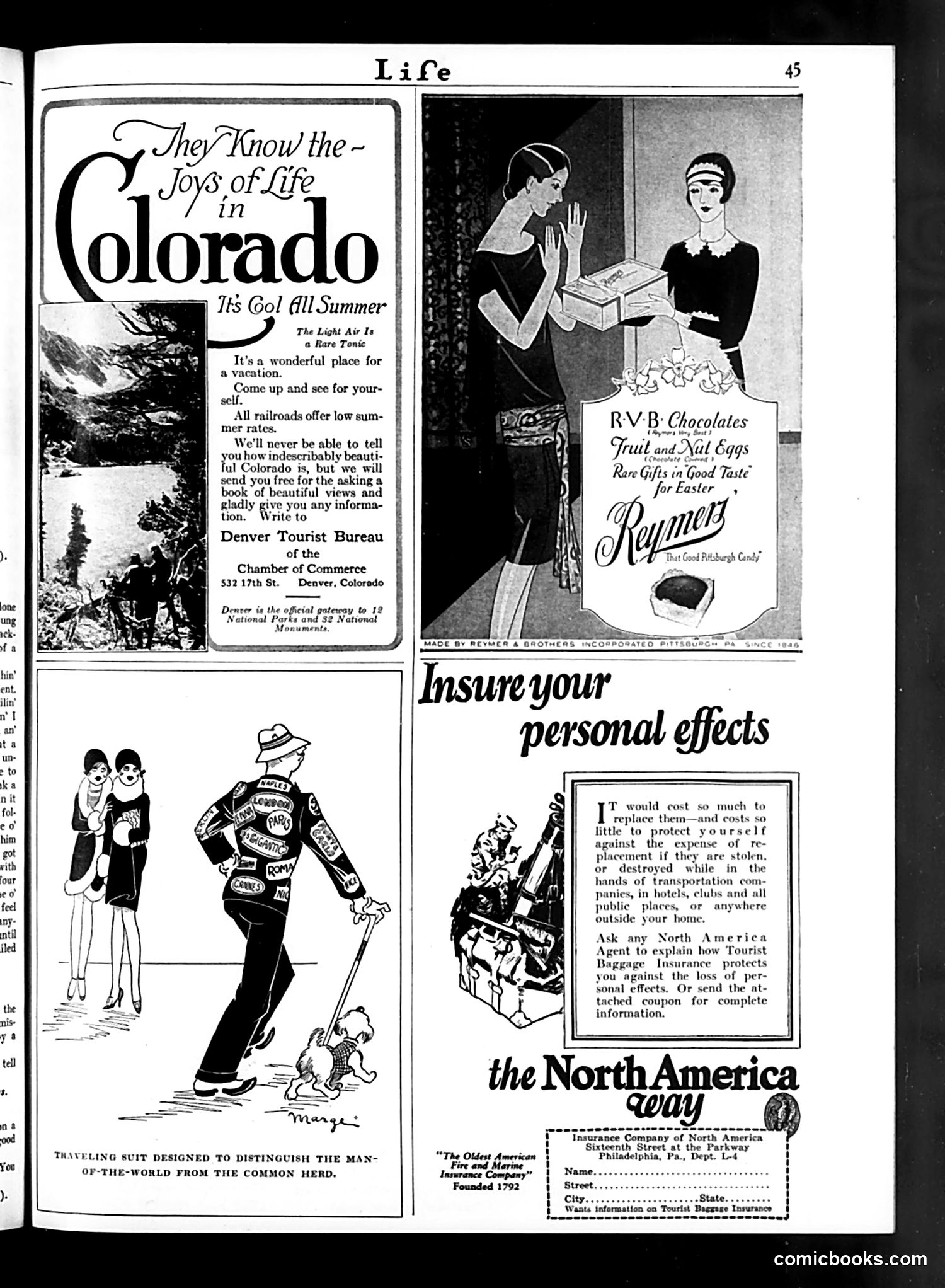
This page contains primarily **advertisements and travel promotion** rather than political satire. The top left features a **Colorado tourism ad** from the Denver Chamber of Commerce, promoting summer vacations with scenic mountain imagery. The top right shows a **Reimers chocolate advertisement** with two illustrated women, one presenting a gift box of Easter candies. The bottom left cartoon, captioned "Traveling Suit Designed to Distinguish the Man-of-the-World from the Common Herd," depicts a **skier covered entirely in travel badges and patches** alongside two ordinary people and a small dog. This is gentle **social satire** mocking wealthy travelers who ostentatiously display their worldly credentials through accumulated travel stickers and pins—essentially making themselves walking billboards of their sophistication. The bottom right is a **North America Insurance advertisement** for baggage/personal effects coverage while traveling. The page reflects 1920s leisure culture and the emerging tourism industry.
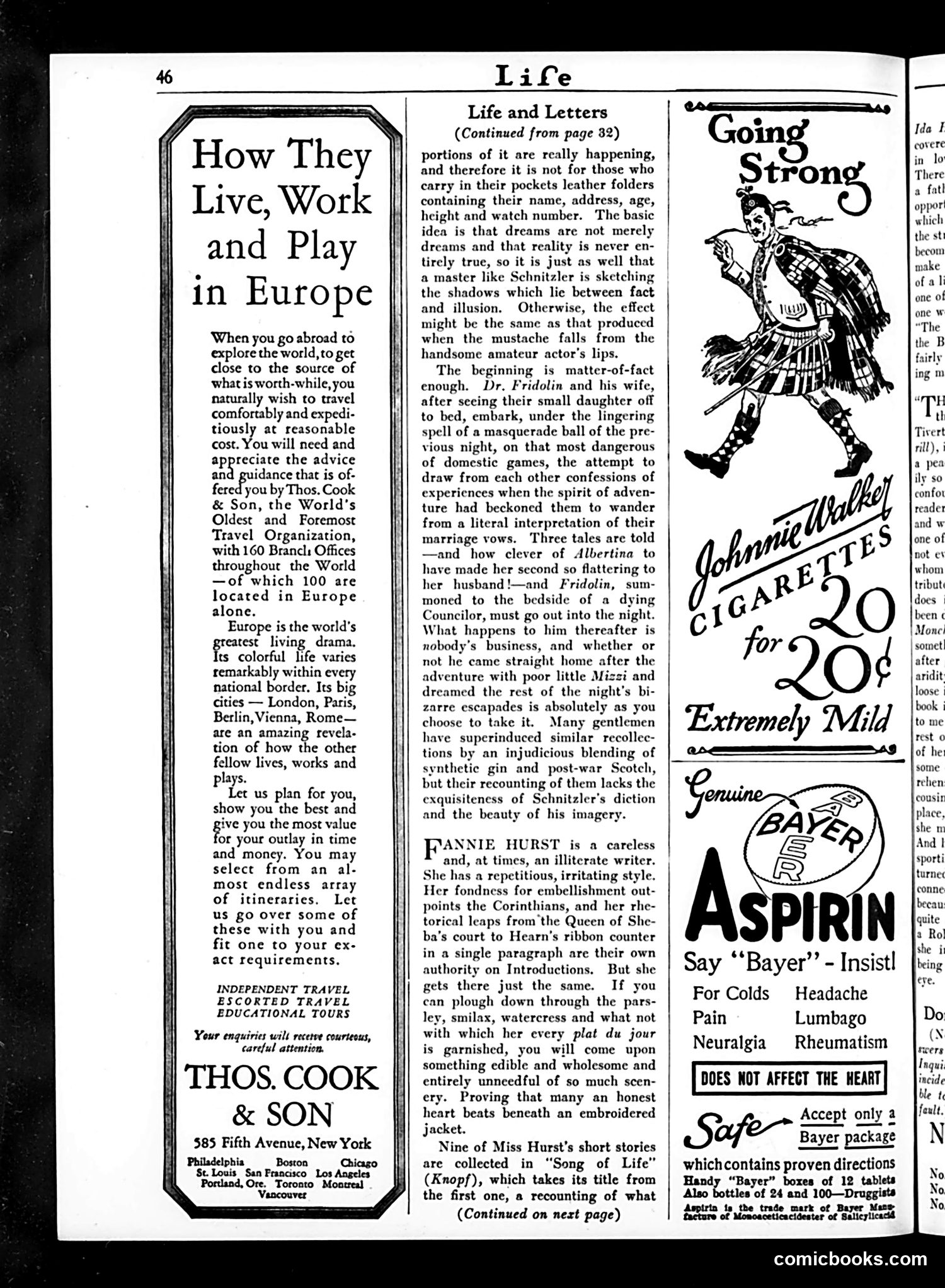
The page is primarily **advertising and book reviews** rather than political satire. The main visual element is a cartoon advertisement for **Johnnie Walker Cigarettes** (20 for 20¢), depicting a jaunty, kilted Scottish figure in exaggerated caricature—representing the brand's Scottish identity and marketing appeal. Below this is a prominent **Bayer Aspirin advertisement**, emphasizing the product's safety and widespread use for common ailments (colds, headaches, pain, etc.). The left column features a **Thos. Cook & Son travel advertisement** promoting European tourism and guided tours. The center contains **book reviews** discussing literary works—including analysis of what appears to be an Arthur Schnitzler novella and Fannie Hurst's writing style. This page reflects **1920s consumer culture**: mass-market pharmaceuticals, international travel becoming accessible to middle-class Americans, and cigarette marketing targeting broad audiences. The ethnic caricature in the Johnnie Walker ad was standard advertising practice of the era, though now considered offensive.
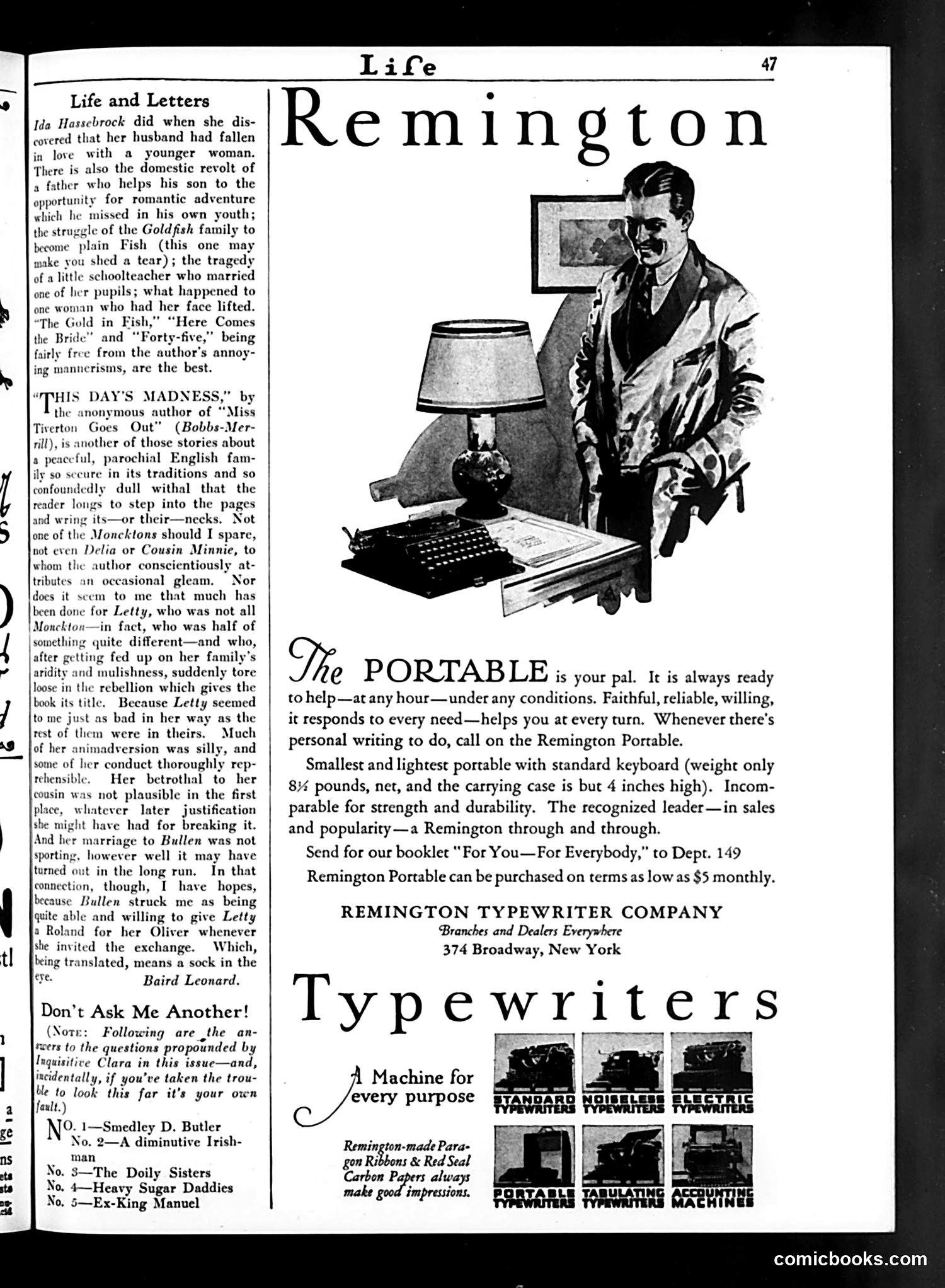
This page combines literary criticism with advertising—it's not primarily a political cartoon. The left column contains **book reviews** by critic Baird Leonard, discussing novels about domestic drama and English family life. The "Don't Ask Me Another!" section is a trivia Q&A feature unrelated to current events. The dominant content is a **Remington Portable typewriter advertisement**. The illustration shows a businessman at his desk with the machine, and the copy emphasizes its reliability and portability for "personal writing." This reflects 1920s-era marketing targeting professionals and businesspeople. Below is a secondary ad listing six typewriter models (Standard, Noiseless, Electric, Portable, Tabulating, and Accounting machines), positioning Remington as offering "a machine for every purpose." **No political satire or caricature appears on this page.** It's a standard period magazine page mixing editorial content with commercial advertising, typical of Life's format during this era.
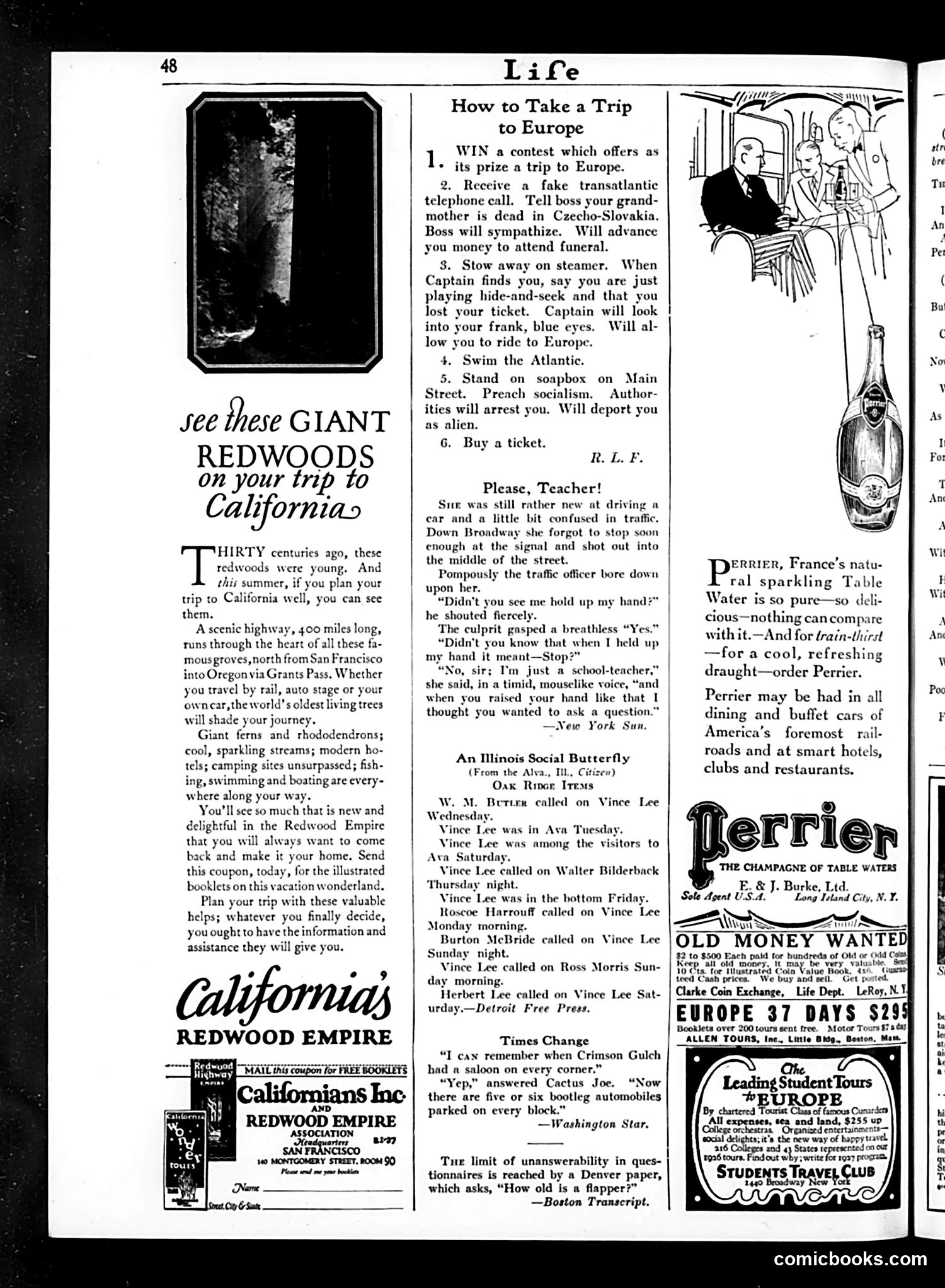
This page contains multiple unrelated satirical pieces typical of Life magazine's format: **"How to Take a Trip to Europe"** is a humorous mock-instruction list that satirizes various methods—some illegal or absurd (stowing away, swimming the Atlantic, preaching socialism to get deported)—before arriving at the mundane solution: "Buy a ticket." The joke mocks both the desperation of ordinary Americans to travel abroad and the era's economic constraints that made European trips seem impossibly difficult. **"Please, Teacher!"** and **"An Illinois Social Butterfly"** are short comic anecdotes typical of the magazine's filler content, using wordplay and observational humor. **"Times Change"** contrasts Prohibition-era bootlegging with the Old West, joking that illegal alcohol distribution now uses automobiles instead of saloons. The remaining content is primarily **advertising**: California redwoods tourism, Perrier water, and travel agencies offering European tours. This reflects Life's business model of mixing editorial satire with paid advertisements.
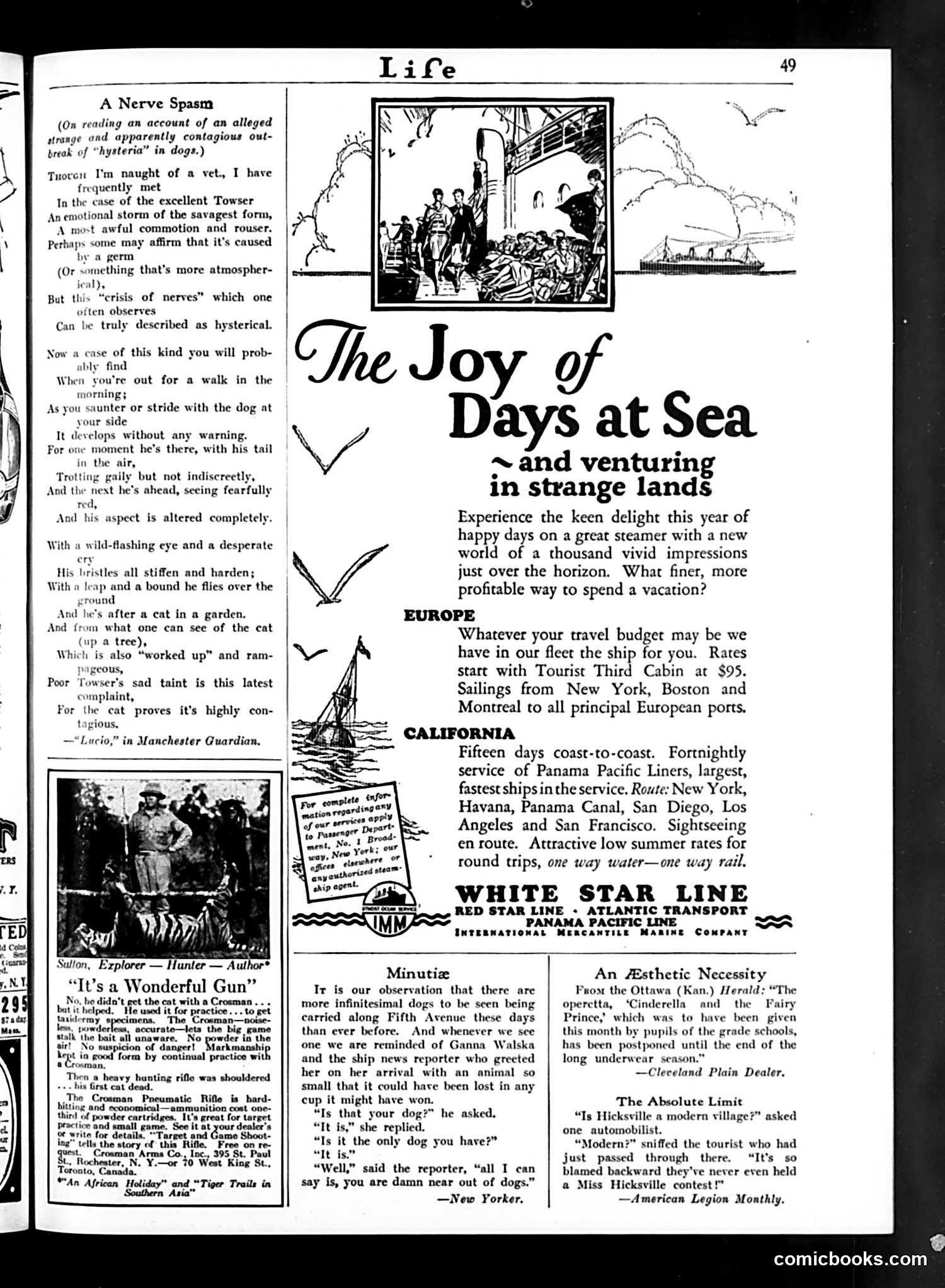
This page is primarily **advertising and filler content** rather than focused political satire. The main content is a humorous poem titled "A Nerve Spasm" mocking dogs' supposedly "hysterical" behavior—apparently responding to a contemporary news story about dogs experiencing nervous breakdowns. The poem describes a dog's sudden, irrational sprint after a cat, humorously suggesting the behavior is contagious. Below is a **Crosman air rifle advertisement** exploiting the poem's premise by showing a boy using the gun for "target practice" before hunting with a real rifle. The remainder is **cruise ship advertising** (White Star Line, Red Star Line, Panama Pacific Line) promoting European and California voyages, and brief humorous **newspaper fillers** about small dogs on Fifth Avenue (referencing socialite Ganna Walska) and opera production logistics. The page reflects **1920s-era Life magazine content**: light satire mixed with advertisements and brief comedic anecdotes from other newspapers. No specific political figures or major events are referenced.
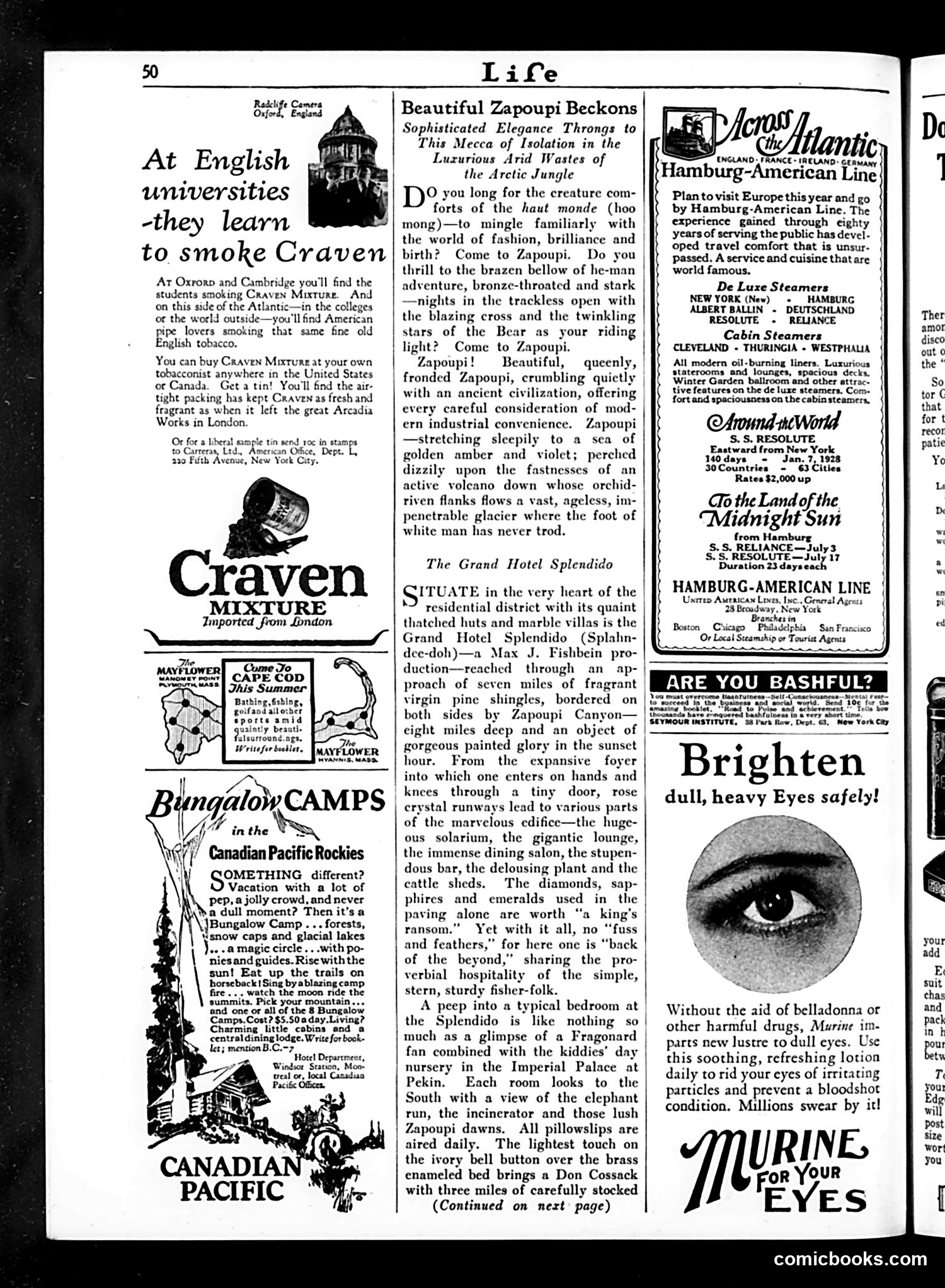
This is a satirical advertisement mocking the overwrought language of 1920s luxury travel marketing. "Zapoupi" appears to be a fictional, impossibly remote destination—described as located in an "Arctic Jungle" with volcanoes, glaciers, and elephant runs (geographically absurd). The satire targets travel industry hyperbole: the resort promises both extreme adventure ("he-man adventure") and refined elegance simultaneously, while featuring absurd amenities (a "delousing plant," accessed by crawling through a tiny door on hands and knees). The Grand Hotel Splendido's description escalates the parody—diamond-paved floors, a decadent yet rustic setting, pretentious French ("haut monde"), and incongruous details (Imperial Palace nursery combined with fisher-folk hospitality). The joke exposes how luxury travel brochures marketed exotic, "uncivilized" locations to wealthy Americans while promising impossible combinations of comfort and authentic adventure. The internal contradictions reveal the hollowness of such marketing.
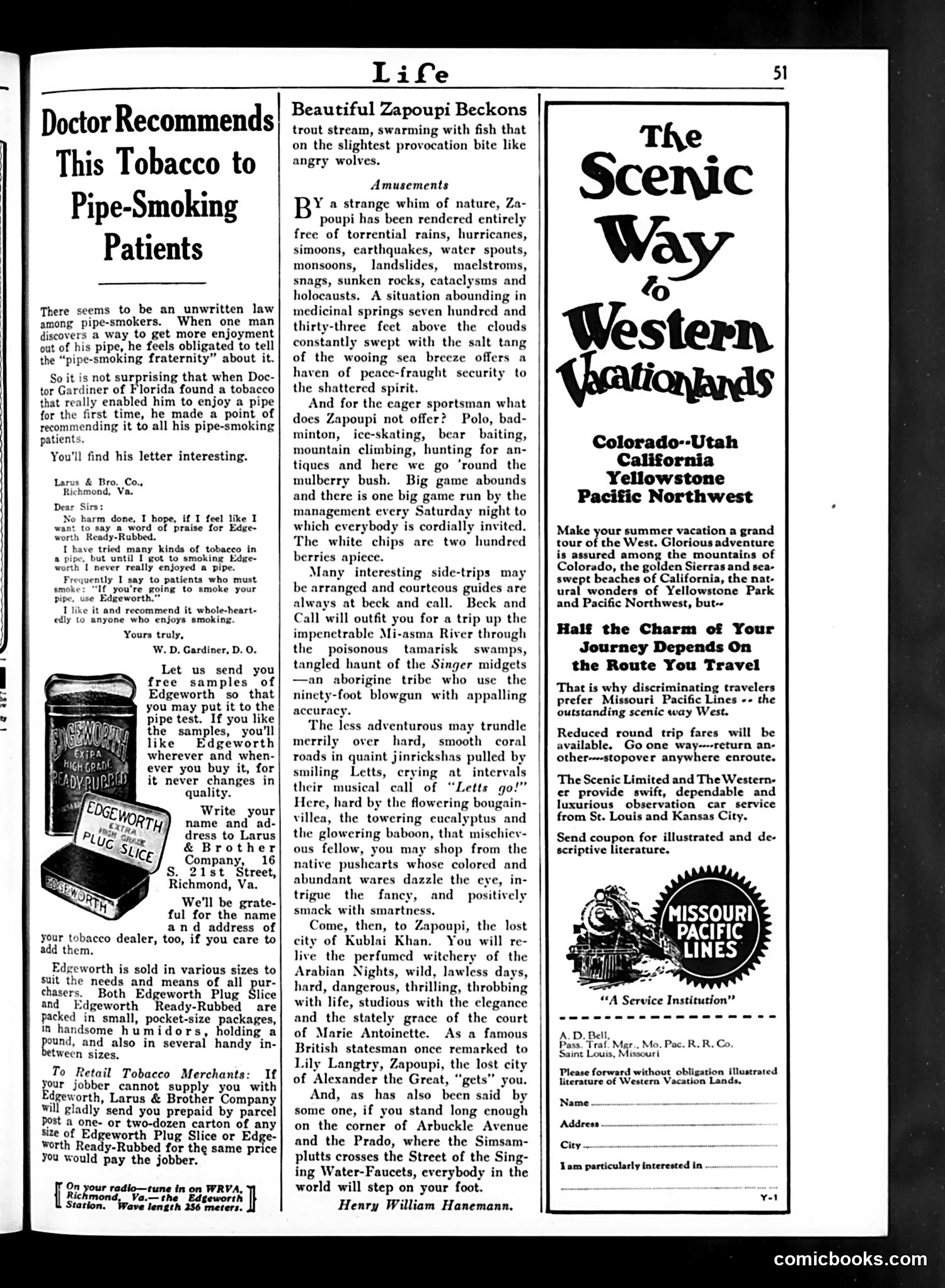
This page contains two distinct pieces: **Left side: Tobacco advertisement** featuring a doctor's endorsement of Edgeworth pipe tobacco. A Dr. W.D. Gardiner of Florida testifies that he recommends this brand to pipe-smoking patients because it finally enabled him to enjoy smoking. This is a straightforward product advertisement using medical authority as persuasion—a common marketing tactic of the era when such claims were permissible. **Right side: Travel satire** titled "The Scenic Way to Western Vacationlands." This is humorous fiction promoting a fictional resort called "Zapoupi" through absurdist exaggeration. The text mockingly describes an implausibly perfect location: free from all natural disasters, offering unlikely activities ("bear baiting," "Singer midgets" with blowguns), and featuring gambling ("big game run by management"). The satire ridicules travel brochure hyperbole and questionable resort marketing claims. Both pieces exemplify 1920s commercial culture—one straightforward advertising, one satirizing travel industry deception.
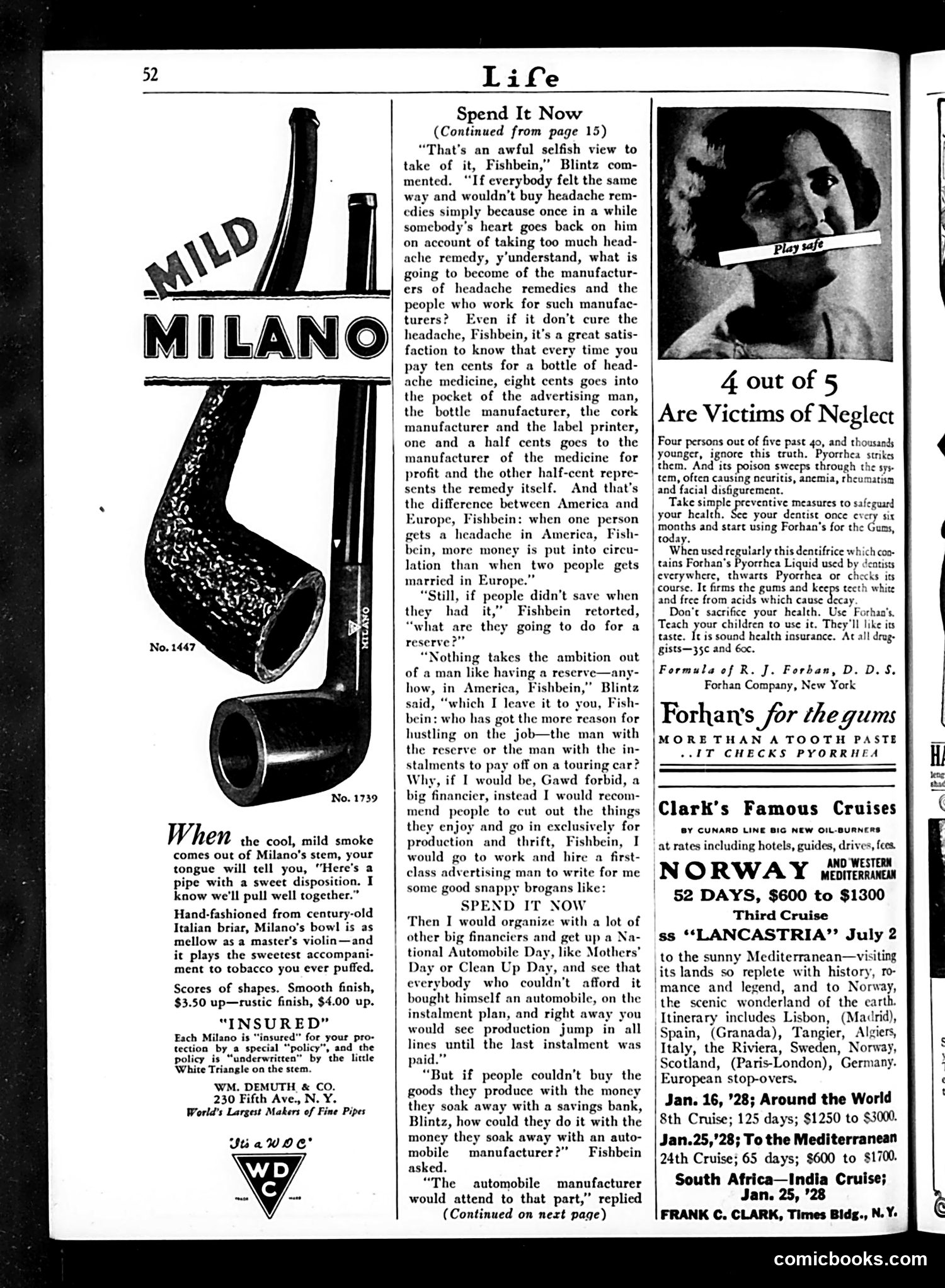
This page contains **satirical dialogue about consumer spending habits** (the "Spend It Now" column) alongside period advertisements. The cartoon satirizes arguments made by **Blintz**, an apparent financier or economist character, who advocates aggressive consumer spending and production. He argues that people should buy goods (particularly automobiles) on installment plans rather than save money—claiming this stimulates the economy and keeps workers employed. His logic is circular: he'd hire advertisers to convince poor people to buy cars they can't afford, believing this cycle benefits production. **Fishbein** (presumably another character) represents the opposing view, questioning the logic of spending money borrowed from manufacturers rather than using savings. The satire critiques **1920s consumer capitalism and installment-plan economics**, mocking the idea that spending beyond one's means benefits society. This reflects genuine debates about consumer credit's role in the pre-1929 economic boom. The surrounding advertisements (Milano pipes, Forhan's toothpaste, cruise lines) are typical period marketing, offering context for the satirical critique of consumer culture.
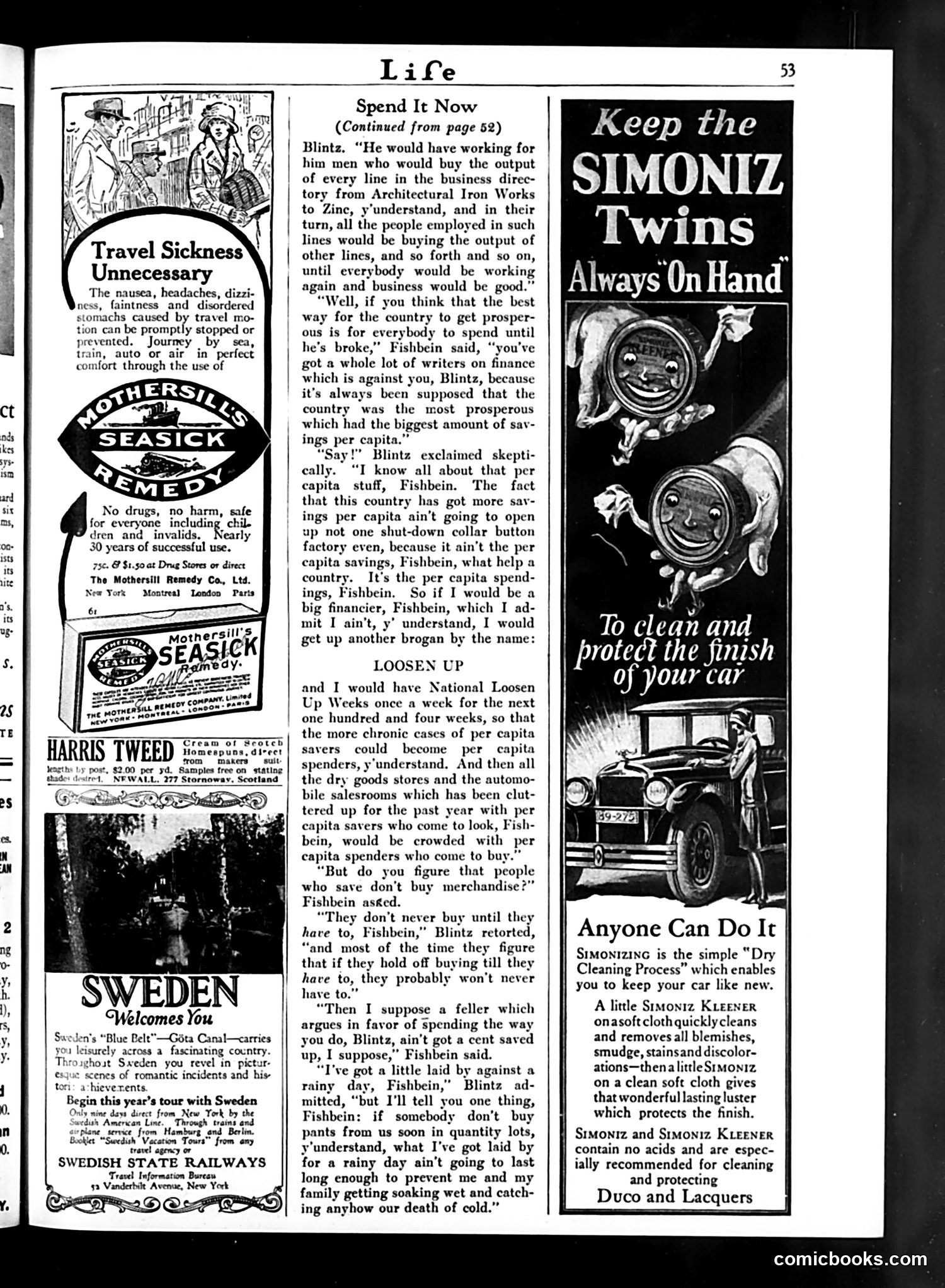
This page features a satirical dialogue between two characters—Blintz and Fishbein—debating Depression-era economic philosophy. Blintz argues for aggressive consumer spending to stimulate business and employment, proposing "National Loosen Up Weeks" to convert savers into spenders. He contends that savings per capita don't help the economy; spending does. Fishbein counters with traditional financial wisdom: that savings indicate prosperity and that people who save eventually do buy goods. The satire mocks both positions through Blintz's malapropisms and working-class dialect, while critiquing the era's competing economic theories during economic hardship. The debate reflects genuine 1920s-30s disagreement about whether saving or spending drives recovery. The page also contains period advertisements (travel, car products) typical of *Life* magazine's commercial content.
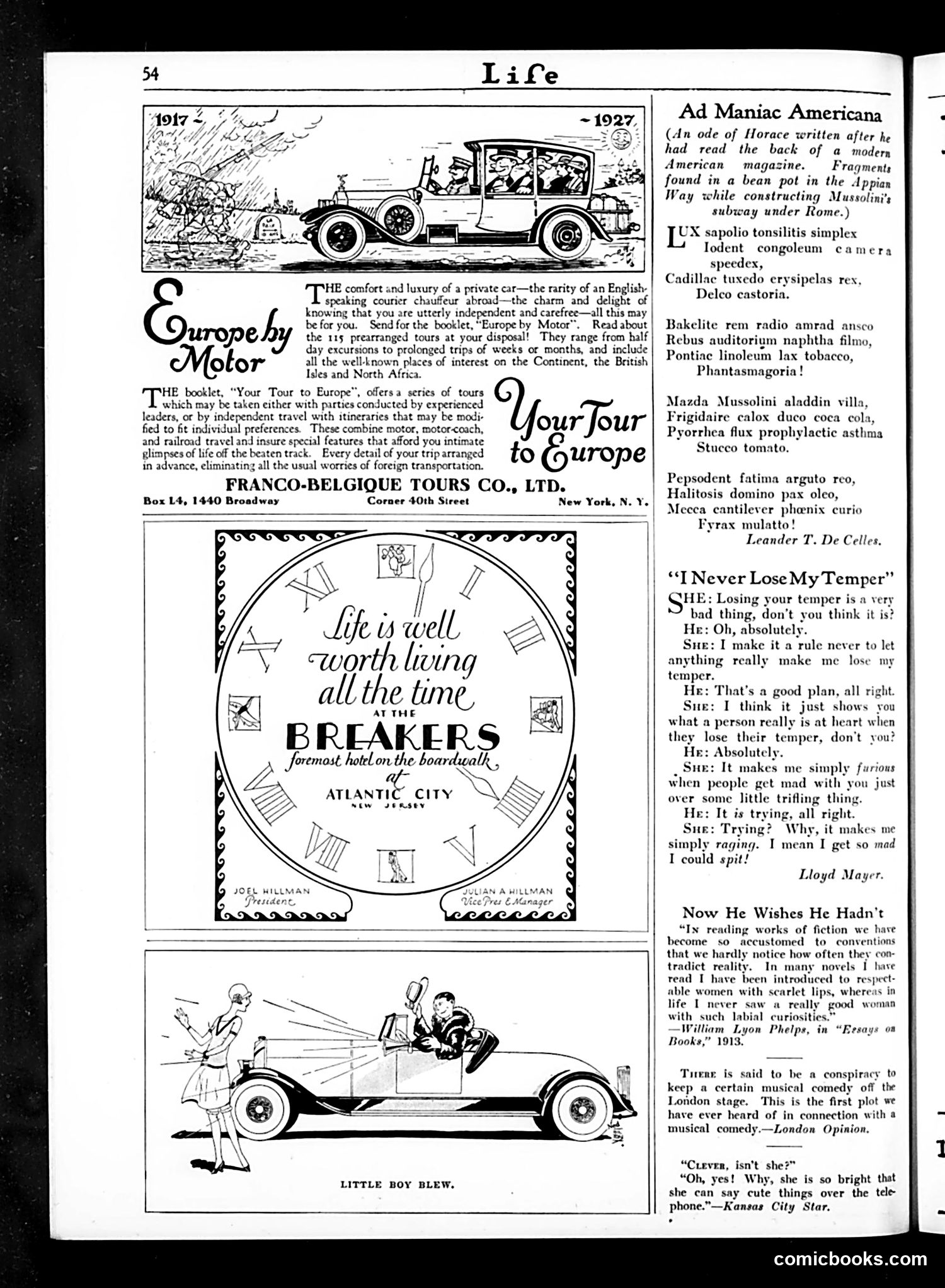
This cartoon parodies the absurdist effect of modern advertising by rewriting the nursery rhyme "Little Boy Blue" as pseudo-Latin poetry composed entirely of brand names and advertising slogans—Sapolio, Cadillac, Frigidaire, Pepsodent, Halitosis, etc. The satire targets how American magazines of the 1920s bombarded readers with product advertisements, making the commercial language so ubiquitous it becomes meaningless nonsense. The Latin framing device (attributing the poem to "Leander T. De Celles" and setting it in ancient Rome) heightens the absurdity: classical literature has been replaced by marketing jargon. The accompanying illustration shows a fashionably dressed woman with a car—herself a walking advertisement. The joke is that consumer culture has invaded and corrupted even high culture and literature.
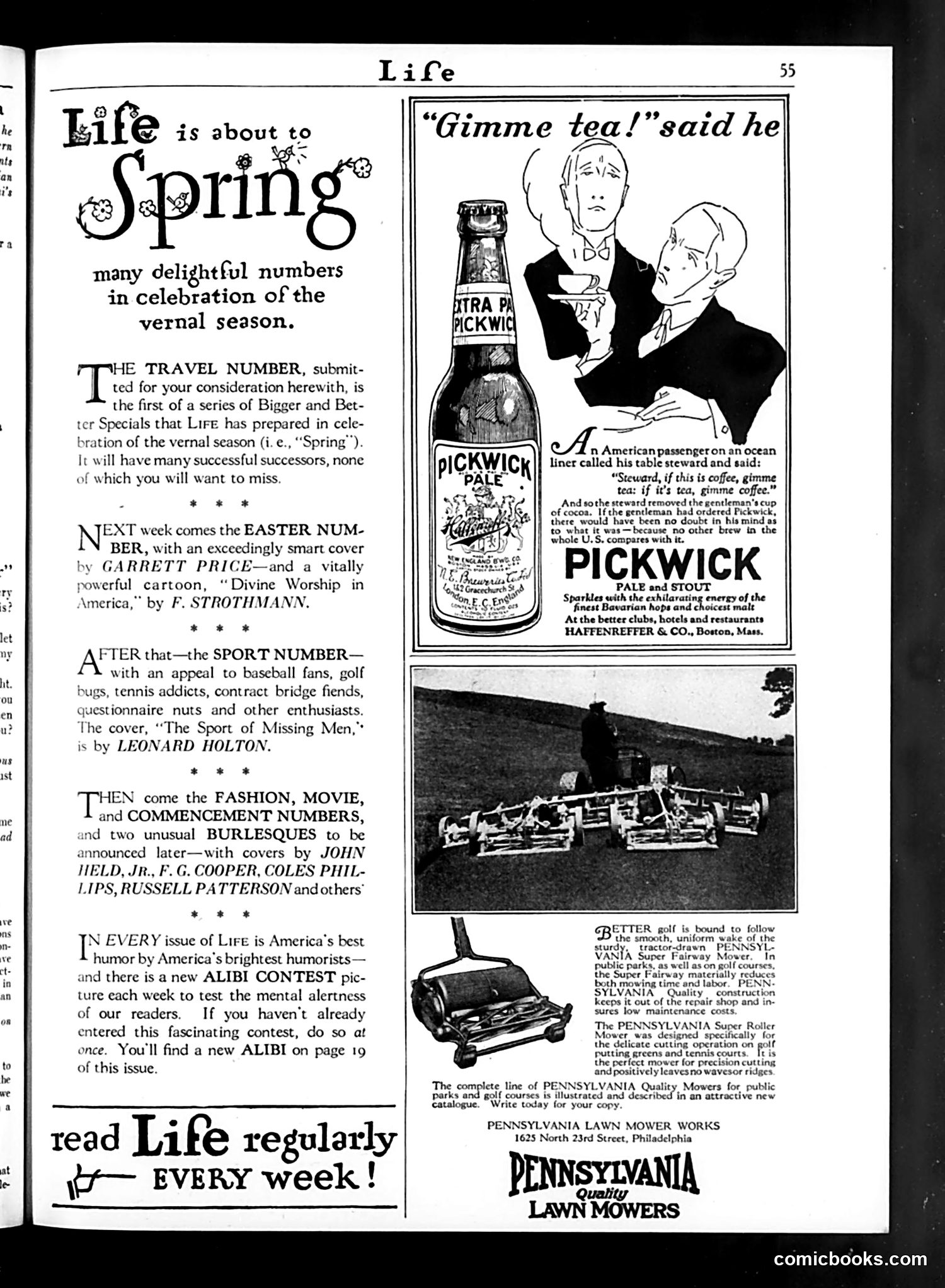
This page announces Life's upcoming "Spring" special issues. The main cartoon depicts a running joke about ambiguous beverage service: an ocean liner passenger complains to his steward that he cannot tell whether he's been served coffee or tea, so demands the steward guess which one to bring him instead. The steward removes what turns out to be cocoa—establishing the humor that even the server doesn't know what was served. This cartoon introduces a Pickwick Pale Ale advertisement, which uses the joke's premise to argue their beer is so distinctly flavorful it requires no such confusion. The page is primarily promotional, announcing upcoming special issues (Travel, Easter, Sport, Fashion, Movie, and Commencement numbers) with covers by notable cartoonists like Garrett Price and Leonard Holton. It also promotes an "Alibi Contest" for readers. The remaining space features advertisements for Pennsylvania Lawn Mowers, typical for the era.
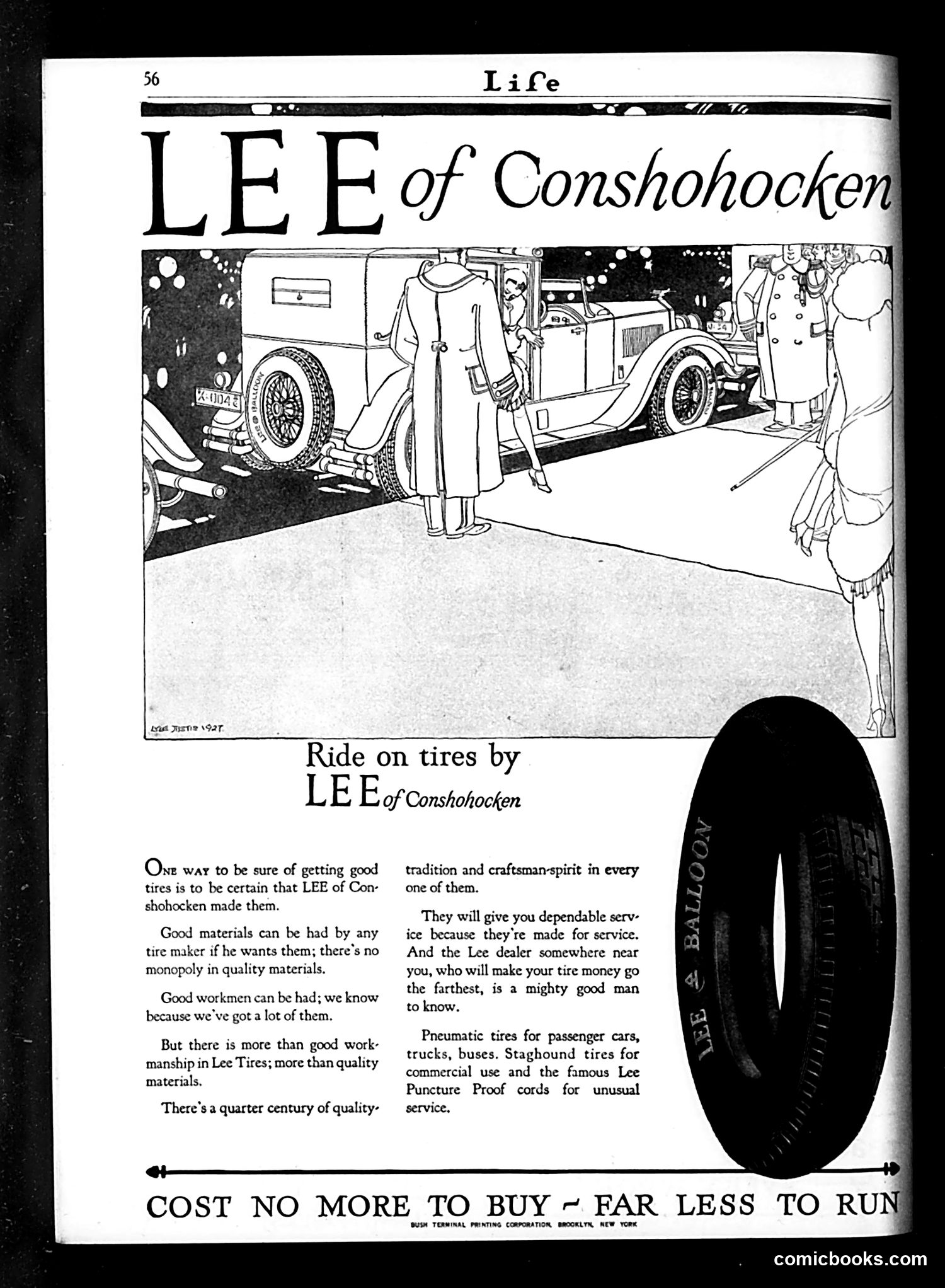
This is a **full-page advertisement**, not satire or political commentary. It promotes Lee Tires, manufactured in Conshohocken, Pennsylvania. The illustration depicts a 1920s street scene with well-dressed women admiring automobiles, establishing an aspirational lifestyle context for the product. The advertisement emphasizes Lee's competitive advantages: quality materials, skilled workmanship, and crucially, a "quarter century of quality-tradition"—appealing to consumer confidence through established reputation. The key selling point is the slogan "COST NO MORE TO BUY ~ FAR LESS TO RUN," claiming Lee tires offer superior value despite comparable pricing. The ad mentions specialized products like "Puncture Proof cords" for unusual service, targeting both passenger and commercial markets. The signature date appears to be 1927, placing this during the automobile boom era when tire quality directly impacted vehicle reliability and safety on emerging road systems.
I can see this is a black and white page that appears to be mostly blank or very dark, making it difficult to discern specific cartoon content, figures, or text beyond the "comicbooks.com" watermark at the bottom right. The OCR text provided only contains that watermark and no actual article or caption content that would help identify the political or social references, caricatured figures, or satirical intent. Without being able to clearly see cartoon illustrations or readable text describing specific political events, public figures, or social commentary, I cannot responsibly identify what this page is meant to satirize or explain its historical context to a modern reader. If you have a clearer version of this page or can provide the full OCR'd text, I'd be happy to analyze it properly.