
Life, 1927-04-07 · page 33 of 59
Life — April 7, 1927 — page 33: what you’re looking at
What you’re looking at
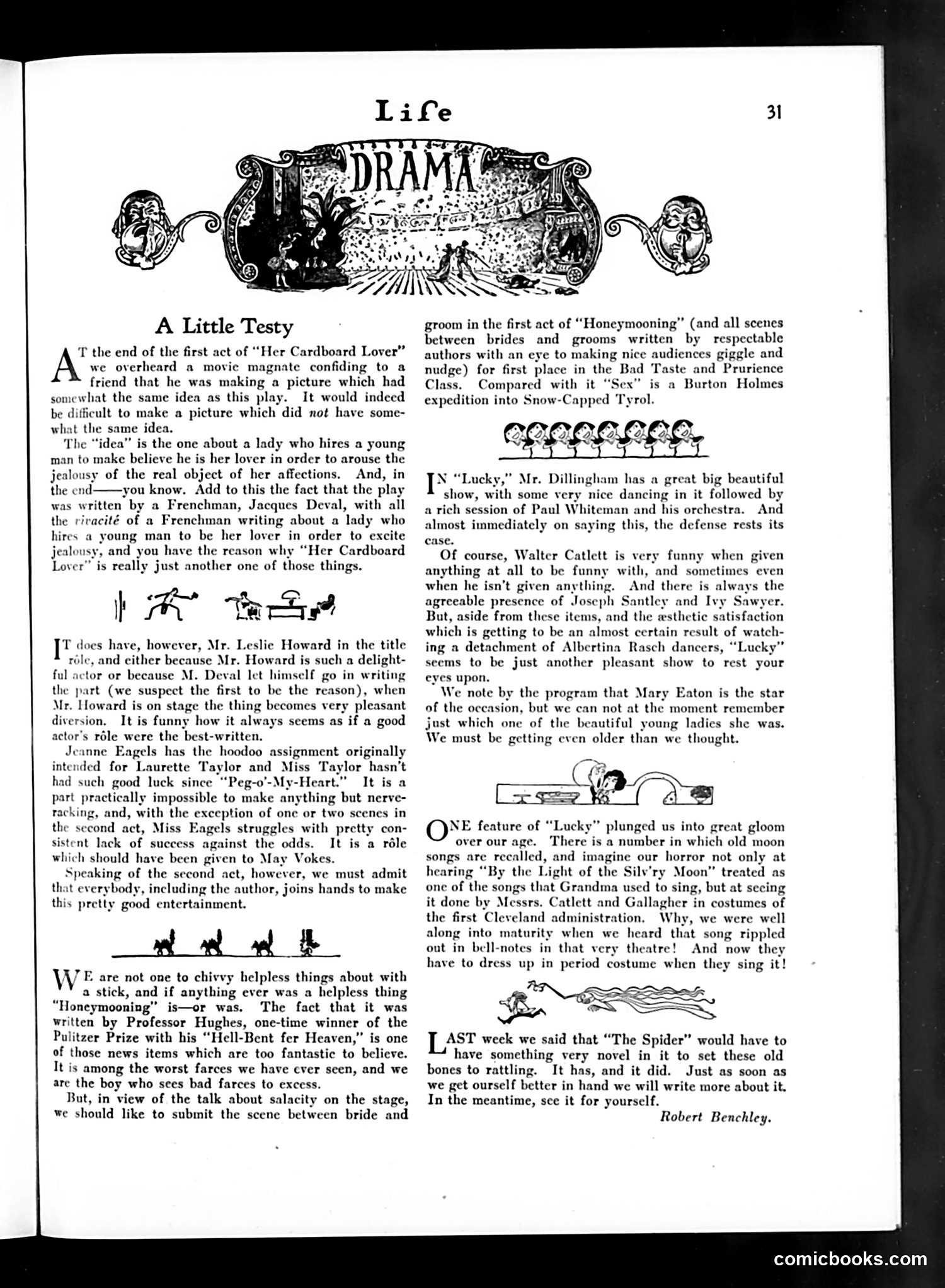
This is a theater review column titled "A Little Testy," critiquing three Broadway productions. The writer—identified at the end as Robert Benchley—employs satirical commentary on contemporary stage fare. **Key References:** - "Her Cardboard Lover": A French play by Jacques Deval about a woman hiring a man to pose as her lover to provoke jealousy—dismissed as derivative Hollywood fare - "Honeymooning": Written by Professor Hughes (Pulitzer Prize winner of "Hell-Bent fer Heaven"), yet deemed among "the worst farces we have ever seen" - "Lucky": A musical revue featuring dancer Mary Eaton, Paul Whiteman's orchestra, and comic Walter Catlett **The Satire:** Benchley mocks both the predictable plots plaguing theater and cinema, and the pretentiousness of claiming moral concern about stage "salacity" while producing genuinely bad entertainment. The humor lies in his bemused observation that good acting cannot redeem poor material, and that audiences—including himself—keep attending anyway.
📄 Transcribed text from this page (OCR, searchable)
Machine-transcribed from the original scan — historical spelling and the odd misread are preserved.
A Little Testy A T the end of the first act of ‘Her Cardboard Lover” we overheard a movie magnate confiding to a friend that he was making a picture which had somewhat the same idea as this play. It would indeed be difficult to make a picture which did not have some- what the same idea. The “idea” is the one about a lady who hires a young man to make believe he is her lover in order to arouse the jealousy of the real object of her affections. And, in the end you know. Add to this the fact that the play was written by a Frenchman, Jacques Deval, with all the rivacité of a Frenchman writing about a lady who hires a young man to be her lover in order to excite jealo| and you have the reason why “Her Cardboard Lover” is really just another one of those things. be eS I" does have, however, Mr. Leslie Howard in the title role, and cither because Mr. Howard is such a delight- ful actor or because M. Deval let himself go in writing the part (we suspect the first to be the reason), when Mr. Howard is on stage the thing becomes very pleasant diversion, It is funny how it always seems as if a good actor's role were the best-written. Jeanne Eagels has the hoodoo assignment originally intended for Laurette Taylor and Miss Taylor hasn't had such good luck since “Peg-o’-My-Heart.” It is a part practically impossible to make anything but nerve- racking, and, with the exception of one or two scenes in the second act, Miss Eagels struggles with pretty con- sistent lack of succe: It is a réle which should have be Speaking of the second act, however, we must admit that everybody, including the author, joins hands to make this pretty good entertainment. eo a W E are not one to chivvy helpless things about with a stick, and if anything ever was a helpless thing “Honeymooning” is—or was. The fact that it was written by Professor Hughes, one-time winner of the Pulitzer Prize with his “Hell-Bent fer Heaven,” is one of those news items which are too fantastic to believe. It is among the worst farces we have ever seen, and we are the boy who sees bad farces to excess. But, in view of the talk about salacity on the stage, we should like to submit the scene between bride and groom in the first act of “Honeymooning” (and all scenes between brides and grooms written by respectable authors with an eye to making nice audiences giggle and nudge) for first place in the Bad Taste and Prurience Class. Compared with it “Sex” is a Burton Holmes expedition into Snow-Capped N “Lucky,” Mr. Dillingham has a great big beautiful show, with some very nice dancing in it followed by a rich session of Paul Whiteman and his orchestra. And almost immediately on saying this, the defense rests its case. Of course, Walter Catlett is very funny when given anything at all to be funny with, and sometimes even when he isn’t given anything. And there is alw: agreeable presence of Joseph Santley and Iv But, aside from these items, and the s which is getting to be an almost certain re: sult of wate ing a detachment of Albertina Rasch dancers, “Lucky seems to be just another pleasant show to rest your eyes upon. We note by the program that Mary Eaton is the star of the occasion, but we can not at the moment remember just which one of the beautiful young ladies she was. We must be getting even older than we thought. NE feature of “Lucky” plunged us into great gloom over our age. There is a number in which old moon songs are recalled, and imagine our horror not only at hearing “By the Light of the Silv’ry Moon” treated as one of the songs that Grandma used to sing, but at secing it done by Messrs. Catlett and Gallagher in costumes of the first Cleveland administration. Why, we were well along into maturity when we heard that song rippled out in bell-notes in that very theatre! And now they have to dress up in period costume when they sing it! AST week we said that “The Spider” would have to have something very novel in it to set these old bones to rattling. It has, and it did. Just as soon as we get ourself better in hand we will write more about it. In the meantime, sce it for yourself. Robert Benchley. comicbooks.com