
Life, 1927-04-07 · page 28 of 59
Life — April 7, 1927 — page 28: what you’re looking at
What you’re looking at
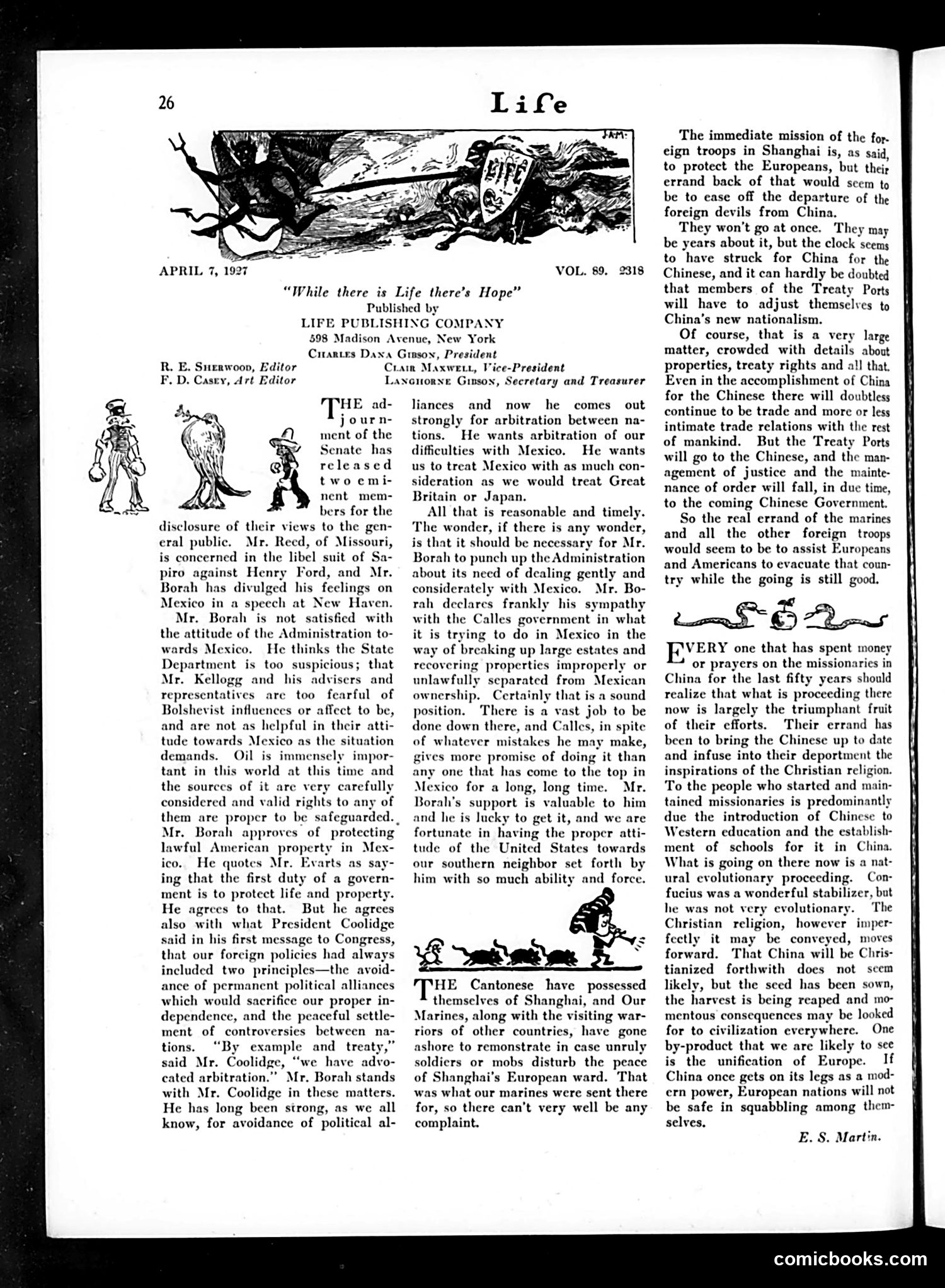
This page contains editorial commentary on two major foreign policy issues: **Mexico:** Senator Borah criticizes the Coolidge administration for being overly suspicious of Mexico and insufficiently supportive of President Calles's land reform efforts. The writer praises Borah's calls for arbitration and respectful treatment of Mexico, arguing the administration should match this diplomatic approach rather than appearing fearful of Bolshevik influence. **China:** The commentary addresses foreign troop presence in Shanghai following Cantonese forces taking the city. While officially protecting European residents, the writer suggests the deeper agenda is managing the "departure of the foreign devils from China"—acknowledging that Western imperial dominance in China is ending, though the transition will be prolonged. The cartoons (spider and figures) appear to illustrate these entangling foreign complications, though their specific meaning is unclear from the image alone.
📄 Transcribed text from this page (OCR, searchable)
Machine-transcribed from the original scan — historical spelling and the odd misread are preserved.
VOL. 89. 2318 “While there is Life there’s Hope” Published by LIFE PUBLISHING COMPANY 598 Madison Avenue, New York Cirartes Dana Grnson, President R. E. Surrwoon, Editor F. D. Casry, Art Editor TH E ad- journ- ment of the Senate has released two emi- nent mem- bers for the disclosure of their views to the gen- eral public. Mr. Recd, of Missouri, is concerned in the libel suit of Sa- piro against Henry Ford, and Mr. Borah divulged his feelings on Mexico in a speech at New Haven. Mr. Borah is not fied with the attitude of the Administration to- wards Mexico. He thinks the State Department is too suspicious; that Mr. Kellogg and his advisers and representatives are too fearful of Bolshevist influences or affect to be, and are not as helpful in their atti- tude towards Mexico as the situation demands. Oil is immensely impor- tant in this world at this time and the sources of it are very carefully considered and valid rights to any of them are proper to be safeguarded. | Mr. Borah approves of protecting lawful American property in Mex- ico. He quotes Mr. Evarts as say- ing that the first duty of a govern- ment is to protect life and property. He agrees to that. But he agrees also with what President Coolidge said in his first message to Congress, that our foreign policies had always included two principles—the avoid- ance of permanent political alliances which would sacrifice our proper in- dependence, and the peaceful settle- ment of controversies between na- tions. “By example and treaty,” said Mr. Coolidge, “we have advo- cated arbitration.”” Mr. Borah stands with Mr. Coolidge in these matters. He has long been strong, as we all know, for avoidance of political al- Cram Maxwett, Vice-President Laxonorxe Ginson, Secretary and Treasurer liances and now he comes out strongly for arbitration between na- tions. He wants arbitration of our difficulties with Mexico. He wants us to treat Mexico with as much con- sideration as we would treat Great Britain or Japan. All that is reasonable and timely. The wonder, if there is any wonder, is that it should be necessary for Mr. Borah to punch up the Administration about its need of dealing gently and considerately with Mexico. Mr. Bo- rah declares frankly his sympathy with the Calles government in what it is trying to do in Mexico in the way of breaking up large estates and recovering properties improperly or unlawfully separated from Mexican ownership. Certainly that is a sound position. There is a vast job to be done down there, and Calles, in spite of whatever mistakes he may make, gives more promise of doing it than any one that has come to the top in Mexico for a long, long time. Mr. Borah’s support is valuable to him and he is lucky to get it, and we are fortunate in having the proper atti- tude of the United States towards our southern neighbor set forth by him with so much ability and force. Re THE Cantonese have possessed themselves of Shanghai, and Our Marines, along with the visiting war- riors of other countries, have gone ashore to remonstrate in case unruly soldiers or mobs disturb the peace of Shanghai's European ward. That was what our marines were sent there for, so there can’t very well be any complaint. The immediate mission of the for. eign troops in Shanghai is, as said, to protect the Europeans, but their errand back of that would scem to be to ease off the departure of the foreign devils from China. They won't go at once. They may be years about it, but the clock ‘seems to have struck for China for the Chinese, and it can hardly be doubted that members of the Treaty Ports will have to adjust themselves to China’s new nationalism. Of course, that is a very large matter, crowded with details about properties, treaty rights and all that. Even in the accomplishment of China for the Chinese there will doubtless continue to be trade and more or less intimate trade relations with the rest of mankind. But the Treaty Ports will go to the Chinese, and the man- agement of justice and the mainte- nance of order will fall, in due time, to the coming Chinese Government. So the real errand of the marines and all the other foreign troops would seem to be to assist Europeans and Americans to evacuate that coun- try while the going is still good. Cm SE Dimes EVERY one that has spent money or prayers on the missionaries in China for the last fifty years should realize that what is proceeding there now is largely the triumphant fruit of their efforts. Their errand has been to bring the Chinese up to date and infuse into their deportment the inspirations of the Christian religion. To the people who started and main- tained missionaries is predominantly due the introduction of Chinese to Western education and the establish- ment of schools for it in China. What is going on there now is a nat- ural evolutionary proceeding. Con- fucius was a wonderful stabilizer, but he was not very evolutionary. The Christian religion, however imper- fectly it may be conveyed, moves forward. That China will be Chris- tianized forthwith does not seem likely, but the seed has been sown, the harvest is being reaped and mo- mentous consequences may be looked for to civilization everywhere. One by-product that we are likely to see is the unification of Europe. If China once gets on its legs as a mod- ern power, European nations will not be safe in squabbling among them- selves, E. S. Martin. comicbooks.com