
Life, 1927-04-07 · page 34 of 59
Life — April 7, 1927 — page 34: what you’re looking at
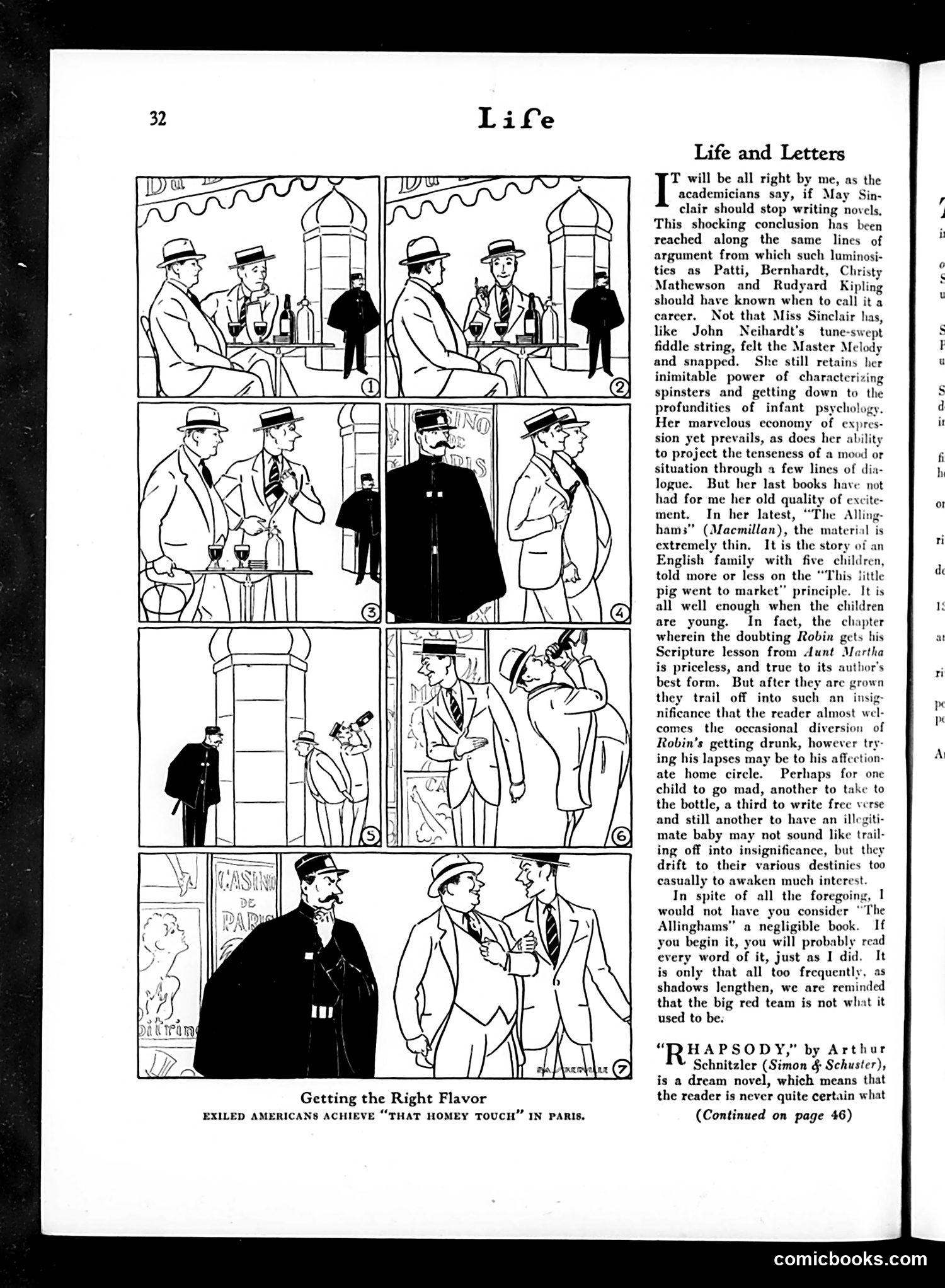
What you’re looking at
This comic strip satirizes American expatriates in Paris during the 1920s-1930s. The seven panels show exiled Americans attempting to recreate familiar "homey" American experiences—dining, socializing, conducting business—while physically located in Paris (indicated by the Parisian architecture). The humor derives from the contrast between their setting and their behavior: despite being abroad, they cling to American mannerisms, dress, and social rituals. The caption's phrase "that homey touch" is ironic—these expatriates cannot escape their Americanness even when trying to embrace European culture. The accompanying essay critiques author May Sinclair's declining literary output, noting that even celebrated writers (Patti, Bernhardt, Kipling) know when to retire. Her latest novel *The Allinghams* is dismissed as thin material about an English family, though competently written. The page reflects broader 1920s-era fascination with American expatriate communities abroad and debates about artistic decline.
📄 Transcribed text from this page (OCR, searchable)
Machine-transcribed from the original scan — historical spelling and the odd misread are preserved.
Getting the Right Flavor EXILED AMERICANS ACHIEVE “THAT HOMEY TOUCH” IN PARIS, Life and Letters T will be all right by me, as the academicians say, if May Sin- clair should stop writing novels, This shocking conclusion has been reached along the same lines of argument from which such luminosi- ties as Patti, Bernhardt, Christy Mathewson and Rudyard Kipling should have known when to call it a career. Not that Miss Sinclair has, like John Neihardt’s tune-swept fiddle string, felt the Master Melody and snapped. She still retains her inimitable power of characterizing spinsters and getting down to the profundities of infant psychology. Her marvelous economy of expres- sion yet prevails, as does her ability to project the tenseness of a mood or situation through a few lines of dia- logue. But her last books have not had for me her old quality of excite- ment. In her latest, “The Alling- hams” (Macmillan), the material is extremely thin. It is the story of an English family with five children, told more or less on the “This little pig went to market” principle. It is all well enough when the children are young. In fact, the chapter wherein the doubting Robin gets his Scripture lesson from Aunt Martha is priceless, and true to its author's best form. But after they are grown they trail off into such an_ insig- nificance that the reader almost wel- comes the occasional diversion of Robin’s getting drunk, however try- ing his lapses may be to his affection- ate home circle. Perhaps for one child to go mad, another to take to the bottle, a third to write free verse and still another to have an illegiti- mate baby may not sound like trail- ing off into insignificance, but they drift to their various destinies too casually to awaken much interest. In spite of all the forege would not have you consider “The Allinghams” a negligible book. If you begin it, you will probably read every word of it, just as I did. It is only that all too frequently, as shadows lengthen, we are reminded that the big red team is not what it used to be. “RHAPSODY,” by Arthur Schnitzler (Simon § Schuster), is a dream novel, which means that the reader is never quite certain what (Continued on page 46) comicbooks.com