
A complete issue · 34 pages · 1927
Life — January 20, 1927
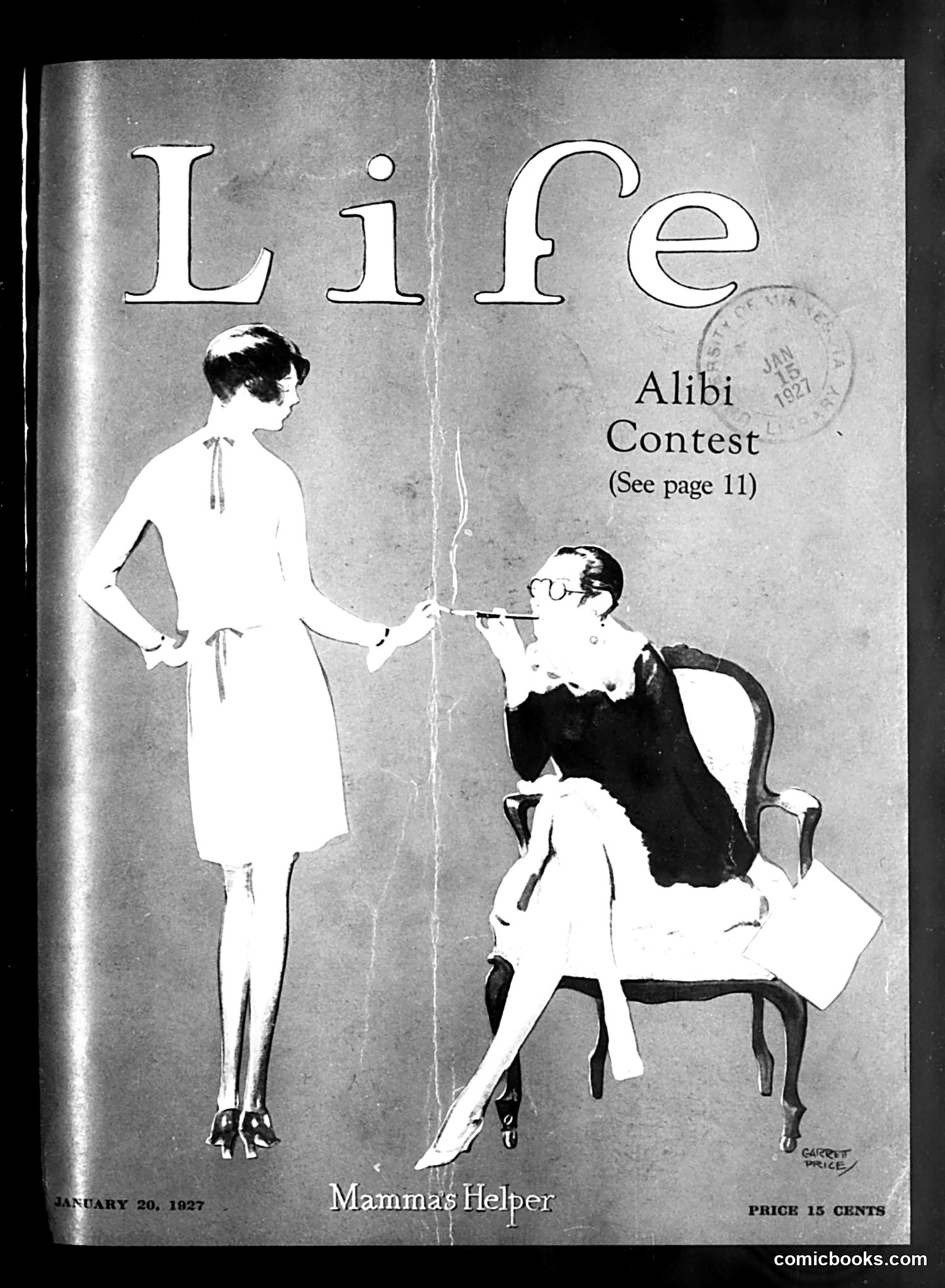
This cover features two illustrated women in 1920s fashion, likely depicting a satirical commentary on contemporary society. The title "Life" with "Alibi Contest (See page 11)" and "Mammas Helper" suggests the main article concerns women's social roles or behavior. The standing woman in white and seated woman in black appear to represent contrasting female types—possibly critiquing how women justified their actions or social positions during the Jazz Age. The "alibi" reference hints at excuses or justifications, perhaps mocking popular explanations women gave for their newfound freedoms in the 1920s. The price of 15 cents and date confirm this is genuine period satirical commentary on evolving gender roles and social conventions of the Roaring Twenties.
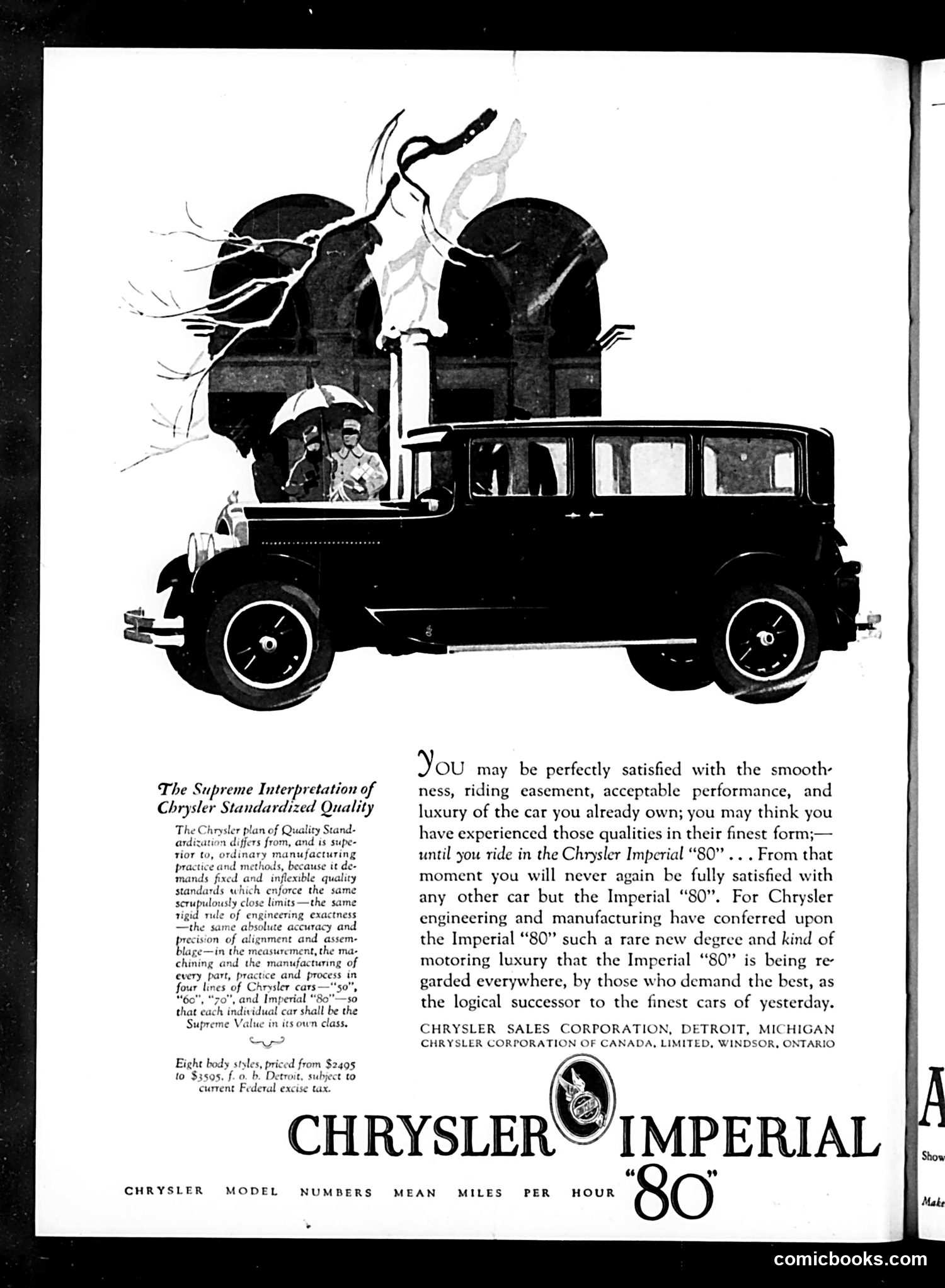
This page is **primarily a Chrysler automobile advertisement**, not political satire. The illustration shows a 1920s-era car passing beneath an ornate archway while two figures hold an umbrella during what appears to be stormy weather. The image functions as metaphorical marketing: the car provides reliable passage through difficult conditions, symbolizing dependability and luxury. The lengthy text praises the Chrysler Imperial "80" model, emphasizing superior engineering, manufacturing precision, and comfort. It positions the car as the logical successor to earlier Chrysler models and appeals to buyers seeking "the best." The page's satirical or humorous elements, if any, are subtle—the contrast between the elegant car and the stormy chaos above creates mild visual irony, suggesting the Imperial's superiority transcends adversity. However, this is fundamentally a product advertisement rather than political commentary.

This is **not a cartoon or satire** — it's a straightforward advertisement for American Radiator Company, appearing in Life magazine. The page features a Gothic-style architectural portal (labeled "A World Institute of Heating") set against a tall Manhattan skyscraper, emphasizing the company's products serve buildings from grand skyscrapers to modest homes. The copy claims American Radiator provides "heating comfort and health" and receives "universal preference" due to its "public service" vision. An inset photo shows their Institute of Thermal Research facility. The ad lists numerous showroom locations and product types (ideal boilers, water heaters, ventilating heaters, etc.). This represents early 20th-century corporate advertising strategy: associating industrial products with progress, scientific research, and American prosperity.
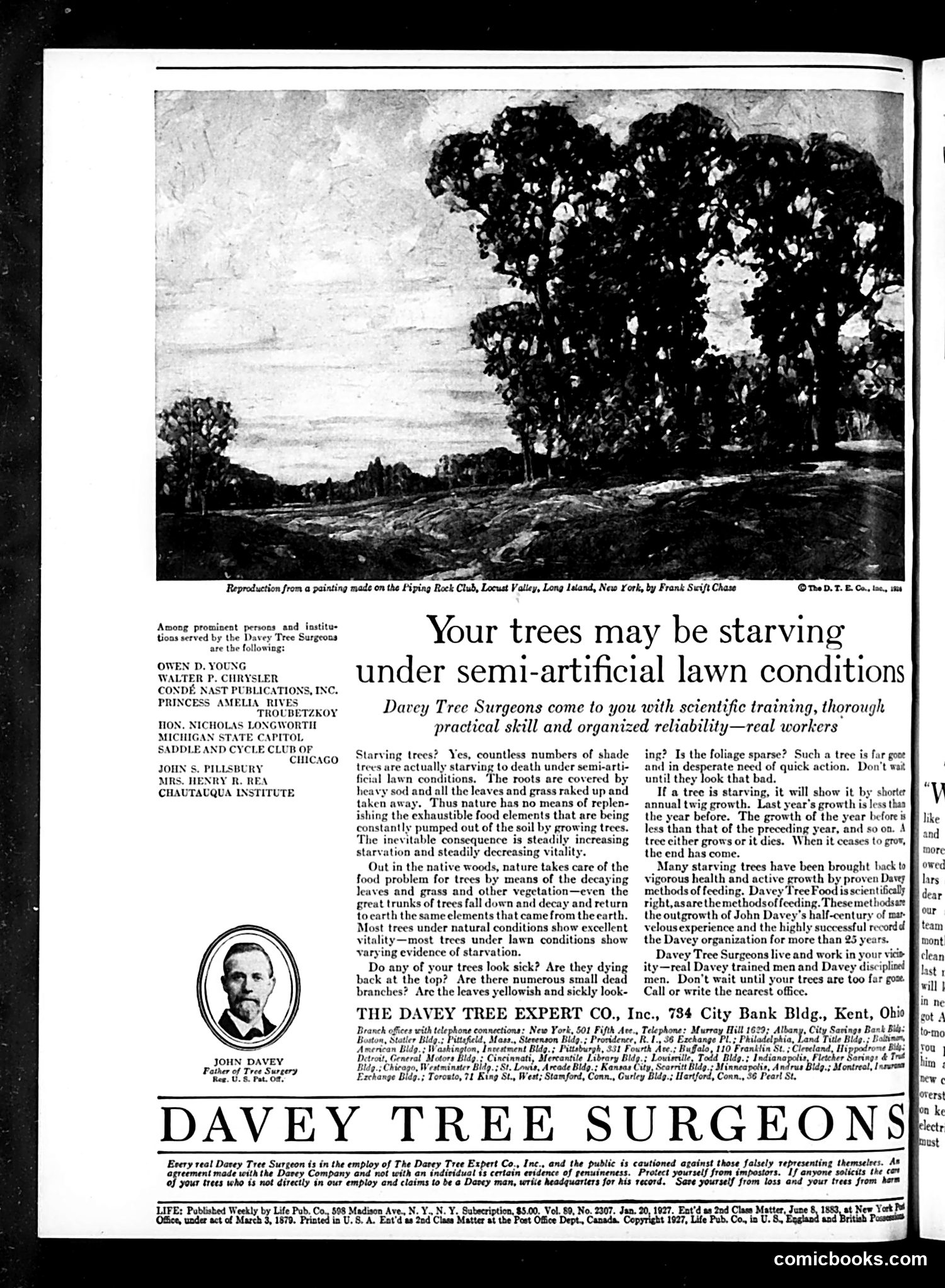
This page is **primarily an advertisement**, not editorial content or satire. It's a full-page ad for the Davey Tree Expert Co., Inc., a tree care service based in Kent, Ohio. The ad features a painting of trees in a landscape and warns that trees may be "starving" under artificial lawn conditions. It includes a portrait of what appears to be the company founder and lists prominent patrons, including Owen D. Young, Walter P. Chrysler, and institutions like Michigan State Capitol. The ad emphasizes that Davey Tree Surgeons employ "scientific training" and "proven busy methods of feeding" to restore tree health. It's essentially a business promotion warning customers about tree care problems and offering professional solutions—typical early-20th-century trade advertising rather than satirical content.
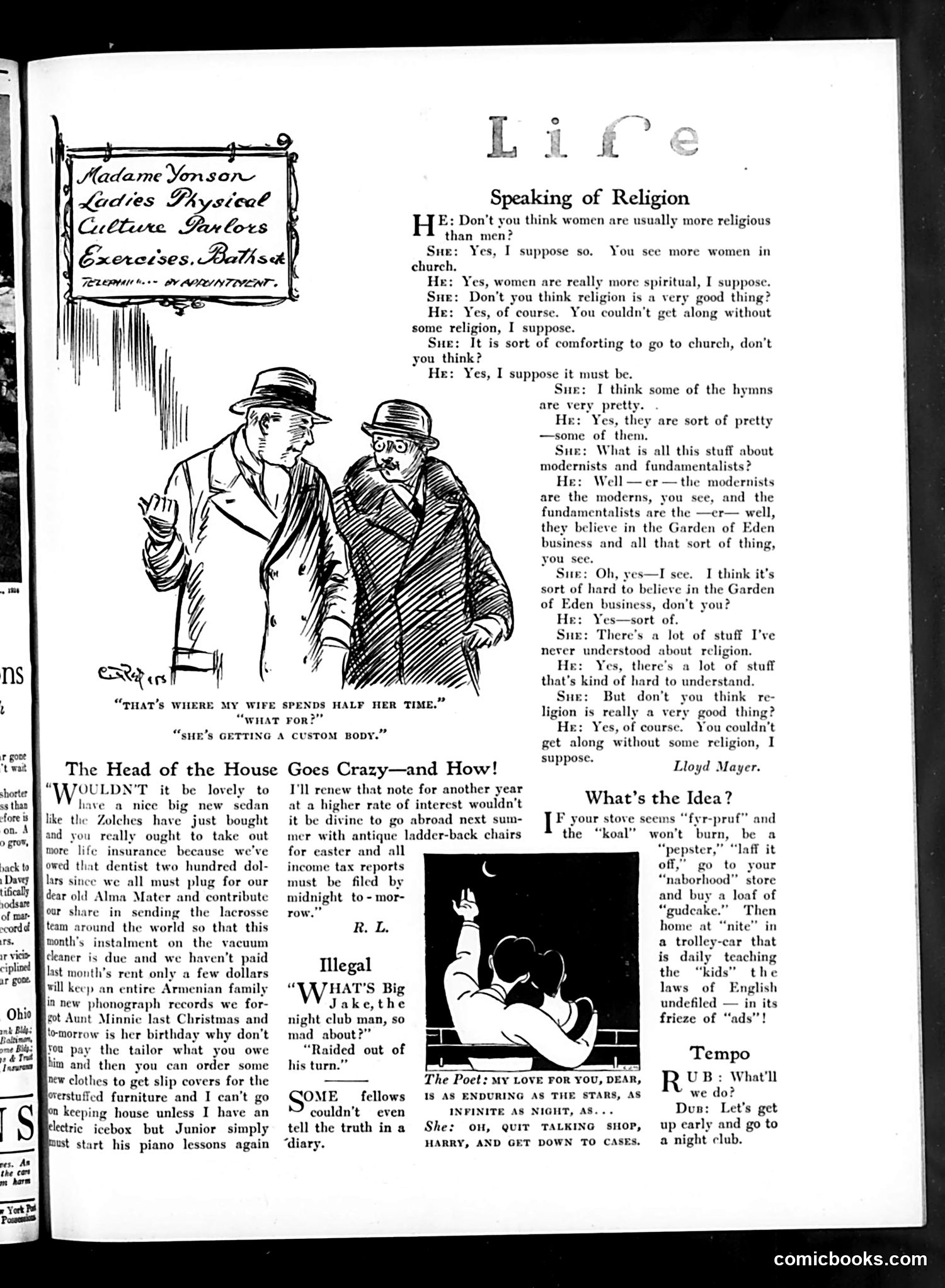
This page from *Life* magazine contains several humor pieces targeting early 20th-century domestic life and social attitudes. **"The Head of the House Goes Crazy"** satirizes a husband's frustration with household expenses. He complains about his wife's spending on luxuries (a new sedan, life insurance, dental work, Armenian relief contributions, and a lacrosse team) while he struggles with taxes and mortgage payments. The joke reflects anxieties about wives' expanding consumer power and charitable involvement during a period of economic uncertainty. **"Speaking of Religion"** is a dialogue mocking women's religiosity as superficial—attending church for comfort rather than genuine belief, finding hymns "pretty," and struggling to understand theological concepts like modernism versus fundamentalism. The other brief humor pieces ("Illegal," "What's the Idea?", "Tempo") appear to be short jokes about nightclubs, household appliances, and dating customs, typical of *Life's* satirical approach to contemporary social behavior.
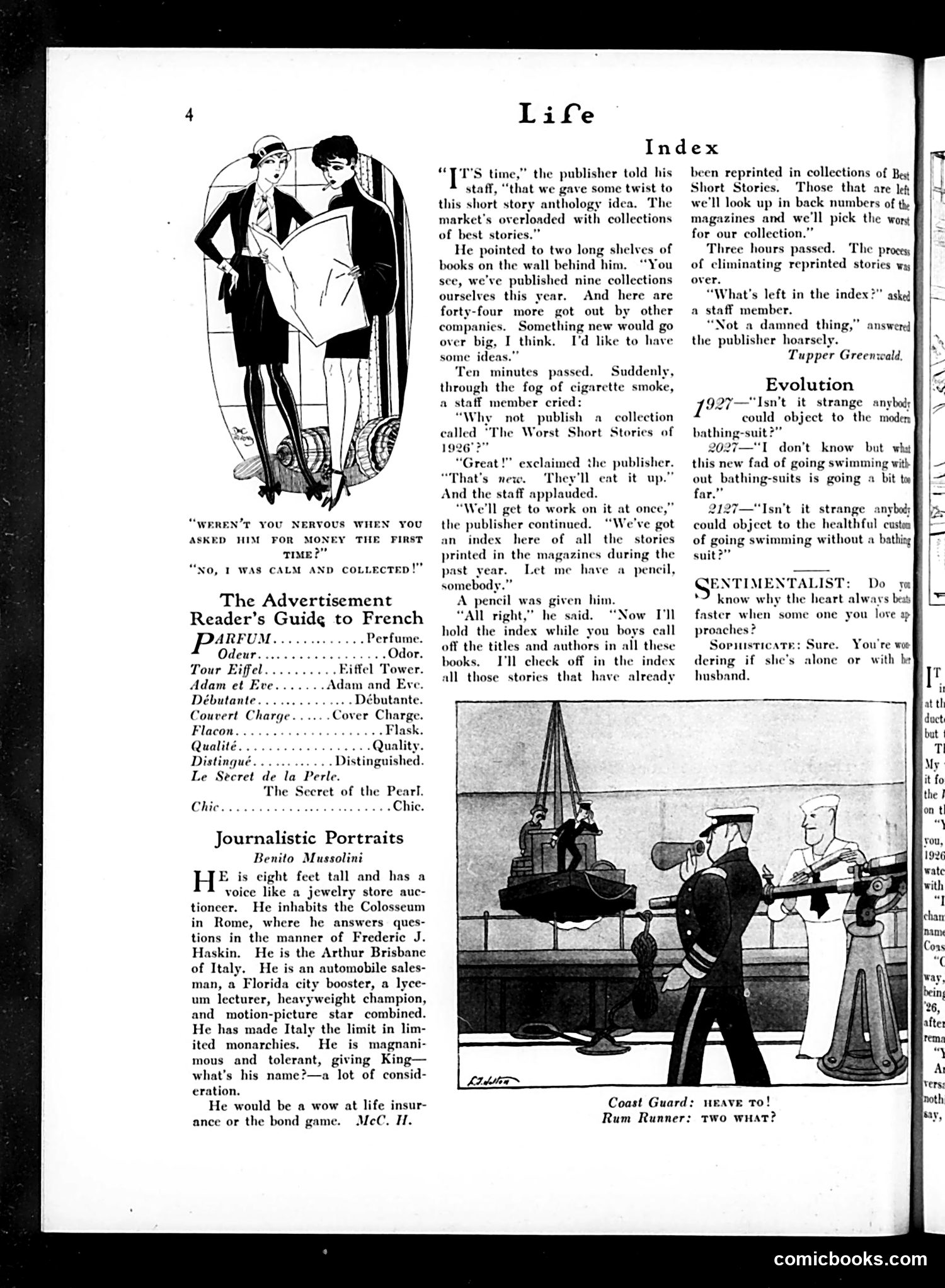
This page contains three distinct sections: 1. **"The Advertisement Reader's Guide to French"** — A humorous vocabulary list translating French fashion and culture terms (Odeur/Odor, Tour Eiffel, etc.) into blunt English equivalents, satirizing pretentious Francophilia among American readers. 2. **"Journalistic Portraits: Benito Mussolini"** — A biographical sketch describing Mussolini as an eight-foot tall jewelry store auctioneer inhabiting Rome's Colosseum, sarcastically listing his varied accomplishments (automobile salesman, boxer, motion-picture star). The exaggerated, contradictory description mocks his grandiose self-presentation. 3. **Bottom cartoon** — Depicts a Coast Guard officer and rum runner at a boat, playing on Prohibition-era smuggling. The joke's specific meaning is unclear without additional context. All content satirizes contemporary figures and cultural pretensions.
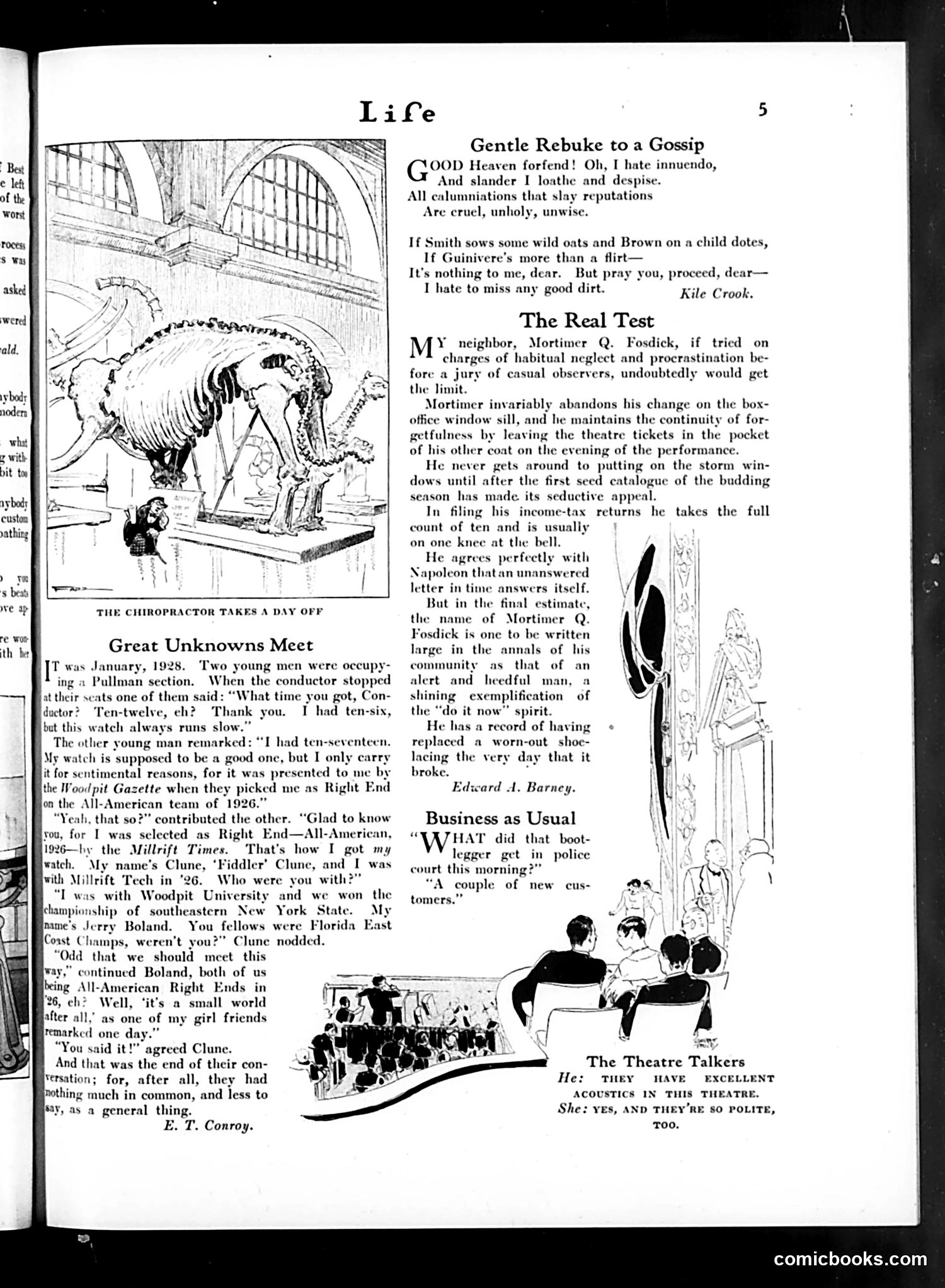
This page contains humorous short pieces and illustrations typical of Life's satirical humor section. **"The Chiropractor Takes a Day Off"** (top left illustration): Shows a chiropractor being manipulated by a large dinosaur skeleton, reversing the typical patient-doctor dynamic. The joke plays on occupational role reversal. **"Great Unknowns Meet"** describes a 1928 encounter between two young men on a train, each claiming to have attended various prestigious universities and teams. The satire mocks how people casually name-drop institutions and athletic achievements to establish social status through dubious credentials. The remaining pieces—**"Gentle Rebuke to a Gossip,"** **"The Real Test,"** and **"Business as Usual"**—are brief, witty observations about social behavior and human nature, typical of Life's short-form humor style.
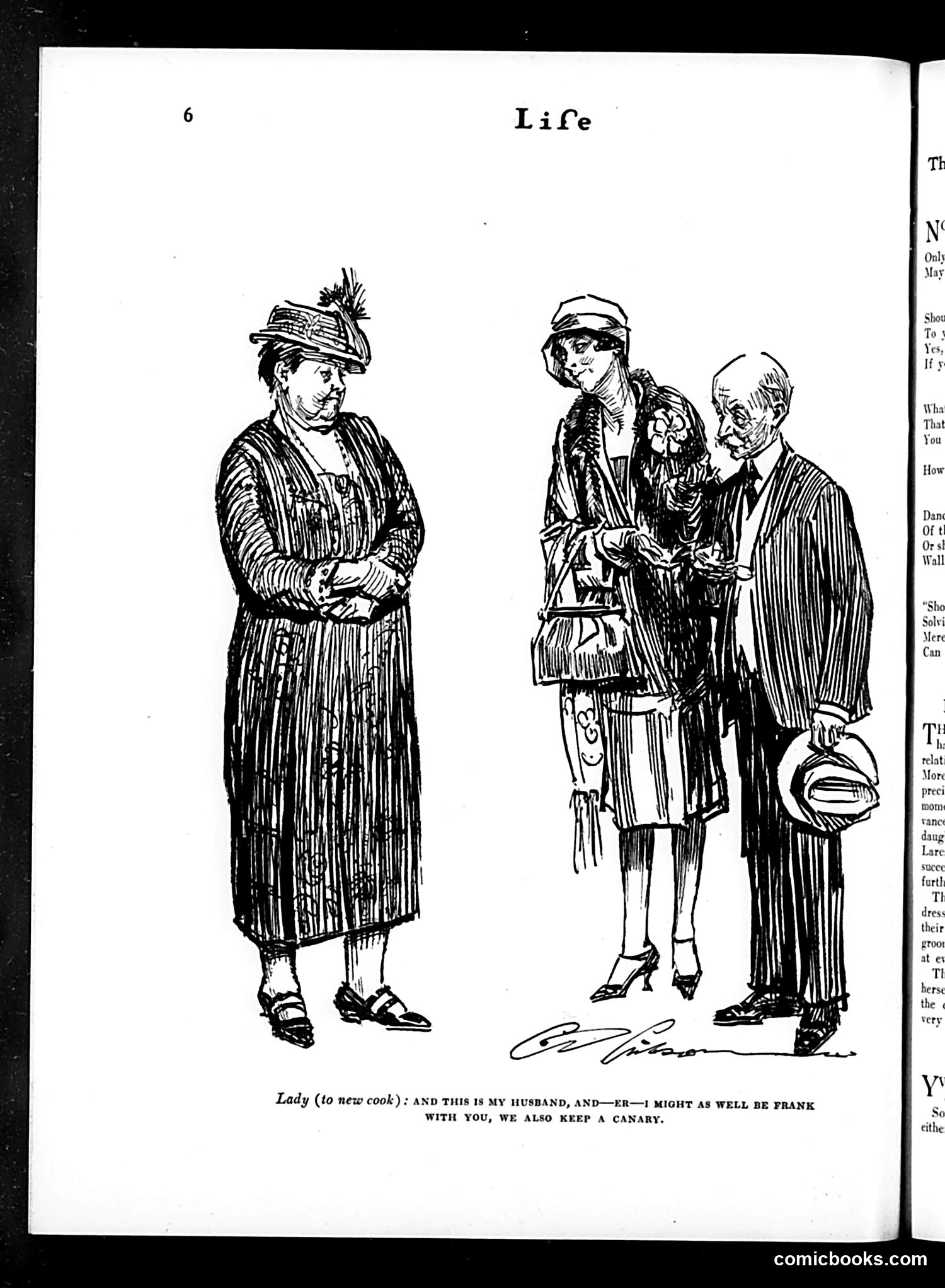
This single-panel cartoon depicts a social interaction between three figures: a woman on the left (identified as "Lady (to new cook)") and a couple on the right—a man and woman dressed in formal attire. The caption reads: "AND THIS IS MY HUSBAND, AND—ER—I MIGHT AS WELL BE FRANK WITH YOU, WE ALSO KEEP A CANARY." The satire targets the awkwardness of employer-servant relationships in early 20th-century domestic service. The lady's awkward introduction of her husband to the new cook, coupled with her admission that they also keep a canary, mocks the social pretension and discomfort middle-class employers experienced when interacting with household staff. The humor lies in treating a canary—a pet—with the same formal introduction level as her husband, suggesting both her social anxiety and the peculiar hierarchies of domestic life.
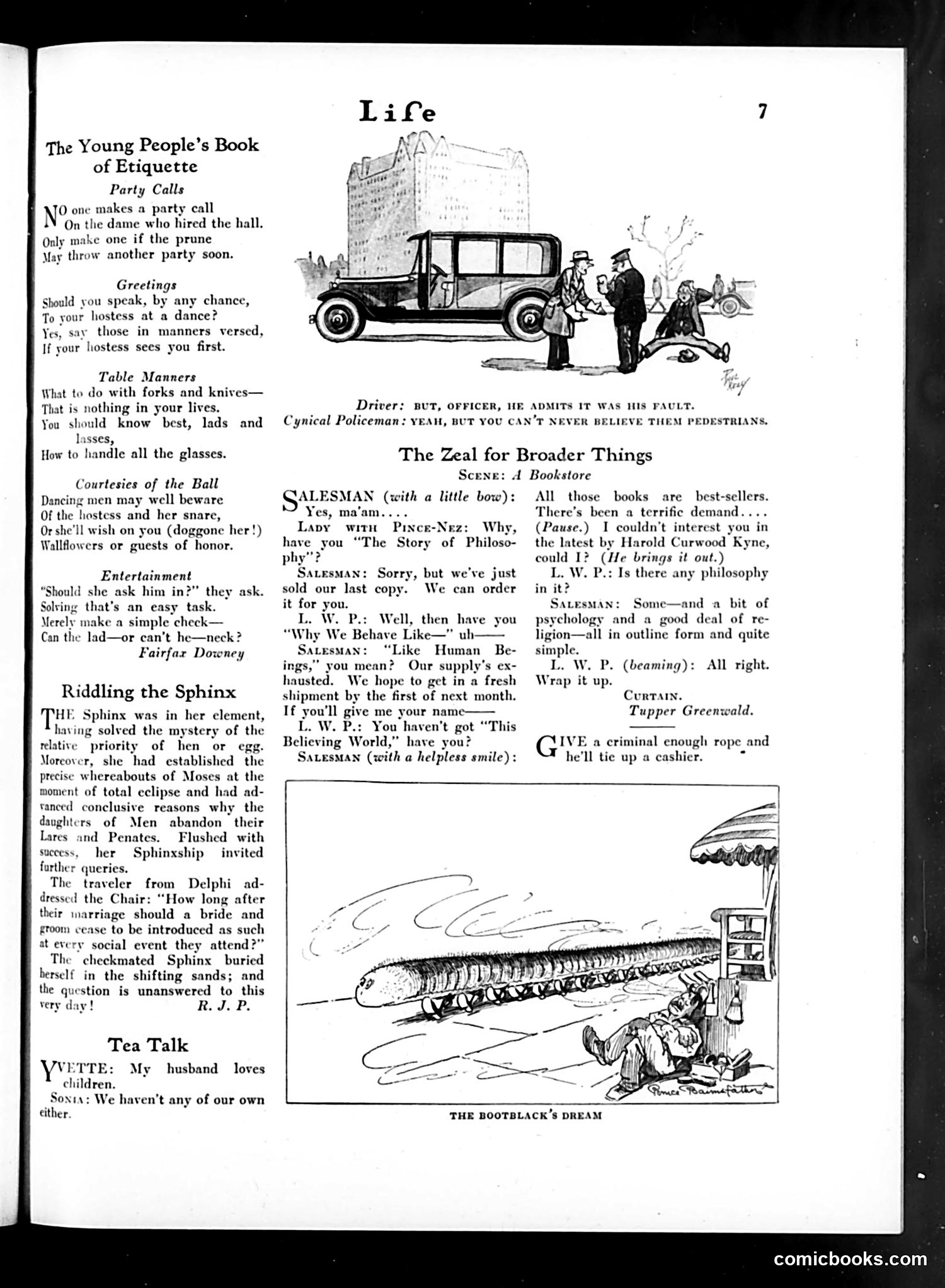
This satirical sketch depicts a bookstore conversation between a salesman and a customer interested in Harold Curwood Kyne's "The Story of Philosophy." The humor centers on the customer's contradictory desires: wanting an intellectually serious philosophy book while simultaneously requesting something "simple" with "a good deal of psychology and a good deal of religion—all in quite simple" form. The joke mocks the period's trend of readers seeking "serious" literature without genuine intellectual effort—wanting philosophy made palatable and digestible rather than challenging. The salesman's weary responses and the customer's helpless smile suggest the absurdity of this demand for simplified profundity, satirizing contemporary reading habits and intellectual pretension.
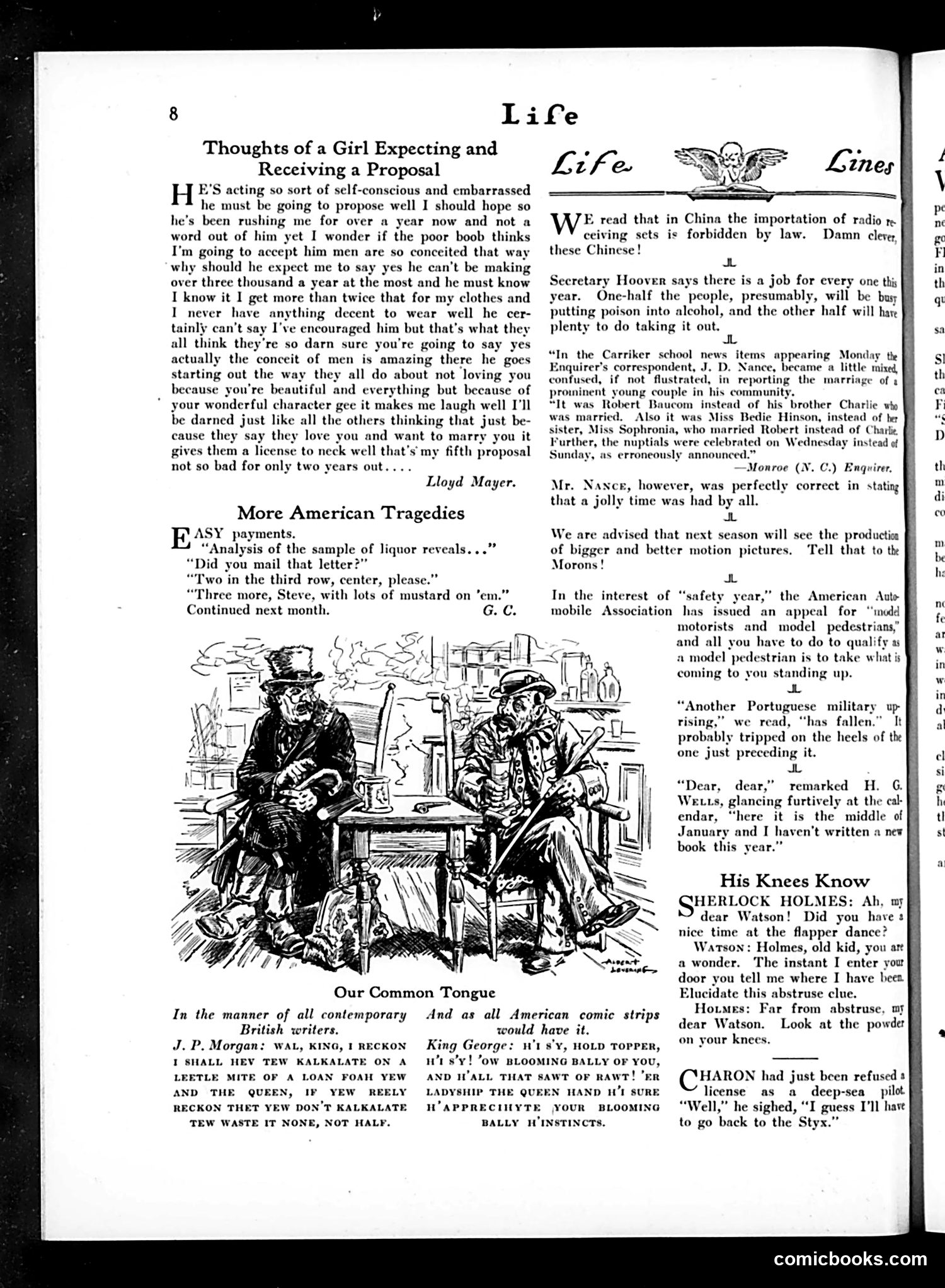
This page contains several satirical pieces typical of Life magazine's humor: **"More American Tragedies"** shows two disheveled men in conversation, likely satirizing Prohibition-era bootlegging and the illicit alcohol trade. The dialogue references liquor and "mustard," suggesting coded language for illegal drinking. **"Our Common Tongue"** mocks both British and American dialects through exaggerated spelling and slang, poking fun at national stereotypes and linguistic pretension. **"His Knees Know"** is a Sherlock Holmes parody where Holmes deduces Watson's activities from powder on his trousers—satirizing both the detective genre and social conventions. The overall tone reflects post-WWI American culture: skepticism toward Prohibition enforcement, class distinctions, and popular literary conventions. The humor relies on shared knowledge of contemporary events and cultural references.
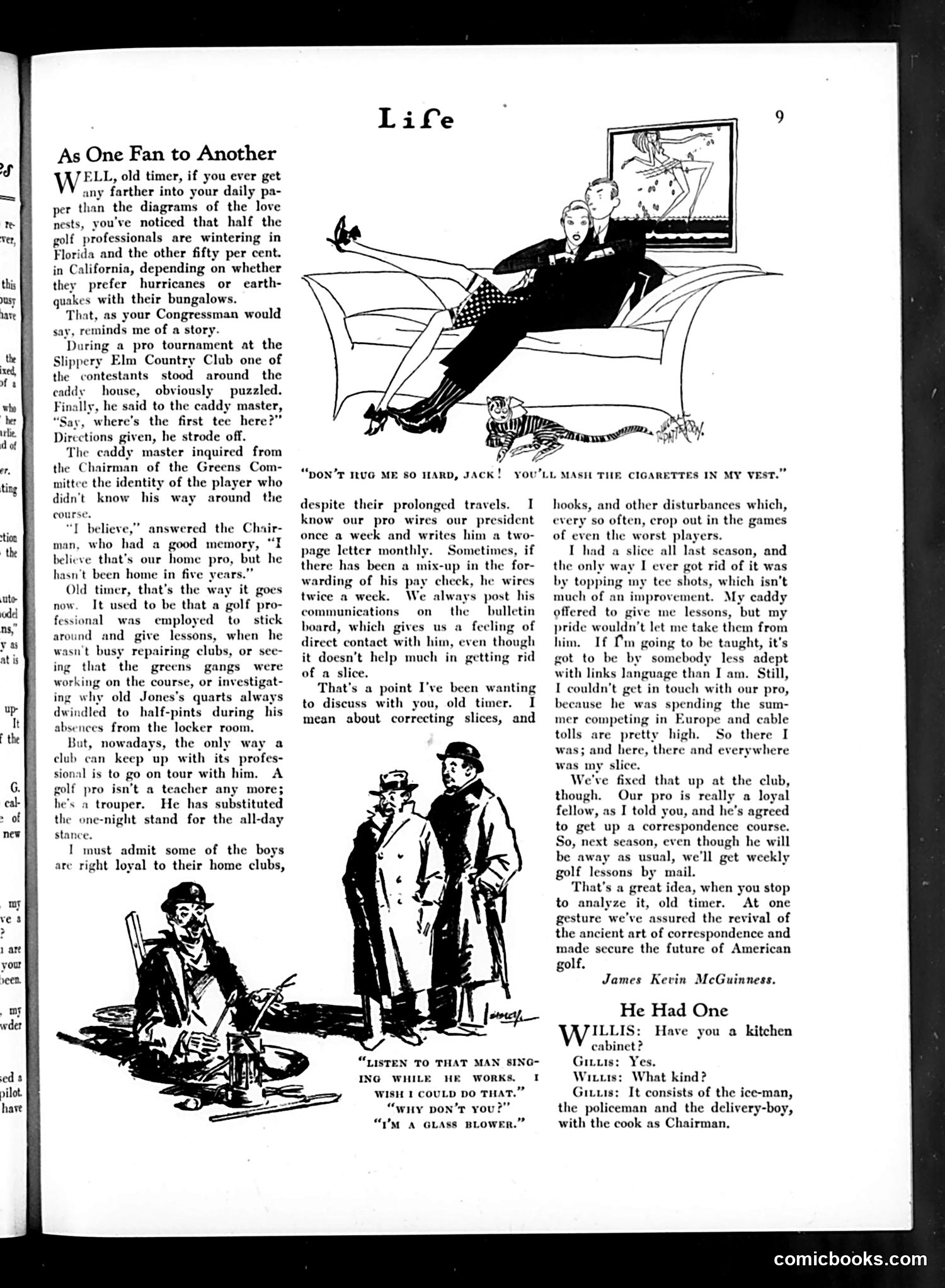
This page satirizes professional golf culture through a conversational article about touring pro golfers. The main cartoon shows a man and woman on a couch, with the man's feet up dramatically—captioned "DON'T NEG ME SO HARD, JACK! YOU'LL MASH THE CIGARETTES IN MY VEST." The article discusses how professional golfers divide their time between Florida and California, receive weekly pay checks, and maintain contact with home clubs via bulletin boards. The author argues that golf pros should offer correspondence courses to amateur golfers to improve American golf overall. The supporting cartoons show working-class figures (a glass blower, tradesmen), contrasting with elite golf culture. The satire mocks both golfers' lifestyles and the domestic tensions their frequent travel creates—a common theme in 1920s-era Life magazine humor.
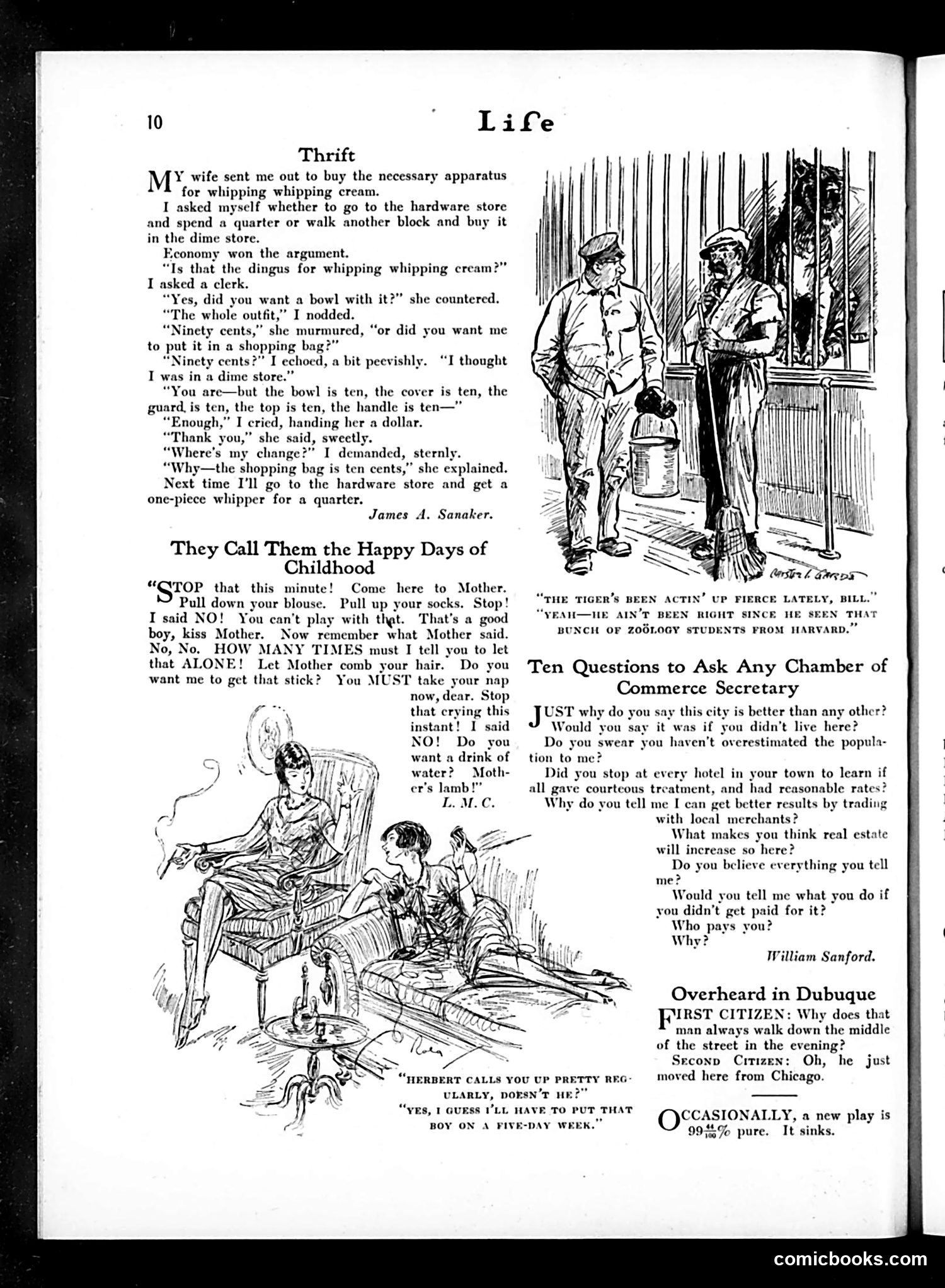
This page contains three distinct pieces of humor: 1. **"Thrift"** by James A. Sanaker: A domestic comedy about a husband sent shopping for whipping cream apparatus. The joke satirizes penny-pinching thriftiness—the wife quibbles over whether to buy at a hardware or dime store, then demands exact change, revealing false economy when the "savings" cost more in aggravation. 2. **"They Call Them the Happy Days of Childhood"**: A mother exhausted by her son's constant demands and misbehavior. The satire mocks sentimental nostalgia about childhood, contrasting idealized memories with parenting's actual chaos. 3. **"Ten Questions to Ask Any Chamber of Commerce Secretary"**: Satirical questions exposing how Chamber of Commerce officials exaggerate city virtues through propaganda and selective truths. The illustrations use period-appropriate sketch style typical of early 20th-century American humor magazines.
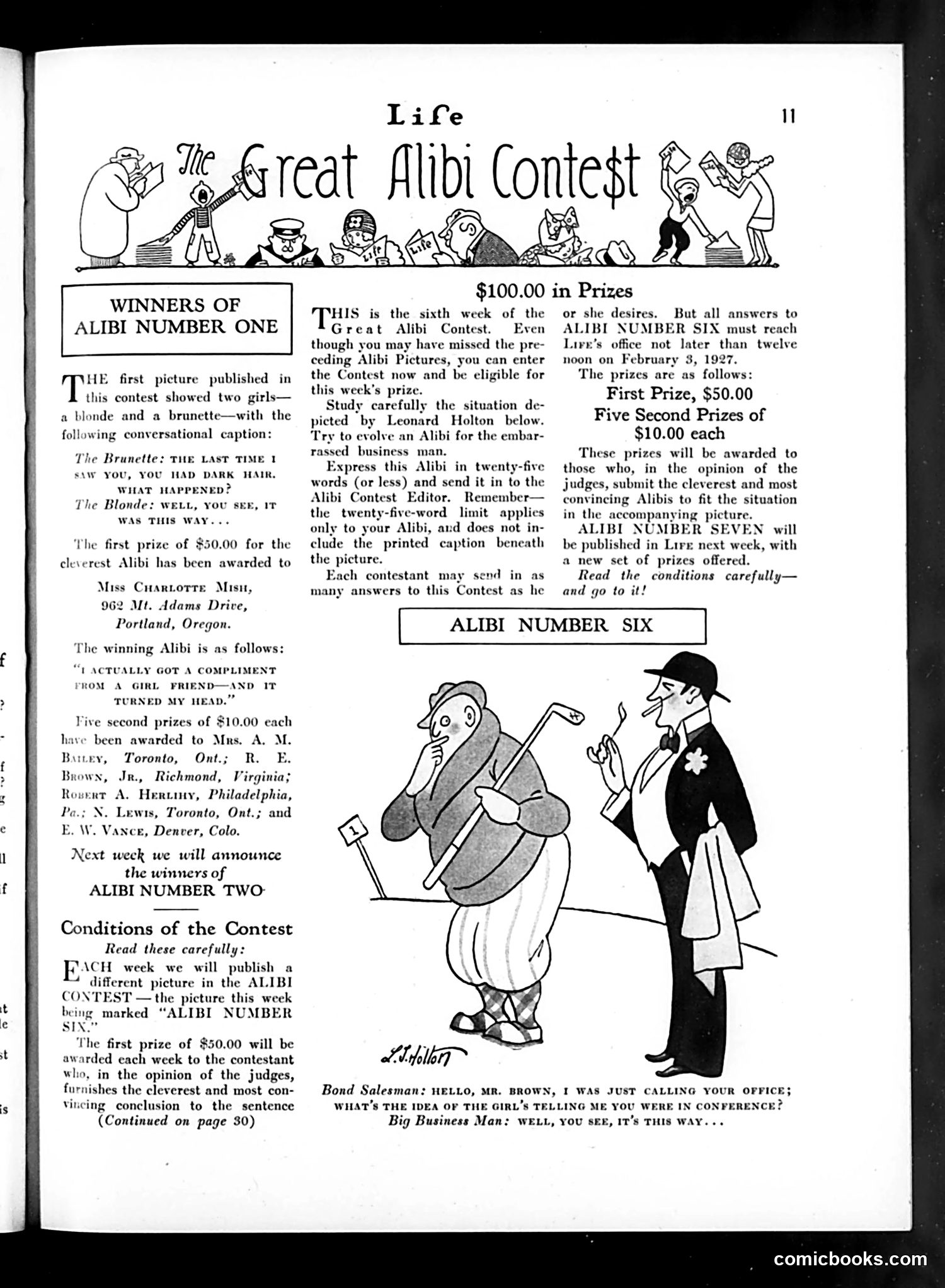
This page announces winners of an ongoing "Great Alibi Contest" where readers submit creative excuses (alibis) in 25 words or less. The winning alibi from the previous week was: "I actually got a compliment from a girl friend—and it turned my head." The cartoon illustrates **Alibi Number Six**, depicting a Bond Salesman confronting a Big Business Man. The salesman claims he was "just calling your office" while the businessman challenges him, saying "it's this war"—suggesting the man is using the war as an excuse for his absence or misconduct. The contest offers $100 in total prizes ($50 first prize, five $10 second prizes) and invites readers to submit humorous, believable excuses for everyday situations.
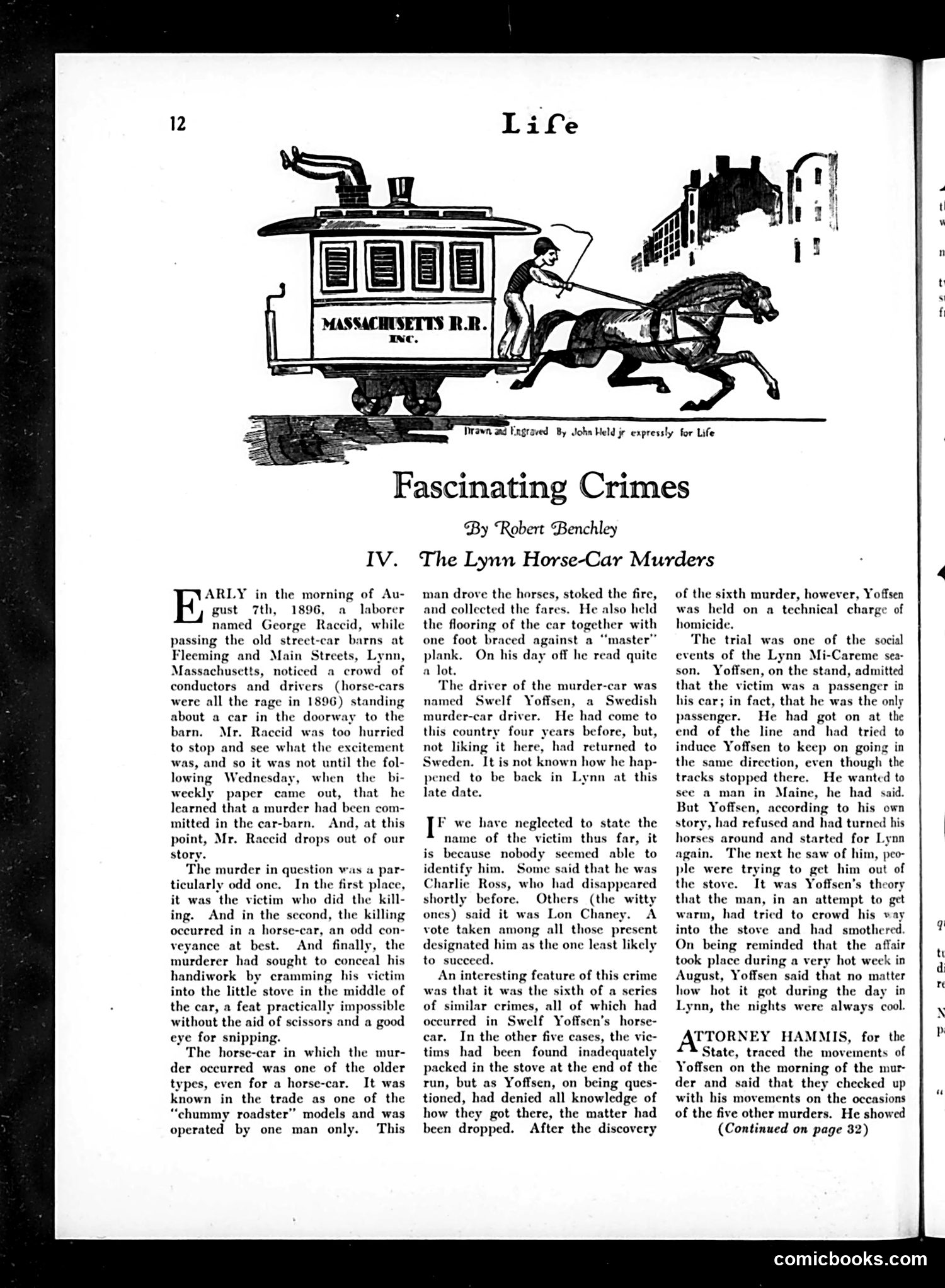
This page presents a true-crime article by Robert Benchley about murders that occurred in a horse-drawn streetcar in Lynn, Massachusetts. The illustration at the top shows a horse pulling a Massachusetts Railroad Inc. car, with a driver whipping the horse—likely depicting the actual crime scene or murder conveyance. The article describes a series of murders committed in a horse-car (streetcar), with the sixth victim being a passenger named Yoffsen. A Swedish driver named Sweif Yoffsen is suspected but denies involvement. The text notes this was an older crime type, operated by a single driver, making concealment of bodies in the stove "a feat practically impossible." The article treats a grim historical crime with matter-of-fact journalistic tone typical of Life magazine's crime reporting.
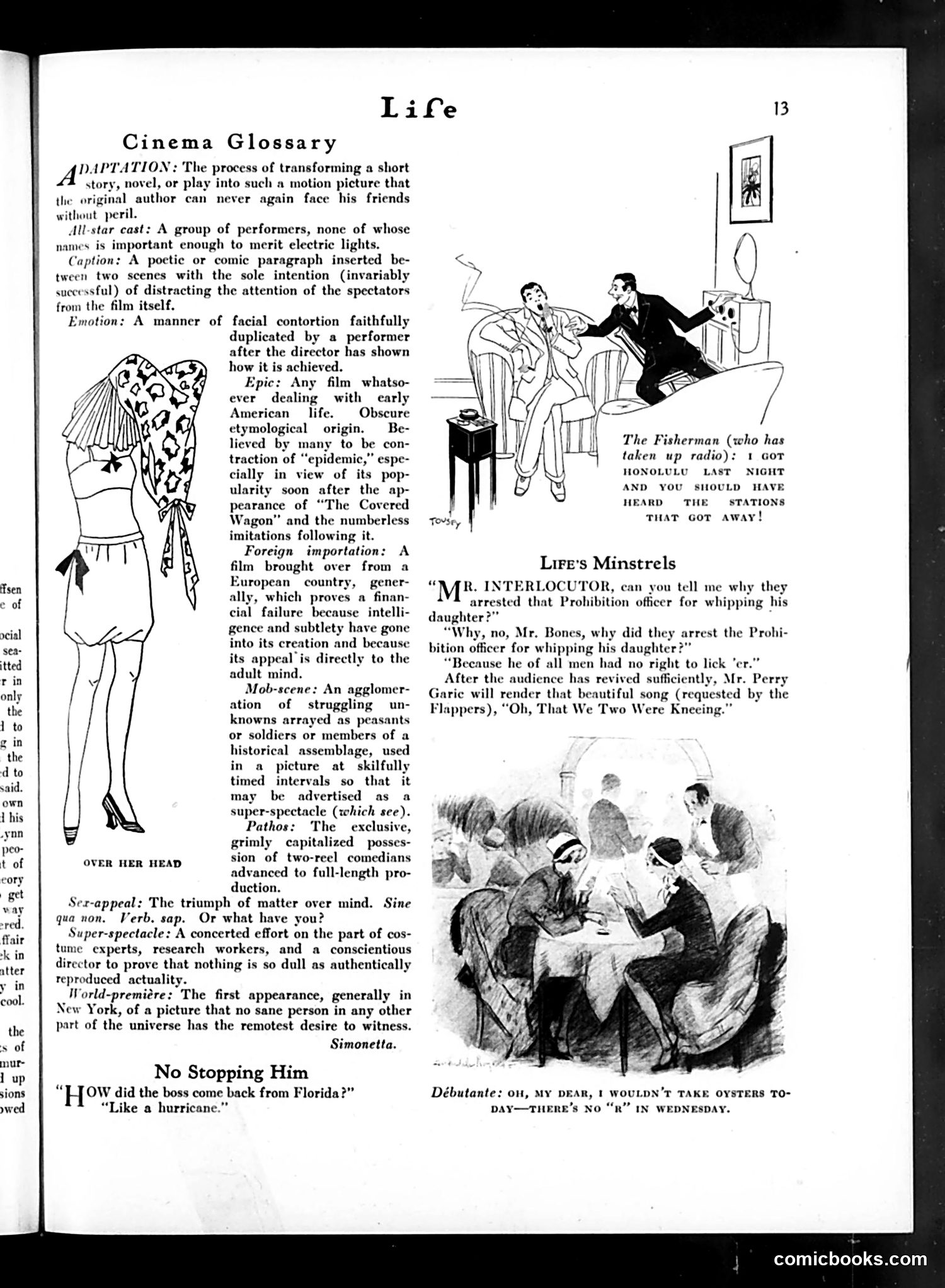
This page contains a **Cinema Glossary** defining film industry terms, alongside two unrelated comic sketches. The top illustration labeled "Over Her Head" depicts a woman with an exaggerated expression, satirizing silent film acting conventions—specifically the overwrought "emotion" style defined in the glossary. Below that, "Life's Minstrels" shows two brief comedy sketches. The first involves dialogue about Prohibition enforcement (arresting someone for "whipping his daughter"), a topical reference to the unpopular Volstead Act. The second sketch, "Débatante," depicts wealthy diners debating oyster consumption, mocking high-society pretensions. The bottom section, "No Stopping Him," presents a brief joke about someone returning from Florida "like a hurricane"—likely referencing 1920s Florida's boom-and-bust real estate cycle or hurricane damage, though context is unclear. These are light satirical commentaries on contemporary American culture.
This page contains editorial commentary rather than political cartoons. The main text discusses **Wayne B. Wheeler**, identified as a General Counsel and superintendent of the Anti-Saloon League, who appears as the central figure being criticized. The article satirizes Wheeler's role in enforcing Prohibition. The text compares him to **Torquemada** (the Spanish Inquisition figure), suggesting Wheeler's zealous anti-alcohol crusade is comparable to religious persecution. The satire criticizes how Prohibition poisoning deaths resulted from government denaturizing alcohol, while Wheeler—described as having "lost his sense of proportion"—remained a powerful reformer. Small cartoon illustrations accompany the text, mocking Prohibition enforcement and its consequences. The piece argues that without free newspapers documenting abuses, reformers like Wheeler operate unchecked.
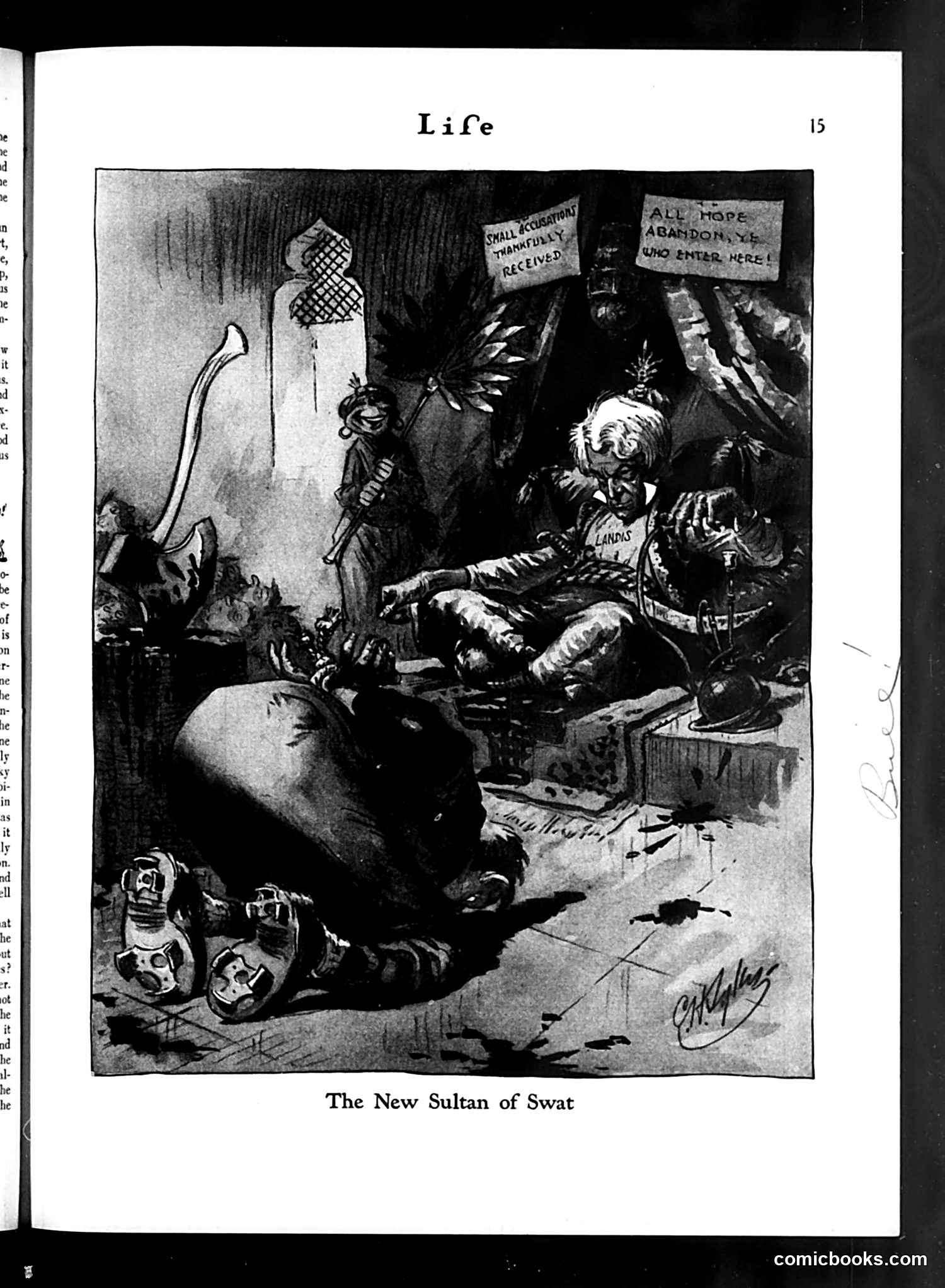
This political cartoon satirizes a powerful figure as an Eastern despot. The central caricature, labeled "LANDS," appears to be a wealthy or influential American relaxing luxuriously while receiving petitions and tributes. Signs reading "SMALL ACCUSATIONS QUICKLY RECEIVED" and "ALL HOPE ABANDON, YE WHO ENTER HERE" suggest mockery of someone wielding excessive power and treating supplicants dismissively. The cartoon likely critiques American wealth inequality or corporate power circa early 20th century, comparing American financial dominance to Ottoman imperial authority. The "Sultan of Swat" reference appears to invoke both Eastern despotism and American colloquialism. Without knowing the specific date and context, the precise target remains unclear, though the satire targets concentrated power and arrogance.
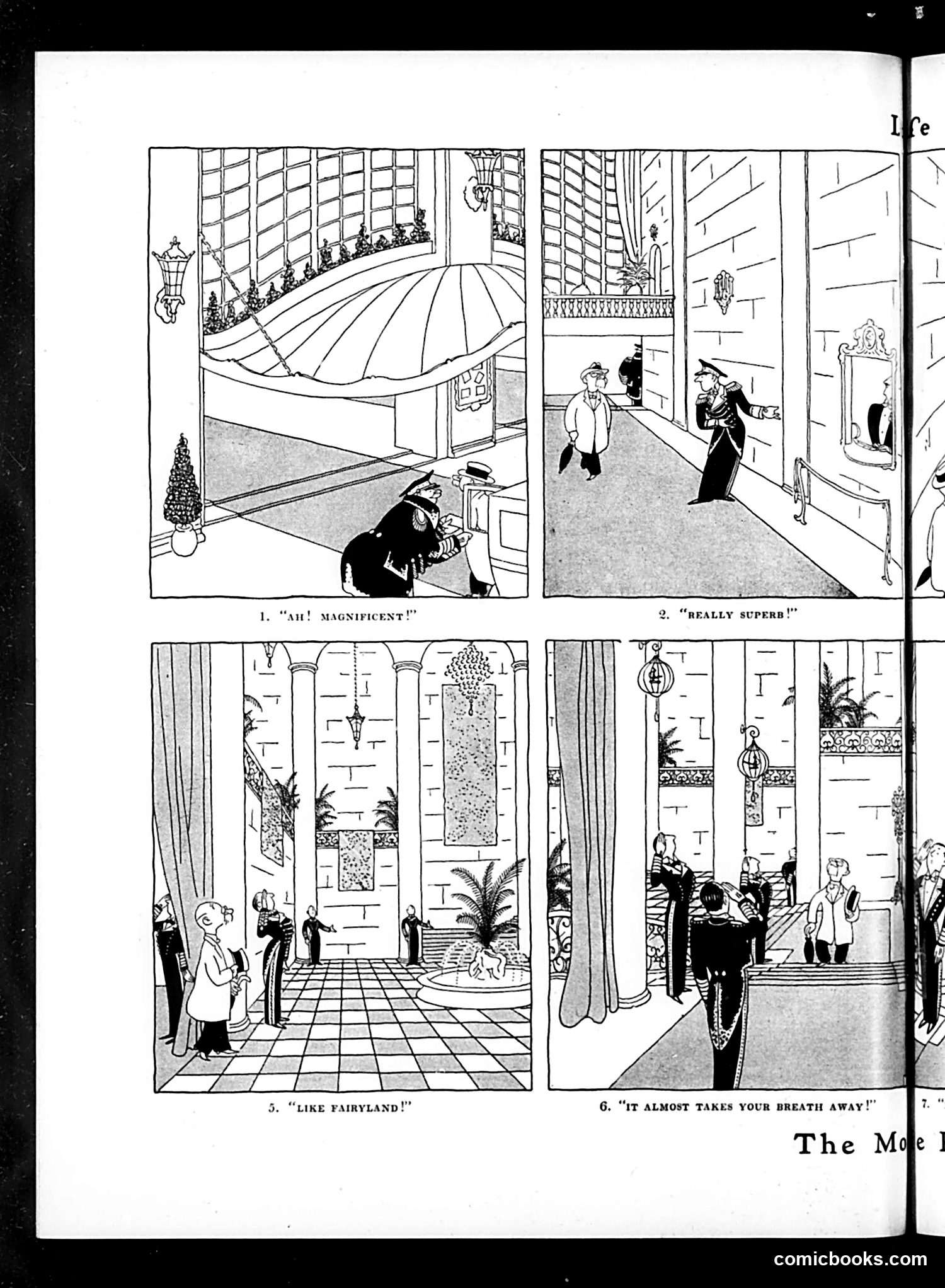
This appears to be a six-panel comic strip titled "The Mo[del]" (title cut off) satirizing luxury hotel or apartment living. The sequence shows well-dressed visitors touring an elaborate, ornate building with grand architectural features—tall columns, decorative plants, elegant furnishings, and dramatic lighting. The captions ("Ah! Magnificent!", "Really Superb!", "Like Fairyland!", "It almost takes your breath away!") track increasingly enthusiastic reactions to the opulent space. The satire targets the pretentiousness of wealthy society—people performing impressed reactions to conspicuous luxury as social performance. The joke appears to mock how such displays inspire reflexive admiration, suggesting the absurdity of valuing style over substance in high-society culture.
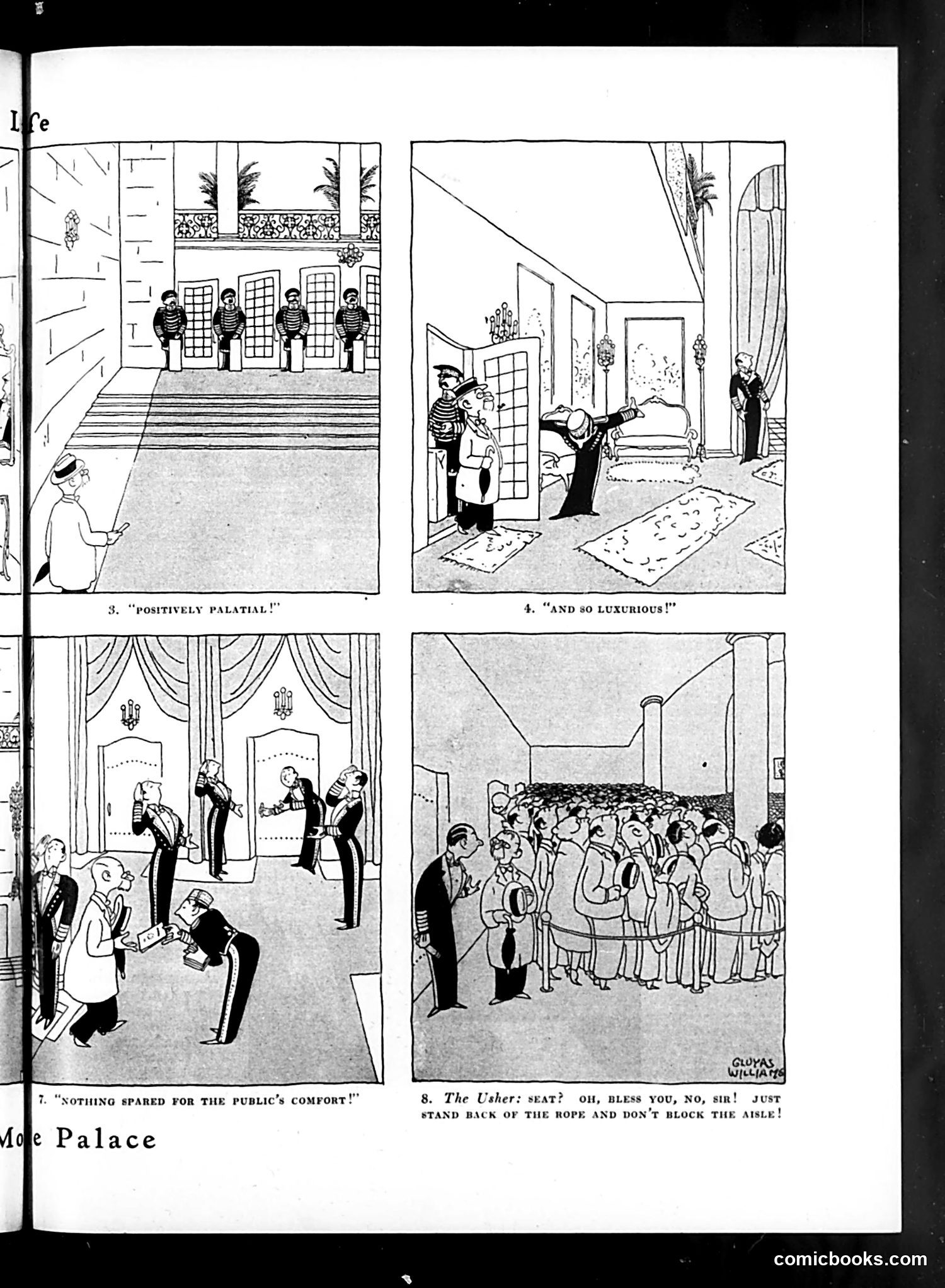
This six-panel satirical comic mocks the excessive luxury and pretension of high society during the early 20th century. The narrative follows what appears to be a wealthy family touring or inhabiting an ornate palace. The satire targets: - **Conspicuous consumption**: Panel titles like "Positively Palatial!" and "And so Luxurious!" mock the self-congratulatory attitude toward material excess - **Class performance**: Guests and servants perform elaborate formality - **Discomfort masquerading as comfort**: Panel 7's caption "Nothing spared for the public's comfort!" is ironic—the final panel shows an usher directing crowds like cattle, revealing the "palace" as a public exhibition where actual comfort is sacrificed for appearances The joke critiques how the wealthy display wealth performatively while actually providing poor conditions, exposing the gap between pretense and reality.
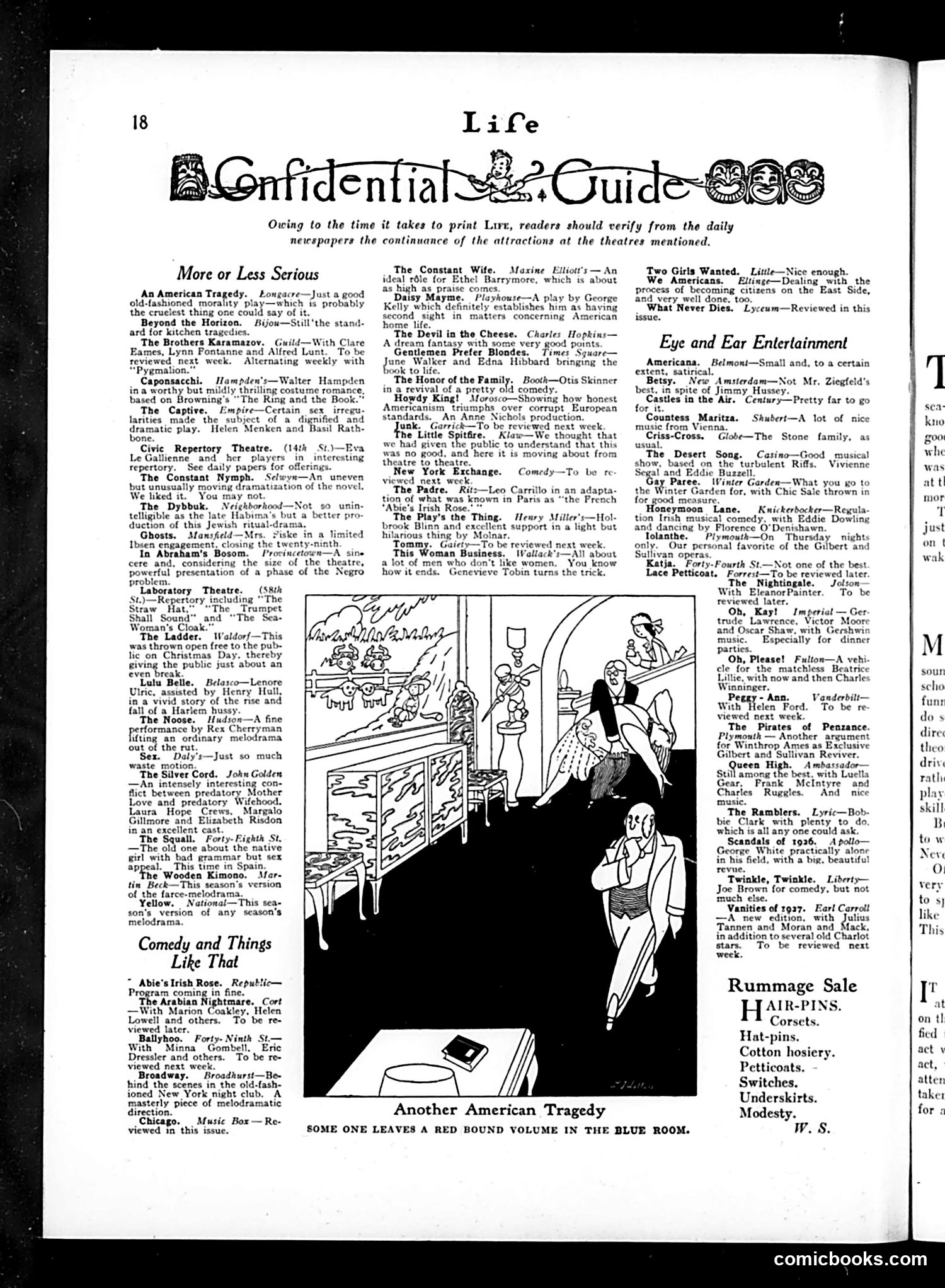
This cartoon illustrates the caption "Another American Tragedy—Some One Leaves a Bed Bound Volume in the Blue Room," a satirical jab at absent-minded theater patrons. The image depicts a bedroom scene where a woman discovers a forgotten book left behind on a bed. The "tragedy" is comedic: someone has carelessly abandoned a bound volume (likely a playbill or program) in what appears to be a hotel or theater's private room—the "Blue Room." The satire targets early 20th-century theatergoers' inattentiveness and the minor inconveniences this caused venues. The exaggerated domestic setting and formal illustration style mock the melodramatic language applied to such trivial mishaps, playing on contemporary theater culture's tendency toward overwrought dramatic language. This reflects Life magazine's consistent mockery of theatrical pretension and audience behavior during this era.
This page contains theater reviews by Robert Benchley, a prominent satirical drama critic. The content mocks theatrical performances of the era. **Key references:** - **"What Never Dies"**: A play at the Lyceum starring E.H. Sothern, whom Benchley dismisses as unfunny. He jokes that the second act was so long he left to eat clams and lobster, returning to find the director David Belasco still giving his curtain speech. - **"Chicago"**: A play by Maurine Watkins (notably, a woman writing "a he-man's play"). Benchley praises it as biting satire attacking American traits—sentimentality, hypocrisy, tabloid sensationalism, and the obsession with publicity. The satire targets both mediocre theatrical direction (the "Joe Cook" reference to mechanical comedy) and celebrates sharper social commentary. Benchley's humor relies on the absurdity of audience behavior and theatrical pretension.
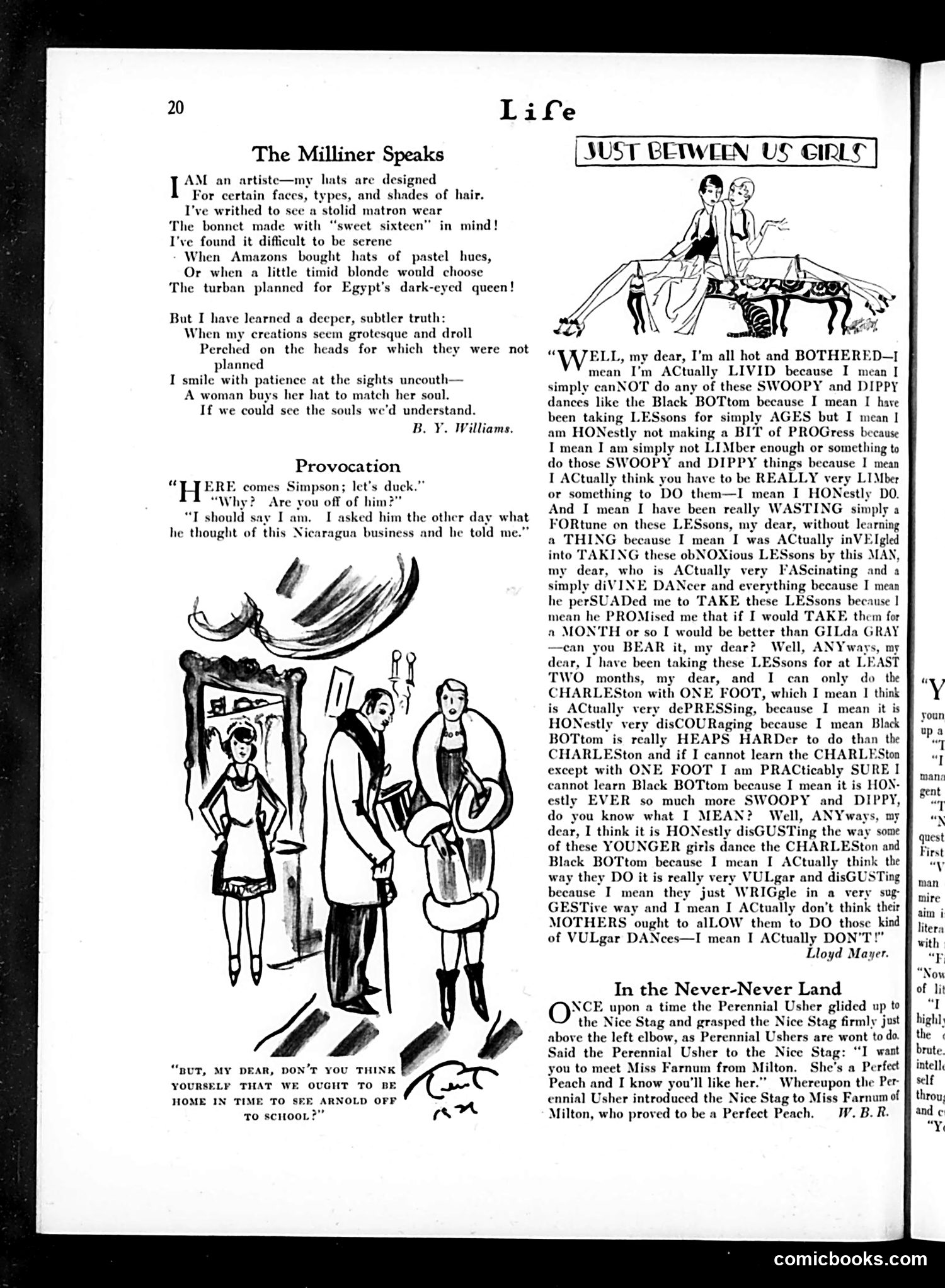
This page contains three satirical pieces typical of 1920s Life magazine: **"The Milliner Speaks"** — A poem by B.Y. Williams defending hat design. A milliner argues that women buy hats matching their inner character ("soul"), not objective suitability, explaining why her creations sometimes look ridiculous on certain customers. **"Provocation"** — A brief joke about a man named Simpson and Nicaragua, with an illustration showing a domestic scene where a husband asks his wife if they should go home to see their son Arnold off to school. **"Just Between Us Girls"** — A satirical monologue (by Lloyd Mayer) mocking young women's obsession with 1920s dance crazes—the Charleston and Black Bottom. The speaker complains about dance lessons, her inability to master these moves, and criticizes younger girls for dancing in "vulgar" ways, using exaggerated capitalization for emphasis throughout. **"In the Never-Never Land"** — A whimsical story fragment by W.B.R. about social introductions at what appears to be a dance or social event, poking fun at predictable social rituals. The page satirizes 1920s social conventions, particularly women's fashion consciousness and jazz-age dance culture.
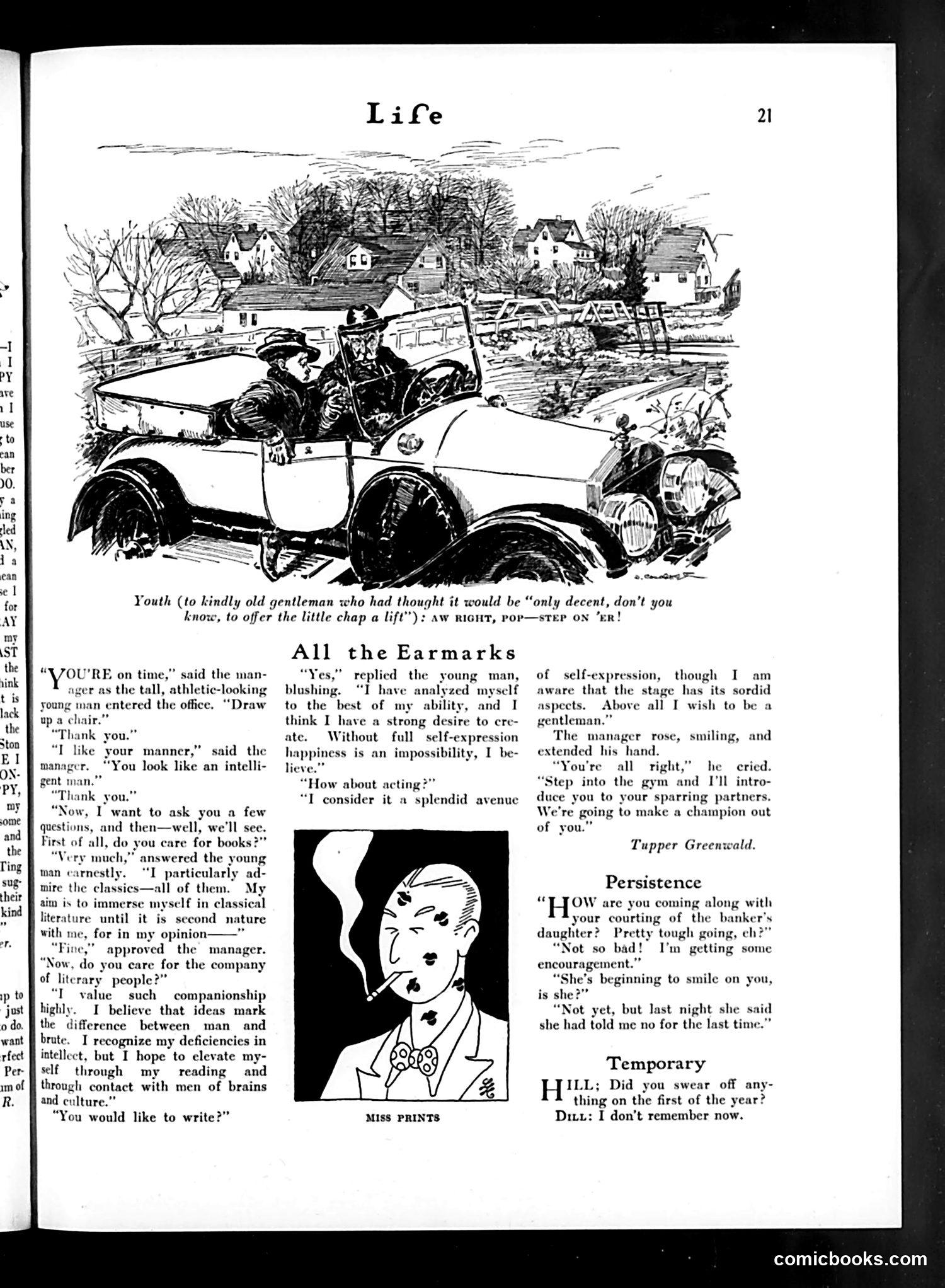
This piece mocks young men who adopt affected intellectual pretensions to appear cultured. The protagonist delivers earnest speeches about loving "the classics," valuing "companionship" with literary people, and wishing to become a writer and gentleman—all the fashionable markers of refinement. The joke's punchline: the manager, unimpressed by this posturing, offers him a job as a **boxer**—"we're going to make a champion out of you." The satire suggests that despite all his talk of culture and self-expression, the young man's actual value lies in physical brutishness, not intellect. The cartoon ridicules both pretentious youths who perform learned sophistication and the superficiality of judging character by such affectations. The title "All the Earmarks" emphasizes how easily one can mimic—but not genuinely possess—cultured refinement. The page's other brief humorous items ("Persistence," "Temporary") are unrelated joke snippets typical of *Life* magazine's format.
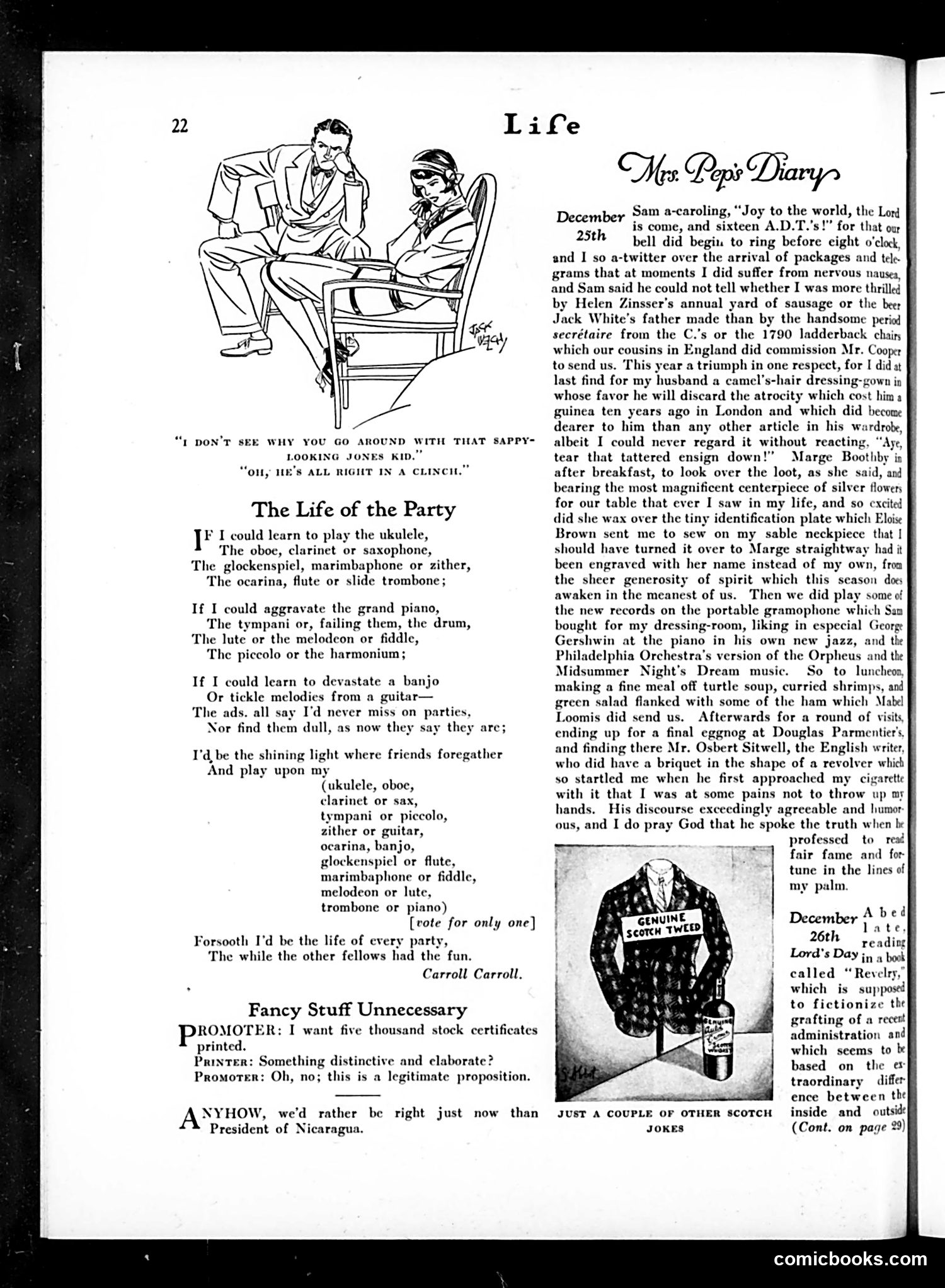
This page contains satirical humor typical of 1920s Life magazine: **Top cartoon:** Shows two men discussing a third person ("Jones kid"). The joke mocks shallow social judgment—one man criticizes the other's companion as "sappy-looking," but accepts he's "all right in a clinch" (reliable when needed). The satire targets superficial social hierarchies. **"Life of the Party" poem:** Mocks advertising claims that learning instruments guarantees social success. The poet notes that despite ads promising party popularity through musical ability, he'd still be left out while "other fellows had the fun." It's cynical commentary on consumer culture promising transformation. **"Fancy Stuff Unnecessary" joke:** A promoter wants stock certificates printed plainly, not elaborately—a dig at fraudulent companies. The printer assumes legitimate businesses need fancy design; the promoter's preference for plain certificates becomes the joke about "legitimate" (actually illegitimate) schemes. **Bottom section:** Mrs. Peps' diary entry (December 25-26) details Christmas gift-receiving and socializing among the wealthy, written in affected, pretentious language—satirizing upper-class affectation.
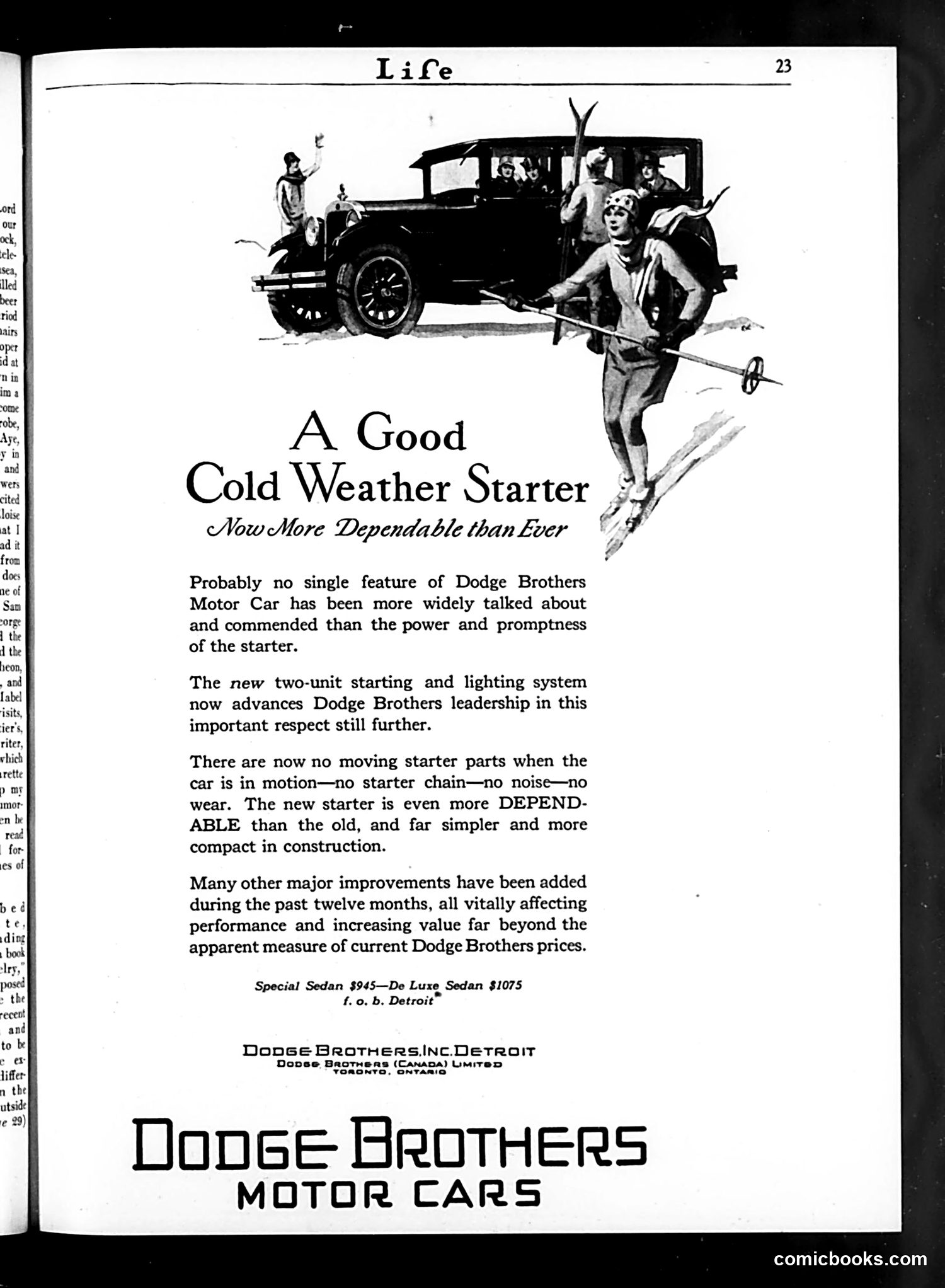
This is a **full-page automobile advertisement**, not satire or political commentary. It advertises Dodge Brothers motor cars, emphasizing their improved cold-weather starter system. The illustration shows a 1920s-era sedan with passengers, alongside a man hand-cranking the engine—a visual contrast highlighting progress. Hand-cranking was the dangerous, labor-intensive method of starting older cars; Dodge's electric starter eliminated this necessity. The ad's appeal targets practical concerns of the era: reliable cold-weather starting was genuinely difficult for early automobiles, making a dependable starter a significant selling point. The text emphasizes the new "two-unit starting and lighting system" is simpler, more compact, and more dependable than previous models. Pricing ($945–$1075) situates this as mid-market automobiles. This represents straightforward advertising typical of *Life* magazine in the 1920s–30s—no hidden political message or satire is evident.
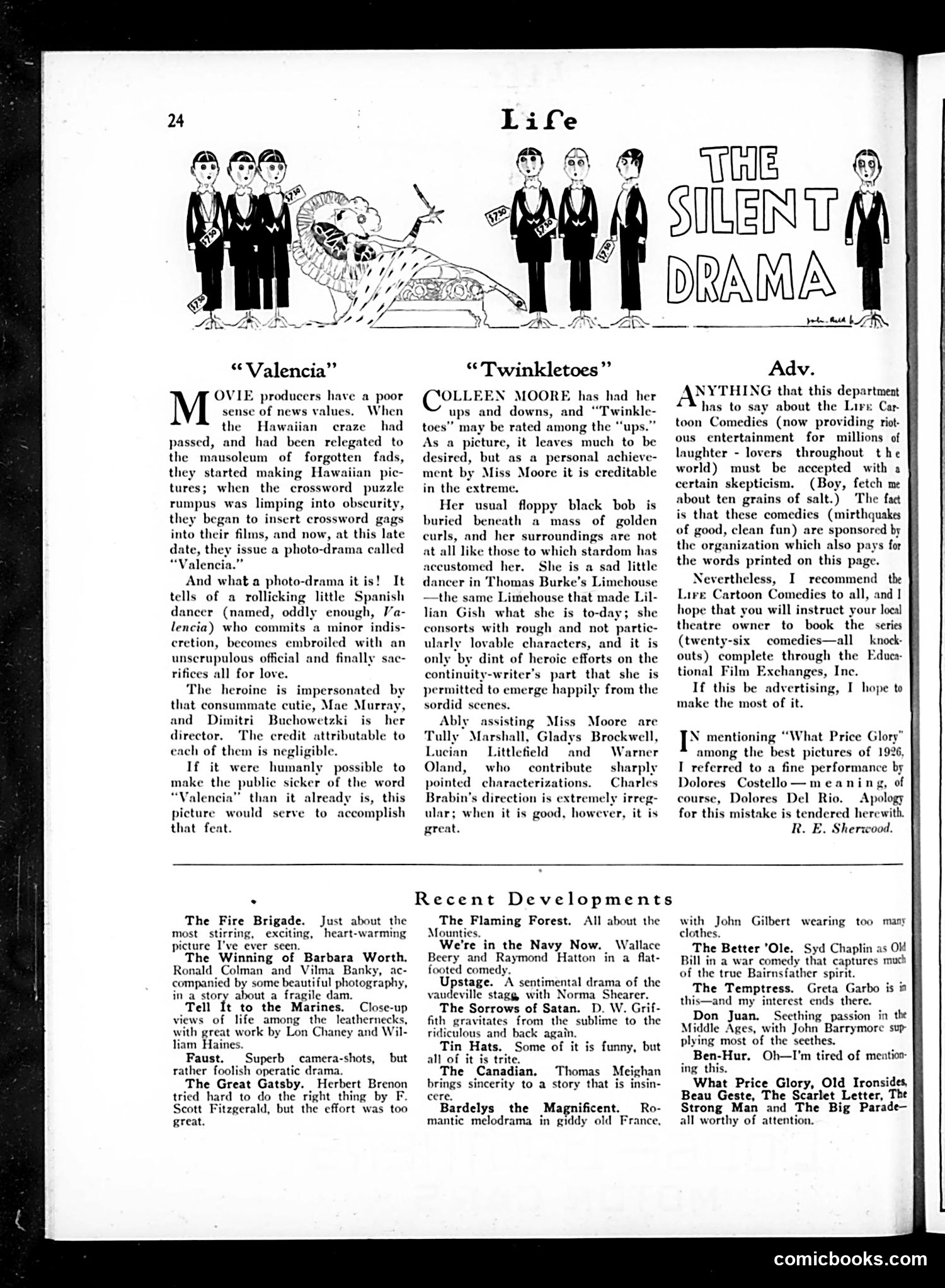
This page reviews recent films and contains a cartoon titled "The Silent Drama" satirizing the film industry's tendency to chase trends. ## The Cartoon The cartoon depicts three men in suits watching a woman fall or collapse dramatically. It mocks Hollywood producers for belatedly capitalizing on fads—they made Hawaiian pictures after the Hawaiian craze had peaked, added crossword puzzle gags after that trend faded, and now release "Valencia" when Spanish dancer themes are no longer fresh. ## Film Reviews The page reviews three pictures: - **"Valencia"**: Mae Murray stars in a Spanish dancer drama the critic finds tedious and derivative, criticizing producers for pursuing expired trends. - **"Twinkletoes"**: Colleen Moore performs creditably in a gritty Thomas Burke adaptation (Limehouse setting), though the script strains to give her a happy ending. - **"The Silent Drama"**: A self-aware advertisement for Life Cartoon Comedies, where the author ironically acknowledges he's reviewing content his magazine sponsors, requesting "ten grains of salt." The page also lists other recent releases briefly, and includes an apology correction regarding "What Price Glory."
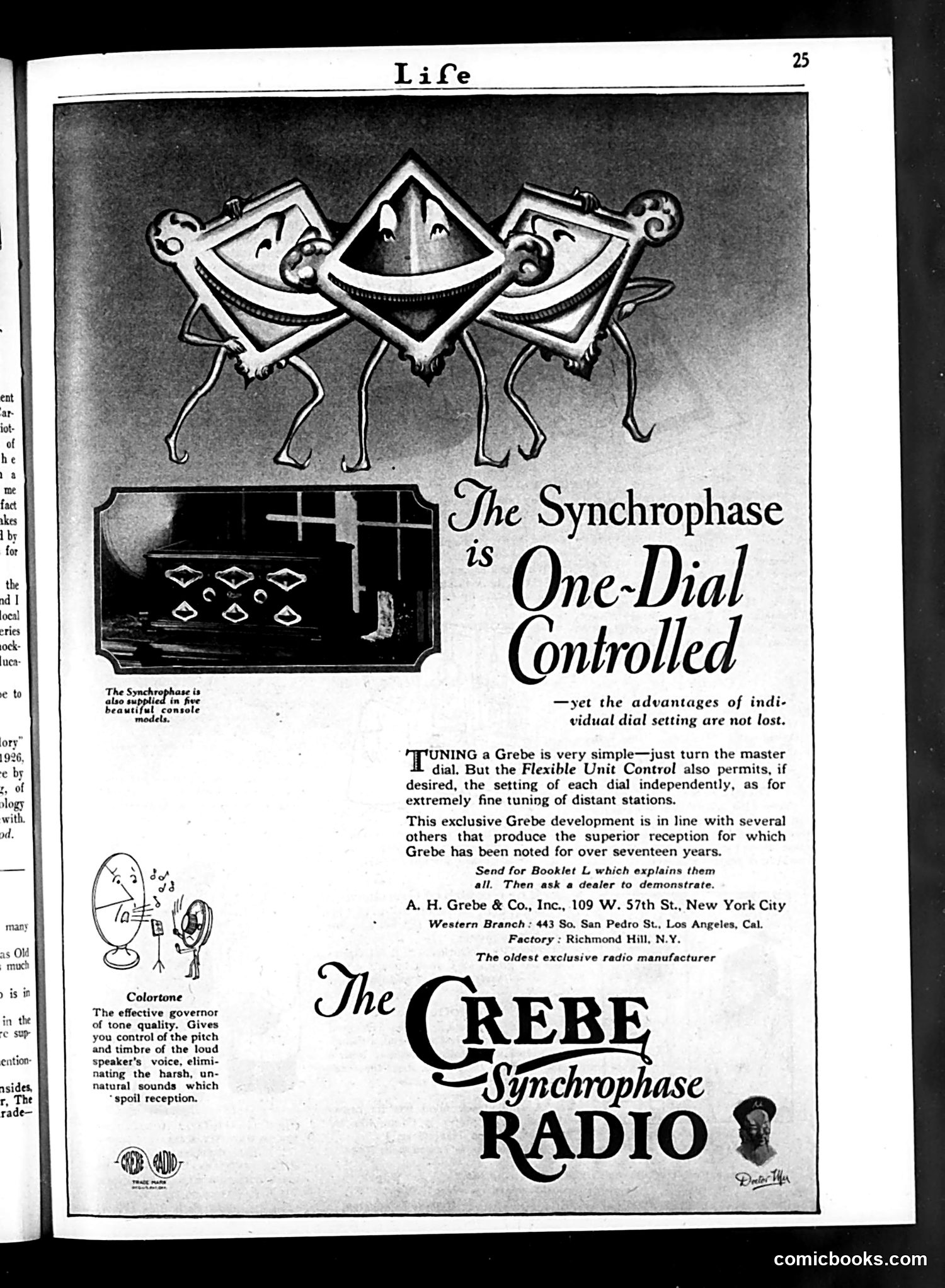
This page is primarily a **radio advertisement**, not political satire. It advertises the Grebe Synchrophase Radio, marketed as "the oldest exclusive radio manufacturer." The cartoon at top—three anthropomorphic radio dials dancing together—is **whimsical product imagery**, not satire. It illustrates the radio's key selling point: the "One-Dial Controlled" tuning system that simplifies operation while still allowing independent fine-tuning of multiple dials. The small "Colortone" illustration depicts a radio speaker personified as a face, humorously showing how the tone control feature lets users adjust sound quality—controlling "pitch and timbre" to eliminate harshness. **Context for modern readers**: This reflects 1920s radio technology, when tuning radios required adjusting multiple dials. Grebe's innovation was a master dial for simple operation alongside individual controls for advanced users. The dancing dials and speaking speaker are light comedic touches typical of 1920s advertising design.
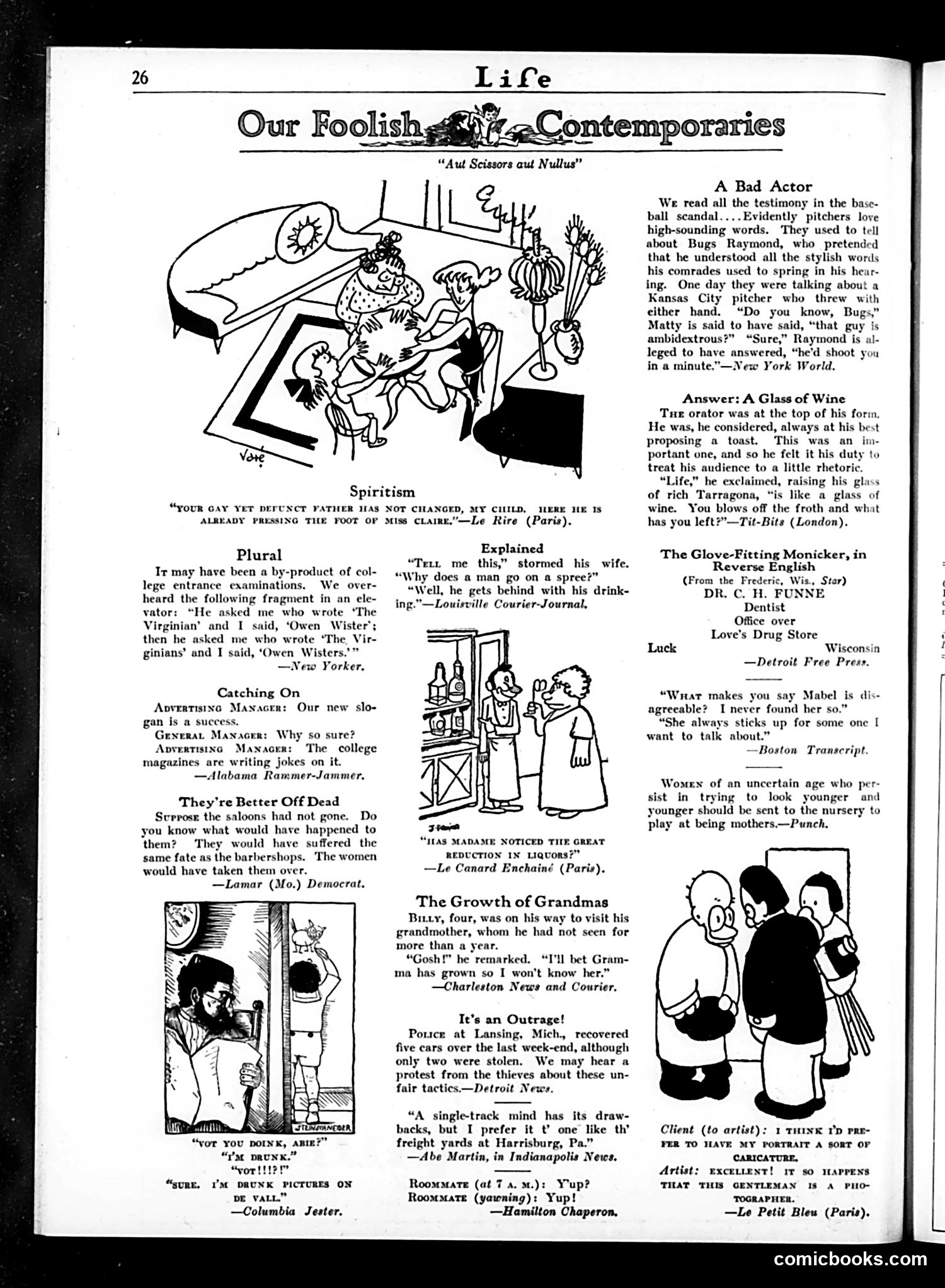
This is a humor page collecting short jokes and satirical observations from various American and foreign publications. Key content includes: **"Spiritism"**: Mocks belief in communicating with the dead through séances—a popular fad of the era. **"A Bad Actor"**: References baseball scandal figure Bugs Raymond, satirizing athletes who pretend knowledge they lack. The joke: when told a pitcher is "ambidextrous," Raymond supposedly answered he'd "shoot you in a minute"—misunderstanding the word entirely. **"They're Better Off Dead"**: Dark humor about Prohibition's impact—saloons closing, but barbershops supposedly taken over by women (suggesting women's increasing public presence was unwelcome). **Various one-liners** mock contemporary absurdities: people confusing author names, drunk men creating wall art, children's innocent observations, and police incompetence. The page reflects 1910s-20s American anxieties: Prohibition, changing gender roles, Prohibition-era crime, and satirizes pretension across social classes. The tone is lighthearted but reflects period attitudes toward women, drinking, and class divisions.
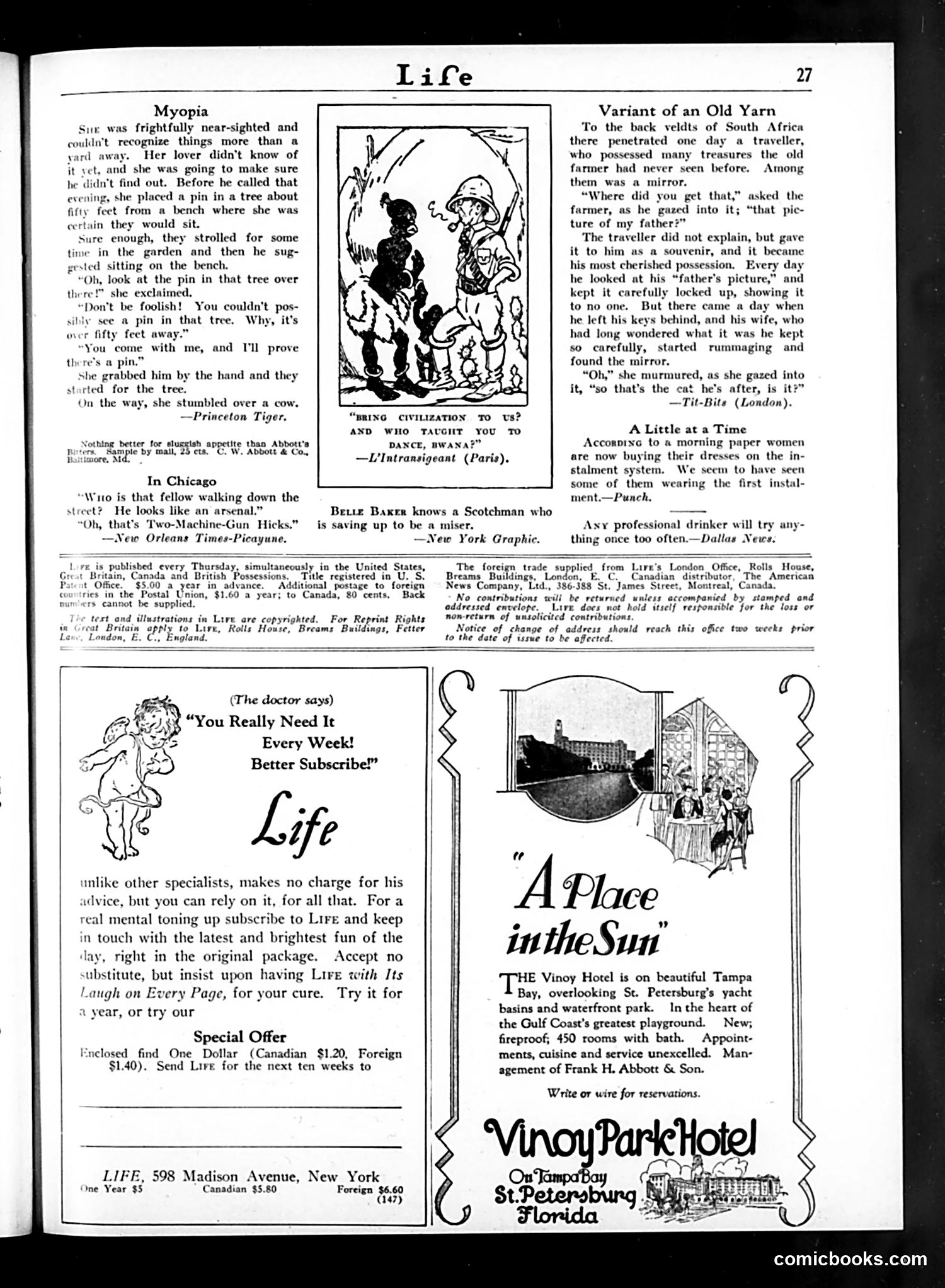
This page contains several short humorous anecdotes typical of Life magazine's satirical format: **"Myopia"**: A woman uses her near-sightedness as a romantic test. She claims to see a pin fifty feet away to impress her boyfriend, then deliberately walks him toward it to "prove" her vision. The joke relies on the period's attitudes about courtship deception. **"Variant of an Old Yarn"**: A South African farmer mistakes a mirror for a portrait of his father, then his wife assumes it's evidence of an affair ("the cat he's after"). The humor depends on the farmer's unfamiliarity with mirrors—suggesting colonial-era stereotypes about rural or non-Western populations. **"Bring Civilization to Us?"**: A brief cartoon (artist credited to L'Intransigeant, Paris) showing colonial-era racial attitudes, with the caption implying irony about "civilization." The page also includes period advertisements for Life subscriptions and the Vinoy Park Hotel in Florida. The overall tone reflects early 20th-century humor conventions, including casual racial and gender stereotypes now considered offensive.
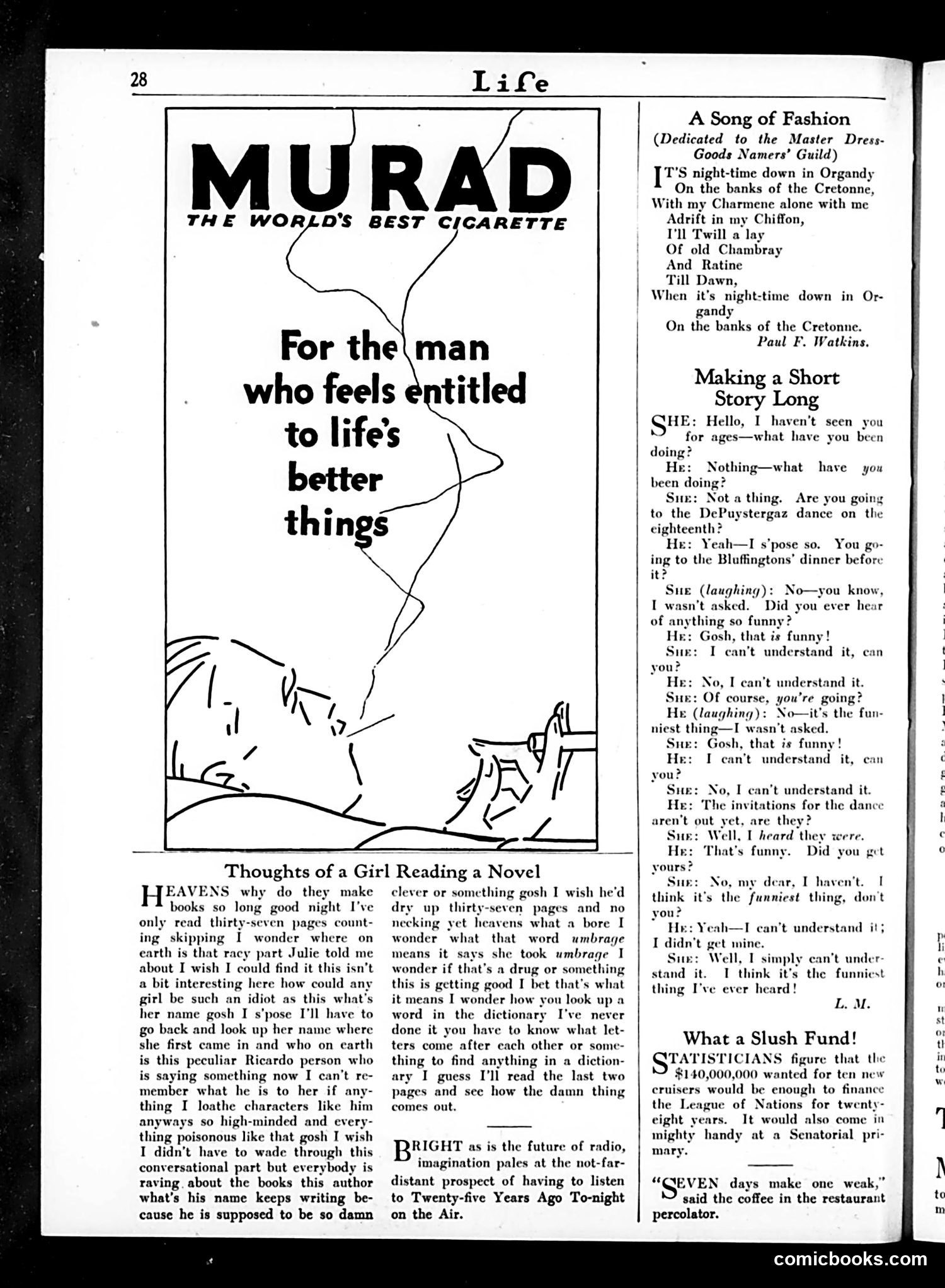
This page contains **advertisements and light satirical humor** typical of 1920s-30s Life magazine. The **Murad cigarette ad** uses a stylized profile illustration to market cigarettes to aspirational men seeking "life's better things"—reflecting era advertising that associated smoking with sophistication and status. **"Thoughts of a Girl Reading a Novel"** satirizes female readers as scattered and impatient, jumping between pages, forgetting character names, and skipping to find "racy" (romantic/scandalous) content. This reflects period attitudes dismissing women's literary engagement as frivolous. **"Making a Short Story Long"** is a dialogue joke where two people repeatedly say they weren't invited to events and find it "funny"—obvious mutual misunderstanding played for absurdist humor. **"A Song of Fashion"** parodies pretentious fabric names (Organdy, Cretonne, Chiffon) used in high-end dressmaking, mocking the industry's use of fancy terminology. The **Slush Fund** item compares military spending ($140 million for cruisers) to League of Nations funding, with a joke about political corruption in Senate primaries—commentary on government priorities and backroom dealing.
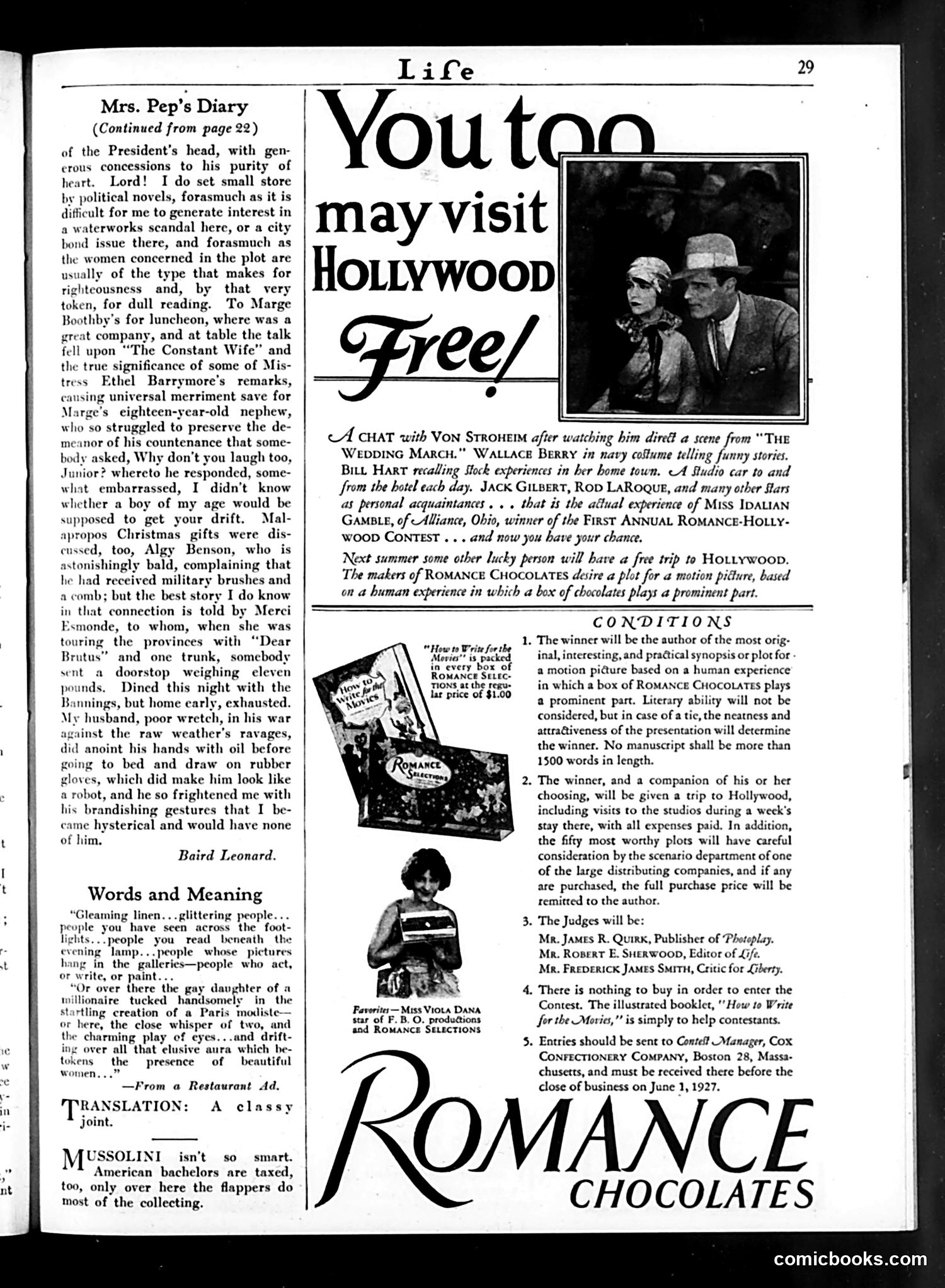
This page is primarily an **advertisement for Romance Chocolates** disguised as editorial content. The contest offers a trip to Hollywood to the writer of the best plot synopsis for a motion picture centered around a box of their chocolates. The "editorial" portion features a chat with **Von Stroheim** (a famous silent-film director) and mentions of Hollywood actors like Wallace Berry, Jack Gilbert, and Rod LaRoque—all genuine 1920s cinema figures used as promotional draw. The left column contains unrelated diary entries and literary commentary ("Words and Meaning"), including a satirical note about Mussolini's intellect—typical of Life's political humor of the era. **The satire here is subtle**: Life is mixing genuine celebrity gossip and film-industry commentary with a straightforward product advertisement, blurring editorial and advertising boundaries in a way that would raise modern ethical concerns about disclosure.
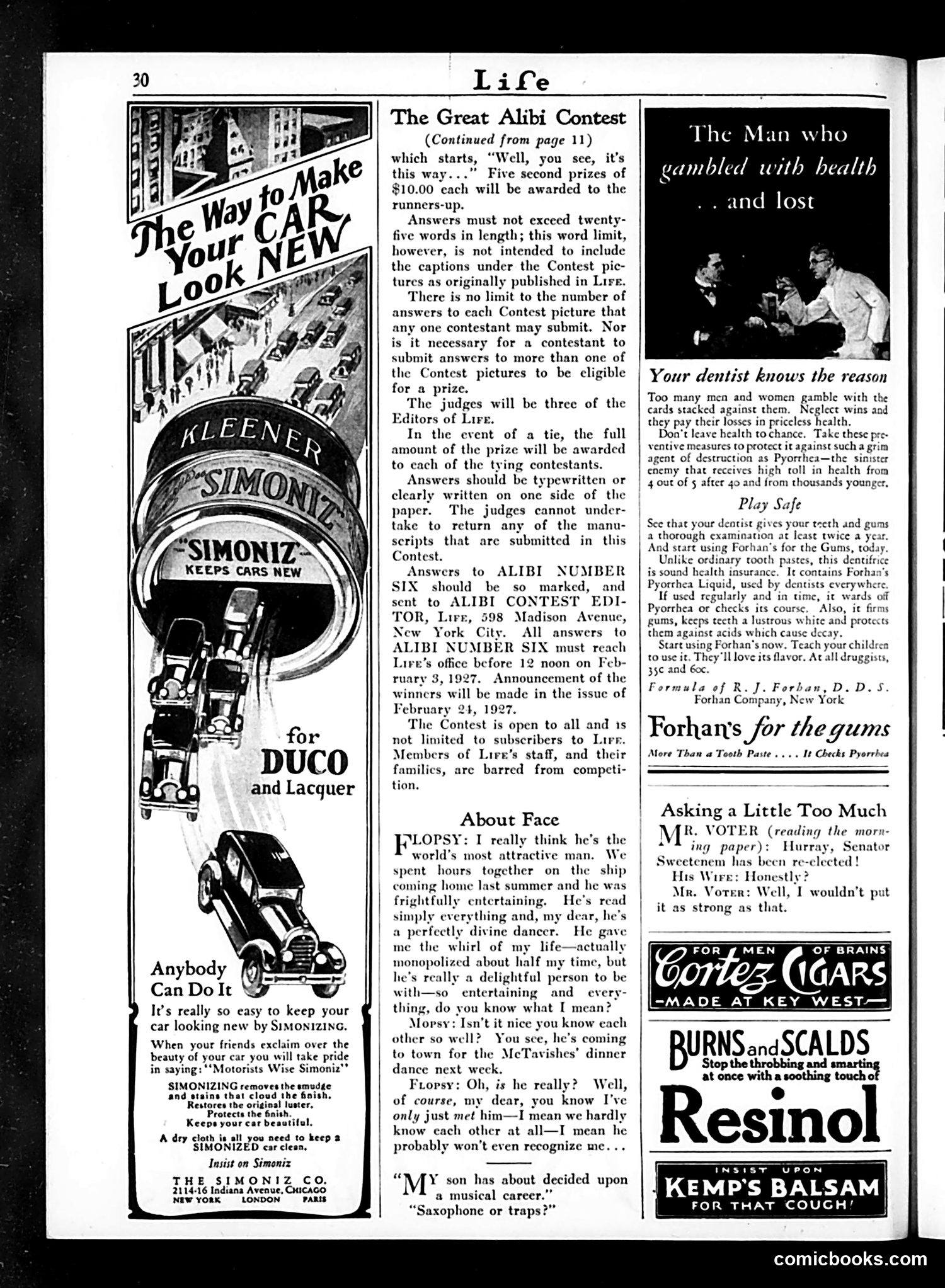
This page primarily contains **advertisements and contest information** rather than political cartoons. The main content includes: **"The Great Alibi Contest"** – Life magazine's ongoing contest asking readers to complete humorous alibis (excuses) in 25 words or fewer, with $10 prizes. Judges are Life's editors. **Advertisements** dominate the right side, promoting: - **Forhan's toothpaste** – targeting dental health, specifically claiming to prevent pyorrhea (a gum disease), with a moralizing tone about health choices - **Simoniz car wax** – showing how easy it is to maintain a car's finish - **Cortez cigars, Resinol ointment, Kemp's Balsam** – standard 1920s product ads **"About Face"** – A brief humorous dialogue between "Plopsy" and "Flopsy" (characters discussing an attractive man from a ship voyage), typical of Life's light social satire. The overall tone reflects 1920s consumer culture combined with mild social commentary on dating and health consciousness.
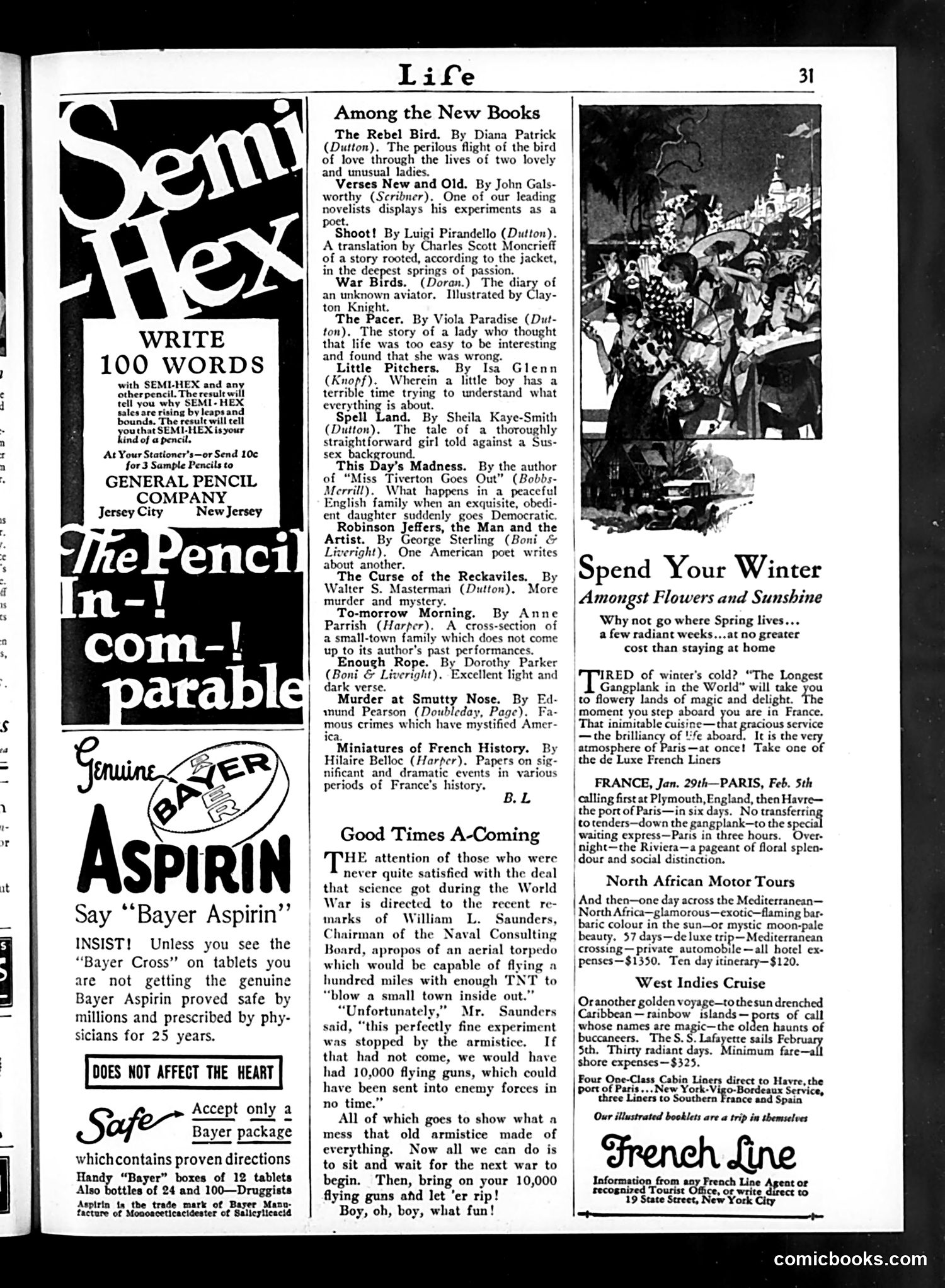
This page is primarily **advertising and book reviews**, not political satire. However, it contains one significant commentary piece: The "Good Times A-Coming" section mocks **William L. Saunders**, Chairman of the Naval Consulting Board, who lamented that WWI's armistice interrupted development of a 100-mile-range aerial torpedo capable of destroying entire towns. Saunders expressed regret they couldn't deploy 10,000 such weapons. The satire is biting: Life presents his disappointment as absurd, using his own language ("What fun!") to highlight the grotesque logic of weapons development prioritized over peace. The piece critiques the military-industrial mindset that views an armistice—which saved lives—as a missed opportunity for mass destruction. The remaining content consists of book advertisements and travel promotions typical of 1920s Life magazine.
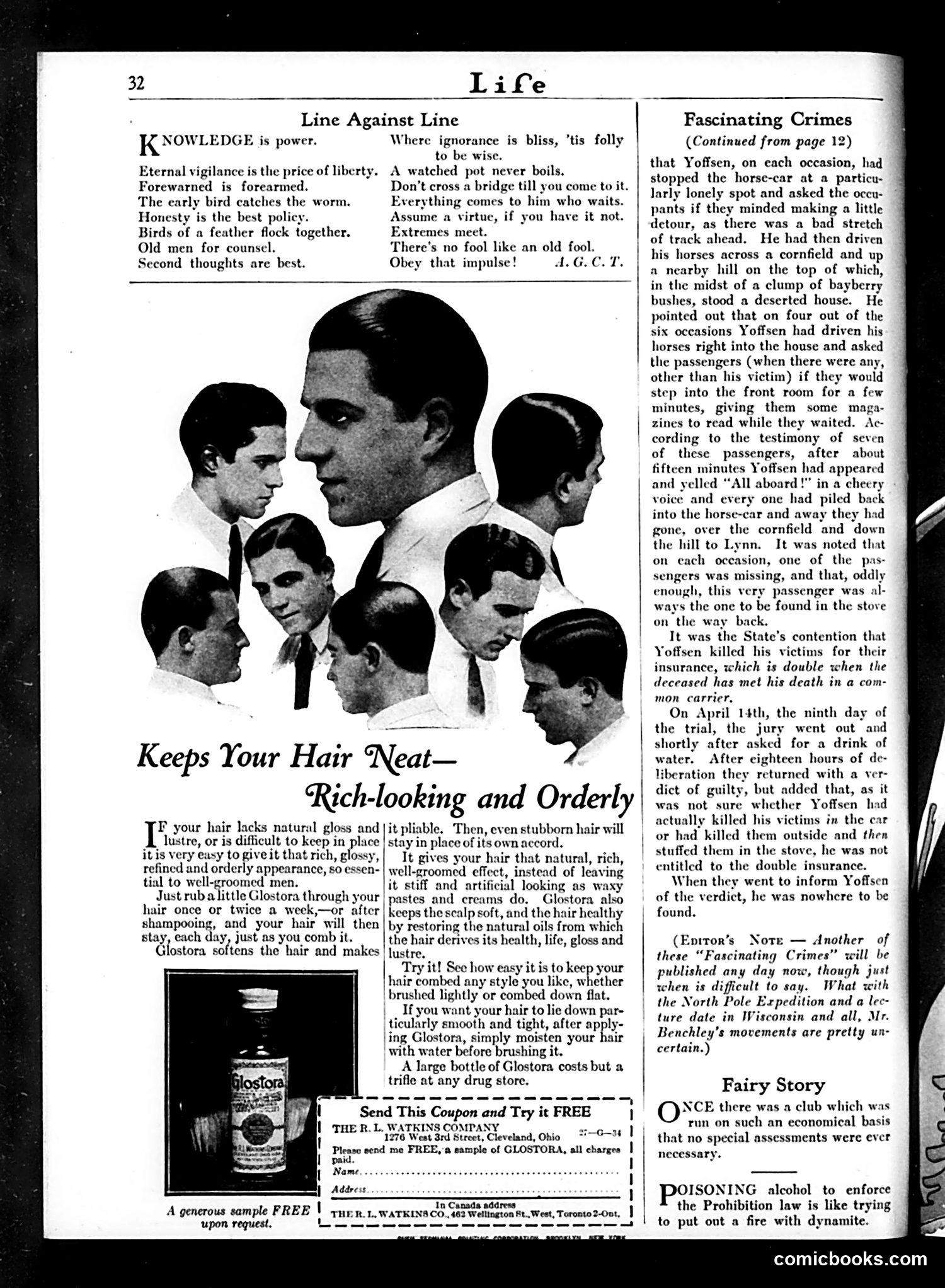
This page combines unrelated content typical of early 20th-century Life magazine format. **Top Section ("Line Against Line"):** A visual and textual debate presenting contradictory proverbs—"Knowledge is power" versus "Ignorance is bliss"—expressing the tension between opposing conventional wisdom. The point appears to be that folk sayings often contradict each other, making blind adherence to any single principle foolish. **Center Advertisement:** A Glostora hair product ad featuring photographs of men's heads demonstrating the product's grooming benefits. Standard period advertising with a coupon offer. **Right Column ("Fascinating Crimes"):** Continues a serialized true-crime narrative about a criminal named Yoffsen who murdered passengers in a horse-car for their insurance money. The case describes his method of luring victims to an isolated house, killing them, and hiding bodies in a stove. The jury convicted him but expressed uncertainty about details. The page reflects Life's mixed editorial approach: intellectual commentary, commercial advertising, and sensational crime reporting.