
Life, 1927-01-20 · page 14 of 34
Life — January 20, 1927 — page 14: what you’re looking at
What you’re looking at
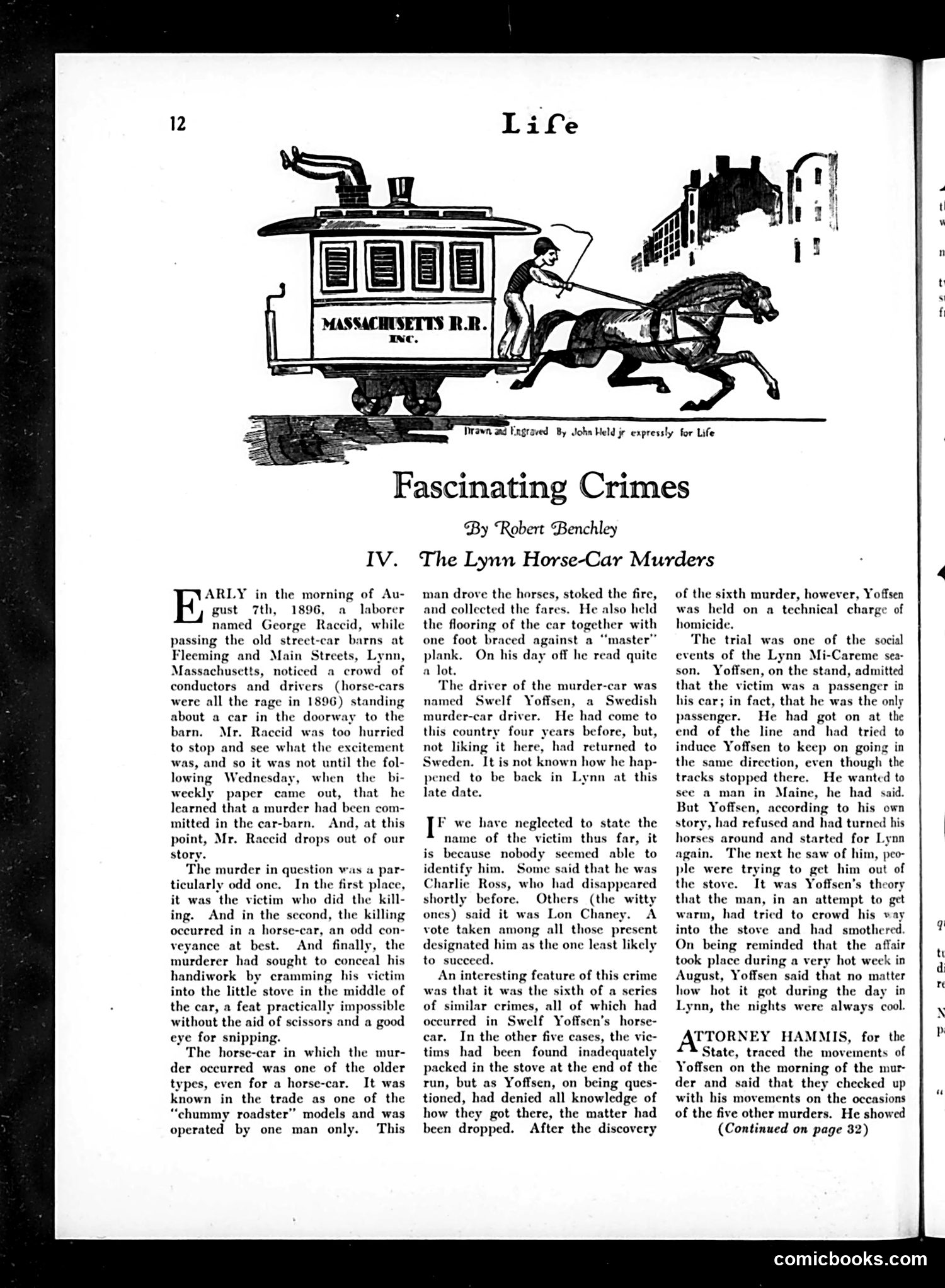
This page presents a true-crime article by Robert Benchley about murders that occurred in a horse-drawn streetcar in Lynn, Massachusetts. The illustration at the top shows a horse pulling a Massachusetts Railroad Inc. car, with a driver whipping the horse—likely depicting the actual crime scene or murder conveyance. The article describes a series of murders committed in a horse-car (streetcar), with the sixth victim being a passenger named Yoffsen. A Swedish driver named Sweif Yoffsen is suspected but denies involvement. The text notes this was an older crime type, operated by a single driver, making concealment of bodies in the stove "a feat practically impossible." The article treats a grim historical crime with matter-of-fact journalistic tone typical of Life magazine's crime reporting.
📄 Transcribed text from this page (OCR, searchable)
Machine-transcribed from the original scan — historical spelling and the odd misread are preserved.
Drawn aad Engraved By John Held jr expressly for Life Fascinating Crimes By “Robert Benchley IV. The Lynn Horse-Car Murders ARLY in the morning of Au- gust 7th, 1896, a laborer named George Raccid, while passing the old strect-car barns at Fleeming and Main Streets, Lynn, Massachusetts, noticed a crowd of conductors and drivers (horse-cars were all the rage in 1896) standing about a car in the doorway to the barn. Mr. Raccid was too hurried to stop and see what the excitement was, and so it was not until the fol- lowing Wednesday, when the bi- weekly paper came out, that he learned that a murder had been com- mitted in the car-barn. And, at this point, Mr. Raccid drops out of our story. The murder in question was a par- ticularly odd one. In the first place, it was the victim who did the kill- ing. And in the second, the killing occurred in a horse-car, an odd con- veyance at best. And finally, the murderer had sought to conceal his handiwork by cramming his victim into the little stove in the middle of the car, a feat practically impossible without the aid of scissors and a good eye for snipping. The horse-car in which the mur- der occurred was one of the older types, even for a horse-car. It was known in the trade as one of the “chummy roadster” models and was operated by one man only. This man drove the horses, stoked the fire, and collected the fares. He also held the flooring of the car together with one foot braced against a “master” plank. On his day off he read quite a lot. The driver of the murder-car was named Swelf Yoffsen, a Swedish murder-car driver. He had come to this country four years before, but, not liking it here, had returned to Sweden. It is not known how he hap- pened to be back in Lynn at this late date. F we have neglected to state the name of the victim thus far, it is because nobody seemed able to identify him. Some said that he was Charlie Ross, who had disappeared shortly before. Others (the witty ones) said it was Lon Chaney. A vote taken among all those present designated him as the one least likely to succeed, An interesting feature of this crime was that it was the sixth of a series of similar crimes, all of which had occurred in Swelf Yoffsen’s horse- car. In the other five cases, the vie- tims had been found inadequately packed in the stove at the end of the run, but as Yoffsen, on being ques- tioned, had denied all knowledge of how they got there, the matter had been dropped. After the discovery of the sixth murder, however, Yorffsen was held on a technical charge of homicide. The trial was one of the social events of the Lynn Mi-Careme sea- son. Yoffsen, on the stand, admitted that the victim was a passenger in his car; in fact, that he was the only passenger. He had got on at the end of the line and had tried to induce Yoffsen to keep on going in the same direction, even though the tracks stopped there. He wanted to see a man in Maine, he had said But Yoffsen, according to his own story, had refused and had turned his horses around and started for Lynn again. The next he saw of him, peo- ple were trying to get him out of the stove. It was Yoffsen'’s theory that the man, in an attempt to get warm, had tried to crowd his way into the stove and had smothered. On being reminded that the affair took place during a very hot week in August, Yoffsen said that no matter how hot it got during the day in Lynn, the nights were always cool. TTORNEY HAMMIS, for the State, traced the movements of Yoffsen on the morning of the mur- der and said that they checked up with his movements on the occasions of the five other murders. He showed (Continued on page 82) comicbooks.com