
Life, 1927-01-20 · page 26 of 34
Life — January 20, 1927 — page 26: what you’re looking at
What you’re looking at
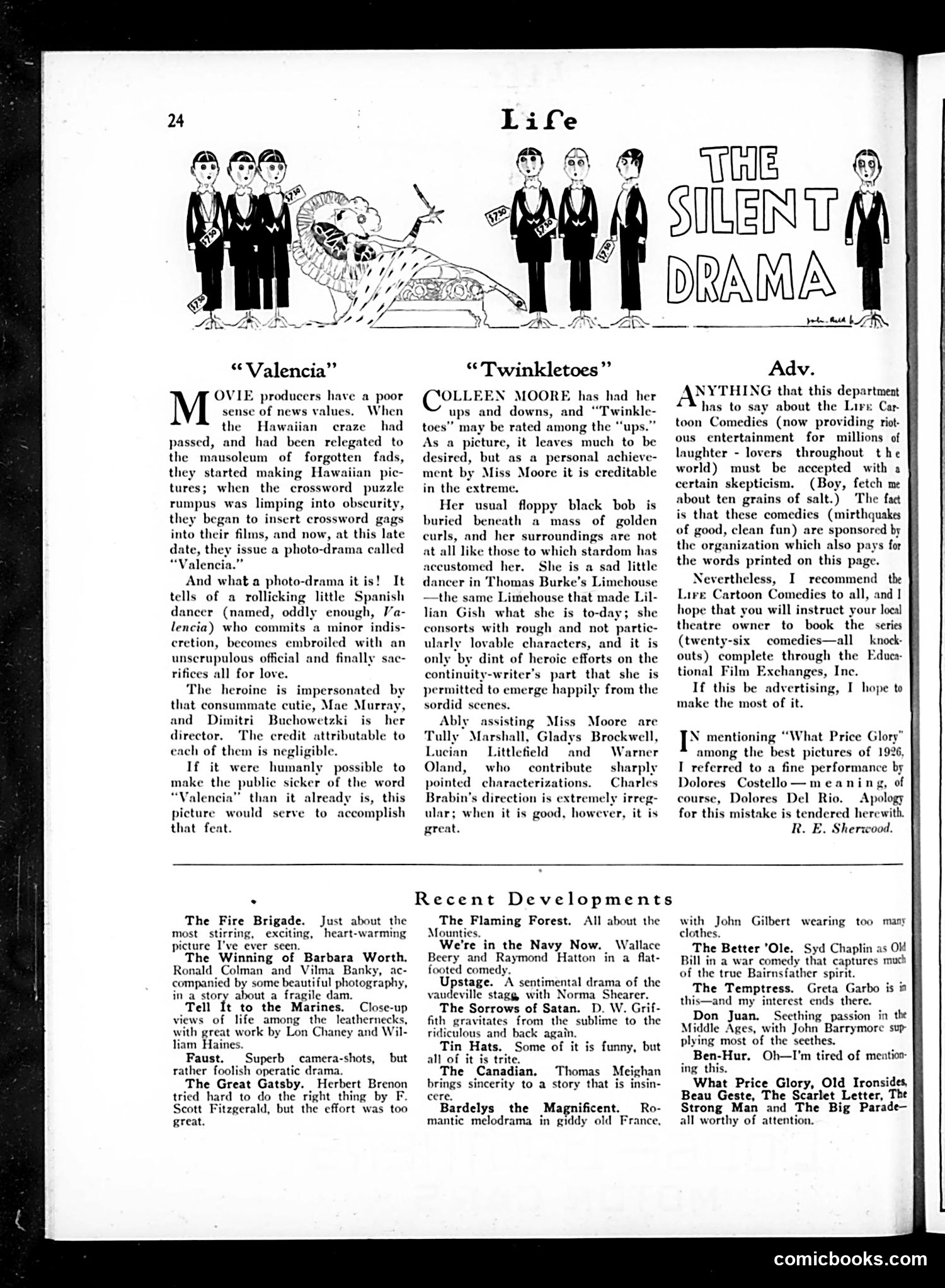
This page reviews recent films and contains a cartoon titled "The Silent Drama" satirizing the film industry's tendency to chase trends. ## The Cartoon The cartoon depicts three men in suits watching a woman fall or collapse dramatically. It mocks Hollywood producers for belatedly capitalizing on fads—they made Hawaiian pictures after the Hawaiian craze had peaked, added crossword puzzle gags after that trend faded, and now release "Valencia" when Spanish dancer themes are no longer fresh. ## Film Reviews The page reviews three pictures: - **"Valencia"**: Mae Murray stars in a Spanish dancer drama the critic finds tedious and derivative, criticizing producers for pursuing expired trends. - **"Twinkletoes"**: Colleen Moore performs creditably in a gritty Thomas Burke adaptation (Limehouse setting), though the script strains to give her a happy ending. - **"The Silent Drama"**: A self-aware advertisement for Life Cartoon Comedies, where the author ironically acknowledges he's reviewing content his magazine sponsors, requesting "ten grains of salt." The page also lists other recent releases briefly, and includes an apology correction regarding "What Price Glory."
📄 Transcribed text from this page (OCR, searchable)
Machine-transcribed from the original scan — historical spelling and the odd misread are preserved.
LE ‘ ¢ J AX _ FIN. “Valencia” OVIE producers have a poor M sense of ne ues. When the Hawaiian craze had passed, and had been relegated to the mausoleum of forgotten fads, they started making Hawaiian pic- tures; when the crossword puzzle rumpus limping into obscurity, they began to insert crossword gags into their films, and now, at this late date, they issue a photo-drama called “Valenci: And what a photo-drama it is! It tells of a rollicking little Spanish dancer (named, oddly enough, Va- lencia) who commits a minor indis- cretion, becomes embroiled with an unscrupulous official and finally sac- rifices all for love. The heroine is impersonated by that consummate cutie, Mae Murray, and Dimitri Buchowetzki is her director. The credit attributable to each of them is negligible. If it were humanly possible to make the public sicker of the word Valencia” than it already is, this picture would serve to accomplish that feat. “Twinkletoes” OLLEEN MOORE has had her ups and downs, and “Twinkle- toes” may be rated among the “ups.” As a picture, it leaves much to be desired, but as a personal achieve- ment by Miss Moore it is creditable in the extreme. Her usual floppy black bob is buried beneath a mass of golden curls, and her surroundings are not at all like those to which stardom has accustomed her, She is a sad little d. rin Thomas Burke’s Limehouse —the same Limehouse that made Lil- lian Gish what she is to-day; she consorts with rough and not partic- ularly lovable characters, and it is only by dint of heroic efforts on the continuity-writer’s part that she is permitted to emerge happily from the sordid scenes. Ably assisting Miss Moore are Tully Marshall, Gladys Brockwell, Lucian Littlefield = and = Warner Oland, who contribute — sharply pointed characterizations. Charles Brabin’s direction is extremely irreg- ular; when it is good, however, it is great. SILENT “ YTHING that this department s to say about the Lire Car- toon Comedies (now providing riot- ous entertainment for millions of laughter - lovers throughout the world) must be accepted with a certain skepticism. (Boy, fetch me about ten grains of salt.) The fact is that these comedies (mirthquakes of good, clean fun) are sponsored by the organization which also pays for the words printed on this page. Nevertheless, I recommend the Lire Cartoon Comedies to all, and | hope that you will instruct your local theatre owner to book the series (twenty-six comedies—all — knock- outs) complete through the Educa- tional Film Exchanges, Inc. If this be advertising, I hope to make the most of it. N mentioning ‘What Price Glory among the best pictures of 1926, I referred to a fine performance by Dolores Costello—meaning, of course, Dolores Del Rio. Apology for this mistake is tendered herewith. R. E, Sherwood. : The Fire Brigade. most stirring, exciting, picture I've ever seen. The Winning of Barbara Worth. Ronald Colman and Vilma Banky, ac- companied by some beautiful photography, ina story about a fragile dam. Tell It to the Marines. Close-up views of life among the leathernecks, with great work by Lon Chaney and Wil- liam Haines. Faust. Superb — camera-shots, rather foolish operatic drama. The Great Gatsby. Herbert Brenon tried hard to do the right thing by F. Scott Fitzgerald, but the effort was too great. Just about the heart-warming but Recent Developments The Flaming Forest. All about the Mounties. We're in the Navy Now. Wallace Beery and Raymond Hatton in a flat- footed comedy. Upstage. A sentimental drama of the vaudeville stagg, with Norma Shearer. The Sorrows of Satan. D. W. Grif- fith gravitates from the sublime to the ridiculous and back again. Tin Hats. Some of it is funny, but all of it is trite. The Canadian. Thomas Meighan brings sincerity to a story that is insin- cere, Bardelys the Magnificent. Ro- mantic melodrama in giddy old France, with John Gilbert wearing too many clothes. ' The Better Ole. Syd Chaplin as Ol Bill in a war comedy that captures much of the true Bairnsfather spirit. The Temptress. Greta Garbo is is this—and my interest ends there. Don Juan. Seething passion in the Middle Ages, with John Barrymore sup- plying most of the seethes. Ben-Hur. Oh—I'm tired of mention ing this. What Price Glory, Old Ironsides, Beau Geste, The Scarlet Letter, The Strong Man and The Big Parade— all worthy of attention. comicbooks.com