
Life, 1927-01-20 · page 21 of 34
Life — January 20, 1927 — page 21: what you’re looking at
What you’re looking at
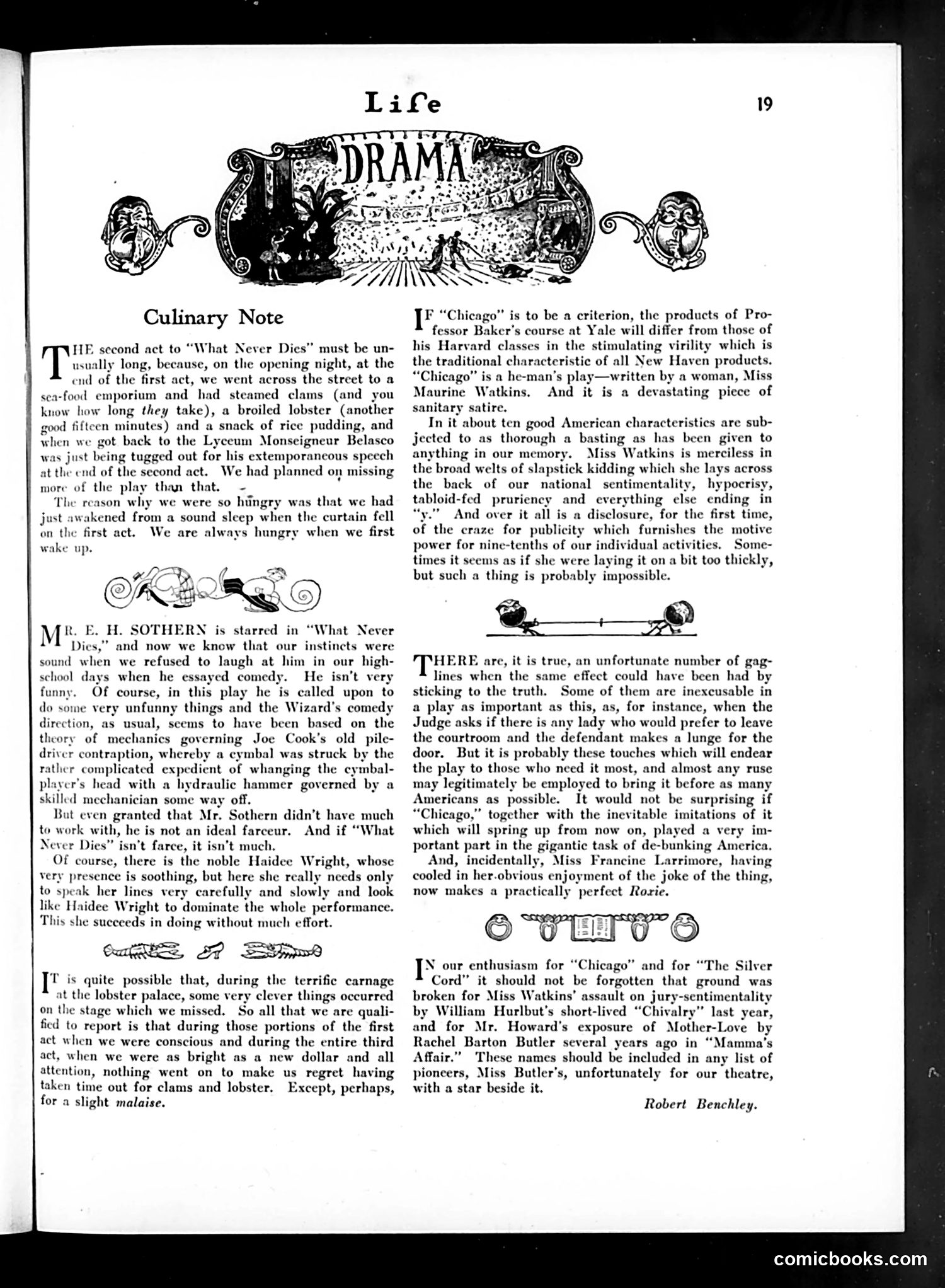
This page contains theater reviews by Robert Benchley, a prominent satirical drama critic. The content mocks theatrical performances of the era. **Key references:** - **"What Never Dies"**: A play at the Lyceum starring E.H. Sothern, whom Benchley dismisses as unfunny. He jokes that the second act was so long he left to eat clams and lobster, returning to find the director David Belasco still giving his curtain speech. - **"Chicago"**: A play by Maurine Watkins (notably, a woman writing "a he-man's play"). Benchley praises it as biting satire attacking American traits—sentimentality, hypocrisy, tabloid sensationalism, and the obsession with publicity. The satire targets both mediocre theatrical direction (the "Joe Cook" reference to mechanical comedy) and celebrates sharper social commentary. Benchley's humor relies on the absurdity of audience behavior and theatrical pretension.
📄 Transcribed text from this page (OCR, searchable)
Machine-transcribed from the original scan — historical spelling and the odd misread are preserved.
HE second act to “What Never Dies” must be un- T iseatt long, because, on the opening night, at the end of the first act, we went across the street to a sea-food emporium and had steamed clams (and you know how long they take), a broiled lobster (another good fifteen minutes) and a snack of rice pudding, and when we got back to the Lyceum Monseigneur Belasco was just being tugged out for his extemporancous speech at the end of the second act. We had planned on missing more of the 7 than that. - The reason why we were so hiingry was that we had just awakened from a sound sleep when the curtain fell on the first act. We are always hungry when we first wake up. H. SOTHERN is starred in “What Never »s,”" and now we know that our instincts were sound when we refused to laugh at him in our high- 's when he ed comedy. He isn’t very funny. Of course, in this play he is called upon to do some very unfunny things and the Wizard’s comedy direction, as usual, scems to have been based on the theory of mechanics governing Joe Cook's old _pile- driver contraption, whereby a cymbal was struck by the rather complicated expedient of whanging the cymbal- player's head with a hydraulic hammer governed by a skilled mechanician some way off. But even granted that Mr. Sothern didn’t have much to work with, he is not an id farceur. And if “What Never Dies” isn’t farce, it isn’t much. Of course, there is the noble H very presence is soothing, but her y to speak her lines very carefully and slowly and look like Haidee Wright to dominate the whole performance. This she succeeds in doing without much effort. OEE, Sf Tsk school I’ is quite possible that, during the terrific carnage at the lobster palace, some very clever things occurred on the stage which we missed. So all that we are quali- fied to report is that during those portions of the first act when we were conscious and during the entire third act, when we were as bright as a new dollar and all attention, nothing went on to make us regret having taken time out for clams and lobster. Except, perhaps, for a slight malaise. “Chicago” is to be a criterion, the products of Pro- fessor Baker's course at Yale will differ from those of his Harvard classes in the stimulating virility which is the traditional characteristic of all New Haven products. “Chicago” is a he-man’s play—written by a woman, Miss Maurine Watkins. And it is a devastating piece of sanitary satire. In it about ten good American characteristics are sub- jected to as thorough a basting as has been given to anything in our memo Miss Watkins is merciless in the broad welts of slapstick kidding which she lays across the k of our national sentimentality, hypocrisy, tabloid-fed pruriency and everything else ending in “y.”’ And over it all is a disclosure, for the first time, of the craze for publicity which furnishes the motive power for nine-tenths of our individual act . Some- times it seems as if she were laying it on a bit too thickly, but such a thing is probably impossible. + —._ © HERE are, it is true. unfortunate number of gag- lines when the same t could have been had by sticking to the truth. Some of them are inexcusable in a play as important as this, as, for instance, when the Judge asks if there is any lady who would prefer to leave the courtroom and the defendant makes a lunge for the door. But it is probably these touches which will endear the play to those who need it most, and almost any ruse may legitimately be employed to bring it before as many Americans as possible. It would not be surprising if “Chicago,” together with the inevitable imitations of it which will spring up from now on, played a very im- portant part in the gigantic task of de-bunking America. And, incidentally, Miss Francine Larrimore, having cooled in her.obvious enjoyment of the joke of the thing, now makes a practically perfect Roxie. G ane Be N our enthusiasm for “Chicago” and for “The Silver Cord” it should not be forgotten that ground was broken for Miss Watkins’ assault on jury-sentimentality by William Hurlbut’s short-lived “Chivalry” last year, and for Mr. Howard's exposure of Mother-Love by Rachel Barton Butler several years ago in ‘“‘Mamma’s Affair.” These names should be included in any list of pioncers, Miss Butler's, unfortunately for our theatre, with a star beside it. ENKEI Robert Benchley. comicbooks.com