
Life, 1927-01-20 · page 16 of 34
Life — January 20, 1927 — page 16: what you’re looking at
What you’re looking at
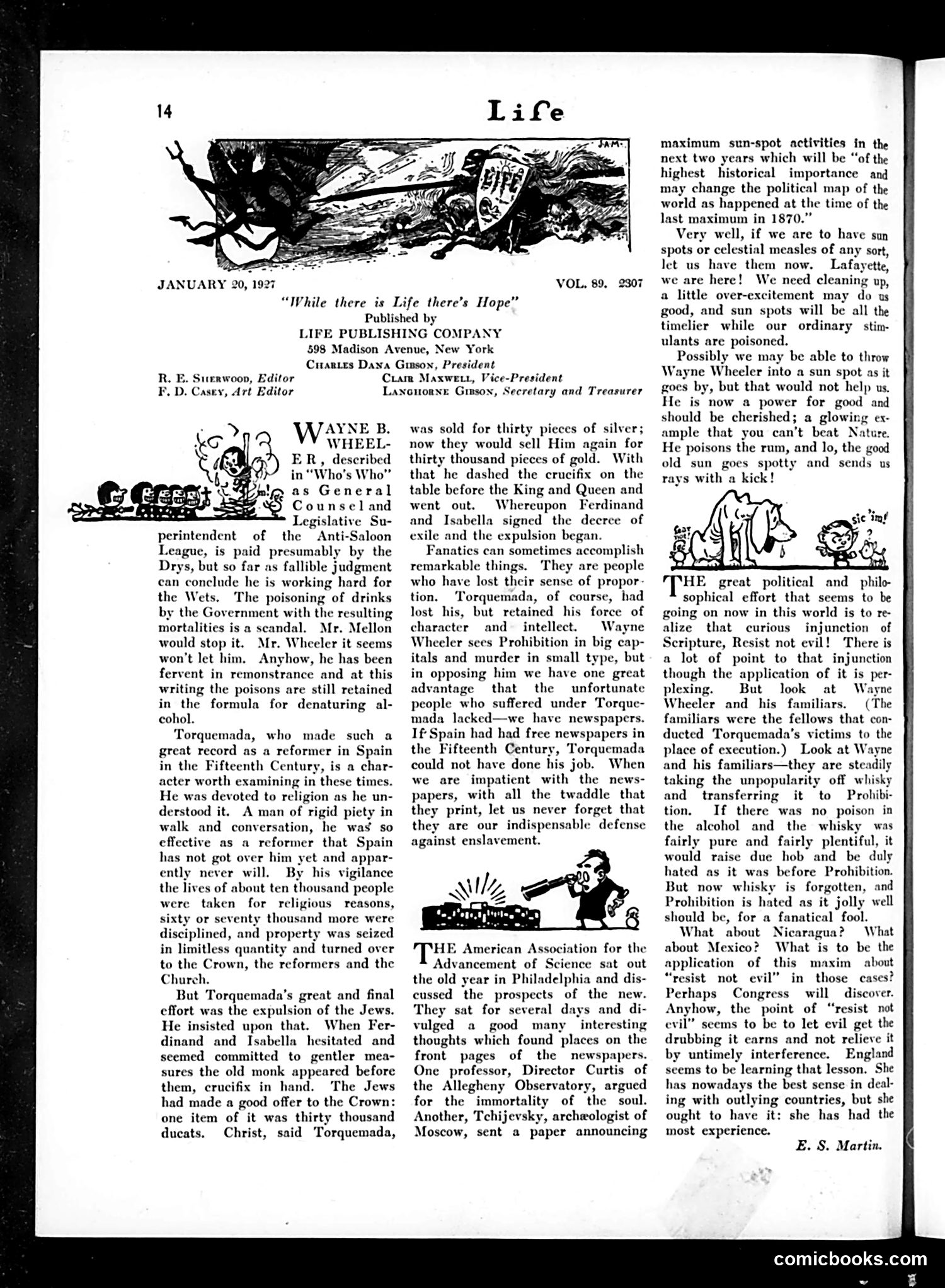
This page contains editorial commentary rather than political cartoons. The main text discusses **Wayne B. Wheeler**, identified as a General Counsel and superintendent of the Anti-Saloon League, who appears as the central figure being criticized. The article satirizes Wheeler's role in enforcing Prohibition. The text compares him to **Torquemada** (the Spanish Inquisition figure), suggesting Wheeler's zealous anti-alcohol crusade is comparable to religious persecution. The satire criticizes how Prohibition poisoning deaths resulted from government denaturizing alcohol, while Wheeler—described as having "lost his sense of proportion"—remained a powerful reformer. Small cartoon illustrations accompany the text, mocking Prohibition enforcement and its consequences. The piece argues that without free newspapers documenting abuses, reformers like Wheeler operate unchecked.
📄 Transcribed text from this page (OCR, searchable)
Machine-transcribed from the original scan — historical spelling and the odd misread are preserved.
JANUARY 20, 19: VOL, 89. 2307 “While there is Life there’s Hope” Published by LIFE PUBLISHING COMPANY 598 Madison Avenue, New York Cirantes Daya Ginson, President nwoop, Editor asx, Art Editor WAYNE B. WHEEL- R, described in “Who's Who” mig as General Counsel and Legislative Su- perintendent of the Anti-Saloon League, is paid presumably by the Drys, but so far as fallible judgment can conclude he is working hard for the Wets. The poisoning of drinks by the Government with the resulting mortalities is a scandal. Mr. Mellon would stop it. Mr. Wheeler it seems won't let him. Anyhow, he has been fervent in remonstrance and at this writing the poisons are still retained in the formula for denaturing al- cohol. Torquemada, who made such a great record as a reformer in Spain in the Fifteenth Century, is a char- acter worth examining in these times. He was devoted to religion as he un- derstood it. A man of rigid piety in walk and conversation, he was so effective as a reformer that Spain has not got over him yet and appar- ently never will. By his vigilance the lives of about ten thousand people were taken for religious reasons sixty or seventy thousand more were disciplined, and property was seized in limitless quantity and turned over to the Crown, the reformers and the Church. But Torquemada’s great and final effort was the expulsion of the Jews. He insisted upon that. When Fer- dinand and Isabella hesitated and seemed committed to gentler mea- sures the old monk appeared before them, crucifix in hand. The Jews had made a good offer to the Crown: one item of it was thirty thousand ducats. Christ, said Torquemada, al’ > As Cram Maxwett, Vice-President Lanotorne Grnson, Secretary and Treasurer was sold for thirty pieces of silver; now they would sell Him again for thirty thousand pieces of gold. With that he dashed the crucifix on the table before the King and Queen and went out. Whereupon Ferdinand and Isabella signed the decree of exile and the expulsion began. Fanatics can sometimes accomplish remarkable things. They are people who have lost their sense of propor- tion. Torquemada, of course, had lost his, but retained his force of character and intellect. | Wayne Wheeler sees Prohibition in big cap- itals and murder in small type, but in opposing him we have one great advantage that the unfortunate people who suffered under Torque- mada lacked—we have newspapers. If Spain had had free newspapers in the Fifteenth Century, Torquemada could not have done his job. When we are impatient with the news- papers, with all the twaddle that they print, let us never forget that they are our indispensable defense against enslavement. HE American Association for the Advancement of Science sat out the old year in Philadelphia and dis- cussed the prospe of the new. They sat for several di and di- vulged a good many interesting thoughts which found places on the front pages of the newspapers. One professor, Director Curtis of the Allegheny Observatory, argued for the immortality of the soul. Another, Tchijevsky, archeologist of Moscow, sent a paper announcing maximum sun-spot activities in the next two years which will be “of the highest historical importance and may change the political map of the world as happened at the time of the last maximum in 1870.” Very well, if we are to have sun spots or celestial measles of any sort, let us hb them now. ‘ayette, we are here! We need cleaning up, a little over-excitement may do us good, and sun spots will be all the timelier while our ordinary stim- ulants are poisoned. Possibly we may be able to throw Wayne Wheeler into a sun spot as it gocs by, but that would not help us, He is now a power for good and should be cherished; a glowing ex- ample that you can’t beat Nature. He poisons the rum, and lo, the good old sun goes spotty and sends us rays with a kick! HE great political and_philo- sophical effort that seems to be ing on now in this world is to re- alize that curious injunction of Scripture, Resist not evil! There is a lot of point to that injunction though the application of it is per- plexing. But look at Wayne Wheeler and his familiars. (The familiars were the fellows that con- ducted Torquemada’s victims to the place of execution.) Look at Wayne and his familiars—they are steadily taking the unpopularity off whisky and transferring it to Prohibi- tion. If there was no poison in the alcohol and the whisky fairly pure and fairly plentiful, it would raise due hob and be duly hated as it was before Prohibition. But now whisky is forgotten, and Prohibition is hated as it jolly well should be, for a fanatical fool. What about Nicaragua? | What about Mexico? What is to be the application of this maxim about “resist not evil” in those cases? Perhaps Congress will discover. Anyhow, the point of “resist not evil” seems to be to let evil get the drubbing it earns and not relieve it by untimely interference. England seems to be learning that lesson. She has nowadays the best sense in deal- ing with outlying countries, but she ought to have it: she has had the most experience. was E. S. Martin. comicbooks.com