
A complete issue · 34 pages · 1926
Life — December 16, 1926
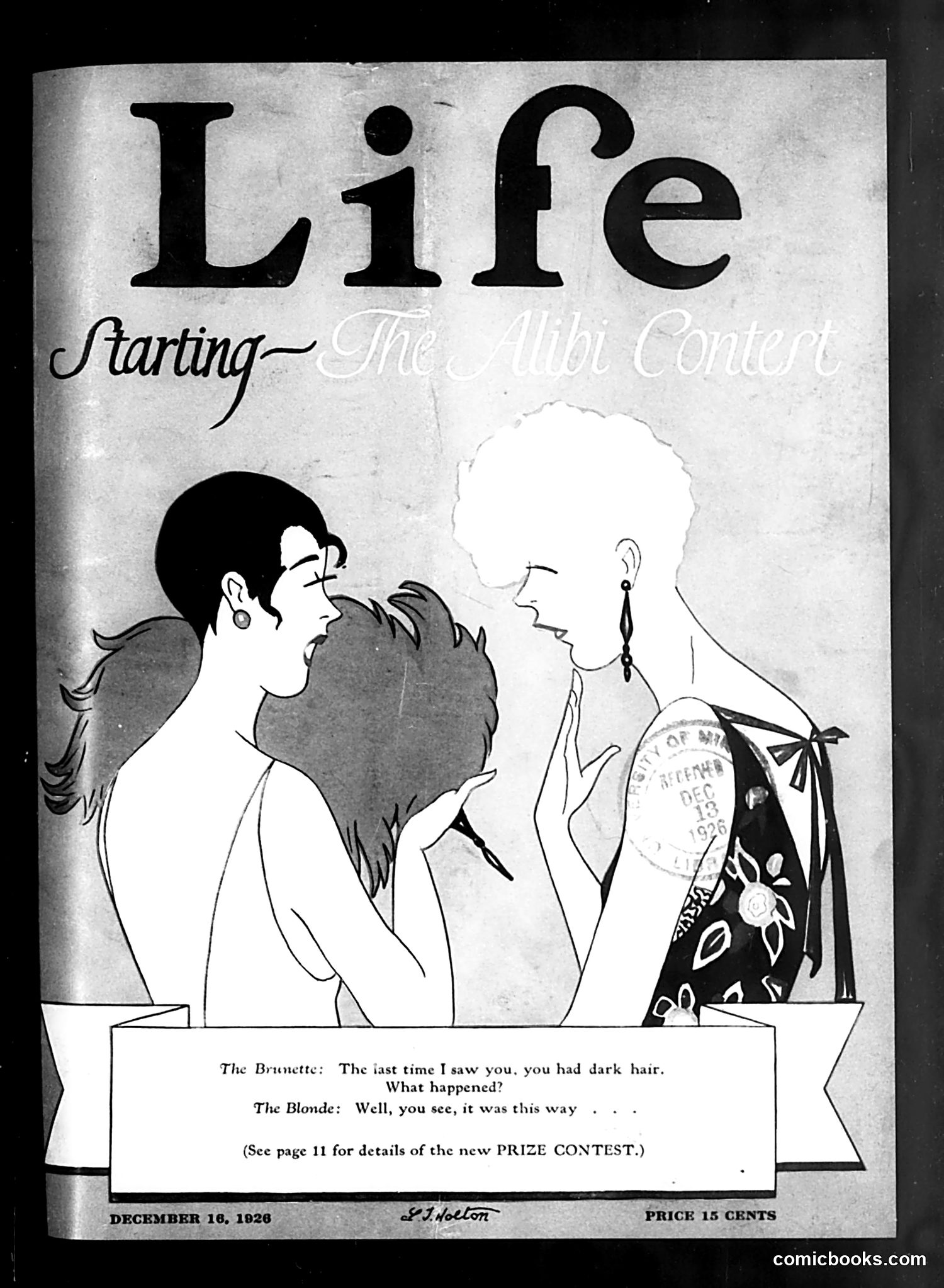
This is a Life magazine cover from December 16, 1926, featuring an illustrated conversation between two women. The dialogue references a striking social change of the 1920s: the "Brunette" comments that the last time she saw her friend, she had dark hair, asking what happened. The "Blonde" explains she deliberately changed her hair color. The satire targets the 1920s obsession with appearance and reinvention, particularly women's adoption of blonde hair as a fashionable ideal during the Jazz Age. The cover mocks this trend as superficial and humorous—the casual way women would alter their appearance to follow beauty standards. The reference to a "PRIZE CONTEST" suggests Life used this cover to promote reader engagement with a hair-related competition.
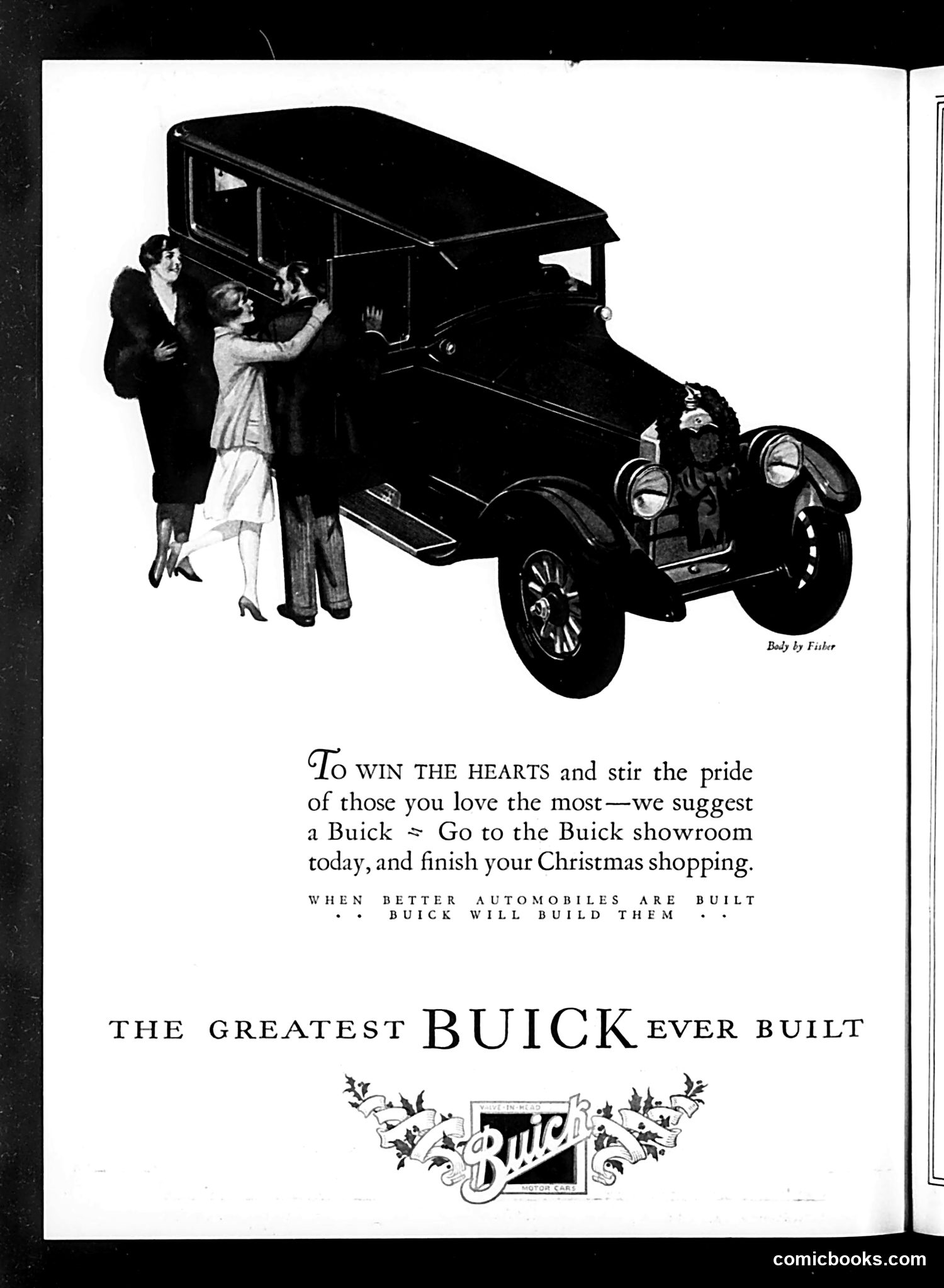
This is a **Buick automobile advertisement**, not political satire. The image shows a well-dressed couple and man examining a luxury car, with the tagline "To win the hearts and stir the pride of those you love the most—we suggest a Buick." The ad promotes purchasing a Buick as a Christmas gift to impress loved ones. It reflects 1920s consumer culture values: automobiles as status symbols and expressions of affection. The "Body by Fisher" credit indicates custom coachwork, emphasizing luxury. The slogan "When Better Automobiles Are Built Buick Will Build Them" was Buick's actual advertising motto from this era. This is straightforward commercial marketing targeting affluent holiday shoppers, not political commentary or satire.
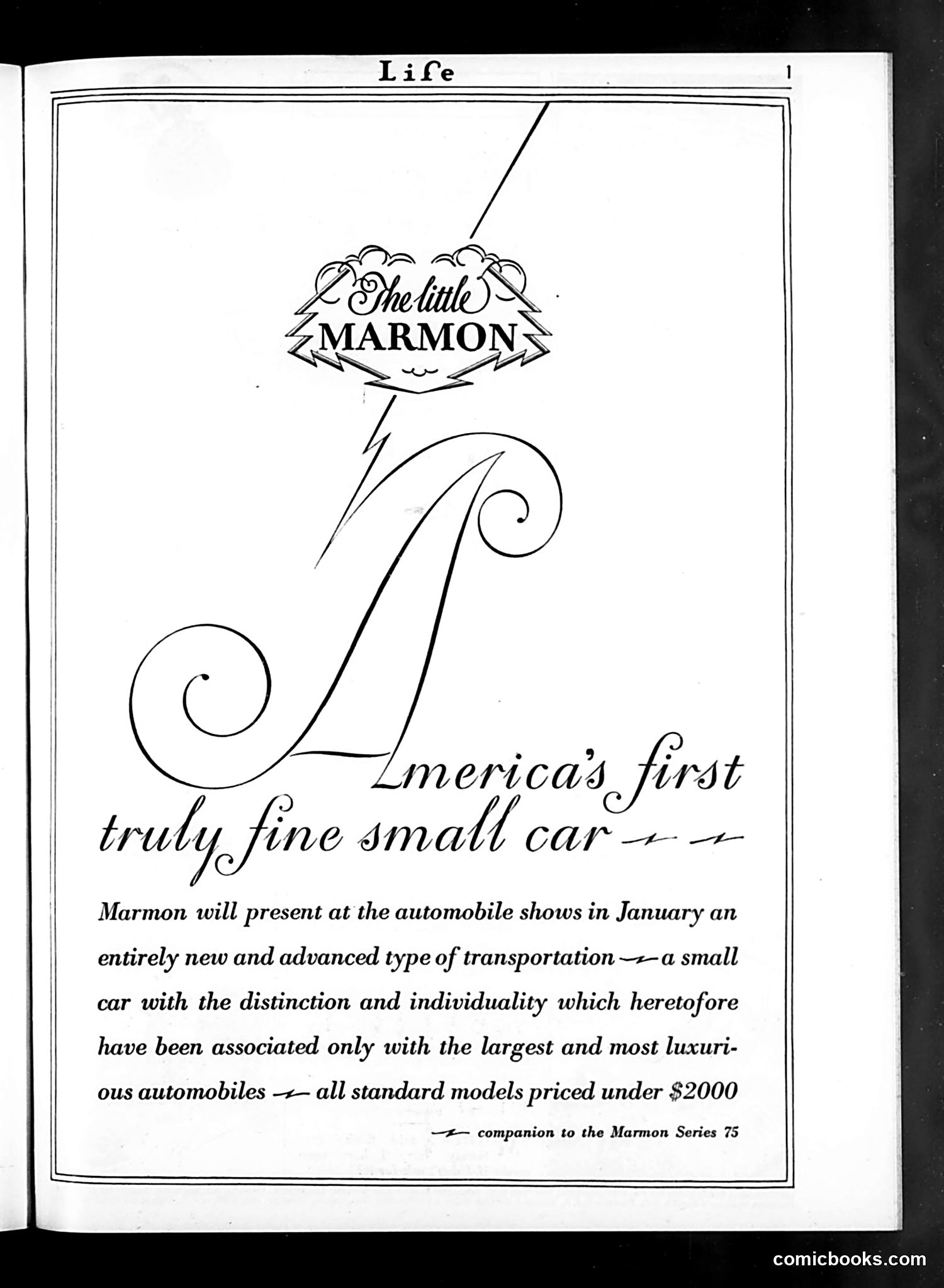
This is **advertising, not satire or editorial content**. The page promotes the Marmon automobile, specifically positioning it as "America's first truly fine small car." The decorative header features the Marmon brand logo (with ornamental flourishes), and the body text announces a new small car model to be presented at automobile shows in January. The marketing emphasizes that Marmon is bringing luxury qualities—previously available only in large, expensive automobiles—to an affordable vehicle under $2,000. The elegant typography and decorative elements reinforce the luxury positioning. This appears to be a standard product advertisement from Life magazine, not satirical commentary. The mention of "Marmon Series 75" suggests this is promotional material for a specific model line.
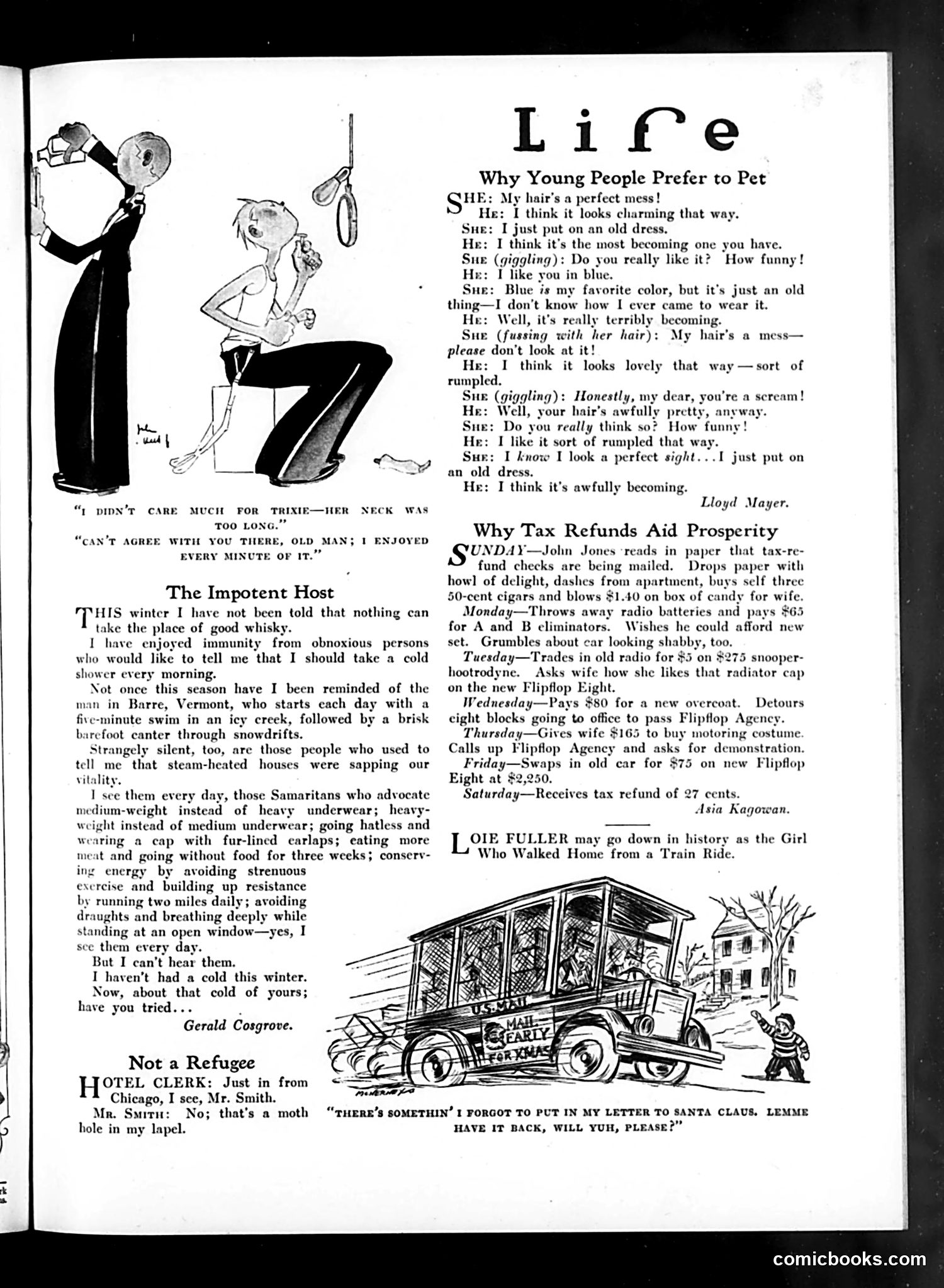
This page contains several humor pieces typical of 1920s-30s Life magazine: **"Why Young People Prefer to Pet"** satirizes dating etiquette through dialogue where a young man compliments a woman's disheveled appearance ("rumpled hair," "old dress"), claiming it looks "charming" and "becoming." The joke mocks insincere flattery and changing social attitudes toward casual dating and physical affection—"petting" was controversial behavior of the era. **"Why Tax Refunds Aid Prosperity"** catalogs frivolous purchases made with tax refund money (cigars, candy, theater tickets, costumes), suggesting people waste government money rather than save it—social commentary on spending habits during uncertain economic times. **"Loie Fuller" cartoon** references the famous dancer who walked home from a train mishap, illustrated with a child watching an unusual vehicle pass. The overall tone reflects Jazz Age social anxieties about youth morality and economic behavior.
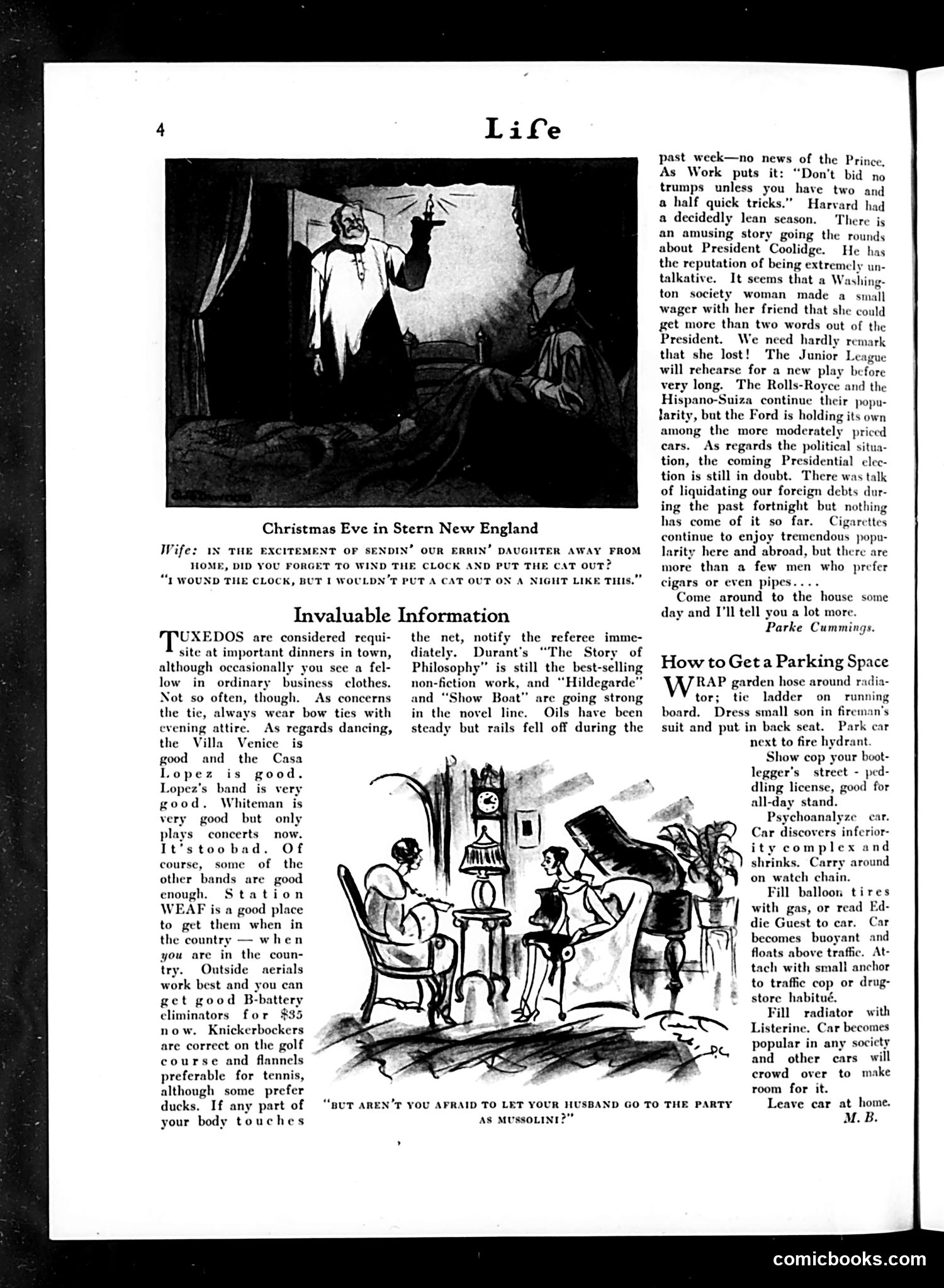
**Top Image: "Christmas Eve in Stern New England"** A humorous domestic scene showing a wife confronting her husband about leaving the cat out on Christmas Eve. The caption jokes that she wouldn't put a cat out on such a night, implying her husband is unusually cruel or negligent. This is light satire on household relationships and holiday sentiment. **Middle Section: "Invaluable Information"** Social advice on proper etiquette—tuxedos at dinners, dancing venues (Willis, Casa Lopez), and band recommendations (Whiteman). Standard early 20th-century upper-class social guidance. **Bottom Cartoon & "How to Get a Parking Space"** The cartoon satirizes wives' anxieties about husbands attending parties (possibly referencing Mussolini, per caption). The "parking space" section offers humorous, impractical advice for avoiding traffic cops and managing cars—satire of urban automobile culture and driving frustrations.
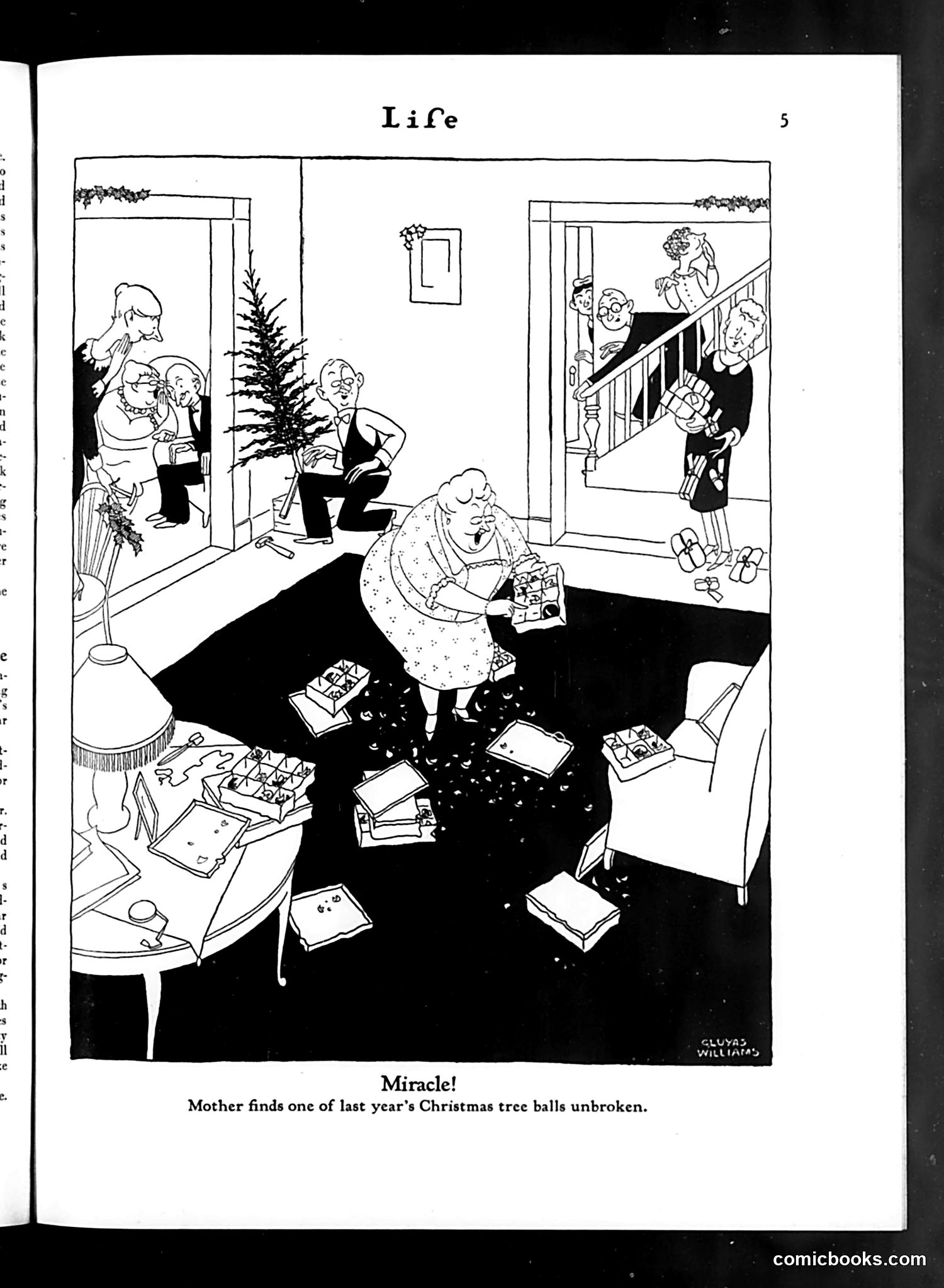
This single-panel cartoon depicts a humorous domestic scene centered on Christmas decoration storage. The joke, titled "Miracle! Mother finds one of last year's Christmas tree balls unbroken," satirizes the fragility of glass ornaments and the chaos of holiday storage and retrieval. The cartoon shows a middle-aged woman discovering an intact ornament among numerous boxes and scattered items in what appears to be a basement or storage area. Multiple family members observe from various vantage points—doorways and stairs—emphasizing that this is treated as a genuinely remarkable event worthy of family attention. The satire targets the universal frustration of storing delicate holiday decorations. The exaggerated reaction to finding *one* unbroken ornament among many broken ones reflects mid-20th-century domestic humor about household management and holiday traditions.
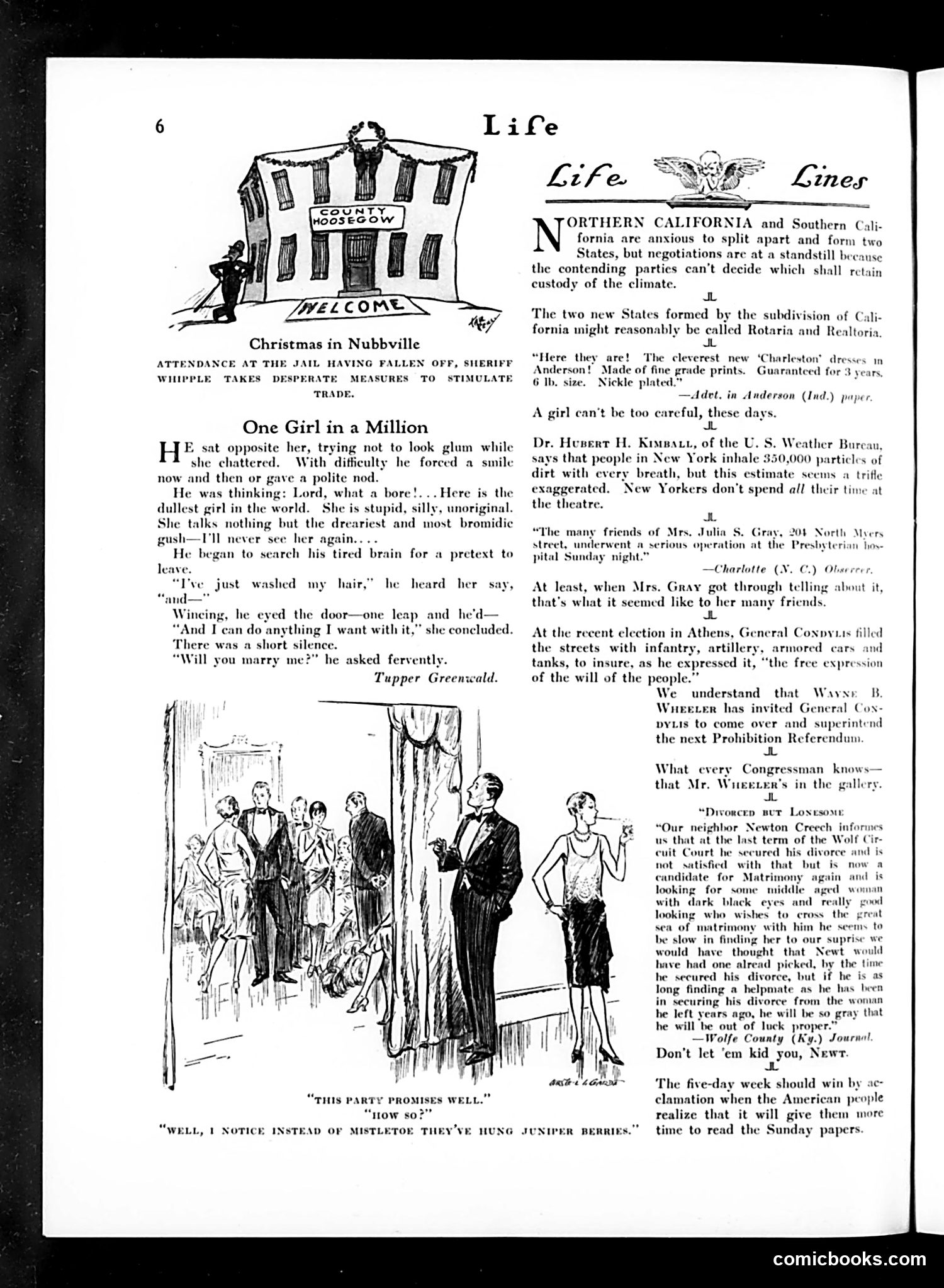
This page contains satirical "Life Lines" commentary and two cartoon illustrations. **Top cartoon** ("Christmas in Nubville"): Depicts a jailhouse with a sheriff using "desperate measures to stimulate trade"—satirizing economic hardship, likely from the Great Depression era, by joking that even jail attendance has declined. **Middle story** ("One Girl in a Million"): A romantic narrative about a young couple, where a man proposes despite the woman's perceived ordinariness. The satire mocks both female stereotypes and male romanticism. **Bottom cartoon** ("This party promises well"): Shows a formal gathering with dialogue about mistletoe berries versus juniper berries—likely satirizing either prohibition-era drink substitutes or general social pretension at holiday parties. The "Life Lines" section contains brief satirical news items mocking contemporary politics, social trends, and public figures.
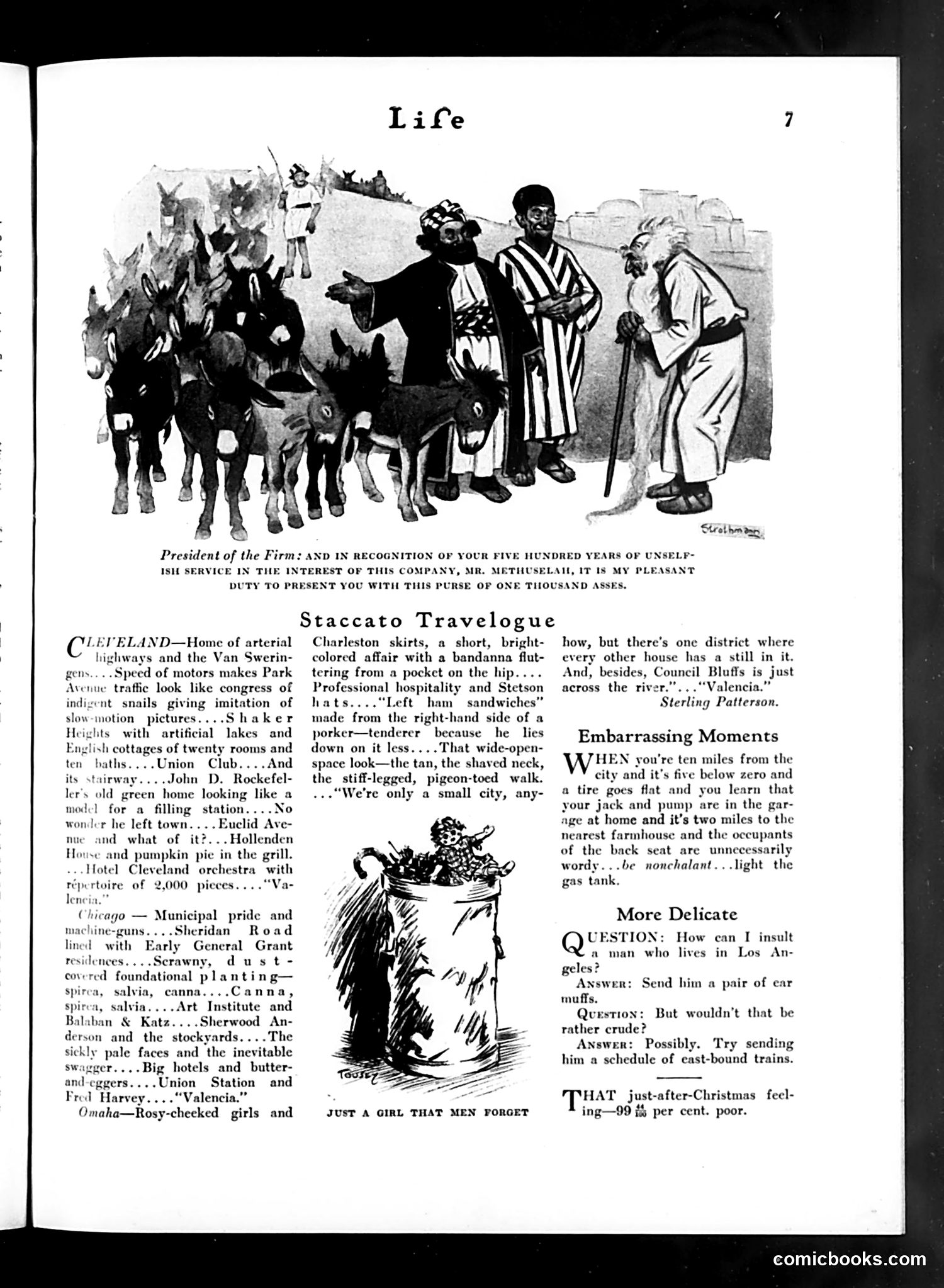
The top cartoon depicts a corporate ceremony where a company president presents a purse of 1,000 asses to an employee named Methuselah in recognition of 500 years of service. The humor relies on the pun "asses" — simultaneously meaning donkeys (shown in the illustration) and money/currency slang. The page contains humor columns titled "Staccato Travelogue" (brief observations about American cities), "Embarrassing Moments" (social awkwardness), and "More Delicate" (a Q&A column about etiquette). These satirize urban life, automotive embarrassments, and social propriety of the era. The illustration of a trash can labeled "Just a Girl That Men Forget" uses personification to mock men's treatment of women as disposable.
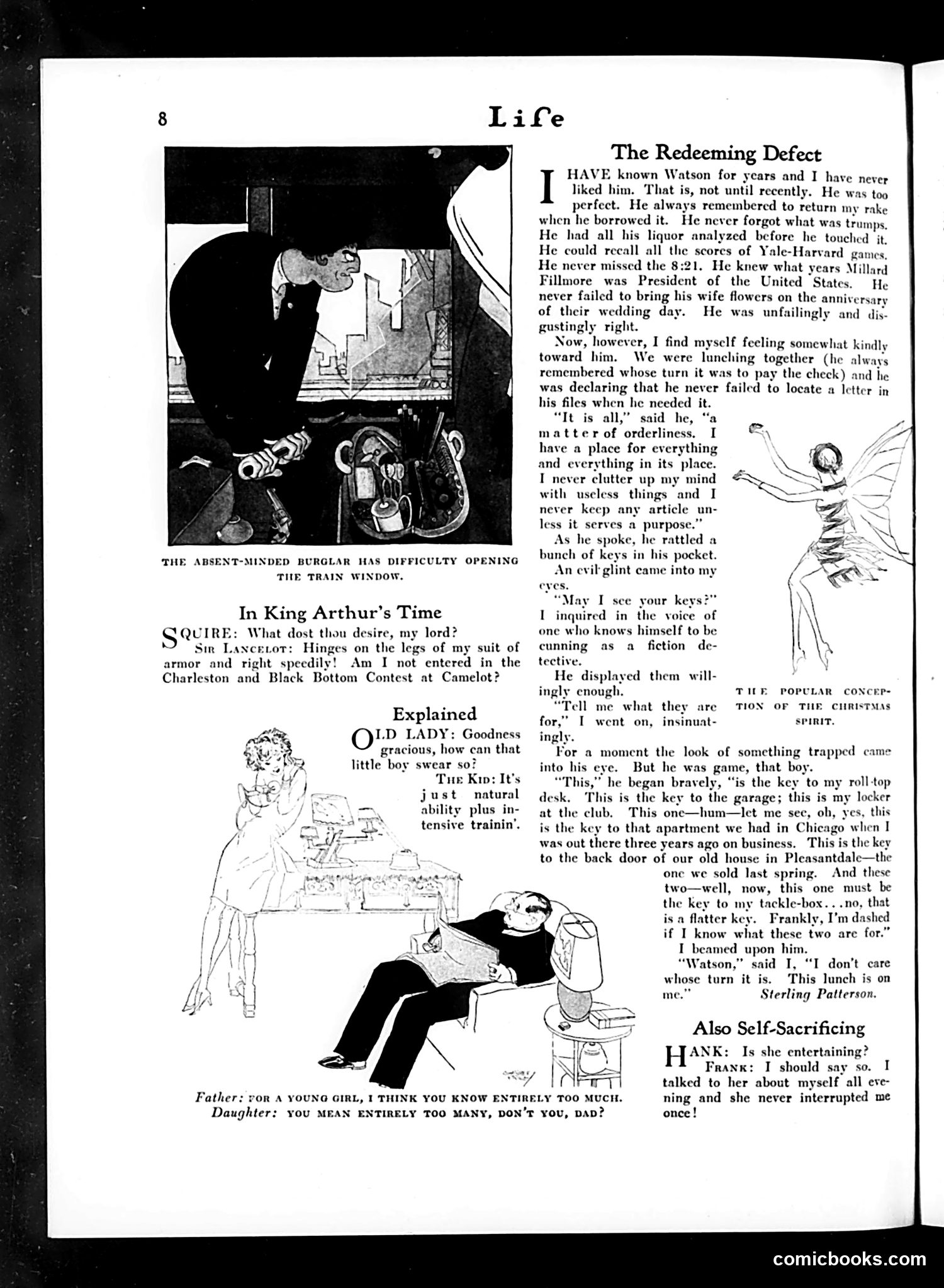
This page contains three separate humorous pieces typical of early 20th-century satirical magazines: 1. **"The Absent-Minded Burglar"** (top): A visual joke about a burglar struggling to open a train window—the absurdist humor lies in his incompetence at a basic task. 2. **"In King Arthur's Time"** (middle-left): A medieval dialogue joke between a Squire and Sir Lancelot about armor hinges and a chess contest, playing on anachronistic confusion. 3. **"The Redeeming Defect"** (right): A narrative about Watson, someone chronically forgetful and disorganized, whose only virtue is returning borrowed items. The satire mocks the tension between personal failings and occasional redeeming qualities. The page represents typical Life magazine humor: wordplay, domestic observation, and gentle social satire rather than sharp political commentary.
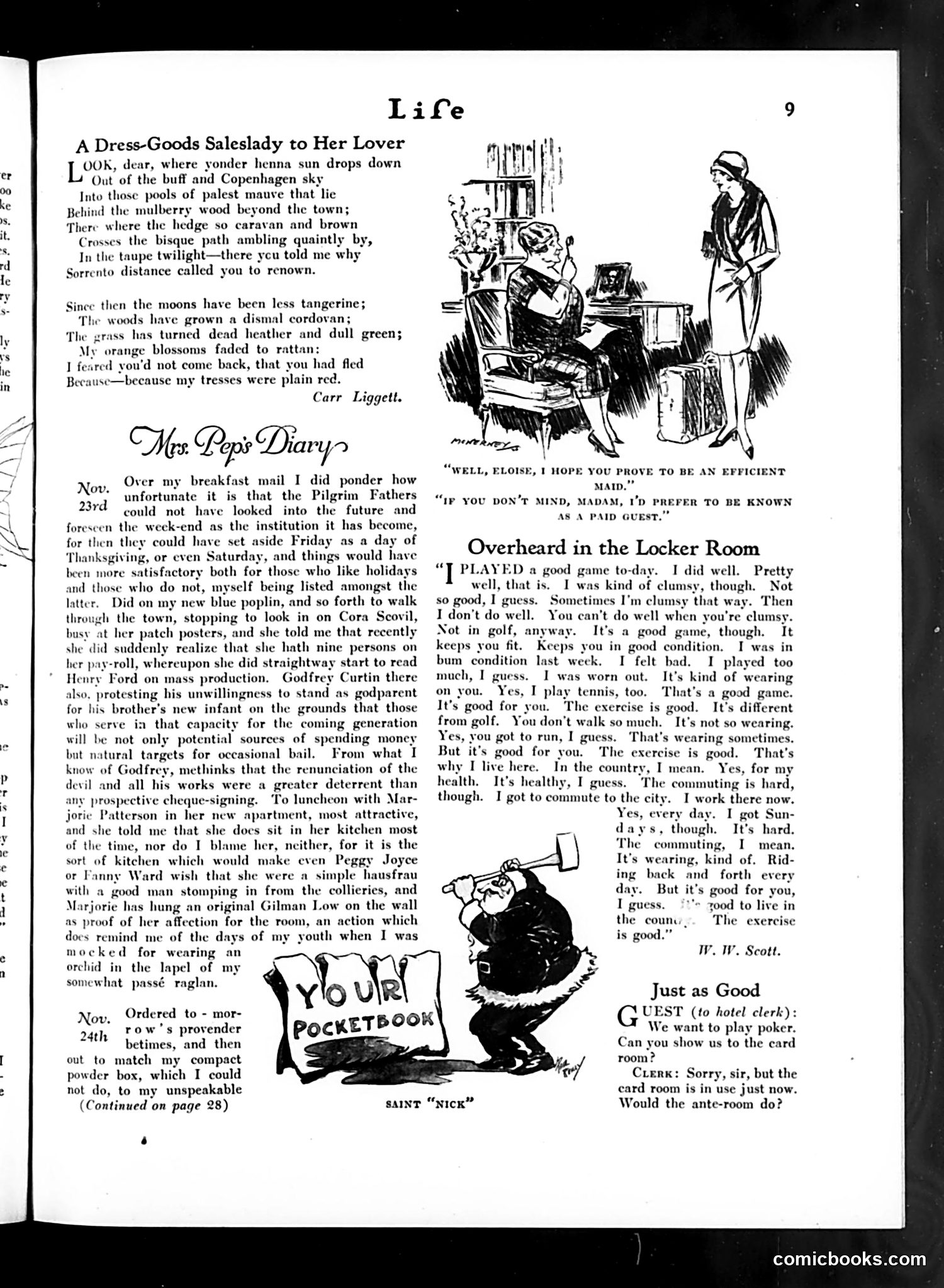
This page contains three separate pieces of satirical content: 1. **"A Dress-Goods Saleslady to Her Lover"** (poem by Carr Liggett): A woman laments her lover's absence, describing Copenhagen and natural decay—likely commentary on romantic disappointment or wartime separation. 2. **"Mrs. Pep's Diary"**: Social satire about an upper-middle-class woman navigating post-Thanksgiving weekend social obligations, including visits to posters and managing household staff—typical Life magazine commentary on domestic pretension. 3. **"Overheard in the Locker Room"**: Golf club banter where a man justifies excessive golfing as exercise and "country living," while complaining about commuting. This satirizes wealthy men prioritizing leisure over practicality. 4. **"Just as Good"**: A brief joke about a hotel clerk misdirecting guests to the "ante-room." The illustrations are modest pen sketches typical of 1920s-era Life magazine humor.
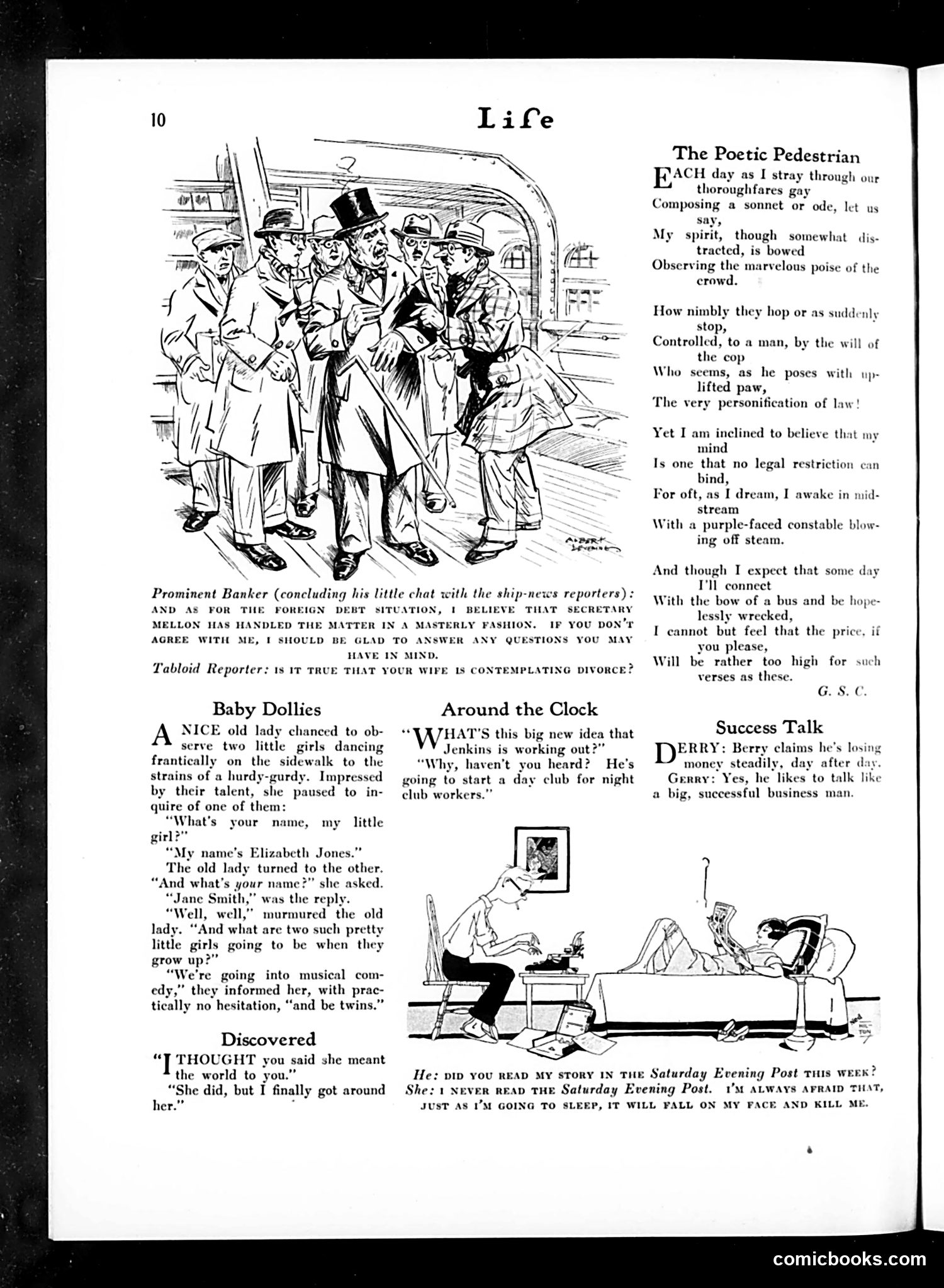
This page contains several satirical humor pieces typical of early 20th-century Life magazine: **"The Poetic Pedestrian"** (right): A poem mocking street poets who compose verses while observing urban crowds, apparently trying to sell their work. The satire suggests these poets are pretentious yet commercially desperate. **Top cartoon**: Shows a banker speaking to reporters about handling financial matters "masterfully." The satire targets financial elites' self-aggrandizement, particularly their secretive dealings that the public doesn't understand. **"Baby Dollies"**: Satirizes stage mothers who exploit young daughters in entertainment, pushing them toward theatrical careers. **"Around the Clock"**: A brief workplace joke about a night-shift day club. **"Success Talk"** (right): A conversational cartoon mocking business clichés and the repetitive nature of successful businessmen's advice. The overall tone reflects Life's consistent satirical critique of American social pretension and commercialism.
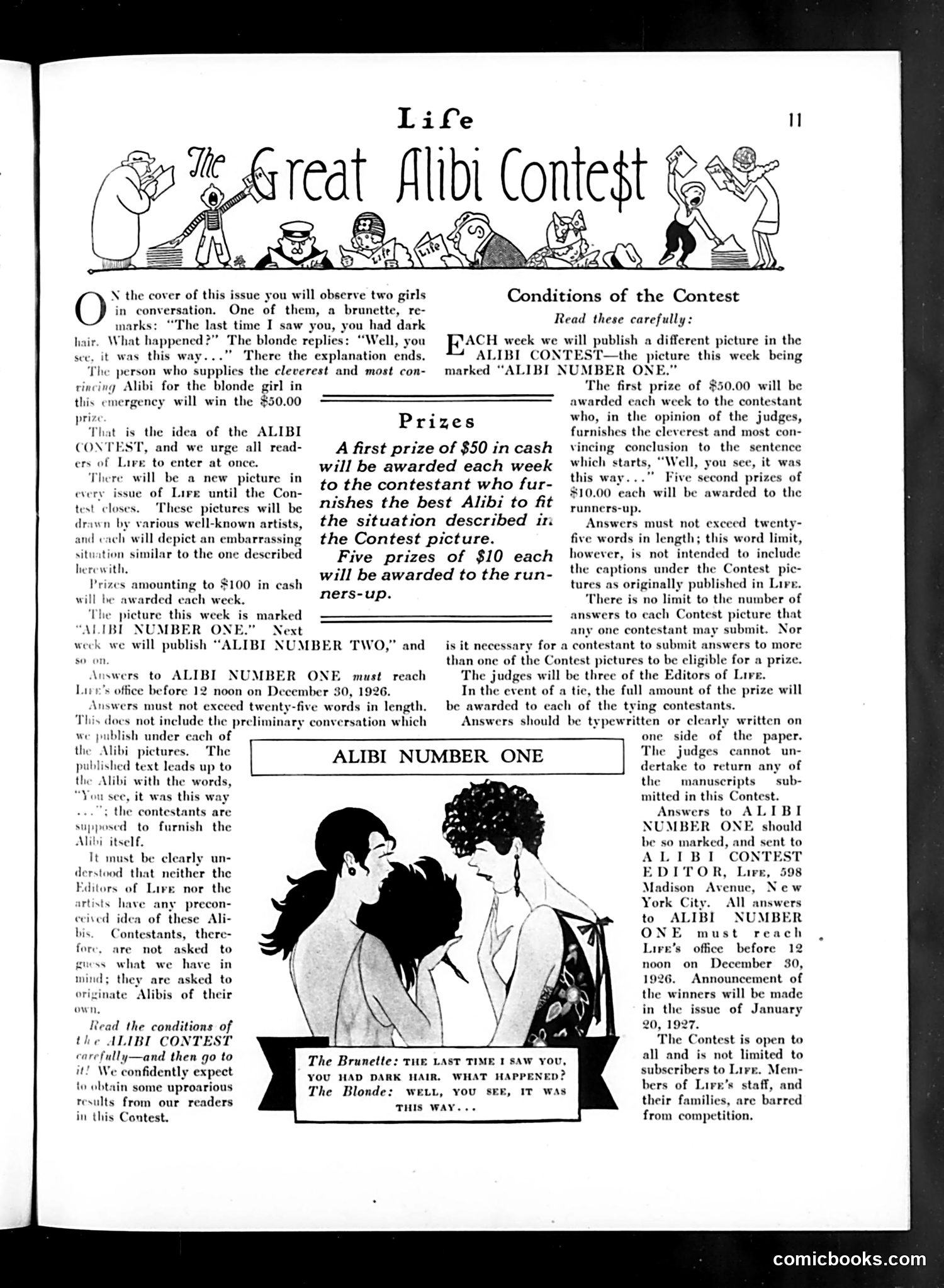
This page announces a weekly contest where readers submit creative "alibis"—excuses or explanations—to match embarrassing situations depicted in illustrations. The featured "Alibi Number One" shows two women in conversation. The brunette says: "The last time I saw you, you had dark hair. What happened?" The blonde must reply with an alibi explaining her hair color change. Readers submit answers (max 25 words) by December 30, 1926. Winners receive cash prizes: $50 for the best alibi each week, plus $10 prizes for runners-up. The humor relies on readers creating plausible or witty excuses for mundane social awkwardness—a parlor game format designed to engage the magazine's audience through participatory entertainment.
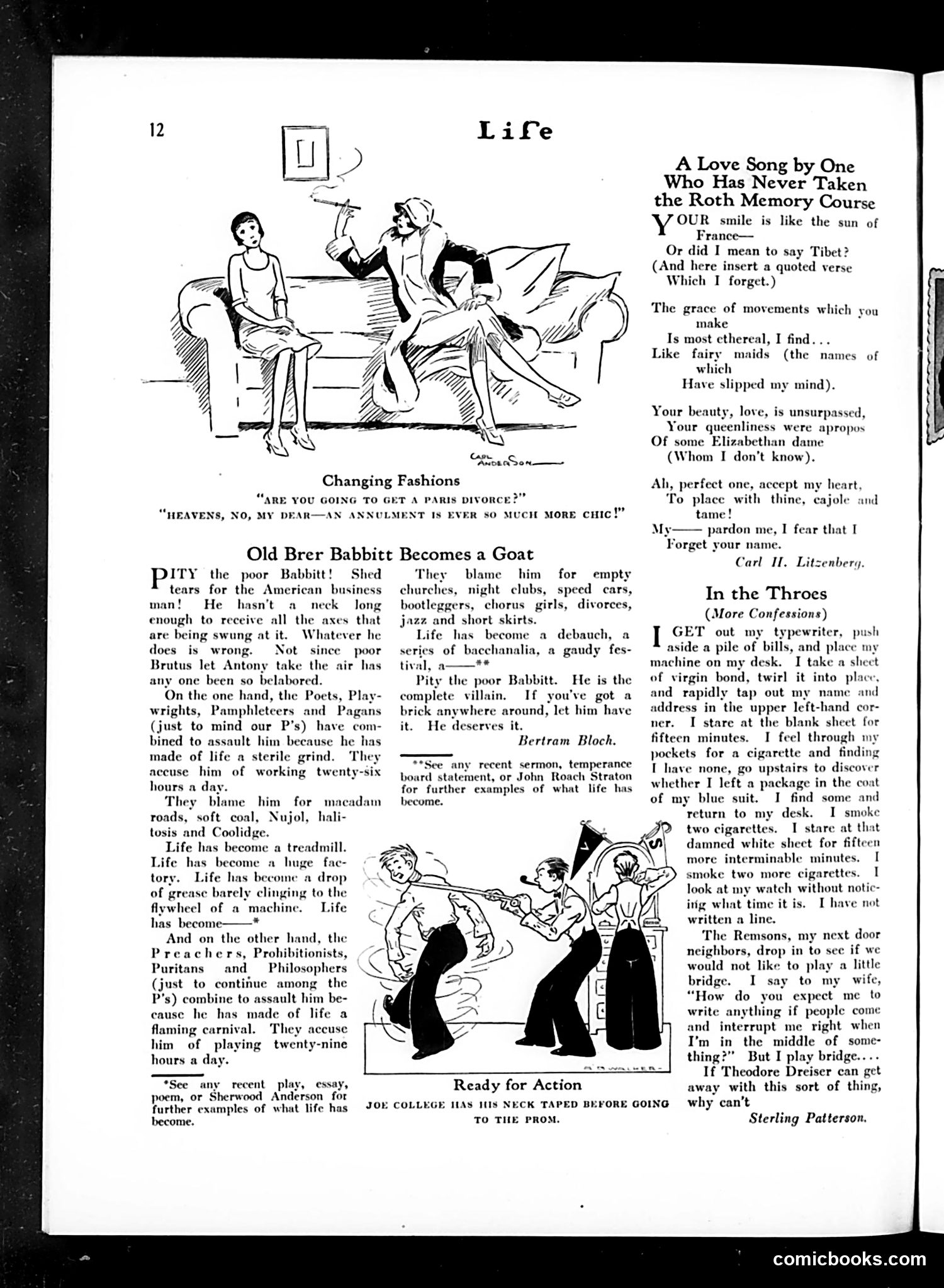
**"Changing Fashions"** (top cartoon): A woman asks a man about getting a Paris divorce. His response—"an annulment is ever so much more chic!"—satirizes how wealthy Americans adopt European fashions and social attitudes, treating serious matters like divorce as style choices rather than substantive concerns. **"Old Brer Babbitt Becomes a Goat"**: This longer piece mocks "Babbitt"—the archetypal middle-class American businessman from Sinclair Lewis's 1922 novel. The satire condemns how society blames ordinary businessmen for modern ills (empty churches, jazz, short skirts, divorces) while preachers and prohibitionists share responsibility. Life critiques the hypocrisy of blaming one social class for widespread cultural decline.
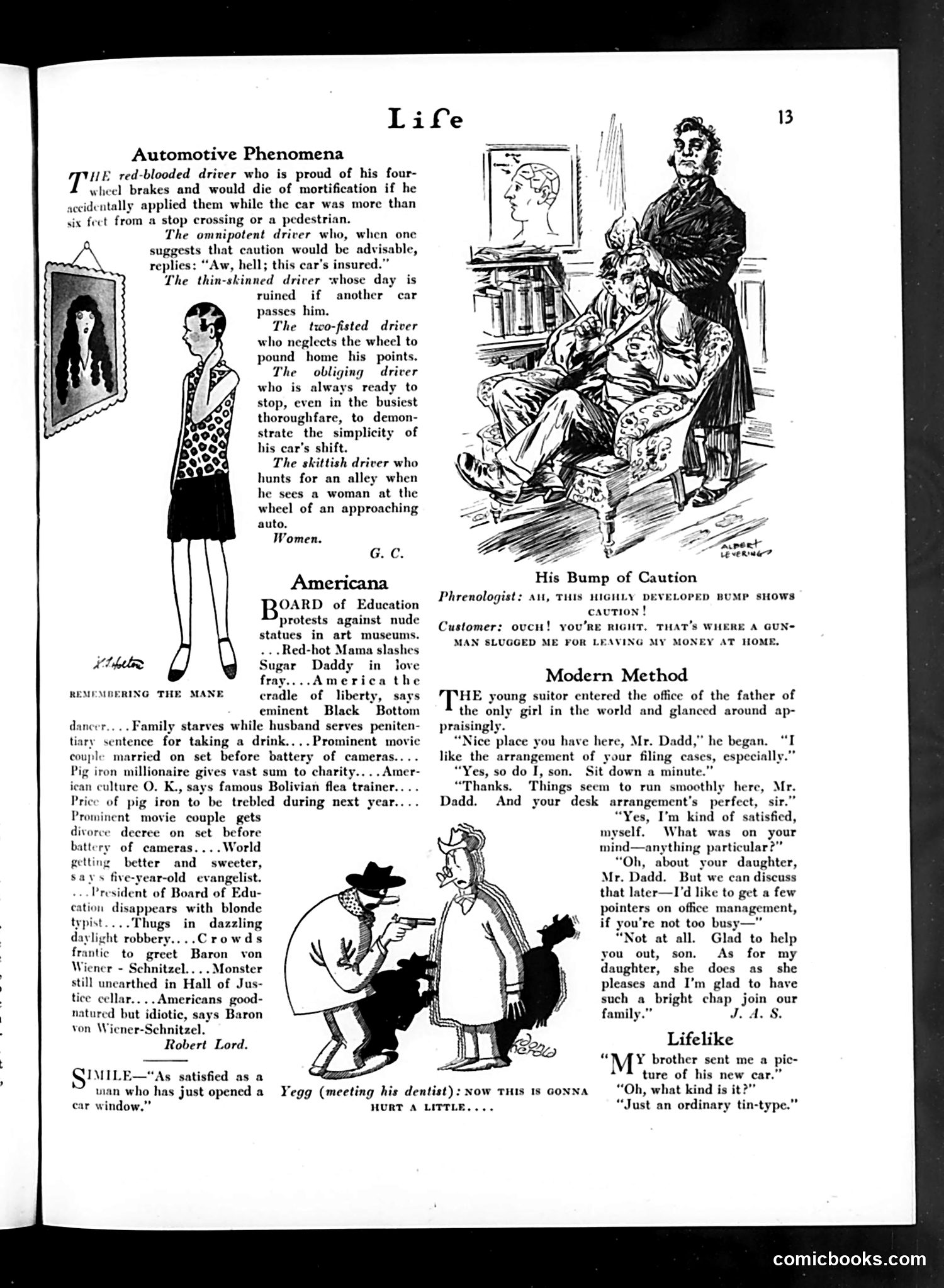
This page contains three separate satirical pieces: **"Automotive Phenomena"** catalogs driver stereotypes—the reckless, cautious, and boastful types—mocking predictable driving behaviors. **"His Bump of Caution"** shows a phrenologist (pseudo-scientist claiming skull bumps indicate character) examining a man's head while a customer jokes that a gunman robbed him because he *wasn't* cautious enough—satirizing phrenology as pseudoscience. **"Modern Method"** depicts a young man flattering his girlfriend's father by praising his office organization and filing system, then asking to date his daughter. The satire mocks transparent, calculated courtship tactics. **"Lifelike"** is a brief joke about someone showing a photo of their car rather than their actual car. These pieces typify Life's humor: social observation, debunking false sciences, and gentle mockery of everyday pretense.
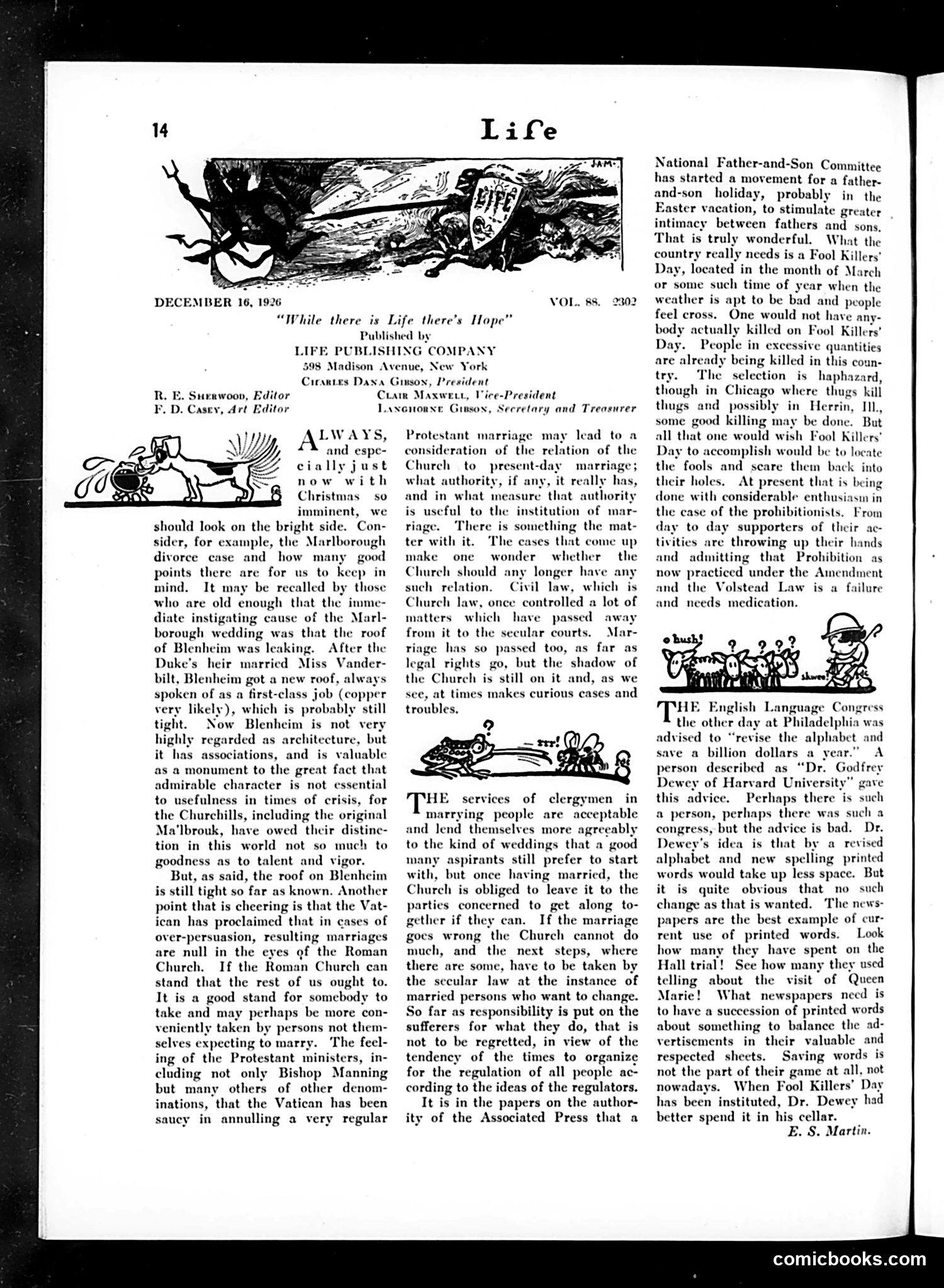
This page contains three distinct editorial cartoons/illustrations satirizing contemporary social issues: 1. **Top cartoon** (unmarked): Depicts what appears to be a dead or defeated figure labeled "LIFE," suggesting commentary on the state of the publication or society itself. 2. **Middle cartoon** (unmarked): Shows figures in what the text calls "Fool Killers' Day," mocking a proposal for a father-son holiday in March when "weather is apt to be bad." The satire targets those supporting Prohibition's failures and ineffectiveness. 3. **Bottom cartoon** (unmarked): Illustrates the English Language Congress's proposed alphabet revision, mocking Dr. Godfrey Dewey of Harvard for suggesting reformed spelling would save money on printing. The cartoon ridicules this impractical linguistic reform. All three target contemporary absurdities: failed policies, holiday kitsch, and pedantic over-intellectualism.
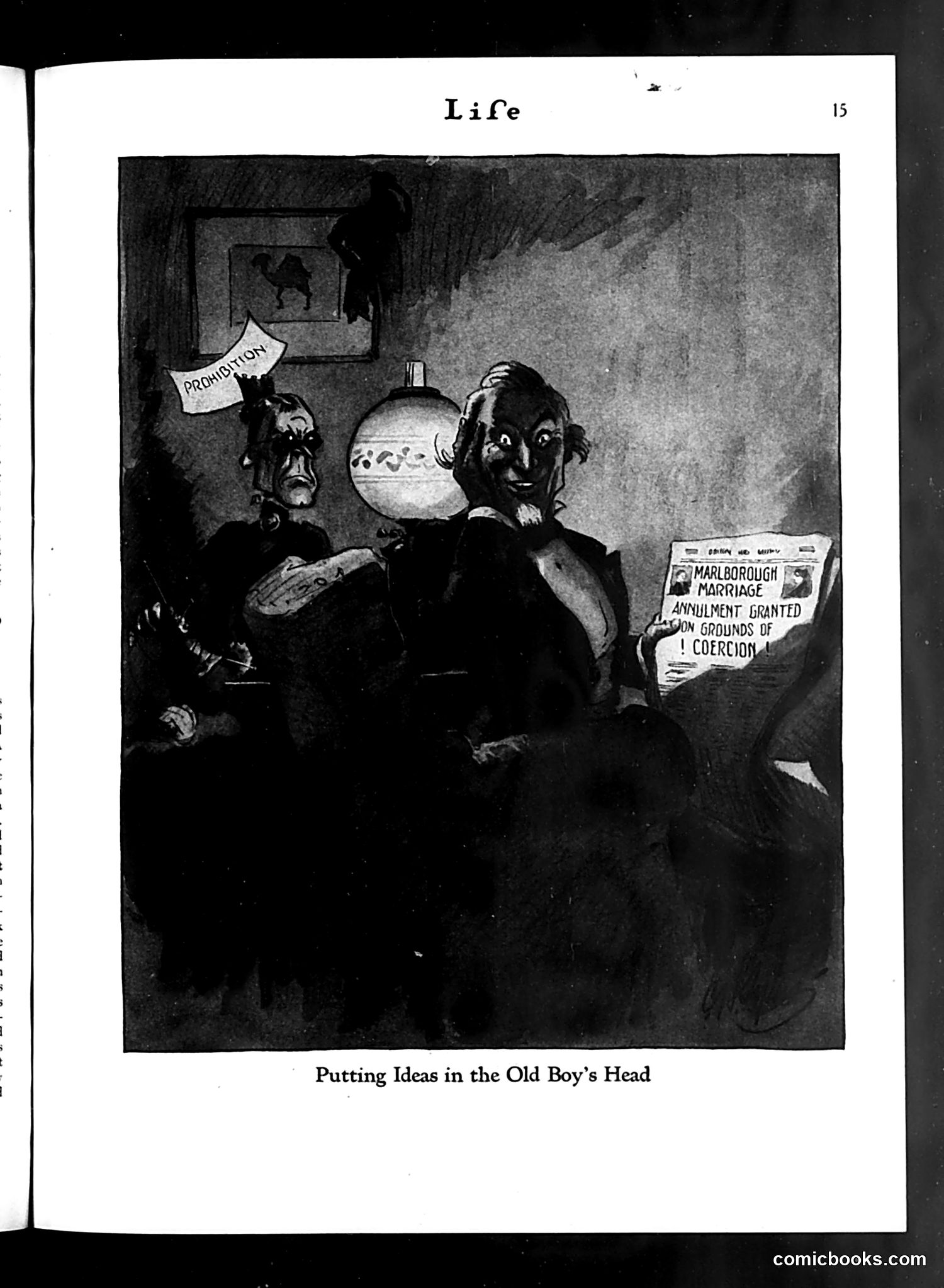
This satirical cartoon depicts two devil-like figures attempting to influence an elderly man's mind (represented as a large sphere). The visible newspaper headline reads "MARLBOROUGH MARRIAGE ANNULMENT GRANTED ON GROUNDS OF COERCION," referencing a high-profile legal case. The cartoon critiques how outside forces—likely political operatives or manipulators—seek to shape public opinion on controversial matters through propaganda and persuasion. The "Prohibition" sign visible on the wall suggests this concerns alcohol policy debates of the era. The satire suggests that ordinary citizens ("the old boy") are targets of deliberate manipulation by unseen powerful interests attempting to control their beliefs and votes on major social issues through coercive messaging rather than honest debate.
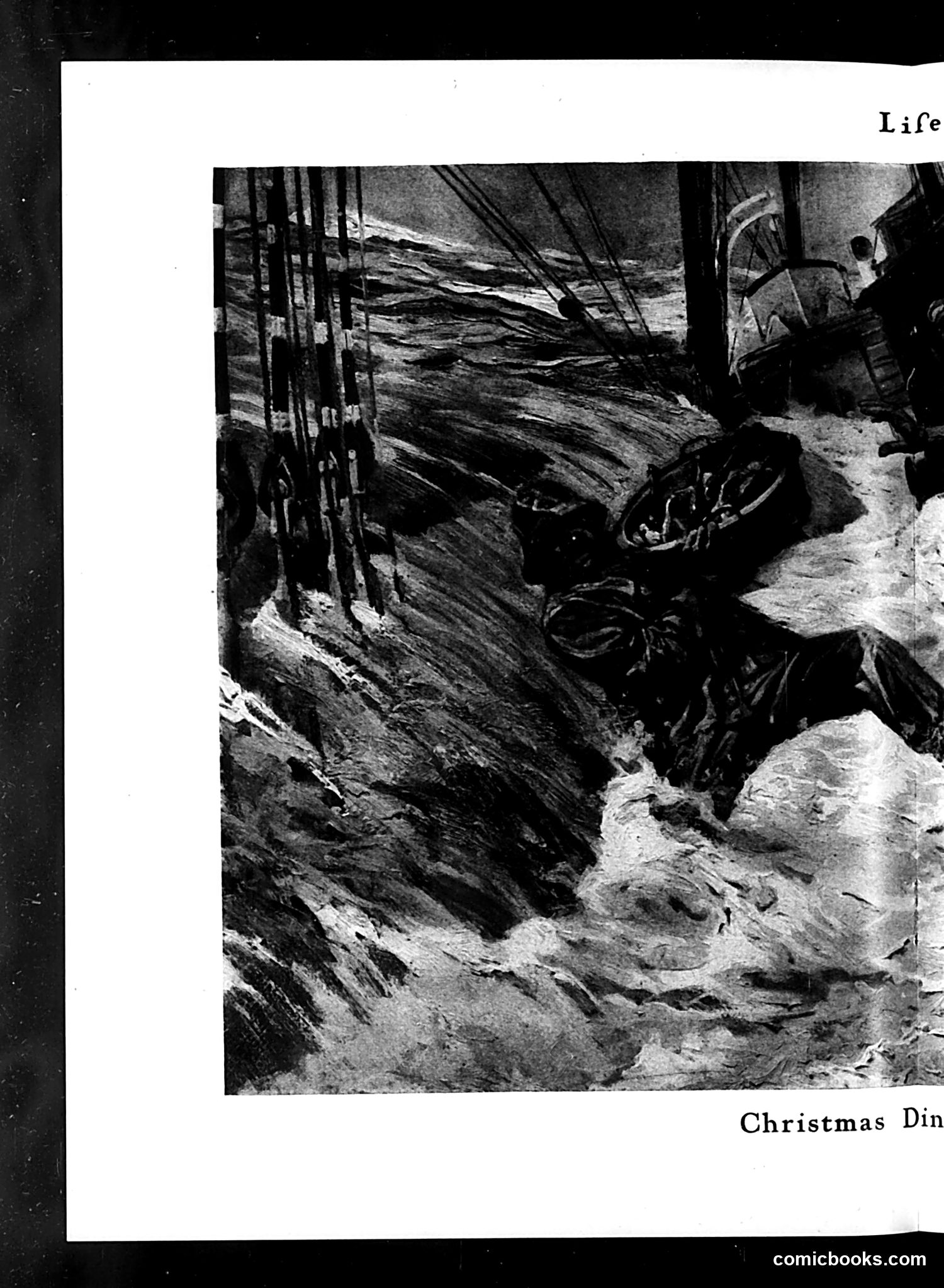
This appears to be a page from *Life* magazine featuring a black and white photograph rather than a traditional cartoon. The image shows what looks like a rustic or deteriorated interior space with wooden beams, various objects, and what appear to be animal remains or taxidermied specimens. The visible text fragments—"life" at top right and "Christmas Din" at bottom right—suggest this is part of a larger article or photo essay, likely related to holiday dining or rural/hunting culture. The specific subject matter is unclear without additional context or caption text. The photograph's grainy quality and composition suggest it may be satirizing or documenting rural American customs, but the exact satirical intent cannot be determined from the image alone.
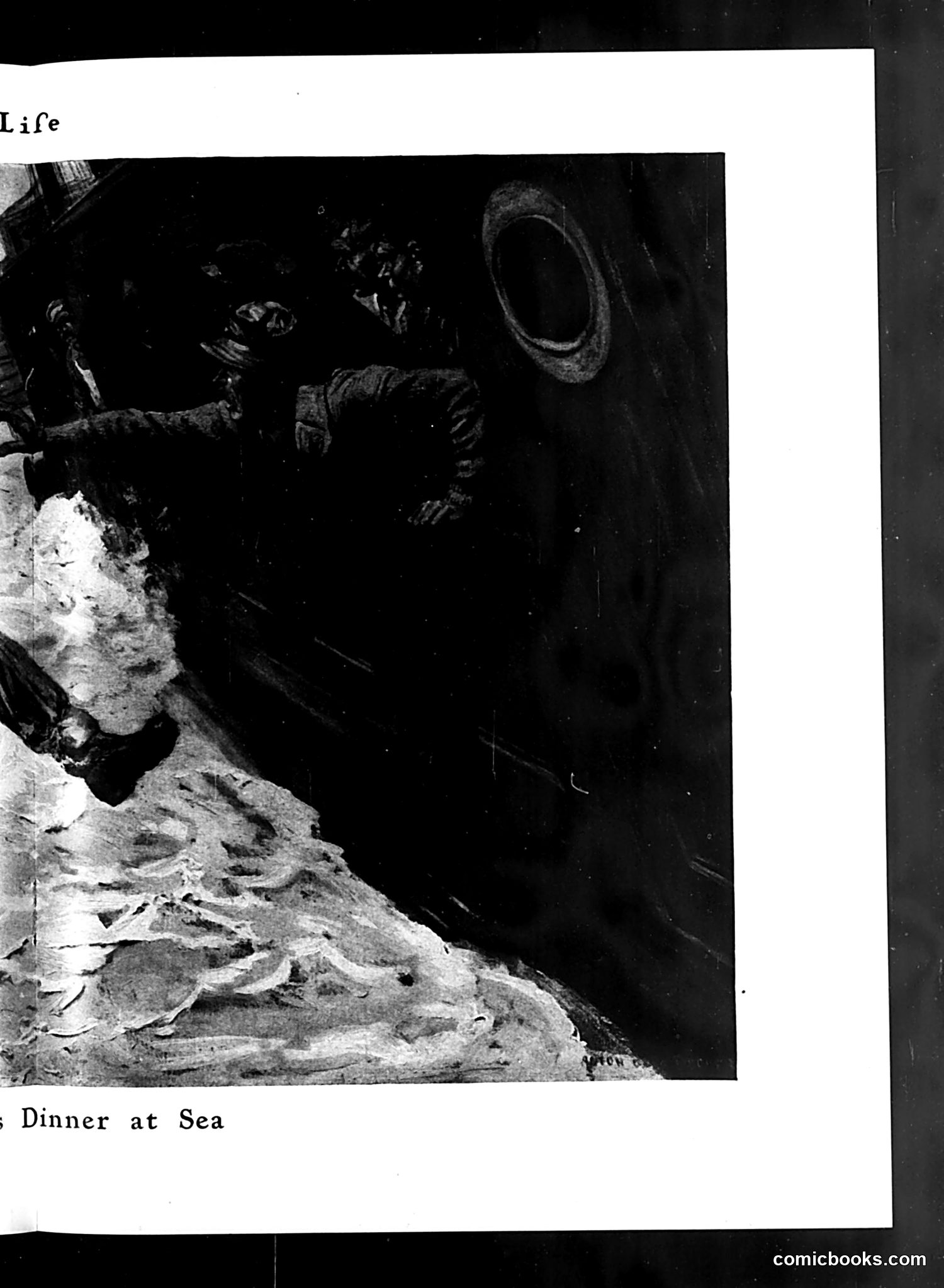
This page appears to be from Life magazine's "Life" section, showing a black and white photograph titled "Dinner at Sea." The image depicts what seems to be a dining scene aboard a ship, with figures in formal dress visible against the dark interior of what appears to be a ship's cabin or dining area. A porthole is visible on the right side. Without additional context or caption text beyond the title, the specific satirical point is unclear. The image may be commenting on maritime dining customs, class distinctions among ship passengers, or contemporary social situations related to sea travel. However, the exact subject of satire cannot be definitively determined from the visible elements alone.
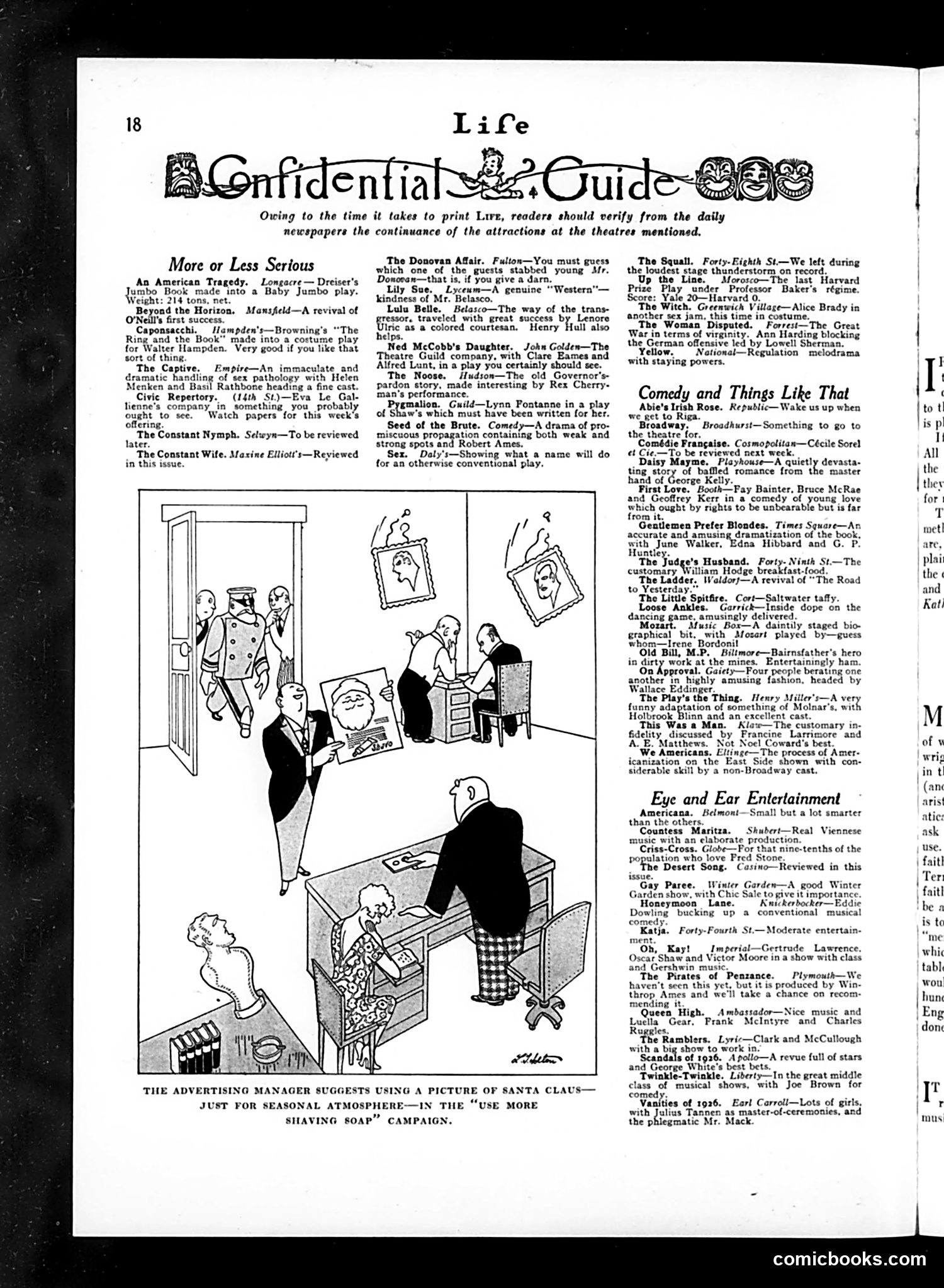
This page from *Life* magazine is a **theatrical review section** from the 1920s. The large cartoon satirizes advertising practices of the era. **The Cartoon's Point:** An advertising manager suggests using Santa Claus imagery in a "Use More Shaving Soap" campaign purely for "seasonal atmosphere"—despite shaving soap having nothing to do with Christmas. The satire mocks how advertisers cynically exploit holidays and emotional associations to sell unrelated products, prioritizing atmospheric appeal over logical marketing. **The Figures:** Generic businessmen and the imagined Santa Claus represent the advertising industry's manipulative tactics. **The Context:** This reflects 1920s concerns about emerging mass-marketing and consumer culture. The joke assumes readers recognize advertising's growing reliance on psychological manipulation rather than product merit—a cutting critique of modern capitalism's deceptive methods that remains relevant today.
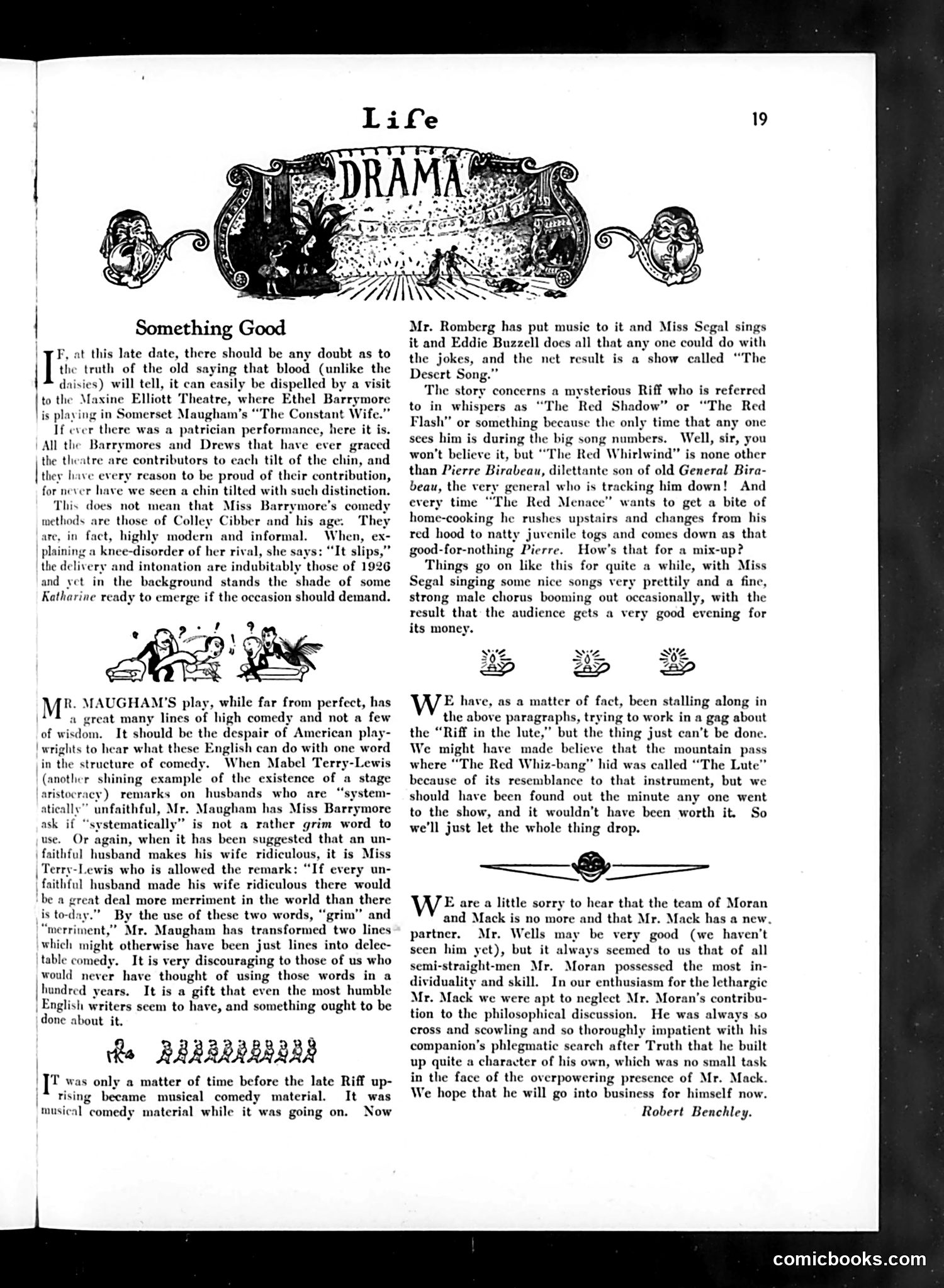
This page contains theatrical reviews from Life magazine's drama section. The main content critiques three shows: 1. **"The Constant Wife"** — Ethel Barrymore's performance at the Maxine Elliott Theatre, praised for her aristocratic bearing and modern comedic delivery, with references to her distinguished theatrical family legacy. 2. **Somerset Maugham's Play** — The reviewer praises English playwrights' superior skill with language and comic timing, lamenting American writers' inability to match their wit. 3. **"The Desert Song"** — A musical comedy based on the Riff uprising in North Africa. The review mocks the plot's absurdity: a mysterious "Red Shadow" rebel is actually Pierre Birabeau, a dilettante whose father hunts him—yet he simply changes clothes and returns home for dinner. The reviewer acknowledges the formulaic entertainment value while poking fun at the implausible premise, particularly noting a failed attempt at a "Riff in the lute" pun. The decorative illustration at top depicts a theatrical scene. The tone is witty, sophisticated satire typical of 1920s Life magazine.
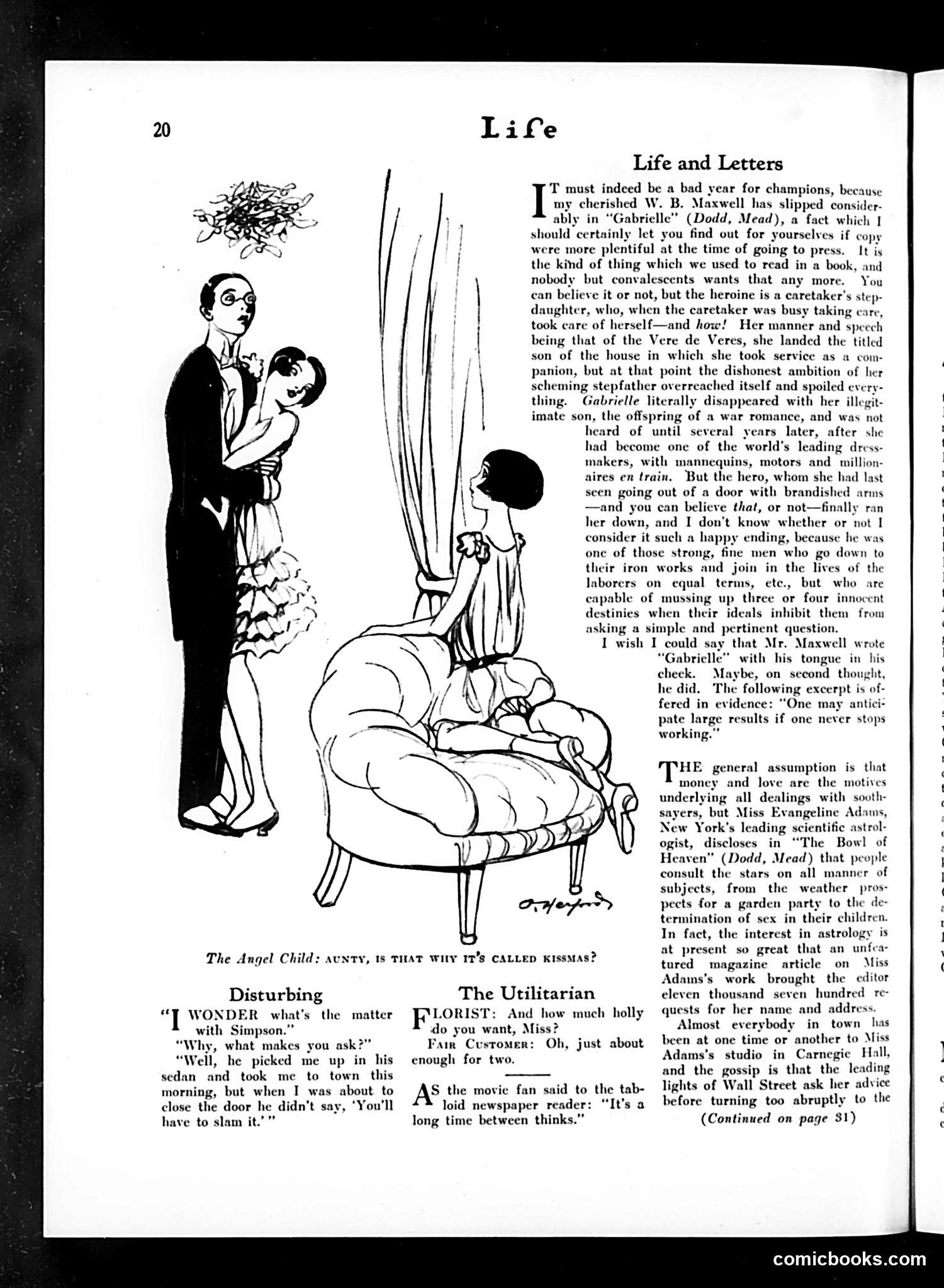
This page contains three brief satirical pieces typical of Life's humor: **"The Angel Child"** (cartoon): A child asks an adult why Christmas is called "kissmas," referencing the physical affection associated with the holiday—gentle satire on children's innocent literalism. **"Disturbing"**: A social commentary joke. A man picks up his acquaintance in a sedan but doesn't issue the then-common demand "You'll have to slam it" (referring to the car door). The humor relies on this being such a normalized, expected phrase that its absence seems socially wrong—satirizing formulaic masculine behavior. **"The Utilitarian"**: A florist and customer discuss holly quantities. The customer wants "enough for two," implying minimal decoration—satire on penny-pinching during the holiday season. The page's main text discusses W.B. Maxwell's novel *Gabrielle* and Miss Evangeline Adams's astrology book. The astrology section notes that Adams's work generated thousands of inquiries, including from Wall Street figures—satirizing both public fascination with astrology and wealthy businessmen's reliance on it.
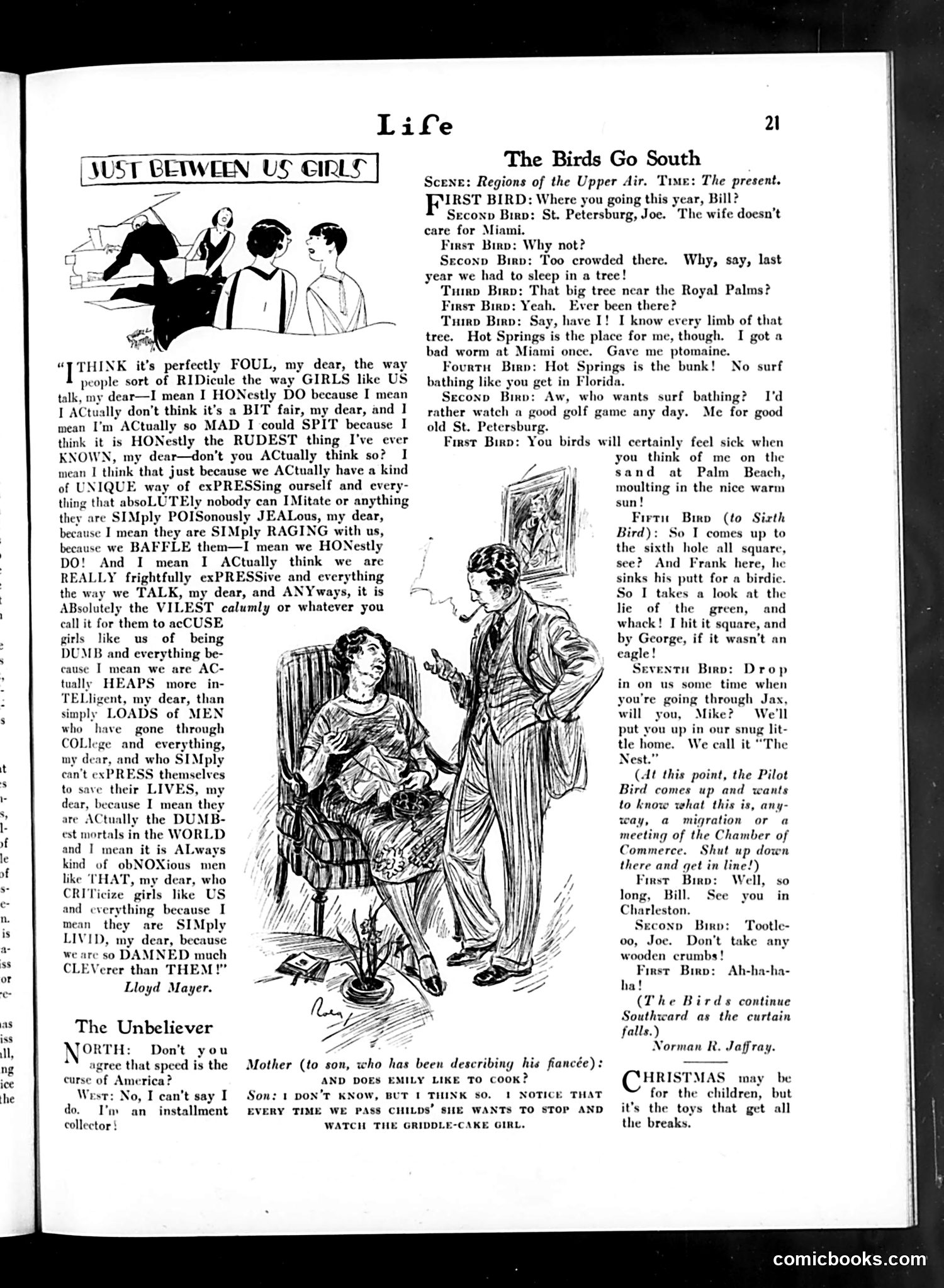
This page contains three satirical pieces typical of 1920s Life magazine humor: **"Just Between Us Girls"** mocks the affected speech patterns of upper-class women who overemphasize certain syllables and use pretentious vocabulary while claiming intellectual superiority. The monologue exaggerates this "unique" way of speaking to ridicule women who criticize others for mocking their dialect—the satire being that their defensive complaint itself exemplifies the very annoying speech pattern being criticized. **"The Unbeliever"** is a brief joke about an installment collector defending speed as necessary for his work—a dig at the era's consumer credit culture. **"The Birds Go South"** is a comic dialogue between migratory birds discussing winter destinations (Florida, South Carolina) and gossiping about golf, romantic relationships, and local attractions. It's gentle observational humor anthropomorphizing birds as vacationing humans with mundane concerns. The cartoons reflect 1920s preoccupations: class pretension, consumer culture, and leisure travel.
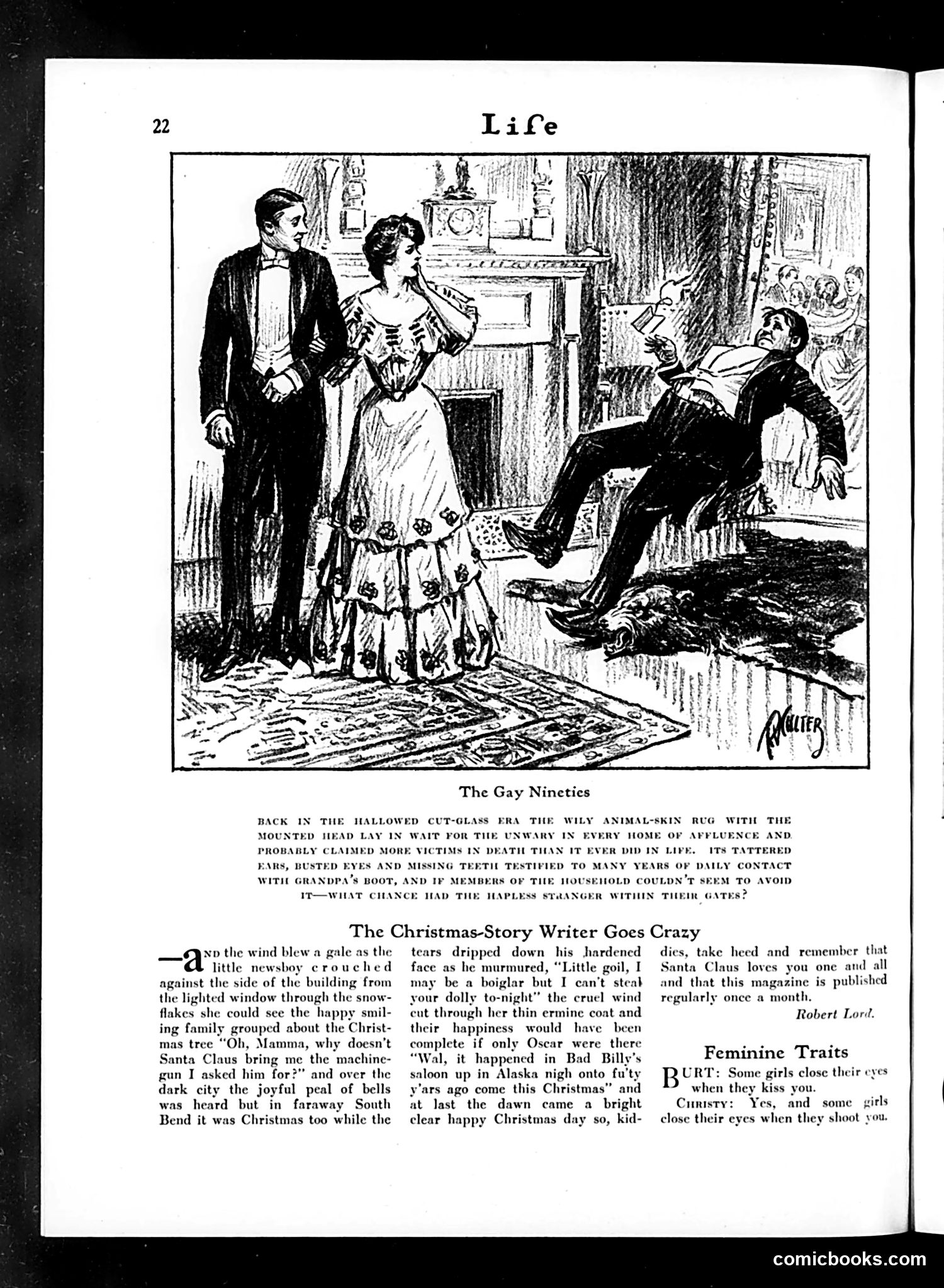
The top cartoon mocks wealthy 1890s parlor life, depicting a mounted animal-head rug—a status symbol of affluence. The caption sardonically notes this taxidermied trophy, with its "tattered ears, busted eyes and missing teeth" from years of contact with "grandpa's boot," killed more through daily abuse than it did in life. The joke targets the pretentiousness of the wealthy and their careless treatment of luxury goods meant to display refinement. Below, Robert Lord's piece parodies sentimental Christmas stories popular in magazines. He catalogs the clichéd tropes: the poor newsboy in the snow, the happy family, the hardened criminal's redemption, the frontier saloon—stacking absurdities to mock the formulaic sentimentality of holiday fiction. The satire suggests such stories are overwrought and manipulative. The brief "Feminine Traits" section uses ironic contrast: girls who close their eyes kissing versus shooting, implying modern women are tough or dangerous.
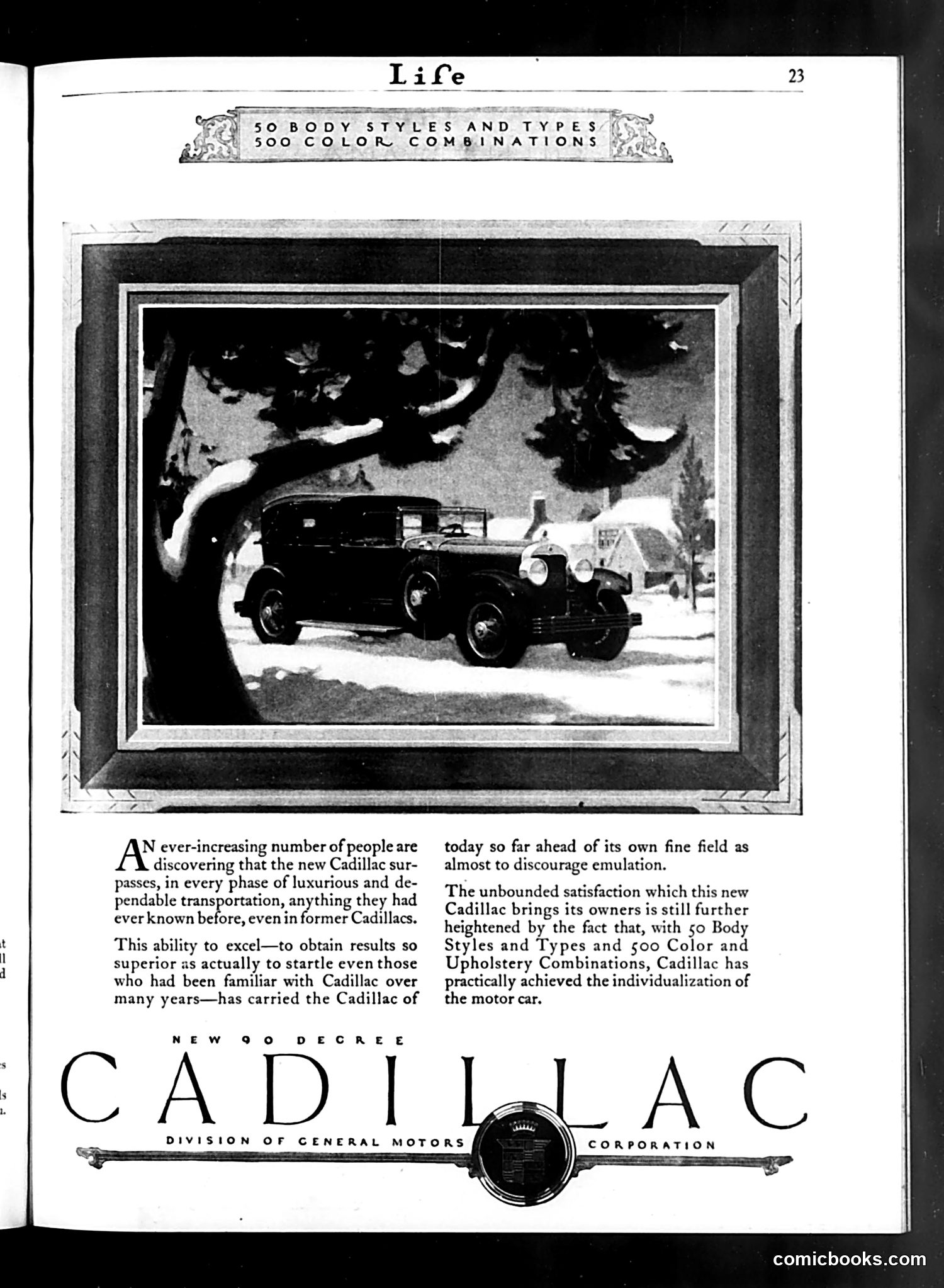
This is **not a cartoon or satire**—it's a straightforward luxury automobile advertisement from Life magazine's early era. The page promotes Cadillac's "New 90 Degree" models, emphasizing their superiority over competitors and even previous Cadillac models. The key selling points are: 1. **Customization**: 50 body styles and 500 color/upholstery combinations offered "individualization of the motor car"—a novel luxury concept for the era. 2. **Market dominance**: The text claims Cadillac is "so far ahead" competitors can barely compete. 3. **Brand loyalty appeal**: Even longtime Cadillac owners will be "startled" by improvements. The photograph shows period automobiles parked under trees, presenting the car as a status symbol for the wealthy. This reflects 1920s-1930s advertising culture, when automobiles were luxury goods and Cadillac represented peak American automotive prestige. The emphasis on customization reflected emerging consumer culture and individualism.
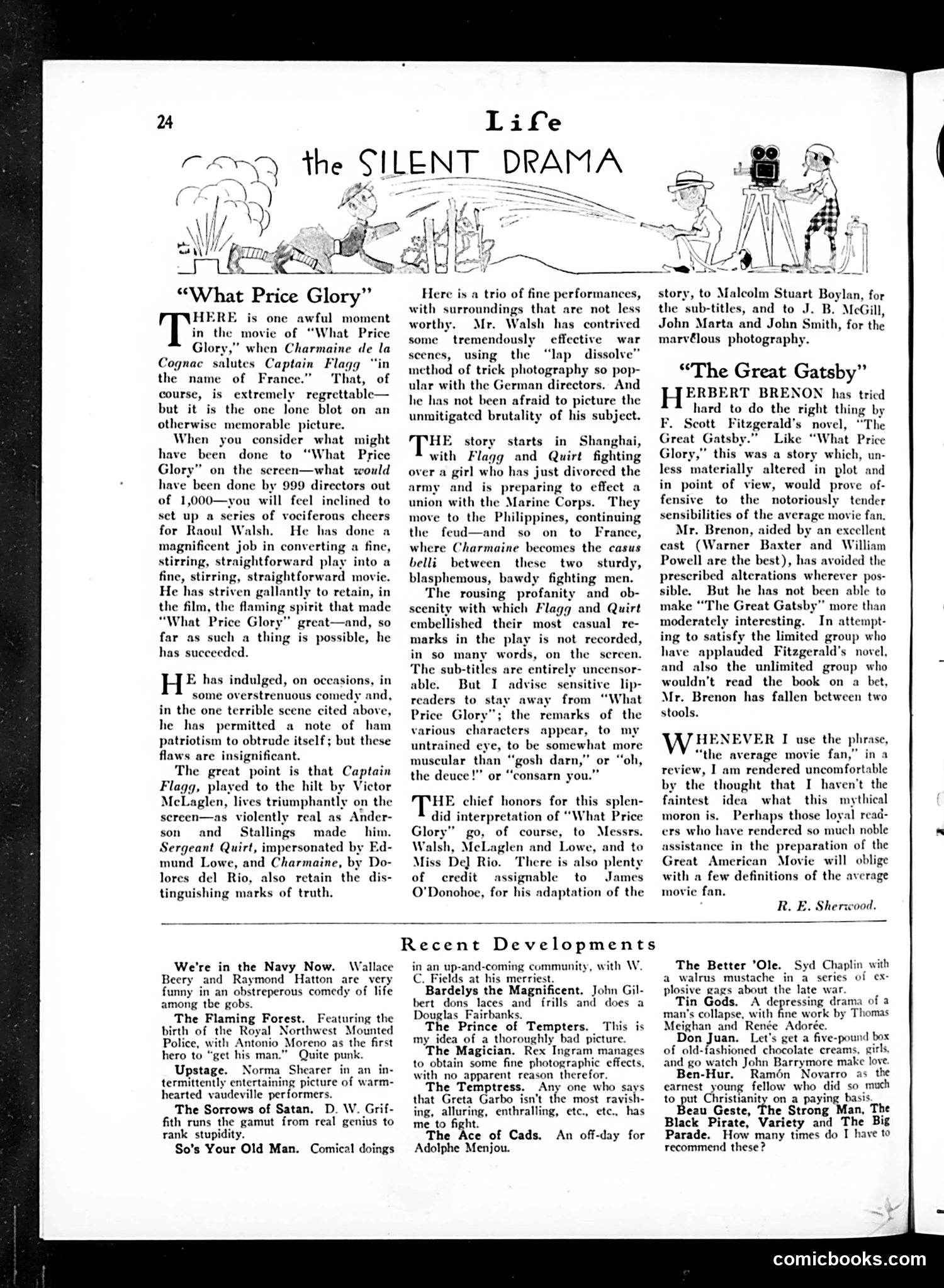
This page reviews two 1920s silent films. The top article praises director Raoul Walsh's adaptation of the play "What Price Glory," starring Victor McLaglen as Captain Flagg and Edmund Lowe as Sergeant Quirt. The reviewer celebrates Walsh's fidelity to the source material's "flaming spirit" while noting one unfortunate moment of ham patriotism. The film depicts soldiers fighting in Shanghai, the Philippines, and France over a woman named Charmaine (Dolores del Rio). The lower section reviews Herbert Brenon's "The Great Gatsby" adaptation of F. Scott Fitzgerald's novel. The reviewer acknowledges Brenon's effort to preserve the book's sophisticated tone despite concerns it might offend "the average movie fan," but concludes the film falls between satisfying both Fitzgerald devotees and general audiences—"fallen between two stools." Both reviews engage with the tension between literary source material and commercial cinema constraints.
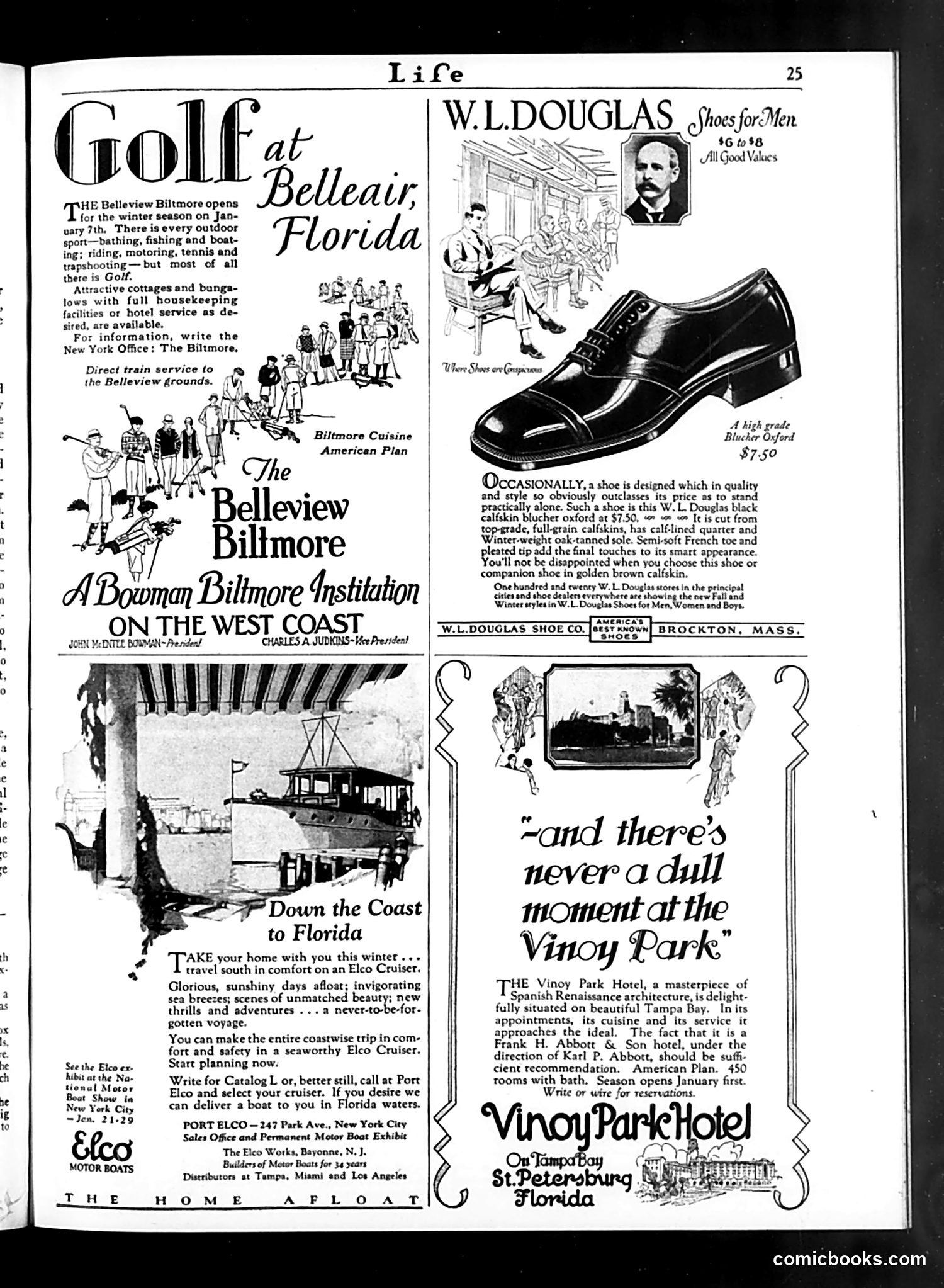
This is primarily a **commercial advertising page**, not a satirical cartoon page. The content consists of four distinct travel and product advertisements: 1. **Belleview Biltmore Resort** (Florida) – promoting winter golf and leisure activities 2. **W.L. Douglas Shoes** – advertising a $7.50 men's oxford shoe as high-quality value 3. **Elco Motor Boats** – promoting pleasure cruisers for coastal Florida travel 4. **Vinoy Park Hotel** (St. Petersburg, Florida) – advertising luxury Spanish Renaissance accommodations The unifying theme is **winter leisure for affluent Americans**, particularly travel to Florida. These ads target upper-middle-class readers seeking comfortable, fashionable ways to escape northern winters. The page reflects 1920s marketing: emphasizing quality, comfort, and conspicuous leisure travel during the Florida real-estate boom era. There is no apparent political satire or social commentary—this is straightforward commercial content typical of Life magazine's advertising sections.
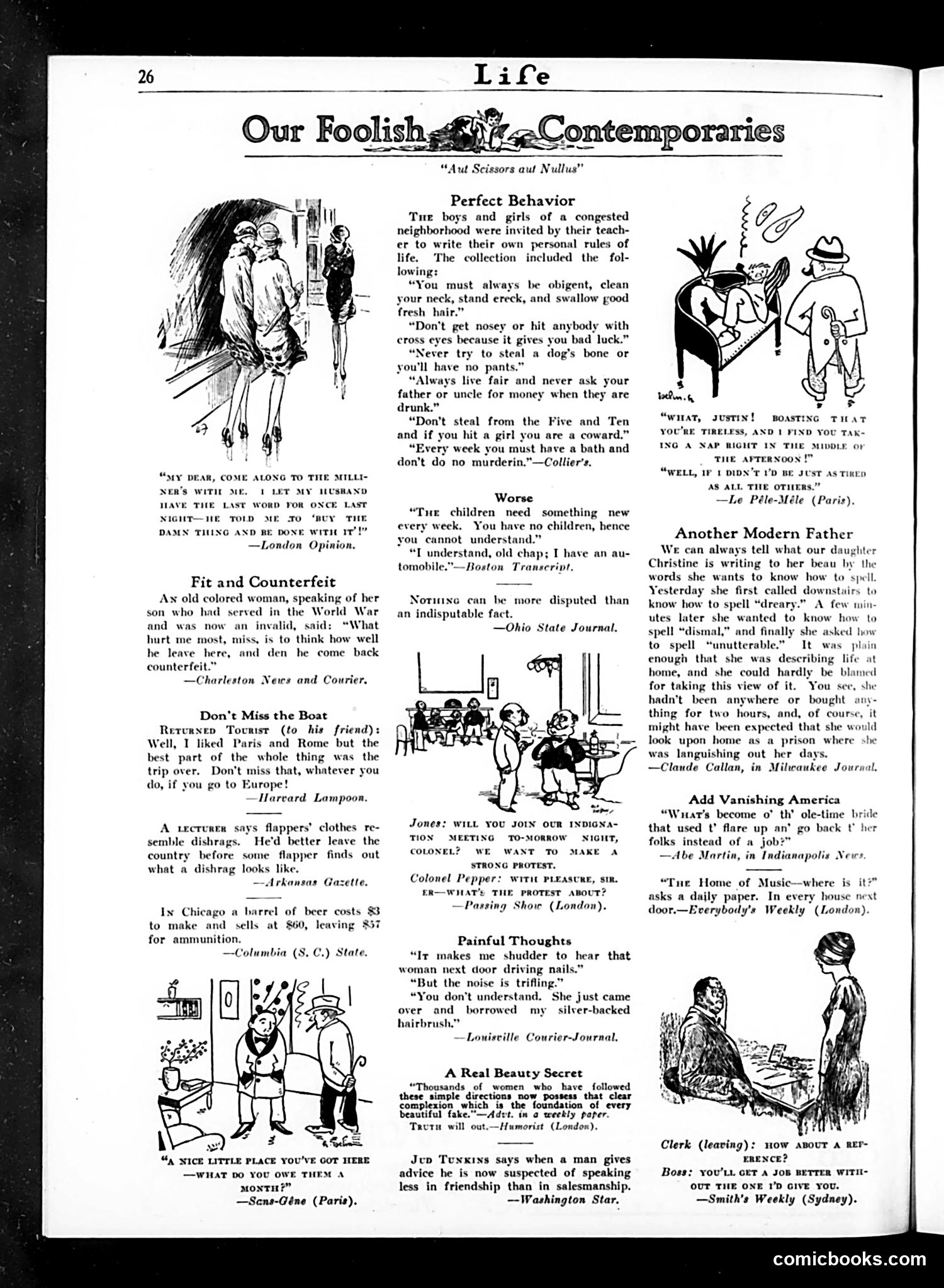
This page collects brief humorous observations about modern life and social behavior, typical of *Life* magazine's satirical format. Key sections include: **"Perfect Behavior"**: Children's written rules of conduct, humorously misspelled and naive ("swallow good fresh hair," "don't do no murderin'"), satirizing both childhood innocence and educational pretensions. **"Another Modern Father"**: A father deduces his daughter's mood from the words she asks how to spell—"dreary," "dismal," "unutterable"—implying she's complaining about home life. The satire targets both modern parental cluelessness and teenage melodrama. **Various brief jokes** mock: wives' frivolous shopping habits, disabled WWI veterans ("counterfeit"), flapper fashion, Prohibition-era beer pricing, and modern courtship rituals. The overall tone reflects 1920s American preoccupations: post-war disillusionment, changing gender roles, youth culture, and economic concerns. The cartoons are crude line drawings accompanying satirical commentary from American and international sources.
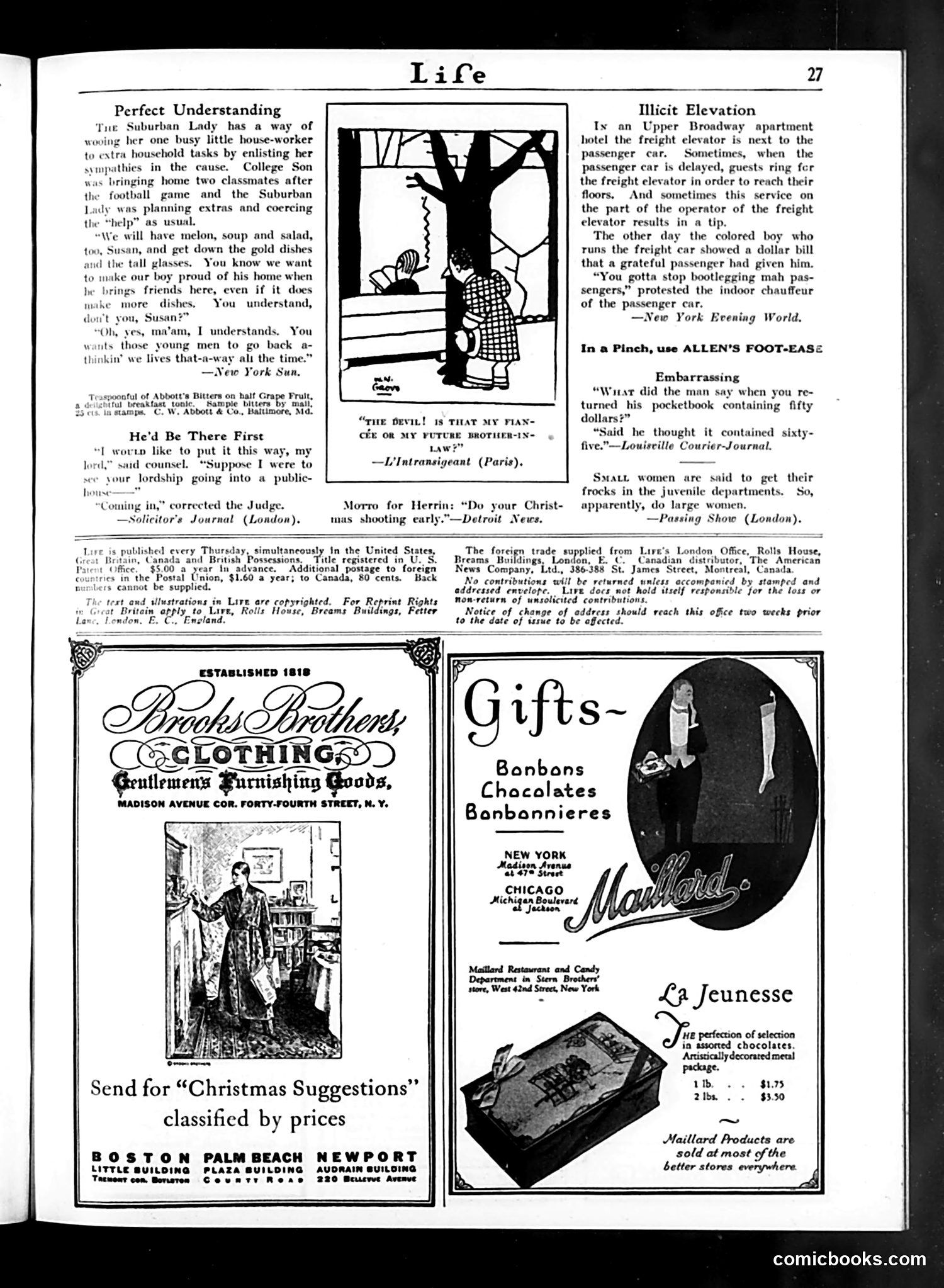
This page contains multiple short humorous anecdotes typical of Life's satirical style, plus period advertisements. **"Perfect Understanding"** depicts class dynamics: a suburban lady manipulates her working-class housekeeper (Susan) into extra labor by flattering her about impressing the lady's college son. Susan's vernacular response—"You wants those young men to go back a-thinkin' we lives that-a-way all the time"—reveals she understands the deception but complies anyway. The satire mocks both the employer's transparent manipulation and the servant's resigned acceptance of social pretense. **"Illicit Elevation"** jokes about an apartment building where a freight elevator operator accepts tips from guests using his elevator when the passenger elevator is slow. A competing chauffeur sarcastically calls this "bootlegging" passengers—a topical reference to Prohibition-era smuggling, applied humorously to unauthorized passenger transport. **"Embarrassing"** is a simple joke: a man returns a lost wallet containing fifty dollars; the finder assumed it held sixty-five, making the return awkward. The page is otherwise dominated by period advertisements for Brooks Brothers clothing, Maillard chocolates, and other luxury goods targeting affluent readers.
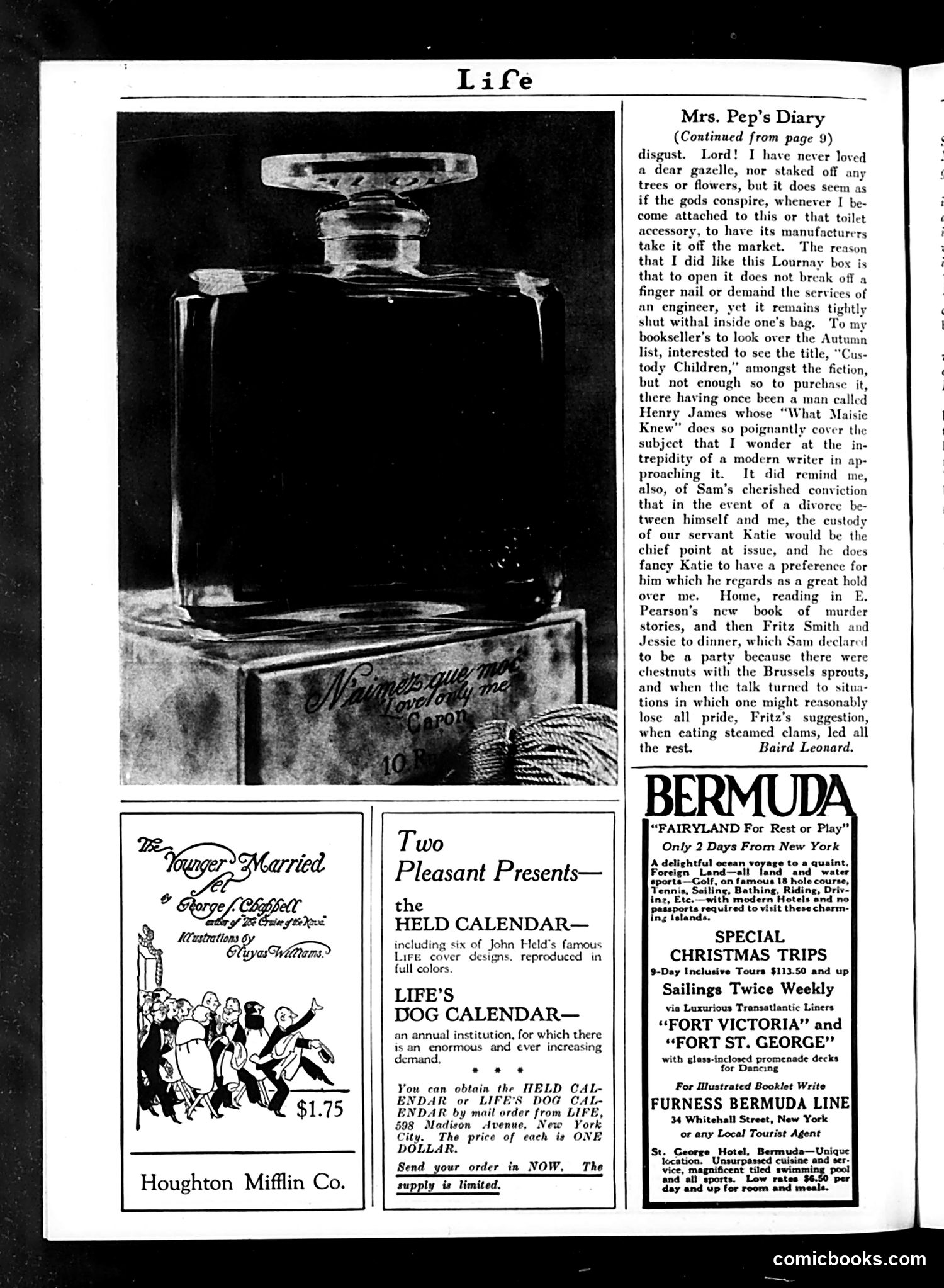
This page is primarily **advertising and serialized diary content**, not political satire. **Main Content:** "Mrs. Pep's Diary" (continued) is a humorous domestic column describing a socialite's day—her frustration with discontinued toiletries, browsing a new novel called "Custody Children" (which she compares unfavorably to Henry James's "What Maisie Knew"), and hosting dinner guests. The humor is gentle domestic observation: her husband Sam jokingly suggests their servant Katie would side with him in divorce, and dinner conversation turns to situations where one loses dignity—apparently when eating steamed clams. **Advertisements:** - *The Younger Married* (book, $1.75) by George Ade, illustrated by Ethel Williams - *Held Calendar* and *Life's Dog Calendar* (collectible calendars, $1 each) - Bermuda tourism promotion featuring luxury liners and resort amenities The page reflects **1920s leisure-class life**: servants, dinner parties, seaside travel, and light domestic comedy aimed at affluent readers.
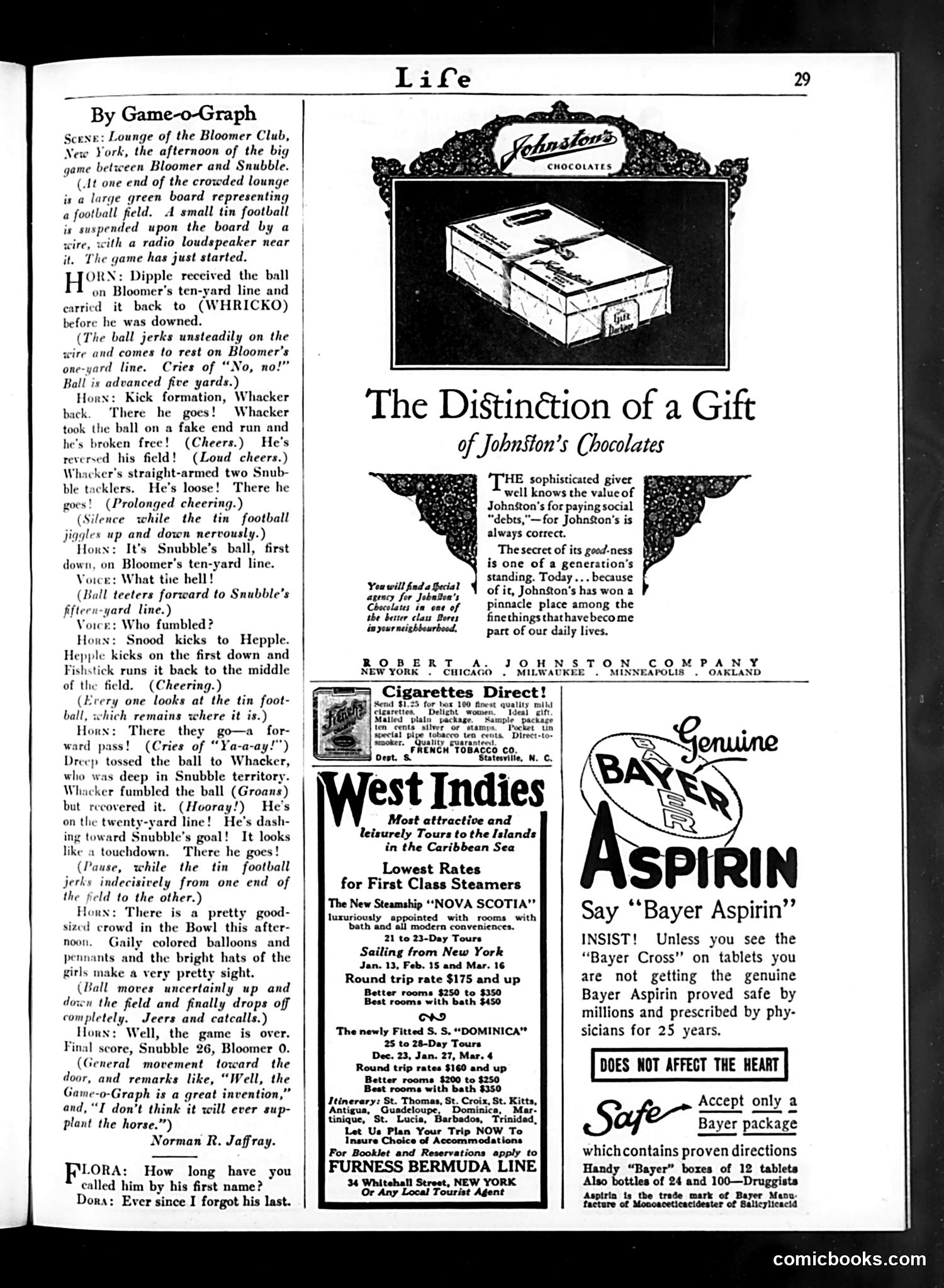
This cartoon mocks the then-popular radio broadcasts of football games. The scene depicts women at the "Bloomer Club" in New York watching a mechanical tin football on a wire board while listening to a radio announcer narrate a game between "Bloomer" and "Snubble." The satire highlights the absurdity of this indirect entertainment: spectators become emotionally invested in a disembodied voice describing action they cannot see, reacting to a tiny metal ball's jerky movements that often contradict the announcer's commentary. The disconnect is emphasized when the ball "remains where it is" despite excited play-by-play narration. The joke targets both the novelty of radio technology and the growing female sports audience—"Bloomer Club" references the women's athletic movement of the era. The final line ("I don't think it will ever supplant the horse") humorously suggests this newfangled invention will never replace traditional entertainment. The page is otherwise advertisements for Johnston's Chocolates, Bayer Aspirin, West Indies travel, and cigarettes.
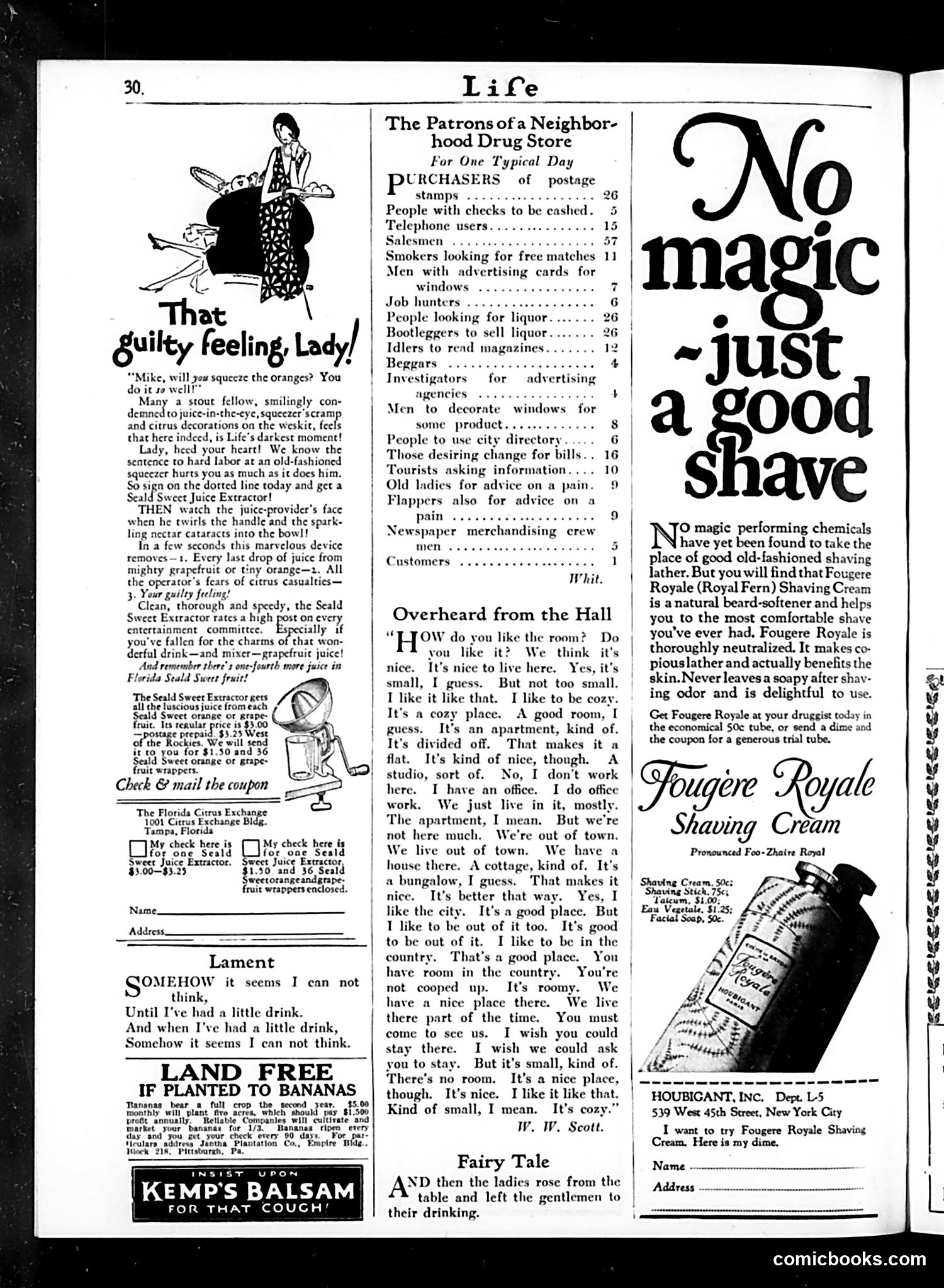
This page contains a satirical advertisement disguised as humorous content. The main cartoon shows a woman asking her husband to squeeze oranges, implying he'll get juice in his eyes and clothes—a messy, unpleasant task. The satire targets **gender roles and domestic labor**. The joke assumes readers will sympathize with the husband's suffering, then pivots to sell the "Seald Sweet Juice Extractor"—a mechanical solution that eliminates his "guilty feeling" of resenting the task. The real target is the **wife's guilt** for asking him to do unpleasant work. The ad suggests that by purchasing this device, she can assuage her conscience while still avoiding the work herself. It's satire on how consumer products are marketed to solve emotional discomfort rather than address underlying inequities in household labor distribution. The surrounding content—drug store patrons, a poem about drinking, banana-land schemes—is typical period filler advertising and light comedy.
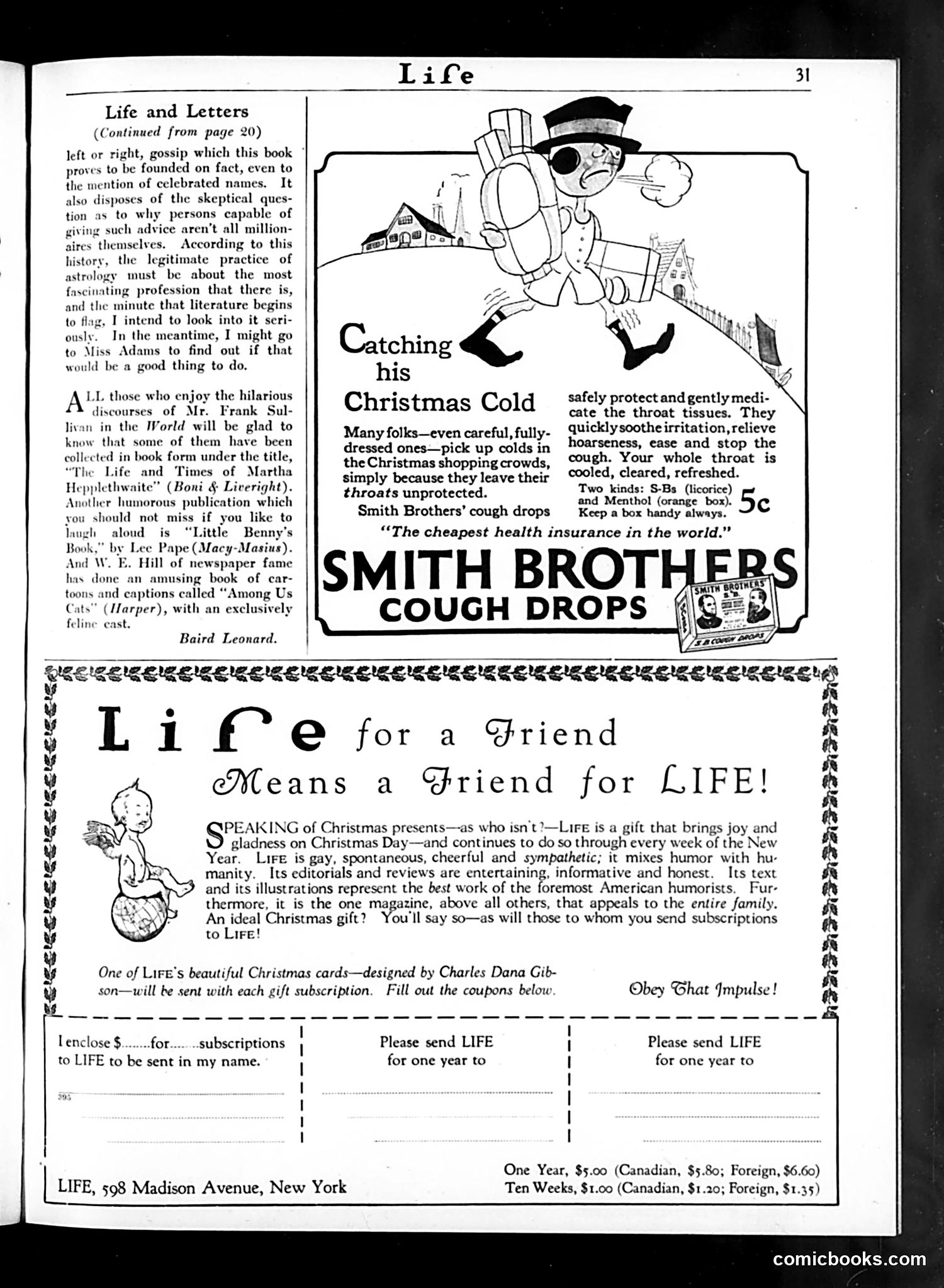
This page combines editorial content with advertisements and subscription promotions. **The Main Cartoon:** A humorous illustration shows a man bundled heavily with winter gear, literally running away while catching a cold—depicted by visible illness signs. This advertises Smith Brothers' cough drops, which the ad claims are "the cheapest health insurance in the world." The joke plays on the irony that despite precautions, people still catch colds during Christmas shopping season because they leave their throats unprotected. **The Text Section** discusses literary humor: Frank Sullivan's work in the *World* newspaper, and other humorous books with animal characters and satirical cartoons. **The Lower Section** promotes Life magazine itself as a Christmas gift subscription, emphasizing it appeals to families with quality humor and illustrations by noted cartoonist Charles Dana Gibson. The page reflects Life's identity as a satirical magazine relying on visual humor and witty commentary about everyday American life—here, the universal experience of winter colds and holiday shopping.
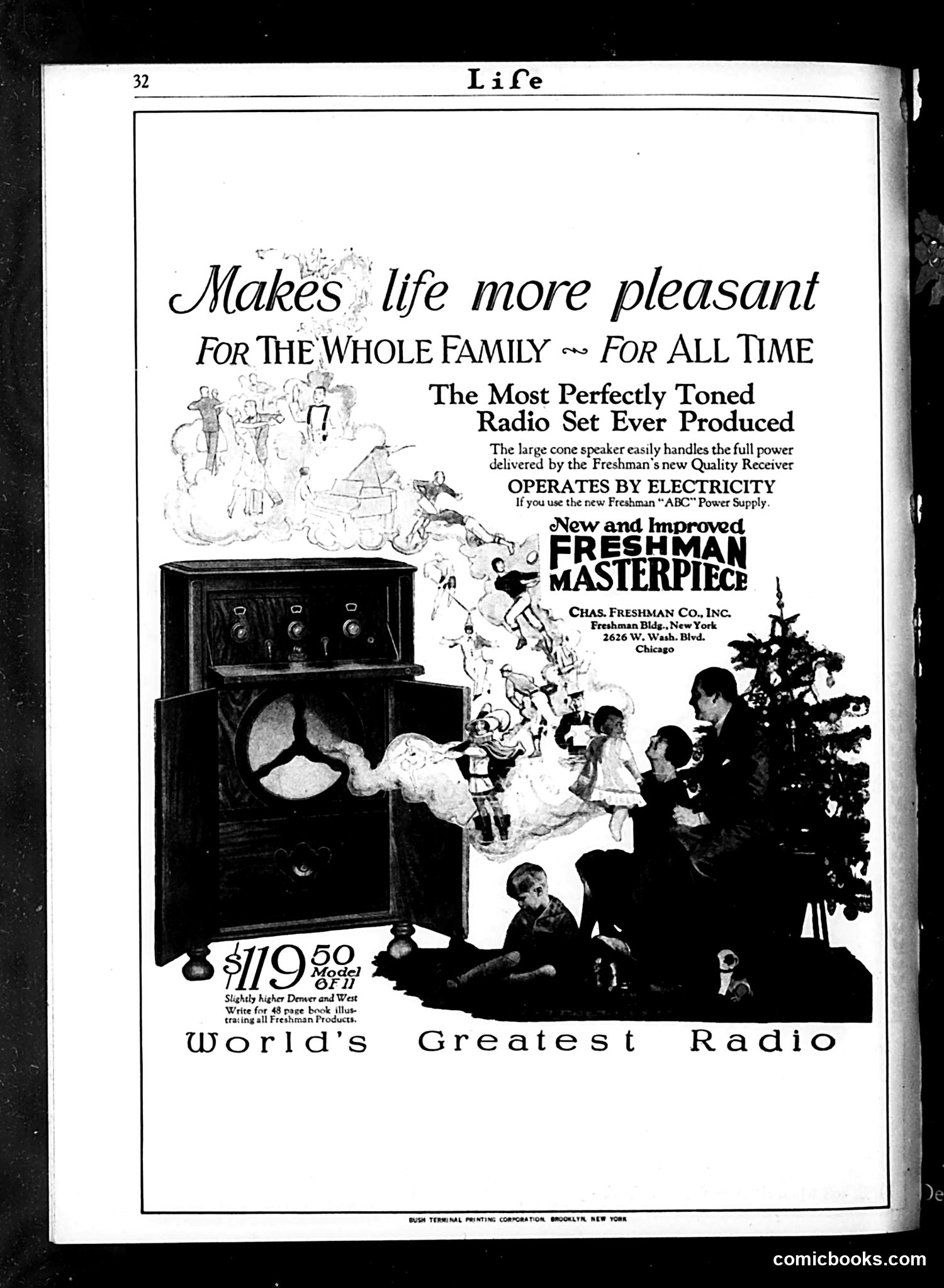
This page is primarily a **product advertisement**, not political satire. It promotes the Freshman Masterpiece radio set, marketed as "The Most Perfectly Toned Radio Set Ever Produced." The illustration shows a family gathering around a large console radio during the Christmas season (decorated tree visible), depicting idealized domestic contentment. The radio was a luxury consumer good in this era, and the ad emphasizes it "makes life more pleasant for the whole family." Key selling points highlighted: operates by electricity (notable at this time), features a large cone speaker for full power, and costs $119.50. The ad references the "new Freshman 'ABC' Power Supply" and provides manufacturer addresses in New York and Chicago. The phrase "World's Greatest Radio" is typical period advertising hyperbole. There is no visible political or satirical commentary—this is straightforward commercial promotion appearing in *Life* magazine, which carried advertisements alongside its editorial content.