
Life, 1926-12-16 · page 21 of 34
Life — December 16, 1926 — page 21: what you’re looking at
What you’re looking at
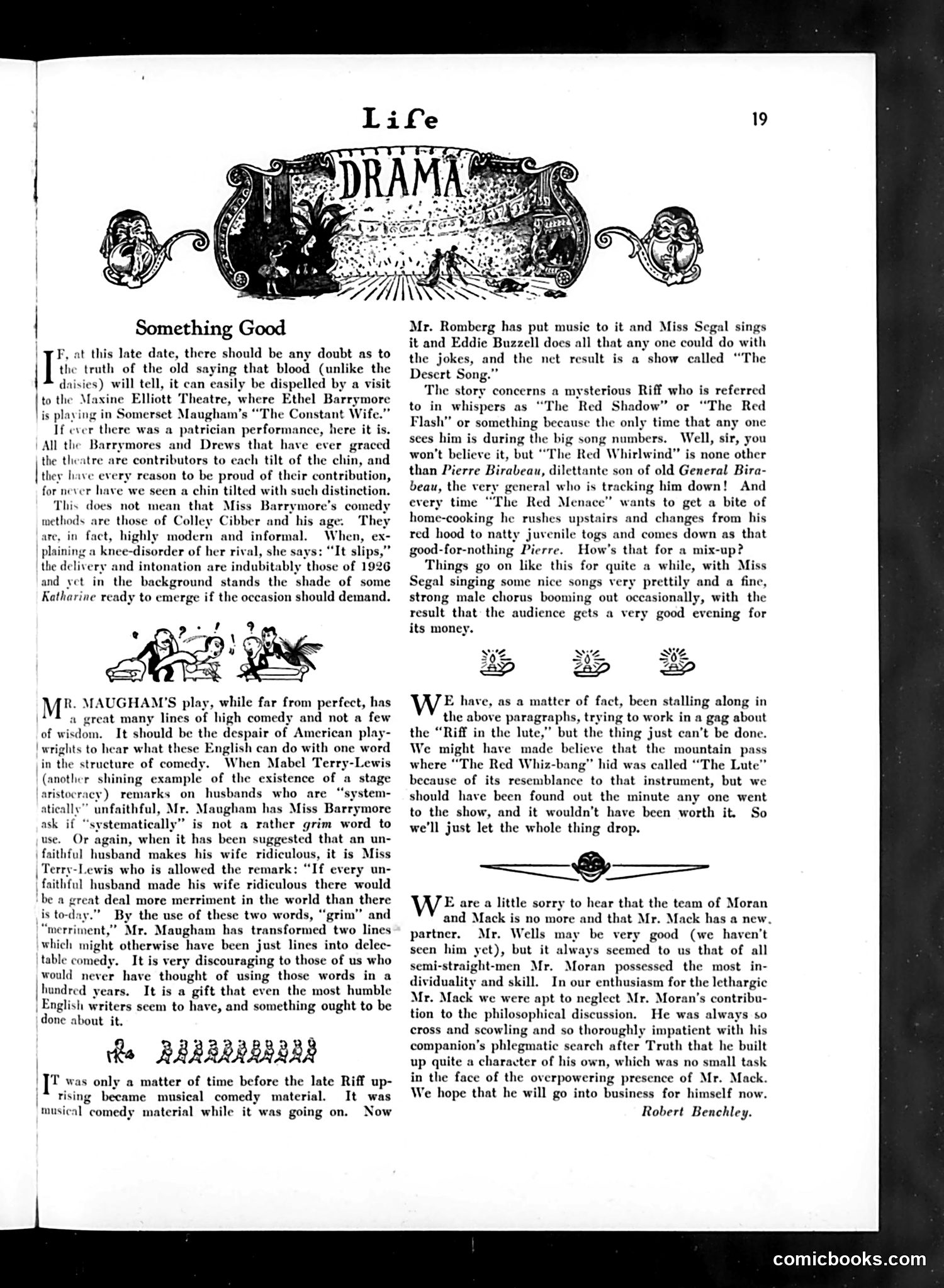
This page contains theatrical reviews from Life magazine's drama section. The main content critiques three shows: 1. **"The Constant Wife"** — Ethel Barrymore's performance at the Maxine Elliott Theatre, praised for her aristocratic bearing and modern comedic delivery, with references to her distinguished theatrical family legacy. 2. **Somerset Maugham's Play** — The reviewer praises English playwrights' superior skill with language and comic timing, lamenting American writers' inability to match their wit. 3. **"The Desert Song"** — A musical comedy based on the Riff uprising in North Africa. The review mocks the plot's absurdity: a mysterious "Red Shadow" rebel is actually Pierre Birabeau, a dilettante whose father hunts him—yet he simply changes clothes and returns home for dinner. The reviewer acknowledges the formulaic entertainment value while poking fun at the implausible premise, particularly noting a failed attempt at a "Riff in the lute" pun. The decorative illustration at top depicts a theatrical scene. The tone is witty, sophisticated satire typical of 1920s Life magazine.
📄 Transcribed text from this page (OCR, searchable)
Machine-transcribed from the original scan — historical spelling and the odd misread are preserved.
| Semwihing Gaod F, at this late date, there should be any doubt as to iT truth of the old saying that blood (unlike the daisies) will tell, it easily be dispelled by a visit to the Maxine Elliott Theatre, where Ethel Barrymore is playing in Somerset Maugham’s “The Constant Wife If ever there was a patrician performance, here it is. All the Barrymores and Drews that have ever graced the theatre are contributors to each tilt of the chin, and | they have every reason to be proud of their contribution, for never have we seen a chin tilted with such distinction. This does not mean that Miss Barrymore’s comedy methods are those of Colley Cibber and his age. They are, in fi highly modern and informal. When, plaining a knee-disorder of her rival, she says: “It slips,” the delivery and intonation are indubitably those of 1926 and yet in the background stands the shade of some Katharine ready to emerge if the occasion should demand. 2 M: MAUGHAM'S play, while far from perfect, has great many lines of high comedy and not a few of wisdom. It should be the despair of American play- | wrights to hear what these English can do with one word in the structure of comedy. When Mabel Terry-Lewis (another shining example of the existence of a stage aristocracy) remarks on husbands who are “system- atically” unfaithful, Mr. Maugham has Miss Barrymore ask if “systematically” is not a rather grim word to use. Or again, when it has been suggested that an un- faithful husband makes his wife ridiculous, it is Miss | Terry-Lewis who is allowed the remark: “If every un- [faithful husband made his wife ridiculous there would be a great deal more merriment in the world than there oe By the use of these two words, “grim” and “merriment,” Mr. Maugham has transformed two lines which might otherwise have been just lines into delec- table comedy. It is very discouraging to those of us who would never have thought of using those words in a jhundred years. It is a gift that even the most humble | English writers seem to have, and something ought to be done about it. tee BERSRRSIIRS I" was only a matter of time before the late Riff up- rising became musical comedy material. It was musical comedy material while it was going on. Now 19 Mr. Romberg has put music to it and Miss Segal sings it and Eddie Buzzell does all that any one could do with the jokes, and the net result is a show called “The Desert Song.” The story concerns a mysterious Riff who is referred to in whispers as “The Red Shadow” or “The Red Flash” or something because the only time that any one sees him is during the big song numbers. Well, sir, you won't believe it, but “The Red Whirlwind” is none other than Pierre Birabeau, dilettante son of old General Bira- beau, the very general who is tracking him down! And every time “The Red Menace” wants to get a bite of home-cooking he rushes upstairs and changes from his red hood to natty juvenile togs and comes down as that good-for-nothing Pierre. How's that for a mix-up? Things go on like this for quite a while, with Miss Segal singing some nice songs very prettily and a fine, strong male chorus booming out occasionally, with the result that the audience gets a very good evening for its money. OY E have, as a matter of fact, been stalling along in the above paragraphs, trying to work in a gag about the “Riff in the lute,” but the thing just can’t be done. We might have made believe that the mountain pass where “The Red Whiz-bang” hid was called “The Lute” because of its resemblance to that instrument, but we should have been found out the minute any one went to the show, and it wouldn't have been worth it. So we'll just let the whole thing drop. G ys Wy, is My io —_ & —— E are a little sorry to hear that the team of Moran and Mack is no more and that Mr. Mack has a new. partner. Mr. Wells may be very good (we haven't seen him yet), but it always seemed to us that of all semi-straight-men Mr. Moran possessed the most in- dividuality and skill. In our enthusiasm for the lethargic Mr. Mack we were apt to neglect Mr. Moran's contribu- tion to the philosophical discussion. He was always so cross and scowling and so thoroughly impatient with his companion’s phlegmatic search after Truth that he built up quite a character of his own, which was no small task in the face of the overpowering presence of Mr. Mack. We hope that he will go into business for himself now. Robert Benchley. comicbooks.com