
Life, 1926-12-16 · page 22 of 34
Life — December 16, 1926 — page 22: what you’re looking at
What you’re looking at
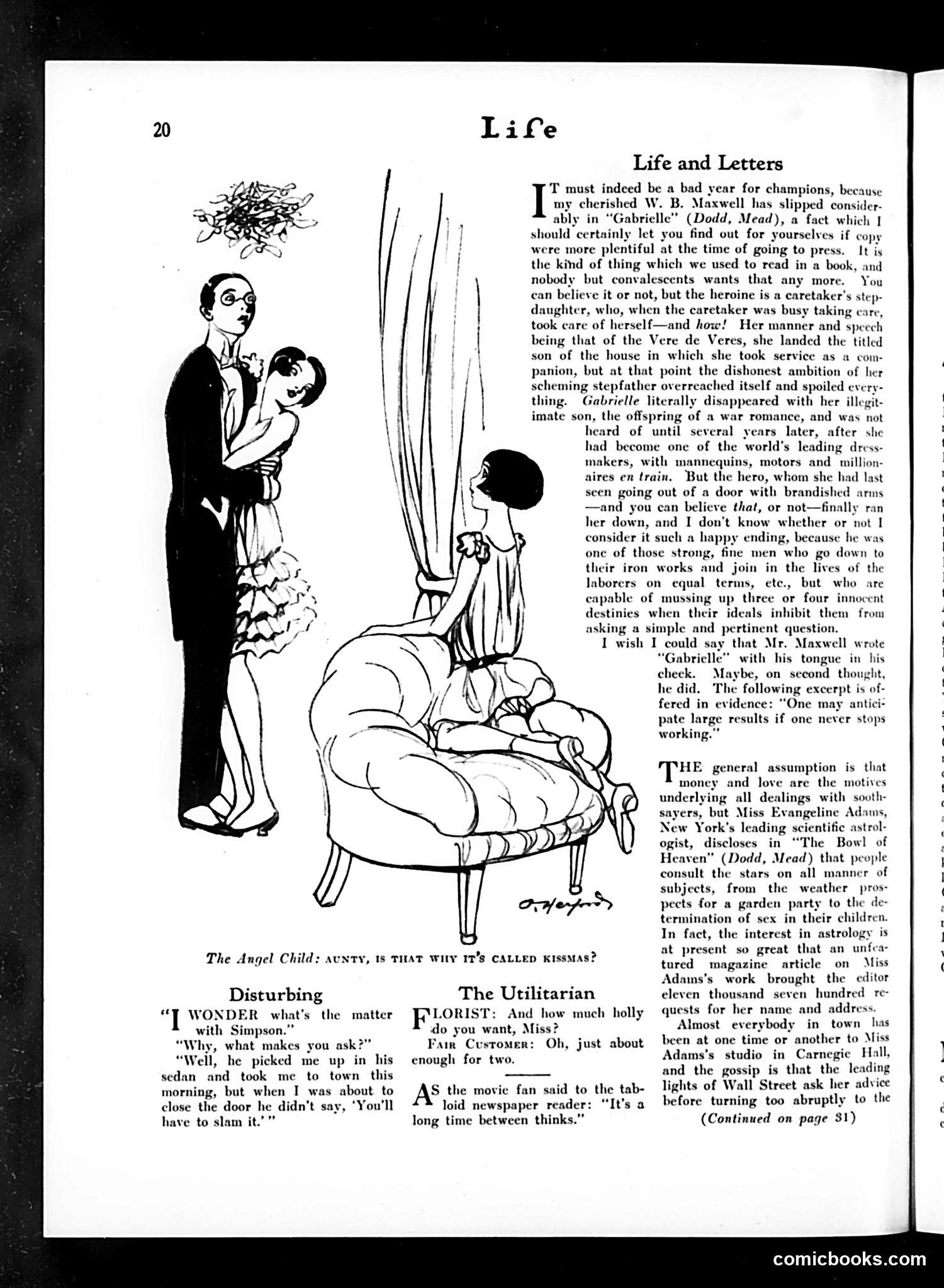
This page contains three brief satirical pieces typical of Life's humor: **"The Angel Child"** (cartoon): A child asks an adult why Christmas is called "kissmas," referencing the physical affection associated with the holiday—gentle satire on children's innocent literalism. **"Disturbing"**: A social commentary joke. A man picks up his acquaintance in a sedan but doesn't issue the then-common demand "You'll have to slam it" (referring to the car door). The humor relies on this being such a normalized, expected phrase that its absence seems socially wrong—satirizing formulaic masculine behavior. **"The Utilitarian"**: A florist and customer discuss holly quantities. The customer wants "enough for two," implying minimal decoration—satire on penny-pinching during the holiday season. The page's main text discusses W.B. Maxwell's novel *Gabrielle* and Miss Evangeline Adams's astrology book. The astrology section notes that Adams's work generated thousands of inquiries, including from Wall Street figures—satirizing both public fascination with astrology and wealthy businessmen's reliance on it.
📄 Transcribed text from this page (OCR, searchable)
Machine-transcribed from the original scan — historical spelling and the odd misread are preserved.
The Angel Child: aunty, 1s THAT Wity IT’S CALLED KISsMAs? Disturbing “T WONDER what's the matter with Simpson.” “Why, what makes you ask?” “Well, he picked me up in his sedan and took me to town this morning, but when I was about to close the door he didn’t say, ‘You'll have to slam it.’” Life The Utilitarian LORIST: And how much holly do you want, Miss? Fair Customer: Oh, just about enough for two. AS the movie fan said to the tab- loid newspaper reader: “It’s a long time between thinks. Life and Letters T must indeed be a bad year for champions, because I my cherished W. B. Maxwell has slipped consider- ably abrielle’” (Dodd, Mead), a fact which I should certainly let you find out for yourselves if copy were more plentiful at the time of going to press. It is the kind of thing which we used to read in a book, and nobody but convalescents wants that any more. You can believe it or not, but the heroine is a caretaker's step- daughter, who, when the caretaker was busy taking care, took care of herself—and how! Her manner and speech being that of the Vere de Veres, she landed the titled son of the house in which she took service as a com- panion, but at that point the dishonest ambition of her scheming stepfather overreached itself and spoiled every- thi Gabrielle literally disappeared with her illegit- imate son, the offspring of a war romai and was not heard of until several years later, after she had become one of the world’s leading dress- makers, with mannequins, motors and million- aires en train. But the hero, whom she had last seen going out of a door with brandished arms —and you can believe that, or not—finally ran her down, and I don’t know whether or not I consider it such a happy ending, because he was one of those strong, fin n who go down to their iron works and join in the lives of the laborers on equal terms, ete., but who are able of mussing up three or four innocent destinies when their ideals inhibit them from asking a simple and pertinent question. I wish I could hat Mr. Maxwell wrote “Gabriel with his tongue in his cheek. Maybe, on second thoughit, he did. The following excerpt is fered in evidence: “One may antici- pate large results if one never stops working.” THE general assumption is that money and love are the motives underlying all dealings with sooth- sayers, but Miss Evangeline Adams, w York's leading scientific astrol- discloses in “The Bowl of Heaven” (Dodd, Mead) that people consult the stars on all manner of subjects, from the weather pros- for a garden party to the de- in their children. st in astrology is nt so great that an unfea- tured magazine article on Miss Adams's work brought the editor eleven thousand seven hundred re- quests for her name and address. Almost everybody in town has been at one time or another to Miss Adams’s studio in Carnegie Hall, and the gossip is that the leading lights of Wall Street ask her advice before turning too abruptly to the (Continued on page 31) comicbooks.com