
Life, 1926-12-16 · page 20 of 34
Life — December 16, 1926 — page 20: what you’re looking at
What you’re looking at
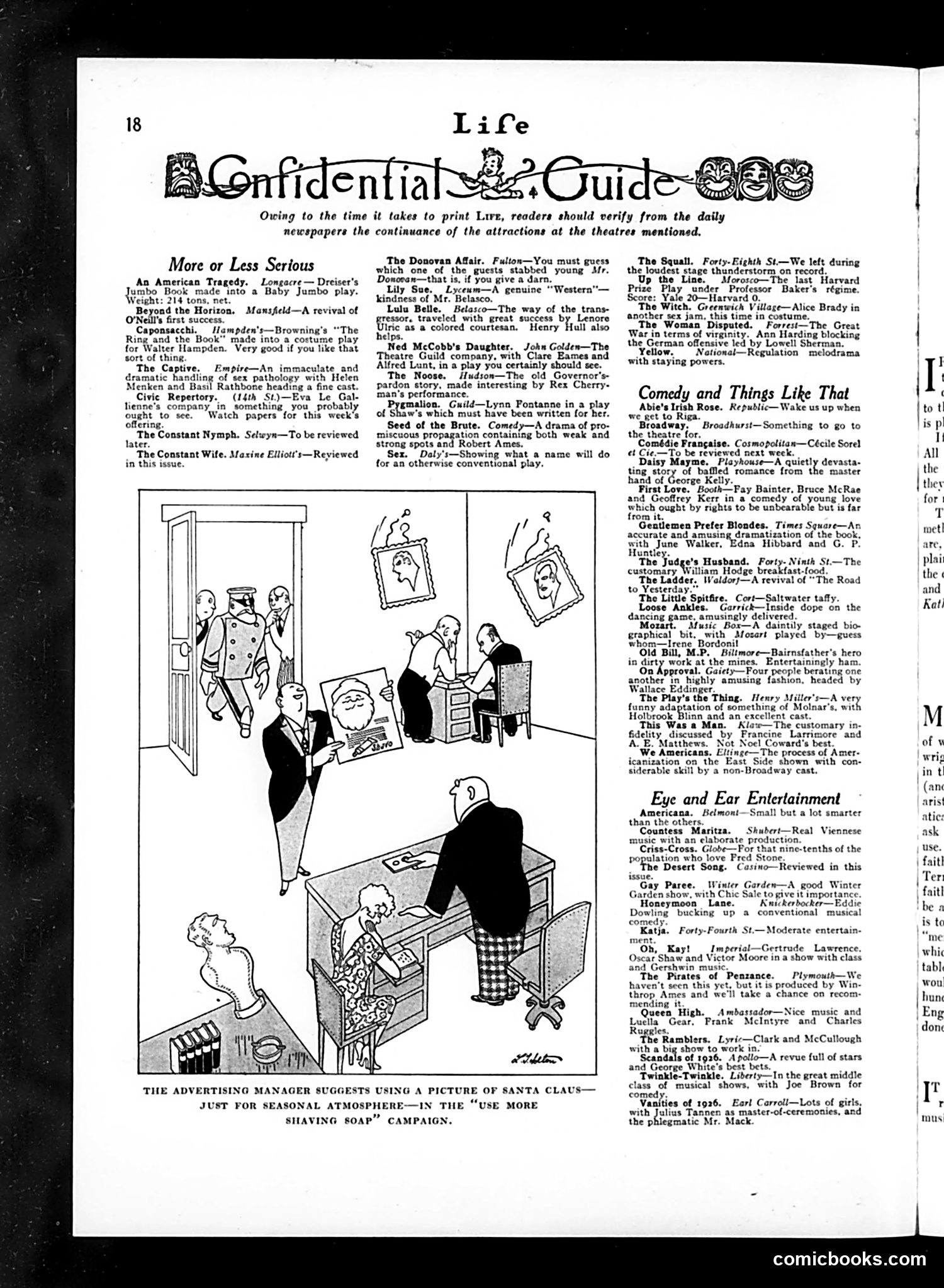
This page from *Life* magazine is a **theatrical review section** from the 1920s. The large cartoon satirizes advertising practices of the era. **The Cartoon's Point:** An advertising manager suggests using Santa Claus imagery in a "Use More Shaving Soap" campaign purely for "seasonal atmosphere"—despite shaving soap having nothing to do with Christmas. The satire mocks how advertisers cynically exploit holidays and emotional associations to sell unrelated products, prioritizing atmospheric appeal over logical marketing. **The Figures:** Generic businessmen and the imagined Santa Claus represent the advertising industry's manipulative tactics. **The Context:** This reflects 1920s concerns about emerging mass-marketing and consumer culture. The joke assumes readers recognize advertising's growing reliance on psychological manipulation rather than product merit—a cutting critique of modern capitalism's deceptive methods that remains relevant today.
📄 Transcribed text from this page (OCR, searchable)
Machine-transcribed from the original scan — historical spelling and the odd misread are preserved.
More or Less Serious An American Tragedy. Longacre — Dreiser's lumbo Book made into a Baby Jumbo play. Weight: 214 tons, net. Beyond the Horizon, Mansfeld—A revival of O'Neill's first success. Caponsacchi. Ring and the Book” made into a costume play for Walter Hampden. Very good if you like that sort of thing. The Captive. Empire—An immaculate and dramatic handling of sex pathology with Helen Menken and Basil Rathbone heading a fine cast. Civic Repertory. (14th St.)—Eva Le Gal- lienne’s company in something you probably ought to see. Watch papers for this week's offering. , The Constant Nymph. Selwyn—To be reviewed later. The Constant Wife. Maxine Elliott's—Reyiewed in this issue. Hampden's—Browning’s “The Owing to the time it takes to print Live, readers should verify from the daily newspapers the continuance of the attractions at the theatres mentioned. The Donovan Affair. Fulton—You must guess which one of the guests stabbed young Mr. Donovan—that is, if you give a darn. Lily Sue. Lyceum—A genuine “Western”— kindness of Mr. Belasco, Lulu Belle. Belasco—The way of the trans- ressor, traveled with great success by Lenore Biric as © colored courtesan. Henry Hrait also eps. Ned McCobb’s Daughter. John Golden—The Theatre Guild company, with Clare Eames and Alfred Lunt, in a play you certainly should see. The Noose. Hudson—The old Governor's- pardon story, made interesting by Rex Cherry- man’s performance. Ryemalion. Guild—Lyna Pontanne in a play of Shaw's which must have been written for her. Seed of the Brute. Comedy—A drama of pro- miscuous propagation containing both weak and strong spots and Robert Ames. Sex. Daly's—Showing what a name will do for an otherwise conventional play. THE ADVERTISING MANAGER SUGGESTS USING A PICTURE OF SANTA CLAUS— JUST FOR SEASONAL ATMOSPHERE—IN THE “USE MORE SHAVING SOAP” CAMPAIGN. The Squall. Forty-Eighth St—We left during the loudest stage thunderstorm on record. Up the Line. Morosco—The last Harvard Prize Play under Professor Baker's régime. Score: Yale 20—Harvard 0. The Witch. Greenwich Village—Alice Brady in another sex jam, this time in costume. e Woman Disputed. Forresi—The Great War in terms of virginity. Ann Harding blocking the German offensive led by Lowell Sherman. Yellow. Netional—Regulation melodrama with staying powers. Comedy and Things Like That Abie's Irish Rose. Republic—Wake us up when we get to Riga. Broadway. Broadhurst—Something to go to the theatre for. Comédie Francaise. Cosmopolitan—Cécile Sorel ¢ Cie—To be reviewed next week. _ Daisy Mayme. Playhouse—A quietly devasta- ting story of baled romance from the master hand of George Kelly. First Love. Booth—Pay Bainter, Bruce McRae and Geoffrey Kerr in a comedy of young love which ought by rights to be unbearable but is far rom it Gentlemen Prefer Blondes. Times Square—An accurate and amusing dramatization of the book, with June Walker, Edna Hibbard and G. Huntley. The Judge's Husband. Forty. Ninth Si customary William Hodge breakfast-food. The Ladder. Waldorf—A revival of “The Road to Yesterday.” The Little Spitfire. e Ankle: dancing game, Mozart. Music Box—A daintily staged bio- graphical bit, with Mozart played by—guess whom—Irene’Bordonil Old Bill, M.P. Biltmore—Bairnsfather's hero in dirty work at the mines. Entertainingly ham. On Approval. Gaiety—Four people berating one another in highly amusing fashion, headed by Wallace Eddinger. The Play's the Thing. Henry Miller's—A very funny adaptation of something of Molnar’s, wit Holbrook Blinn and an excellent cast. This Was a Man. Klax—The customary in- fidelity discussed by Francine Larrimore and A.E. Matthews. Not Noel Coward's best. We Americans. Eltinge—The process of Amer- icanization on the East Side shown with con- siderable skill by a non-Broadway cast, The Cort—Saltwater taffy. Eye and Ear Entertainment Americana. Belmont—Small but a lot smarter than the others. Countess Maritza. Shuberi—Real Viennese music with an elaborate production. Criss-Cross. Globe—For that nine-tenths of the population who love Pred Stone. _ he Desert Song. Casino—Reviewed in this issue. Gay Paree. Winter Garden—A good Winter Garden show, with Chic Sale to give it importance. Honeymoon Lane. — Knickerbocker—Eddie Dowling bucking up a conventional musical comed: Forty-Fourth St.— Moderate entertain- me Oh, Kay! — Imperial—Gertrude Lawrence, Oscar’ Shaw and Victor Moore in a show with class and Gershwin music. The Pirates of Penzance. Plymouth—We haven't seen this yet, but it is produced by Win- throp Ames and we'll take a chance on recom mending it ‘ Queen High. Ambassador—Nice music and Luella Gear, Prank McIntyre and Charles Ruggles. he Ramblers. Lyric—Clark and McCullough with a big show to work in. Scandals of 1926. A pollo—A revue full of stars and George White's best bets. : Twinkle-Twinkle. Liberty—In the great middle class of musical shows, with Joe Brown for comedy, Vanities of 1926. Earl Corroll—Lots of girls, with Julius Tannen as master-of-ceremonies, and the phiegmatic Mr. Mack wou | hun | Eng done \" ? mus comicbooks.com