
Life, 1926-12-16 · page 26 of 34
Life — December 16, 1926 — page 26: what you’re looking at
What you’re looking at
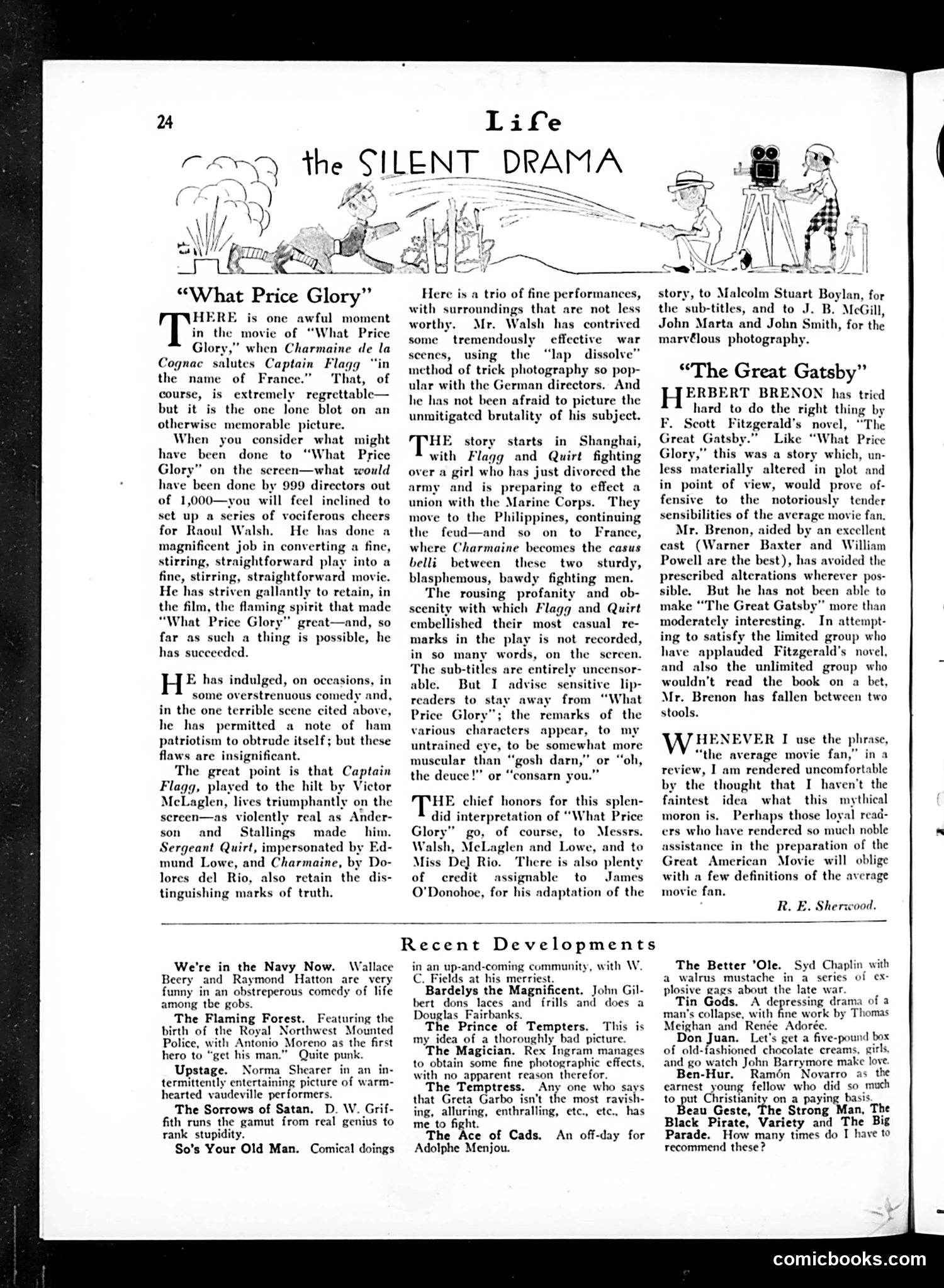
This page reviews two 1920s silent films. The top article praises director Raoul Walsh's adaptation of the play "What Price Glory," starring Victor McLaglen as Captain Flagg and Edmund Lowe as Sergeant Quirt. The reviewer celebrates Walsh's fidelity to the source material's "flaming spirit" while noting one unfortunate moment of ham patriotism. The film depicts soldiers fighting in Shanghai, the Philippines, and France over a woman named Charmaine (Dolores del Rio). The lower section reviews Herbert Brenon's "The Great Gatsby" adaptation of F. Scott Fitzgerald's novel. The reviewer acknowledges Brenon's effort to preserve the book's sophisticated tone despite concerns it might offend "the average movie fan," but concludes the film falls between satisfying both Fitzgerald devotees and general audiences—"fallen between two stools." Both reviews engage with the tension between literary source material and commercial cinema constraints.
📄 Transcribed text from this page (OCR, searchable)
Machine-transcribed from the original scan — historical spelling and the odd misread are preserved.
“What Price Glory” HERE is one awful moment in the movie of “What Price Glory,” when Charmaine de la Cognac salutes Captain Flagg “in the na of France.” That, of course, extremely regrettable— but it is the one lone blot on an otherwise memorable picture. When you consider what have been done to “What Price Glory” on the screen—what would have been done by 999 directors out of 1,000—you will feel inclined to set up a series of vociferous cheers for Raoul Walsh. He has done a magnificent job in converting a fine, stirring, straightforward play into a fine, stirring, straightforward movie. He has striven gallantly to retain, in the film, the flaming spirit that made “What Price Glory” great—and, so far as such a thing is possible, he has succeeded. HE has indulged, on occasions, in some overstrenuous comedy and, in the one terrible scene cited above, he has permitted a note of ham patriotism to obtrude itself; but these flaws are insignificant. The great point is that Captain Flagg, played to the hilt by Victor McLaglen, lives triumphantly on the sereen—as violently real as Ander- son and Stallings made him. Sergeant Quirt, impersonated by Ed- mund Lowe, and Charmaine, by Do- lores del Rio, also retain the dis- tinguishing marks of truth. might Life the SILENT DRAMA Herc is a trio of fine performances, with surroundings that are not less worthy, Mr. Walsh has contrived some tremendously effective war scenes, using the “lap dissolve” method of trick photography so pop- ular with the German directors. And he has not been afraid to picture the unmitigated brutality of his subject. HE story starts in Shanghai, ith Flagg and Quirt fighting over a girl who has just divorced the army and is preparing to effect a union with the Marine Corps. They move to the Philippines, continuing the feud—and so on to France, where Charmaine becomes the casus belli between these two sturdy, blasphemous, bawdy fighting men. The rousing profanity and ob- scenity with which Flagg and Quirt embellished their most casual re- marks in the play is not recorded, in so many words, on the sercen. The sub-titles are entirely un able. But I advise sensitive readers to stay away from “What Price Glory"; the remarks of the various characters appear, to my untrained eye, to be somewhat more muscular than “gosh darn,” or “oh, the deuce!” or “consarn you.” HE chief honors for this splen- did interpretation of “What Price Glory” go, of course, to Messrs. Walsh, MeLaglen and Lowe, and to Miss De] Rio. There is also plen of credit assignable to James O'Donohoe, for his adaptation of the story, to Malcolm Stuart Boylan, for the subtitles, and to J. B. McGill, John Marta and John Smith, for the marvélous photography. “The Great Gatsby” ERBERT BRENON has tried hard to do the right thing by F. Scott Fitzgerald’s novel, “The Great Gatsby.” Like “What Price Glory,” this was a story which, un- less materially altered in plot and in point of view, would prove of- fensive to the notoriously tender sensibilities of the average movie fan. Mr. Brenon, aided by an excellent cast (Warner Baxter and William Powell are the best), has avoided the prescribed alterations wherever pos- sible. But he has not been able to make “The Great Gatsby” more than moderately interesting. In attempt- ing to satisfy the limited group who have applauded Fitzgerald's novel, and also the unlimited group who wouldn't read the book on a bet, Mr. Brenon has fallen between two stools. H EVER I use the phir: “the average movie fan,” in a review, I am rendered uncomfortable by the thought that I haven't the faintest idea what this mythical moron is. Perhaps those loyal read- ers who have rendered so much noble assistance in the preparation of the Great American Movie will oblige with a few definitions of the average movie fan. R. E. Sherwood. We're in the Navy Now. Wallace Beery and Raymond Hatton are very funny in an obstreperous comedy of life among tbe gobs. The Flaming Forest. Featuring the birth of the Royal Northwest Mounted Police, with Antonio (Moreno as the first hero to “get his man.” Quite punk. Upstage. Norma Shearer in an in- termittently entertaining picture of warm- hearted vaudeville performers. The Sorrows of Satan. D. W. Grif- fith runs the gamut from real genius to rank stupidity. So’s Your Old Man. Comical doings Recent Developments in an up-and-coming community, with W. C. Fields at his merriest, Bardelys the Magnificent. John Gil- bert dons laces and frills and does a Douglas Fairbanks. The Prince of Tempters. This is my_idea of a thoroughly” bad picture. The Magician. Rex Ingram manages to obtain some fine photographic effects, with no apparent reason therefor. The Temptress. Any one who says that Greta Garbo isn't the most ravish- ing, alluring, enthralling, etc., ete. has me to fight. The Ace of Cads. An off-day for Adolphe Menjou. The Better ’Ole. Syd Chaplin with a walrus mustache in a series of ex- plosive gags about the late Tin Gods. A depressing drama of a man’s collapse, with Bre work by Thomas Meighan and Renée Adorée. Don Juan. Let's get a five-pound bis of old-fashioned chocolate creams, and go watch John Barrymore mak joey Ben-Hur. Ramén Novarro as the earnest young fellow who did so much to put Christianity on a paying basis. eau Geste, The Strong Man, The Black Pirate, Variety and The Big Parade. How many times do I have to recommend these? comicbooks.com