
A complete issue · 45 pages · 1926
Life — December 9, 1926
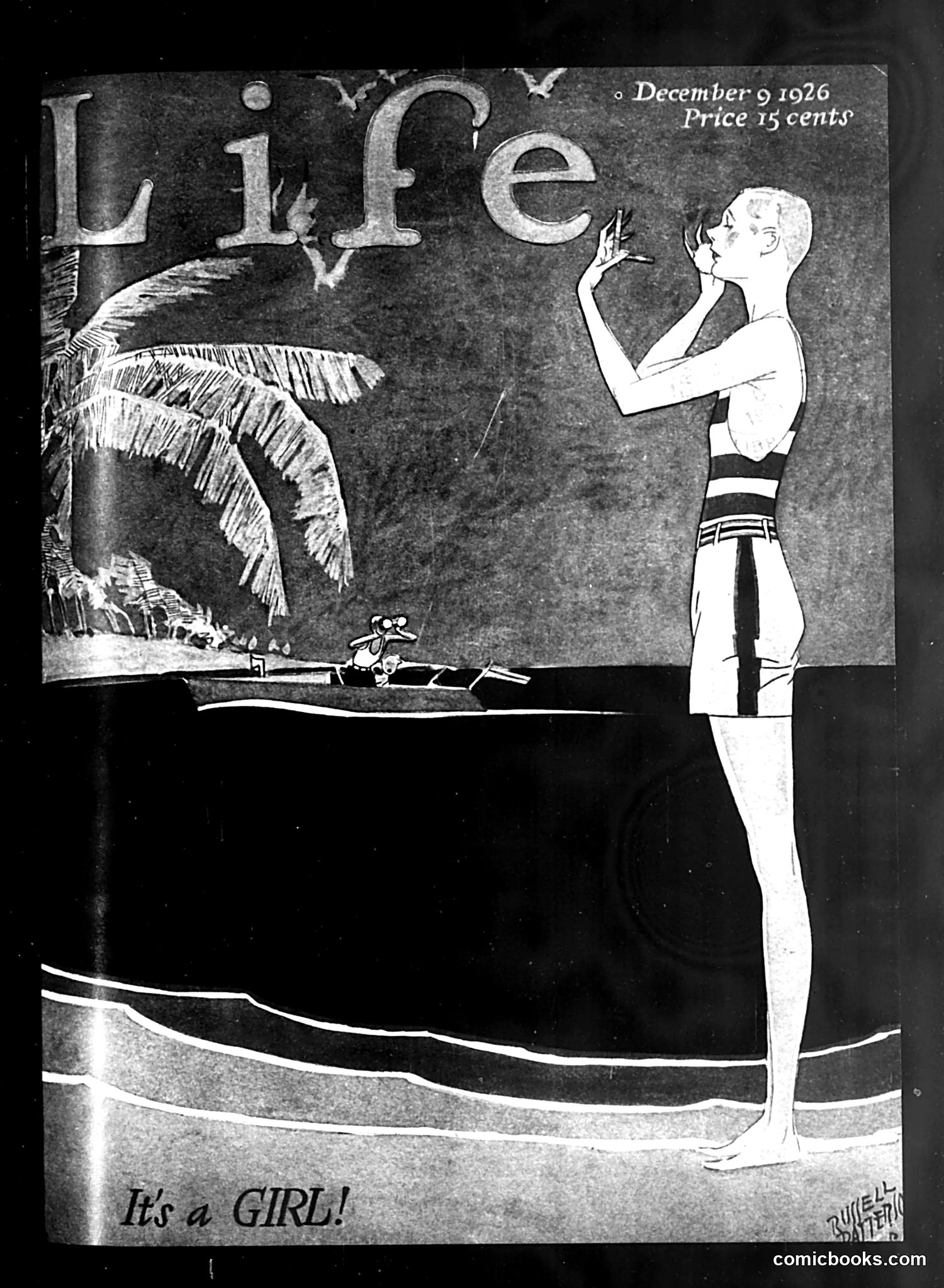
This is a satirical magazine cover featuring a young woman in 1920s attire (short hair, minimal clothing, decorative waistband) admiring herself in a mirror. The caption "It's a GIRL!" suggests commentary on modern femininity and appearance-consciousness. The cover likely satirizes the "flapper" culture of the 1920s—young women embracing shorter skirts, bobbed hair, and more independent lifestyles that shocked conservative society. The woman's self-admiring pose and minimal dress exemplify the era's perceived rejection of Victorian modesty. The exotic feathered element on the left may reference contemporary entertainment (Jazz Age cabaret culture) or primitivism, popular design motifs of the period. Overall, this appears to be gentle satire of modern women's changing social roles and fashion choices during the Roaring Twenties.
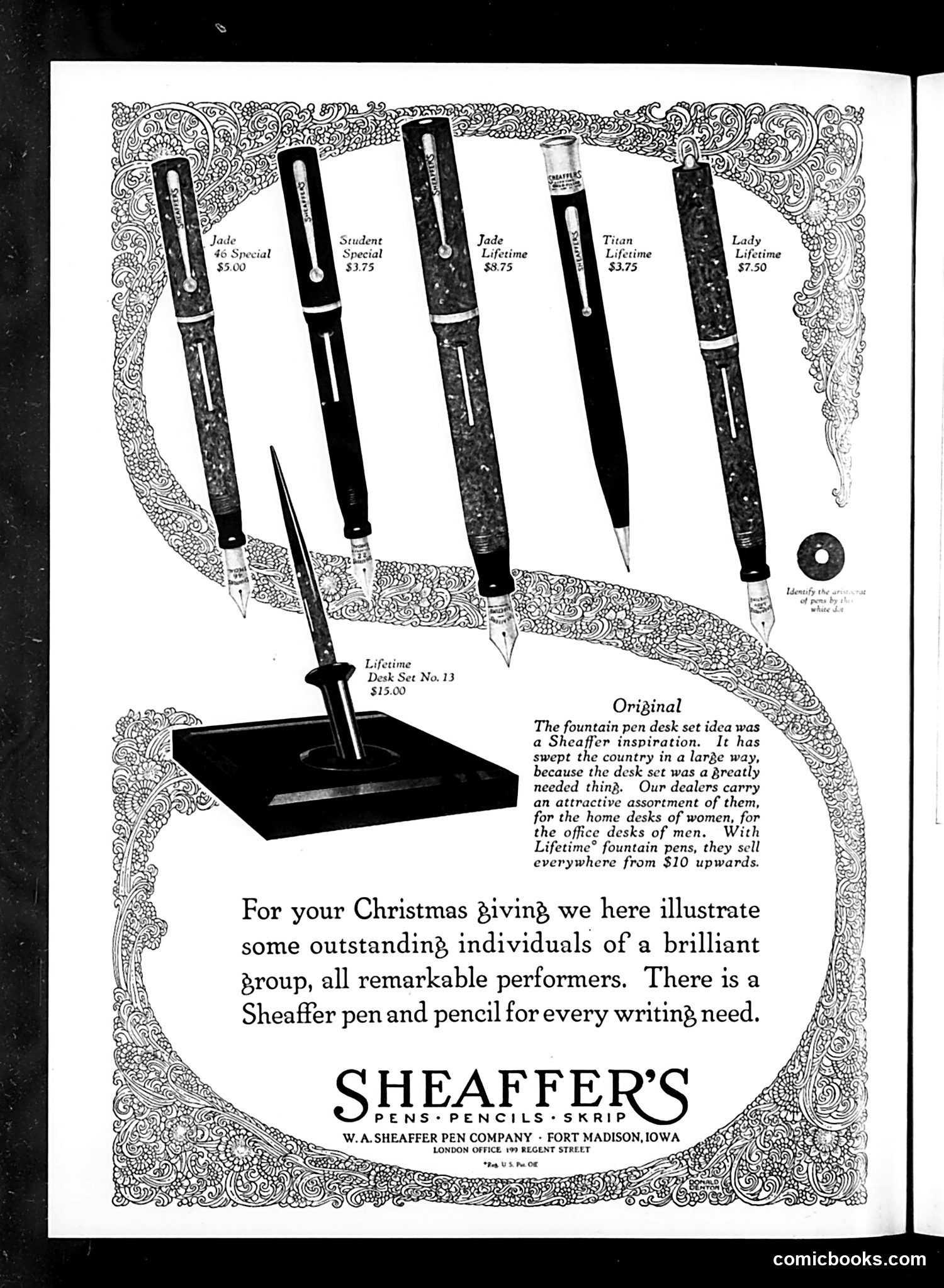
This is **not a cartoon or satire page** — it's a vintage advertisement for Sheaffer's fountain pens and pencils, likely from the 1920s-1930s based on the styling and prices ($3.75-$8.75). The page displays five different Sheaffer pen models (Jade 45 Special, Student Special, Jade Lifetime, Titan Lifetime, Lady Lifetime) and a desk set, arranged around decorative Art Deco borders. The advertising copy frames these writing instruments as ideal Christmas gifts, claiming Sheaffer pens are "remarkable performers" and that "there is a Sheaffer pen and pencil for every writing need." The text emphasizes the fountain pen desk set's popularity with consumers. This is straightforward product advertising with no political or satirical content.
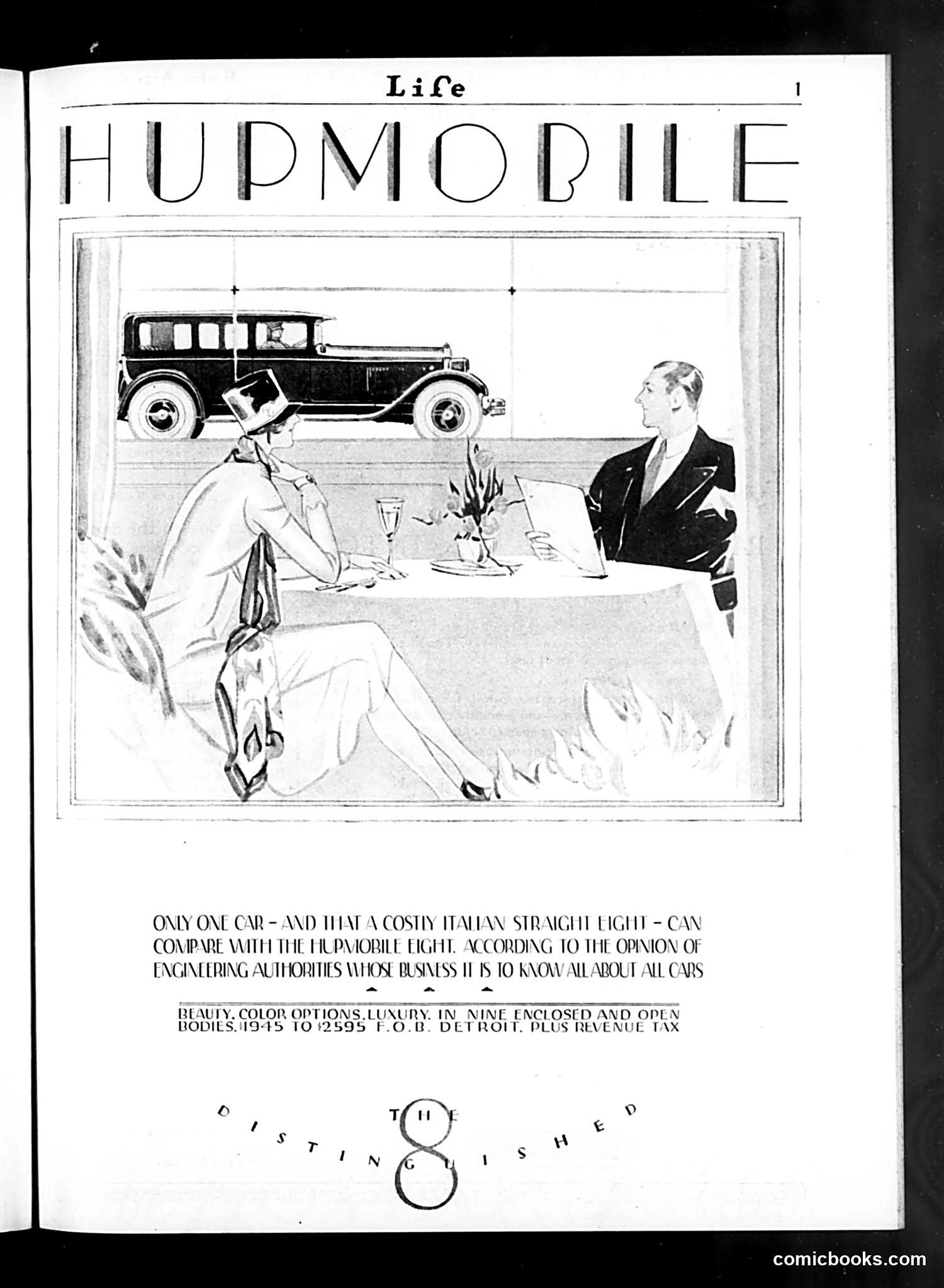
This is primarily a **Hupmobile automobile advertisement**, not political satire. The page depicts two elegantly dressed figures (a woman in a light dress and hat, a man in formal attire) dining outdoors with cocktails, with a Hupmobile automobile visible in the background. The ad's humor is social/aspirational rather than political: it suggests that only one car—"a costly Italian straight eight"—can match the sophistication of the scene depicted. The text emphasizes luxury features (beauty, color options, enclosed and open bodies) and pricing ($1,945-$2,595 F.O.B. Detroit). This reflects 1920s advertising strategy: associating automobiles with wealth, elegance, and refined leisure to appeal to affluent consumers.
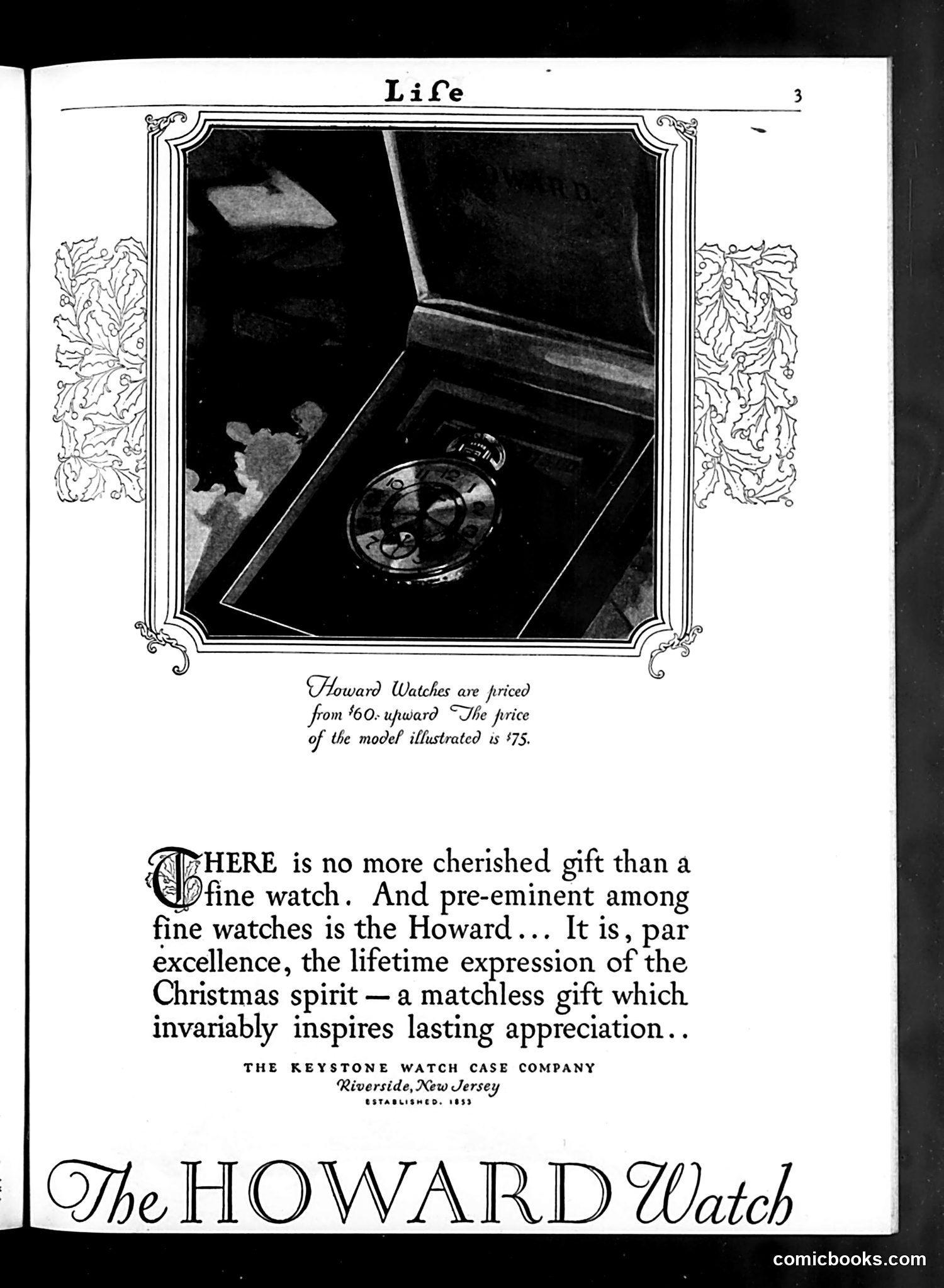
This page is **primarily an advertisement**, not satire or political commentary. The content promotes the Howard Watch, manufactured by The Keystone Watch Case Company in Riverside, New Jersey. The advertisement emphasizes that Howard watches are prestigious gifts, particularly suitable for Christmas, and positions them as expressions of lasting appreciation. The only visual element is a photograph of an ornate watch displayed in an open box—meant to showcase the product's quality and appeal as a luxury item. There is **no cartoon, political reference, or satire** on this page. It represents straightforward early 20th-century advertising copy using emotional language about gift-giving and craftsmanship to market watches to affluent readers of Life magazine.
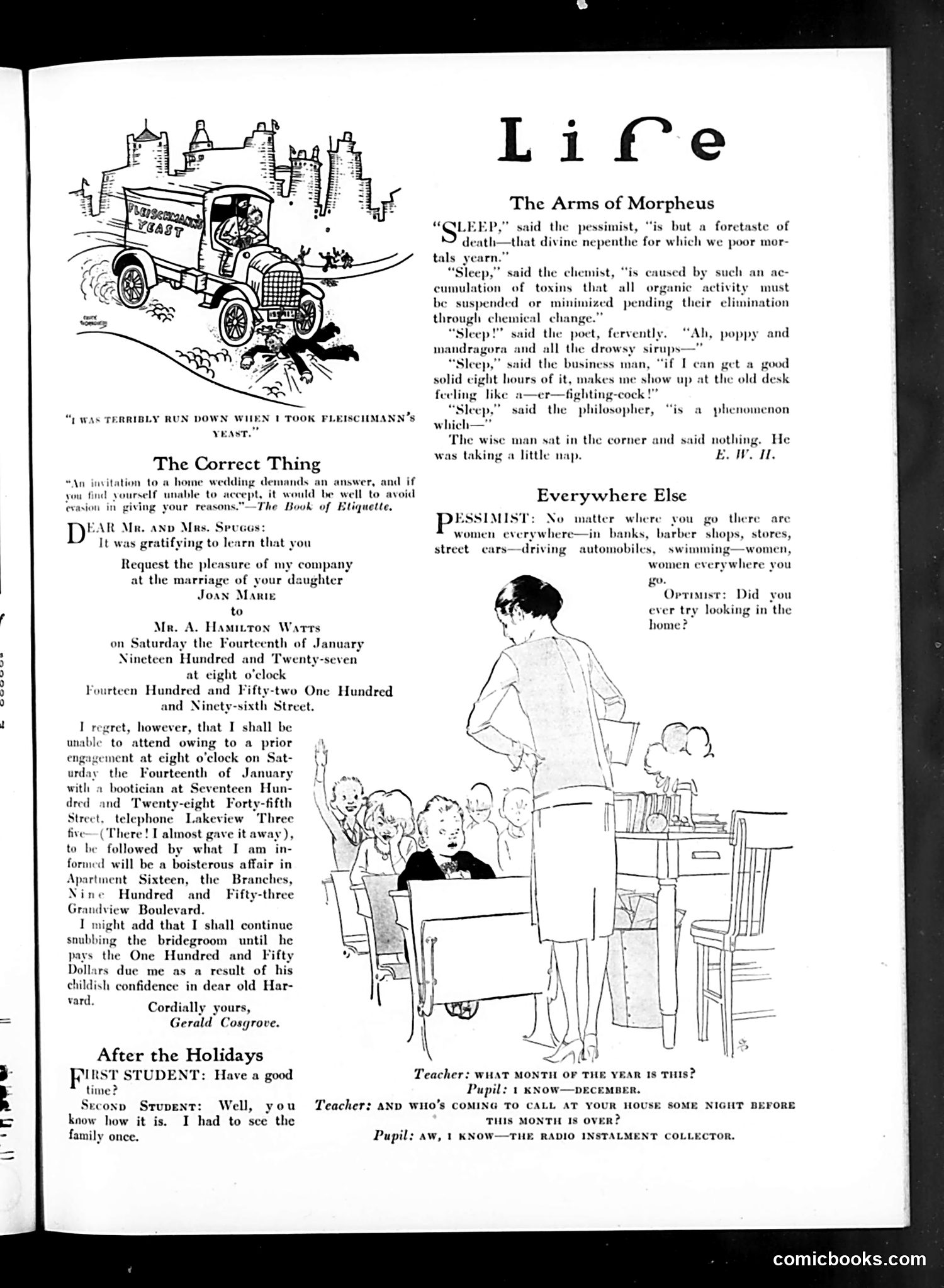
This page contains several satirical sketches and humorous pieces typical of *Life* magazine's social commentary style. **"The Correct Thing"** mocks wedding invitation etiquette through a fictional invitation from Joan Marie to Mr. A. Hamilton Watts, with the narrator unable to attend due to a prior engagement—a joke about the social obligation and formality of wedding invitations. **"Everywhere Else"** contrasts a pessimist and optimist debating whether women are found everywhere or should stay home. The accompanying classroom cartoon satirizes student excuses about homework and radio installment payments—poking fun at modern distractions and consumer credit. **"The Arms of Morpheus"** presents different philosophical perspectives on sleep, ending with a wise man simply napping—mocking pretentious over-analysis of ordinary experiences. The humor targets social conventions, student behavior, and intellectual pretension common to 1920s American life.
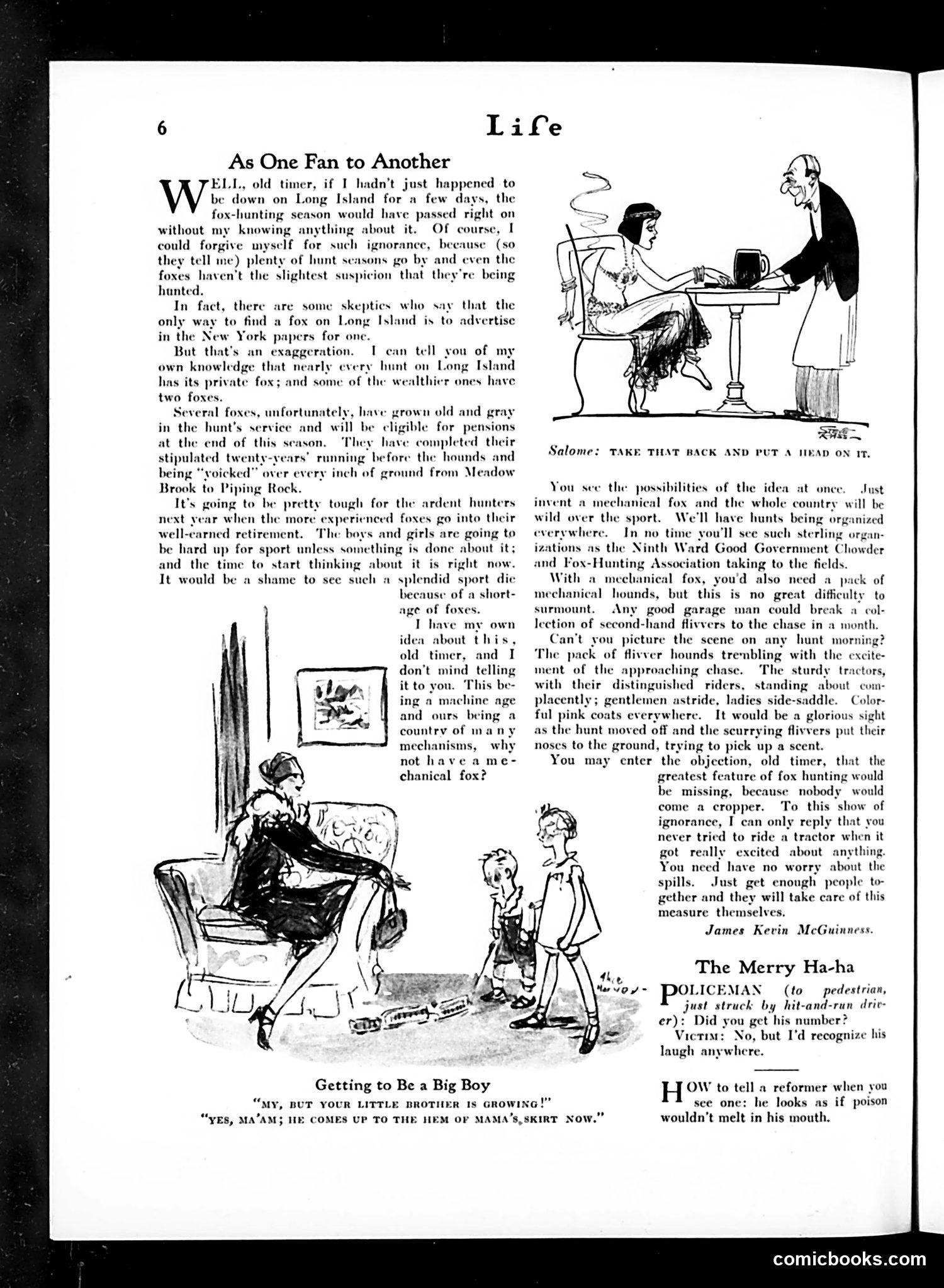
This page contains three separate pieces of humor: 1. **"As One Fan to Another"** (main article): A commentary on fox hunting on Long Island. The author proposes a mechanical fox to replace live foxes, which are aging out of service. The accompanying cartoon shows a woman at a desk with a man in formal dress, likely discussing this satirical invention. 2. **"Getting to Be a Big Boy"** (bottom cartoon): A domestic humor piece where a mother comments that her young son is growing up, now reaching her skirt hem—a simple observation about childhood growth. 3. **"The Merry Ha-ha"** (right column): A brief joke about a policeman unable to identify a hit-and-run driver by appearance alone, played for gentle humor. The page reflects early 20th-century upper-class leisure activities and family life.
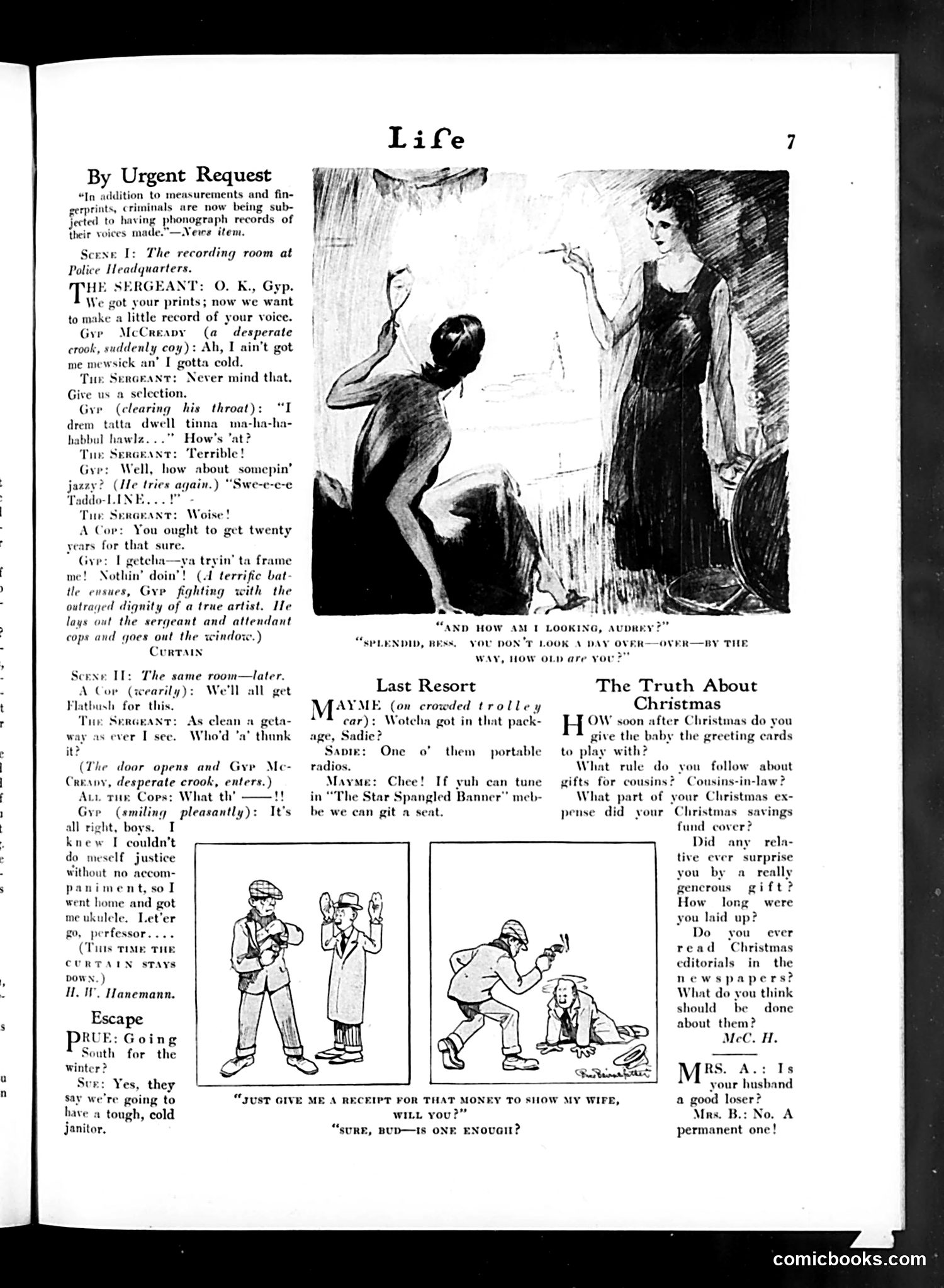
This page contains three satirical sketches with comedic dialogue: **"By Urgent Request"** depicts a recording session where a sergeant requests a soldier sing for a phonograph record. The soldier's terrible vocal performance (described as "Terrible!" and "Worse!") is the joke—he's hilariously bad, yet persists in trying. **"Last Resort"** shows a couple (Mayme and Sadie) discussing portable radios and tuning into "The Star-Spangled Banner." **"Escape"** features a domestic scene where a man uses a fabricated story about a tough, cold winter and needing a janitor as an excuse to leave home—poking fun at marital escape tactics. **"The Truth About Christmas"** is an advice column addressing holiday gift-giving and family spending customs. The overall tone is light domestic humor typical of 1920s American satire.
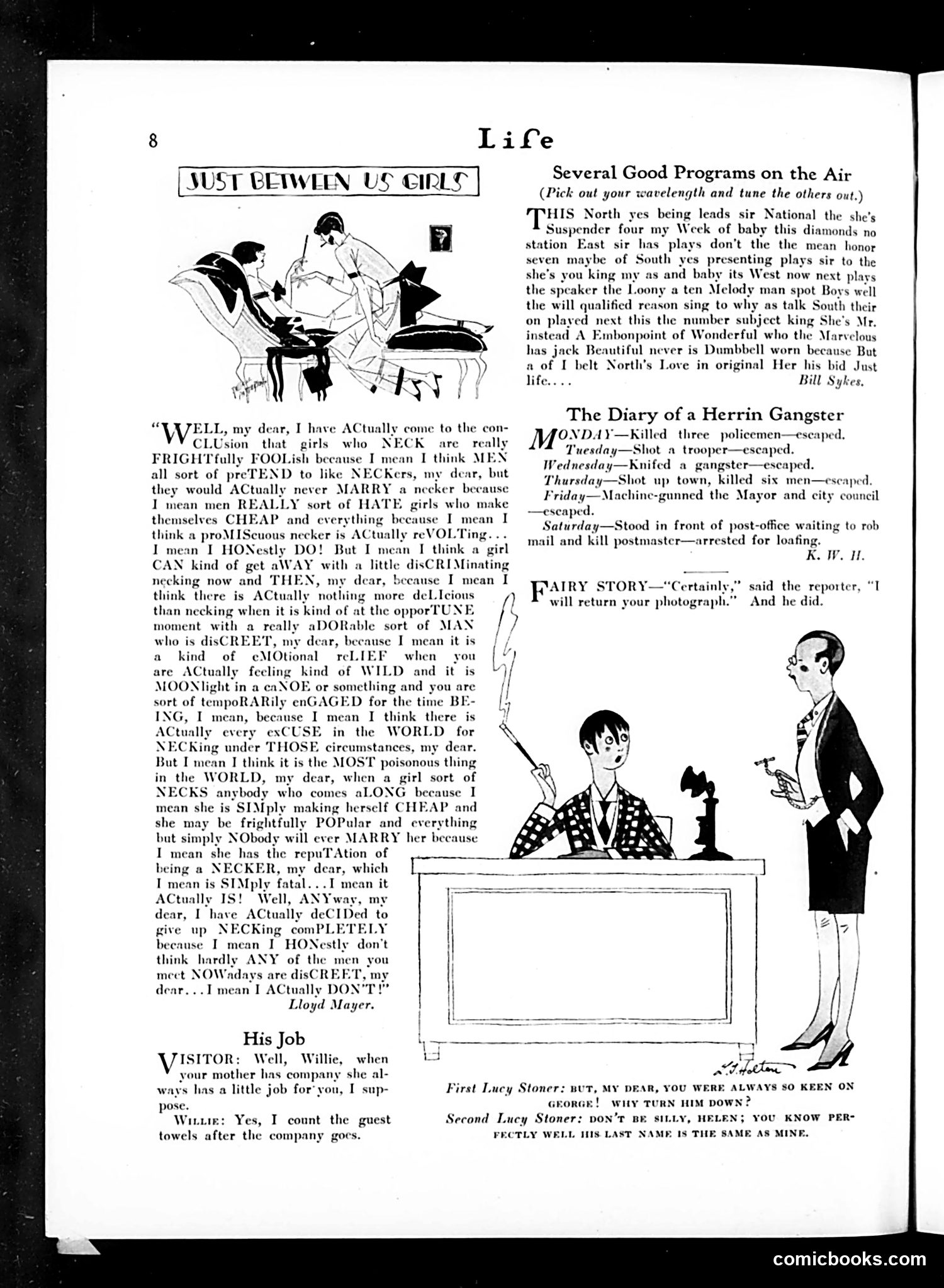
This page contains three separate satirical pieces: 1. **"Just Between Us Girls"** (top): A column attacking men who wear necks/neckties. The author (Lloyd Mayer) uses exaggerated capitalization to mock men as "discreet," "emotional," and "poisonous"—sarcastically praising their flaws while claiming women shouldn't marry them. 2. **"The Diary of a Herring Gangster"** (middle): A humorous crime log listing daily criminal activities (killing police, shooting townspeople). The absurdist humor mocks sensational crime reporting popular in the era. 3. **"His Job"** and **"Fairy Story"** (bottom): Two short joke pieces—one about counting guest towels, another a visual gag about Lucy Stoner (a feminist reference) and her husband George. The page exemplifies 1920s-30s Life magazine's style: satirizing social conventions, gender relations, and contemporary fads through exaggeration and wordplay.
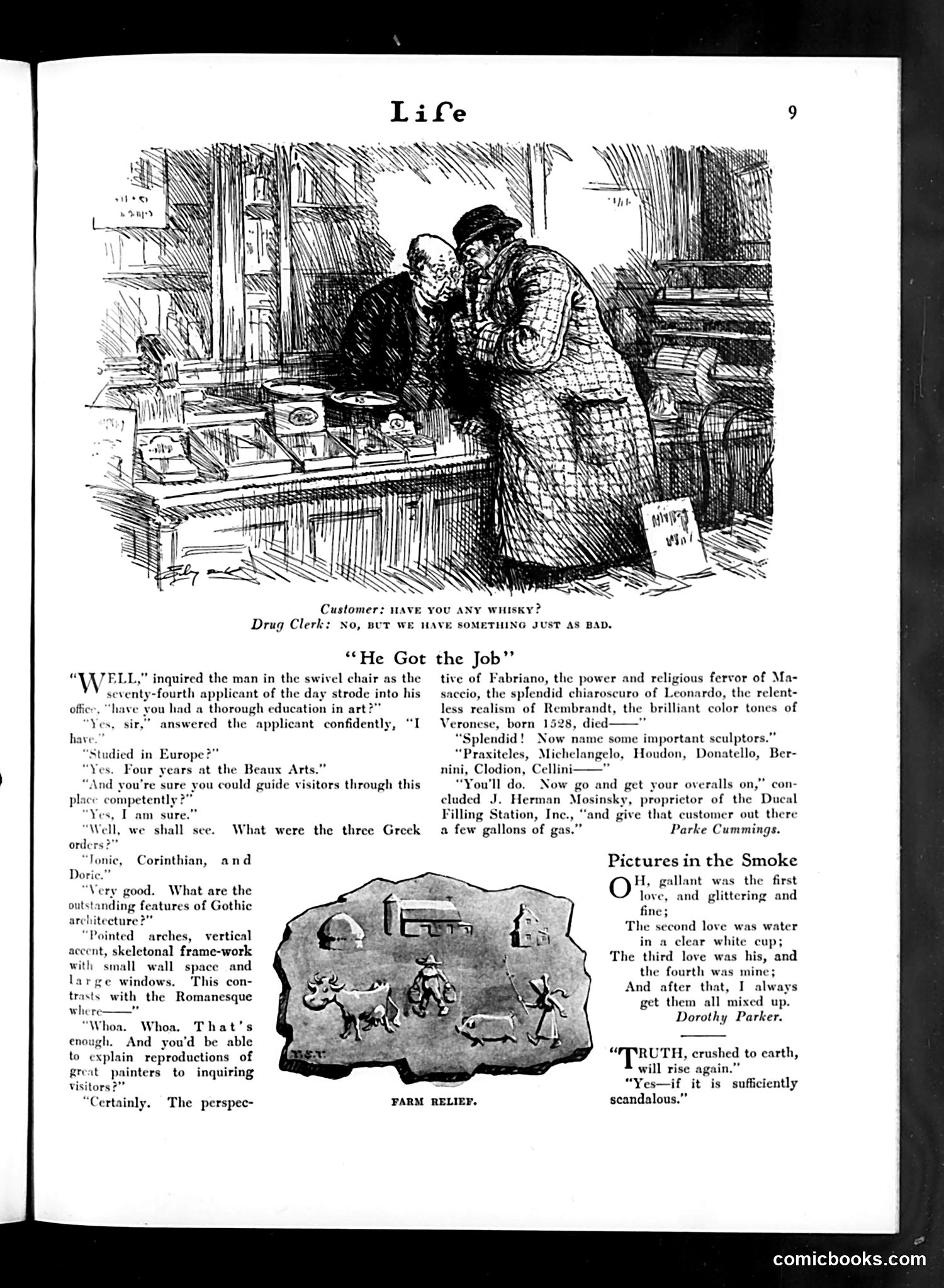
**Top Cartoon: "He Got the Job"** This depicts a drug store clerk interaction satirizing job interviews and credentials. A customer asks if the store has whisky; the clerk replies they have "something just as bad." The accompanying dialogue mocks applicants who claim extensive education (studying in Europe, knowledge of art history and Greek orders, Gothic architecture) yet are vastly overqualified—or their credentials worthless—for menial work. The humor targets the employment mismatch of the era: educated men forced into low-wage jobs, and employers' indifference to qualifications when filling service positions. **Bottom Image: "Farm Relief"** A separate illustration showing rural/farming scenes, paired with Dorothy Parker's poetic quote about love and water. This likely references agricultural economic struggles of the period.
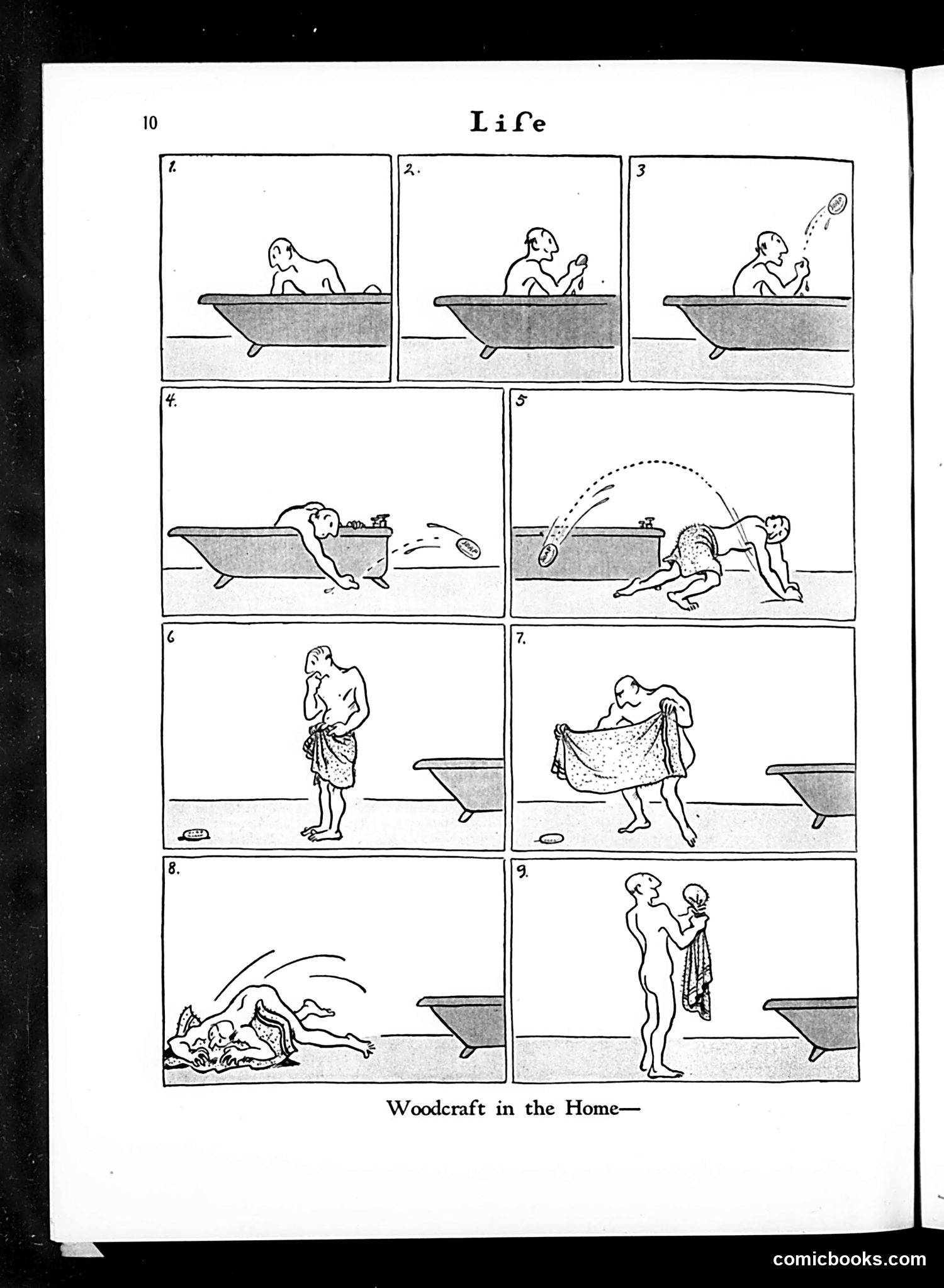
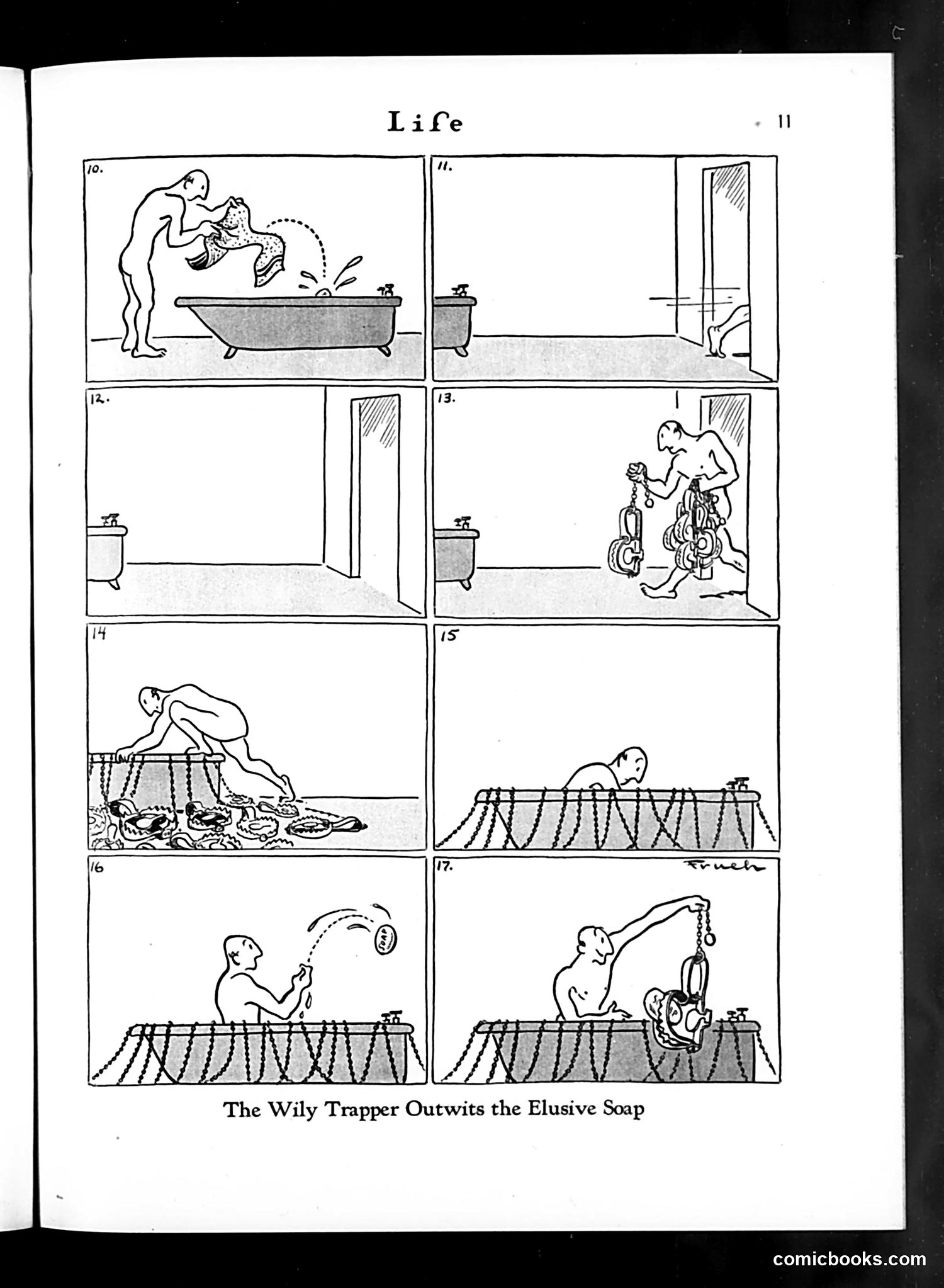
This nine-panel comic satirizes bathing a young child. The sequence shows a parent attempting to bathe a reluctant toddler in a bathtub, depicting the child's escalating resistance—splashing water (panel 3), leaping from the tub (panel 5), and generally creating chaos and mess (panel 8). The final panels show the exhausted parent wrapping the wet child in towels. The satire targets the common domestic struggle of bathing uncooperative children—a relatable challenge for early 20th-century parents. "Woodcraft in the Home" ironically invokes outdoor survival skills, suggesting that managing a defiant toddler requires the cunning and resilience of wilderness survival. The humor derives from the exaggerated chaos and the parent's evident frustration throughout the ordeal.
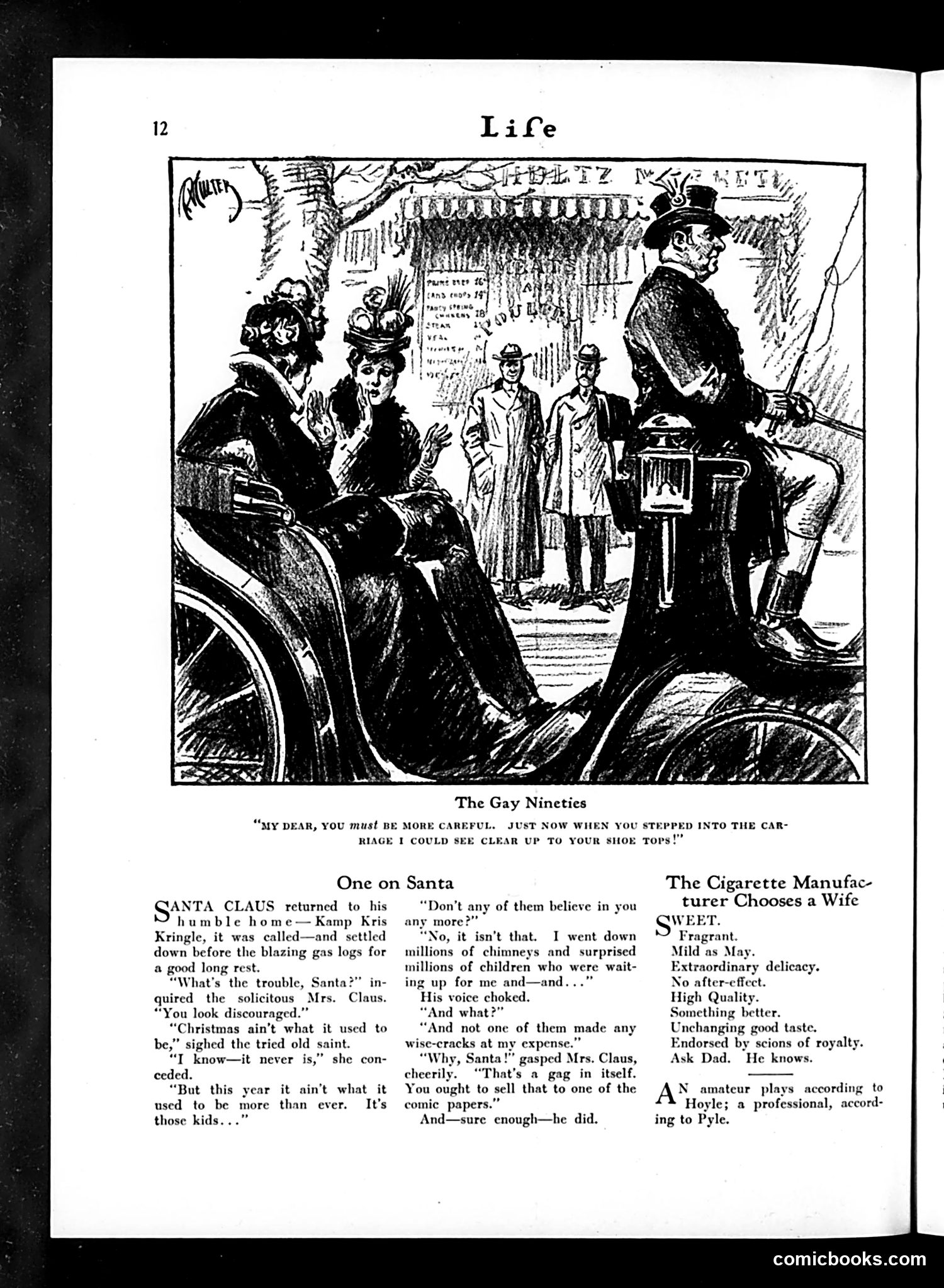
This page contains two separate pieces of early 20th-century satire: **"The Gay Nineties" cartoon** depicts a wealthy couple in a carriage being cautioned about their footwear visibility—social commentary on class vanity and propriety during the 1890s. **"One on Santa"** is a brief story where Santa Claus expresses disappointment that children no longer believe in him, blaming this disbelief on comic papers that have made "wise-cracks" at his expense. It's satirical commentary on how popular media and cynicism erode childhood wonder and tradition. **"The Cigarette Manufacturer Chooses a Wife"** advertises a cigarette brand using humorous character descriptions, exemplifying period advertising that directly targeted readers with product endorsements framed as lifestyle advice.
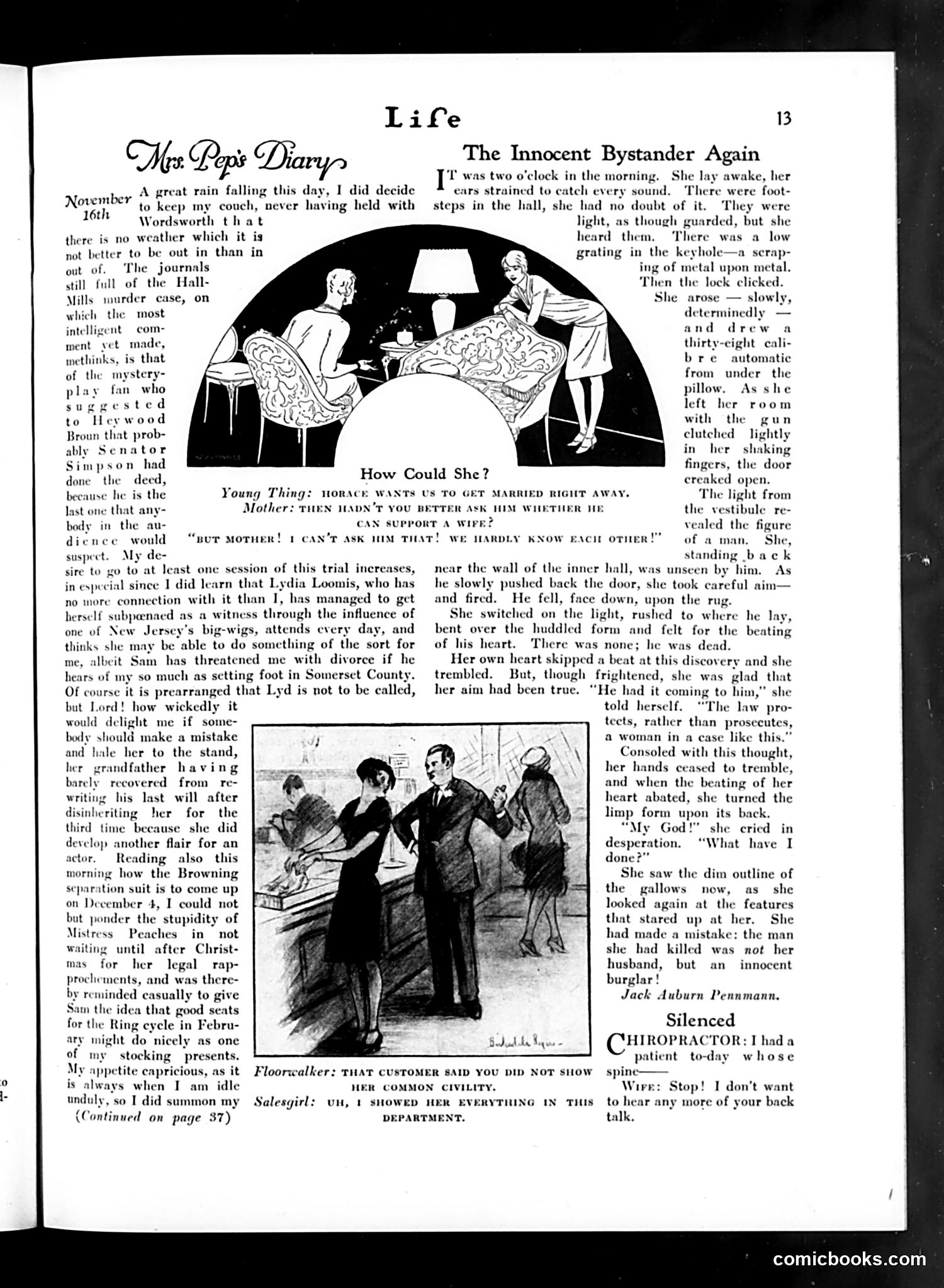
This page contains three distinct pieces of satirical content: 1. **"Mrs. Pep's Diary"** (left): A society column entry dated November 16th mocking the absurdity of a high-profile murder trial—likely the Hall-Mills case, a sensational 1920s New Jersey scandal. The diarist jokes about attending court sessions as social entertainment, suggesting wealthy people treated serious criminal proceedings as theatrical spectacle. 2. **"How Could She?" (top illustration)**: A domestic scene satirizing gender dynamics, where a young man asks his mother to help him marry without knowing his fiancée, prompting indignant responses about women's limited agency in marriage decisions. 3. **"Floorwalker/Silenced" (bottom)**: Brief comedic sketches about retail customer service and a husband silencing his wife's complaints about a chiropractor—gentle domestic humor typical of the era's gender-based jokes.
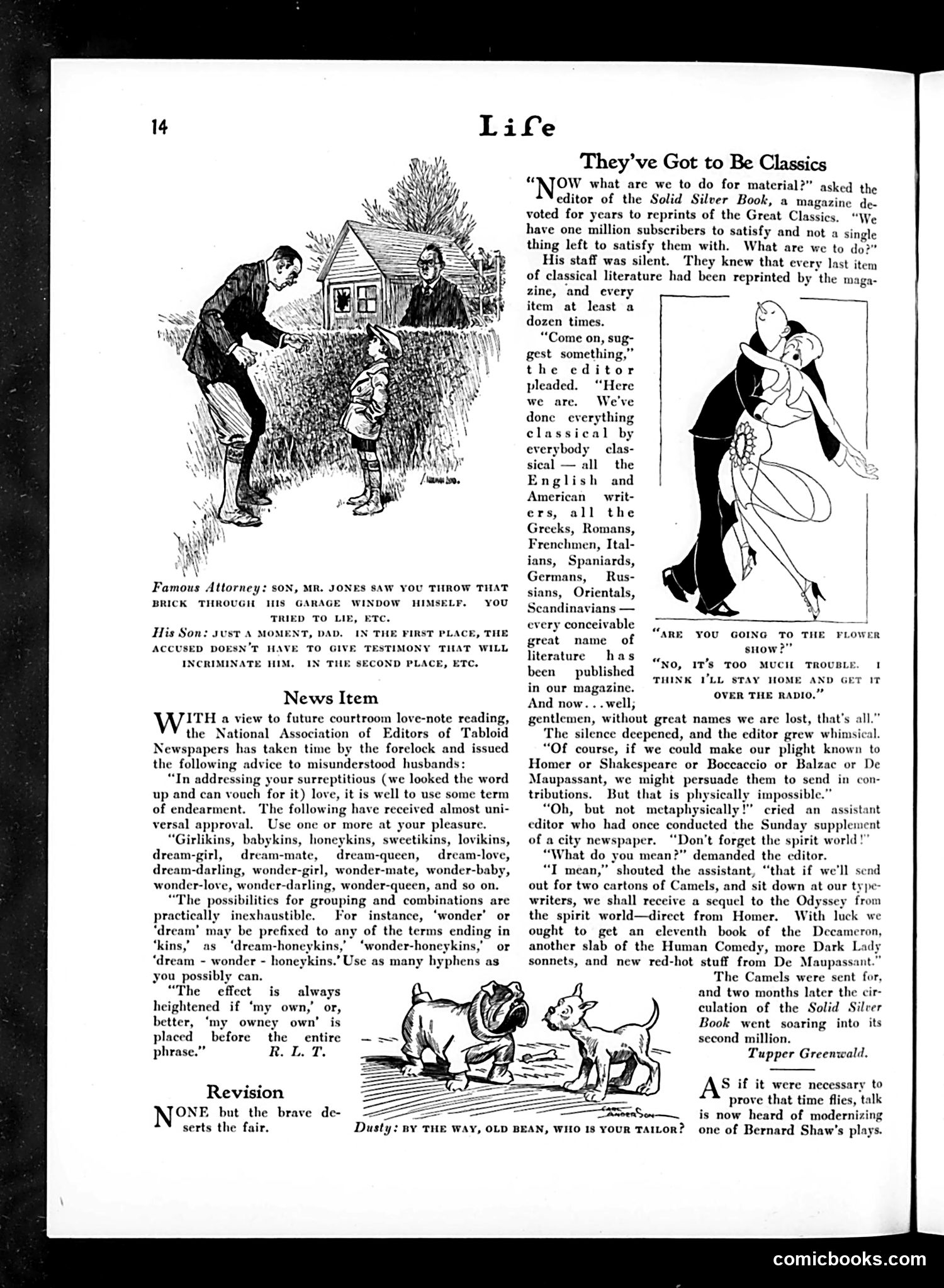
This page satirizes the *Solid Silver Book*, a magazine that reprints classical literature to satisfy one million subscribers. The editor faces a crisis: they've exhausted all famous classical works—every English, American, Greek, Roman, French, Italian, Spanish, German, Russian, Oriental, and Scandinavian classic has been republished multiple times. The cartoon jokes depict the desperation that follows. One shows a father attempting to pass off his son's lie as classical testimony. Another illustrates a couple discussing attendance at a flower show, with the man joking he'll "stay home and get it over the radio"—mocking the magazine's absurd solution of recycling content. The satire targets both the magazine's creative exhaustion and early-20th-century mass-market publishing's hunger for safe, canonical material.
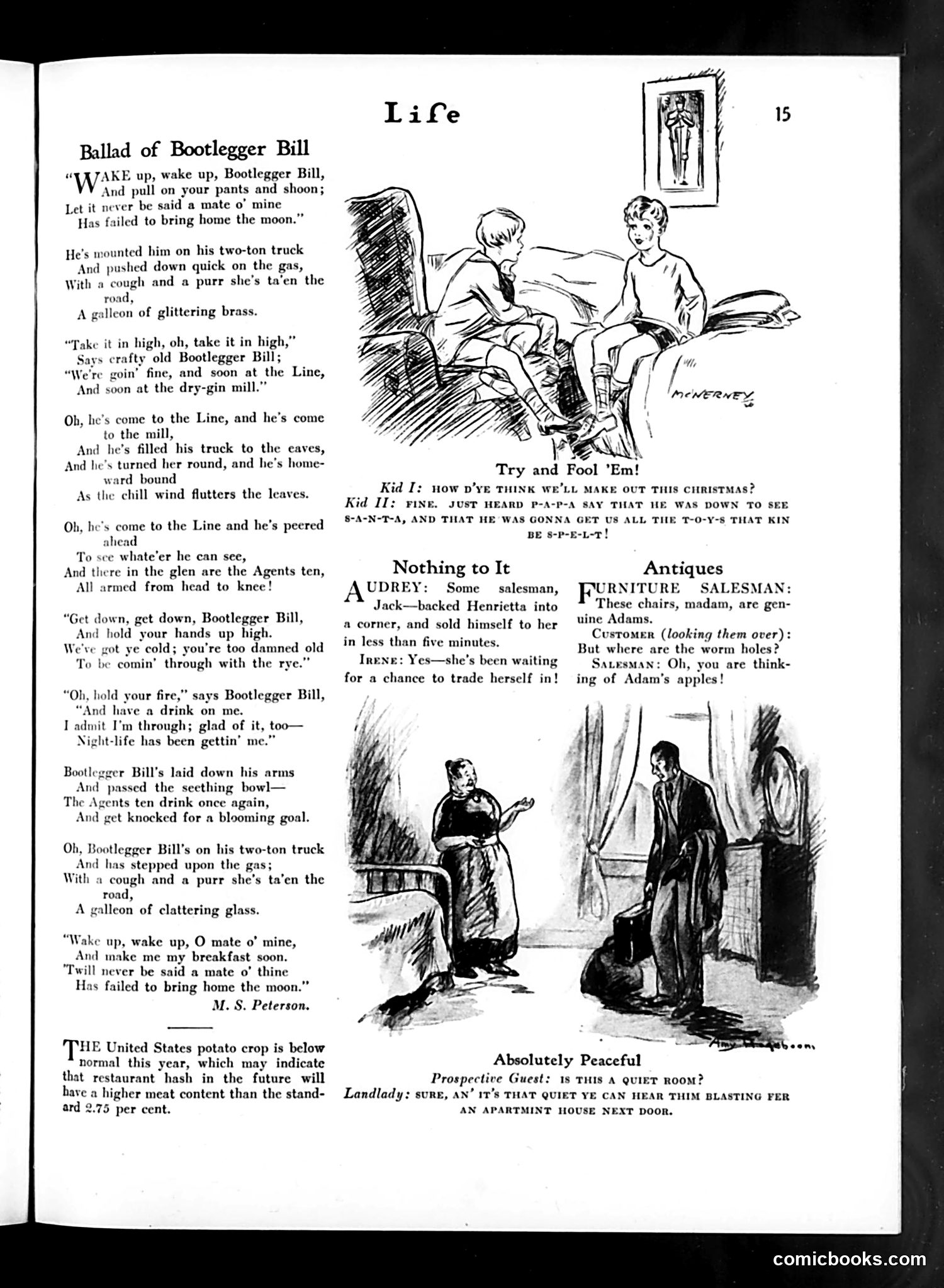
This page contains three separate humorous pieces: 1. **"Ballad of Bootlegger Bill"**: A satirical poem mocking Prohibition-era bootleggers. The narrative follows a character who attempts increasingly dangerous stunts (driving recklessly, delivering contraband) to prove his worth, ultimately failing comically. The repeated refrain about "failing to bring home the moon" suggests absurd, impossible boasts. 2. **"Try and Fool 'Em!"**: A cartoon showing two children discussing Christmas, with one spelling out that their father is "down to see S-A-N-T-A" to avoid spoiling the surprise—satirizing parental attempts to maintain childhood innocence. 3. **"Nothing to It," "Antiques," and "Absolutely Peaceful"**: Short comedic sketches about salesmanship, furniture fraud, and noisy apartment living. The page satirizes American consumer culture and social pretensions of the era.
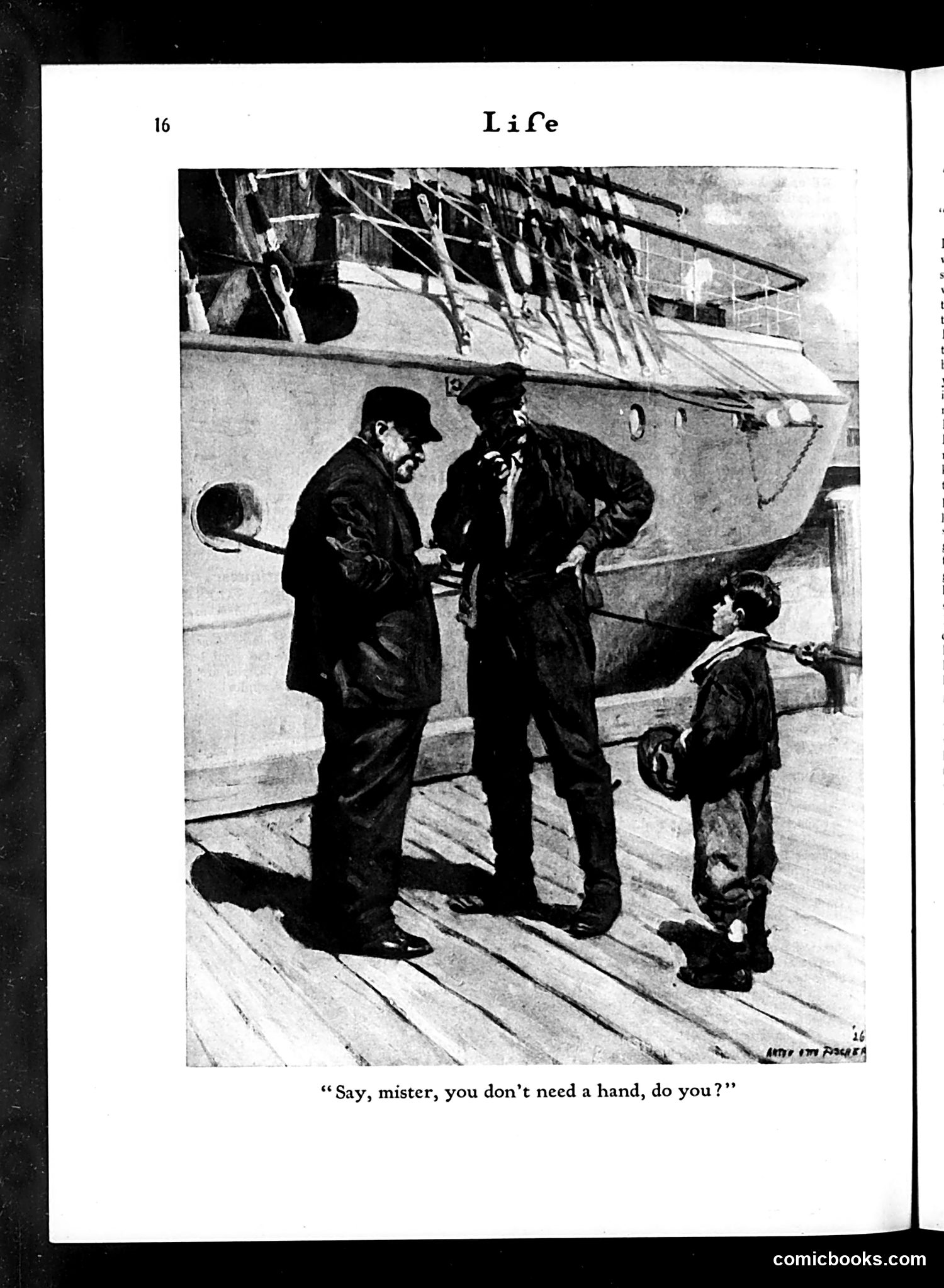
This is a humorous photograph from *Life* magazine showing three men on a ship's deck. The caption reads: "Say, mister, you don't need a hand, do you?" The joke appears to be a dark play on words: one of the men shown is apparently missing an arm or hand. The child asking the question is innocently offering assistance, not realizing the man literally doesn't have a hand to need. This is a classic early-20th-century style of humor that used physical disability or misfortune as the basis for puns or double-meaning jokes. The satirical point seems to be social commentary on public attitudes toward disabled individuals—treating disability as fodder for casual humor rather than with dignity. The setting (a ship) suggests this may reference maritime work or immigration themes common in *Life* magazine during this era.
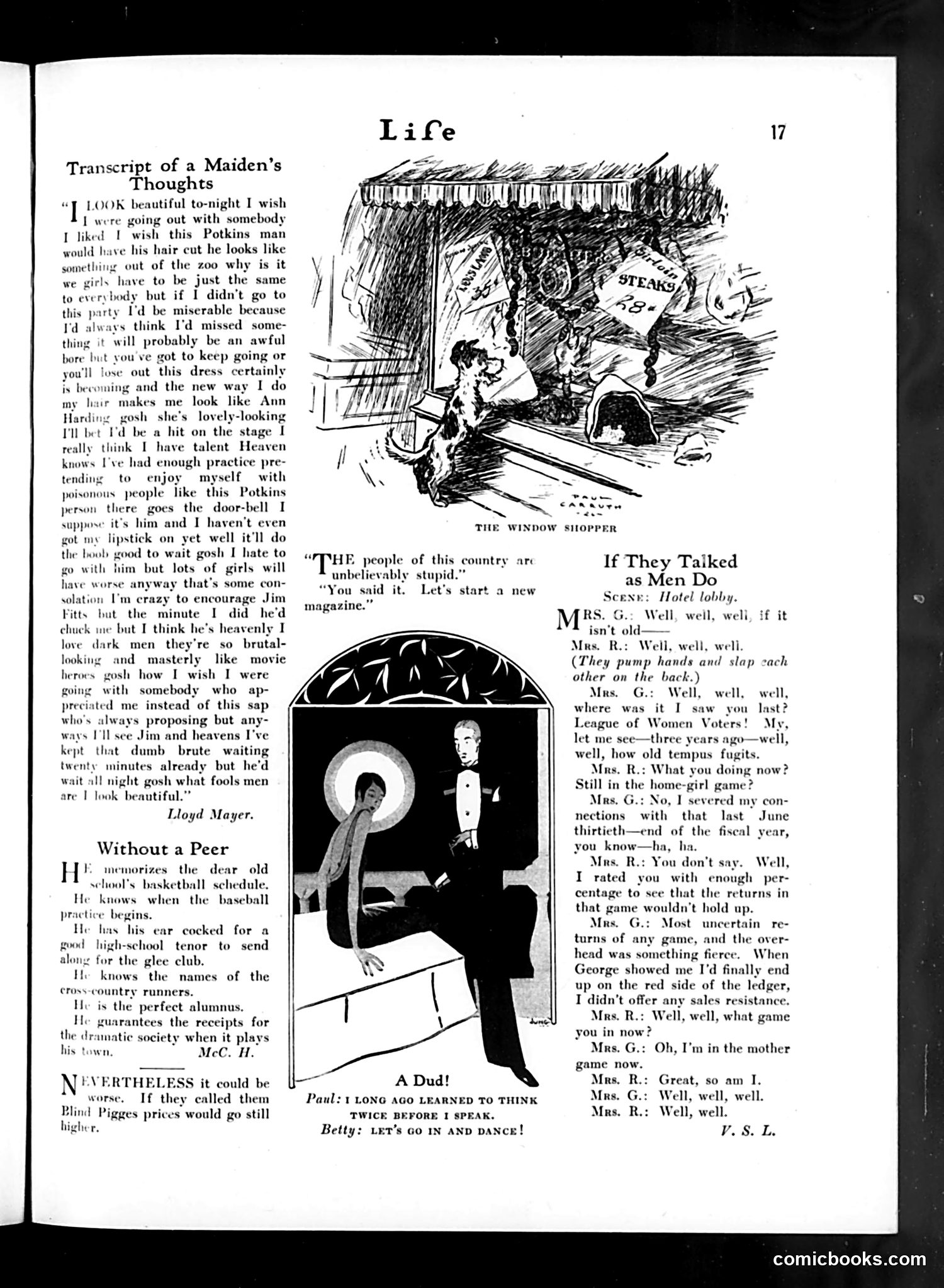
This page contains several humor pieces typical of 1920s Life magazine satire: **"The Window Shopper"** cartoon depicts a woman gazing at a restaurant window displaying steaks, suggesting commentary on economic disparity or rationing during this era. **"Without a Peer"** humorously lists contradictions about a school basketball player—he's simultaneously perfect in multiple ways, satirizing the impossible idealization of student athletes. **"A Dud!"** shows a man and woman with dialogue about dancing, poking fun at dating customs and romantic expectations. The **"If They Talked as Men Do"** dialogue mocks women's conversation, presenting exaggerated small-talk between acquaintances—a common sexist trope of the period stereotyping women as superficial gossips. Overall, this represents typical early-20th-century magazine humor mixing social observation with period stereotypes about gender and class.
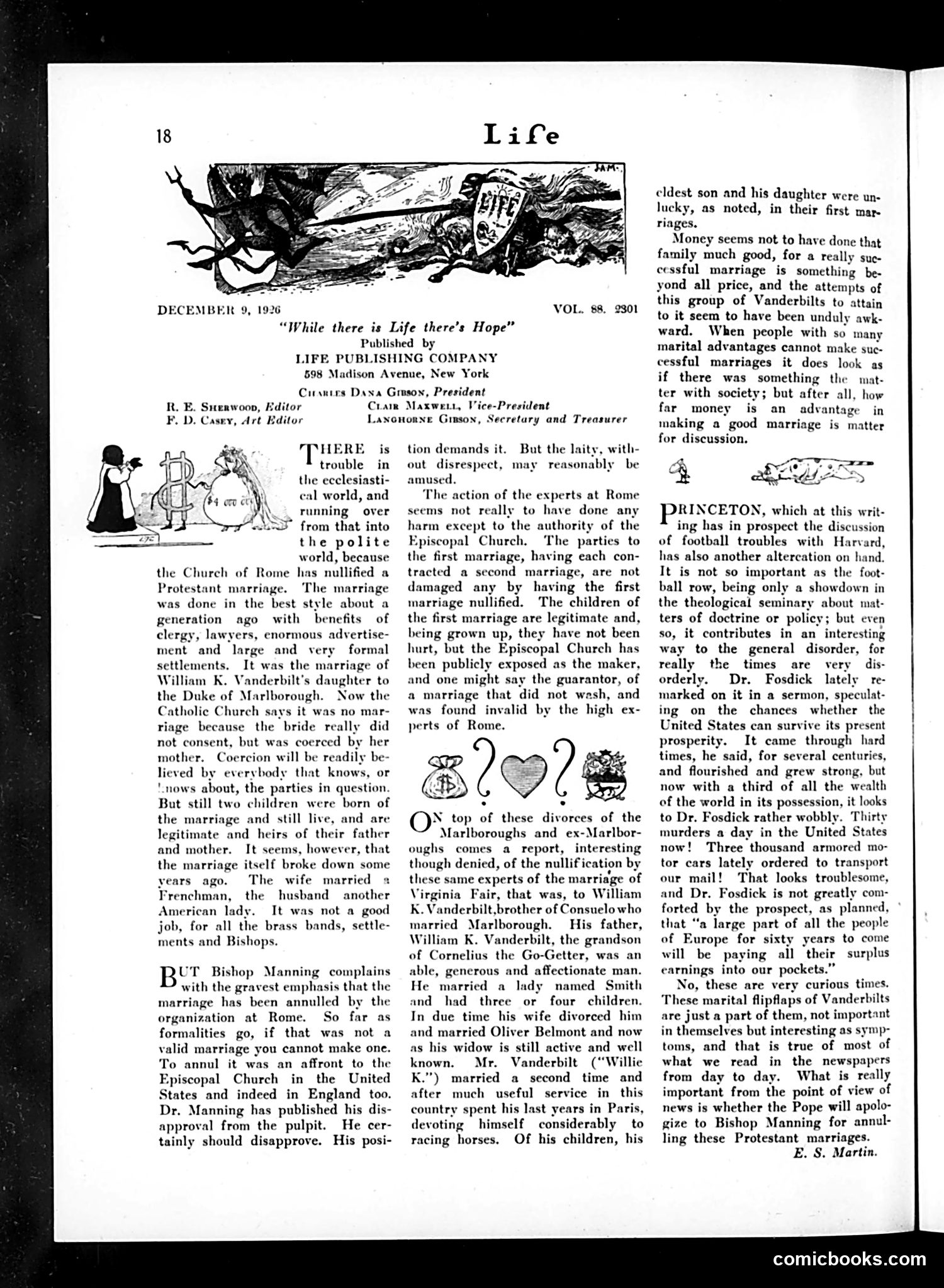
This article satirizes the Catholic Church's annulment of William K. Vanderbilt's daughter's marriage to the Duke of Marlborough—a high-society 1920s scandal. The Church claimed the bride didn't consent, coerced by her mother, despite the couple having two legitimate children and a lavish wedding decades prior. The satire targets multiple targets: the Church's authority (embarrassing the Episcopal Church by invalidating what it blessed), the Vanderbilt family's repeated marital failures despite their wealth and "advantages," and broader high-society hypocrisy. The author suggests that if the ultra-wealthy cannot maintain successful marriages despite every resource, the problem lies with society itself, not individuals. The cartoon (small illustrations visible) appears to support this mockery through visual commentary on marriage and social pretension.
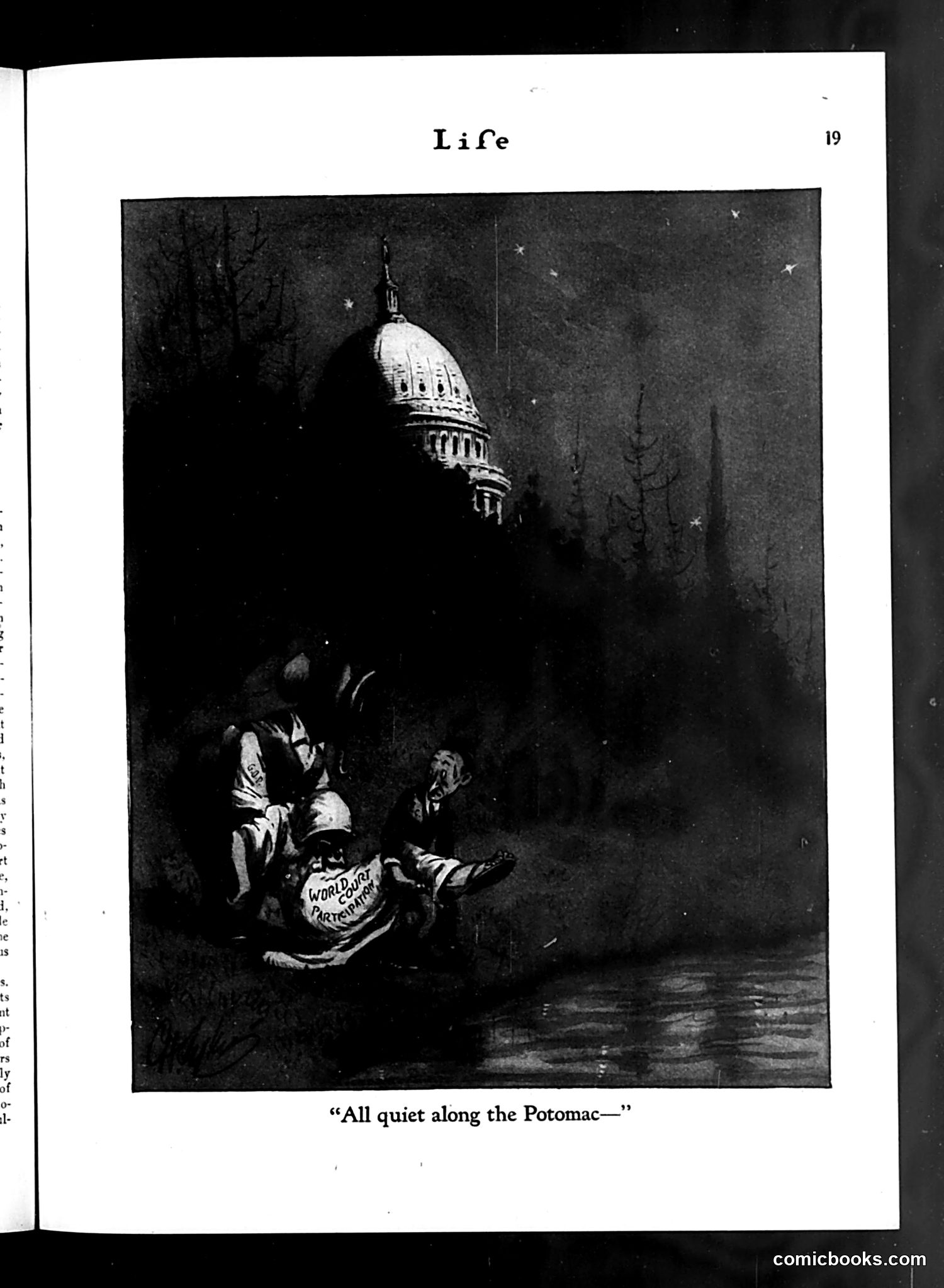
This is a satirical cartoon from *Life* magazine showing the U.S. Capitol building illuminated at night, while a figure labeled "World War Profiteer" sits contentedly by the Potomac River. The caption "All quiet along the Potomac—" references a Civil War-era phrase suggesting peaceful conditions. The satire contrasts the Capitol's symbolic representation of American government with the war profiteer's comfort, suggesting that while official Washington appears calm and orderly, wealthy industrialists are enriching themselves during wartime. This likely critiques American business interests profiting from World War I while soldiers suffered. The dark, ominous tone and nocturnal setting emphasize the hidden, shadowy nature of such profiteering beneath a veneer of normalcy.
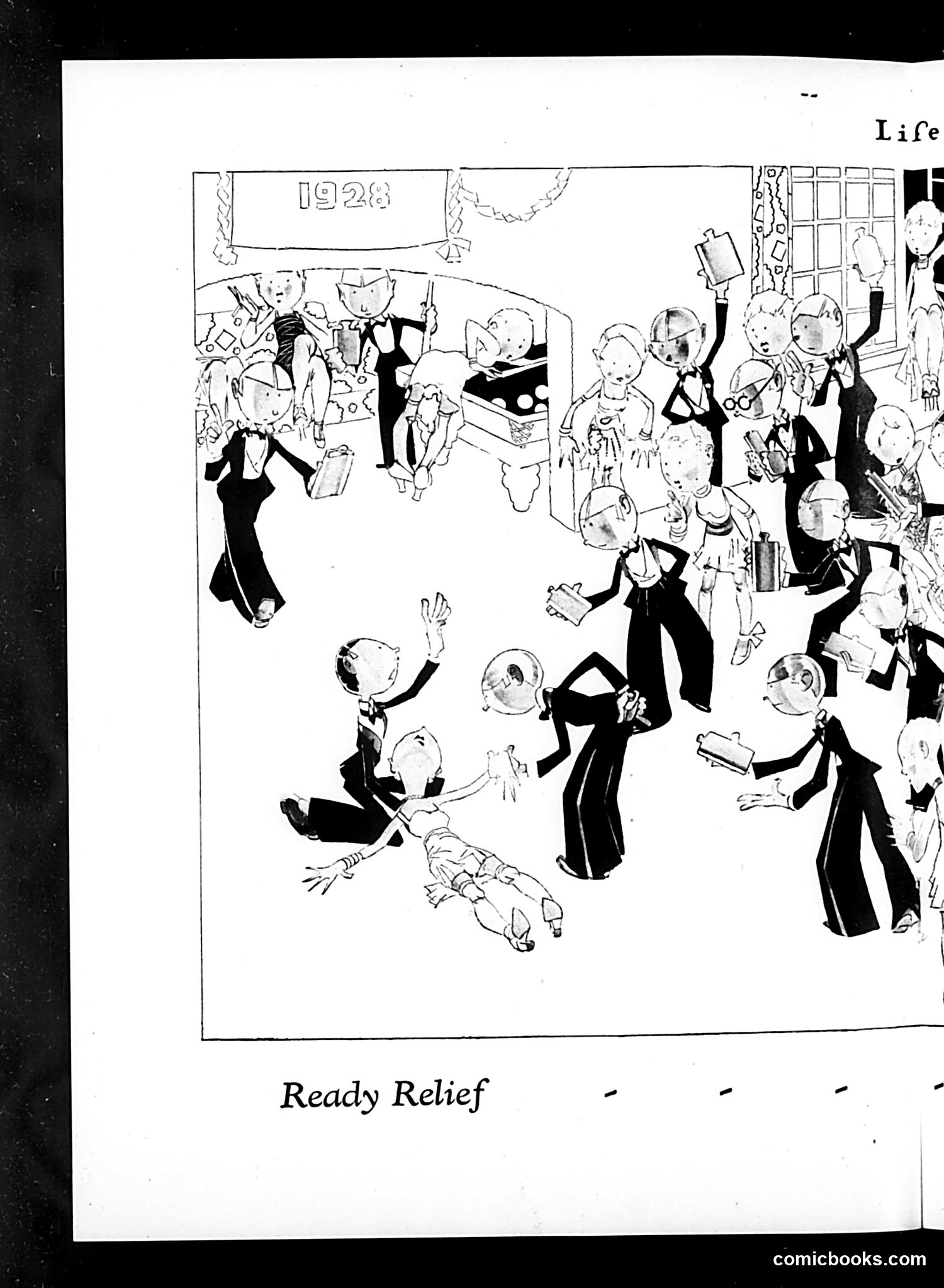
This cartoon, titled "Ready Relief," depicts a 1928 New Year's celebration scene. The illustration shows formally dressed figures (wearing tuxedos) engaged in festive chaos—dancing, celebrating, and appearing to welcome the new year with abandon. The "1928" date visible at top confirms the timing. The satire likely comments on post-Prohibition attitudes or the contrast between formal propriety and uninhibited celebration. The crowded, exuberant scene with well-dressed revelers suggests commentary on how the wealthy or elite celebrated, possibly mocking their excessive behavior or hypocrisy regarding social norms during this era. Without additional context about Life magazine's specific editorial position in early 1928, the precise satirical target remains somewhat unclear, though the visual emphasis on chaotic revelry among the formally dressed suggests critique of elite behavior or celebration customs.
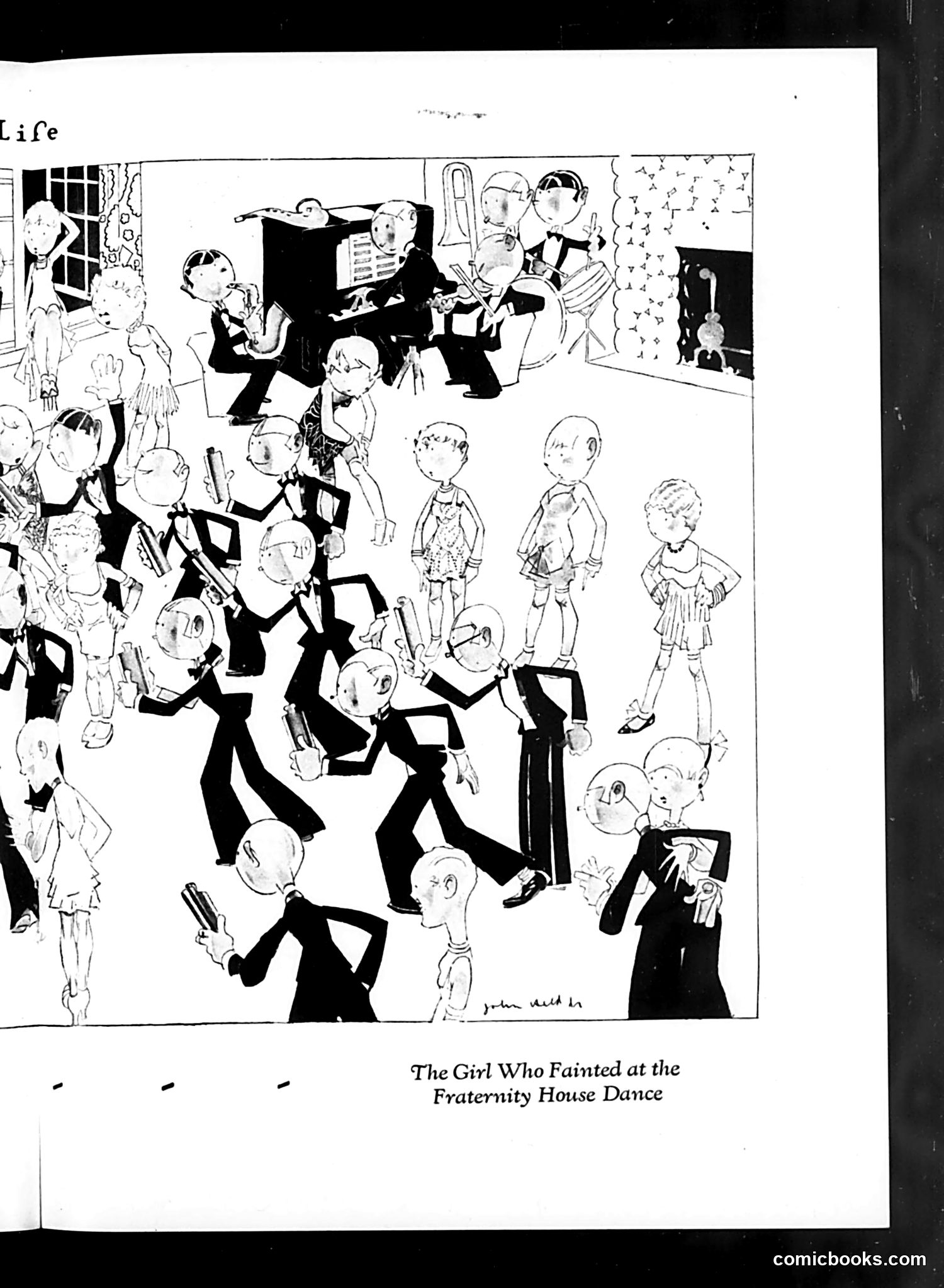
This illustration satirizes social pretension at college fraternity events. The scene depicts a lively dance with formally dressed men in tuxedos and women in various states of dress. Three casually-dressed girls stand apart on the right, appearing as outsiders or less sophisticated guests—likely contrasting with the formally attired attendees. The humor appears to mock the artificiality and social hierarchy of fraternity culture: the spectacle and overcrowding of the dance, the formality expected, and the implicit social stratification between different groups of attendees. The title's reference to a girl who "fainted" suggests the event's overwhelming or exhausting nature—though the fainting girl isn't clearly identified in the visible scene. This represents typical *Life* magazine satire of American college social conventions and class consciousness.
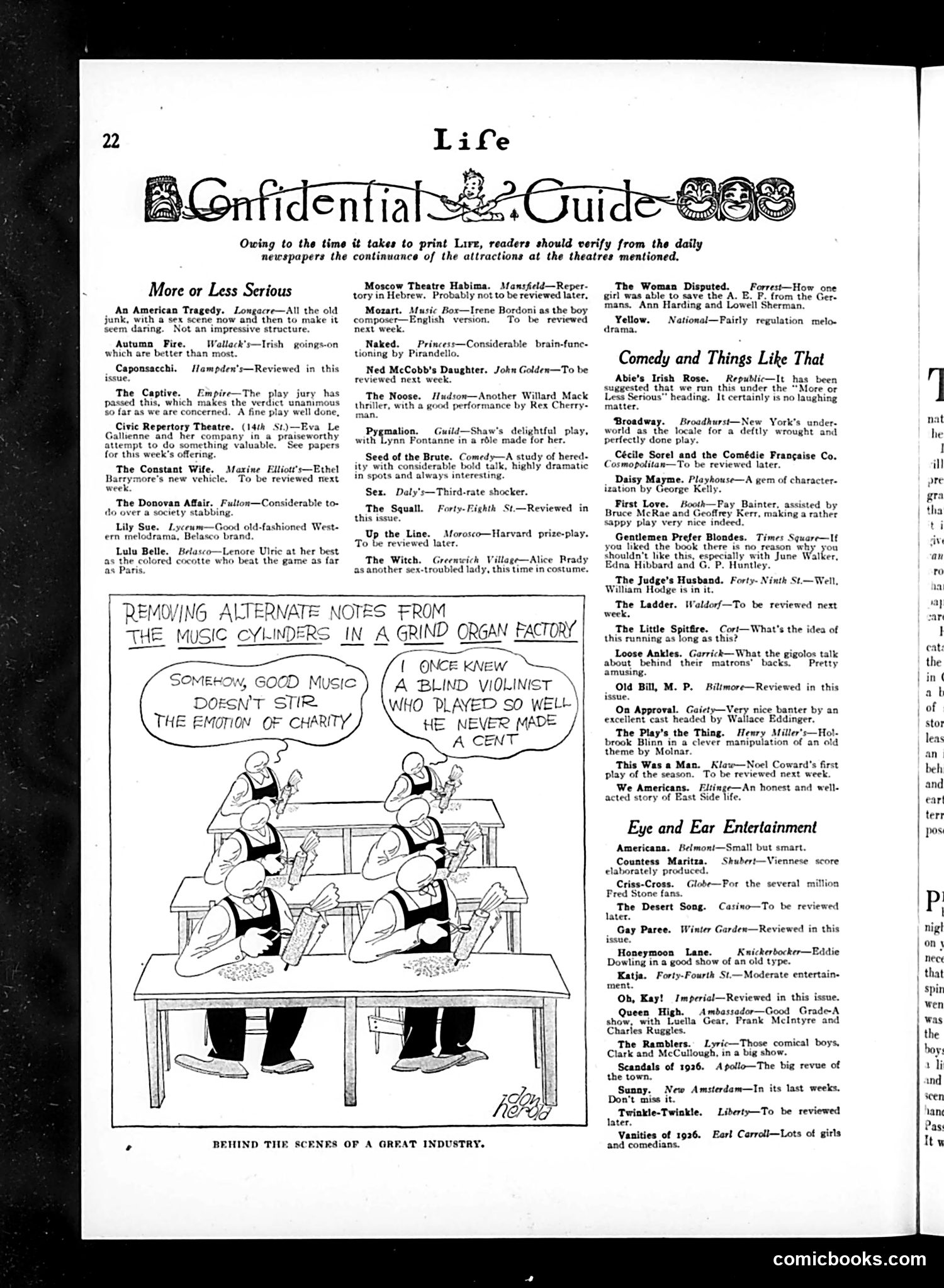
This page is **theater reviews and entertainment criticism**. The left column lists Broadway openings with brief dismissals or endorsements—notably sarcastic about "Abie's Irish Rose" (calling it so unfunny it belongs under "Serious" plays) and self-aware about topical dramas like "The Woman Disputed" (a WWI melodrama). The cartoon satirizes **artistic compromise in commercial entertainment**. Two factory workers at a grinding organ remove alternate musical notes, reasoning that since "good music doesn't stir the emotion of charity," removing notes won't harm it. The joke: they're producing intentionally degraded, mass-market entertainment—removing quality until nothing remains but mechanical drivel. The caption "Behind the Scenes of a Great Industry" is sardonic. This reflects 1920s highbrow anxieties about commercialized entertainment dumbing down culture for profit, sacrificing artistry for maximum audience appeal. The cartoon mocks both the producers (cynically stripping art) and by extension the audiences who consume it.
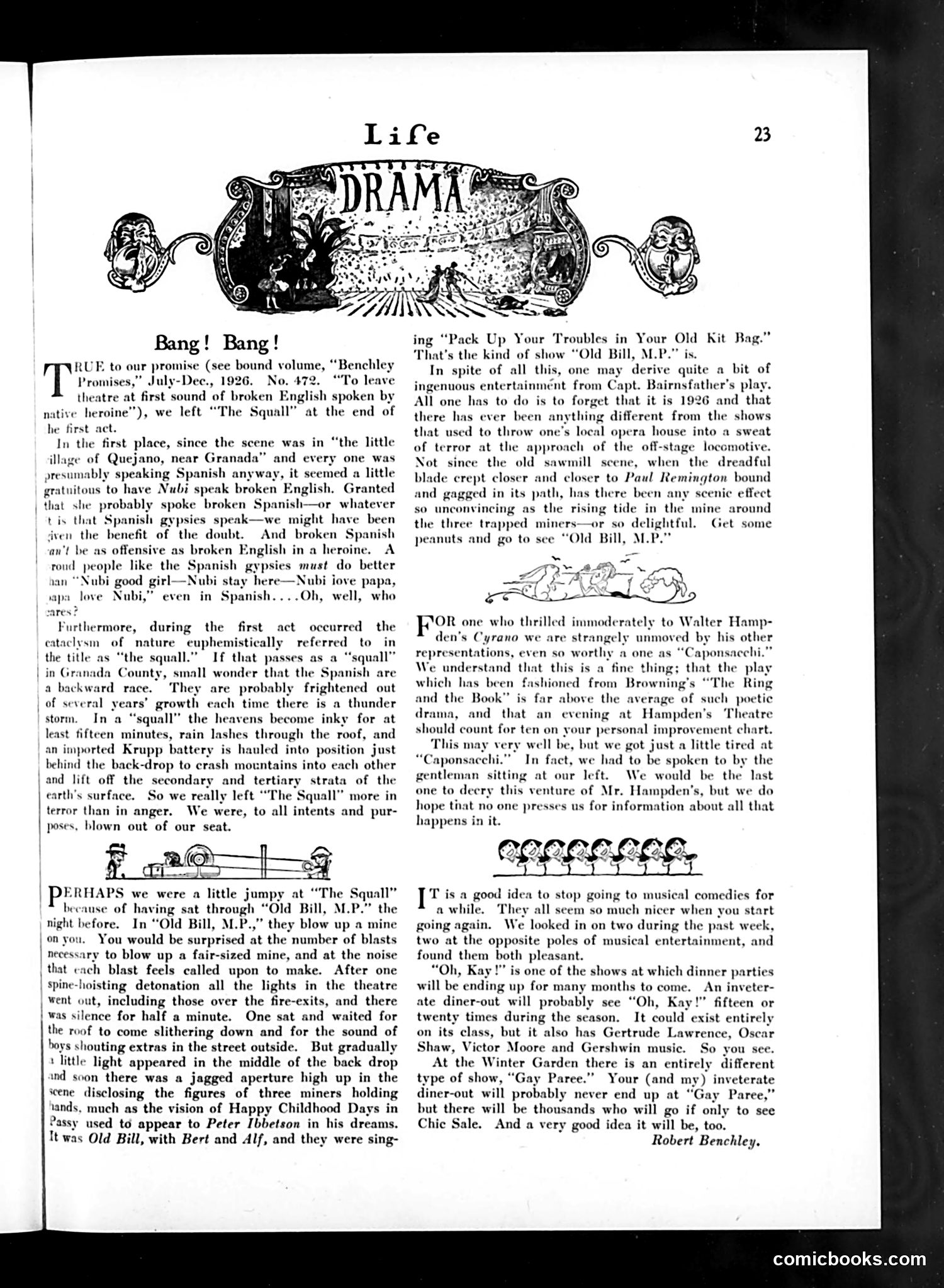
This page reviews three theatrical productions, written by Robert Benchley. The critic discusses "The Squall," a play set in Spain featuring a gypsy heroine named Nubi who speaks broken English despite the Spanish setting—Benchley finds this choice absurd and offensive, arguing the broken English is gratuitously awkward for a heroine. He then critiques "Old Bill, M.P.," a war play based on Captain Bairnsfather's work, mocking its melodramatic, outdated staging (including unconvincing mine-explosion effects and a rising-tide scene). Despite poor production values, he notes audiences derive entertainment from its nostalgic appeal to pre-1926 theatrical conventions. Finally, he mentions Walter Hampden's "Caponsacchi," adapted from Browning's poetry, acknowledging it's critically superior to the other productions but confessing personal indifference to it. The tone is satirical toward theatrical excess and audience credulity.
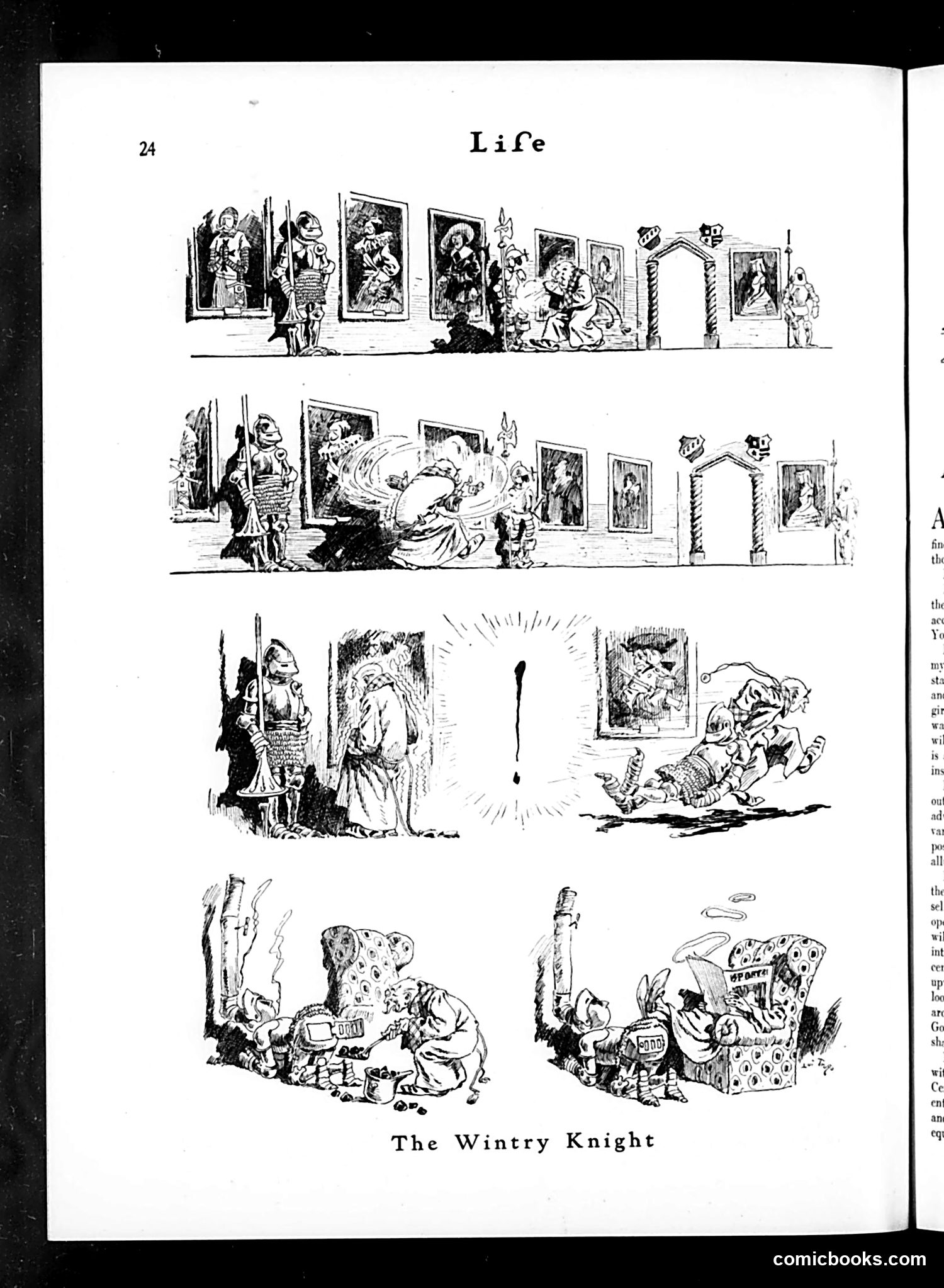
This page contains four sequential cartoon panels depicting a narrative about a knight dealing with winter conditions. The top panels show a knight in an art gallery or formal setting; subsequent panels show the figure increasingly distressed or affected by cold weather. The bottom two panels shift to outdoor scenes showing the knight struggling with winter—appearing to be cold, poorly equipped, or in difficult survival situations with minimal shelter. The satire likely mocks chivalric ideals or romantic notions of knighthood when confronted with harsh practical reality. The progression from formal/civilized settings to outdoor hardship suggests the cartoon's point: that noble concepts fail when tested against genuine adversity or poverty. The title "Wintry Knight" reinforces this contrast between the romantic image of knighthood and grim winter conditions.
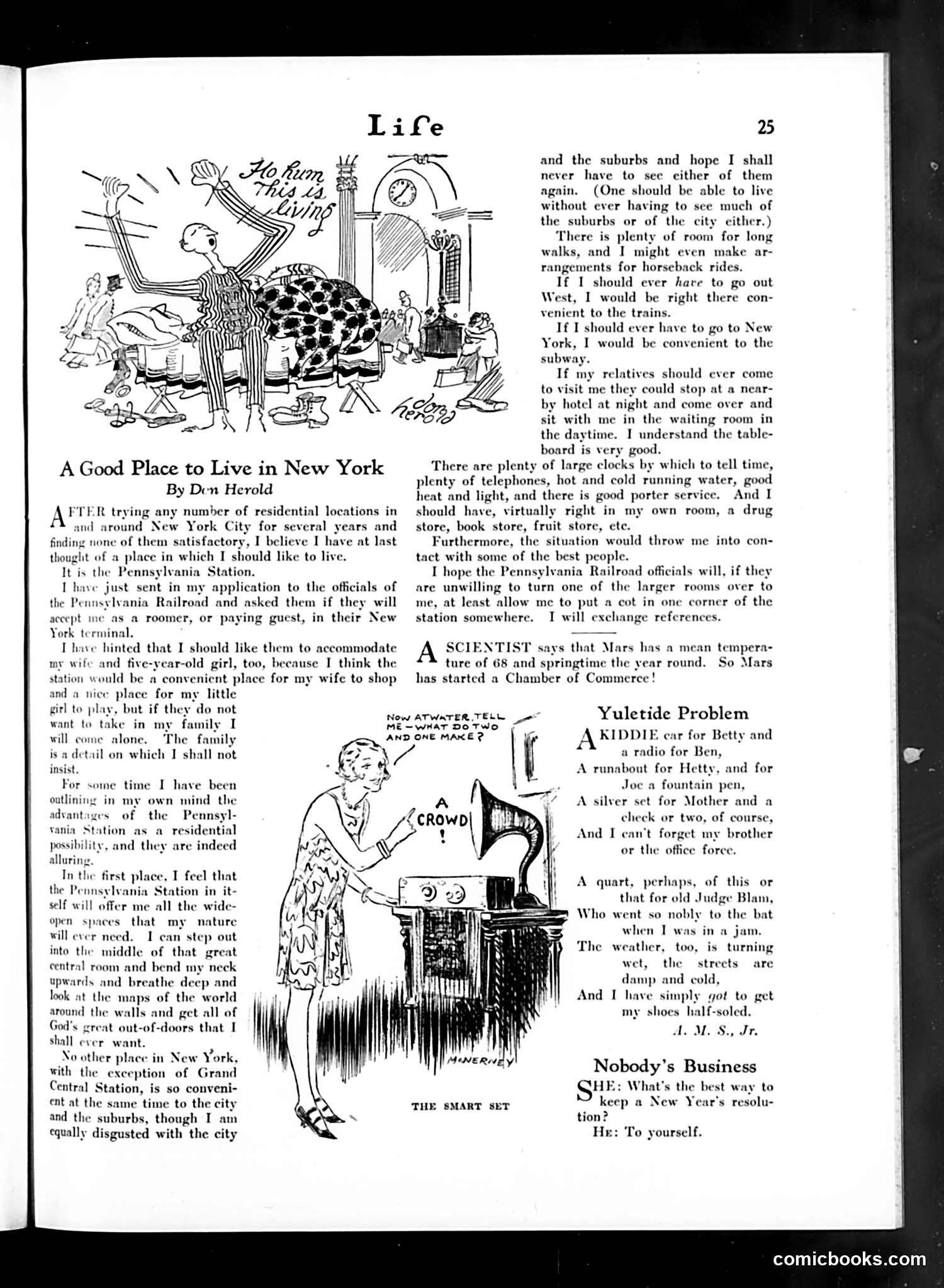
This humorous article by Don Herold satirizes post-WWI urban dissatisfaction. The author, disgusted with both Manhattan and its suburbs, proposes living in Pennsylvania Station as a mock-serious solution to New York's residential problems. The joke relies on **absurdist logic**: the station offers "wide open spaces" (the main terminal), convenience to trains for escaping west, proximity to subways for going to New York, entertainment (watching crowds), and amenities (clocks, phones, running water, drugstores). He even suggests his wife could shop there and his daughter play—treating a railroad terminal as an actual home. The cartoon below shows a woman at a telephone, likely representing the absurdity of such arrangements. The satire mocks 1920s urban alienation and housing frustrations by proposing the ridiculous as practical, thereby critiquing how genuinely inadequate actual New York living options had become for many residents.
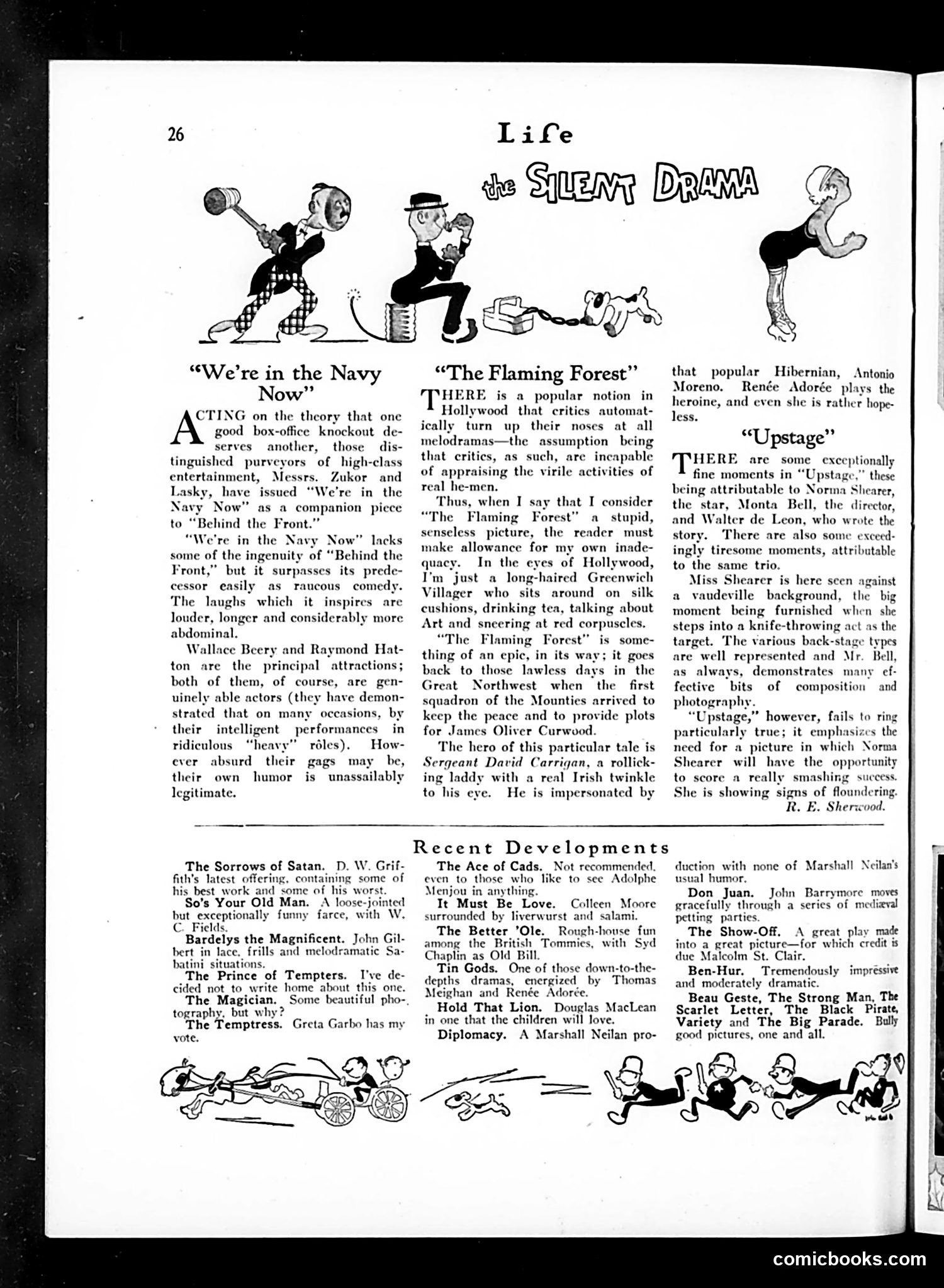
This page reviews several silent films from the early 1920s. The top section features three reviews by what appears to be R.E. Sherwood (a prominent drama critic of the era): **"We're in the Navy Now"** — A comedy sequel to "Behind the Front," starring Wallace Beery and Raymond Hatton. The reviewer praises it as "raucous comedy" with genuinely funny performances, despite absurd gags. **"The Flaming Forest"** — A melodrama the reviewer dismisses as "stupid" and "senseless," set in the Canadian Northwest with actor Antonio Moreno. The critic sardonically notes Hollywood assumes critics automatically reject melodramas, using himself as an example of a dismissive "Greenwich Villager." **"Upstage"** — Featuring Norma Shearer, directed by Monta Bell. The reviewer finds exceptional moments but overall considers it unconvincing, suggesting Shearer needs better material to truly succeed. The bottom section lists brief capsule reviews of other recent releases, using sharp, sometimes cutting humor typical of Life's satirical style.
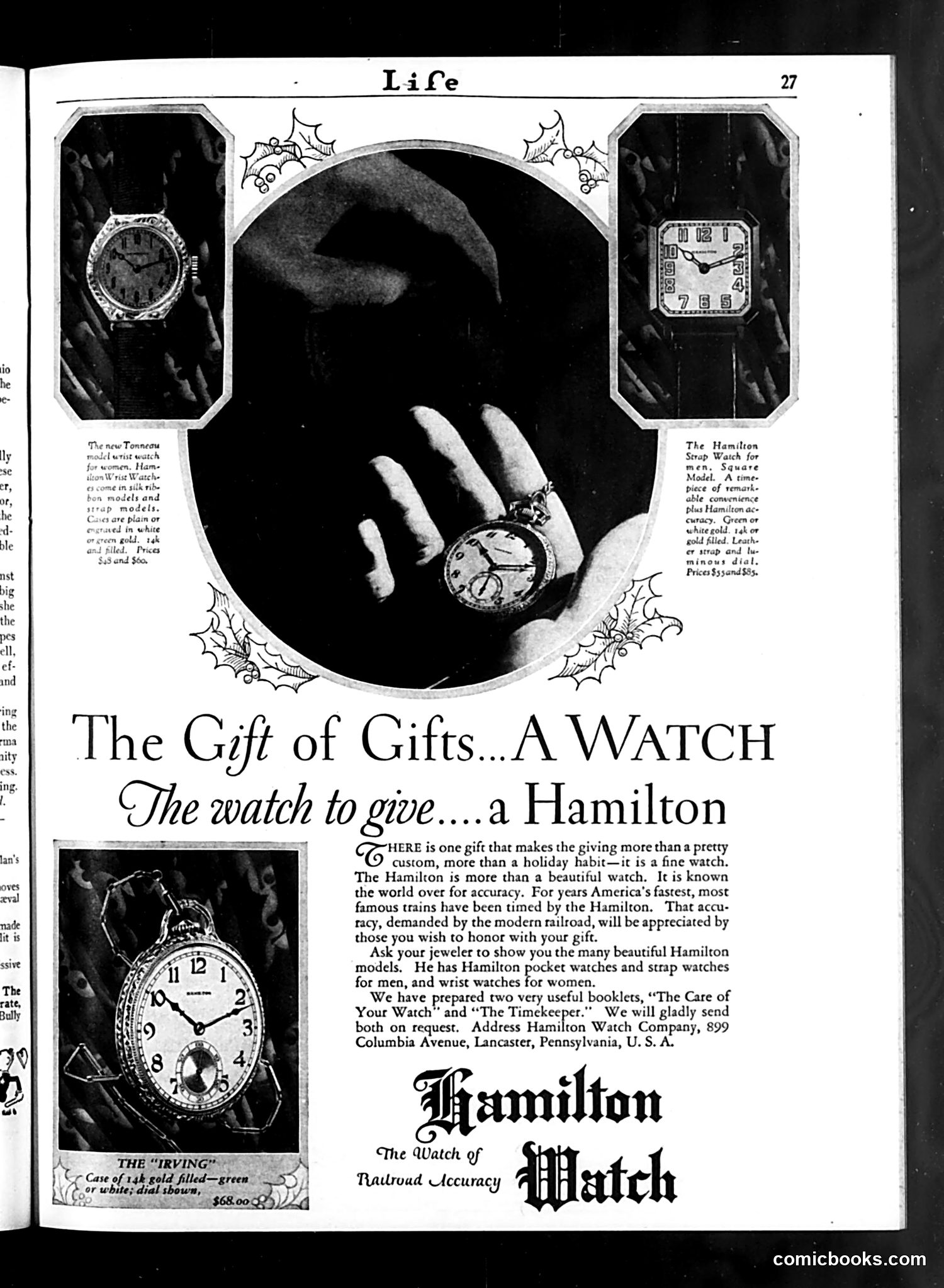
This page is **entirely an advertisement**, not satire or political commentary. It's a Hamilton Watch Company promotional piece from *Life* magazine. The content shows three watches in elegant presentation: two strap watches (top left and right) and one pocket watch (bottom left, labeled "The Irving"). The central image depicts a hand holding a watch, emphasizing it as a luxury gift. The ad's message is straightforward: Hamilton watches are reliable timepieces ("The Watch of Railroad Accuracy") suitable for gifting. It appeals to prestige by noting that America's fastest trains used Hamilton timing, implying the watches are trustworthy enough for critical infrastructure. The decorative holly leaves suggest holiday gift-giving season. The copy emphasizes that a Hamilton watch transcends being merely a "pretty custom"—it's a serious, valuable gift reflecting the giver's regard for the recipient. There is no satire, no caricature, and no political reference. This is vintage commercial advertising showcasing luxury goods.
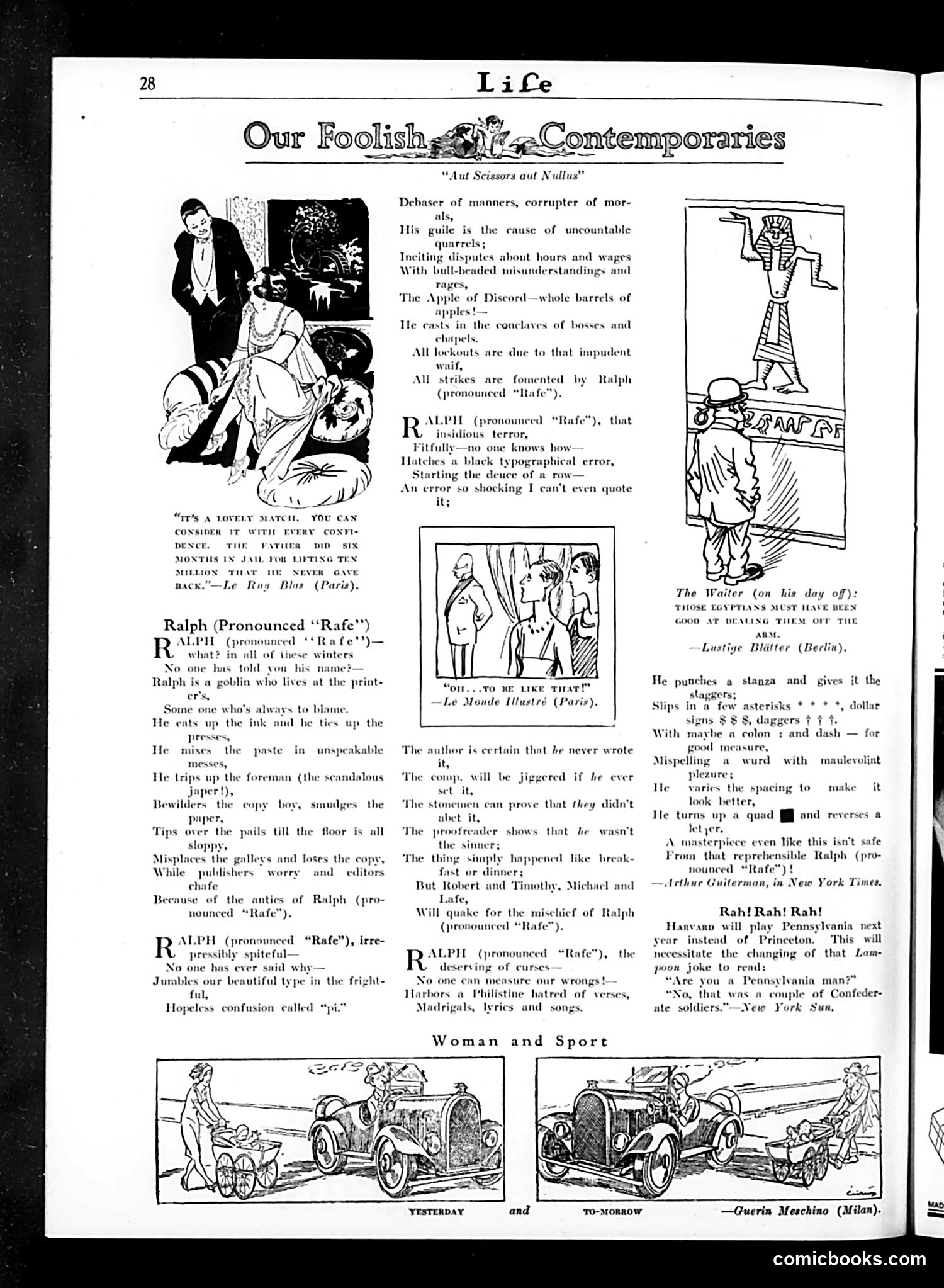
This page satirizes printing-industry mishaps through the fictional character "Ralph" (pronounced "Rafe"), a mischievous goblin blamed for every workplace problem. The satire targets how printers, publishers, and editors habitually blame a scapegoat rather than accepting responsibility. Ralph causes typographical errors, labor disputes, lost copy, messy proofs, and general chaos. The repeated refrain—"RALPH (pronounced 'Rafe'), [some vice]"—mocks how workers and management alike invoke his name whenever anything goes wrong, from strikes to printing errors to misspellings. The joke reflects early 20th-century workplace frustrations: rather than addressing real systemic issues (wages, working conditions, management competence), everyone blames an imaginary troublemaker. It's a satirical commentary on workplace dysfunction and the human tendency to externalize blame. The bottom section, "Woman and Sport," shows unrelated cartoons about automobile racing and waiters—typical magazine filler content.
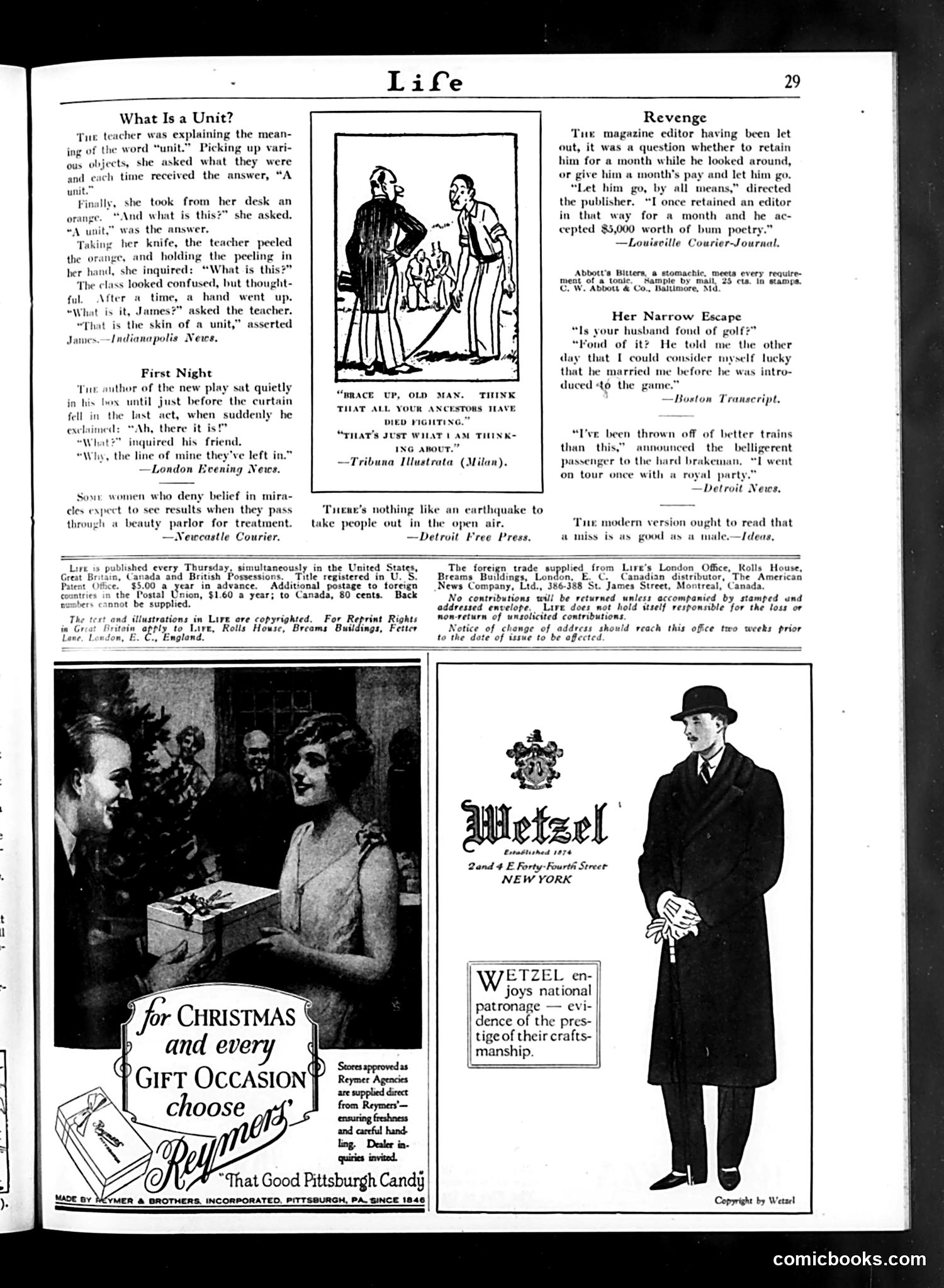
This page from *Life* magazine contains several short humorous anecdotes and advertisements rather than political cartoons. The main content includes joke items like "What is a Unit?" (a pun on the teacher's explanation), "First Night" (about a playwright missing his own line in the theater), and "Her Narrow Escape" (about a husband prioritizing golf over marriage). These are typical of *Life*'s satirical humor targeting everyday American life and social foibles. The illustrated cartoon shows an old man being advised to "think of all your ancestors have died fighting"—likely social commentary on militarism or war propaganda, though the specific context is unclear. The page also features period advertisements for Raymer's candy, Abbott's Bitters tonic, and Wetzel products, typical of early 20th-century magazine advertising. Overall, this represents *Life*'s mix of domestic satire and consumer advertising rather than hard political commentary.
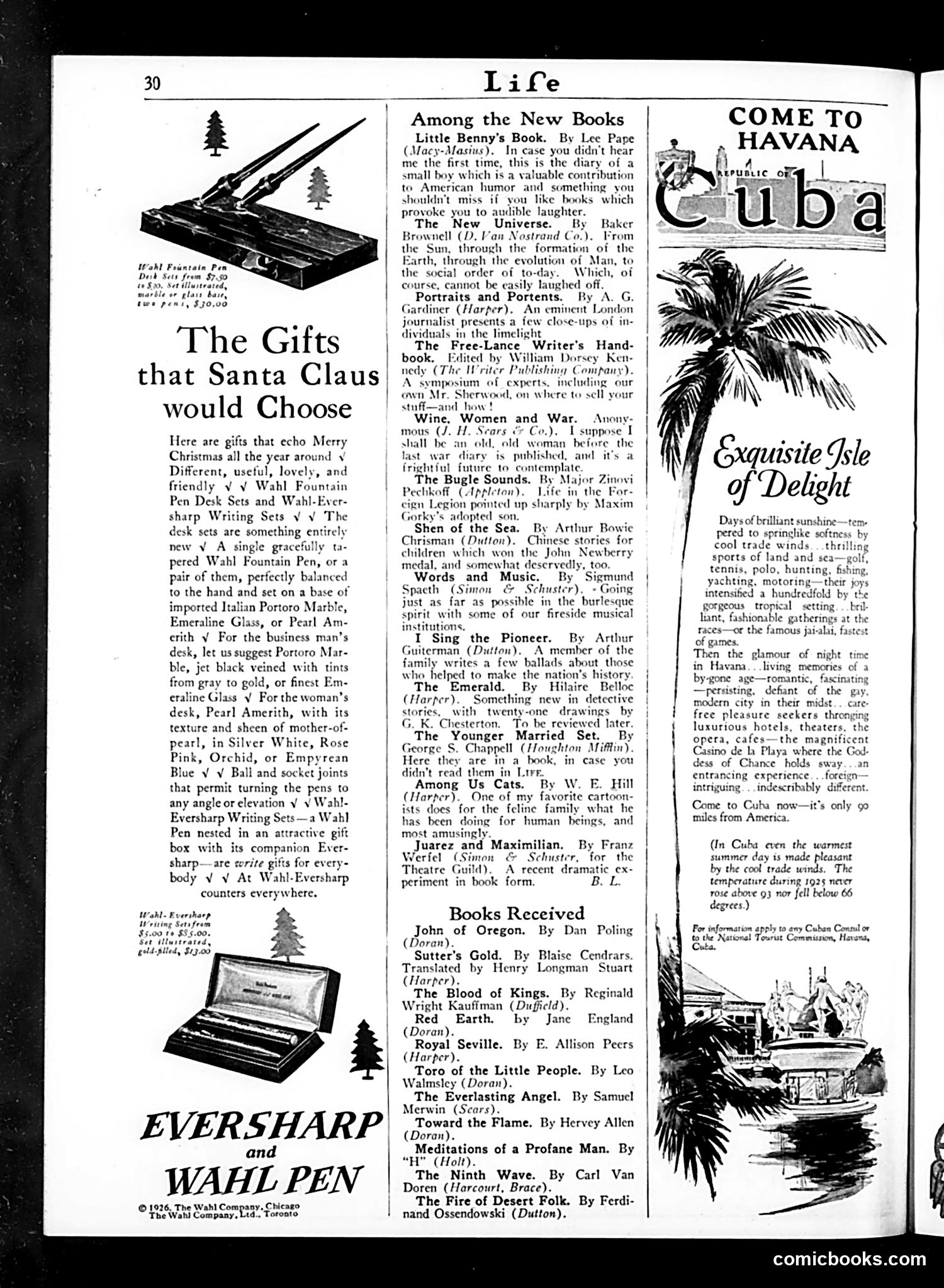
This page is primarily **advertising and book reviews**, not political satire. The main content advertises **Wahl Fountain Pens and Eversharp Writing Sets** as Christmas gifts—marketed as luxury items for business professionals and women, with bases of imported marble and pearl materials in various colors. The copywriting emphasizes sophistication and practicality. The "Among the New Books" section reviews contemporary 1926 publications, including *Little Benny's Book* (humor), *The New Universe* (science), and *Shen of the Sea* (children's literature that won the Newbery Medal). The right column advertises **Cuba tourism**, promoting "Exquisite Isle of Delight" with descriptions of sunshine, sports, and nightlife—typical 1920s travel marketing before the political upheavals that would later define the island. There is **no political cartoon or satire** on this page. It represents standard commercial magazine content from the prosperous pre-Depression era.
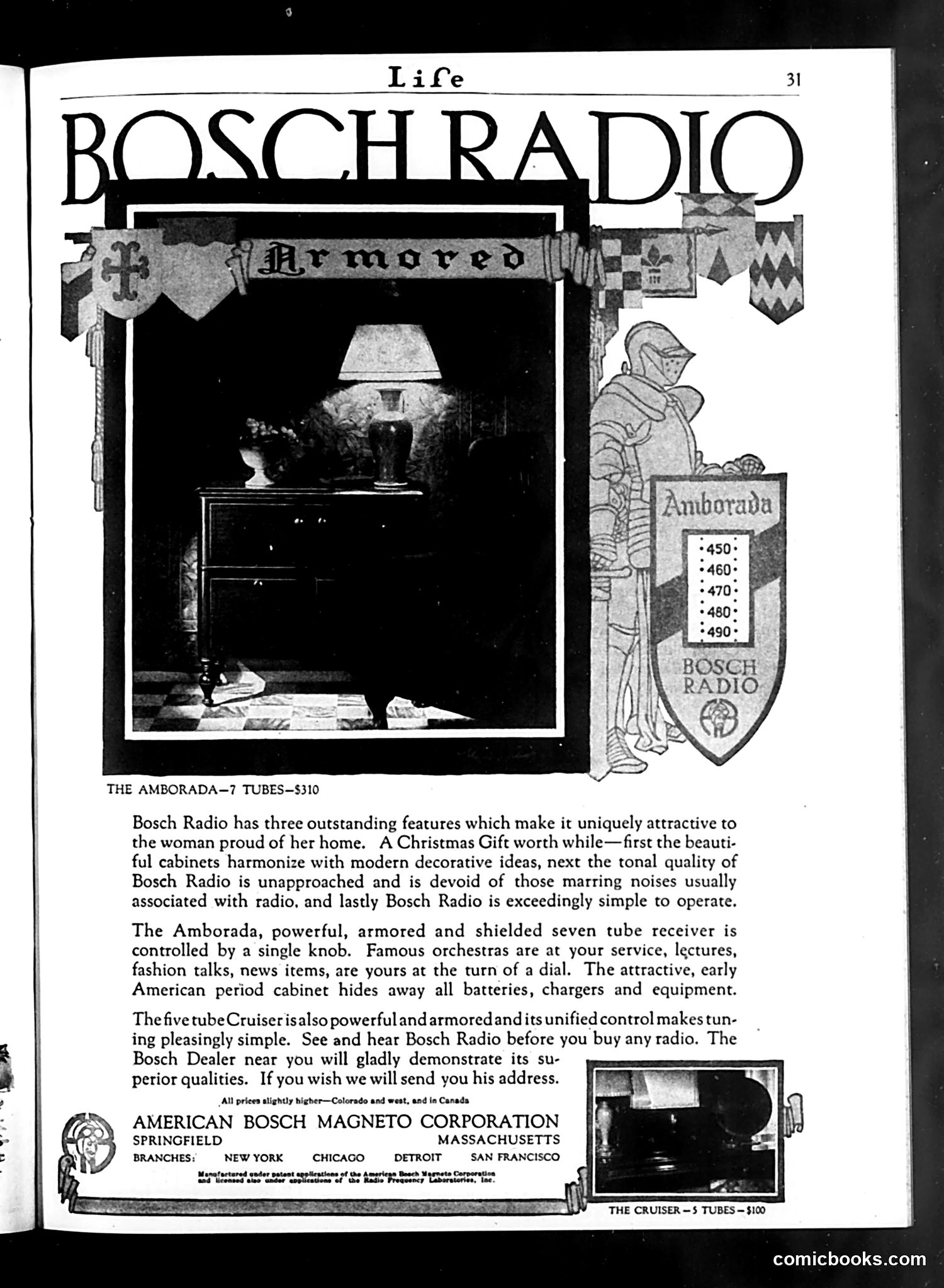
This is primarily a **radio advertisement**, not political satire. It appears from a 1920s-era *Life* magazine promoting Bosch Radio products. The page showcases two radio models: the "Amborada" (7 tubes, $310) and the "Cruiser" (5 tubes, $100). The marketing targets women homeowners, emphasizing that radios are attractive furniture pieces that blend with "modern decorative ideas" and hide mechanical components in period cabinets. The copy emphasizes three selling points: aesthetic appeal, superior sound quality ("devoid of those marring noises"), and ease of operation (single-knob control). This reflects early radio's status as a luxury household item requiring both technical sophistication and home-décor consideration. The military language ("armored," "shielded") and dial frequencies (450-490) indicate technical specifications meant to seem impressive to consumers unfamiliar with radio technology. **This is straightforward advertising, not editorial content or satire.**
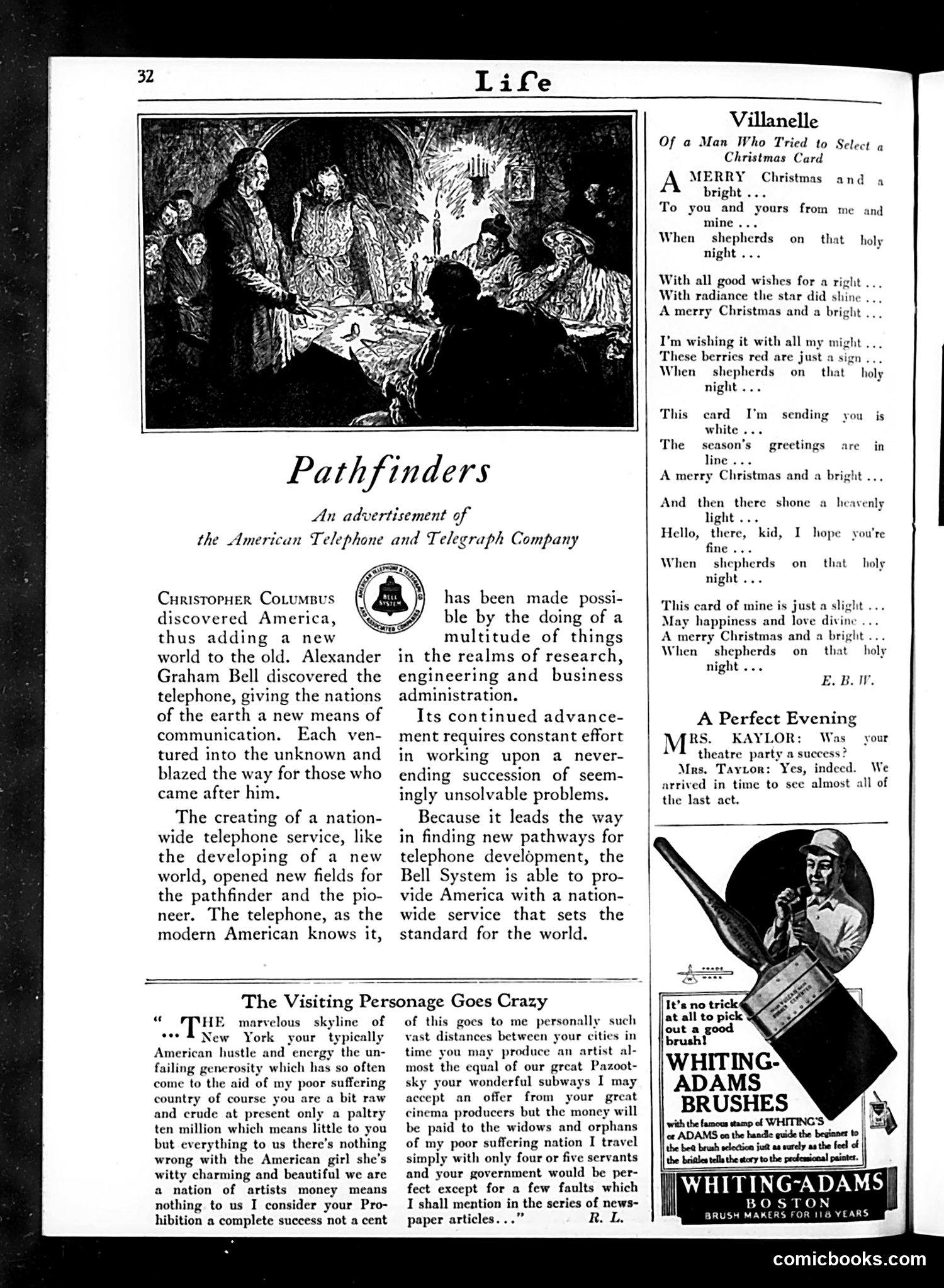
This page contains three distinct pieces: **"Pathfinders"** is an AT&T advertisement equating Alexander Graham Bell with Christopher Columbus as discoverers/pioneers. It argues the Bell System's ongoing research and engineering represents continued American progress and justifies the company's monopoly as providing world-standard telephone service. **"The Visiting Personage Goes Crazy"** is satire mocking a pretentious European visitor (likely a Russian or Eastern European aristocrat, given references to "Pazootsky"). The figure complains about America while simultaneously praising it and boasting of their own poverty and humble travels with "four or five servants." The joke satirizes foreign intellectuals' condescension toward American culture and wealth, and their performative modesty. **"Villanelle"** and **"A Perfect Evening"** are brief humorous pieces—one about Christmas card clichés, the other a joke about arriving late to theater. The page also includes advertisements for Whiting-Adams brushes. The satirical content reflects early 20th-century American attitudes toward European pretension and immigrant intellectuals.
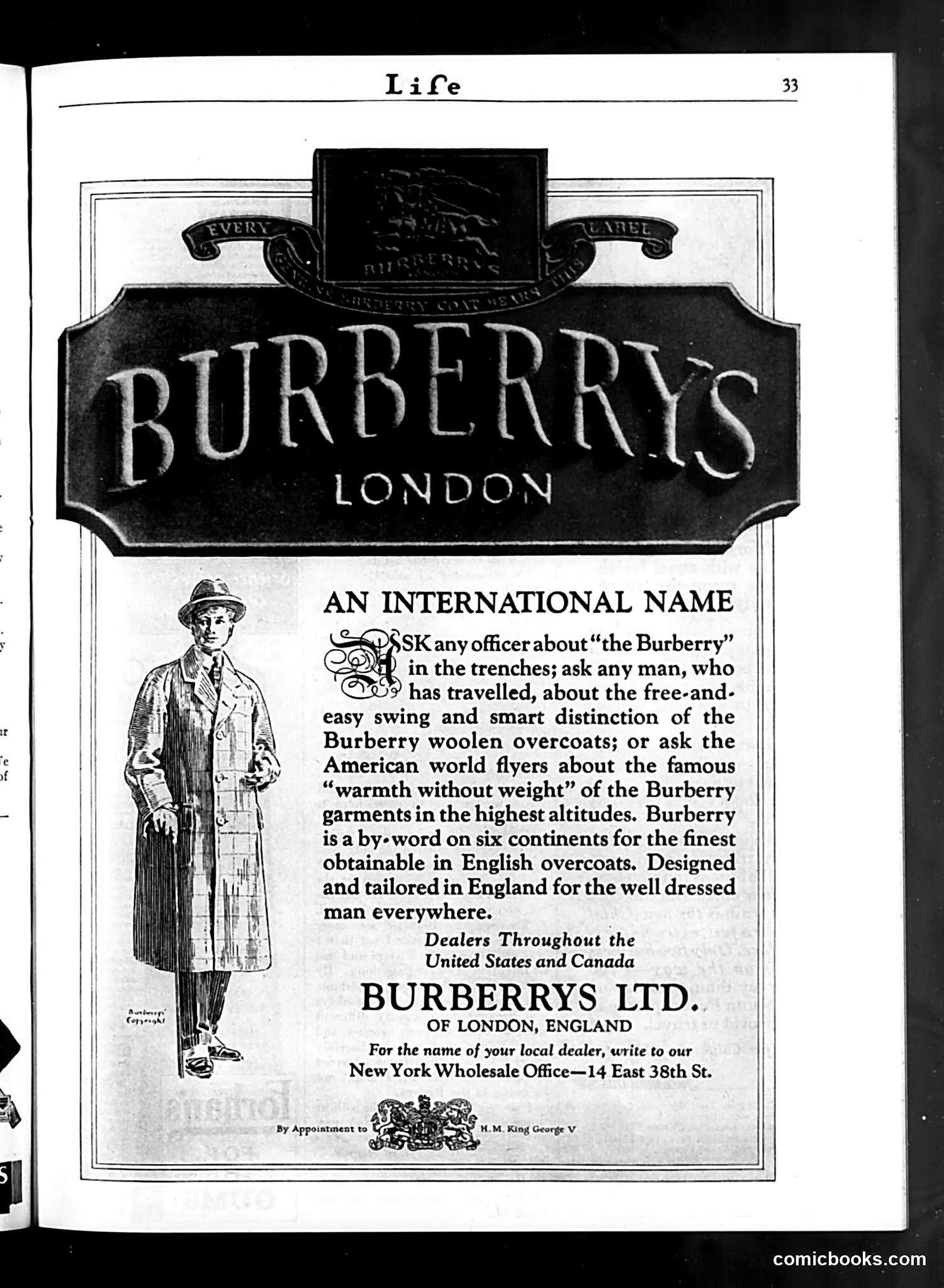
This is primarily a **full-page advertisement**, not satirical content. It's a Burberry London advertisement from *Life* magazine featuring a fashion illustration of a man in an overcoat. The ad markets Burberry overcoats by emphasizing their prestige and international reputation. Key selling points include: - **Military credibility**: References to officers wearing Burberrys "in the trenches" (World War I context) - **Explorer appeal**: Mentions of travelers and "American world flyers" using them at high altitudes - **Quality messaging**: "Warmth without weight" and "finest obtainable in English overcoats" - **Royal endorsement**: Notes "By Appointment to H.M. King George V" at bottom The advertisement positions Burberry as an elite, globally-recognized brand for "the well dressed man everywhere." It directs readers to the New York wholesale office, targeting American consumers during a period when English products held significant prestige. This reflects early 20th-century advertising strategy: associating luxury goods with military service, exploration, and royal approval.
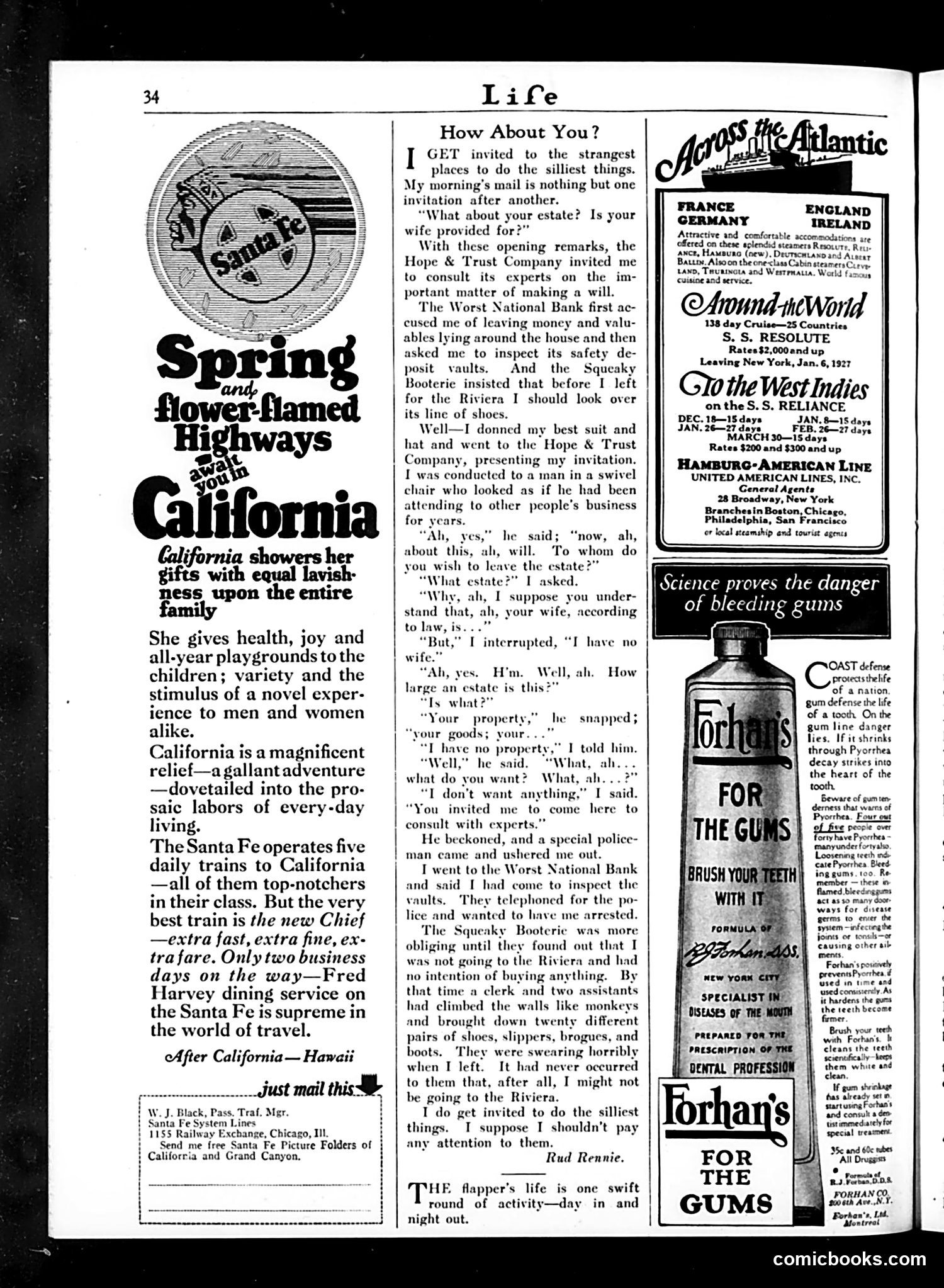
This page is primarily **advertising and light humor**, not political satire. The main content is "How About You?" by Rud Rennie—a comedic essay mocking the absurdity of unsolicited business solicitations. The joke: The narrator receives invitations from banks, trust companies, and retailers (the "Hope & Trust Company," "Worst National Bank," a shoe store) claiming to offer expert advice. When he visits each, he discovers he has no estate, no property, and no travel plans—making their "expertise" irrelevant. Staff respond by calling police to remove him, treating him as suspicious for not wanting their services. **The satire targets**: 1920s aggressive marketing and the assumption that everyone needs financial/consumer products; the absurdity of institutions creating problems to sell solutions. The page also features travel advertisements (Santa Fe railroad, steamship lines) and a tooth-hygiene product ad—typical Life magazine content of this era (appears to be 1927).
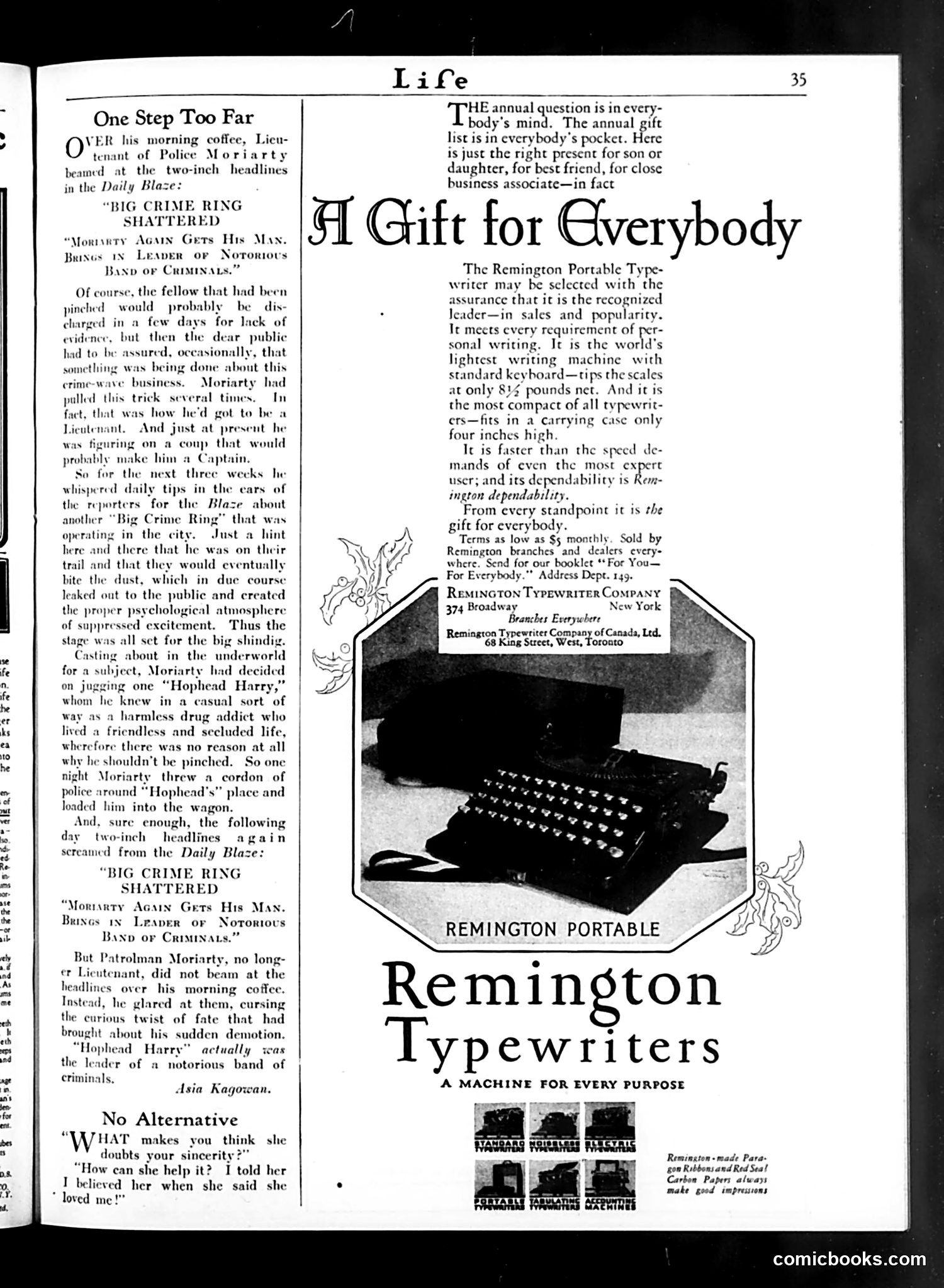
This satirical story mocks police corruption and headline-driven justice. Lieutenant Moriarty fabricates a "big crime ring" by feeding false tips to reporters, creating sensational newspaper headlines to boost his career prospects toward a captaincy. The public remains deliberately deceived through manufactured psychological excitement. The bitter irony: to stage his final dramatic arrest, Moriarty targets "Hophead Harry," a harmless, friendless drug addict—only to discover the man actually *is* a genuine crime boss. Moriarty's demotion from Lieutenant to Patrolman follows. The satire critiques early 20th-century urban policing: the collusion between police and press, the use of fake crime waves for promotional purposes, and the cynical exploitation of vulnerable citizens. The joke's twist—that his scheme backfires when reality matches his fabrication—underscores the chaos underlying systems built on deception.
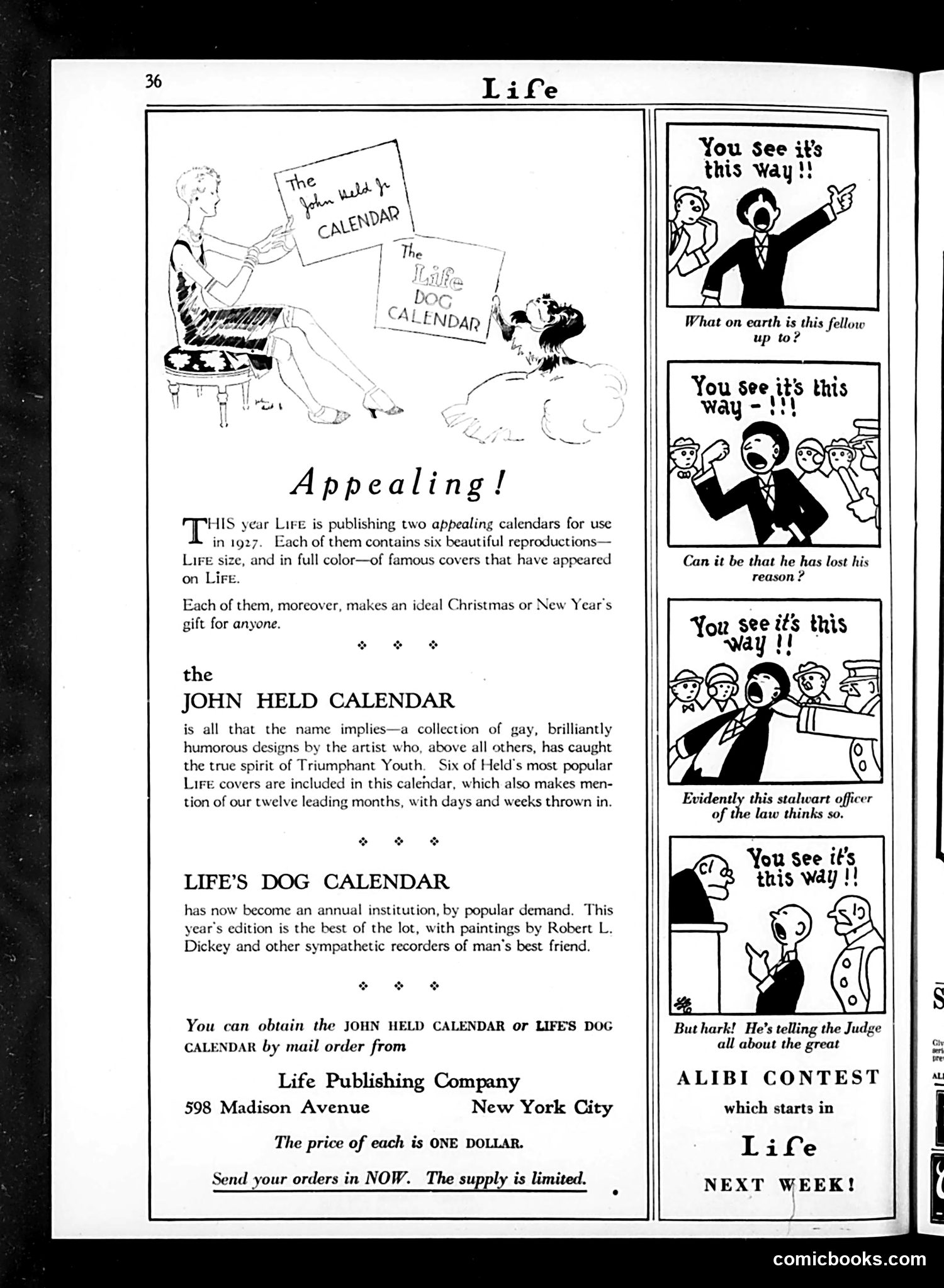
This is primarily **advertising**, not satire. Life magazine is promoting two 1927 calendars—one featuring cartoonist John Held Jr.'s humorous designs, another featuring dog paintings. The right-side comic strips form a teaser for an upcoming "Alibi Contest" in Life. The humor shows a man repeatedly explaining himself ("You see it's this way!!") to increasingly skeptical figures—a couple, a crowd, a police officer, and finally a judge. The escalating scenario suggests he's been caught doing something questionable and is desperately spinning excuses. **Key context**: John Held Jr. was famous for capturing 1920s "flapper" culture and youth humor. The alibi contest likely invited readers to submit humorous excuses for various situations, playing on the era's comedic sensibility. The repeated phrase "You see it's this way!!" became the joke's hook—promising next week's full contest details.
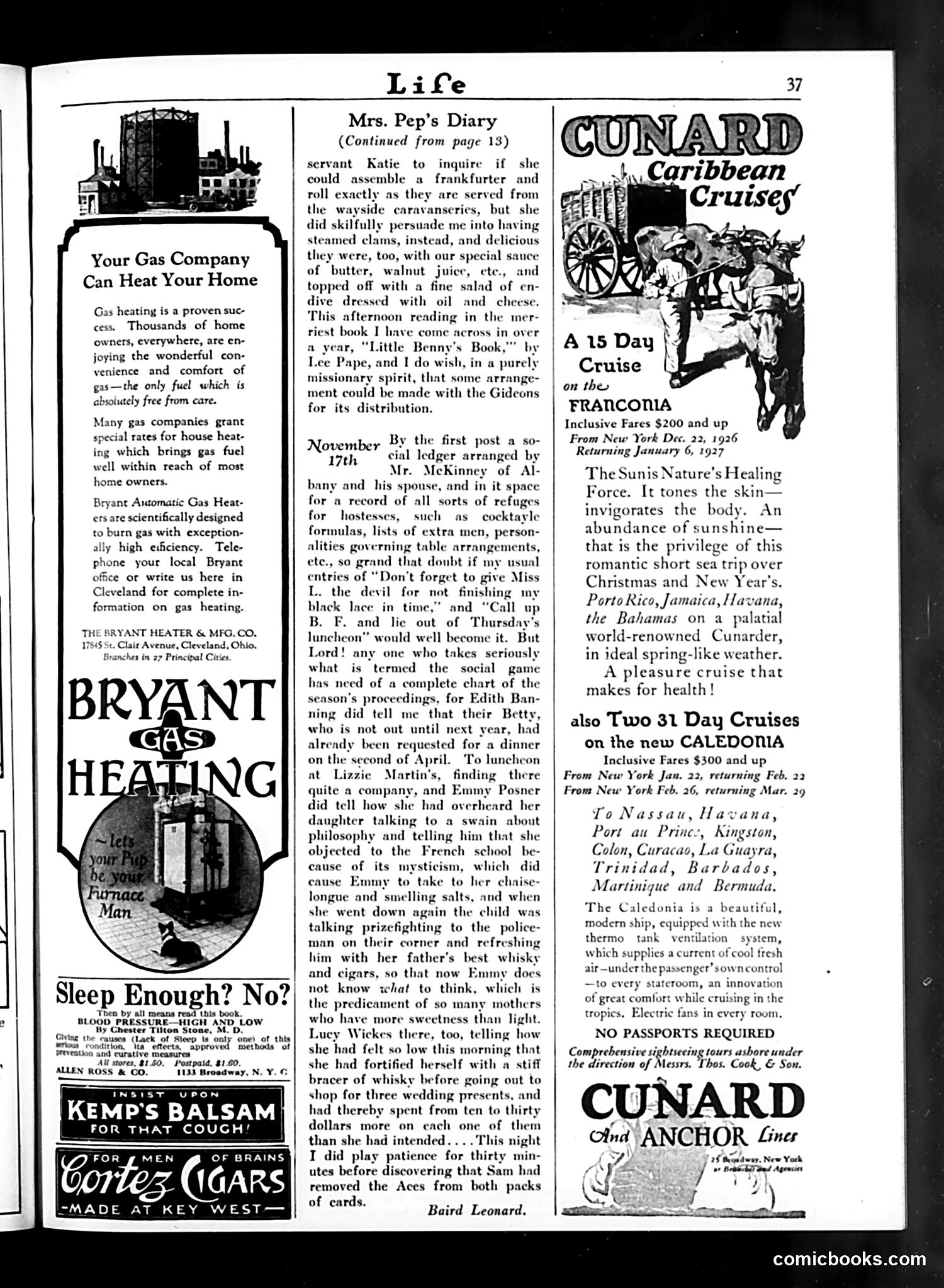
This page mixes advertisements with a serialized diary column. **Mrs. Pep's Diary** is a satirical domestic humor piece depicting upper-class social life. The entries mock trivial concerns of wealthy women: servants, dinner party logistics, and social anxieties. The November 17th entry ridicules the obsession with social scheduling and etiquette guides, while criticizing the "social game" as shallow. The humor targets women's perceived frivolousness—Lucy Wickes fortifying herself with whisky before shopping, Emmy Posner fainting over her daughter's philosophical inconsistency, and the diarist's own petty grievances (a servant not finishing lace work). The final joke about Sam removing playing cards from patience card games adds domestic annoyance. The advertisements surrounding it (gas heating, sleep aids, cigars) represent contemporary concerns but are unrelated to the satire's social critique of upper-class domesticity and women's preoccupations.
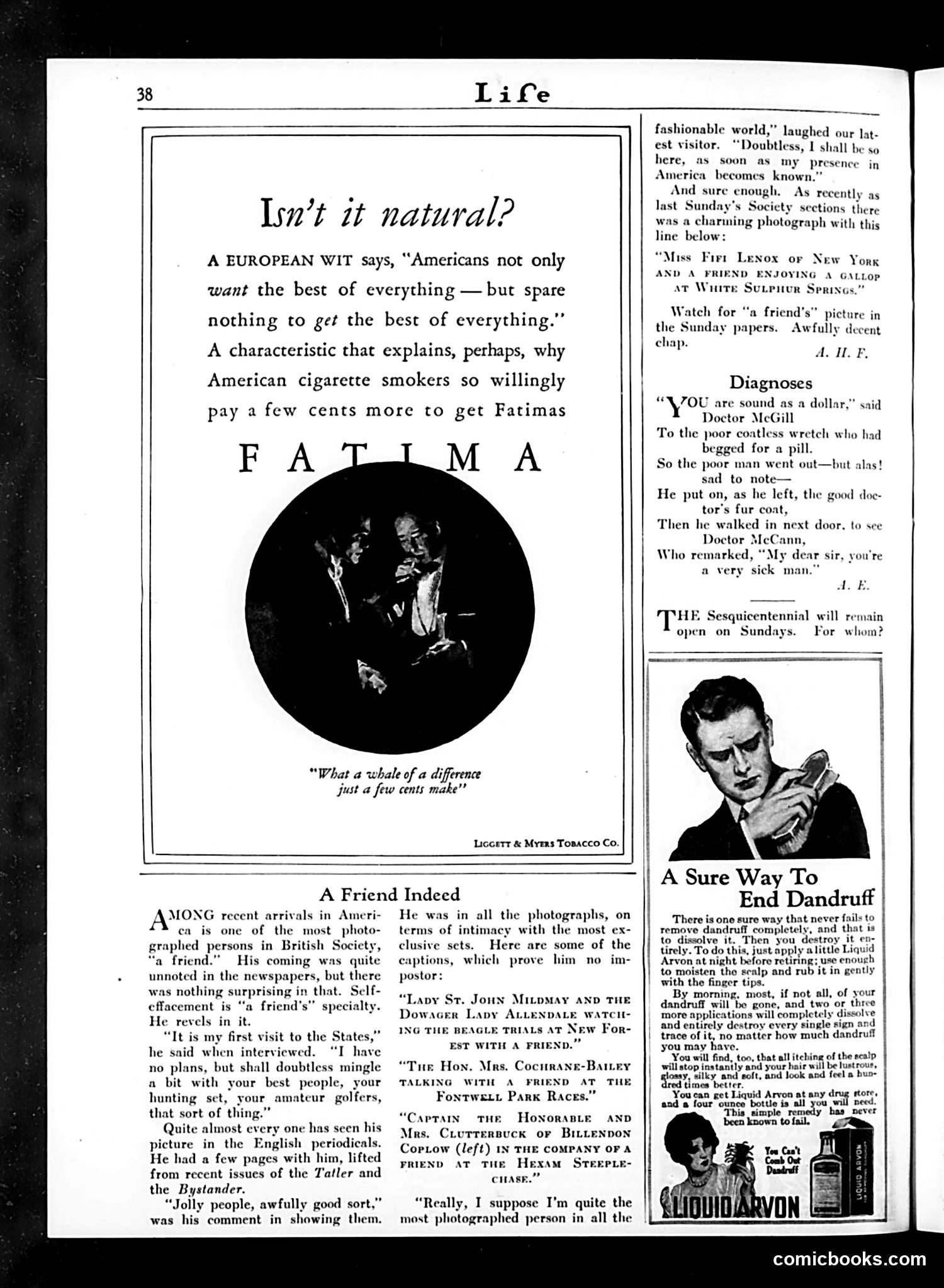
This page contains **three distinct pieces of content**: 1. **Fatimas Cigarette Advertisement** (top): Uses a European stereotype to satirize American consumer behavior—positioning Americans as willing to overpay for premium goods. The ad plays on class aspirations and the notion that Americans value prestige over practicality. 2. **"A Friend Indeed" Satirical Article** (center-left): Mocks British high society through the figure of an unnamed man ("a friend") who appears constantly in English society photographs at exclusive events—always photographed *with* prominent aristocrats but never identified by name. The joke is that he's so unremarkable he's become famous for his anonymous presence. The article then notes he's now appearing in American society pages, suggesting American high society mimics British pretension. 3. **"Diagnoses" Humor Piece** (right): A short poem satirizing a doctor's contradictory diagnoses—a poor man receives a clean bill of health but steals the doctor's fur coat; when examined by another doctor while wearing the coat, he's declared seriously ill. The satire targets superficial medical judgment based on appearance rather than actual health. The page reflects 1920s class commentary and transatlantic cultural mockery.
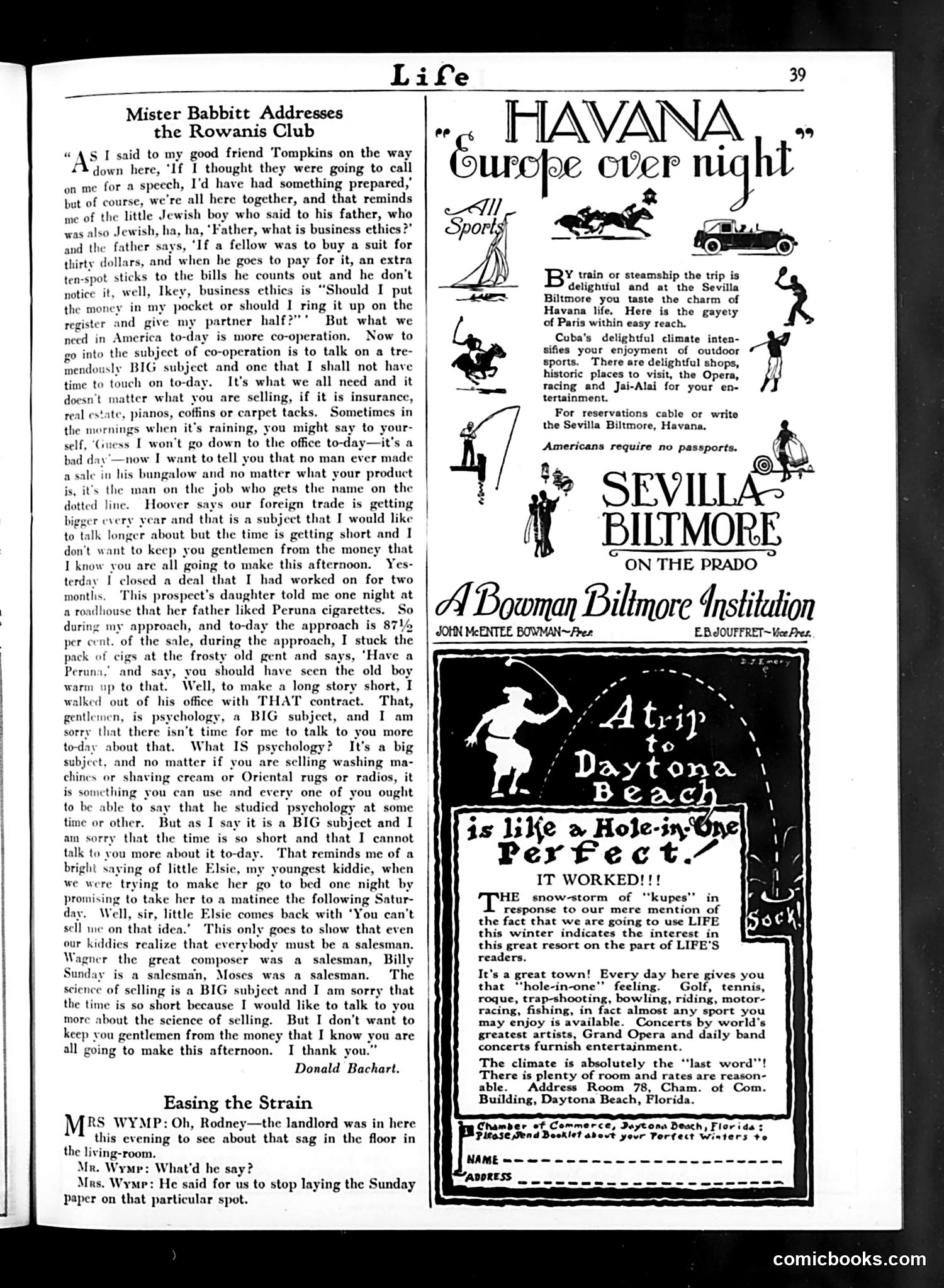
This satirical piece mocks the archetypal American businessman-orator of the 1920s. The speaker rambles through a self-congratulatory speech to the Rotary Club (misspelled "Rowanis"), jumping between disconnected topics—business ethics, cooperation, foreign trade, psychology, selling technique—while constantly apologizing for lack of time, yet continuing to talk. The satire targets several things: the hollow motivational-speaker style, name-dropping of famous figures (Wagner, Billy Sunday, Moses) as "salesmen," reliance on dubious anecdotes (the Peruna cigarettes story), and the reduction of all human activity to salesmanship. The embedded Jewish joke about business ethics reinforces period stereotypes while the speaker's obliviousness to his own bombast is the point. The character is Sinclair Lewis's "Babbitt"—the complacent, conformist businessman—a recognizable American type by 1920s readers.
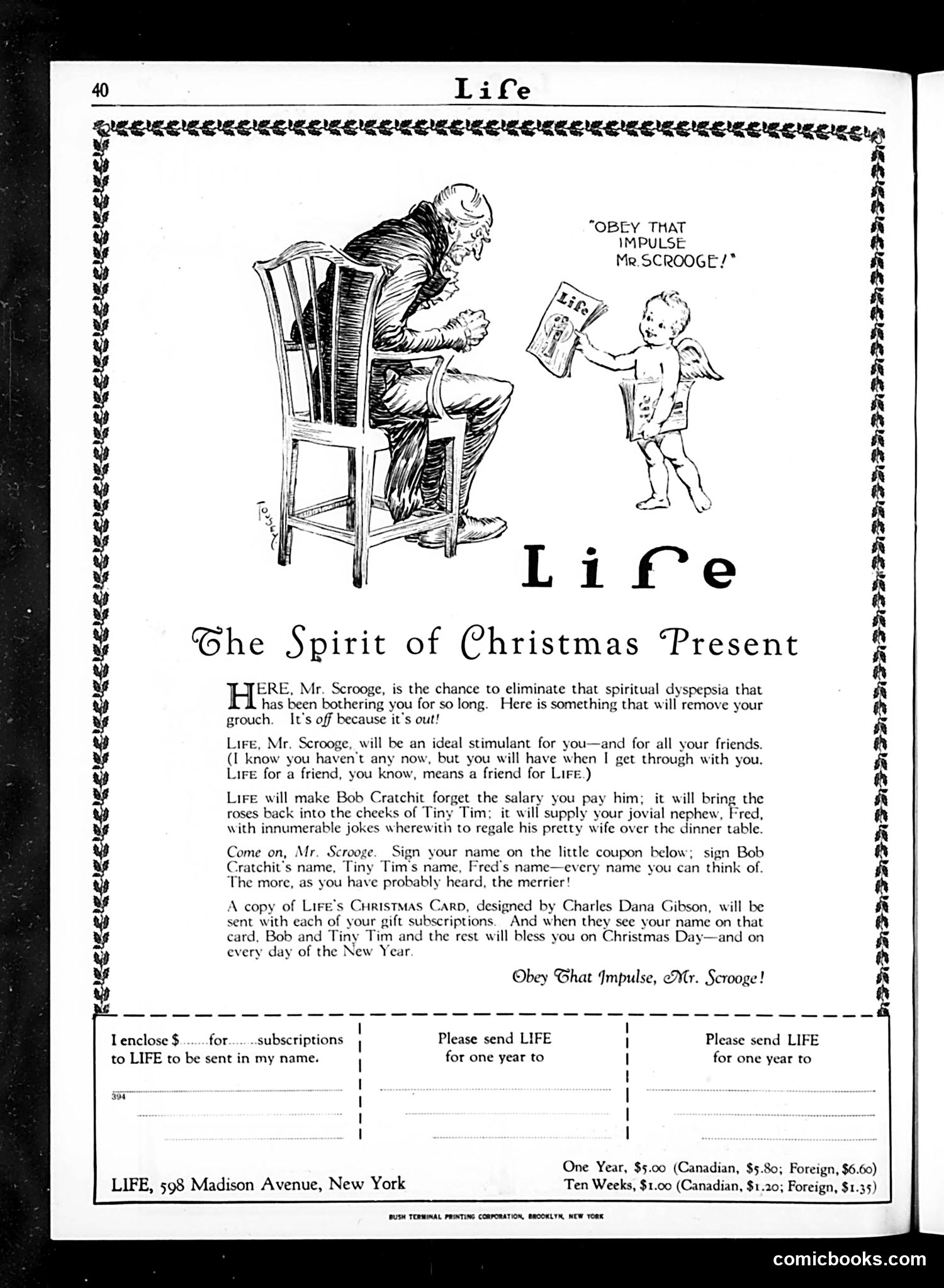
This is a Christmas gift subscription advertisement for *Life* magazine, using Charles Dickens' "A Christmas Carol" as its framework. The illustration depicts Scrooge being confronted by the Spirit of Christmas Present (shown as a cherub/angel), referencing the famous novella. The satire operates on two levels: it humorously applies Scrooge's redemption arc to convince miserly readers to subscribe to *Life* as gifts. The text promises that gifting subscriptions will transform the giver from a selfish "Scrooge" into a generous benefactor—it will make Bob Cratchit (Scrooge's underpaid clerk) forget his low salary, restore Tiny Tim's health, and delight nephew Fred with humor. The ad's central joke: *Life* magazine itself becomes the "spirit of Christmas present"—the vehicle for generosity and human connection. By subscribing to send *Life* to others, readers enact their own moral redemption, just as Scrooge does by the novella's end.
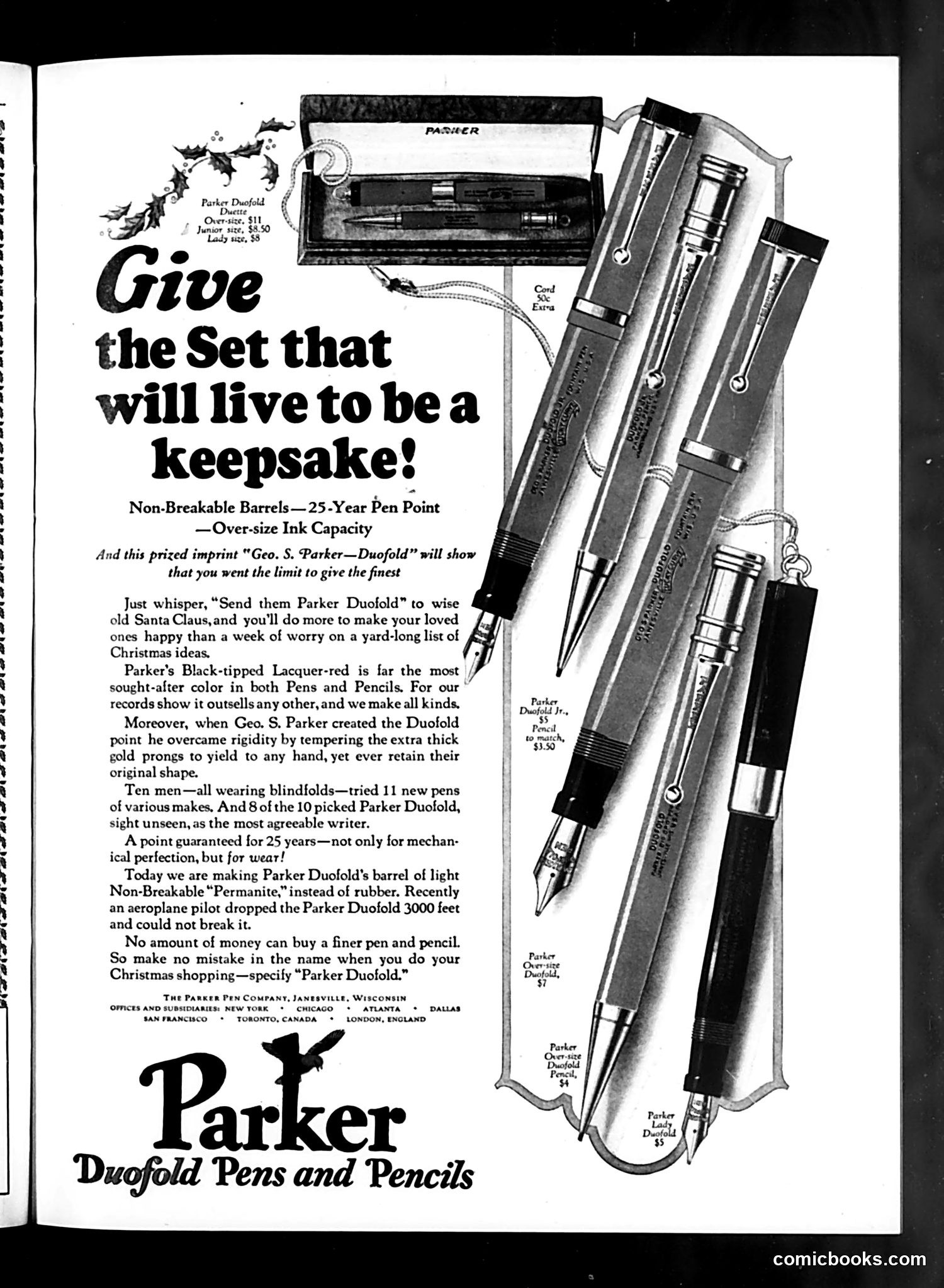
This is not a political cartoon or satire—it's a **straightforward product advertisement** for Parker Duofold pens and pencils, likely from the 1920s-30s based on style. The page promotes luxury writing instruments as Christmas gifts, emphasizing durability ("25-Year Pen Point," "Non-Breakable"), quality ("8 of 10 blindfolded testers chose Parker"), and prestige. The reference to an "aeroplane pilot" dropping a pen 3,000 feet without breaking it demonstrates extreme durability—a notable technological claim for the era when aviation was still novel. The "keepsake" framing suggests these are heirloom-quality gifts, positioning Parker Duofold as the premium choice over competitors. The distinctive red-and-black color and craftsmanship appeal to affluent buyers seeking to give "the finest" gift, avoiding generic Christmas shopping stress. This reflects early 20th-century marketing that linked consumer goods to status and permanence.
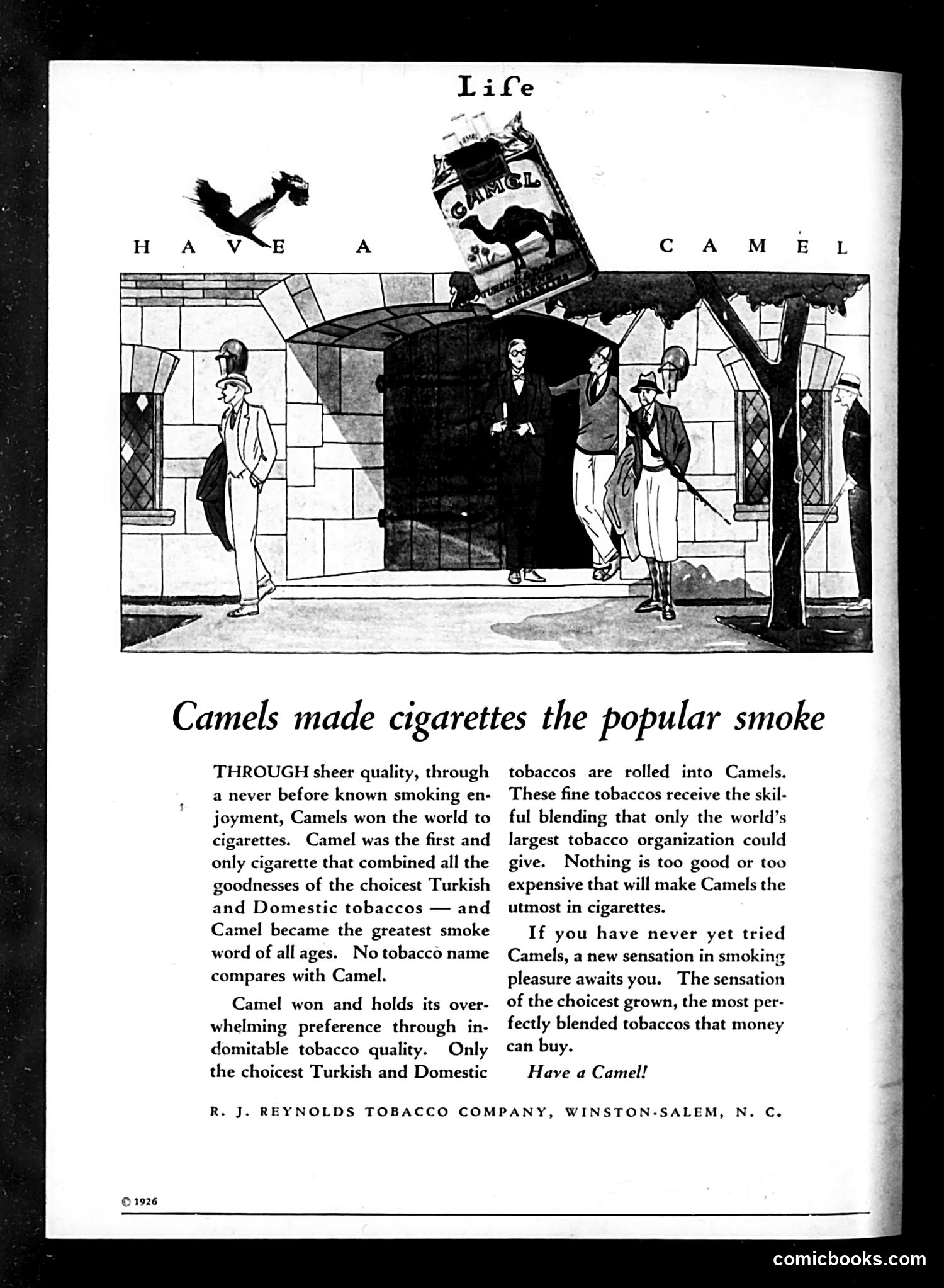
This is a **Camel cigarette advertisement**, not satire. The illustration shows well-dressed men in 1920s business attire gathered outside an elegant building with a large Camel cigarette package looming above them. The ad makes three marketing claims: 1. Camel pioneered quality cigarette smoking 2. The brand combines Turkish and Domestic tobaccos in superior blending 3. Smoking Camels represents a refined lifestyle choice The text emphasizes exclusivity and craftsmanship—"nothing is too good or too expensive" to make Camels superior. The sophisticated setting and well-groomed figures reinforce aspirational messaging: smoking Camels signals status and good taste. From a modern perspective, this is remarkable primarily for its **unironic health claims**—promoting cigarettes as a pleasurable sensory experience without any health warnings, which was standard pre-1965 advertising.

I can see this is a very dark, low-contrast image that appears to be from a historical magazine or publication. However, the image quality is too poor for me to reliably discern specific cartoon content, figures, caricatures, or satirical details. While there appear to be some circular or spiral shapes visible on the right side, and what might be text or design elements, I cannot make out enough detail to accurately identify political figures, social references, or explain the intended satire. To provide you with an accurate historical analysis as requested, I would need a clearer, higher-contrast version of this page. I cannot responsibly guess at identities or meanings when the visual information is this unclear.