
Life, 1926-12-09 · page 20 of 45
Life — December 9, 1926 — page 20: what you’re looking at
What you’re looking at
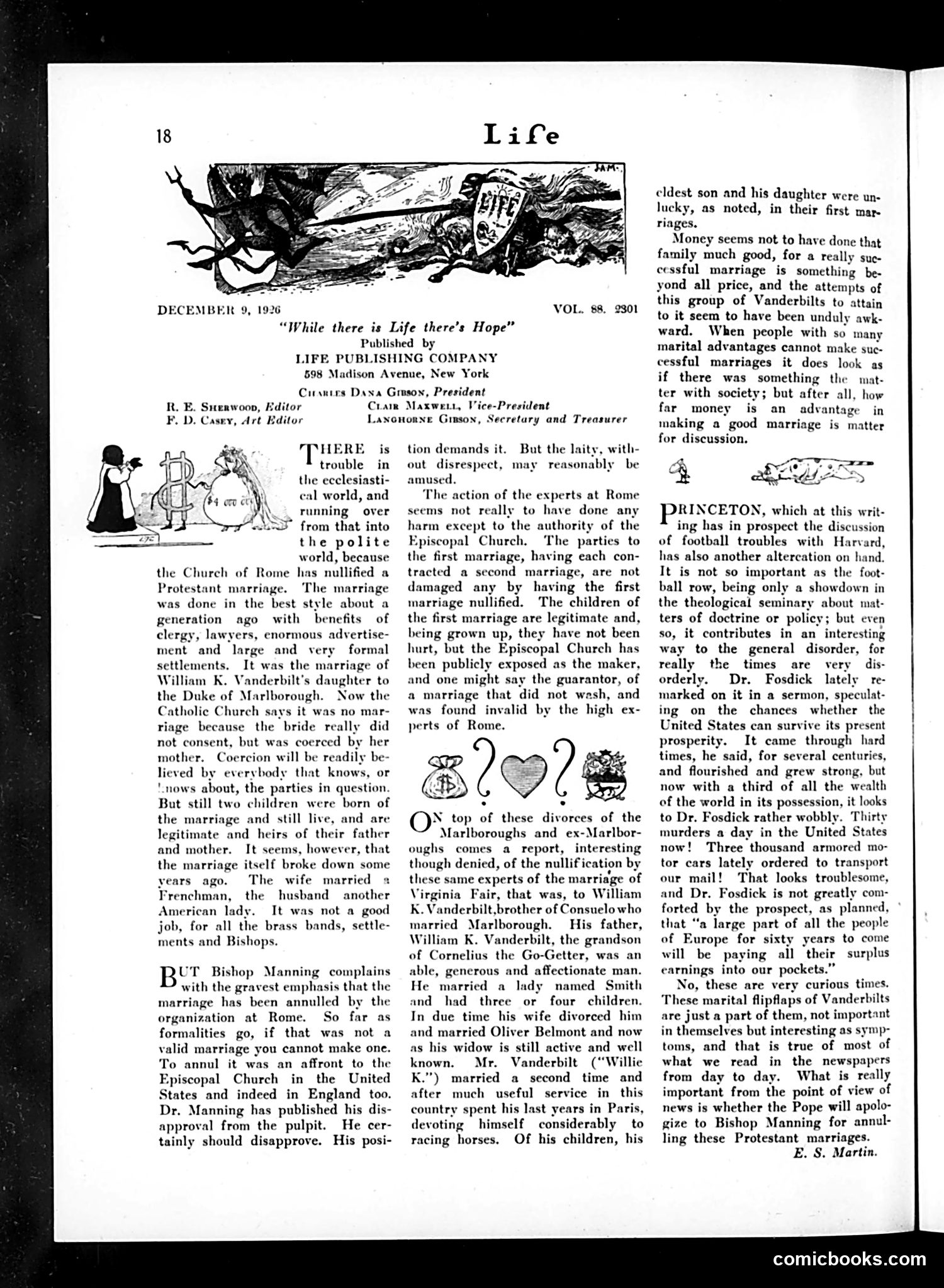
This article satirizes the Catholic Church's annulment of William K. Vanderbilt's daughter's marriage to the Duke of Marlborough—a high-society 1920s scandal. The Church claimed the bride didn't consent, coerced by her mother, despite the couple having two legitimate children and a lavish wedding decades prior. The satire targets multiple targets: the Church's authority (embarrassing the Episcopal Church by invalidating what it blessed), the Vanderbilt family's repeated marital failures despite their wealth and "advantages," and broader high-society hypocrisy. The author suggests that if the ultra-wealthy cannot maintain successful marriages despite every resource, the problem lies with society itself, not individuals. The cartoon (small illustrations visible) appears to support this mockery through visual commentary on marriage and social pretension.
📄 Transcribed text from this page (OCR, searchable)
Machine-transcribed from the original scan — historical spelling and the odd misread are preserved.
DECEMBER 9, 1926 VOL. 88. 2301 “While there is Life there’s Hope” Published by LIFE PUBLISHING COMPANY 598 Madison Avenue, New York Cunirs Dana Grnson, President R. E. Suerwoop, Editor F. D. Casey, Art Editor TTHERE is trouble in the ecclesiasti- cal world, and running over from that into the polite world, because the Church of Rome nullified a Protestant marriage. The marriage was done in the best style about a generation ago with benefits of clergy, lawyers, enormous advertise- formal It was the marriage of ment and large and very settlements. William K. Vanderbilt's daughter to the Duke of Marlborough. Now the Catholic Church says it was no mar- riage because the bride really did not consent, but was coerced by her mother. Coercion will be readily be- lieved by everybody that knows, or 'nows about, the parties in question. But still two children were born of the marriage and still live, and are legitimate and heirs of their father and mother. It seems, however, that the marriage itself broke down some years ago. The wife married 2 Frenchman, the husband another American lady. It was not a good job, for all the brass bands, settle- ments and Bishops. UT Bishop Manning complains with the gravest emphasis that the marriage has been annulled by the organization at Rome. So far as formalities go, if that was not a valid marriage you cannot make one. To annul it was an affront to the Episcopal Church in the United States and indeed in England too. Dr. Manning has published his dis- approval from the pulpit. He cer- tainly should disapprove. His posi- Cram Maxweit, Vice-President Laxononne Gmson, Secretary and Treasurer tion demands it. But the laity, with- out disrespect, may reasonably be amused. The action of the experts at Rome seems not really to have done any harm except to the authority of the Episcopal Church. The parties to the first marriage, having each con- tracted a second marriage, are not damaged any by having the first marriage nullified. The children of the first marriage are legitimate and, being grown up, they have not been hurt, but the Episcopal Church has been publicly exposed as the maker, and one might say the guarantor, of a marriage that did not wash, and was found invalid by the high ex- perts of Rome. ESACIA O* top of these divorces of the Marlboroughs and ex-Marlbor- oughs comes a report, interesting though denied, of the nullification by these same experts of the marriage of Virginia Fair, that was, to William K. Vanderbilt, brother of Consuelo who married Marlborough. His father, William K. Vanderbilt, the grandson of Cornelius the Go-Getter, was an able, generous and affectionate man. He married a lady named Smith and had three or four children. In due time his wife divorced him and married Oliver Belmont and now as his widow is still active and well known. Mr. Vanderbilt (‘Willie K.”) married a second time and after much useful service in_ this country spent his last years in Paris, devoting himself considerably _ to racing horses. Of his children, his eldest son and his daughter were un- lucky, as noted, in their first mar- riages, Money seems not to have done that family much good, for a really suc- cessful marriage is something be- yond all price, and the attempts of this group of Vanderbilts to attain to it seem to have been unduly awk- ward. When people with so many marital advantages cannot make suc- cessful marriages it does look as if there was something the mat- ter with society; but after all, how far money is an advantage in making a good marriage is matter for discussion. Tee A We pei > RINCETON, which at this writ- ing has in prospect the discussion of football troubles with Harvard, has also another altercation on hand. It is not so important as the foot- ball row, being only a showdown in the theological seminary about mat- ters of doctrine or policy; but even so, it contributes in an interesting way to the general disorder, for really the times are very dis- orderly. Dr. Fosdick lately re- marked on it in a sermon, speculat- ing on the chances whether the United States can survive its present prosperity. It came through hard times, he said, for several centuries, and flourished and grew strong, but now with a third of all the wealth of the world in its possession, it looks to Dr. Fosdick rather wobbly. Thirty murders a day in the United States now! Three thousand armored mo- tor cars lately ordered to transport our mail! That looks troublesome, and Dr. Fosdick is not greatly com- forted by the prospect, as planned, that “a large part of all the people of Europe for sixty years to come will be paying all their surplus earnings into our pockets.” No, these are very curious times. These marital flipflaps of Vanderbilts are just a part of them, not important in themselves but interesting as symp- toms, and that is true of most of what we read in the newspapers from day to day. What is really important from the point of view of news is whether the Pope will apolo- gize to Bishop Manning for annul- ling these Protestant marriages. E. S. Martin. comicbooks.com