
Life, 1926-12-09 · page 24 of 45
Life — December 9, 1926 — page 24: what you’re looking at
What you’re looking at
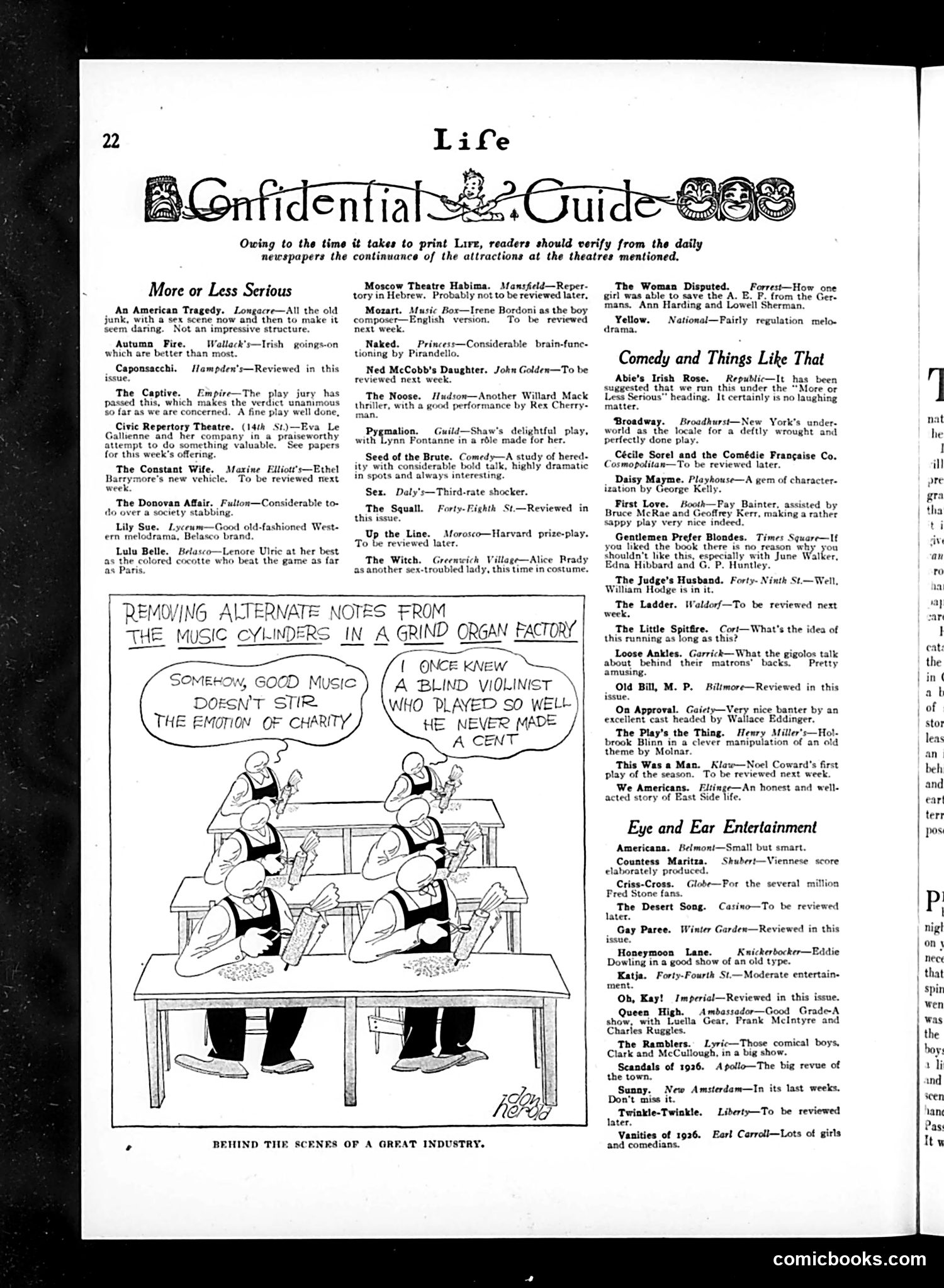
This page is **theater reviews and entertainment criticism**. The left column lists Broadway openings with brief dismissals or endorsements—notably sarcastic about "Abie's Irish Rose" (calling it so unfunny it belongs under "Serious" plays) and self-aware about topical dramas like "The Woman Disputed" (a WWI melodrama). The cartoon satirizes **artistic compromise in commercial entertainment**. Two factory workers at a grinding organ remove alternate musical notes, reasoning that since "good music doesn't stir the emotion of charity," removing notes won't harm it. The joke: they're producing intentionally degraded, mass-market entertainment—removing quality until nothing remains but mechanical drivel. The caption "Behind the Scenes of a Great Industry" is sardonic. This reflects 1920s highbrow anxieties about commercialized entertainment dumbing down culture for profit, sacrificing artistry for maximum audience appeal. The cartoon mocks both the producers (cynically stripping art) and by extension the audiences who consume it.
📄 Transcribed text from this page (OCR, searchable)
Machine-transcribed from the original scan — historical spelling and the odd misread are preserved.
Moscow Theatre Habima. Mansfeld—Reper- More or Less Serious tory in Hebrew. Probably not to be reviewed later, An American Tragedy. Longacre—All the old Mozart. Music Box—Irene Bordoni as the boy junk, with a se seem daring. x scene now and then to make it composer—English version. To be reviewed jot an impressive structure, next week. Autumn Fire. Wallack's—Irish goings-on Naked. — Princess—Considerable brain-func- which are better than most. tioning by Pirandello. Caponsacchi. /ampden’s—Reviewed in this Ned McCobb’s Daughter. John Golden—To be issue, reviewed next week. The Captive. | Empire—The play jury has The Noose. Hudson—Another Willard, Mack passed this, which makes the verdict unanimous thriller, with a good performance by Rex Cherry- so far as we are concerned. A fine play well done, man. Civic Repertory Theatre. (14th St.)—Eva Le Gallienne and her compa in a@ praiseworthy pt to do something valuable. See papers P for this week's offering. Seed of the Brute. Comedy—A study of hered- The Constant Wife. Maxine Elliott's—Ethel ity with considerable bold talk, highly dramatic Barrymore's new vehicle. To be reviewed next in spots and always interesting. week. Sex. Daly's—Third-rate shocker. The Squall. Forty-Fighth St—Reviewed in Pygmalion. Guild—Shaw's delightful play, with Lynn Fontanne in a réle made for her. The Donovan Affair. Fulton—Considerable to- do over a society stabbing. anne ily Sue. Ly —Good old-fashioned West- . . ere Rltamg: Belasco bend monet Wests yp the Line. Morosco—Harvard prize-play. ‘o be reviewed later. Lulu Belle. Brlasco—Lenore Ulric at her best the colored cocotte who beat the game as far The Witch. Greenwich Village—Alice Rrady as another sex-troubled lady, this time in costume. | REMOVING ALTERNATE NOTES FROM S IN A GRIND ORGAN FACTORY THE MUSIC CYIIND UxGh! ( ONCE KNew S— A BLIND VIOLINIST \ WHO PLAYED SO WELL HE NEVER MADE SomeHow, GOOD Music DOESN'T STIR. THE EMOTION OF CHARITY, BEHIND THE 8c S$ OF A GREAT INDUSTRY. Owing to the time it takes to print Lire, readers should verify from the daily newspapers the continuance of the attractions at the theatres mentioned. The Woman Disputed. Forrest—How one girl was able to save the A. E. P. from the Ger- mans. Ann Harding and Lowell Sherman. Yellow. National—Pairly regulation melo- drama. Comedy and Things Like That Abie's Irish Rose. Republic—It has been suggested that we run this under the “More or Less Serious” heading. It certainly is no laughing matter. Broadway. Broadhurst—New York's under- world as the locale for a deftly wrought and perfectly done play. Cécile Sorel and the Comédie Francaise Co. Cosmopolitan—To be reviewed later. Daisy Mayme. Playhouse—A gem of character- ization by George Kelly. First Love. Hooth—Pay Bainter, assisted by Bruce McRae and Geoffrey Kerr, making a rather sappy play very nice indeed. Gentlemen Prefer Blondes. Times Square—If you liked the book there is no reason why you shouldn't like this, especially with June Walker, Edna Hibbard and G. P. Huntley. The Judge's Husband. Forty- Ninth St.—Well, William Hodge is in it, The Ladder. Waldorf—To be reviewed next week, The Little Spitfire. Cort—What's the idea of this running as long as this? Loose Ankles. Garrick—What the gigolos talk about behind their matrons’ backs. Pretty amusing. _ Old Bill, M. P. Bilimore—Reviewed in this issue. On Approval. Gairty—Very nice banter by an excellent cast headed by Wallace Eddinger. The Play's the Thing. Henry Miller's—Hol- brook Blinn in a clever manipulation of an old theme by Molnar. This Was a Man. Klaw—Noel Coward's first play of the season. To be reviewed next week. We Americans. Eltinge—An honest and well- acted story of East Side life. Eye and Ear Entertainment Americana. Belmont—Small but smart. Countess Maritza. Skuber!—Viennese score elaborately produced. Criss-Cross. Globe—For the several million Fred Stone fans. The Desert Song. Casino—To be reviewed later. Gay Paree. Winter Garden—Reviewed in this issue. Honeymoon Lane. — Knickerbocker—Eddie Dowling in a good show of an old type. Katja. Forty-Fourth St—Moderate entertain ment. Ob, Kay! Imperial—Reviewed in this issue. Queen High. Ambassodor—Good GradeA show, with Luella Gear, Prank McIntyre and Charles Ruggles. The Ramblers. Lyric—Those comical boys, Clark and McCullough, in a big show. Scandals of 1926. A pollo—The big revue of the town. Sunny. New Amsterdam—In its last weeks. Don't miss it. Twinkle-Twinkle, Liberty—To be reviewed later. Vanities of 1926. Earl Carroll—Lots of girls and comedians. nat nigl on \ neee that spin | Wen Was the comicbooks.com