
Life, 1926-12-09 · page 25 of 45
Life — December 9, 1926 — page 25: what you’re looking at
What you’re looking at
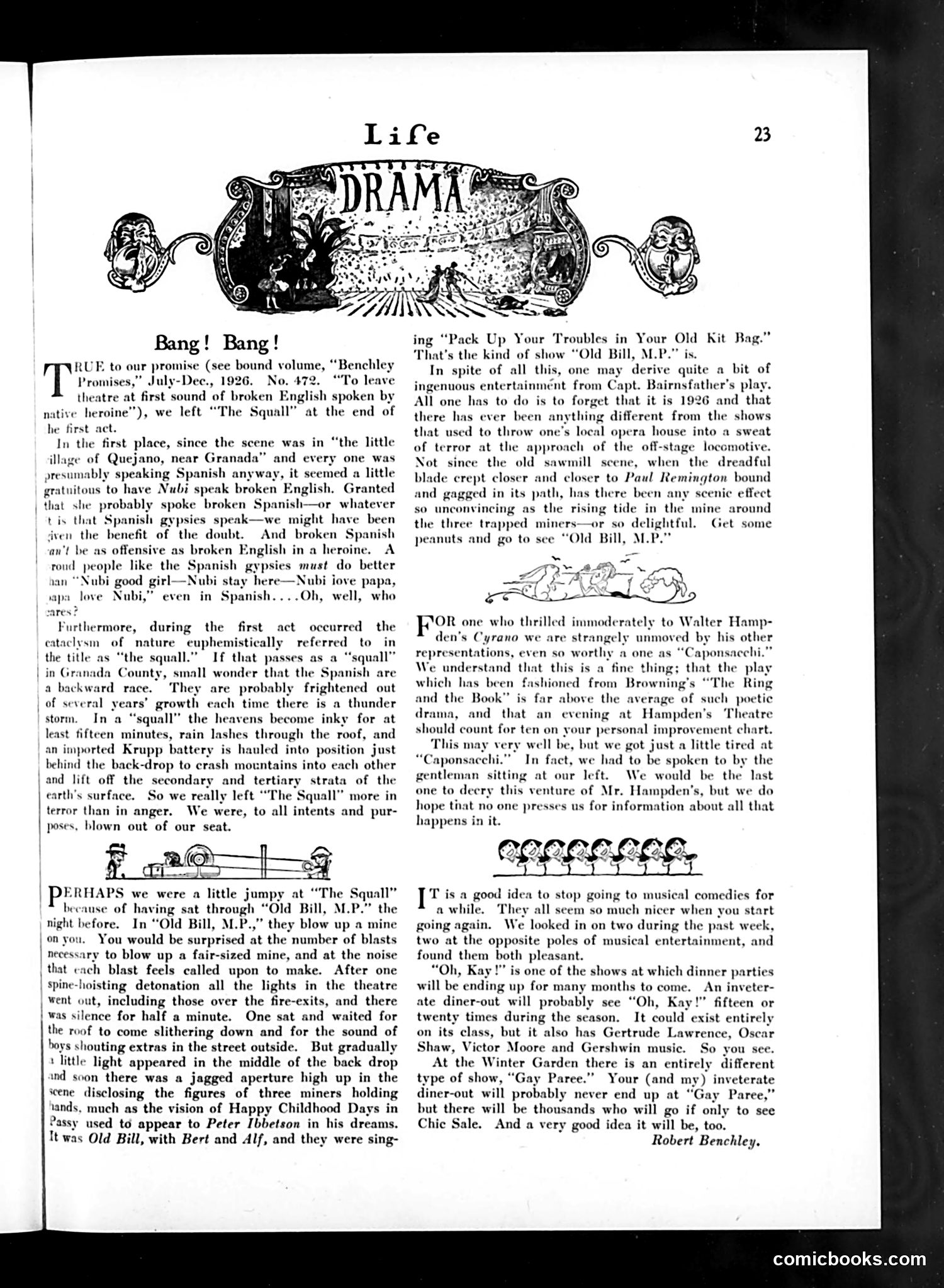
This page reviews three theatrical productions, written by Robert Benchley. The critic discusses "The Squall," a play set in Spain featuring a gypsy heroine named Nubi who speaks broken English despite the Spanish setting—Benchley finds this choice absurd and offensive, arguing the broken English is gratuitously awkward for a heroine. He then critiques "Old Bill, M.P.," a war play based on Captain Bairnsfather's work, mocking its melodramatic, outdated staging (including unconvincing mine-explosion effects and a rising-tide scene). Despite poor production values, he notes audiences derive entertainment from its nostalgic appeal to pre-1926 theatrical conventions. Finally, he mentions Walter Hampden's "Caponsacchi," adapted from Browning's poetry, acknowledging it's critically superior to the other productions but confessing personal indifference to it. The tone is satirical toward theatrical excess and audience credulity.
📄 Transcribed text from this page (OCR, searchable)
Machine-transcribed from the original scan — historical spelling and the odd misread are preserved.
Promises,” July-Dec., 1926. No. 472. “To leave theatre at first sound of broken English spoken by native heroine”), we left “The Squall” at the end of he first act. In the first place, since the scene was in “the little illage of Quejano, near anac and every one was presumably speaking Spanish anyway, it seemed a little gratuitous to have Nubi speak broken English. Granted that she probably spoke broken Spanish—or whatever tis that Spanish gypsies speak—we might have been civen the benefit of the doubt. And broken Spanish an’! be as offensive as broken English in a heroine. A roud people like the Spanish gypsies must do better tan “Nubi good girl—Nubi stay here—Nubi iove papa, apa love Nubi,” even in Spanish....Oh, well, who cares? Furthermore, during the first act cataclysm of nature euphemistically the title as “the squall.” If that y a “squall” | in Granada County, small wonder that the Spanish are a backward race. They are probably frightened out | of several ’ growth each time there is a thunder In a “squall” the heavens become inky for at least fifteen minutes, rain lashes through the roof, and an imported Krupp battery is hauled into po: behind the back-drop to crash mountains into | and lift off the secondary and tertiary stra | earth's surface. So we really left “The Squall” more in terror than in anger. We were, to all intents and pur- poses, blown out of our seat. Tires to our promise (see bound volume, “Benchley occurred the referred to in storm. ERHAPS we were a little jumpy at “The Squall” because of having sat through “Old Bill, M.P.” the night before. In “Old Bill, M.P.,” they blow up a mine | ony You would be surprised at the number of blasts ary to blow up a fair-sized mine, and at the noise j that each blast feels called upon to make. After one spine-hoisting detonation all the lights in the theatre went out, including those over the fire-exits, and there was silence for half a minute. One sat and waited for the roof to come slithering down and for the sound of boys shouting extras in the street outside. But gradually ‘ little light appeared in the middle of the back drop ind soon there was a jagged aperture high up in the scene disclosing the figures of three miners holding tands, much as the vision of Happy Childhood Days in Passy used to appear to Peter [bbetson in his dreams. It was Old Bill, with Bert and Alf, and they were sing- neces: ing “Pack Up Your Troubles in Your Old kit Bag.” That's the kind of show “Old Bill, M.P.” In spite of all this, one may derive quite a bit of ingenuous entertainment from Capt. Bairnsfather’s play. All one has to do is to forget that it is 1926 and that there has ever been anything different from the shows that used to throw one’s local opera house into a sweat of terror at the approach of the off-stage locomotive. Not since the old sawmill scene, when the dreadful blade crept closer and closer to Paul Remington bound and gagged ts path, has there been any scenic effect so unconvincing as the rising tide in the mine around the three trapped miners—or so delightful. Get some peanuts and go to see “Old Bill, M.P.” 4OR one who thrilled immoderately to Walter Hamp- den’s Cyrano we are strangely unmoved by his other representations, even so worthy as “Caponsacehi.” We understand that this is a fine thing; that the pl which has been fashioned from Browning's “The Ring and the Book” is far above the average of such poetic drama, and that an evening at Hampden’s Theatre should count for ten on your personal improvement chart. This may very well be, but we got just a little tired at “Caponsacel In fact, we had to be spoken to by the gentleman sitting at our left. We would be the last one to decry this venture of Mr. Hampden’s, but we do hope tiat no one presses us for information about all that happens in it. I‘ is a good idea to stop going to musical comedies for awhile. They all seem so much nicer when you start going again. We looked in on two during the past week, two at the opposite poles of musical entertainment, and found them both pleasant. “Oh, Kay!” is one of the shows at which dinner pa: will be ending up for many months to come. An inveter- ate diner-out will probably see “Oh, Kay!” fifteen or twenty times during the season. It could exist entirely on its class, but it also has Gertrude Lawrence, Oscar Shaw, Victor Moore and Gershwin music. So you see. At the Winter Garden there is an entirely different type of show, “Gay Paree.”” Your (and my) inveterate er-out will probably never end up at “Gay Paree,” but there will be thousands who will go if only to see Chic Sale. And a very good idea it will be, too. Robert Benchley, comicbooks.com