
Life, 1926-12-09 · page 28 of 45
Life — December 9, 1926 — page 28: what you’re looking at
What you’re looking at
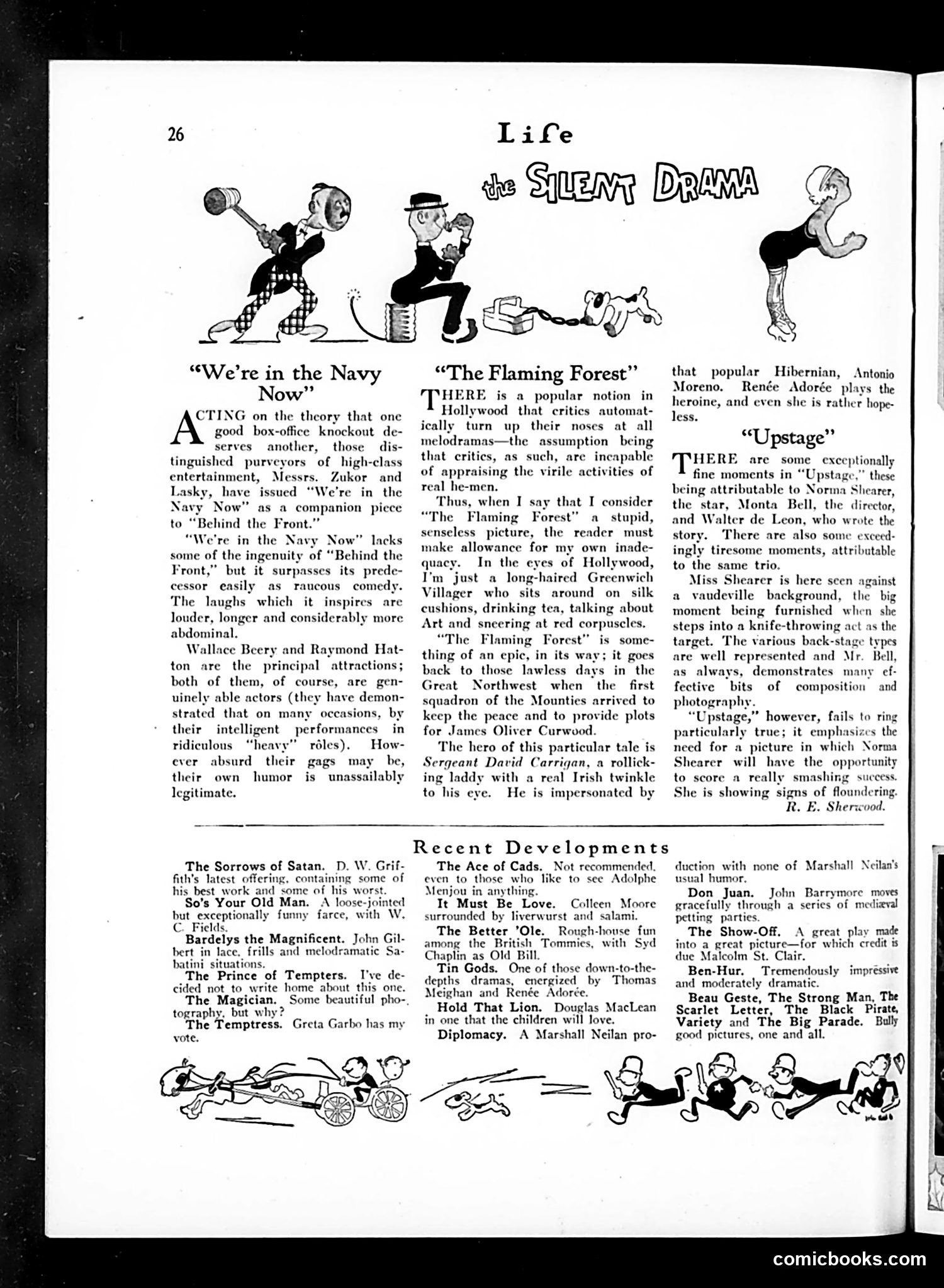
This page reviews several silent films from the early 1920s. The top section features three reviews by what appears to be R.E. Sherwood (a prominent drama critic of the era): **"We're in the Navy Now"** — A comedy sequel to "Behind the Front," starring Wallace Beery and Raymond Hatton. The reviewer praises it as "raucous comedy" with genuinely funny performances, despite absurd gags. **"The Flaming Forest"** — A melodrama the reviewer dismisses as "stupid" and "senseless," set in the Canadian Northwest with actor Antonio Moreno. The critic sardonically notes Hollywood assumes critics automatically reject melodramas, using himself as an example of a dismissive "Greenwich Villager." **"Upstage"** — Featuring Norma Shearer, directed by Monta Bell. The reviewer finds exceptional moments but overall considers it unconvincing, suggesting Shearer needs better material to truly succeed. The bottom section lists brief capsule reviews of other recent releases, using sharp, sometimes cutting humor typical of Life's satirical style.
📄 Transcribed text from this page (OCR, searchable)
Machine-transcribed from the original scan — historical spelling and the odd misread are preserved.
“We're in the Navy Now” CTING on the theory that one good box-office knockout de- serves another, those dis- tinguished purveyors of high-class entertainment, Messrs. Zukor and Lasky, have issued ‘We're in the ar Now” as a companion piece » “Behind the Front.” wave re in the Navy Now” lacks some of the ingenuity of “Behind the Front,” but it surpasses its prede- cessor easily as raucous comedy. The laughs which it inspires are Jouder, longer and considerably more abdominal. Wallace Beery and Raymond Hat- ton are the principal attractions; both of them, of course, are gen- uinely able actors (they have demon- strated that on many their intelligent performances in ridiculous “heavy” réles). How- ever absurd their gags may be, their own humor is unassailably legitimate. occasions, by “The Flaming Forest” HERE is a popular notion in Hollywood that critics automa ically turn up their noses at all melodramas—the assumption being that critics, as such, are incapable of appraising the virile activities of he-men. hus, when I say that I consider “The Flaming Forest’ a stupid, senseless picture, the reader must make allowance for my own inade- quacy. In the eyes of Hollywood, I'm just a long-haired Greenwich Villager who sits around on silk cushions, drinking tea, talking about Art and sneering at red corpuscles. “The Flaming Forest” some- thing of an epic, in its way; it goes back to those lawless days in the Great Northwest when the first squadron of the Mounties arrived to keep the peace and to provide plots for James Oliver Curwood. The hero of this particular tale is Sergeant David Carrigan, a rollick- ing laddy with a real Irish twinkle to his eve. He is impersonated by that popular Hibernian, Antonio Moreno. Renée Adorée plays the heroine, and even she is rather hope- less. “Upstage” HERE are some_ exceptionally fine moments in “Upstage,” these being attributable to Norma Shearer, the star, Monta Bell, the director, and Walter de Leon, who wrote the story. There are also some exceed- ingly tiresome moments, attributable to the same trio. Miss Shearer is here seen against a vaudeville background, the big moment being furnished when she steps into a knife-throwing act as the target. The various back-stage types are well represented and Mr. Bell, as always, demonstrates many ef- fective bits of composition and photography. “Upstage,” however, fails to ring particularly true; it emphasizes the need for a picture in which Norma Shearer will have the opportunity to score a really smashing success. She is showing signs of floundering. R. E. Sherwood. The Sorrows of Satan. D. W. Grif- fith’s latest offering, containing some of his best work and some of his worst. So’s Your Old Man. A loose-jointed but exceptionally funny farce, with W. C._ Fields. Bardelys the Magnificent. John Gil- bert in lace, frills and melodramatic Sa- batini situations. The Prince of Tempters. I've de- cided not_to write home about this one. The Magician. Some beautiful pho- tography, but why? The Temptress. Greta Garbo has my Recent Developments The Ace of Cads. Not recommended, even to those who like to see Adolphe Menjou in anything. It Must Be Love. Colleen Moore surrounded by liverwurst and salami. The Better ’Ole. Rough-house fun among the British Tommies, with Syd Chaplin_as Old Bill. Tin Gods. One of those down-to-the- depths dramas, energized by Thomas Meighan and Renée Adorée. Hold That Lion. Douglas MacLean in one that the children will love. Diplomacy. A Marshall Neilan pro- duction with none of Marshall Neilan’s usual humor. Don Juan. John Barrymore moves gracefully through a series of medieval petting parties. The Show-Off. A great play made into a great picture—for which credit is due Malcolm St. Clair. Ben-Hur. — Tremendously and moderately dramatic. Beau Geste, The Strong Man, The Scarlet Letter, The Black Pirate, Variety and The Big Parade. Bully good pictures, one and all. impréssive < Cy, Q comicbooks.com 7