
A complete issue · 45 pages · 1926
Life — November 11, 1926
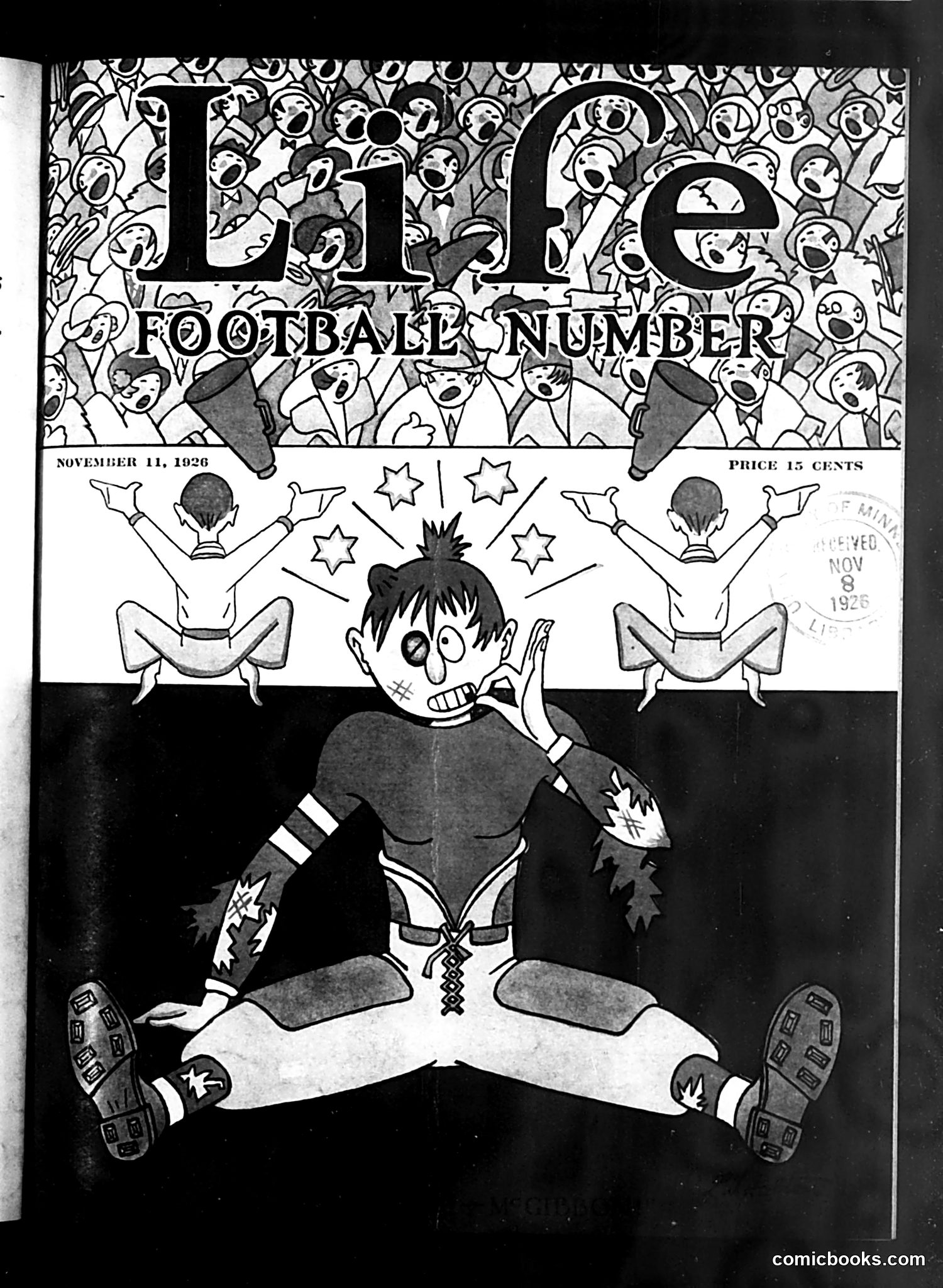
This is a cover for *Life's* sports-themed issue, featuring an exaggerated cartoon character in football uniform. The central figure displays grotesque features—wild hair, enormous grin, and an exaggerated body—typical of 1920s caricature style. The character sits triumphantly with legs spread, surrounded by adoring crowd faces at top and celebratory imagery (stars, cheering figures) below. The satire appears to mock the excessive hype and celebrity culture surrounding college football during the "Golden Age of Sports" in the 1920s. The grotesque portrayal suggests ironic commentary on how the public idolizes football players, elevating them to absurd, almost monstrous status. The 15-cent price and November date position this during peak college football season.
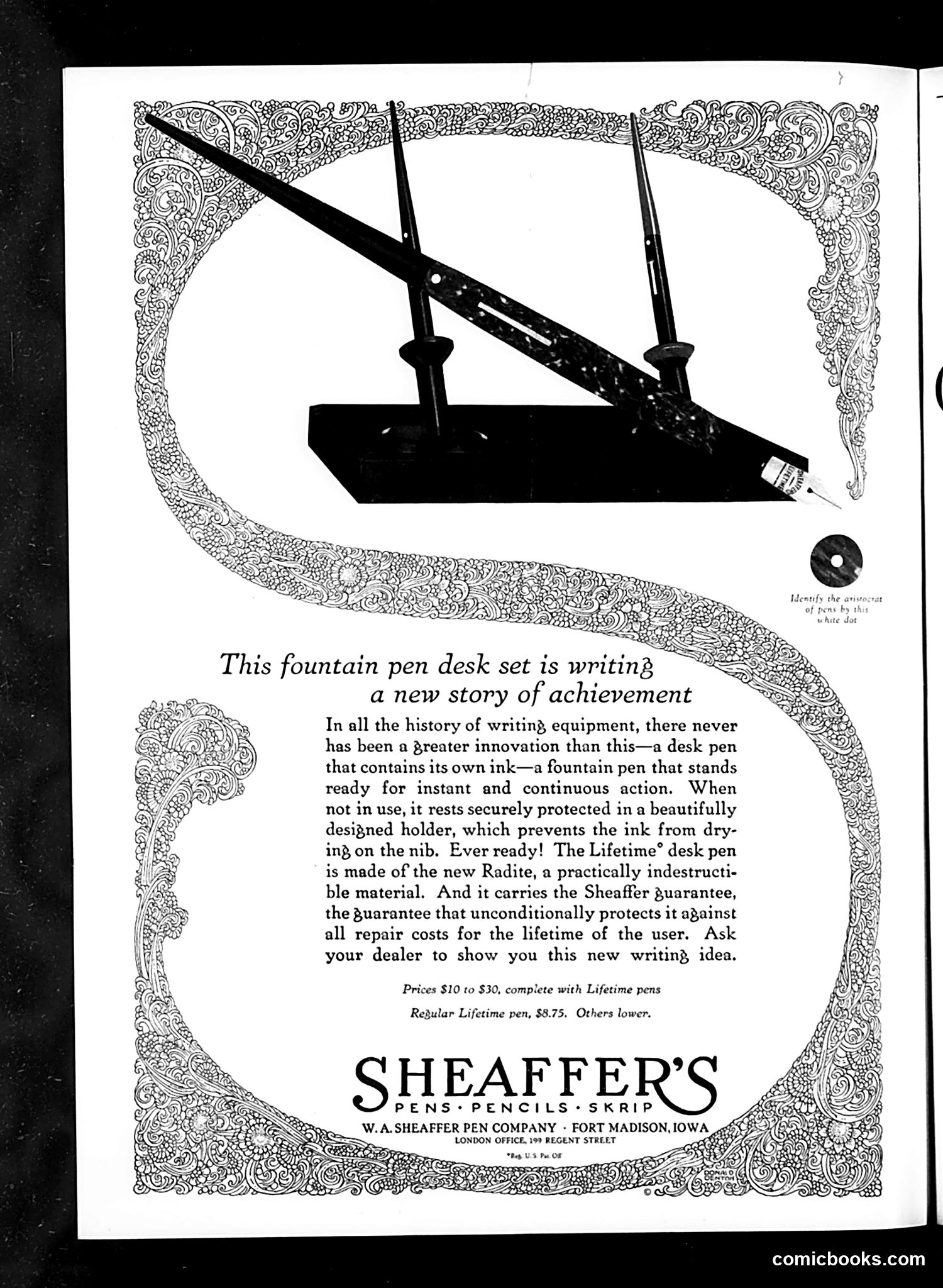
This page is **primarily an advertisement**, not satirical content. It promotes Sheaffer's fountain pen desk sets, marketed as an innovation in writing equipment. The ad emphasizes the pen's practical features: it stores ink internally, rests securely in a decorative holder (preventing nib drying), and comes with a lifetime guarantee covering all repair costs. The pen is made from "Radite," described as nearly indestructible. The ornate decorative border and formal typography reflect early 20th-century advertising aesthetics. Pricing ranges from $10-$30 for complete desk sets, with standard pens at $8.75. There is **no political or social satire** on this page. It's a straightforward product advertisement for the W.A. Sheaffer Pen Company, based in Fort Madison, Iowa, with a London office.
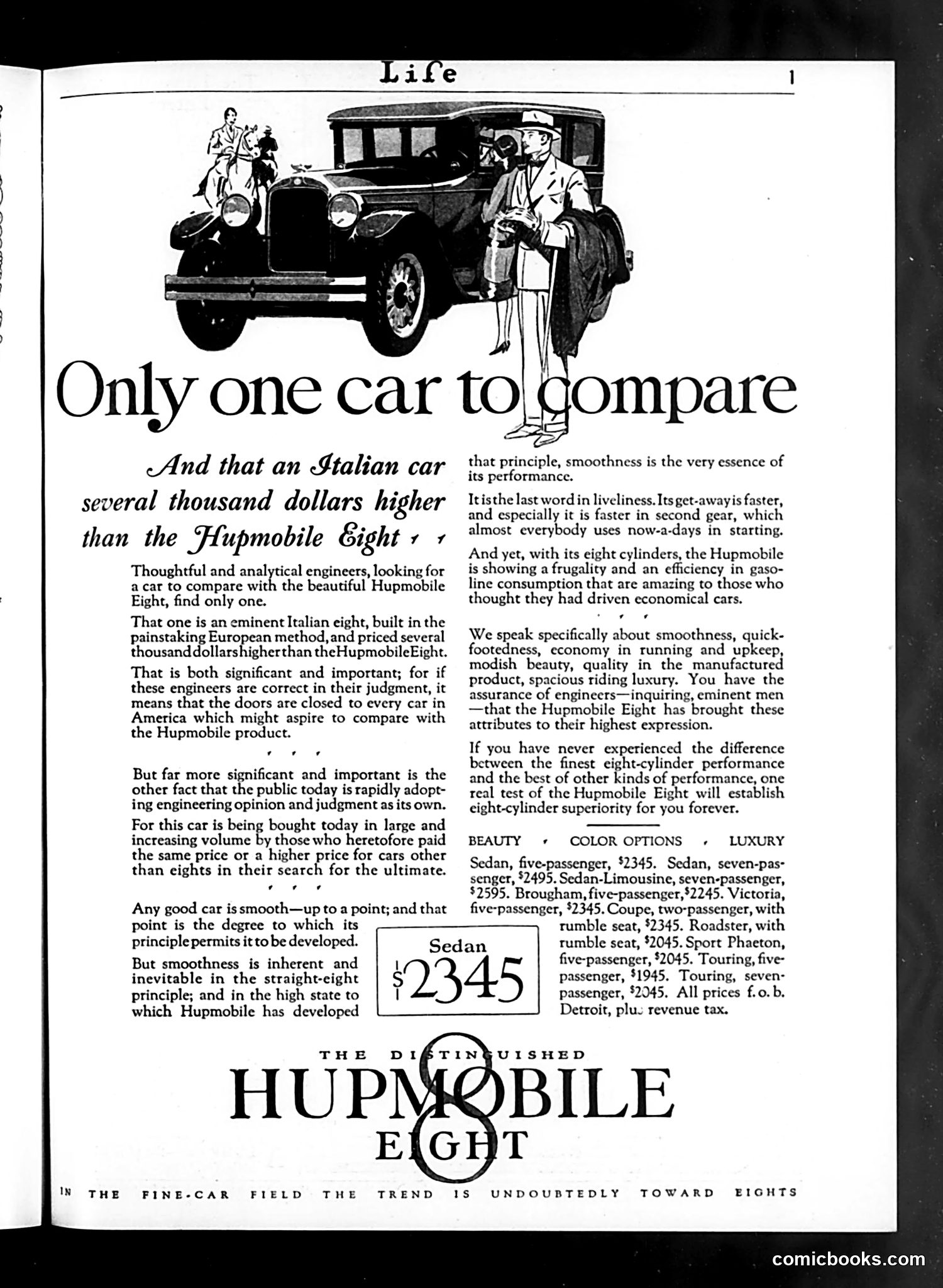
This is primarily **advertising content**, not satire or political commentary. The Hupmobile Eight automobile company places a full-page ad in Life magazine comparing their eight-cylinder car favorably to competitors. The ad's humor is gentle and commercial rather than satirical. It features an illustration of a well-dressed man examining a Hupmobile, with well-to-do figures in the background. The "joke" is that there's "only one car to compare"—implying the Hupmobile's superiority is so obvious that comparisons are unnecessary. The ad emphasizes smoothness, economy, and performance as selling points, targeting affluent buyers. Pricing starts at $2,345 for a sedan. This reflects 1920s automobile marketing conventions, not social or political satire.
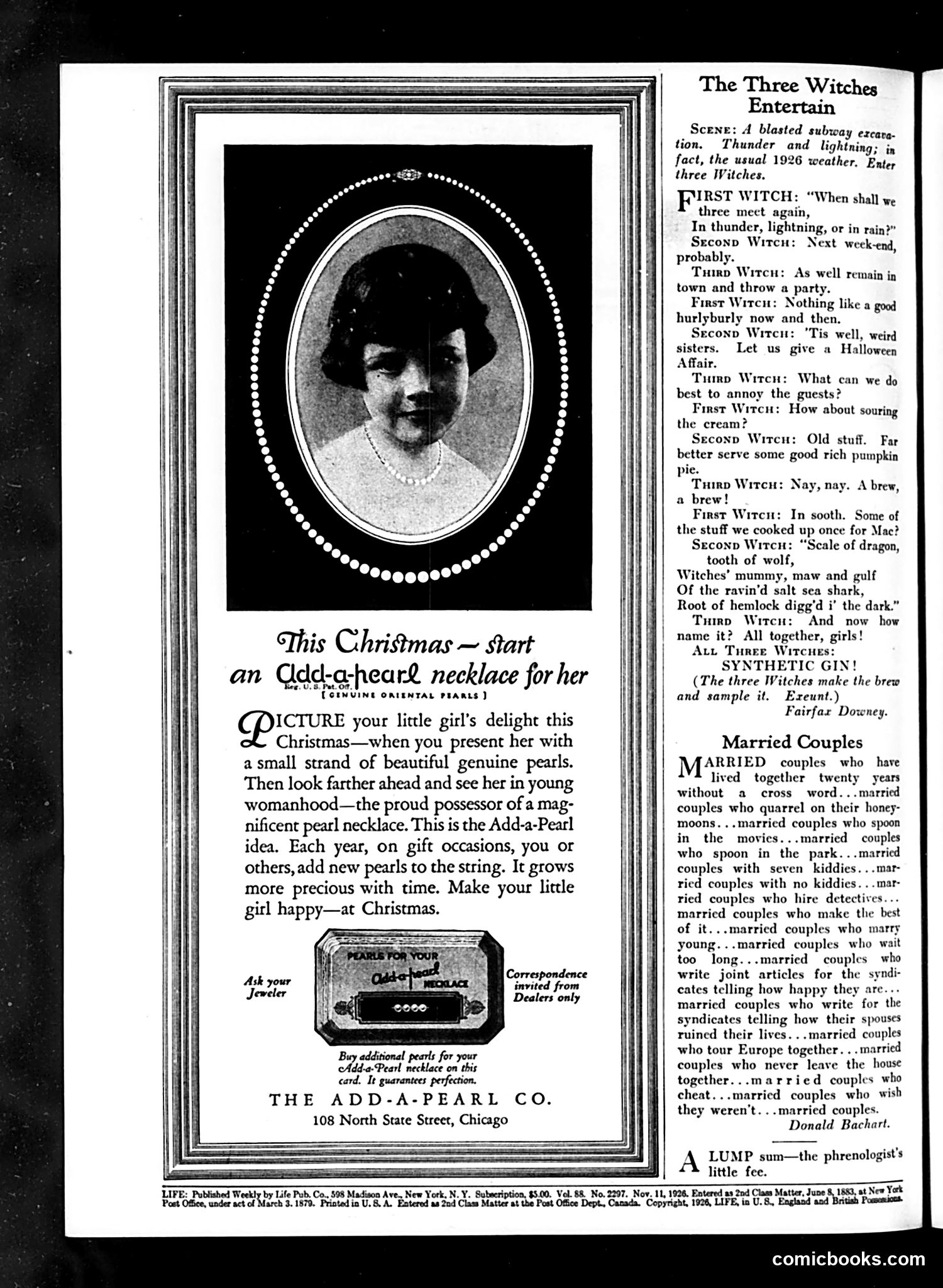
This page contains **two distinct items**: a pearl necklace advertisement (left) and literary content (right). The **advertisement** promotes the "Add-a-Pearl" necklace concept—a marketing strategy where parents gift a child a strand of pearls, then add pearls annually. The pitch targets gift-giving occasions across the child's life, culminating in her wearing it as a mature woman. This reflects 1920s consumer culture and the advertising industry's growing sophistication in creating long-term brand loyalty. The **right column** features "The Three Witches Entertain"—a Shakespearean parody (the witches reference *Macbeth*) reimagined for humorous Halloween entertainment. Below is a satirical piece on "Married Couples" by Donald Bachart, cataloging mundane domestic scenarios in comedic shorthand—typical *Life* magazine social satire of the era.
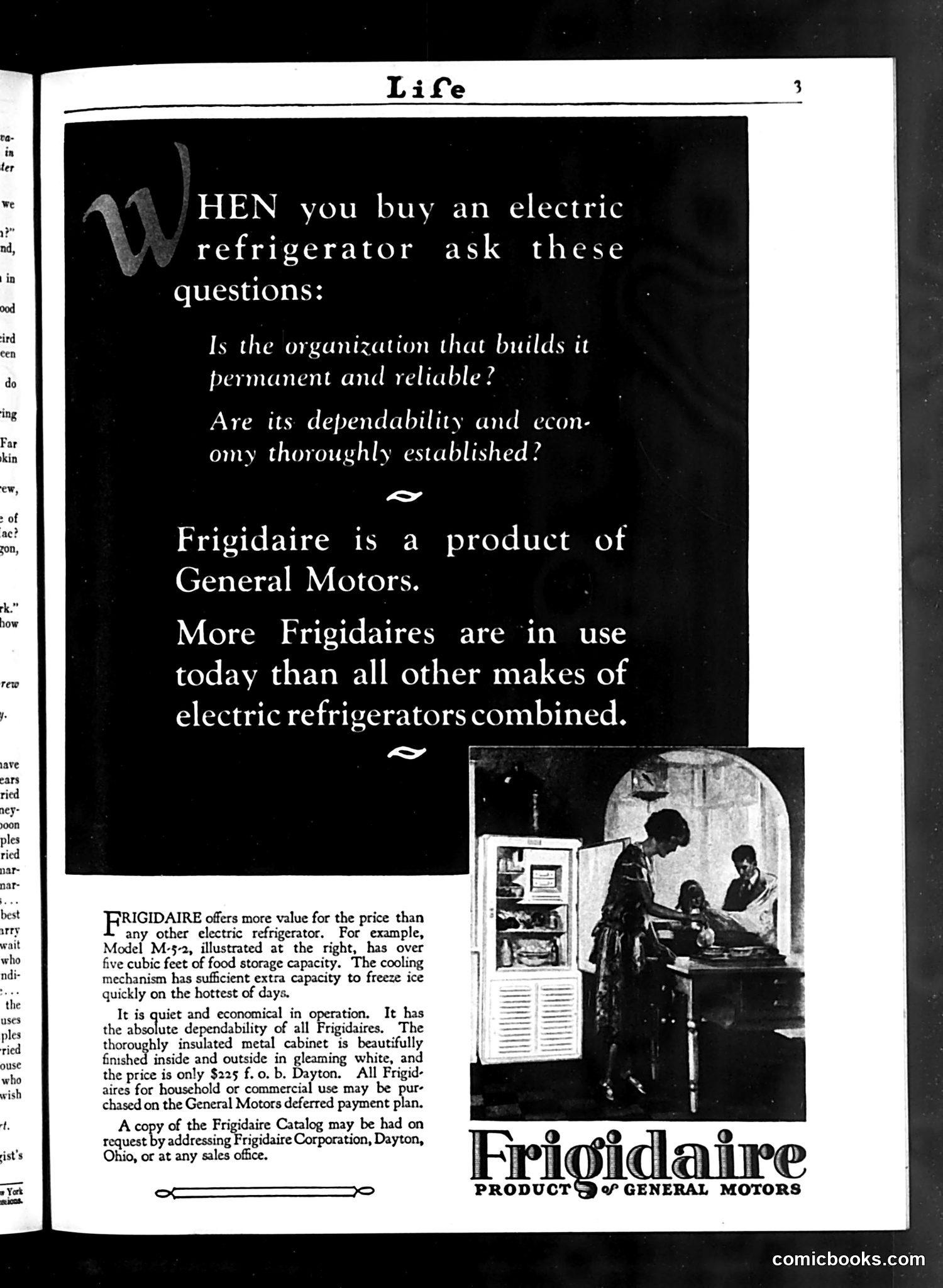
This is a **Frigidaire refrigerator advertisement**, not satire or political commentary. The page uses a rhetorical strategy common in early 20th-century advertising: it poses questions to consumers ("When you buy an electric refrigerator ask these questions") about reliability and economy, then answers them by promoting Frigidaire as a General Motors product. The ad claims Frigidaire dominates the market ("More Frigidaires are in use today than all other makes combined") and emphasizes affordability ($325 f.o.b. Dayton, with payment plans available). The photograph shows a family using the Model M-5-2 refrigerator in a domestic kitchen setting—typical aspirational advertising imagery for the era depicting modern convenience and family life.
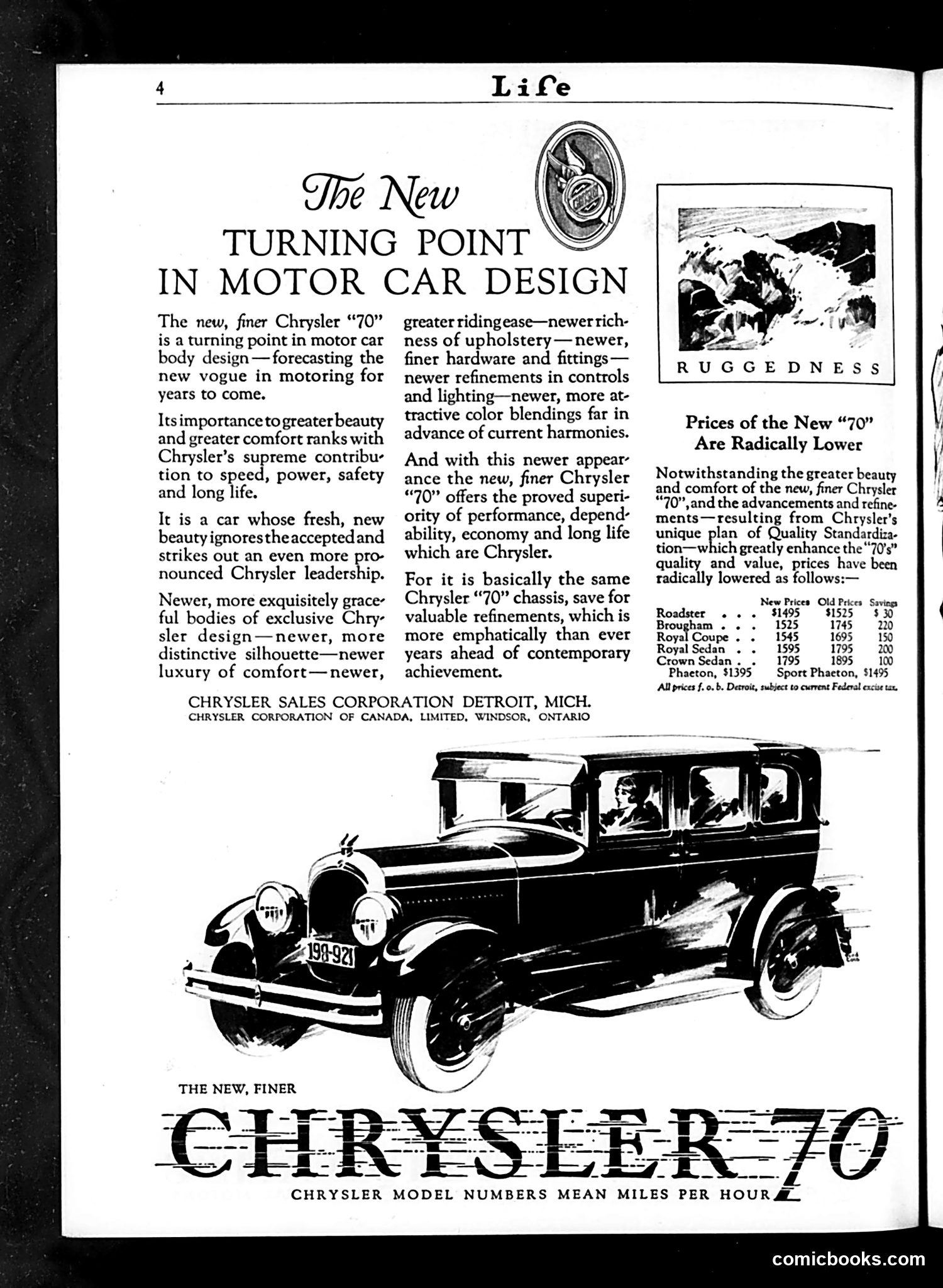
This page is **primarily advertising, not satire or editorial content**. It's a Chrysler Motor Company advertisement for the new "70" model, which according to the fine print means "miles per hour." The ad emphasizes the car's design innovations—more comfortable bodies, refined controls, better lighting, and color combinations—positioning it as a significant advancement in automotive engineering. The single image shows the Chrysler "70" sedan with passengers, rendered in a professional illustration style typical of 1920s advertising. There is **no political cartoon or satire present**. This is straightforward commercial promotion highlighting product features and competitive pricing, reflecting how Life magazine balanced editorial content with paid advertising revenue.
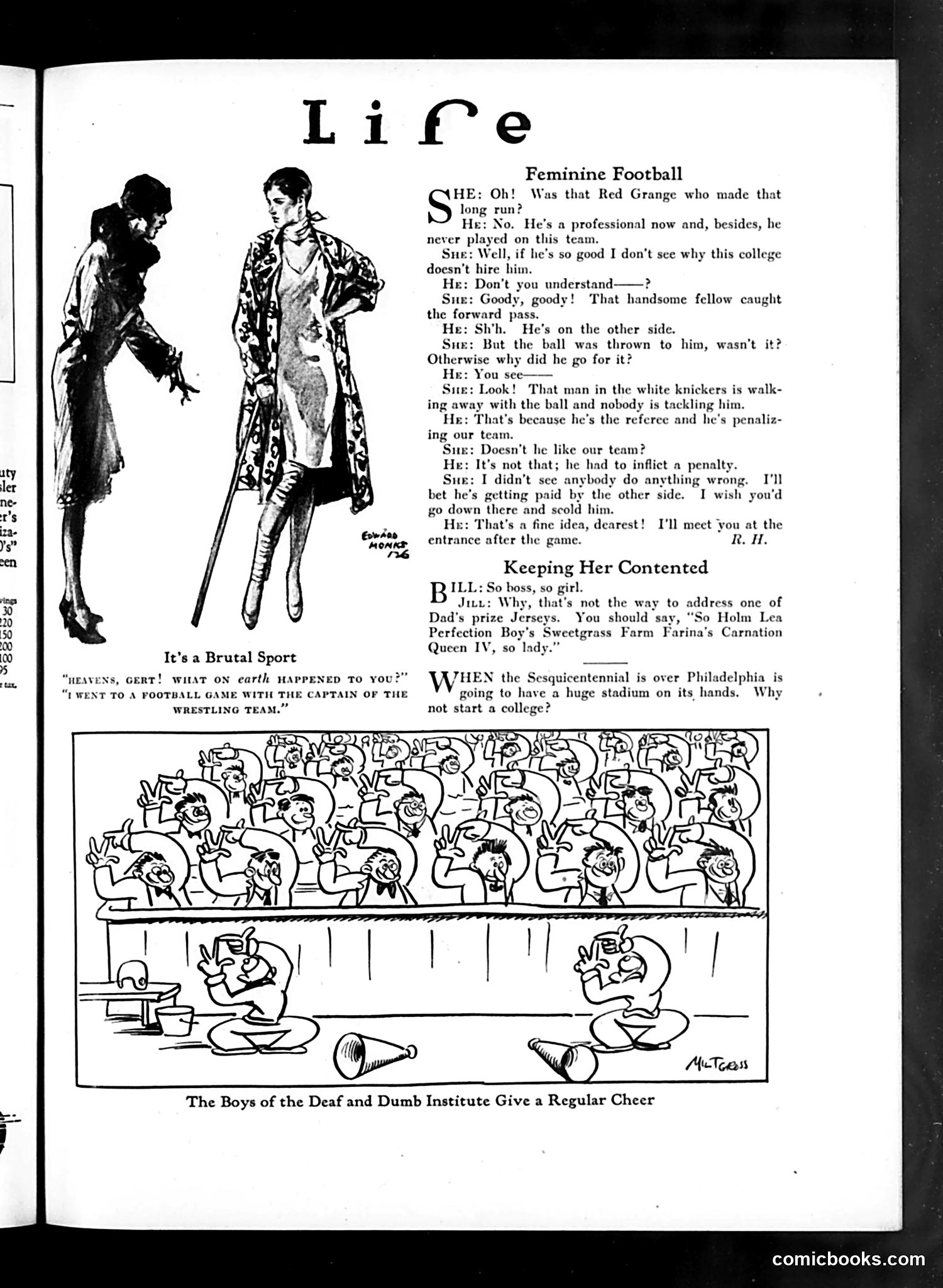
This page contains two satirical pieces about women's sports in what appears to be the 1920s era. **"Feminine Football"** depicts a dialogue between a man and woman arguing about a college football game. The woman questions why her college doesn't hire a particular talented player, misunderstanding basic football rules about forward passes and penalties. The satire mocks women's supposed ignorance of sports. **"It's a Brutal Sport"** shows a man claiming he joined a wrestling team but actually attended a women's football game—suggesting women's athletics are chaotic or comically incompetent. The bottom cartoon, "The Boys of the Deaf and Dumb Institute Give a Regular Cheer," depicts deaf/mute students attempting to cheer, using visual gestures and horns instead of vocal cheers—played for comedic effect. The humor relies on period stereotypes about women and disability.
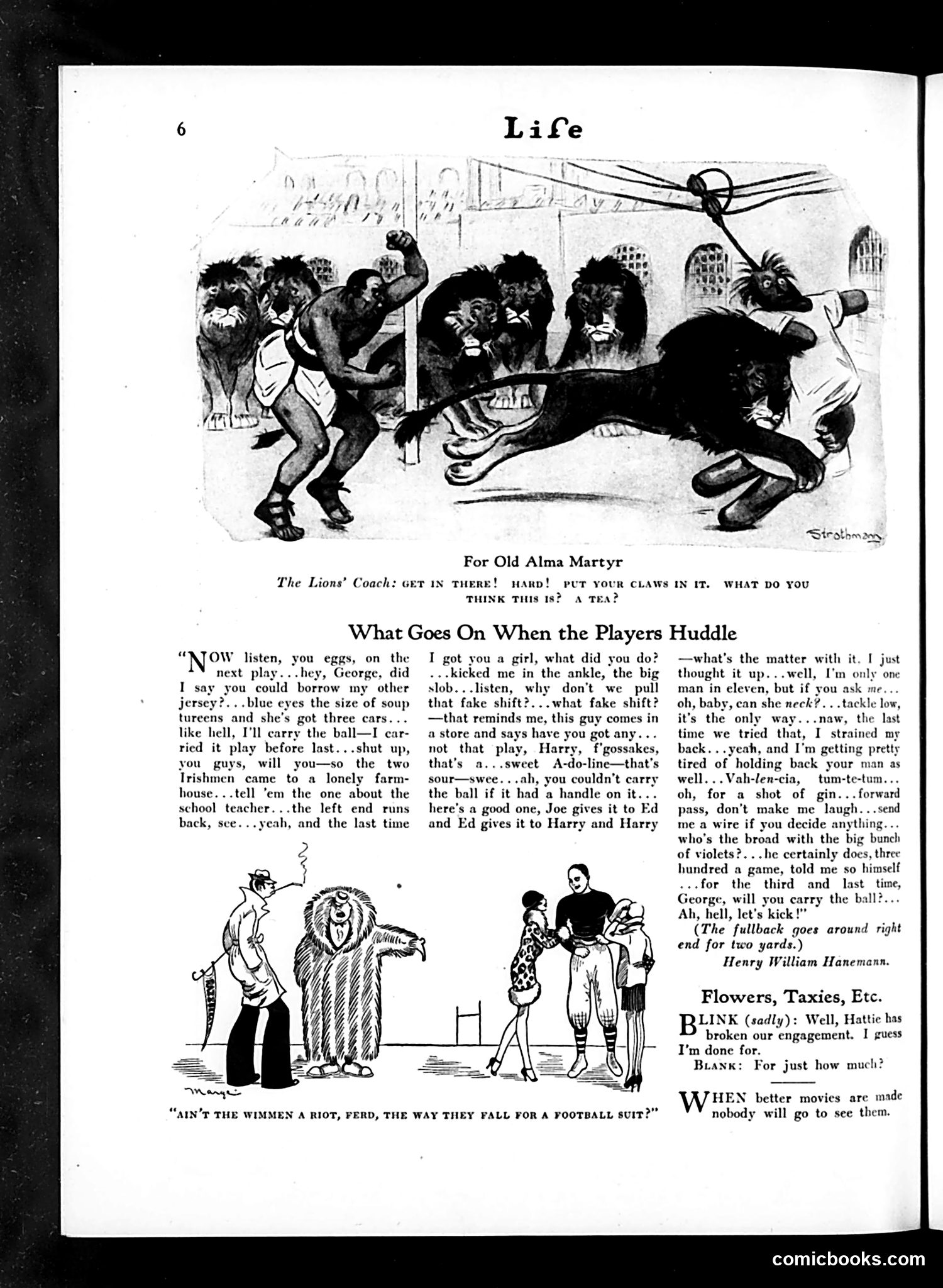
**Top Cartoon:** "The Lions' Coach" depicts anthropomorphized lions in a sports huddle, with the coach instructing them to "put your claws in it." The satire compares ruthless football tactics to predatory animal behavior, suggesting that competitive football players are encouraged to be aggressive and injurious—"like hell, I'll carry the ball." **Middle Section:** "What Goes On When the Players Huddle" presents a lengthy humorous monologue capturing locker-room banter. Players discuss borrowed equipment, romantic entanglements, and strategic plays in crude, colloquial language. **Bottom Cartoon:** "Ain't the Wimmen a Riot, Ferd" shows a man with a lion, appearing to mock female enthusiasm for football. The page satirizes early 20th-century American football culture—its violence, machismo, and the social phenomenon of female spectators.
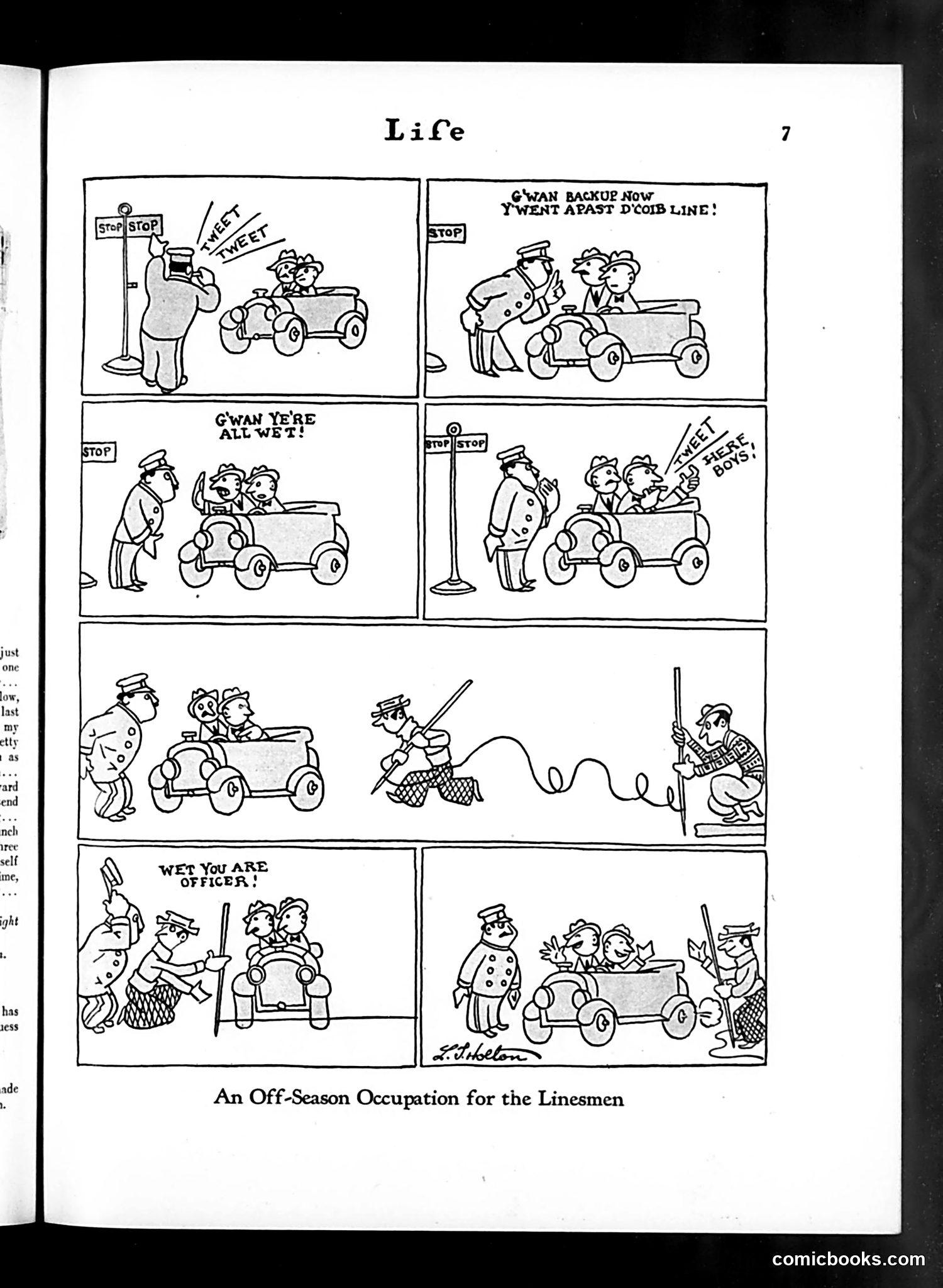
This comic strip satirizes traffic police officers ("linesmen" — those who enforce street traffic lines) during their off-season when there's less work. The humor progresses through escalating absurdity: 1. An officer tickets a toy car at a stop sign 2. He stops children in the toy car, warning them to back up 3. He chases them with a water hose (as if it's a weapon) 4. In the final panels, he's actively attacking/arresting them with a club and net The satire mocks overzealous police who, lacking real enforcement duties, invent petty violations or resort to comical harassment of innocent civilians—here represented by children in a toy car. It's a commentary on bureaucratic overreach and boredom-driven abuse of authority.
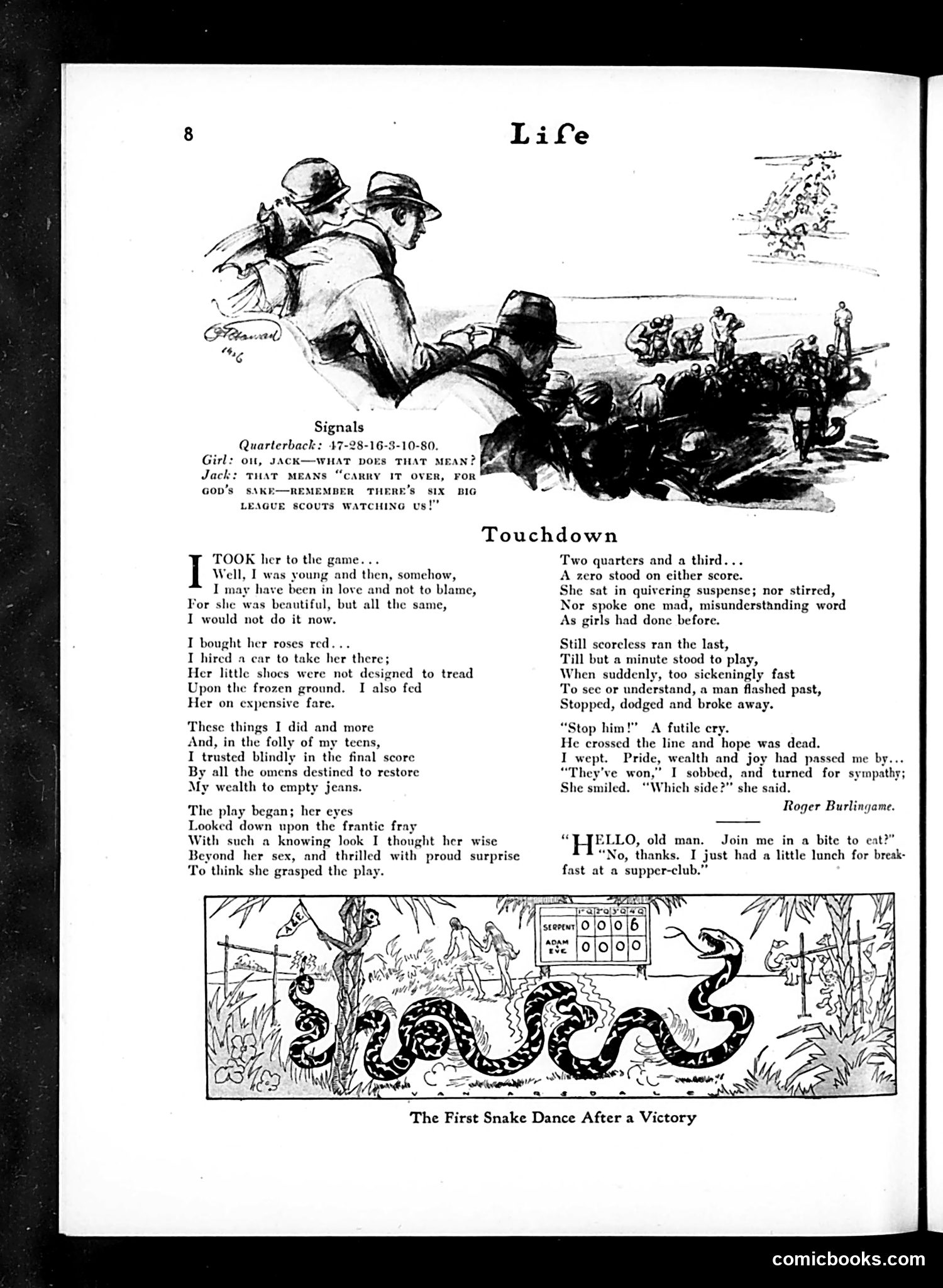
This page contains a poem titled "Touchdown" by Roger Burlingame about taking a woman to a football game. The narrator describes hiring a car, buying her roses, and trusting her with his wealth—only to watch their team lose, causing him emotional devastation while she remains unmoved by the defeat. The satirical point: the poem mocks male emotional investment in sports and the absurdity of a man's romantic gestures being overshadowed by athletic disappointment. The humor targets masculine vulnerability and the disproportionate importance placed on game outcomes. The bottom cartoon, "The First Snake Dance After a Victory," depicts celebratory snakes dancing at a stadium after a win—a whimsical, surreal image contrasting with the poem's melancholy tone and likely referencing actual celebratory "snake dances" (conga-line celebrations) that occurred after sports victories.
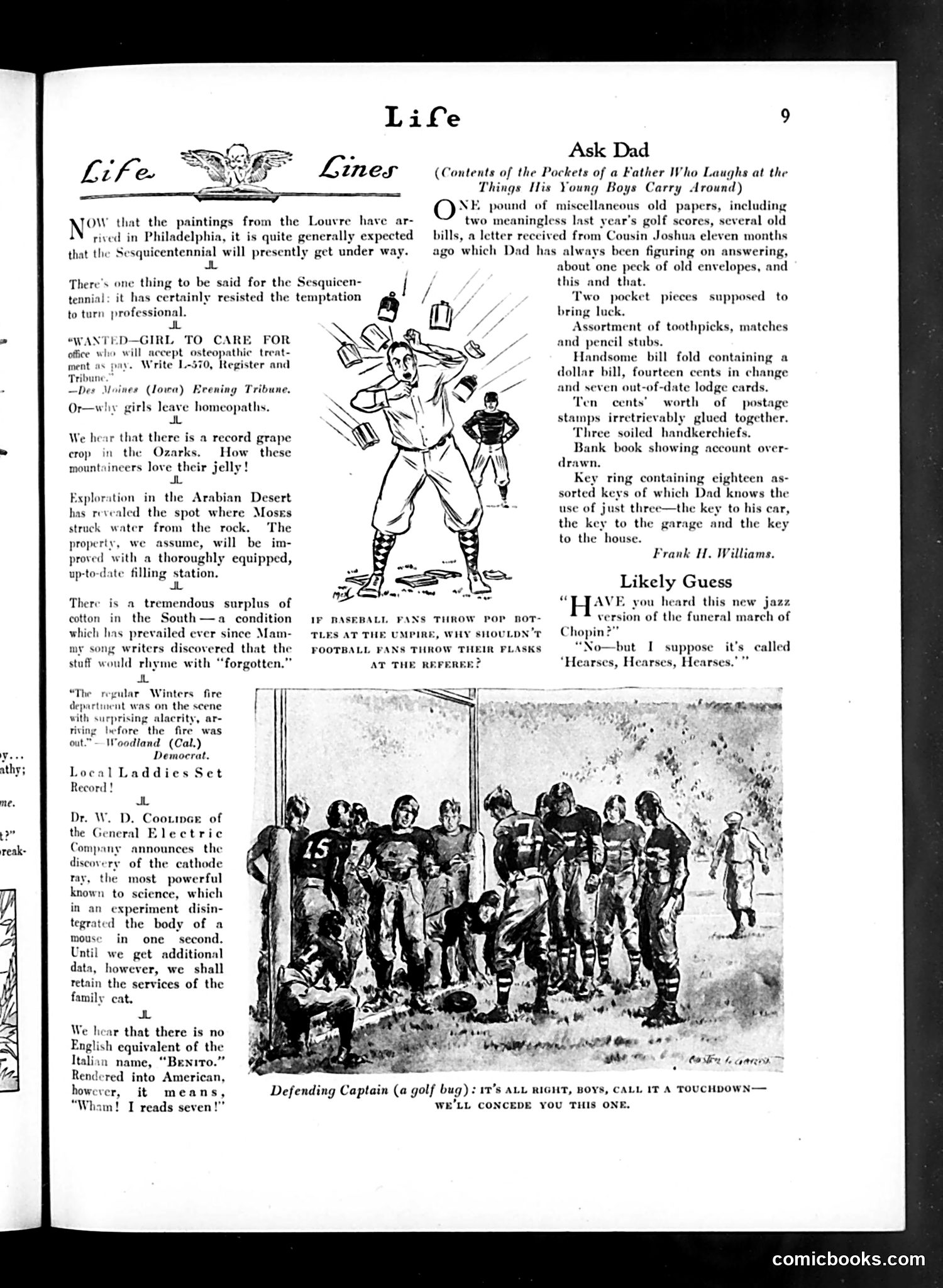
This page features humorous advice columns and illustrations typical of early 20th-century Life magazine. The main cartoon shows a father figure surrounded by miscellaneous items from his pockets—a visual joke about the random junk fathers accumulate. The accompanying text catalogs these items: old papers, bills, envelopes, toothpicks, matches, a key ring with eighteen keys, and an overdrawn bank book. The satire targets the stereotypical absent-minded father figure—a common character in period humor. The joke rests on the idea that fathers are walking repositories of useless items and financial disorganization, presented as harmless domestic comedy rather than serious criticism. The page also includes unrelated brief anecdotes about art, cotton, and sports, typical of Life's miscellaneous humor format.
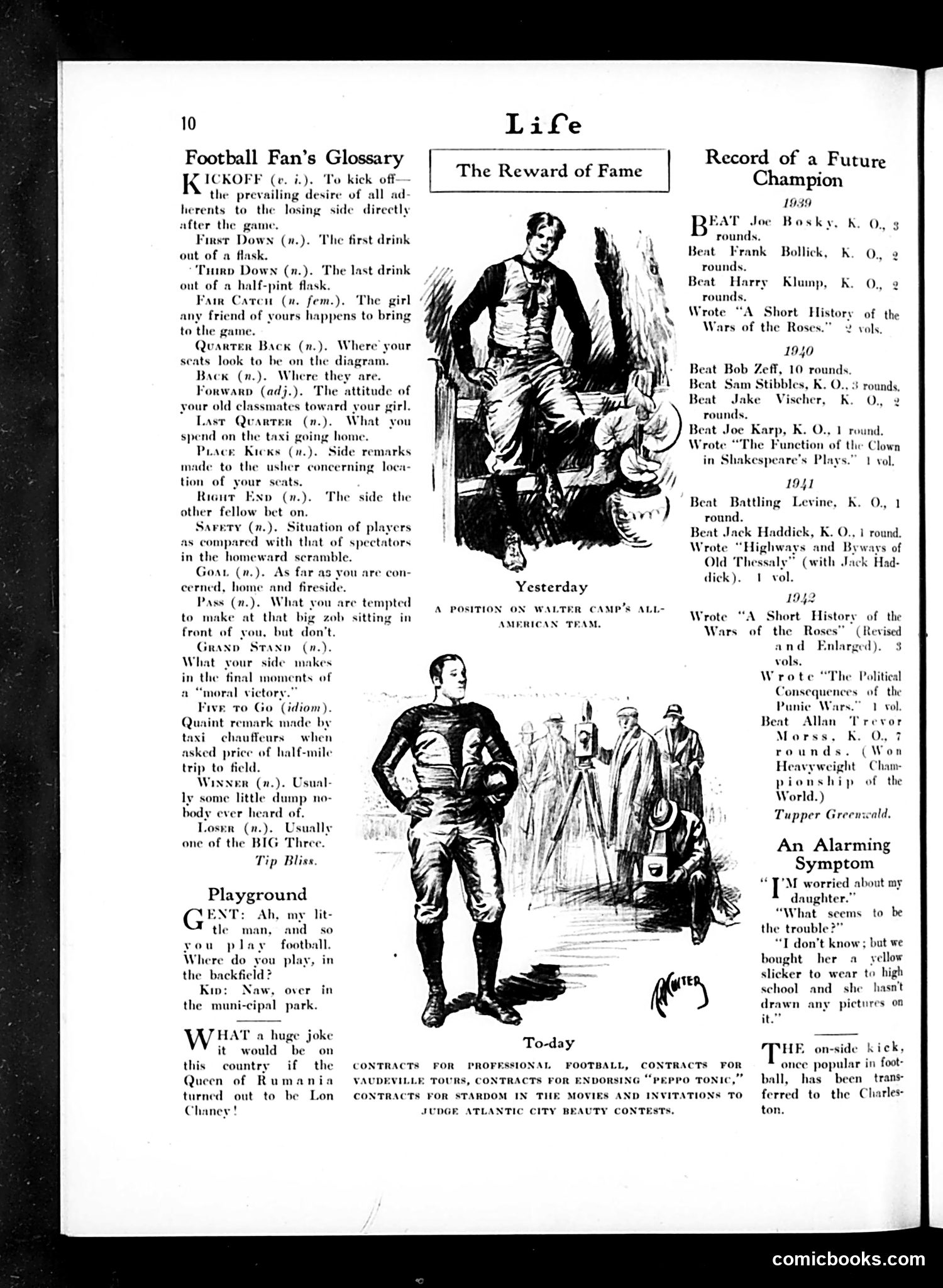
This page contains a **Football Fan's Glossary** (left column), two illustrations, and sports/entertainment content. The top illustration shows a figure in period military dress seated with what appears to be a large animal—likely depicting a historical or allegorical scene titled "The Reward of Fame" and "Yesterday," though the specific reference is unclear from context alone. The bottom illustration labeled "To-day" shows a football player in uniform with well-dressed pedestrians in the background, contrasting past and present. The right column lists boxing victories and literary works from 1939-1942, suggesting this celebrates an athlete-turned-author. The page's humor relies on football terminology definitions and the contrast between athletic and intellectual achievements—typical of Life's satirical approach to American celebrity culture.
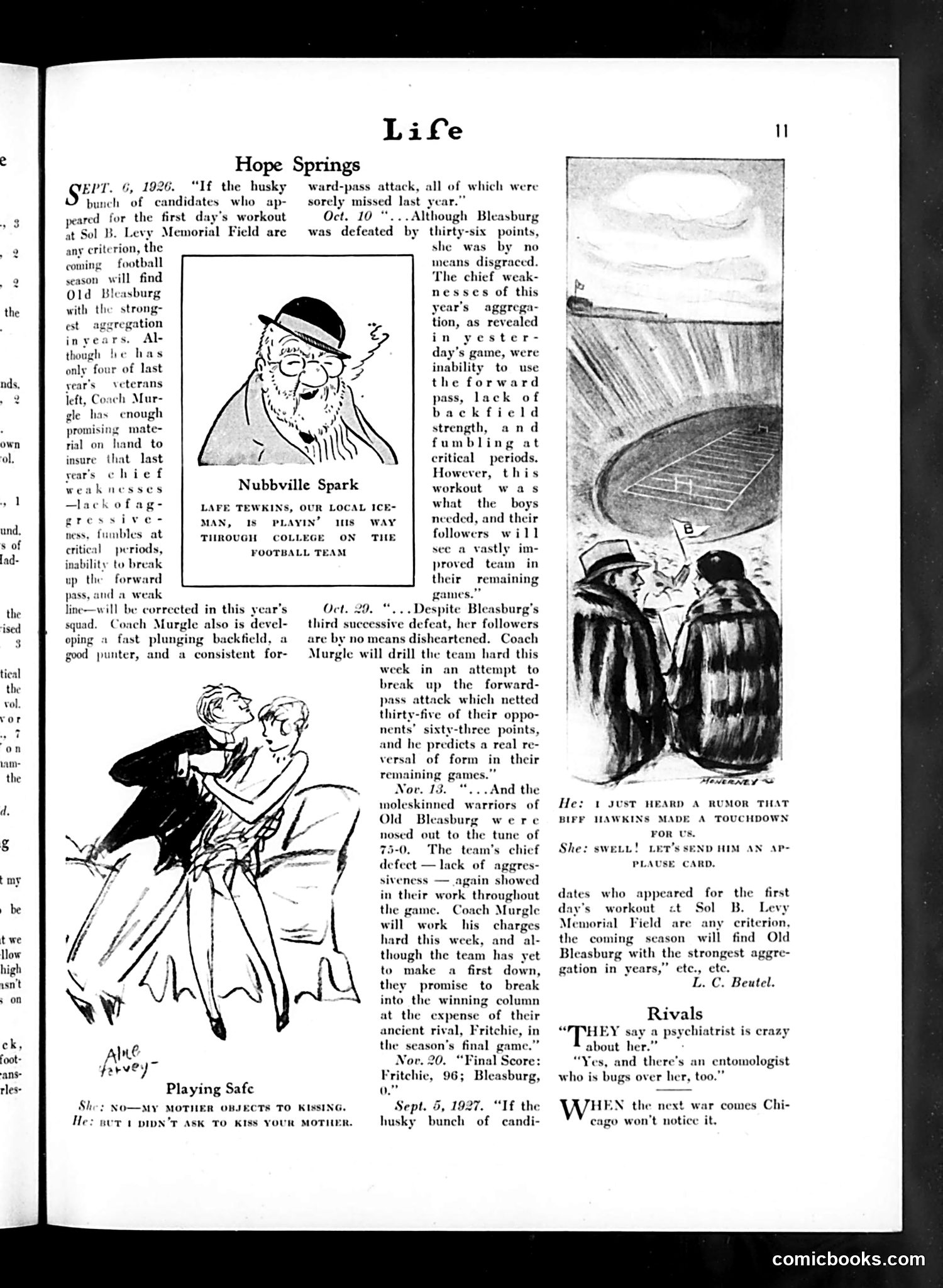
This page satirizes college football, specifically **Old Bleasburg's** struggling football team. The cartoon "Nubville Spark" depicts **Life Tewkins, a local ice-man**, humorously described as "playin' his way through college on the football team"—suggesting he's an unlikely or unqualified player. The accompanying article mocks Bleasburg's repeated defeats and weak performance (lacking aggression, backfield strength, and forward-pass execution). Coach Murgle is portrayed as attempting to salvage the season through harder drilling. The smaller cartoon "Playing Safe" is a domestic joke about a mother objecting to her son kissing. The page's humor relies on contemporary college football culture and small-town American life in the 1920s—presenting amateur athletes and coaching struggles with gentle, affectionate mockery typical of Life's satirical approach.
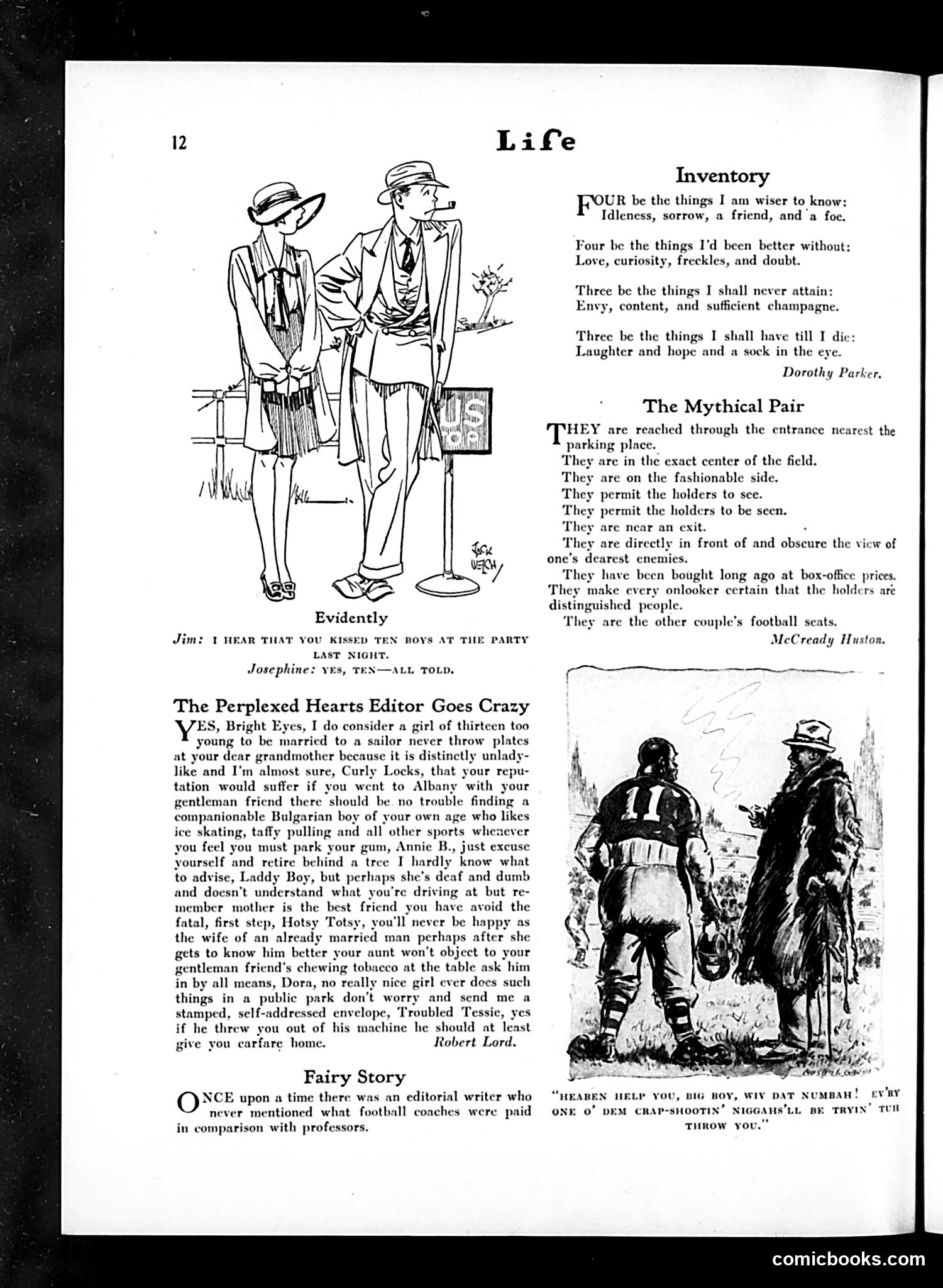
This page contains three satirical pieces about social etiquette and romantic advice typical of 1920s Life magazine: **"Evidently"** mocks a couple at a party through dialogue about kissing boys. **"The Perplexed Hearts Editor Goes Crazy"** parodies advice columnists by presenting an absurdly long, rambling response to a letter from "Bright Eyes" about whether a 13-year-old should marry a sailor. The editor's answer humorously spirals into incoherent suggestions, satirizing the overwrought nature of contemporary advice columns. **"The Mythical Pair"** describes football spectators with desirable seats—a social commentary on status and visibility at sporting events. **"Fairy Story"** (text only, incomplete) appears to begin a satirical tale about editorial writers and football coaches' salaries. The drawings illustrate fashionable 1920s dress and social situations.
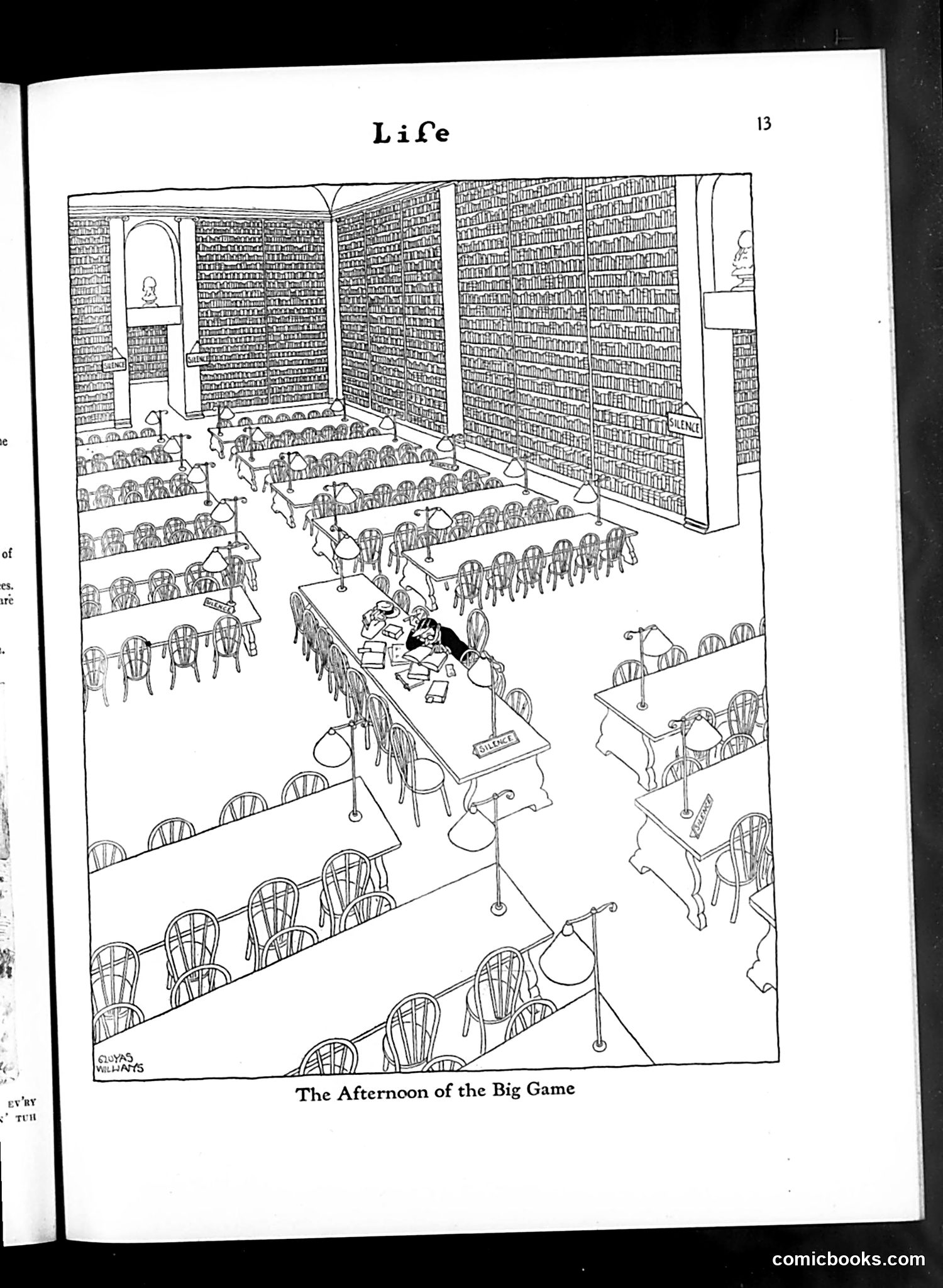
This cartoon depicts a massive library or repository of books arranged in towering shelves that form the walls of what appears to be a vast institutional space. In the foreground, numerous figures sit at tables arranged in rows—this appears to satirize the American obsession with spectator sports, particularly football games. The joke seems to be that while crowds gather to watch "the big game," an equally massive crowd could fill a library of comparable size. The cartoon critiques either the relative lack of interest in intellectual pursuits compared to sports, or perhaps comments on how libraries were underutilized compared to sports venues. The architectural exaggeration emphasizes this social contrast satirically.
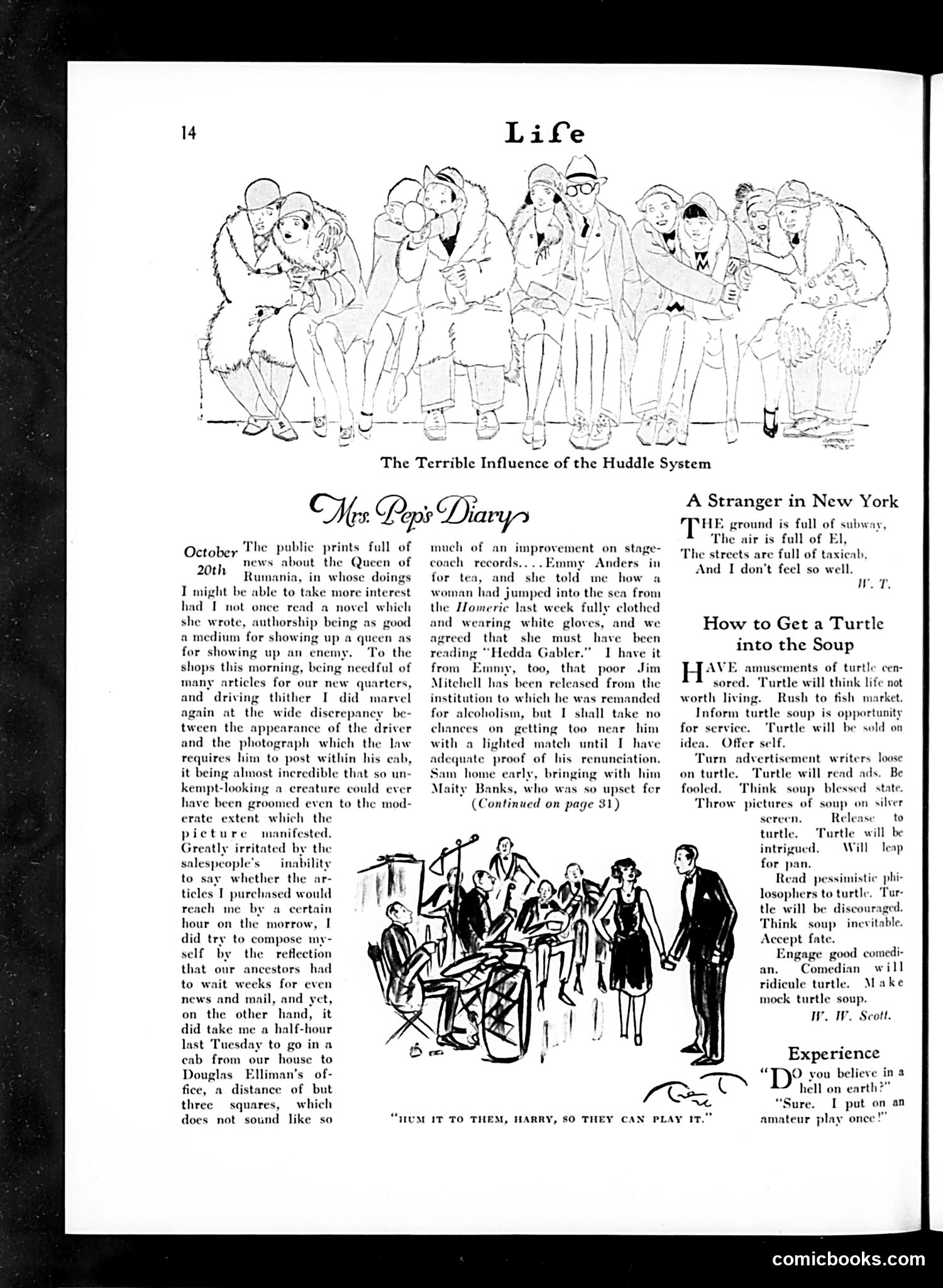
This page contains several distinct humor pieces rather than a unified political cartoon. **Top cartoon** ("The Terrible Influence of the Huddle System"): Depicts a group of men in coats and hats huddled together. This satirizes the "huddle" formation in American football, which was relatively new at this time, suggesting it had negative social influence—possibly implying it encouraged roughness or unsportsmanlike behavior. **"Mrs. Pipp's Diary"** and accompanying sections are personal anecdotes and light social commentary rather than political satire. The remaining pieces ("A Stranger in New York," "How to Get a Turtle into the Soup," "Experience") are humorous short-form writing typical of Life's satirical editorial content, poking fun at contemporary urban life and human nature rather than addressing specific political events.
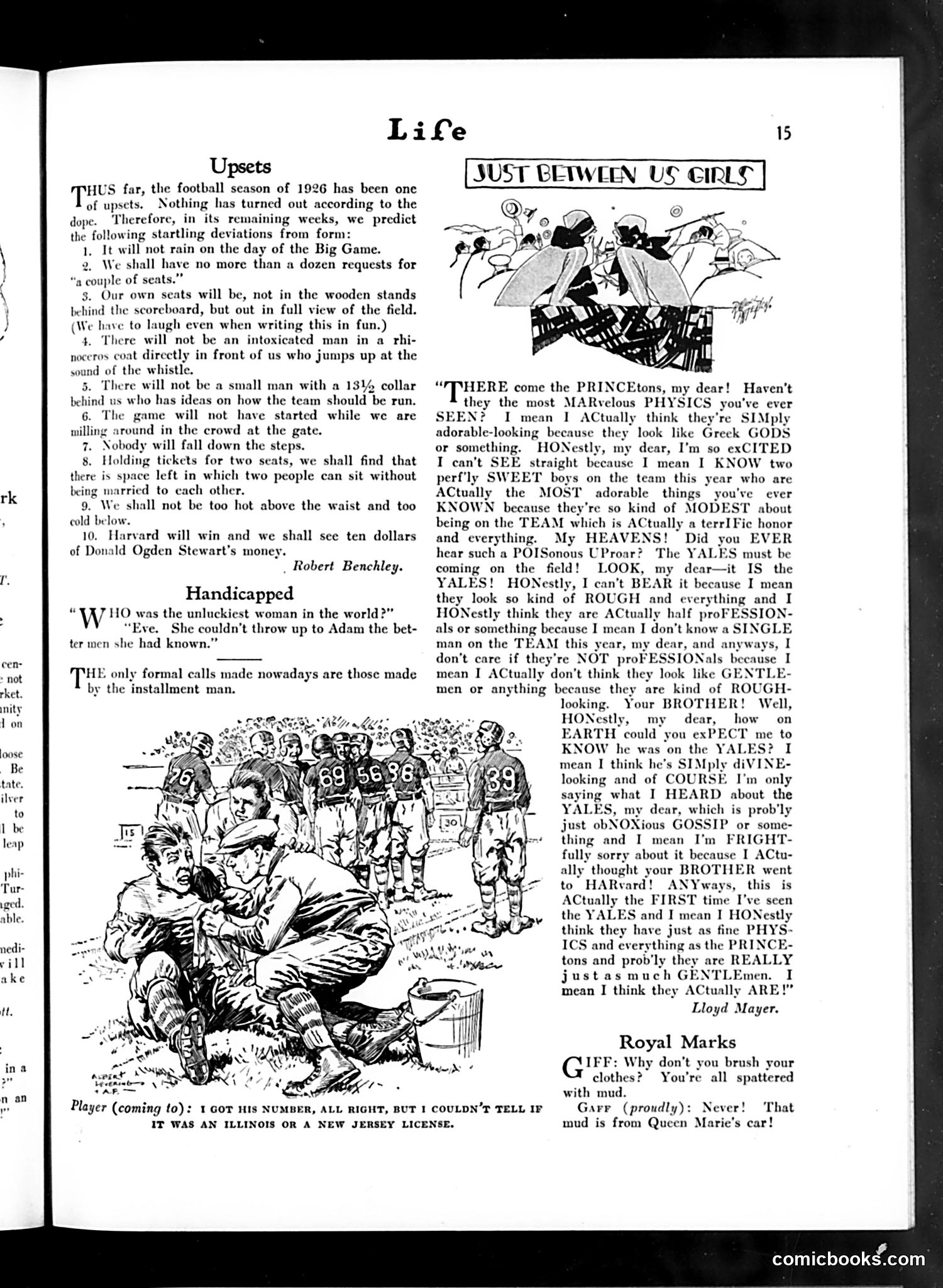
This is a **1926 Life magazine humor page** featuring football-related content. The main cartoon titled "Handicapped" shows a coach addressing his team, illustrating the caption: "Player (coming to): I got his number, all night, but I couldn't tell if it was an Illinois or a New Jersey license." The joke references **inter-state rivalry in college football**, specifically between University of Illinois and presumably Rutgers or another New Jersey school. The humor comes from a player being hit so hard during the game that he couldn't identify which state's rival tackled him—suggesting the collision was so violent it scrambled his perception. The other pieces ("Upsets," "Just Between Us Girls," and "Royal Marks") are unrelated humor columns typical of Life's satirical format during this era.
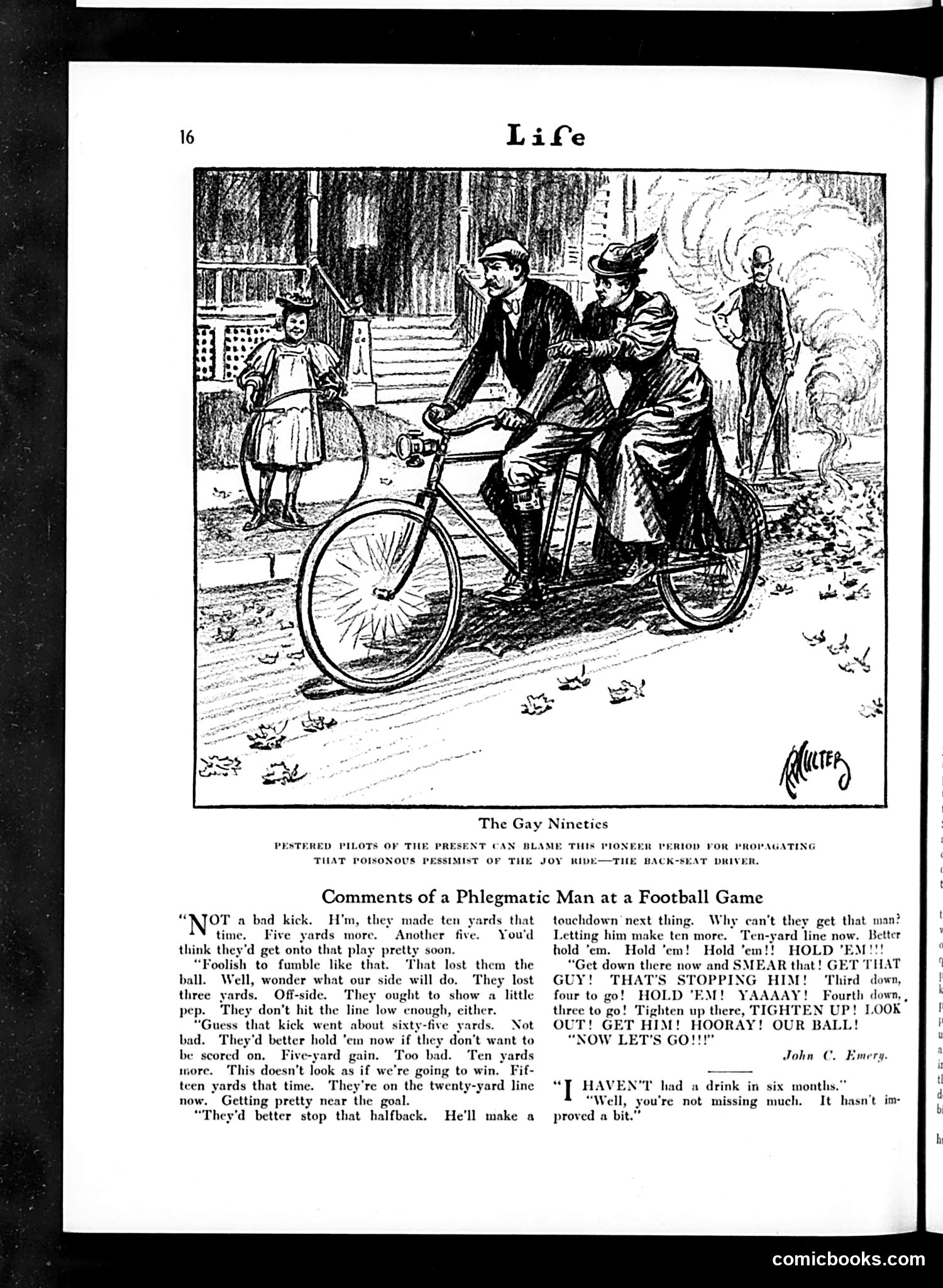
**The Cartoon ("The Gay Nineties"):** This illustration depicts two men on a tandem bicycle, watched by pedestrians. The caption mocks "pestered pilots of the present" who blame this pioneer bicycle period for popularizing "that poisonous pessimist of the joy ride—the back-seat driver." The joke is that the tandem bicycle invented the problem of one passenger backseat driving the other, a nagging companion who gives unwanted directions or criticism while not controlling the vehicle. **The Text Below:** Two separate comic vignettes follow: 1. A hyperactive football game commentator's breathless play-by-play narration 2. A brief joke about someone not drinking alcohol for six months The page satirizes everyday American annoyances and social situations through humor.
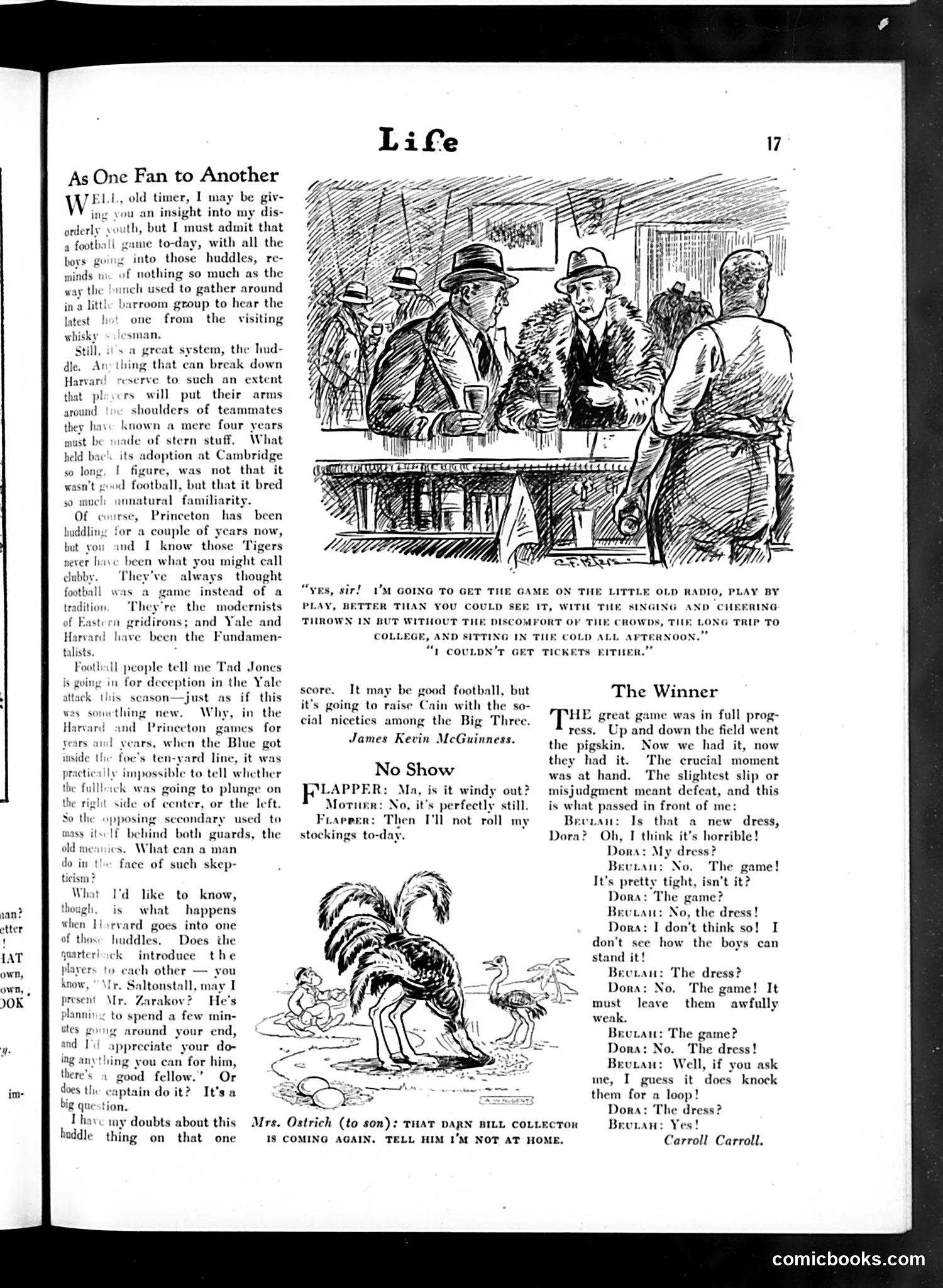
This page contains three separate humorous pieces about college football and social life: 1. **"As One Fan to Another"** (top left): A lengthy column criticizing Harvard's football prowess and questioning the legitimacy of elite university dominance in the sport. The author suggests such success seems "unnatural" and suspects deception in recruitment practices. 2. **"No Show"** (middle): A brief comic dialogue between characters "Flapper" and "Morning" about weather canceling stockings—likely referring to women's fashion trends of the era (the 1920s flapper period). 3. **"The Winner"** (right): A dialogue between characters Beulah and Dora debating whether to attend a crucial football game or wear a new dress—satirizing women's priorities and the social importance of both fashion and sports. The cartoons reflect 1920s college culture and gender dynamics.
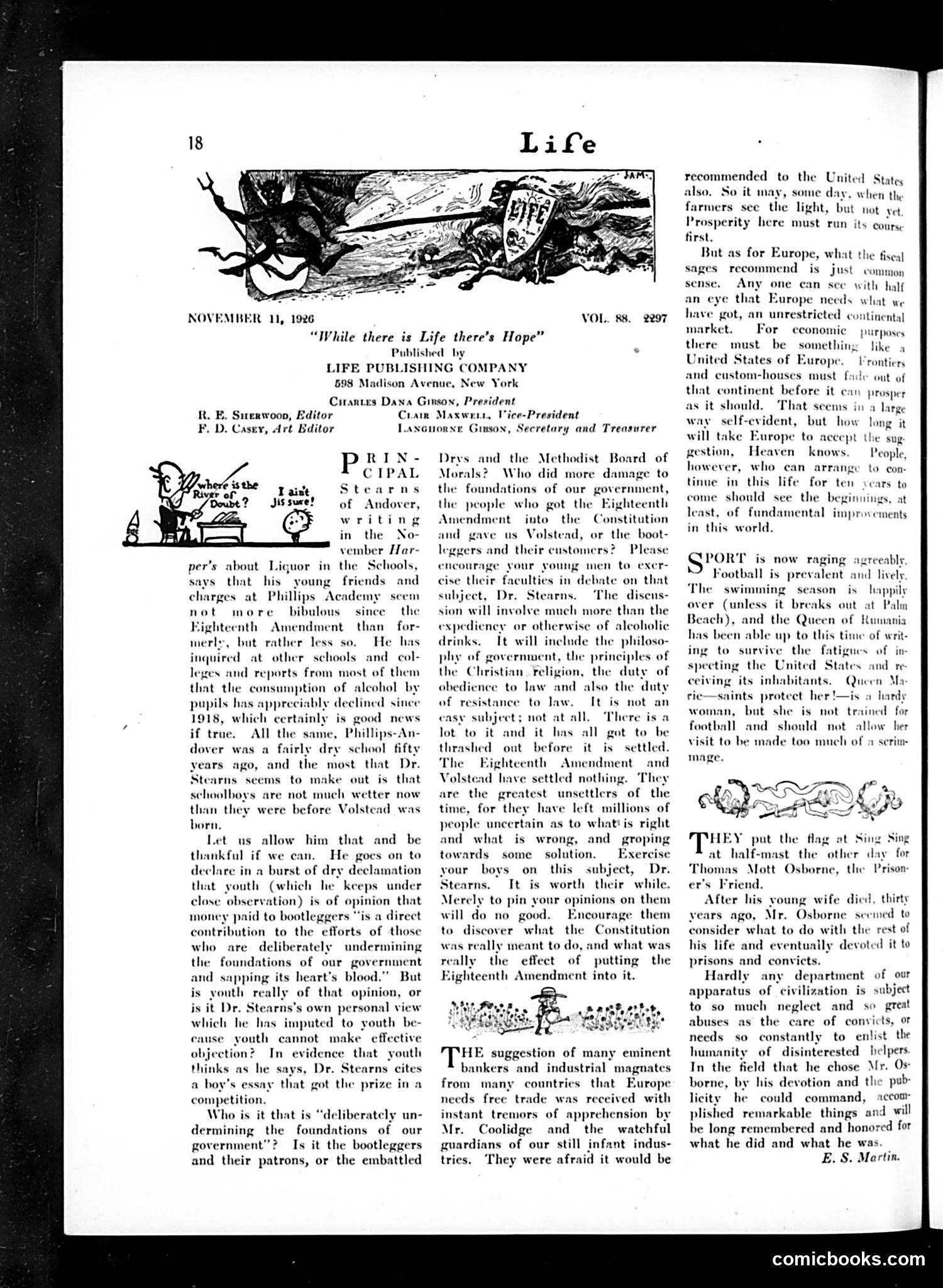
This page contains editorial commentary on Prohibition and related policy debates, rather than traditional political cartoons. The main content attacks Dr. Stearns of Phillips Academy, who claimed Prohibition hasn't increased youth drinking. The anonymous editor sarcastically questions whether Stearns is reporting facts or imposing his own anti-alcohol ideology on young people. The piece provocatively asks: who actually undermined American government—bootleggers and drinkers, or the "Drys and the Methodist Board of Morals" who imposed Prohibition through the Eighteenth Amendment? The satire argues the Eighteenth Amendment and Volstead Act created fundamental confusion about law and morality, leaving millions uncertain about right and wrong. A secondary editorial discusses free trade in Europe, sarcastically noting American industrial interests fear recommending it to the U.S., despite its economic sense. The cartoons are decorative mastheads without substantive commentary.
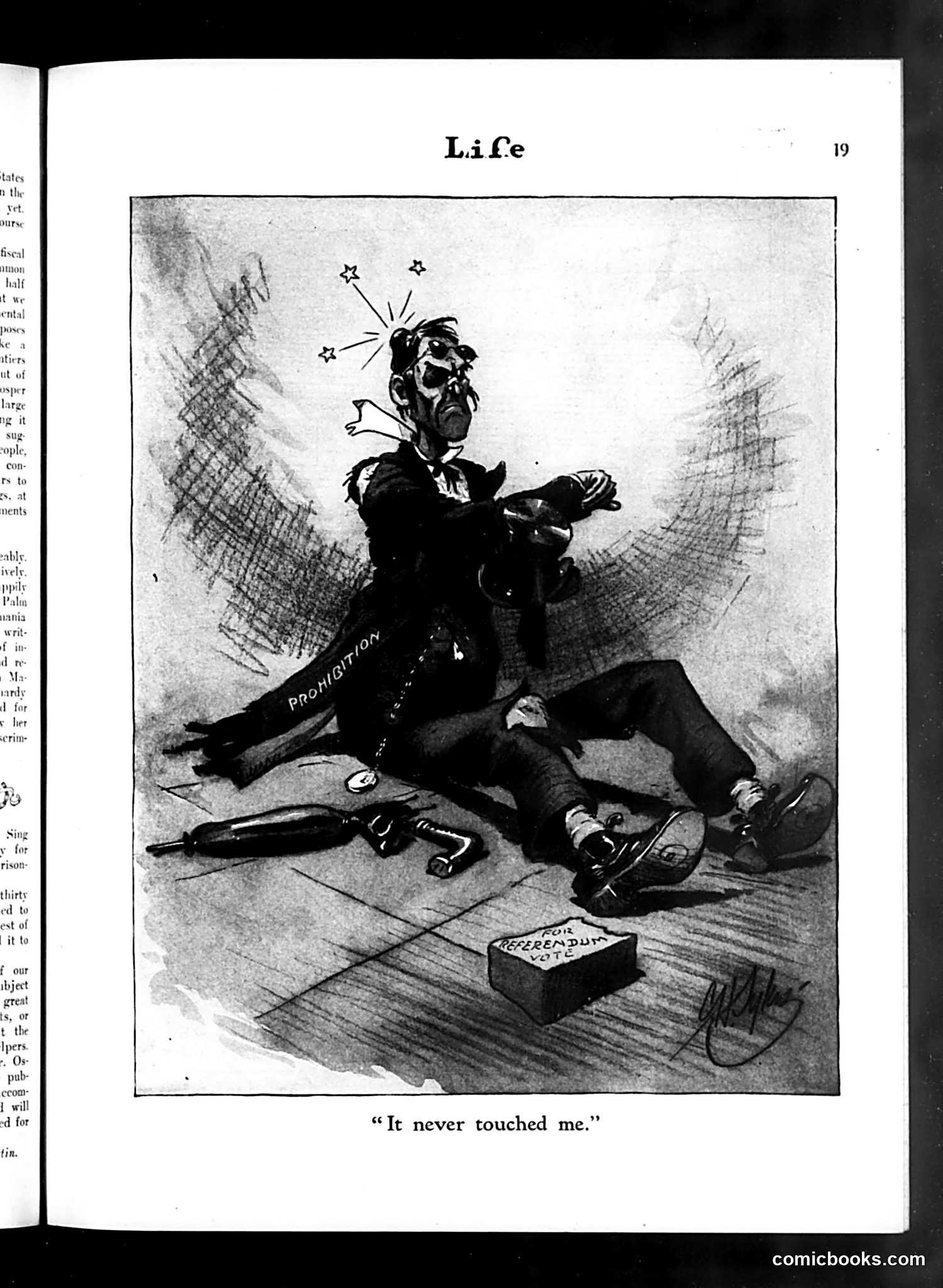
This cartoon satirizes a politician or public figure (depicted as a disheveled man in formal attire) denying involvement with Prohibition enforcement. The figure sits surrounded by weapons and enforcement apparatus labeled "PROHIBITION," yet claims innocence—"It never touched me." The satire targets hypocrisy: the character is clearly associated with Prohibition's violent enforcement mechanisms (visible guns and equipment), yet disavows responsibility. The stars around his head suggest confusion or dizziness, implying the absurdity of his denial. This likely comments on a specific official during Prohibition era (1920-1933) who publicly distanced themselves from the policy's brutal enforcement while benefiting politically from it. The cartoon mocks the cognitive dissonance between claims of innocence and obvious complicity with a controversial, violence-prone policy.
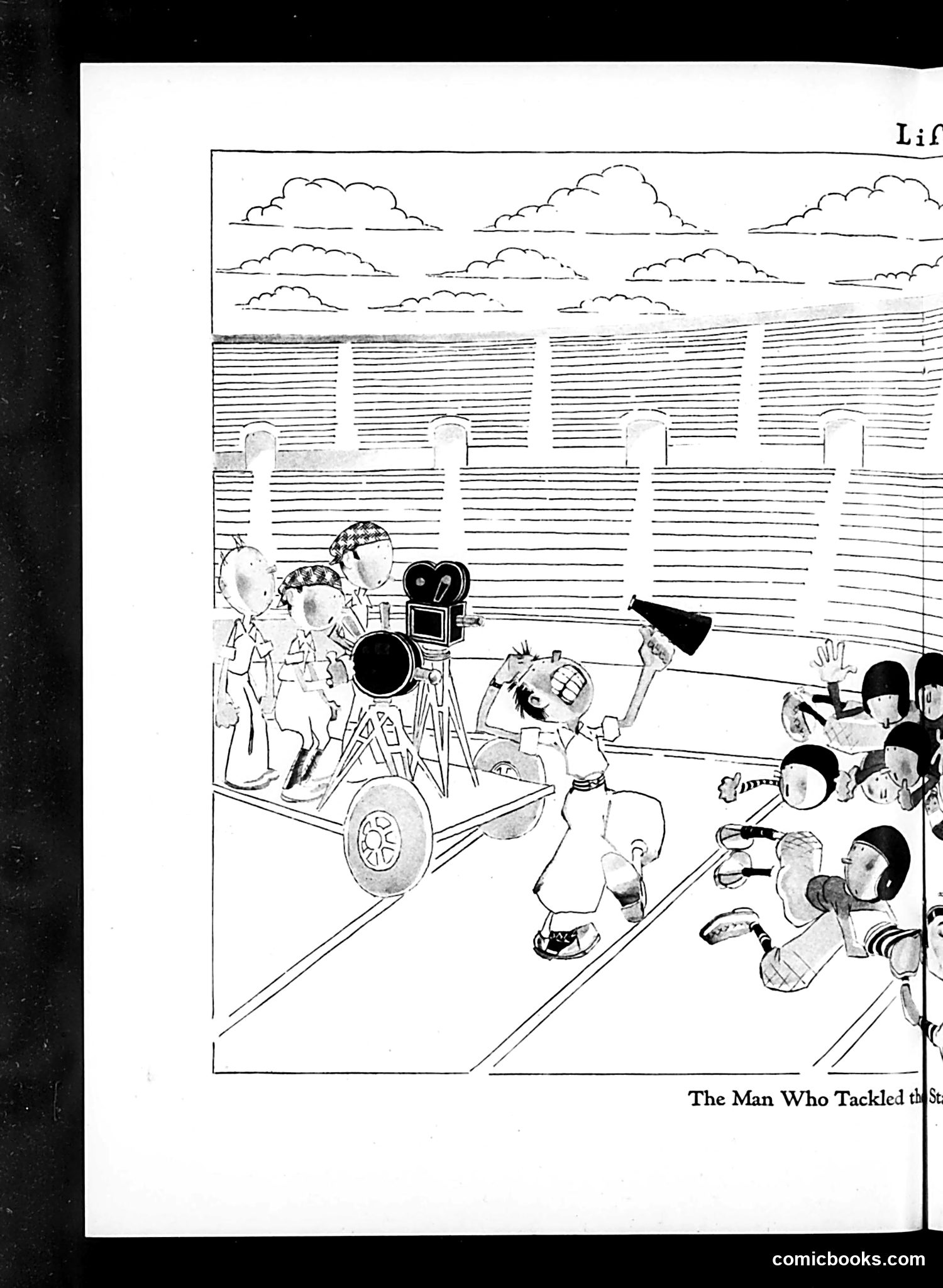
This page shows a cartoon depicting a film production scene. A movie camera on a tripod is positioned in the center, operated by film crew members. To the left stands what appears to be an actress or performer in period costume holding a large prop balloon or sphere. On the right, a group of people (likely extras or audience members) react with apparent shock or alarm, with one figure wielding what looks like a megaphone or director's tool. The incomplete title "The Man Who Tackled th St[reet]" (cut off) suggests this depicts a silent-film production or film industry satire. The cartoon likely mocks either the melodramatic nature of early cinema, the chaos of film sets, or specific contemporary film industry practices. Without the complete caption, the exact satirical point remains unclear, though it appears to critique filmmaking conventions of the era.
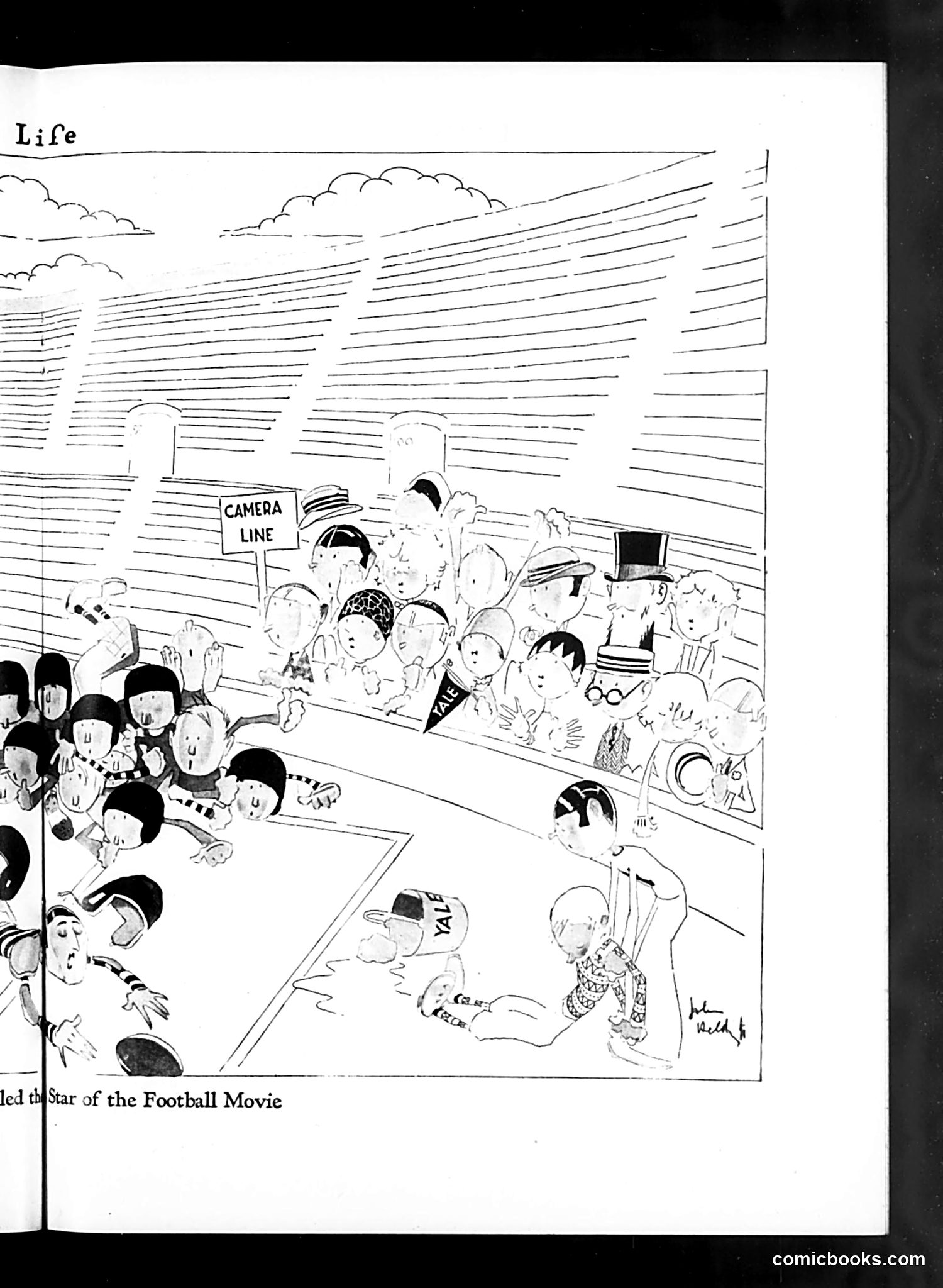
This cartoon satirizes the movie industry's exploitation of football's popularity. The scene shows a film production with a "CAMERA LINE" sign, depicting numerous elegantly dressed spectators (in top hats and formal wear) crowded around what appears to be a staged football scene. The contrast is clear: well-dressed producers and executives surround a modest football action in the foreground, suggesting that the "star" attraction isn't genuine athletic skill but rather manufactured spectacle for profit. The cartoon critiques how Hollywood capitalizes on sports by creating artificial drama and star-making machinery around football, transforming an athletic competition into a commercialized entertainment product designed primarily to generate box office revenue rather than showcase authentic sport.
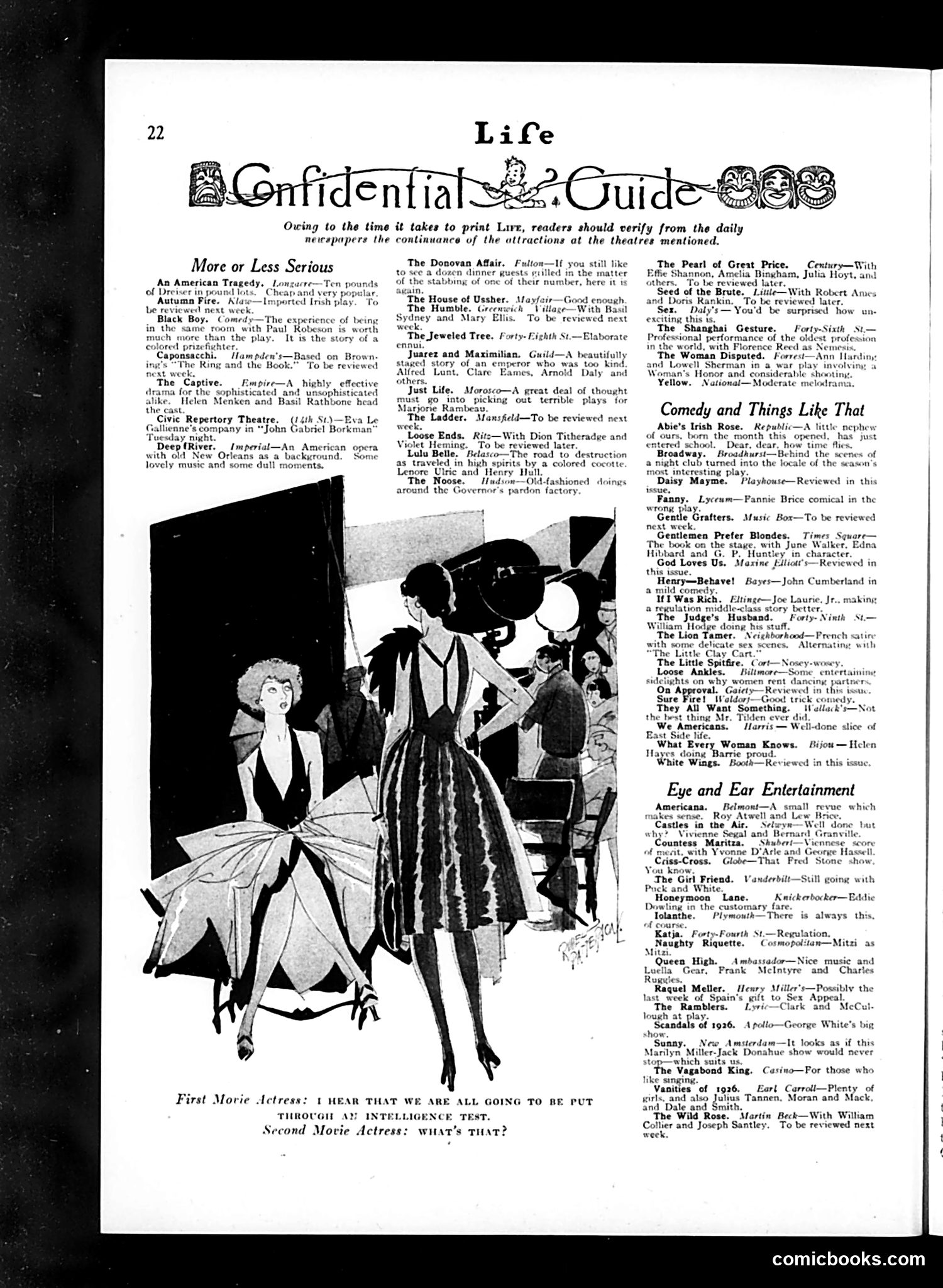
This page presents theatre and film reviews from Life magazine's "Confidential Guide" section. The cartoon illustrates a joke about intelligence testing in cinema: two movie actresses discuss an "intelligence test" audiences must undergo. The first actress announces everyone will be subjected to this test; the second responds "What's that?" — the humor lying in her apparent lack of intelligence, making her the perfect example of who needs such testing. The bulk of the page lists Broadway shows and films with brief, often sardonic reviews. Notable entries include "Abie's Irish Rose" (commenting on how long it's been running since the reviewer's nephew was born), "Gentlemen Prefer Blondes" (adapted from the popular book), and various dramatic productions. The tone is witty and dismissive of mediocre entertainment, typical of Life's satirical approach to cultural criticism during the Jazz Age.
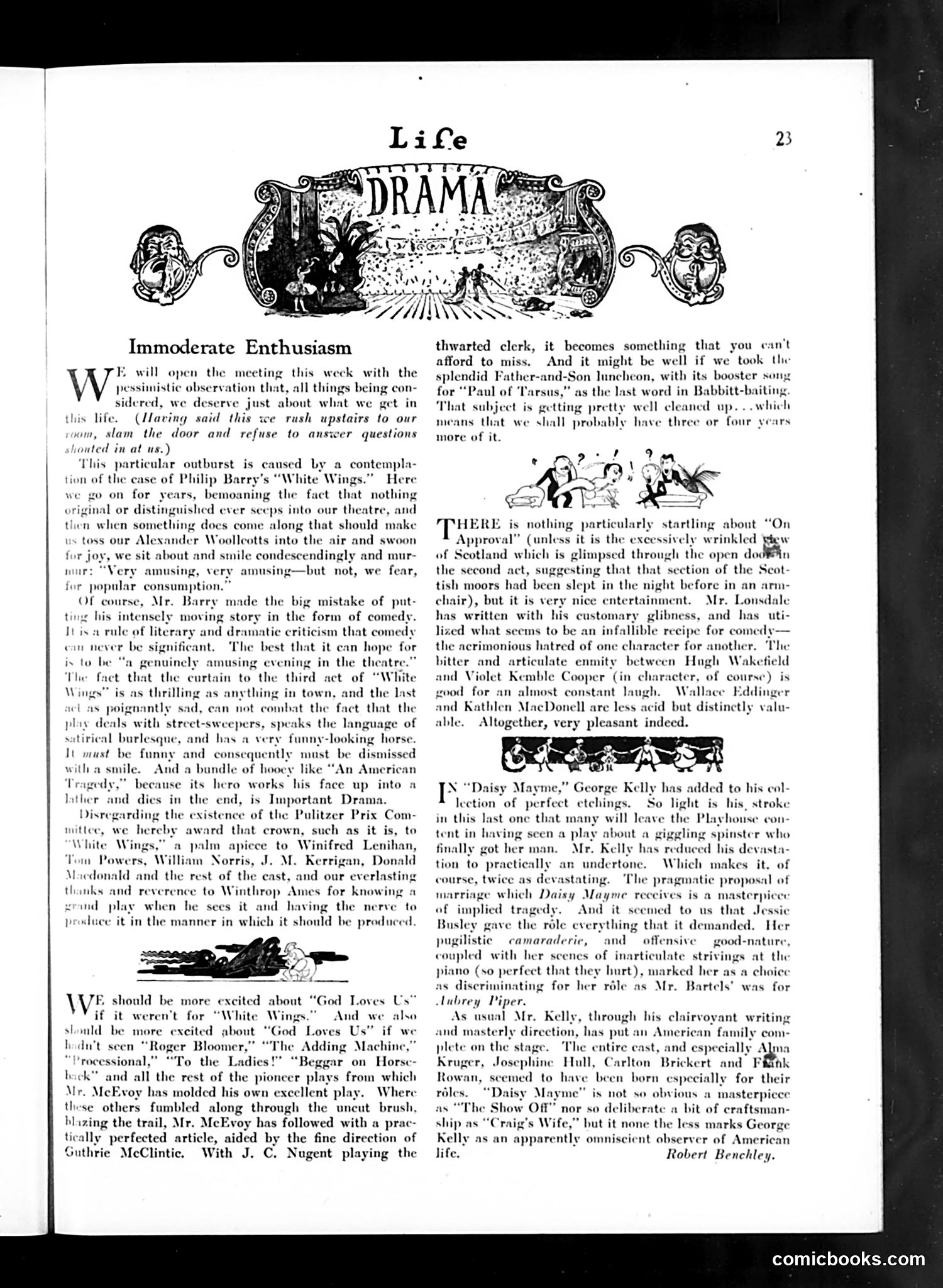
This is a theater review column criticizing American audiences' and critics' snobbish dismissal of comedy as inherently inferior to serious drama. The author argues that Philip Barry's play "White Wings"—about street-sweepers—deserves serious recognition despite being funny, yet critics dismiss it as mere entertainment. Meanwhile, plays like "An American Tragedy" receive prestige simply because they're melodramatic and tragic, regardless of quality. The satire targets the cultural prejudice that equates significance with tragedy and tears. The reviewer notes this contradiction: pioneering plays like "The Adding Machine" and "Processional" were celebrated for breaking new ground, but their successors ("God Loves Us," "Daisy Mayme") receive less attention despite being better-crafted—simply because the novelty wore off. The column's title, "Immoderate Enthusiasm," ironically describes the reviewer's frustrated passion for intelligent comedy and contempt for automatic prestige-granting based on genre rather than merit.
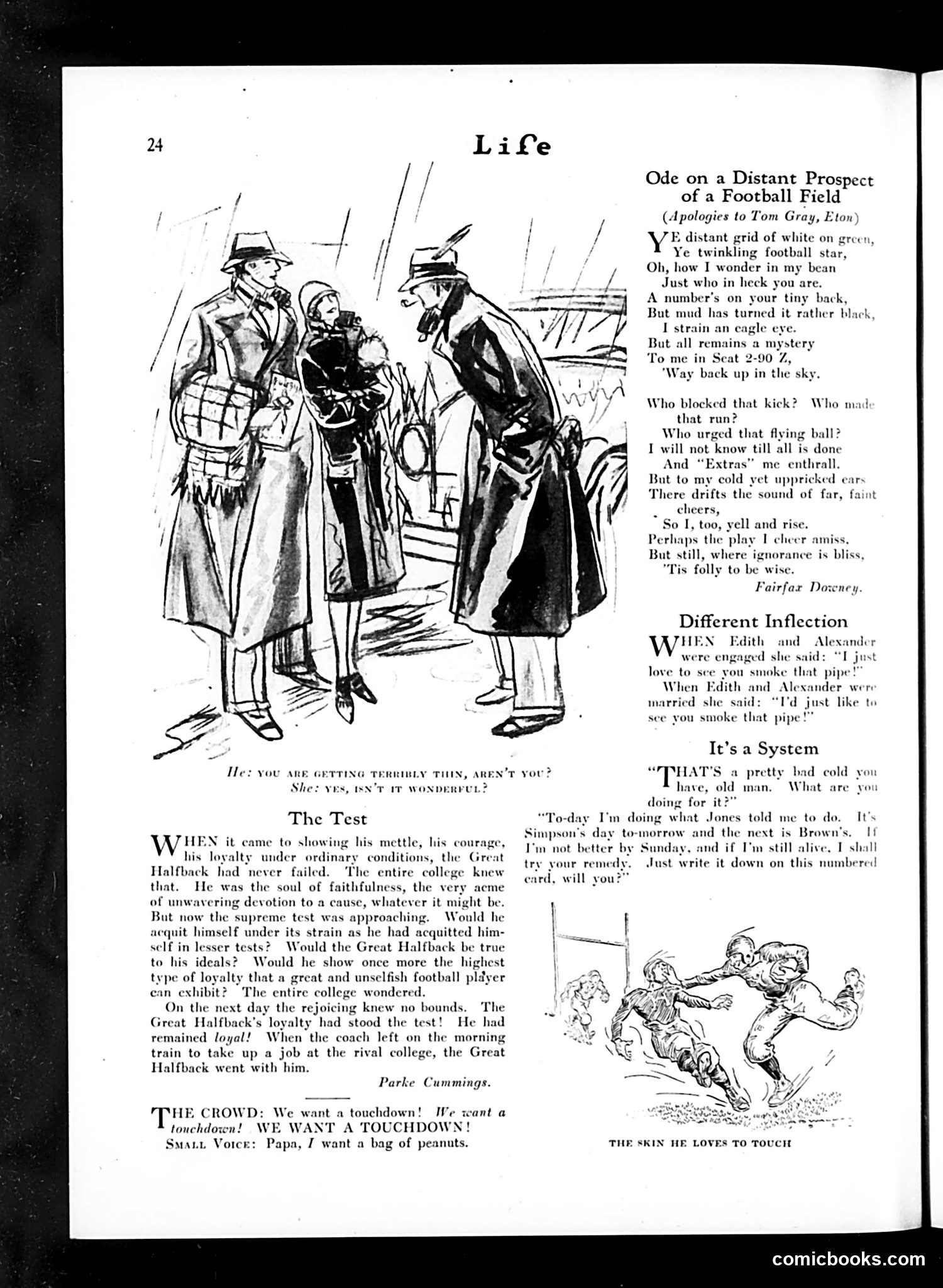
This page from *Life* magazine contains satirical pieces mocking American college football culture and romance conventions of the early 20th century. **"Ode on a Distant Prospect"** parodies highbrow poetry (Gray's "Ode on a Distant Prospect of Eton College") by applying it to football—the speaker in the stadium cannot identify players through mud and distance, cheers anyway, and admits total ignorance. The satire targets both pretentious literary references and mindless sports enthusiasm. **"Different Inflection"** jokes about how women's tone changes after marriage—the same phrase ("smoke that pipe") shifts from romantic to nagging, suggesting wives become controlling. **"The Test"** ironically praises a halfback's "loyalty" for following his coach to a rival college rather than staying with his team, satirizing how athletes prioritize coaches over institutional loyalty. The bottom cartoons mock hypochondria and the circus atmosphere of football crowds (children wanting peanuts amid frenzied chanting). Overall, the page satirizes American sports obsession, gender dynamics, and the gap between noble ideals and actual behavior.
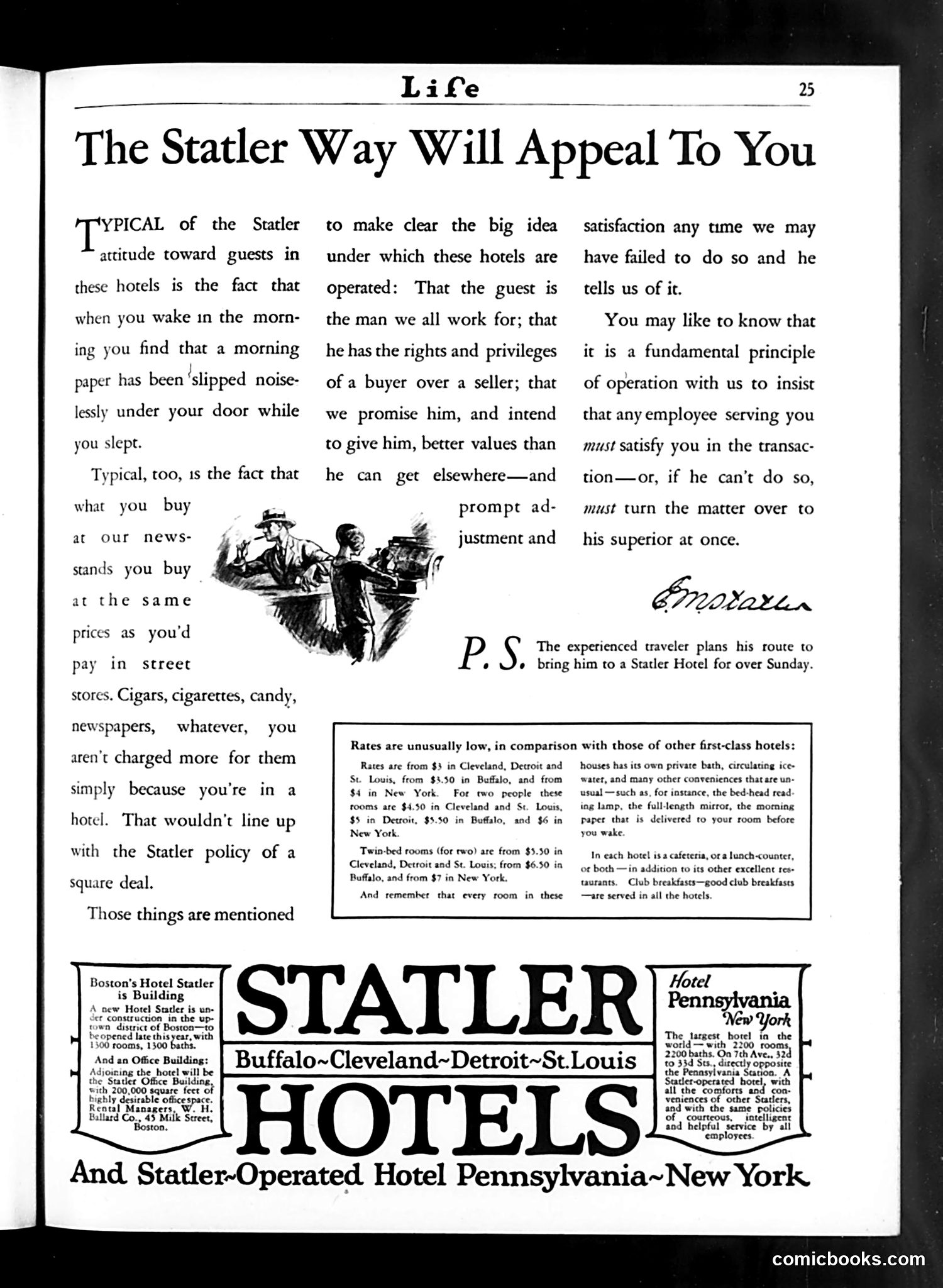
This page is primarily **advertising**, not satire or political commentary. It promotes Statler Hotels across American cities (Buffalo, Cleveland, Detroit, St. Louis, Boston, New York). The small illustration shows a bellhop delivering a newspaper—meant to demonstrate the hotel chain's attentive service. The "appeal" referenced in the headline is commercial: the advertisement emphasizes Statler's customer-service philosophy—that guests are "the man we all work for" with "buyer's rights." They promise fair newsstand prices, prompt complaint resolution, and amenities like morning papers and private baths at competitive rates ($3-6 per room). This reflects **early 20th-century hotel marketing**, positioning Statler as customer-focused and honest—a "square deal"—contrasting with competitors who might overcharge captive hotel guests. The tone is earnest advertising copy, not satirical commentary. The page demonstrates how Life magazine's pages mixed editorial content with paid advertisements.
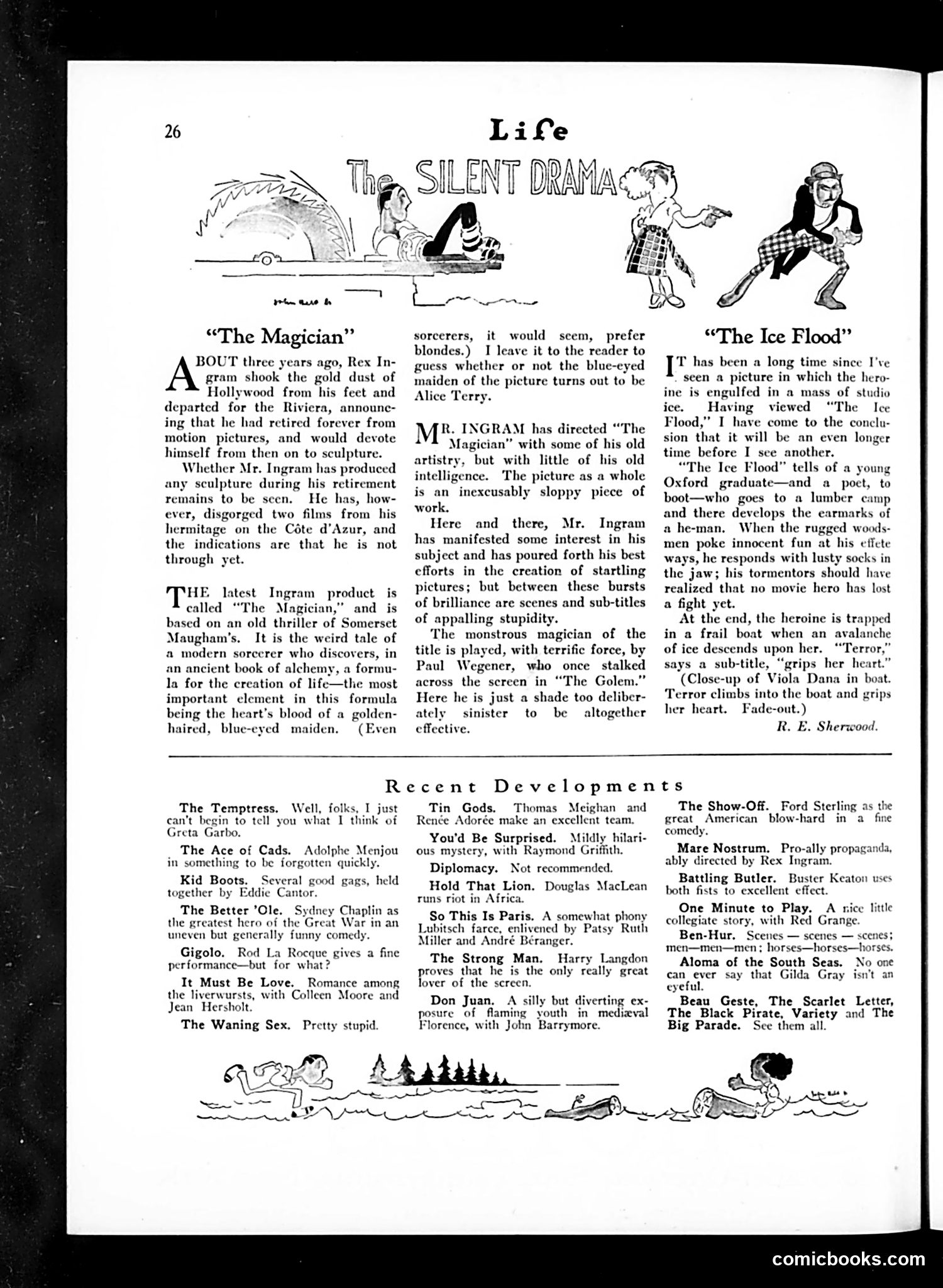
This page reviews two 1920s silent films, satirizing their plots and performances for modern readers unfamiliar with them. **"The Magician"** mocks director Rex Ingram's pretentious return from French retirement. The film—a Somerset Maugham adaptation about a sorcerer needing a blonde maiden's heart-blood to create life—is dismissed as "inexcusably sloppy," despite Paul Wegener's performance. The reviewer sarcastically notes the formula's preference for "golden-haired, blue-eyed maidens" and hints the ingénue is likely Alice Terry. **"The Ice Flood"** parodies melodramatic clichés: a poetry-loving Oxford graduate becomes a lumberjack, gets into fistfights (movie heroes "never lose"), and ultimately watches the heroine trapped in an avalanche of studio ice. The reviewer mocks the overwrought title card "Terror grips her heart," with a close-up of actress Viola Dana in the boat. Both reviews employ sardonic humor to critique overstated dramatic conventions typical of silent cinema, while the accompanying "Recent Developments" section briefly rates other current releases.
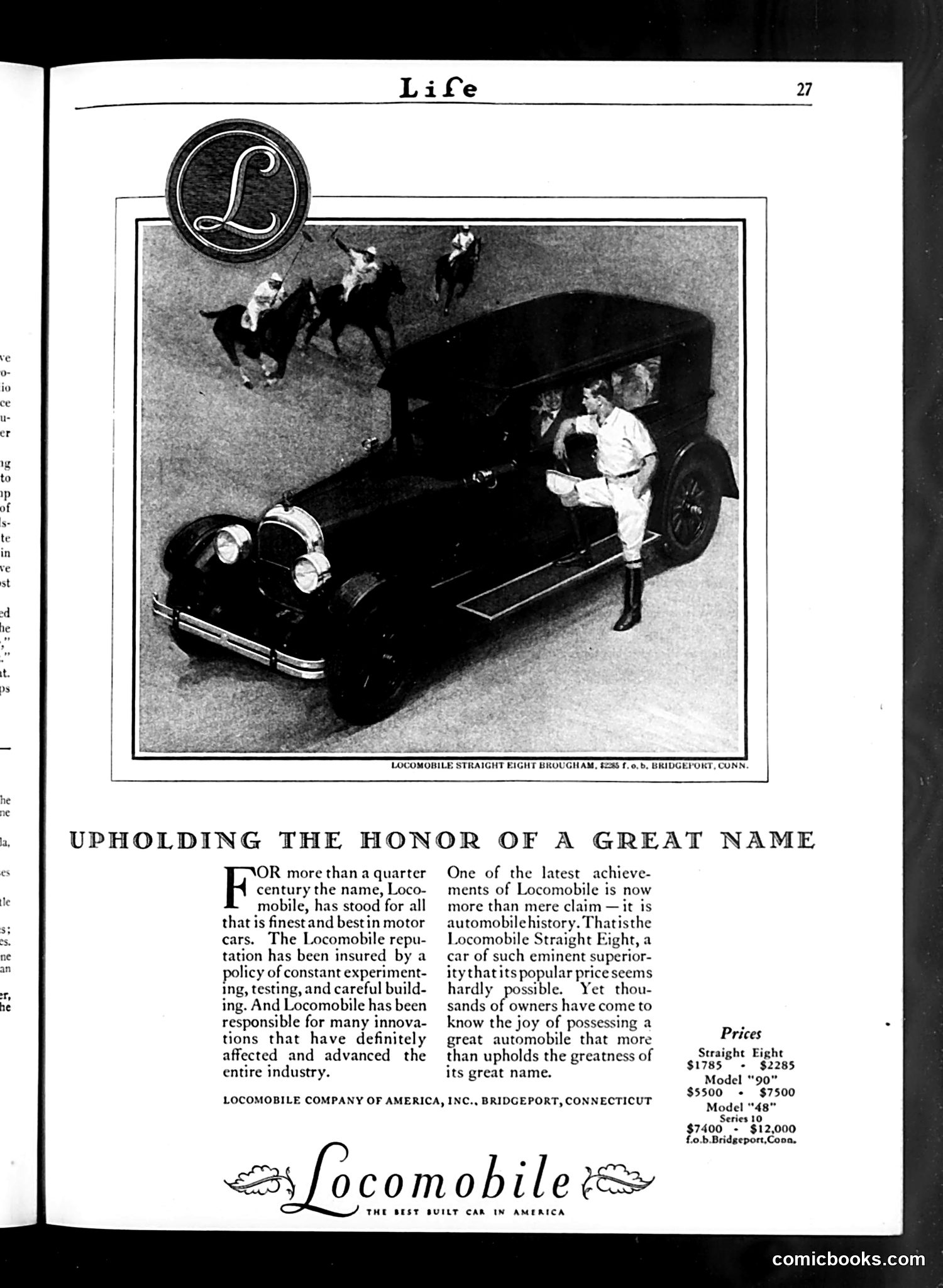
This is primarily **automobile advertising**, not political satire. The page promotes Locomotile automobiles in Life magazine. The image shows a Locomotile Straight Eight automobile with several figures around it—a woman in 1920s attire stands beside the car while riders on horseback appear in the background, likely representing leisure, wealth, and modernity. The accompanying text argues that Locomotile's quarter-century reputation for quality engineering justifies its "Straight Eight" model as the finest automobile at a reasonable price. The headline "Upholding the Honor of a Great Name" appeals to brand prestige and heritage. There is no cartoon or political joke here—this is a straightforward luxury car advertisement targeting affluent readers of Life magazine, emphasizing innovation, craftsmanship, and the aspirational lifestyle associated with owning a high-quality automobile during the 1920s automotive boom.
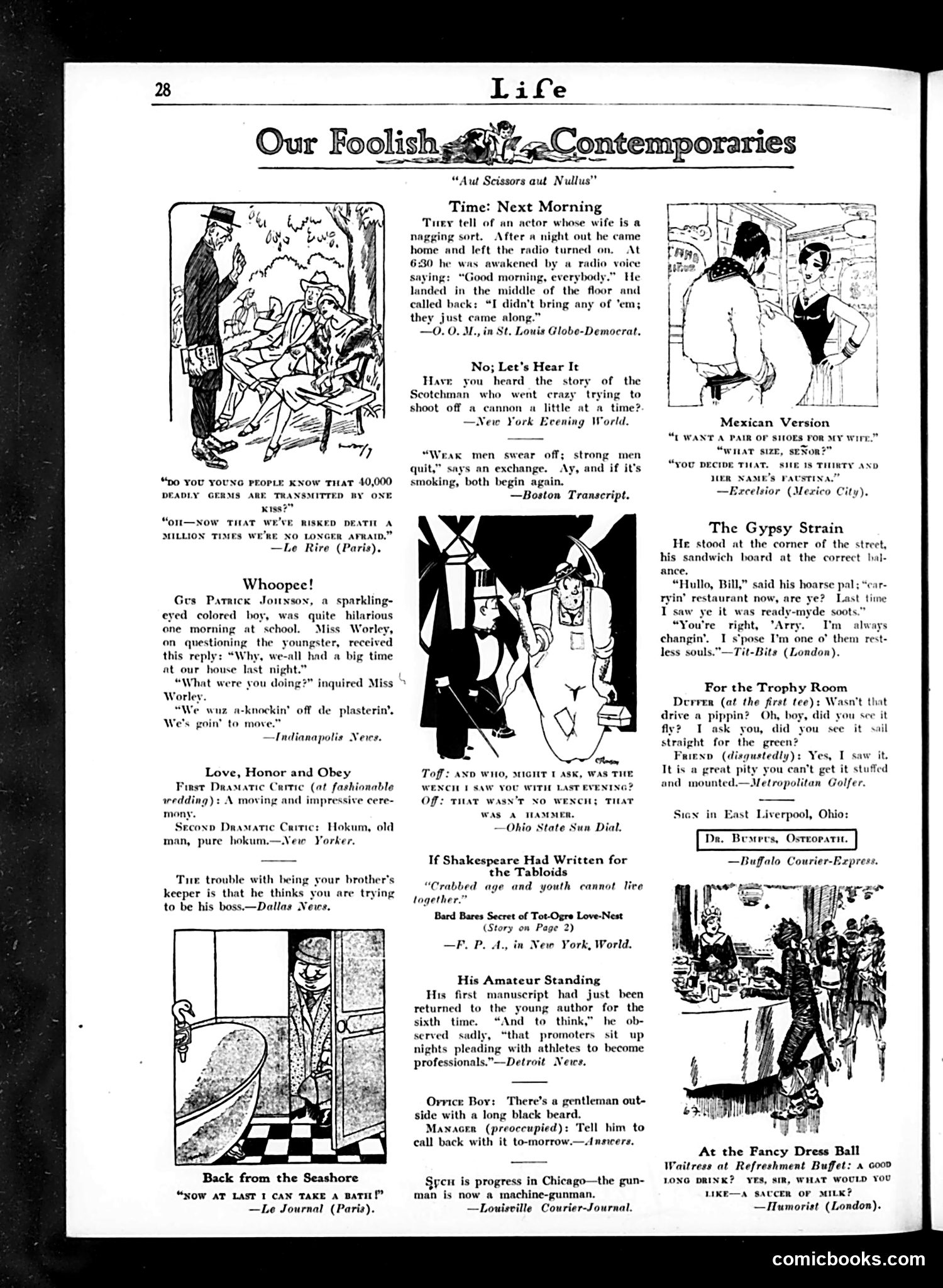
This page collects brief humorous anecdotes and jokes from various newspapers and magazines, organized by theme. The cartoons and quips satirize everyday social situations and human foibles rather than specific political figures. Key recurring jokes include: - **Racial stereotypes**: A "colored boy" using dialect humor about removing plaster - **Gender dynamics**: Nagging wives, weak vs. strong men, wives' shoe sizes - **Class observations**: Dramatic critics, job-seekers, amateur writers - **Modern technology**: Radio humor, machine-gunmen in Chicago (suggesting modernization of crime) - **Tabloid sensationalism**: The "Shakespeare for tabloids" section mocking lurid headlines The page represents Life magazine's format of curating wit from international sources (Paris, London, etc.), celebrating clever wordplay and observational humor about marriage, social pretension, and urban life. The satire targets human nature rather than specific events or policies—a gentler, more universal comedy style than political cartooning.
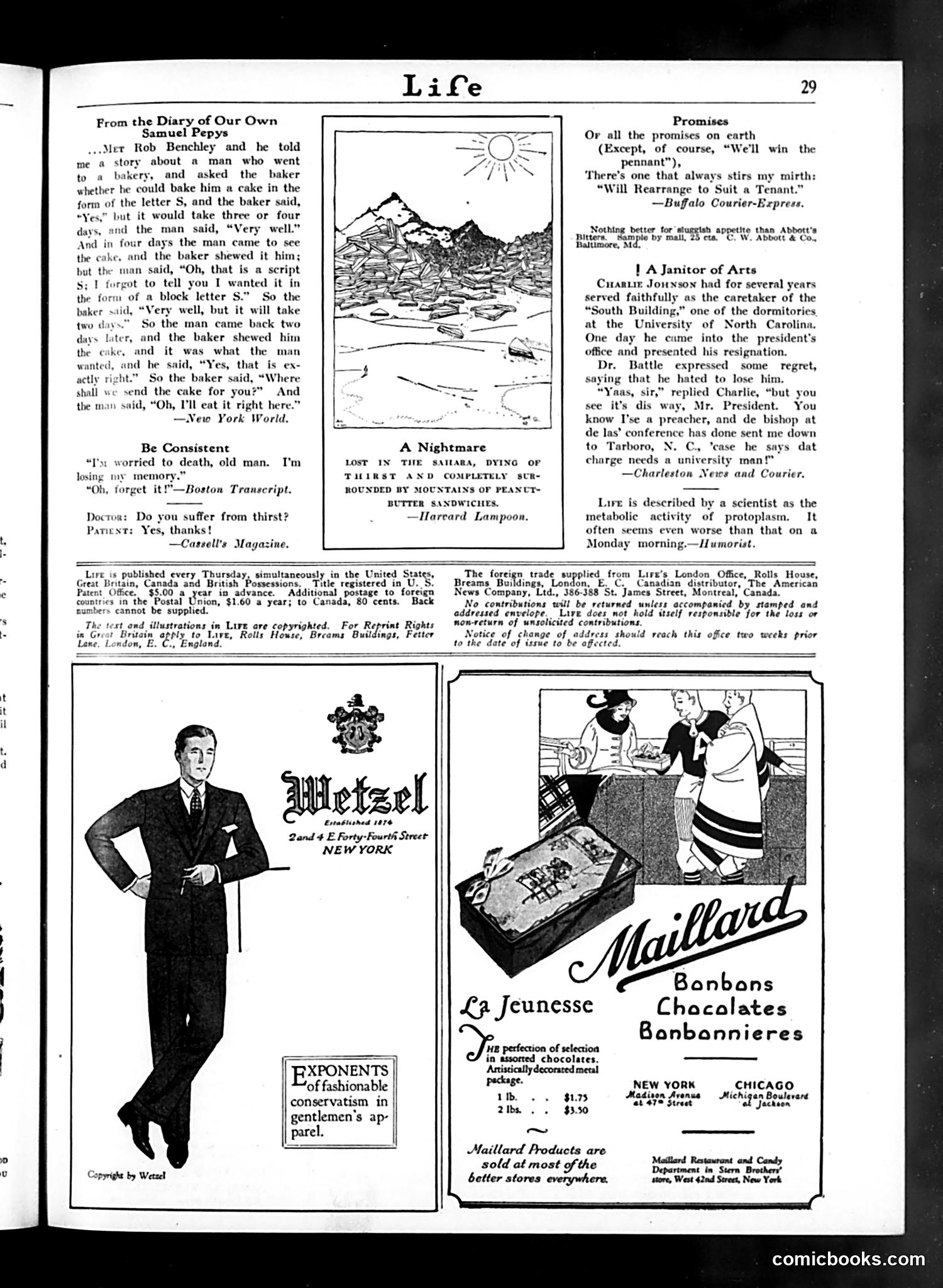
This page comprises **humor columns and advertisements** rather than political cartoons. The main content includes: **Humor pieces:** - "From the Diary of Our Own Samuel Pepys": A anecdote about a baker unable to distinguish letter styles—satire of pedantic absurdity - "Be Consistent" and "A Nightmare": Brief jokes about memory loss and a surreal peanut-butter-sandwich scenario - "A Janitor of Arts": A dialect-humor piece about an African American janitor resigning from University of North Carolina to become a preacher, reflecting early-20th-century racial stereotyping in comedy - Short quips about promises and Monday mornings **Advertisements:** Wetzel (men's formal wear), Maillard chocolates, and Abbott Bitters The page demonstrates Life's format: mixing light satirical commentary on everyday absurdities with genteel advertisements. The racial humor reflects period attitudes. No specific political figures or events are referenced.
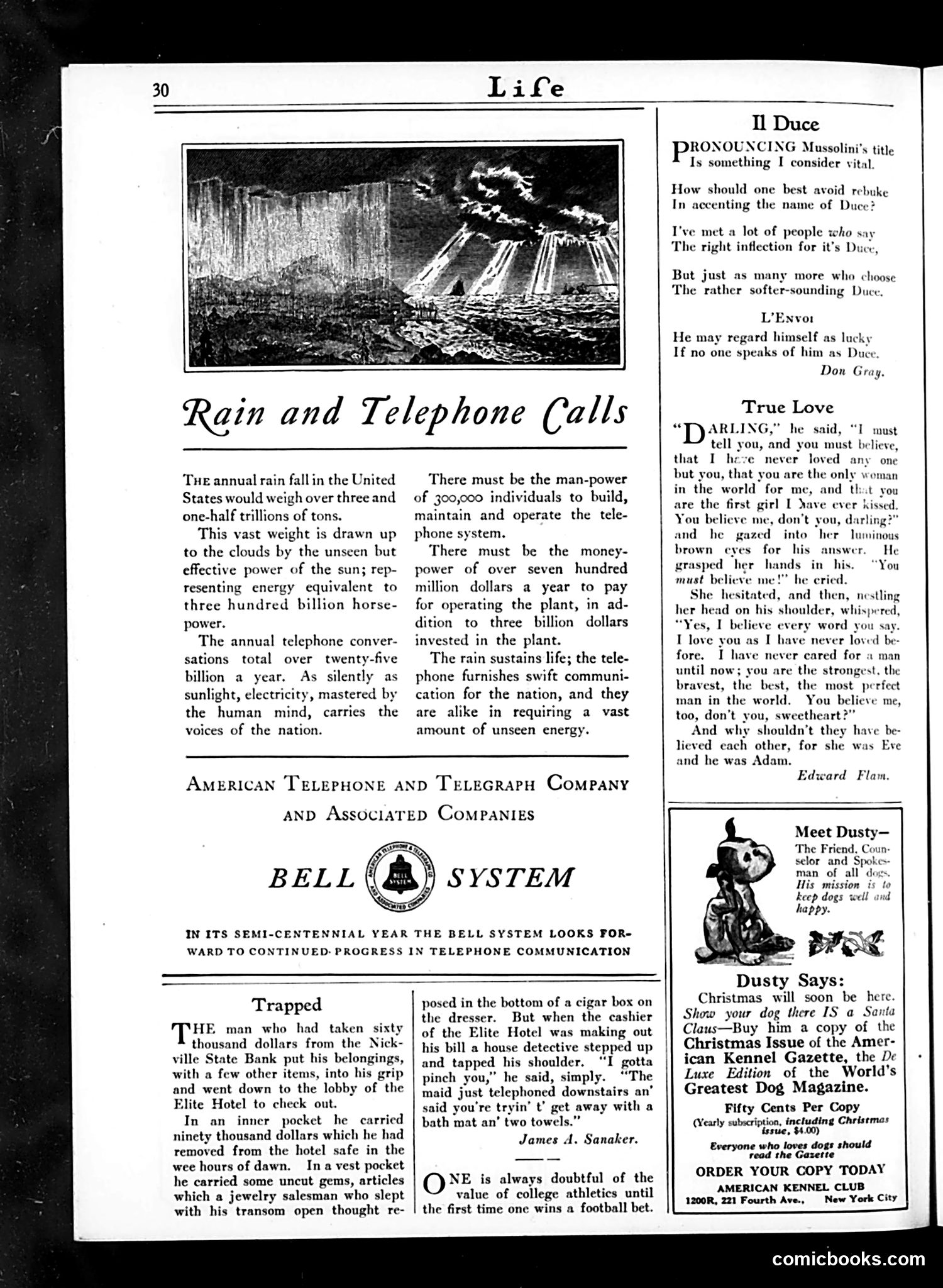
This page is primarily **advertising and filler content** rather than political satire. The main elements are: **"Rain and Telephone Calls"** is a Bell System advertisement comparing rainfall's natural power to the telephone system's technological infrastructure—both require vast unseen energy. It's corporate messaging celebrating the telephone network's scale (300,000 workers, $700 million annually). **"Trapped"** is a humorous short story about a bank robber caught not for theft, but for stealing hotel towels and a bath mat—the irony being his downfall comes from telephoning, not detection of the serious crime. **"Il Duce"** is a light poem about pronunciation confusion around Mussolini's title. This references Italy's fascist leader but treats the subject humorously rather than critically. **"True Love"** is a sentimental romance story. The remaining content is advertising for dog magazines and kennel club subscriptions. The page reflects *Life*'s typical mix of light satire, advertising, and fiction rather than sharp political commentary.
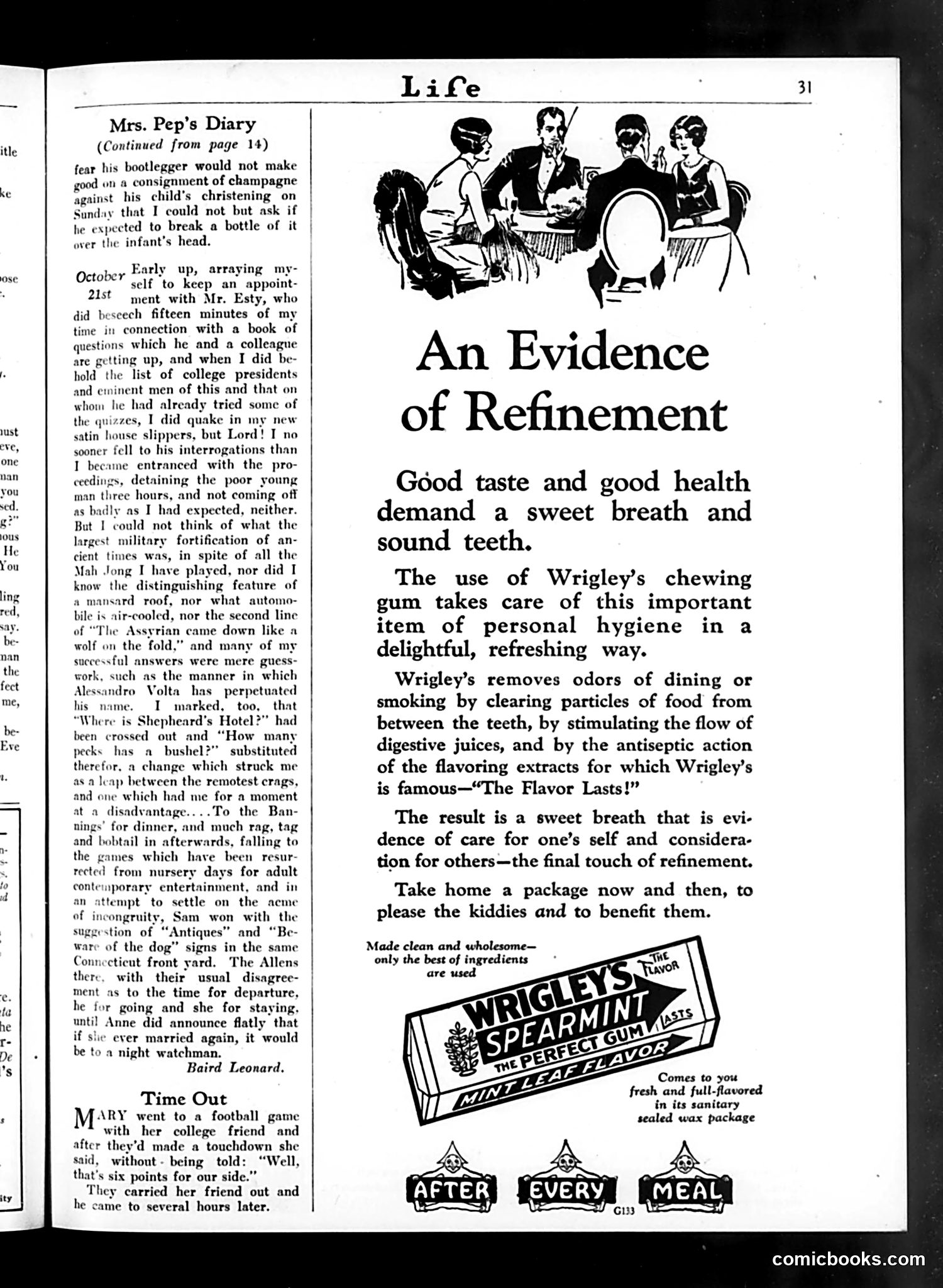
This page contains two distinct elements: **Mrs. Pep's Diary** (left column): A humorous society column narrating the author's social activities and mild embarrassments—attending a quiz on obscure topics, dinner parties, and observing the marital discord of acquaintances. The tone is gently satirical of upper-class social pretensions and intellectual pretensions (the author struggles with basic trivia despite extensive education). **"Time Out" anecdote** (bottom left): A brief joke about a young woman at a football game who enthusiastically exclaims "six points for our side!" after a touchdown—revealing her complete ignorance of football scoring (touchdowns are worth six points, but context suggests she's confused or simply clueless about sports). **Wrigley's Spearmint Advertisement** (right side): A full-page ad claiming chewing gum promotes personal hygiene and social refinement—"evidence of care for one's self and consideration for others." This reflects 1920s advertising's focus on linking consumer products to social respectability and cleanliness standards. The satire appears incidental to what is primarily an **advertising-driven magazine page** mixing lifestyle content with commerce.
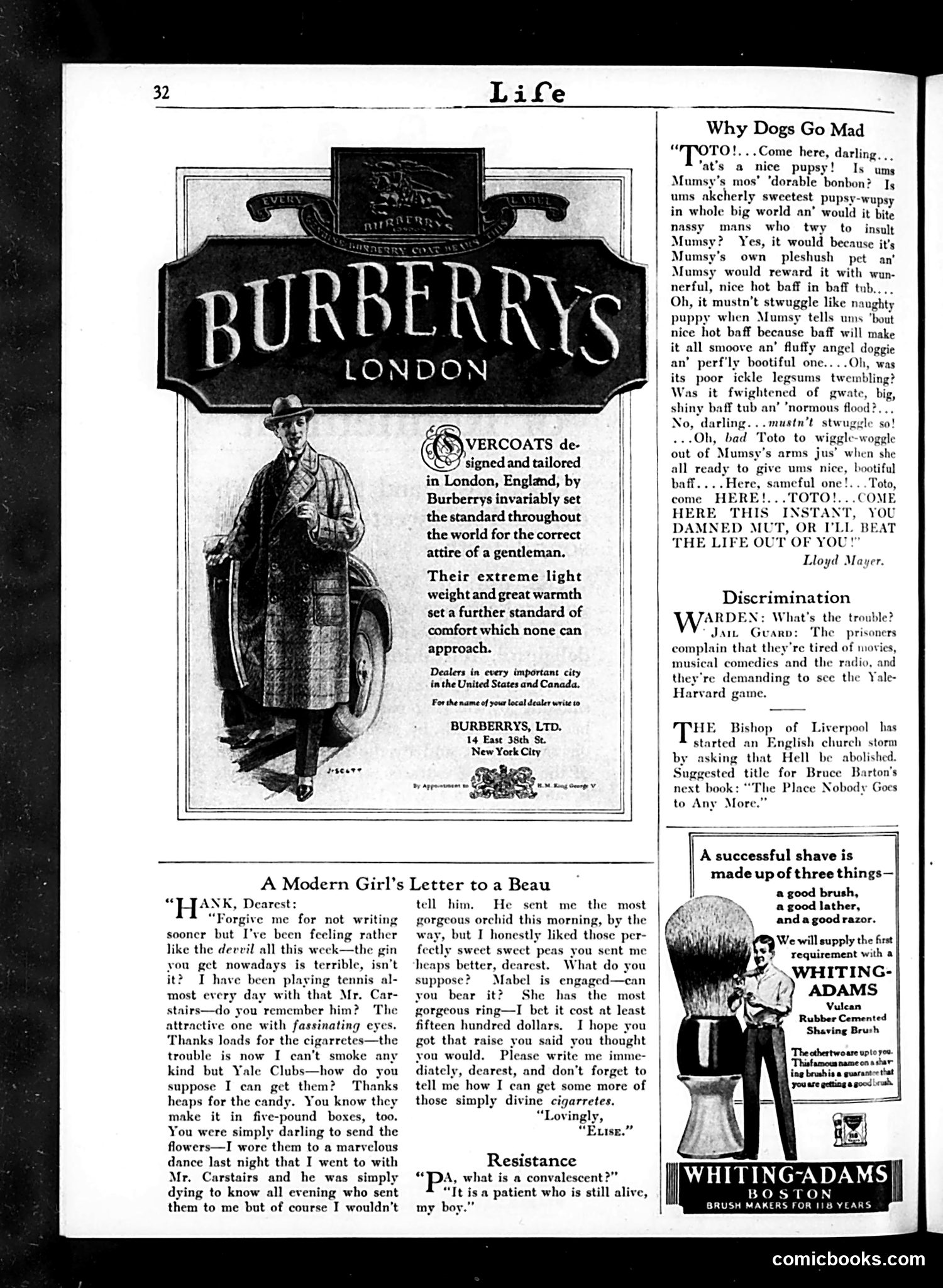
This page contains primarily **advertisements and humorous social commentary** rather than political cartoons. The main Burberrys overcoat ad emphasizes British tailoring standards for gentlemen—reflecting early 20th-century class consciousness about proper dress. The satirical pieces mock contemporary social behavior: **"A Modern Girl's Letter to a Beau"** satirizes a young woman's materialism and duplicitousness—she accepts gifts (cigarettes, flowers, candy) from her beau while flirting with another man (Carstairs) and constantly asking for more luxuries. The joke targets women's perceived mercenary attitudes and smoking/drinking habits (the gin reference suggests Prohibition-era speakeasies). **"Why Dogs Go Mad"** parodies overly sentimental pet owners who baby-talk to dogs and subject them to unwanted baths, suggesting this excessive coddling drives dogs to madness. Minor jokes mock prison entertainment demands (Yale-Harvard football game) and the Bishop of Liverpool's call to abolish Hell from church doctrine. The page reflects 1920s social anxieties about women's independence, consumerism, and changing moral standards.
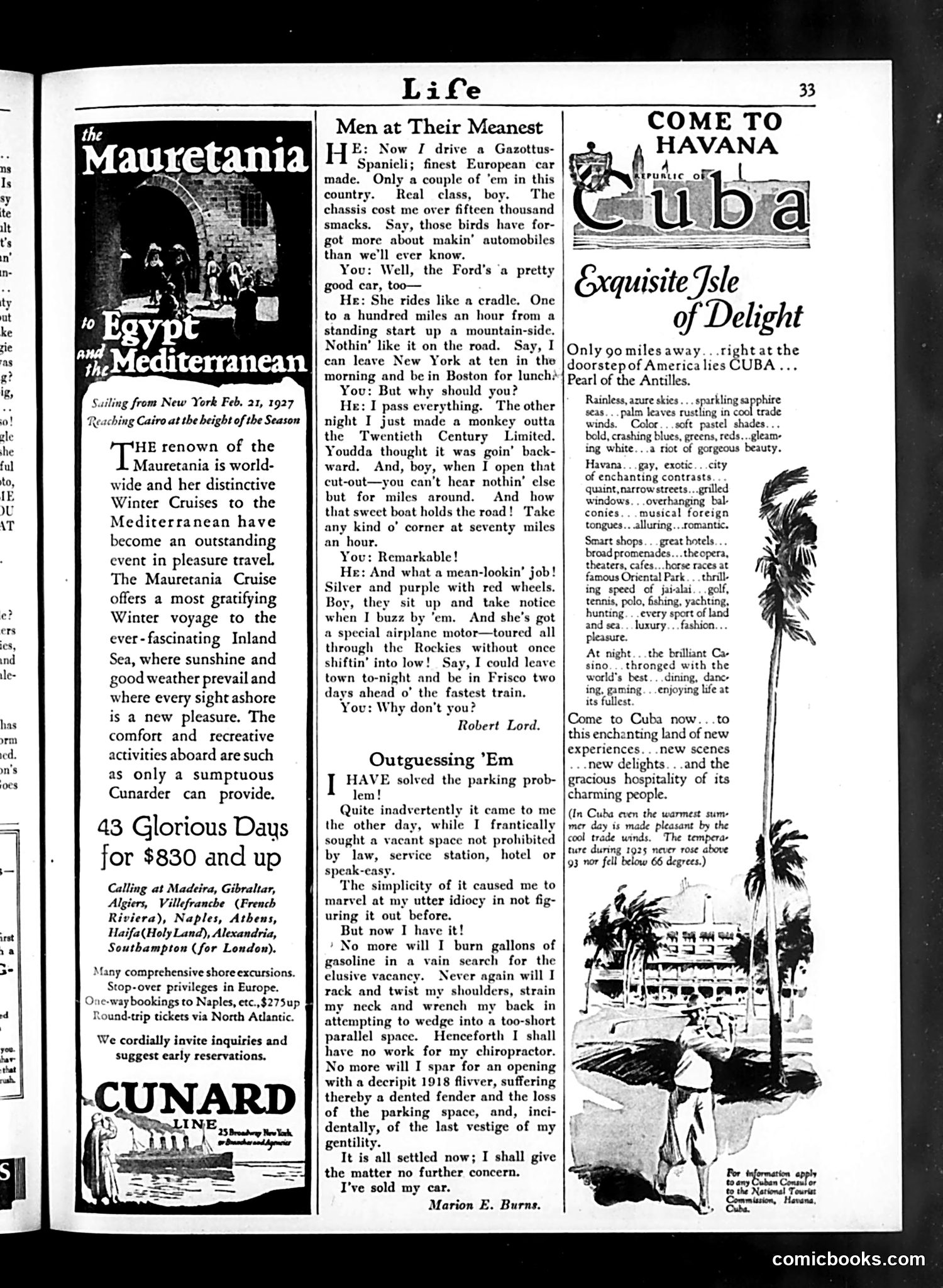
This page contains travel advertisements and satirical humor typical of Life magazine's 1927 content. ## "Men at Their Meanest" A dialogue satirizing male boasting about automobiles. One man brags about his expensive European "Gazottus-Spanish" car—its performance, speed, distinctive appearance with "silver and purple with red wheels," and airplane motor. The satire targets masculine vanity and one-upmanship: he constantly emphasizes the car's superiority, how others notice him, and his ability to outpace the "Twentieth Century Limited" train. His interlocutor's brief responses ("Why don't you?") subtly mock the braggadocio—if the car is so superior, why doesn't he actually use it as claimed? The humor lies in exposing male pretension through automotive status-seeking. ## Advertisements The page also features luxury travel ads: Cunard Line's Mediterranean cruises and a Cuba tourism ad promoting Havana as an exotic getaway "90 miles away," emphasizing romantic scenery and entertainment.
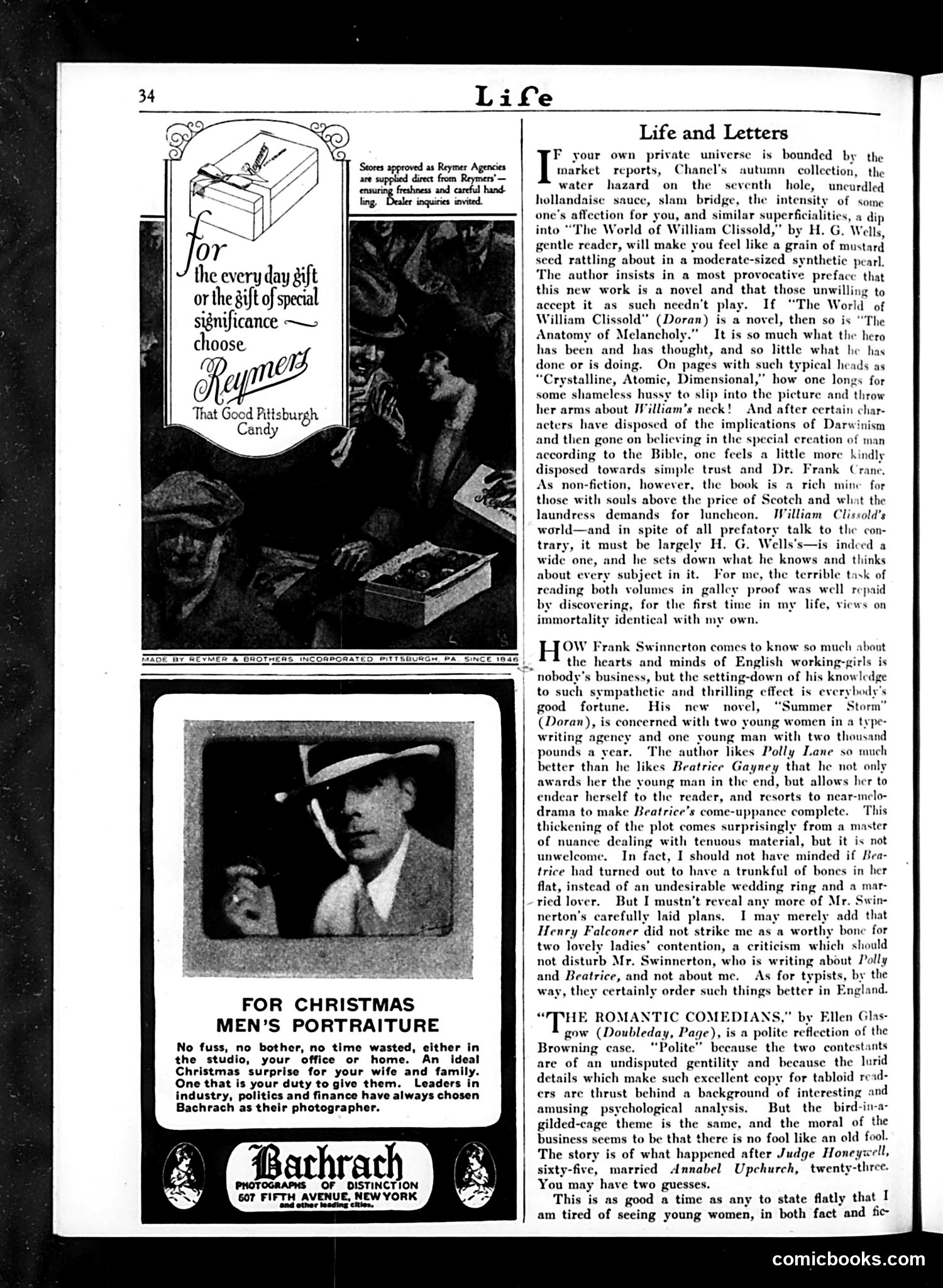
This page primarily contains literary book reviews rather than political cartoons. The content discusses three contemporary novels: 1. **H.G. Wells's "The World of William Clissold"** — criticized as more philosophical essay than novel, though the reviewer appreciates its intellectual depth on immortality 2. **Frank Swinnerton's "Summer Storm"** — praised for sympathetic portrayal of English working-girls in a typewriting agency, though the reviewer notes the plot melodramatically favors one female character over another 3. **Ellen Glasgow's "The Romantic Comedians"** — described as a polite reflection on a real-world scandal (the "Browning case," likely referencing a contemporary society marriage) The advertisements include Reymers Pittsburgh candy and Bachrach photography services for Christmas portraits. The reviews demonstrate *Life* magazine's role as a sophisticated arbiter of literary taste for educated American readers, discussing serious fiction within a humorous, gossipy framework typical of 1920s periodicals.
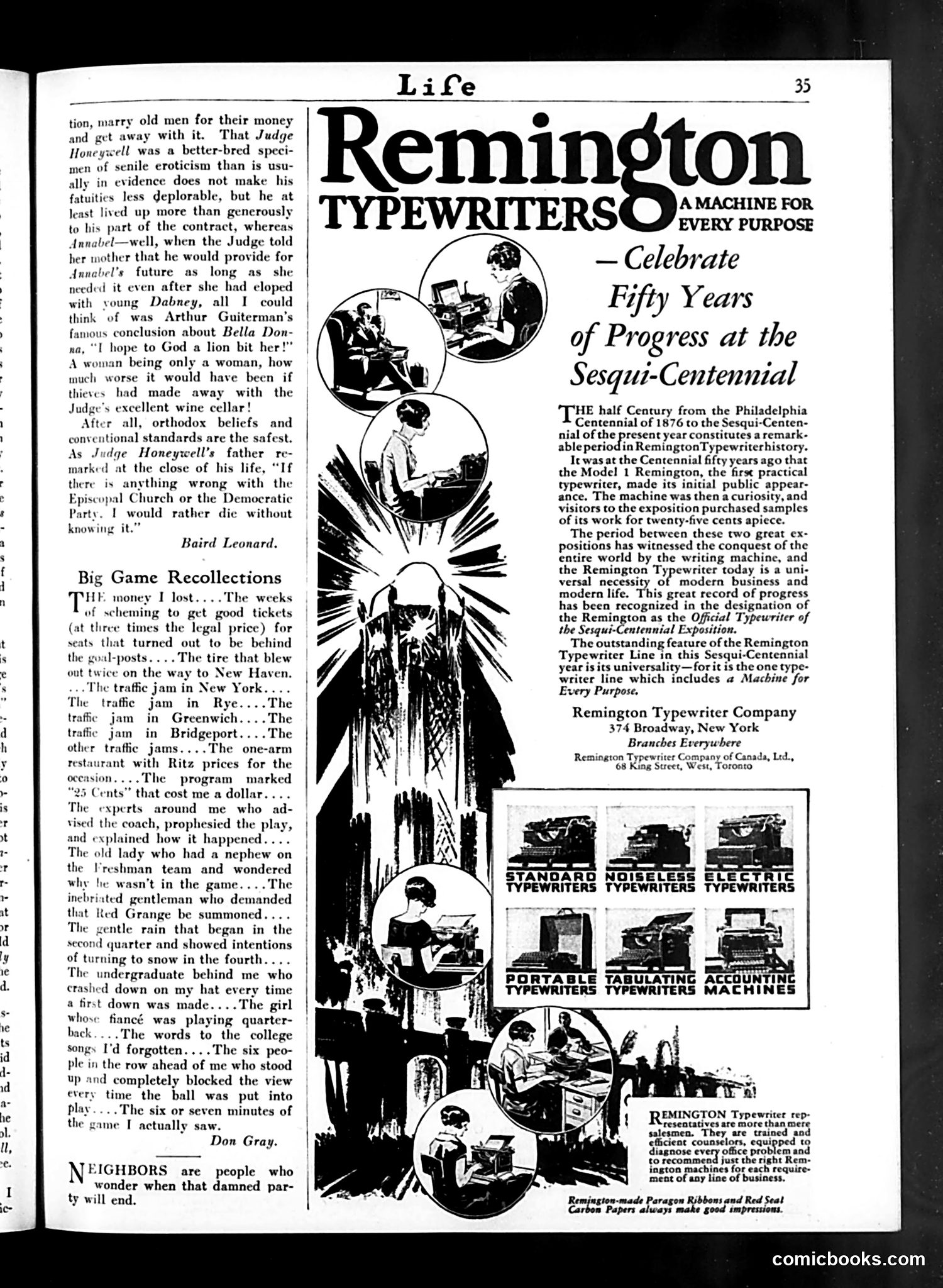
This page combines satirical fiction with advertising. The left side contains two humorous pieces: "Big Game Recollections" by Don Gray mockingly catalogs the tedious annoyances of attending a college football game (traffic jams, poor seating, drunk spectators, weather), while an earlier untitled piece critiques a character named Judge Honeywell who married a young woman named Annabel, satirizing both her mercenary motives and his foolish infidelity. The right side is a substantial **Remington Typewriter advertisement** celebrating the company's fifty-year history from the 1876 Philadelphia Centennial to the 1926 Sesqui-Centennial exposition. The ad promotes Remington as "the official typewriter" and emphasizes its evolution from curiosity to business necessity. Illustrations show various typewriter models and office workers, positioning the machine as essential to modern life. The juxtaposition reveals how Life balanced satirical social commentary with advertising revenue during the 1920s.
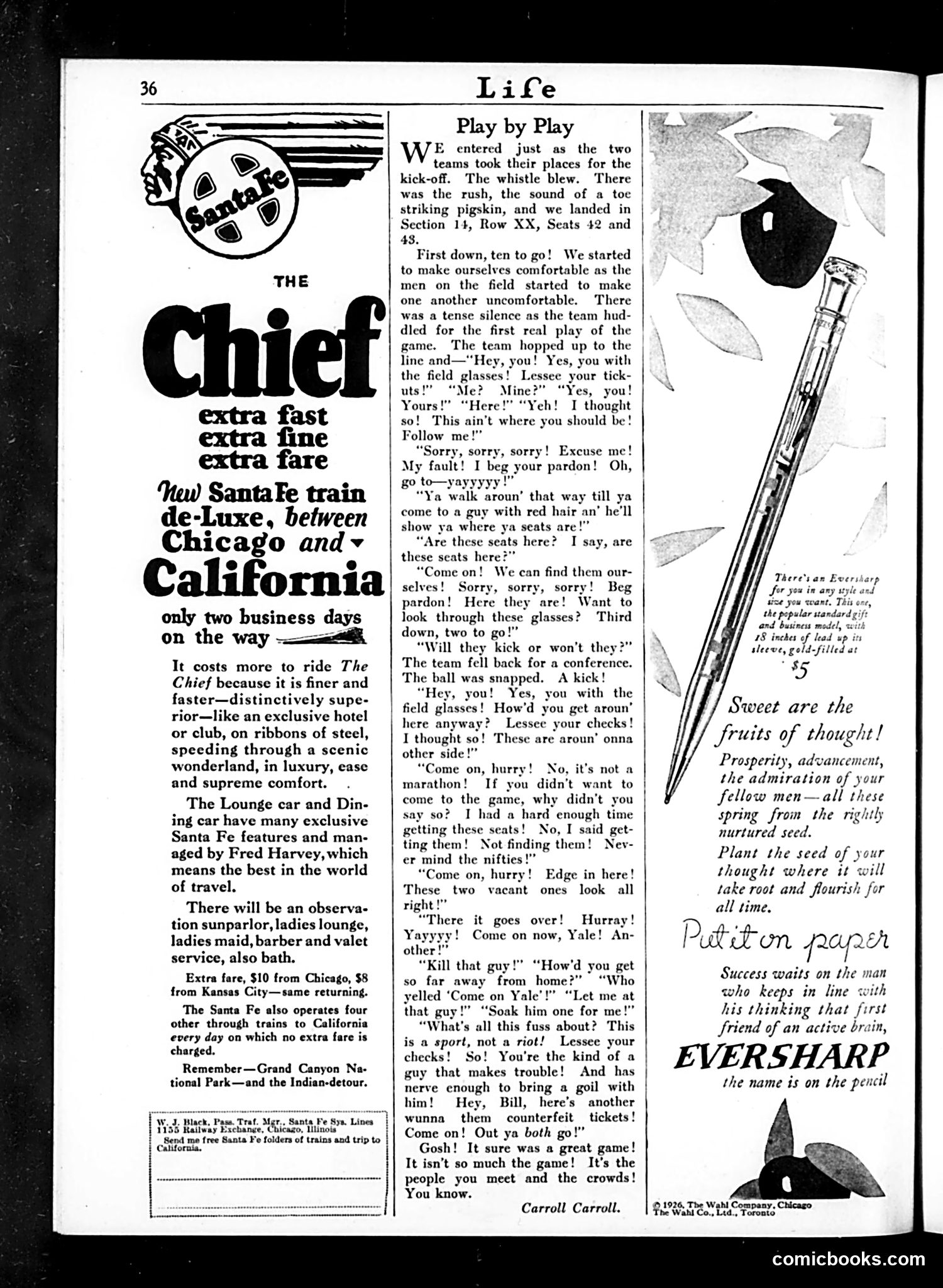
This page contains **two distinct elements**: a Santa Fe railroad advertisement and a humorous essay about attending a football game. ## The Advertisement "The Chief" promotes an luxury train service between Chicago and California, emphasizing exclusivity ("extra fast, extra fine, extra fare") and premium amenities managed by Fred Harvey, a renowned hospitality company. The $10 surcharge from Chicago positioned this as an upscale alternative to standard rail travel. ## "Play by Play" Essay Carroll Carroll's satirical piece humorously depicts the *actual* experience of attending a football game—which involves constant disruption from ushers checking tickets and seats, angry fans yelling at other spectators for cheering for Yale, counterfeit ticket holders, and general crowd chaos. The ironic punchline: "It's the people you meet and the crowds!"—suggesting the social chaos, not the sport itself, defines the experience. The smaller advertisements for Eversharp pencils use inspirational language about success and achievement, typical of 1920s advertising rhetoric.
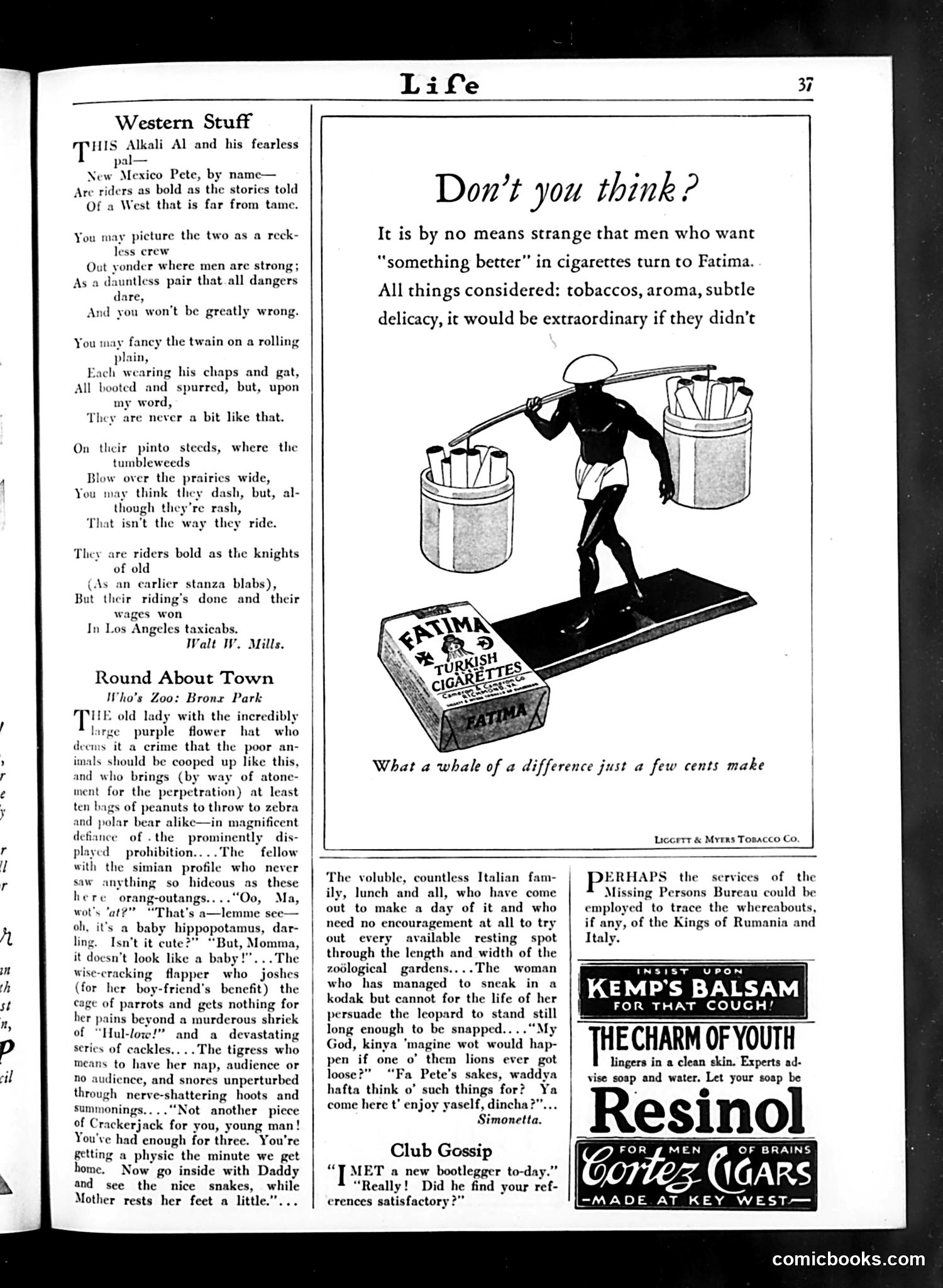
This page contains satirical sketches and advertisements from what appears to be the 1920s. The main content includes: **"Western Stuff"** - A humorous poem mocking the romantic myth of Wild West cowboys. The joke: "Alkali Al" and "New Mexico Pete" are supposedly bold frontier riders, but actually work as Los Angeles taxicab drivers. This satirizes the gap between America's romantic self-image and mundane modern reality. **"Round About Town"** - Observations of typical zoo visitors at Bronx Park, including stereotyped characters: a fussy elderly woman, working-class families, a flapper girl, and Italian immigrants. The humor derives from class-based caricatures common to the era. **"Club Gossip"** - A brief joke about meeting a "bootlegger" during Prohibition, with reference to "references"—wordplay on the illegal alcohol trade. The page also contains period cigarette, cough syrup, and cigar advertisements—typical magazine filler of the era.
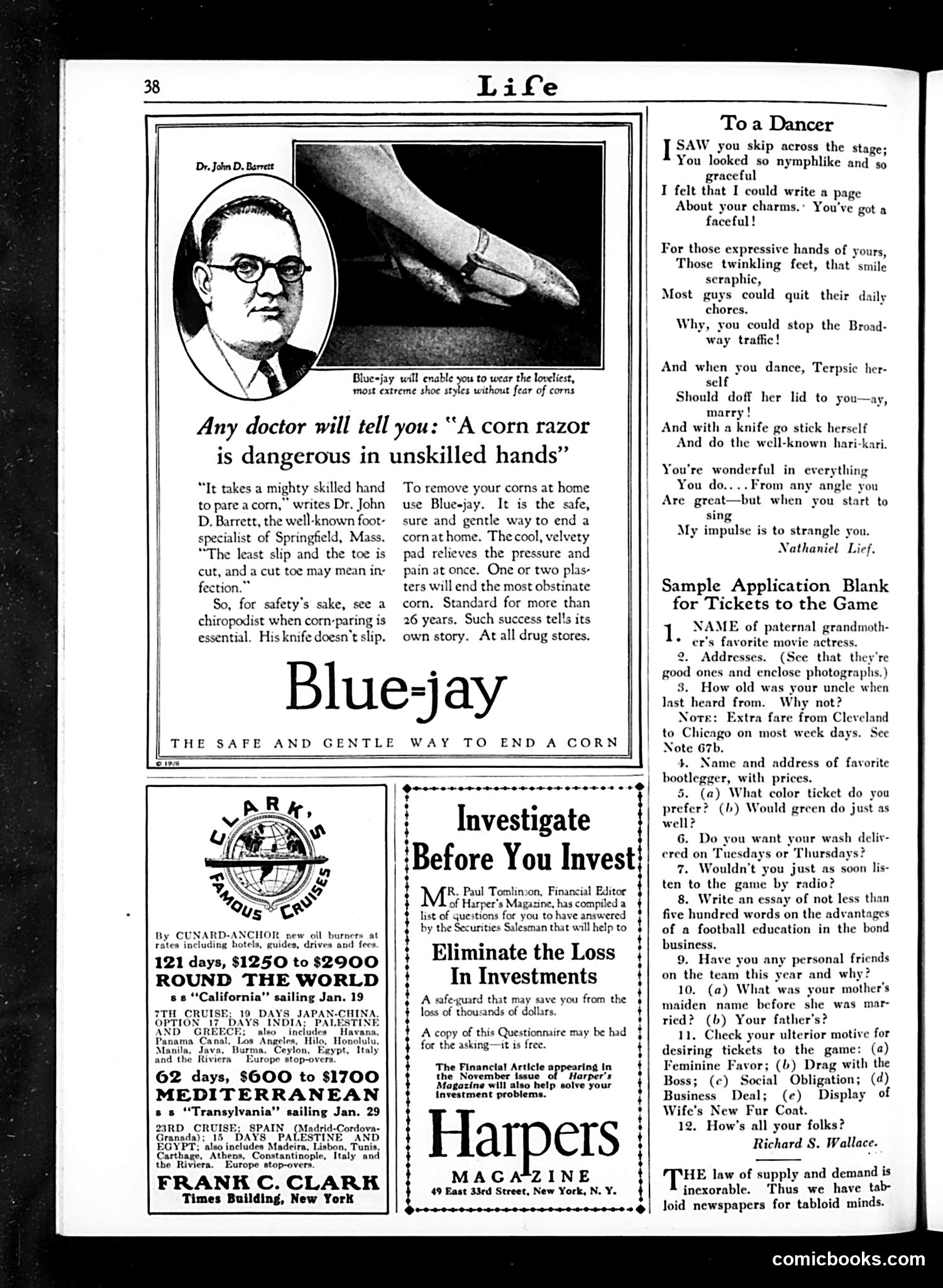
This page contains primarily **advertisements and light satirical content**, not political cartoons. The main ad features **Dr. John D. Barrett**, a real Springfield, Massachusetts foot specialist, endorsing "Blue-jay" corn plasters. The ad uses the appeal-to-authority strategy common in 1920s advertising, claiming doctors warn that amateur corn removal is dangerous—implying readers should buy the product instead. The right column includes a humorous poem "To a Dancer" by Nathaniel Lief that compliments a performer's dancing but brutally mocks her singing, ending with "My impulse is to strangle you"—typical of Life's satirical humor. Below that is a parody "Application Blank for Tickets to the Game"—absurdist questions (asking for your uncle's age or your mother's maiden name) that mock the increasingly invasive questionnaires and bureaucratic forms becoming common in modern life. The page otherwise showcases cruise ship advertisements and investment advice, reflecting 1920s consumer culture and financial concerns.
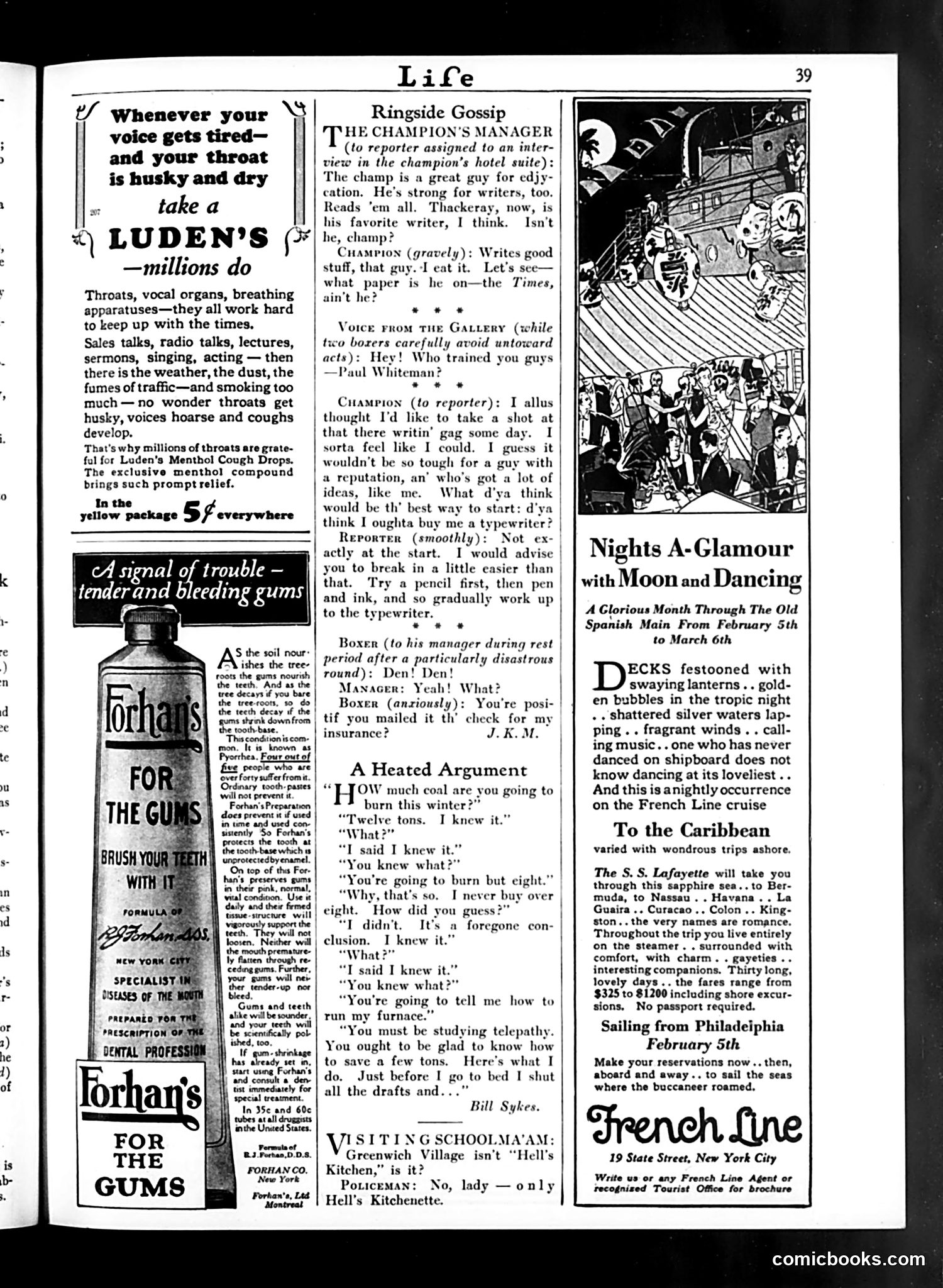
This page from *Life* magazine contains **satirical humor pieces** and advertisements typical of the 1920s-30s era. The **"Ringside Gossip"** cartoon mocks a boxing champion's pretense of literary sophistication. His manager claims the fighter reads Thackeray and appreciates good writing, but the champion immediately confuses the author with a newspaper, revealing his actual ignorance. Hecklers from the gallery reference Paul Whiteman (a famous bandleader), further exposing the absurdity. The joke satirizes athletes' attempts to appear cultured and intelligent beyond their actual knowledge. **"A Heated Argument"** presents a repetitive, circular dispute between two men about coal consumption—one claims foreknowledge of the other's heating habits through supposed telepathy. The humor lies in the frustrated, circular logic. Other pieces include brief comedic exchanges and advertisements for **Luden's cough drops** and **Forhan's toothpaste**—standard period advertising claiming health benefits. The page reflects 1920s-30s American humor: lightweight satire of celebrity pretension, working-class dialect comedy, and medical product marketing using pseudo-scientific claims.
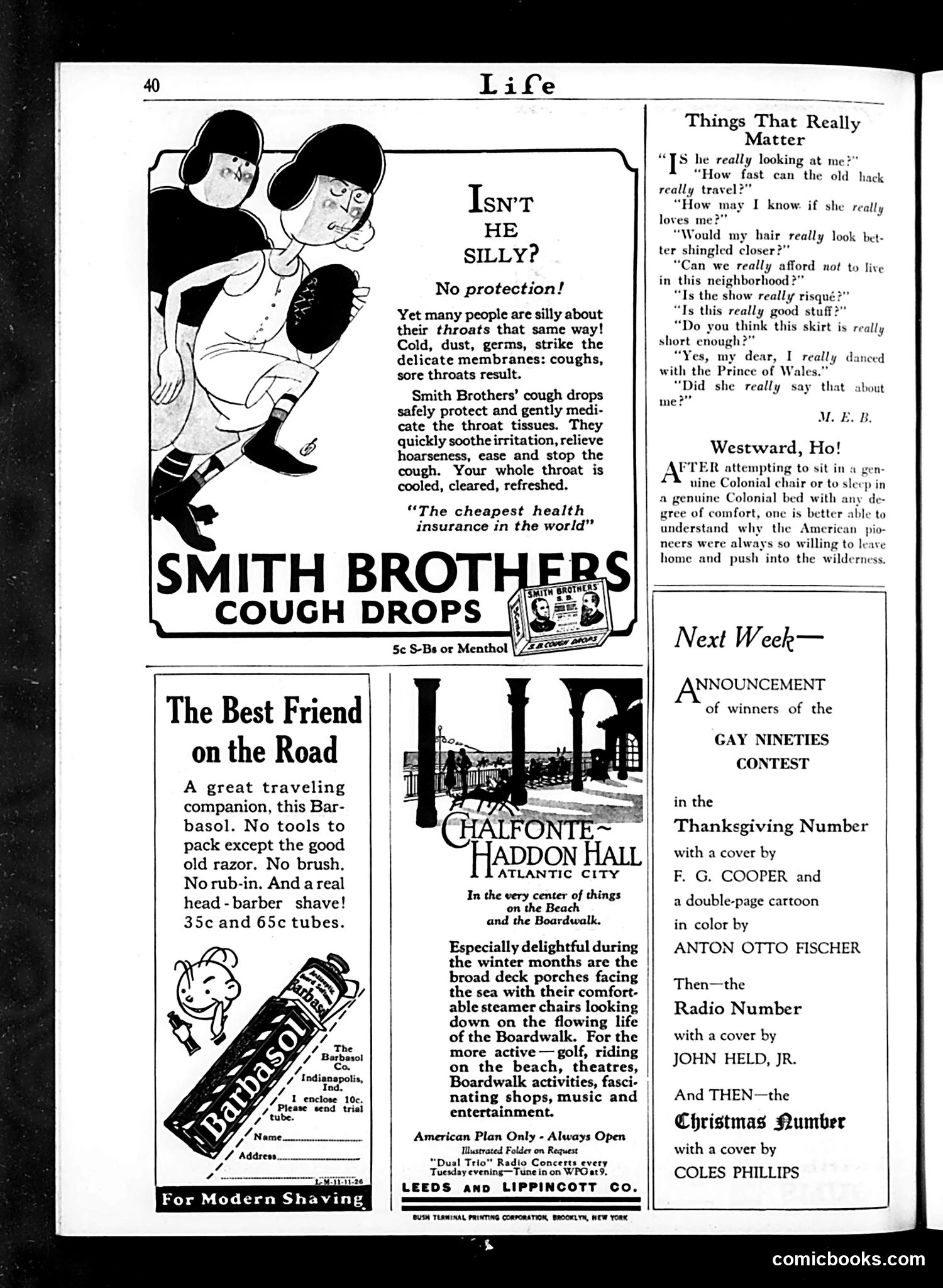
This page from Life magazine (undated but appears early 20th century) contains satirical commentary on American social anxieties. The main cartoon mocks people overly concerned with trivial matters—whether a lover truly cares, if one's hair looks "really" good, or if a skirt is "really" short enough. The satire suggests Americans obsess about superficial concerns while neglecting genuine health (the throat protection theme). The "Westward, Ho!" piece humorously suggests American pioneers left home not from adventurous spirit but from discomfort—attributing westward expansion to uncomfortable Colonial furniture rather than manifest destiny or economic opportunity. This inverts the romantic narrative of pioneering. The advertisements (Smith Brothers cough drops, Barbrasol shaving cream, Babasol razor, and Halfonte-Haddon Hall hotel) are period commercial content, not satire. The page reflects Jazz Age anxieties about modernity, social propriety, and changing values—poking fun at contemporary preoccupations with status and appearance.
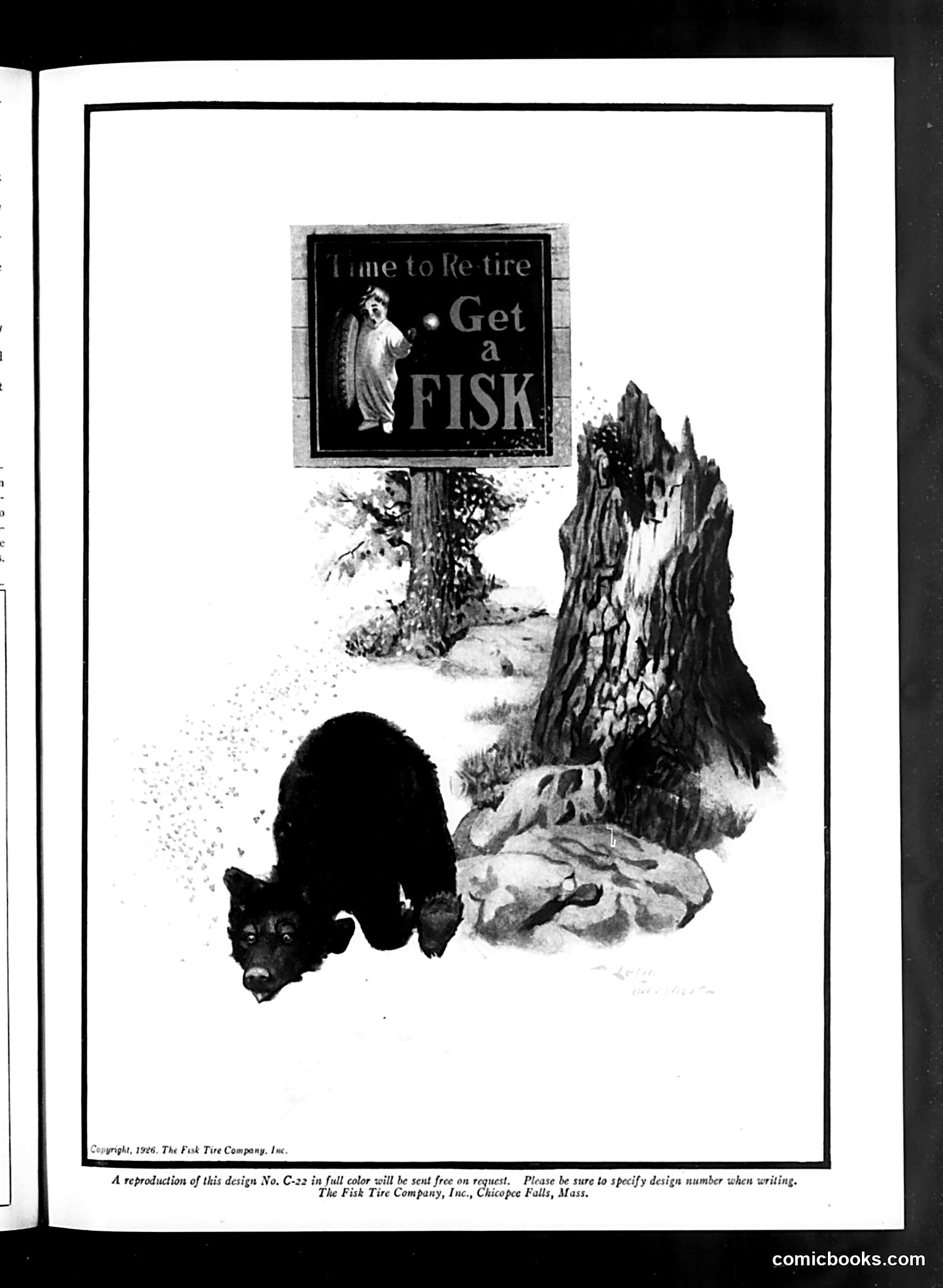
This is a **commercial advertisement** for Fisk Tires, not editorial satire. The image features the famous Fisk Tire Company mascot—a tired-looking child in pajamas holding a candle—juxtaposed with a bear in a rocky wilderness landscape. The slogan "Time to be tire / Get a FISK" puns on "tire" (exhaustion) and "tire" (wheel). The advertisement's humor plays on the contrast: just as the sleepy child needs rest, travelers on tires need reliable Fisk products. The bear suggests outdoor adventure and rugged terrain where quality tires matter. This reflects 1920s automobile culture and the marketing strategy of depicting Fisk's iconic drowsy mascot across various scenarios to promote brand recognition and tire durability.
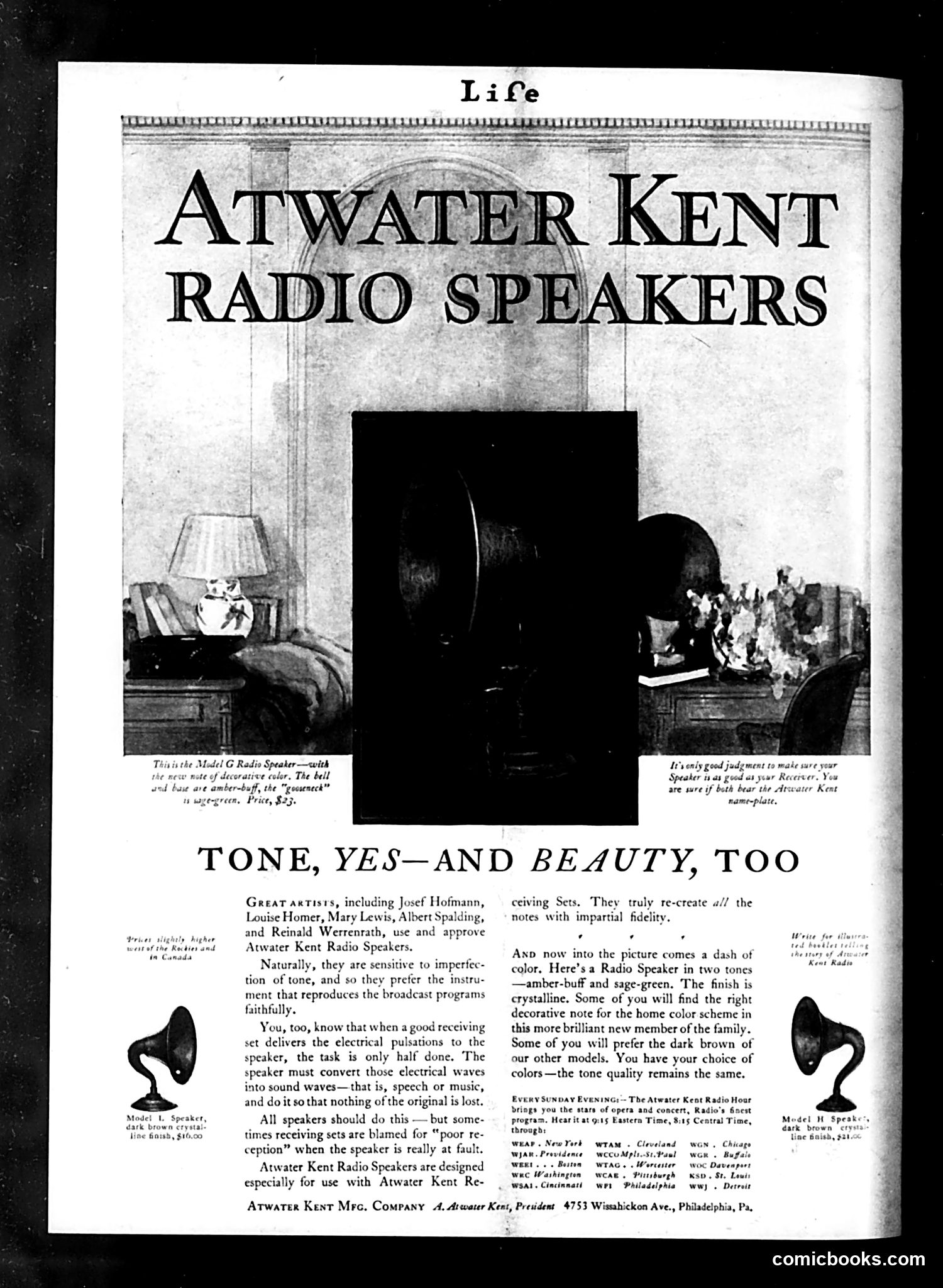
This is **advertising copy**, not satire or political commentary. It's a full-page advertisement for Atwater Kent Radio Speakers from Life magazine. The page promotes radio speakers by claiming endorsement from famous classical musicians (Josef Hofmann, Louise Homer, Mary Lewis, Albert Spalding, Reinald Werrenrath). The pitch emphasizes that a quality speaker is essential—receiving sets alone don't complete the job; the speaker must faithfully convert electrical signals into sound without loss. The "cartoon" element is minimal: two small illustrations of radio speaker models (Models G and H) in different finishes—amber-buff/sage-green and dark brown—positioned left and right of the main text. The actual appeal is to home décor: radio speakers are now available in colors that complement interior design, making them furniture-appropriate. The bottom lists affiliated radio stations broadcasting the "Atwater Kent Radio Hour" of classical music. This reflects 1920s consumer marketing: positioning technological products as both functionally superior *and* aesthetically desirable for the modern home.

I can see this is a very dark, low-contrast image from what appears to be a historical publication. The page is predominantly black with only a white margin visible on the left side and the "comicbooks.com" watermark at the bottom right. Unfortunately, the image quality and contrast make it impossible to discern any cartoon illustrations, text content, or political figures that would be necessary to explain the satire or historical context. The OCR text provided only contains a website attribution. To properly analyze this page's political or social commentary, I would need a clearer, higher-contrast version of the image where the actual cartoon artwork and text are legible.