
Life, 1926-11-11 · page 25 of 45
Life — November 11, 1926 — page 25: what you’re looking at
What you’re looking at
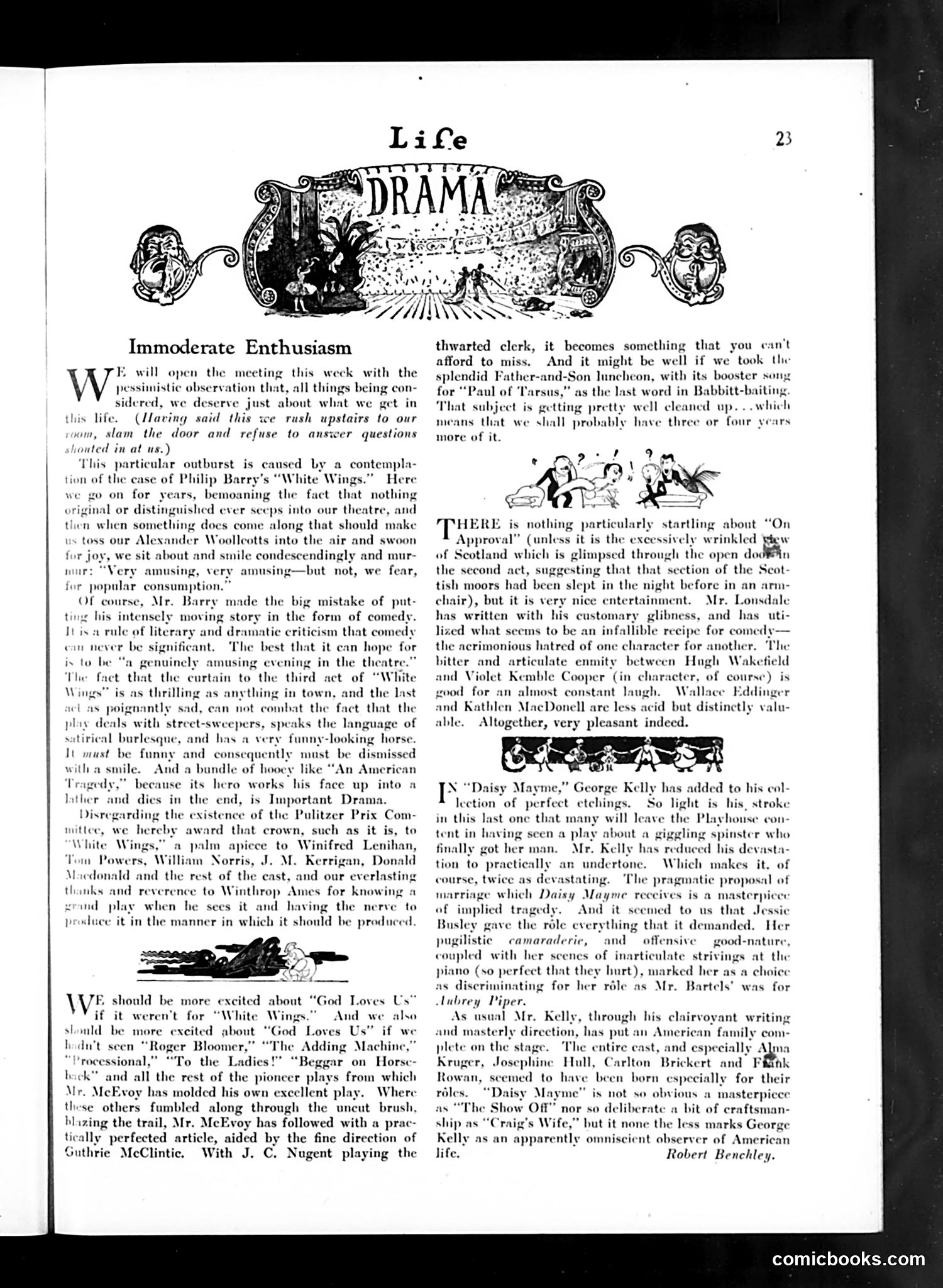
This is a theater review column criticizing American audiences' and critics' snobbish dismissal of comedy as inherently inferior to serious drama. The author argues that Philip Barry's play "White Wings"—about street-sweepers—deserves serious recognition despite being funny, yet critics dismiss it as mere entertainment. Meanwhile, plays like "An American Tragedy" receive prestige simply because they're melodramatic and tragic, regardless of quality. The satire targets the cultural prejudice that equates significance with tragedy and tears. The reviewer notes this contradiction: pioneering plays like "The Adding Machine" and "Processional" were celebrated for breaking new ground, but their successors ("God Loves Us," "Daisy Mayme") receive less attention despite being better-crafted—simply because the novelty wore off. The column's title, "Immoderate Enthusiasm," ironically describes the reviewer's frustrated passion for intelligent comedy and contempt for automatic prestige-granting based on genre rather than merit.
📄 Transcribed text from this page (OCR, searchable)
Machine-transcribed from the original scan — historical spelling and the odd misread are preserved.
Immoderate Enthusiasm E. will open the mee this week wi W crest observation that, all things be sidered, we deserve just about what we get in sis life. (//aving said this we rush upstairs to our vm, slam the door and refuse to answer questions outed in at us.) This particular outburst is caused by a contempla- tion of the case of Philip Barry's “White Wings.” Here we go on for years, bemoaning the fact that nothing original or distinguished ever seeps into our theatre, and then when something docs come along that should make us toss our Alexander Woollcotts into the air and swoon for joy, we sit about and smile condescendingly and mur- n Very amusing, very amusing—but not, we fear, for popular consumption.” Of course, Mr. Barry made the big mistake of put- ting his intensely moving story in the form of comedy. I) isa rule of literary and dramatic criticism that comedy cin never be significant. The best that it can hope for is to be “a genui musing evening in the theatre.” ‘The fact that the curtain to the third act of “White Wings” is as thrilling as anything in town, and the last clas poignantly sad, ean not combat the fact that the play deals with street-sweepers, speaks the nage of satirical burlesque, and has a very funny-looking horse. It must be funny and consequently must be dismissed with a smile. And a bundle of hooey like “An American Tragedy,” because its hero works his face up into a luther and dies in the end, is Important Drama. Disregarding the existence of the Pulitzer Prix Com- mitlee, we hereby award that crown, such as it is, to White W palm apiece to Winifred Len Tom Powe rs, William Norris, J. M. Kerr Macdonald and the rest of the cast, and our everlasting thanks and reverence to Winthrop Ames for knowin rind play when he secs it and having the nerve to produce it in the manner in which it should be produc —_—_ Ce \E should be more excited about “God Loves Us” f it weren't for “White W And we also should be more exeited about “C a Loves Us” if we hadn't seen “Roger Bloomer,” “The Adding Machine, “Vrocessional,” ‘To the Ladies!” “Beggar on Hors’ back" and all the rest of the pioneer plays from which Mr. McEvoy has molded his own excellent p' Where these others fumbled along through the uncut brush, blazing the trail, Mr. McEvoy has followed with a prac- tically perfected article, aided by the fine direction of Guthrie McClintic. With J. C. Nugent playing the thwarted clerk, it becomes something that you can't afford to miss. And it might be well if we took the splendid Father-and-Son luncheon, with its booster sony r ‘Paul of Tarsus,” as the last word in Babbitt-baiting. t subject is getting pretty well cleaned up. ..which means that we shall probably have three or four years more of it. & HERE is nothing particularly startling about “On Approval” (unless it is the excessively wrinkled pew of Scotland which is glimpsed through the open dooFin the second act, suggesting that that section of the Scot- tish moors had been slept in the night before in an arm- chair), but it is very nice entertainment. Mr. Lonsdale has written with his customary glibness, and at seems to be an infallible recipe for cd onious hatred of one character for another. bitter and articulate enmity between Hugh Waketield d Violet Kemble Cooper (in character, of course) is od for an almost constant laugh. Wallace Eddinger and Kathlen MacDonell are less acid but distinctly valu- F Altogether, very pleasant indee =a N “Daisy Mayme,” George Kelly has added to his eol- lection of perfect etchings. So Tight is his, stroke in this last one that many will Ic ¢ Playhouse con- tent in having seen a play about a giggling spinster who finally got her man. Mr. Kelly has reduced his devasta- tion to. practicall undertone. Which makes it. of course, twice as devastating. The pragmatic proposal of marriage which Daisy Mayme receives is a masterpicet of implied tragedy. And it seemed to us that Jessie ave the role everything that it demanded. Her camarade ind offensive od-nature, coupled with her scenes of inarticulate strivings at the piano (so perfect that they hurt), marked her as a choice as diserit g for her réle as Mr. Bartels’ was for Aubrey Piper. As usual Mr, Kelly, through his clairvoyant writing and masterly direction, has put an American family com- plete on the stage. The entire east, and especially Kruger, Josephine Hull, Carlton Brickert and F seemed to have been born espec for their sy Mayme” is not so obvious a masterpiece as “The Show Off” nor so deliberate a bit of craftsman- ship as “Craig’s Wife,” but it none the less marks George Kelly as an apparently omniscient observer of American life. Robert Benchley. comicbooks.com