
Life, 1926-11-11 · page 36 of 45
Life — November 11, 1926 — page 36: what you’re looking at
What you’re looking at
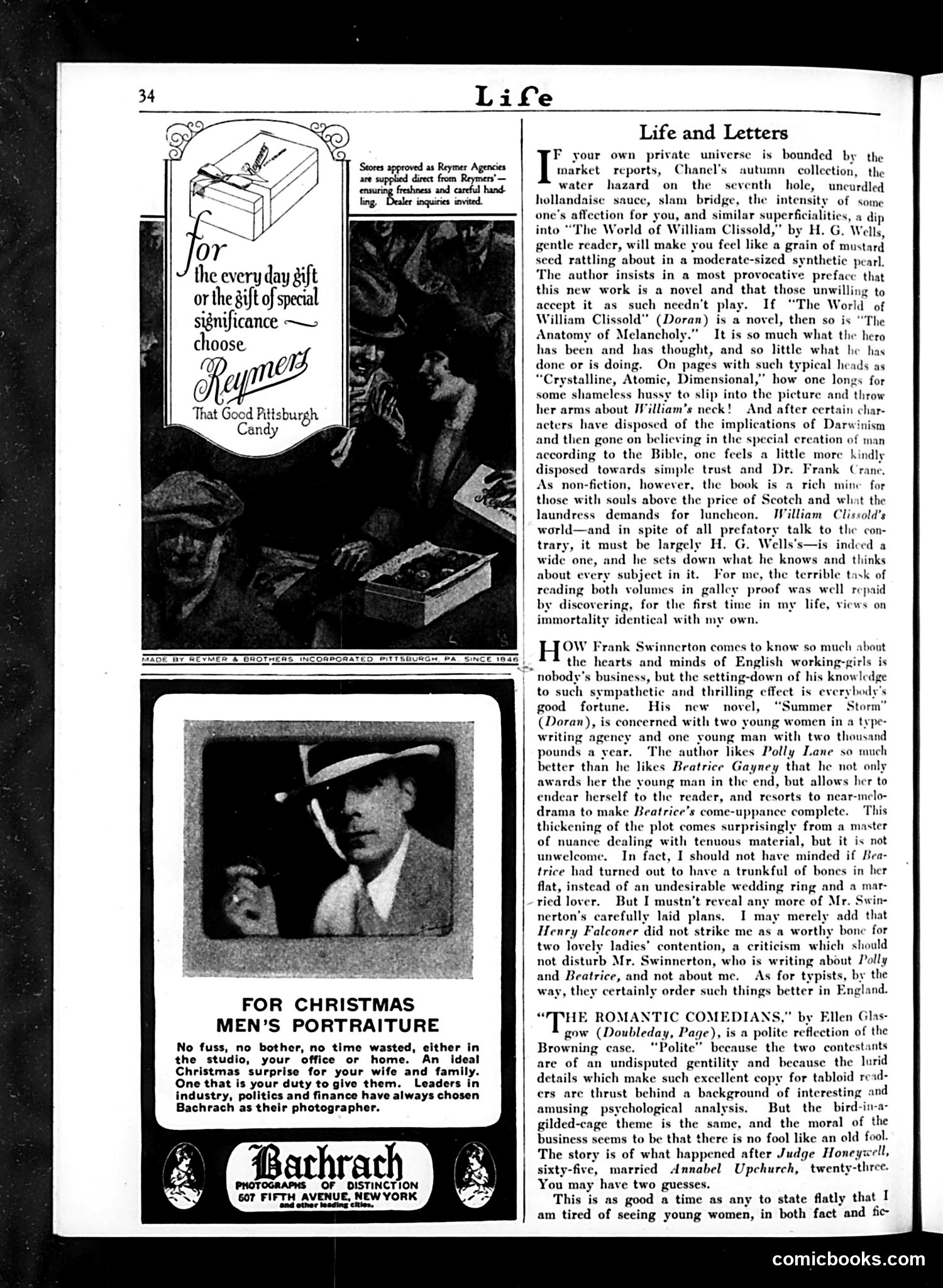
This page primarily contains literary book reviews rather than political cartoons. The content discusses three contemporary novels: 1. **H.G. Wells's "The World of William Clissold"** — criticized as more philosophical essay than novel, though the reviewer appreciates its intellectual depth on immortality 2. **Frank Swinnerton's "Summer Storm"** — praised for sympathetic portrayal of English working-girls in a typewriting agency, though the reviewer notes the plot melodramatically favors one female character over another 3. **Ellen Glasgow's "The Romantic Comedians"** — described as a polite reflection on a real-world scandal (the "Browning case," likely referencing a contemporary society marriage) The advertisements include Reymers Pittsburgh candy and Bachrach photography services for Christmas portraits. The reviews demonstrate *Life* magazine's role as a sophisticated arbiter of literary taste for educated American readers, discussing serious fiction within a humorous, gossipy framework typical of 1920s periodicals.
📄 Transcribed text from this page (OCR, searchable)
Machine-transcribed from the original scan — historical spelling and the odd misread are preserved.
Life and Letters F your own private universe is bounded by the I market reports, Chanel’s autumn collection, the water hazard on the seventh hole, uncurdled hollandaise sauce, slam bridge, the intensity of some one’s affection for you, and similar supertficialities, a dip into “The World of William Clissold,” by H. G. Wells, gentle reader, will make you feel like a grain of mustard . q seed rattling about in a moderate-sized synthetic pearl, the every day gift | The author insists in a most provocative preface that th A t ‘al this new work is a novel and that those unwilling to or e gif Of specia j accept it as such needn't play. If “The World of significance as 4 William Clissold” (Doran) is a novel, then so is “The } Anatomy of Melancholy.” It is so much what the hero choose has been and has thought, and so little what he has d ’ done or is doing. On pages with such typical heads as y , ¢ “Crystalline, Atomic, Dimensional,” how one longs for 27, 4 [ some shameless hussy to slip into the picture and throw That Good Pittsburgh 4 her arms about William’s neck! And after certain char- Candy acters have disposed of the implications of Darwinism and then gone on believing in the special creation of man according to the Bible, one feels a little more kindly disposed towards simple trust and Dr. nk Crane, As non-fiction, however, the book is a rich mine for those with souls above the price of Scotch and what the laundress demands for luncheon. William Clissold’s world—and in spite of all prefatory talk to the con- trary, it must be largely H. G. Wells’s—is indeed a wide one, and he sets down what he knows and thinks about every subject in it. For me, the terrible task of reading both volumes in galley proof was well repaid by discovering, for the first time in my life, views on immortality identical with my own. OW Frank Swinnerton comes to know so much about the hearts and minds of English working-girls is nobody's business, but the setting-down of his knowledge to such sympathetic and thrilling effect is everybody's good fortune. His new novel, “Summer Storm” (Doran), is concerned with two young women in a type- writing agency and one young man with two thousand pounds a year, The author likes Polly Lane so much better than he likes Beatrice Gayney that he not only awards her the young man in the end, but allows her to endear herself to the reader, and resorts to near-melo- drama to make Beatrice’s come-uppance complete. This thickening of the plot comes surprisingly from a master of nuance dealing with tenuous material, but it is not unwelcome. In fact, I should not have minded if Bea- trice had turned out to have a trunkful of bones in her flat, instead of an undesirable wedding ring and a mar- ried lover. But I mustn't reveal any more of Mr. Swin- nerton’s carefully laid plans, I may merely add that Henry Falconer did not strike me as a worthy bone for two lovely ladies’ contention, a criticism which should not disturb Mr. Swinnerton, who is writing about Polly and Beatrice, and not about me. As for typists, by the way, they certainly order such things better in England. Rape by REY MER _& OROTHERS INCORPORA: FOR CHRISTMAS oe eee MEN’S PORTRAITURE “(MHE ROMANTIC COMEDIAN by Ellen Glas- gow (Doubleday, Page), is a polite reflection of the No fuss, no bother, no time wasted, either in Browning case. ‘Polite’ because the two contestants the studio, your office or home. An ideal i entility < 7 C id Christmas ‘surprioe for your wife and family. are of an undisputed gentility and because the luri One that is your duty to give them. Leaders in details which make such excellent copy for tabloid read- industry, politics and finance have always chosen ers are thrust behind a background of interesting and Bachrach as their photographer. amusing psychological analysis. But the bird-in-a gilded-cage theme is the same, and the moral of the business scems to be that there is no fool like an old fool. The story is of what happened after Judge Hone sixty-five, married Annabel Upchurch, twenty-three. PHOTOGRAPHS OF DISTINCTION You may have two guesses. or FIFTH AVENUE, NEW YORK This is as good a time as any to state flatly that I am tired of seeing young women, in both fact and fic- comicbooks.com