
A complete issue · 36 pages · 1926
Life — September 30, 1926
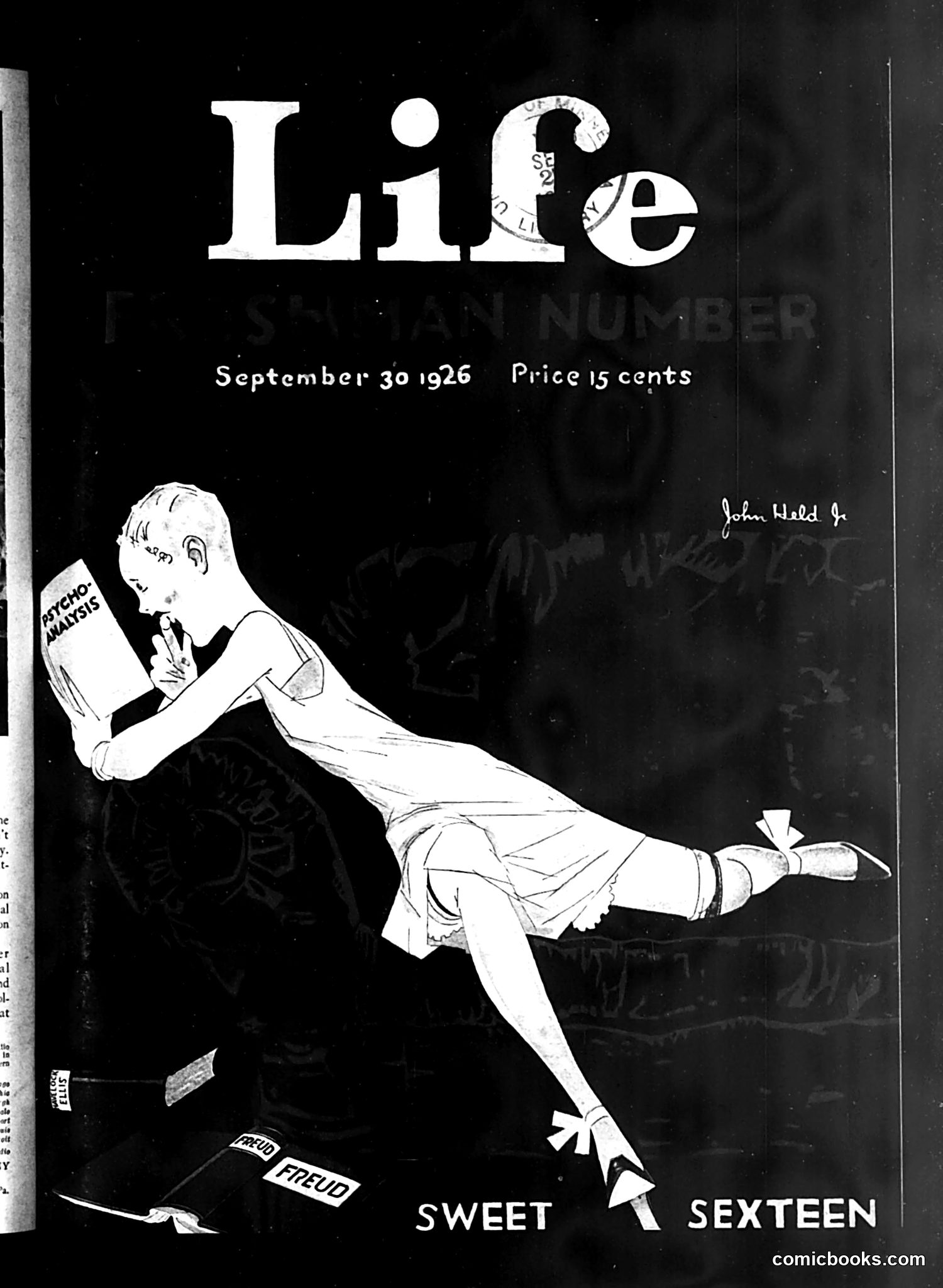
This cover illustrates the "Sweet Sixteen" phenomenon of the 1920s—the cultural preoccupation with young women's sexuality and desirability. The illustration depicts a teenage girl reclining while reading "Psychoanalysis," one of the era's fashionable intellectual trends. The scattered "Freud" papers reference the popularization of Freudian psychology in American culture. The satire targets how modern youth, particularly young women, adopted sophisticated adult concepts—psychology, sexuality, modernism—prematurely. The "Psychoanalysis" reading material in a teenager's hands satirizes both her precocious intellectualism and the era's anxieties about the "flapper" generation's accelerated maturation and independence during the Jazz Age.
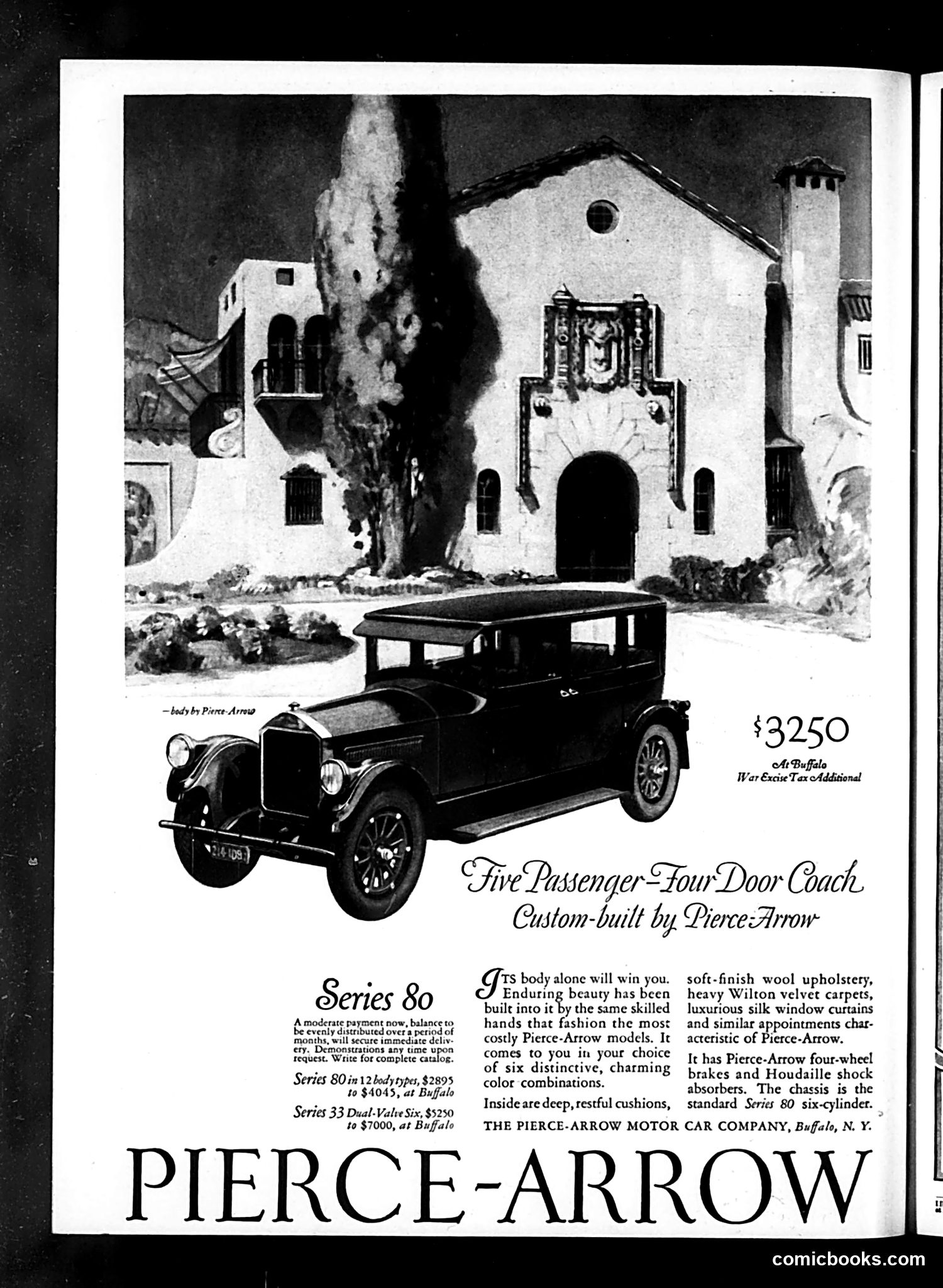
This page is **primarily an advertisement**, not satirical content. It shows a Pierce-Arrow automobile—specifically a "Five Passenger Four Door Coach" priced at $3250—displayed against a Mediterranean villa backdrop. The ad emphasizes luxury features: custom Pierce-Arrow construction, wool upholstery, silk curtains, and advanced engineering (four-wheel brakes, Houdaille shock absorbers). Multiple Series options are listed with varying prices ($2895-$7000). The architectural setting and refined aesthetics target wealthy buyers. The tagline "Its body alone will win you" suggests aspirational messaging—that owning this car signals social status and refined taste. There is no political satire or cartoon commentary present. This is a straightforward luxury automobile advertisement from the automobile industry's golden age.
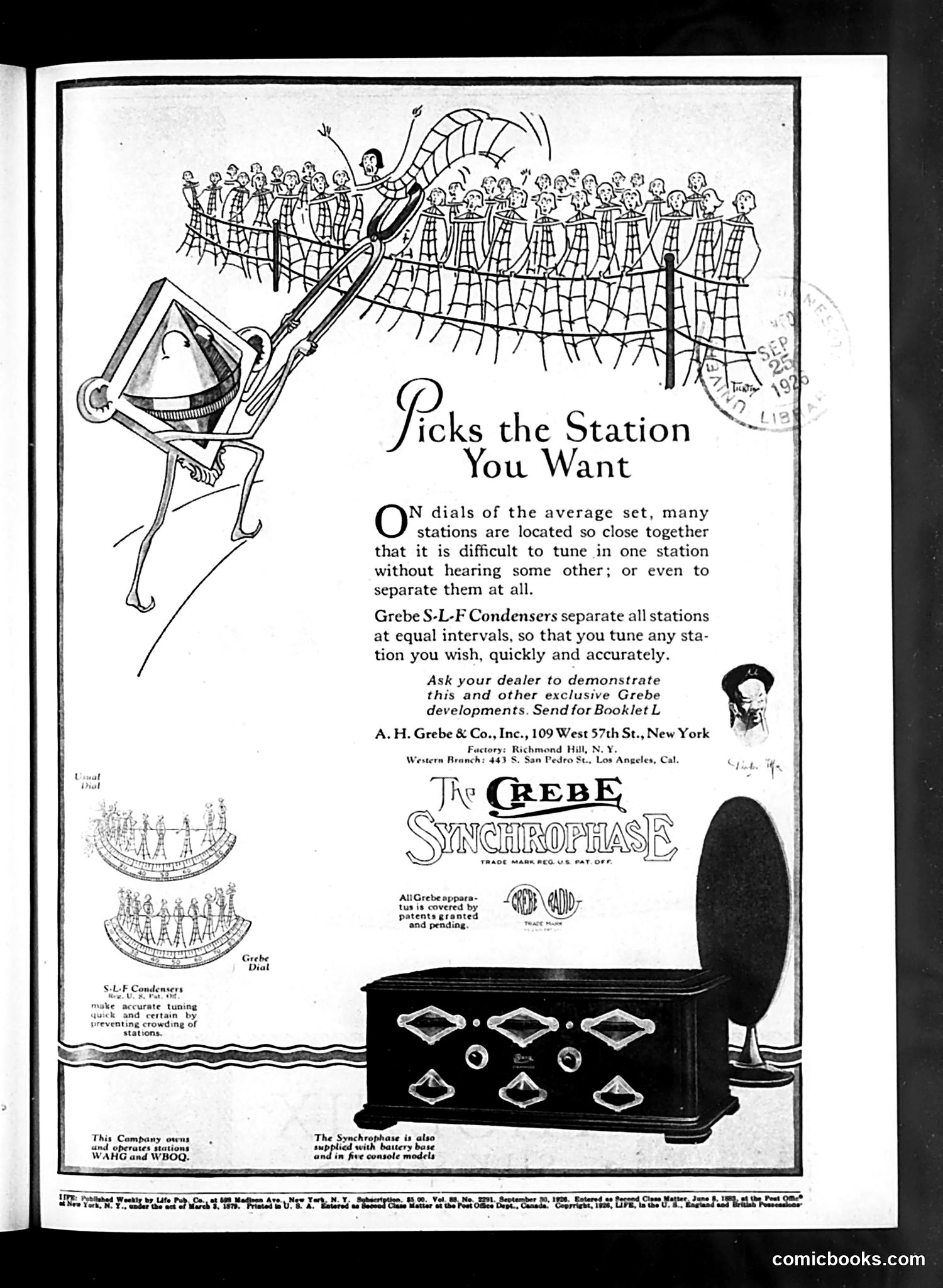
This is primarily **advertising**, not satire or political commentary. The page promotes the Grebe Synchrophase radio receiver, manufactured by A.H. Grebe & Co. The cartoon imagery serves a commercial purpose: a caricatured figure with an exaggerated radio-dial head conducts an orchestra of people, illustrating the advertiser's claim that their "S-L-F Condensers" allow listeners to "tune in any station you wish, quickly and accurately." The joke is visual wordplay—the conductor's head *is* a radio dial, suggesting mastery over radio selection. The orchestra of people represents different radio stations. This was likely humorous to early 1920s audiences discovering radio technology. The technical diagrams below show internal radio components. This is straightforward product marketing emphasizing technological superiority, not political or social satire.
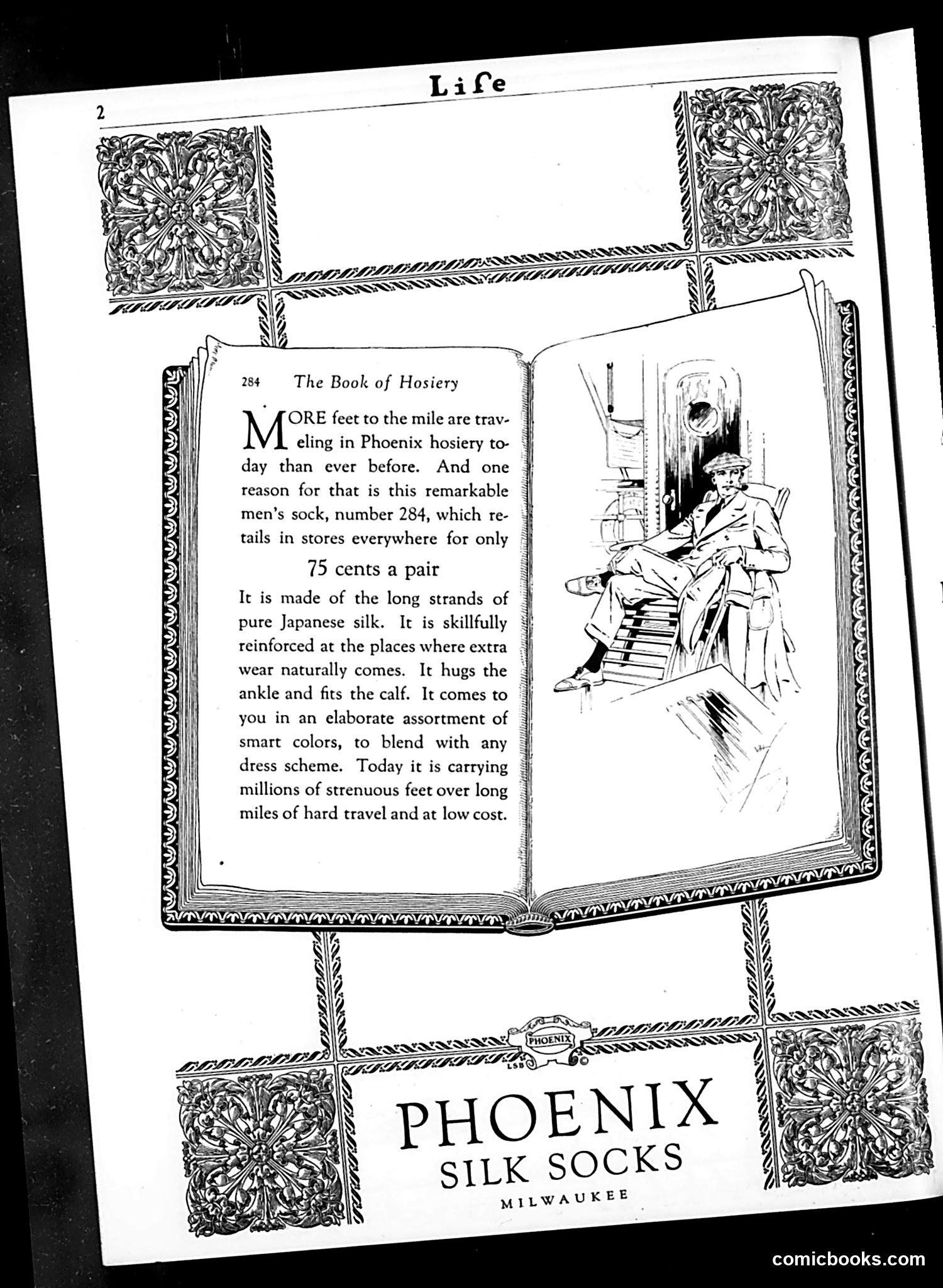
This page is **primarily an advertisement**, not political satire. It promotes Phoenix Silk Socks (number 284), made from Japanese silk and priced at 75 cents per pair. The ad emphasizes durability and comfort for travelers. The only illustrative element is a sketch showing a man in a hat and suit sitting in what appears to be a train or travel setting—likely depicting the "Phoenix" brand's target customer: the traveling businessman. The decorative borders and ornamental panels are typical of early 20th-century magazine design. The reference to Phoenix hosiery being used "millions of strenuous feet over long miles" connects the product to the era's emphasis on mobility and modern travel. There is no detectable political or social satire on this particular page.
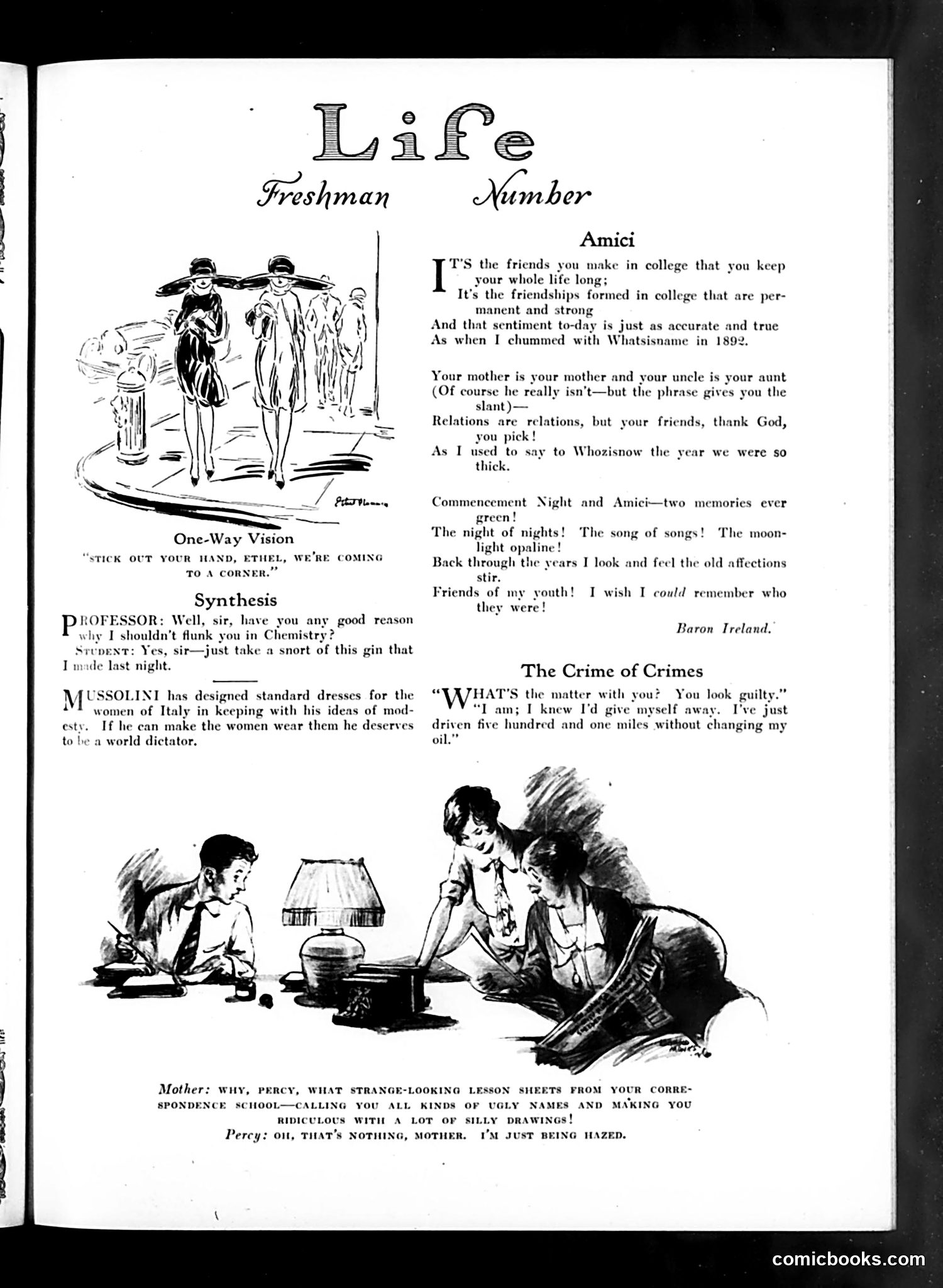
This is a college-themed humor issue. The content includes: **"One-Way Vision"** cartoon: Shows figures with luggage, captioned about "sticking out your hand" to flag down a car—likely satirizing freshman hitchhiking. **"Synthesis"** joke: A professor and student exchange about gin in chemistry class, poking fun at Prohibition-era college drinking despite legal restrictions. **"The Crime of Crimes"** cartoon: Depicts a confrontation between a mother and son (Percy) over correspondence school lesson sheets with "ugly names and ridiculous drawings." Percy claims he's "just being hazed"—satirizing hazing practices and students' excuses for misbehavior. The overall page mocks typical freshman experiences: travel mishaps, alcohol consumption during Prohibition, and dormitory pranks. The humor targets both student behavior and parental concern about college life.
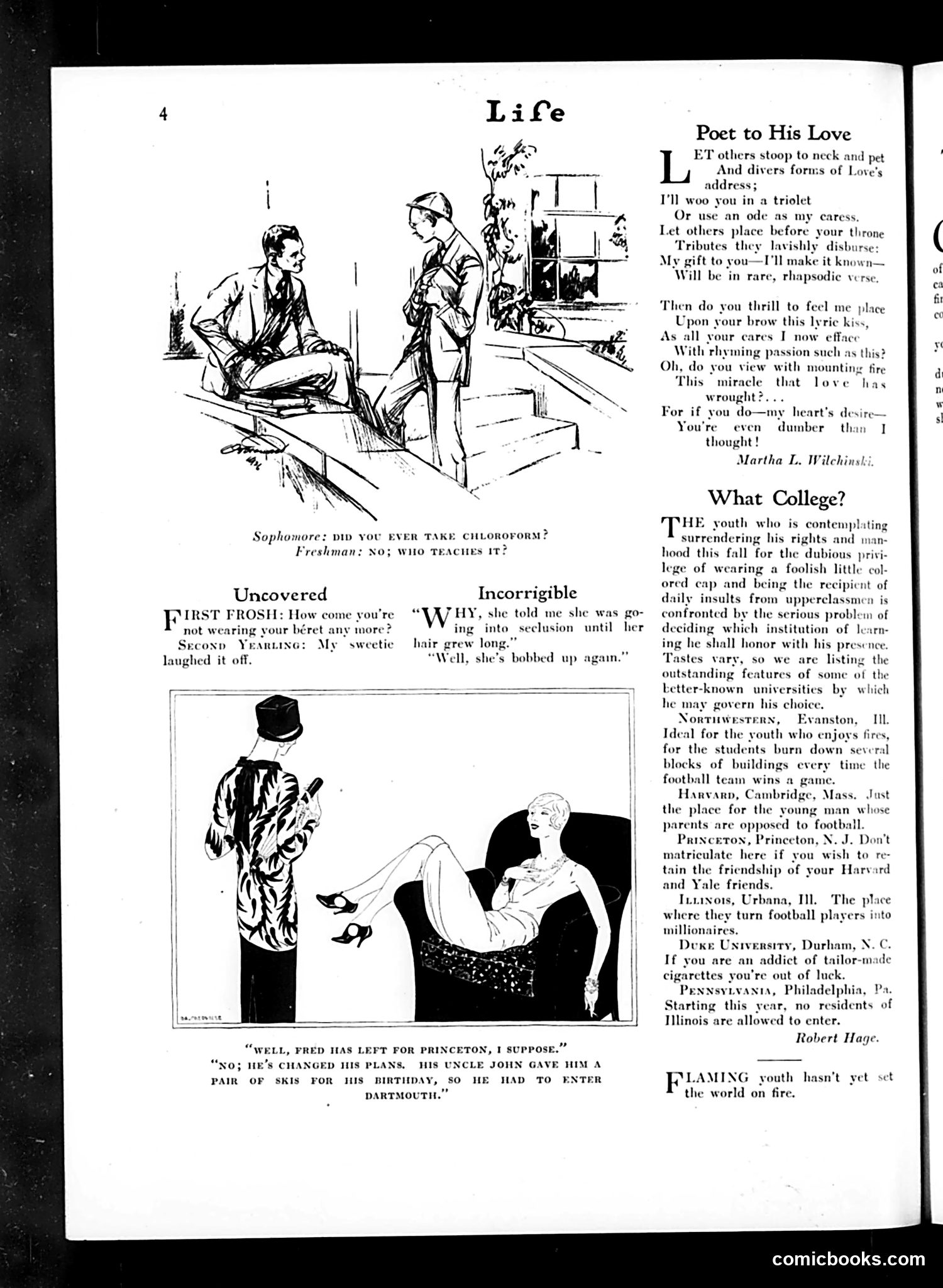
This page contains three distinct pieces of humor: 1. **"Poet to His Love"** - A romantic poem by Martha L. Wilchinski mocking overwrought declarations of love. 2. **"Uncovered" and "Incorrigible"** - Two brief dialogue jokes about removing a beret and hair growing back after a cut—light domestic humor. 3. **"What College?"** - A satirical article by Robert Hage critiquing college selection. It mocks prestigious universities (Northwestern, Harvard, Princeton, Illinois, Duke, Pennsylvania) by listing their supposed defining characteristics in exaggerated terms—suggesting these institutions are more notable for specific traits (football, tradition, or vice) than serious academics. The tone suggests skepticism about whether attending these famous schools actually matters. The accompanying cartoon depicts a woman lounging while a man departs, illustrating relationship dynamics of the era.
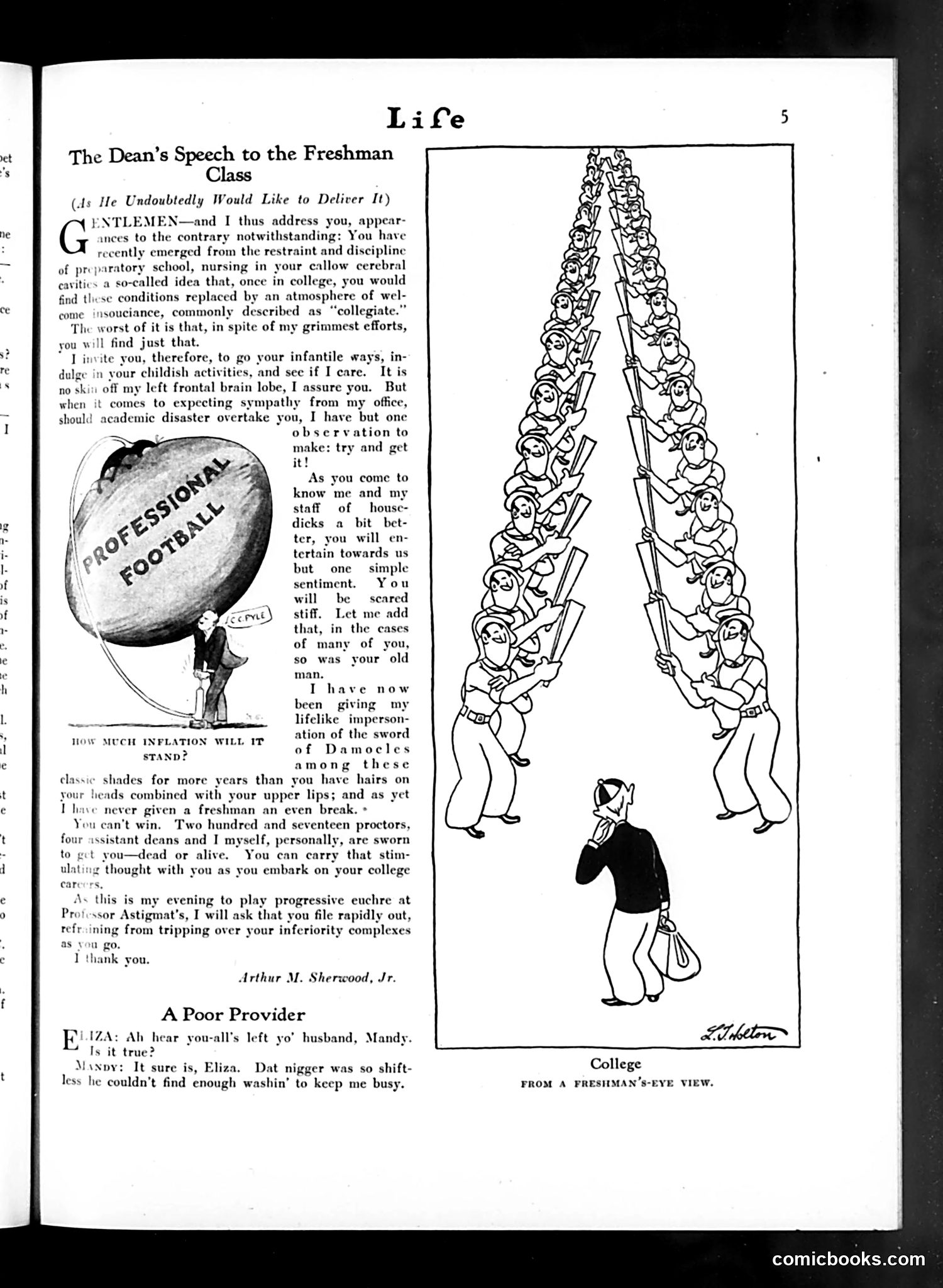
This page contains two pieces: 1. **"The Dean's Speech to the Freshman Class"** by Arthur M. Sherwood, Jr. - A humorous monologue where a college dean addresses new students, warning them not to indulge their "infantile ways" or expect sympathy for academic failures. The accompanying cartoon shows a tiny man struggling with a massive "Professional Football," illustrating the dean's point about inflated expectations. 2. **"A Poor Provider"** - A brief dialogue between two characters, Eliza and Mandy, discussing Eliza's husband's inability to find work, suggesting economic hardship. 3. **"College from a Freshman's Eye View"** - A cartoon showing two tall columns of identical freshmen faces viewed from above, with one confused freshman at the bottom, satirizing the overwhelming conformity and standardization of college life and freshman orientation.
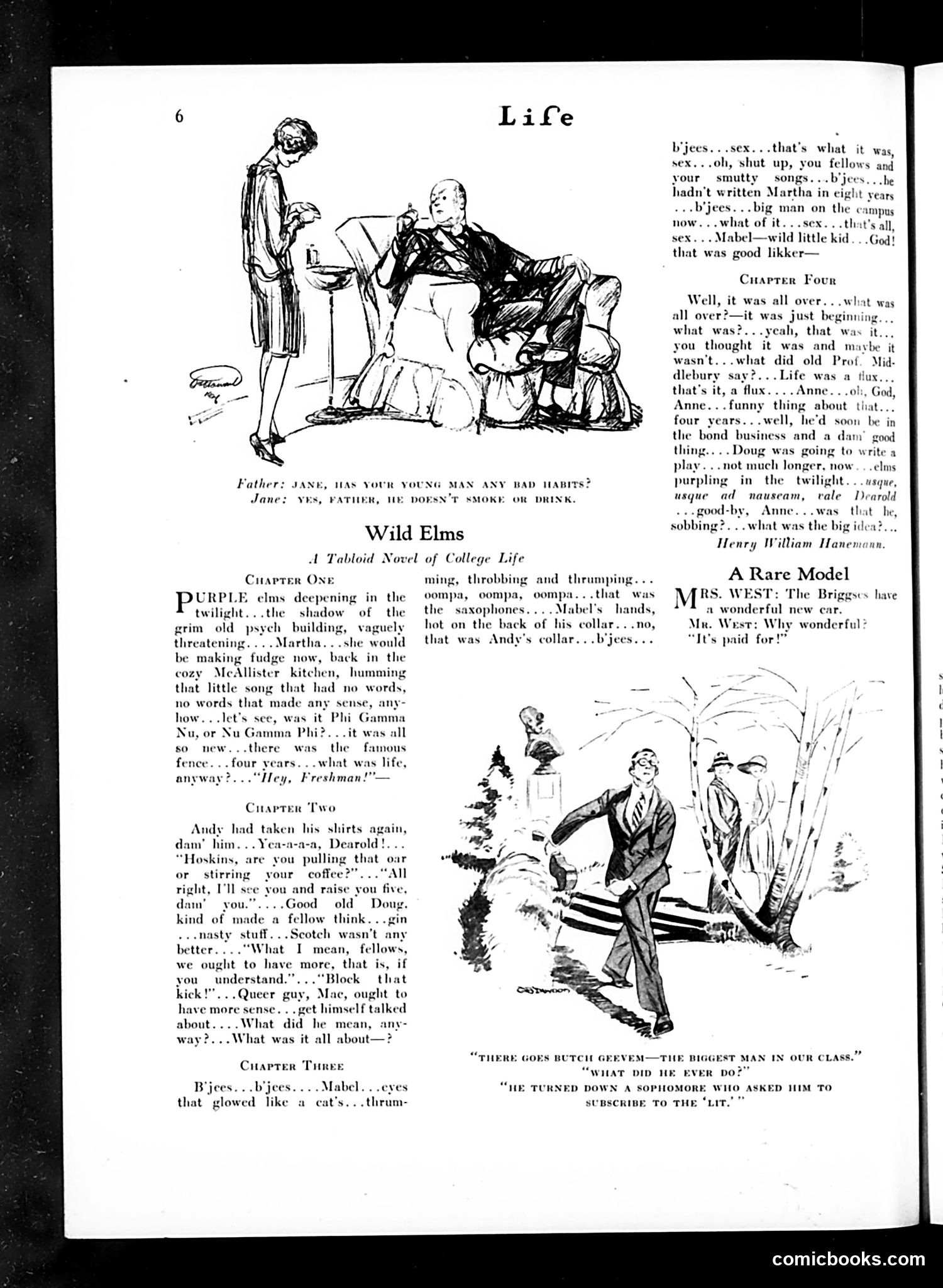
This page contains two literary pieces: "Wild Elms," a satirical short story about college life, and "A Rare Model," a brief humorous anecdote about a car purchase. The main illustration for "Wild Elms" depicts college students in casual, somewhat dissolute situations—drinking, lounging, discussing worldly matters. The accompanying text captures period slang and student behavior, referencing smoking, drinking, and romantic entanglements. "A Rare Model" uses the illustration of men examining an automobile with apparent confusion or skepticism. The caption's joke—about a man turning down a sophomore who asked him to subscribe to "the Lit" (likely a literary magazine)—plays on the assumption of inappropriate solicitation, creating satirical commentary on college publication promotion tactics. Both pieces mock early 20th-century college culture through exaggeration and innuendo.
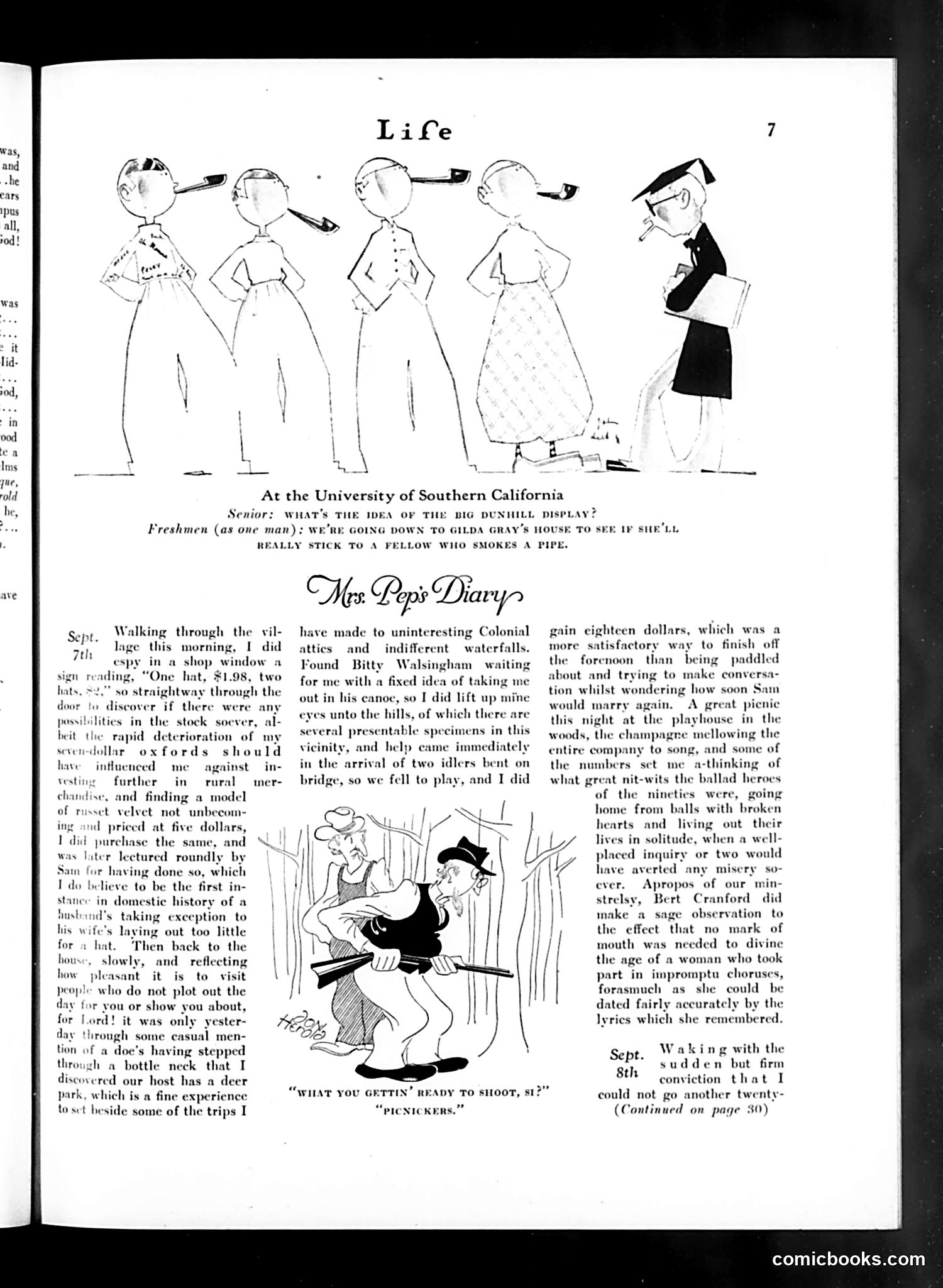
This page satirizes college life at USC through a fictional diary entry. The top cartoon shows four female freshmen with cigarettes, captioned as planning to visit a male student's house to see if "she'll really stick to a fellow who smokes a pipe"—mocking both women's smoking (then scandalous) and dating behavior. The main illustration depicts a couple in a canoe, with the caption "What you gettin' ready to shoot, si?" / "Picnickers"—suggesting the man is hunting unsuspecting couples, likely a commentary on campus romance and predatory behavior. The diary text itself humorously recounts mundane college social activities and romantic speculation, satirizing the triviality of student concerns and gossip during the 1920s era.
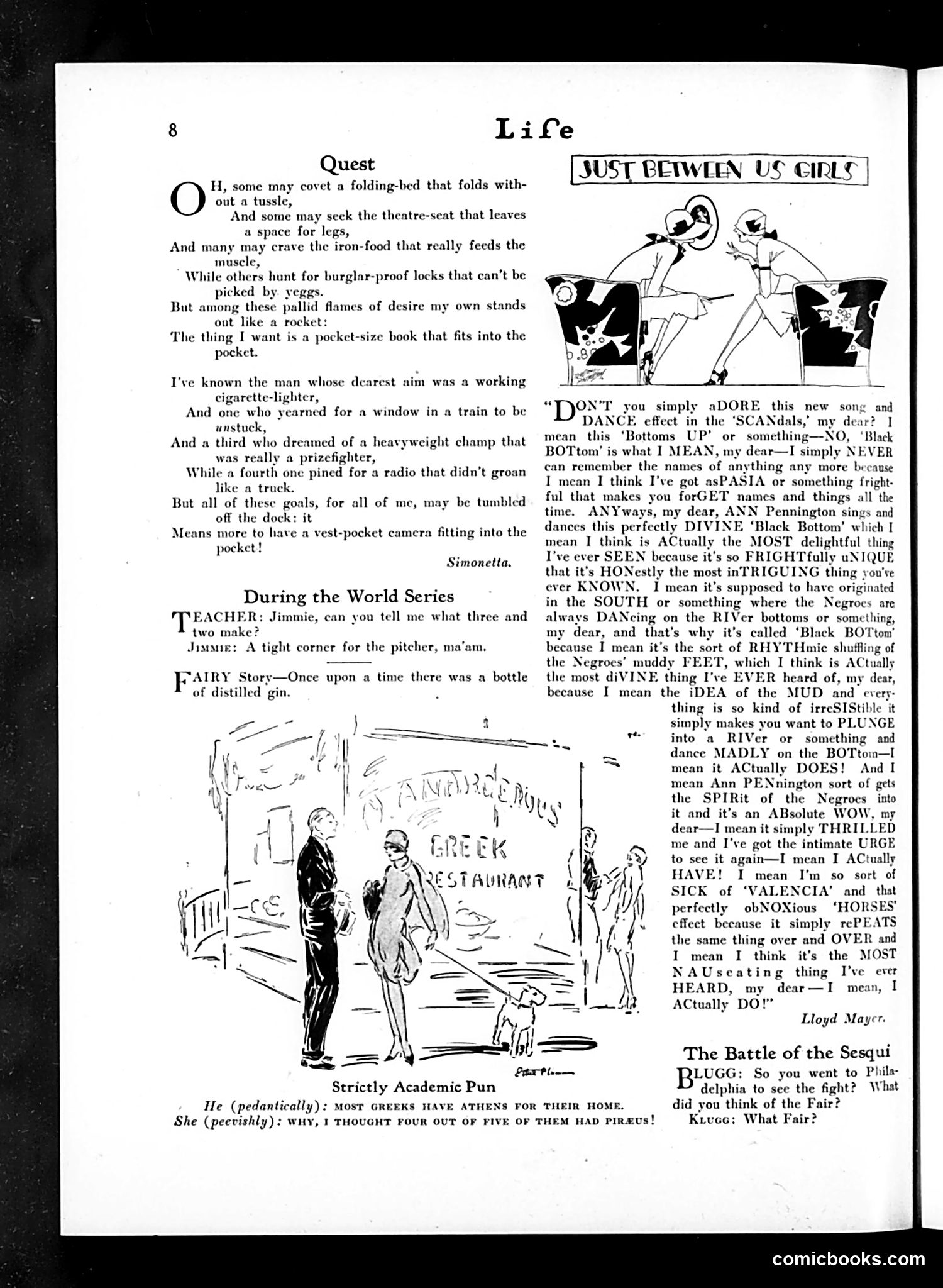
This cartoon depicts two figures outside a "Greek Restaurant." The accompanying text presents a pedestrian pun: **He (pedantically): "Most Greeks have Athens for their home."** **She (especially): "Why, I thought four out of five of them had Piraeus!"** The joke plays on homophones: "Athens" (the Greek capital) sounds like "a thens," while "Piraeus" (Athens's port city) sounds like "piraeus/pyre us." The humor relies on this linguistic wordplay rather than political commentary. The cartoon illustrates the "academic" nature of the pun—it's deliberate, forced, and relies on classical knowledge of Greek geography. The setting at a Greek restaurant provides contextual setup for the joke, making it a straightforward example of early 20th-century magazine humor based on linguistic cleverness rather than satire.
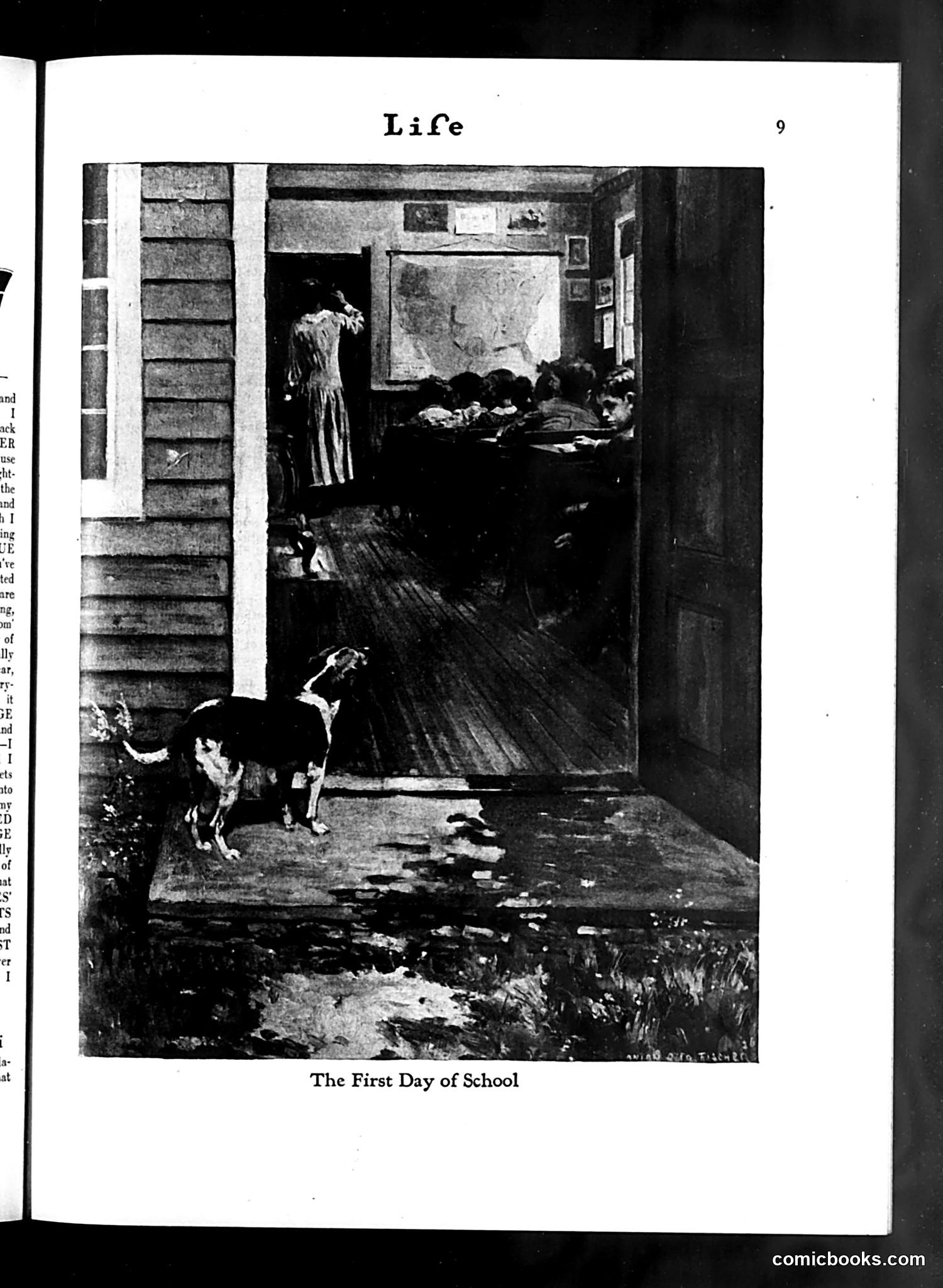
This illustration depicts a dog standing outside a schoolhouse doorway, appearing reluctant or hesitant to enter. Inside, a teacher stands before a classroom of seated students, with maps visible on the walls. The satire plays on the common anxiety experienced by both children and pets on their first day of school—anthropomorphizing the dog's reluctance as parallel to human childhood fears. The composition humorously suggests the dog is a prospective student, capturing the universal nervousness about entering an unfamiliar institutional environment. This is gentle social commentary on educational anxiety rather than pointed political satire, using visual humor to reflect relatable experiences of uncertainty and apprehension that precedes formal schooling.
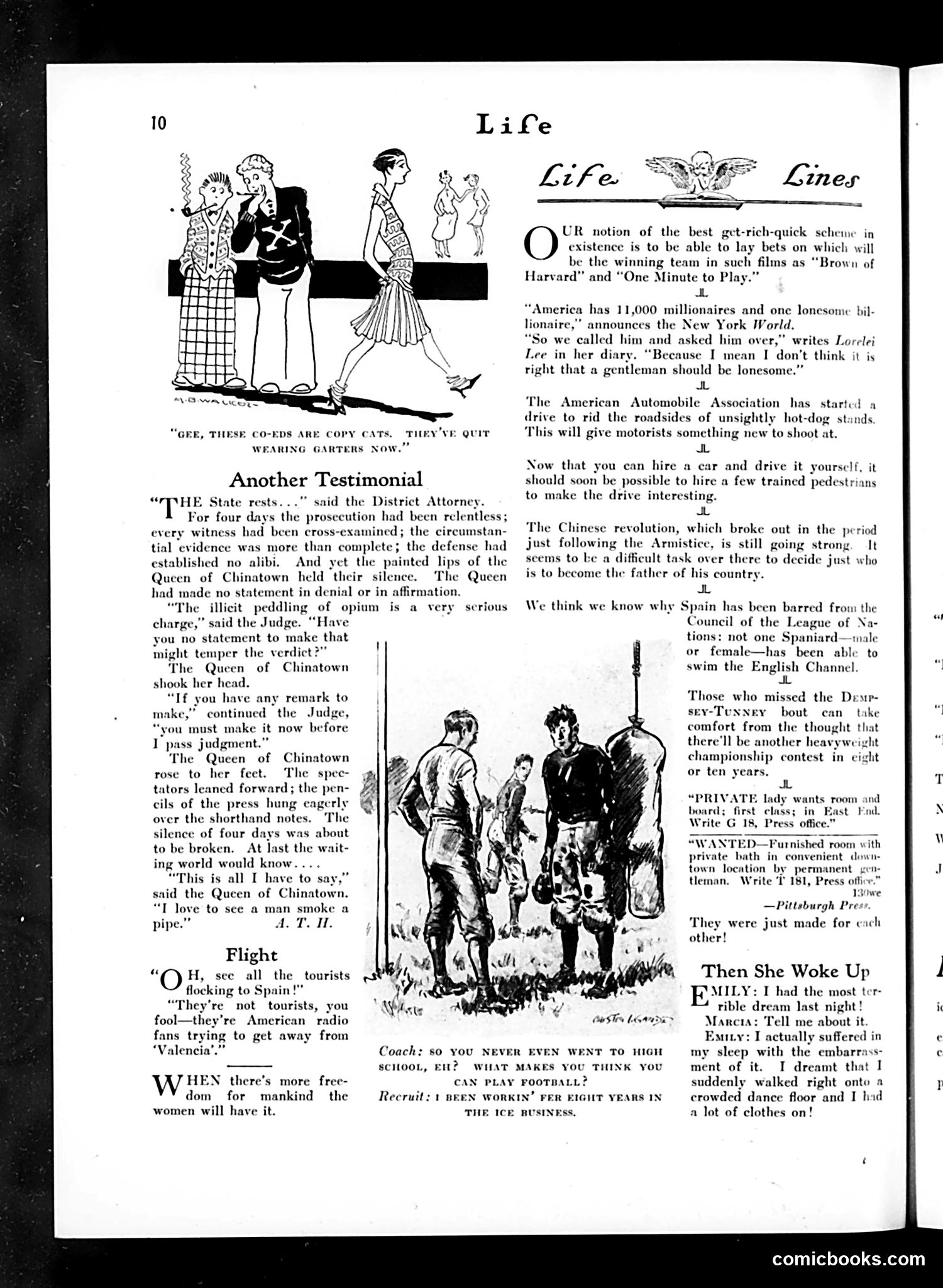
This page contains satirical commentary and humor typical of Life magazine's social criticism. **Top Cartoon:** Shows three figures discussing women wearing garters. The joke plays on concerns about women's changing fashion and behavior—specifically that young women are adopting previously risqué styles (garters were once associated with less respectable women). **"Another Testimonial":** A humorous courtroom exchange where a judge questions whether a defendant has anything to say before sentencing. It satirizes the legal system's formalities and the silence of accused persons. **"Flight":** A brief joke about tourists fleeing Spain, with dialogue mocking "American radio fans" and their escape from radio personalities. **"Then She Woke Up":** A domestic comedy exchange between Emily and Marcia about an embarrassing dream. The overall tone reflects 1920s-era social anxieties about changing gender roles and modern entertainment.
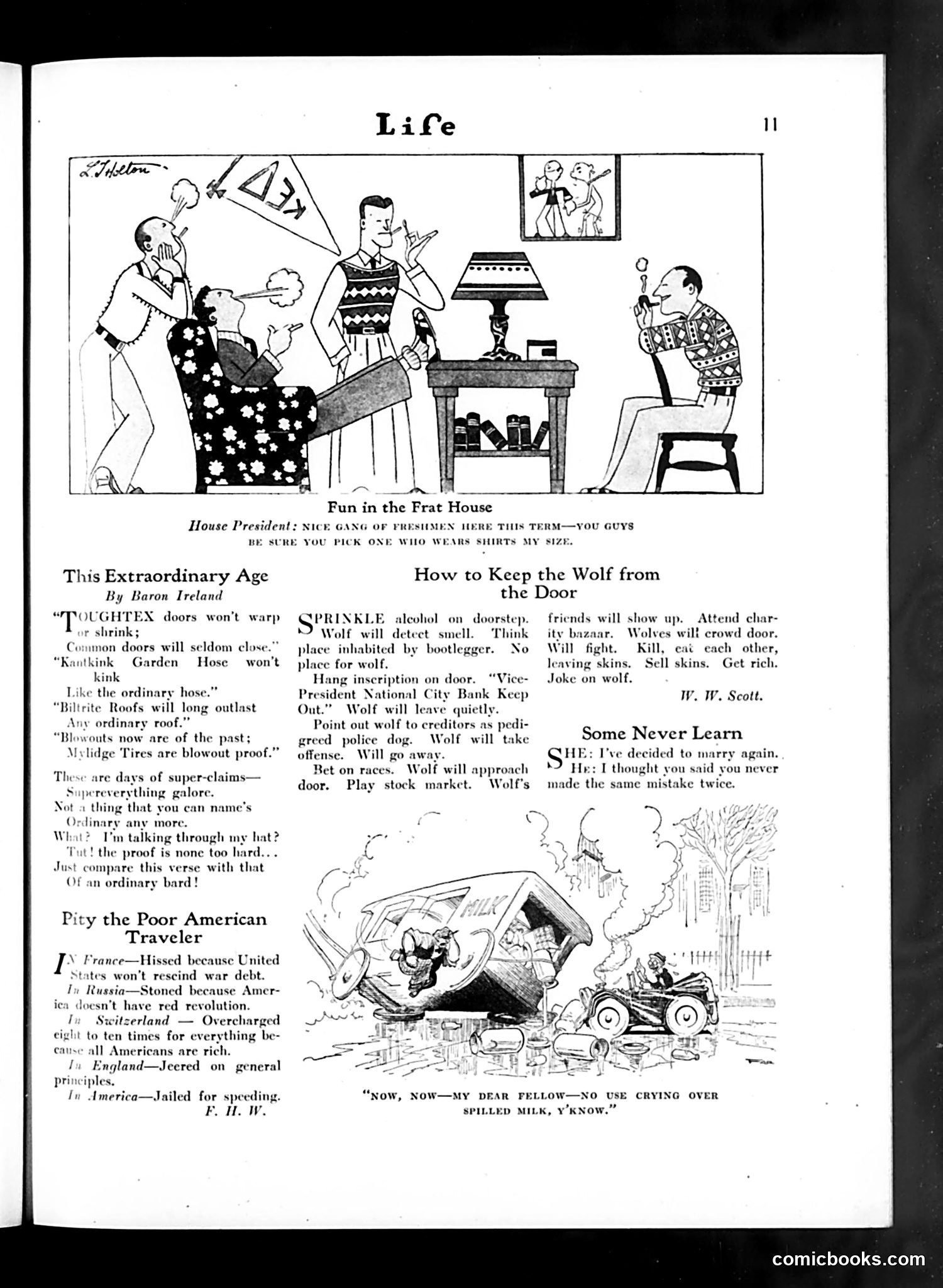
**"Fun in the Frat House"** (top cartoon) depicts college fraternity hazing. The "House President" instructs pledges to select an older member's shirt to wear—a crude joke about theft and humiliation as initiation ritual. **"This Extraordinary Age"** by Baron Ireland mocks advertising claims for consumer products (Toughfex doors, Billete Roofs, Midge Tires). The verse satirizes exaggerated marketing language promising durability and perfection. **"How to Keep the Wolf from the Door"** humorously suggests ways to prevent debt collection or homelessness during financial hardship—sprinkle alcohol to detect bootleggers, hang fake bank signs, acquire a guard dog. **"Some Never Learn"** cartoon shows a car crash, with the caption mocking a woman remarrying, suggesting she'll repeat relationship mistakes. These pieces reflect 1920s concerns: college culture, consumer skepticism, Prohibition-era bootlegging, and domestic humor.
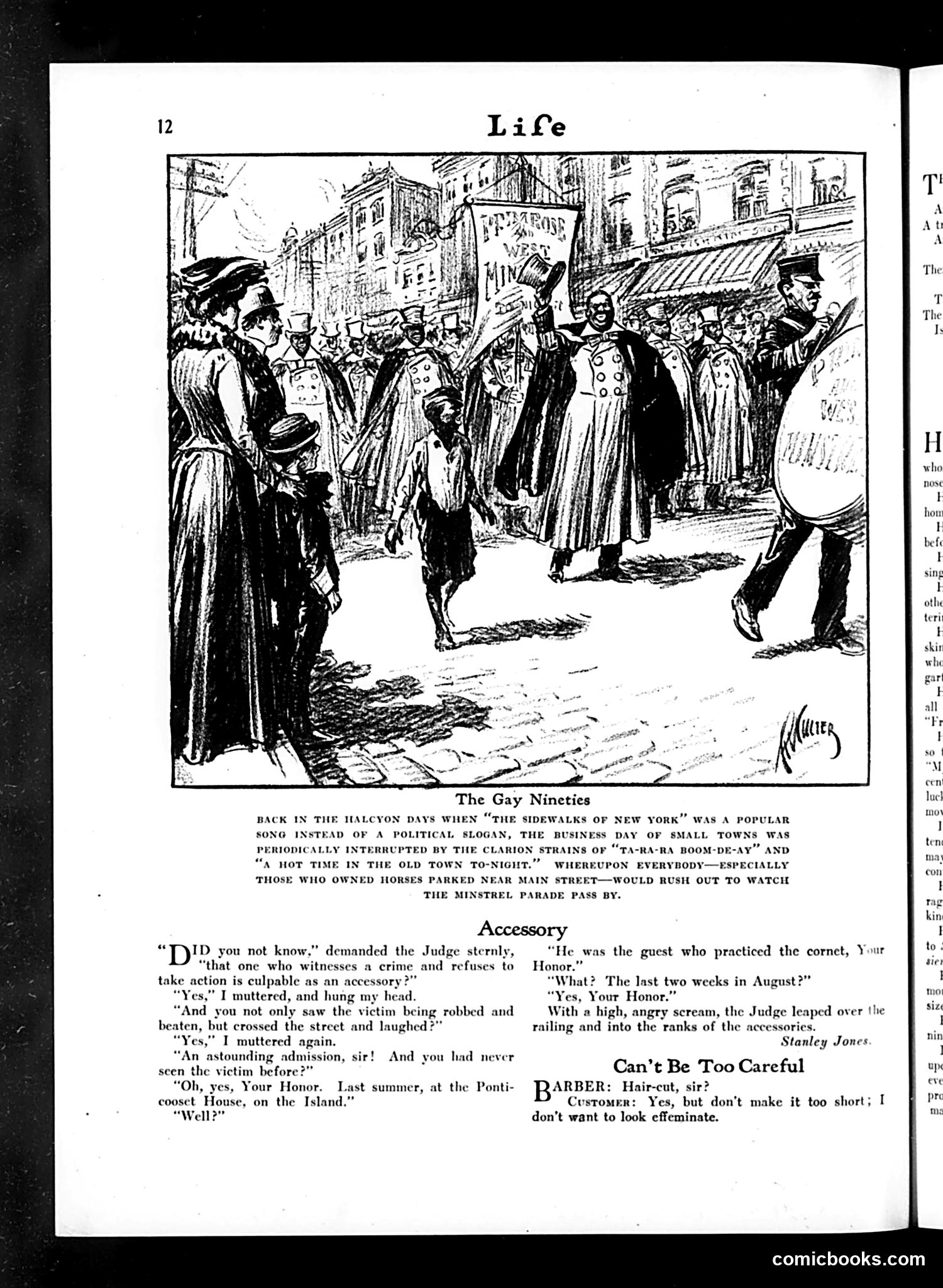
This illustration depicts a bustling street scene labeled "The Gay Nineties," showing well-dressed crowds in late 19th-century New York. The caption explains that during this era, "sidewalks of New York" were popular gathering spots where small-town business interrupted by musical entertainment ("ta-ra-ba boom-de-ay") drew crowds. Horse owners would rush out to watch minstrel parades pass by. The satire targets nostalgia for a simpler past: the image celebrates turn-of-the-century urban life's casual pleasures—street entertainment, community gathering, and public spectacle—contrasting implicitly with whatever modern complications existed when this piece was published. Below are two brief comic sketches: "Accessory" (a legal joke about witnessing a robbery) and "Can't Be Too Careful" (a barber-shop humor piece), typical filler content for the magazine.
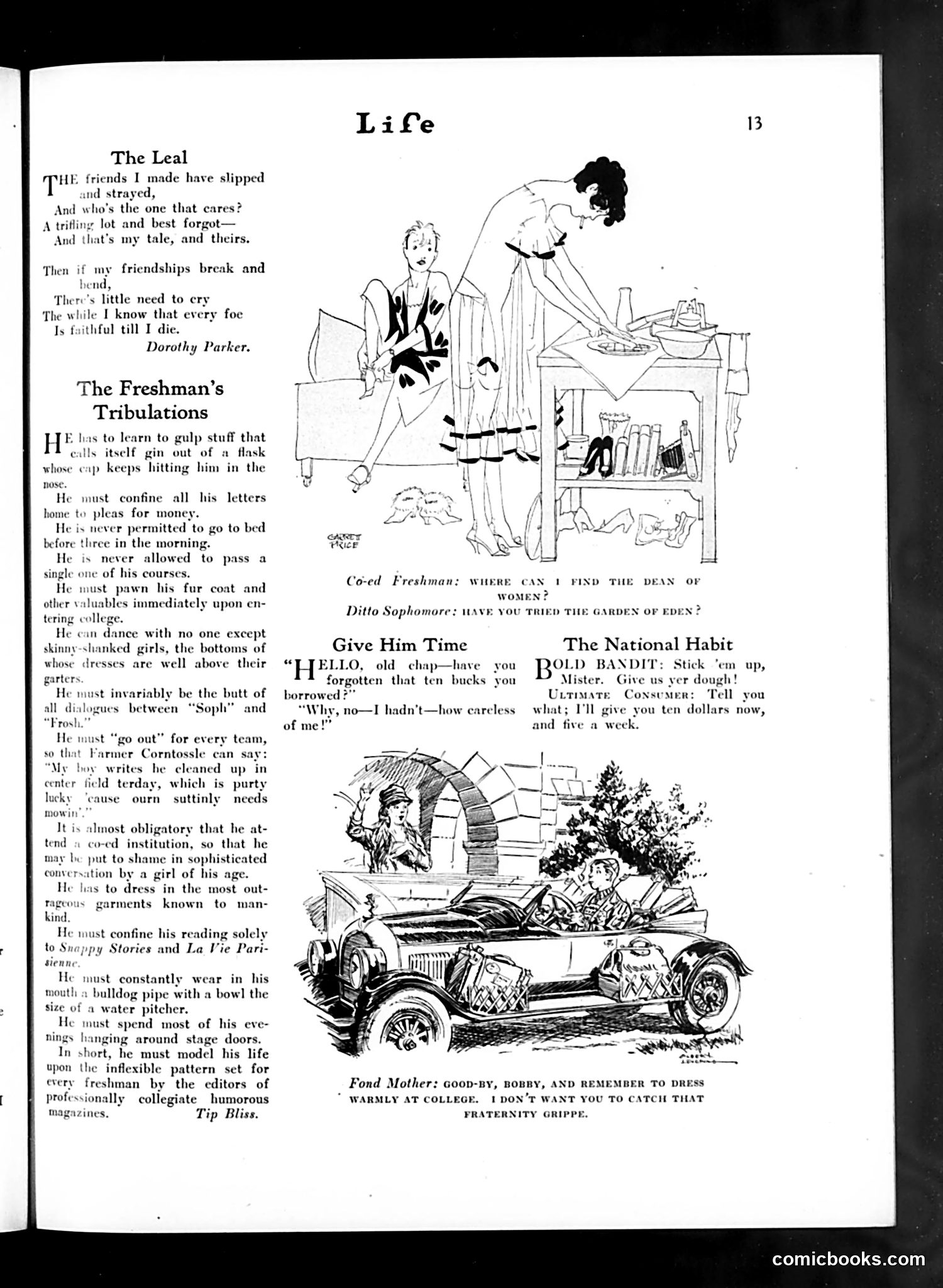
This page presents satirical commentary on college life, circa early 20th century. **"The Leal"** (top left): A Dorothy Parker poem about friendship's impermanence—friends disappoint, but one should expect it philosophically. **"The Freshman's Tribulations"**: A humorous list of college hazing rituals and social rules a new student must endure—including drinking stunts, mandatory dating, attending coed institutions for propriety, wearing prescribed clothing, and consuming only approved publications like *Sporting Stories*. **"Give Him Time" / "The National Habit"**: A comic dialogue about lending money to a broke friend ("old chap"), playing on the period's casual attitude toward debt and the recurring theme of financial irresponsibility. The cartoons satirize both parental anxiety about college life and freshman vulnerability to peer pressure and tradition.
This page contains two distinct satirical articles rather than political cartoons. The main piece discusses **Lady Astor**, a British-American socialite and politician, praising her intelligence, energy, and influence while gently mocking her tendency to discuss these qualities herself. The satire suggests she's accomplished and interesting but somewhat self-promotional. The second article comments on **international politics**, specifically Germany's joining the League of Nations and concerns about Soviet Russia sending a female diplomat (Mme. Kollontay) to Mexico. The satire expresses anxiety about communist influence in the Western Hemisphere while discussing diplomatic decorum—top hats as symbols of respectability in international relations. Both pieces reflect 1920s concerns: women in politics and Cold War anxieties about Soviet expansion.
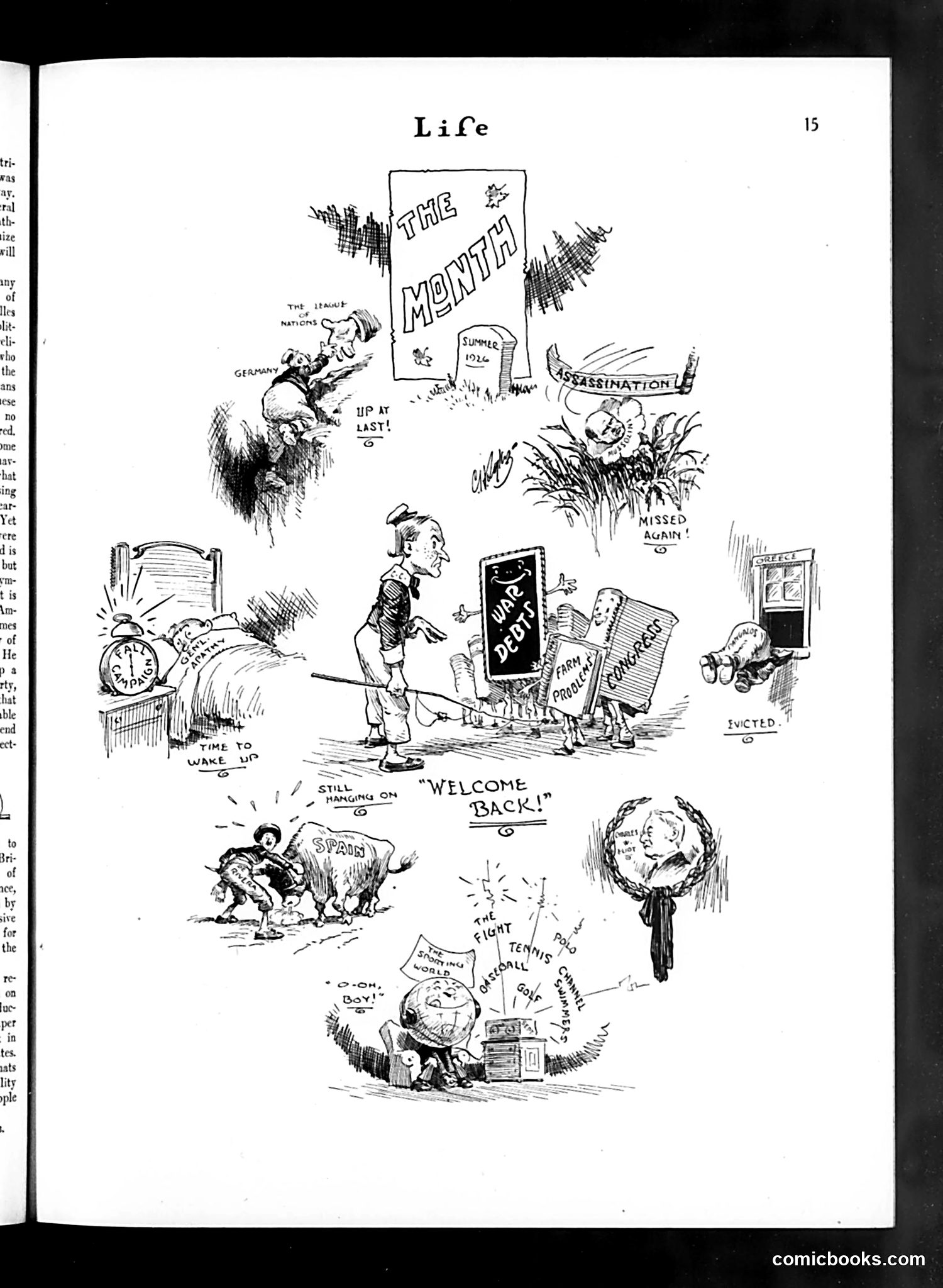
This is a satirical editorial cartoon depicting major events of a single month, likely from WWI era based on visual references. The central figure appears to be a young boy ("Welcome Back!") surrounded by vignettes representing global chaos: - **Top left**: Germany labeled figure climbing/struggling - **Top right**: "Assassination" and "Missed Again!" suggesting political violence - **Center**: War-related imagery with figures labeled "War Debt," "Prohibition," "Famine" - **Bottom**: A globe surrounded by conflict references including "Fight," "Scandal," and other calamities The cartoon satirizes how the world constantly lurches from one crisis to another, with the innocent child welcoming back to this chaotic existence serving as bitter commentary on the unsustainable state of global affairs during this turbulent period.
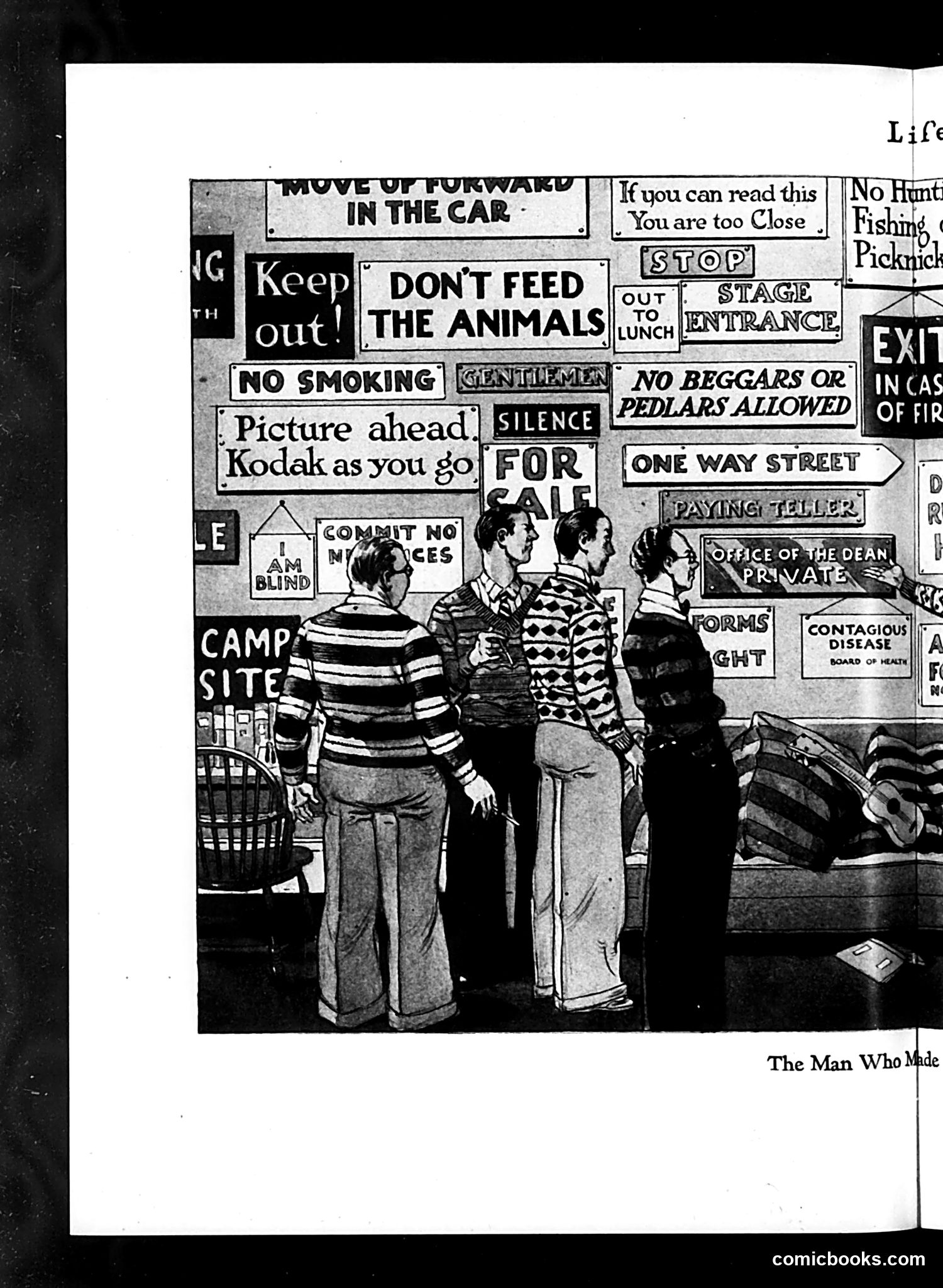
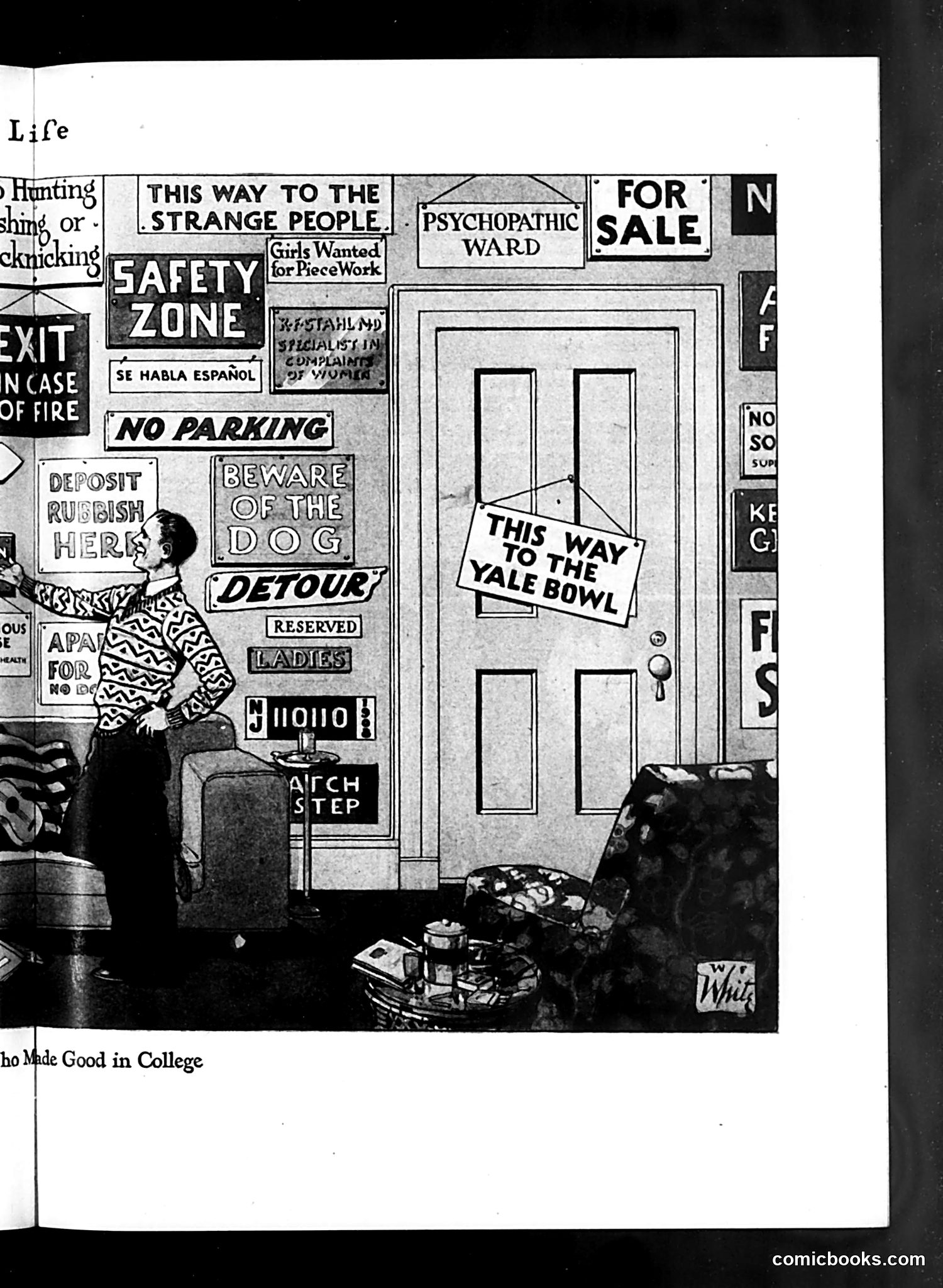
This is a satirical cartoon titled "Life" mocking the chaotic atmosphere of a college building or dormitory. The central figure is a confused woman surrounded by absurdist, contradictory signs: "SAFETY ZONE," "PSYCHOPATHIC WARD," "FOR SALE," "THIS WAY TO THE YALE BOWL," "BEWARE OF THE DOG," "NO PARKING," and "DEPOSIT RUBBISH HERE." The joke satirizes college life as organized chaos—a bewildering maze of conflicting rules and nonsensical directions. The signs parody institutional bureaucracy and campus confusion. The woman's patterned outfit and confused posture emphasize her disorientation in this absurd environment. The title "Who Made Good in College" (visible at bottom) suggests ironic commentary on college success, implying that navigating such institutional madness is itself an achievement. This reflects early-20th-century American humor about higher education's complications.
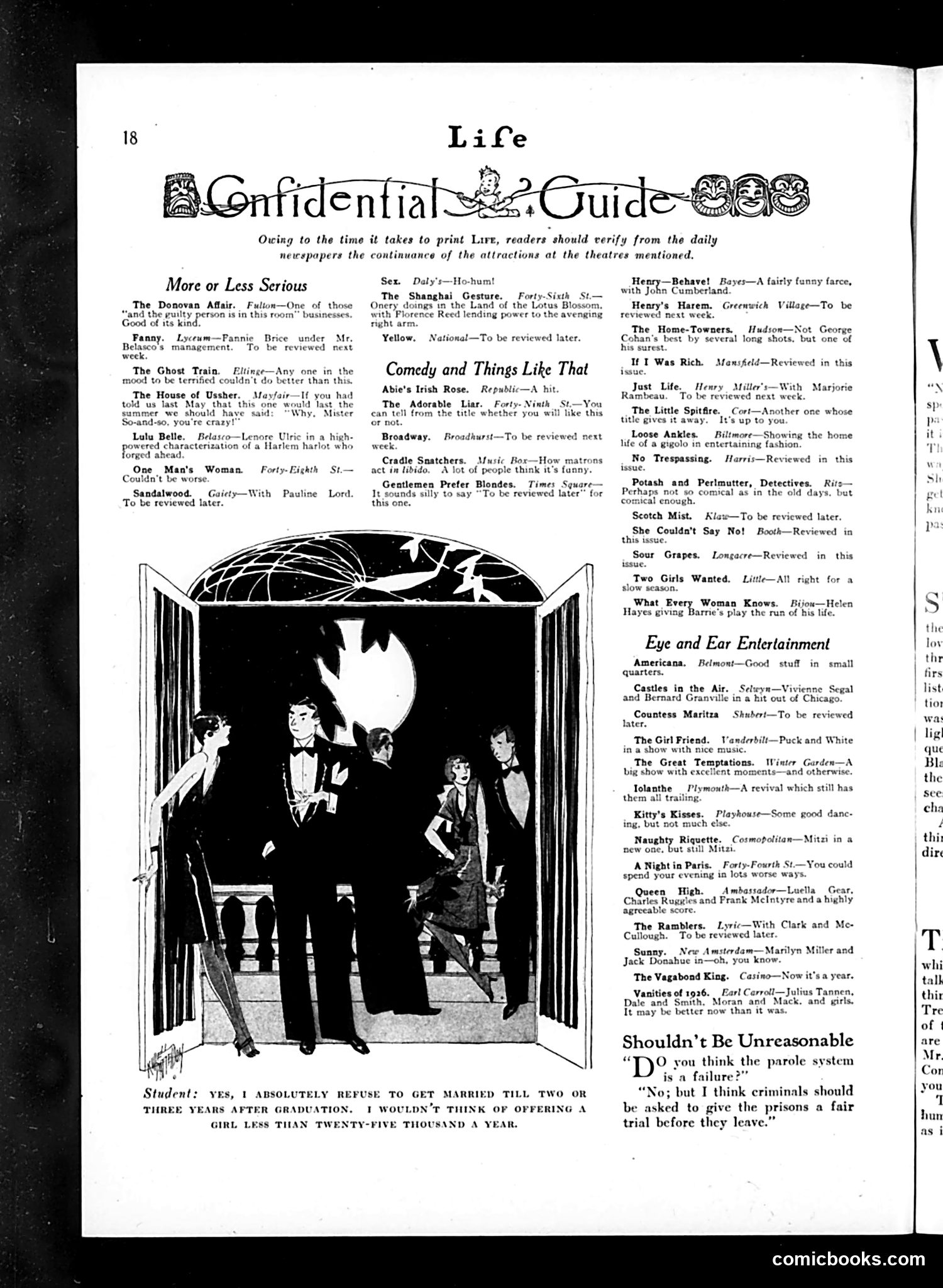
This page is primarily a **theatre guide and review section** for Broadway shows, not a political cartoon. The main illustration depicts a scene from a play—likely "The Donovan Affair" (mentioned at top)—showing well-dressed figures in what appears to be a dramatic moment, with the caption about a student refusing marriage until earning $25,000 annually. The satire works on two levels: The illustration jokes about melodramatic "one of us is guilty" plot devices common in 1920s theatre. The student caption below mocks both the absurdity of such ultimatums and, implicitly, Depression-era economic anxieties about marriage affordability. The bottom section, "Shouldn't Be Unreasonable," is a brief humorous dialogue questioning prison parole systems—sardonically suggesting criminals should "try" prison before early release, a mild jab at criminal justice debates of the era. The page overall reflects 1920s entertainment culture and contemporary social concerns about economics and justice.
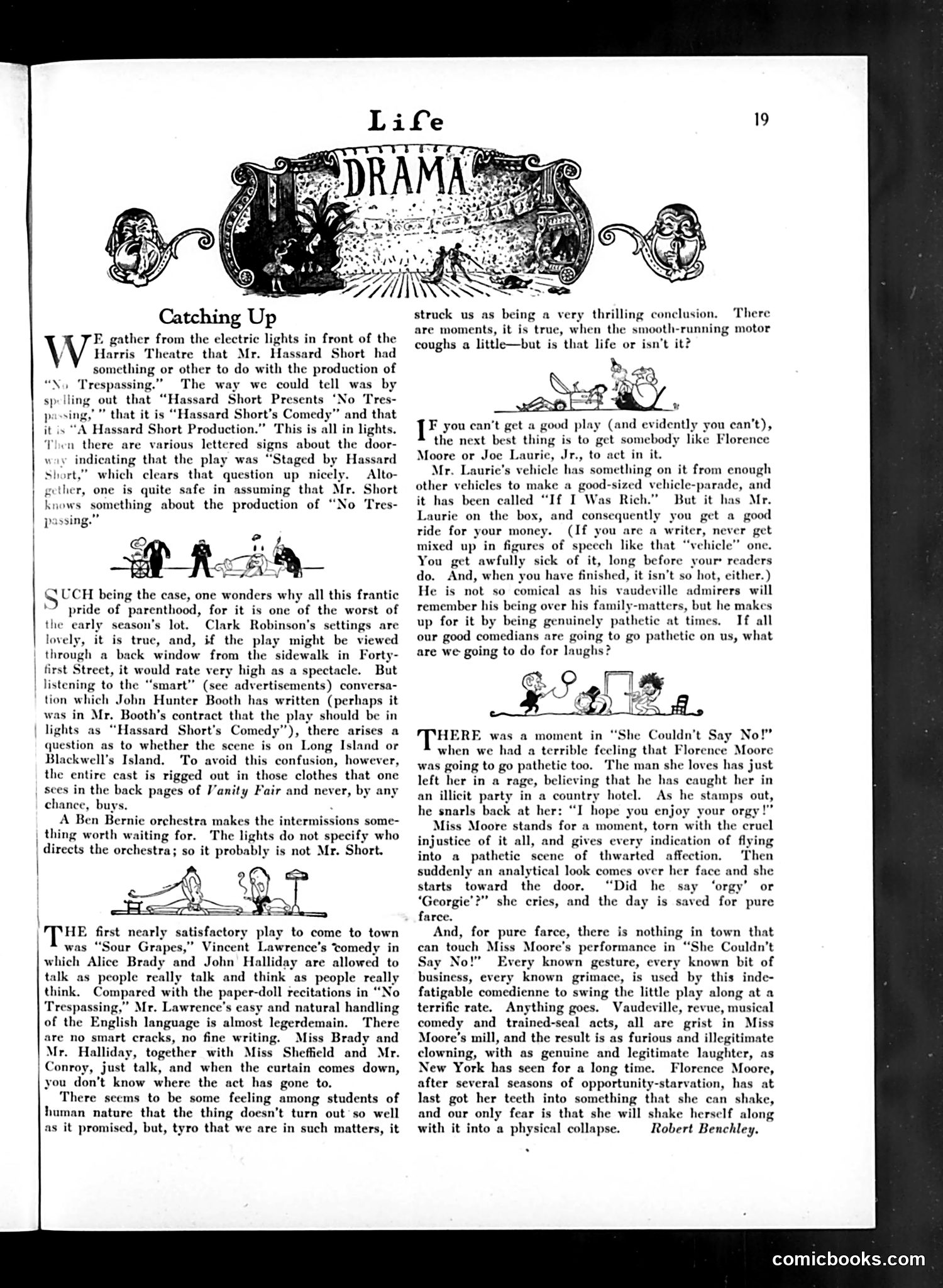
This page reviews three Broadway plays. The opening section ridicules **Hassard Short**, a theater producer/director, for aggressively self-promoting his play "No Trespassing"—his name appears everywhere (in lights, on signs, as "presented by," "staged by," "produced by"). The satire: the play is actually "one of the worst of the season's lot," yet Short acts as though he created a masterpiece. The joke relies on the contrast between his outsized ego and the production's mediocrity. The reviews then praise **Vincent Lawrence's "Sour Grapes"** (starring **Alice Brady** and **John Halliday**) for its naturalistic dialogue, contrasting it favorably with "No Trespassing's" artificial "smart" dialogue. Finally, the page discusses **Florence Moore** in "She Couldn't Say No!," noting she almost descends into pathos but recovers to save the scene as farce. The piece criticizes comedians abandoning humor for manufactured pathos. The cartoons appear to illustrate theatrical scenes, though specific details are unclear.
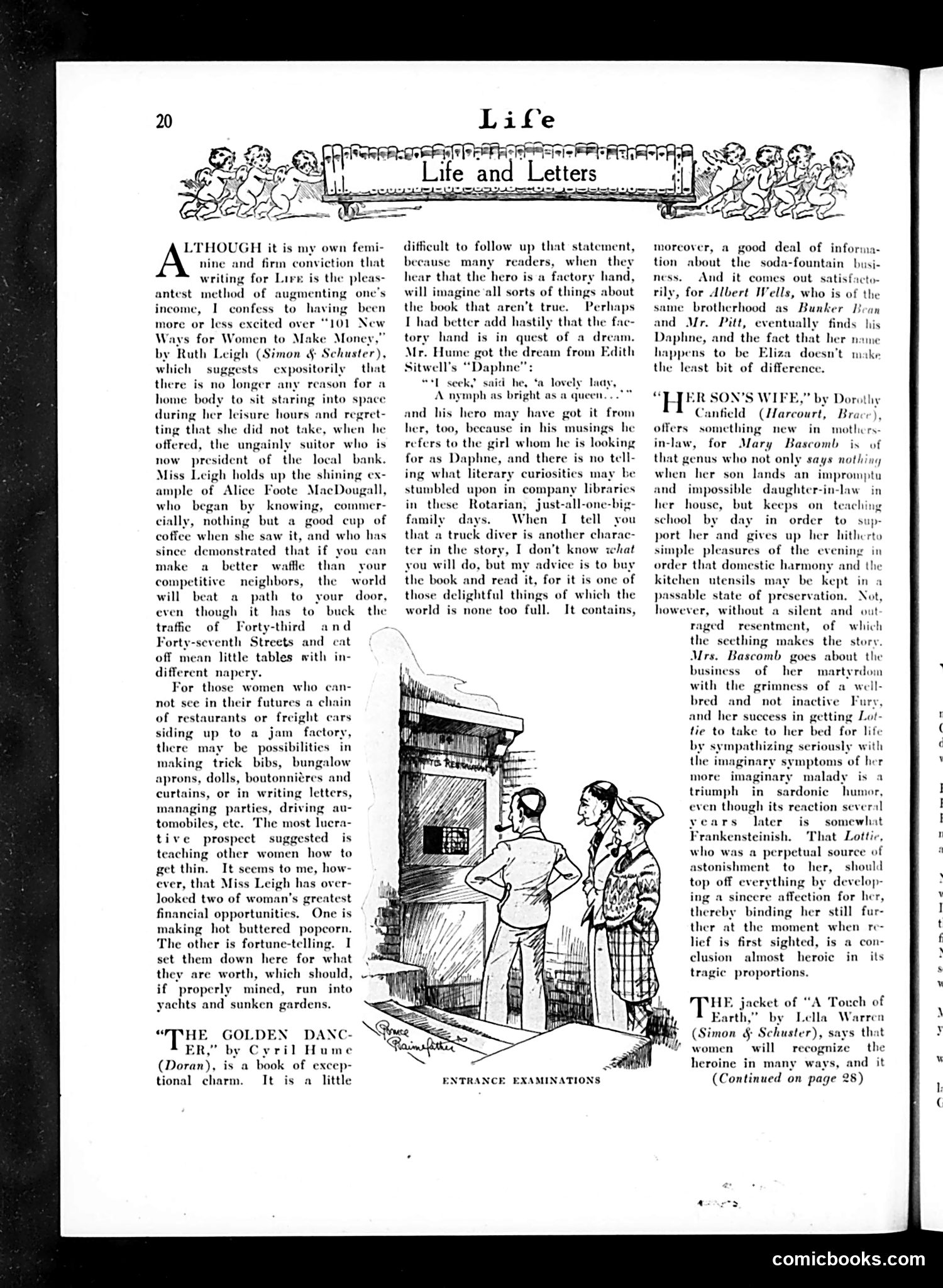
This untitled cartoon (captioned "ENTRANCE EXAMINATIONS") depicts two men at what appears to be a soda fountain or restaurant entrance. The joke likely satirizes working-class or immigrant access to American establishments during the early 20th century. The context matters: the surrounding text discusses "The Golden Dancer" by Cyril Hume, which features a truck driver as a character and contains "information about the soda-fountain business." The cartoon appears to humorously illustrate class or social barriers—the two figures seem to be seeking entry or employment at such an establishment, with the visual gag suggesting some form of examination or scrutiny required for entrance. The exact social commentary remains somewhat unclear without additional context, but it likely references either working-class aspiration, immigrant experience, or class-based discrimination in service establishments common to the era.
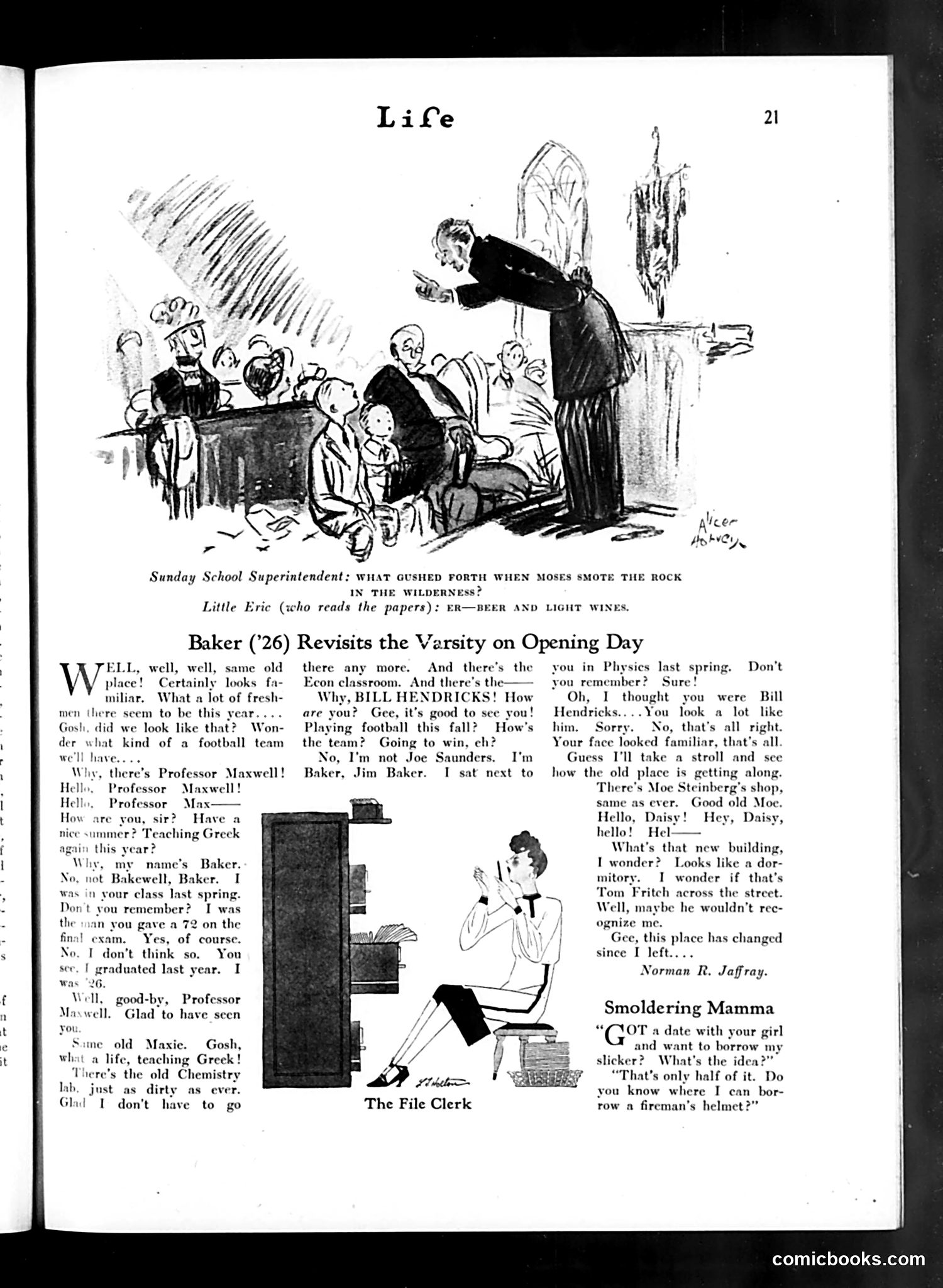
This page contains three satirical pieces about college life and social pretense. **"Baker ('26) Revisits the Varsity"** mocks the awkwardness of returning alumni. Baker, a recent graduate, repeatedly fails to be recognized by former professors and classmates. The humor lies in his deflation—he expects to be remembered but is forgotten or confused with others. This satirizes both the transience of college life and the ego of young alumni. **"The File Clerk"** cartoon depicts office tedium: a young woman at her desk, likely illustrating the mundane reality of clerical work—a common job for women of this era. **"Smoldering Mamma"** is a brief joke about a young man borrowing his roommate's slicker (raincoat) and fireman's helmet for a date, suggesting he's planning romantic adventure or impression-making through borrowed props and false pretense. The opening cartoon satirizes Sunday school teachers misquoting the Bible—when asked what "gushed forth when Moses smote the rock," the boy answers "beer and light wines," suggesting the teacher reads newspapers obsessed with Prohibition-era alcohol scandals rather than scripture.
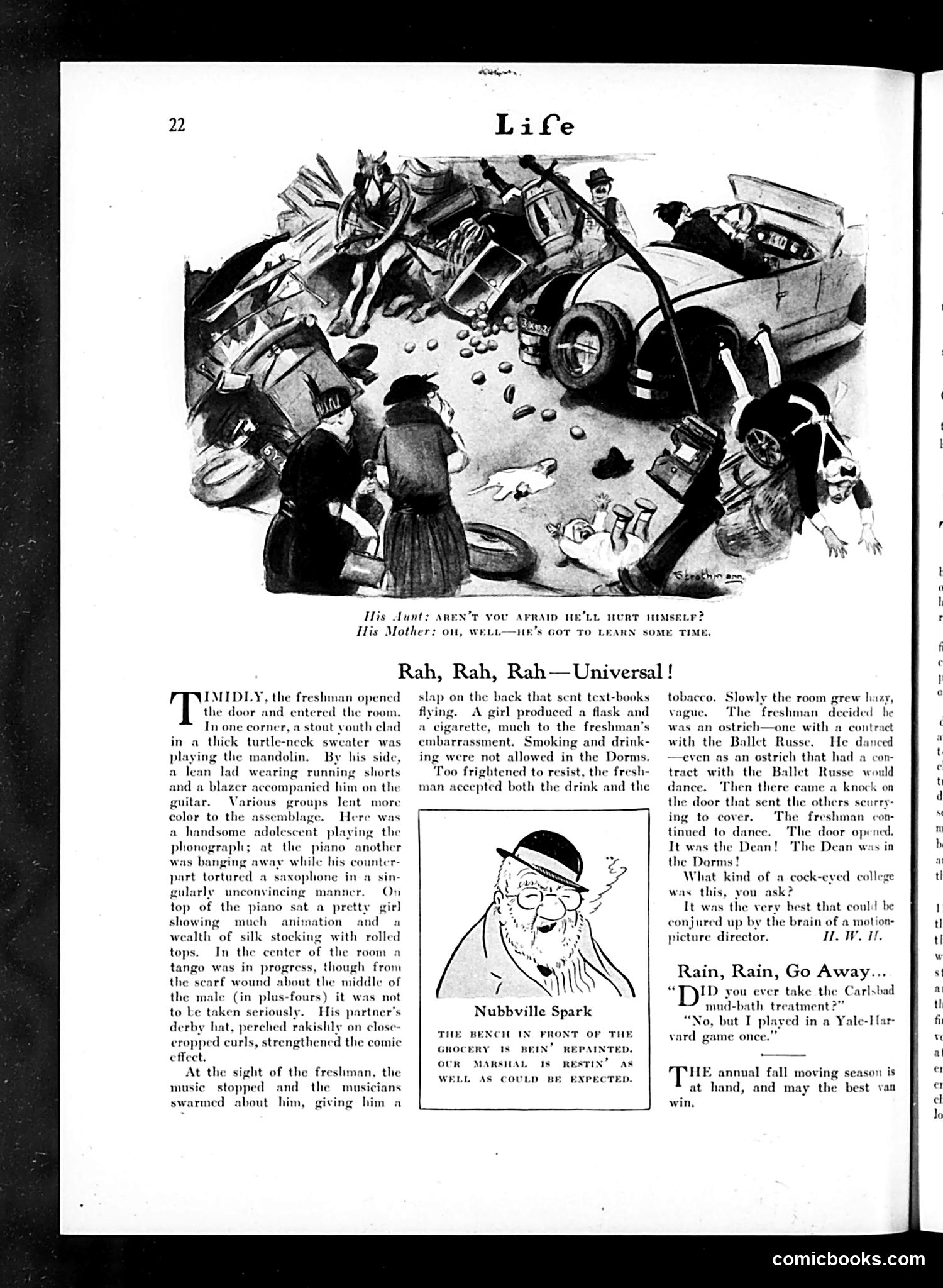
This page from *Life* magazine contains two satirical pieces about college life, likely from the 1920s based on the style and references. **"Rah, Rah, Rah—Universal!"** is a humorous story mocking college dormitory parties. It depicts freshmen in a chaotic dorm room filled with musicians, dancers, and socializing—activities that violated actual dormitory rules. The humor centers on the hypocrisy: students break prohibition-era drinking laws and smoking bans, only to panic when the Dean arrives. The title suggests this "universal" college experience is exaggerated by motion-picture directors creating fantasy versions of campus life. **"Nubbville Spark"** appears to be a separate rural humor item about a town's bench being repainted and a marshal resting. **"Rain, Rain, Go Away..."** briefly jokes about moving season and an anecdote referencing the Carlsbad mud-bath treatment and Yale-Harvard athletics. The page satirizes both wild college behavior and the gap between actual dormitory rules and student conduct, plus Hollywood's sanitized dramatization of campus life.
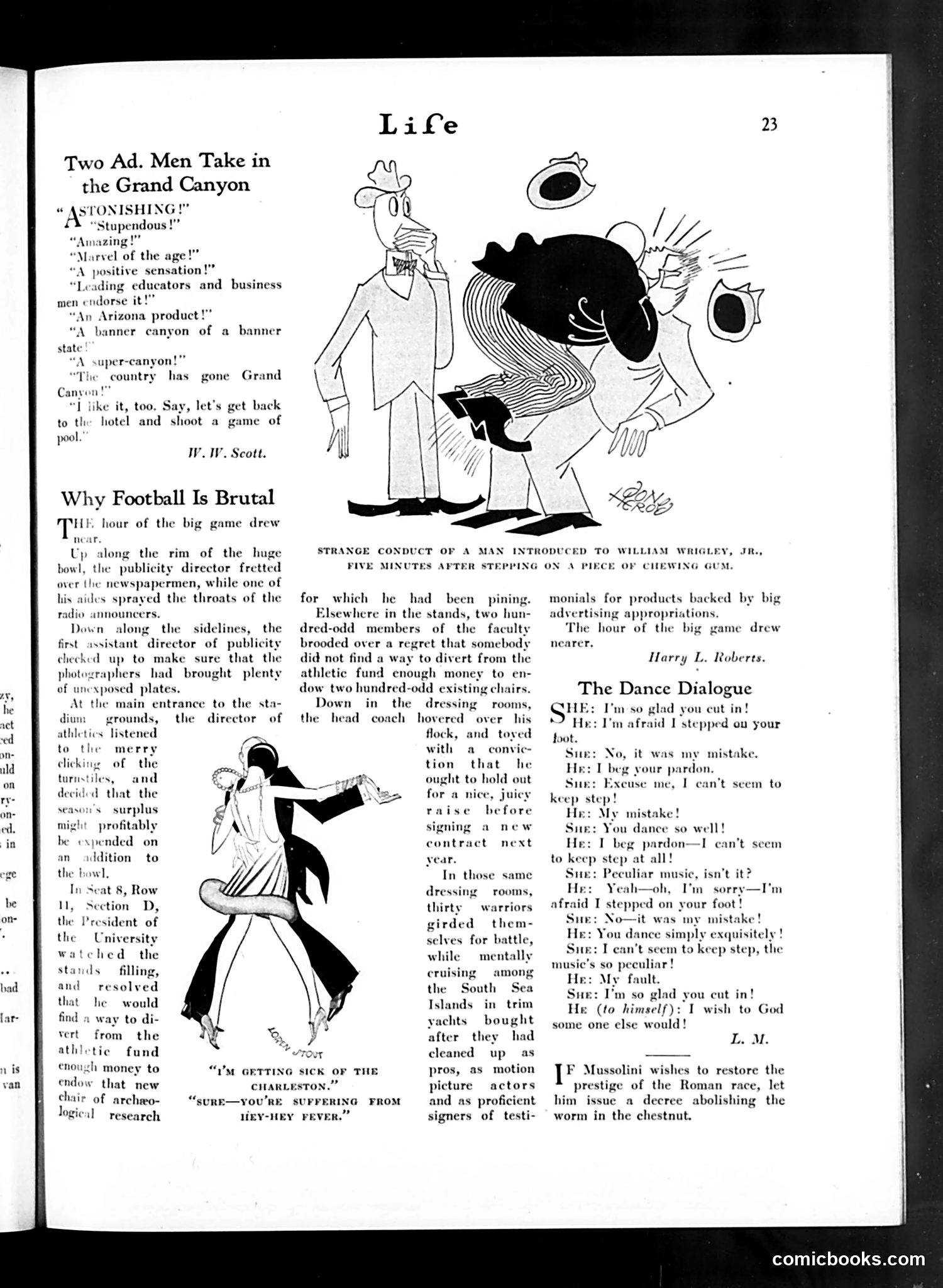
This page contains three distinct satirical pieces: **"Two Ad. Men Take in the Grand Canyon"** mocks advertising hyperbole. Two businessmen react to the Grand Canyon—one of Earth's natural wonders—with exaggerated praise ("Astonishing!" "Marvel of the age!"). The punchline undercuts this: they immediately want to return to their hotel to play pool, suggesting advertisers' enthusiasm is performative and shallow. **"Why Football Is Brutal"** satirizes university football's commercialization. Rather than athletes or sport, the focus is on publicity directors, radio announcers, ticket-sellers, and the university president calculating how to divert athletic funds. Faculty members want those funds for academic chairs instead. The "brutality" isn't physical—it's the cynical exploitation of the game for profit and institutional gain. **"The Dance Dialogue"** is a comedic exchange where a couple dances while each constantly apologizes for stepping on the other's feet, blaming the music. The final aside—"I wish to God some one else would!"—reveals the man's actual irritation, contrasting polite surface behavior with private frustration. All three pieces critique 1920s American culture: superficial commercialism, institutional corruption, and social hypocrisy.
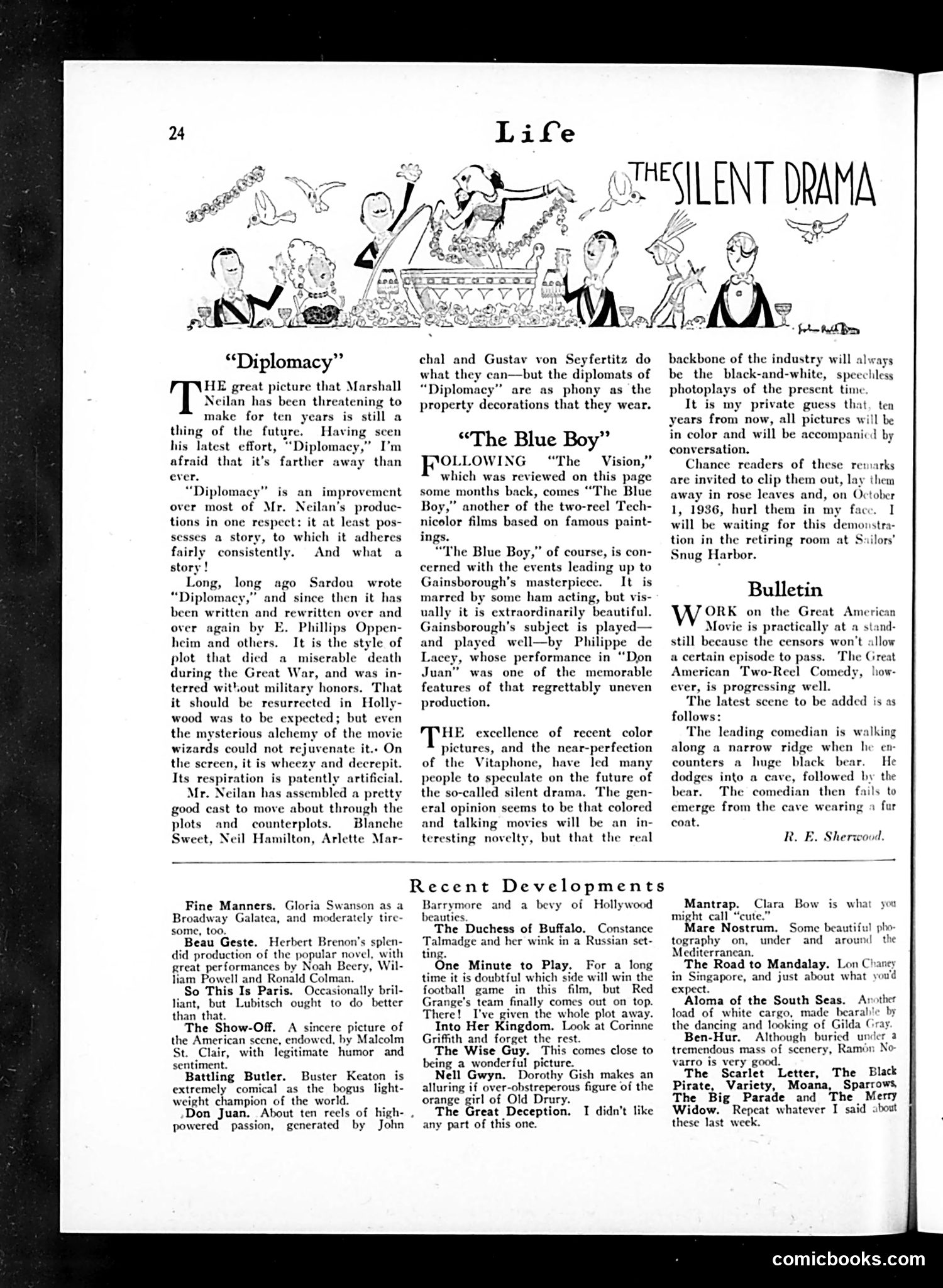
This is a film criticism column from Life magazine, circa mid-1920s, reviewing recent movies. The heading illustration satirizes the theatrical excess of silent film acting—showing exaggerated gestures and melodramatic poses. The main reviews critique: 1. **"Diplomacy"** (directed by Marshall Neilan)—a adaptation of a Sardou play deemed outdated. The critic argues this pre-WWI plot style "died a miserable death during the Great War" and shouldn't have been resurrected. 2. **"The Blue Boy"**—a Technicolor short based on the famous painting, praised visually but criticized for "ham acting." A notable prediction appears: the critic bets that within ten years (by 1936), all films will be in color with synchronized sound, rejecting the prevailing industry opinion that silent black-and-white films would remain cinema's backbone. This reflects the transitional moment before "talkies" revolutionized Hollywood—the author's 1936 deadline proves remarkably prescient.
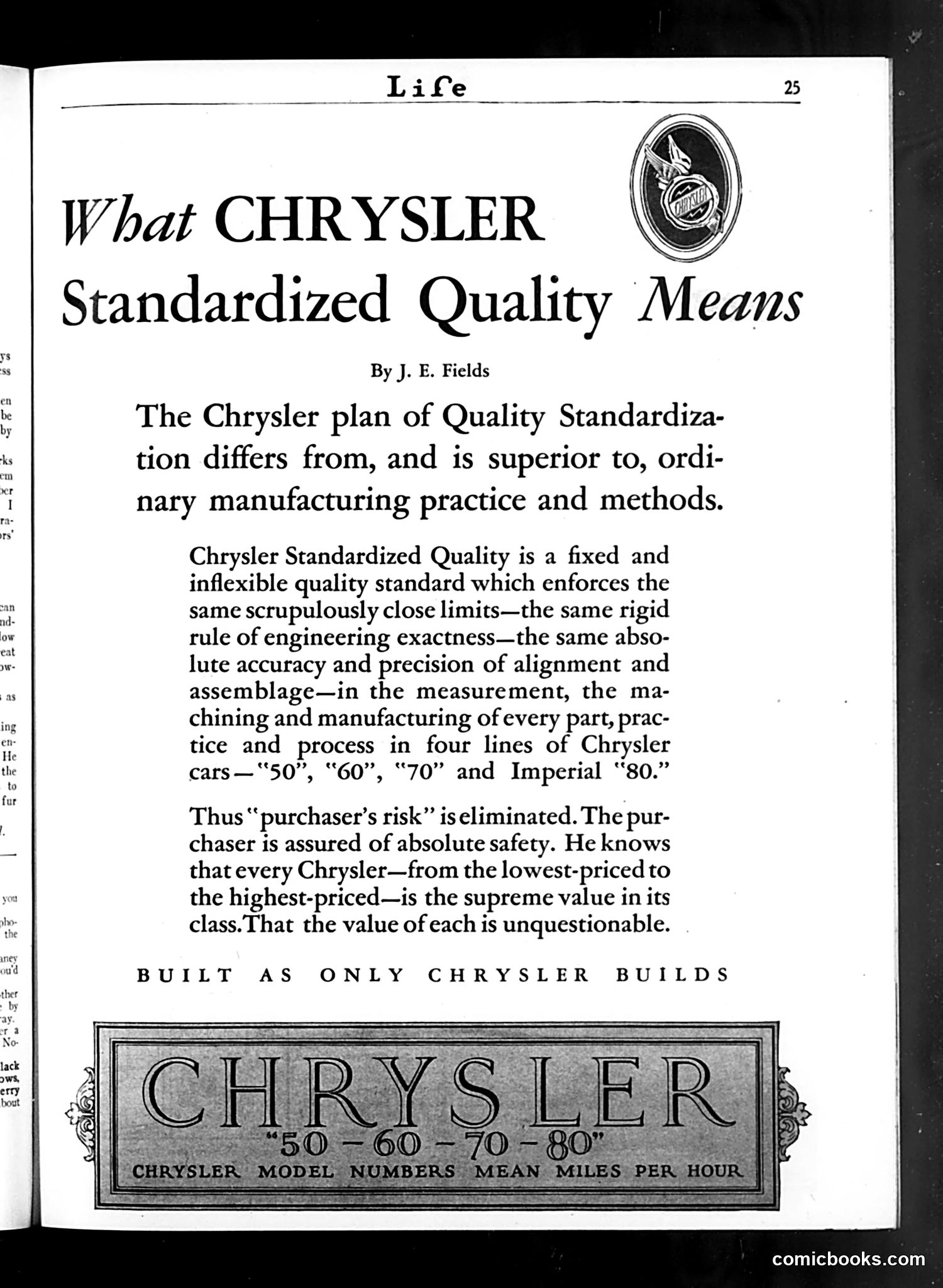
This is a **Chrysler automobile advertisement**, not a political cartoon or satire. It appears in *Life* magazine's advertising section (page 25). The ad promotes Chrysler's manufacturing philosophy of "Standardized Quality"—claiming that all Chrysler models ("50," "60," "70," and Imperial "80") meet identical rigid engineering standards. The pitch eliminates "purchaser's risk" by assuring buyers that every car, regardless of price tier, delivers equal quality and value. The Chrysler logo (top right) and the large branded box at bottom ("BUILT AS ONLY CHRYSLER BUILDS") emphasize brand superiority. The text, by J.E. Fields, uses language about "absolute safety" and "supreme value" to differentiate Chrysler from competitors using standardized manufacturing practices—a significant selling point during this era of automotive development. This is purely corporate marketing, not satirical commentary.
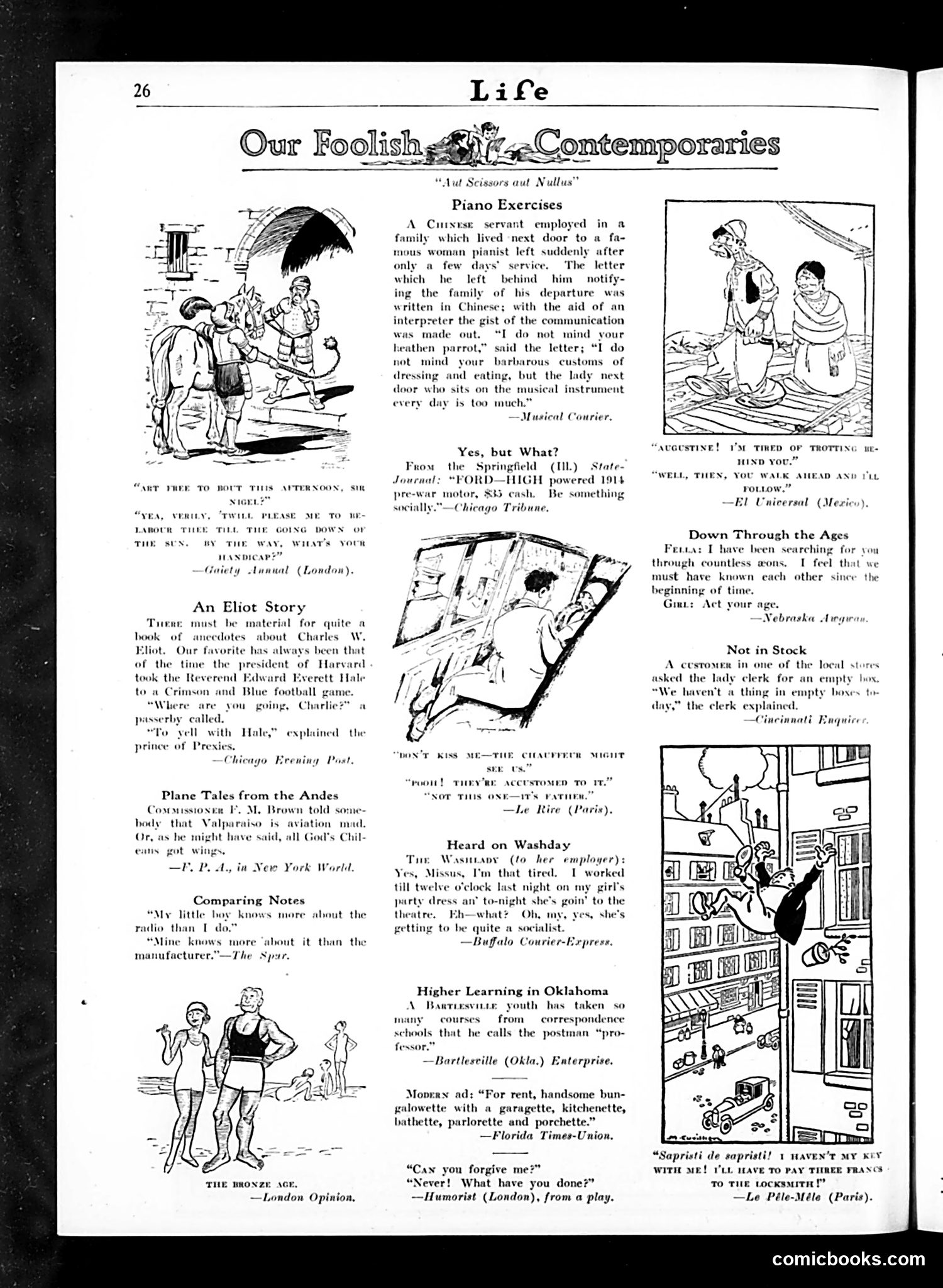
This is a humor anthology page collecting brief jokes and anecdotes from various newspapers and magazines, organized by theme. The cartoons and text mock everyday foolishness and social absurdities of the era. **Key sections include:** - **"Piano Exercises"**: A Chinese servant's complaint (via interpreter) about his employer's wife's terrible piano playing—satire on cultural misunderstandings and domestic annoyances. - **"An Eliot Story"**: An anecdote about Harvard President Charles W. Eliot, playing on his authority and wit. - **"Higher Learning in Oklahoma"**: Mockery of correspondence-school culture and a youth so over-educated by mail that he mistakes the postman for a "professor." - **Various one-liners**: Jokes about automobile ads, employment disputes, and domestic situations. The page's unifying theme ridicules modern life's pretensions, miscommunications, and social climbing through brief, punchy humor sourced from contemporary publications.
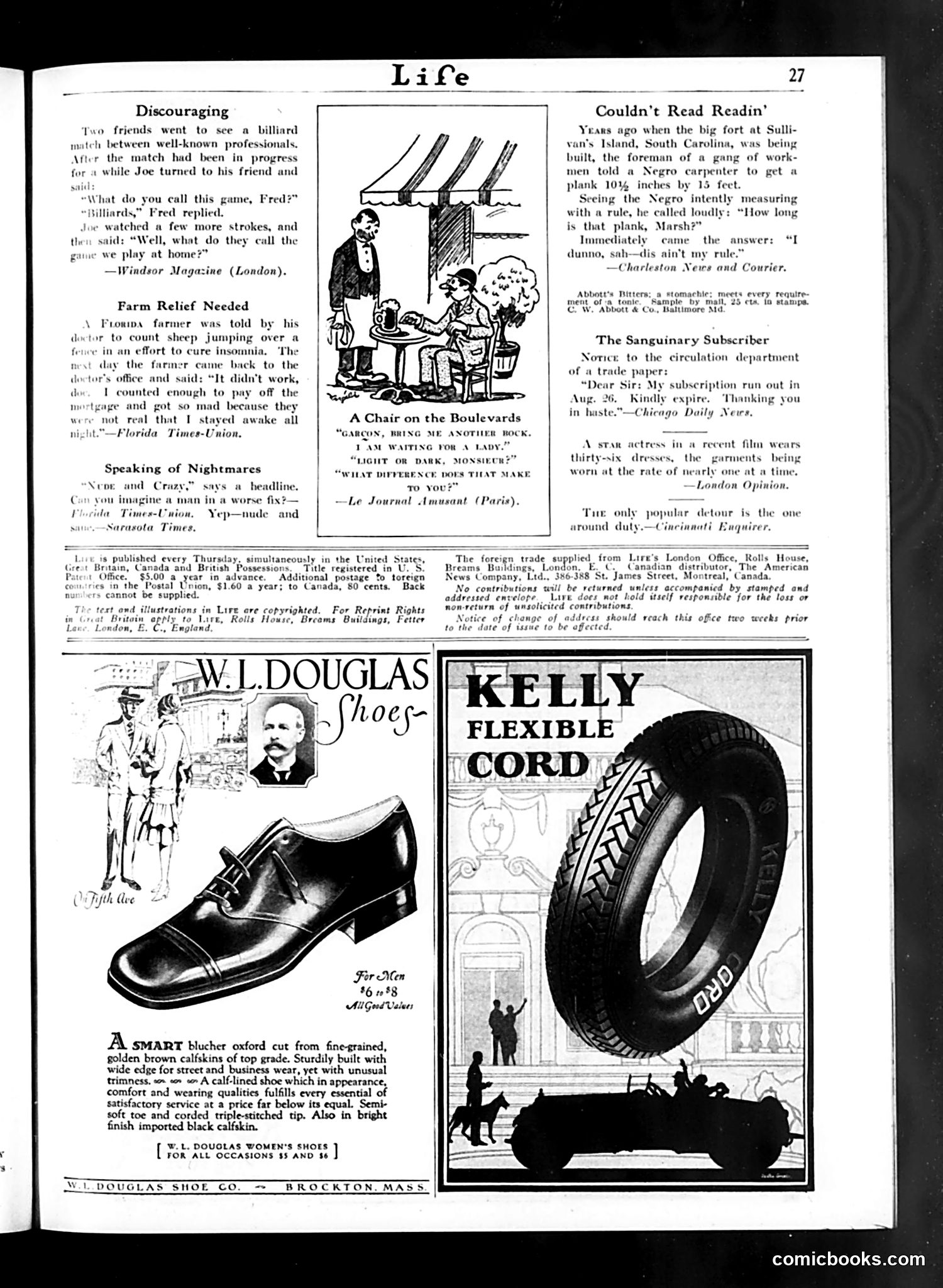
This page contains several brief satirical pieces typical of *Life* magazine's humor: **"Discouraging"**: A joke about billiards terminology—Joe, unfamiliar with the sport, asks what the game is called. When told "billiards," he naively asks what they call it where he's from, missing that it's the same game everywhere. **"Couldn't Read Readin'"**: A dialect humor piece (common in early 20th-century publications) about a Black carpenter who cannot read a measurement rule, playing on stereotypes about literacy and education. **"Farm Relief Needed"** and **"Speaking of Nightmares"**: Brief anecdotes about rural life and insomnia, typical of the magazine's miscellaneous humor section. **"A Chair on the Boulevards"**: A French joke about a waiter misunderstanding a customer's request. The page is primarily filler humor between advertisements for W.L. Douglas shoes and Kelly tires, reflecting the magazine's mixed content of satire, advertising, and light comedy.
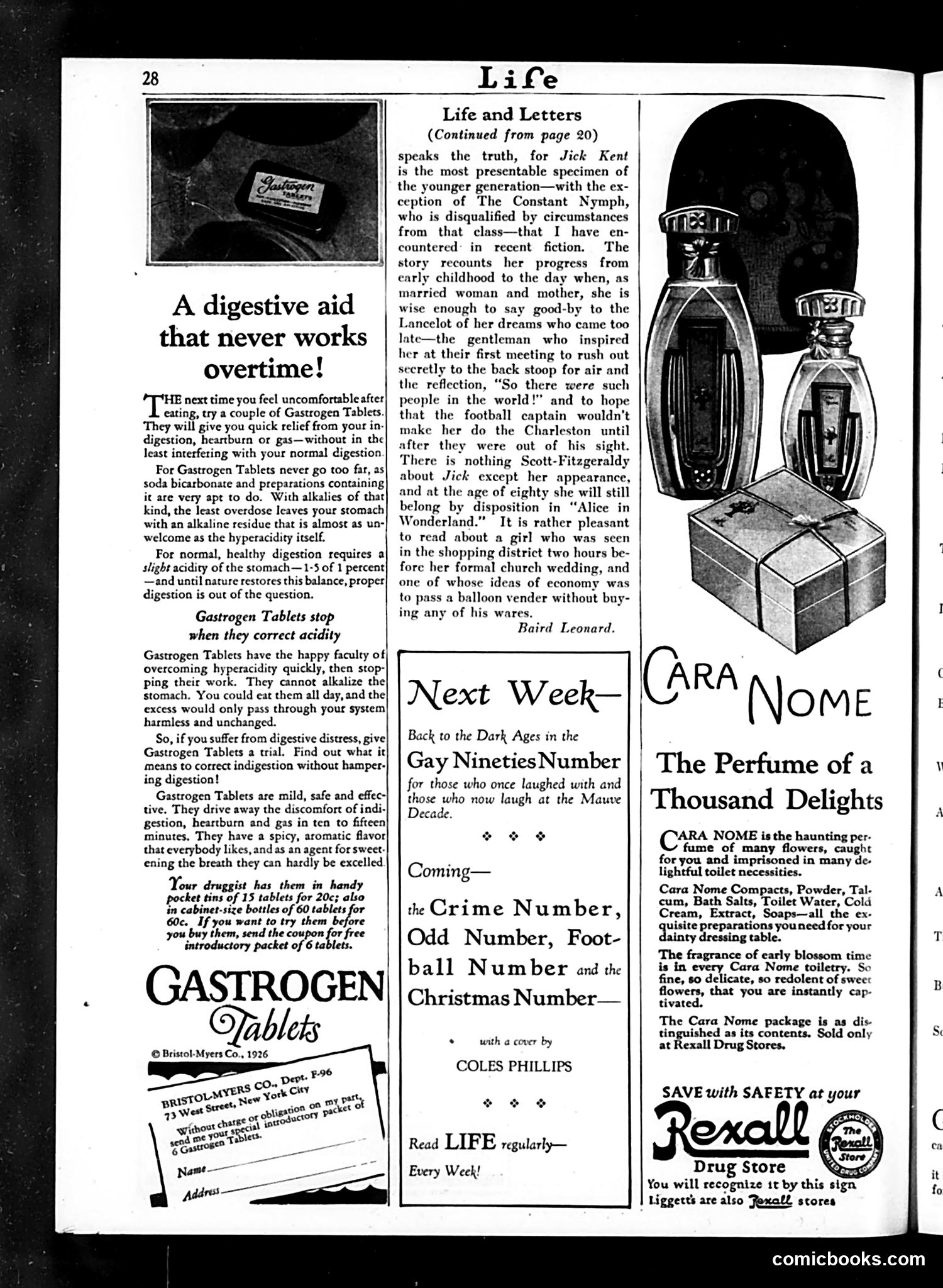
This page is primarily **advertising with some editorial content**. The main elements are: **Gastrogen Tablets Advertisement** (left): A digestive aid marketed as gentler than competing antacids like soda bicarbonate. The pitch emphasizes it corrects stomach acidity without over-alkalizing—a technical distinction meant to appeal to health-conscious consumers of the 1920s when patent medicines heavily advertised scientific-sounding benefits. **"Life and Letters" Column** (center): A literary review by Baird Leonard discussing female characters in contemporary fiction, particularly praising a character named "Jick Kent" for representing modern womanhood—independent, economical, and practical rather than romantic. **Cara Nome Perfume Advertisement** (right): A luxury toiletry product marketed to women for their "dressing table." **There is no political cartoon on this page.** The content reflects 1920s consumer culture and literary tastes, with advertising dominating the layout—typical of Life magazine's business model during this era.
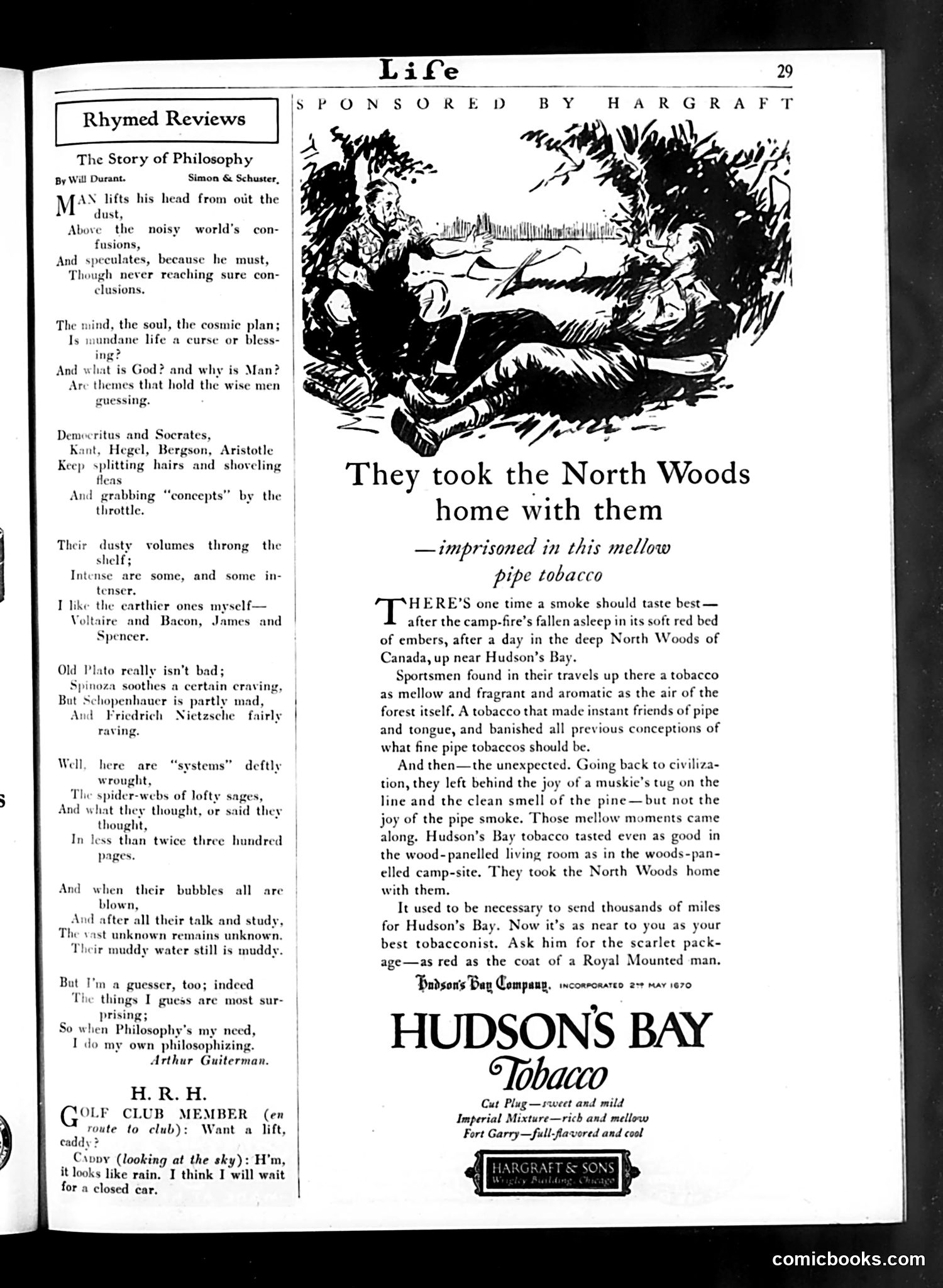
**Left Column: Book Review** Arthur Guiterman's rhymed review of Will Durant's "The Story of Philosophy" (Simon & Schuster) humorously surveys major philosophers—Plato, Socrates, Kant, Nietzsche, and others—mocking their abstract theorizing as ultimately futile. The reviewer admits philosophy leaves fundamental questions unanswered ("The vast unknown remains unknown") yet confesses to doing amateur philosophizing anyway. The satire targets both pretentious philosophical systems and human intellectual vanity. **Right Column: Advertisement** A Hudson's Bay Company tobacco advertisement presents a romanticized narrative: sportsmen discover superior tobacco in Canada's North Woods, experience its quality campfire-side, then bring it home. The copy emphasizes the tobacco captures the "mellow" essence of wilderness and nature itself, now conveniently available locally. **Bottom: Golf Humor** A brief joke plays on class assumptions: a club member offers a caddy a ride, but the caddy declines, preferring to wait for a "closed car"—implying he won't ride exposed with his social inferior.
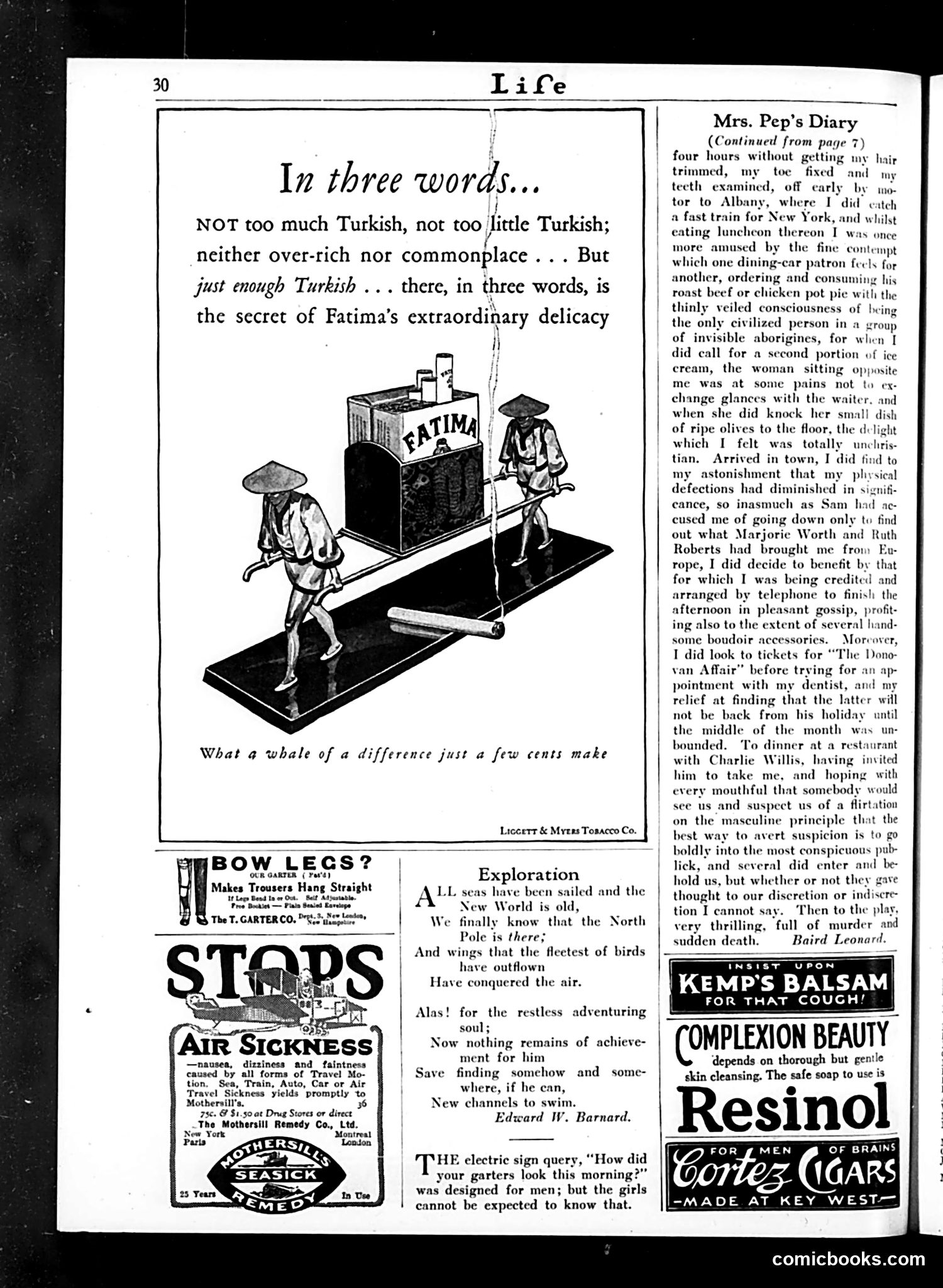
This page is primarily **advertising**, not political satire. The main cartoon (upper left) promotes **Fatima cigarettes** through a humorous visual pun: two Chinese coolies carry a giant cigarette package on a pole, illustrating the phrase "what a whale of a difference just a few cents make." The ad's text claims Fatima's quality comes from the right balance of "Turkish" tobacco—not too much, not too little. This was a genuine selling point in early 20th-century cigarette marketing, when Turkish tobacco was considered premium. The page includes other period advertisements (garters, seasickness remedy, soap, cigars) and a diary column by "Mrs. Pep" recounting her social activities in New York. An Edward W. Barnard poem about exploration appears as filler content. The humor relies on ethnic caricature (the coolies' depiction) and wordplay typical of the era's advertising approach.
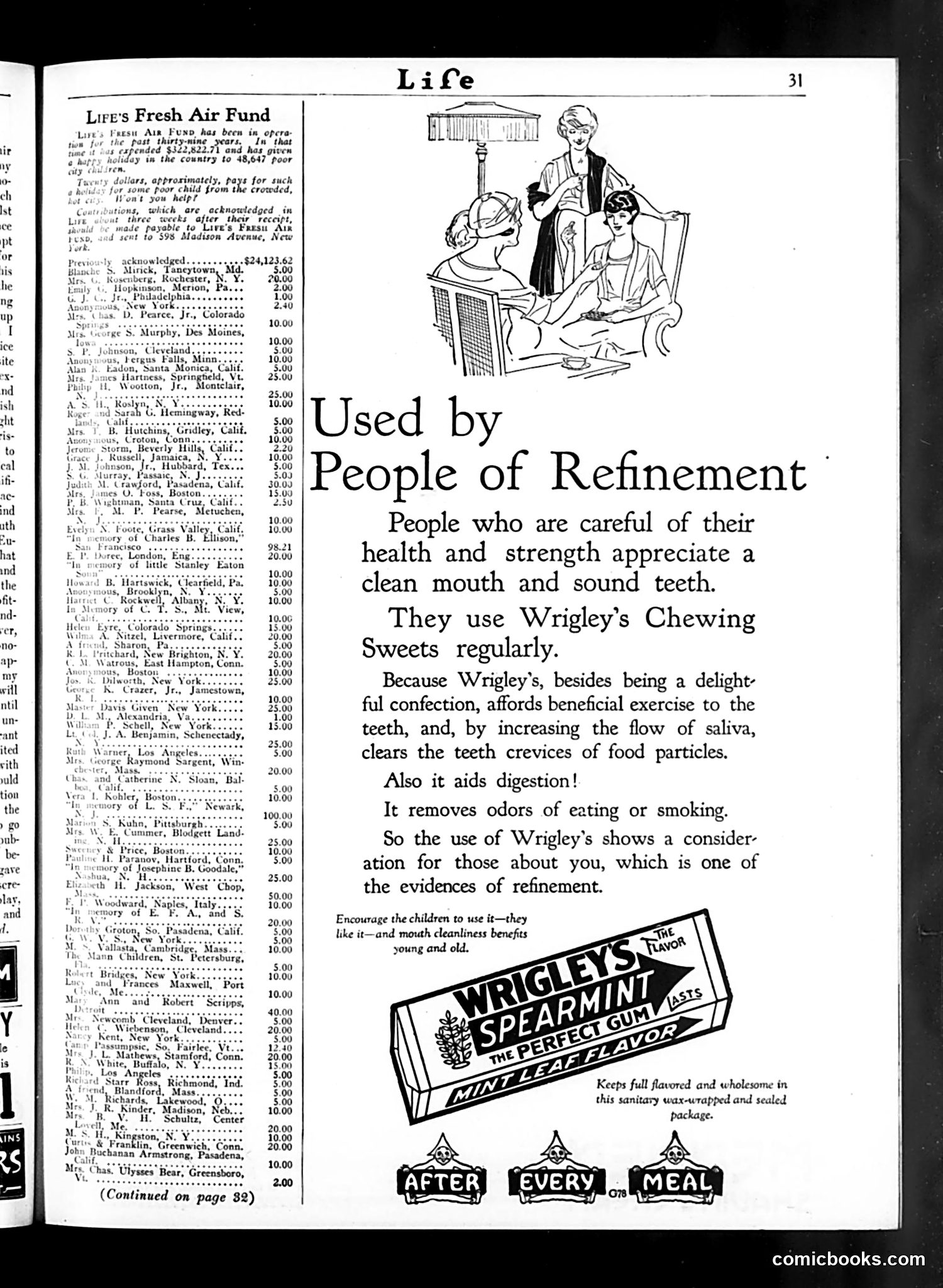
This page contains two distinct elements: **Left side:** A charitable fundraising appeal for Life's Fresh Air Fund, listing donor contributions ranging from $1 to $100. The fund sends poor children from crowded cities to the countryside—a Progressive Era social welfare initiative typical of the 1910s-1920s. **Right side:** A Wrigley's chewing gum advertisement disguised as lifestyle advice. The ad claims that gum use signifies "refinement" and "consideration for those about you"—positioning chewing gum as a marker of middle-class respectability. It promises dental benefits (saliva flow, odor removal, digestion aid) using pseudo-scientific language common in early 20th-century advertising. The implicit message: refined people chew Wrigley's. For modern readers, this reflects how advertising historically tied consumer products to social status and morality, creating artificial links between commodities and character traits.
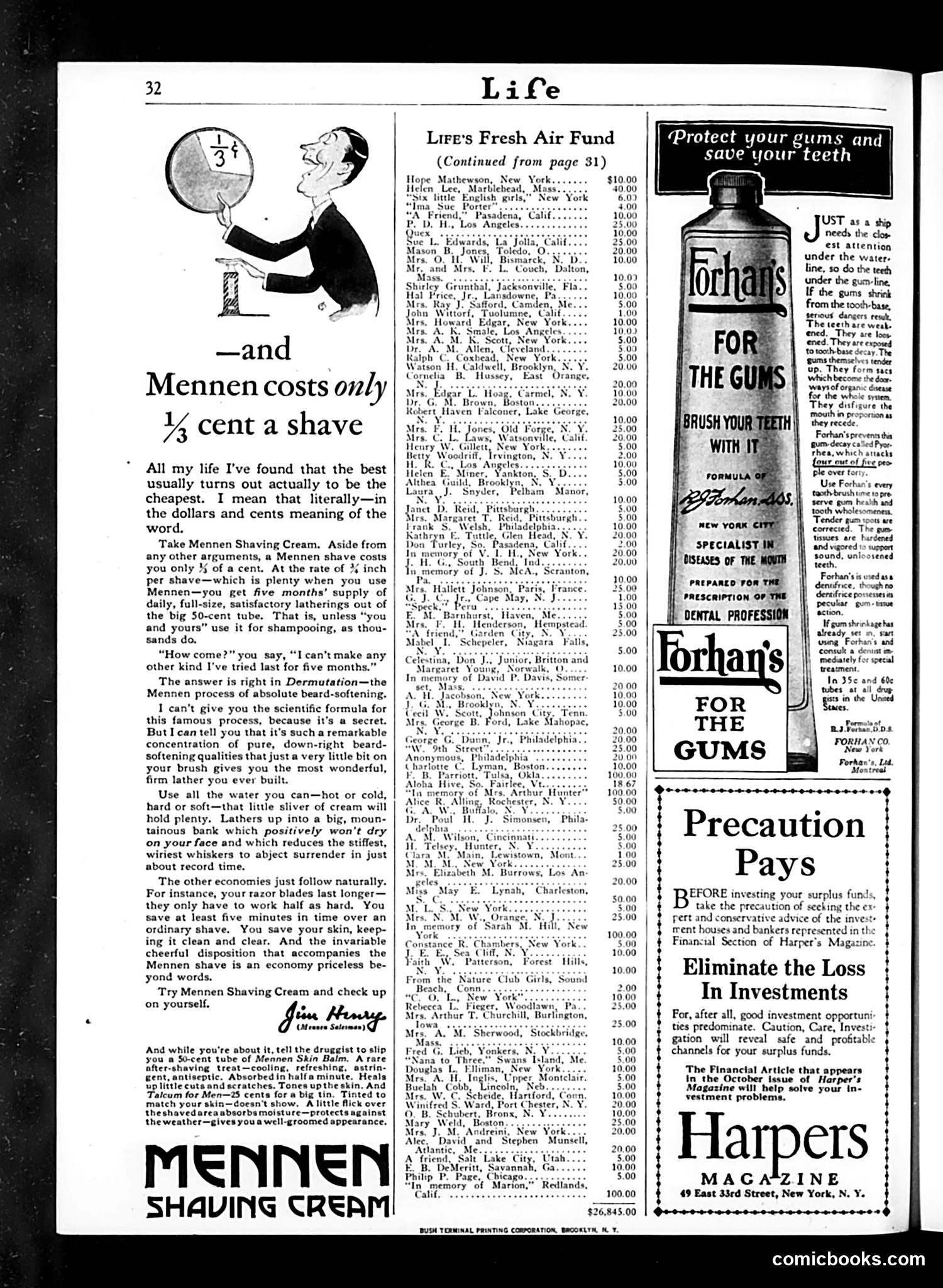
This page is primarily **advertising**, not political satire. It features a **Mennen Shaving Cream advertisement** occupying the left column, with the main pitch delivered by a man holding a pie chart showing a tiny slice labeled "1/3¢"—visualizing the claimed cost-per-shave. The ad's humor is gentle commercial persuasion: the salesman (identified as "John Henny, Coffeeman Salesman") argues that expensive products are cheapest long-term. He claims Mennen's special "Dermutation" beard-softening formula makes one tube last five months of daily use, reducing cost to one-third cent per shave. The right side contains **Life's Fresh Air Fund** donations (a charitable cause), plus advertisements for **Forhan's toothpaste** and **Harper's Magazine**. The satire is minimal—just the gentle irony of a coffee salesman hawking shaving cream by mathematics rather than vanity. This reflects early-20th-century advertising's shift toward rational, scientific sales appeals.
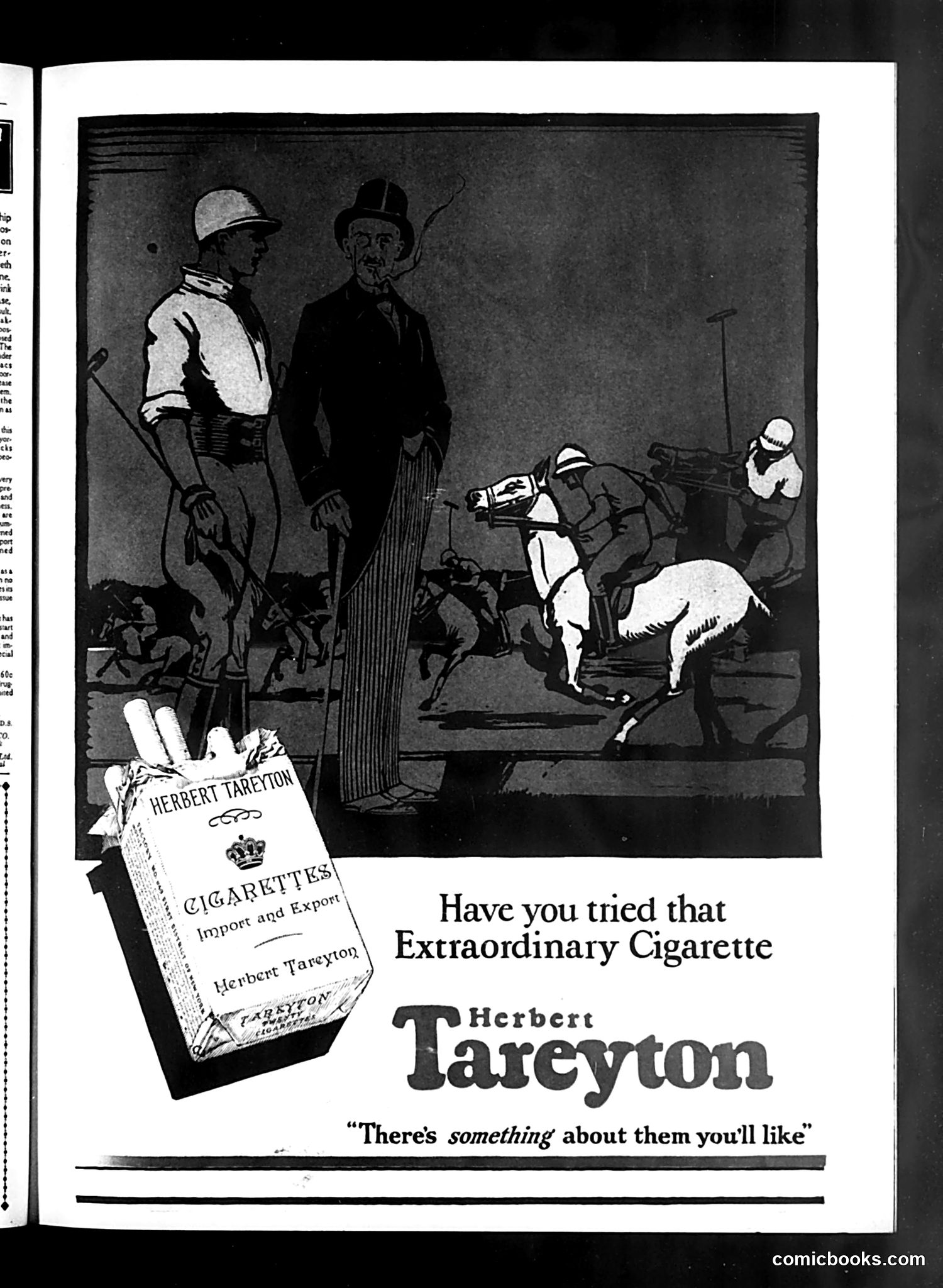
This is a **cigarette advertisement** for Herbert Tareyton brand, not political satire. The image shows two well-dressed men (appearing to be wealthy gentlemen or aristocrats, based on their formal attire and top hats) observing polo players on horseback—a sport associated with the upper class. The ad's appeal is **aspirational**: by smoking Tareyton cigarettes, ordinary consumers could associate themselves with the refined leisure and status of wealthy polo enthusiasts. The tagline "There's something about them you'll like" uses vague but appealing language typical of early 20th-century tobacco marketing. The cigarette pack shown features "Import and Export" branding, suggesting premium quality and international sophistication—another status marker designed to attract buyers.
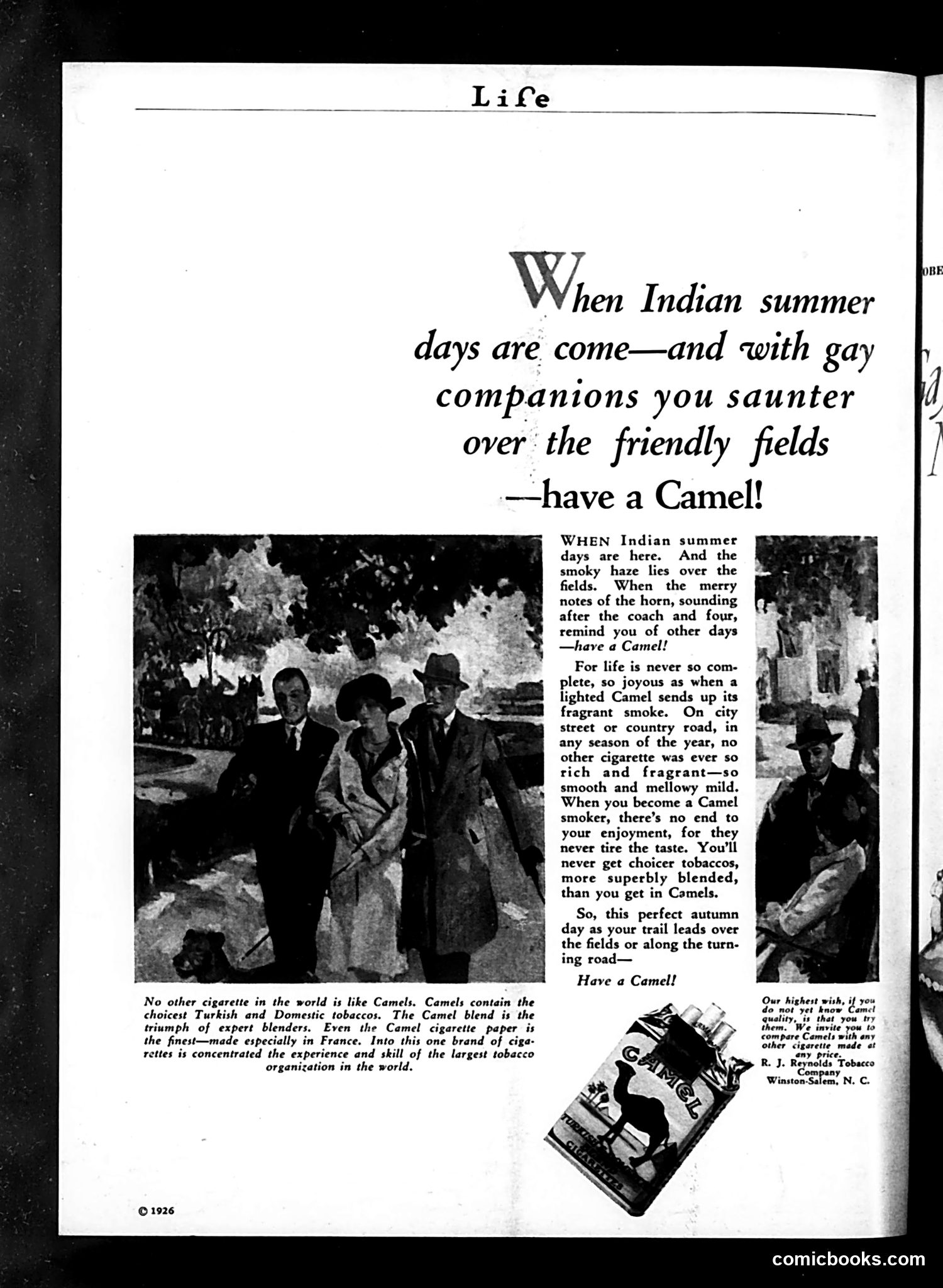
This is a **Camel cigarette advertisement**, not political satire. The page depicts three well-dressed figures enjoying an autumn outing—likely representing leisure-class recreation with "gay companions" sauntering through fields. The text romanticizes "Indian summer" and countryside pleasures ("coach and four," hunting horns) as the ideal setting for smoking. The ad employs nostalgic imagery and aspirational lifestyle marketing: smoking Camels is positioned as essential to a complete, joyous life. It emphasizes product superiority (Turkish and Domestic tobaccos, French paper, "expert blenders"). **For modern readers:** This represents pre-regulation cigarette advertising that freely linked smoking to social status, romantic moments, and lifestyle satisfaction—tactics now banned. The "Indian summer" framing uses seasonal leisure to normalize casual smoking in everyday contexts. The copyright date (©1926) places this during peak cigarette marketing before health warnings existed.