
Life, 1926-09-30 · page 22 of 36
Life — September 30, 1926 — page 22: what you’re looking at
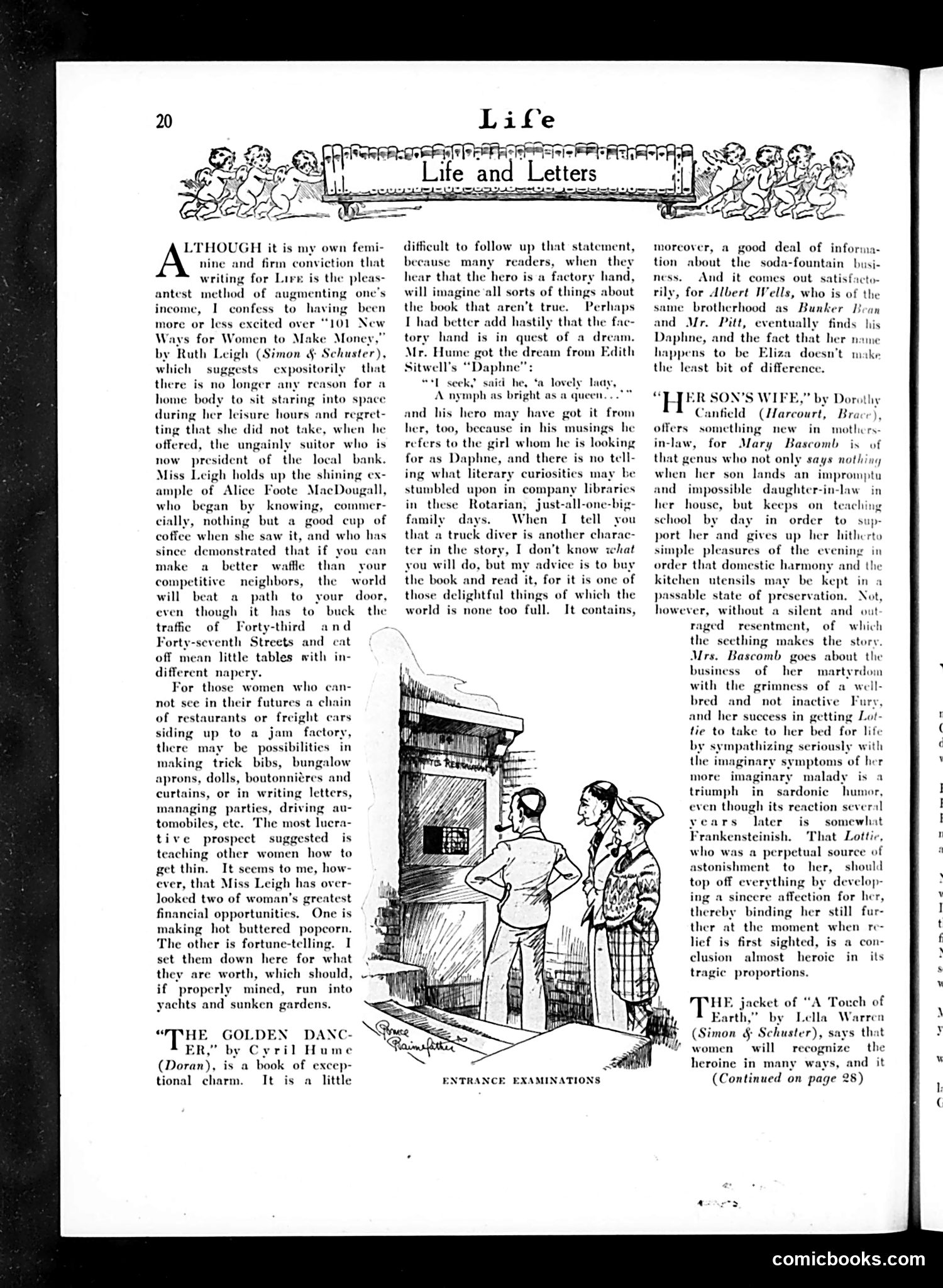
What you’re looking at
This untitled cartoon (captioned "ENTRANCE EXAMINATIONS") depicts two men at what appears to be a soda fountain or restaurant entrance. The joke likely satirizes working-class or immigrant access to American establishments during the early 20th century. The context matters: the surrounding text discusses "The Golden Dancer" by Cyril Hume, which features a truck driver as a character and contains "information about the soda-fountain business." The cartoon appears to humorously illustrate class or social barriers—the two figures seem to be seeking entry or employment at such an establishment, with the visual gag suggesting some form of examination or scrutiny required for entrance. The exact social commentary remains somewhat unclear without additional context, but it likely references either working-class aspiration, immigrant experience, or class-based discrimination in service establishments common to the era.
📄 Transcribed text from this page (OCR, searchable)
Machine-transcribed from the original scan — historical spelling and the odd misread are preserved.
HOUGH it is my own femi- nine and firm conviction that writing for Lirg is the pleas- antest method of augmenting one’s income, I confess to having bee more or less excited over “101 N Ways for Women to Make Money, by Ruth Leigh (Simon § Schuster), which suggests expositorily — that there is no longer any reason for a home body to sit staring into space during her leisure hours and regret- ting that she did not take, when he offered, the ungainly suitor who is now president of the local bank. Miss Leigh holds up the shining ex- ample of Alice Foote MacDougall, who began by knowing, commer- cially, nothing but a good cup of coffee when she saw it, and who has since demonstrated that i pan make better waffle than your competitive neighbors, the world will beat a path to your door, even though it has to buck the traffic of Forty-third and Forty-seventh Streets and cat off mean little tables with in- different napery. For those women who can- not sce in their futures a ch. of restaurants or freight © siding up to a jam facte there may be possibilitic making trick bibs, bungalow aprons, dolls, boutonniéres and curtains, or in writing letters, managing parties, driving au- tomobiles, ete. The most lucra- tive prospect suggested is teaching other women how to get thin. It seems to me, how- ever, that Miss Leigh has over- looked two of woman's greatest financial opportunities. One is making hot buttered popcorn. The other is fortune-telling. I set them down here for what they are worth, which should, if properly mined, run into yachts and sunken gardens. “TPHE GOLDEN DANC- ER,” by Cyril Hume (Doran), is a book: of excep= tional charm. It is a little rcause many readers, when they rar that the hero is a factory hand, will imagine all sorts of things about the book that aren't true. Perhaps I had better add hastily that the tory hand is in quest of a dre Mr. Hume got the dream from Sitwell’s “Daphne”: “SL seek, said he, ‘a lovely lnay, A nymph as bright as a queen...” and his hero may have got it from her, too, because in his musings he refers to the girl whom he is looking for as Daphne, and there is no tell- ing what literary curiosities may be stumbled upon in company libraries in these Rotarian, just-all-one-big- family day: When I tell you that a truck diver is another charac- ter in the story, I don’t know what you will do, but my advice is to buy the book and read it, for it is one of those delightful things of which the world is none too full. It contains, ENTRANCE EXAMINATIONS moreover, a good d of informa- tion about the soda-fountain busi- ness. And it comes out satisfac rily, for Albert Wells, who is of the same brotherhood as Bunker Bean and Mr. Pitt, eventually finds his Daphne, and the fact that her name happens to be Eliza doesn’t make the least bit of difference. “hE ER SON’S WIFE,” by Dorothy Canfield. (Harcourt, Bra offers something new in mothers. in-law, for Mary Bascomb is of that genus who not only says nothing when her son lands an impromptu and impossible daughter-in-law in her house, but keeps on teaching school by day in order to sup- port her and gives up her hitherto simple pleasures of the evening in order that domestic harmony and the kitchen utensils may be kept in a passable state of preservation. Not, however, without a silent and out raged resentment, of which the seething makes the story. Mrs. Bascomb goes about the business of her martyrdom with the grimness of a well- bred and not inactive Fury, and her success in getting Lot- tie to take to her bed for life by sympathizing seriously with the imaginary symptoms of her more imagin malady is a triumph in’ sardonic humor, even though its reaction several years later is somewhat Frankensteinish. That Lottir, who was a perpetual source of astonishment to her, should top off everything by develop- ing a sincere affection for her, thereby binding her still fur- ther at the moment when re- lief is first sighted, is a con- clusion almost heroic in_ its tragic proportions. HE jacket of “A Touch of Earth,” by Lella V (Simon § Schuster), s women will recognize heroine in many ways, and it (Continued on page 28) comicbooks.com