
Life, 1926-09-30 · page 26 of 36
Life — September 30, 1926 — page 26: what you’re looking at
What you’re looking at
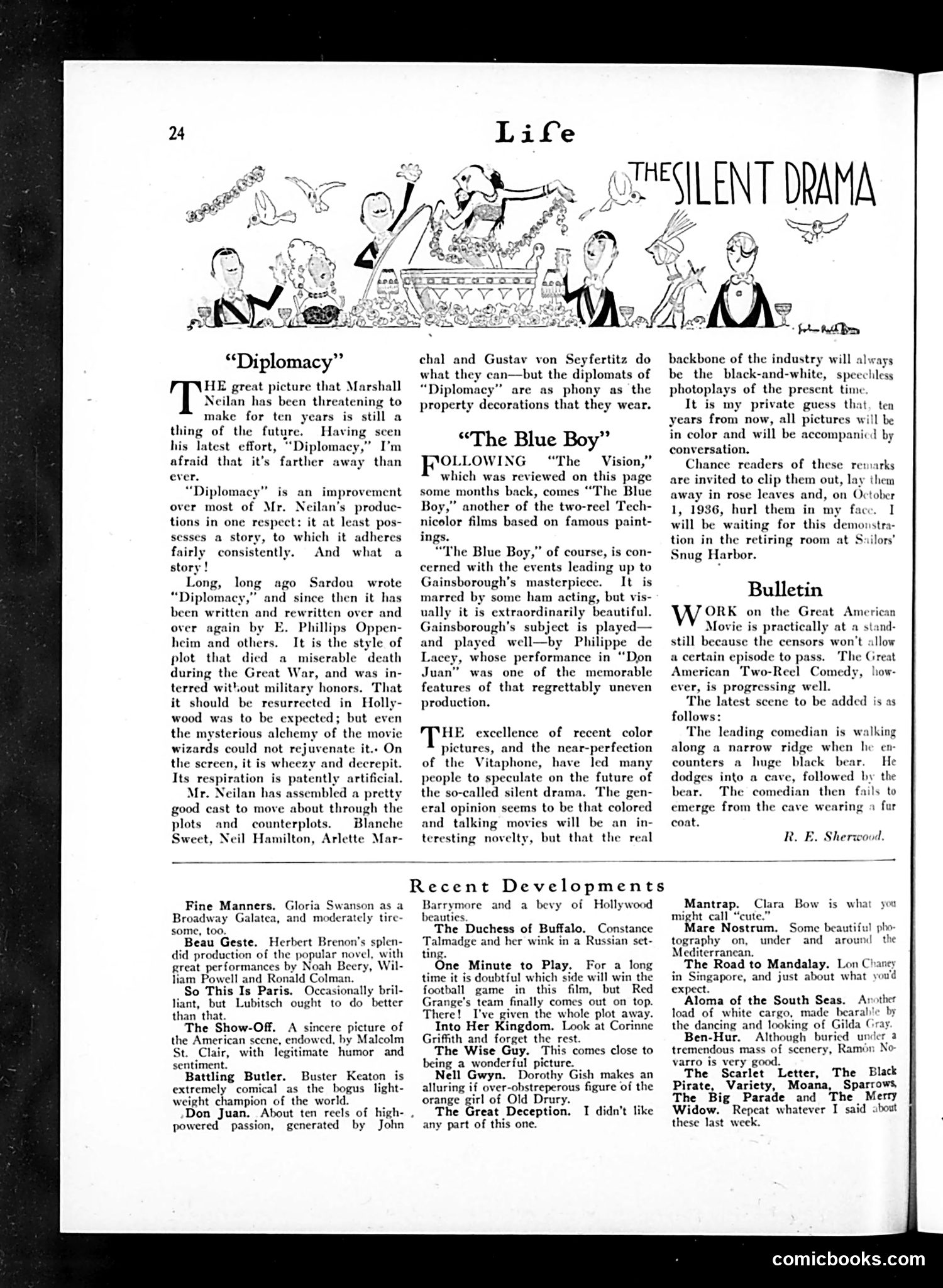
This is a film criticism column from Life magazine, circa mid-1920s, reviewing recent movies. The heading illustration satirizes the theatrical excess of silent film acting—showing exaggerated gestures and melodramatic poses. The main reviews critique: 1. **"Diplomacy"** (directed by Marshall Neilan)—a adaptation of a Sardou play deemed outdated. The critic argues this pre-WWI plot style "died a miserable death during the Great War" and shouldn't have been resurrected. 2. **"The Blue Boy"**—a Technicolor short based on the famous painting, praised visually but criticized for "ham acting." A notable prediction appears: the critic bets that within ten years (by 1936), all films will be in color with synchronized sound, rejecting the prevailing industry opinion that silent black-and-white films would remain cinema's backbone. This reflects the transitional moment before "talkies" revolutionized Hollywood—the author's 1936 deadline proves remarkably prescient.
📄 Transcribed text from this page (OCR, searchable)
Machine-transcribed from the original scan — historical spelling and the odd misread are preserved.
oe SILENT UAT HE great picture that Marshall Neilan has been threatening to make for ten years is still a thing of the future. Having scen his latest effort, “Diplomacy,” I’m afraid that it’s farther away than ever. “Diplomacy” is an improvement over most of Mr. Neilan’s produc- tions in one respect: it at least pos- sesses a story, to which it adheres fairly consistently. And what a story ! Long, long ago Sardou wrote “Diplomacy,” and since then it has been written and rewritten over and over again by E. Phillips Oppen- heim and others. It is the style of plot that died a miserable death during the Great War, and was in- terred without military honors. That it should be resurrected in Holly- wood was to be expected; but even the mysterious alchemy of the movie wizards could not rejuvenate it.. On the screen, it is wheezy and decrepit. Its respiration is patently artificial. Mr. Neilan has assembled a pretty good cast to move about through the plots and counterplots. Blanche Sweet, Neil Hamilton, Arlette Mar- chal and Gustav von Seyfertitz do what the n—but the diplomats of “Diplomacy” are as phony as the property decorations that they wear. “The Blue Boy” OLLOWING “The Vision,” which was reviewed on this page some months back, comes “The Blue Boy,” another of the two-reel Tech- nicolor films based on famous paint- ings. “The Blue Boy,” of course, is con- cerned with the events leading up to Gainsborough’s masterpiece. It is marred by some ham acting, but vis- ually it is extraordinarily beautiful. Gainsborough’s subject is played— and played well—by Philippe de La whose performance in “Don Juan” was one of the memorable features of that regrettably uneven production. HE excellence of recent color pictures, and the near-perfection of the Vitaphone, have led many people to speculate on the future of the so-called silent drama. The gen- eral opinion seems to be that colored nd talking movies will be an in- teresting novelty, but that the real backbone of the industry will aly be the black-and-white, speechless photoplays of the present timc It my private guess that, ten years from now, all pictures will be in color and will be accompanicd by conversation. . Chance readers of these retiarks are invited to clip them out, lay them away in rose leaves and, on October 1, 1936, hurl them my face. I ill be waiting for this demonstra- tion in the retiring room at Sailors’ Snug Harbor. Bulletin ORK on the Great American Movie is practically at a stand- still because the censors won't allow a certain episode to pass. The Great American Two-Reel Comedy, ever, is progressing well. The latest scene to be added is as follows: The leading comedian is walking along a narrow ridge when he en- counters a huge black bear. He dodges into a cave, followed by the bear. The comedian then fails to emerge from the cave wearing « fur coat. R. E. Sherwood. Fine Manners. Gloria Swanson as a Broadway Galatea, and moderately tire- some, too. Beau Geste. Herbert Brenon’s splen- did production of the popular novel, with great performances by Noah Beery, Wil- liam Powell and Ronald Colman. So This Is Paris. Occasionally bril- liant, but Lubitsch ought to do better than that. The Show-Off. A sincere picture of the American scene, endowed, hy Malcolm St. Clair, with legitimate humor and sentiment. Battling Butler. Buster Keaton is extremely comical as the bogus light- weight champion of the world. Don Juan. About ten recls of high- powered passion, generated by John Recent Developments ymore and a bevy of Hollywood . The Duchess of Buffalo. Constance Talmadge and her wink in a Russian set- ting. One Minute to Play. For a long time it is doubtful which side will win the football game in this film, but Red Grange’s team finally comes out on top. There! I've given the whole plot away. Into Her Kingdom. Look at Corinne Griffith and forget the rest. The Wise Guy. This comes close to being a wonderful picture. Nell Gwyn. Dorothy Gish makes an alluring if over-obstreperous figure of the orange girl of Old Drury. The Great Deception. any part of this one. T didn’t like Mantrap. Clara Bow might call “cute.’ are Nostrum. tography on, Mediterranean. The Road to Mandalay. Lon Chani ey in Singapore, and just about what you'd expect. Aloma of the South Seas. Another load of white cargo, made bearable by the dancing and looking of Gilda Gray. Ben-Hur. Although buried under a tremendous mass ot scenery, Ramon No varro is very good, The Scarlet Letter, The Black Pirate, Variety, Moana, Sparrows, The Big Parade and The Merry Widow. Repcat whatever I said about these last week. is what you pho- e Some beauti under and around comicbooks.com