
Life, 1926-09-30 · page 21 of 36
Life — September 30, 1926 — page 21: what you’re looking at
What you’re looking at
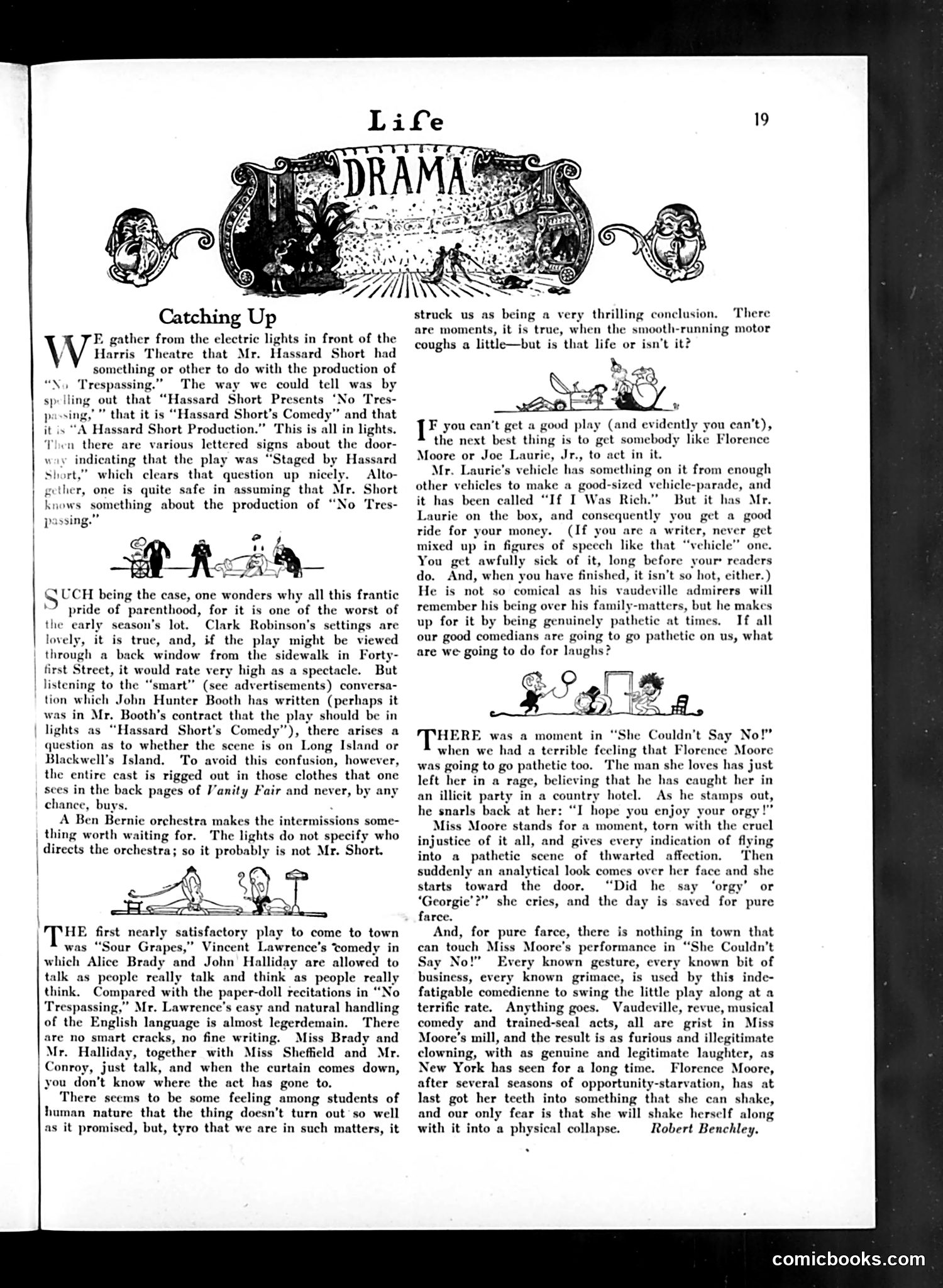
This page reviews three Broadway plays. The opening section ridicules **Hassard Short**, a theater producer/director, for aggressively self-promoting his play "No Trespassing"—his name appears everywhere (in lights, on signs, as "presented by," "staged by," "produced by"). The satire: the play is actually "one of the worst of the season's lot," yet Short acts as though he created a masterpiece. The joke relies on the contrast between his outsized ego and the production's mediocrity. The reviews then praise **Vincent Lawrence's "Sour Grapes"** (starring **Alice Brady** and **John Halliday**) for its naturalistic dialogue, contrasting it favorably with "No Trespassing's" artificial "smart" dialogue. Finally, the page discusses **Florence Moore** in "She Couldn't Say No!," noting she almost descends into pathos but recovers to save the scene as farce. The piece criticizes comedians abandoning humor for manufactured pathos. The cartoons appear to illustrate theatrical scenes, though specific details are unclear.
📄 Transcribed text from this page (OCR, searchable)
Machine-transcribed from the original scan — historical spelling and the odd misread are preserved.
E. gather from the electric lights in front of the Harris Theatre that Mr. Hassard Short had something or other to do with the production of Trespassing.” The way we could tell was by spilling out that “Hassard Short Presents ‘No Tres- passing,’ " that it is “Hassard Short’s Comedy” and that it is “A Hassard Short Production.” This is all in lights. ‘Then there are various lettered signs about the door- way indicating that the play was “Staged by Hassard Short,” wh rs t question up nicely. Alto- gether, one safe in assuming that Mr. Short knows something about the production of “No Tres- ssing. QUCH being the case, one wonders why all this frantic ‘pride of parenthood, for it is one of the worst of season's lot. Clark Robinson's settings are > is true, and, if the play might be viewed through a back window from the sidewalk in Forty- | first Street, it would rate very high as a spectacle. But listening to the ‘‘smart” (see advertisements) conversa- tion which John Hunter Booth has written (perhaps it was in Mr. Booth’s contract that the play should be in lights as “Hassard Short’s Comedy’), there arises a question as to whether the scen on Long Island or Blackwell's Island. To avoid this confusion, however, the entire cast is rigged out in those clothes that one sces in the back pages of Vanity Fair and never, by any chance, buys. A Ben Bernie orchestra makes the intermissions some- | thing worth waiting for. The lights do not specify who | directs the orchestra; so it probably is not Mr. Short. the love | =e Poe THE } first nearly satisfactory play to come to town | * was “Sour Grapes,” Vincent Lawrence's ‘comedy in which Alice Brady and John Halliday are allowed to talk as people really talk and think as people really think. Compared with the paper-doll recitations in “No Trespassing,” Mr. Lawrence's easy and natural handling of the English language is almost legerdemain. There are no smart cracks, no fine writing. Miss Brady and Mr. Halliday, together with Miss Sheffield and Mr. Conroy, just talk, and when the curtain comes down, you don’t know where the act has gone to. There seems to be some feeling among students of human nature that the thing doesn’t turn out’ so well as it promised, but, tyro that we are in such matters, it struck us as being a very thrilling conclusion, There are moments, it is true, when the smooth-running motor coughs a little—but is that life or isn’t it? [- you can’t get a good } the next best th is to get “somebody like Moore or Joe Jr., to ac! vehicle has something 0 on it from enough s to make a good- yehicle-parade, and f I Was Rict But it has Mr. and consequently you get a good (If you are a writer, never get mixed up in figures of speech like that “vehicl You get awfully sick of it, long before your readers do. And, when you have finished, it isn’t so hot, either.) He is not so comical as his vaudeville admirers will remember his being over his family-matters, but he makes up for it by being genuinely pathetic at times. If all our good comedians are going to go pathetic on us, what are we going to do for laughs? ae x Pn HERE was a moment in “She Couldn't Say No!” when we had a terrible fecling that Florence Moore was going to go pathetic too. The man she loves has just left her in a rage, believing that he has caught her in an illicit party in a country hotel. As he stamps out, he snarls back at her: “I hope you enjoy your orgy!” Miss Moore stands for a moment, torn with the cruel injustice of it all, and gives every ind into a pathetic scene of thwarted suddenly an analytical look comes over her f starts toward the door. “Did he ‘Georgie’? she cries, and the day is ss farce. And, for pure farce, there is nothing in town that can touch Miss Moore’s performance in “She Couldn't Say No!” Every known gesture, every known bit of business, eve Yy known grimace, is used by this inde- fatigable comedienne to swing the little play along at a terrific rate. Anything goes. Vaudeville, revue, musical comedy and trained-seal acts, all are grist in Miss Moore’s mill, and the result is as furious and illegitimate clowning, with as genuine and legitimate laughter, as New York has seen for a long time. Florence Moore, after several seasons of opportunity-starvation, has at last got her teeth into something that she can shake, and our only fear is that she will shake herself along with it into a physical collapse. Robert Benchley, Florence other vehic it has been called ‘ Laurie on the bo: ride for your money. * one. and she ‘orgy’ or d for pure comicbooks.com