
A complete issue · 40 pages · 1926
Life — September 9, 1926
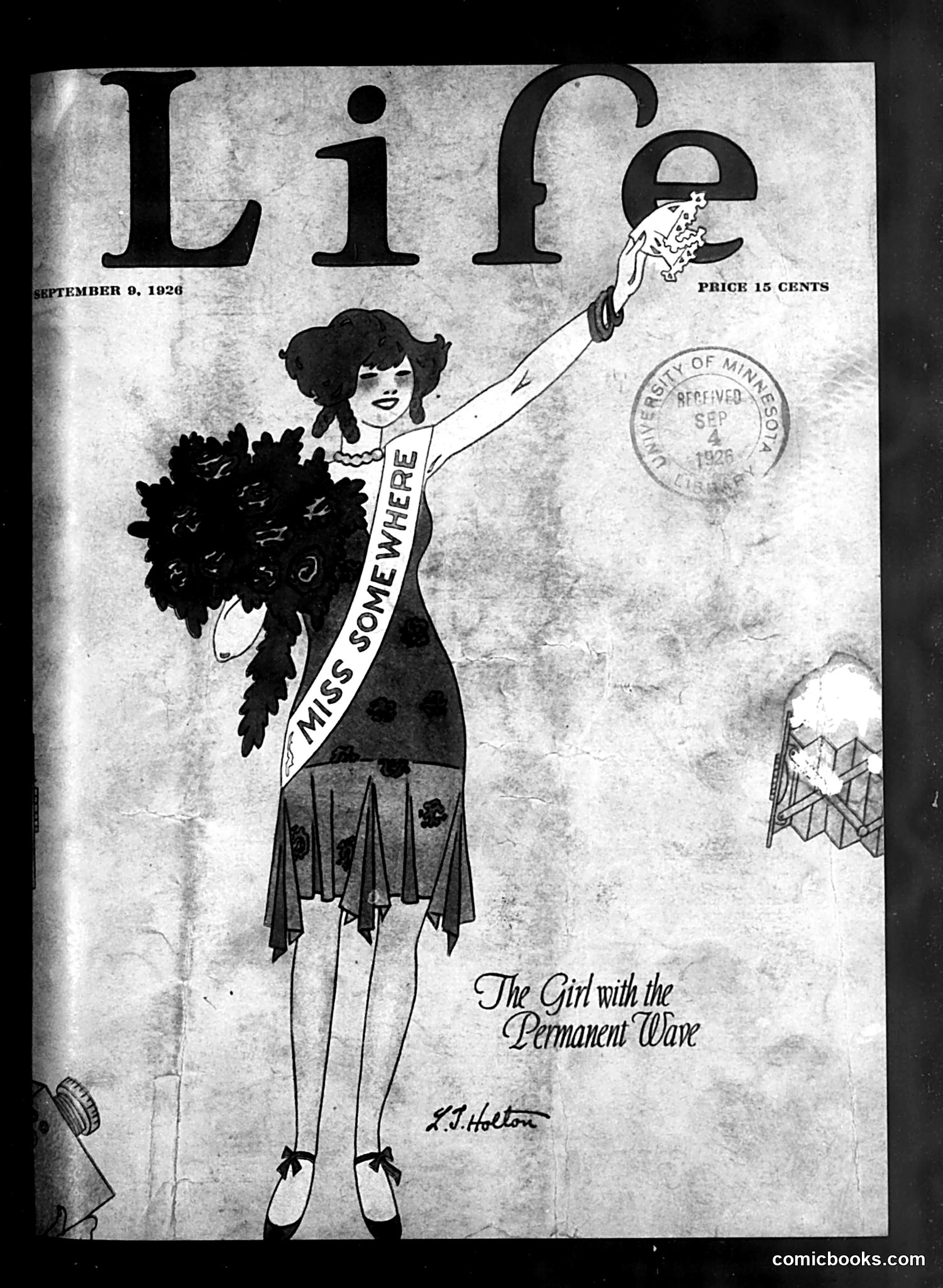
This cover satirizes the 1920s beauty trend of the "permanent wave"—a chemical hair-treatment process. The illustration shows a stylized flapper girl labeled "Miss Somewhere" triumphantly holding an enormous "e" (from "Life"), embodying the modern woman of the Jazz Age. The satire targets how women enthusiastically adopted this new cosmetic technology. The exaggerated pose and the sash reading "Miss Somewhere" mock the pageantry surrounding beauty standards, while her confident stance ironically celebrates consumer culture and vanity. The permanent wave was marketed as a revolutionary convenience, but the cartoonist gently ridicules how women embraced it as a defining feature of modernity. This reflects 1920s cultural tensions between traditional femininity and the era's new consumer-driven identity.
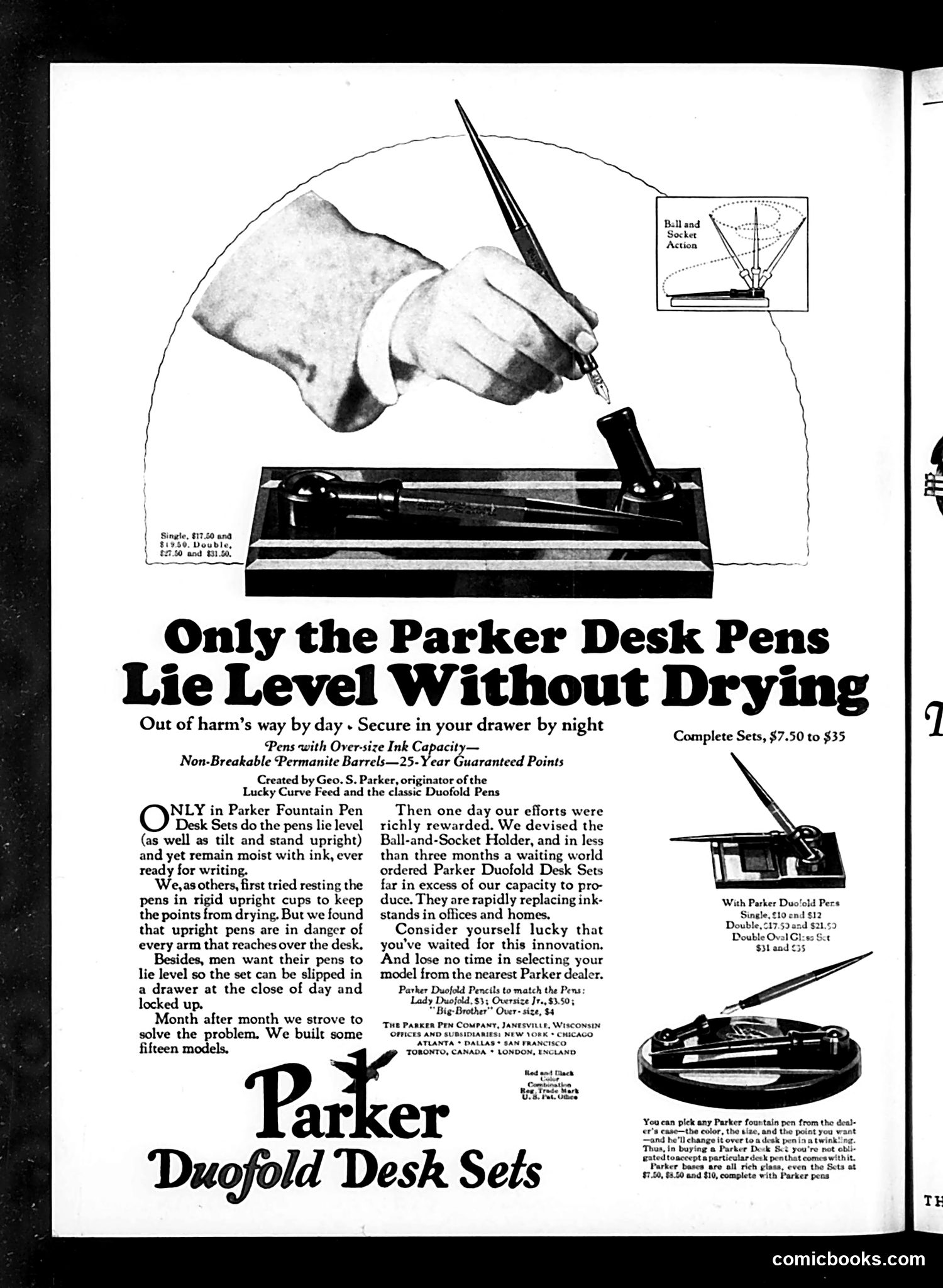
This page is **not a political cartoon or satire**—it's a **full-page advertisement** for Parker Duofold Desk Sets, a line of fountain pens and desk accessories manufactured by the Parker Pen Company. The ad features a photograph of a hand demonstrating the pens' key selling point: they remain level when resting horizontally without drying out, unlike competitor pens. The headline promises pens that "Lie Level Without Drying." The text explains Parker spent months developing a "Ball-and-Socket Holder" solution to keep desk pens functional and ready for writing. The ad emphasizes durability ("Non-Breakable 'Permanent' Barrels—25-Year Guaranteed Points") and convenience. This is commercial advertising with no political or satirical content.
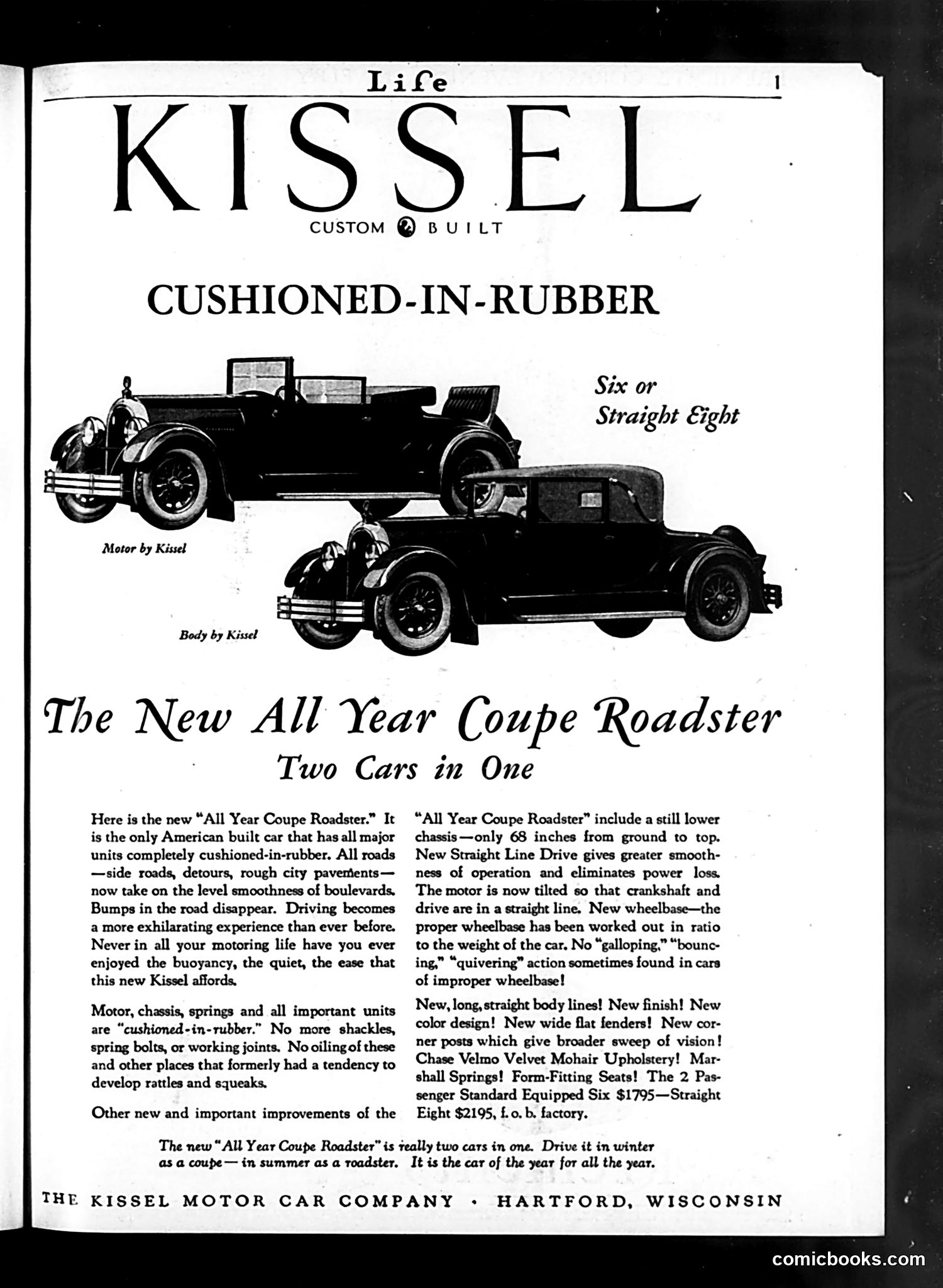
This is **not a cartoon or satirical piece** — it's a straightforward automobile advertisement from Life magazine's early automotive era. The page advertises the **Kissel "All Year Coupe Roadster,"** a convertible vehicle marketed as "two cars in one" because its design allowed it to function as both a closed coupe and open roadster depending on weather conditions. The ad emphasizes practical innovations: rubber cushioning throughout, low chassis height, improved wheelbase proportions, and a new straight-line drive system. Pricing is listed at $1795 (Six) and $2195 (Straight Eight). The Kissel Motor Car Company, based in Hartford, Wisconsin, positioned this vehicle for year-round versatility — a significant selling point in early automotive marketing before standardized car designs became common.
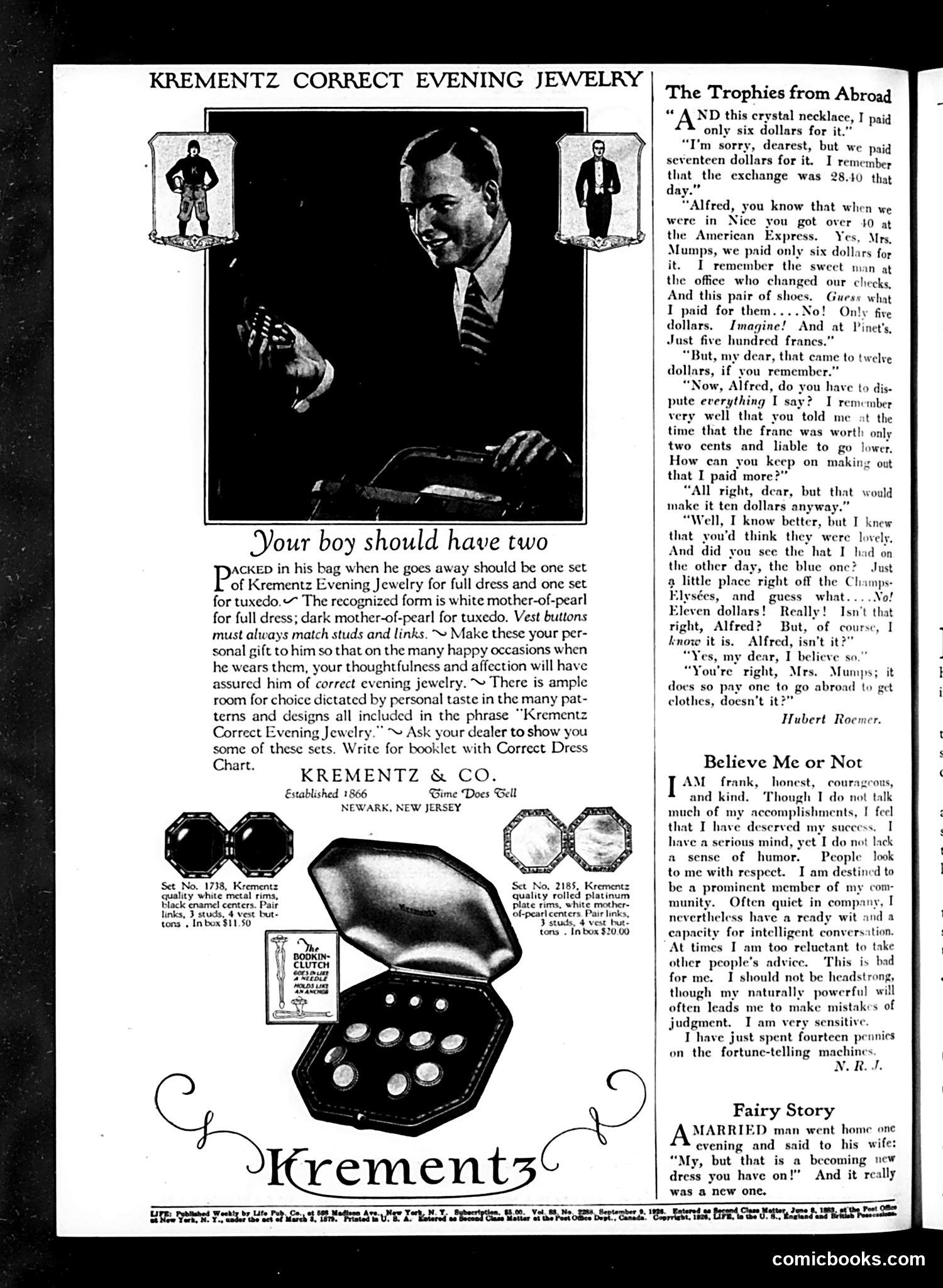
This page is **primarily advertising** for Krementz jewelry, a company established in 1866. The main content features a male model displaying evening jewelry sets—cufflinks, studs, and vest buttons in mother-of-pearl and enamel. The right side contains three separate short pieces: "The Trophies from Abroad" (a dialogue about overpriced European purchases), "Believe Me or Not" (a character sketch about an introspective man), and "Fairy Story" (a brief anecdote about a new dress). These appear to be filler content typical of Life magazine's satirical format, poking gentle fun at human vanity and consumerism rather than making specific political commentary.
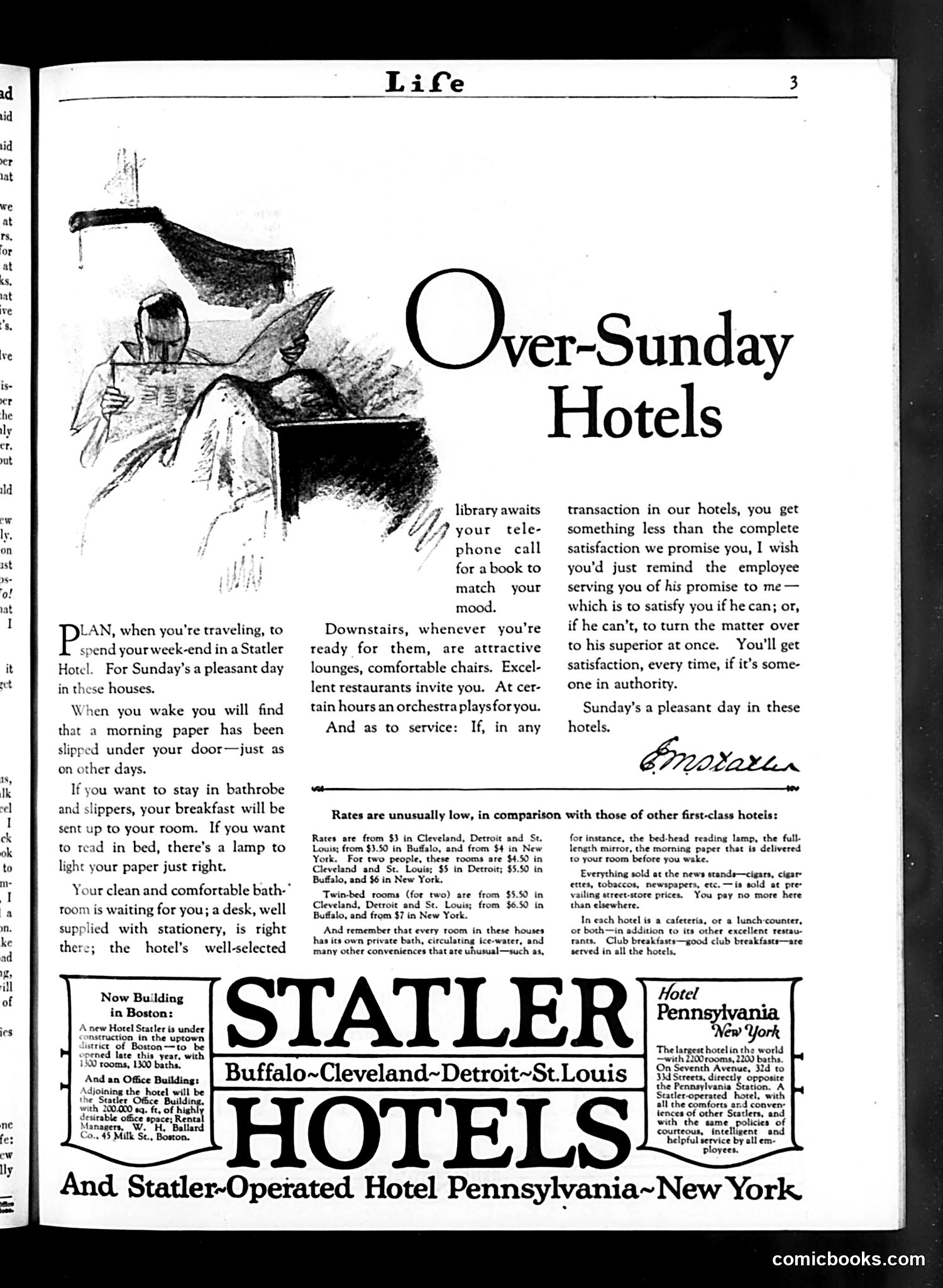
This page is primarily **advertising content** for Statler Hotels, not satire or political commentary. The illustration shows a traveler in bed reading a newspaper, with hotel amenities highlighted nearby—depicting the comfortable weekend hotel experience Statler promises. The text emphasizes service quality and competitive pricing for weekend stays across their chain (Buffalo, Cleveland, Detroit, St. Louis, Pennsylvania, New York). The signature appears to be from hotel management, underscoring their personal commitment to guest satisfaction. The sole cartoon element is modest: a simple illustration of a relaxed guest, designed to convey comfort and leisure rather than satirize anything. This is fundamentally a commercial advertisement positioned within Life magazine's pages, not editorial political or social commentary.
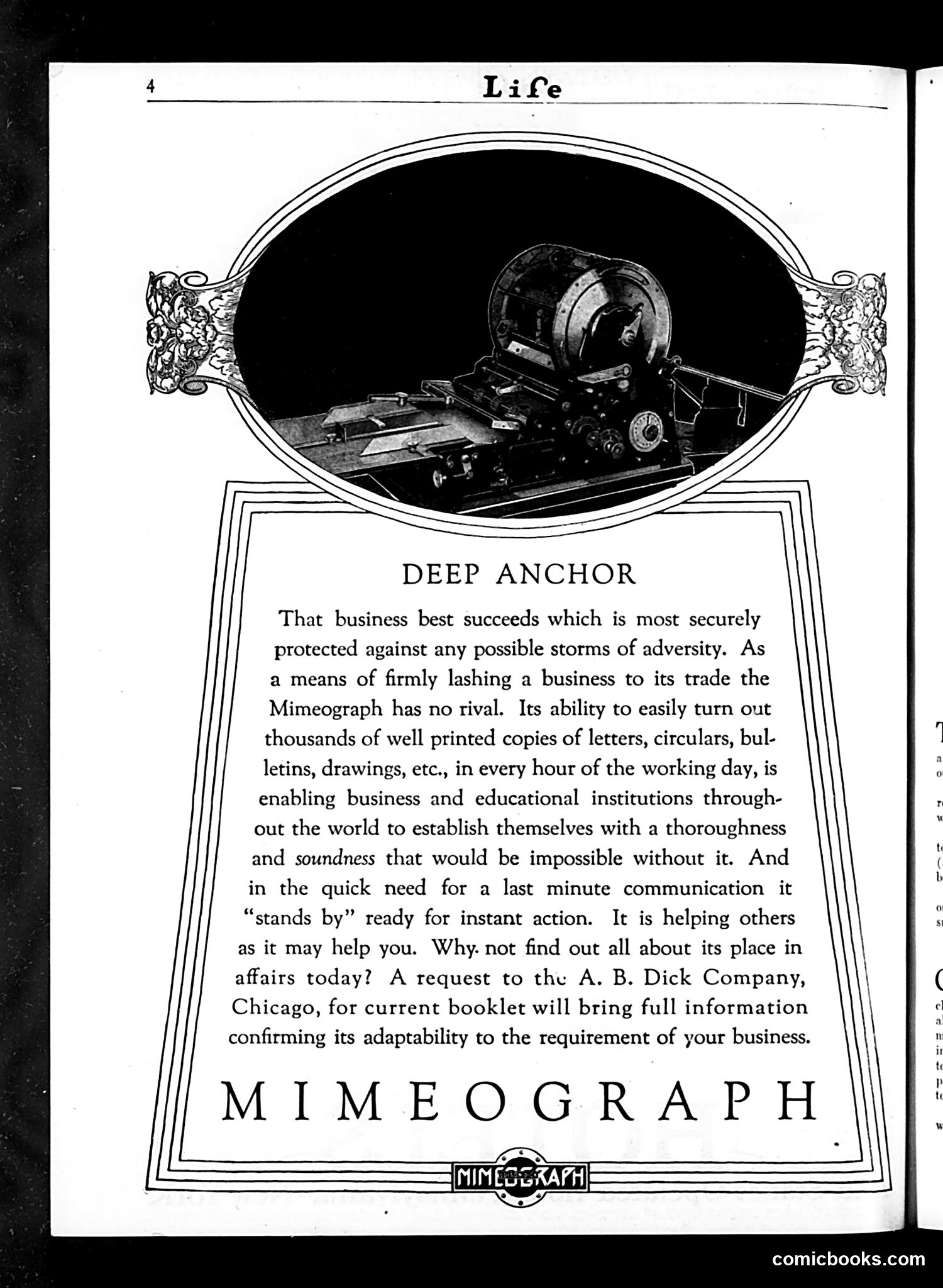
This page is **not a cartoon or satirical content**—it's an advertisement for the Mimeograph machine, placed in Life magazine. The ad uses the metaphor "Deep Anchor" to compare the mimeograph's reliability to a ship's anchor in storms. The image shows the actual machine itself. The text argues that businesses need the mimeograph to succeed by rapidly producing copies of letters, circulars, and bulletins. It positions the device as essential for institutional communication and last-minute correspondence. The ad targets business owners and educational institutions, emphasizing the mimeograph's speed and dependability as competitive advantages. Readers are invited to contact the A.B. Dick Company in Chicago for more information. This represents early 20th-century office technology marketing in a humor magazine's advertising section.
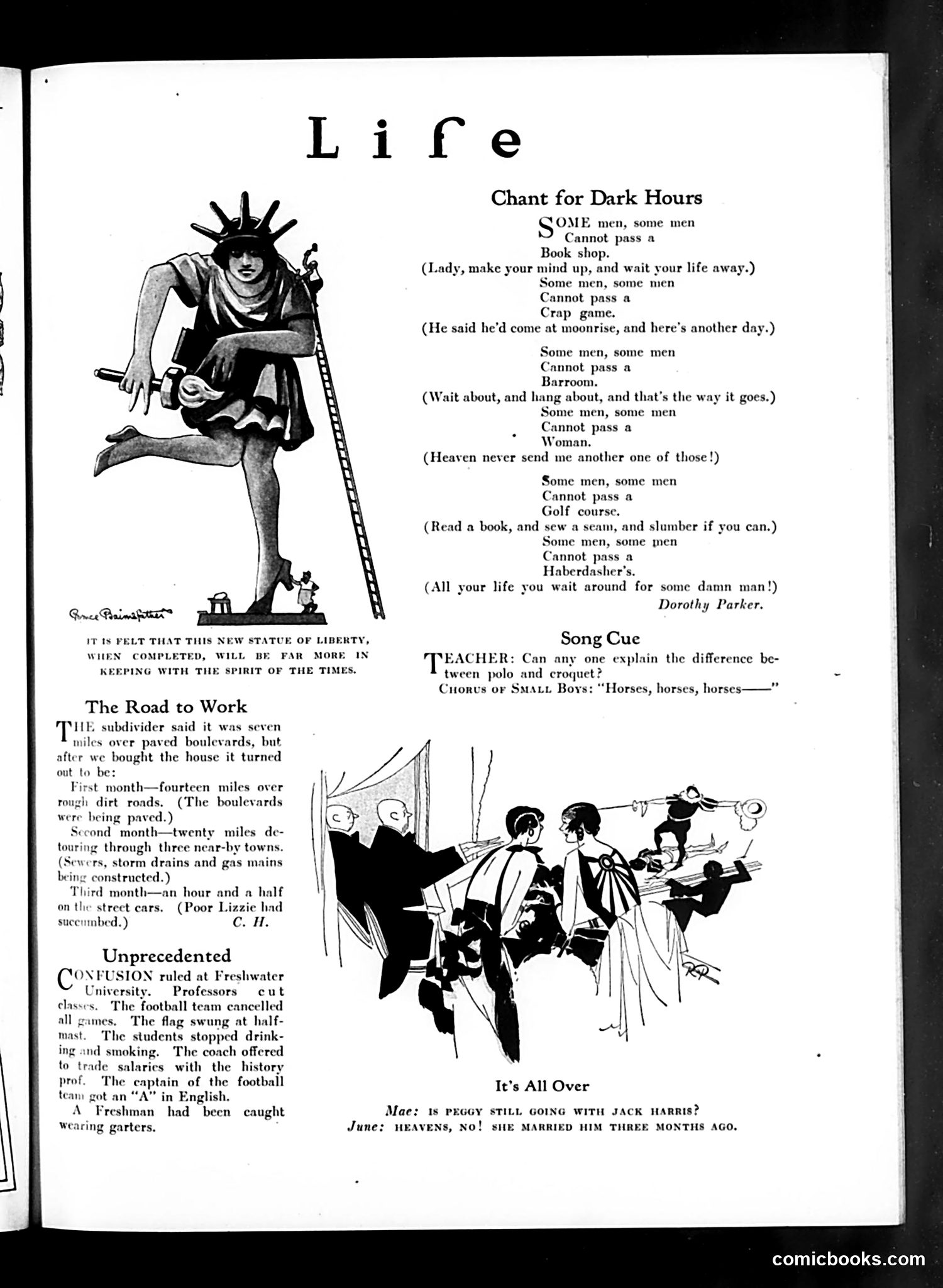
This page from *Life* magazine contains several pieces of satirical humor targeting early 20th-century American social anxieties: **"Life" (top)**: A drawing of Lady Liberty on a ladder confronting obstacles—depicting American society's obstacles to progress. The caption notes the artwork will eventually reflect "the spirit of the times." **"The Road to Work"**: Satirizes suburban expansion and infrastructure chaos. A homeowner discovers their "seven-mile" commute actually involves fourteen miles of rough roads, then twenty miles through towns, illustrating how real distances far exceeded advertised proximity to the city. **"Unprecedented"**: Mocks college disruption (likely WWI-era), where normal operations cease—football cancelled, professors cut salaries, students stop drinking/smoking. The satire highlights how extraordinary circumstances inverted institutional norms. **"Song Cue" and "It's All Over"**: Brief romantic/social humor pieces typical of the magazine's lighter content.
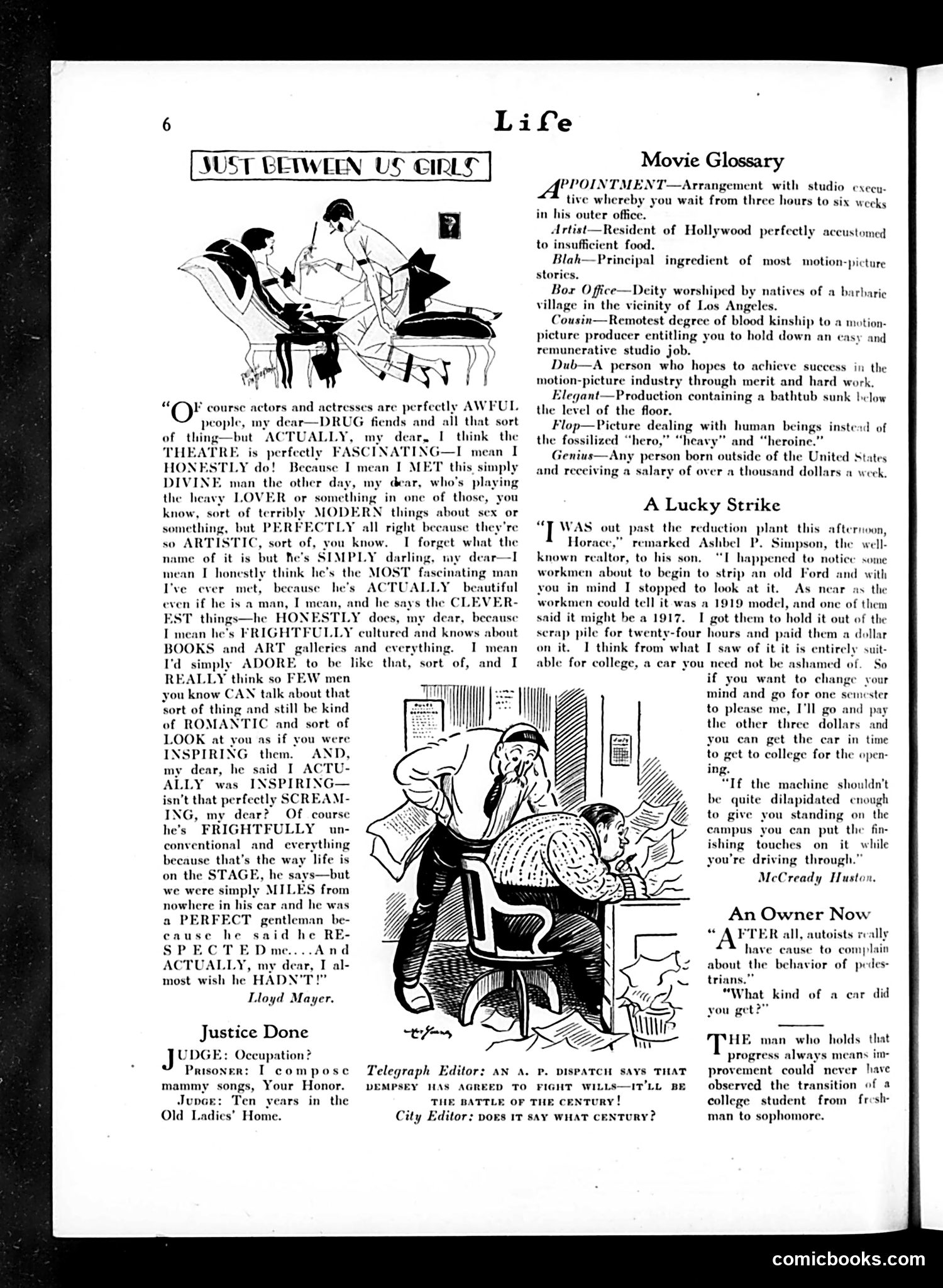
This page satirizes Hollywood culture and actors' pretensions. The main article mocks theatrical people as self-absorbed and morally questionable, claiming actors discuss "terrible MODERN things about sex" while presenting themselves as artistic and inspirational. The author (Lloyd Mayer) dismissively calls them "PERFECTLY all right" but "ARTISTIC" — sarcastically praising their shallow sophistication. The accompanying cartoon shows someone at a typewriter, likely depicting a gossip columnist or writer discussing Hollywood figures. Additional sections parody Hollywood terminology ("Box Office," "Dub," "Flop") and include anecdotes about studio contracts and automobiles — poking fun at the industry's materialism and the ridiculous situations actors create for themselves.
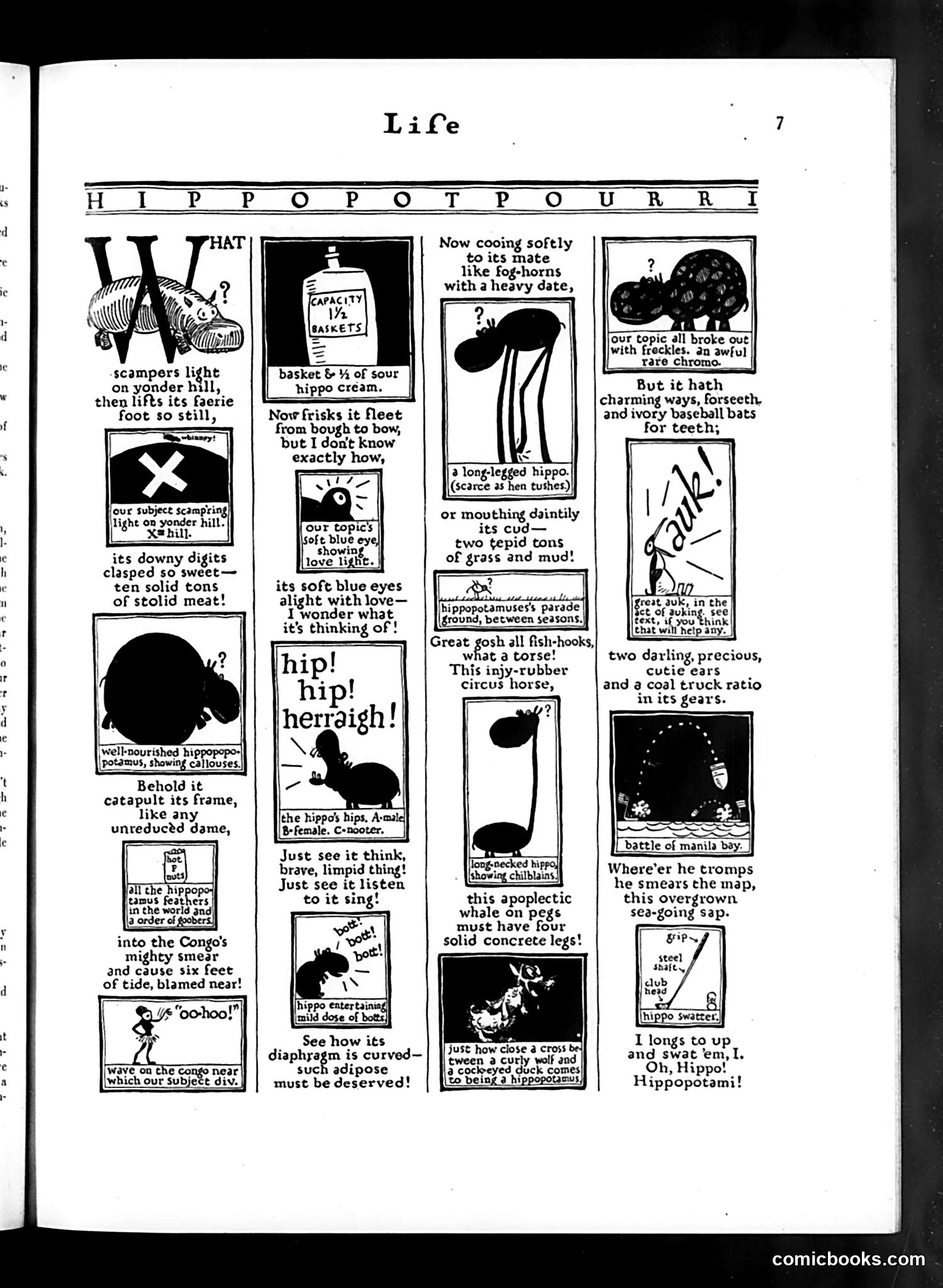
This is a humorous nature guide presenting the hippopotamus through exaggerated, anthropomorphic observations. The cartoon catalogs hippo traits—their capacity for mud, powerful jaws, social behavior ("cooing softly to its mate"), and physical characteristics (freckles, solid tons of meat). The satire mocks pretentious natural history writing by treating a prosaic animal with overwrought poetic language ("charming ways, forseeth, and ivory baseball bats for teeth"). References like "hippocampus's parade" and "battle of manila bay" appear to be humorous asides. The comic uses exaggerated illustrations and puns ("hip! hip! herraigh!") to parody both wildlife documentation and genteel magazine humor conventions. It's lighthearted zoological satire targeting the period's earnest nature writing.
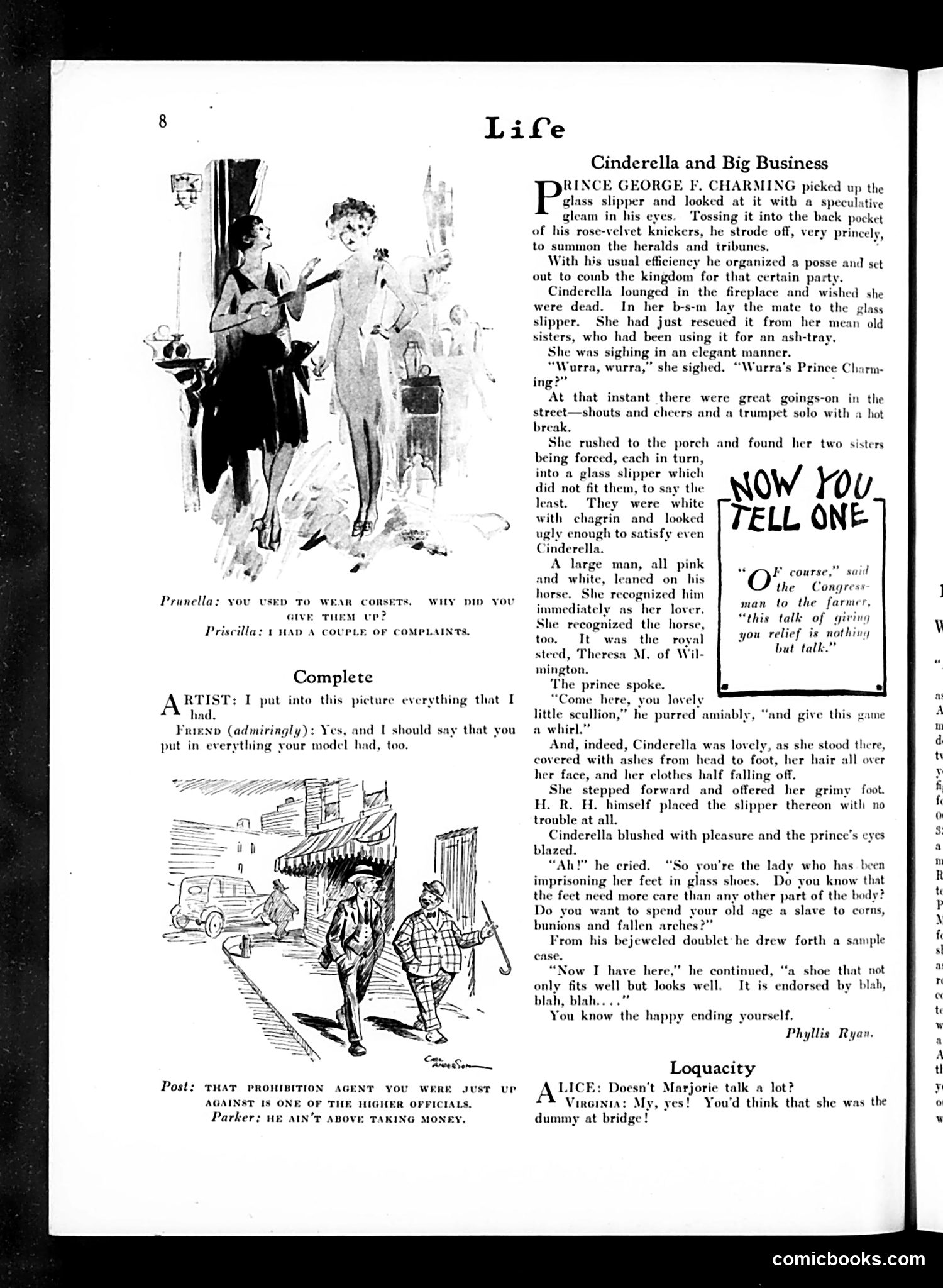
This satirical piece by Phyllis Ryan parodies the Cinderella fairy tale as a modern "big business" scenario. Prince George F. Charming arrives with a glass slipper, but the joke centers on commercial opportunism: he's portrayed as a salesman promoting the shoe's practical benefits rather than romance. The accompanying cartoons mock corporate efficiency and self-promotion. The humor targets early 20th-century business culture's obsession with marketing and salesmanship, even for something as traditionally romantic as a prince's quest. The slipper becomes a commercial product to be "endorsed" and sold rather than a symbol of love. The piece satirizes how American capitalism was infiltrating even classic romantic narratives.
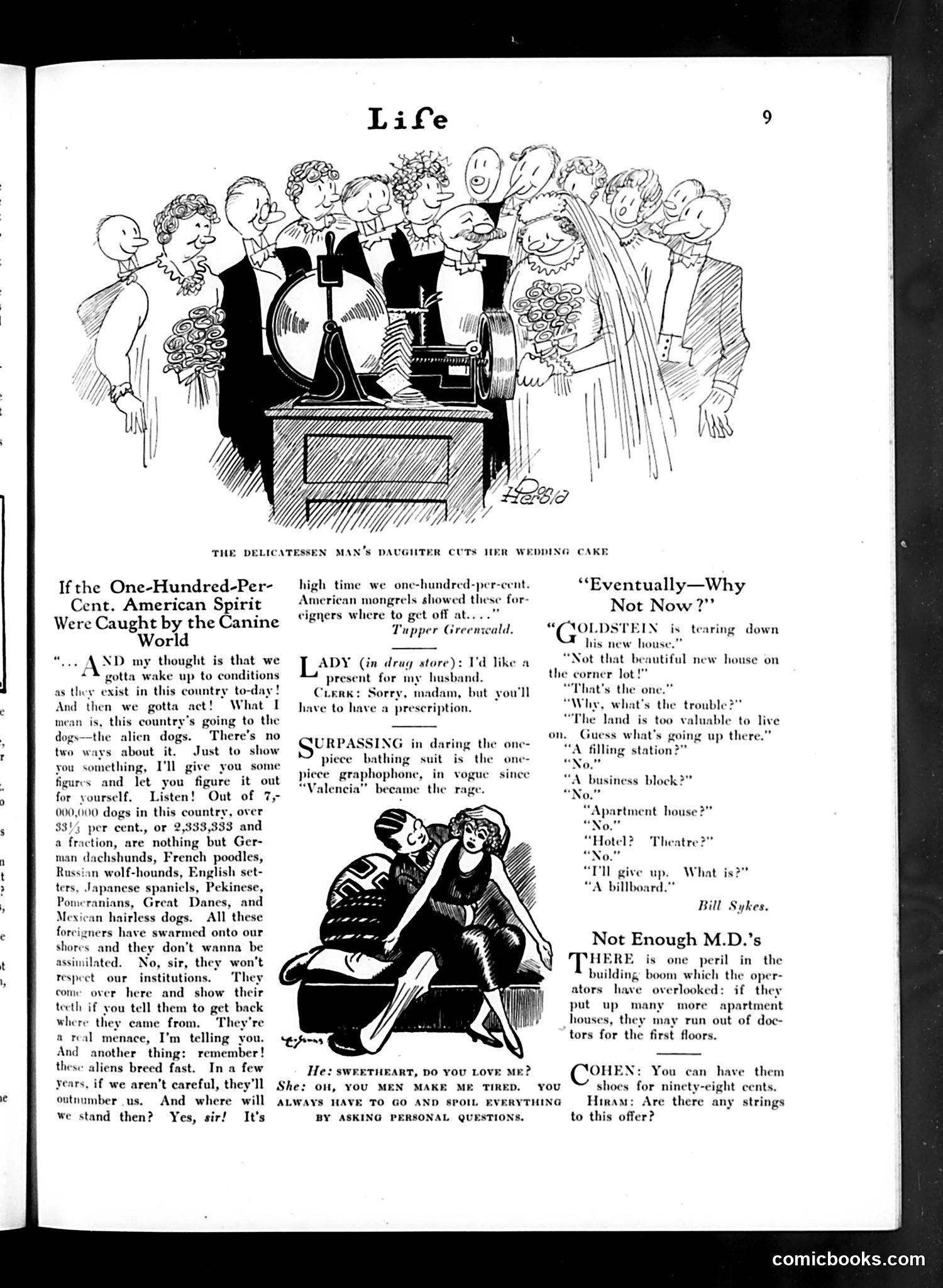
**Top Cartoon:** "The Delicatessen Man's Daughter Cuts Her Wedding Cake" depicts a bride and groom at their wedding surrounded by well-dressed guests. The joke plays on class mobility—the title suggests the bride is marrying "up" from her father's working-class background as a delicatessen owner. **Left Column Article:** "If the One-Hundred-Percent American Were Caught by the Canine World" satirizes xenophobic "100% American" rhetoric popular in the 1920s. The piece argues that pure-bred dog registries would reject mongrels similarly to how such Americans rejected immigrants, using dog breeds (Russian wolfhounds, Japanese spaniels, etc.) as a metaphor for immigrant groups. **Right Column:** Brief comic dialogues on modern urban life—apartment hunting difficulties and affordable shoe prices—reflect post-WWI American consumer culture.
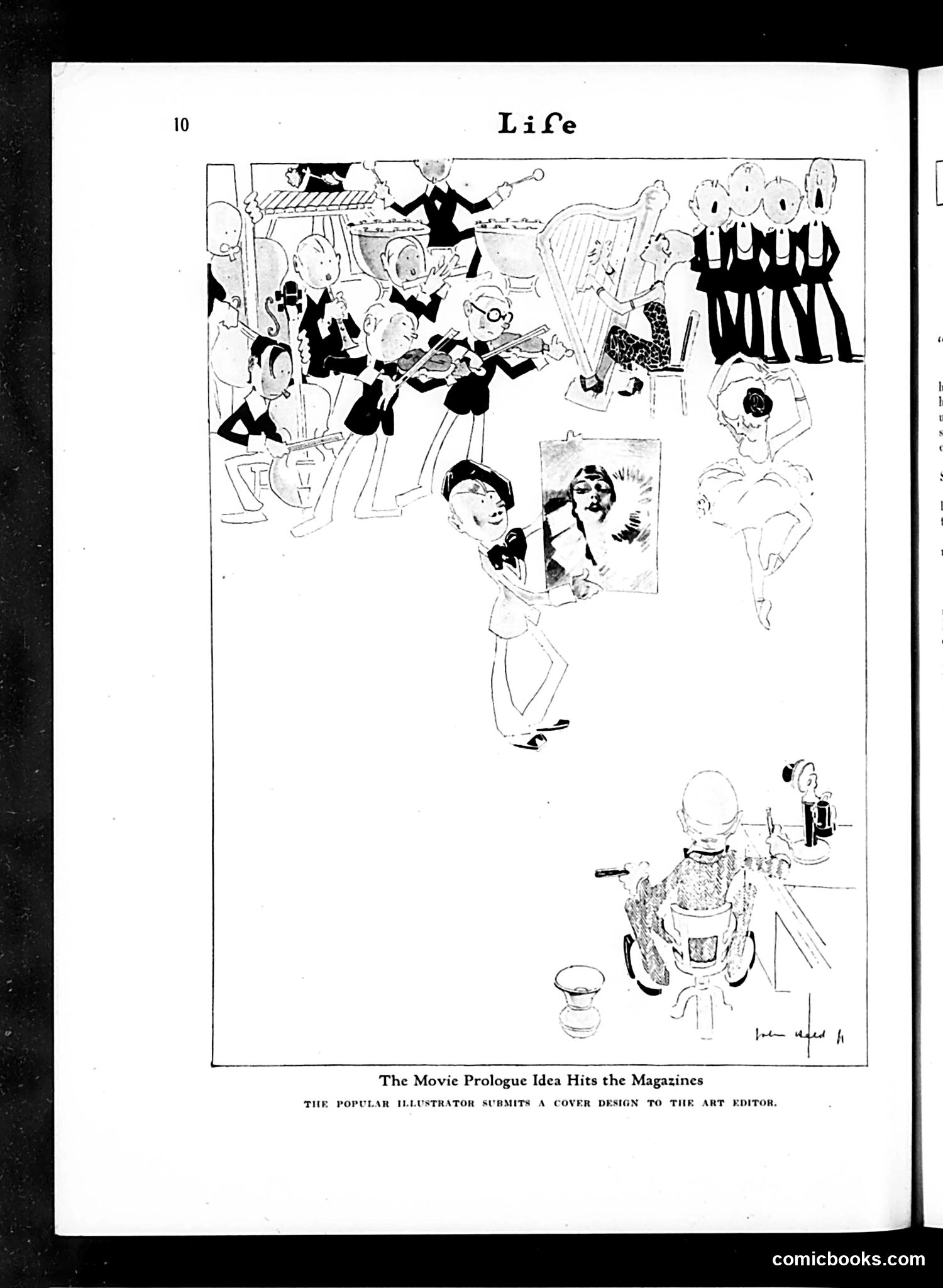
This cartoon satirizes the entertainment industry's trend of creating movie prologues—brief filmed introductions shown before feature films. The caption indicates "The Popular Illustrator Submits a Cover Design to the Art Editor." The upper scene depicts a chaotic magazine office where excited figures are celebrating or discussing this "movie prologue idea." The lower panel shows someone operating film camera equipment, suggesting the practical implementation of filming these prologues. The satire mocks how quickly magazine publishers and illustrators embraced this new film trend, treating it as a major commercial innovation. The frenzied energy in the office scene emphasizes the industry's obsessive adoption of the movie prologue concept as a means to modernize their publications and compete with cinema's growing popularity.
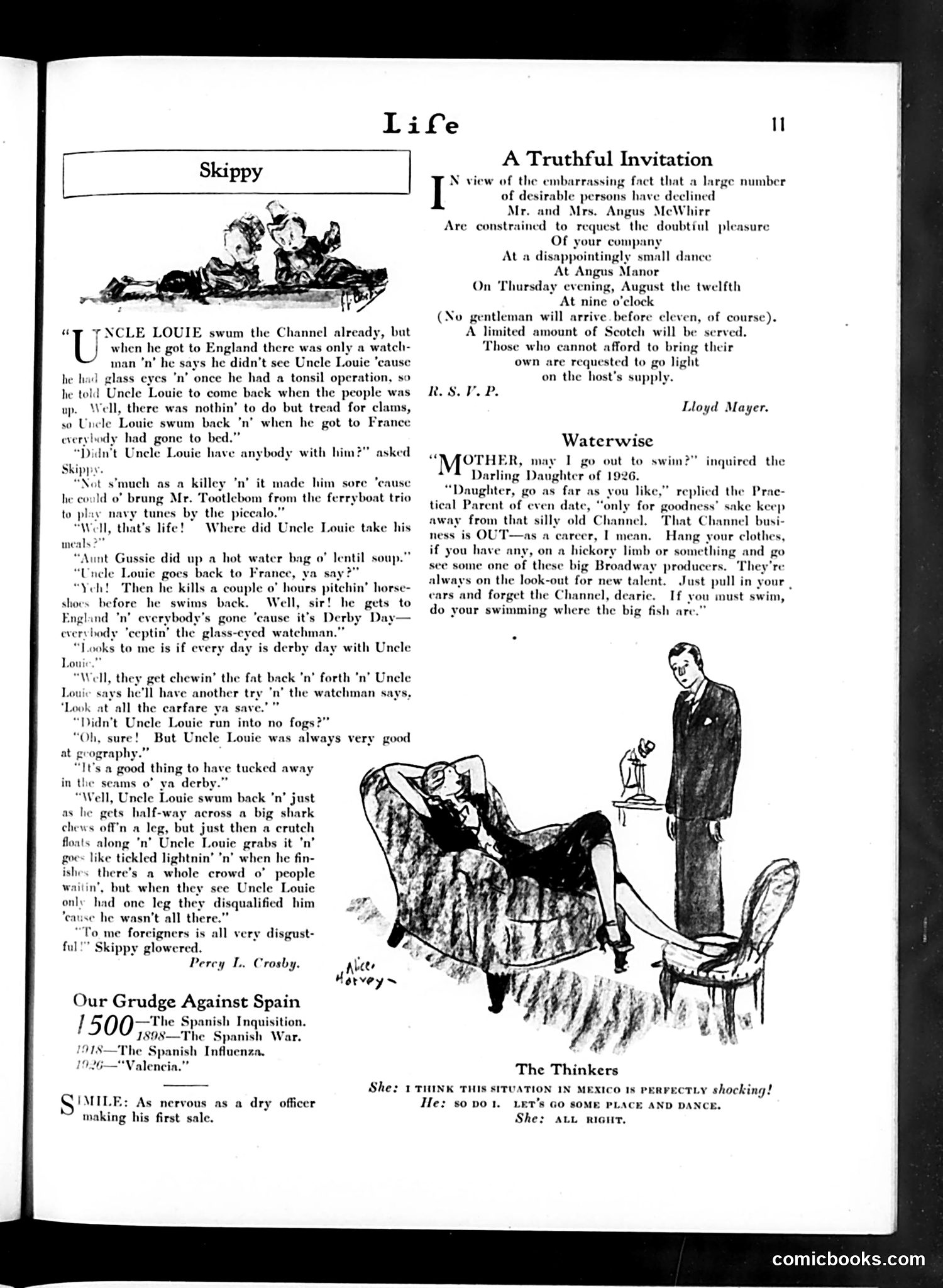
**"Skippy"** is a comic strip about a mischievous boy. The story here satirizes Uncle Louie, who supposedly swam the English Channel but was actually just avoiding a tonsil operation. The humor mocks exaggeration and false heroism—Uncle Louie fabricates swimming achievements to cover mundane medical procedures. When he later tries swimming in France, he's exposed as a fraud. The strip's point: people inflate trivial events into grand narratives. **"A Truthful Invitation"** mocks upper-class social etiquette by presenting a dance invitation that explicitly acknowledges most guests have declined, requests modest gift contributions, and admits low attendance—inverting typical polite invitation language with brutal honesty. Both pieces satirize pretension in early 20th-century American society.
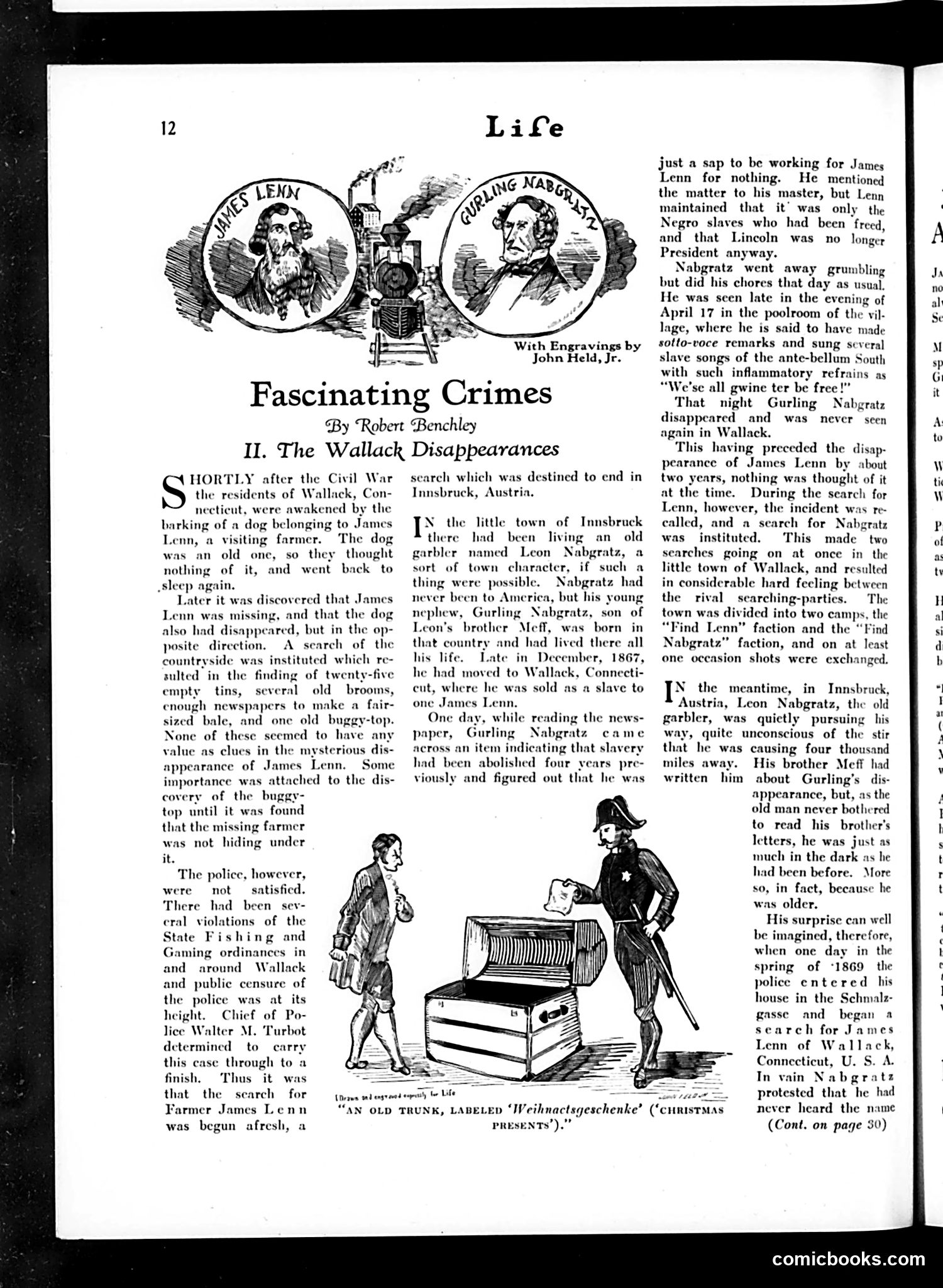
This is a serialized crime story by Robert Benchley with engravings by John Held, Jr. The narrative concerns James Lenn, a farmer who disappeared after the Civil War, and his connection to a man named Leon Nabgratz in Innsbruck, Austria. The illustrated cartoon shows a police officer examining a large trunk, suggesting the mystery involves hidden cargo or a body. The caption references the trunk as a "Christmas present," implying darkly comedic undertones about how Lenn's disappearance occurred. The story satirizes contemporary sensationalized crime reporting and the public's fascination with missing-person cases. It's a fictional "true crime" narrative typical of *Life* magazine's entertainment content from this period.
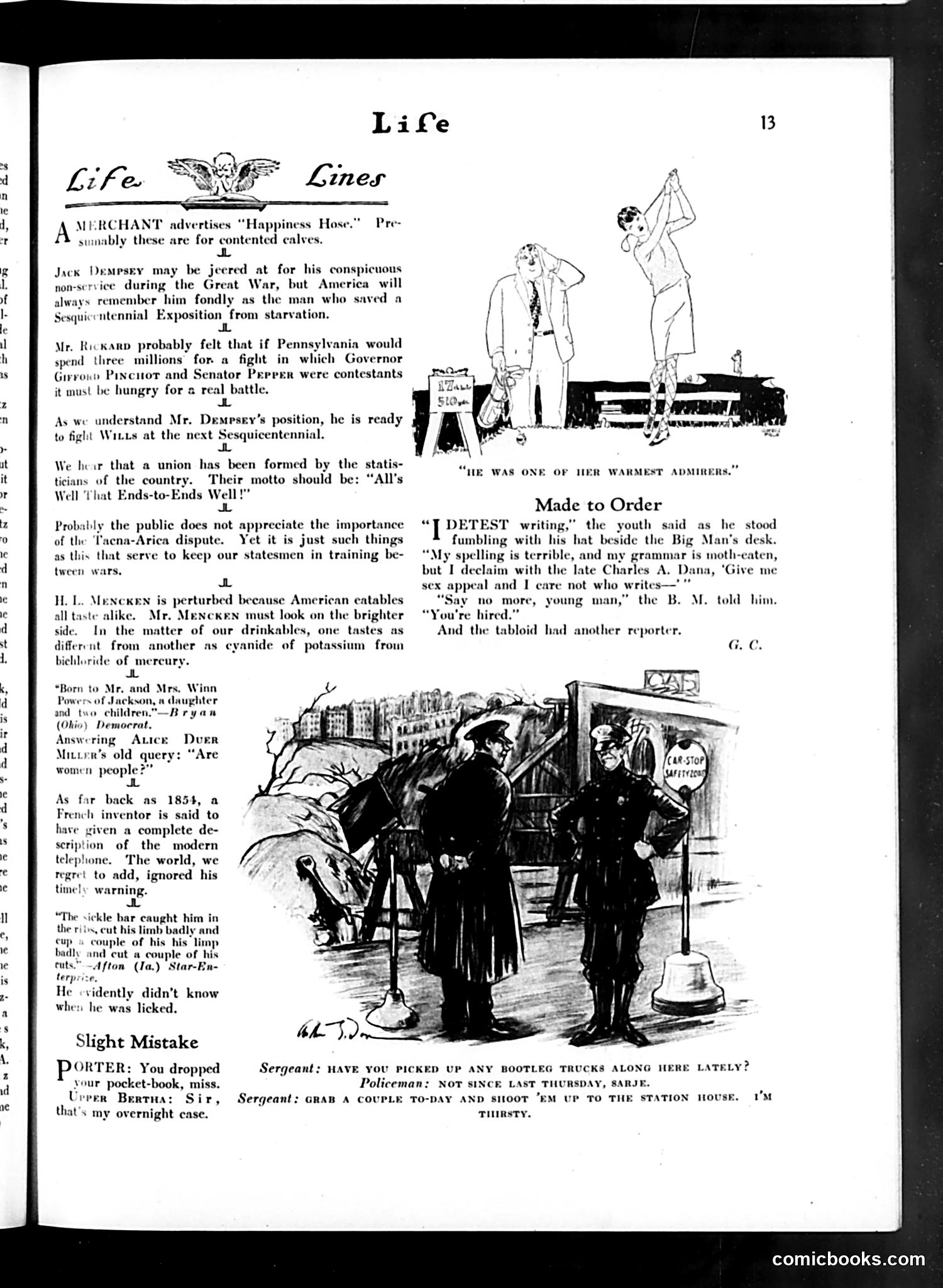
This page contains several satirical items and cartoons typical of Life magazine's format. **Top cartoon**: Shows a woman and man golfing. The caption references "one of her warmest admirers," likely satirizing romantic or social pretension. **"Made to Order"**: A brief anecdote mocking a young reporter's dismissal by an editor (likely Charles Dana) for poor writing skills—satire on journalism standards. **Lower cartoon**: Depicts a sergeant and policeman discussing "bootleg trucks," referencing Prohibition-era illegal alcohol smuggling. The sergeant requests the policeman grab bootleggers to "shoot 'em up to the station house"—satirizing law enforcement's frustration with bootlegging. **"Slight Mistake"**: A brief joke about someone confusing an overnight case with a pocket-book. The page reflects 1920s concerns: Prohibition enforcement, journalism standards, and social behavior.
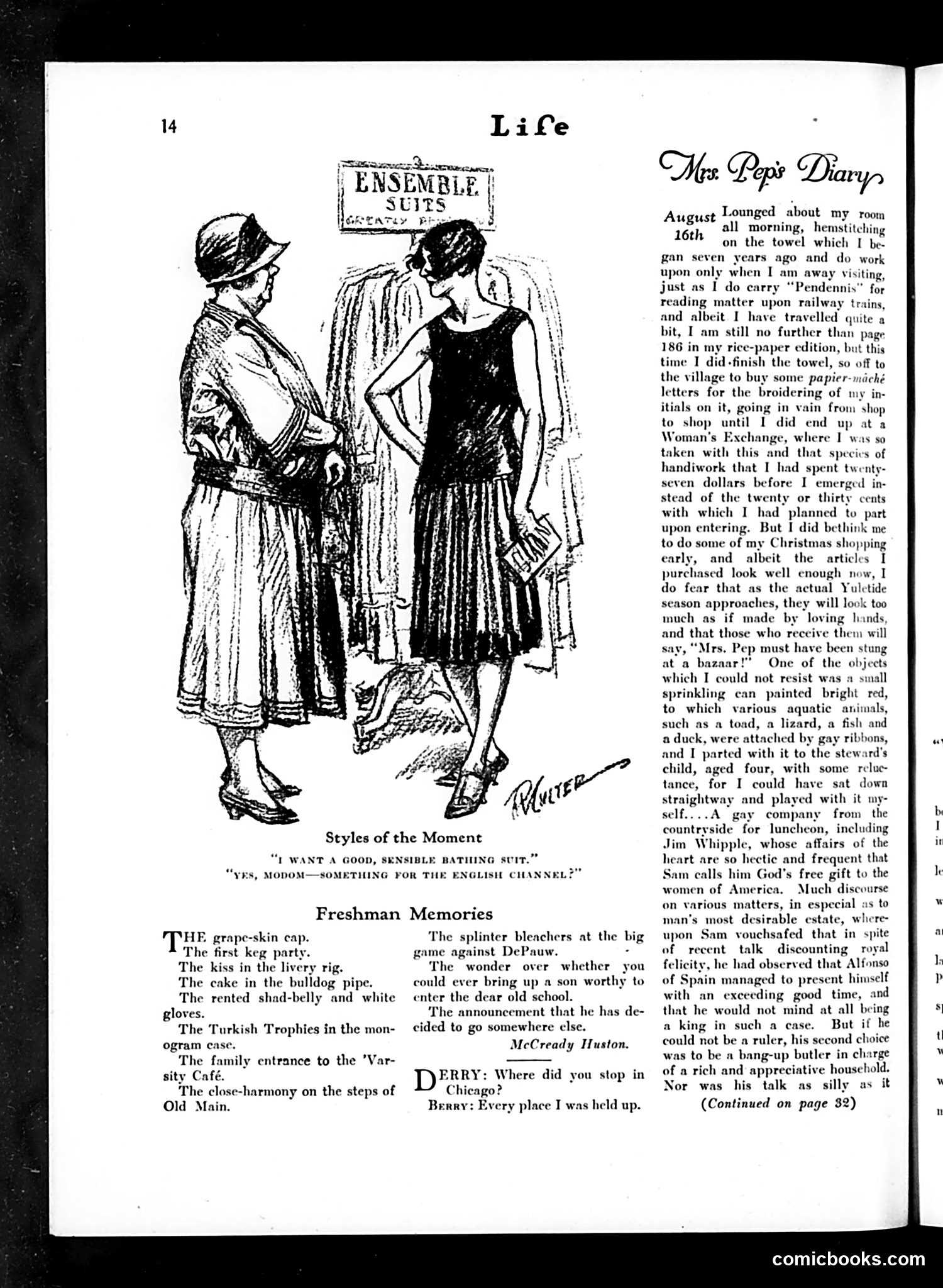
This page contains fashion commentary and college nostalgia rather than political satire. The main cartoon shows two women examining an "Ensemble Suits" display, with the caption critiquing current fashion: "I want a good, sensible Ensuing suit" / "Yes, madam—something for the English Channel?" The joke mocks overly fashionable women's suits that appear impractical for actual use. Below, "Freshman Memories" lists humorous college experiences (grape-skin caps, keg parties, cake in pipes), satirizing nostalgic idealization of student life. "Mrs. Pep's Diary" (right column) humorously chronicles her domestic activities—hemstitching towels, shopping at bazaars, hosting guests including Jim Whipple and Sam. The tone is gently mocking of upper-middle-class women's domestic preoccupations and social concerns during this era.
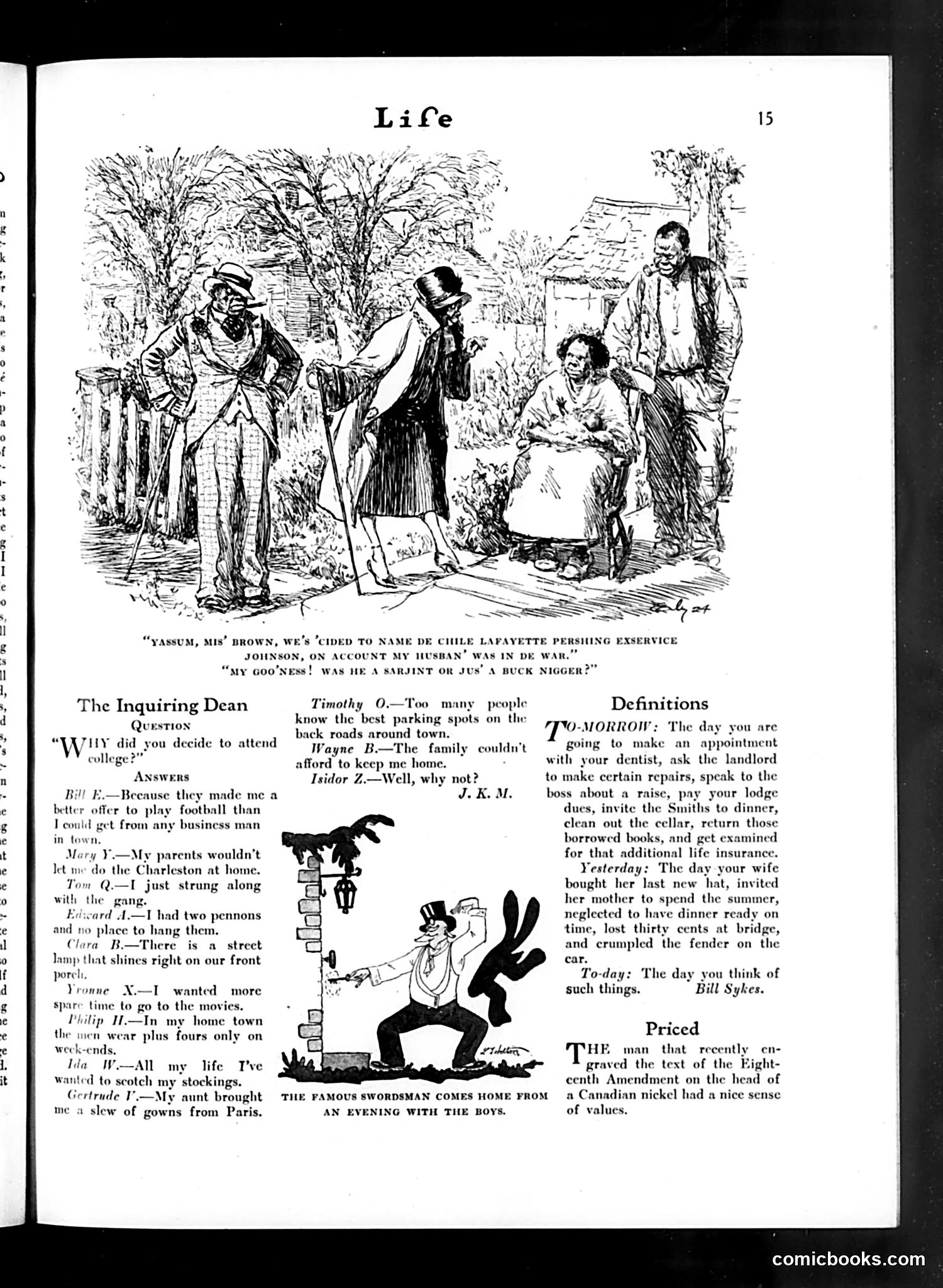
This page features three distinct humor pieces: **"The Inquiring Dean"** presents a Q&A format mocking college students' reasons for attending university—answers range from athletic opportunities to romantic pursuits rather than academics, satirizing frivolous motivations. **The cartoon** shows a well-dressed man returning home, apparently from evening entertainment with boys, carrying a sword. The caption jokes that he's "the famous swordsman," suggesting ironic contrast between his genteel appearance and rough-and-tumble companions—likely poking fun at class pretensions or wealthy men affecting toughness. **"Definitions"** section humorously defines "Tomorrow," "Yesterday," and "Today" through domestic mishaps and procrastination, using everyday domestic life to satirize human behavior and forgetfulness. The humor reflects early 1900s magazine satire targeting middle-class aspirations and social contradictions.
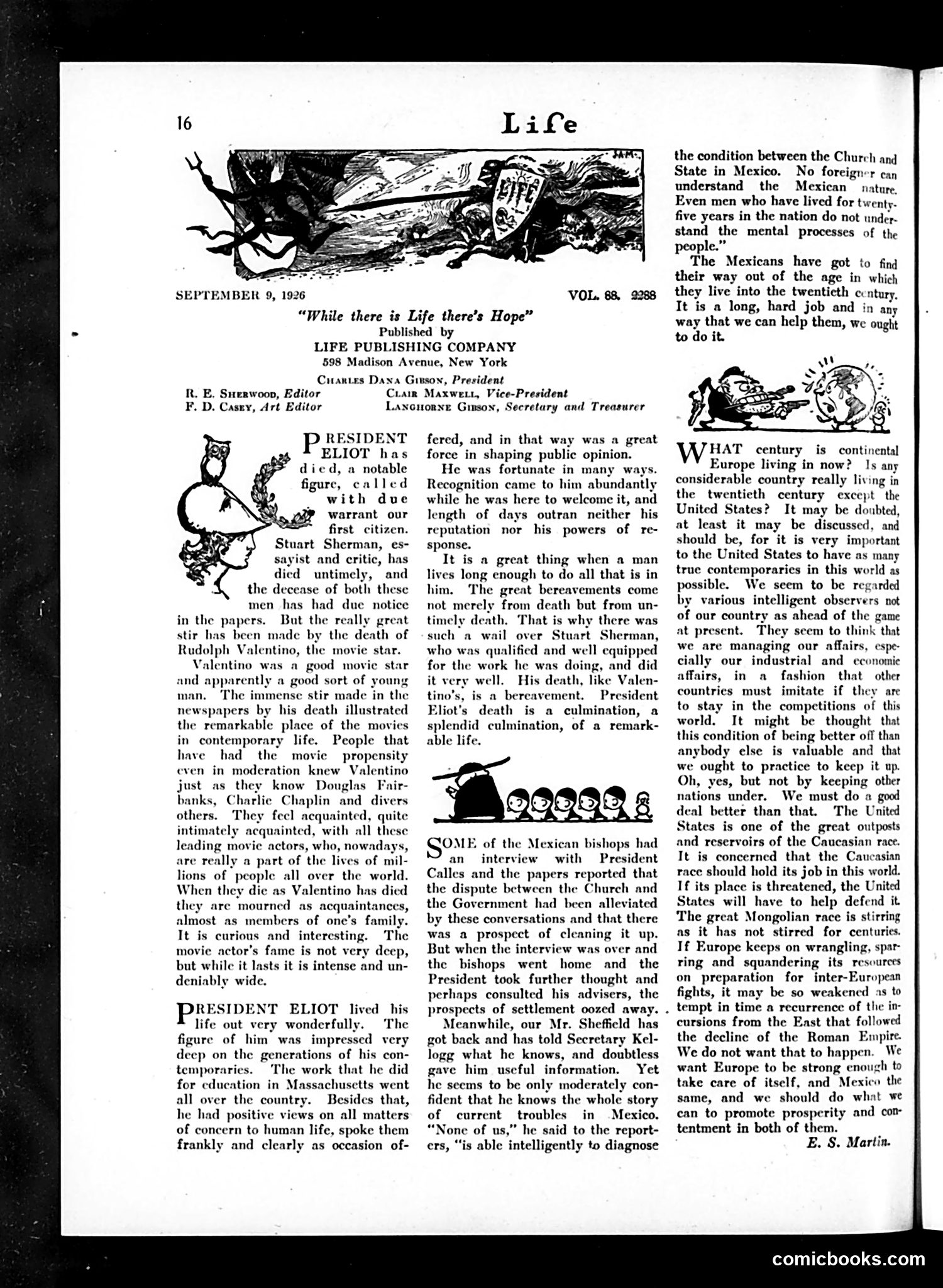
This page memorializes **President Eliot** (of Harvard, based on context) and **Rudolph Valentino**, the famous silent film star who died recently. The editorial praises both men as public figures who shaped opinion and culture. The small cartoon at top-left appears to show a **devil or imp figure**, likely satirizing how death claims notable figures indiscriminately. The central cartoon depicts **Mexican bishops meeting with President Calles**, referencing ongoing Church-State conflicts in Mexico during the religious persecution period. The text discusses tensions between the Mexican government and Catholic Church. The page's broader theme contrasts American cultural leadership with Mexico's instability, positioning the U.S. as a stable reservoir of values Europe should emulate.
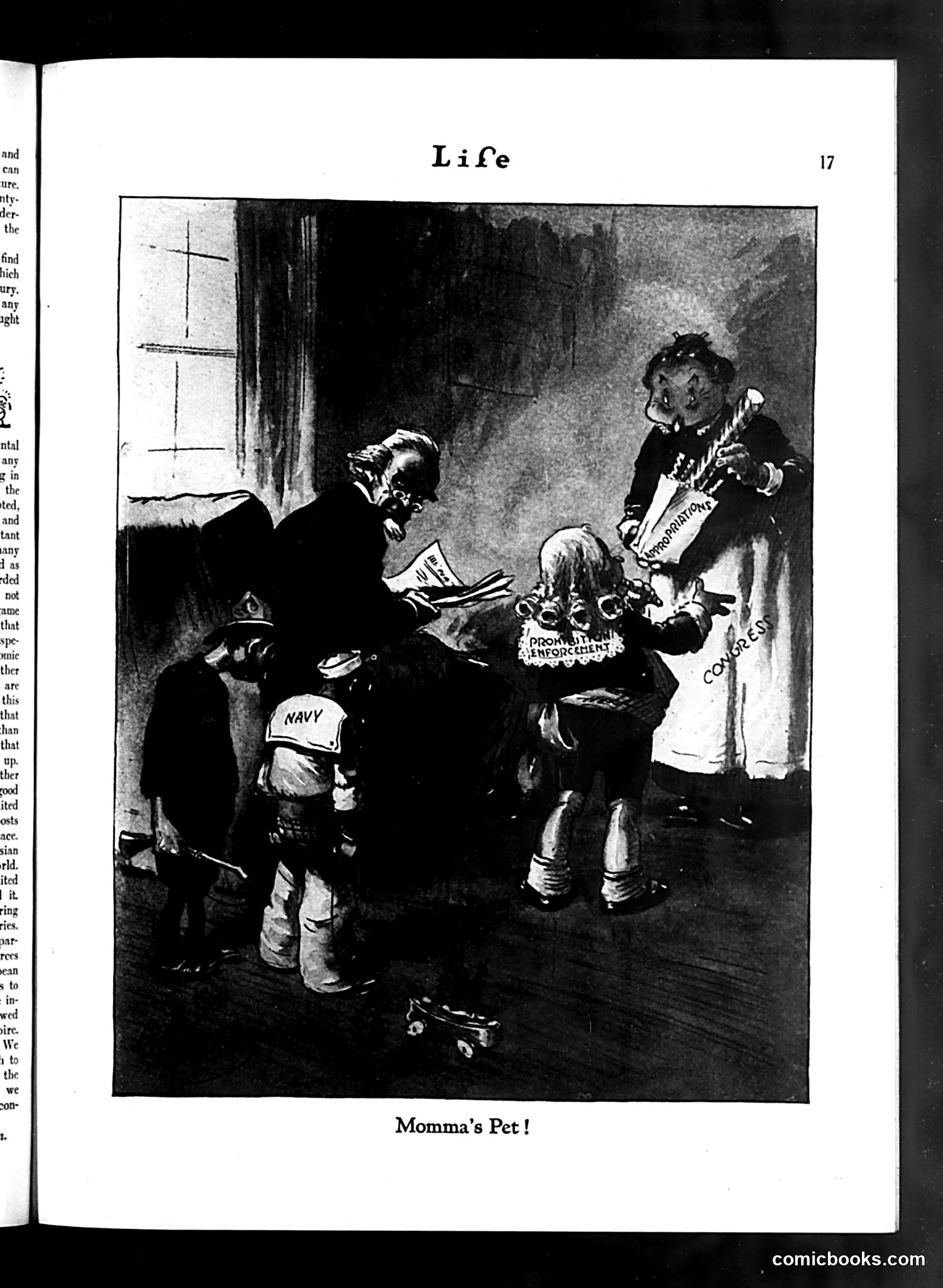
This political cartoon depicts anthropomorphic animals in what appears to be a law enforcement or military setting. A figure labeled "NAVY" sits reading, while characters labeled "PROHIBITION ENFORCEMENT" and "CONGRESS" surround a small dog or similar creature. The caricatured figures with exaggerated features suggest mockery of government agencies. The satire likely criticizes the enforcement of Prohibition (1920-1933) and related government overreach. The "pet" imagery suggests that enforcement agencies or Congress were treating Prohibition as a favored but problematic "pet project." The various agency labels indicate frustration with bureaucratic coordination or competition between different government bodies attempting to enforce alcohol laws during this contentious period.
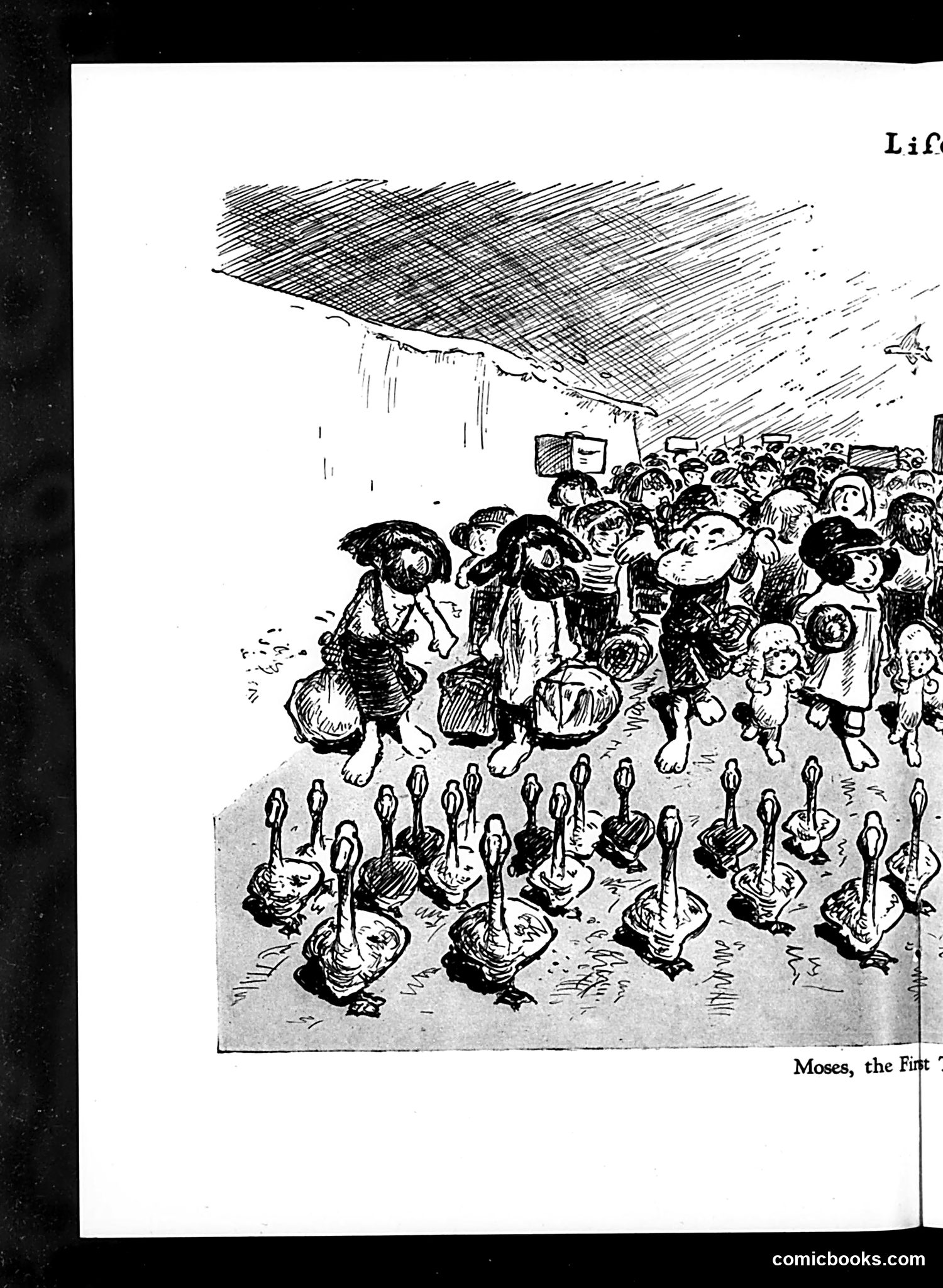
This appears to be a satirical cartoon from *Life* magazine titled "Moses, the First" (visible at bottom right). The image depicts a large crowd of people gathered around numerous torches or burning implements planted in the ground. The cartoon likely references Moses leading the Israelites out of Egypt, with the crowd representing the fleeing population. The torches may symbolize guidance or illumination, evoking the biblical pillar of fire that guided the Exodus. Without clearer historical context or additional visible text, the specific political or social satire being targeted remains unclear. The cartoon could address themes of leadership, mass movement, or religious authority, but the exact contemporary reference this was meant to critique cannot be confidently determined from the visible elements alone.
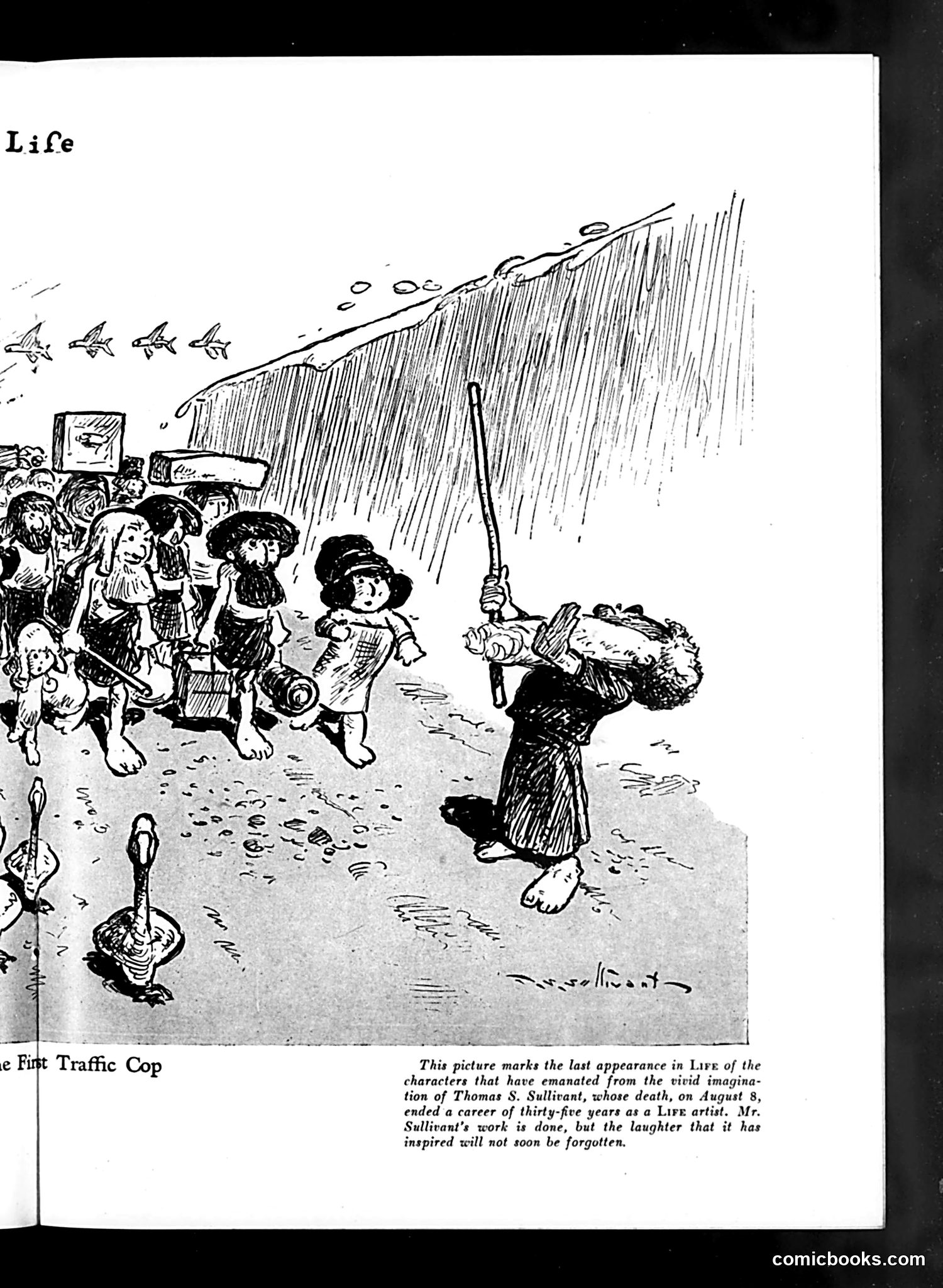
This is a memorial cartoon marking the final appearance of characters created by Thomas S. Sullivant, a Life magazine artist who died August 8 after 35 years contributing to the publication. The cartoon depicts a chaotic street scene where a lone traffic cop attempts to direct a massive crowd of humanity—children, adults, animals, and various figures—crossing a street. The sheer overwhelm of the situation (emphasized by the steep diagonal composition and dense crowd) illustrates the absurdist humor Sullivant was known for. The "First Traffic Cop" likely references early automobile-era urban management challenges, a contemporary concern when traffic policing was newly professionalized. The tribute acknowledges Sullivant's gift for inspired laughter through his satirical depiction of modern life's comic incongruities—here, one authority figure confronting impossible civic disorder.
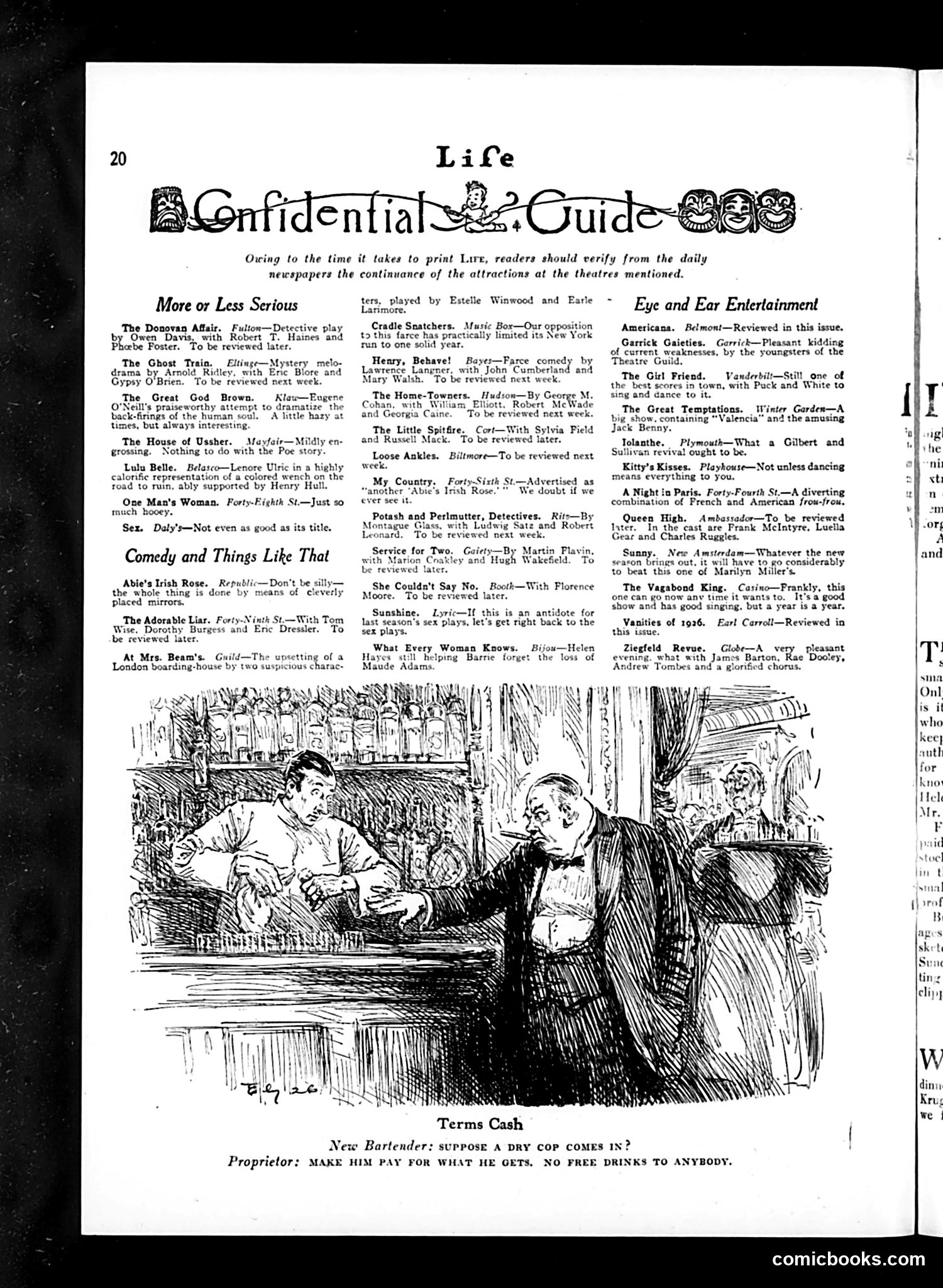
This page is a theater review section from *Life* magazine. The central cartoon—captioned "Terms Cash"—satirizes Prohibition-era speakeasy culture. It depicts a bartender (right) confronting what appears to be an undercover Prohibition agent or police officer (left, seated). The joke's caption reads: "Suppose a dry cop comes in?" with the proprietor's response: "Make him pay for what he gets. No free drinks to anybody." The humor relies on several 1920s references modern readers would miss: 1. **"Dry cop"** = police officer enforcing Prohibition laws 2. **The speakeasy setting** = illegal bars operating during Prohibition (1920-1933) 3. **The satirical point** = even law enforcement pays for drinks at illegal establishments; no one gets special treatment, even those supposedly shutting down speakeasies The cartoon mocks both the ubiquity of illegal drinking and the apparent complicity or corruption of enforcement agents during Prohibition.
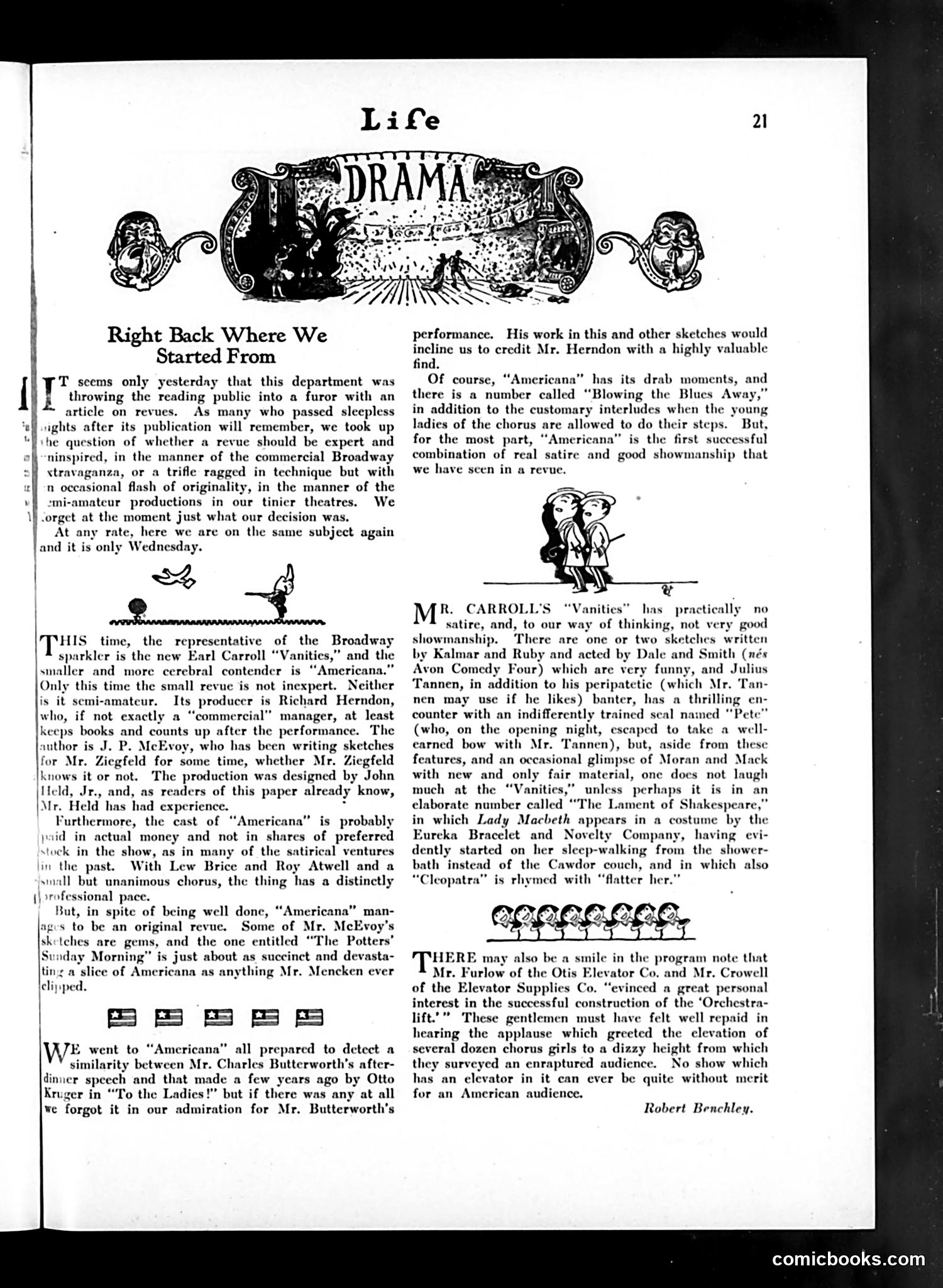
This page reviews two Broadway revues: Earl Carroll's "Vanities" and "Americana." The critic contrasts them as representatives of two opposing philosophies—polished commercial spectacle versus clever amateur production. **The main point:** "Americana," despite being professionally executed (with paid cast, designer John Held Jr., and writer J.P. McEvoy), succeeds because it combines genuine satire with showmanship. A sketch called "The Potters' Sunday Morning" exemplifies sharp social commentary. Charles Butterworth's performance is praised. By contrast, Carroll's "Vanities" lacks satire and showmanship. While featuring performers like Julius Tannen (who performs with a trained seal named "Pete") and the comedy duo Moran and Mack, the show disappoints. A number featuring Lady Macbeth in absurd costume—having apparently started her sleepwalking "from the shower-bath instead of the Cawdor couch"—exemplifies the show's tasteless excess. The review resolves an earlier Life debate: quality small revues can succeed when combining professional execution with intelligent satire.
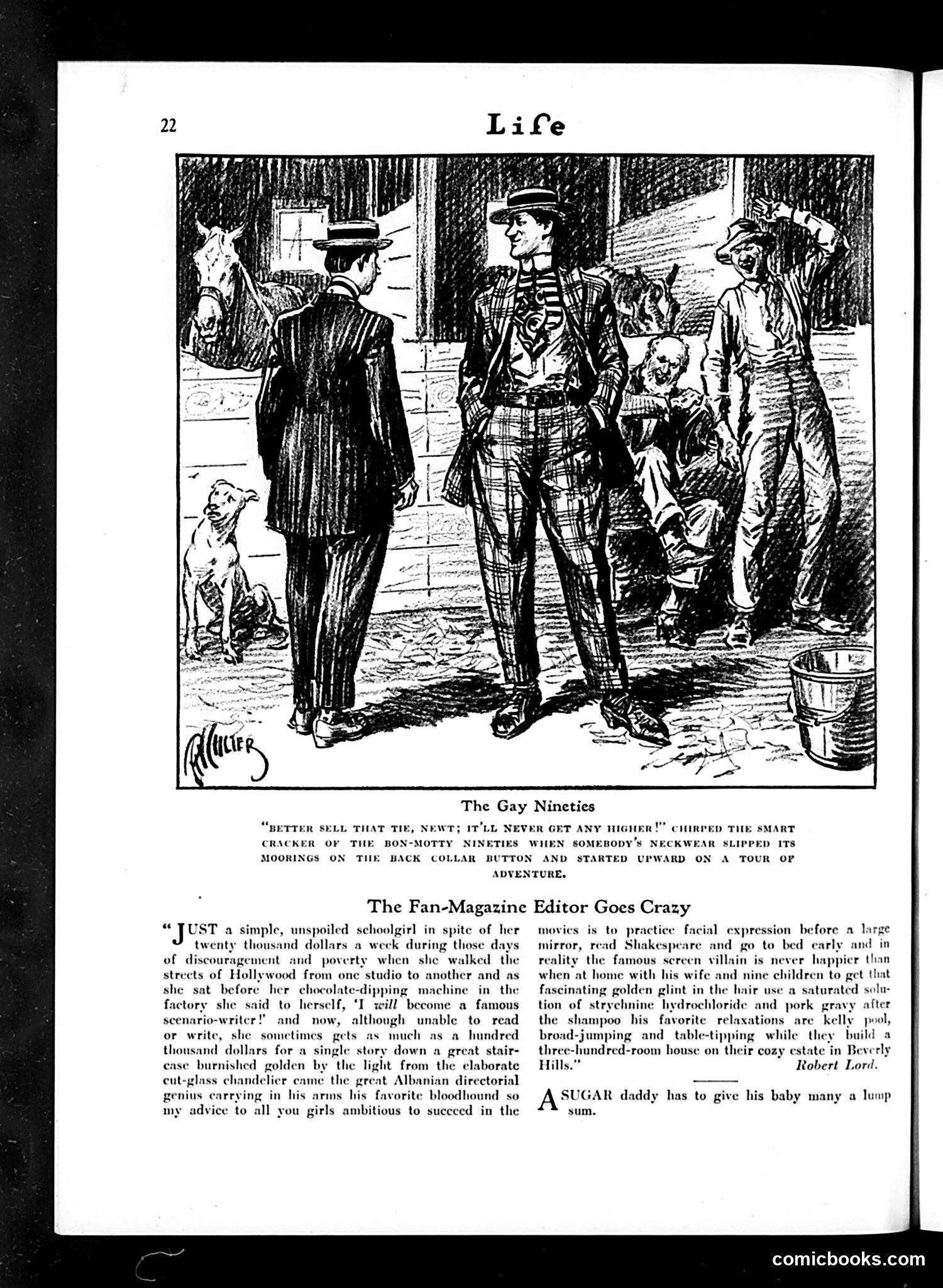
**"The Gay Nineties" cartoon** depicts a 1890s scene where a man's necktie has slipped upward from its moorings, creating amusement among onlookers. The joke is period-specific: in the 1890s, men wore neckwear attached to the collar differently than modern ties, making such mishaps possible and embarrassing—a sight for mockery. **"The Fan-Magazine Editor Goes Crazy"** satirizes both Hollywood's film industry and the fan magazines that promoted it. The piece parodies breathless publicity copy about starlets, ridiculing the fantastical narratives studios created: a girl claims poverty, works in a chocolate factory, yet somehow becomes a famous actress earning enormous sums. The satire mocks the absurdity of these fabricated success stories and the fan magazines' credulous promotion of them. Robert Lord's byline suggests this is credited commentary on Hollywood's myth-making machinery and the gullibility it exploited.
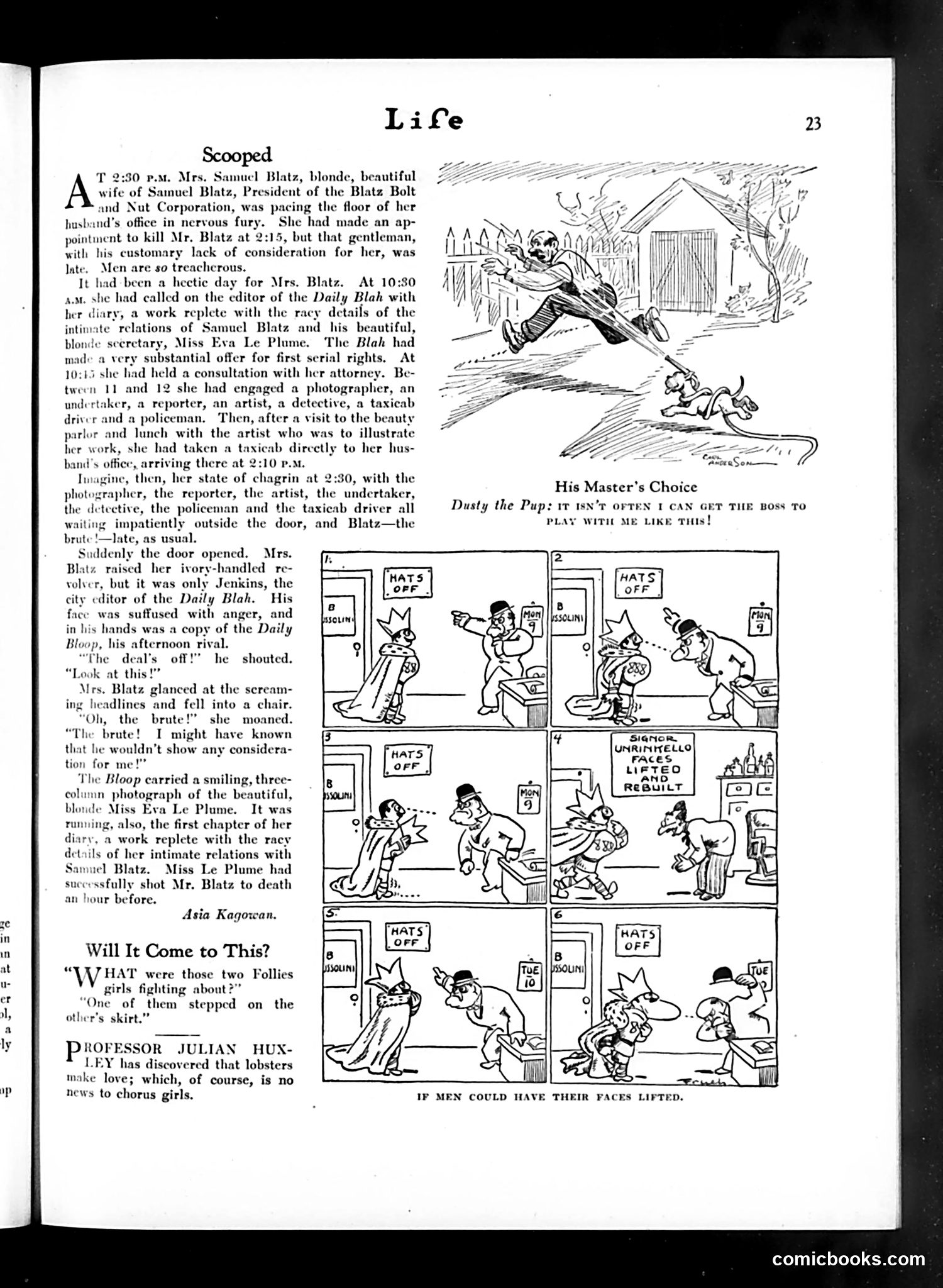
This story satirizes yellow journalism and the era's scandal-hungry media. Mrs. Blatz, a society wife, carefully orchestrates her husband's murder while simultaneously selling the salacious details to competing newspapers—the *Daily Blah* and *Daily Bloop*. The joke's tragedy: she's "scooped" when a rival paper publishes the story first, including photographs, before she can even commit the crime. The competing newspapers and her hired entourage (photographer, reporter, undertaker, detective) emphasize how the *real* scandal is the press's obsession with intimate details over actual events. The cartoon below, "His Master's Choice," shows a dog playing with its owner—a simple domestic moment contrasting sharply with the melodramatic scheming above. The page also includes brief jokes about Follies dancers and lobsters' mating habits, typical of *Life* magazine's humor spanning society scandals to natural science.
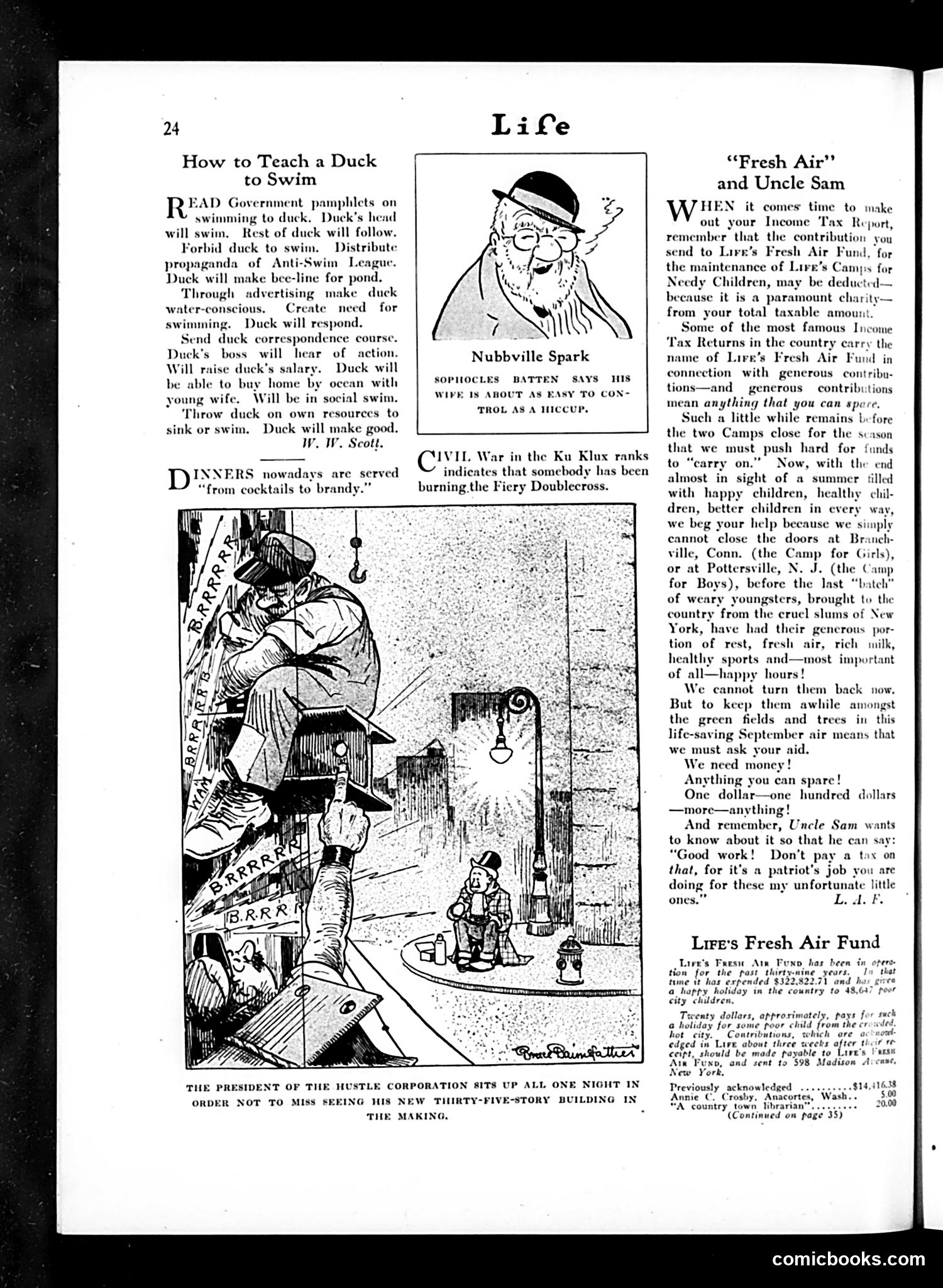
This page contains three distinct satirical pieces: **"How to Teach a Duck to Swim"** mocks bureaucratic overcomplication—government turns a simple task into absurd steps involving pamphlets, propaganda, advertising, and correspondence courses before the duck naturally swims anyway. It's satire on governmental inefficiency. **"Nubbville Spark"** is a brief joke about marital control, framed as small-town gossip. **"Civil War in the Ku Klux Ranks"** references internal KKK conflict, suggesting the organization is so dysfunctional it battles itself—the "Fiery Doublecross" likely alludes to the KKK's burning cross symbol being turned against itself. The large cartoon appears to show a businessman so obsessed with his building's construction he sacrifices sleep—satirizing capitalist excess and greed. **"Fresh Air and Uncle Sam"** is a fundraising appeal for Life's Fresh Air Fund camps for poor urban children, framing charitable donations as patriotic duty and tax-deductible good citizenship.
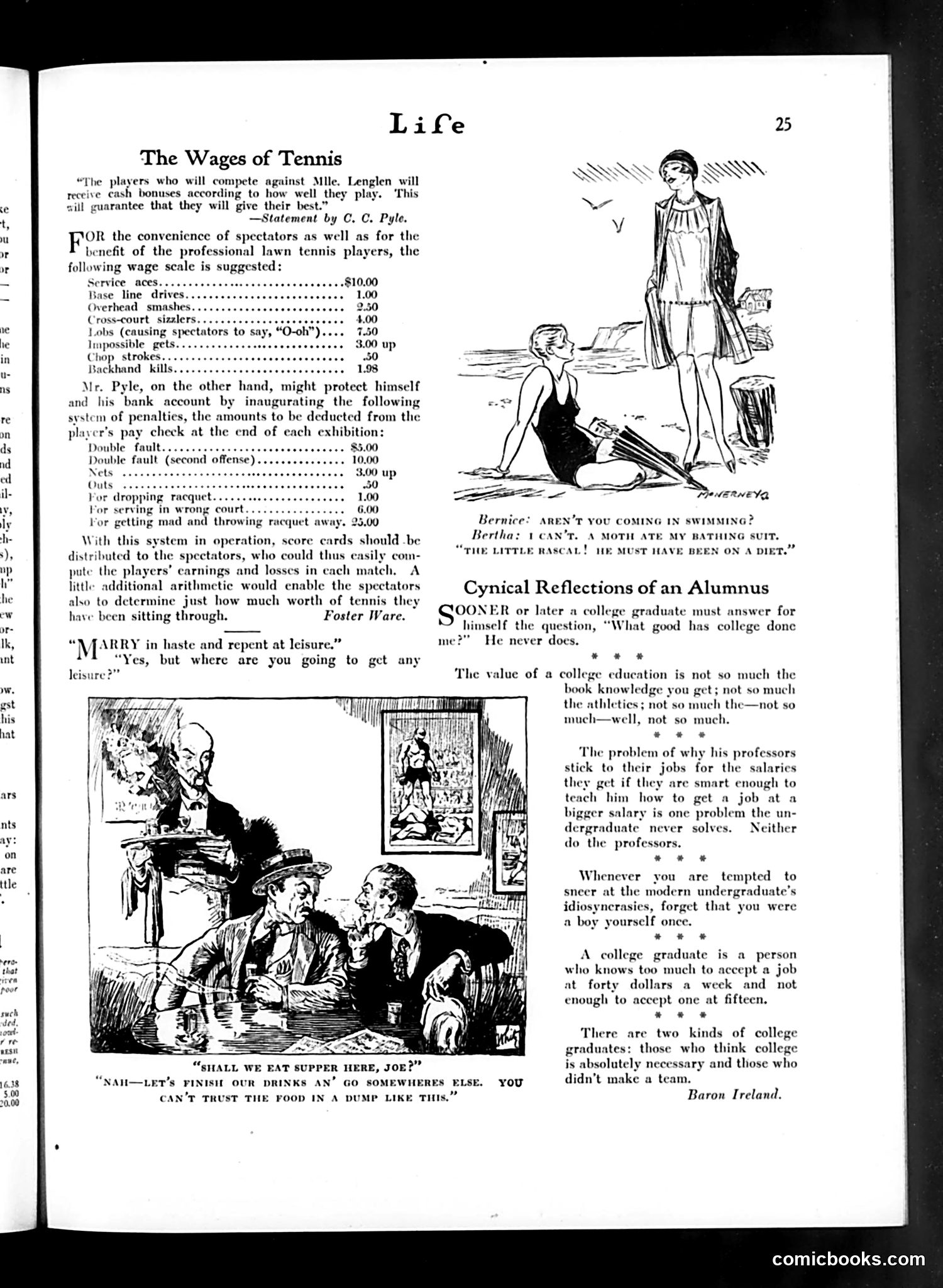
This page satirizes C.C. Pyle's proposal to pay professional tennis players (competing against French star Suzanne Lenglen) performance bonuses based on specific shots and plays. **The Main Cartoon:** The article mocks Pyle's scheme by proposing an absurdist "wage scale"—paying players set amounts for service aces ($10), base-line drives ($1.00), etc., while deducting penalties for double faults ($3.00) and errors. The joke is that reducing tennis to a piecemeal payment system reduces the sport to pure commercial transaction, undermining athletic integrity. **The Point:** By taking Pyle's already-commodified idea to its logical extreme, the satire criticizes the professionalization and commercialization of amateur sport. The accompanying cartoons and "Cynical Reflections" further mock materialism—both in leisure activities and education—suggesting 1920s anxiety about money corrupting traditional values. The secondary cartoons about marriage, food quality, and college graduates reinforce this theme: modern life has become cynically transactional.
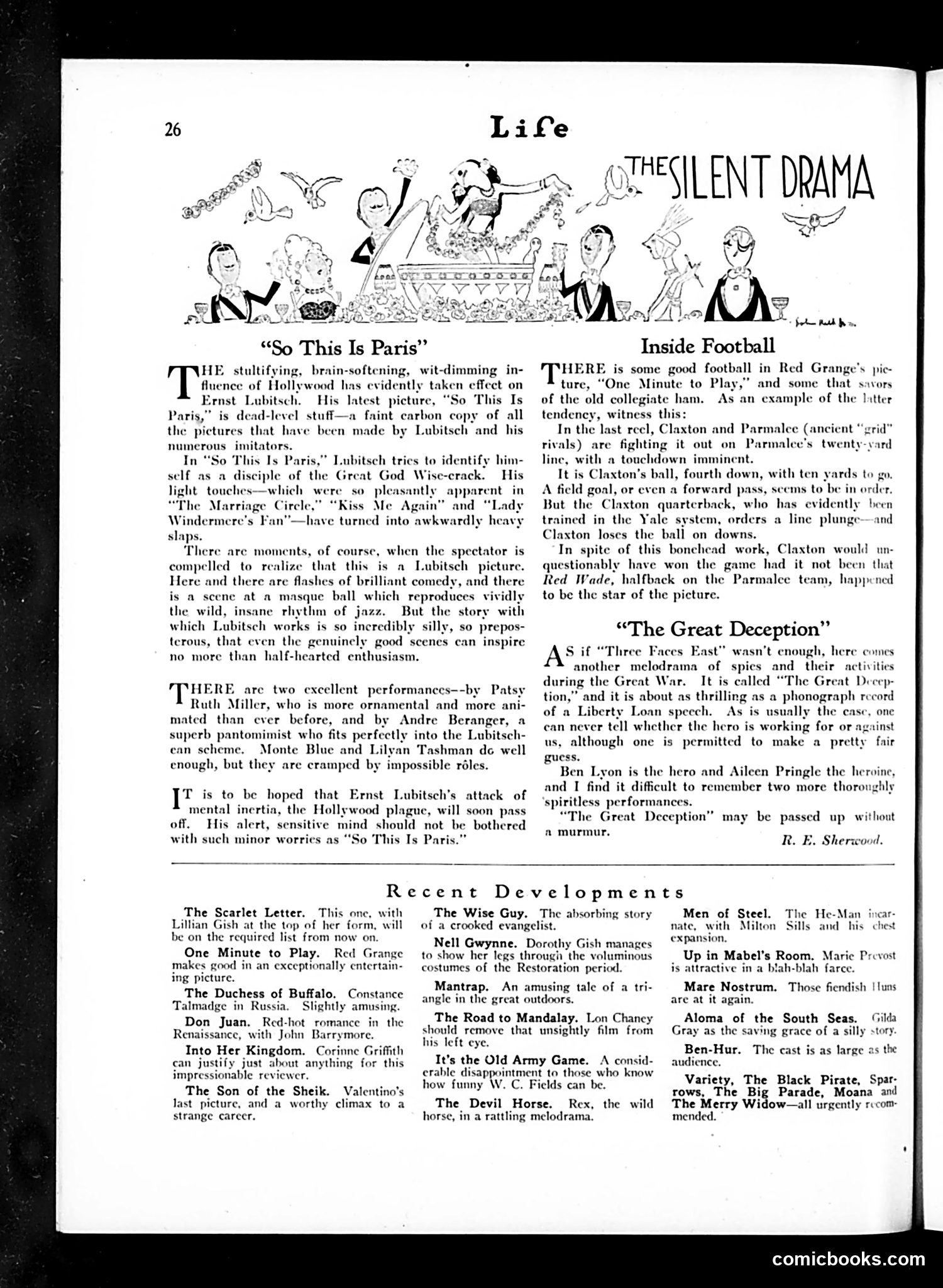
This page reviews three 1920s silent films. The main cartoon depicts a chaotic movie set with exaggerated figures, illustrating the article's critique of director Ernst Lubitsch's recent work "So This Is Paris." **Key Content:** The top review mocks Lubitsch for producing derivative, silly material, claiming Hollywood has dulled his once-sharp comedic touch. His earlier films ("Marriage Circle," "Kiss Me Again") showed finesse, but this new picture relies on awkward slapstick and an absurd plot. The second review discusses Red Grange's football film "One Minute to Play," praising the athletic sequences but criticizing the protagonist's bonehead decision-making during a climactic game. The third condemns "The Great Deception," a WWI spy melodrama, as tedious and forgettable—comparing it unfavorably to another recent war film, noting performances by Ben Lyon and Aileen Pringle lack any spark. The "Recent Developments" section briefly lists other current releases, mostly positively (praising Lillian Gish and John Barrymore). The satire targets Hollywood's tendency toward repetitive formula entertainment.
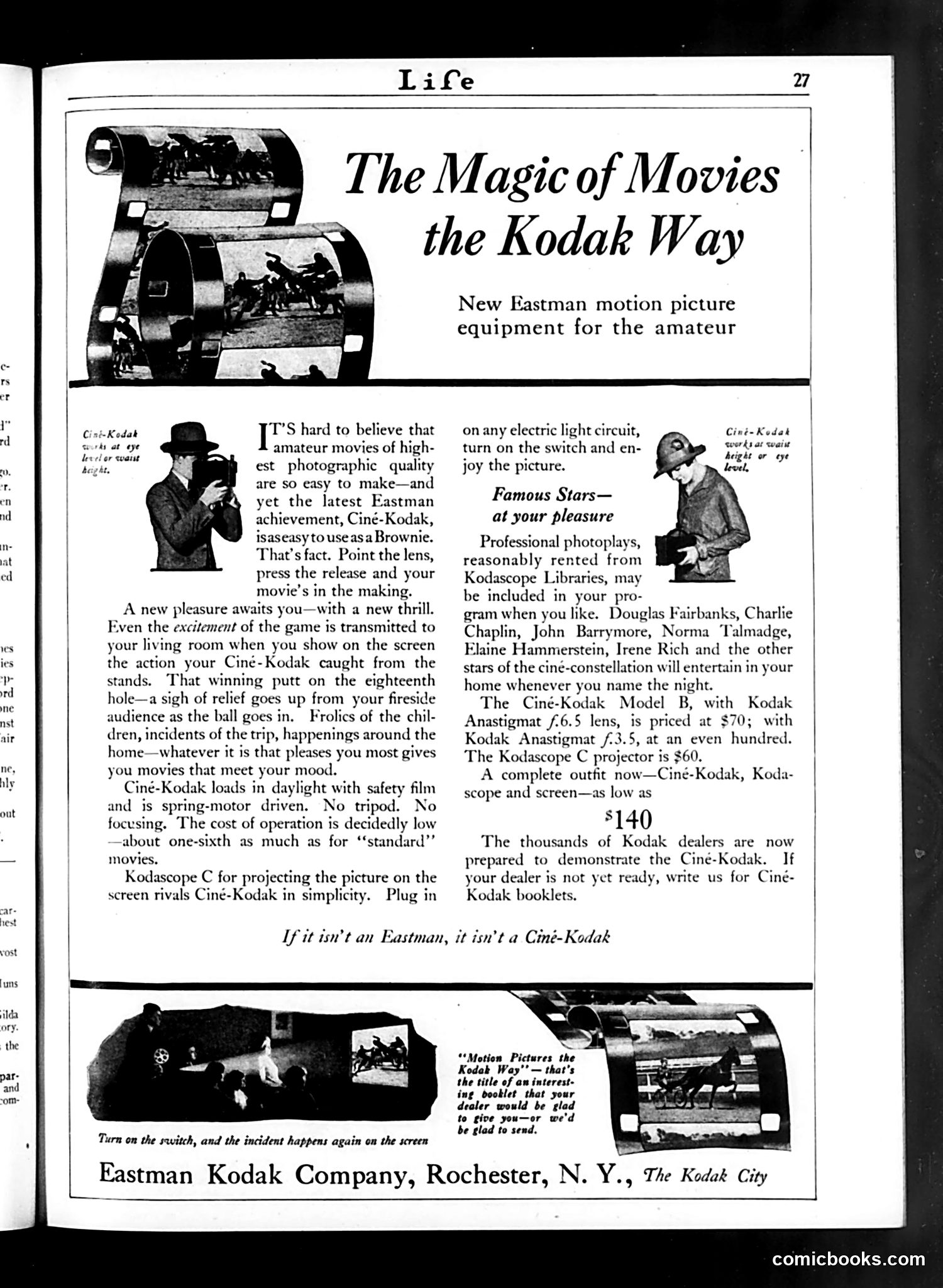
This is a **full-page advertisement**, not satire or political commentary. It promotes Eastman Kodak's new Ciné-Kodak amateur movie camera system. **The Product**: A home motion-picture camera designed for everyday consumers—positioning it as easy to use as a Brownie still camera. Key selling points: daylight loading, spring-motor drive, no tripod needed, low operating costs (one-sixth of professional equipment). **The Appeal**: The ad emphasizes capturing personal moments—golf victories, children playing, family trips—and screening them at home. It promises access to Hollywood stars (Chaplin, Fairbanks, Barrymore, etc.) via rental libraries. **Pricing & Market**: Complete outfit costs $140 (roughly $2,200 in 2024 dollars), positioning this as a luxury consumer good for middle/upper-class households with electricity. **Historical Context**: This appears to be 1920s-era marketing for what was genuinely revolutionary technology—bringing movie-making into American homes during cinema's early golden age. There is no political dimension; it's purely commercial messaging.
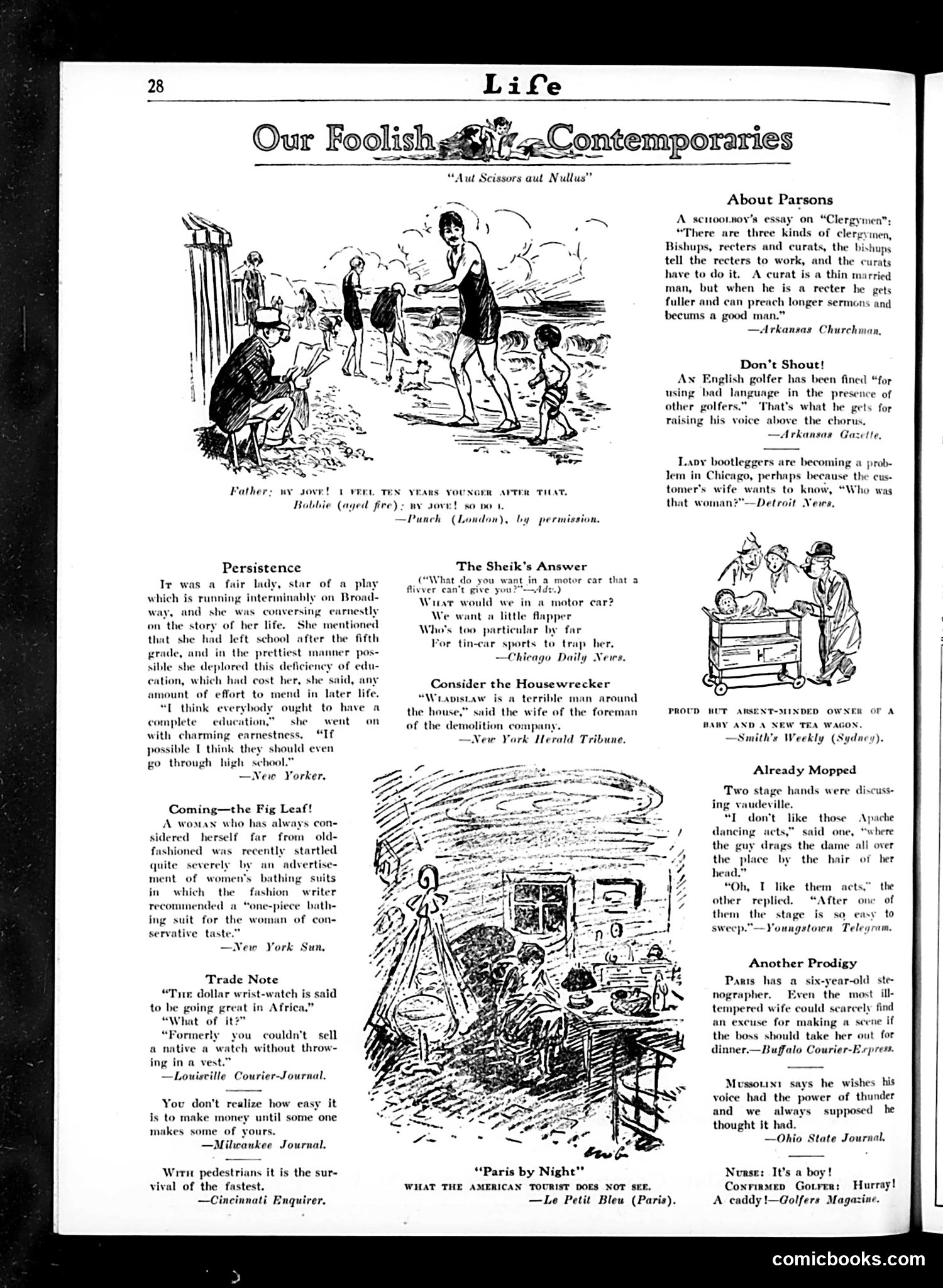
This page collects brief satirical items from newspapers and magazines, mocking contemporary absurdities. Key items include: **Top cartoon**: A father tells his young son he feels "ten years younger" after their beach trip; the child replies he also feels younger—suggesting children possess natural resilience adults have lost. **"Coming—the Fig Leaf!"**: Mocks changing fashion standards, where a "one-piece bathing suit" is now marketed as "conservative"—satirizing how quickly modesty standards shift. **"The Sheik's Answer"**: References the popular "Sheik" films/craze of the 1920s, joking about what luxuries flappers demand in cars beyond basic transportation. **"Paris by Night"**: A French magazine's caption suggests American tourists miss the city's authentic character, seeing only tourist attractions. **Various one-liners**: Mock clergy hierarchies, golfer etiquette, bootleggers, vaudeville acts, and other contemporary social foibles. The page's purpose is satirizing modern life through collected snippets—a common Life magazine format targeting educated readers familiar with current trends and social pretensions.
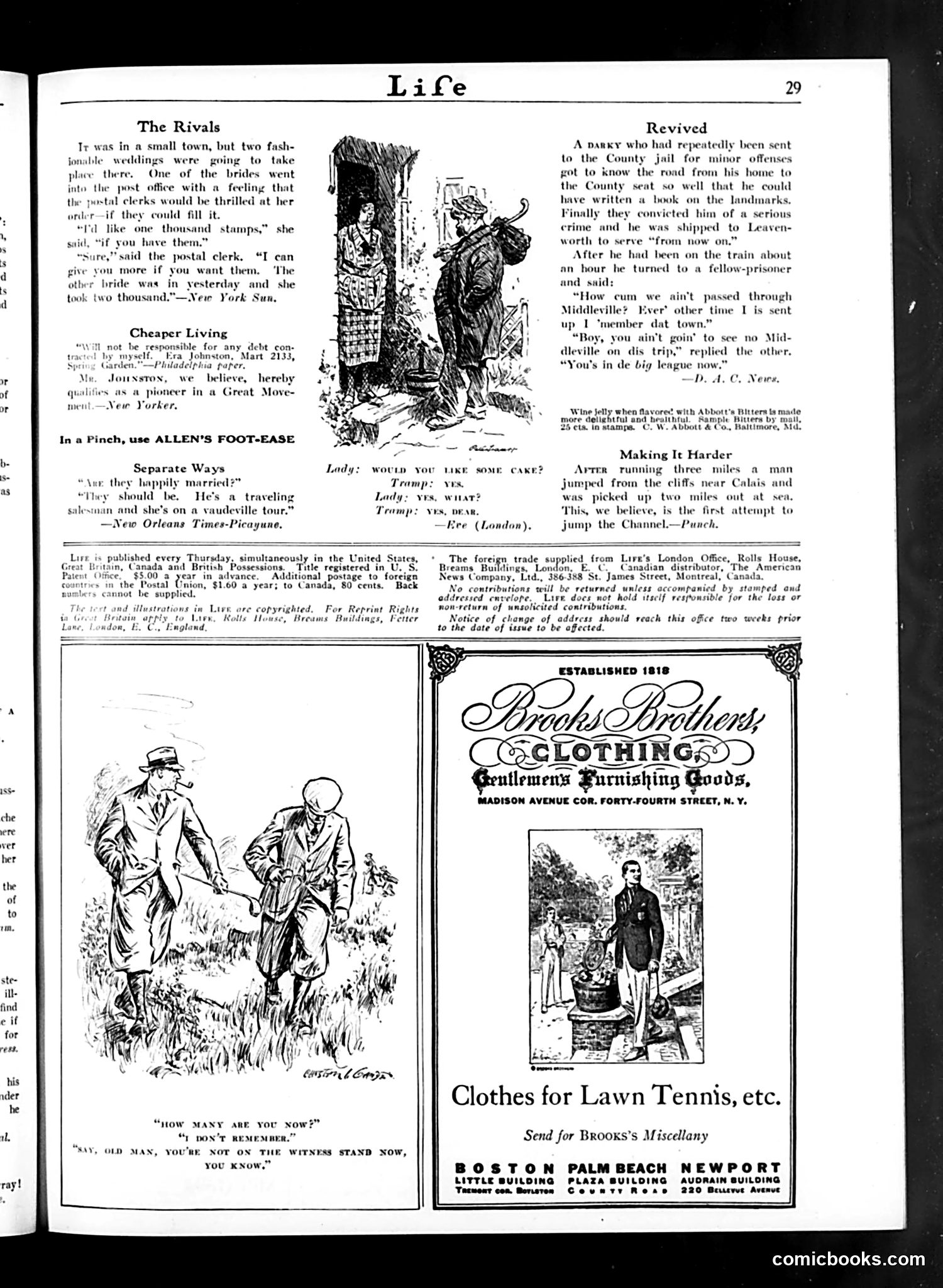
This page contains several short humorous anecdotes typical of Life's satirical humor, plus advertisements. **"The Rivals"**: Two brides in a small town compete over purchasing wedding stamps at the post office. The joke: the first bride asks for 1,000 stamps; the clerk reveals the other bride already bought 2,000—a commentary on competitive, ostentatious wedding planning or one-upmanship among society women. **"Revived"**: A convict repeatedly jailed for minor offenses knew the Middleville route so well he could write a guidebook. Now convicted of serious crime and sent to Leavenworth prison, a fellow prisoner tells him he won't see Middleville—he's "in de big league now." The humor targets the criminal justice system's escalation and the prisoner's rueful realization. **"Making It Harder"**: A brief joke about a man jumping from Calais cliffs into the sea as "the first attempt to jump the Channel"—dark humor about a suicide attempt. The remaining content is advertising (Brooks Brothers clothing) and publication information.
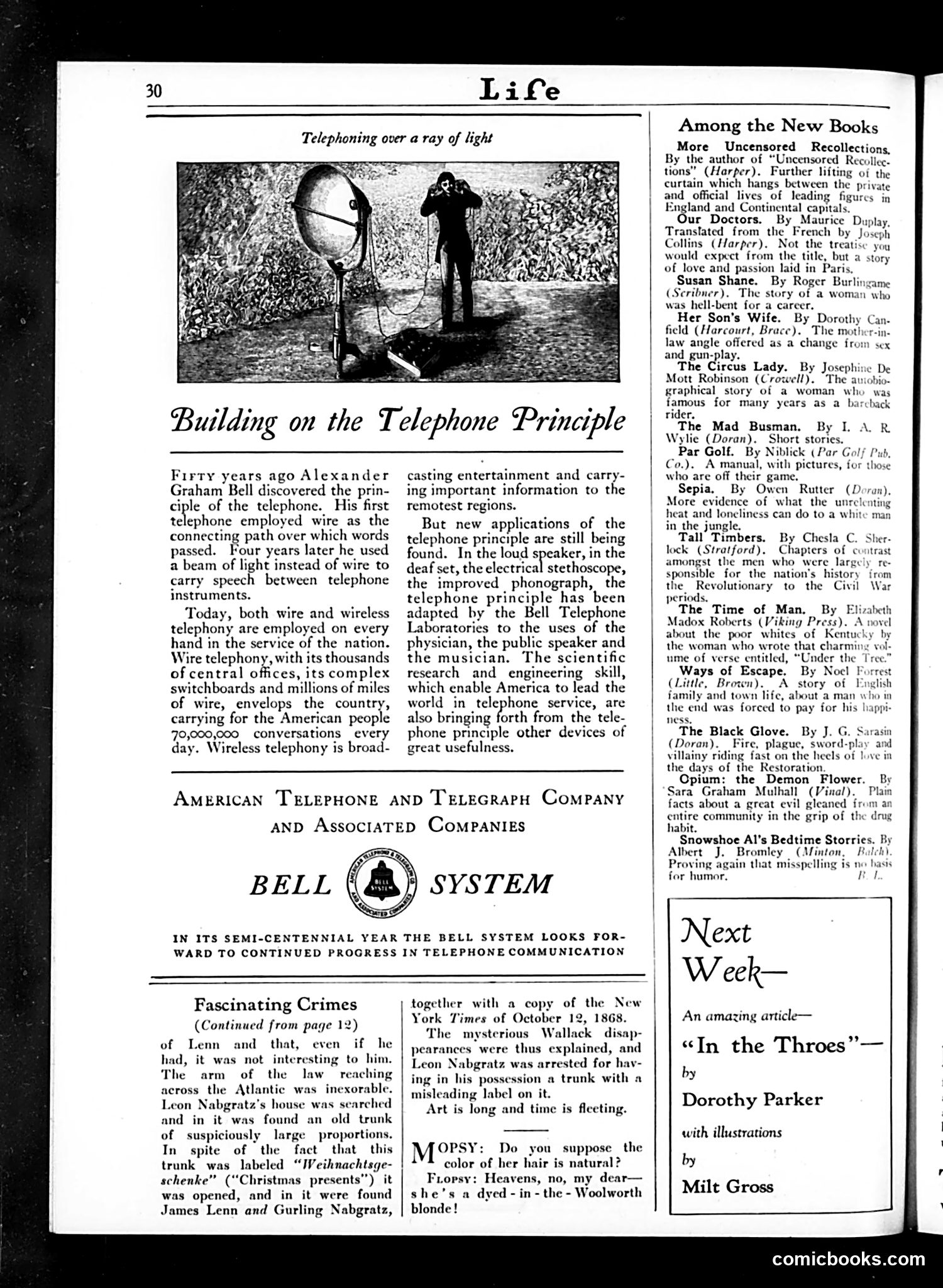
This page primarily showcases **advertising and book reviews** rather than political satire. The main content is a **Bell Telephone System advertisement** featuring an illustration of two silhouetted figures communicating via a beam of light—visualizing Alexander Graham Bell's principle of transmitting sound through light rather than wire. The accompanying text celebrates fifty years of telephone innovation and wireless telephony's role in American communication. The small satirical content appears in the "Mopsy" and "Flopsy" dialogue at bottom—a brief joke about a woman's hair color, suggesting it's artificially dyed blonde from Woolworth's (a budget retailer). This is gentle social satire about vanity and affordable fashion, typical of Life magazine's light humor. The remainder features book advertisements and reviews typical of period Life content—no political references or caricatures are visible.
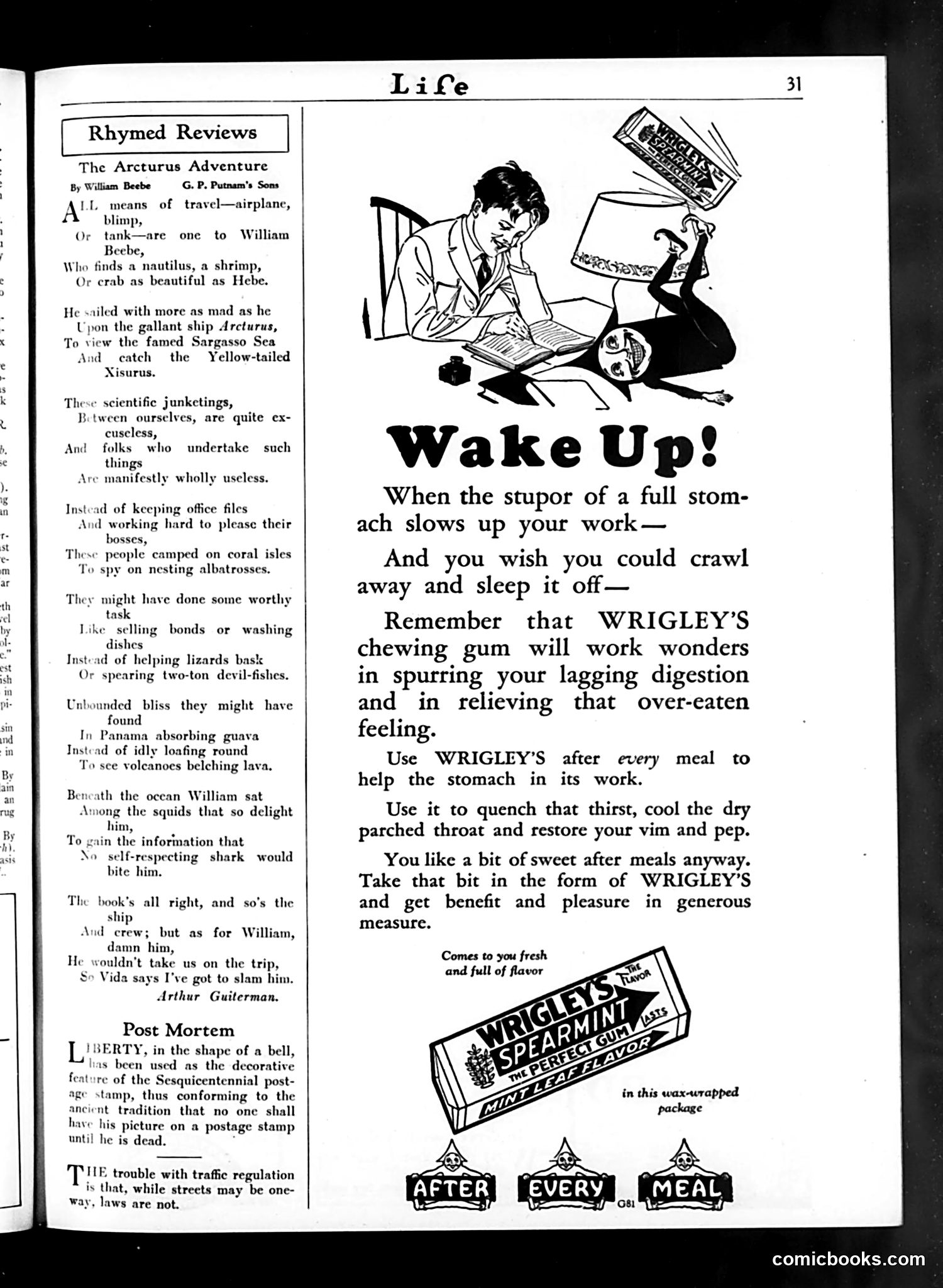
This page contains literary criticism and advertising rather than political cartoons. **"Rhymed Reviews"** critiques William Beebe's book *The Arcturus Adventure*, a real account of a scientific expedition to study marine life in the Sargasso Sea. Poet Arthur Guiterman's satire mocks such expeditions as wasteful vanity—arguing scientists should work ordinary jobs (keeping files, washing dishes) rather than pursuing impractical research like observing albatrosses or volcanic activity. The humor reflects early 20th-century skepticism about pure scientific exploration as frivolous luxury. **"Post Mortem"** contains brief satirical quips: one notes Liberty's image appears on a Sesquicentennial stamp only because tradition forbids living subjects on stamps; another jokes that traffic laws lack the consistency of one-way streets. The **Wrigley's advertisement** dominates the right side, using a cartoon of a sluggish office worker overwhelmed by digestive discomfort to pitch chewing gum as digestive aid—a now-dubious health claim typical of 1920s advertising.
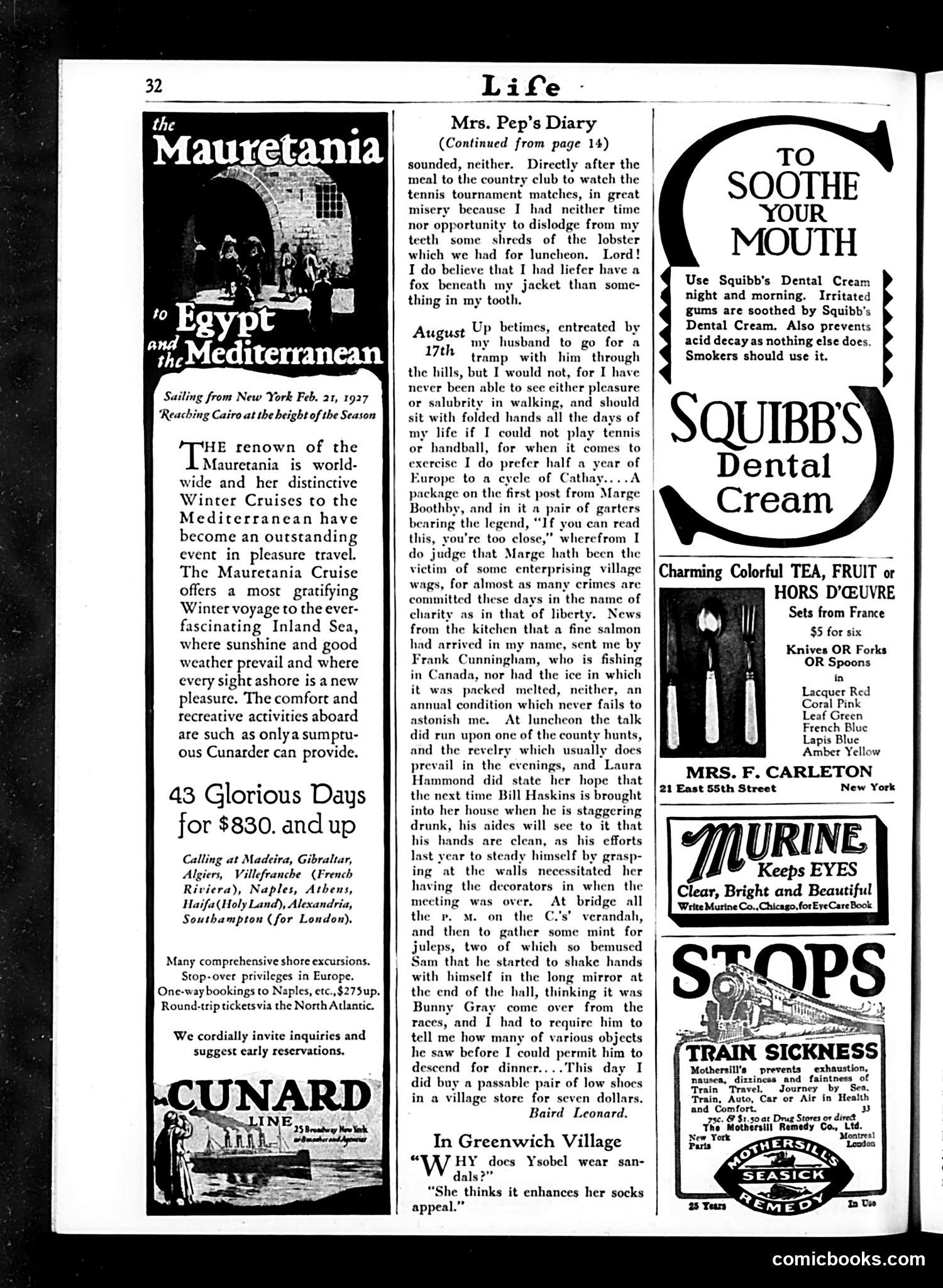
This page is primarily **advertising and serialized humor**, not political satire. The main content is "Mrs. Pep's Diary," a humorous domestic column satirizing upper-class leisure activities. Mrs. Pep complains about trivial annoyances—lobster between her teeth, missing tennis, her husband's drinking at social gatherings. The satirical point mocks wealthy women's preoccupations with social events (country clubs, bridge games, hunts) while fretting over petty concerns. The Greenwich Village joke at bottom ("Why does Ysobel wear sandals?") plays on 1920s bohemian stereotypes about unconventional dress. The advertisements—Cunard cruise line, Squibb's dental cream, Murine eye drops, train sickness remedy—represent typical 1920s luxury and patent medicine marketing. The cruise ad emphasizes exotic Mediterranean travel for the affluent. No specific political figures or events are referenced. This is lifestyle satire aimed at the magazine's wealthy readership, gently mocking their own social pretensions.
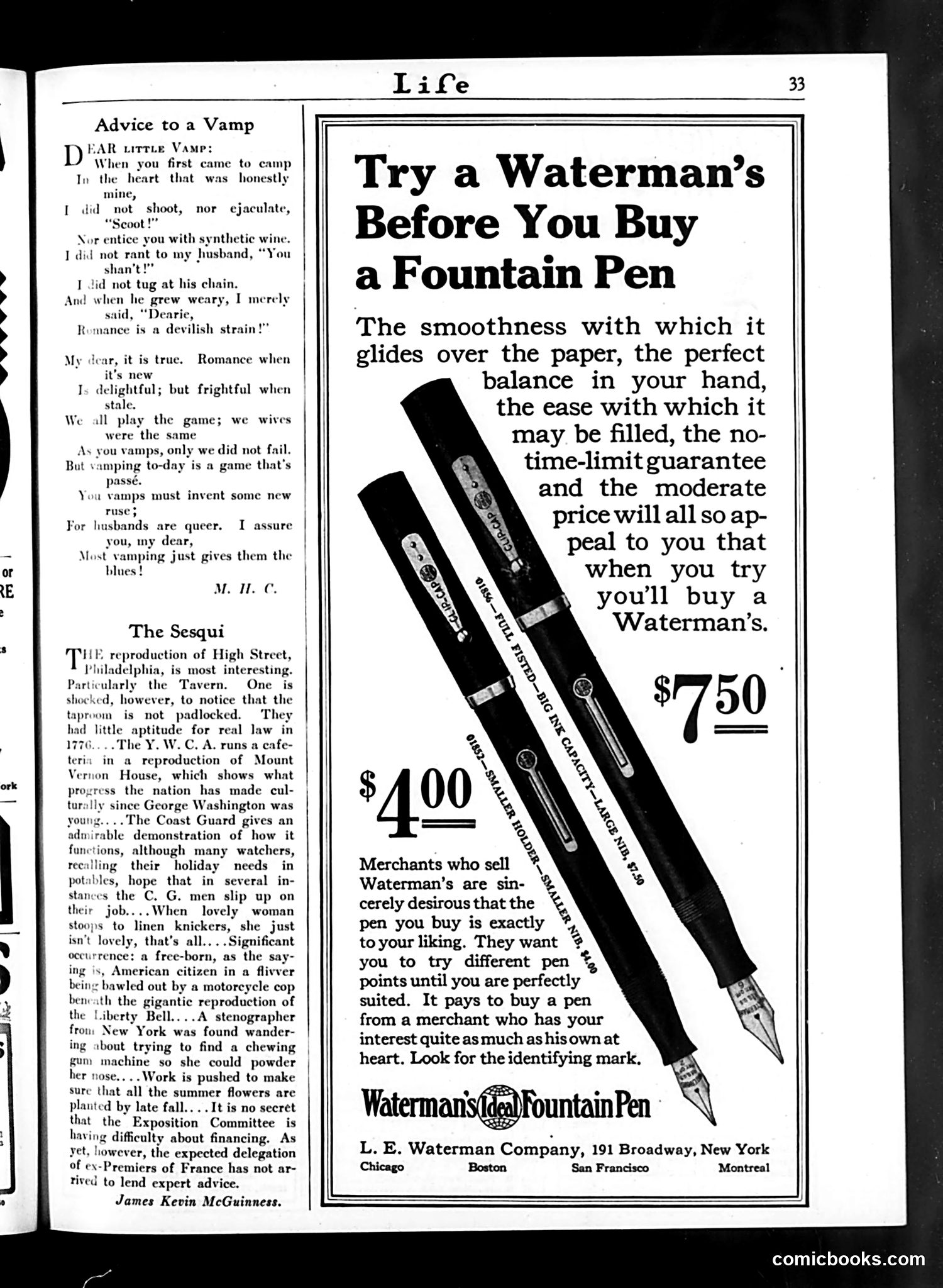
This page contains two distinct elements: **Left column: "Advice to a Vamp"** — A humorous column (signed M.H.C.) addressed to a young woman using seduction tactics. The writer, apparently an older married woman, warns that "vamping" (1920s slang for flirting/seduction) is an outdated strategy. She advises that modern husbands find such behavior tiresome rather than charming, and suggests the younger generation needs new tactics. The satire mocks both the dated seduction methods and changing gender dynamics of the era. **Right side: Waterman's Fountain Pen Advertisement** — A full commercial ad promoting Waterman fountain pens at $4.00 and $7.50, emphasizing smoothness, balance, ease of filling, and lifetime guarantee. The ad encourages trying different pen points before purchasing and notes merchants' genuine interest in customer satisfaction. The page juxtaposes social commentary about courtship with consumer product advertising—typical of Life magazine's mixed editorial and advertising format from this period.
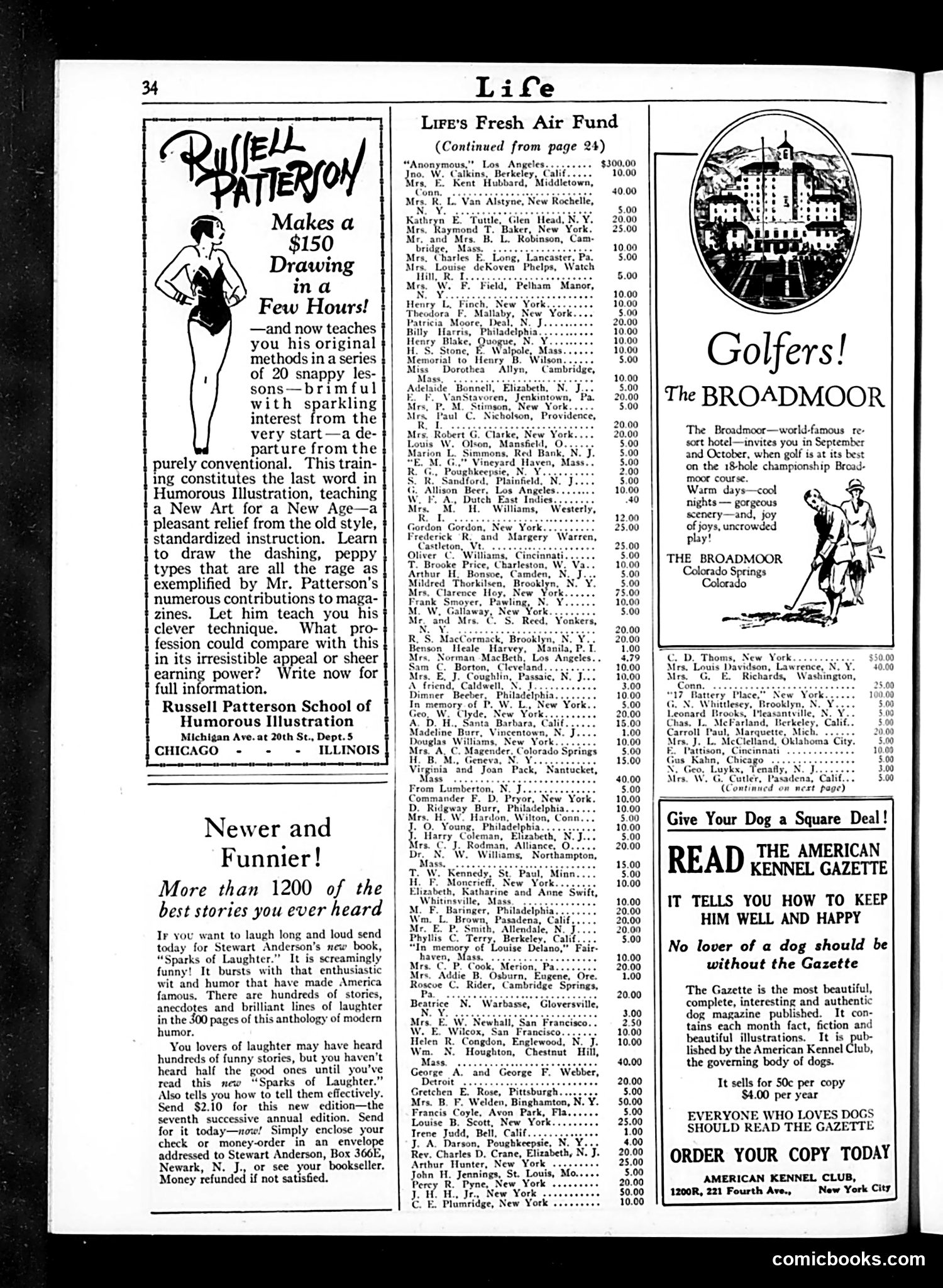
This page contains **no political cartoons or satire**—it's primarily advertising and charitable donation listings. The left column features **commercial advertisements**: Russell Patterson's correspondence school for aspiring illustrators (promising to teach "snappy" modern cartooning techniques) and Stewart Anderson's humor anthology "Sparks of Laughter." The center and right columns list donations to **Life's Fresh Air Fund**, a contemporary charitable program providing outdoor recreation for underprivileged children—a common philanthropic initiative of the era. The donations range from $1 to $300, representing contributions from readers nationwide. The right column also advertises **The Broadmoor golf resort** in Colorado Springs and **The American Kennel Gazette** dog magazine. This is a typical era magazine page mixing commerce with charitable fundraising, with no satirical content requiring historical context to decode.
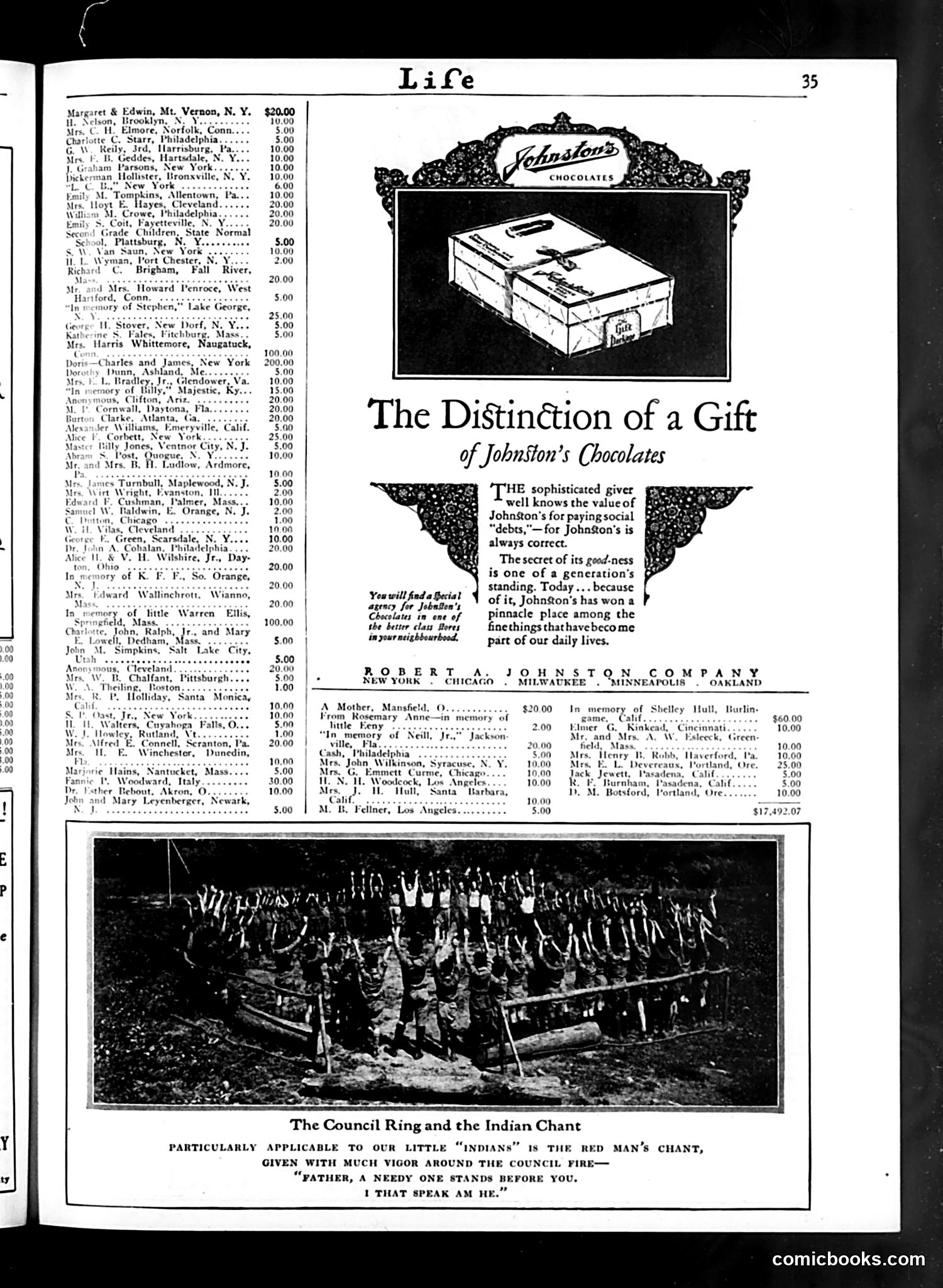
This page is primarily **charitable fundraising content**, not satire or political commentary. The bulk consists of donation lists for what appears to be a children's charity or camp (references to "little 'Indians'" and "Council Ring" suggest a youth organization). The **Johnston's Chocolates advertisement** occupies the center, framing gift-giving as socially correct behavior—a common early 20th-century marketing appeal to middle-class propriety. The **bottom photograph** shows children at a "Council Ring" performing an "Indian Chant" around a council fire. This reflects the era's widespread appropriation of Native American imagery for youth activities, presented without irony as wholesome entertainment. The accompanying text romanticizes this as character-building. **For modern readers**: This represents problematic cultural attitudes of that period—stereotyping Indigenous practices as exotic performance material for children, while simultaneously fundraising (likely from wealthy donors, judging by donation amounts) ostensibly to benefit youth welfare.
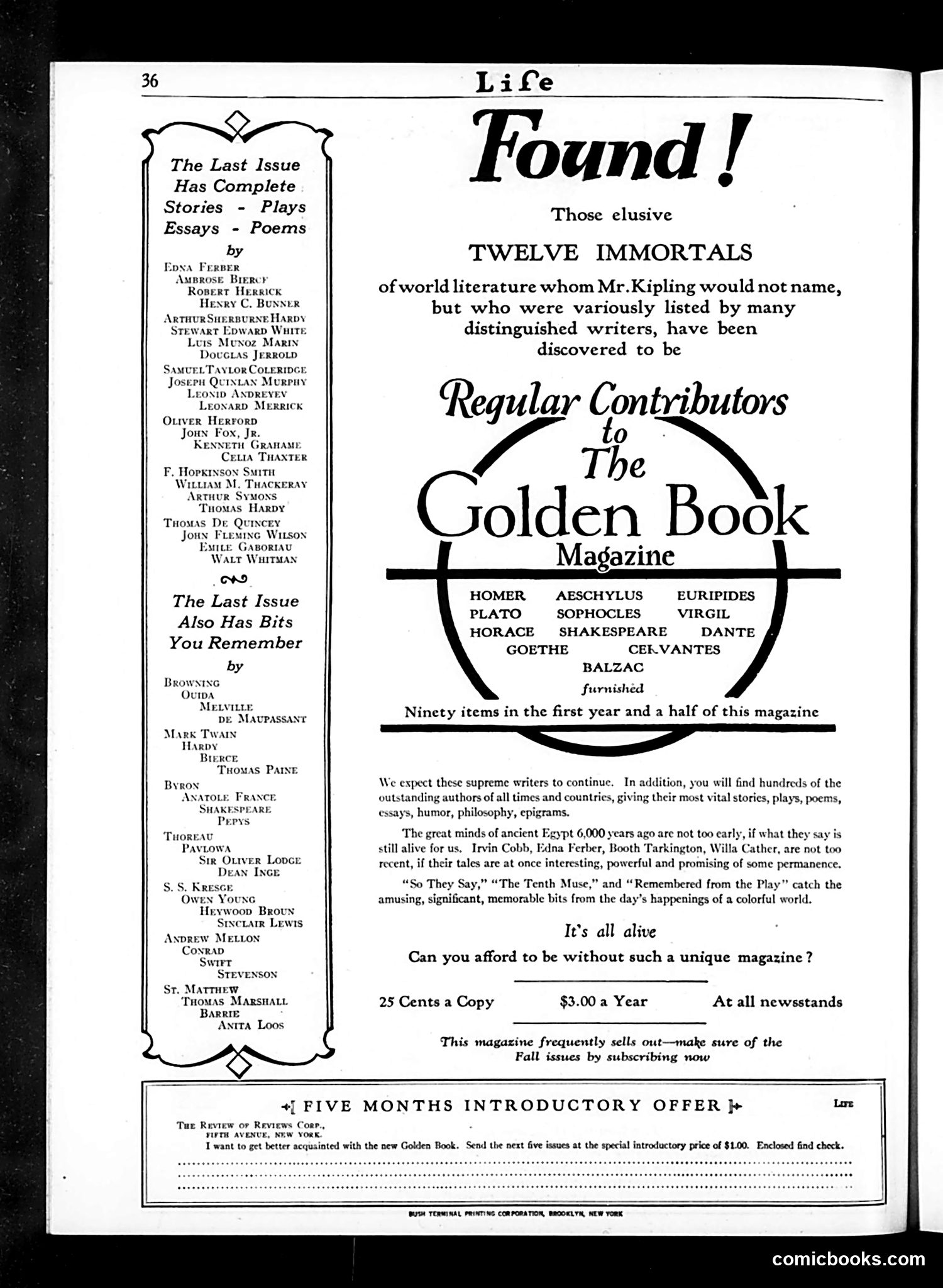
This is primarily an **advertisement for *The Golden Book* magazine**, not a political cartoon. The page announces the magazine's discovery of "twelve immortals" of world literature—classical authors like Homer, Plato, Shakespeare, Dante, and Goethe—as regular contributors. The satire is subtle and self-promotional: the ad claims these great historical writers have been "found" as contributors, humorously implying *The Golden Book* has somehow secured their work. This is obviously tongue-in-cheek—these authors are deceased—but the point is that the magazine reprints their classic writings alongside contemporary authors (Irvin Cobb, Edna Ferber, Booth Tarkington). The left column lists the magazine's actual recent contributors, mixing established and lesser-known writers to suggest literary prestige and variety. The advertisement positions *The Golden Book* as offering both timeless classics and modern relevance at 25 cents per copy, with a promotional five-month introductory offer for $1.00. It's essentially aspirational marketing: promising readers access to humanity's greatest minds.
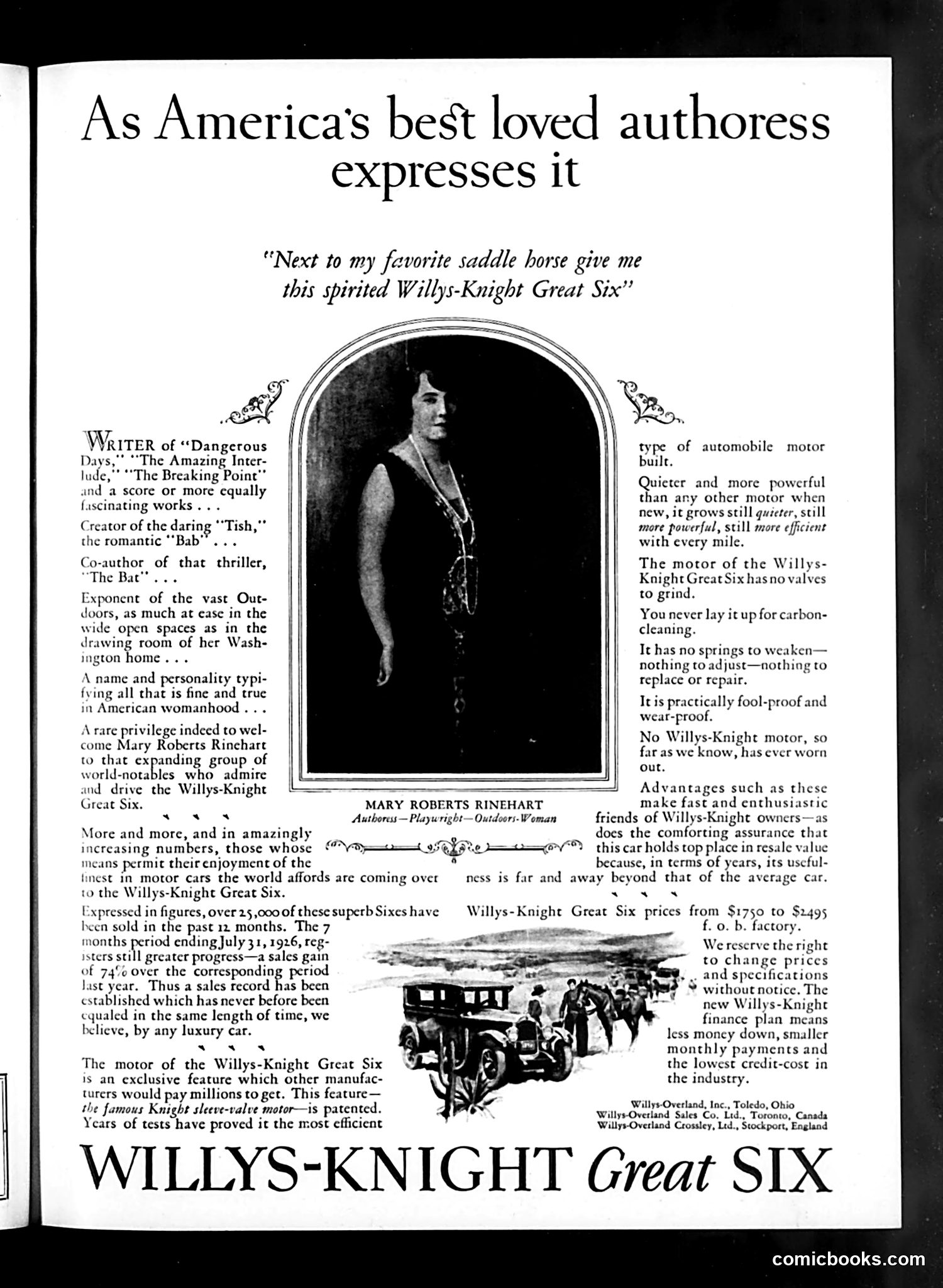
This is primarily **automobile advertising**, not satire or political commentary. The page uses a celebrity endorsement strategy rather than humor. **The Figure:** Mary Roberts Rinehart, a genuinely prominent American author of the 1920s known for mystery novels ("Tish," "Bab") and outdoor adventure writing. **The Strategy:** The ad quotes Rinehart endorsing the Willys-Knight Great Six automobile, positioning the car as the choice of cultured, accomplished Americans. The left column catalogs her credentials—bestselling author, playwright, outdoorswoman—to establish her as representative of "all that is fine and true in American womanhood." **Key Sales Pitch:** The right column emphasizes the car's "Knight sleeve-valve motor," claimed as a patented exclusive feature that requires no maintenance (no valve grinding, no carbon cleaning) and "has ever worn out." **For Modern Readers:** This reflects pre-1930 advertising techniques before regulations required substantiation of claims. The celebrity endorsement tactic and the implied status association (buy what famous people buy) remain recognizable marketing strategies, though the specific claims about durability are now unverifiable and likely exaggerated.
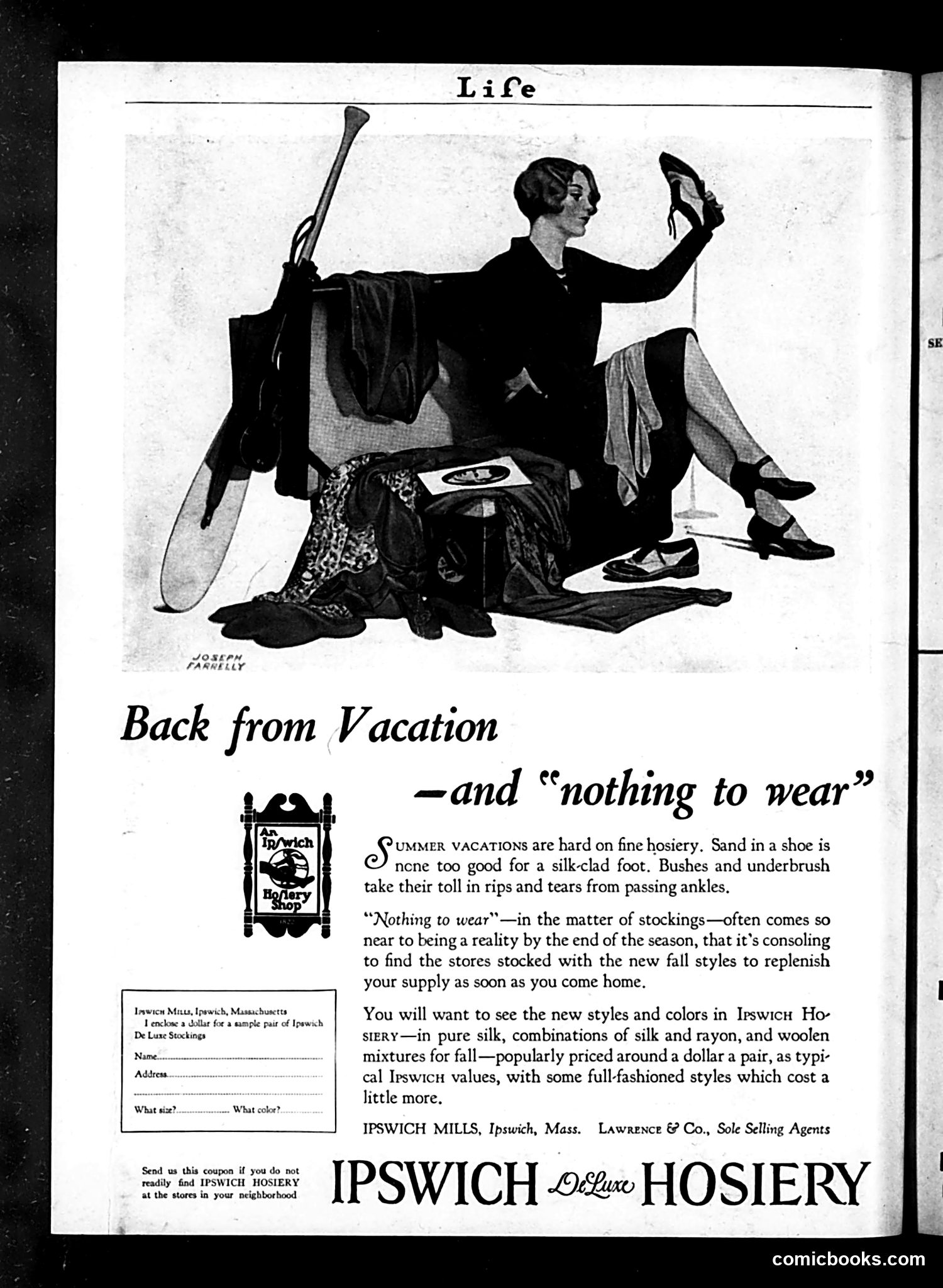
This is primarily a **commercial advertisement for Ipswich hosiery**, not political satire. The illustration by Joseph Farrell depicts a woman returning from summer vacation with damaged stockings—a relatable problem for the era. The joke plays on the phrase "nothing to wear," a period expression about wardrobe depletion. The visual gag shows a woman surrounded by vacation gear (tennis racket, shoes, scattered clothing) with her stockings visibly ruined from outdoor activities like hiking through bushes and sand. The ad's pitch: summer vacation destroys quality hosiery, so women will need to replace their stock with new fall styles. Ipswich offers affordable options (around a dollar per pair) in silk, rayon, and wool blends. This reflects early 20th-century consumer culture targeting women, treating hosiery as a necessity regularly requiring replacement—a practical sales angle rather than satire.