
Life, 1926-09-09 · page 28 of 40
Life — September 9, 1926 — page 28: what you’re looking at
What you’re looking at
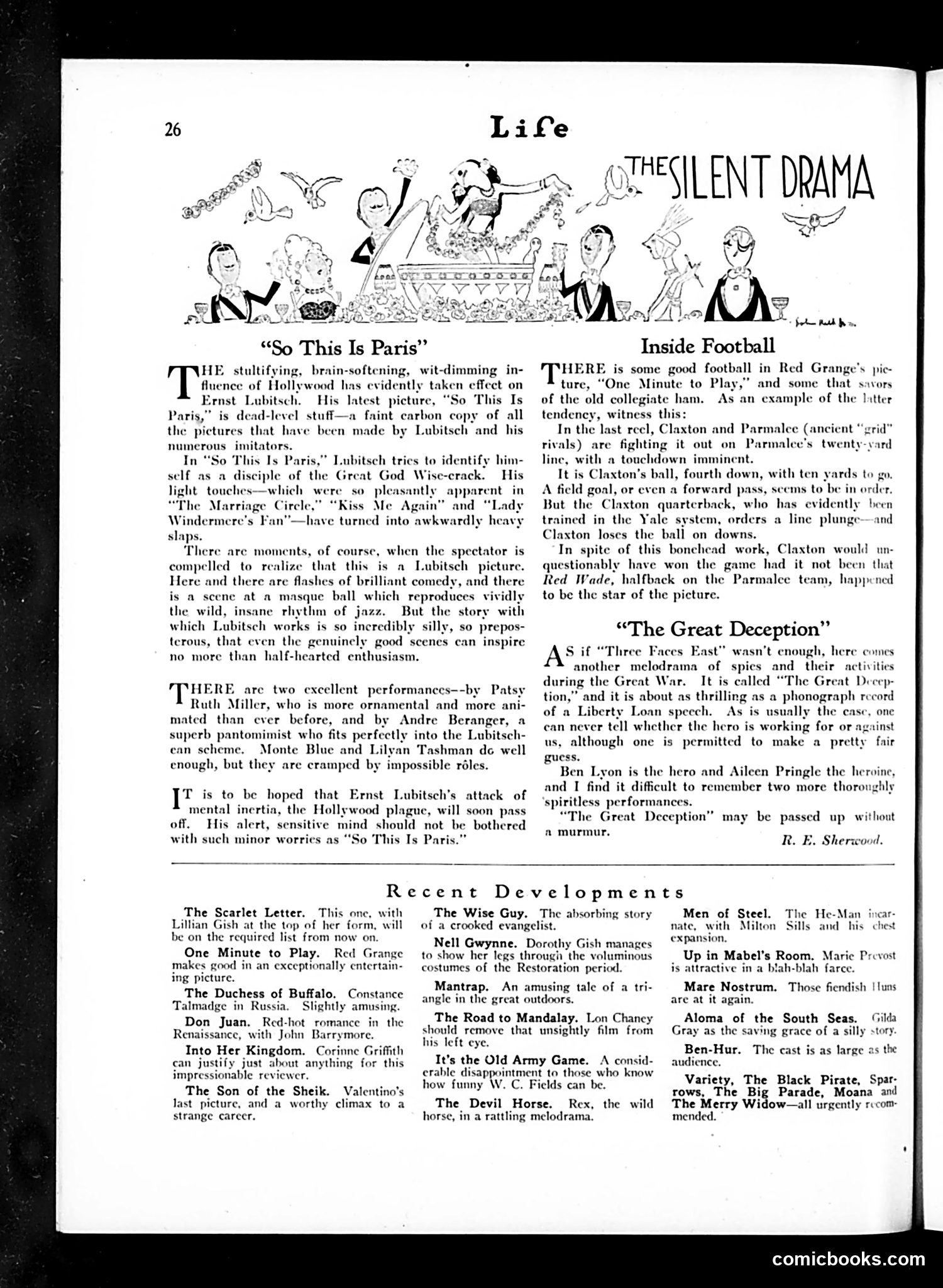
This page reviews three 1920s silent films. The main cartoon depicts a chaotic movie set with exaggerated figures, illustrating the article's critique of director Ernst Lubitsch's recent work "So This Is Paris." **Key Content:** The top review mocks Lubitsch for producing derivative, silly material, claiming Hollywood has dulled his once-sharp comedic touch. His earlier films ("Marriage Circle," "Kiss Me Again") showed finesse, but this new picture relies on awkward slapstick and an absurd plot. The second review discusses Red Grange's football film "One Minute to Play," praising the athletic sequences but criticizing the protagonist's bonehead decision-making during a climactic game. The third condemns "The Great Deception," a WWI spy melodrama, as tedious and forgettable—comparing it unfavorably to another recent war film, noting performances by Ben Lyon and Aileen Pringle lack any spark. The "Recent Developments" section briefly lists other current releases, mostly positively (praising Lillian Gish and John Barrymore). The satire targets Hollywood's tendency toward repetitive formula entertainment.
📄 Transcribed text from this page (OCR, searchable)
Machine-transcribed from the original scan — historical spelling and the odd misread are preserved.
as mrOs & “So This Is Paris” HE sstultifying, brain-softening, wit-dimming in- fluence of Hollywood has evidently taken effect on Ernst Lubitsch. His latest picture, “So This Is Paris,” is dead-level stuff—a faint carbon copy of all the pictures that have been made by Lubitsch and his numerous imitators. In “So This Is Paris,” Lubitsch tries to identify him- self as a disciple of the Great God Wise-crack. His light touches—which were so pleasantly apparent in © Marriage Circle,” ss Me Again” and “Lady Windermere’s Fan"—have turned into awkwardly he: slaps. There are moments, of course compelled to realize that this is a Lubitsch picture. Here and there are flashes of bi nt comedy, and there is a scene at a masque ball which reproduces vividly the wild, insane rhythm of But the story with which Lubitsch works is so incredibly silly, so prepos- terous, that even the genuinely good scenes can inspire no more than half-hearted enthusiasm. when the spectator is HERE are two excellent performances—-by Patsy Ruth Miller, who is more ornamental and more ani- mated than ever before, and by Andre Beranger, a superb pantomimist who fits perfectly into the Lubitsch- ean scheme. Monte Blue and Lilyan Tashman de well enough, but they are cramped by impossible réles. T is to be hoped that Ernst Lubitsch’s attack of mental inertia, the Hollywood plague, will soon pass off. His alert, sensitive mind should not be bothered with such minor worries as “So This Is Paris.” S Ww STP*SILENT DRAMA kat HERE is some good football in Red Grange’s pic- ture, “One Minute to Pls and some that savors of the old collegiate > latter tendency, witness thi In the last reel, Claxton and Parmalce (ancient ting it out on Parmalee’s twent line, with a touchdown imminent. It is Claxton’s ball, fourth down, with ten yards to go, A field goal, or even a forward pass, seems to be in order. But the Claxton quarterback, who has evidently been trained in the Yale system, orders a line plur and Claxton loses the ball on downs, In spite of this bonehead work, Claxton would un- questionably have won the game had it not been that Red Wade, halfback on the Parmalece team, happened to be the star of the picture. “The Great Deception” S if “Three Faces East” wasn’t enough, here comes another melodrama of spics and their activities during the Great War. It is called “The Great Decep- tion,” and it is about as thrilling as a phonograph record of a Liberty Loan speech. As is usually the case, one can never tell whether the hero is working for or against us, although one is permitted to make a pretty fair guess. Ben Lyon is the hero and Aileen Pringle the heroine, and I find it difficult to remember two more thoroughly spiritless performances. “The Great Deception” may be passed up without “murmur: R. E. Sherwood. Recent Developments The Wise Guy. of a crooked evangelist. Nell Gwynne. Dorothy Gish manages to show her legs through the voluminous costumes of the Restoration period. The Scarlet Letter. This onc, with Lillian Gish at, the top of her form, will be on the required list from now on. One Minute to Play. Red makes good in an exceptionally ente: ing picture. The Duchess of Buffalo. Talmadge in Russia. Don Juan, Red-hot romance in the Renaissance, with John Barrymore. Into Her Kingdom. Corinne Griffith can justify just about anything for this impressionable reviewer. The Son of the Sheik. Valentino's last picture, and a worthy climax to a strange carcer. Constance Slightly amusing. The absorbing story Mantrap. An amusing tale of a tri- angle in the great outdoors, The Road to Mandalay. Lon Chancy should remove that unsightly film from his left eye. It’s the Old Army Game. A consid- crable disappointment to those who know how funny W. C. Fields can be. The Devil Horse. Rex, the horse, in a rattling melodrama. wild Men of Steel. nate, with Milton expansion, Up in Mabel’s Room. Marie Prevost is attractive in a blah-blah farce. The He-Man in Sills and his che Mare Nostrum. Those fiendish | luns are at it again. Aloma of the South Seas. Gilda Gray as the saving grace of a silly story. Ben-Hur. audience. Variety, The Black Pirate, Spar- rows, The Big Parade, Moana and 0’ The Merry Widow—all urgently recom- mended. The cast is as large as the comicbooks.com