
Life, 1926-09-09 · page 14 of 40
Life — September 9, 1926 — page 14: what you’re looking at
What you’re looking at
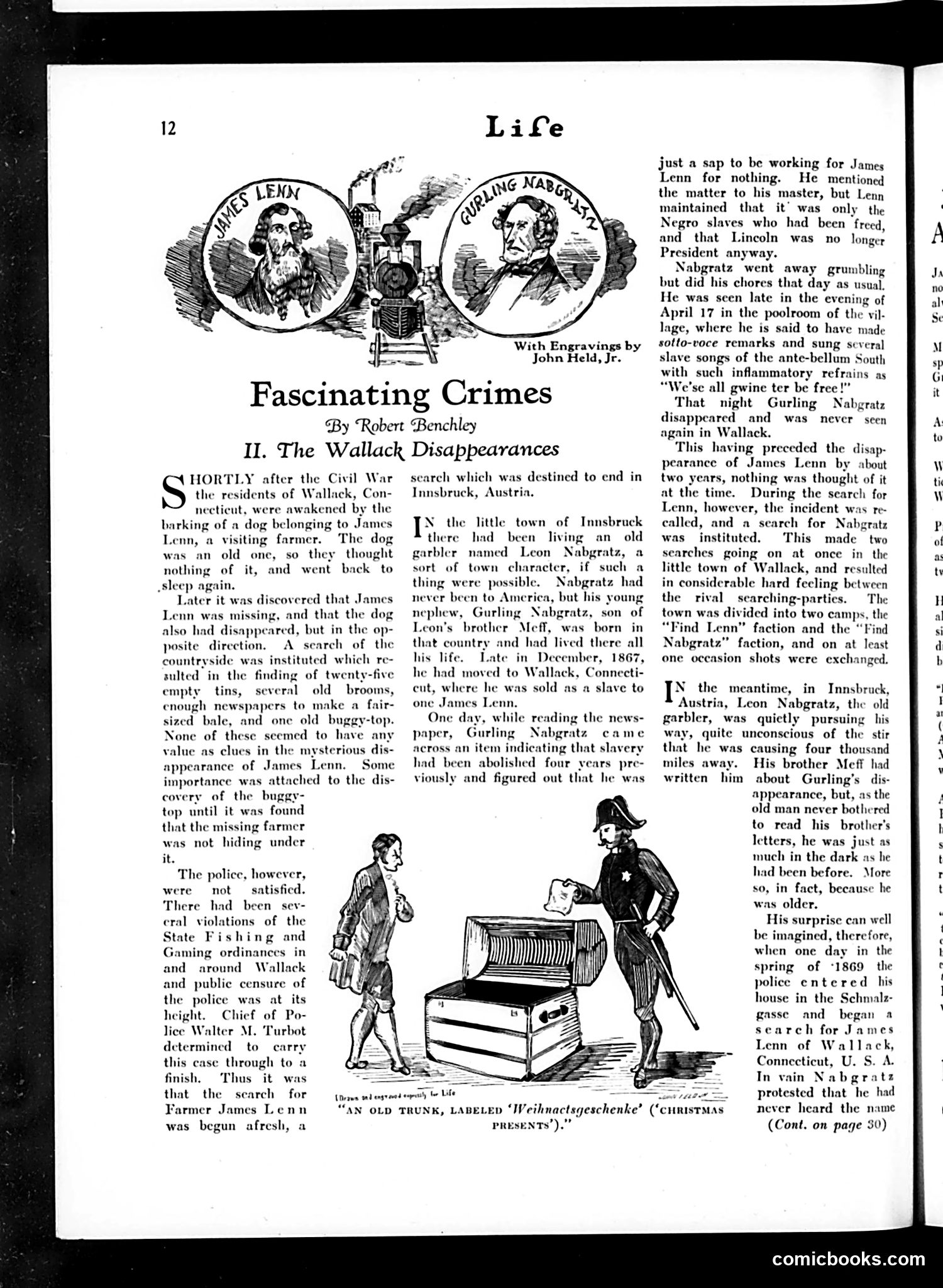
This is a serialized crime story by Robert Benchley with engravings by John Held, Jr. The narrative concerns James Lenn, a farmer who disappeared after the Civil War, and his connection to a man named Leon Nabgratz in Innsbruck, Austria. The illustrated cartoon shows a police officer examining a large trunk, suggesting the mystery involves hidden cargo or a body. The caption references the trunk as a "Christmas present," implying darkly comedic undertones about how Lenn's disappearance occurred. The story satirizes contemporary sensationalized crime reporting and the public's fascination with missing-person cases. It's a fictional "true crime" narrative typical of *Life* magazine's entertainment content from this period.
📄 Transcribed text from this page (OCR, searchable)
Machine-transcribed from the original scan — historical spelling and the odd misread are preserved.
With Engravings by John Held, Jr. Fascinating Crimes By Robert Benchley II. The Wallack Disappearances HORTLY after the il War S the residents of W: , Con- necticut, were awakened by the barking of a dog belonging to James Lenn, a visiting farmer. The dog was an old one, so they thought nothing of it, and went back to .sleep again, Later it was discovered that James Lenn was missing, and that the dog also had disappeared, but in the op- posite direction. A search of the countryside was instituted which re- sulted in the finding of twenty- empty tins, several old brooms, enough newspapers to make a fair- sized bale, and one old bug None of these seemed to have < value as clues in the mysterious appearance of James Lenn. Some importance was attached to the dis- covery of the buggy top until it was found that the missing farmer was not hiding under it. The police, however, were not __ satisfied. There had been sev- cral violations of the State Fishing and Gaming ordinances in and around Wallack and public censure of the police was at its height. Chief of Po- lice Walter M. Turbot determined — to this carry ase through to a finish, Thus it was that the search for Farmer James Lenn was begun afresh, a search which was destined to end in Innsbruck, Austri N the little town of Innsbruck there had been living an old garbler named Leon bgratz, a sort of town character, if such a thing were possible. Nabgratz had never been to America, but his young nephew, Gurling bgratz, son of Leon’s brother Meff, was born in that country and had lived there all his life. Late in December, 1867, he had moved to Wallack, Connecti- cut, where he was sold as a slave to one James Lenn. One ¢ while reading the news- paper, rling nbgratz came across an item indicating that slavery had been abolished four years pre- viously and figured out that he was OLD TRUNK, LABELED ‘Weihnactsgeschenke’ (‘curistTMas PRESENTS’). just a sap to be working for James Lenn for nothing. He mentioned the matter to his master, but Lenn maintained that it’ was only the Negro slaves who had been freed, and that Lincoln was no longer President anyway. - Nabgratz went away grumbling but did his chores that day as usual, He was seen late in the evening of April 17 in the poolroom of the vil- lage, where he is said to have made sotto-voce remarks and sung several slave songs of the ante-bellum South with such inflammatory refrains as “We'se all gwine ter be free!” That night Gurling Nabgratz disappeared and was never again in Wallack. This having preceded the disap- pearance of James Lenn by about two years, nothing was thought of it at the time. During the search for Lenn, however, the incident called, and a search for gratz tuted. This made two searches going on at once in the little town of Wallack, and resulted in considerable hard feeling between the rival searching-parties. The town was divided into two camps, the “Find Lenn” faction and the “Find Nabgratz” faction, and on at least one occasion shots were exchanged. seen N the meantime, in Innsbruck, Austria, Leon Nabgratz, the old garbler, was quietly pursuing his way, quite unconscious of the stir that he was causing four thousand miles away. His brother Meff had written him about Gurling’s dis- appearance, but, as the old man never bothered to read his brother's letters, he was just as much in the dark as he had been before. More so, in fact, because he was older. His surprise can well be imagined, therefore, when one day in the spring of °1869 the police entered his house in the Schmalz- gasse and began a search for James Lenn of Wallack, Connecticut, U. S. A. In vain Nabgratz protested that he had never heard the name (Cont. on page 30) comicbooks.com