
Life, 1926-09-09 · page 18 of 40
Life — September 9, 1926 — page 18: what you’re looking at
What you’re looking at
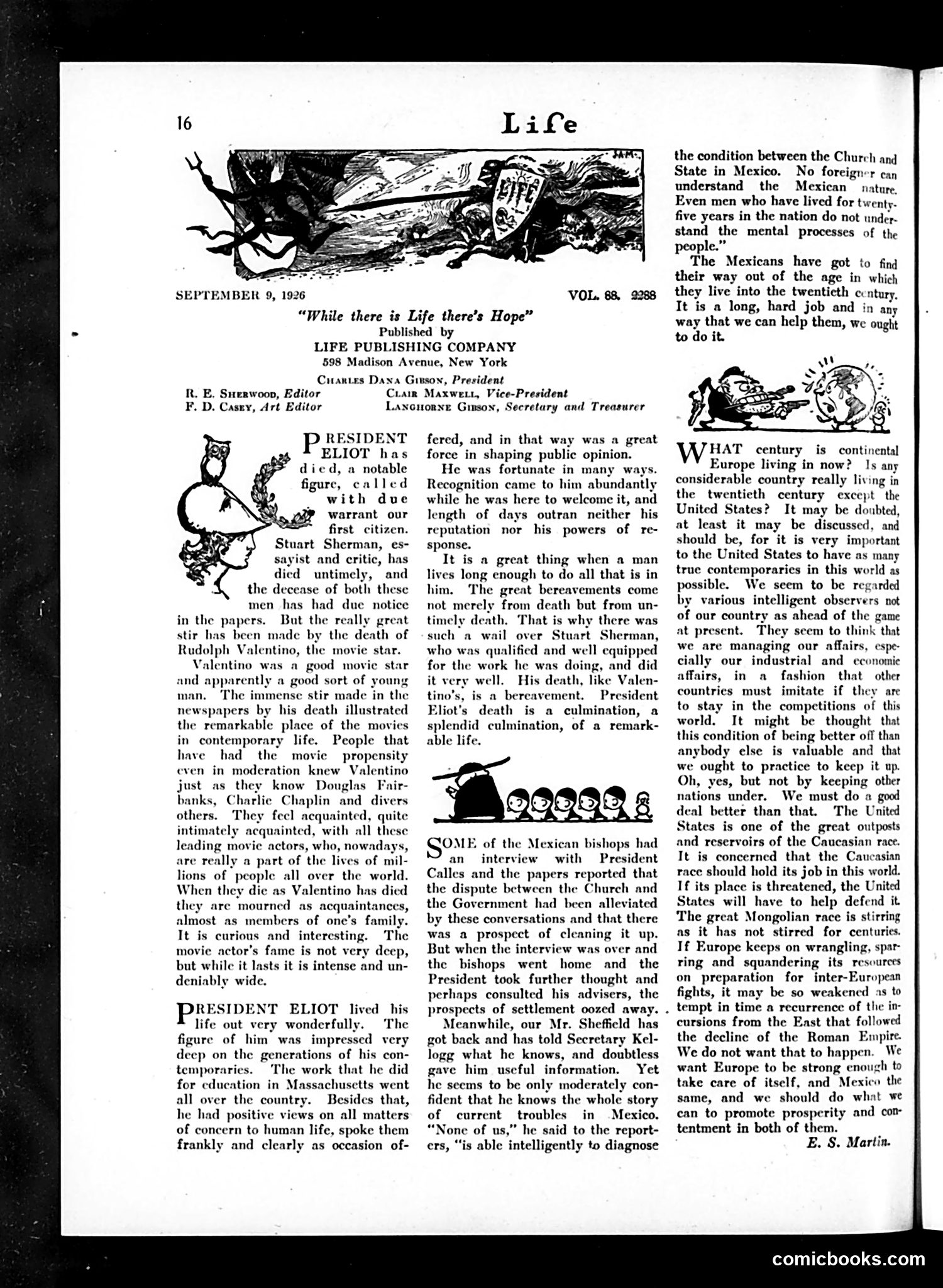
This page memorializes **President Eliot** (of Harvard, based on context) and **Rudolph Valentino**, the famous silent film star who died recently. The editorial praises both men as public figures who shaped opinion and culture. The small cartoon at top-left appears to show a **devil or imp figure**, likely satirizing how death claims notable figures indiscriminately. The central cartoon depicts **Mexican bishops meeting with President Calles**, referencing ongoing Church-State conflicts in Mexico during the religious persecution period. The text discusses tensions between the Mexican government and Catholic Church. The page's broader theme contrasts American cultural leadership with Mexico's instability, positioning the U.S. as a stable reservoir of values Europe should emulate.
📄 Transcribed text from this page (OCR, searchable)
Machine-transcribed from the original scan — historical spelling and the odd misread are preserved.
SEPTEMBER 9, 1926 “While there is Life there’s Hope” Published by LIFE PUBLISHING COMPANY 598 Madison Avenue, New York Cuantes Daxa Ginson, R. E. Suerwoon, Editor F. D. Casry, Art Editor RESIDENT ELIOT has died, a notable figure, called with due warrant our first citizen. Stuart Sherman, es- sayist and critic, has untimely, and the decease of both these men has had duc notice in the papers. But the really great stir has been made by the death of Rudolph Valentino, the movie star. Valentino was a good movie star and apparent good sort of young man. The immense stir made in the newspapers by his death illustrated the remarkable place of the movies in contemporary life. People that have had the movie propensity even in moderation knew Valentino just as they know Douglas banks, Charlie Chaplin and divers others. They fecl acquainted, quite intimately acquainted, with all these leading movic actors, who, nowadays, are really a part of the lives of mil- lions of people all over the world. When they die as Valentino has diced they are mourned as acquaintances, almost as members of one’s family It is curious and interesting. The movie actor’s fame is not very deep, but while it lasts it is intense and un- deniably wide. IDENT ELIOT lived his figure of him was impressed very deep on the ge nerations of his con- > work that he did for cducation in Massachusetts went all over the count: Besides that, he had positive views on all matters of concern to human life, spoke them frankly and clearly as occasion of- President Crain Maxwewr, Vice-President Laxouorxe Ginson, Secretary and Treasurer fered, and in that way was a great force in shaping public opinion. He was fortunate in many ways. Recognition came to him abundantly while he was here to welcome it, and length of days outran neither his reputation nor his powers of re- sponse. It is a great thing when a man lives long enough to do all that is in him. The great bereavements come not merely from death but from un- timely death, That is why there was such a wail over Stuart Sherman, who was qualified and well equipped for the work he was doing, and did it very well. His death, like Valen- tino’s, is a bereavement. President Eliot's death is a culmination, a splendid culmination, of a remark- able life. Some of the Mexican bishops had an interview with President Calles and the papers reported that the dispute between the Church and the Government had been alleviated by these conversations and that there was a prospect of cleaning it up. But when the interview was over and the bishops went home and the President took further thought and perhaps consulted his advisers, the prospects of settlement oozed away. . Meanwhile, our Mr. Sheffield has got back and has told Secretary Kel- logg what he knows, and doubtless gave him useful information. Yet he seems to be only moderately con- fident that he knows the whole story of current troubles in Mexico. “None of us,” he said to the report- ers, “is able intelligently to diagnose the condition between the Church and State in Mexico. No foreigner can understand the Mexican nature, Even men who have lived for twenty- five years in the nation do not under- pane the mental processes of the e”* The Mexicans have got to find their way out of the age in which they live into the twenticth c ntury, It is a long, hard job and in any way that we can help them, we ought to do it Wwiat century is continental Europe living in now? 1s any considerable country really living in the twentieth century except the United States? It may be doubted, at least it may be discussed, and should be, for it is very important to the United States to have as many true contemporaries in this world as possible. We seem to be regarded by various intelligent observers not of our country as ahead of the game at present. They seem to think that we are managing our affairs, espe- cially our industrial and economic affairs, in a fashion that other countries must imitate if they are to stay in the competitions of this world. It might be thought that this condition of being better off than anybody else is valuable and that we ought to practice to keep it up. Oh, yes, but not by keeping other nations under. We must do a good deal better than that. The United States is one of the great outposts and reservoirs of the Caucasian race. It is concerned that the Caucasian race should hold its job in this world. If its place is threatened, the United States will have to help defend it The great Mongolian race is stirring as it has not stirred for centuries. If Europe keeps on wrangling, spar ring and squandering its resources on preparation for inter-European fights, it may be so weakened as to tempt in time a recurrence of the in- cursions from the East that followed the decline of the Roman Empire. We do not want that to happen. We want Europe to be strong enough to take care of itself, and Mexico the same, and we should do what we can to promote prosperity and con- tentment in both of them. E. S. Marlin. comicbooks.com