
Life, 1926-09-09 · page 32 of 40
Life — September 9, 1926 — page 32: what you’re looking at
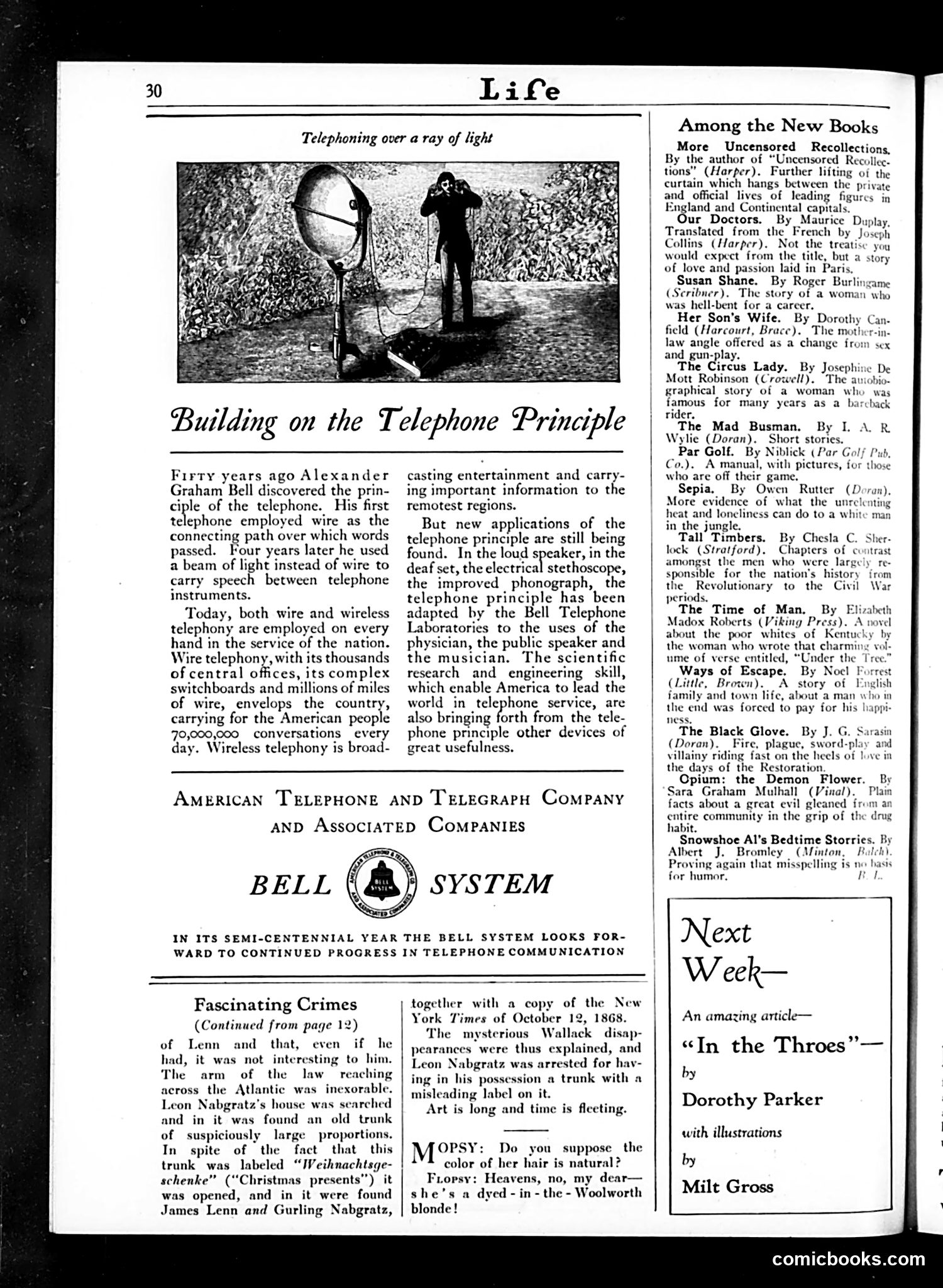
What you’re looking at
This page primarily showcases **advertising and book reviews** rather than political satire. The main content is a **Bell Telephone System advertisement** featuring an illustration of two silhouetted figures communicating via a beam of light—visualizing Alexander Graham Bell's principle of transmitting sound through light rather than wire. The accompanying text celebrates fifty years of telephone innovation and wireless telephony's role in American communication. The small satirical content appears in the "Mopsy" and "Flopsy" dialogue at bottom—a brief joke about a woman's hair color, suggesting it's artificially dyed blonde from Woolworth's (a budget retailer). This is gentle social satire about vanity and affordable fashion, typical of Life magazine's light humor. The remainder features book advertisements and reviews typical of period Life content—no political references or caricatures are visible.
📄 Transcribed text from this page (OCR, searchable)
Machine-transcribed from the original scan — historical spelling and the odd misread are preserved.
Life Telephoning over a ray of light Building on the Telephone Principle Firty years ago Alexander Graham Bell discovered the prin- ciple of the telephone. His first telephone employed wire as the connecting path over which words passed. Four years later he used a beam of light instead of wire to carry speech between telephone instruments. Today, both wire and wireless telephony are employed on every hand in the service of the nation. Wire telephony, with its thousands of central offices, its complex switchboards and millions of miles of wire, envelops the country, carrying for the American people 70,000,000 conversations every day. Wireless telephony is broad- casting entertainment and carry- ing important information to the remotest regions. But new applications of the telephone principle are still being found. In the loud speaker, in the deaf set, the electrical stethsacope, the improved phonograph, the telephone principle has been adapted by the Bell Telephone Laboratories to the uses of the physician, the public speaker and the musician. The scientific research and engineering skill, which enable America to lead the world in telephone service, are also bringing forth from the tele- phone principle other devices of great usefulness. American TELEPHONE AND TELEGRAPH ComPaNny AND AssocIATED ComPANIES BELL CY, SYSTEM IN ITS SEMI-CENTENNIAL YEAR THE BELL SYSTEM LOOKS FOR- WARD TO CONTINUED PROGRESS IN TELEPHONE COMMUNICATION Fascinating Crimes (Continued from page 12) of Lenn and that, even if hh had, it was not interesting to him. The arm of the law reaching across the Atlantic was inexorable. Leon Nabgratz’s house was searched and in it was found an old trunk of suspiciously large proportions. In spite of the fact that this trunk was labeled “WVeihnachtsge- schenke” (“Christmas presents”) it was opened, and in it were found James Lenn and Gurling Nabgratz, together with a copy of the New York Times of October 12, 1868. The mysterious Wallack disap- pearances were thus explained, and Leon Nabgratz was arrested for hav- ing in his possession a trunk with a misleading label on it. Art is long and time is fleeting. OPSY: Do you suppose the color of her hair is natural? Fiopsy: Heavens, no, my dear— she’s a dyed - in- the - Woolworth blonde! Among the New Books More Uncensored Recollections, By the author of “Uncensored Recollec- tions” (Harper). Further lifting of the curtain which hangs between the private and official lives of leading figures in England and Continental capitals. ur Doctors. By Maurice Duplay, Translated from the French by Joseph Collins (Harper). Not the treatise you would expect from the title, but a story of love and passion laid in Paris, Susan Shane. By Roger Burlingame (Scribner), The story of a woman who was hell-bent for a career, Her Son’s Wife. By Dorothy field (Harcourt, Brace). The mot! law angle offered as a change fir and gun-play. The Circus Lady. By Josep! Mott Robinson (Crowell). “The auiobio- graphical story of a woman who was famous for many years as a_barchack rider. The Mad Busman. Wylie (Doran). Short stories, Par Golf. By Niblick (Par C Pub, Co.). A manual, with pictures, for those who are off their game, Sepia. By Owen Rutter (Doron), More evidence of what the unrelenting heat and loneliness can do to a white man in the jungle. Tall Timbers. By Chesla C. Sher- lock (Stratford), Chapters of contrast amongst the men who were largely re- sponsible for the nation’s history from the Revolutionary to the Civil War periods. The Time of Man. By Elizabeth Madox Roberts (Viking Press). A novel about the poor whites of Kentucky by the woman who wrote that charming ume of verse entitled, “Under the Tre Ways of Escape. By Noel Fi (Little, Brown). story of family and town li put a man the end was forced to pay for his lai ness. The Black Glove. By J. G. Sarasin (Doran). Fire, plague, sword-play villainy riding fast on the heels of love in the days of the Restoration. Cpium: the Demon Flower. By Sara Graham Mulhall (Vinal). Plain facts about a great evil gleaned { a entire community in the grip of the drug habit. Snowshoe Al’s Bedtime Storries. By Albert J. Bromley (Minton, Balch). Proving again that misspelling is for humor. Next Week— An amazing article— “In the Throes”— by Dorothy Parker By LAR with illustrations by Milt Gross comicbooks.com