
Life, 1926-09-09 · page 23 of 40
Life — September 9, 1926 — page 23: what you’re looking at
What you’re looking at
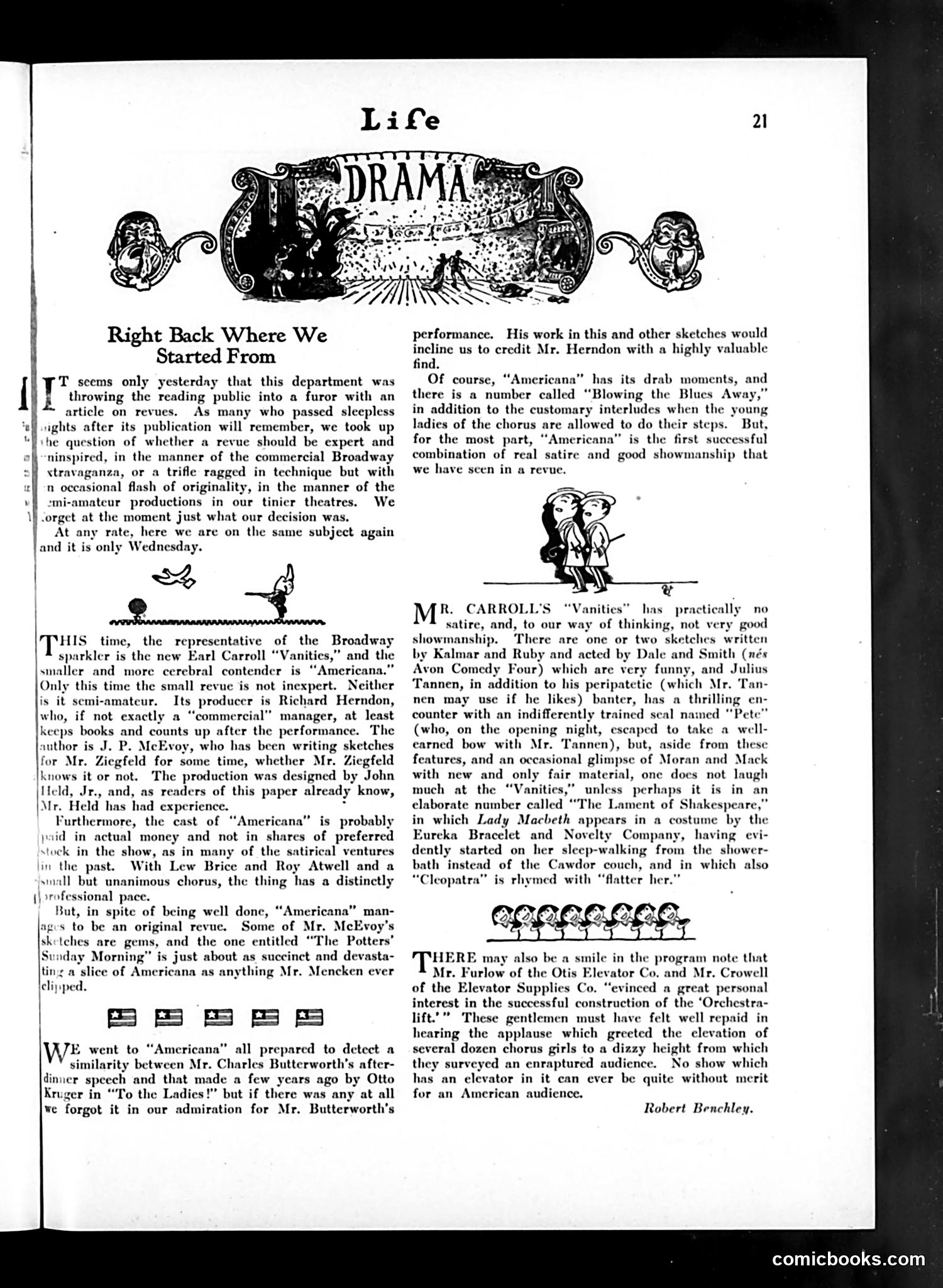
This page reviews two Broadway revues: Earl Carroll's "Vanities" and "Americana." The critic contrasts them as representatives of two opposing philosophies—polished commercial spectacle versus clever amateur production. **The main point:** "Americana," despite being professionally executed (with paid cast, designer John Held Jr., and writer J.P. McEvoy), succeeds because it combines genuine satire with showmanship. A sketch called "The Potters' Sunday Morning" exemplifies sharp social commentary. Charles Butterworth's performance is praised. By contrast, Carroll's "Vanities" lacks satire and showmanship. While featuring performers like Julius Tannen (who performs with a trained seal named "Pete") and the comedy duo Moran and Mack, the show disappoints. A number featuring Lady Macbeth in absurd costume—having apparently started her sleepwalking "from the shower-bath instead of the Cawdor couch"—exemplifies the show's tasteless excess. The review resolves an earlier Life debate: quality small revues can succeed when combining professional execution with intelligent satire.
📄 Transcribed text from this page (OCR, searchable)
Machine-transcribed from the original scan — historical spelling and the odd misread are preserved.
Right Back Where We Started From T seems only yesterday that this department was throwing the reading public into a furor with an article on revues. As many who passed sleepless ughts after its publication will remember, we took up he question of whether a revue should be expert and ninspired, in the manner of the commercial Broadway xtravaganza, or a trifle ragged in technique but with tl] n occasional flash of originality, in the manner of the ¥{} emi-amatecur productions in our tinier theatres. We \} orget at the moment just what our decision was, | At any rate, here we are on the same subject again Jand it is only Wednesday. 3% HIS time, the representative of the Broadway sparkler is the new Earl Carroll “Vanities,” and the smaller and more cerebral contender is “Americana.” Only this time the small revue is not inexpert. Neither is it semi-amateur. Its producer is Richard Herndon, who, if not exactly a “commercial” manager, at least keeps books and counts up after the performance. The suthor is J. P. McEvoy, who has been writing sketches for Mr. Ziegfeld for some time, whether Mr. Ziegfeld |knows it or not. The production was designed by John Held, Jr., and, as readers of this paper already, know, Mr. Held has had experience. Furthermore, the cast of “Americana” is probably yaid in actual money and not in shares of preferred stock in the show, as in many of the satirical ventures in the past. With Lew Brice and Roy Atwell and a simtll but unanimous chorus, the thing has a distinctly {\ rofessional pace. But, in spite of being well done, “Americana” man- ages to be an original revuc. Some of Mr. McEvoy’s sketches are gems, and the one entitled “The Potters’ Sunday Morning” is just about as succinct and devasta- ting a slice of Americana as anything Mr. Mencken ever |clip ped. = PS WE went to “Americana” all prepared to detect a similarity between Mr. Charles Butterworth’s after- dinner speech and that made a few years ago by Otto Kruger in “To the Ladies!” but if there was any at all we forgot it in our admiration for Mr. Butterworth’s performance. His work in this and other sketches would incline us to credit Mr. Herndon with a highly valuable find. Of course, “Americana” has its drab moments, and there is a number called “Blowing the Blues Away,” in addition to the customary interludes when the young ladies of the chorus are allowed to do their steps. But, for the most part, “Americana” is the first successful combination of real satire and good showmanship that we have seen in a revue. R. CARROLL'S “Vanities” has practically no satire, and, to our way of thinking, not very good showmanship. There are one or two sketches written by Kalmar and Ruby and acted by Dale and Smith (nés Avon Comedy Four) which are very funny, and Julius Tannen, in addition to his peripatetic (which Mr. Tan- nen may use if he likes) banter, has a thrilling en- counter with an indifferently trained seal named “Pete” (who, on the opening night, escaped to take a well- earned bow with Mr. Tannen), but, aside from these features, and an occasional glimpse of Moran and Mack with new and only fair material, one docs not laugh much at the “Vanities,” unless perhaps it is in an elaborate number called “The Lament of Shakespe: in which Lady Macbeth appears in a costume by the Eureka Bracelet and Novelty Company, having evi- dently started on her sleep-walking from the shower- bath instead of the Cawdor couch, and in which also “Cleopatra” is rhymed with “flatter her.” COREE SES HERE may also be a smile in the program note that Mr. Furlow of the Otis Elevator Co. and Mr. Crowell of the Elevator Supplies Co. “evinced a great personal interest in the successful construction of the ‘Orchestra- lift.’ These gentlemen must have felt well repaid in hearing the applause which greeted the elevation of several dozen chorus girls to a dizzy height from which they surveyed an enraptured audience. No show which has an elevator in it can ever be quite without merit for an Amcrican audience, Robert Benchley. comicbooks.com