
Life, 1926-09-09 · page 27 of 40
Life — September 9, 1926 — page 27: what you’re looking at
What you’re looking at
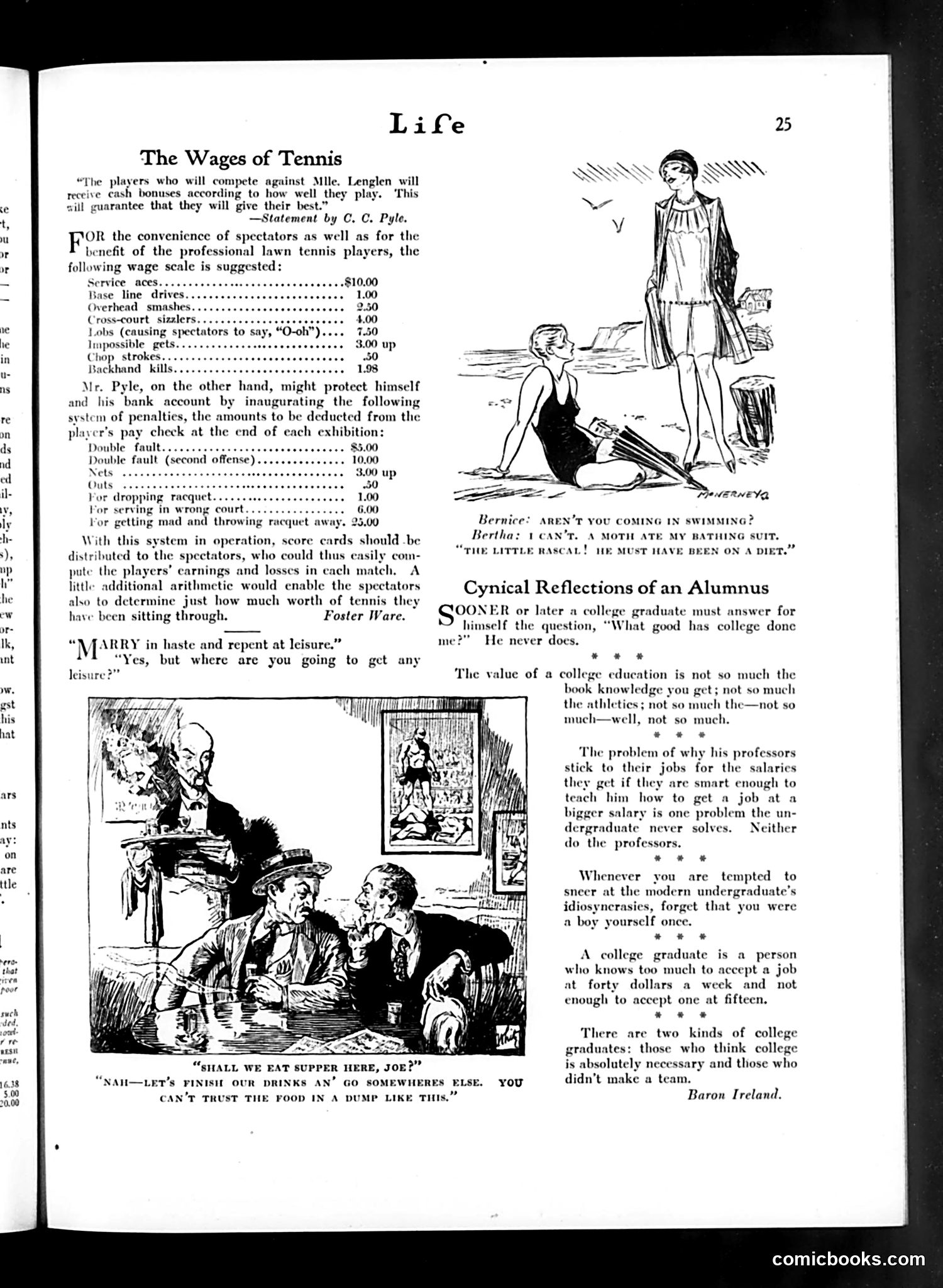
This page satirizes C.C. Pyle's proposal to pay professional tennis players (competing against French star Suzanne Lenglen) performance bonuses based on specific shots and plays. **The Main Cartoon:** The article mocks Pyle's scheme by proposing an absurdist "wage scale"—paying players set amounts for service aces ($10), base-line drives ($1.00), etc., while deducting penalties for double faults ($3.00) and errors. The joke is that reducing tennis to a piecemeal payment system reduces the sport to pure commercial transaction, undermining athletic integrity. **The Point:** By taking Pyle's already-commodified idea to its logical extreme, the satire criticizes the professionalization and commercialization of amateur sport. The accompanying cartoons and "Cynical Reflections" further mock materialism—both in leisure activities and education—suggesting 1920s anxiety about money corrupting traditional values. The secondary cartoons about marriage, food quality, and college graduates reinforce this theme: modern life has become cynically transactional.
📄 Transcribed text from this page (OCR, searchable)
Machine-transcribed from the original scan — historical spelling and the odd misread are preserved.
Life The Wages of Tennis “The players who will compete against Mlle. Lenglen will receive cash bonuses according to how well they play. ‘This sill guarantee that they will give their best.” —Statement by C. C. Pyle. OR the convenience of spectators as well as for the benefit of the professional lawn tennis players, the following wage scale is suggested: Service aces. . Base line drives Overhead smashes. Cross-court sizzlers..... Chop strokes.........sseeees Backhand kills. . Mr. Pyle, on the other hand, might protect himself and his bank account by inaugurating the following system of penalties, the amounts to be deduct player’s pay check at the end of each exhibition: Double fault..... + Double fault (second offense) Impossible gets " Vor serving in wrong court... Vor getting mad and throwing With this system in operation, score cards should -be distributed to the spectators, who could thus casily com- pute the players’ carnings and losses in cach match, A little additional arithmetic would enable the spectators also to determine just how much worth of tennis they have been sitting through. Foster Ware. “MARRY in haste and repent at leisure.” “Yes, but where are you going to get any leisure?” “SHALL WE EAT SUPPER HERE, JOE?” “NAH—LET’S PINISIT OUR DRINKS AN’ GO SOMEW ERES ELSE. CAN'T TRUST THE FOOD IN A DUMP LIKE THIS,” Bernice: aren’? you com Bertha: 1 can’t. A MOTH ATE MY BATHI “THE LITTLE RASCAL! 1k MUST HAVE BEEN ON A DIET.” Cynical Reflections of an Alumnus SoOoxer or later a college graduate must answer for himself the question, “What good has college done He never does. * # # The value of a college education is not so much the book knowledge you get; not so much the athletics; not so much the—not so much—well, not so much. ee # The problem of why his professors stick to their jobs for the salaries they get if they are smart enough to ch him how to get a job at a bigger salary is one problem the un- dergraduate never solves. Neither do the professors. “8 & Whenever you are tempted to snecr at the modern undergraduate’s idiosyncrasies, forget that you were a boy yourself once. * # % A college graduate is a person who knows too much to accept a job at forty dollars a week and not enough to accept one at fifteen, * 8 * There are two kinds of college graduates: those who think college is absolutely necessary and those who didn’t make a team. Baron Ireland. You comicbooks.com