
A complete issue · 37 pages · 1926
Life — August 19, 1926
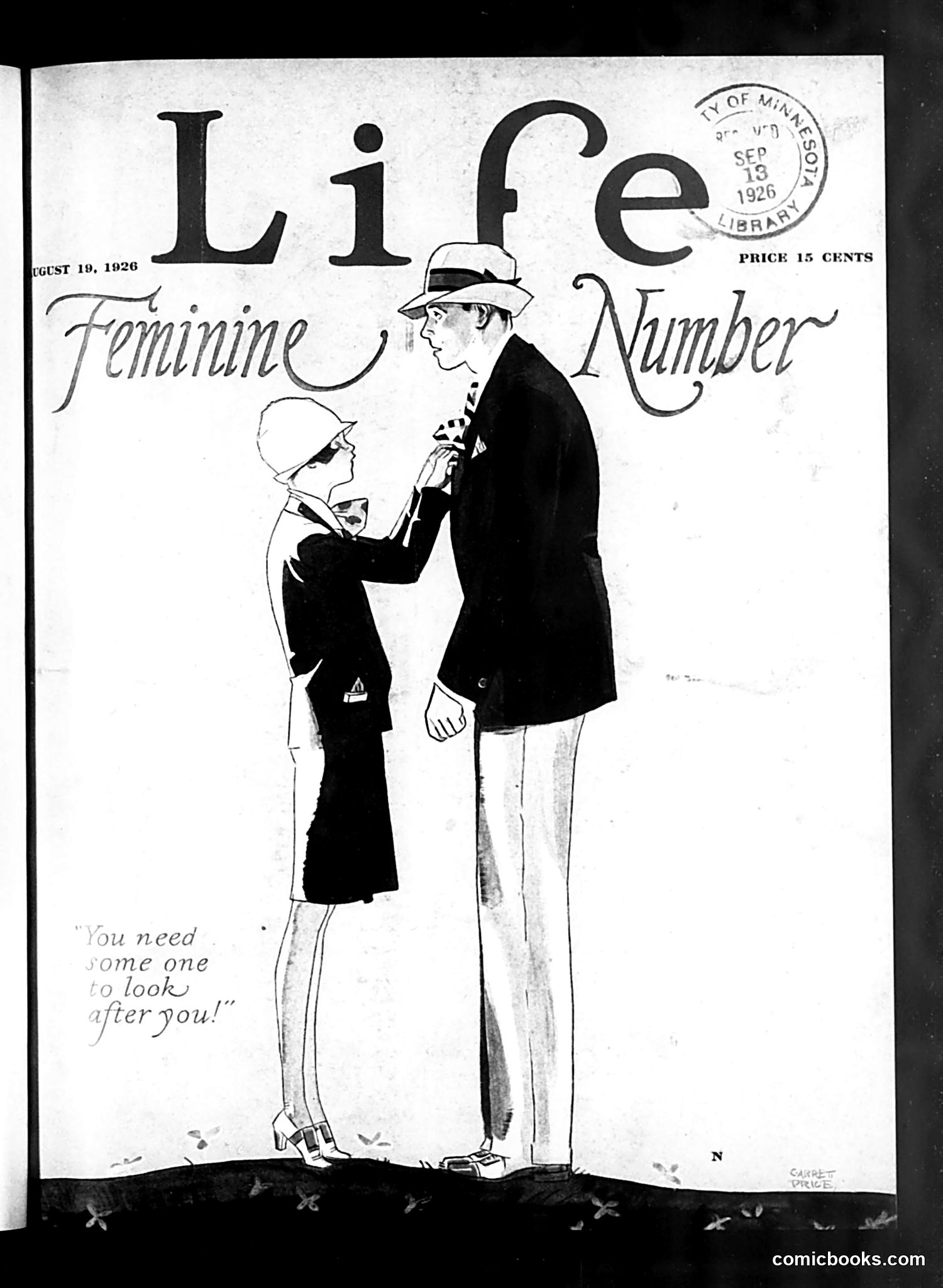
This is a "Feminine Number" cover featuring a satirical illustration of a small woman in a suit and hat adjusting the tie of a tall man, with the caption "You need some one to look after you!" The image plays on gender role reversal humor popular in the 1920s. The diminutive woman positioned as the caretaker of an adult man satirizes the era's evolving debates about women's independence and changing domestic relationships. The "Feminine Number" designation suggests the issue highlighted women's topics. The exaggerated height difference and the woman's confident posture emphasize the absurdity of the scenario, likely poking fun at either newly independent women or shifting gender dynamics during this period of social change. The joke relies on audience expectations about traditional gender roles.
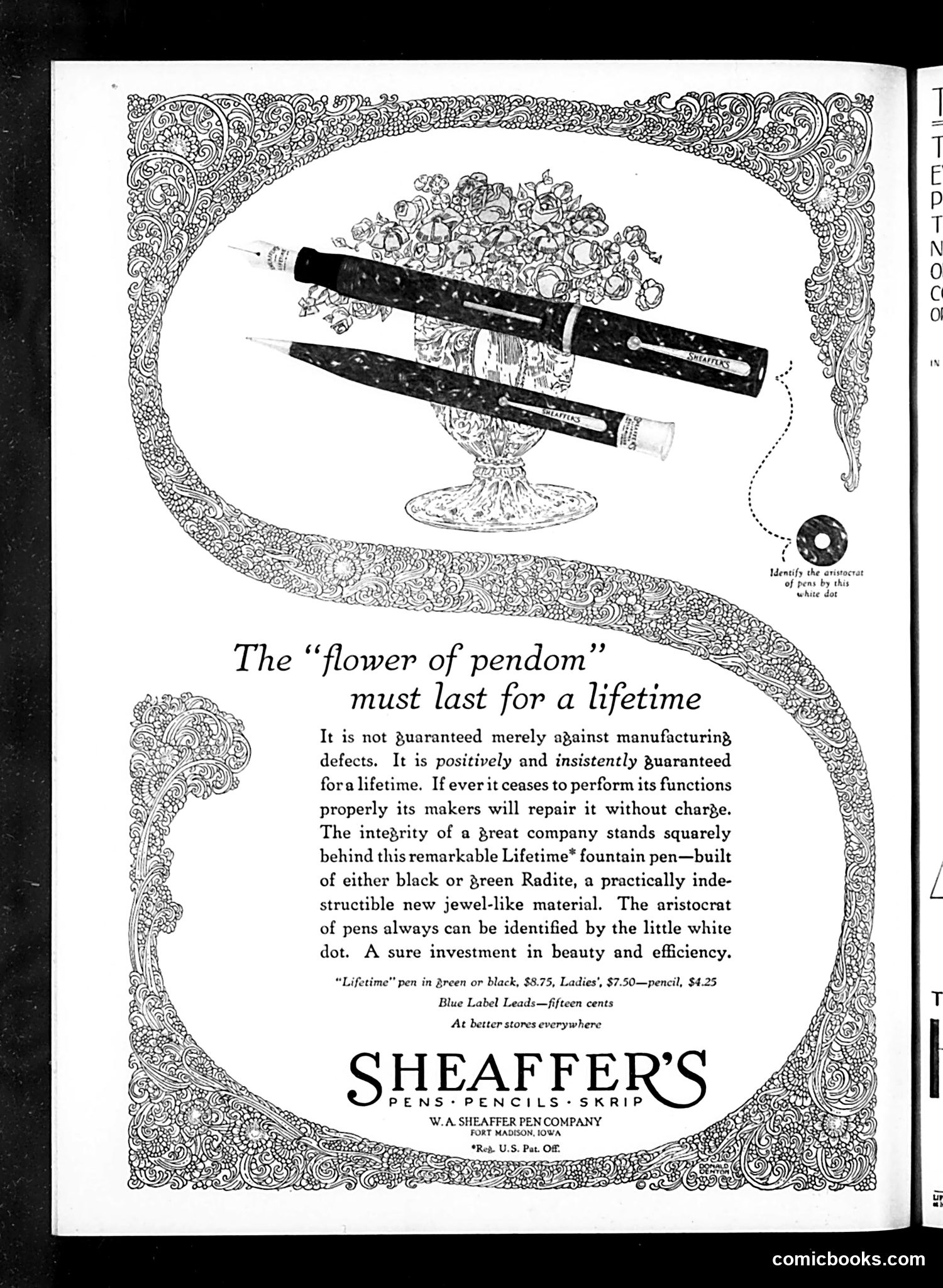
This page is **primarily a Sheaffer fountain pen advertisement**, not political satire. The ad features an ornate decorative border and shows two black pens crossed over an illustration of flowers in a vase. The text emphasizes the "Lifetime" guarantee—the pen will be repaired free if it malfunctions. The marketing hook targets affluent consumers by positioning the pen as a luxury item ("aristocrat of pens") made from Radite material, identifiable by a white dot. There is **no political cartoon or satire present**. This is straightforward 1920s-era commercial advertising emphasizing product durability and prestige to justify its premium price ($8.75 for the pen, $7.50 for ladies' models). The ornamental design reflects the era's aesthetic preferences for classical elegance in advertisement design.
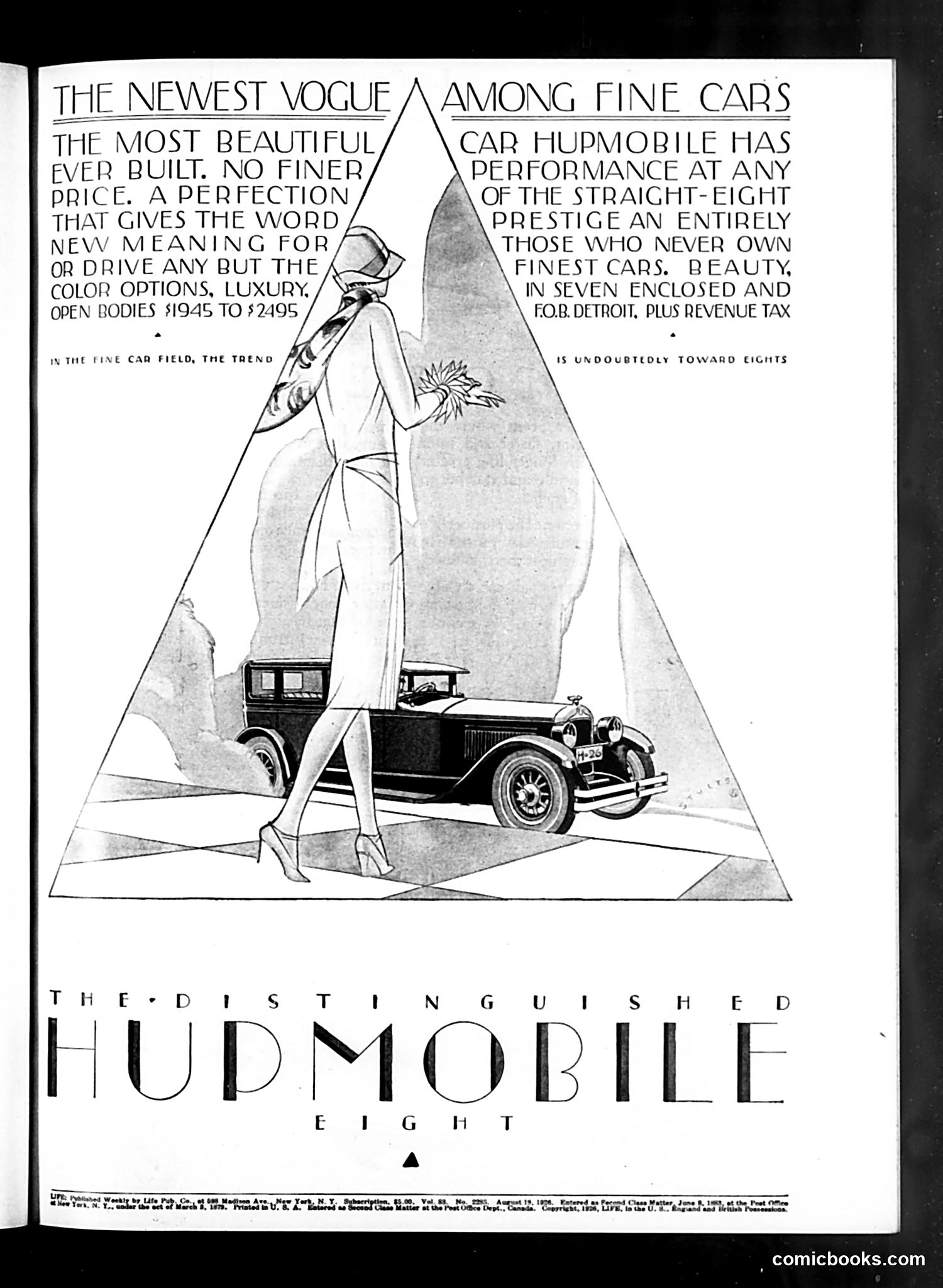
This is a **Hupmobile automobile advertisement**, not political satire. The page promotes the Hupmobile "Eight," a luxury car priced $1,945-$2,495. The image depicts a fashionable woman in 1920s attire (short dress, long legs prominently displayed) posed beside the automobile. This reflects period advertising conventions: associating cars with glamour and aspirational lifestyle. The text emphasizes luxury features and performance of the straight-eight engine, positioning the car as exclusive—for owners of "finest cars" only. The woman's fashionable presentation serves as visual appeal to attract wealthy buyers, typical of Jazz Age advertising that linked automobiles with modernity and sophistication. This is purely commercial messaging, not commentary or satire.
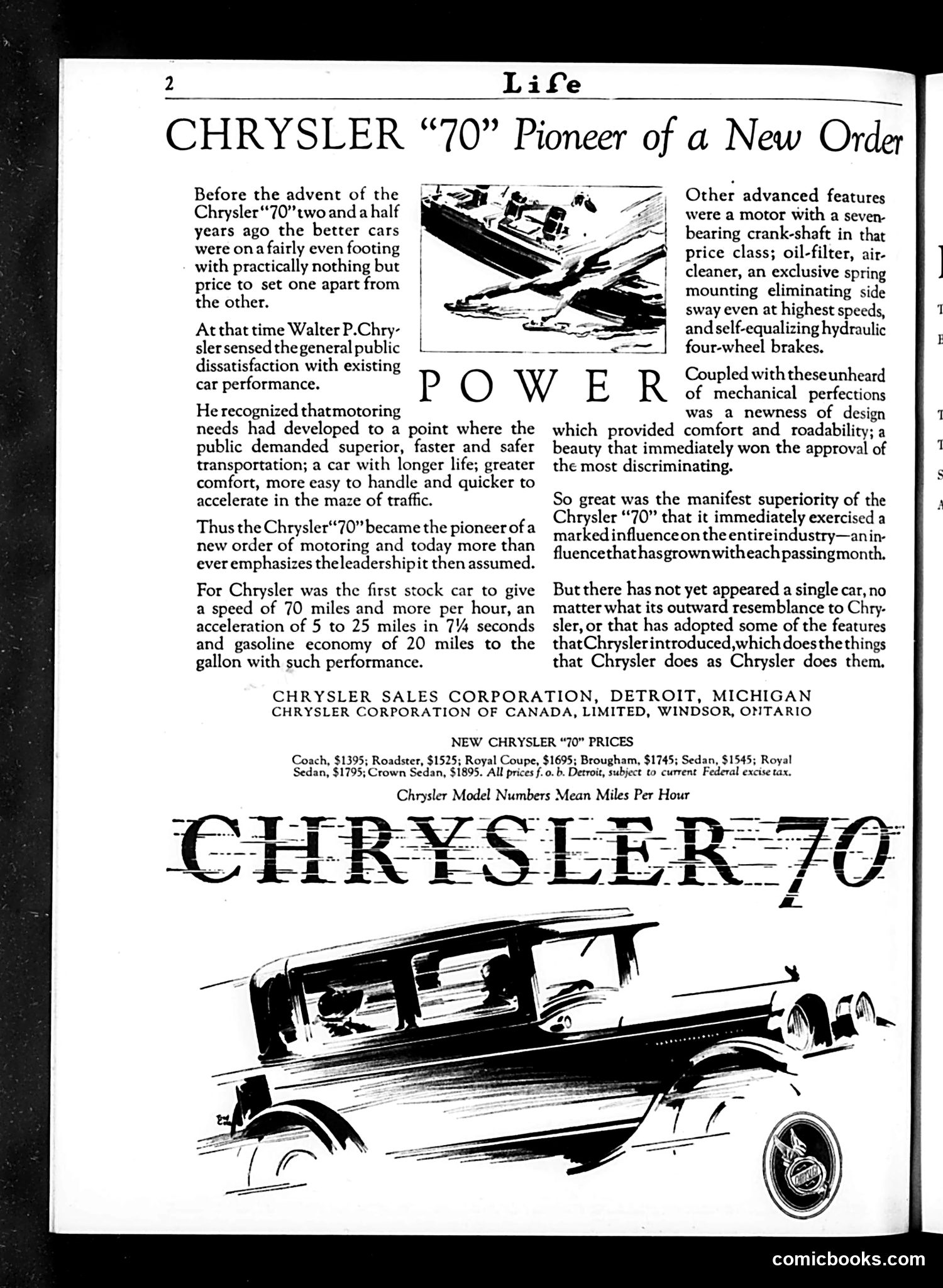
This is primarily **advertising content, not satire or political commentary**. The page promotes Chrysler's "70" automobile model, presented as a revolutionary advancement in automotive design and performance. The text emphasizes the car's technical innovations—seven-bearing crankshaft, oil-filter, hydraulic brakes—and superior performance metrics (70 mph speed, 20 mpg fuel economy, 5-25 mph acceleration in 7.5 seconds). Walter P. Chrysler is credited as recognizing public demand for better cars and pioneering this "new order" of motoring. The advertisement claims the Chrysler 70's superiority was so significant it influenced the entire automotive industry. The illustrated car and wheel are product showcases, not satirical imagery. This appears to be a standard corporate advertisement from Life magazine's early era.
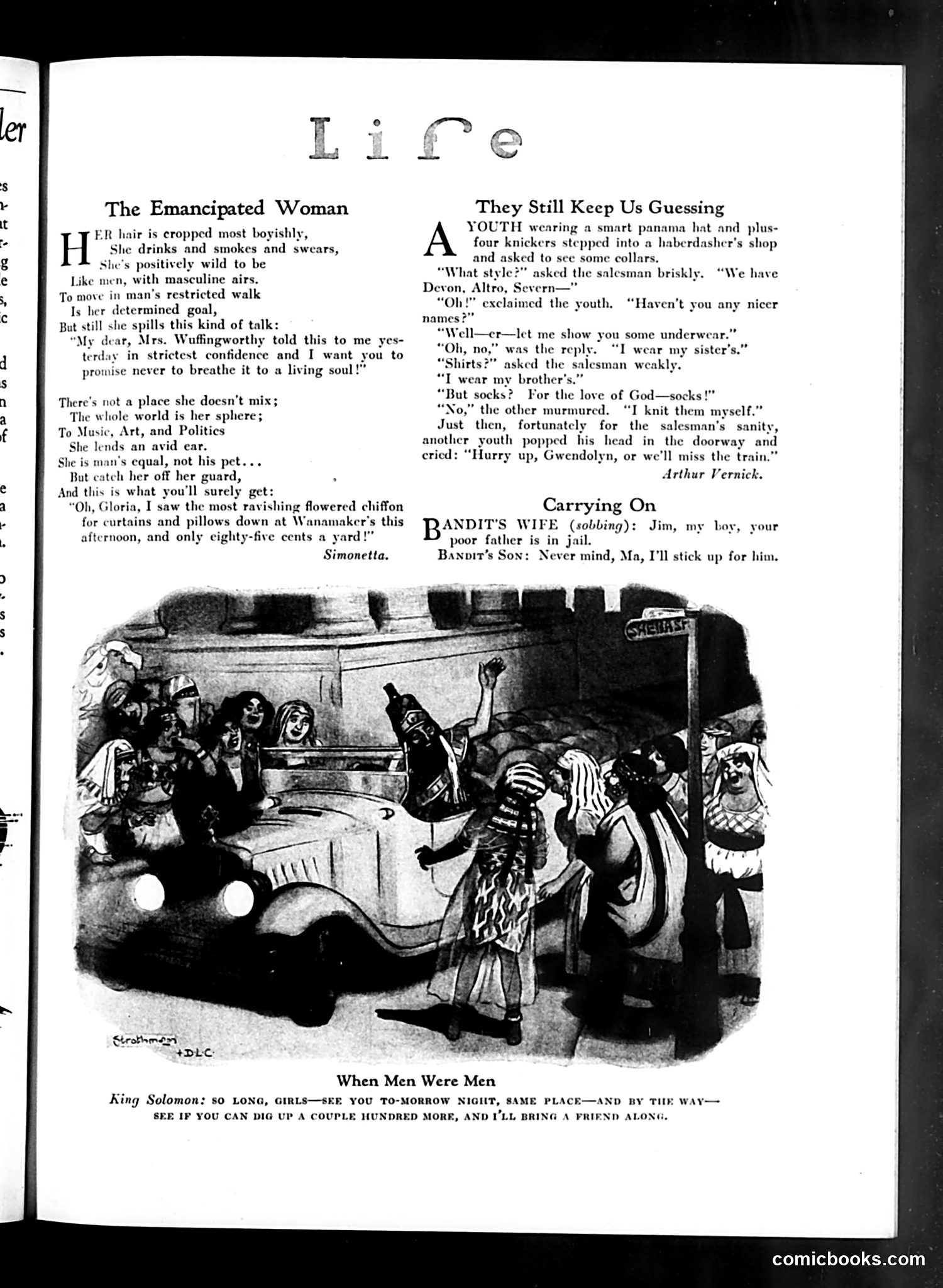
This page contains three separate satirical pieces: **"The Emancipated Woman"** mocks women's increasing social independence—bobbed hair, smoking, drinking, and intellectual pursuits. The satire suggests such behavior violates traditional femininity. **"They Still Keep Us Guessing"** features a humorous retail exchange where a young man struggles to name clothing items, implying youth are either ignorant or evasive about fashion details. **"Carrying On"** and **"When Men Were Men"** use contrasting titles to satirize changing gender roles. The cartoon shows people around a car in what appears to be celebratory or chaotic scene, suggesting nostalgia for an earlier, more orderly era when "men were men"—a common 1920s complaint about modern social transformation and loosening moral standards. The page collectively satirizes early 20th-century social upheaval, particularly women's liberation and generational shifts.
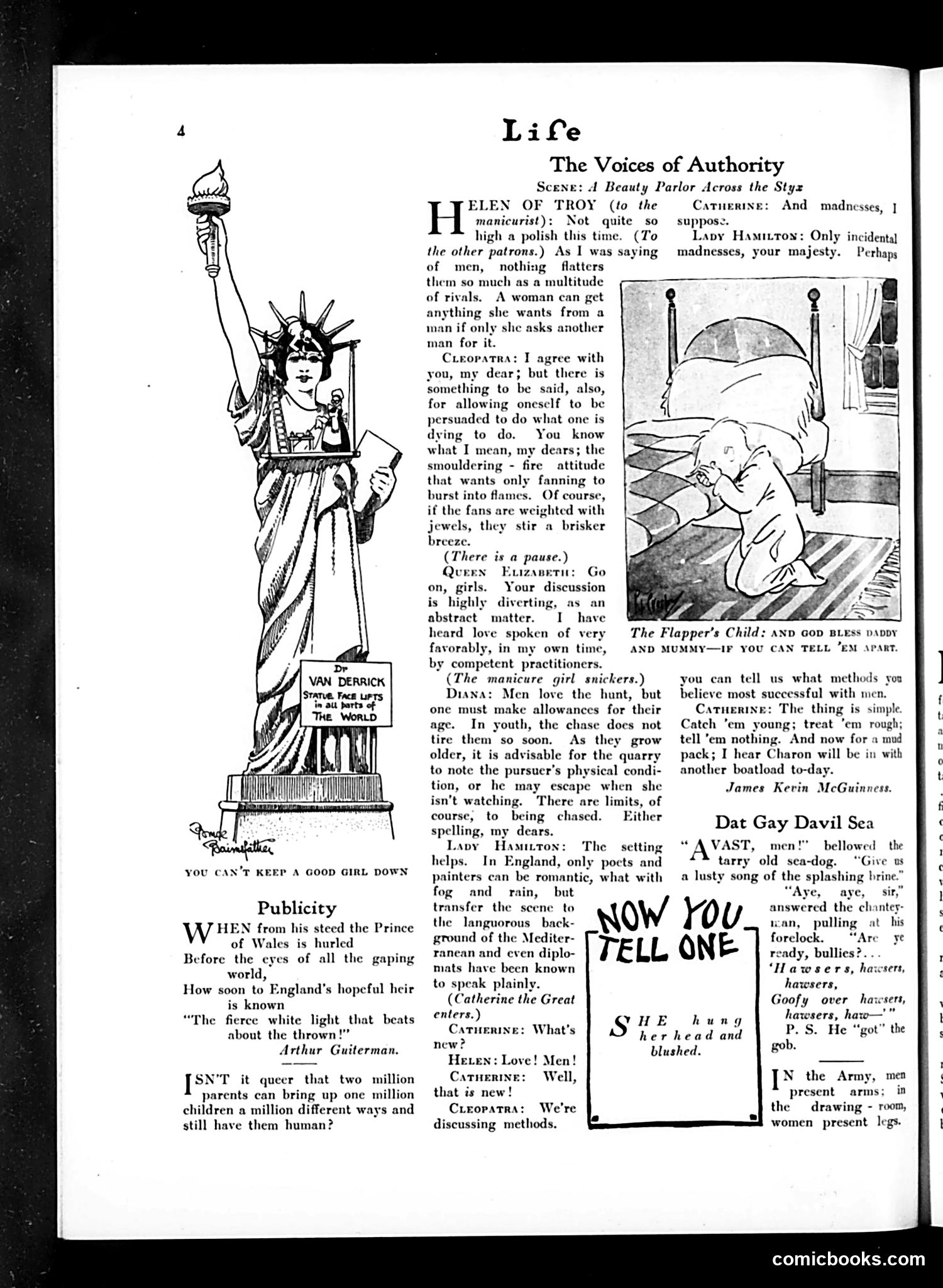
**The Statue of Liberty Cartoon ("You Can't Keep a Good Girl Down")** This Van Derrick illustration depicts the Statue of Liberty as a flapper—a 1920s young woman with bobbed hair and modern dress. The cartoon satirizes concerns about changing female behavior and independence during this era. The "good girl" reference suggests anxiety about women's liberation from traditional constraints, with Liberty herself embodying this cultural shift. The title's double meaning (can't suppress women's newfound freedoms) reflects the Jazz Age debate over women's roles. **Other Content** The page includes theatrical dialogue and a piece titled "Dat Gay David Sea" describing sailors. The overall content reflects 1920s social commentary on gender roles, modernization, and generational conflict typical of Life magazine's satirical approach.
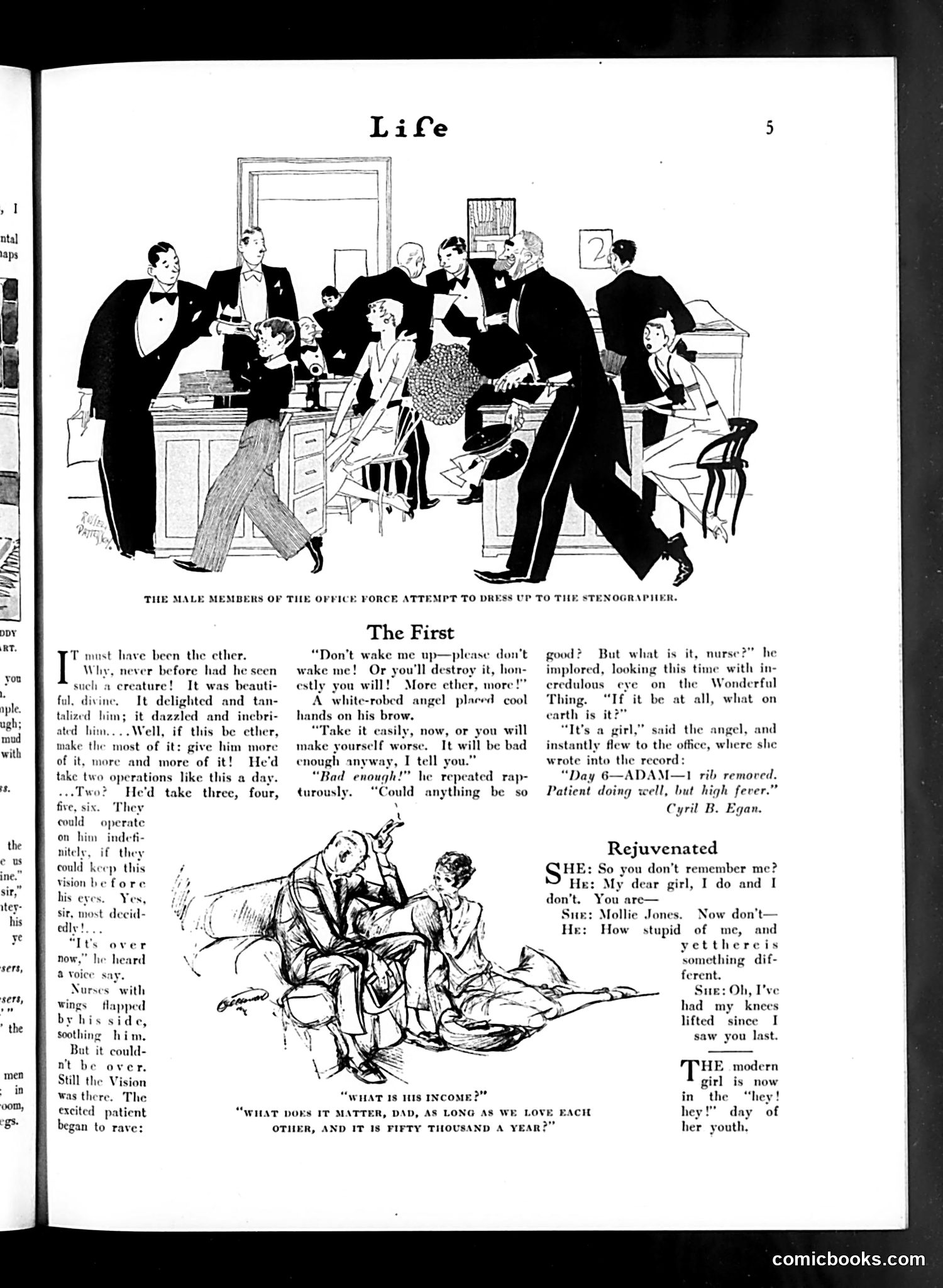
This page from *Life* magazine satirizes early 20th-century office culture and gender dynamics. **Top cartoon**: Shows male office workers attempting to "dress up" a stenographer (female typist). The humor targets workplace gender relations—the men are literally trying to make her more presentable or "refined," suggesting condescension toward working women and the male gaze in professional settings. **"The First" story**: Depicts a man encountering an angel, playing on Victorian sentimental literature while mocking romantic idealization. The angel's exchange about income—"fifty thousand a year"—sardonically suggests that even spiritual encounters cannot escape materialist concerns. **"Rejuvenated"**: A brief comedic dialogue between former lovers who've aged, playing on nostalgia and physical decline, typical of *Life*'s light humor about aging and memory. The overall tone mocks both workplace hierarchies and romantic sentimentality of the era.
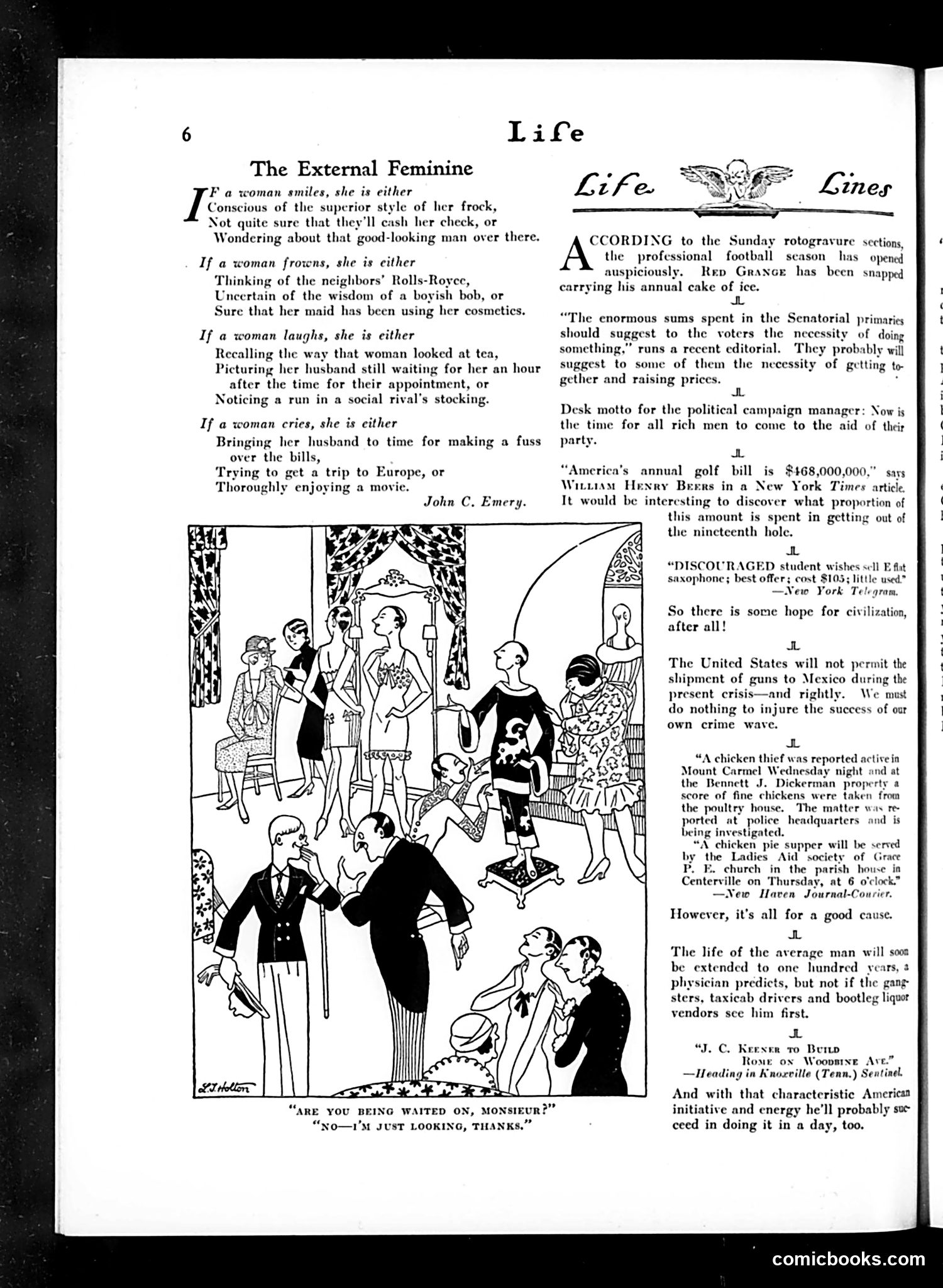
This page contains satirical commentary on 1920s American society. "The External Feminine" by John C. Emery mocks women's behavior through exaggerated observations—women supposedly either obsess over luxury cars, worry about gossip, or create domestic drama. The main cartoon depicts a formal social gathering where a woman in striking black attire appears to be the center of attention. The caption reads: "ARE YOU BEING WAITED ON, MONSIEUR?" / "NO—I'M JUST LOOKING, THANKS." This appears to satirize either a woman's aggressive social dominance or confusion about service roles at such events. The "Life Lines" section offers brief satirical quips about politics, wealth, and social behavior typical of the era's urbane humor. The overall tone mocks both modern women's independence and upper-class pretension.
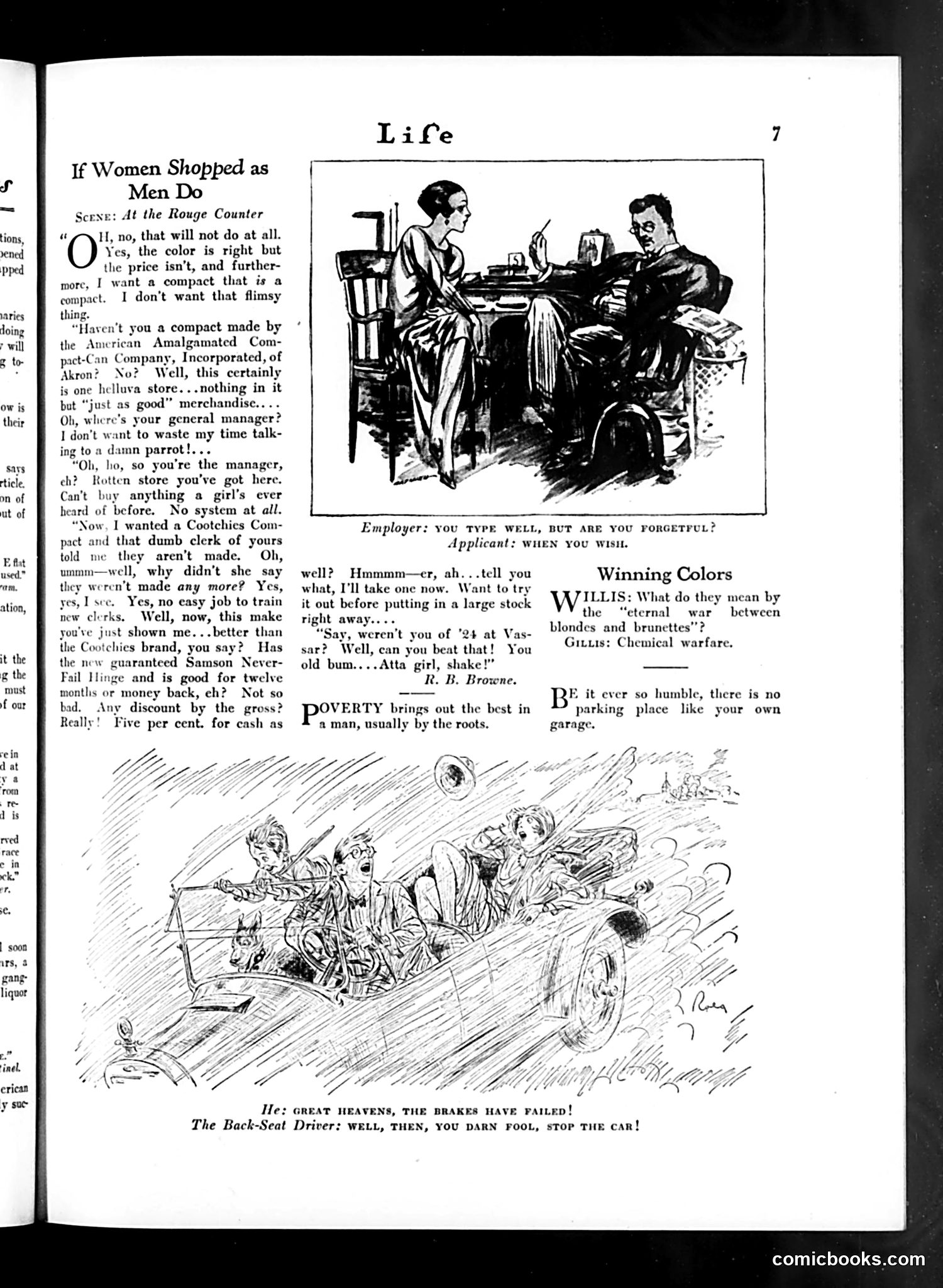
This page contains two satirical pieces about gender and social behavior: **Top cartoon** ("If Women Shopped as Men Do"): Shows a woman at a store counter negotiating with a male clerk. The satire mocks how men allegedly shop—the woman demands a "compact" item and haggling over price and quality, treating shopping as transactional rather than leisure-focused. The dialogue suggests men are practical, demanding customers who resist sales tactics. **Bottom cartoon** ("The Back-Seat Driver"): Depicts a car with multiple passengers encountering brake failure. The satire targets the "back-seat driver"—a passenger who gives unsolicited driving advice. When actual danger occurs, the backseat passenger panics rather than helping, highlighting the uselessness of backseat criticism. Both pieces use gender stereotypes to humorously critique contemporary social behaviors.
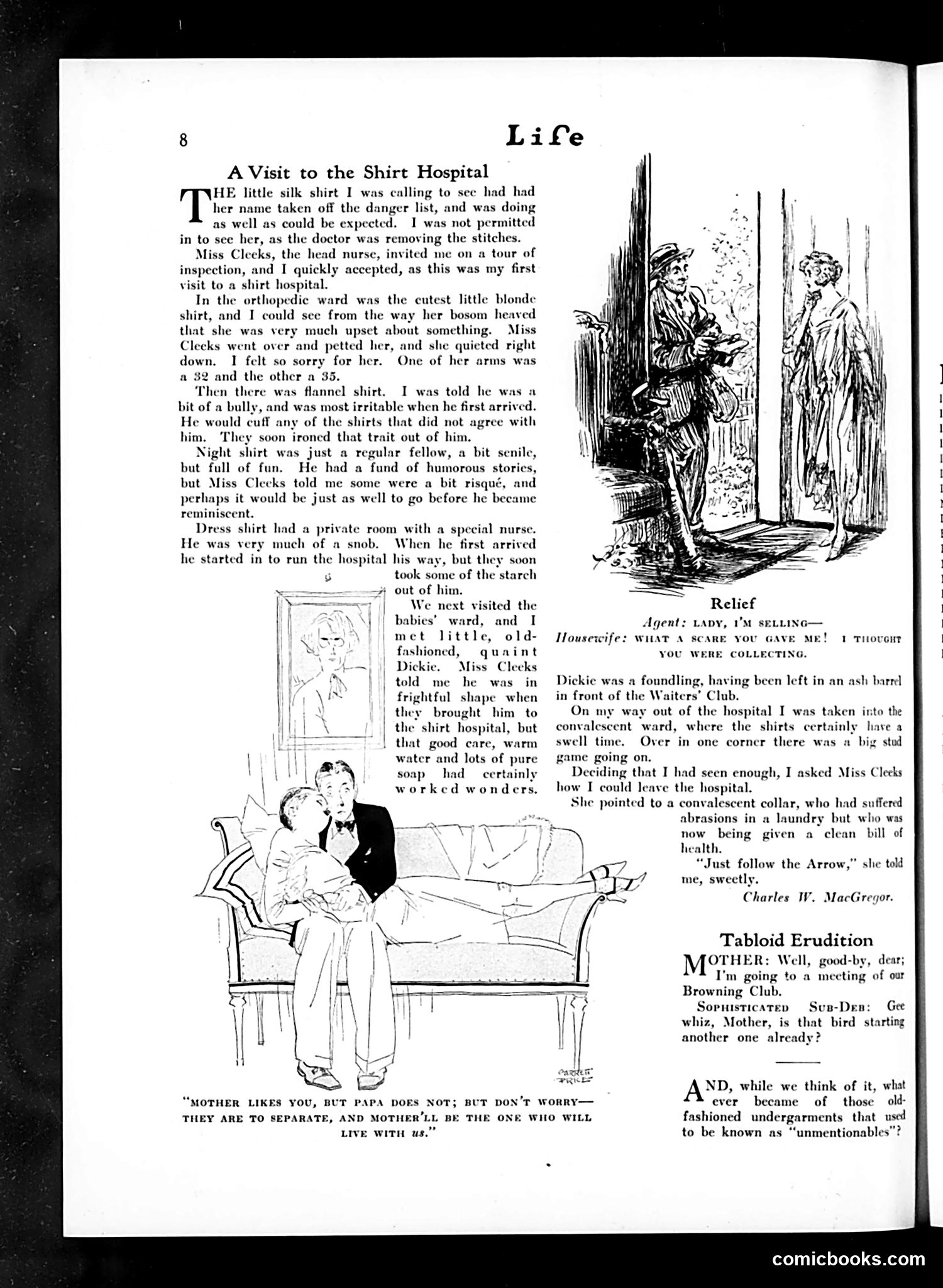
This page contains three separate pieces of humorous content typical of early 20th-century Life magazine: 1. **"A Visit to the Shirt Hospital"** - A satirical narrative about taking a damaged silk shirt to a specialized laundry service. The humor derives from treating shirt repair with the formality of medical care, complete with a "head nurse" (Miss Cleeks) conducting ward tours. 2. **The illustration** shows a nurse with a patient, playing on the hospital metaphor. 3. **"Relief"** - A brief joke about a housewife selling items to avoid collecting charity during hard times, with social commentary on pride and economic hardship. 4. **"Tabloid Erudition"** - A joke about outdated undergarments, playing on generational fashion differences. The page reflects concerns about laundry services, domestic economy, and social class anxieties of its era.
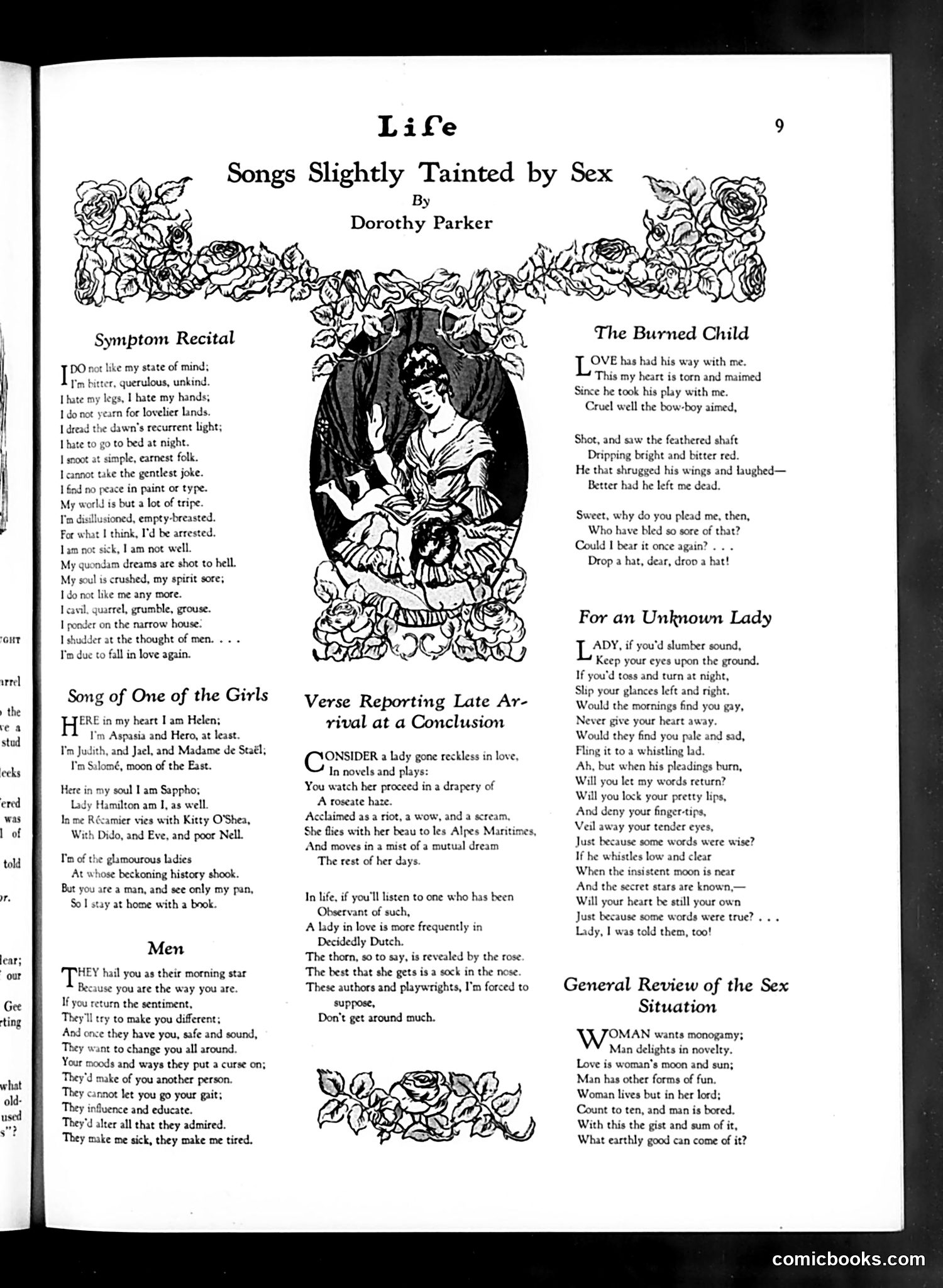
This page presents satirical poems by Dorothy Parker addressing gender relations and romantic disappointment. The content reflects 1920s social anxieties about changing gender roles. The poems mock both sexes: "Men" critiques male inconstancy and emotional manipulation, while "The Burned Child" presents a woman scorned by a boy who played with her affections. "For an Unknown Lady" satirizes feminine emotional vulnerability and romantic obsession. The centerpiece illustration depicts a woman with a cherub or cupid figure, typical Art Deco imagery for romantic/sexual themes. "General Review of the Sex Situation" concludes the piece by noting the fundamental incompatibility between men and women—men seek variety while women want monogamy—suggesting marriage itself is a doomed compromise. The satire targets both genders' emotional contradictions and the era's romantic/marital tensions.
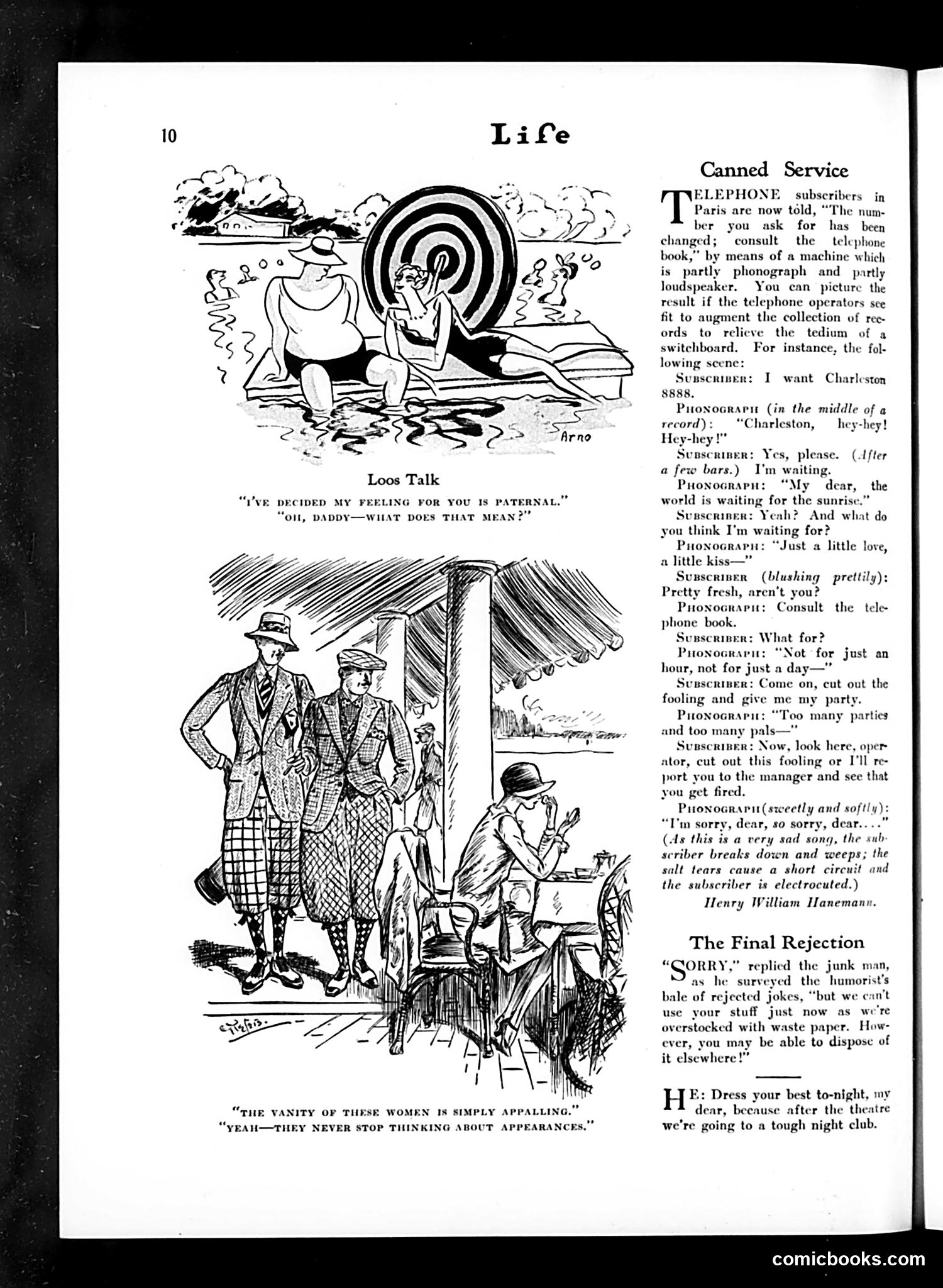
This page contains three separate humorous pieces: 1. **"Canned Service"**: A satirical description of a Parisian telephone service that uses phonographs and loudspeakers to deliver pre-recorded responses. The joke mocks automated customer service—a subscriber asking for "Charleston 8888" receives only canned romantic phrases instead of helpful assistance. The satire critiques both modern technology's inadequacy and the absurdity of mechanized human interaction. 2. **"Loos Talk"**: A cartoon depicting men in hats discussing women's vanity, with the caption about women never stopping to think about appearances—ironic commentary on gender stereotypes and vanity. 3. **"The Final Rejection"**: A brief anecdote where a junk dealer rejects humorous material, comparing it to "waste paper," suggesting publishers were oversaturated with such content. The page satirizes modern technology, gender stereotypes, and the publishing industry circa the 1920s.
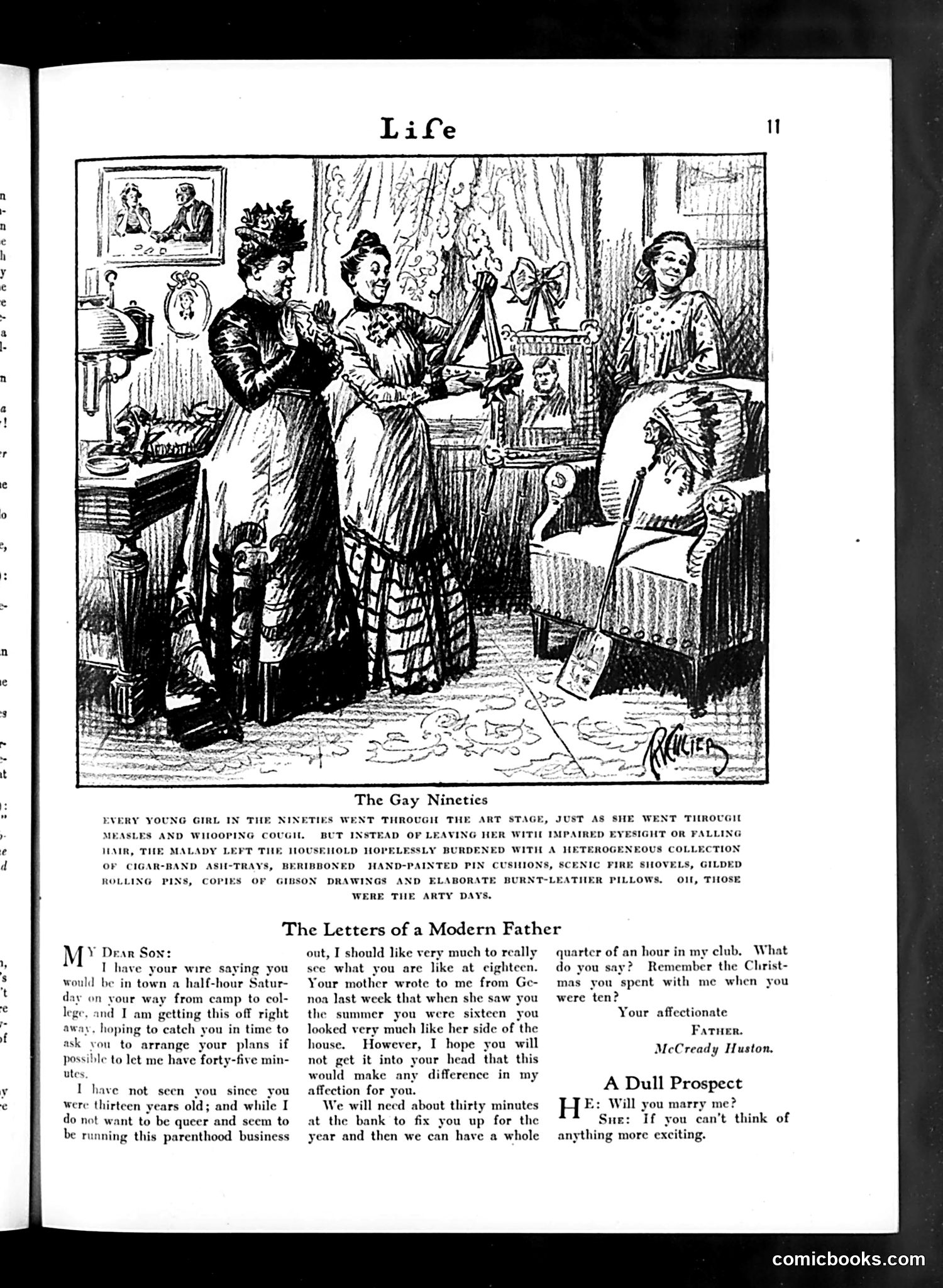
This illustration satirizes upper-class women's behavior in the 1890s. The caption explains that young women of that era underwent an "art stage" (pretending to be cultured), but instead of developing refined taste, they burdened their households with tasteless decorative clutter—cigar-band ashtrays, hand-painted pins, Gibson Girl drawings, and burnt-leather pillows. The cartoon depicts women displaying these gaudy items to each other in an ornate parlor, treating mass-produced "art" as sophisticated. The satire targets both the women's pretensions to culture and the commercial exploitation of that pretension. It mocks 1890s consumer culture and the gap between aspiring to refinement and actual aesthetic judgment.
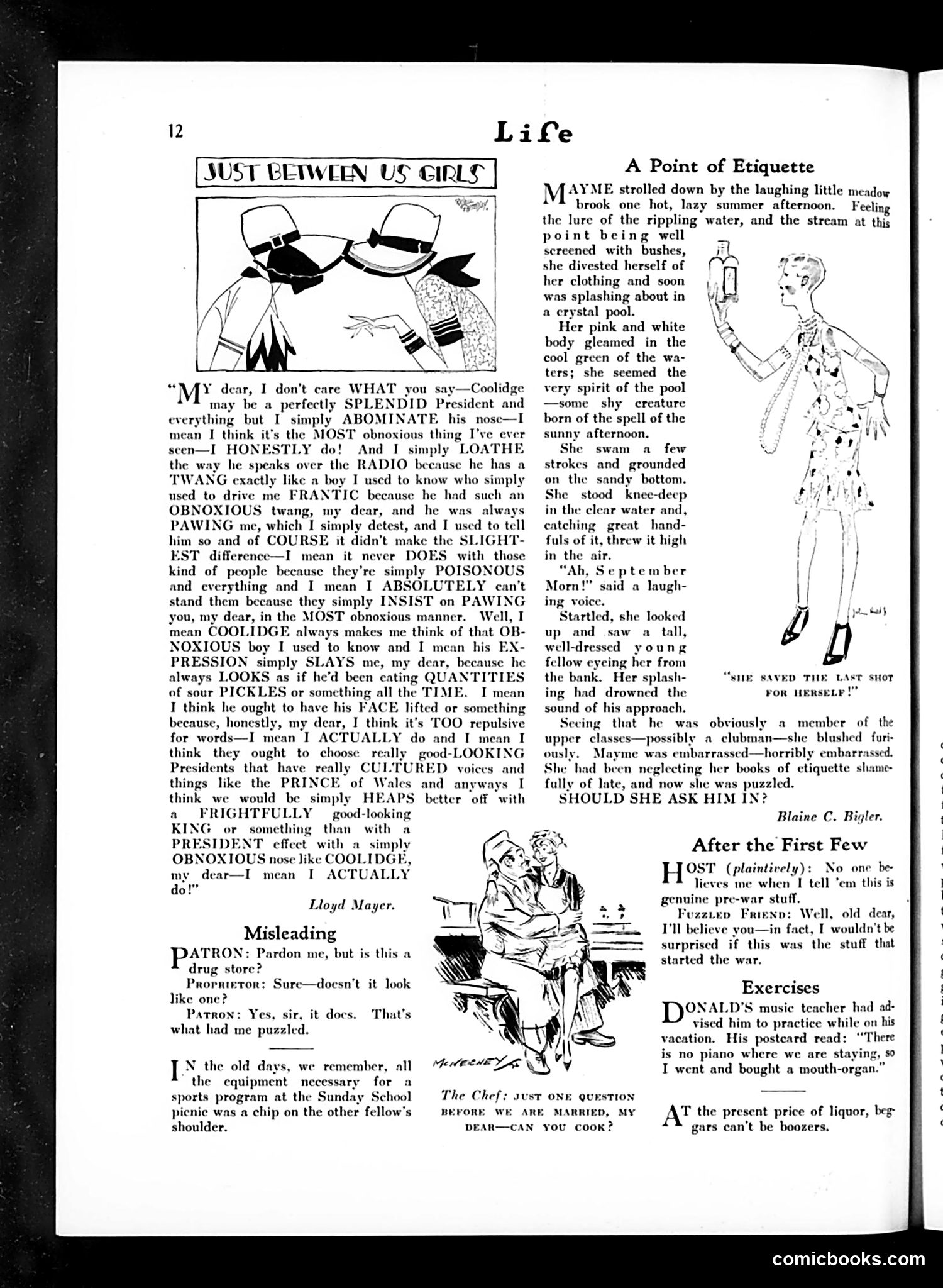
This section features a satirical letter from "Lloyd Mayer" complaining about a man's crude manners—specifically his nose-picking, loud behavior, and general lack of refinement. The writer contrasts this "obnoxious boy" with idealized "good-looking Presidents" and the "Prince of Wales," suggesting upper-class aspirations for masculine behavior. The accompanying illustration shows a young woman at a swimming hole encountering a well-dressed man on the bank, captioned "She Saved the Last Shot for Herbert"—likely a reference to Herbert Hoover, then president. Other brief items mock domestic life, WWI nostalgia, and social pretensions typical of Life magazine's humor circa the 1920s-30s.
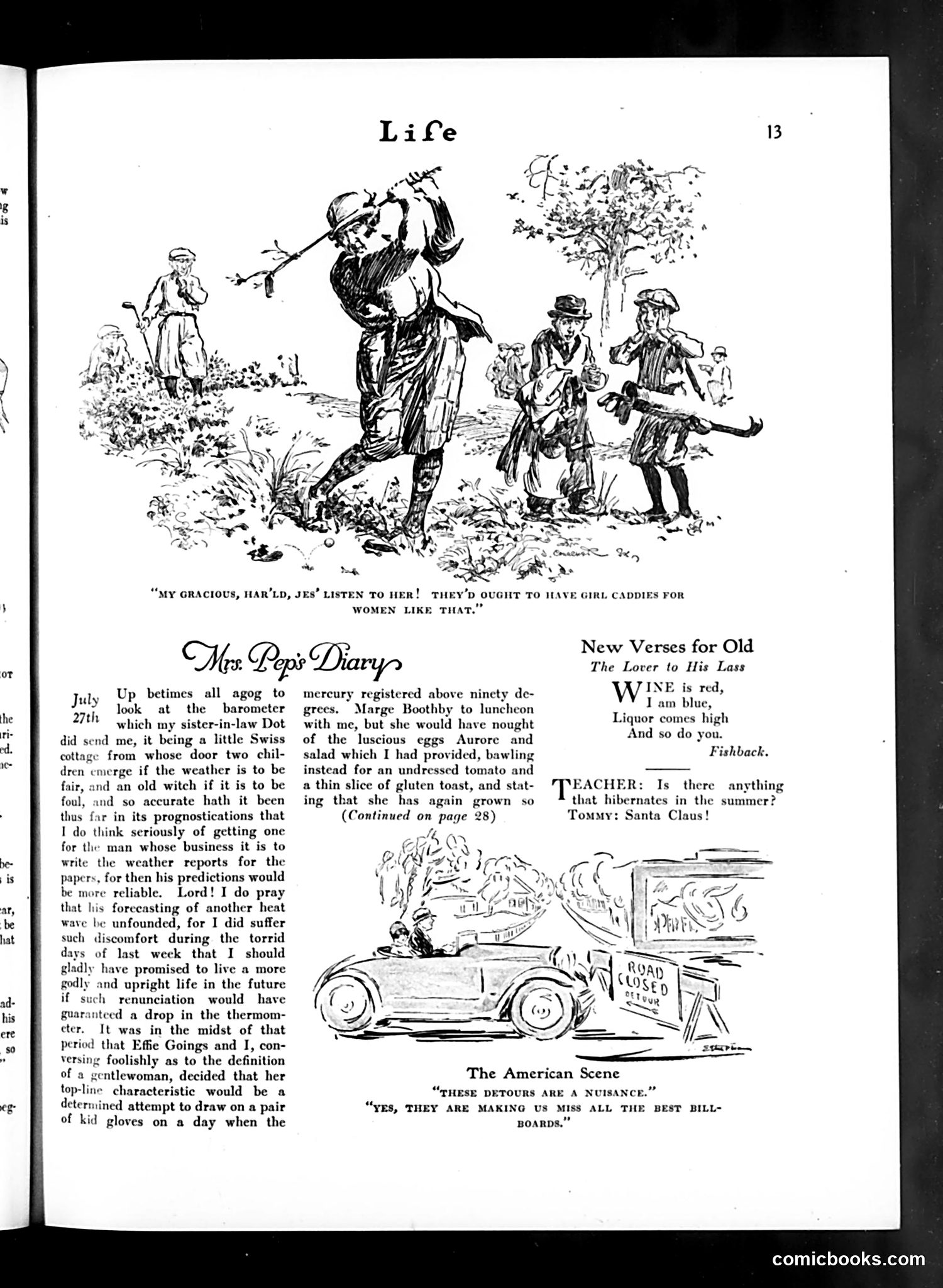
The top illustration shows a golfer mid-swing while other men watch, with the caption about "girl caddies for women." This satirizes early 20th-century gender norms—the joke appears to be that allowing women to employ female caddies (golf assistants) is somehow improper or noteworthy. **Mrs. Peps's Diary** is a gossip column about social activities and weather predictions. **"New Verses for Old"** offers humorous rewrites of classic poetry. **The American Scene** cartoon at bottom depicts a car encountering a "Road Closed" sign, with the caption mocking road construction detours as a nuisance blocking billboards. This satirizes American infrastructure frustration and the prevalence of roadside advertising during the automobile era.
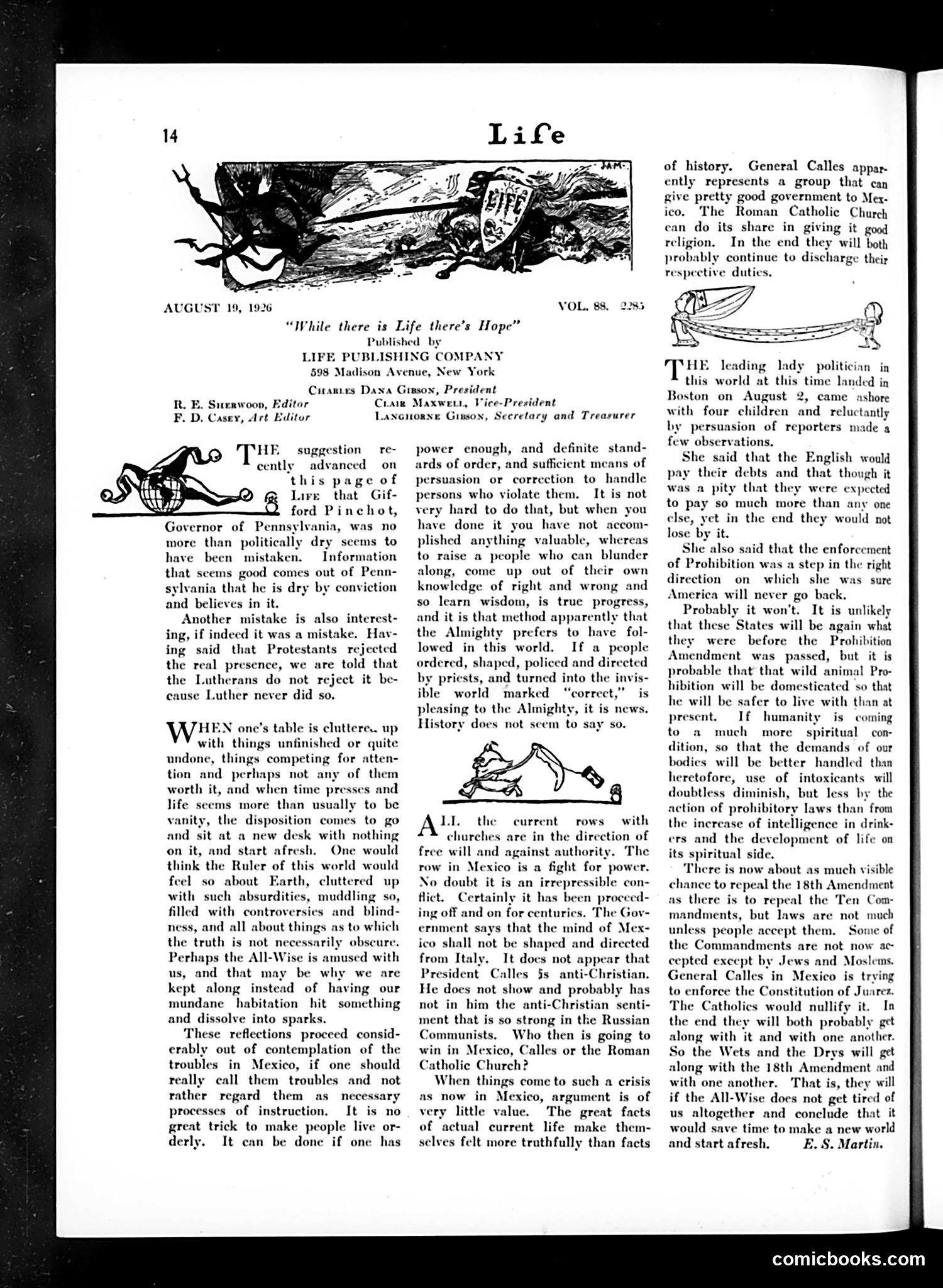
This page contains editorial commentary rather than traditional cartoons. The main visual elements are small decorative illustrations accompanying text essays. The content discusses Governor Gifford Pinchot of Pennsylvania and Mexican politics under President Calles. The editorial criticizes Pinchot's dry stance on Prohibition enforcement while acknowledging his political mistakes. The larger section addresses the religious and political crisis in Mexico, where President Calles is attempting to subordinate the Catholic Church. The author argues this conflict, combined with fighting over power and authority, makes Mexico unstable. The piece suggests these troubles stem from inadequate education rather than blaming Mexico itself, and questions whether America's own social stability might face similar challenges. The tone is analytical commentary rather than satirical humor.
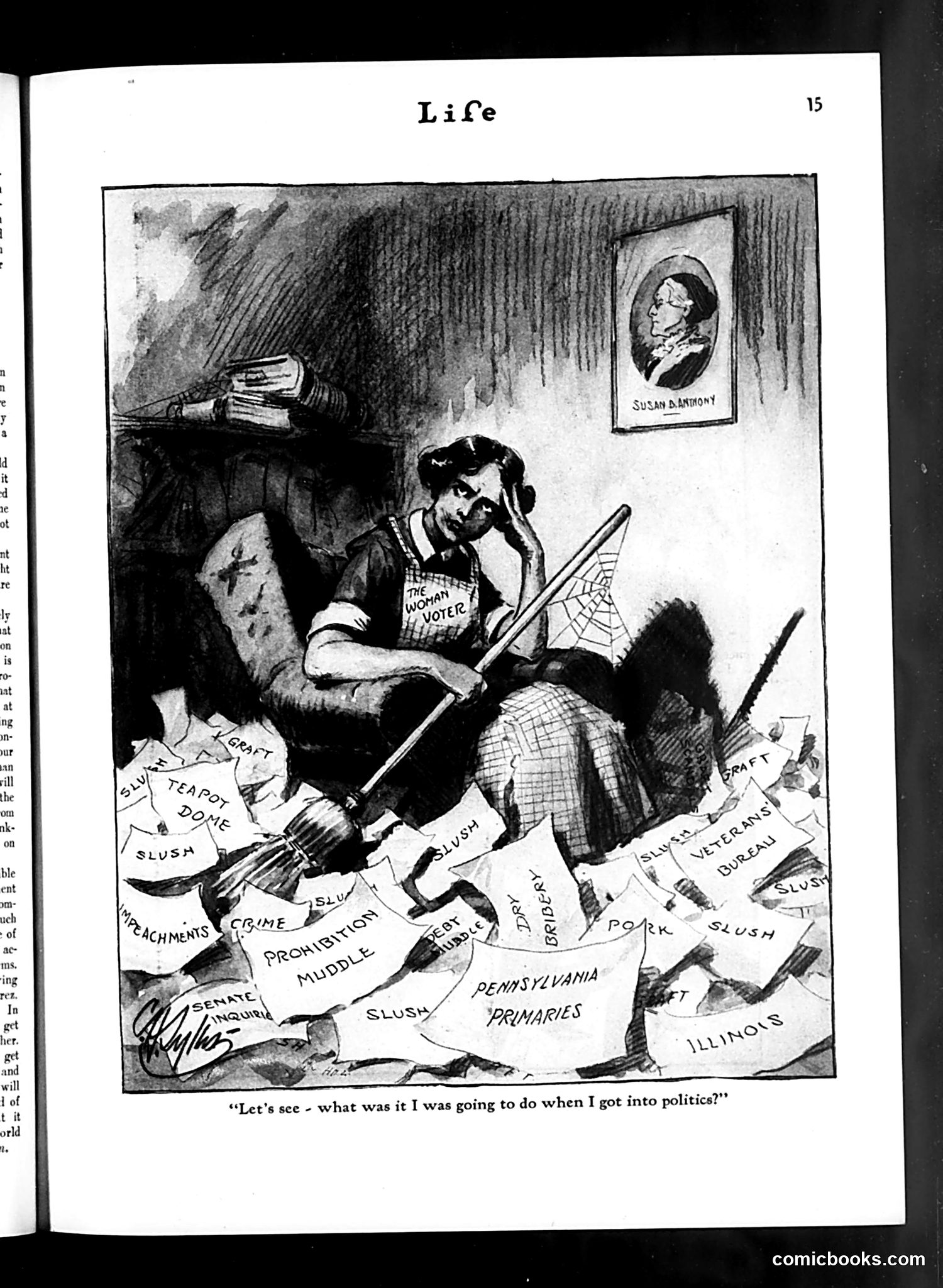
This cartoon satirizes a female politician's entry into politics, likely from the early 20th century based on the style. The figure labeled "The Woman Voter" sits amid scattered papers labeled with various political issues: "Slush," "Crime," "Prohibition," "Muddle," "Pennsylvania Primaries," "Pork Barrel," "Slum," and "Corruption." A portrait of Susan B. Anthony hangs on the wall, indicating this concerns women's suffrage and political participation. The cartoon suggests that newly enfranchised women entering politics encounter a chaotic mess of established problems and corruption. The caption—"Let's see—what was I going to do when I got into politics?"—implies the overwhelming complexity and disillusionment awaiting idealistic female voters confronting the realities of political systems.
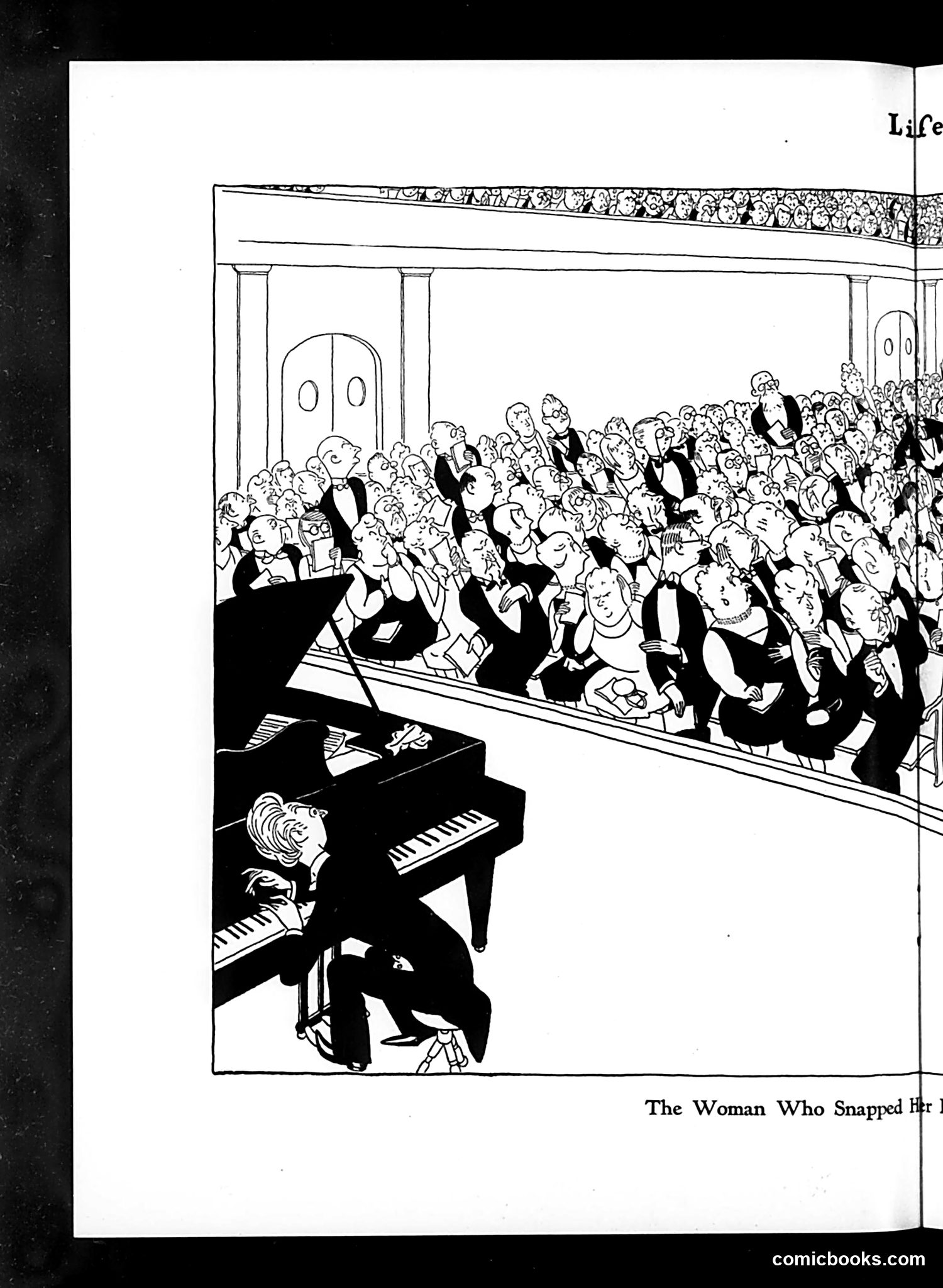
This cartoon illustrates a concert hall scene with a pianist performing for a formally dressed audience. The title suggests the cartoon satirizes a woman who dismissed or disrespected something—likely a musical performance or classical music itself. The humor appears to target either: - A woman who showed contempt for "high culture" (concert music), or - Someone who disrupted formal etiquette in an upper-class setting The detailed rendering of the crowded, elegant audience in formal wear emphasizes the pretentiousness of the scene. Without additional context about the original publication date or accompanying article, the specific reference remains unclear, but the satire critiques either cultural snobbery or violations of social convention among the wealthy elite.
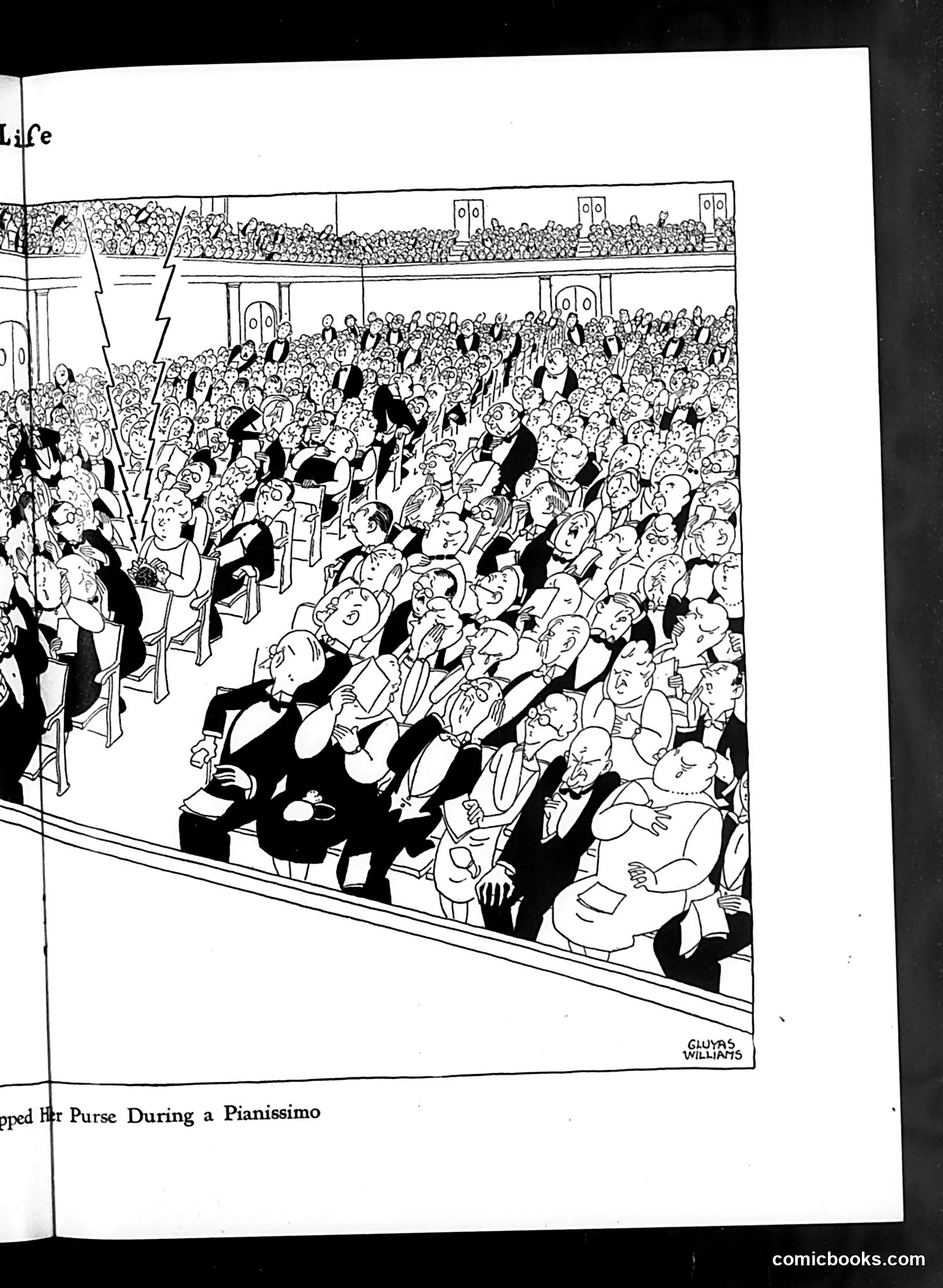
This cartoon by Gluyas Williams depicts a formal concert hall during a pianissimo (a very soft, quiet musical passage). A woman in the audience has dropped her purse, creating an embarrassing situation: the noise of the dropped purse would be conspicuously loud during the deliberately quiet musical moment, disrupting the performance and drawing attention to her clumsiness. The humor targets both the social awkwardness of the situation and the tension between refined cultural events (classical music concerts) and the mundane realities of everyday life. The packed hall, formal attire, and rapt audience emphasize how mortifying such an interruption would be during an intimate musical passage requiring complete silence from the audience.
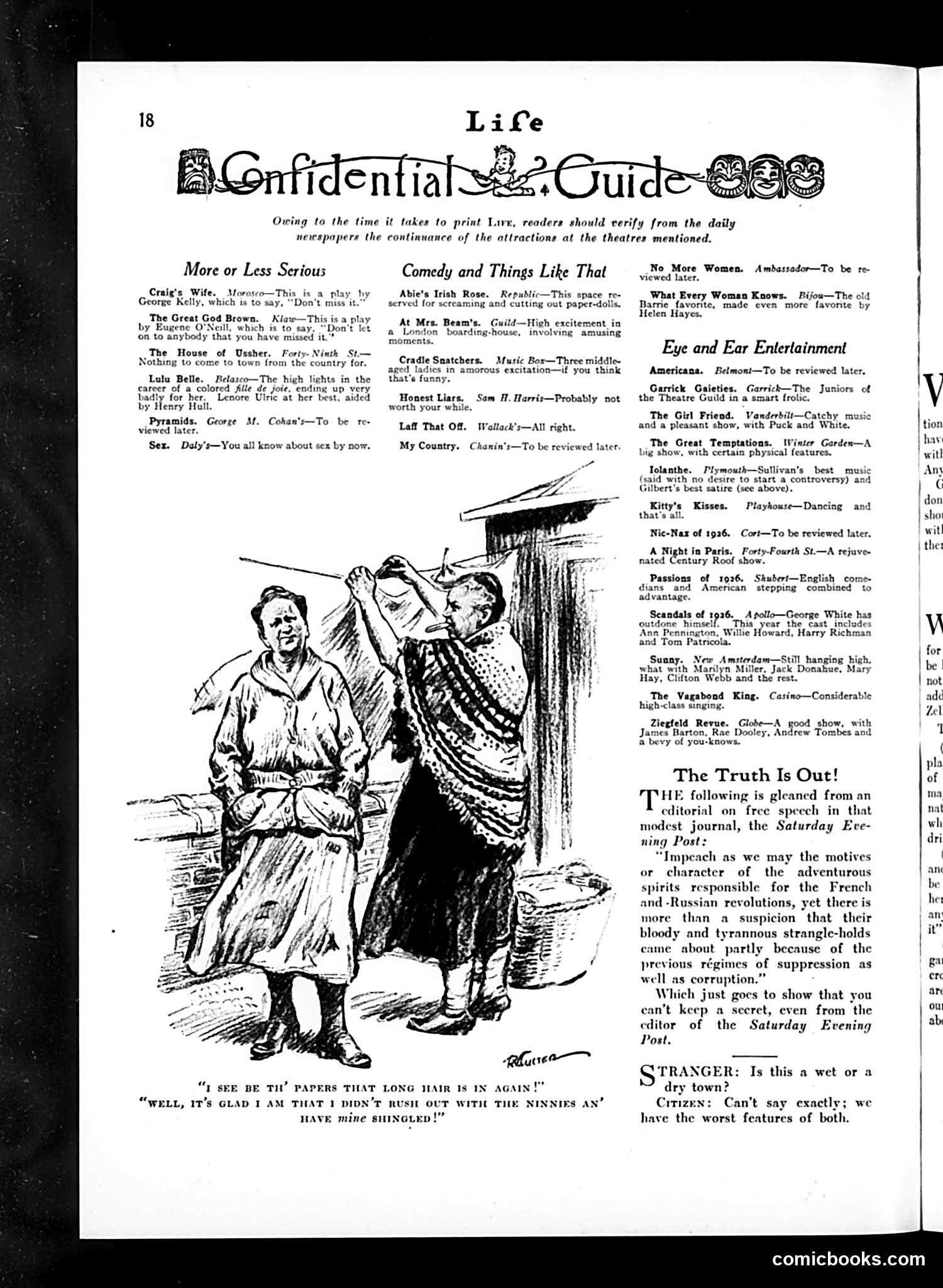
This page from Life magazine (appearing to be from 1926, based on show listings) contains a satirical cartoon about hair fashion and two separate joke formats typical of the era. ## The Main Cartoon The illustration depicts a woman confronting a barber or hairdresser about her appearance, with the caption commenting on long hair. The joke appears to satirize the "bob" hairstyle trend—women were cutting their traditionally long hair short, which was controversial. The woman's comment about not "rushing out with the ninnies" suggests she resisted this fashionable trend, implying that following it made women foolish. ## Additional Content Below are two brief joke exchanges—a common Life feature—offering satirical social commentary. One references the tension between "wet" (pro-alcohol) and "dry" (Prohibition) sentiment in American towns, a major political division of the 1920s. The page also lists theatrical reviews, reflecting Life's role as a cultural commentary magazine on contemporary entertainment.
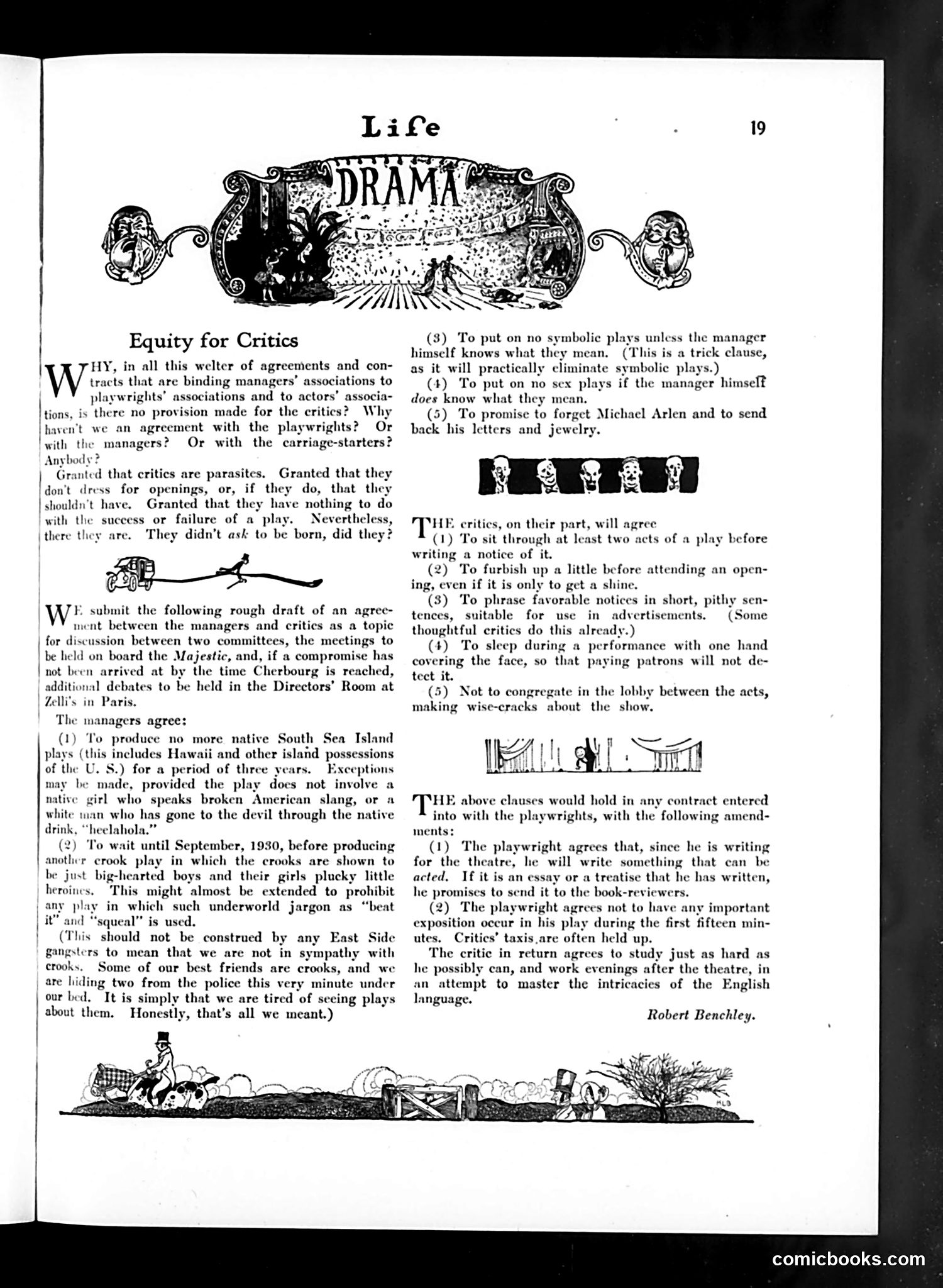
This satirical article proposes a mock labor agreement between theater managers, critics, and playwrights—mirroring the real union agreements binding these groups in 1920s theater. **The satire targets:** - **Playwrights** for churning out hackneyed plots: repetitive "South Sea Island" plays featuring noble natives and fallen white men; formulaic gangster films with sentimentalized criminals using slang like "beat" and "squeal" - **Critics** for their parasitic role: attending openings unprepared, sleeping during performances, making backstage wisecracks, while wielding power over shows' success - **Theater managers** and the entire labor system creating binding contracts for everyone *except* critics **The joke:** By proposing absurd "agreements"—managers eliminating clichéd plots, critics actually watching plays sober and well-dressed—Benchley satirizes how none of these groups will voluntarily improve. The theatrical world operates on mutual hypocrisy that no contract could fix.
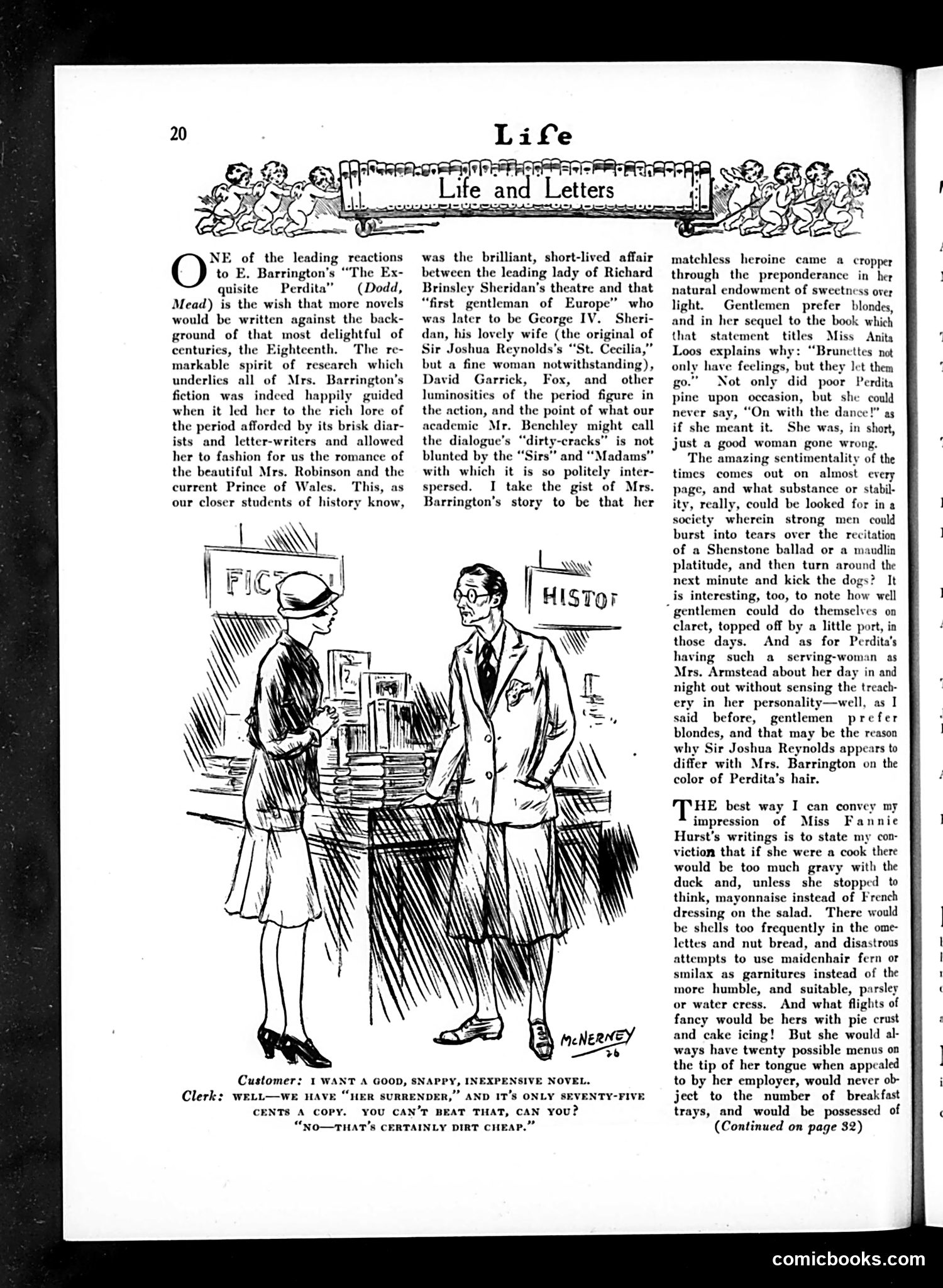
This page reviews E. Barrington's novel "The Exquisite Perdita," set in 18th-century England during the affair between actress Mrs. Robinson and the Prince of Wales (later George IV). The text praises the book's historical detail and notes its inclusion of famous figures like Sheridan and Garrick, while critiquing the heroine's excessive sentimentality as typical of the era. The single cartoon depicts a bookstore transaction: a customer seeks an inexpensive novel, and the clerk recommends "Her Surrender" for seventy-five cents, calling it "dirt cheap." The humor lies in the double meaning—the customer agrees it's cheap *and* morally/literally dirty, suggesting the book contains scandalous content. This satirizes both cheap pulp fiction's salacious appeal and the customer's frank acknowledgment of what "inexpensive" novels typically offer.
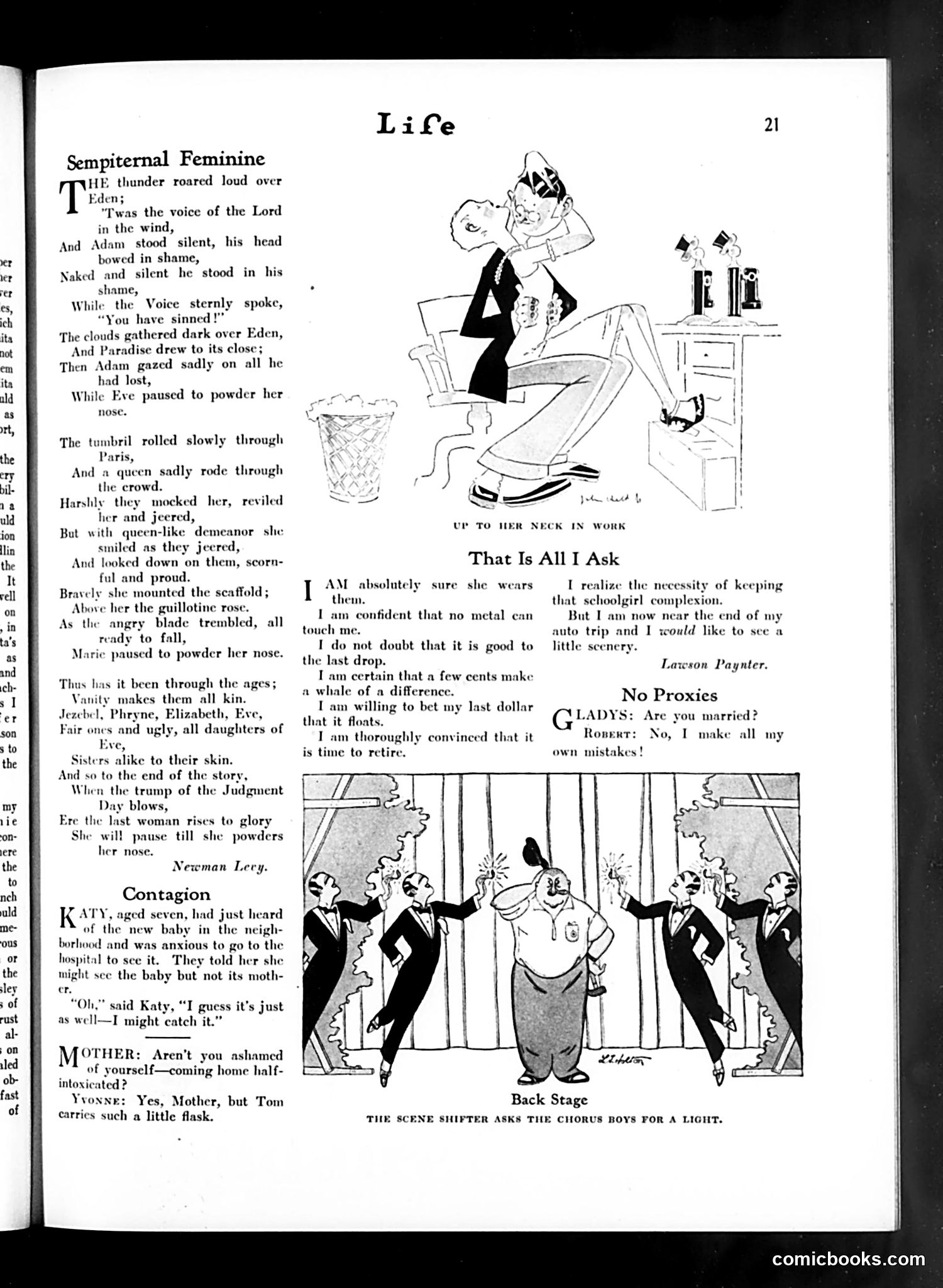
This page contains satirical poems and cartoons mocking various social conventions of the era. **"Sempiternal Feminine"** by Newman Levy is a poem suggesting that vanity—particularly women powdering their noses—transcends all circumstances, from Eve in Eden to Marie Antoinette facing the guillotine. The satire targets women's supposed preoccupation with appearance even in dire situations, comparing historical and biblical figures to suggest this trait is eternal and universal among women. **The cartoons below** depict everyday humor: a woman "up to her neck in work" managing household tasks; a "Back Stage" scene showing theater workers; and brief comic dialogues like "No Proxies" (a man claiming independence from a wife) and "Contagion" (jokes about childhood and drinking). These pieces reflect early 20th-century gender stereotypes common to *Life* magazine's satirical humor—mocking women's vanity, marital dynamics, and social pretensions through exaggeration and wordplay.
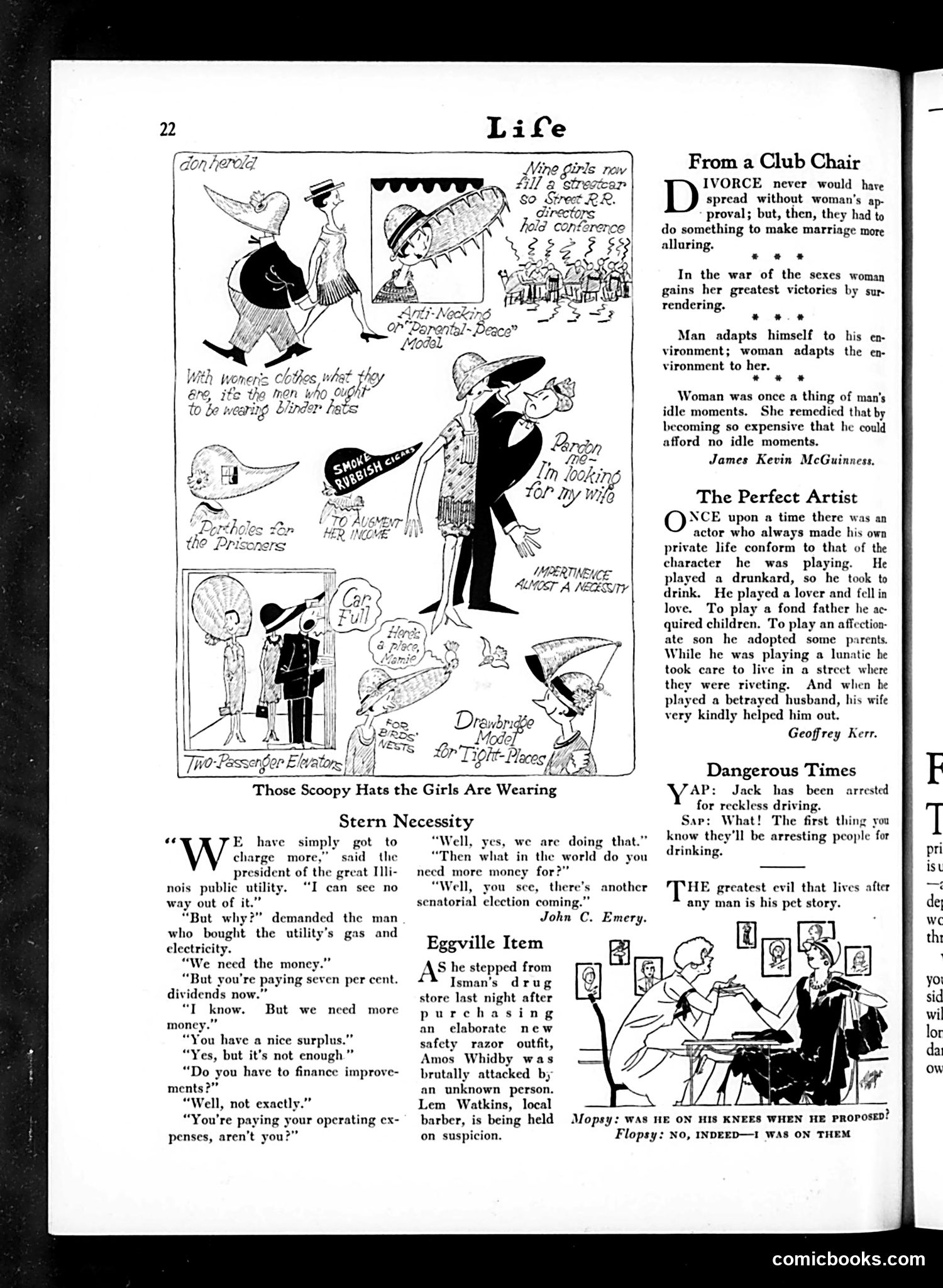
This page from *Life* magazine contains satirical commentary on early 20th-century American life: **"Those Scoopy Hats the Girls Are Wearing"** — A cartoon mocking fashionable women's headwear of the era, depicted through absurdist scenes showing impractical, oversized hats in various situations. **"Stern Necessity"** — A dialogue satirizing corporate greed. An Illinois utility company president demands rate increases despite already collecting 7% dividends and maintaining a surplus. The punchline reveals his true motive: funding a senatorial election—exposing how corporations influence politics through financial contributions. **"Eggville Item"** — A darkly humorous news brief: a barber is arrested after a customer buying a new razor is attacked. The satire suggests barbers feared losing business to safety razors, implying the barber may have committed the assault. The right column contains brief aphorisms about gender relations, marriage, and human nature—typical *Life* filler content offering cynical observations on contemporary social dynamics.
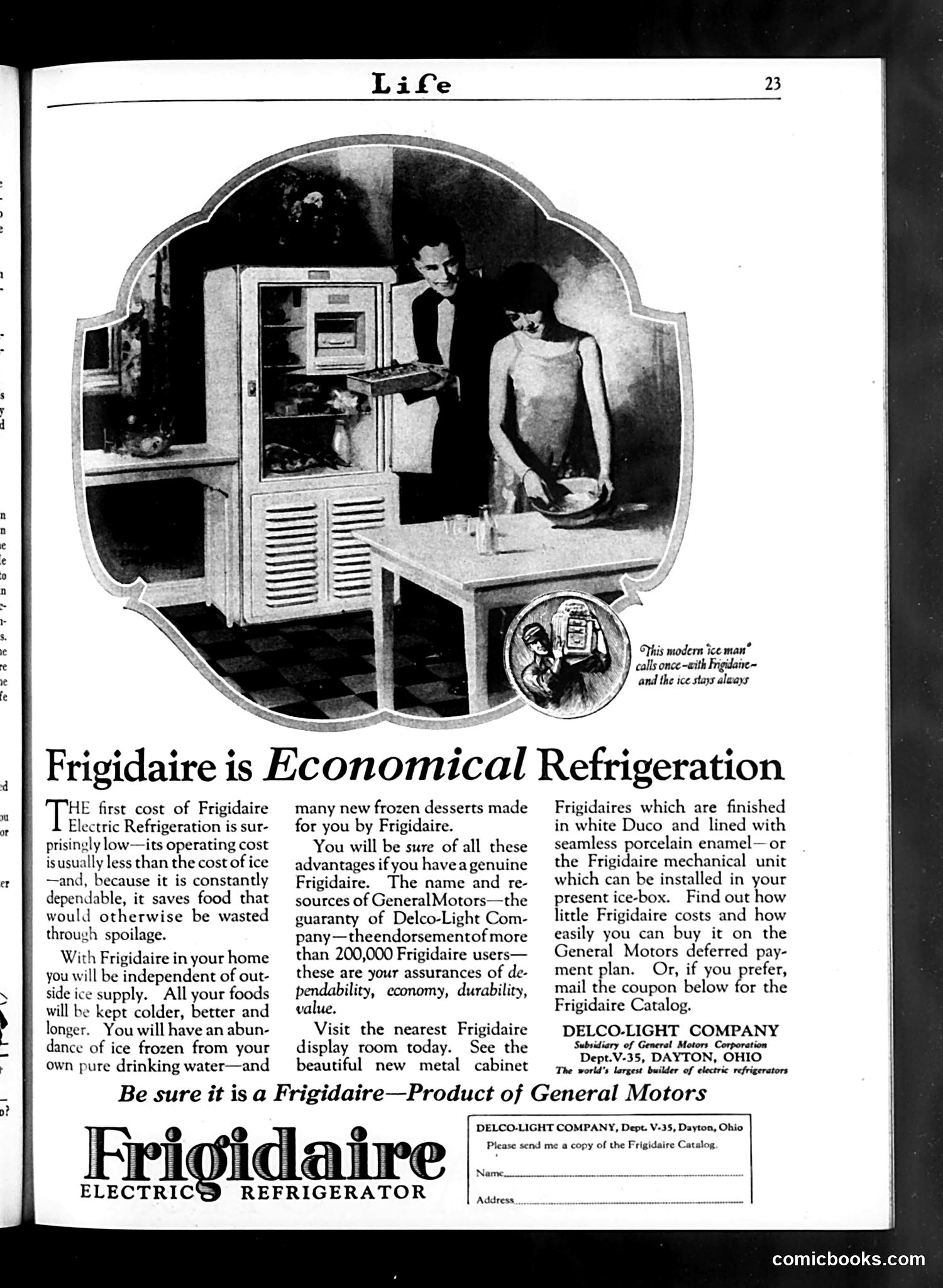
This is primarily a **Frigidaire electric refrigerator advertisement**, not political satire. The small circular inset labeled "This modern ice man calls once with Frigidaire—and the ice stays always" references the **transition from manual ice delivery to electric refrigeration**. The joke targets the traditional "ice man"—a real occupation where workers delivered large blocks of ice to homes for ice boxes. The ad's point: with Frigidaire, you no longer need frequent ice deliveries; the appliance makes its own ice automatically. The main image shows a modern family using their new electric refrigerator, positioned as a technological advancement that eliminates dependence on outside suppliers. For contemporary readers, this represents the early-20th-century shift from hand-delivered ice to electric cooling—a genuine disruption to the ice delivery industry. The ad emphasizes economic advantages (lower operating costs than ice) and modernity, appealing to consumers seeking independence and convenience. This is purely commercial messaging, not editorial commentary or satire.
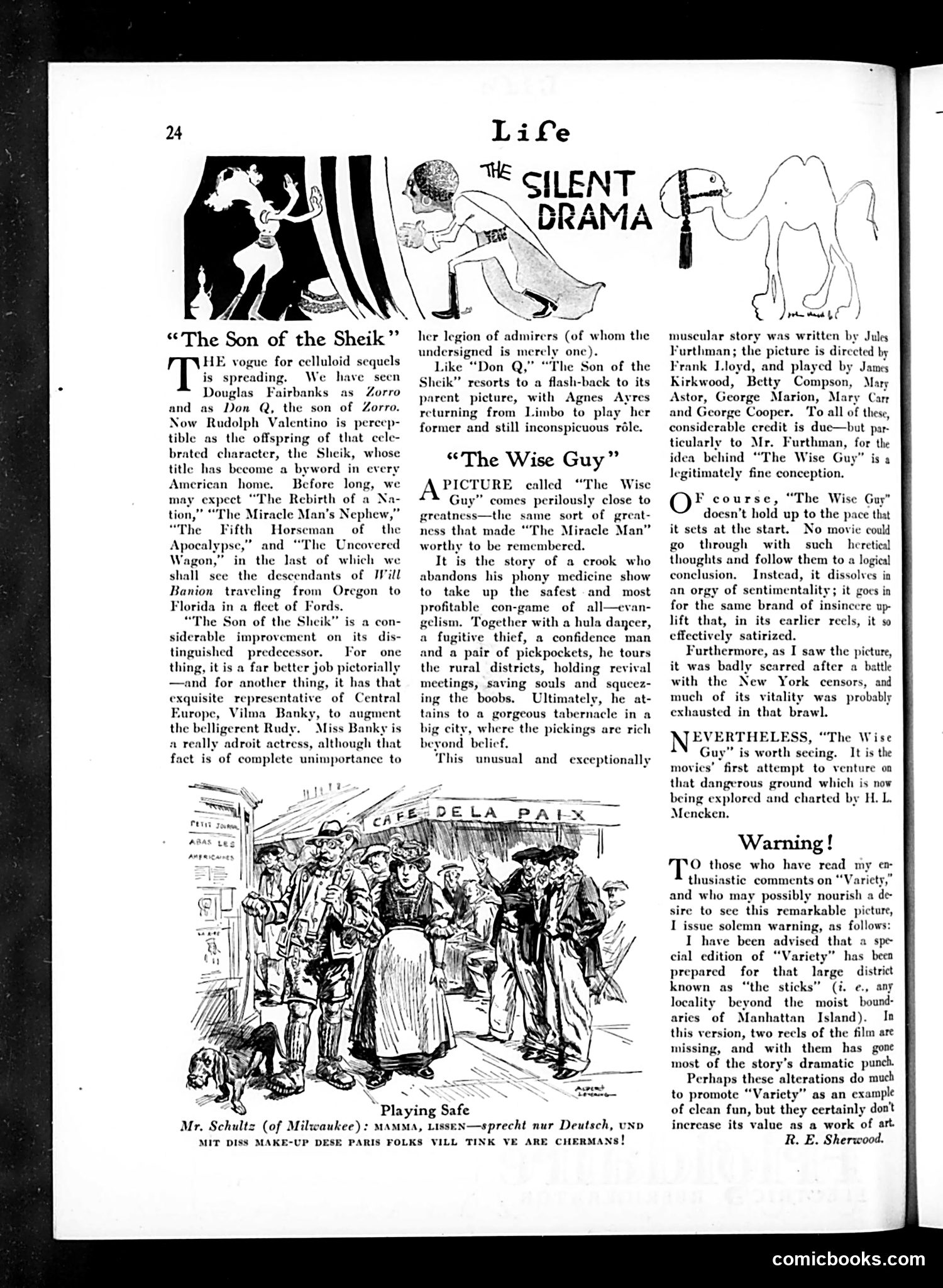
This page reviews three silent films while satirizing 1920s cinema trends. **"The Son of the Sheik"** mocks Hollywood's sequel obsession—the vogue for spinning off successful pictures. The magazine jokes that if this trend continues, we'll soon see absurd sequels like "The Fifth Horseman of the Apocalypse" and "The Uncovered Wagon." Rudolph Valentino stars in this follow-up to the popular "Sheik." **"The Wise Guy"** is praised for its unusual premise: a con artist abandons fake medicine shows to profit from evangelical revival meetings—a satirical jab at religious exploitation. **The cartoon "Playing Safe"** depicts a German immigrant warning his mother to speak only German in Paris, lest people mistake them for Germans. This likely references post-WWI anti-German sentiment still prevalent in 1921, where German identity was undesirable. **The warning section** criticizes censorship of "Variety," noting that the "sticks" (rural areas) receive edited versions with reels removed, gutting the film's dramatic impact while sanitizing it for provincial audiences.
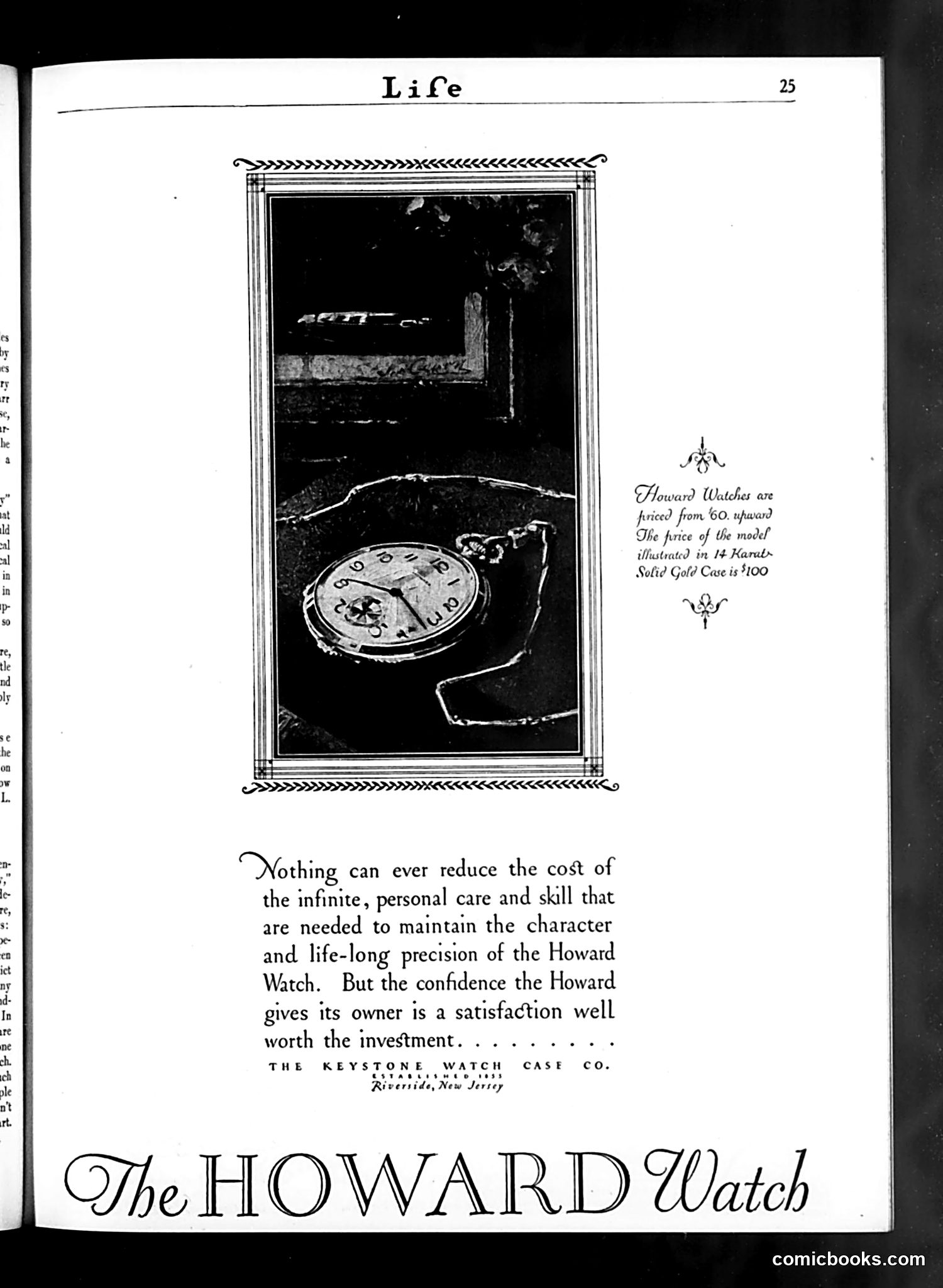
This is **advertising content**, not satire or political commentary. The page features a full-page advertisement for Howard Watches, manufactured by the Keystone Watch Case Company in Riverside, New Jersey. The ad includes a photograph of a Howard pocket watch in a 14-karat solid gold case, displayed against a dark background. The accompanying text emphasizes the watch's precision and craftsmanship, arguing that the high cost ($100 for the gold model shown, or $60+ for base models) is justified by the "infinite, personal care and skill" required for its maintenance. The advertisement's appeal is to affluence and reliability rather than humor—positioning the Howard Watch as a luxury good worthy of investment for discerning owners. There are no political figures, caricatures, or satirical elements present on this page.
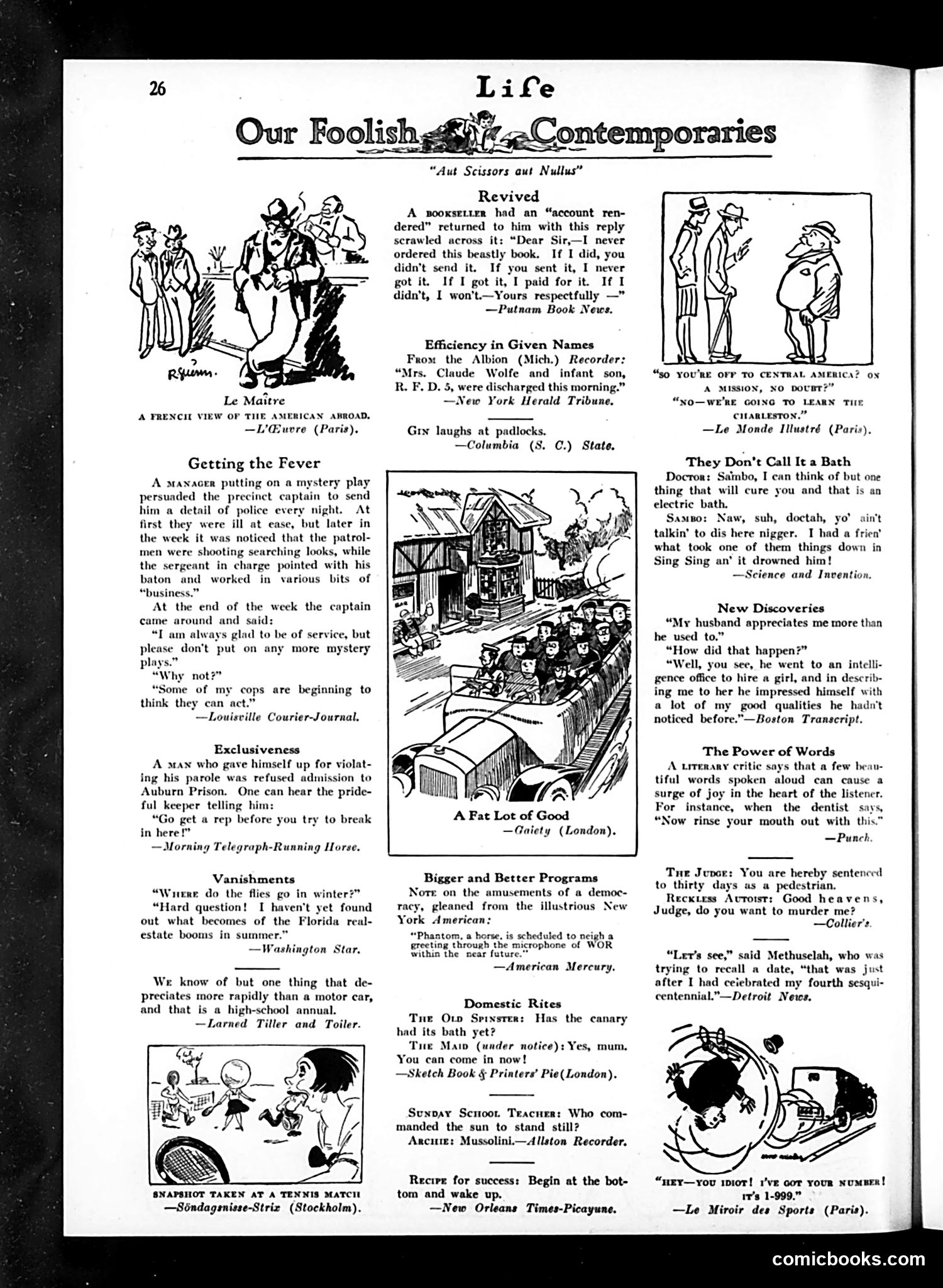
This page from *Life* magazine collects brief humorous anecdotes and jokes on social themes circa the 1920s-30s. Key satires include: **"Le Maitre"**: Mocks American tourists abroad as pretentious or foolish in European settings. **"Getting the Fever"**: Police assigned to a theater production begin acting, suggesting even law enforcement can be seduced by theatrical "business"—satire on theater's infectious appeal. **"Exclusiveness"**: A convict is rejected from Auburn Prison for lack of reputation, ironically elevating prison entrance standards. **"They Don't Call It a Bath"**: Uses racial dialect humor (now offensive) about electrocution methods, referencing Sing Sing prison executions. **"Bigger and Better Programs"**: Mocks radio broadcasting absurdity—scheduling a horse to neigh into a microphone. **Domestic Rites**: Gentle spousal humor about bathing a canary. The page satirizes modern American life: tourism, entertainment culture, bureaucratic absurdity, and emerging mass media technology.
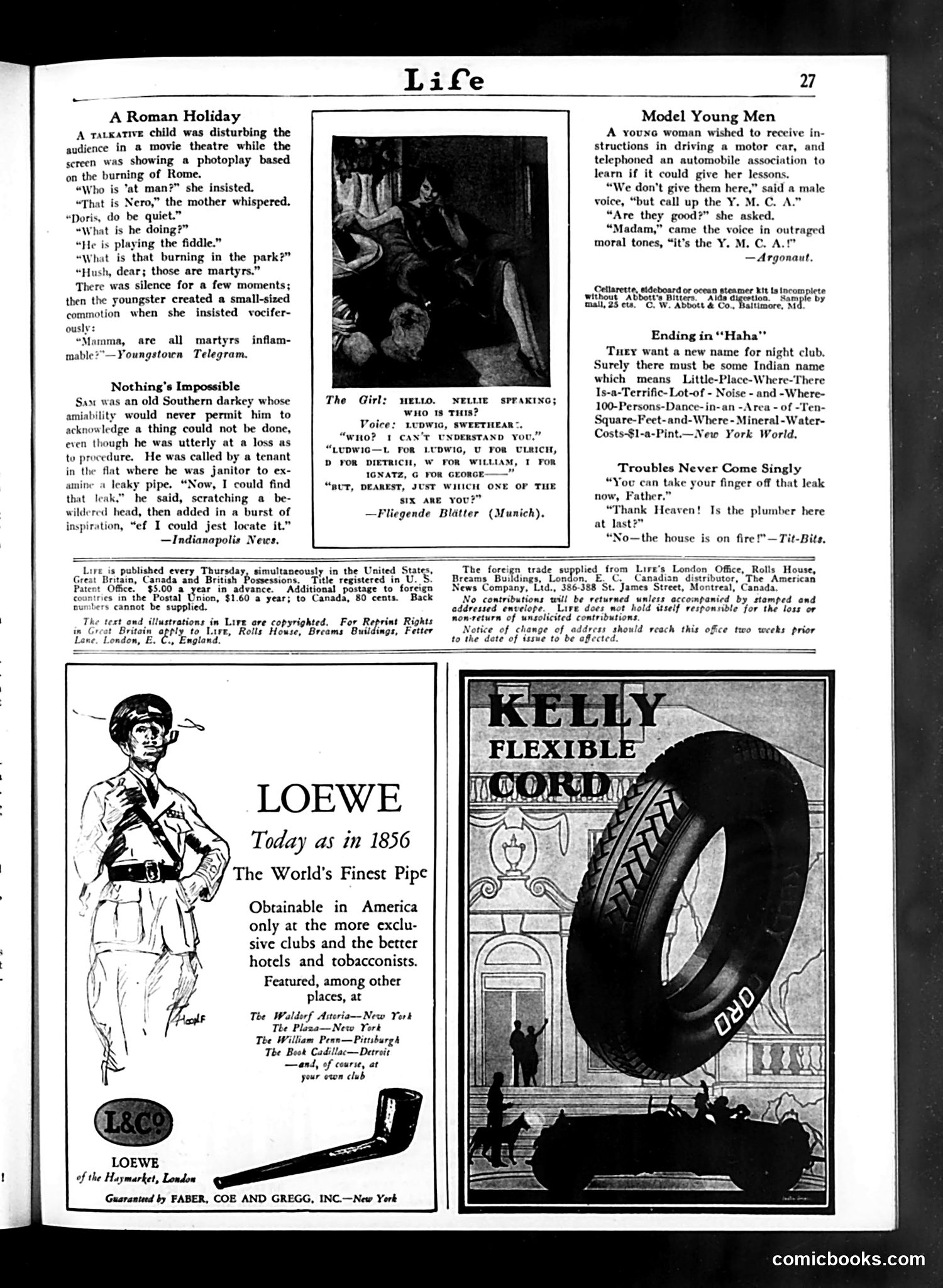
This page from *Life* magazine contains humor pieces and advertisements typical of early 20th-century American satirical journalism. **The humor pieces** are brief anecdotes poking fun at everyday situations: - "A Roman Holiday" jokes about a child's literal interpretation of historical tragedy (confusing martyrs with flammable objects) - "Nothing's Impossible" satirizes Southern dialect and servile politeness through a janitor's inability to admit he can't fix something - "Model Young Men" mocks the Y.M.C.A.'s reputation for moral strictness - Other pieces use wordplay and domestic mishaps for light comedy **The advertisements** promote luxury goods to an affluent audience: LOEWE pipes marketed as exclusive European products available only at elite clubs and hotels, and Kelly flexible automobile tires. The magazine's tone reflects pre-WWI middle-to-upper-class American humor—sentimental, class-conscious, relying on ethnic/regional stereotypes and gentle domestic comedy rather than sharp political satire.
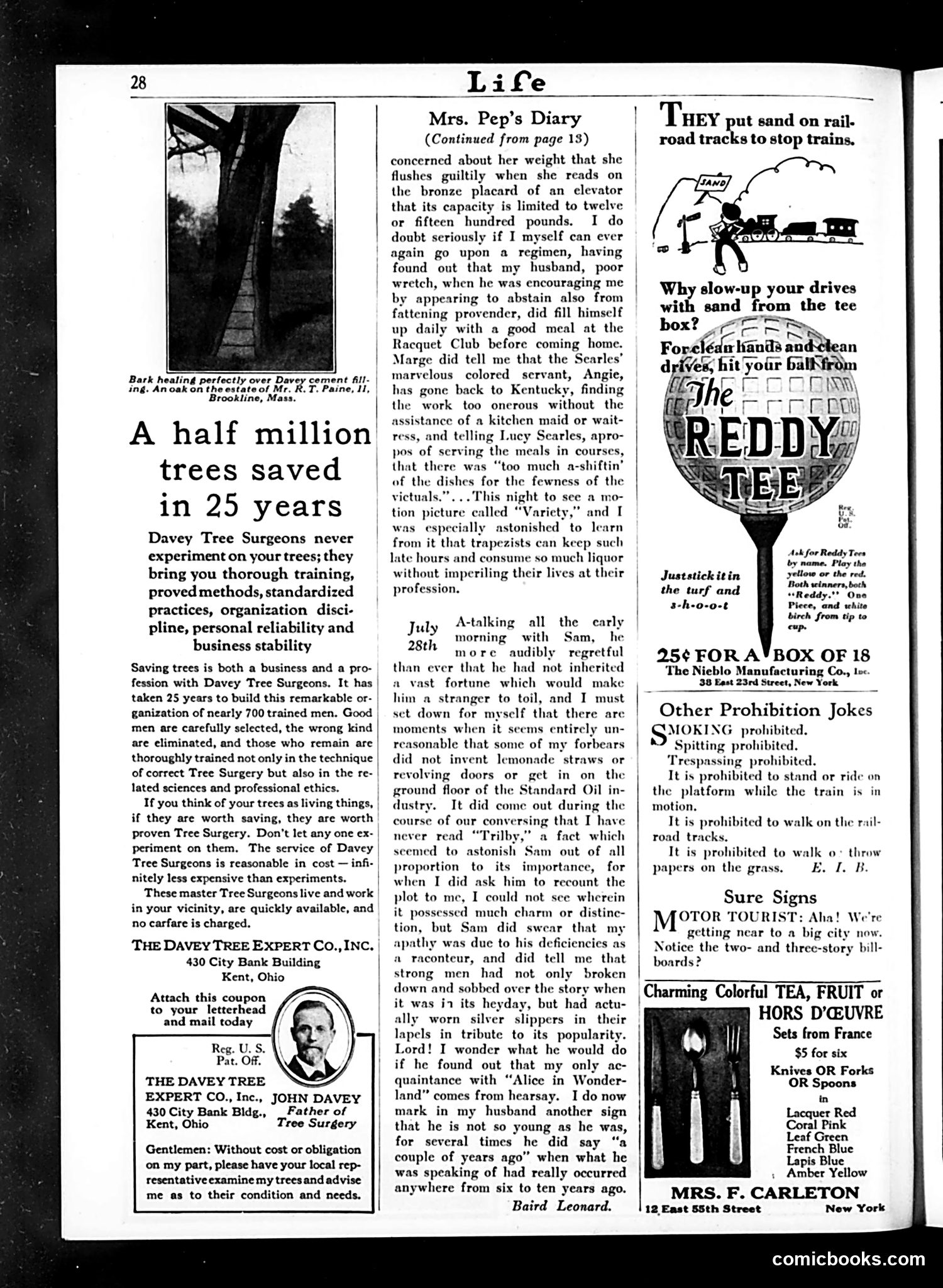
This page is primarily **advertising and social commentary**, not political satire in the traditional sense. The main content includes: 1. **Davey Tree Expert Company advertisement** (left): A business-focused pitch emphasizing professional tree surgery services, contrasting careful expertise against amateur "experimentation." The accompanying photo shows an oak tree, establishing credentials. 2. **"Mrs. Pep's Diary" (center)**: A gossipy society column where the unnamed diarist discusses weight anxiety, servant problems (the departure of a household maid named Angie), and a conversation about the novel "Trilby"—revealing period preoccupations with class status, domestic help availability, and literary culture. 3. **Prohibition-era jokes** (right): Humor playing on 1920s alcohol bans ("Smoking prohibited," "Spitting prohibited," "It is prohibited to stand or ride on the platform"). 4. **Product advertisements**: Reddy Tee golf balls and imported French tea services/cutlery. The page reflects 1920s concerns: domestic servant scarcity, weight consciousness, Prohibition enforcement, and consumer goods marketing.
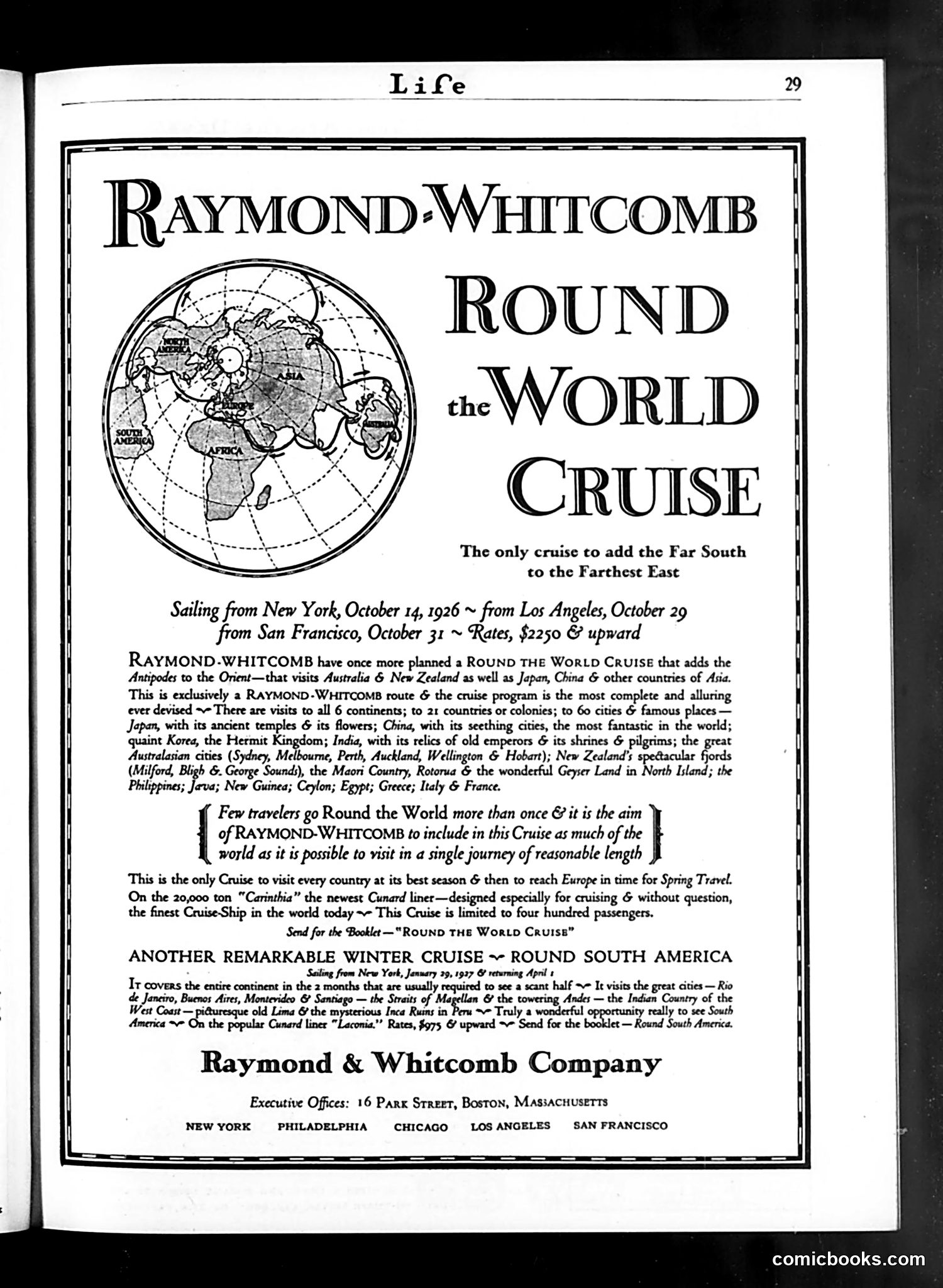
This is a **travel advertisement**, not a cartoon or satirical content. It promotes Raymond & Whitcomb's luxury cruise services for the 1926-1927 season. The page advertises two major cruises: a "Round the World Cruise" departing October 1926 from New York, Los Angeles, and San Francisco (priced from $2,250), and a "Round South America" cruise departing January 1927. Both voyages use Cunard liners and promise comprehensive global tourism—visiting all six continents, 21 countries, and 60 famous locations including Japan, China, Australia, New Zealand, and Egypt. The marketing emphasizes exclusivity and completeness: this cruise allegedly includes more destinations than competitors and visits each country "at its best season." The globe illustration at top reinforces global scope. This represents 1920s luxury travel marketing targeting wealthy Americans interested in comprehensive world tourism—a novelty when international travel was rare and time-consuming.
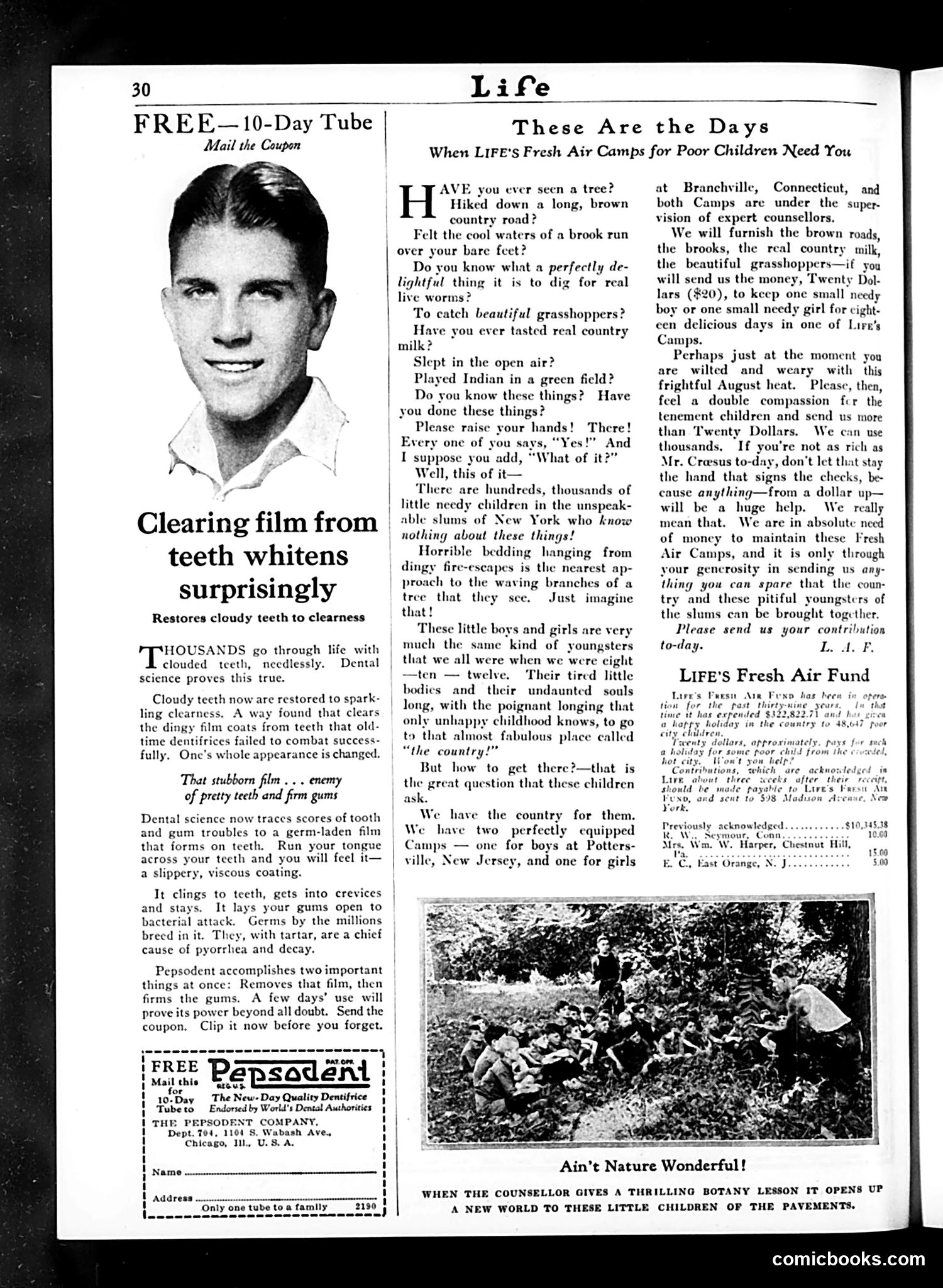
This page contains **two distinct pieces**: a toothpaste advertisement (left) and a charity fundraising appeal (right). **Left side:** A Pepsodent toothpaste ad featuring a young man's photograph. It claims the product removes a "germ-laden film" from teeth that causes discoloration and gum disease. This represents early 20th-century dental marketing that invented or exaggerated problems to sell solutions—the "film" concept became Pepsodent's signature marketing angle. **Right side:** A charity appeal for Life magazine's Fresh Air Camps for poor New York City children. Using rhetorical questions about nature experiences (trees, brooks, grasshoppers), it contrasts privileged children's childhoods with slum children's deprivation. It solicits $20 donations to send needy children to camps in New Jersey and Connecticut. This reflects Progressive Era concern for urban poverty and child welfare, positioning nature exposure as morally restorative.
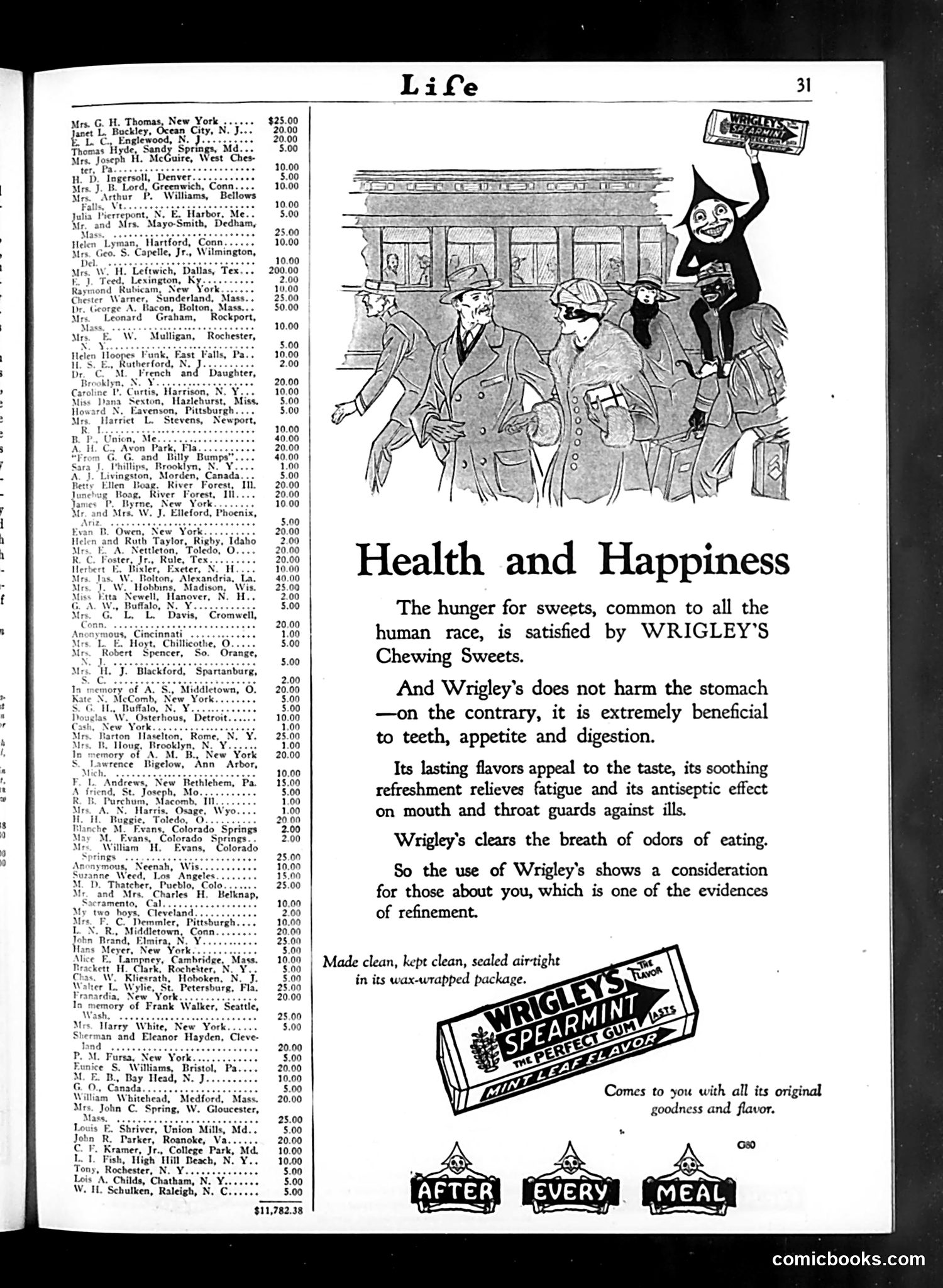
This page is primarily a **Wrigley's Spearmint gum advertisement**, not political satire. The cartoon depicts well-dressed men (appearing to be businessmen or gentlemen of leisure) outside what looks like an upscale building, with one figure holding a large Wrigley's package aloft. The advertisement's pitch combines health claims with **social refinement messaging** typical of early 20th-century marketing. It claims gum benefits digestion, teeth, and appetite while simultaneously suggesting that chewing Wrigley's demonstrates consideration for others—positioning gum-chewing as evidence of "refinement" rather than lower-class behavior (a concern of the era). The left column contains a list of **Life magazine subscribers and their donations**, suggesting this was a fundraising or subscription acknowledgment page. The cartoon's humor appears gentle: the exaggerated enthusiasm for a commercial product, presented as genteel behavior among proper gentlemen.
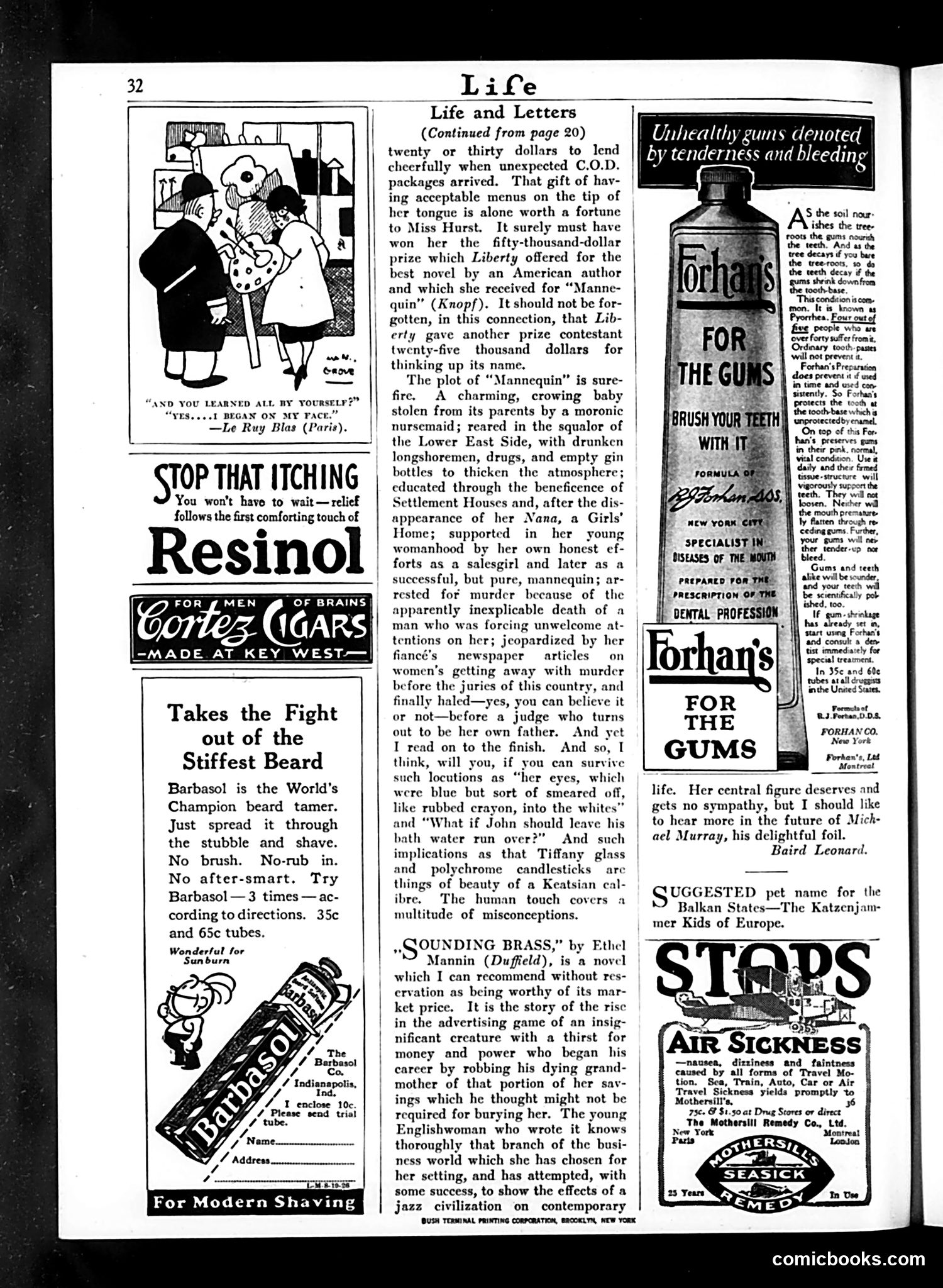
This page is primarily **advertising and book reviews**, not political satire. The cartoon at top depicts a flirtatious exchange—a woman claims she learned something "all by herself," attributing it to a French source. It's a mild innuendo joke about self-education. The bulk of the page contains **product advertisements** (Resinol skin cream, Barbasol shaving cream, Cortez cigars, Forhan's toothpaste) and a **literary review section** discussing novels including "Mannequin" (which won a Liberty magazine prize) and "Sounding Brass" by Ethel Mannin. The reviewer discusses plot summaries and writing quality in a somewhat gossipy tone typical of Life's cultural commentary. There is **no significant political cartoon or satire** on this page—it's a standard mix of consumer advertising and entertainment/literary content from the magazine's earlier 20th-century format. The page illustrates how Life balanced satire and humor with conventional magazine advertising.
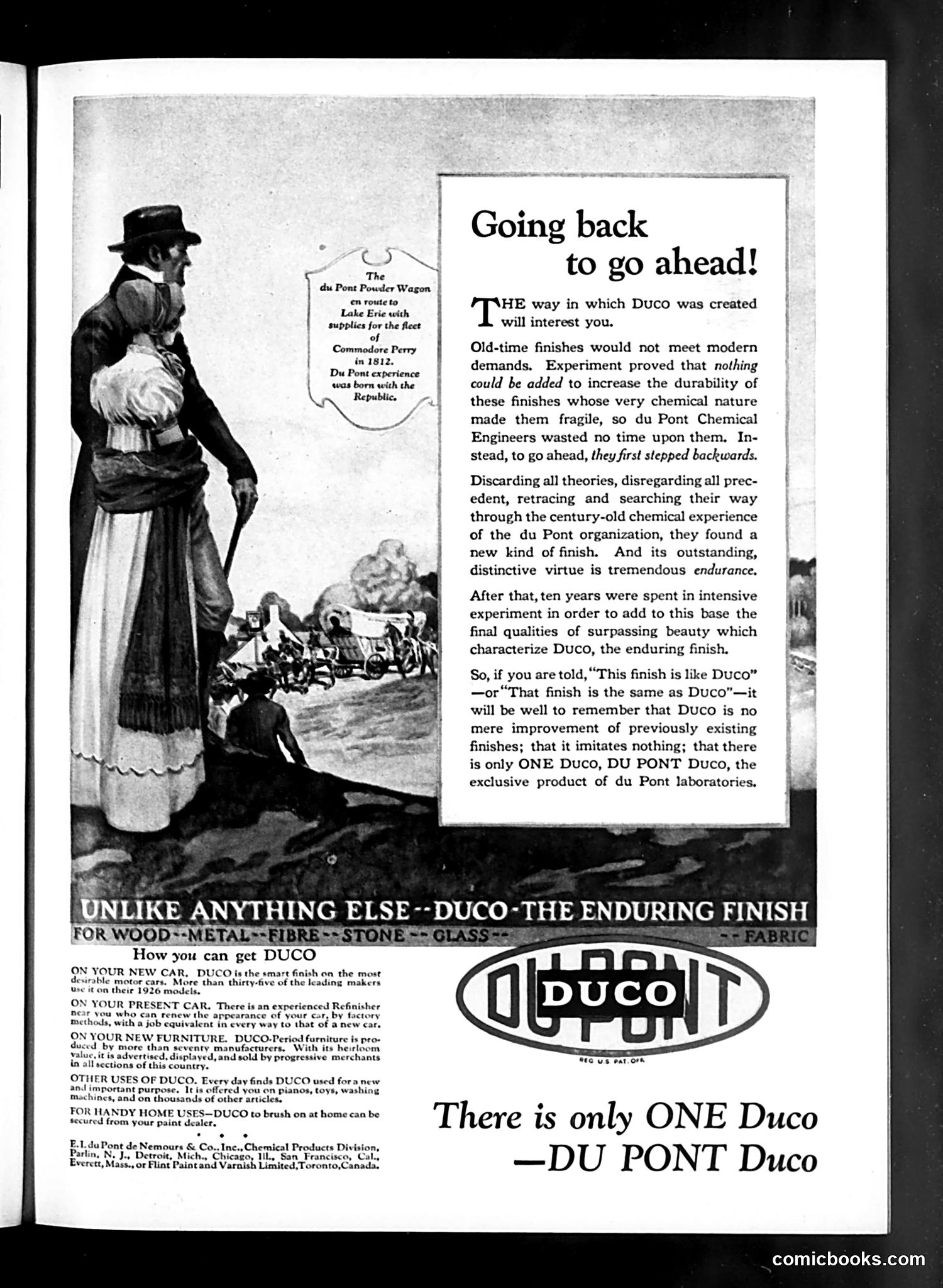
This is primarily a **du Pont company advertisement** for Duco finish (an early automobile lacquer), not political satire. The page uses a historical framing device: an illustration showing a man and woman in 19th-century dress observing a scene labeled as referencing Commodore Perry's 1812 expedition to Lake Erie. This nostalgic imagery accompanies the headline "Going back to go ahead!"—a play on du Pont's development strategy. The advertisement argues that du Pont's engineers rejected conventional wisdom, "stepping backwards" through the company's century-old chemical expertise to innovate a superior finish. The point: Duco is not merely an incremental improvement but a fundamentally new product with exceptional durability. The copy emphasizes exclusivity and superiority, claiming Duco is the "only ONE" genuine product of its kind, available for automobiles, furniture, and household items. This is advertising copy emphasizing innovation and brand dominance rather than satire or political commentary.
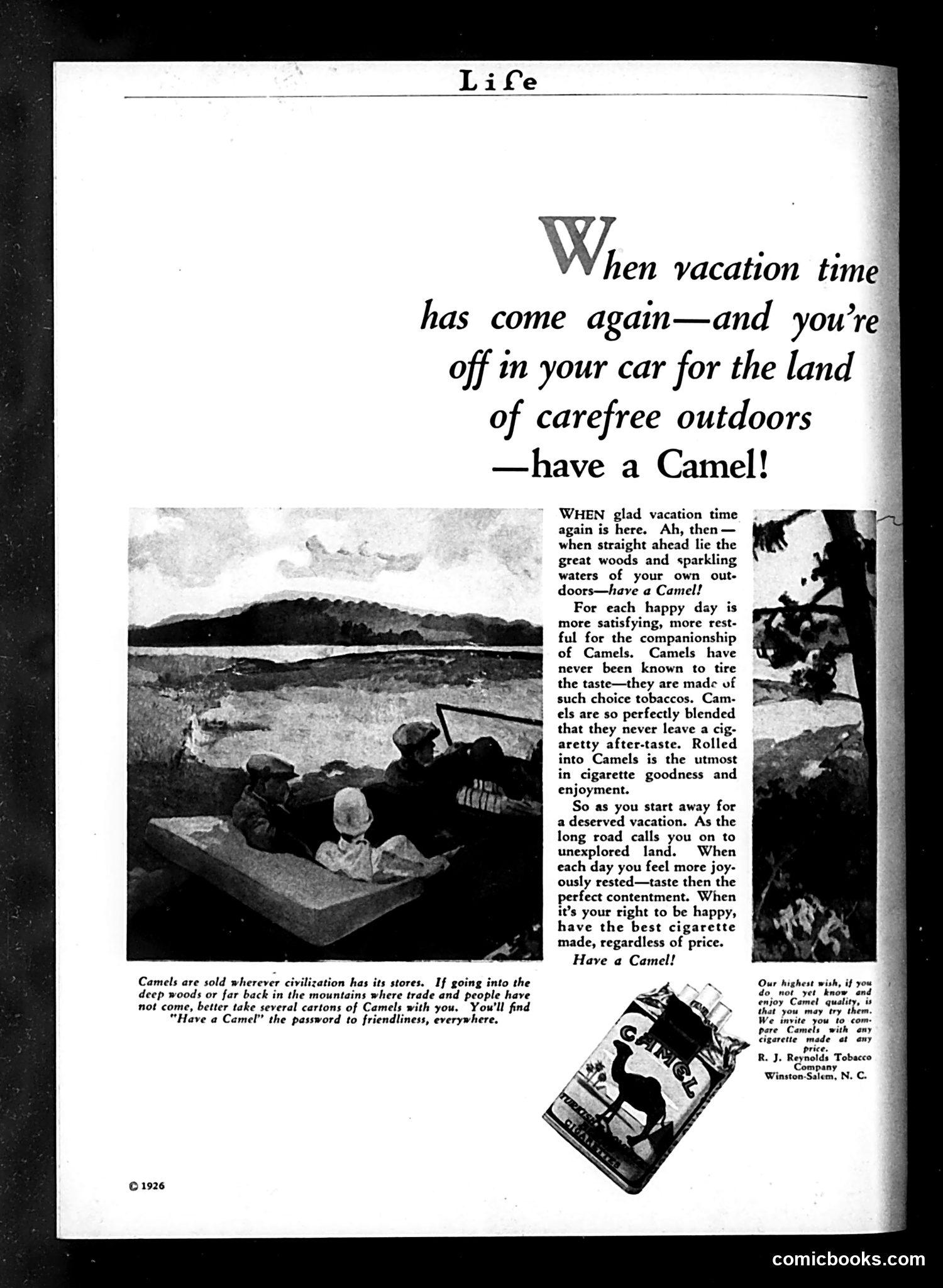
This is a **cigarette advertisement**, not satire or political commentary. It promotes Camel brand cigarettes to vacation-goers. The ad uses imagery of outdoor leisure—people relaxing by scenic landscapes—to associate smoking with relaxation and contentment. The text frames cigarettes as essential vacation companions, even suggesting bringing cartons into remote wilderness to trade with people as "the password to friendliness." **Key period context a modern reader would miss:** - In 1926, cigarette advertising in mainstream magazines was standard and unregulated - Health dangers of smoking were not yet widely acknowledged publicly - The ad assumes smoking enhances social bonding and relaxation - Marketing targeted leisure activities and promised cigarettes wouldn't create "after-taste" The bottom image shows a Camel cigarette package. This represents advertising from an era when such promotions appeared freely in "Life" magazine without health warnings or restrictions.

I can see this is a very dark, low-contrast page from what appears to be Life magazine, but the image quality makes it nearly impossible to discern specific cartoon details, figures, captions, or text clearly. The page appears mostly black with some slightly lighter areas suggesting there may be illustrations or content present, but I cannot reliably identify: - Specific political figures or caricatures - Cartoon subjects or themes - Text beyond the "comicbooks.com" watermark - Historical references or satirical points To provide accurate analysis as requested, I would need a clearer, higher-contrast version of this page where the actual cartoon content and text are legible.