
Life, 1926-08-19 · page 21 of 37
Life — August 19, 1926 — page 21: what you’re looking at
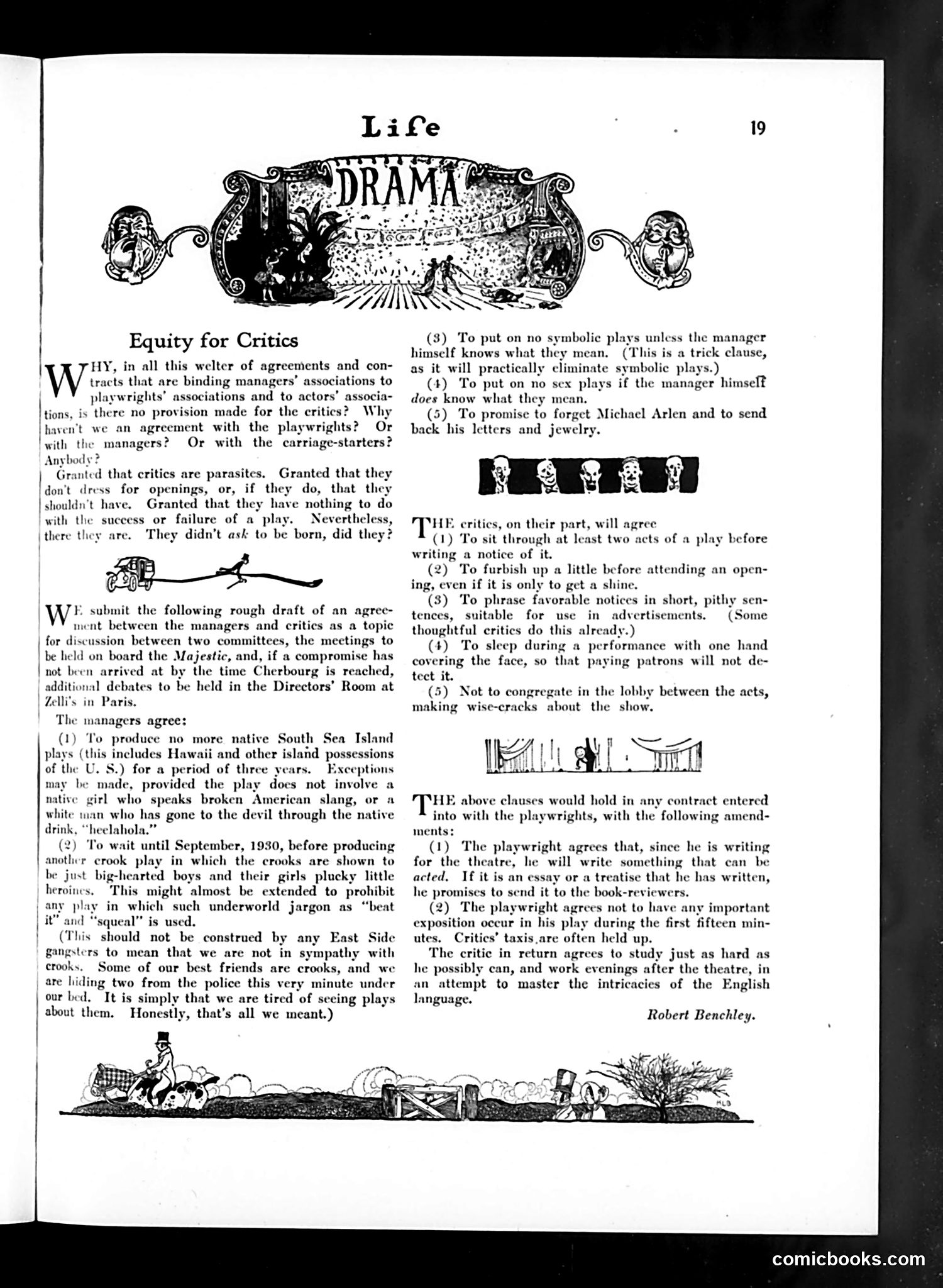
What you’re looking at
This satirical article proposes a mock labor agreement between theater managers, critics, and playwrights—mirroring the real union agreements binding these groups in 1920s theater. **The satire targets:** - **Playwrights** for churning out hackneyed plots: repetitive "South Sea Island" plays featuring noble natives and fallen white men; formulaic gangster films with sentimentalized criminals using slang like "beat" and "squeal" - **Critics** for their parasitic role: attending openings unprepared, sleeping during performances, making backstage wisecracks, while wielding power over shows' success - **Theater managers** and the entire labor system creating binding contracts for everyone *except* critics **The joke:** By proposing absurd "agreements"—managers eliminating clichéd plots, critics actually watching plays sober and well-dressed—Benchley satirizes how none of these groups will voluntarily improve. The theatrical world operates on mutual hypocrisy that no contract could fix.
📄 Transcribed text from this page (OCR, searchable)
Machine-transcribed from the original scan — historical spelling and the odd misread are preserved.
Equity for Critics | HY, in all this welter of agreements and con- V \ acts that are binding managers’ associations to playwrights’ associations and to actors’ associa- | ions, is there no provision made for the critics? Why |haven’t we an agreement with the playwri; ? Or managers? Or with the carriage-starters? | with the Anybody? Granted that critics are parasites. }don't dress for openings, or, if the | shouldn't have. Granted that they with the su or failure of a play. | there they are. They didn’t ask to be bora, did they? 3 fe _—_t—_ FE. submit the following rough draft of an agrec- ment between the managers and critics as a topic | for discussion between two committees, the meetings to | be held on board the Majestic, and, if a compromise has not been arrived at by the time Cherbourg is reached, additional debates to be held in the Directors’ Room at | Zelli’s in Paris. The managers agree: (1) To produce no more native South Sea Island plays (this includes Hawaii and other island poss' ad the U.S.) for a period of thre eptions ay be made, provided the does not involve a nal girl who speaks broken American slang, or a white ian who has gone to the devil through the native drink, E (2) ‘To wait until September, 1930, before producing another crook play in which the crooks are shown to be just big-hearted boys and their girls plucky little heroines. This might ‘almost be extended to prohibit play in which such underworld jargon as “beat and “squeal” is used. | (This should not be construed by any East Side gangsters to mean that we are not in sympathy with crooks. Some of our best friends are crooks, and we are hiding two from the police thi: y minute under | our bed. It is simply that we are tired ‘of se reing plays Granted that they do, that they about them. Honestly, that’s all we meant.) himself knows what they as it will practically climin (4) To put on no sex p' does know what they mean. (5) To promise to forg back his letters and jewelry. THE tics, on their part, will agree (1) To sit through at least two acts of a play before writing a notice of it. (2) To furbish up a little before attending an open- ing, even if it is only to get a shine. (3) To phrase favorable notices in short, pithy sen- tences, suitable for use in advertisements. (Some thoughtful critics do this already.) (4) To sleep during a performance with one hand covering the face, so that paying patrons will not de- tect it. (5) Not to congregate in the lobby between the acts, making wise-cracks about the show. HE above clauses would hold in any contract entered into with the playwrights, with the following amend- ine: (1) The playwright agrees that, since he is writing for the theatre, he will write something that can be acted, If it is ane t he has written, he promises to send it to the book-reviewers. (2) The playwright agrees ¥ it i ay during the first fifteen min- utes. Critics’ taxis are often held up. The critic in return agrees to study just as hard as he possibly can, and work evenings after the theatre, in an attempt to master the intricacies of the English language. Robert Benchley. comicbooks.com