
Life, 1926-08-19 · page 16 of 37
Life — August 19, 1926 — page 16: what you’re looking at
What you’re looking at
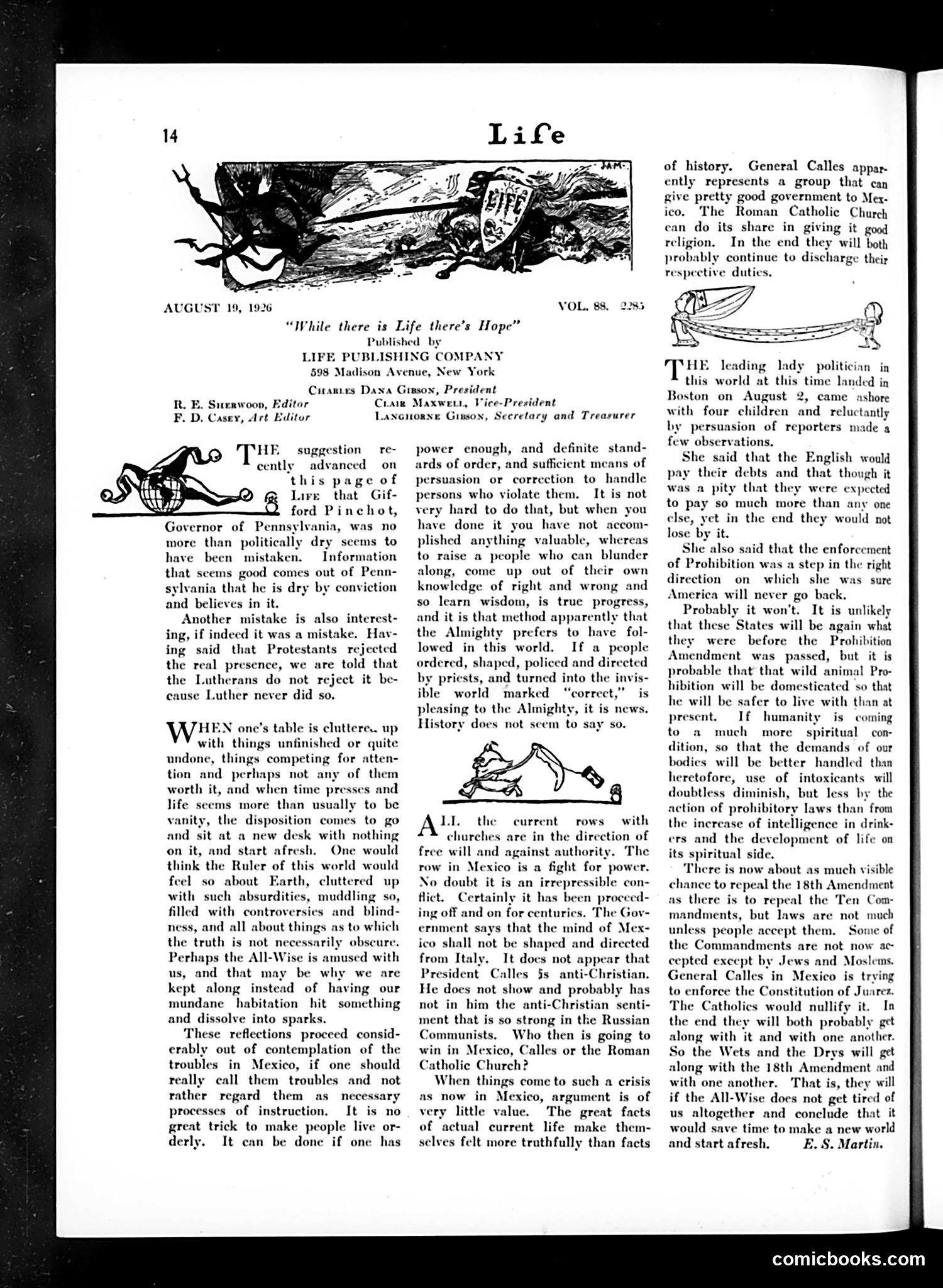
This page contains editorial commentary rather than traditional cartoons. The main visual elements are small decorative illustrations accompanying text essays. The content discusses Governor Gifford Pinchot of Pennsylvania and Mexican politics under President Calles. The editorial criticizes Pinchot's dry stance on Prohibition enforcement while acknowledging his political mistakes. The larger section addresses the religious and political crisis in Mexico, where President Calles is attempting to subordinate the Catholic Church. The author argues this conflict, combined with fighting over power and authority, makes Mexico unstable. The piece suggests these troubles stem from inadequate education rather than blaming Mexico itself, and questions whether America's own social stability might face similar challenges. The tone is analytical commentary rather than satirical humor.
📄 Transcribed text from this page (OCR, searchable)
Machine-transcribed from the original scan — historical spelling and the odd misread are preserved.
AUGUST 19, 1926 “While there is Publi VOL, 88, Life there’s Hope” shed by LIFE PUBLISHING COMPANY 598 Madison A Cuantes Dan R. E. Siuerwoon, Editor Cc F. D. Casey, Art Editor THE, suggestion — re- cently advanced on this page of & Lire that Gif- ford Pinchot, Governor of Pennsylvania, was no more than politically dry ms to have been mistaken. Information that seems good comes out of Penn- sylvania that he is dry by conviction and believes in it. Another mistake is also interest- ing, if indeed it was a mistake. Hav- ing said that Protestants rejected the real presence, we are told that the Lutherans do not reject it be- cause Luther never did so. WHEN one’s table is cluttere. up with things unfinished or quite undone, things competing for atten- tion and perhaps not any of them worth it, and when time presses and life seems more than usually to be vanity, the disposition comes to go and sit at a new desk with nothing on it, and start afresh. One would think the Ruler of this world would feel so about Earth, cluttered up with such absurdities, muddling so, filled with controversies and blind- ness, and all about things as to which the truth is not necessarily obscure. Perhaps the All-Wise is amused with us, and that may be why we are kept along instead of having our mundane habitation hit something and dissolve into sparks. These reflections proceed consid- erably out of contemplation of the troubles in Mexico, if one should really call them troubles and not rather regard them as necessary processes of instruction. It is no great trick to make people live or- derly. It can be done if one has venue, New York Greson, President im Maxwett, Vice-President LaNontoane Giusox, Secretary and Treasurer power enough, and definite stand- ards of order, and sufficient means of persuasion or correction to handle persons who violate them. It is not very hard to do that, but when you ha done it you have not accom- plished anything valuable, whereas to raise a people who can blunder along, come up out of their own knowledge of right and wrong and so learn wisdom, is true progress, and it is that method apparently that the Almighty prefers to have fol- lowed in this world. If a people ordered, shaped, policed and directed by priests, and turned into the invis- ible world marked “correct,” i pleasing to the Almighty, it is ne History does not seem to say so. \ <—s_ 8 A I, the current rows — with churches are in the direction of free will and against authority. The row in Mexico is a fight for power. No doubt it is an irrepressible con- flict. Certainly it has been proceed- ing off and on for centuries. The Gov- ernment says that the mind of Mex- ico shall not be shaped and directed from Italy. It does not appear that President Calles js anti-Christian. He does not show and probably has not in him the anti-Chri: ment that is so strong in the Russian Communists. Who then is going to win in Mexico, Calles or the Roman Catholic Church? When things come to such a crisis as now in Mexico, argument is of very little value. The great facts of actual current life make them- selves felt more truthfully than facts S of history. General Calles appar ently represents a group that can give pretty good government to Mex- ico. The Roman Catholic Church do its share in giving it good religion. In the end they will both probably continue to discharge their respective duties. HE this Boston politician in world at this time landed in on August 2, came ashore with four children and_ reluctantly hy persuasion of reporters made a She said that the English would pay tlh debts and that though it was a pity that they were expected to pay so much more than any one else, yet in the end they would not lose by it. She also said that the enforcement of Prohibition was a step in the right direction on which she was sure America will never go back. Probably it won't. It is unlikely that these States will be again what they were before the Prohibition Amendment was passed, but it is probable that that wild animal Pro- hibition will be domesticated so that he will be safer to live with than at present. If humanity is coming to a much more spiritual con- dition, so that the demands of our bodies will be better handled than heretofore, use of intoxicants will doubtless dir but less by the action of prohibitory laws than from the increase of intelligence in drink- ers and the development of life on tual side. There is now about as much visible chance to repeal the 18th Amendment as there is to repeal the Ten Com- mandments, but laws are not much unless people accept them. Some of the Commandments are not now ac cepted except by Jews and Moslems. General Calles in Mexico is trying to enforce the Constitution of Juarez. The Catholics would nullify it. In the end they will both probably get along with it and with one another. So the Wets and the Drys will get along with the 18th Amendment and with one another. That is, they will if the All-Wise does not get tired of us altogether and conclude that it would save time to make a new world and start afresh, E. S. Martin. comicbooks.com