
Life, 1926-08-19 · page 22 of 37
Life — August 19, 1926 — page 22: what you’re looking at
What you’re looking at
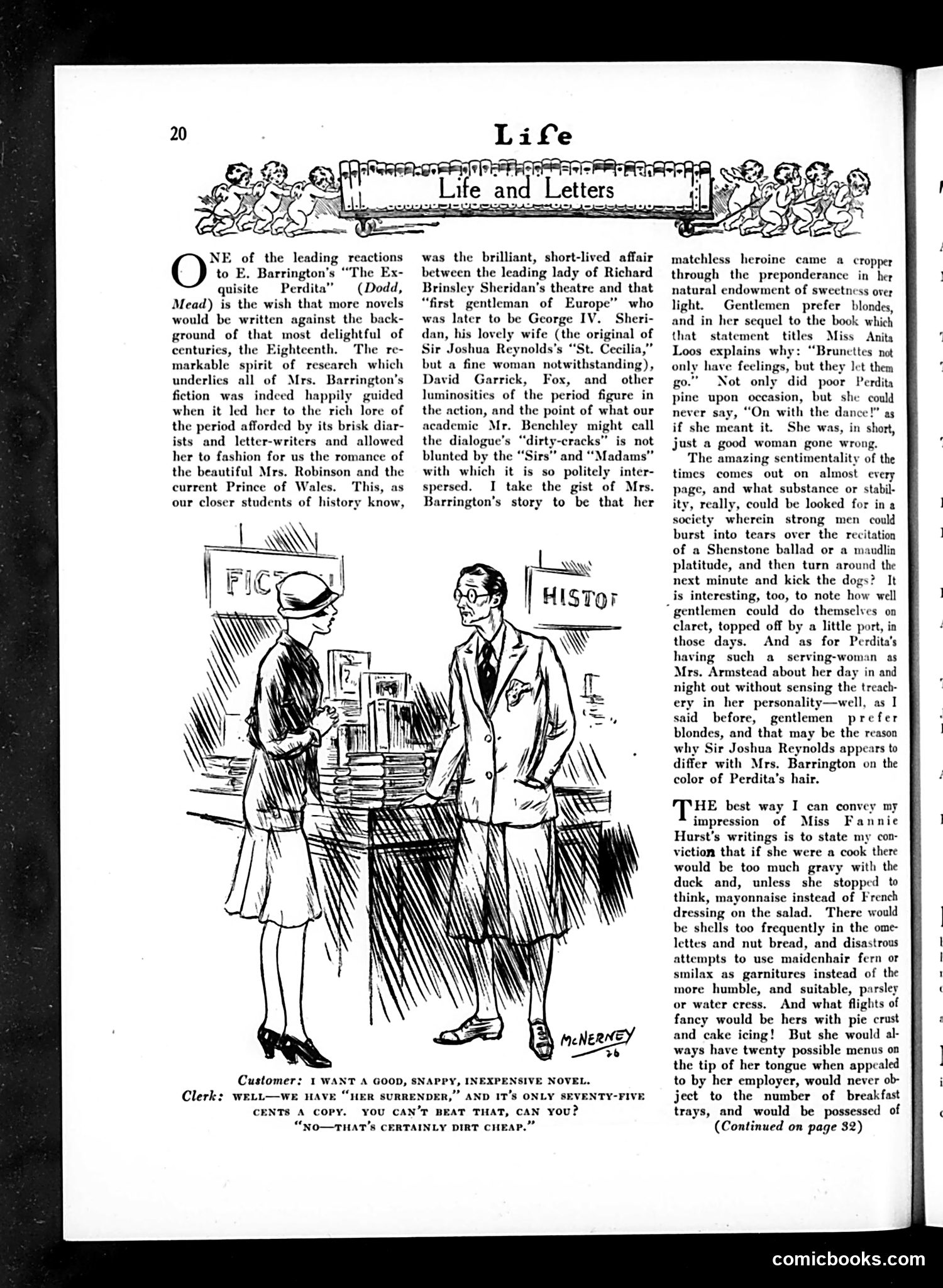
This page reviews E. Barrington's novel "The Exquisite Perdita," set in 18th-century England during the affair between actress Mrs. Robinson and the Prince of Wales (later George IV). The text praises the book's historical detail and notes its inclusion of famous figures like Sheridan and Garrick, while critiquing the heroine's excessive sentimentality as typical of the era. The single cartoon depicts a bookstore transaction: a customer seeks an inexpensive novel, and the clerk recommends "Her Surrender" for seventy-five cents, calling it "dirt cheap." The humor lies in the double meaning—the customer agrees it's cheap *and* morally/literally dirty, suggesting the book contains scandalous content. This satirizes both cheap pulp fiction's salacious appeal and the customer's frank acknowledgment of what "inexpensive" novels typically offer.
📄 Transcribed text from this page (OCR, searchable)
Machine-transcribed from the original scan — historical spelling and the odd misread are preserved.
NE of the leading reactions O to E. Barrington’s “The Ex- quisite Perdita” (Dodd, Mead) is the wish that more novels would be written against the back- ground of that most delightful of centuries, the Eighteenth. The re- markable spirit of research which underlies all of Mrs. Barrington’s fiction was indeed happily guided when it led her to the rich lore of the period afforded by its brisk diar- ists and letter-writers and allowed her to fashion for us the romance of the beautiful Mrs. Robinson and the current Prince of Wales. This, as our closer students of history know, was the brilliant, short-lived affair between the leading lady of Richard Brinsley Sheridan's theatre and that “first gentleman of Europe” who was later to be George IV. Sheri- dan, his lovely wife (the original of Sir Joshua Reynolds's “St. Cecilia,” but a fine woman notwithstanding), David Garrick, Fox, and other luminosities of the period figure in the action, and the point of what our academic Mr. Benchley might call the dialogue’s “dirty-cracks” is not blunted by the “Sirs” and “Madams” with which it is so politely inter- spersed. I take the gist of Mrs. Barrington’s story to be that her HISTor Customer: 1 WANT A GOOD, SNAPPY, INEXPENSIVE NOVEL. Clerk: WrELt—we HAVE “HER SURRENDER,” AND IT’S ONLY SEVENTY-FIVE CENTS A COPY. YOU CAN’T BEAT THAT, CAN You? “NO—THAT’S CERTAINLY DIRT CHEAP.” matchless heroine came a cropper through the preponderance in her natural endowment of sweetness over light. Gentlemen prefer blondes, and in her sequel to the book which that statement titles Miss Anita Loos explains why: “Brunettes not only have feelings, but they let them go.” Not only did poor Perdita pine upon occasion, but she could never say, “On with the dance!” as if she meant it. She was, in short, just a good woman gone wrong. The amazing sentimentality of the times comes out on almost every c, and what substance or stabil- really, could be looked for in a society wherein strong men could burst into tears over the recitation of a Shenstone ballad or a maudlin platitude, and then turn around the next minute and kick the dogs? It is interesting, too, to note how well “gentlemen could do themselves on claret, topped off by a little port, in those days. And as for Perdita’s having such a serving-woman as Mrs. Armstead about her day in and night out without sensing the treach- ery in her personality—well, as I said before, gentlemen prefer blondes, and that may be the reason why Sir Joshua Reynolds appears to differ with Mrs. Barrington on the color of Perdita’s hair. HE best way I can convey my impression of Miss Fannie Hurst's writings is to state my con- viction that if she were a cook there would be too much gravy with the duck and, unless she stopped to think, mayonnaise instead of French dressing on the salad. There would be shells too frequently in the ome- lettes and nut bread, and disastrous attempts to use maidenhair fern or smilax as garnitures instead of the more humble, and suitable, parsley or water cress. And what flights of fancy would be hers with pie crust and cake icing! But she would al- ways have twenty possible menus on the tip of her tongue when appealed to by her employer, would never ob- ject to the number of breakfast trays, and would be possessed of (Continued on page 32) comicbooks.com