
Life, 1926-08-19 · page 26 of 37
Life — August 19, 1926 — page 26: what you’re looking at
What you’re looking at
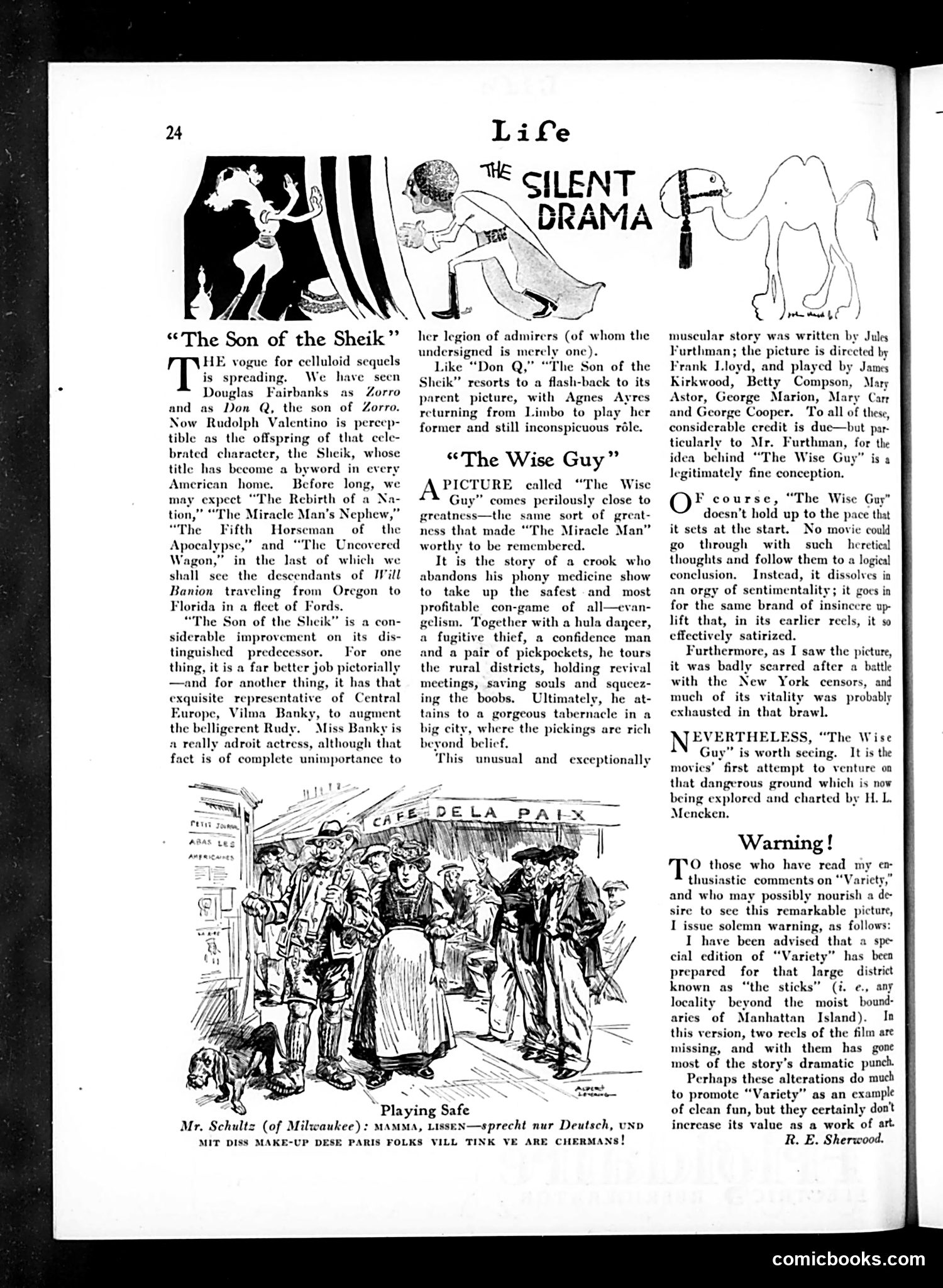
This page reviews three silent films while satirizing 1920s cinema trends. **"The Son of the Sheik"** mocks Hollywood's sequel obsession—the vogue for spinning off successful pictures. The magazine jokes that if this trend continues, we'll soon see absurd sequels like "The Fifth Horseman of the Apocalypse" and "The Uncovered Wagon." Rudolph Valentino stars in this follow-up to the popular "Sheik." **"The Wise Guy"** is praised for its unusual premise: a con artist abandons fake medicine shows to profit from evangelical revival meetings—a satirical jab at religious exploitation. **The cartoon "Playing Safe"** depicts a German immigrant warning his mother to speak only German in Paris, lest people mistake them for Germans. This likely references post-WWI anti-German sentiment still prevalent in 1921, where German identity was undesirable. **The warning section** criticizes censorship of "Variety," noting that the "sticks" (rural areas) receive edited versions with reels removed, gutting the film's dramatic impact while sanitizing it for provincial audiences.
📄 Transcribed text from this page (OCR, searchable)
Machine-transcribed from the original scan — historical spelling and the odd misread are preserved.
HE vogue for celluloid I is spreading. We ha’ Douglas Fairbanks as Zorro and as Don Q, the son of Zorro. Now Rudolph Valentino is percep- tible as the offspring of that cele- brated character, the Sheik, whose title has become a byword in every American home. Before long, we may expect “The Rebirth of a Na- tion,” “The Miracle Man's Nephew,” “The Fifth Horseman of — the Apocalypse,” and “The Uncovered Wagon,” in the last of which we shall see the descendants of MWill Banion traveling from Oregon to Florida in a fleet of Fords. “The Son of the Sheik’ siderable is a con- improvement on its dis- predecessor. For one thing, it is a far better job pictorially —and for another thing, it has that exquisite representative of Central Europe, Vilma Banky, to augment the belligerent Rudy. Miss Banky is a really adroit actress, although that fact is of complete unimportance to her legion of adm undersigned is mere ‘Don Q,” “The Son of the rs (of whom the resorts to a flash-back to its parent picture, with Agnes Ayres returning from Limbo to play her former and still inconspicuous réle. “The Wise Guy” PICTURE called “The Wise Guy” comes perilously close to ness—the same sort of great- ness that made “The Miracle Man” worthy to be remembered. It is the story of a crook who abandons his phony medicine show to take up the safest and most profitable con-game of all—eva gelism. Together with a hula dancer, a fugitive thief, a confidence man and a pair of pickpockets, he tours the rural districts, holding revival meetings, saving souls and sque ing the boobs. Ultimately, he at- tains to a gorgeous tabernacle in a big city, where the pickings are rich beyond belief. This unusual and exceptionally Sa Playing Safe Mr. Schultz (of Milwaukee): mamma, LisseN—sprecht nur Deutsch, uno MIT DISS MAKE-UP DESE PARIS FOLKS VILL TINK VE ARE CHERMANS! muscular story was written by Jules Furthman; the picture is dirceted by Frank Lloyd, and played by James Kirkwood, Betty Compson, Mary Astor, George Marion, Mary Carr and George Cooper. To all of these, considerable credit is due—but par- ticularly to Mr. Furthman, for the i behind “The Wise Guy” itimately fine conception. O F course, “The Wise Guy" doesn’t hold up to the pace that it sets at the start. No movie could go through with such _ heretical thoughts and follow them to a logical conclusion. Instead, it dissolves in an orgy of sentimentality; it goes in for the same brand of insincere up- lift that, in its earlier reels, it so effectively satirized. Furthermore, as I saw the picture, it was badly scarred after a battle with the w York censors, and much of its vitality probably exhausted in that brawl. EVERTHELESS, “The Wise Guy” is worth secing. It is the movies’ first attempt to venture on that dangerous ground which is now being explored and charted by H. L. Mencken. is a Warning! T° those who have read my en- thusiastic comments on “Variety,” and who may possibly nourish a de sire to see this remarkable picture, I issue solemn warning, as follows: I have been advised that a spe cial edition of “Variety” has been prepared for that large district known as “the sticks” (i. ¢., any ty beyond the moist bound- of Manhattan Island). In this version, two recls of the film are missing, and with them has gone most of the story’s dramatic punch. Perhaps these alterations do much to promote “Varicty” as an example of clean fun, but they certainly don’t increase its value as a work of art. R. E. Sherwood. comicbooks.com