
A complete issue · 41 pages · 1926
Life — July 8, 1926
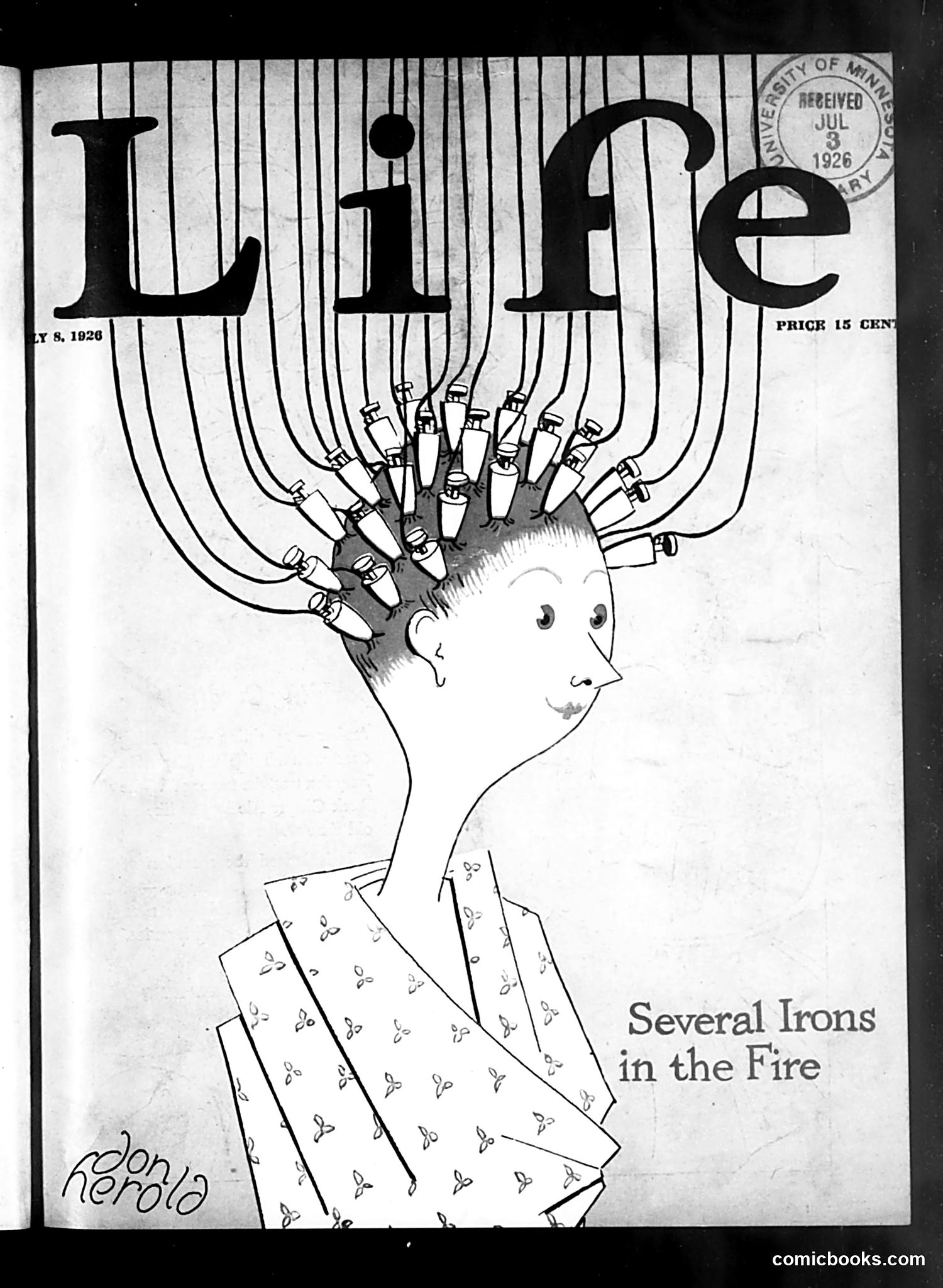
This 1926 Life magazine cover uses visual metaphor to satirize women's hair-curling practices. The illustration shows a woman's head with numerous electrical curling irons plugged in simultaneously—the "several irons in the fire" of the title. The joke targets the labor-intensive beauty standards of the 1920s, when setting waves and curls required heated iron tools. The exaggerated number of irons suggests both the impracticality and obsessiveness of achieving fashionable hairstyles. The woman's surprised expression conveys the absurdity of the situation. This reflects 1920s cultural anxieties about modern technology, consumerism, and evolving women's roles during the "flapper" era, when new beauty products and electrical appliances proliferated.
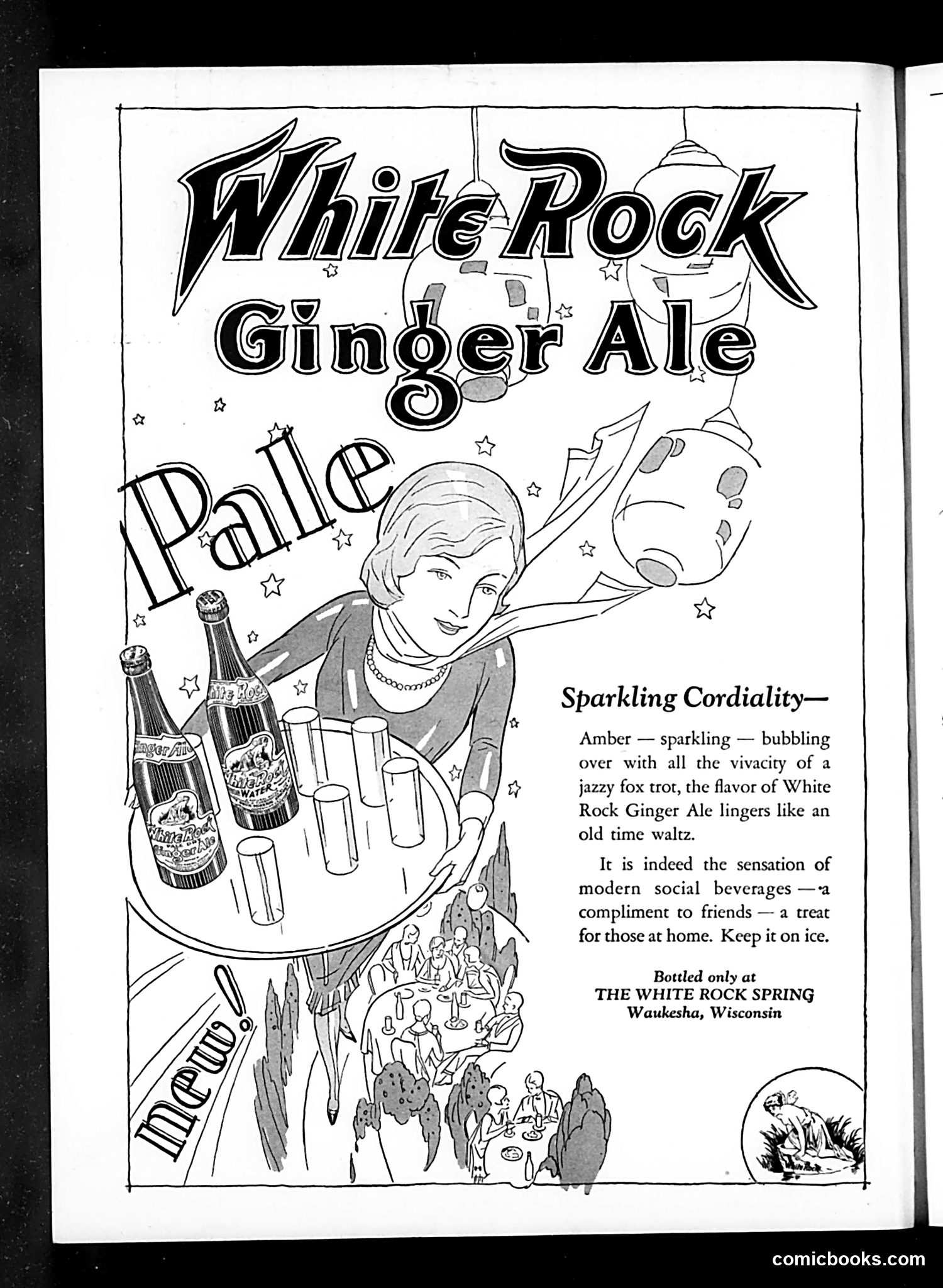
This is a **product advertisement**, not political satire. It promotes White Rock Ginger Ale, bottled in Waukesha, Wisconsin. The ad features a stylized woman in 1920s-30s fashion, depicted in an Art Deco style common to the era. She's shown enjoying herself at what appears to be a social gathering, surrounded by bottles and glasses of the beverage. The imagery emphasizes luxury, sparkle, and modern sophistication. The text describes the drink as "amber—sparkling—bubbling" with "vivacity of a jazzy fox trot," marketing it as appropriate for entertaining guests and social occasions. The phrase "Sparkling Cordiality" suggests hospitality and refinement. This reflects period advertising strategies targeting middle-class consumers during Prohibition or its immediate aftermath, positioning branded beverages as markers of social status and modern living.
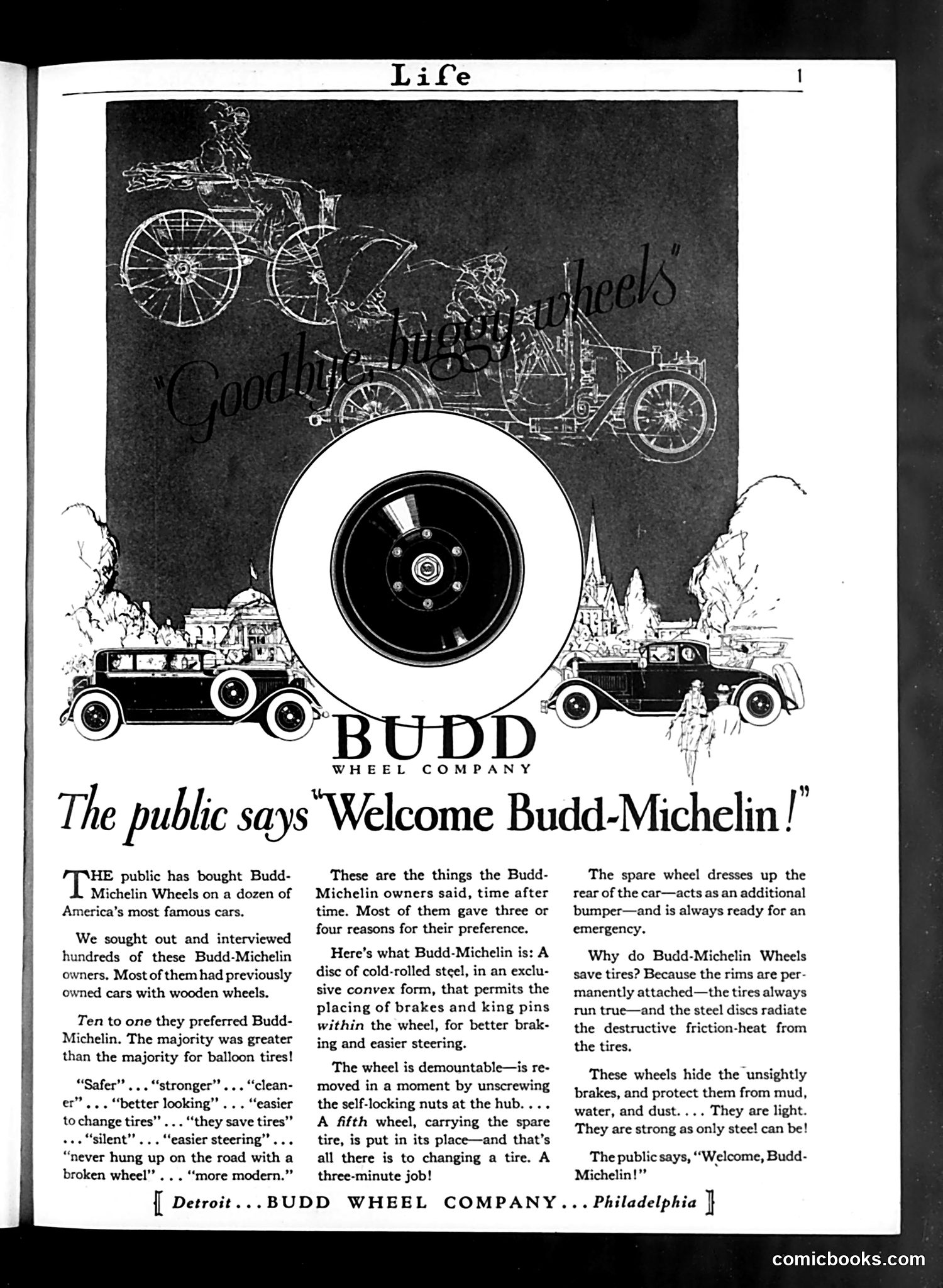
This is primarily a **commercial advertisement**, not political satire. The Budd Wheel Company is promoting their "Budd-Michelin" wheels by claiming the public prefers them for automobiles. The ad uses a collage of vehicles—from early bicycles and motorcars to 1920s automobiles—to suggest the wheels' long success history. The text cites consumer testimonials praising features like safety, durability, and ease of tire-changing. The "Goodby wheels" text at top appears ironic: these new wheels allegedly make old problems obsolete. This represents typical early-20th-century *Life* magazine content: advertisements marketed as editorial endorsements, using aspirational imagery and supposed customer quotes to build brand credibility during the automotive industry's expansion.
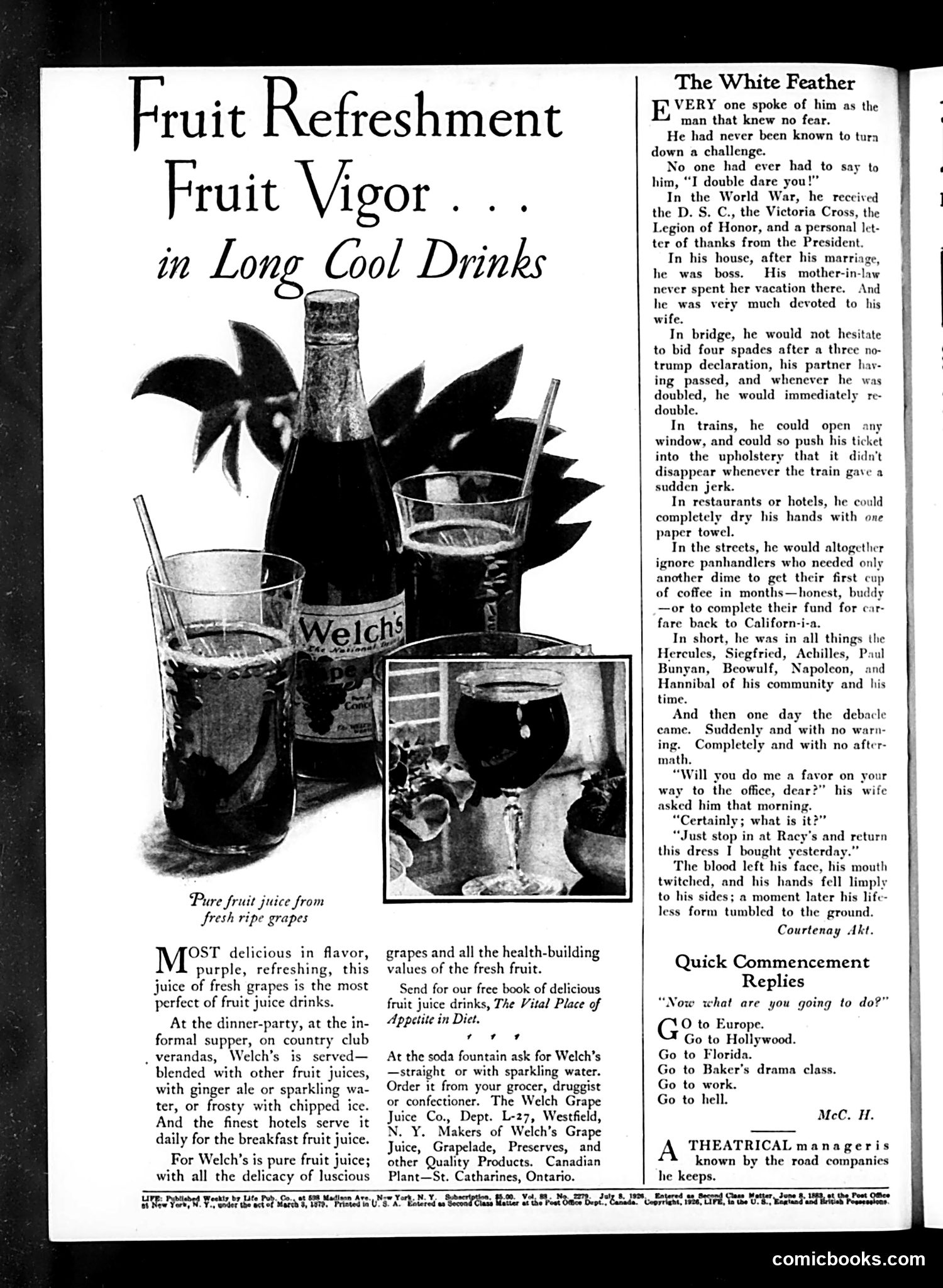
This page is **primarily a Welch's grape juice advertisement**, not political satire. The left side features a product ad showing beverages made from "pure fruit juice from fresh ripe grapes," marketed for refreshment and vigor in "long cool drinks." The right side contains two separate items: 1. **"The White Feather"** — a short story about a fearless man, apparently concerning WWI valor (references to D.S.C., Victoria Cross, Legion of Honor suggest military honors). 2. **"Quick Commencement Replies"** — a brief humor section with joke responses to "what are you going to do?" (Europe, Hollywood, Florida, etc., ending with "hell"). The page mixes advertising with editorial content typical of Life magazine's format.
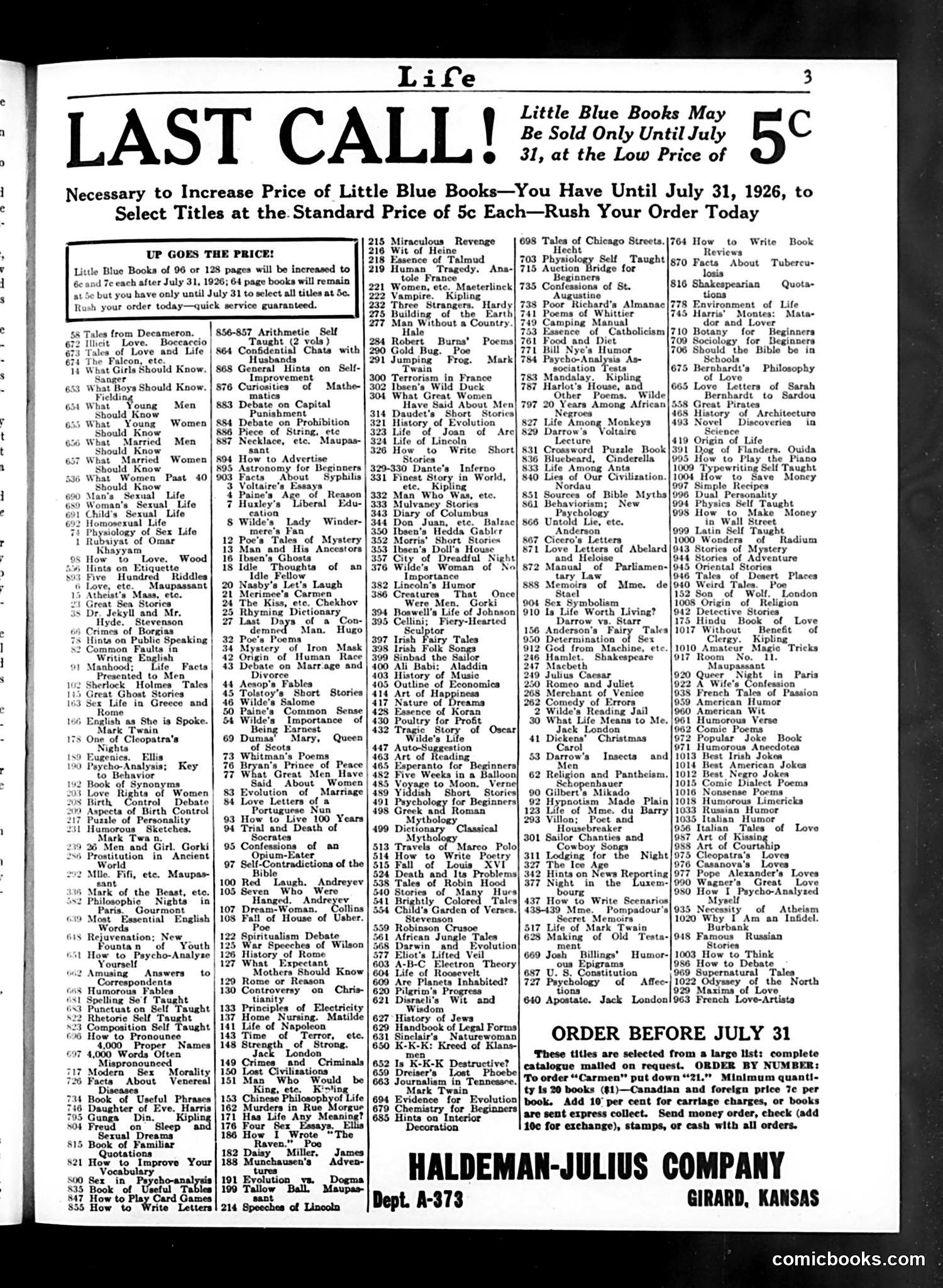
This page is **primarily advertising**, not editorial content. It features a "Last Call!" advertisement for Little Blue Books, a series of inexpensive 5-cent paperbacks published by Haldeman-Julius Company of Girard, Kansas. The ad announces a price increase effective August 1, 1926, urging customers to order before the deadline at the current 5-cent price. The bulk of the page lists hundreds of available titles—ranging from practical guides ("How to Write Letters") to literary classics ("Tales of Edgar Allan Poe") to educational works ("History of Evolution"). This reflects the early 20th-century popularity of affordable, pocket-sized educational literature aimed at working-class readers seeking self-improvement and knowledge.
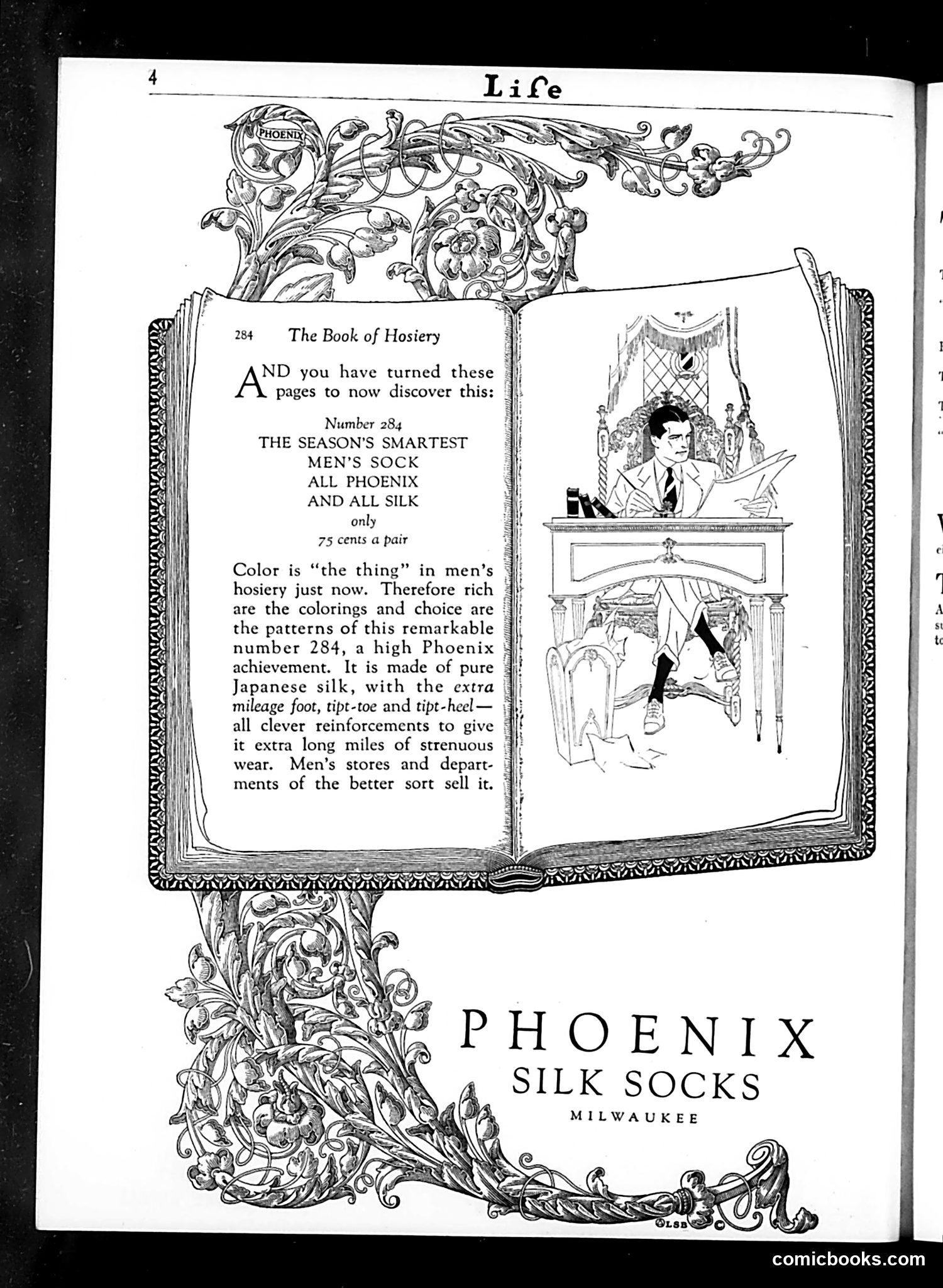
This page is primarily an **advertisement for Phoenix Silk Socks** (Milwaukee), not satire or political commentary. The elaborate book-within-page design frames a sales pitch: Number 284 socks are promoted as "the season's smartest" men's hosiery—all Phoenix and silk at 75 cents per pair. The ad emphasizes "color is 'the thing'" in men's hosiery and highlights reinforced construction (mileage foot, tip-toe, tip-heel). The illustration shows a fashionable man at his desk reading, paired with a seated woman—conventional imagery suggesting these socks suit refined, modern gentlemen. The ornate decorative borders mimic fine book design to lend prestige to the product. This is commercial messaging using Life magazine's editorial design sophistication to market luxury goods to affluent male readers.
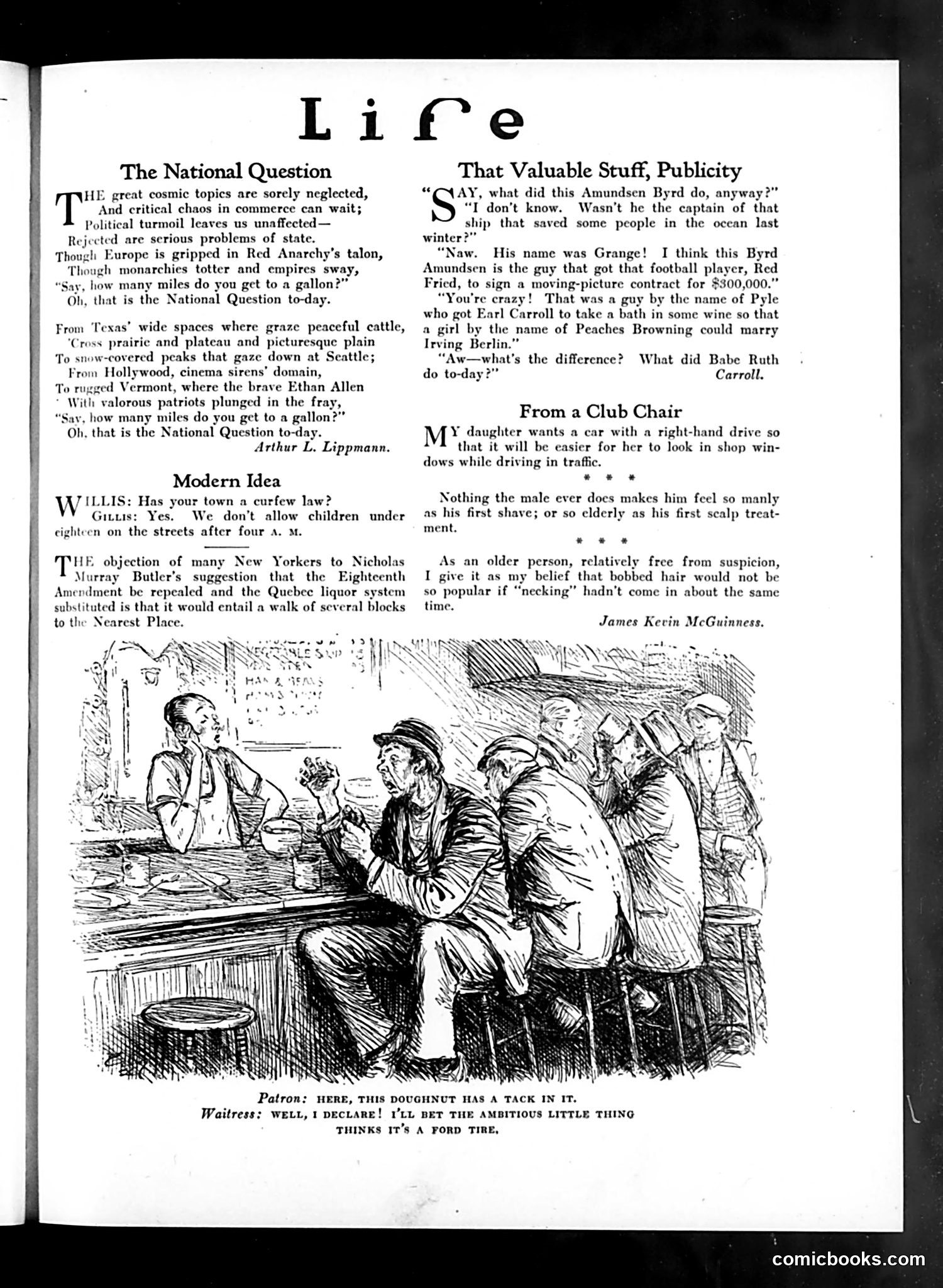
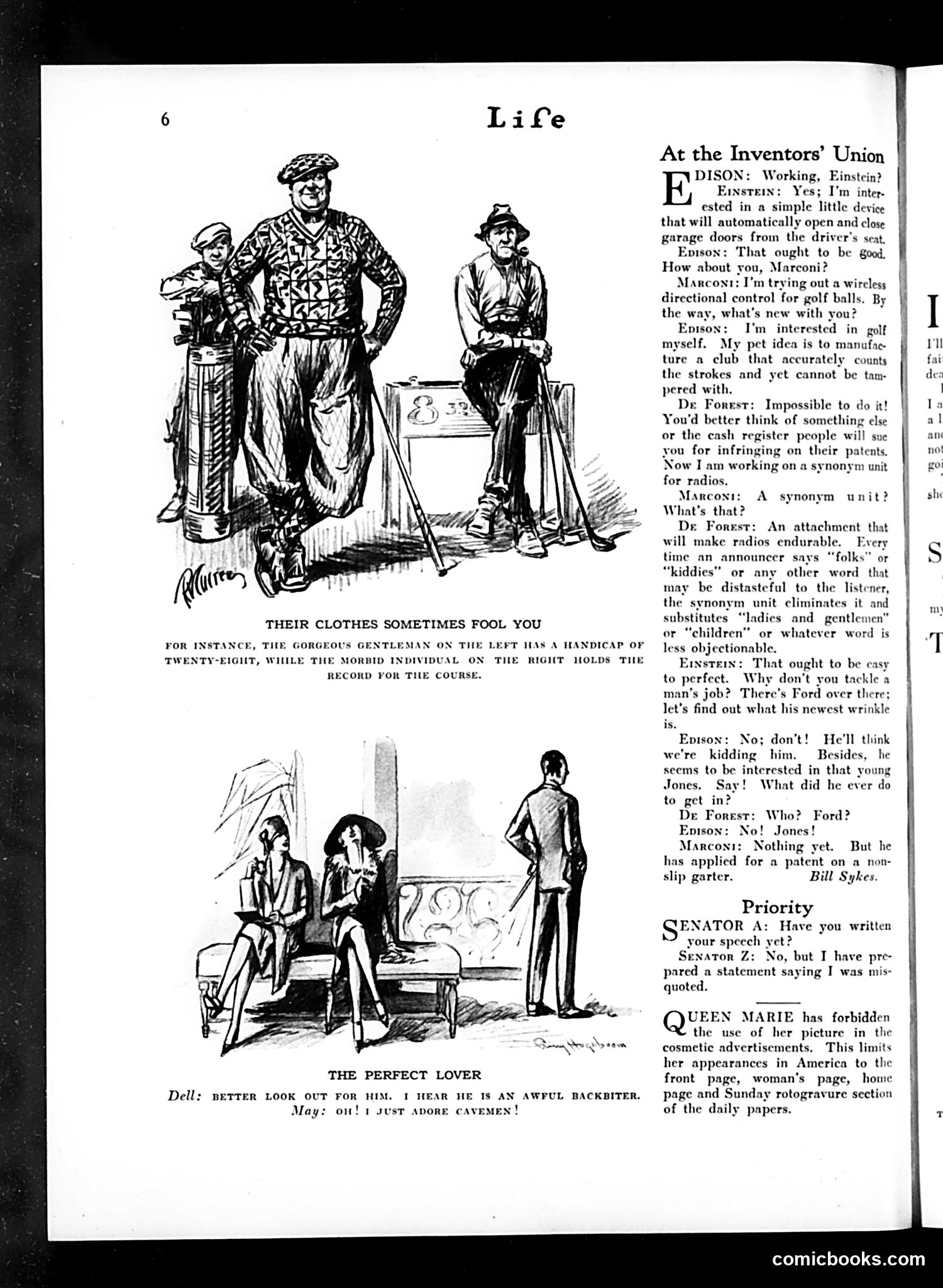
**Top Cartoon: "Their Clothes Sometimes Fool You"** This depicts three men at what appears to be a golf club. The caption notes the well-dressed gentleman on the left has a handicap of 28, while the morbidly obese man on the right holds the course record—suggesting appearances deceive regarding actual ability and competence. **Bottom Cartoon: "The Perfect Lover"** Shows two women observing a man. The dialogue warns one woman to "look out for him" as he's "an awful backbiter," while the other responds she "just adore[s] cavemen"—satirizing women's attraction to masculine men despite knowing of their poor character or gossip. Both cartoons mock human nature and misguided judgments based on superficial impressions.
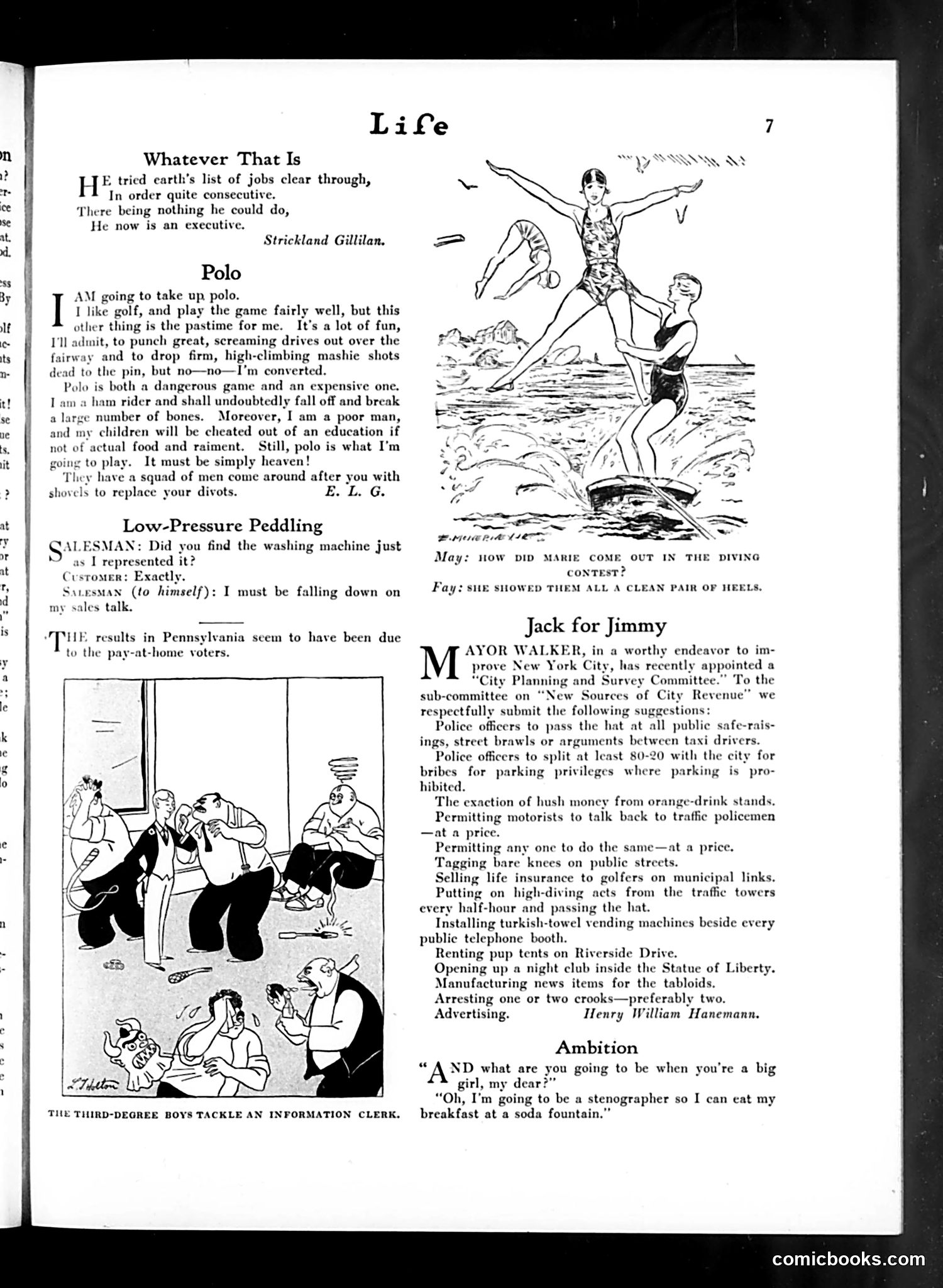
This page contains several satirical pieces: **"Whatever That Is"** and **"Polo"**: Humorous commentary on occupational choices and leisure activities. The polo piece mocks the sport as expensive, dangerous, and impractical while acknowledging its social appeal. **"Low-Pressure Peddling"**: A dialogue joke about a salesman's exaggerated claims regarding a washing machine's performance. **"Jack for Jimmy"**: A satirical letter to Mayor Walker proposing absurd revenue-generating schemes (selling insurance on municipal golf courses, installing vending machines by phone booths, etc.). This appears to mock municipal corruption and creative tax schemes. **"Ambition"**: A brief joke about a girl's aspiration to become a stenographer solely to afford soda fountain breakfasts. The cartoon illustration depicts a beach/diving scene with humorous accompanying caption.
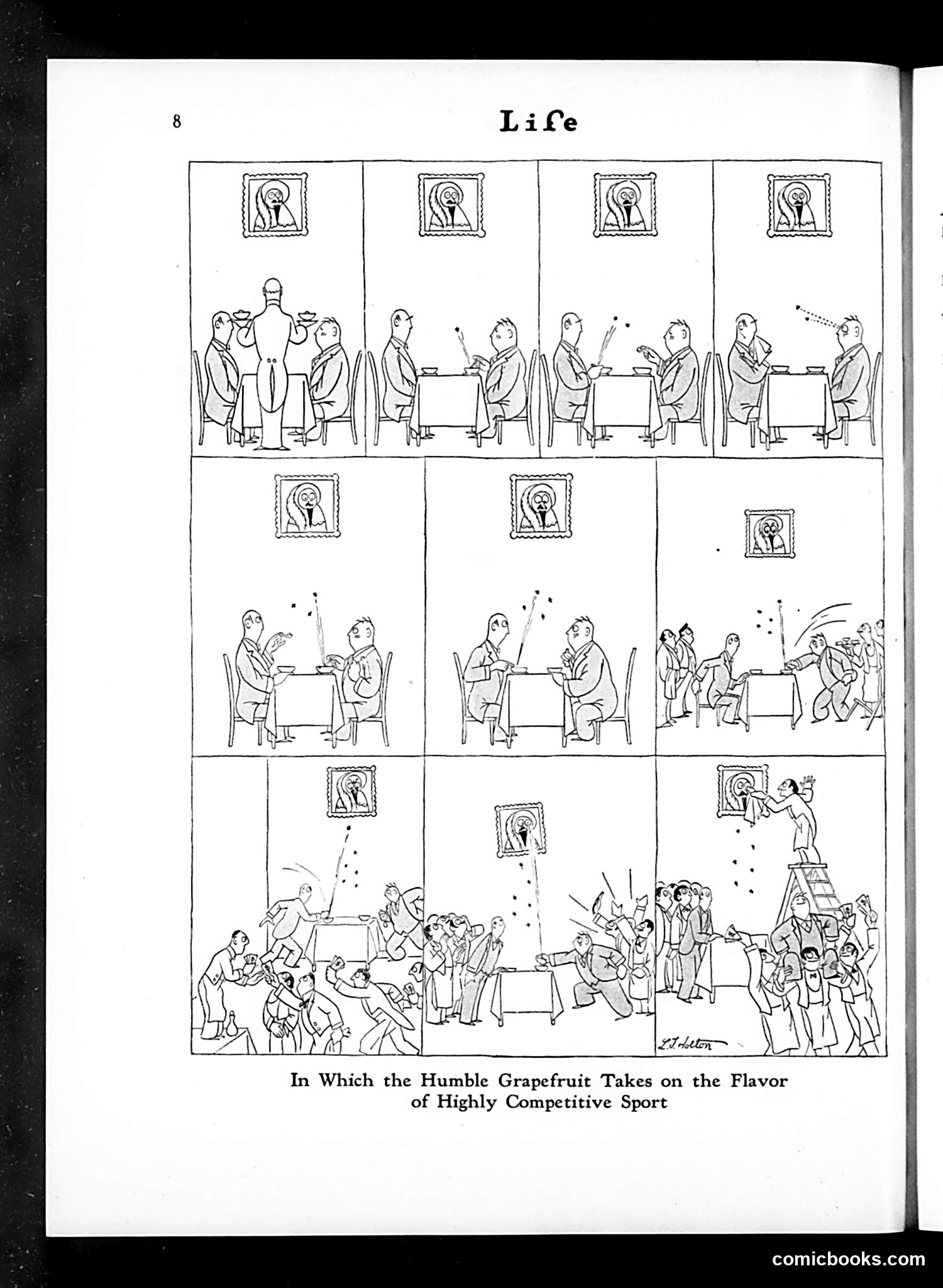
This is a humorous comic strip showing the escalating competitiveness around eating grapefruit. It begins with two men politely sharing a grapefruit at a table, but progresses through increasingly elaborate and chaotic scenes. By the final panels, what started as casual dining has evolved into a massive, frenzied competition with crowds of people, ladders, aggressive gestures, and apparent pandemonium—all centered on consuming grapefruit. The satire mocks how Americans transform ordinary activities into intensely competitive endeavors. The grapefruit serves as an absurd stand-in for any simple activity that Americans turn into a high-stakes sport or competition, reflecting early 20th-century social commentary on American competitiveness and the culture of "winning" at everything.
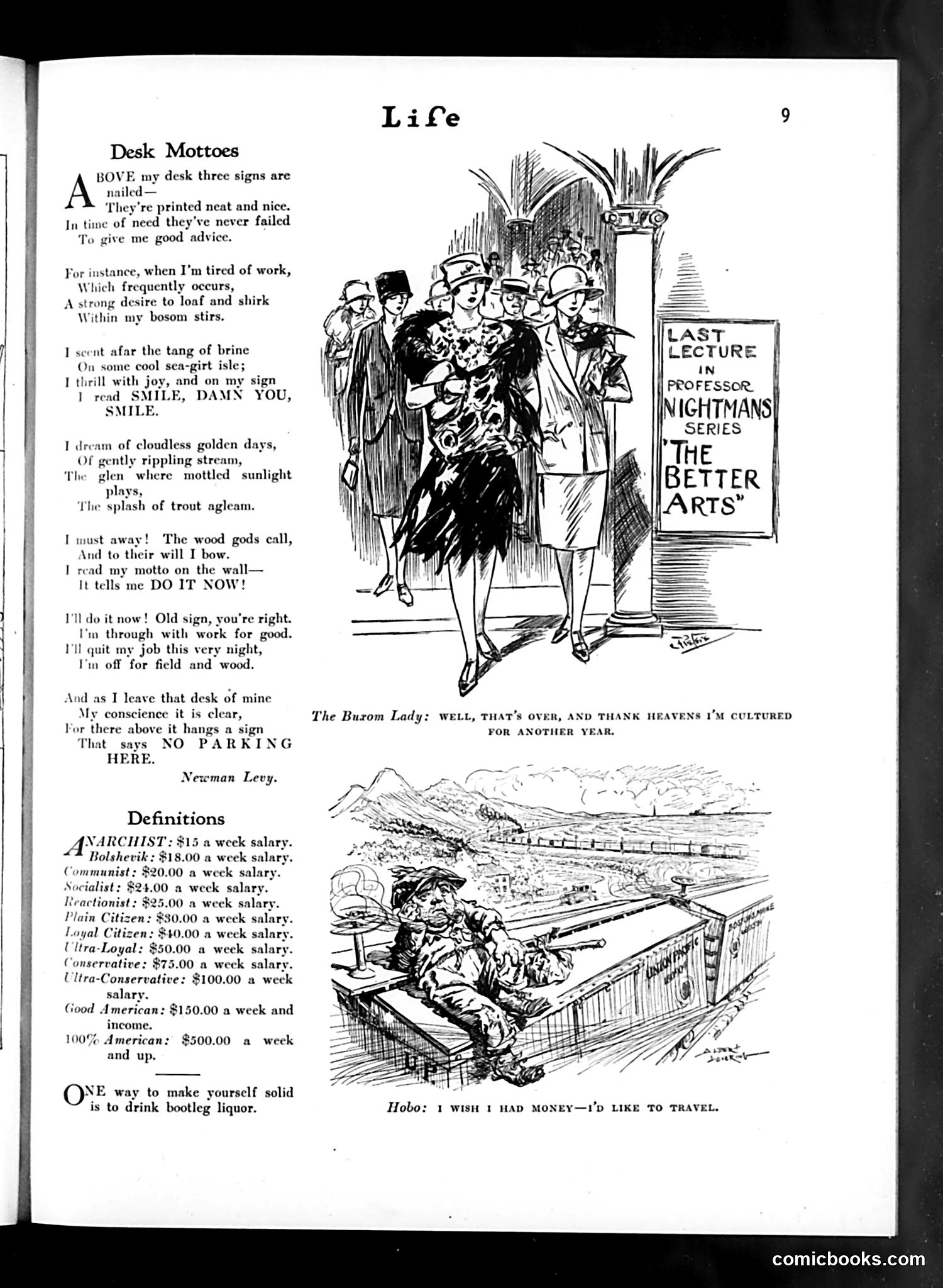
This page contains three satirical elements: **"Desk Mottos"** (poem by Newman Levy): A humorous meditation on workplace escape fantasies. The author humorously lists motivational signs above his desk that encourage him to abandon work for nature and leisure, culminating in a "NO PARKING HERE" sign representing his conscience. **"The Buzom Lady"** cartoon: Depicts a woman leaving a lecture series on "The Better Arts" by Professor Nightmans, sardonically captioned that she's "cultured for another year"—mocking superficial cultural consumption. **"Definitions"** section: A satirical glossary defining political/social positions by their weekly salaries, from "Anarchist" ($15) to "100% American" ($500+). This likely critiques how ideology correlates with wealth and class status. **"Hobo" cartoon**: A vagrant expressing desire to travel, contrasting with the salary-based definitions above. The page satirizes class divisions, pretentious culture, and political hypocrisy.
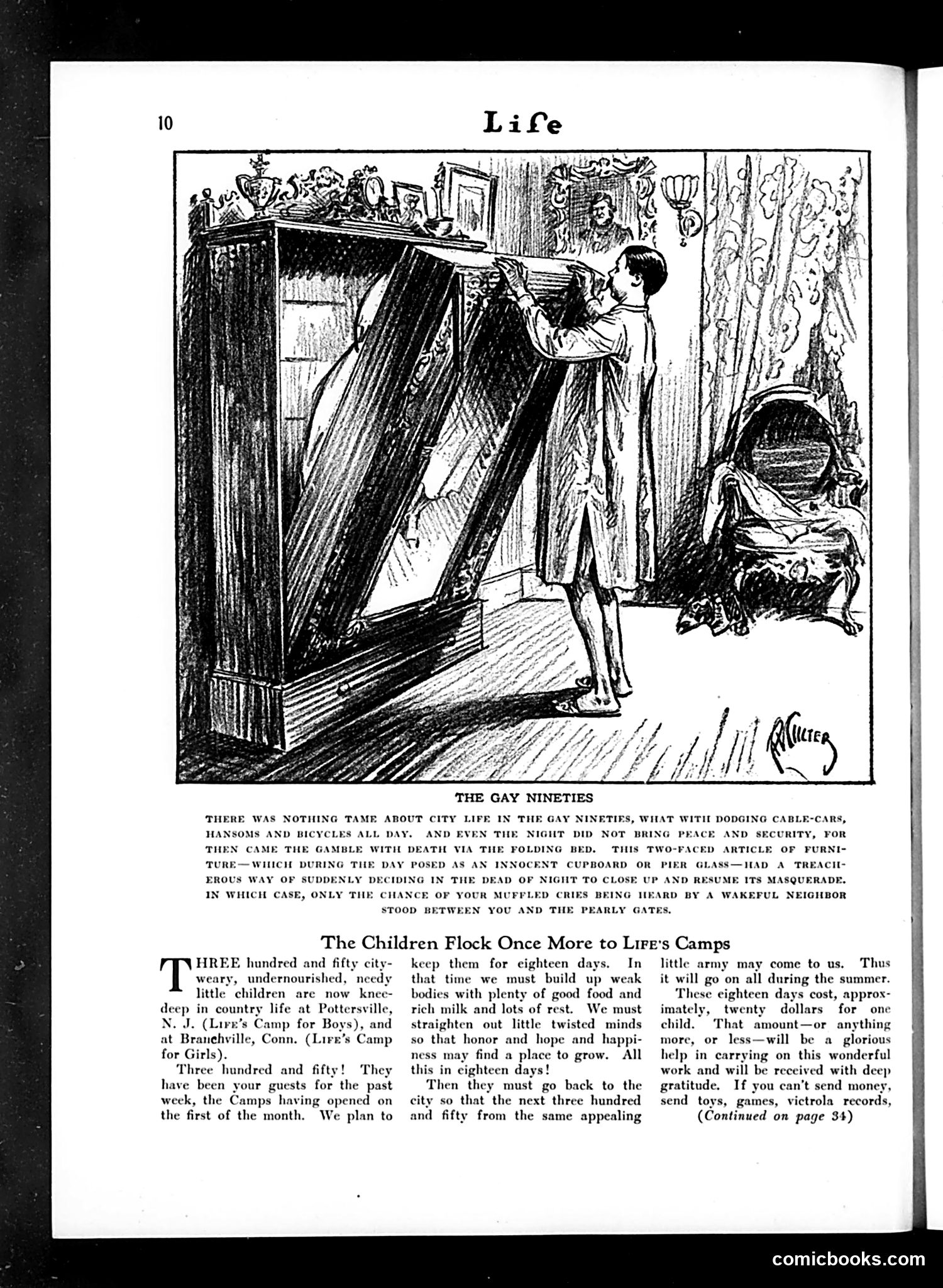
This page contains two distinct items from *Life* magazine: **Top cartoon ("The Gay Nineties"):** A satirical illustration mocking 1890s urban life. The cartoon shows a person manipulating a large folding bed—a piece of furniture that collapses for storage. The caption humorously suggests that in the "Gay Nineties," city dwellers faced such cramped living conditions and dangerous folding furniture that death might come from the bed closing unexpectedly at night. The joke targets overcrowded, squalid city housing and the dark humor that accompanied poverty. **Bottom article ("The Children Flock Once More to Life's Camps"):** A sincere piece announcing summer camps for 350+ underprivileged children from cities, hosted at locations like Potterville, N.J., and Branchville, Connecticut. The text emphasizes providing nutrition, rest, and moral development to needy children during an 18-day stay, soliciting donations ($20 per child) for this charitable effort.
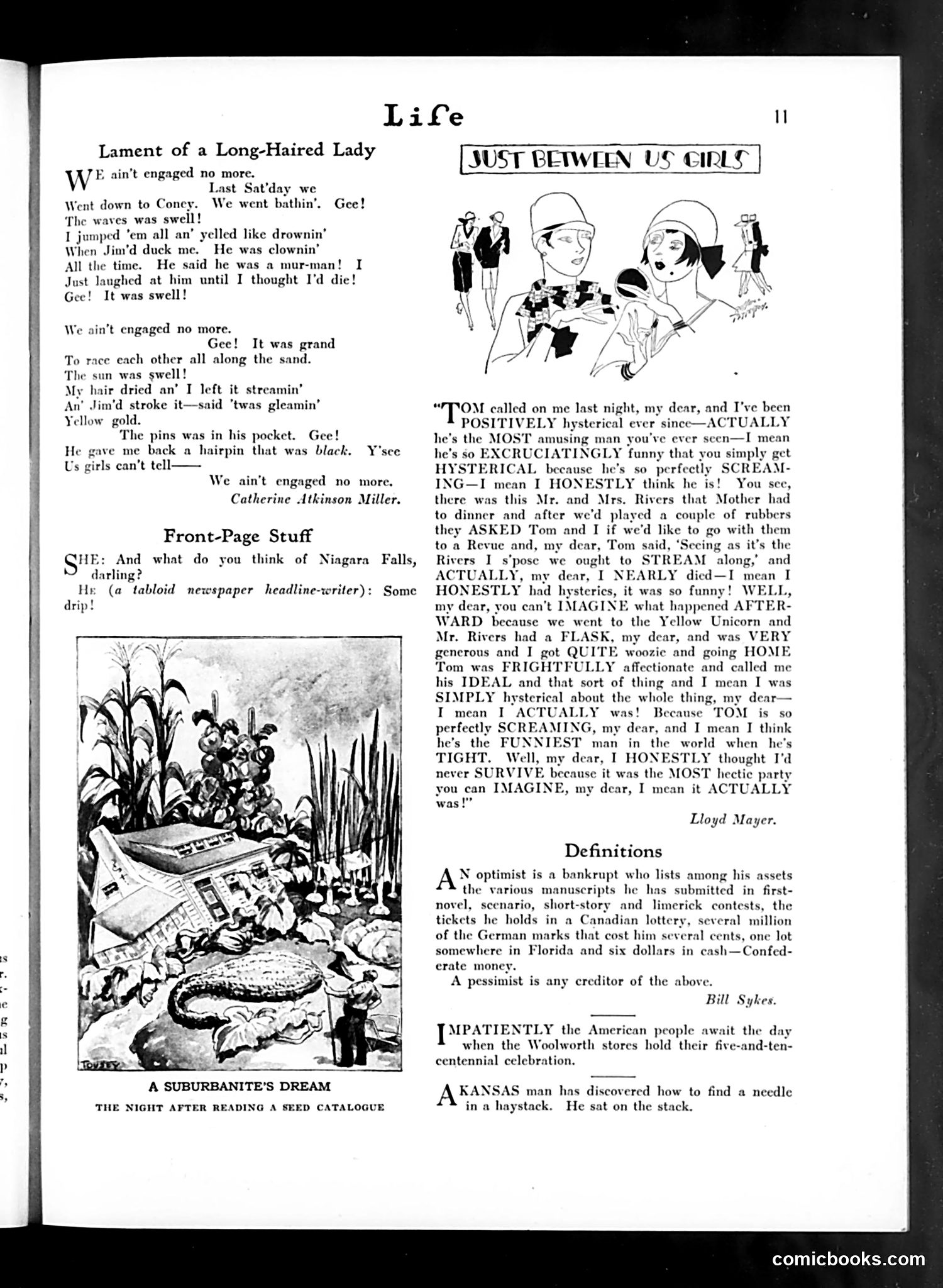
This page contains humor pieces typical of early 20th-century Life magazine. **"Just Between Us Girls"** is a cartoon featuring two young women in fashionable 1920s attire (cloche hats, modern dress). The accompanying text presents a breathless account of a social outing—attending a dance revue and nightclub with a couple named Tom and Mr. Rivers. The joke relies on exaggerated, breathless enthusiasm ("HYSTERICAL," "SCREAMING") about mundane social activities, satirizing how young women of the era gossiped and dramatized their social lives. The accompanying sections—"Front-Page Stuff," "Lament of a Long-Haired Lady," and "Definitions"—continue in this vein of gentle satire about contemporary manners, social pretension, and period concerns. "A Suburbanite's Dream" below depicts surreal, fantastical garden growth, parodying seed-catalog fantasies.
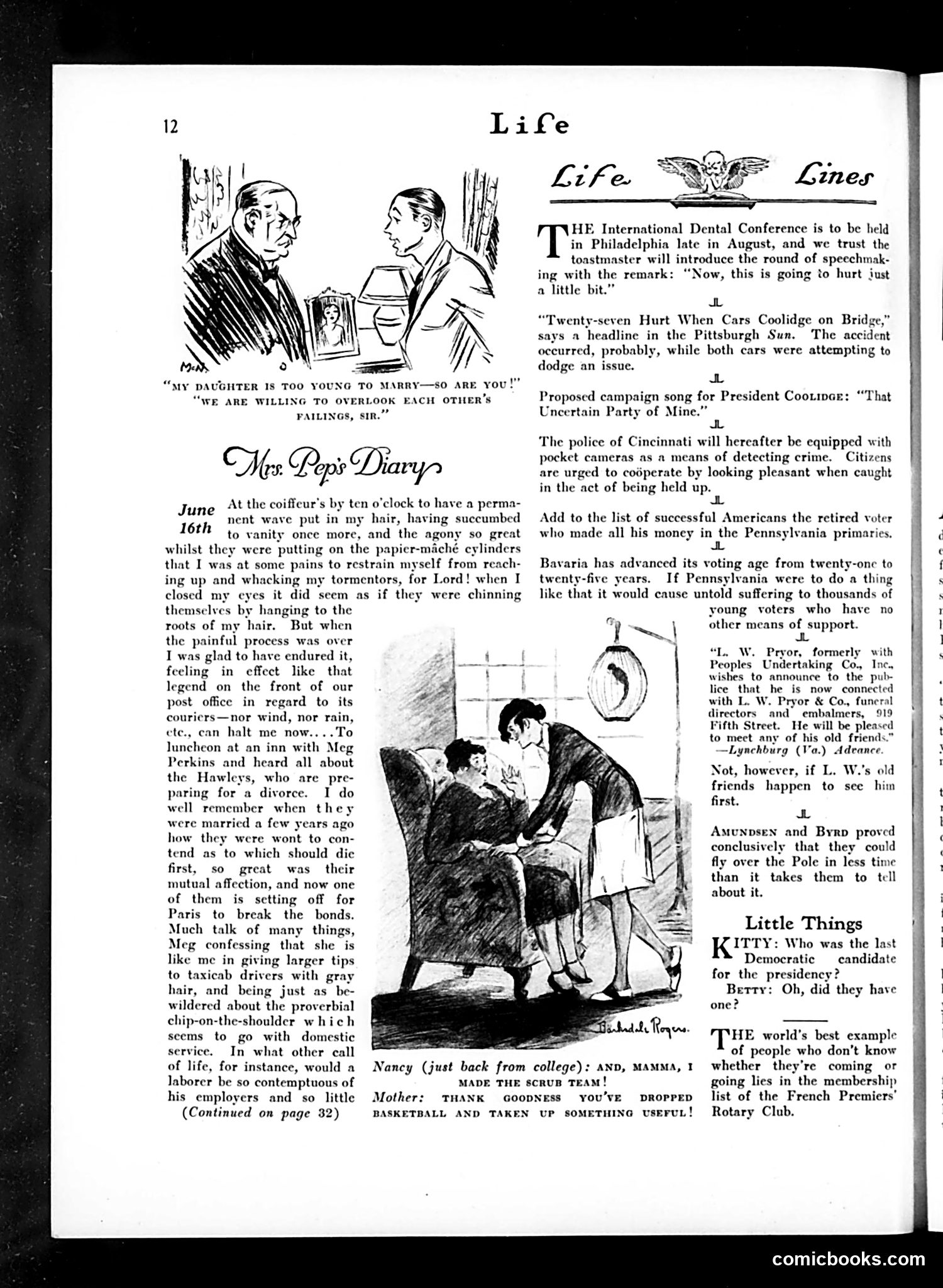
**Main Cartoon (Top Left):** Two men in conversation, with one saying "Any flirtation is too young to marry—so are you!" This appears to be social commentary on age-gap relationships or inappropriate courtship behavior, though the specific context is unclear without additional dating information. **"Mrs. Pep's Diary" (Center-Left):** A humorous account of a woman's visit to a coiffeur (hairdresser) on June 16th. She describes the painful process of having her hair set and waved, comparing her discomfort to various unpleasant situations. The piece satirizes women's beauty routines and the suffering endured for vanity—a recurring satirical target in Life magazine. **"Little Things" (Bottom Right):** A brief joke exchange between characters named Kitty and Berry about Democratic presidential candidates. The page mixes social satire with light domestic humor typical of Life's editorial style.
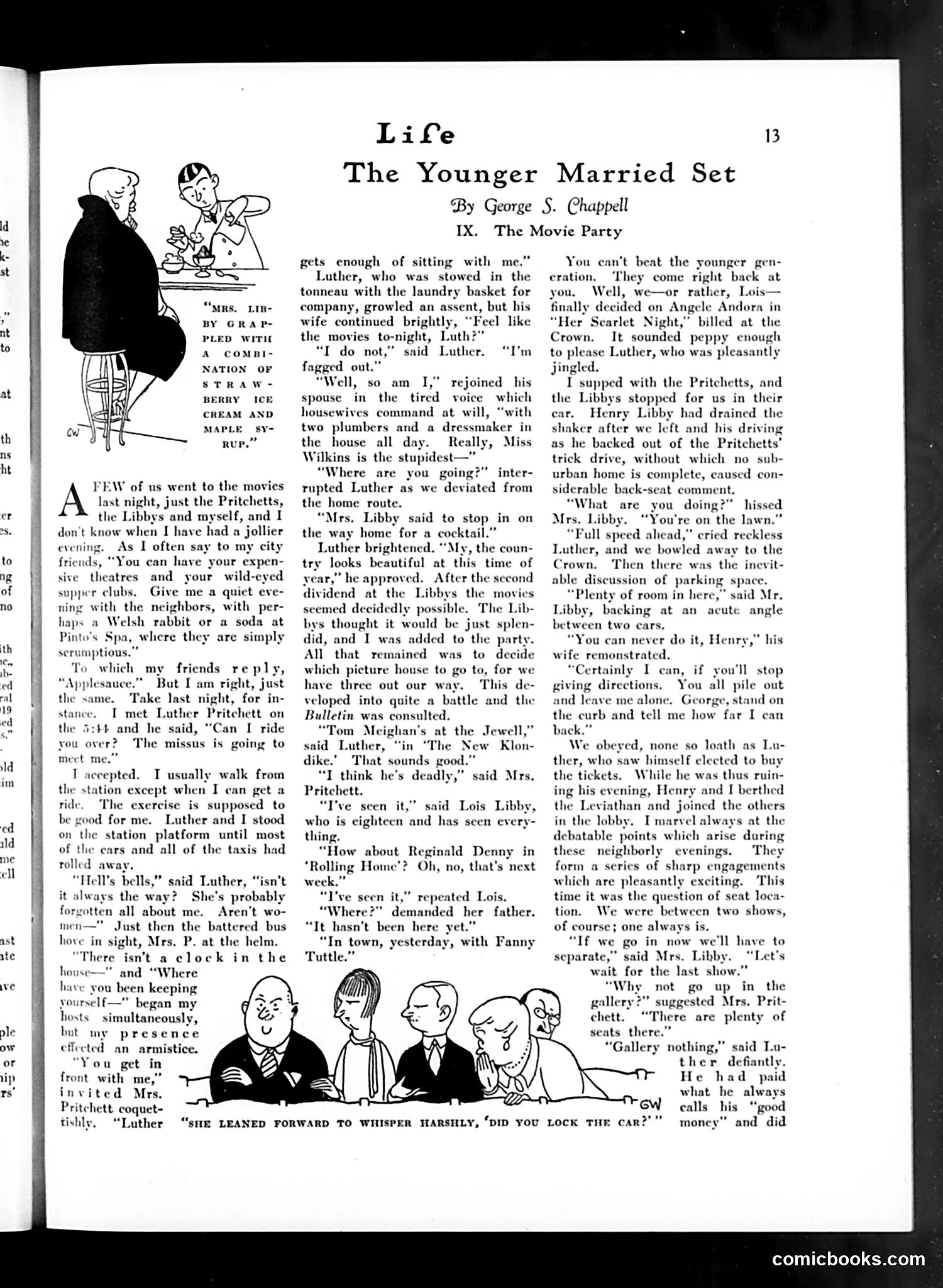
This is a humorous domestic satire by George S. Chappell about young married couples attending movies. The cartoon depicts the social awkwardness and logistics of organizing a group outing: deciding which theater to visit, managing parking and seating arrangements, and the tedious negotiations required to coordinate multiple couples' preferences. The satirical point targets the emerging social rituals of suburban middle-class life in the 1920s-30s—how simple entertainment became complicated by group dynamics and marital negotiations. The illustration at bottom shows the couples arguing, capturing the mild domestic friction beneath genteel socializing. The humor lies in recognizing how couples-socializing, though meant to be pleasant, often devolves into practical complications and minor conflicts.
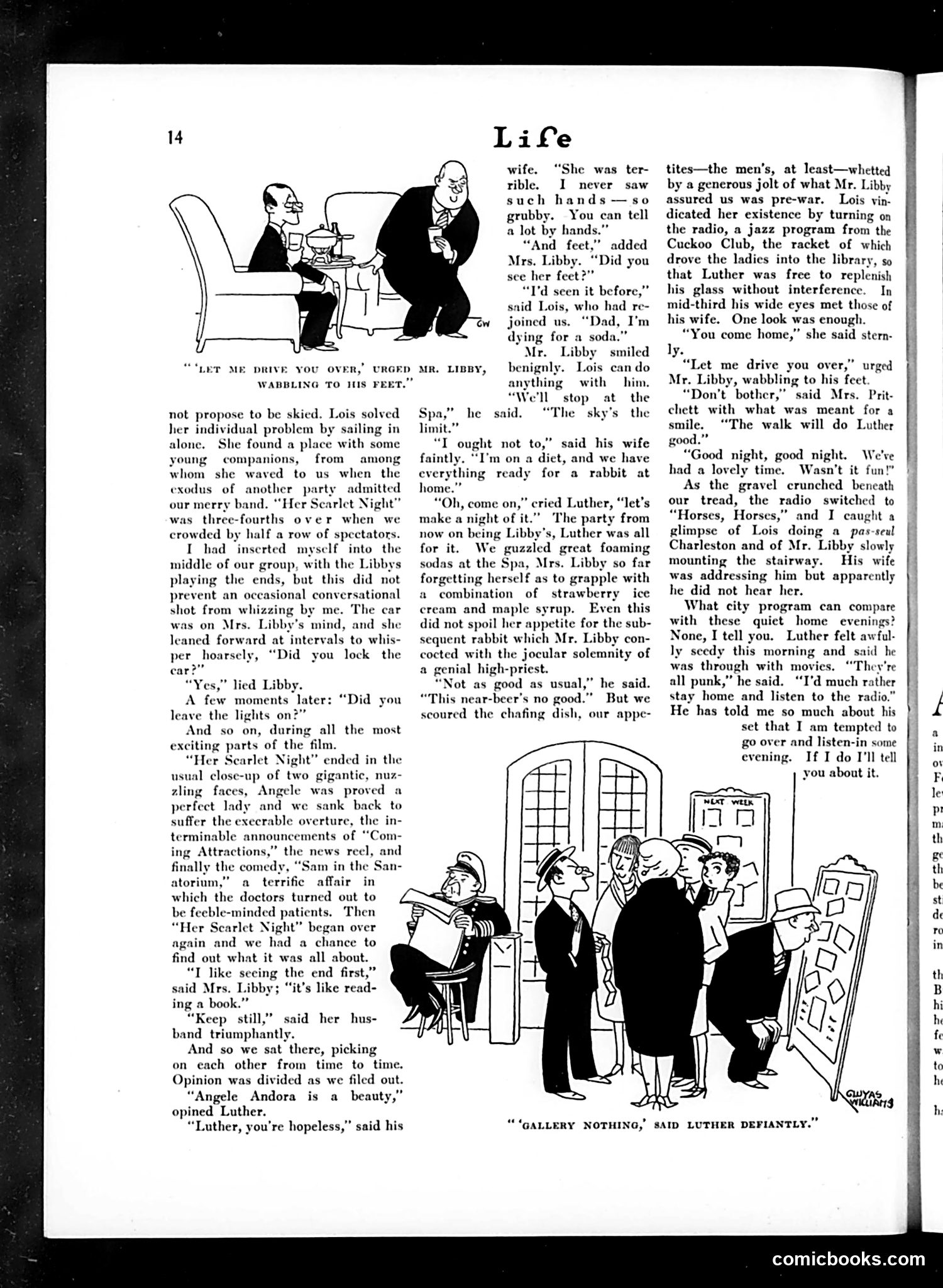
This page contains two cartoon illustrations satirizing domestic life and cultural attitudes of the early 20th century. The top cartoon depicts a husband (Mr. Libby) being urged by his wife to drive her somewhere, with banter about her hands and feet. The humor targets gender dynamics and marital negotiations. The bottom cartoon, captioned "GALLERY NOTHING," SAID LUTHER DEFIANTLY," shows a group examining what appears to be modern art on a wall. Luther's defiant rejection of abstract art ("Gallery nothing") satirizes the tension between traditional and modernist aesthetics that characterized early 20th-century cultural debates. The cartoon mocks both pretentious art appreciation and stubborn resistance to artistic innovation. Both cartoons reflect period anxieties about changing gender roles and artistic modernism.
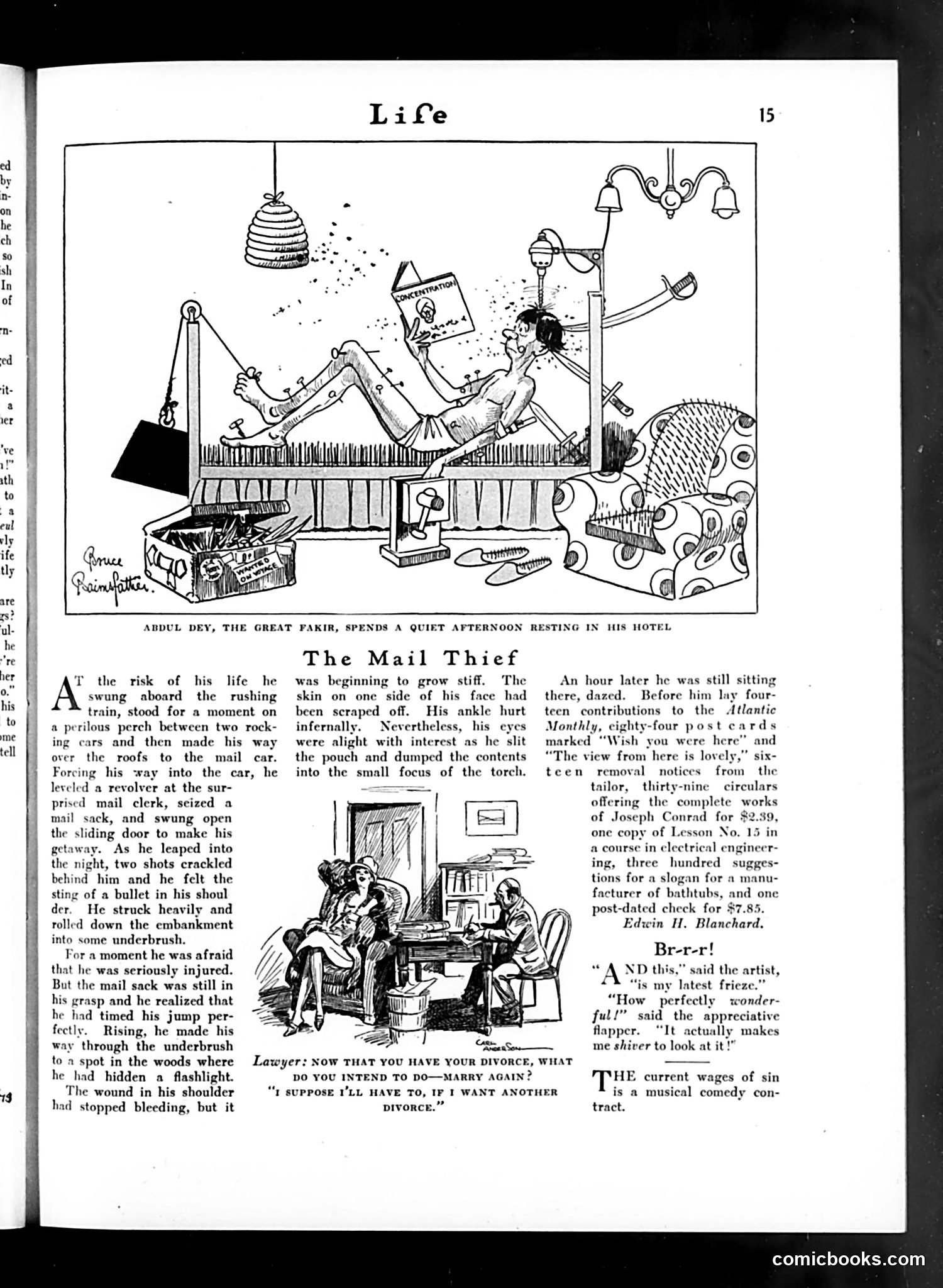
This page contains a short story illustrated with period drawings. The narrative follows a mail thief who boards a train and steals a mail sack, escaping with a bullet wound to his shoulder. The story appears to be a crime/adventure tale rather than political satire. The top illustration shows "Abdul Dev, the Great Fakir" relaxing at a hotel—a separate, unrelated vignette. The lower section includes a lawyer's cartoon dialogue about divorce: a man tells his lawyer he wants another divorce, to which the lawyer responds he'll need to pay for it. This is social satire about the costs and complications of repeated divorces—a commentary on marriage and legal expenses rather than political commentary. The page represents typical early-20th-century magazine entertainment content mixing fiction, illustration, and light social humor.
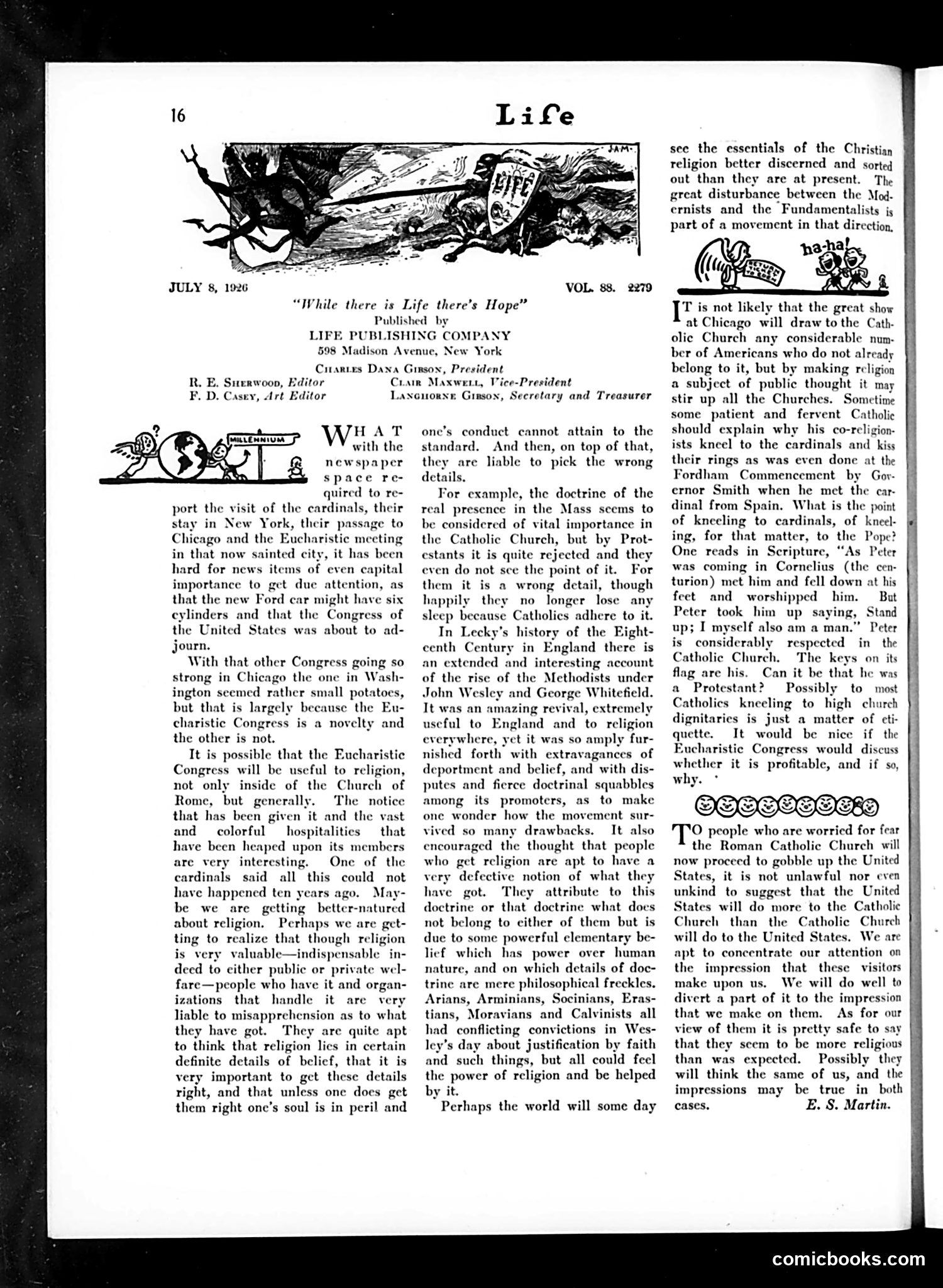
This page contains editorial commentary on religious topics rather than political cartoons. The main illustration at the top appears to be a decorative header showing a cherub or classical figure. The text discusses the recent Eucharistic Congress in Chicago and its religious and social implications. The author critiques both Catholic and Protestant positions on doctrine, arguing that excessive focus on theological minutiae divides rather than unites Christians. The piece references historical religious movements (Methodists, Wesley) and contemporary anxieties about Catholic influence in America. The author advocates for religious tolerance and suggests that doctrinal disputes are ultimately less important than shared Christian values. No specific political figures are caricatured on this page—it's primarily opinion-based religious commentary typical of Life's satirical social criticism of the 1920s.
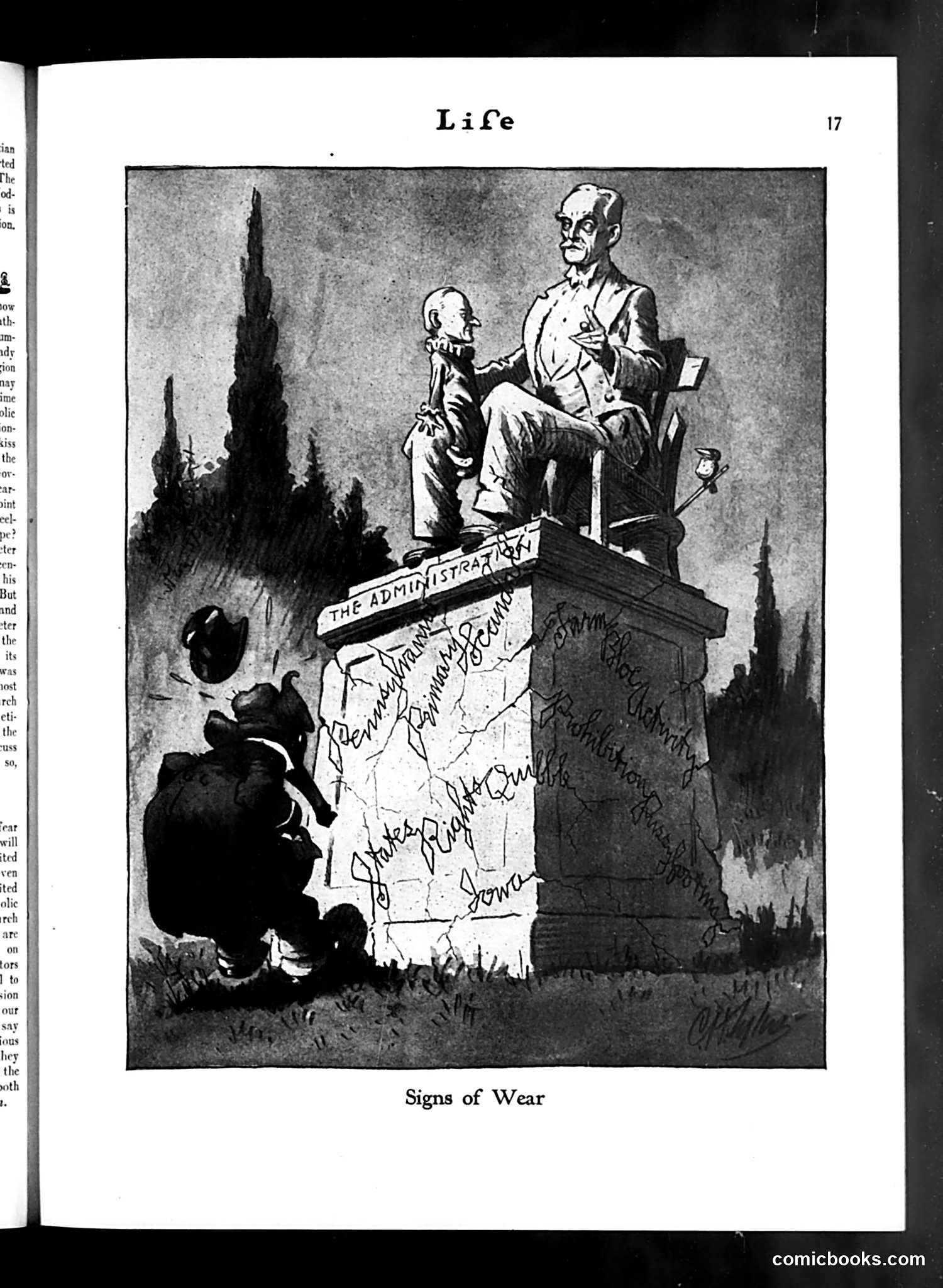
This political cartoon depicts an administrator or government official sitting atop a large map of the United States, appearing worn and exhausted. A small figure (possibly representing a constituent or citizen) stands beside him. The administrator sits on what's labeled "THE ADMINISTRATION," with the map below showing various state names including Iowa and other regions. The satire suggests the administrative burden of governing—the "signs of wear" are literal, showing the official deteriorating under the weight of managing the nation. The cartoon critiques how the duties of office exhaust leadership. Without knowing the specific publication date, the exact political figure remains unclear, though the work appears to comment on the physical and mental toll of high office during an era of significant national challenge.
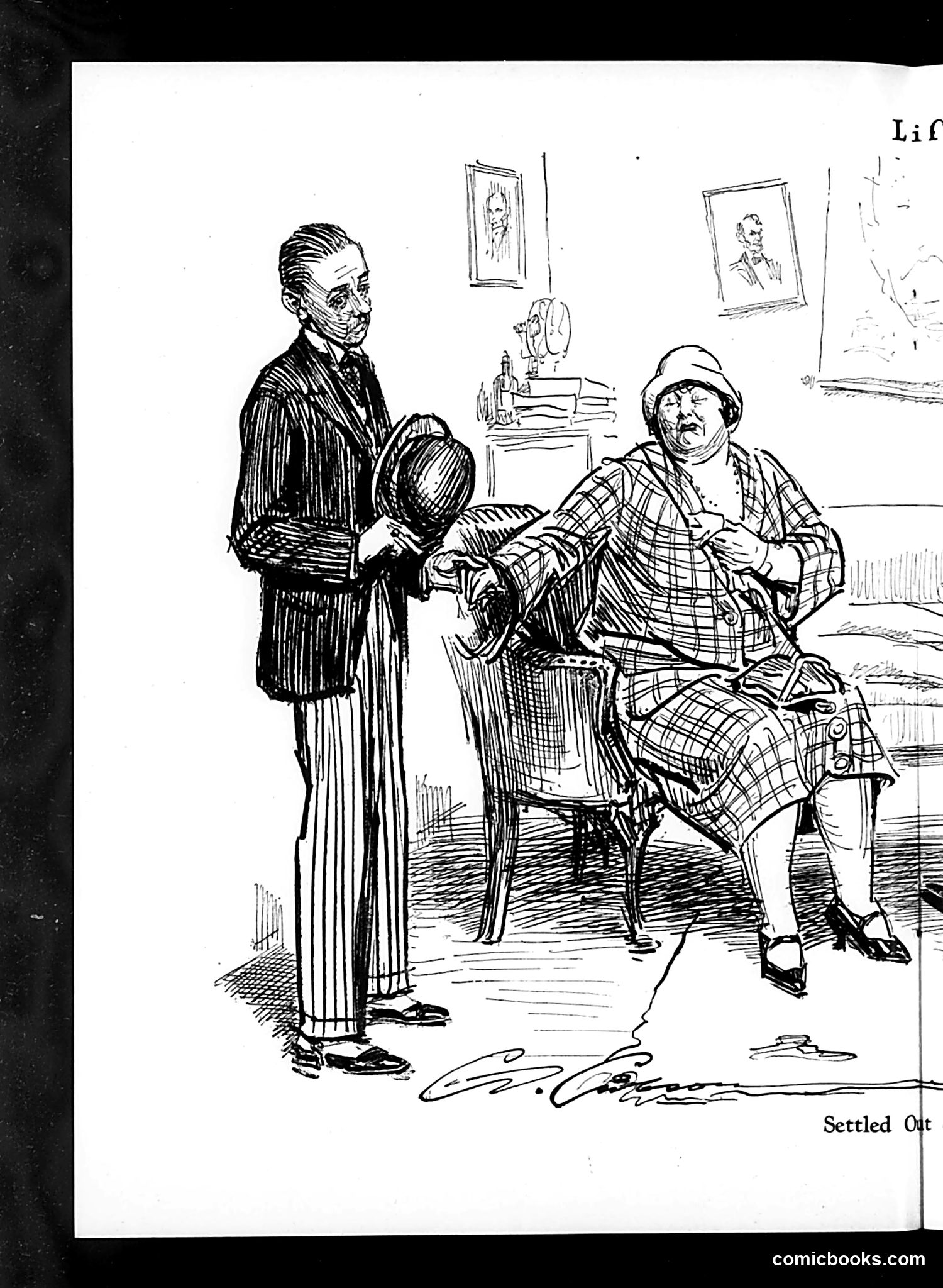
This cartoon depicts a legal or financial settlement scene. A well-dressed man in a pinstriped suit stands with a woman (appearing to be his wife or associate), while a working-class man in a flat cap and plaid clothing sits gesturing animatedly. The seated man appears to be a laborer or common person receiving compensation or settlement terms from the gentleman. The title "Settled Out" suggests an out-of-court settlement, likely involving a dispute or accident claim. The contrast between the formally dressed professional and the working-class figure in shabby clothes suggests class differences in a legal dispute. The cartoon likely satirizes how the wealthy could quickly resolve disputes through financial settlement rather than court proceedings—a commentary on wealth inequality in the American legal system of the era.
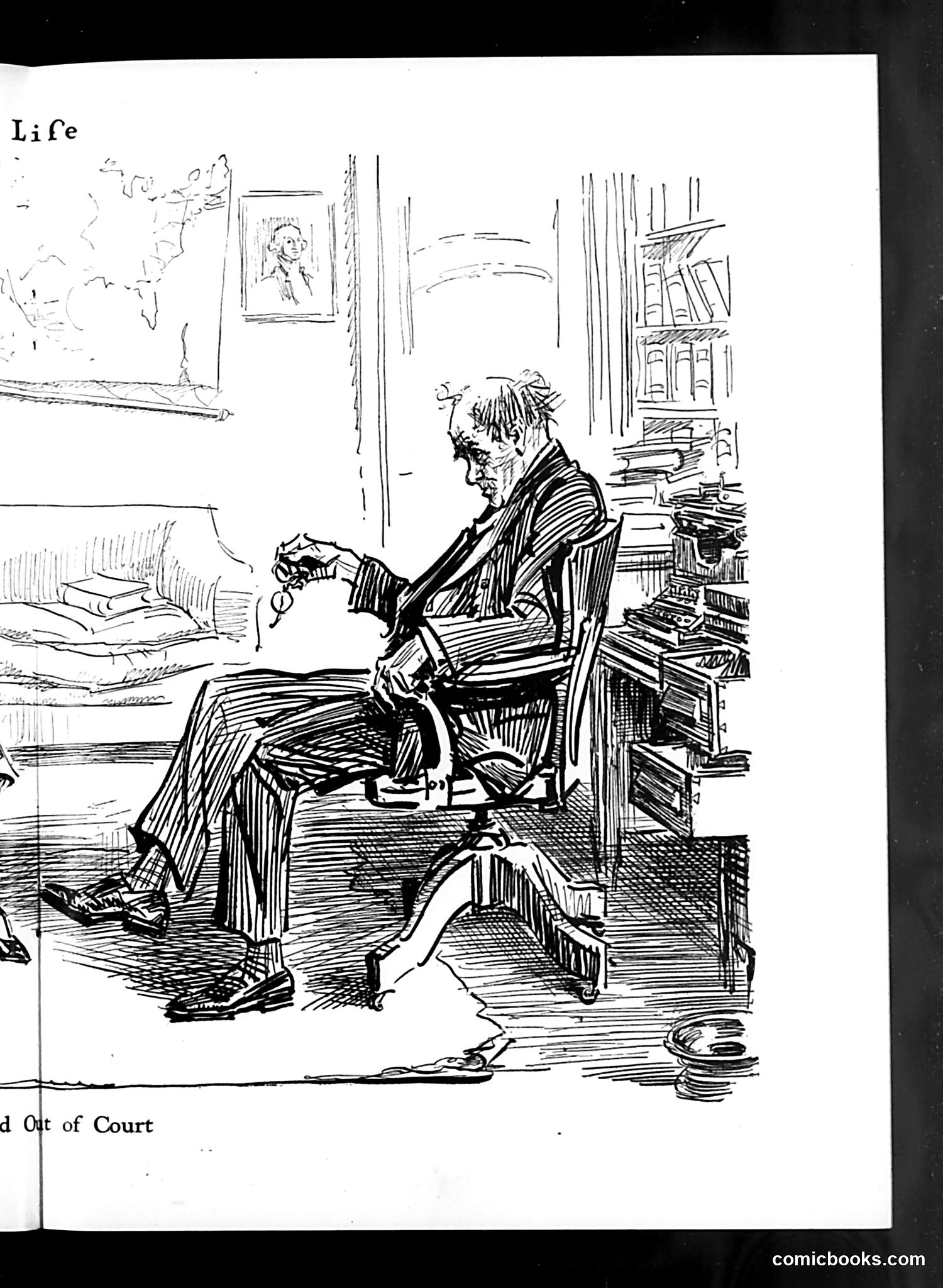
This page shows a single ink sketch titled "Life" depicting an elderly man seated in a study surrounded by books and papers. He holds what appears to be a quill pen or writing instrument and gazes downward in a contemplative pose. The room is heavily cluttered with stacked volumes on shelves and surfaces, suggesting scholarly work or legal research. The caption fragment reads "d Ott of Court," which appears incomplete—likely part of a longer title or caption. Without the full text and given the formal study setting with legal-appearing materials, this appears to be a character study or commentary on a scholarly or legal figure, though the specific satirical point remains unclear from the visible portion alone.
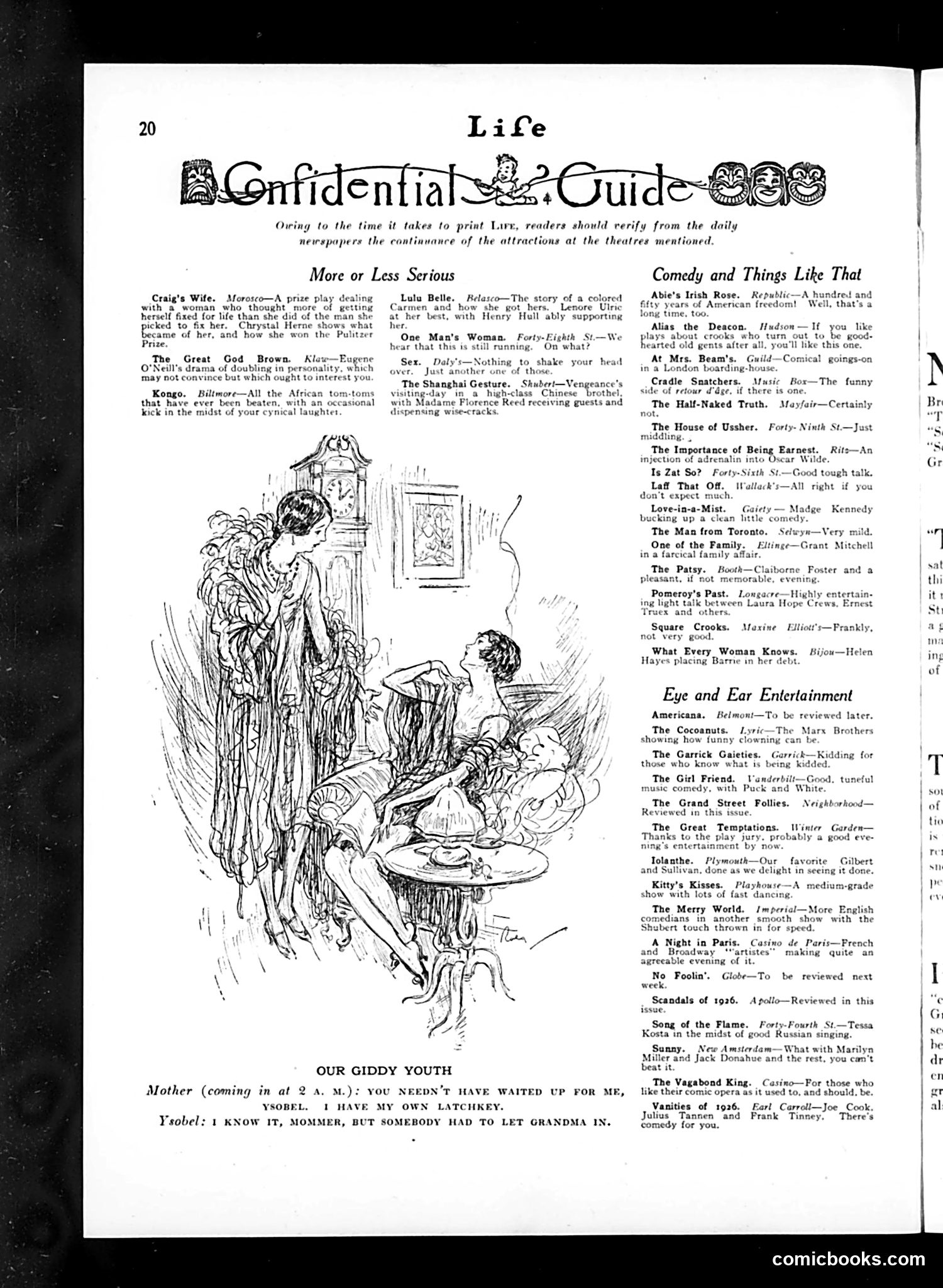
This page from *Life* magazine functions primarily as a **theater guide** listing Broadway shows with brief reviews, organized by genre (serious drama, comedy, entertainment). The cartoon at bottom satirizes **youth culture and changing social norms** of the 1920s. A young woman ("Ysobel") returns home at 2 a.m., prompting her mother's complaint. Ysobel's response—that she has her own latchkey but "somebody had to let grandma in"—is the joke: it suggests the grandmother was out even *later*, playfully inverting generational expectations. This reflects the "Roaring Twenties" anxiety about young women's newfound independence and late-night social freedom (dating, nightclubs), while humorously implying that even older generations were participating in modern nightlife. The humor relies on the reader's awareness that such late-night independence for unmarried women was considered scandalous by conservative standards of the era.
This is a theater review comparing two Broadway revues. "The Grand Street Follies" is criticized as having lost its satirical edge—once fresh and clever, it's now stale and artificial, failing to deliver genuine humor or sharp social commentary despite attempting both. The review singles out a few bright spots: a "Constructivist Russian" parody of "Uncle Tom's Cabin," Milt Gross's character Mrs. Feitlebaum, and Albert Carroll's song-and-dance number. By contrast, George White's "Scandals" is praised as superior entertainment precisely *because* it abandons pretense. Rather than attempting satire, it delivers what it promises: lavish spectacle, talented performers (Harry Richman, Willie Howard, Ann Pennington, Buster West), skilled dancing, and strong comedic sketches with good punchlines. The review's verdict: honest entertainment beats failed sophistication.
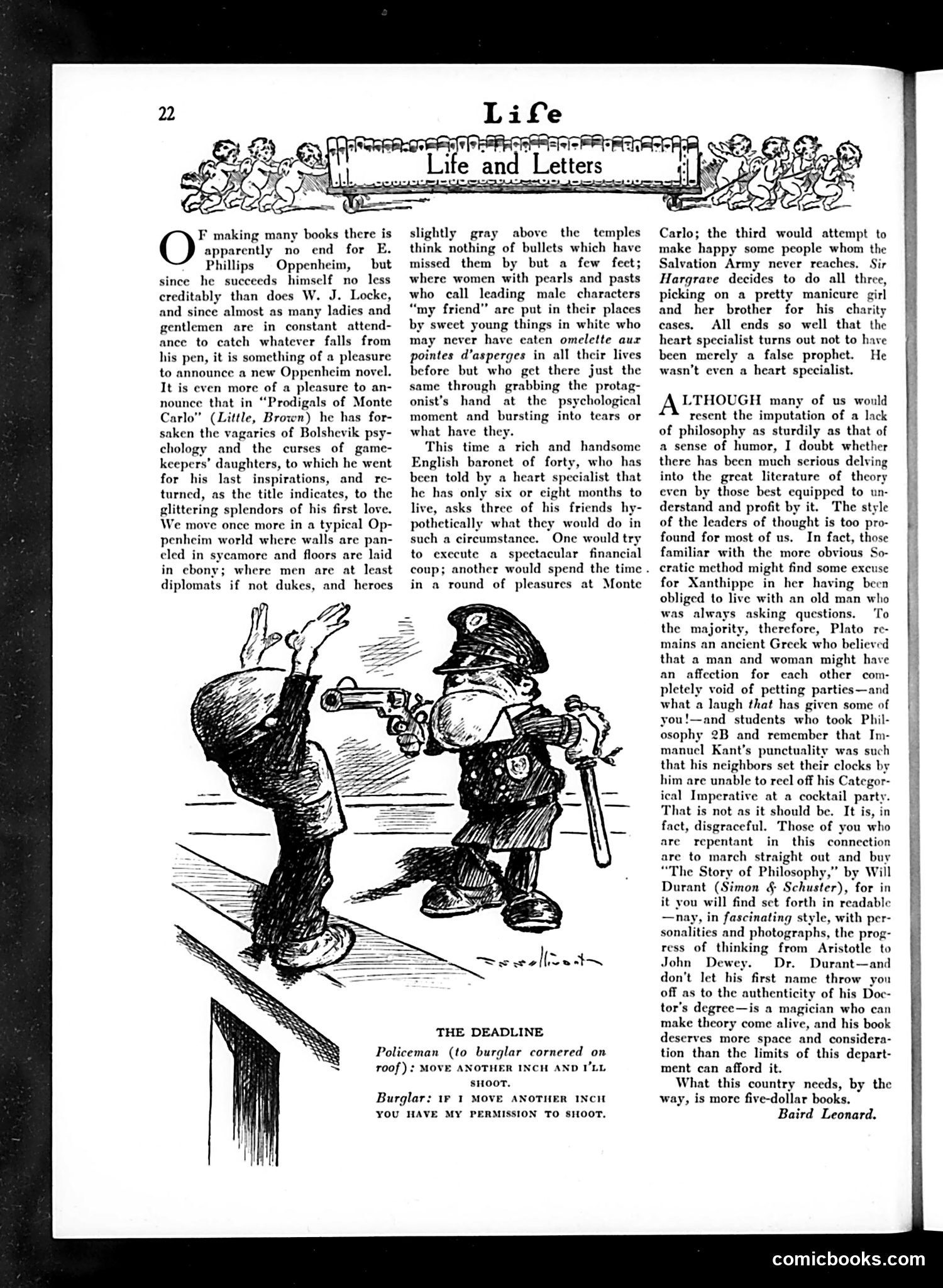
This page contains book reviews and a cartoon joke. The main content reviews E. Phillips Oppenheim's novel "Prodigals of Monte Carlo," praising his return to luxurious settings (paneled walls, ebony floors) and wealthy characters—diplomats, dukes, and women with "pearls and pasts." The cartoon at bottom depicts a burglar cornered on a roof by a policeman. The burglar says, "If I move another inch, you have my permission to shoot"—a absurdist joke playing on the reversal of authority. The burglar effectively dares the policeman to shoot by framing it as the burglar's own permission, creating a logical deadlock. A lengthy essay praises Will Durant's "The Story of Philosophy" (Simon & Schuster), arguing that philosophical literature remains inaccessible to average readers due to dense writing. Durant apparently makes philosophy readable through "fascinating style" with personalities and photographs—making complex thinkers like Plato and Kant understandable beyond academic circles.
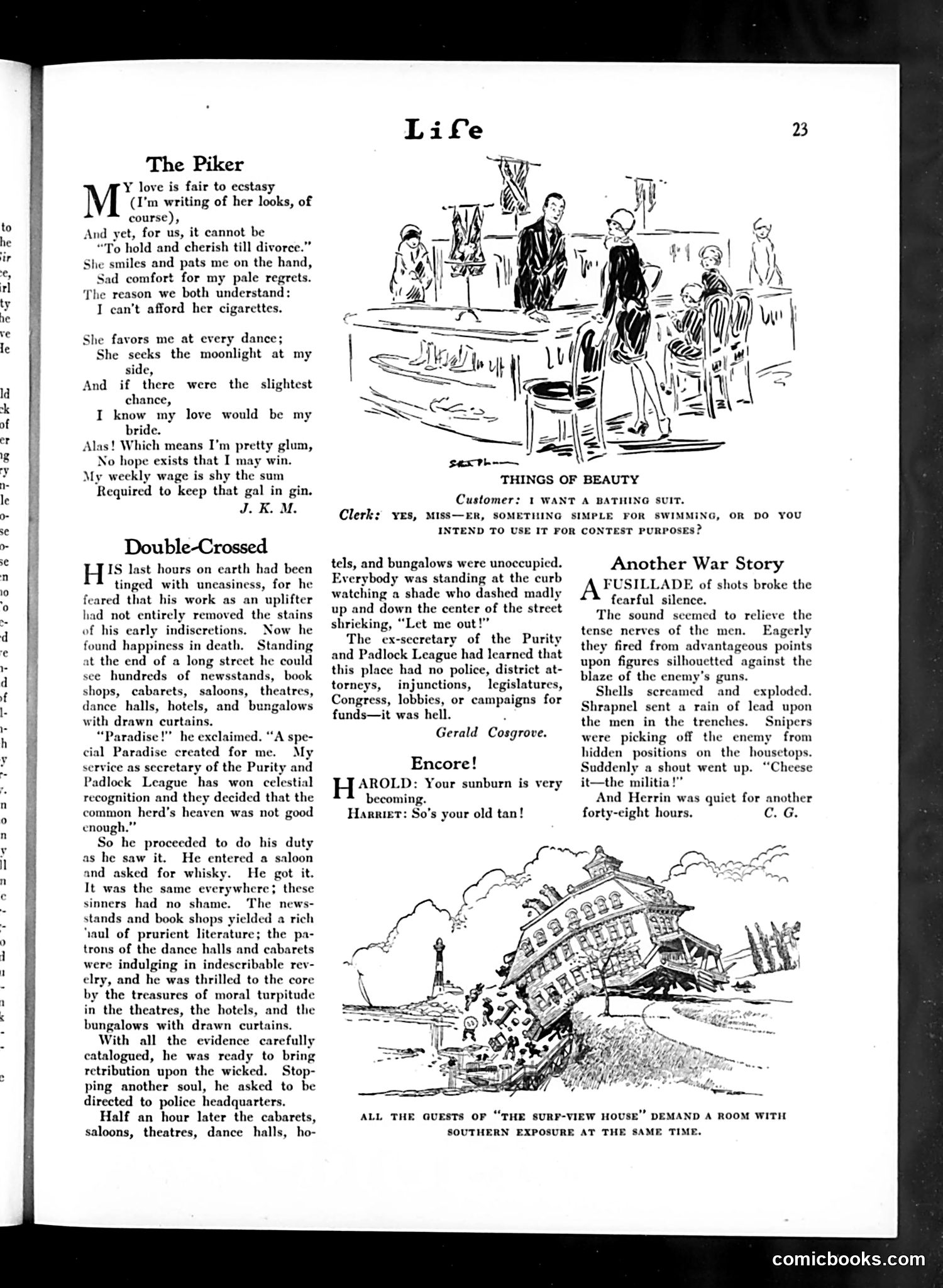
This page contains three satirical pieces typical of 1920s-era Life magazine: **"The Piker"** mocks a young man too poor to court his love interest—he can't afford her cigarettes and gin, making him an inadequate suitor despite her affection. **"Double-Crossed"** satirizes a Purity and Padlock League secretary (referencing real anti-vice organizations of that era). The joke: he dies believing he's reached paradise, but discovers "hell" is a place where his moral crusading finds no authorities to enforce prohibition, no laws to leverage—his entire purpose becomes meaningless, driving him mad. **"Things of Beauty"** makes a double entendre about women's bathing suits—asking whether the customer wants swimwear for actual swimming or for "contest purposes" (beauty pageants/exhibition), implying the suit's real purpose is displaying the wearer's body. **"Another War Story"** references the Herrin Massacre (1922 Illinois labor violence), darkly joking that militia arrival stops the fighting—not through actual combat but through fear of armed confrontation.
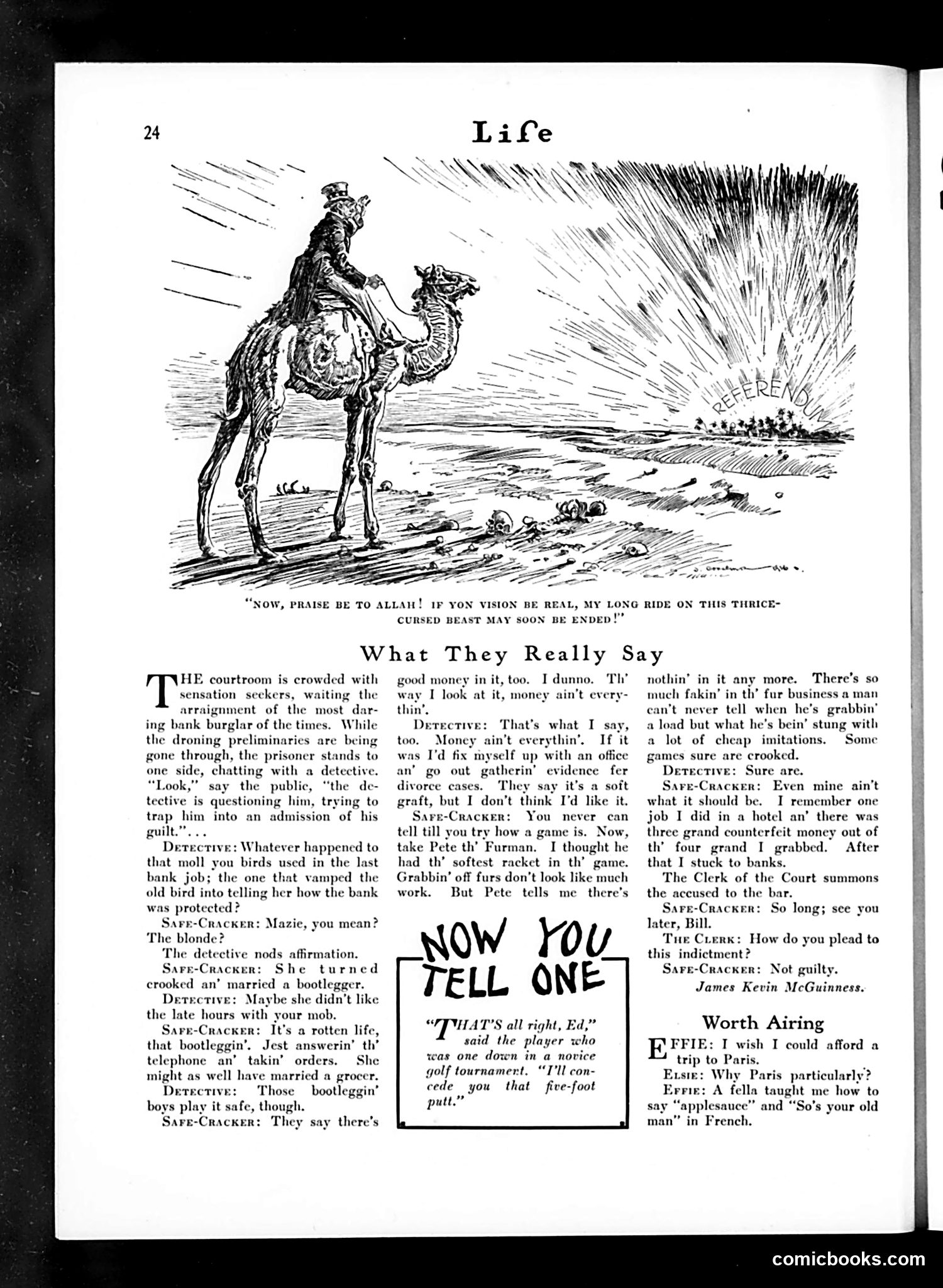
This page contains two satirical pieces from *Life* magazine: **Main Cartoon ("What They Really Say"):** A humorous dialogue between a detective and a safe-cracker (bank burglar) awaiting trial. The satire exposes the public's misconception—observers assume the detective is interrogating the prisoner, when he's actually just chatting casually about criminal life. The joke undercuts the drama: instead of a tense confession attempt, we see criminals matter-of-factly discussing the poor pay and hazards of various illegal trades (bootlegging, fur theft, counterfeiting). It's darkly comedic commentary on organized crime during Prohibition-era America, treating criminals as ordinary workers complaining about their "jobs." **Top Illustration:** A figure on a camel in a desert, likely referencing Arabian Nights or orientalist fantasy—possibly introducing the page's theme or serving as a unrelated decorative element. **"Worth Airing" (bottom):** A brief joke about learning to say American slang phrases ("applesauce"—nonsense; "So's your old man"—a retort) in French, playing on tourists' desire for Parisian sophistication.
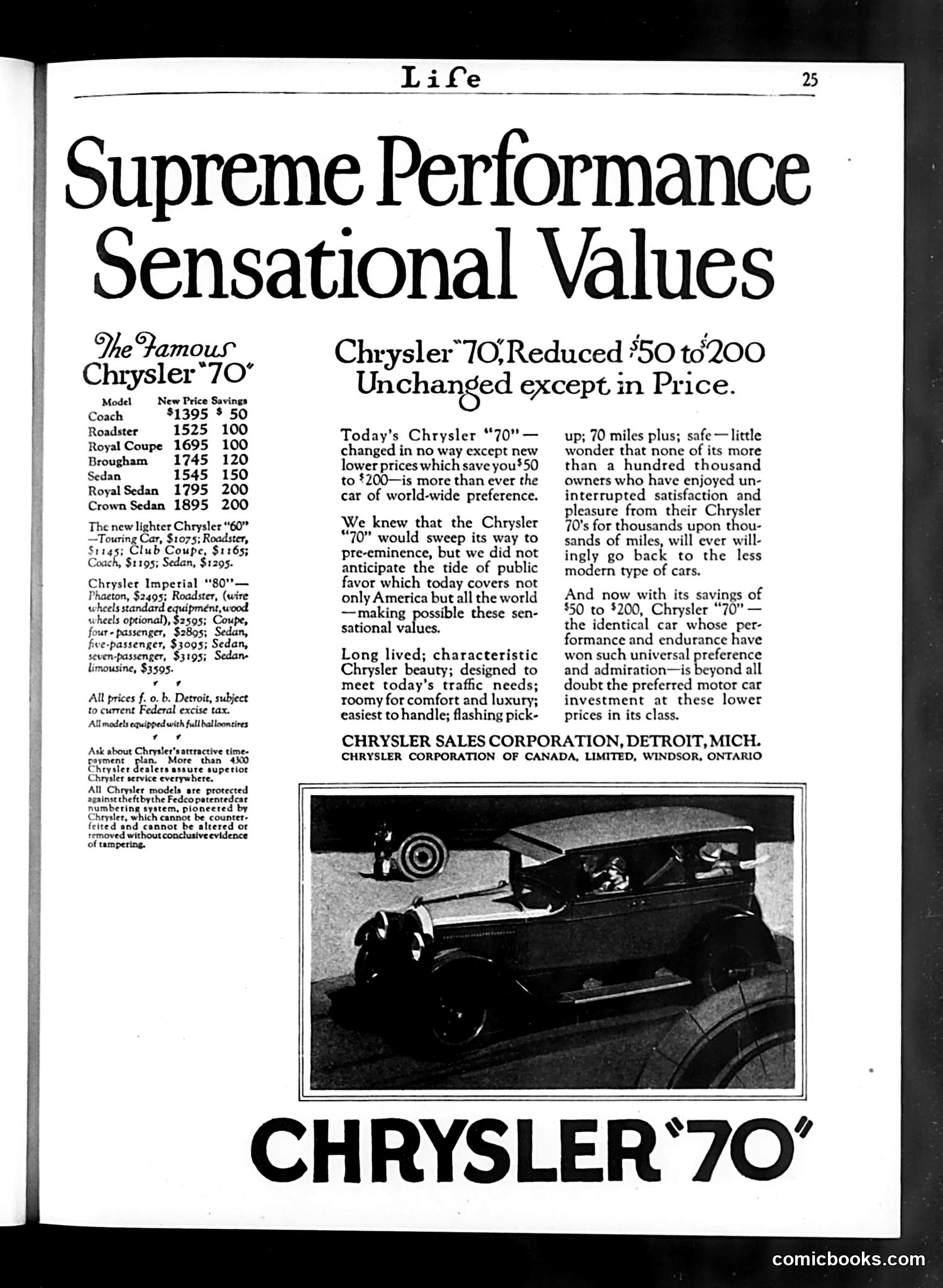
This is **not a cartoon or satire**—it's a straightforward automobile advertisement from Life magazine (circa 1924-1925). The page promotes Chrysler's price reduction on the popular "70" model, claiming savings of $50 to $200 across various body styles. The advertisement emphasizes that the car itself remains mechanically unchanged; only prices have dropped. This reflects post-WWI economic conditions when manufacturers competed on affordability. The image shows the vehicle in profile, typical of period car advertising. The "sensational values" headline and repeated emphasis on worldwide popularity suggest Chrysler was capitalizing on the car's genuine success to justify lower pricing—positioning the brand as both prestigious and now financially accessible. The ad mentions anti-theft features and payment plans, marketing strategies for a mass-market luxury vehicle. No political satire is present; this is commercial messaging.
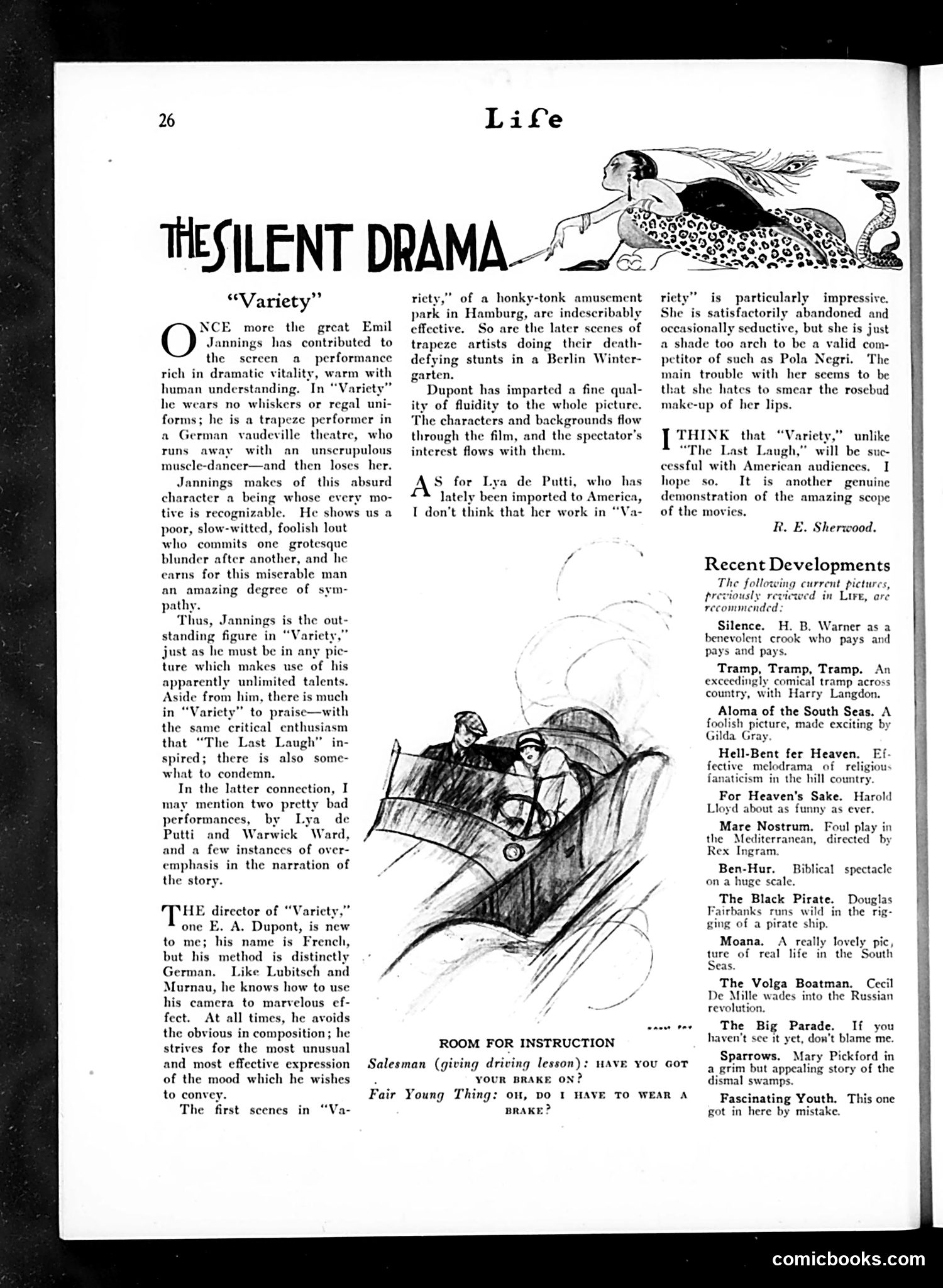
This page reviews the German silent film "Variety," starring Emil Jannings as a trapeze performer in a Hamburg amusement park who abandons his wife for a younger woman. Critic R.E. Sherwood praises Jannings' sympathetic portrayal of a foolish, poorly-educated man, and director E.A. Dupont's German expressionist camera work, comparing him favorably to Lubitsch and Murnau. The review criticizes imported German actress Lya de Putti's stiff performance, claiming she's too arch and overly concerned with maintaining her makeup rather than genuinely acting. Sherwood predicts "Variety" will succeed with American audiences unlike the more avant-garde "The Last Laugh." The cartoon below shows a driving instructor asking a student if her brake is on; she replies she doesn't wear one—a joke about feminine fashion ignorance.
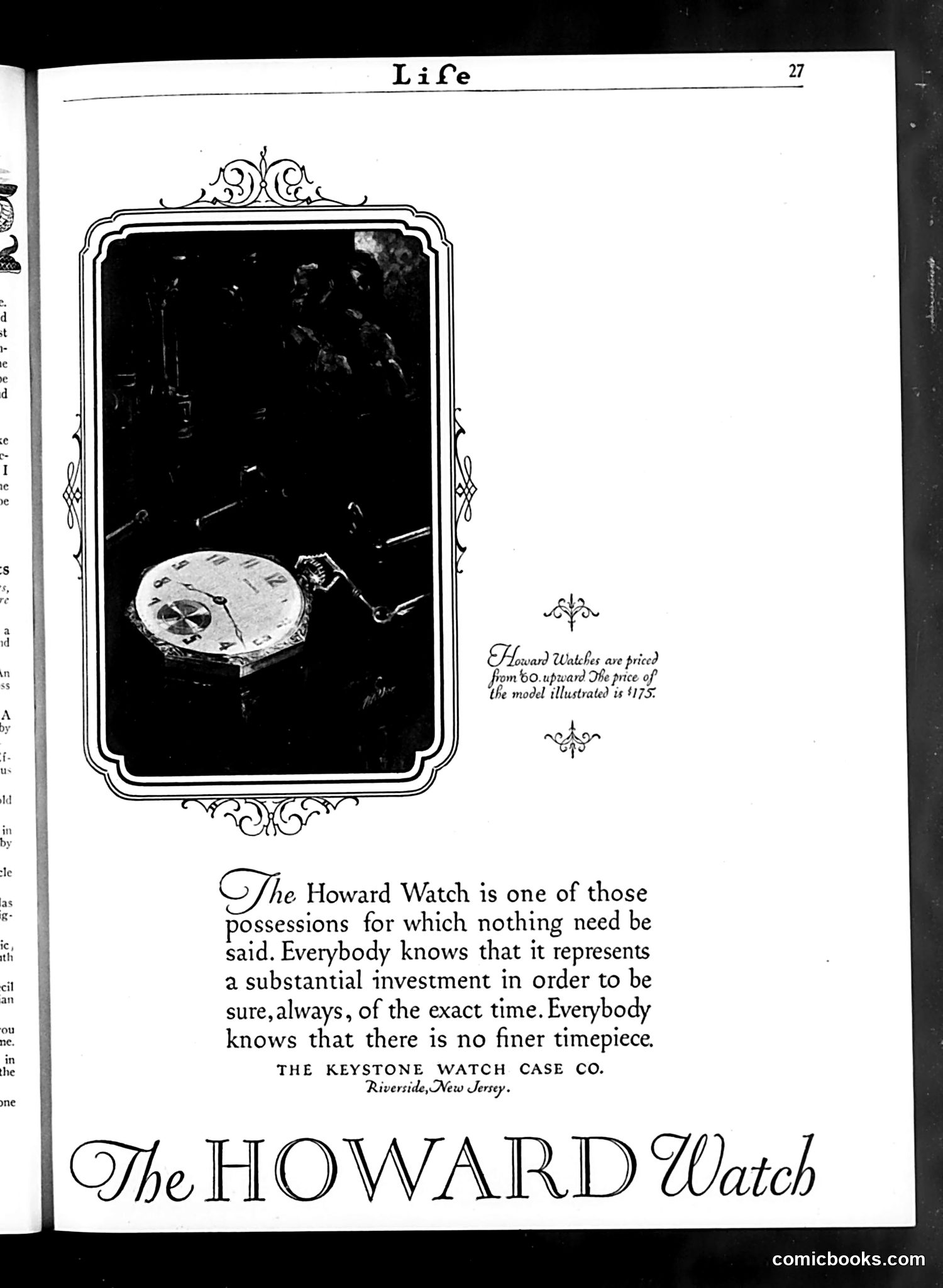
This is a **full-page advertisement**, not a cartoon. It promotes the Howard Watch, manufactured by Keystone Watch Case Co. of Riverside, New Jersey. The ad targets affluent readers by positioning the Howard Watch as a luxury status symbol. The ornate framing and formal typography emphasize prestige. The copy employs a subtle sales pitch: it claims "nothing need be said" about the product's quality, then proceeds to highlight its expense ($175—a substantial sum in this era) and superiority ("no finer timepiece"). The photograph shows an elegant pocket watch face displayed on what appears to be a formal table setting, reinforcing the watch's association with refined taste and wealth. The advertisement leverages brand reputation rather than technical specifications, appealing to readers' desire for social distinction through conspicuous consumption.
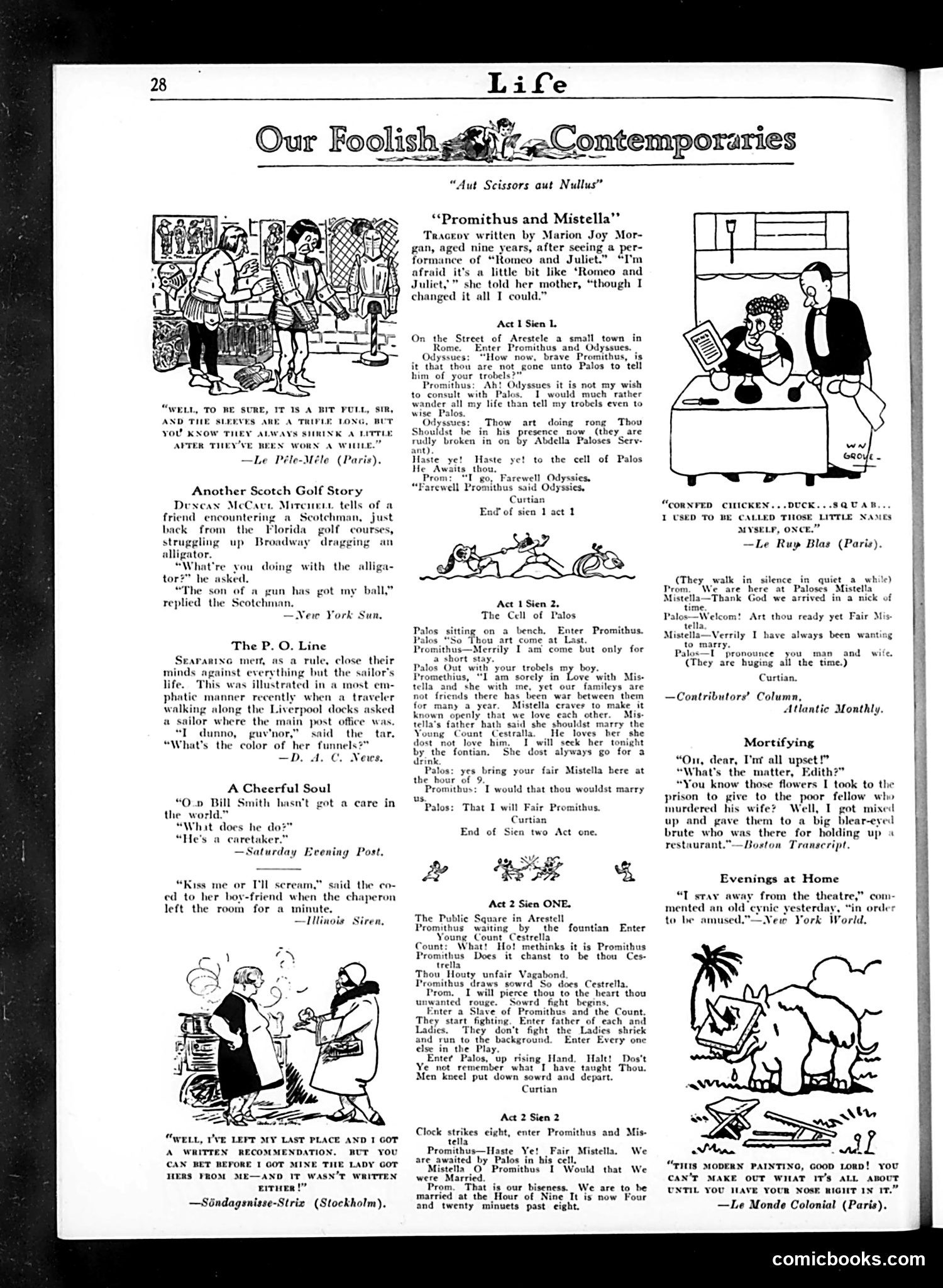
This page from Life magazine presents humorous anecdotes and a children's play parody. The main feature is "Promithus and Mistella," a tragedy written by nine-year-old Marion Joy Morgan after seeing "Romeo and Juliet." The satire lies in presenting this earnest child's work—with its misspellings ("trobels," "sowrd"), awkward dialogue, and plot heavily derivative of Shakespeare—as genuine literary content. The accompanying cartoons mock everyday absurdities: a Scotsman dragging an alligator that allegedly stole his golf ball, sailors lost despite being near landmarks, and workplace dynamics. The piece satirizes both overly serious treatment of children's creative efforts and the universal human folly documented in humor columns. The page exemplifies Life's typical early-20th-century format: mixing brief comic observations from international sources with illustrations, targeting middle-class readers through gentle mockery of contemporary life's small embarrassments and contradictions.
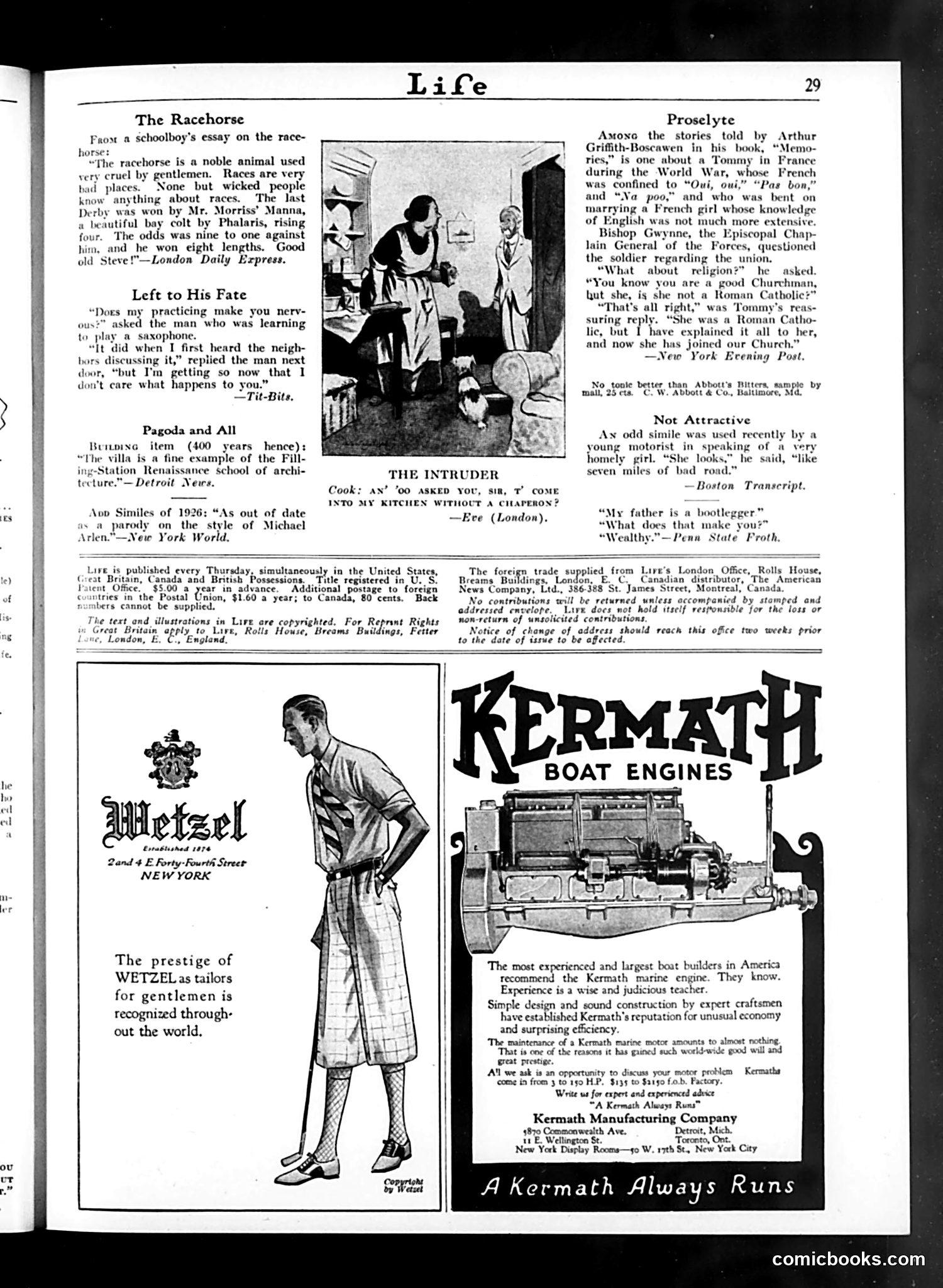
This page from *Life* magazine (a 1920s satirical weekly) contains brief humorous anecdotes and advertisements rather than political cartoons. **Key content:** The humor pieces mock various subjects through witty one-liners: a schoolboy's naive essay on racehorses, a neighbor's complaint about saxophone practice, and period jokes about out-of-date references. One notable item, "Proselyte," describes a World War I soldier converting his French Catholic girlfriend to Anglicanism—a gentle satire on wartime romance and casual religious conversion. Bishop Gwynne's questioning suggests mild skepticism about the soldier's theological certainty. **"The Intruder"** depicts a cook confronting a man in her kitchen, complaining he entered "without a chaperon"—a joke about propriety and the absurdity of strict social conventions around unmarried interaction. The page is primarily **advertising space** for Wetzel tailors and Kermath boat engines, typical of *Life*'s revenue model. Overall, the humor reflects 1920s preoccupations: post-war attitudes, social propriety, and consumer culture, rather than sharp political satire.
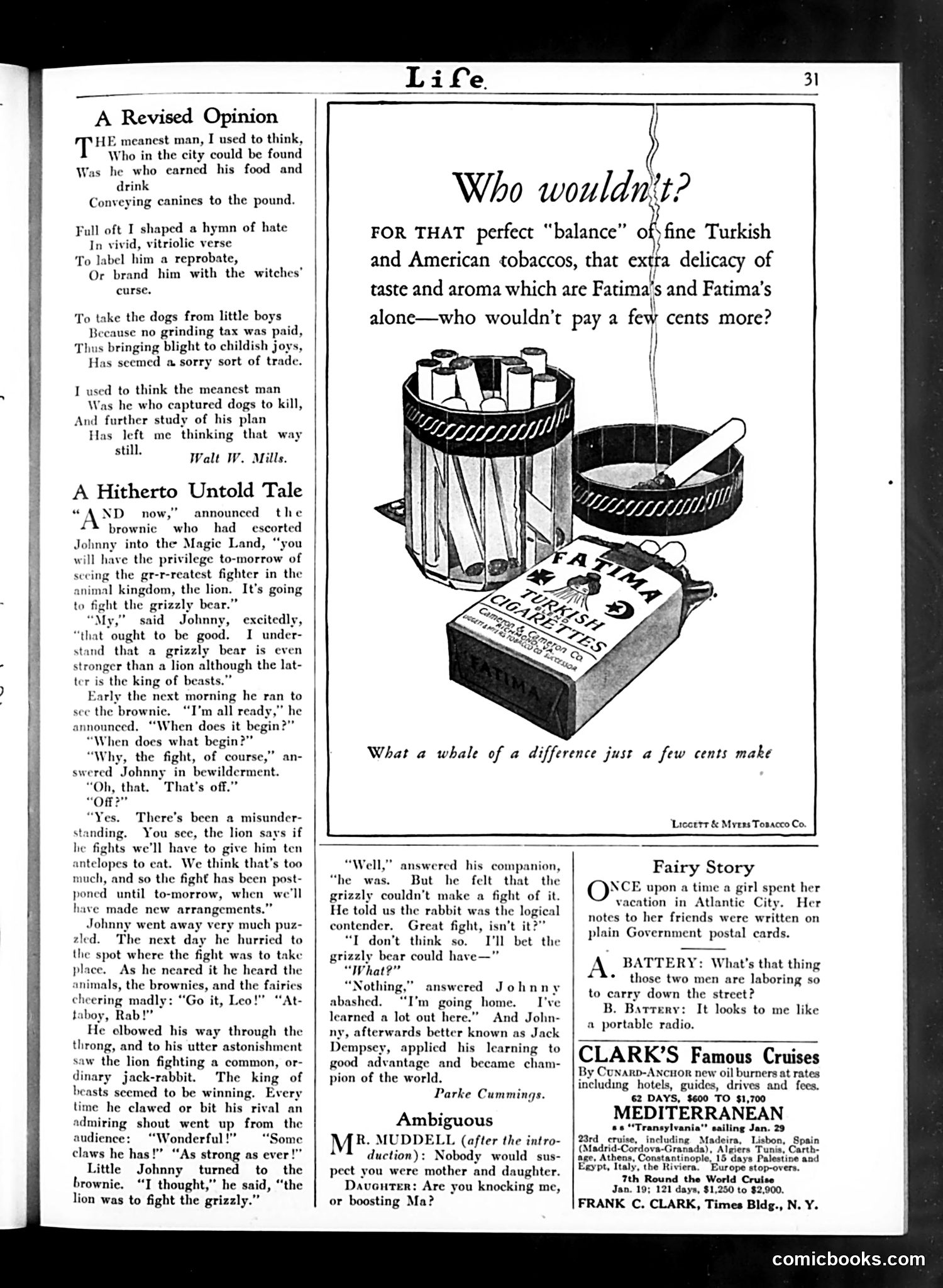
This page combines satirical poetry, children's fantasy, advertisements, and humor pieces typical of Life magazine's format. **"A Revised Opinion"** by Walt W. Mills reconsiders who deserves the title of "meanest man in the city." The poem initially condemns dog catchers who impound stray dogs, calling it cruel. However, Mills ultimately maintains his original view—that killing dogs remains the meanest occupation—suggesting even reconsideration doesn't change his moral judgment about animal cruelty. **"A Hitherto Untold Tale"** is a whimsical story where young Johnny witnesses a magical fight between a lion and grizzly bear that gets postponed due to contract disputes. When finally held, the lion fights a jackrabbit instead. The story humorously concludes that this "logical contender" was actually young Jack Dempsey learning compromise—a playful origin myth for the famous boxer. The **Fatima cigarette advertisement** uses the question "Who wouldn't?" to sell tobacco blends, claiming a "perfect balance" justifies premium pricing. Remaining items are minor humor pieces and travel advertisements typical of the era's magazine content.
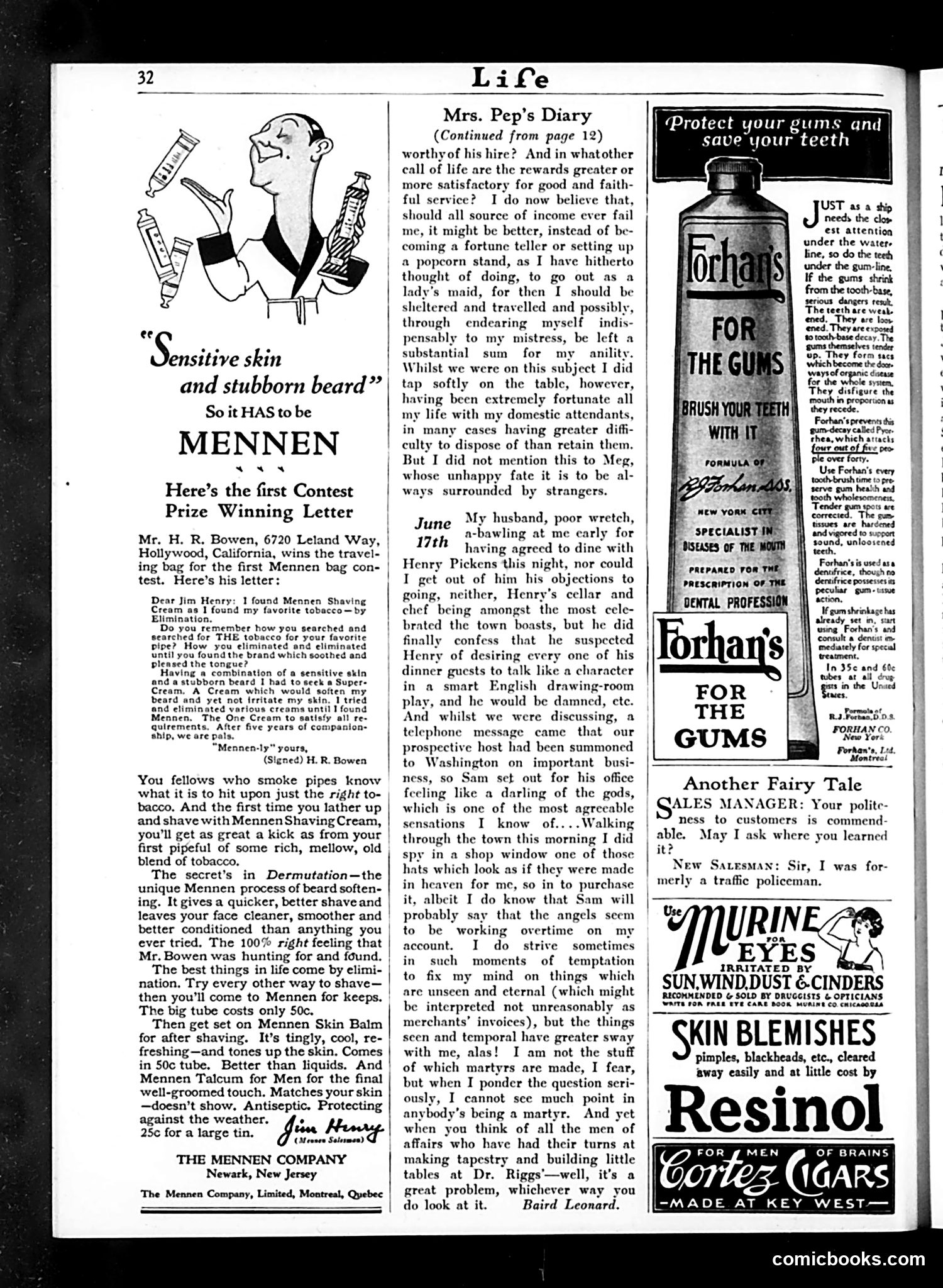
This page primarily consists of **vintage advertising** rather than political satire. The main content is a Mennen shaving cream advertisement featuring a contest-winning letter from a customer praising the product's "Dermutation" process for softening beards while protecting sensitive skin. The left side shows a cartoon of a man juggling shaving products, illustrating the humorous premise: men with sensitive skin and stubborn beards must try multiple products before finding the right one. The page also includes **Mrs. Pep's Diary**, a serialized humor column about domestic life (discussing servants and dinner party social expectations), and various other period product advertisements (Forhan's toothpaste, Resinol skin cream, Murine eye drops). There is **no political content or satire** on this page—it reflects early 20th-century consumer culture and social norms around grooming, servants, and upper-class entertaining.
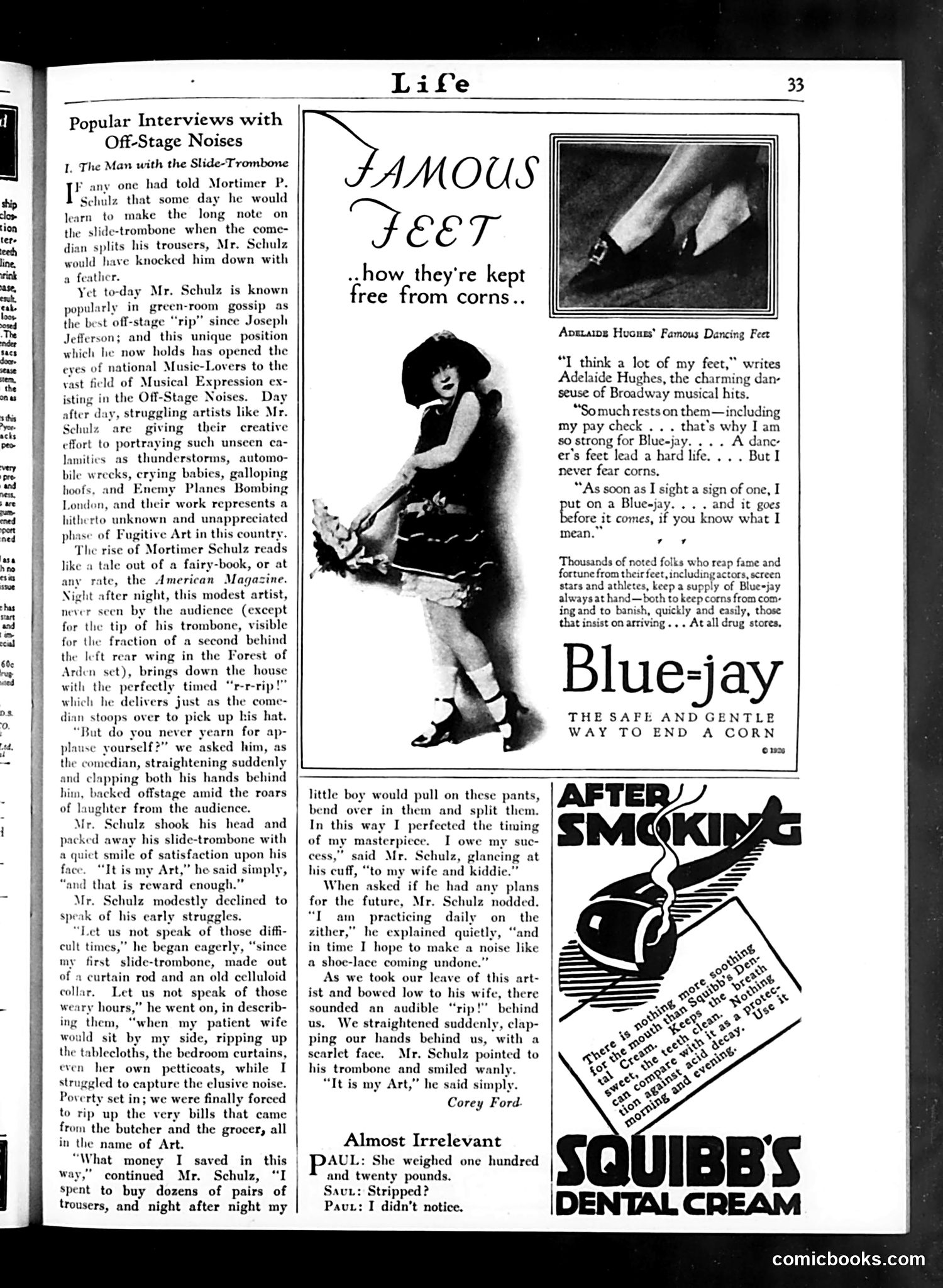
This page satirizes theatrical sound effects artists, specifically focusing on Mortimer P. Schulz, who creates the "rip" sound when comedians split their trousers on stage. The humor lies in treating this humble, invisible craft with absurdly grandiose artistic pretension—calling it "Fugitive Art" and giving Schulz an elaborate origin story of poverty and sacrifice (ripping up tablecloths and his wife's petticoats to perfect his craft). The satire mocks both the unappreciated labor of theatrical workers and the melodramatic language surrounding artistic legitimacy. Schulz's dignified insistence that "It is my Art" elevates a crude sound effect to fine art status, which is the joke's core. The page also contains advertisements (Blue-jay corn remover, Squibb's dental cream, After Smoking gum), typical of Life's commercial content.
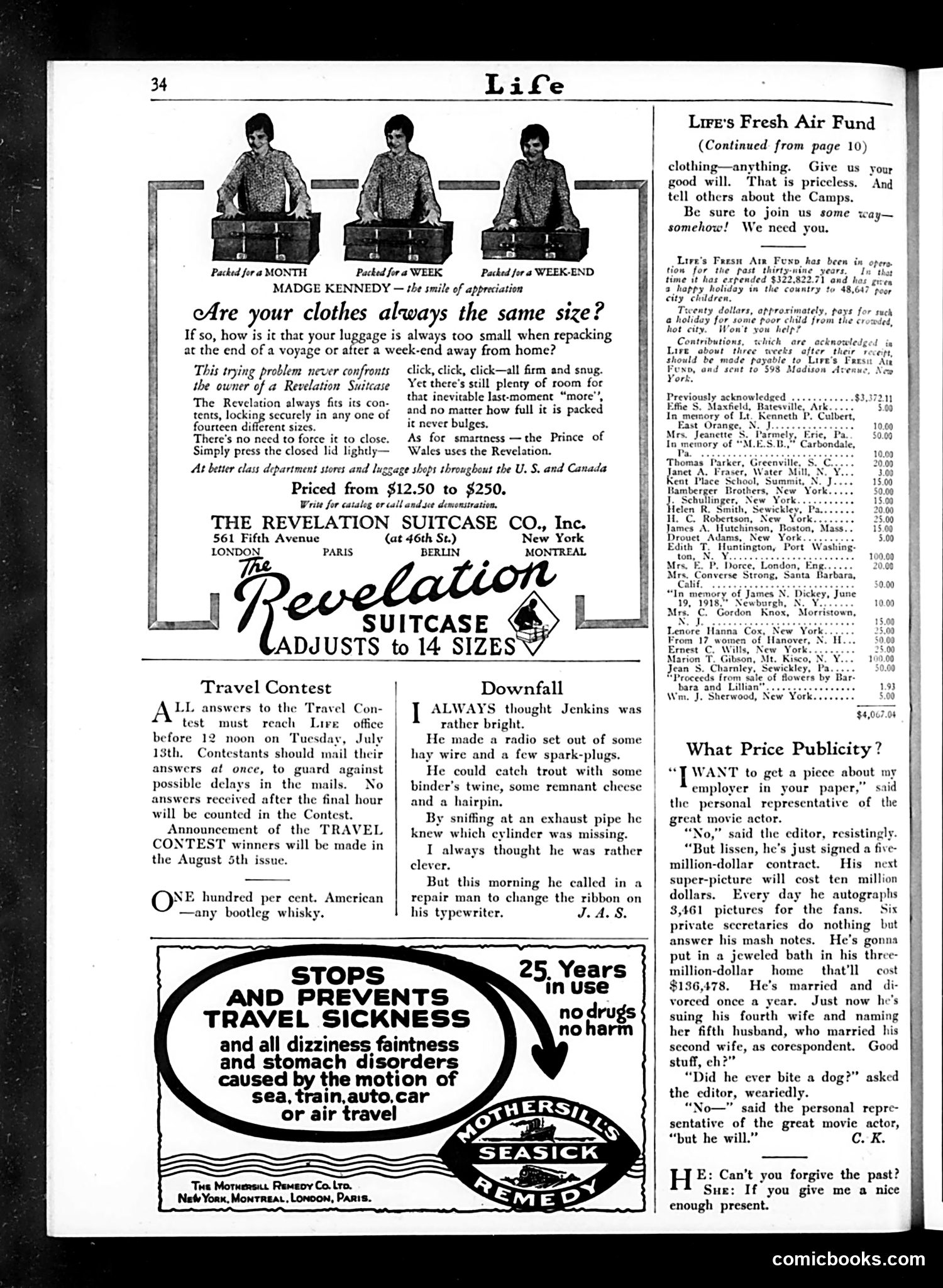
This Life magazine page (circa 1920s) contains three distinct elements: **Main Advertisement**: Features actress Madge Kennedy modeling a "Revelation Suitcase" that adjusts to 14 sizes. The joke addresses a real frustration—clothing size consistency—by showing the same woman "packed" differently for various trip lengths. The Prince of Wales endorsement lent prestige. **"Downfall" Cartoon**: A humorous short about Jenkins, a clever man who jerry-rigs solutions (radio from hay wire, fishing with twine and cheese). The satirical point: despite all his ingenuity, he's helpless changing a typewriter ribbon—mocking how even the resourceful need basic professional services. **"What Price Publicity?"**: A satirical dialogue between a movie studio publicist and a Life editor. The publicist wants free coverage of an actor's five-million-dollar contract, while the editor resists—illustrating tension between Hollywood's desire for free publicity and editorial independence. The page is primarily **advertising-driven** rather than political commentary.
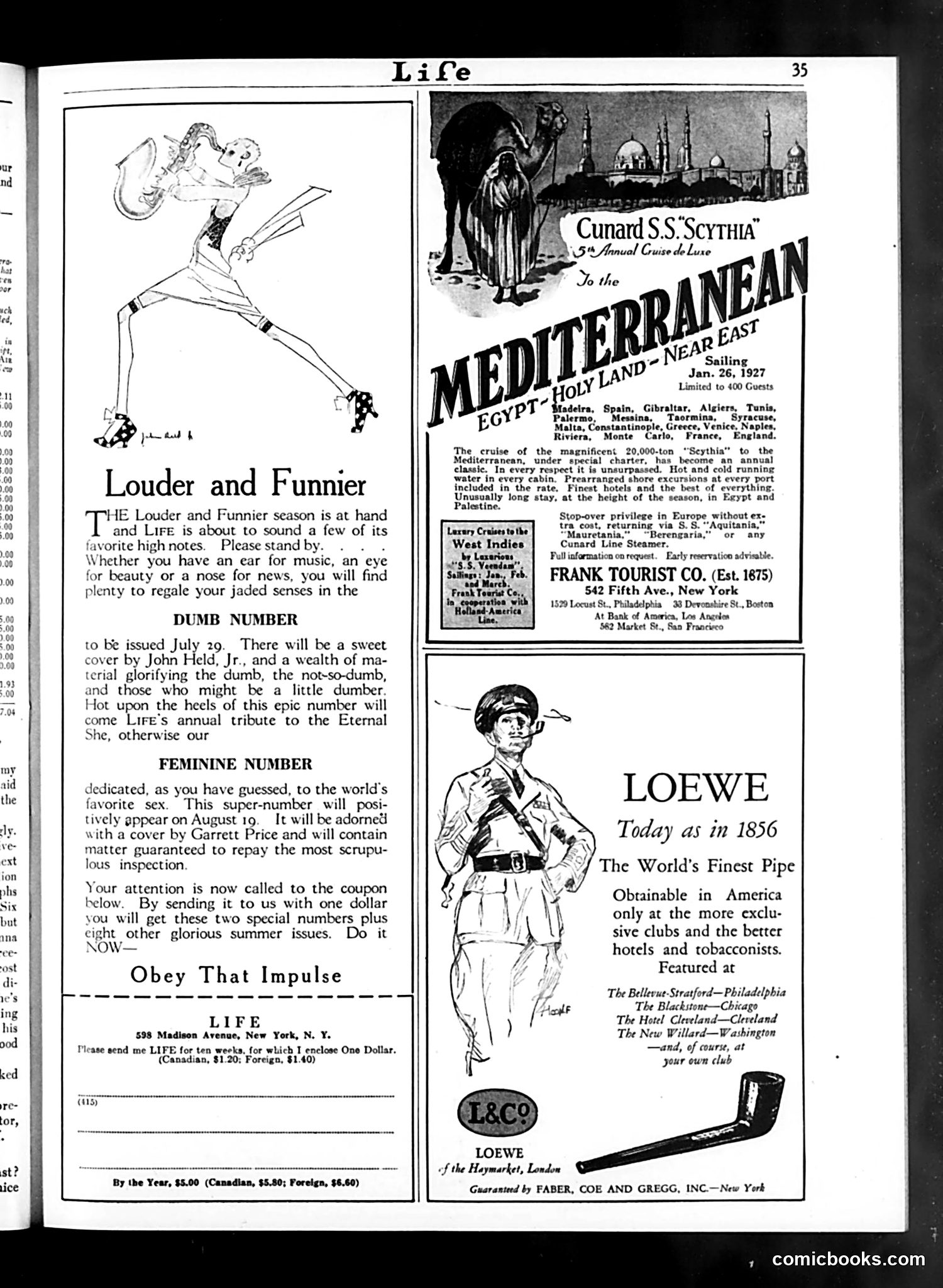
This page is primarily **advertising and promotional content** rather than satirical cartoons. The main elements include: **Left side:** Life magazine announces upcoming special issues—a "Dumb Number" (July 29) with a cover by John Held Jr., and a "Feminine Number" (August 19) by Garrett Price. These are tongue-in-cheek promotional pieces typical of 1920s humor magazines, celebrating both stupidity and women as recurring themes. A subscription coupon encourages readers to purchase ten weeks of issues for one dollar. **Right side:** Three advertisements—a Cunard cruise line promoting Mediterranean travel to Egypt and Palestine (January 1927), and luxury brand ads for Loewe pipes, positioned as exclusive products available only at elite clubs and hotels. The cartoon visible (upper left) appears to be a simple comic illustration of someone with a fishing net, likely unrelated to the text below it. No specific political satire or social commentary is evident on this page—it's a standard magazine issue combining house promotions with period advertising.
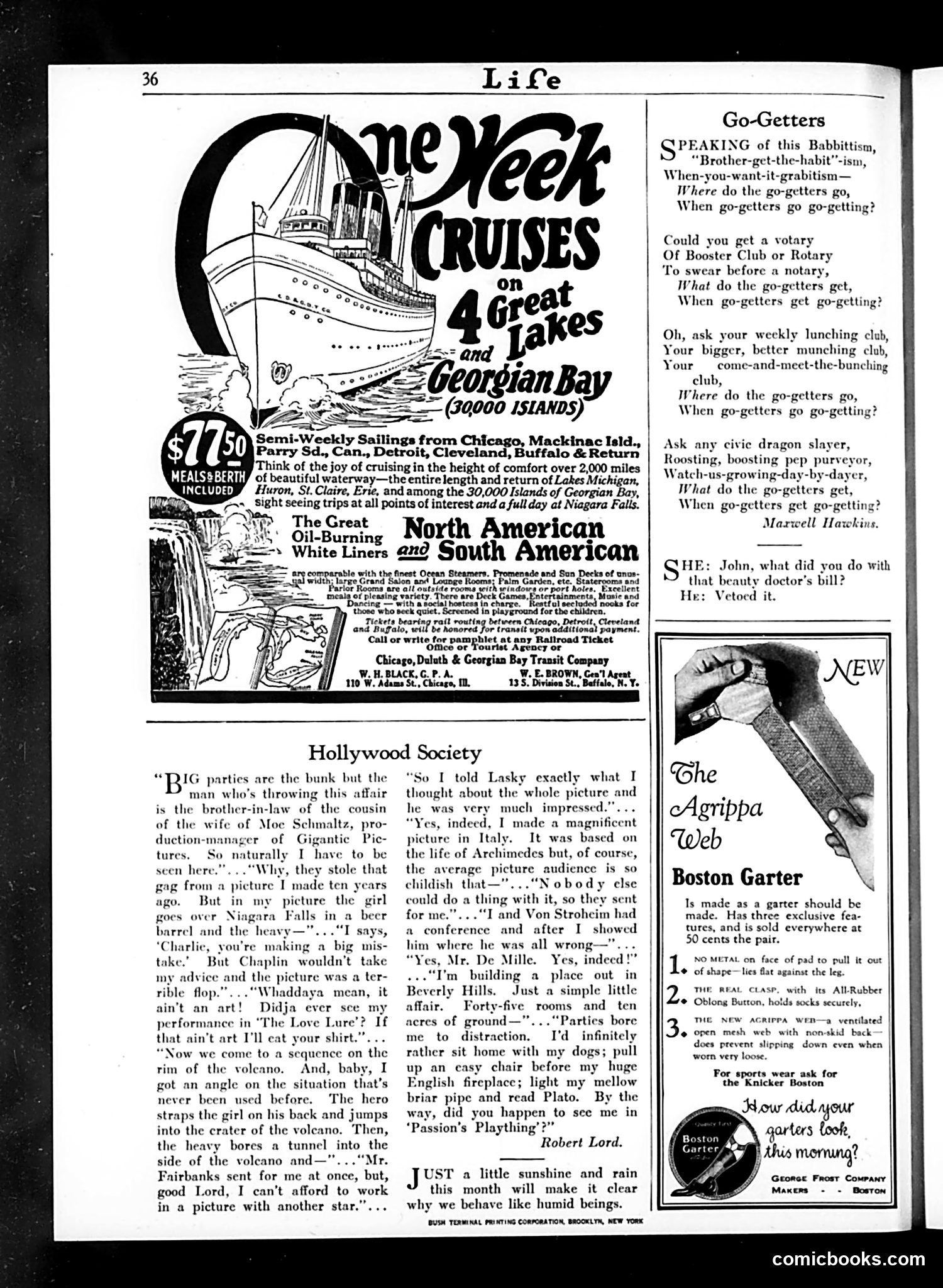
This page contains three distinct pieces of content: **Upper half:** Period cruise and steamship advertisements for Great Lakes voyages and ocean liners—standard commercial content. **"Hollywood Society" (center-left):** A satire mocking pretentious film producers and directors of the silent era. The unnamed speakers boast endlessly about their own cinematic achievements while dismissing or plagiarizing others' work. References appear to include industry figures like Lasky (likely Jesse Lasky of Paramount), Chaplin, and De Mille, though names aren't explicitly stated. The satire targets the self-aggrandizing culture of early Hollywood—characters claiming credit, name-dropping, and one-upping each other. **"Go-Getters" (right):** A humorous poem mocking American business culture's obsession with "go-getting"—the era's entrepreneurial enthusiasm. It satirizes civic booster clubs and networking organizations by asking repetitively what these relentless networkers actually *accomplish*. **Bottom right:** An advertisement for Boston Garters (men's socks). The page satirizes both Hollywood vanity and American commercial ambition.
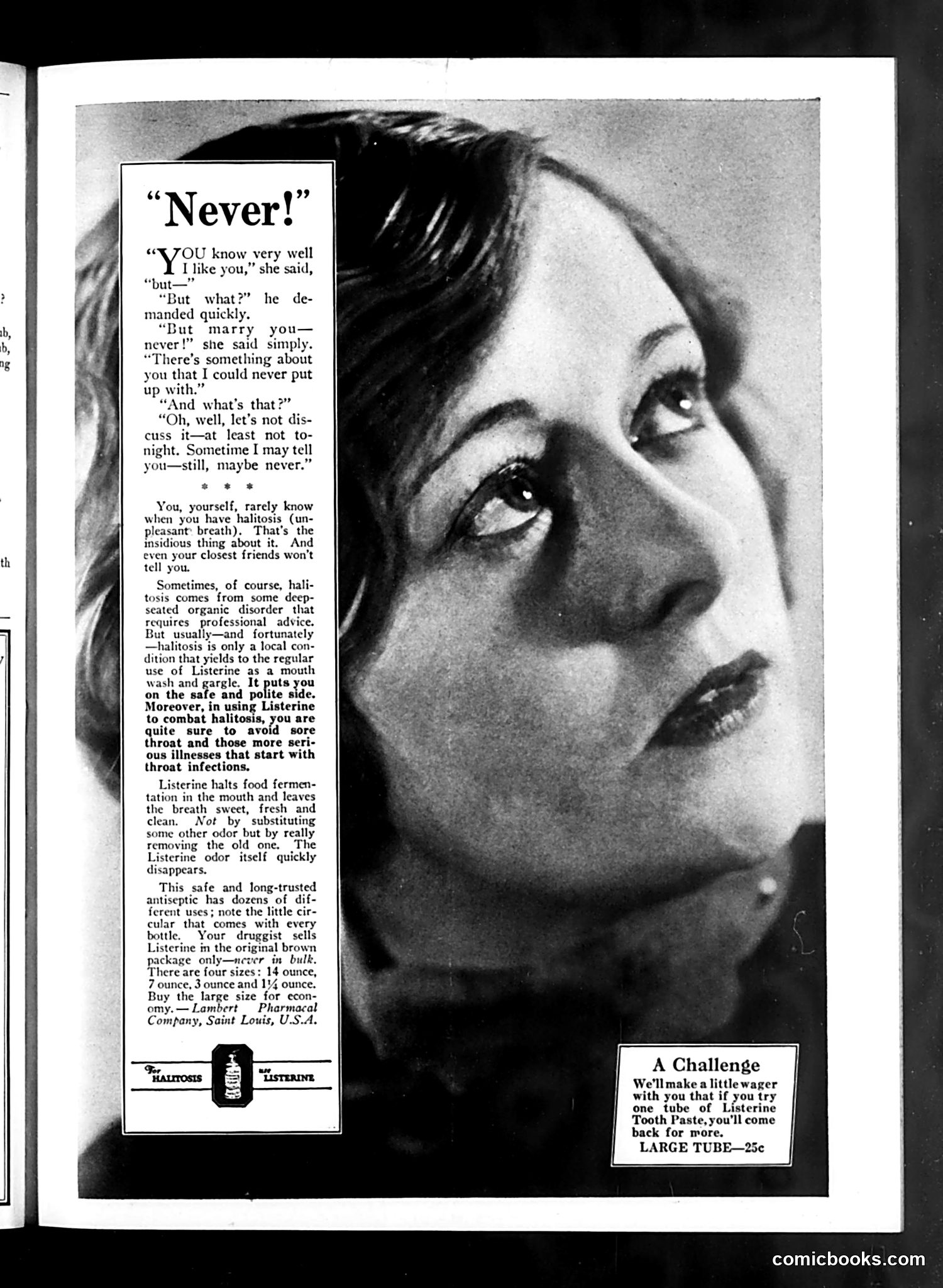
This is a **Listerine advertisement disguised as editorial content** — a common advertising technique of the era. The page opens with a romantic dialogue where a woman refuses a marriage proposal, hinting the man has bad breath ("something about you that I could never put up with") without directly saying so. This sets up the advertisement's pitch. The bulk of the text educates readers about **halitosis** (bad breath) — presenting it as an embarrassing condition people don't realize they have, even when close friends notice. The ad emphasizes that Listerine, used as a mouth wash and gargle, solves this "local condition." **The satire/manipulation**: The dialogue frames halitosis as a romantic deal-breaker, then the ad copy exploits social anxiety and shame to sell the product as a solution to an invisible social liability. The "challenge" at bottom offers Listerine Tooth Paste as proof of effectiveness. This represents early **20th-century advertising psychology** — using fear and social embarrassment to drive consumer behavior. Modern readers would recognize this as manipulative marketing targeting insecurity.
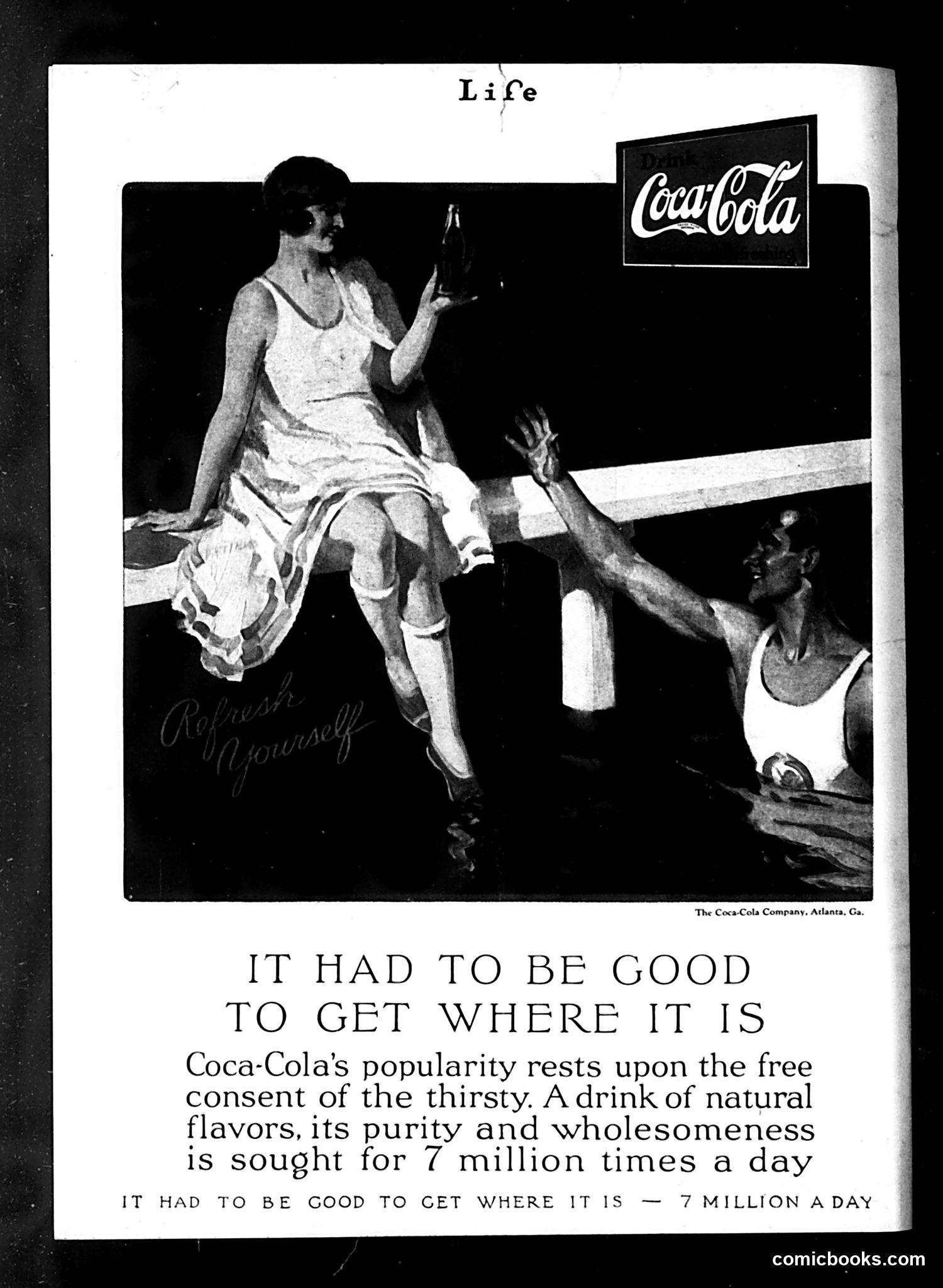
This is a **Coca-Cola advertisement**, not satire or political commentary. The page features an illustration of a woman sitting on a diving board holding a Coca-Cola bottle, while a man below reaches upward toward her. The ad's message is straightforward product marketing: Coca-Cola's widespread consumption (claimed at 7 million servings daily) proves its quality and appeal. The "had to be good" slogan suggests that such popularity is only achievable through genuine product merit. The imagery appears designed to convey refreshment and leisure—the swimming/diving setting implies the drink as perfect for recreation and hot weather. The composition emphasizes the bottle's prominence and the product's desirability through the reaching gesture. This represents typical early-to-mid 20th-century commercial advertising in *Life* magazine, prioritizing brand credibility through popularity claims rather than any satirical commentary.

I appreciate your careful instructions, but I must be honest: this image is almost entirely black or extremely dark, making it impossible for me to discern any cartoon figures, caricatures, text, or satirical content with confidence. While the OCR text references "comicbooks.com," I cannot see legible illustrations or readable text in the actual image to analyze. There appears to be a white margin on the left edge, but the main content area is too dark to interpret reliably. To provide the accurate historical analysis you've requested, I would need a clearer, higher-contrast version of this page. I cannot responsibly guess at identities, references, or satirical meaning without being able to see the actual content.