
Life, 1926-07-08 · page 23 of 41
Life — July 8, 1926 — page 23: what you’re looking at
What you’re looking at
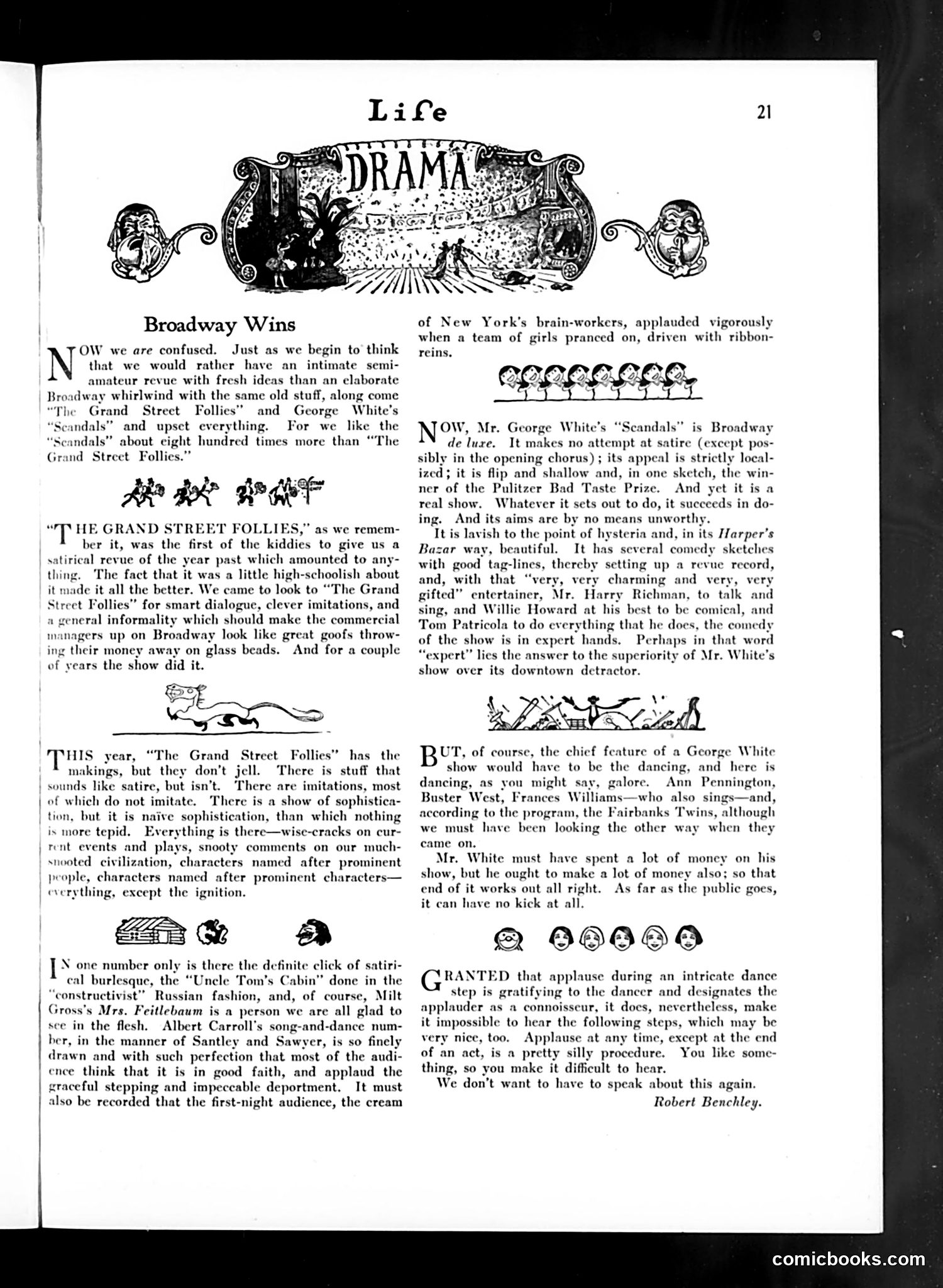
This is a theater review comparing two Broadway revues. "The Grand Street Follies" is criticized as having lost its satirical edge—once fresh and clever, it's now stale and artificial, failing to deliver genuine humor or sharp social commentary despite attempting both. The review singles out a few bright spots: a "Constructivist Russian" parody of "Uncle Tom's Cabin," Milt Gross's character Mrs. Feitlebaum, and Albert Carroll's song-and-dance number. By contrast, George White's "Scandals" is praised as superior entertainment precisely *because* it abandons pretense. Rather than attempting satire, it delivers what it promises: lavish spectacle, talented performers (Harry Richman, Willie Howard, Ann Pennington, Buster West), skilled dancing, and strong comedic sketches with good punchlines. The review's verdict: honest entertainment beats failed sophistication.
📄 Transcribed text from this page (OCR, searchable)
Machine-transcribed from the original scan — historical spelling and the odd misread are preserved.
| Broadway Wins OW we are confused. Just as we begin to think N that we would rather have an intimate semi- amateur revue with fresh ideas than an elaborate Broadway whirlwind with the same old stuff, along come “The Grand Street Follies” and George White's “Scandals” and upset everything. For we like the “Scandals” about eight hundred times more than “The Grand Street Follies.” AR BR HGF “ll HE GRAND STREET FOLLIES,” as we remem- ber it, was the first of the kiddies to give us a satirical revue of the year past which amounted to any- thing. The fact that it was a little high-schoolish about it made it all the better. We came to look to “The Grand Street Follies” for smart dialogue, clever imitations, and a general informality which should make the commercial managers up on Broadway look like great goofs throw- ing their money away on glass beads. And for a couple of years the show did it. = Cars > HIS year, “The Grand Strect Follies” has the makings, but they don’t jell. There is stuff that sounds like satire, but isn’t. There are imitations, most of which do not imitate. There is a show of sophistica- tion, but it is naive sophistication, than which nothing is more tepid, Everything is there—wise-cracks on cur- rent events and plays, snooty comments on our much- snooted civilization, characters named after prominent people, characters named after prominent characters— everything, except the ignition. Ea Of N one number only is there the definite click of satiri- al burlesque, the “Uncle Tom's Cabin” done in the pnstructivist” Russian fashion, and, of course, Milt Gross’s Mrs. Feitlebaum is a person we are all glad to sce in the flesh. Albert Carroll's song-and-dance num- ber, in the manner of Santley and Sawyer, is so finely drawn and with such perfection that most of the audi- ence think that it is in good faith, and applaud the aceful stepping and impeccable deportment. It must also be recorded that the first-night audience, the cream of New York's brain-workers, applauded vigorously when a team of girls pranced on, driven with ribbon- reins. OW, Mr. George White’s “Scandals” is Broadway de lure. It makes no attempt at satire (except pos- sibly in the opening chorus) ; its appeal is strictly locs ized; it is flip and shallow and one sketch, the ner of the Pulitzer Bad Taste Prize. And yet it is a real show. Whatever it sets out to do, it succeeds in do- ing. And its aims are by no means unworthy. It is lavish to the point of hysteria and, in its Harper's Bazar way, beautiful. It has several comedy sketches with good tag-lines, thereby setting up a revue record, and, with that “very, very charming and very, very gifted” entertainer, Mr. Harry Richman, to talk and sing, and Willie Howard at his best to be comical, and Tom Patricola to do everything that he does, the comedy of the show is in expert hands. Perhaps in that word “expert” lies the answer to the superiority of Mr. White's show over its downtown detractor. UT, of course, the chief feature of a George White show would have to be the dancing, and here is dancing, as you might s galore. Ann Pennington, Buster West, Frances Williams—who also sings—and, according to the program, the Fairbanks Twins, although we must have been looking the other way when they came on. Mr. White must have spent a lot of money on his show, but he ought to make a lot of money also; so that end of it works out all right. As far as the public goes, it can have no kick at all. AQ 98O©88H9 RANTED that applause during an intricate dance step is gratifying to the dancer and designates the applauder as a connoisseur, it docs, nevertheless, make it impossible to hear the following steps, which may be very nice, too. Applause at any time, except at the end of an act, is a pretty silly procedure. You like some- thing, so you make it difficult to hear. We don’t want to have to speak about this again. Robert Benchley. comicbooks.com