
Life, 1926-07-08 · page 24 of 41
Life — July 8, 1926 — page 24: what you’re looking at
What you’re looking at
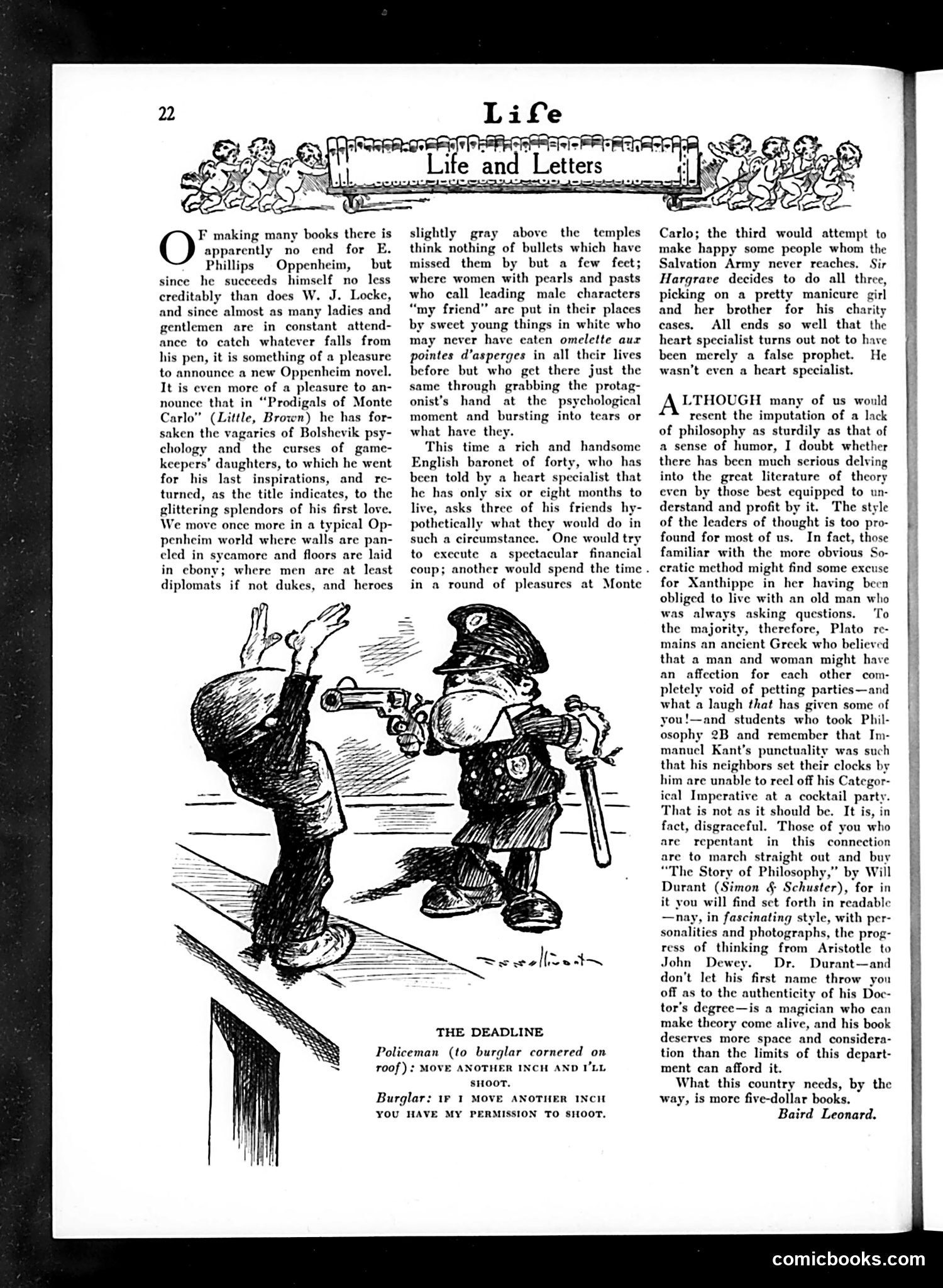
This page contains book reviews and a cartoon joke. The main content reviews E. Phillips Oppenheim's novel "Prodigals of Monte Carlo," praising his return to luxurious settings (paneled walls, ebony floors) and wealthy characters—diplomats, dukes, and women with "pearls and pasts." The cartoon at bottom depicts a burglar cornered on a roof by a policeman. The burglar says, "If I move another inch, you have my permission to shoot"—a absurdist joke playing on the reversal of authority. The burglar effectively dares the policeman to shoot by framing it as the burglar's own permission, creating a logical deadlock. A lengthy essay praises Will Durant's "The Story of Philosophy" (Simon & Schuster), arguing that philosophical literature remains inaccessible to average readers due to dense writing. Durant apparently makes philosophy readable through "fascinating style" with personalities and photographs—making complex thinkers like Plato and Kant understandable beyond academic circles.
📄 Transcribed text from this page (OCR, searchable)
Machine-transcribed from the original scan — historical spelling and the odd misread are preserved.
F making many books there is O apparently no end for E. Phillips Oppenheim, but since he succeeds himself no less creditably than does W. J. Locke, and since almost as many ladies and gentlemen are in constant attend- ance to catch whatever falls from his pen, it is something of a pleasure to announce a new Oppenheim novel. It is even more of a pleasure to an- nounce that in “Prodigals of Monte Carlo” (Little, Brown) he has for- saken the vagaries of Bolshevik psy- chology and the curses of game- keepers’ daughters, to which he went for his last inspirations, and re- turned, as the title indicates, to the glittering splendors of his first love. We move once more in a typical Op- penhcim world where walls are pan- eled in syeamore and floors are laid in ebony; where men are at least diplomats if not dukes, and heroes the think nothing of bullets which have slightly gray above temples missed them by but a few fect; where women with pearls and pasts who call leading male characters “my friend” are put in their places by sweet young things in white who may never have eaten omelette aur pointes d’asperges in all their lives before but who get there just the same through grabbing the protag- onist’s hand at the psychological moment and bursting into tears or what have they. This time a rich and handsome English baronet of forty, who has been told by a heart specialist that he has only six or cight months to live, asks three of his friends hy- pothetically what they would do in such a circumstance. One would try to execute a spectacular financial coup; another would spend the time . in a round of pleasures at Monte a Wp walltads se ie THE DEADLINE Policeman (to burglar cornered on roof): MOVE ANOTHER INCH AND ILL sHoorT. Burglar: 1F 1 MOVE ANOTHER INCI YOU HAVE MY PERMISSION TO SHOOT. Carlo; the third would attempt to make happy some people whom the Salvation Army never reaches. Sir Hargrave decides to do all three, picking on a pretty manicure girl and her brother for his charity cases. All ends so well that the heart specialist turns out not to have been merely a false prophet. He wasn’t even a heart specialist. LTHOUGH many of us would resent the imputation of a lack of philosophy as sturdily as that of a sense of humor, I doubt whether there has been much serious delving into the great literature of theory even by those best equipped to un- derstand and profit by it. The style of the leaders of thought is too pro- found for most of us. In fact, those familiar with the more obvious So- cratic method might find some excuse for Xanthippe in her having been obliged to live with an old man who was always asking questions. To the majority, therefore, Plato re- mains an ancient Greek who believed that a man and woman might have an affection for each other com- pletely void of petting parties—and what a laugh that has given some of you!—and students who took Phil- osophy 2B and remember that Im- manuel Kant’s punctuality was such that his neighbors set their clocks by him are unable to reel off his Categor- ical Imperative at a cocktail party. That is not as it should be. It is, in fact, disgraceful. Those of you who are repentant in this connection are to march straight out and buy “The Story of Philosophy,” by Will Durant (Simon & Schuster), “for in it you will find sect forth in readable —nay, in fascinating style, with per- sonalities and photographs, the prog- ress of thinking from Aristotle to John Dewey. Dr. Durant—and don’t let his first name throw you off as to the authenticity of his Doc- tor’s degree—is a magician who can make theory come alive, and his book deserves more space and considera- tion than the limits of this depart- ment can afford it. What this country needs, by the way, is more five-dollar books. Baird Leonard. comicbooks.com