
Life, 1926-07-08 · page 15 of 41
Life — July 8, 1926 — page 15: what you’re looking at
What you’re looking at
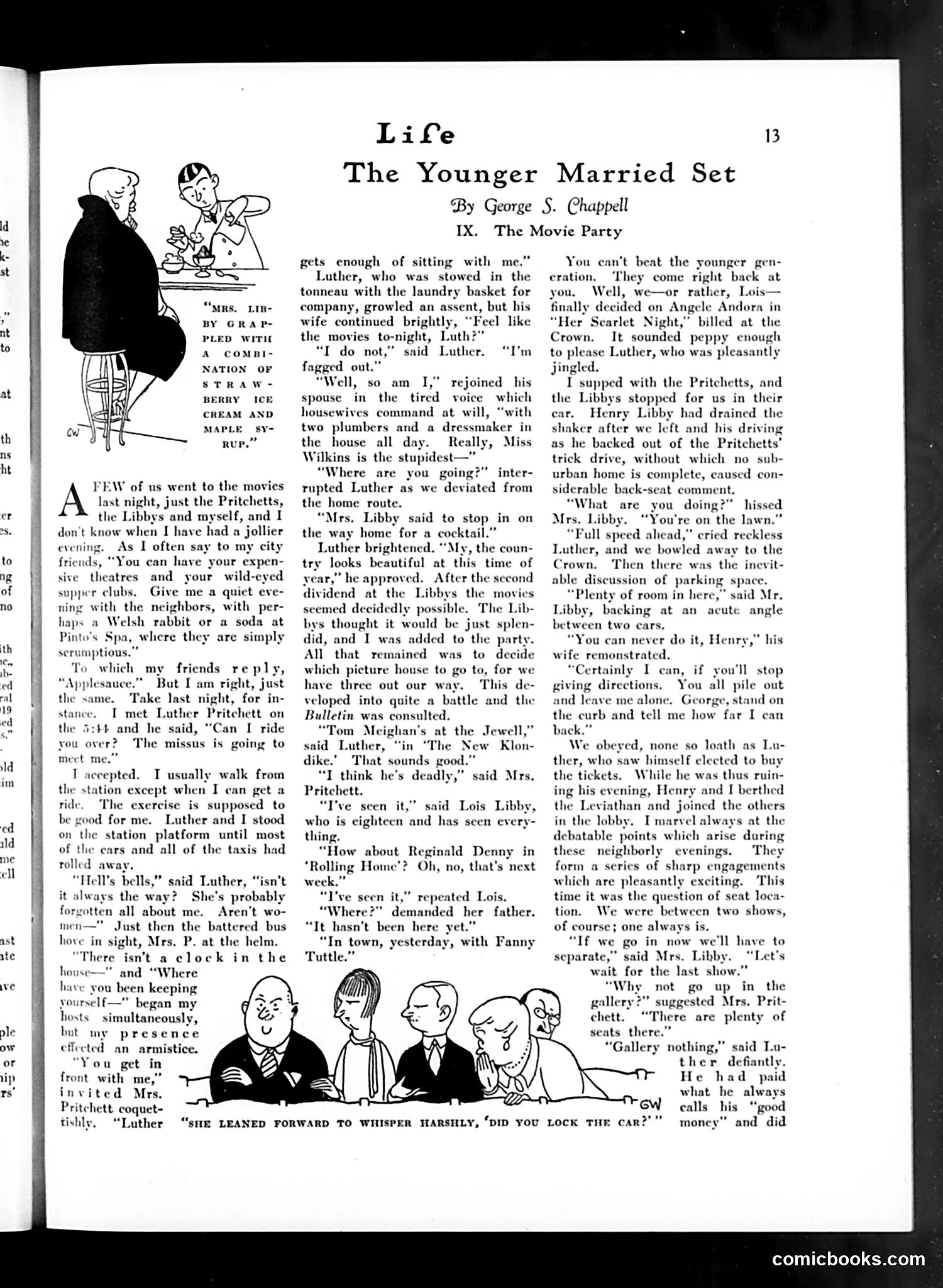
This is a humorous domestic satire by George S. Chappell about young married couples attending movies. The cartoon depicts the social awkwardness and logistics of organizing a group outing: deciding which theater to visit, managing parking and seating arrangements, and the tedious negotiations required to coordinate multiple couples' preferences. The satirical point targets the emerging social rituals of suburban middle-class life in the 1920s-30s—how simple entertainment became complicated by group dynamics and marital negotiations. The illustration at bottom shows the couples arguing, capturing the mild domestic friction beneath genteel socializing. The humor lies in recognizing how couples-socializing, though meant to be pleasant, often devolves into practical complications and minor conflicts.
📄 Transcribed text from this page (OCR, searchable)
Machine-transcribed from the original scan — historical spelling and the odd misread are preserved.
ht ith a MRS. LIB- BY GRAP- PLED WITH A COMBI- NATION OF STRAW- BERRY ICE CREAM AND MAPLE 8Y- RUP. FEW of us went to the movies A last night, just the Pritchetts, the Libbys and myself, and I don't know when I have had a jollier evening. As I often say to my city friends, “You can have your expen- sive theatres and your wild- supper clubs. Give me a quiet ning with the neighbors, with per- haps a Welsh rabbit or a soda at Pinto’s Spa, where they are simply scrumptious To “Applesauce the same. which my friends reply, But I am right, just Take last night, for in- I met Luther Pritchett on 44 and he said, “Can I ride ? The missus is going to stance, the you ov mect me. T accepted. I usually walk from the station except when I can get a ride. The exercise is supposed to be good for me. Luther and I stood on the station platform until most of the cars and all of the taxis had rolled away. “Hell’s bells,” said Luther, “isn’t it always the way? She's probably forgotten all about me. Aren't wo- men—" Just then the battered bus hove in sight, Mrs, P. at the helm. “There isn’t a clock in the hor and “Where have you been keeping yourself—" began my hosts simultaneously, but my presence effected an armistice. “You get in front with me,” invited Mrs, Pritchett coquet- tishly. “Luther Life The Younger Married Set By George §. Chappell gets enough of sitting with me.” Luther, who was stowed in the tonneau with the laundry basket for company, growled an assent, but his wife continued brightly, “Feel like the movies to-night, Luth?” “I do not,” said Luther. fagged out.” “Well, so am I,” rejoined his spouse in the tired voice which housewives command at will, “with two plumbers and a dressmaker in the house all day. Really, Miss Wilkins is the stupidest—” “Where are you going?” inter- rupted Luther as we deviated from the home route. “Mrs. Libby said to stop in on the way home for a cocktail.” Luther brightened. “My, the coun- try looks beautiful at this time of year,” he approved. After the second dividend at the Libbys the mo seemed decidedly possible. The I bys thought it would be just splen- did, and I was added to the party. All that remained was to decide which picture house to go to, for we have three out our way. This de- veloped into quite a battle and the Bulletin was consulted. “Tom Meighan’s at the Jewell,” said Luther, “in ‘The New Klon- dike.’ That sounds good.” “TI think he’s deadly,” said Mrs. Pritchett. “I've scen it,” said Lois Libby, who is eighteen and has seen eve thing. “How about Re, ‘Rolling Home’? O! week.” “I've seen it,” repeated Lois. “Where?” demanded her father. “It hasn't been here yet.” “In town, yesterday, with Fanny “I'm ald Denny in » ho, that’s next “SHE LEANED FORWARD TO WHISPER HARSHLY, ‘DID You LocK THE caR?’” IX. The Movie Party You can’t beat the younger gen- eration, They come right back at you. Well, we—or rather, Lois— finally decided on Angele Andora in “Her Scarlet Night,” billed at the Crown. It sounded peppy enough to please Luther, who was pleasantly jingled. I supped with the Pritchetts, and the Libbys stopped for us in their Henry Libby had drained the ker after we left and his driving as he backed out of the Pritchetts’ trick drive, without which no sub- urban home is complete, caused con- siderable back-seat comment. “What are you doing?” hissed Mrs. Libby. ‘You're on the lawn.” “Full speed ahead,” cried reckless Luther, and we bowled away to the Crown. Then there was the able discussion of par! “Plenty of room in here,” said Mr. Libby, backing at an acute angle between two cars. “You can never do it, Henry,” his wife remonstrated. “Certainly I can, if you'll stop giving directions. You all pile out and leave me alone. George, stand on the curb and tell me how far I can back.” We obeyed, none so loath as Lu- ther, who saw himself elected to buy the tickets. While he was thus ruin- ing his evening, Henry and I berthed » Leviathan and joined the others in the lobby. I marvel always at the debatable points which arise during these neighborly evenings. They form a series of sharp engagements which are pleasantly exciting. This time it was the question of seat loca- tion. We were between two shows, of course; one always is. “If we go in now we'll have to separate,” said Mrs. Libby. “Let's wait for the last show. “Why not go up in the gallery?” suggested Mrs. Prit- chett. “There are plenty of seats there.” “Gallery nothing,” said Lu- ther defiantly. He had _ paid what he always calls his “good and did inevit- cw money comicbooks.com