
Life, 1926-07-08 · page 35 of 41
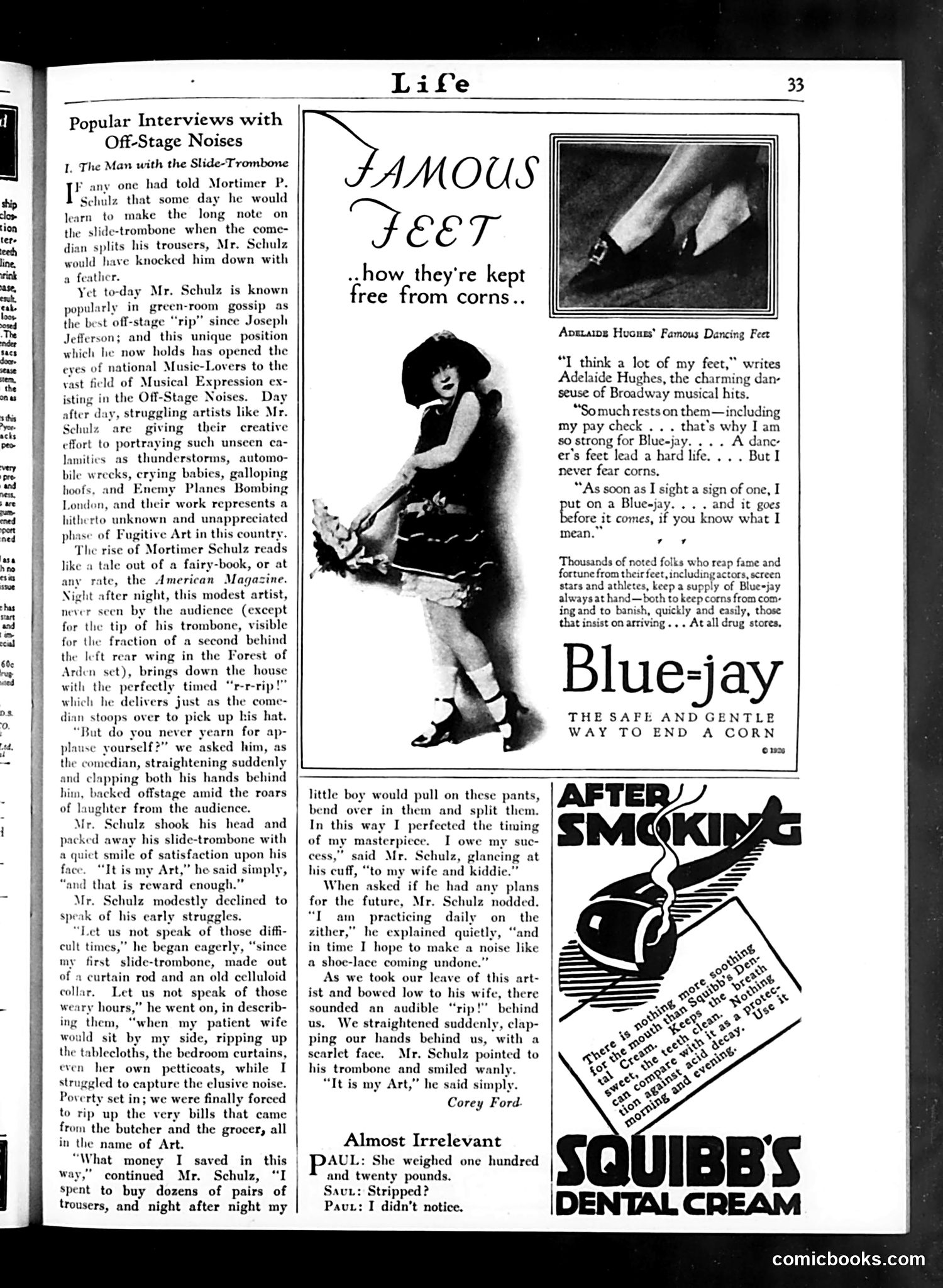
Life — July 8, 1926 — page 35: what you’re looking at
What you’re looking at
This page satirizes theatrical sound effects artists, specifically focusing on Mortimer P. Schulz, who creates the "rip" sound when comedians split their trousers on stage. The humor lies in treating this humble, invisible craft with absurdly grandiose artistic pretension—calling it "Fugitive Art" and giving Schulz an elaborate origin story of poverty and sacrifice (ripping up tablecloths and his wife's petticoats to perfect his craft). The satire mocks both the unappreciated labor of theatrical workers and the melodramatic language surrounding artistic legitimacy. Schulz's dignified insistence that "It is my Art" elevates a crude sound effect to fine art status, which is the joke's core. The page also contains advertisements (Blue-jay corn remover, Squibb's dental cream, After Smoking gum), typical of Life's commercial content.
📄 Transcribed text from this page (OCR, searchable)
Machine-transcribed from the original scan — historical spelling and the odd misread are preserved.
BESSRPERERS ef z ye } — Popular Interviews with Off-Stage Noises I. The Man with the Slide-Trombone any one had told Mortimer P. iulz that some day he would learn to make the long note on the slide-trombone when the come- dian splits his trousers, Mr. Schulz would have knocked n down with a feather. Yet to-day Mr. Schulz is known popularly in green-room gossip the best off-stage “rip” since Joseph Jefferson; and this unique position wshich he now holds has opened the eves of national Music-Lovers to the vast ficld of Musical Expressi isting in the Off-Stage after day, struggling arti Schulz are giving their effort to portraying such unseen ca- lamitics as thunderstorms, automo- bile wrecks, crying babies, galloping hoofs, and Enemy Planes Bombing London, and their work represents a hitherto unknown and unappreciated phase of Fugitive Art in this country. The rise of Mortimer Schulz reads like a tale out of a fairy-book, or at any rate, the American Magazine. Night after night, this modest artist, never seen by the audience (except for the tip of his trombone, visible for the fraction of a second behind the left rear wing in the Forest of Arden set), brings down the house with the perfectly timed ‘r-r-rip!" which he delivers just as the come- dian stoops over to pick up his hat. “But do you never yearn for ap- plause yourself?” we asked him, as the comedian, straightening suddenly and clapping both his hands behind him, backed offstage amid the roars of laughter from the audience. Mr. Schulz shook his head and packed away his slide-trombone with creative ..how_they're kept free from corns.. Apzzaing Hucues’ Famous Dancing Feet “I think a lot of my feet,” writes Adelaide Hughes, the charming dan- seuse of Broadway musical hits. “So much rests on them—including my pay check . . . that’s why I am so strong for Blue-jay. . . . A danc- er’s feet lead a hard life... . But I never fear corns, “As soon as I sight a sign of one, I ut on a Blue-jay. . and it goes efore it comes, if you know what I mean.” ror Thousands of noted folks who reap fame and fortune from their feet, including actors, screen stars and athletes, keep a supply of Bluesjay always at hand—both to keep corns from com- ing and to banish, quickly and easily, those that insist on arriving... At all drug stores, Blue-jay THE SAFE AND GENTLE WAY TO END A CORN ©1928 a quiet smile of satisfaction upon his face. “It is my Art,” he said simply, “and that is reward enough.” Mr. Schulz modestly declined to speak of his early struggles. “Let us not speak of those diffi- cult times,” he began eagerly, “since my first slide-trombone, made out of a curtain rod and an old celluloid collar. Let us not speak of those weary hours,” he went on, in describ- ing them, “when my patient wife would sit by my side, ripping up the tablecloths, the bedroom curtains, even her own petticoats, w I struggled to capture the elusive noise. Poverty set in; we were finally forced to rip up the very bills that came from the butcher and the grocer, all in the name of Art. “What money I saved in this | way,” continued Mr. Schulz, “I | spent to buy dozens of pairs of trousers, and night after night my little boy would pull on these pants, bend over in them and split them. In this way I perfected the timing masterpiece. I owe my suc- hulz, gl ig at his cuff, “to my wife and kiddi When asked if he had any plans for the future, Mr. Schulz nodded. “Iam practicing daily on the zither,” he explained quietly, “and in time I hope to make a noise like a shoe-lace coming undone.” As we took our leave of this art- ist and bowed low to his wife, there behind sounded an audible “rip!” us. We straightened sudden] ping our hands behind us, w scarlet face. Mr. Schulz pointed to his trombone and smiled wanly. “It is my Art,” he said simply. Corey Ford. Almost Irrelevant Pacer: She weighed one hundred and twenty pounds. Saut: Stripped? Paut: I didn't notice. comicbooks.com