
Life, 1926-07-08 · page 30 of 41
Life — July 8, 1926 — page 30: what you’re looking at
What you’re looking at
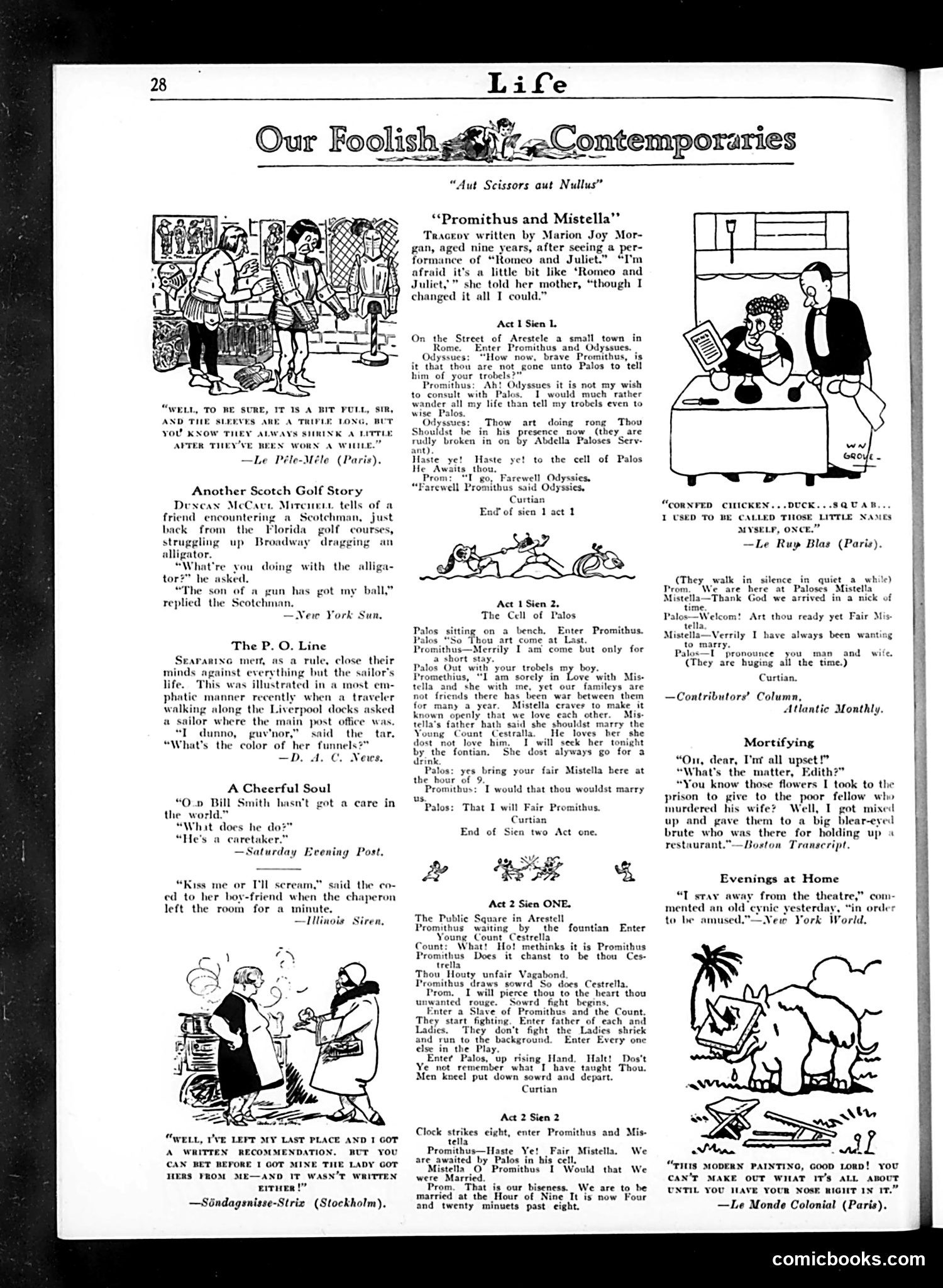
This page from Life magazine presents humorous anecdotes and a children's play parody. The main feature is "Promithus and Mistella," a tragedy written by nine-year-old Marion Joy Morgan after seeing "Romeo and Juliet." The satire lies in presenting this earnest child's work—with its misspellings ("trobels," "sowrd"), awkward dialogue, and plot heavily derivative of Shakespeare—as genuine literary content. The accompanying cartoons mock everyday absurdities: a Scotsman dragging an alligator that allegedly stole his golf ball, sailors lost despite being near landmarks, and workplace dynamics. The piece satirizes both overly serious treatment of children's creative efforts and the universal human folly documented in humor columns. The page exemplifies Life's typical early-20th-century format: mixing brief comic observations from international sources with illustrations, targeting middle-class readers through gentle mockery of contemporary life's small embarrassments and contradictions.
📄 Transcribed text from this page (OCR, searchable)
Machine-transcribed from the original scan — historical spelling and the odd misread are preserved.
Le contemporaries WELL, TO RE SURE, IT 1S A BIT FULL, AND THE SLEEVES ARE A TRIFLE LONG, BUT YOU KNOW THEY ALWAYS SHRINK A LITTLE AVTER THEY'VE EEN WORN A W1UILE Le Péle-Méle (Paris). Another Scotch Golf Story Denecan McCavce Miteness tells friend encountering ptchman, back from the Florida golf courses, struggling up Broadway dragging an alligator. W re you doing with the to; he asked. “The son of a gun has got my ball,” replied the Scotchman. alliga- New York Sun, The P. O. Line FAmING met, as a rule, close their erything but the sailor's This was illustrated in a most em- ic manner recently when a ¢ along the Liverpool docks a sailor where the main post office was. “I dunno, guv'nor,” said the tar. “What's the color of her funnel: —D. : A Cheerful Soul “O.p Bill Smith hasn't got a care in the world.” “What does he do “He's a careta —Saturday Evening Post. “Kiss me or Tl scream.” said the co- ed to her boy-friend when the chaperon left the room for a minute. —Illinois Siren, “WELL, I'VE LEFT MY LAST PLACE AND 1 GOT A WRITTEN RECOMMENDATION. RUT YOU CAN RET BEFORE 1 GOT MINE THE LADY GOT HERS FROM ME—AND IT WASN’T WRITTEN EITHE! —Séndagsnisse-Striz (Stockholm), “Aut Scissors aut Nullus” “Promithus and Mistella’”’ Traceoy written by Marion Joy Mor- gan, aged nine years, after seeing a per- formance of “Romeo and Juliet.” “I'm afraid it's a little bit like ‘Romeo and Juliet,” she told her mother, “though I changed it all T could.” Act I Sien L. On the Street of Arestele a small town in Rome. Enter Promithus and Odyssues. | Odyssues: “How now, brave Promithus, is it that thou are not gone unto Palos to ‘tell him of your trobels?” Promithus: Ah! Odyssues it is not my wish to consult with Palos. I would much rather wander all my life than tell my trobels even to wise Palos. Odyssues: Thow art doing rong Thou Shouldst be in his presence now (they are tudly broken in on by Abdella Paloses Serv- yet to the cell of Palos T go, Farewell Odyssies, “Farewell Promithus said Odyssies. Curtian End’ of sien 1 act 1 Act 1 Sien 2, The Cell of Palos on a bench, Enter Promithus. hou art come at Last. Merrily I am come but only for a short stay. Palos Out with your trobels my boy. Promethius, “I am sorely in Love with Mis- tella and she with me, yet our famileys are ot friends there has been war between them 7 many a year. Mistella craves to make it known openly that we love each other. Mis- tella’s father hath said she shouldst marry the at Cestralla. He loves her she love him. I will seek her tonight by the fontian. She dost alyways go for a drink Palos. sitti yes bring your fair Mistella here at of 9. Promithus: I would that thou wouldst marry us. Palos: That I will Fair Promithus. Curtian End of Sien two Act one. on, 5 GE Act 2 Sien ONE. lie Square in Arestell $ waiting by the fountian Enter Young Count Cestrella Count: What! Ho! methinks it is Promithus Promithus Does it chanst to be thou Ces- trella Thou Houty unfair V: Promithus draws sowrd Prom. unwanted bond. 0 does, Cestrella. I will pierce thou to the heart thou rouge. Sowrd fight begins, Enter a Slave of Promithus and the Count. They start fighting. Enter father of each and Ladies. They don’t fight the Ladies shrick and run to the background. Enter Every one else in the Play. Ente Palos, up rising Hand. Halt! Dos't Ye not remember what I bave taught Thou. Men kneel put down sowrd and depart. Curtian Act 2 Sien 2 Clock strikes eight, enter Promithus and Mis- Fair tella Promithus—Haste Ye! Mistella. We are awaited by Palos in his cell. Mistella O Promithus I Would that We were Married. Prom. That is our biseness. We are to be married at the Hour of Nine It is now Four and twenty minuets past eight. “CORNTED CIICKEN...DUCK...8QUARB... 1 USED TO BE CALLED THOSE LITTLE NAMES MYSELF, ONCE.” —Le Ruy Blas (Paris). (They walk in silence in quiet a while) Prom. We are here at Paloses Mistella Mistella—Thank God we arrived in a nick of time. Palos—Welcom! Art thou ready yet Fair Mis- tella, Mistella—Verrily I have always been wanting to marry. Palos—I_ ‘pronounce you man and wi: (They are huging all the time.) Curtian. Contributors’ Column, Atlantic Monthly. Mortifying “On, dear, I'nt all upset!” What's the matter, Edi “You know those flowers I took to the prison to give to the poor fellow who urdered his w Well, 1 got mixed up and gave them to a big blear-eyed brute who was there for holding up « restaurant."—Boston Transcript. Evenings at Home “I stay away from the theatre,” com- mented an old cynic yesterday, “in order to be amused."—Yew York World. “THIS MODERN PAINTING, Goop Lonp! You CAN'T MAKE OUT WHAT IT’S ALL ABOUT UNTIL YOU HAVE YOUR NOSE RIGHT IN IT. —Le Monde Colonial (Paris). comicbooks.com