
A complete issue · 40 pages · 1926
Life — January 7, 1926
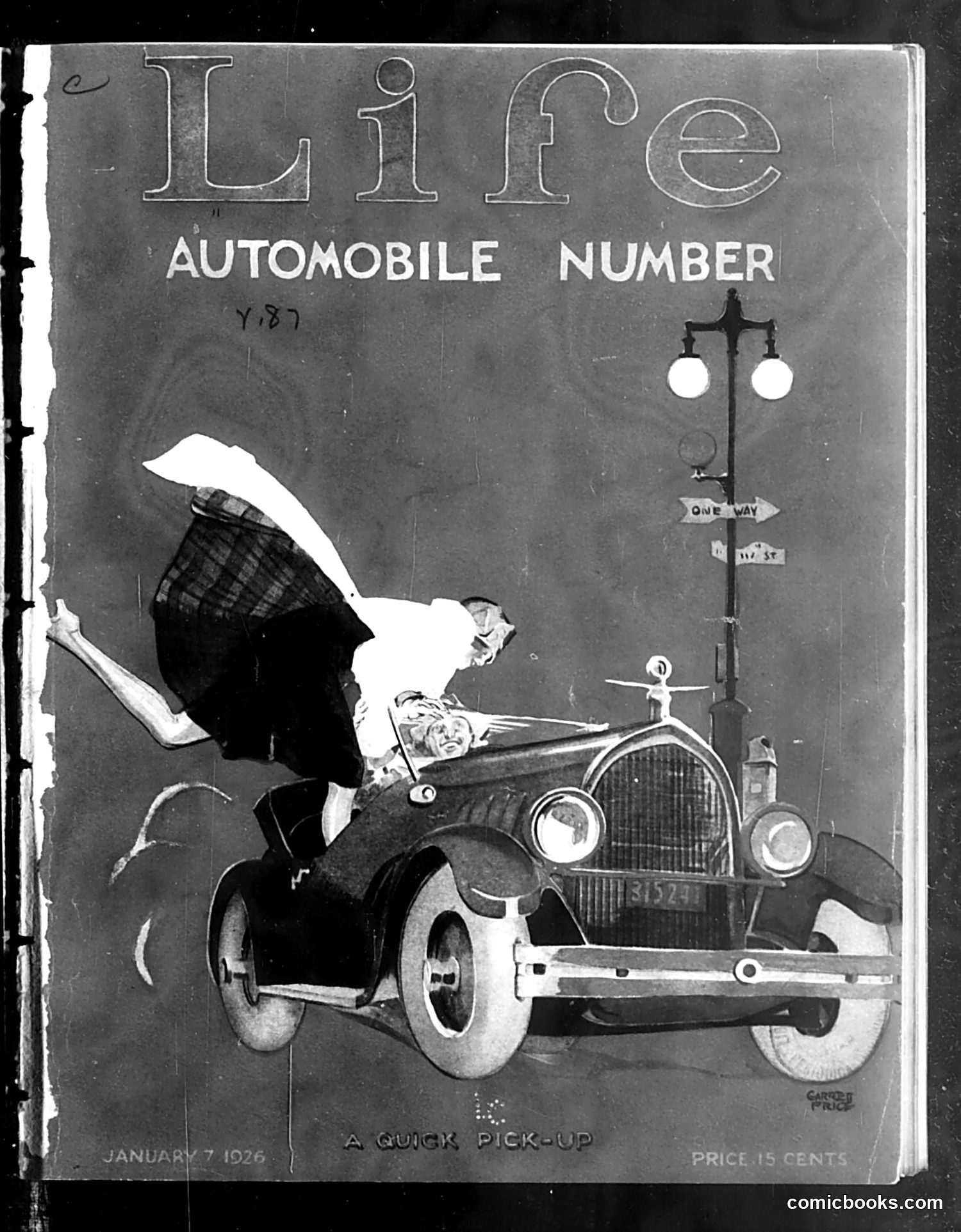
This is a cover for *Life* magazine's "Automobile Number" issue. The illustration shows a comedic scene titled "A Quick Pick-Up," depicting a woman with an exaggerated, oversized hat being picked up by an automobile driven by a young man. The woman appears to be blown backward by the car's speed, her hat dramatically flying. The joke plays on the double meaning of "pick-up"—both literally collecting a passenger and the contemporary slang for a casual romantic encounter. This satirizes the newly mobile dating culture of the 1920s, where automobiles enabled young couples to socialize away from parental supervision. The exaggerated hat and woman's expression mock both fashionable women's accessories of the era and the spontaneous social behaviors enabled by automotive technology.
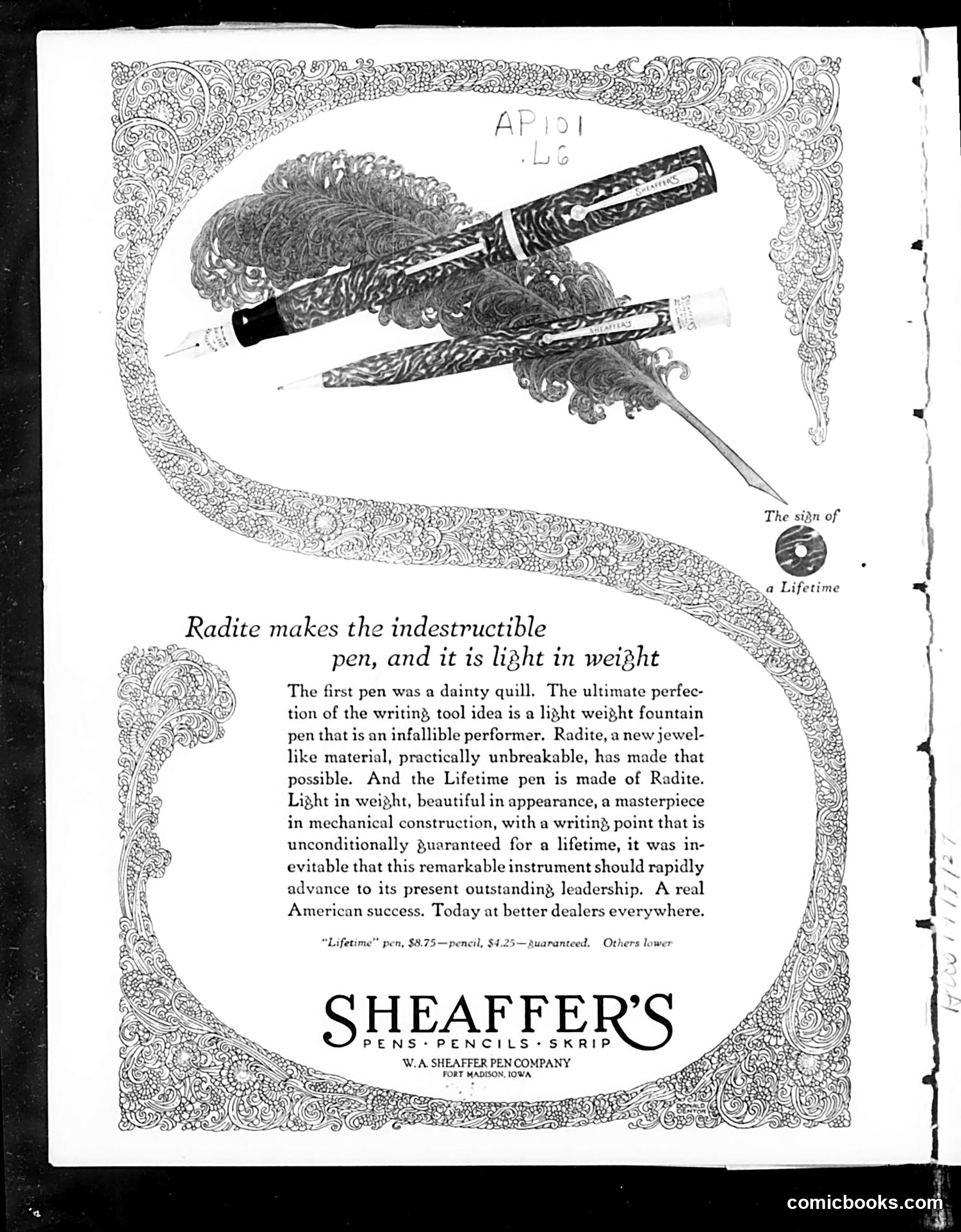
This is a **Sheaffer pen advertisement**, not political satire or editorial content. The page promotes Radite, a new material used to manufacture Sheaffer's "Lifetime" fountain pen. The ornamental border and decorative elements are typical Art Deco styling common to 1920s-1930s advertising. The illustrated pen displays show the product's elegant design with decorative handles. The text emphasizes the pen's durability ("practically unbreakable"), lightweight construction, and lifetime writing-point guarantee—key selling points for fountain pens of this era. The phrase "a real American success" reflects period marketing that tied consumer products to national prosperity. There is no political content, cartoon satire, or caricature present on this page.
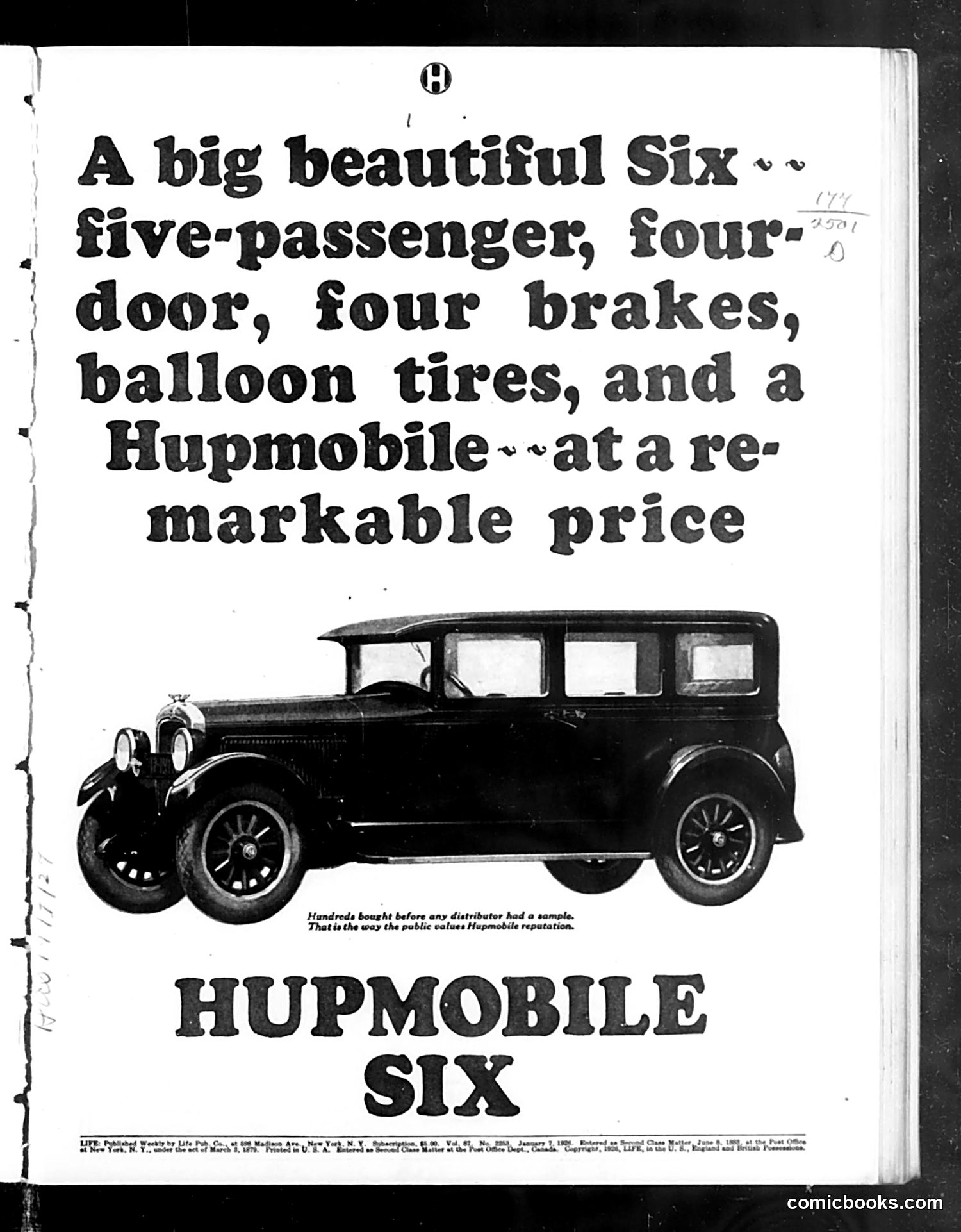
This is a **straightforward advertisement**, not a political cartoon or satire. It promotes the Hupmobile Six automobile, highlighting its features: a six-cylinder engine, five-passenger capacity, four-door design, four brakes, and balloon tires—all presented as desirable specifications for the era. The advertisement's only notable claim is the italicized statement: "Hundreds bought before any distributor had a sample. That is the way the public values Hupmobile reputation." This marketing appeal emphasizes the car's popularity and consumer demand rather than making any satirical or political point. The page reflects early 1920s automotive advertising, when such technical specifications and testimonials to brand reputation were standard sales tactics. No satire or cartoon commentary is present.
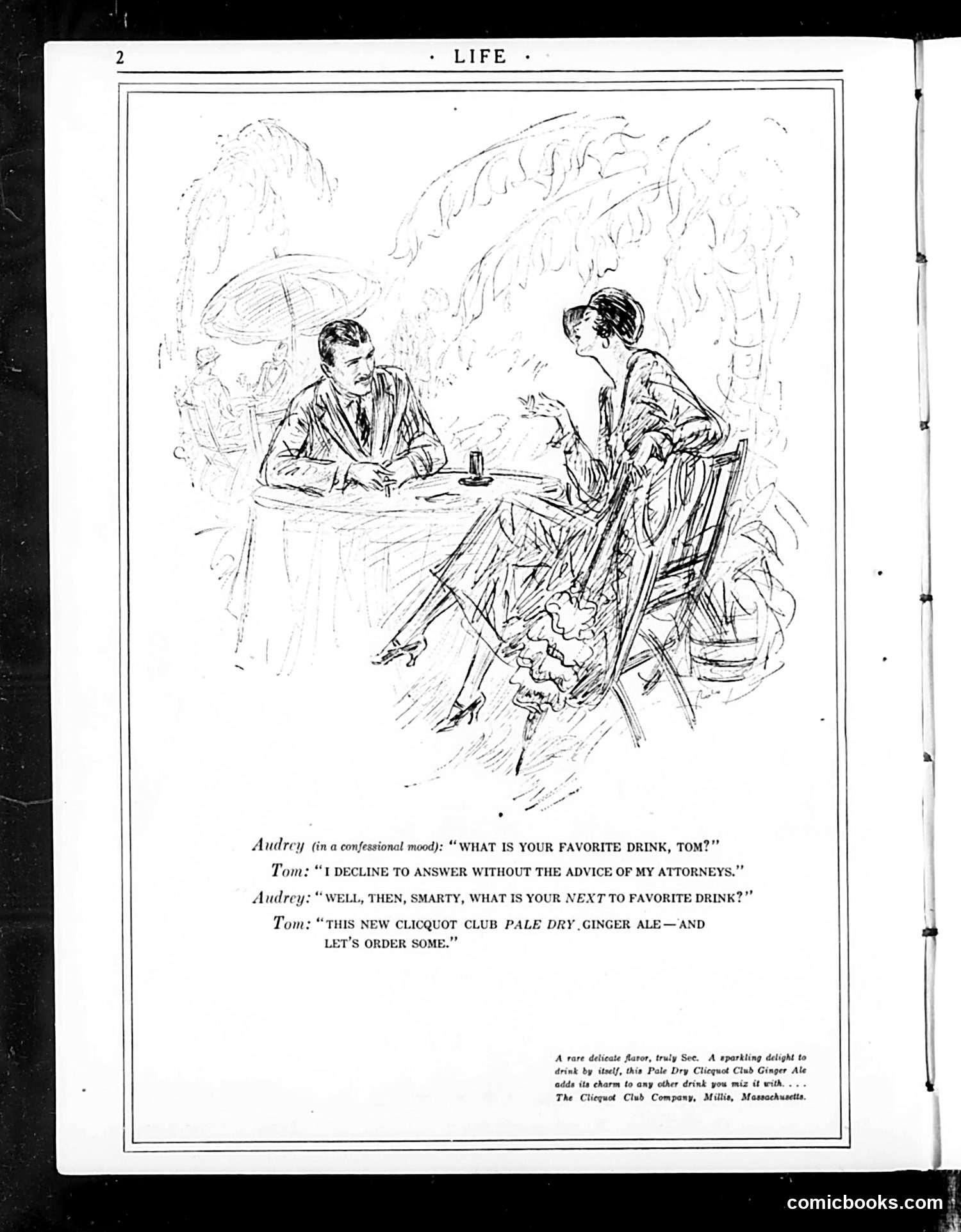
This page is primarily an **advertisement** for Clicquot Club Pale Dry Ginger Ale, disguised as humorous content. The sketch shows two men in conversation at what appears to be a social gathering. One character, "Audrey," asks "Tom" about his favorite drink. Tom deflects the first question by invoking his attorneys (satirizing the era's litigious culture), then reveals his actual preference: the advertised ginger ale. The humor relies on **two period jokes**: First, the absurdity of needing legal counsel before answering a simple question about beverages (mocking overly cautious behavior or Prohibition-era legal sensitivities). Second, Tom's enthusiastic endorsement of a non-alcoholic drink as a sophisticated choice. This is typical early 20th-century *Life* magazine advertising—wrapping commercial messaging in satirical cartoons to engage readers while promoting a product.
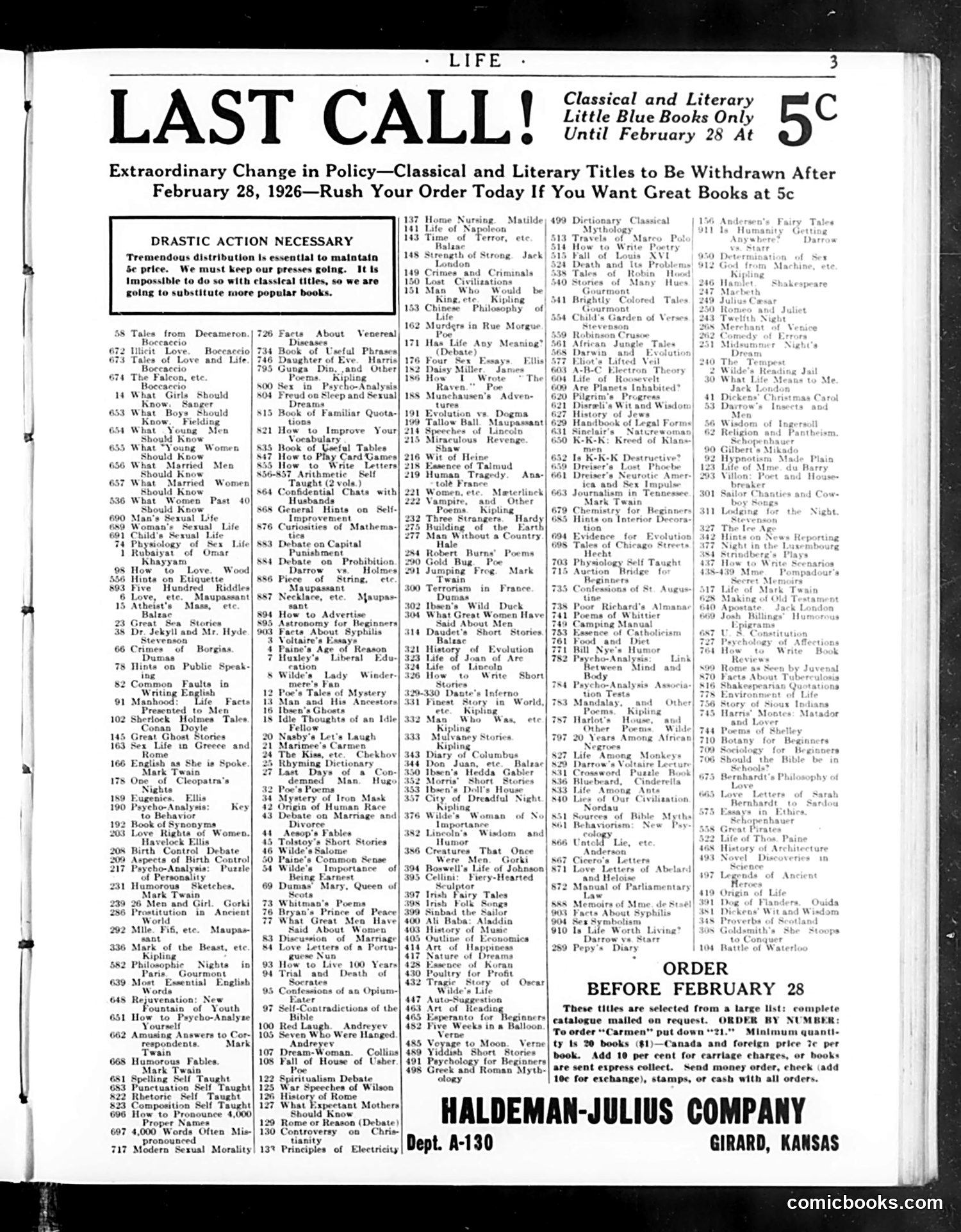
This page is primarily **advertising, not editorial content**. It's a "Last Call!" promotional notice from the Haldeman-Julius Company announcing the withdrawal of classical and literary titles from their "Little Blue Books" series after February 28, 1926. The advertisement emphasizes "drastic action necessary" and lists hundreds of book titles—classics, philosophy, history, poetry, and literary works—available at the bargain price of 5 cents before the deadline. The text warns readers to "rush your order today" to acquire these inexpensive books before they're discontinued. This appears to be a legitimate business clearance sale rather than satirical content, reflecting early 20th-century publishing economics and the popularity of affordable, pocket-sized book collections.
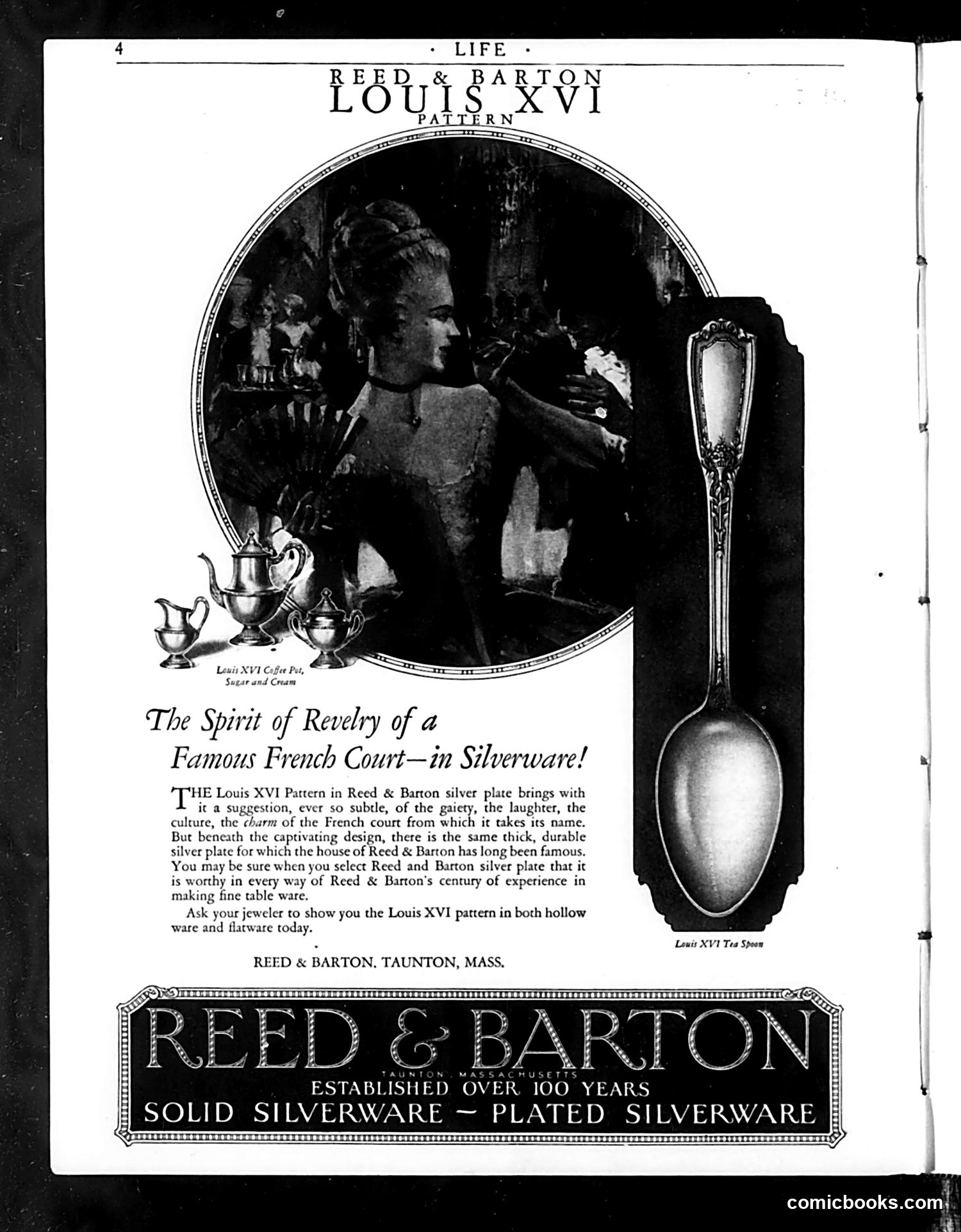
This is **primarily an advertisement**, not satire or editorial content. It's a Reed & Barton silverware ad from *Life* magazine promoting their "Louis XVI Pattern" flatware and hollowware. The circular portrait depicts an elegant woman in 18th-century French court dress, evoking the sophistication and refinement of Louis XVI's era. The accompanying text claims the pattern captures "the spirit of revelry of a famous French court—in silverware," positioning the product as cultured and aspirational. The ad includes product images (a teaspoon and serving pieces) and emphasizes Reed & Barton's "century of experience in making fine table ware." There is no political satire here—it's marketing that uses French aristocratic aesthetics to sell middle-class American consumers on the prestige of their silverware.
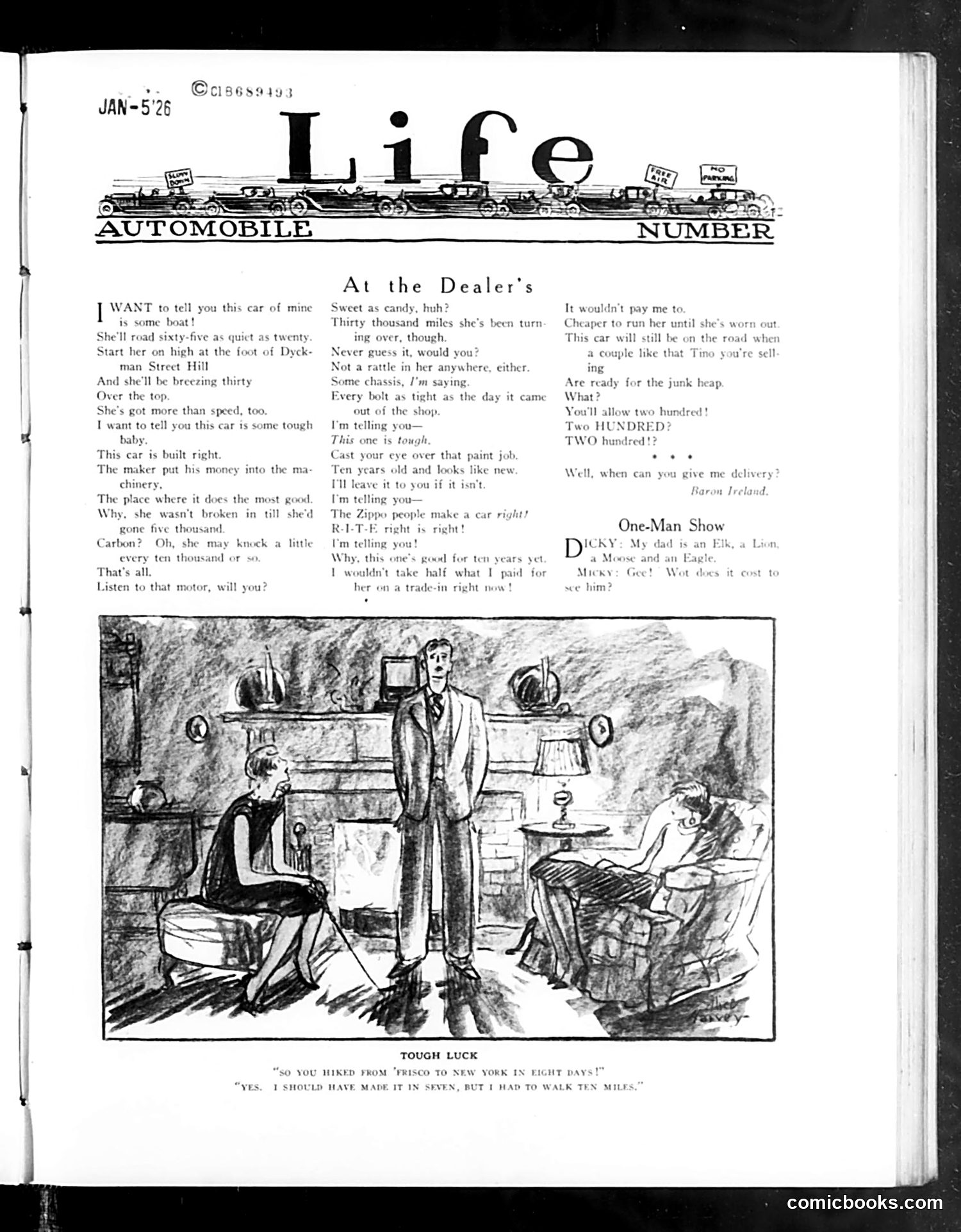
This page satirizes automobile salesmanship and the used-car market. The main cartoon depicts a salesman pitching a worn vehicle to a customer, with dialogue emphasizing the car's durability despite obvious wear ("thirty thousand miles," "every bolt as tight as the day it came out of the shop"). The humor lies in the disconnect between the salesman's enthusiastic claims and the car's actual condition. The caption "Tough Luck" refers to a hitchhiker who hiked from Frisco to New York in eight days but had to walk the final ten miles—suggesting the vehicle ultimately fails despite assurances. The accompanying text mockingly catalogs sales-pitch clichés used to convince buyers that old cars are still valuable. This reflects 1920s consumer skepticism about automobile dealers' reliability and honesty.
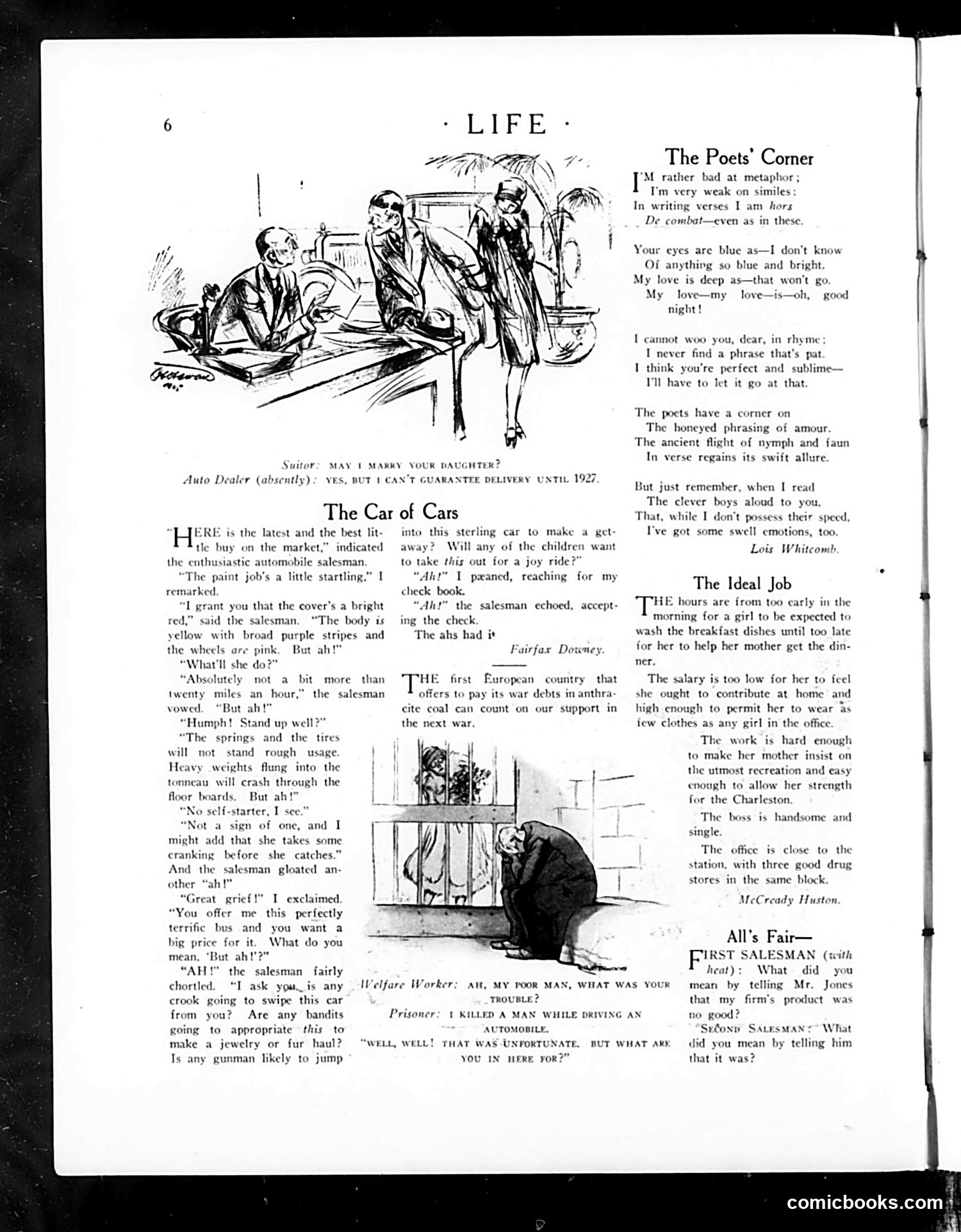
This cartoon satirizes aggressive automobile salesmanship in the 1920s. An enthusiastic salesman pressures a prospective buyer with absurd claims about a vehicle featuring "bright red" body, "yellow" with "purple stripes," pink wheels, and a self-starter—features presented as innovations despite their impracticality. The humor targets two things: (1) the salesman's desperation to make a sale by overselling useless features, and (2) the buyer's naive consideration of such ridiculous specifications. The dialogue reveals the salesman resorting to increasingly desperate pitches when the buyer expresses doubt. This reflects 1920s consumer culture anxiety—the tension between flashy marketing claims and actual product value during the automobile boom's rapid commercialization.
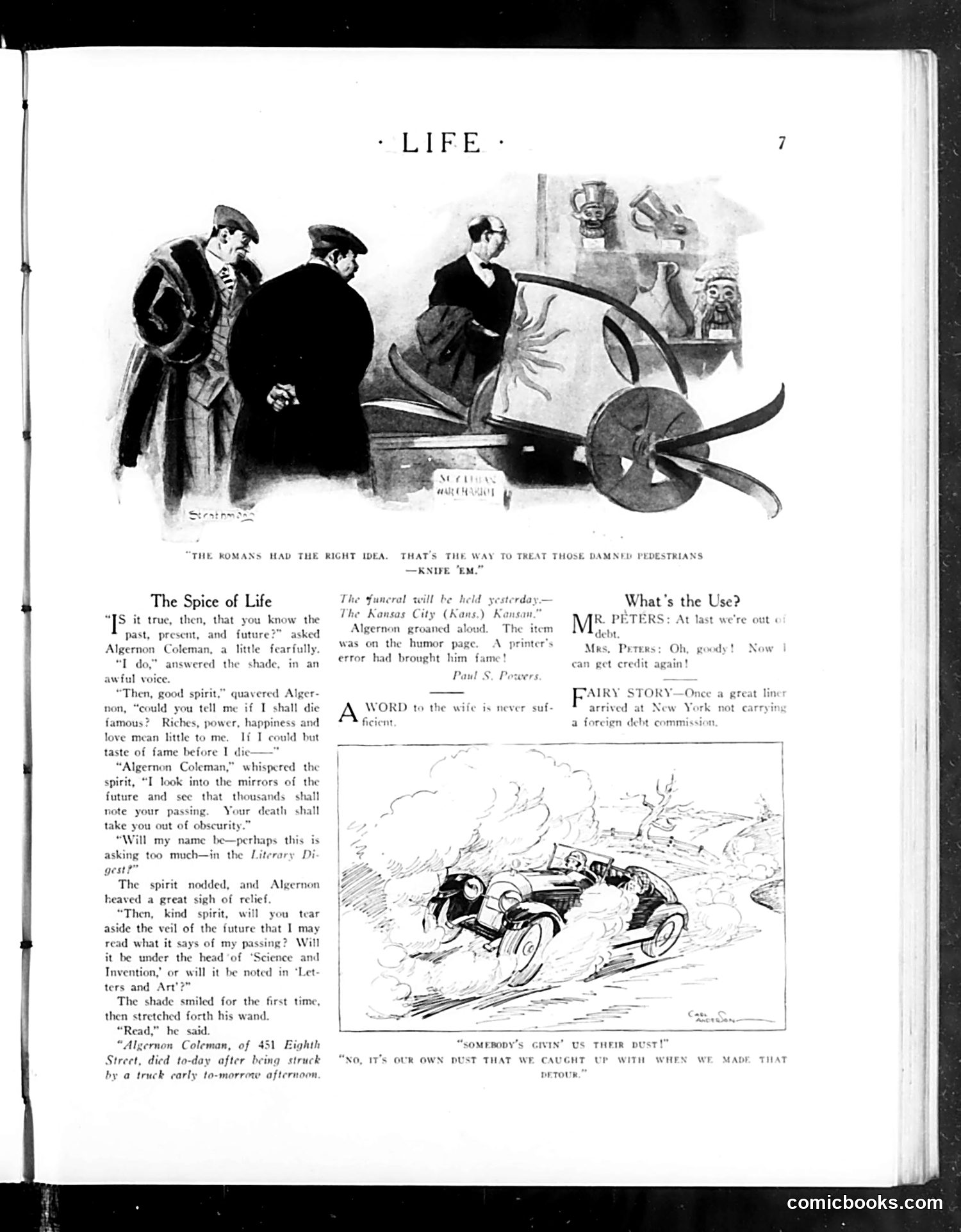
**Top Cartoon**: Shows men examining a large wheeled device labeled "MEDICAL RESEARCH." The caption references Romans treating "pedestrians" with a knife, suggesting contemporary medical treatments are crude or dangerous—likely satirizing early 20th-century medical practices as barbaric. **"The Spice of Life"**: A fictional story where Algernon Coleman, dying after being hit by a truck, encounters a spirit offering to show him the future. The spirit promises glimpses of "Science and Invention," reflecting period fascination with technological progress. **"What's the Use?"**: A brief dialogue between Mrs. Peters and Mr. Peters about getting "old again." **"Fairy Story"**: Illustrates a motorcycle crash with the caption about catching dust "when we made that detour"—likely mocking early automobile/motorcycle mishaps as common occurrences.
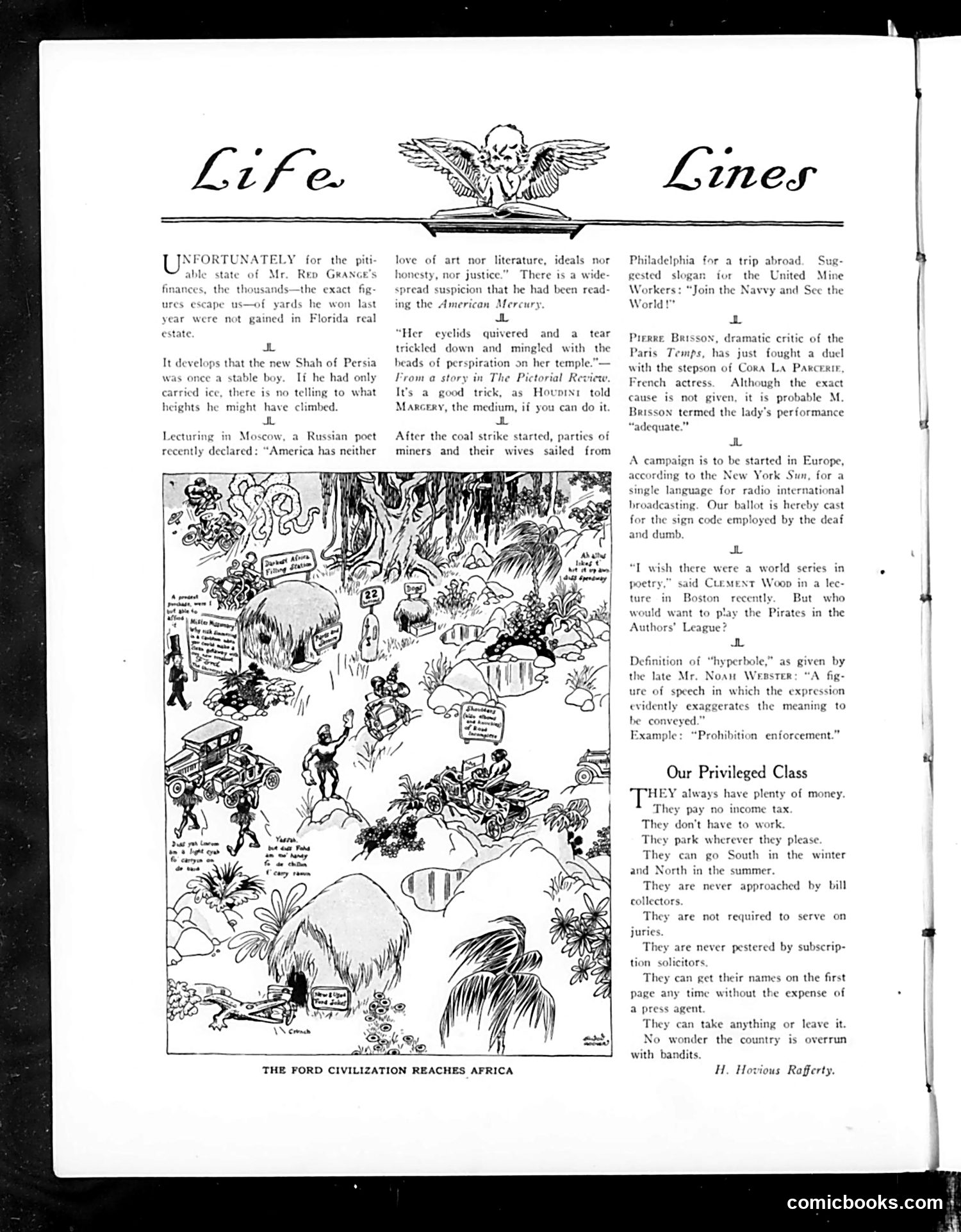
This page from *Life* magazine contains three separate satirical items: 1. **Top left**: Criticizes the Shah of Persia for claiming he gained no wealth in Florida real estate—implying he's lying about his financial dealings. 2. **Center cartoon** ("The Ford Civilization Reaches Africa"): A detailed satirical illustration mocking American industrial expansion into Africa. It depicts Ford automobiles, factories, and American consumer culture being imposed on African landscapes, satirizing both corporate imperialism and the assumption that Western industrialization represents "civilization." 3. **Right side** ("Our Privileged Class"): A poem satirizing wealthy Americans who pay no taxes, avoid work, travel seasonally, evade bill collectors, and face no legal obligations—suggesting the rich operate under different rules than ordinary citizens. The overall tone critiques wealth, corporate expansion, and class inequality.
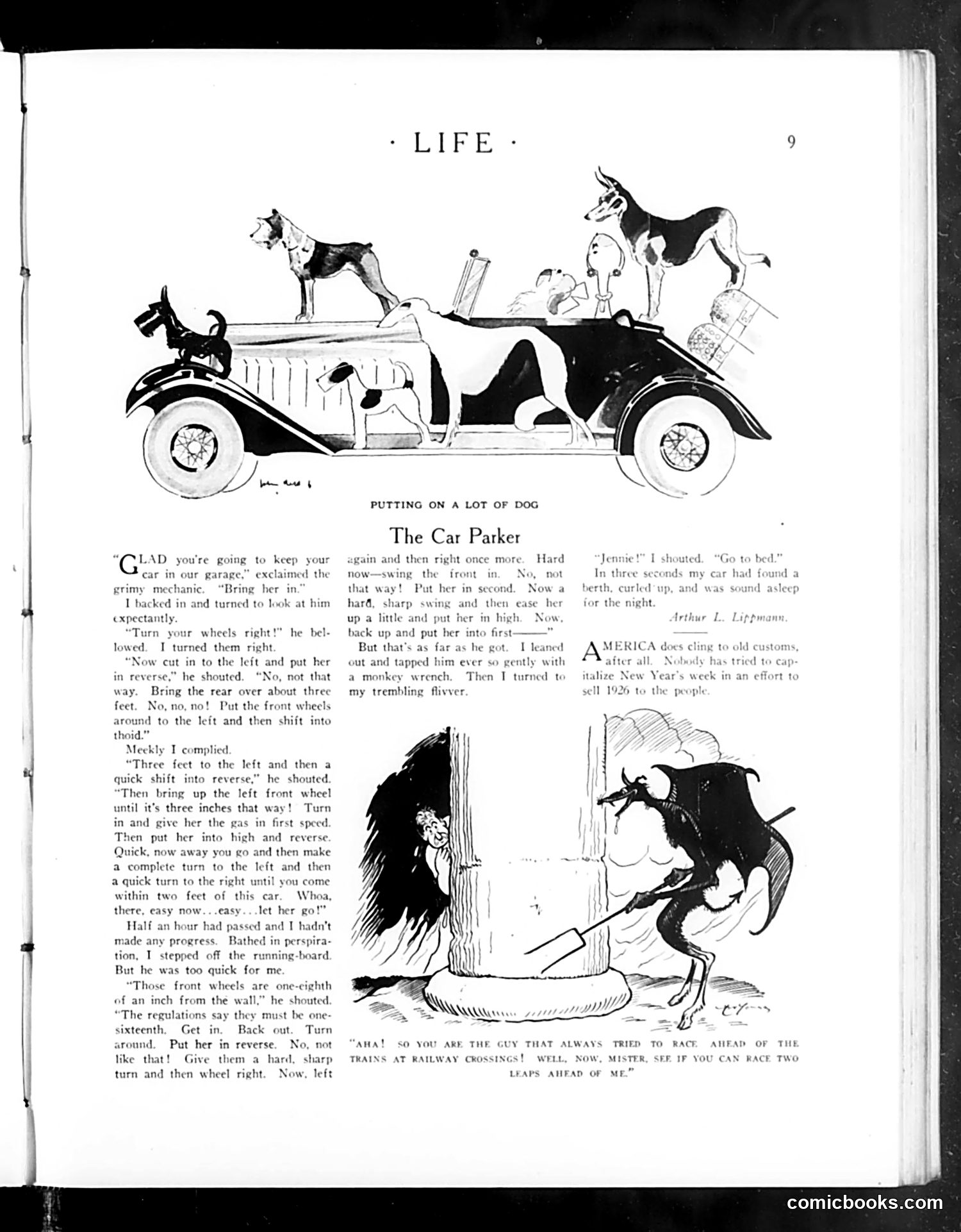
This page satirizes the challenges of parallel parking in the early automobile era. The top illustration shows a chaotic scene with multiple dogs literally piled onto a car—a visual pun on "putting on a lot of dog" (slang for showing off). The main story describes a protagonist's increasingly complicated attempts to park, following increasingly absurd instructions from a mechanic. The humor builds through mounting frustration and failed maneuvers. The lower cartoon depicts two dogs racing, with one boasting about beating trains at railway crossings, presumably mocking drivers who take similar risks. Together, these pieces mock both the mechanical complexity of early cars and the ego-driven behavior of motorists—common satirical targets in early-20th-century humor about automobiles and their owners.
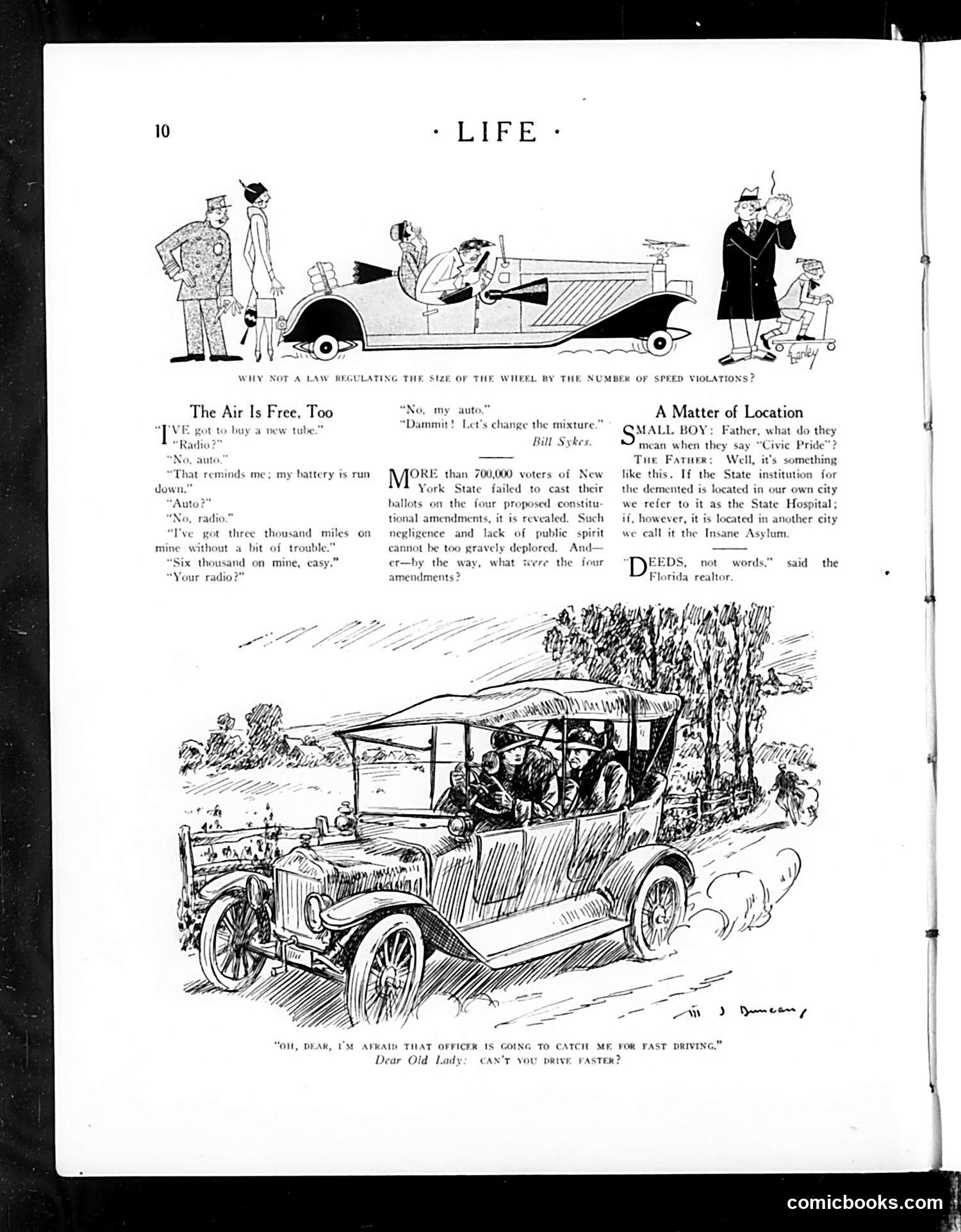
This page contains three brief humor pieces about automobiles, reflecting early 20th-century car culture: **"The Air Is Free, Too"** mocks owners buying expensive car parts while claiming poverty—a joke about status anxiety. **"No, my auto"** satirizes the new habit of frequent car maintenance and repairs, with a driver changing fuel mixture repeatedly. **"A Matter of Location"** uses institutional naming to make a joke: a father explains that calling a "madhouse" by the formal name "State Hospital" or "Insane Asylum" doesn't change what it is—a commentary on how renaming doesn't alter reality. The large cartoon below depicts a speeding car with the caption "OH, DEAR, I'M AFRAID THAT OFFICER IS GOING TO CATCH ME FOR FAST DRIVING"—mocking reckless drivers and the emerging problem of traffic law enforcement.
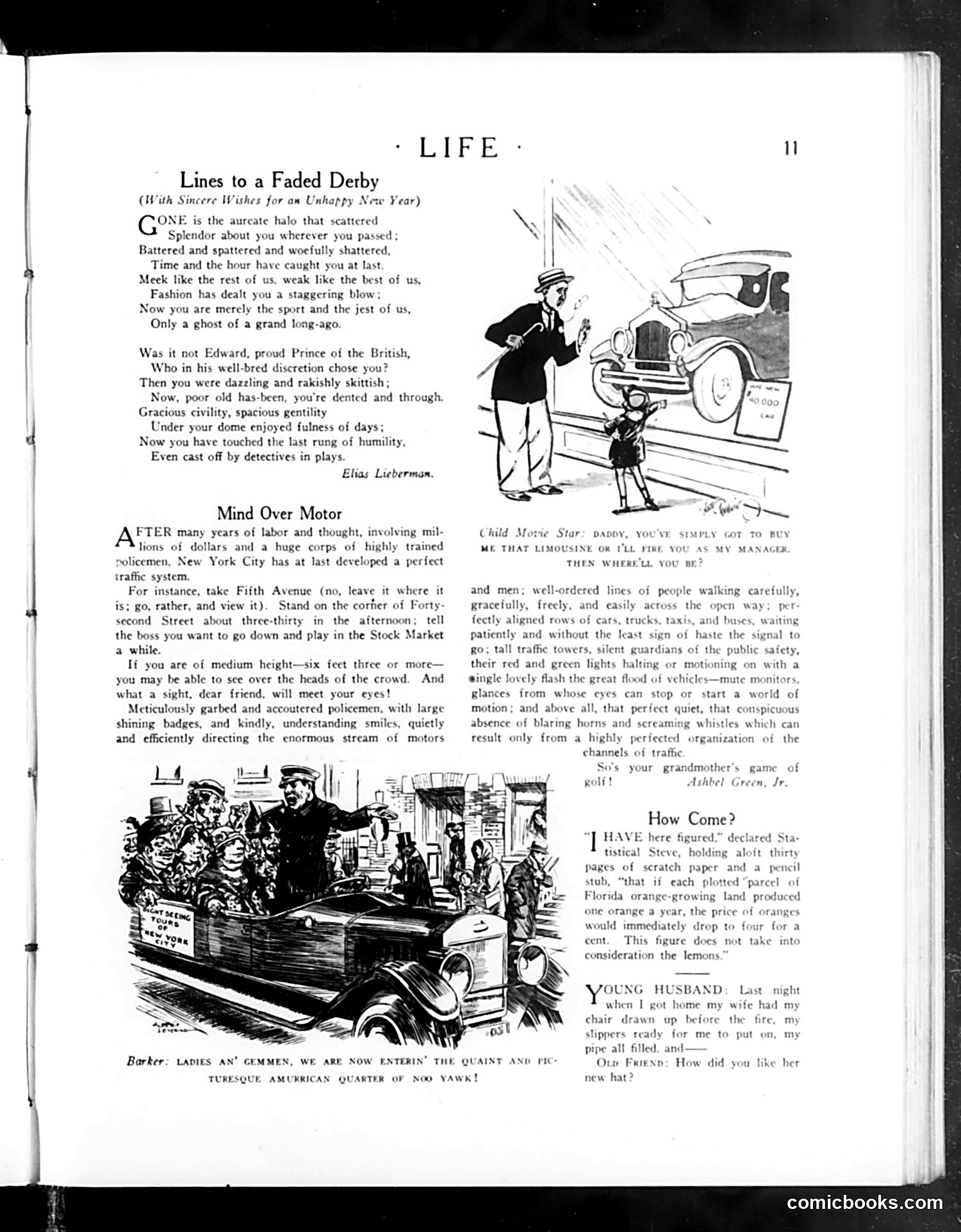
This page contains three separate humor pieces from *Life* magazine: 1. **"Lines to a Faded Derby"** - A satirical poem by Elias Lieberman mocking a worn-out hat that once belonged to someone fashionable but is now shabby and cast aside—a metaphor for lost social status. 2. **"Mind Over Motor"** - An article praising New York City's new traffic control system, illustrated with a cartoon showing a barber directing orderly crowds and vehicles. The satire suggests that controlling NYC's chaotic traffic is as impressive as managing a barbershop. 3. **"How Come?" and "Young Husband"** - Brief humorous anecdotes about everyday domestic situations (oranges, slippers by a fire), representing typical *Life* magazine humor. The cartoons use exaggeration and domestic scenarios to satirize modern urban life and social pretensions.
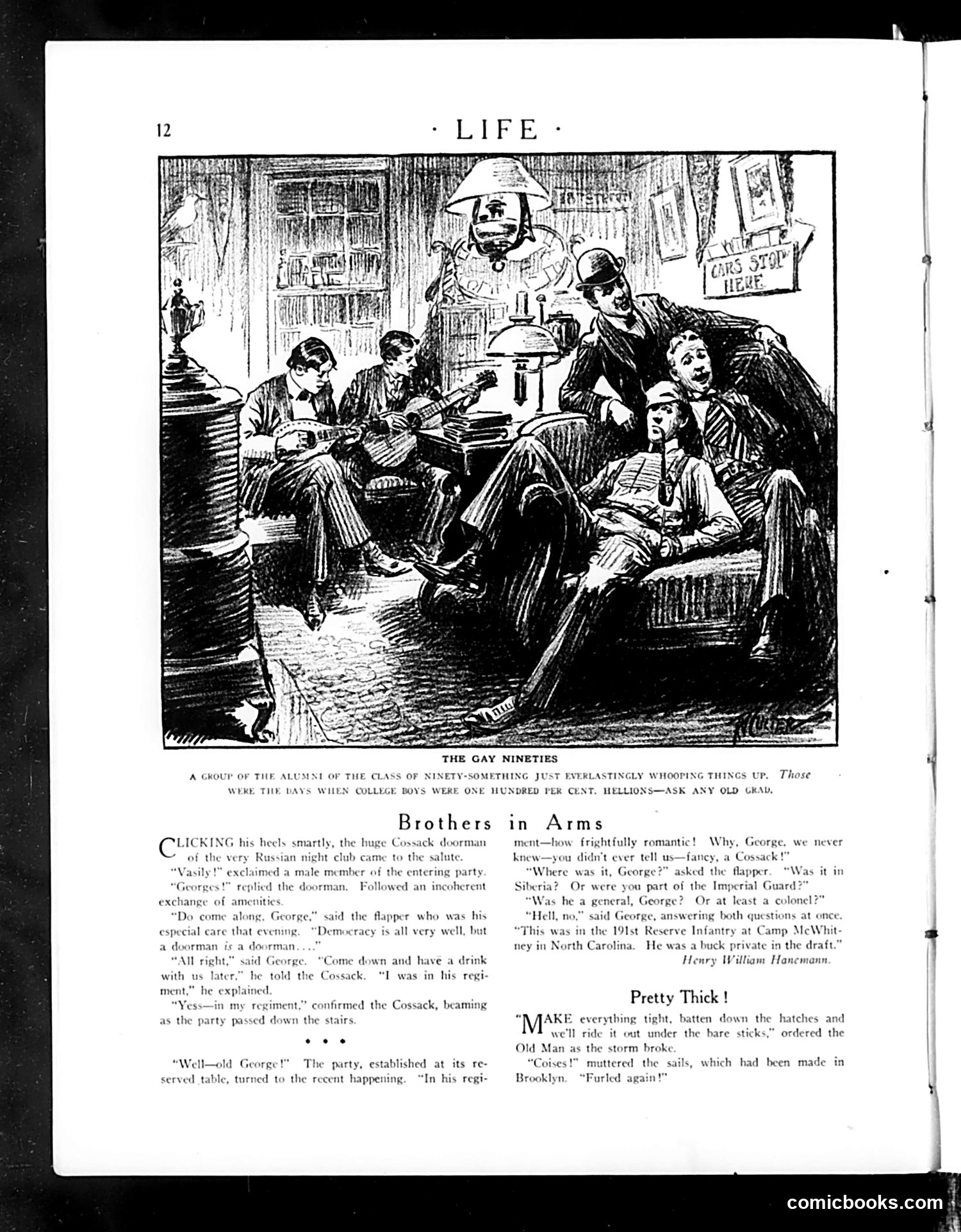
This page contains two separate pieces of satirical content: **"The Gay Nineties"** (top illustration): A nostalgic cartoon showing alumni from the Class of 1890 gathering to reminisce. The caption notes these men were "one hundred per cent. hellions" in their college days—suggesting the contrast between their rowdy youth and present respectability. **"Brothers in Arms"** (bottom text): A humorous dialogue between former college acquaintances, particularly George and a Cossack doorman. The joke centers on George's vague recollection of military service (possibly the Spanish-American War or Philippine campaigns), with absurd claims about generals and colonels that humorously expose his uncertain memory or exaggeration. **"Pretty Thick!"** (final section): A brief nautical anecdote about sailors making repairs during a storm. The overall tone mocks aging men's tendency to romanticize and misremember their younger years.
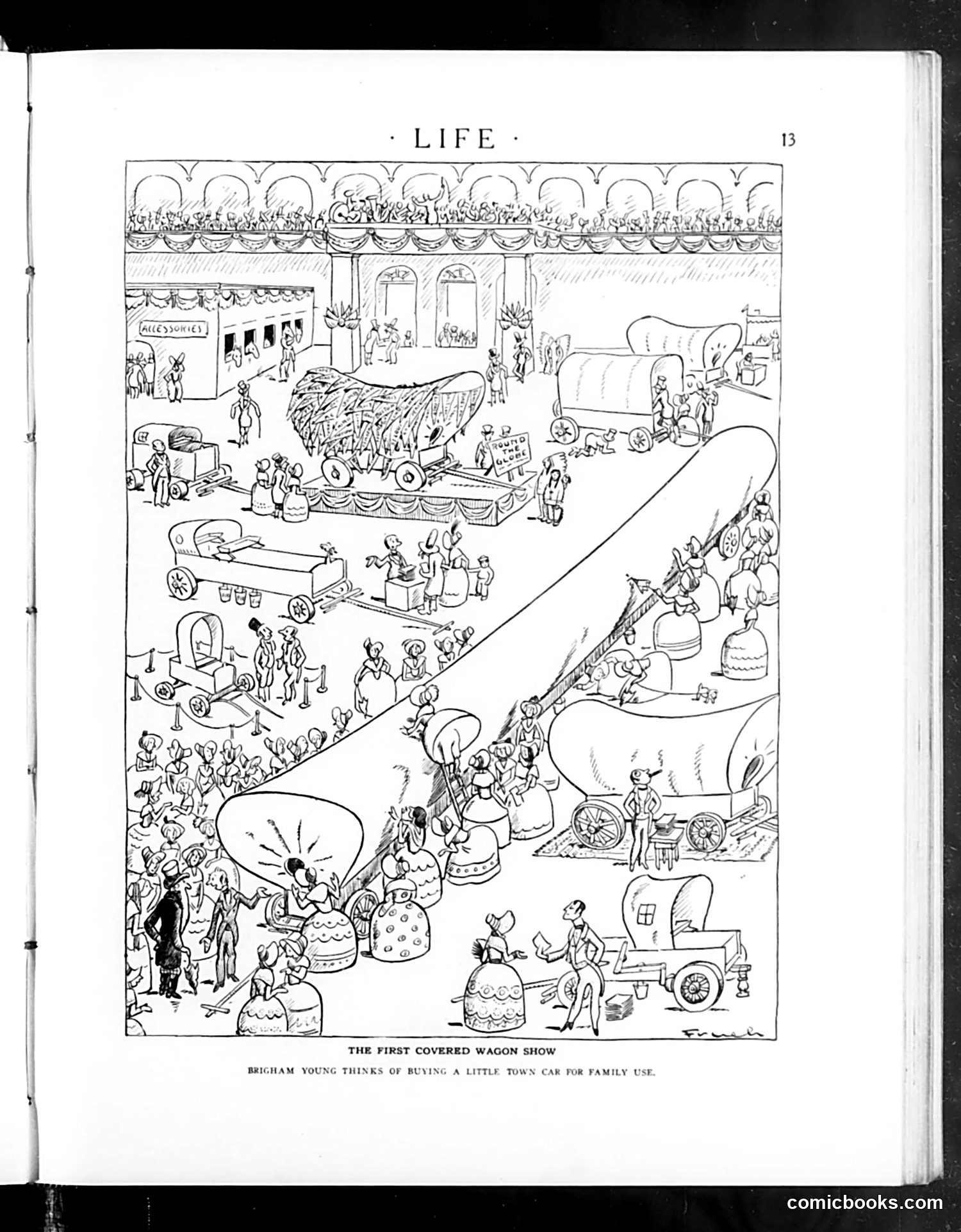
This is a satirical cartoon about Brigham Young, the Mormon leader, supposedly considering "buying a little town car for family use." The joke plays on Young's famous polygamy—he had numerous wives—by depicting a massive "covered wagon show" filled with enormous wagons and what appear to be many people (representing his large family). The cartoon mocks the incongruity of a religious leader known for maintaining multiple households considering a modern automobile instead of his traditional covered wagons. It's a humorous critique using exaggeration: showing an absurdly oversized, carnival-like wagon exhibition to satirize the impracticality of transporting such a large family unit, while also poking fun at Mormonism's polygamous practices, which remained socially controversial in early 20th-century America.
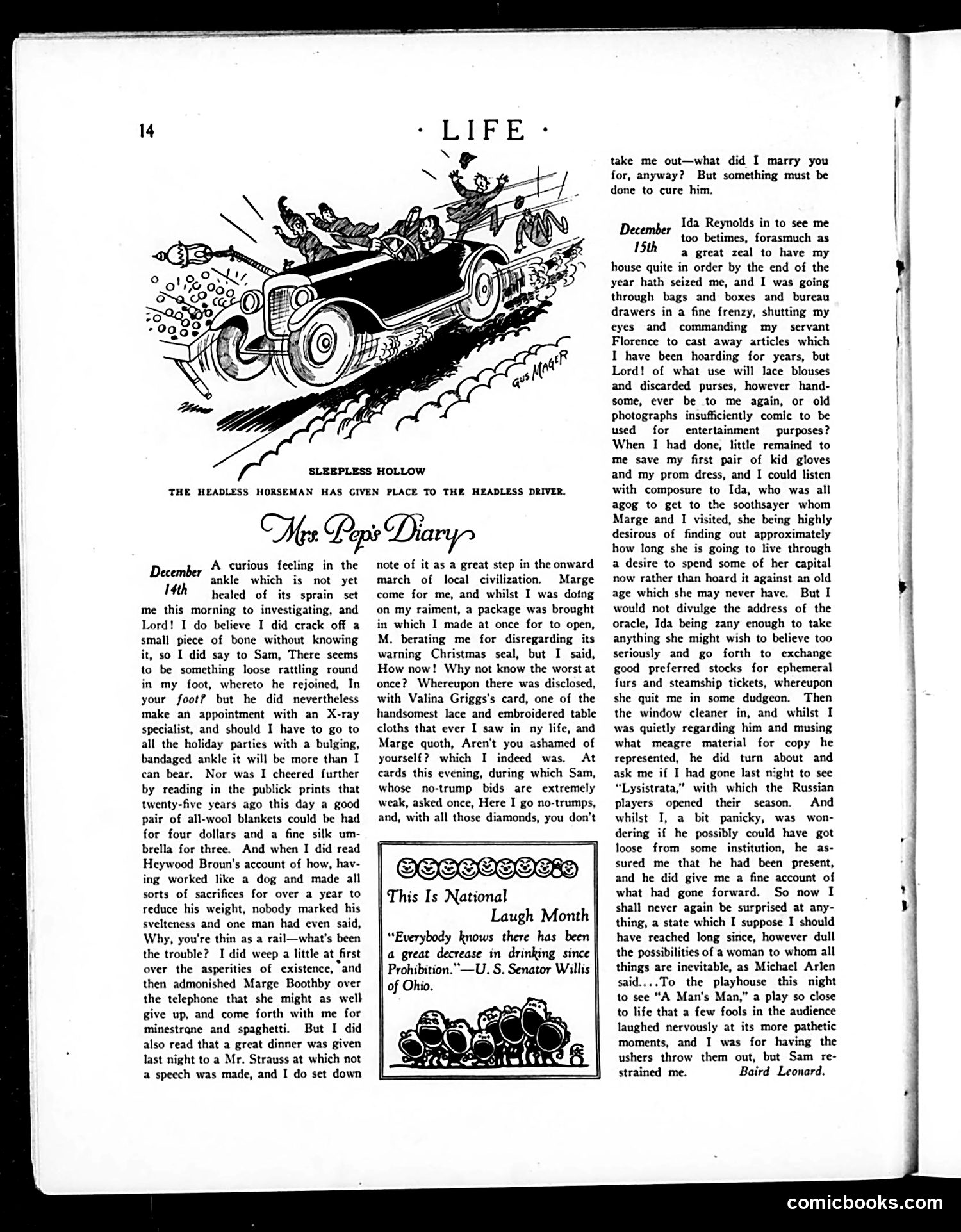
This cartoon satirizes the dangerous driving of the 1920s "Jazz Age." The illustration shows a chaotic car crash with passengers flying everywhere, replacing the headless horseman of Washington Irving's classic tale with a "headless driver"—suggesting reckless motorists operating vehicles without judgment or caution. The caption's literary reference ("Sleepless Hollow") mocks both Irving's folklore and modern automotive hazards. The accompanying "Mrs. Pep's Diary" entry (dated December 14th) discusses holiday cleaning and social obligations, representing typical upper-class concerns of the era. The "Laugh Month" inset promotes National Prohibition's supposed success in reducing drinking—ironic given the page's overall satirical tone questioning American civilization's actual progress.
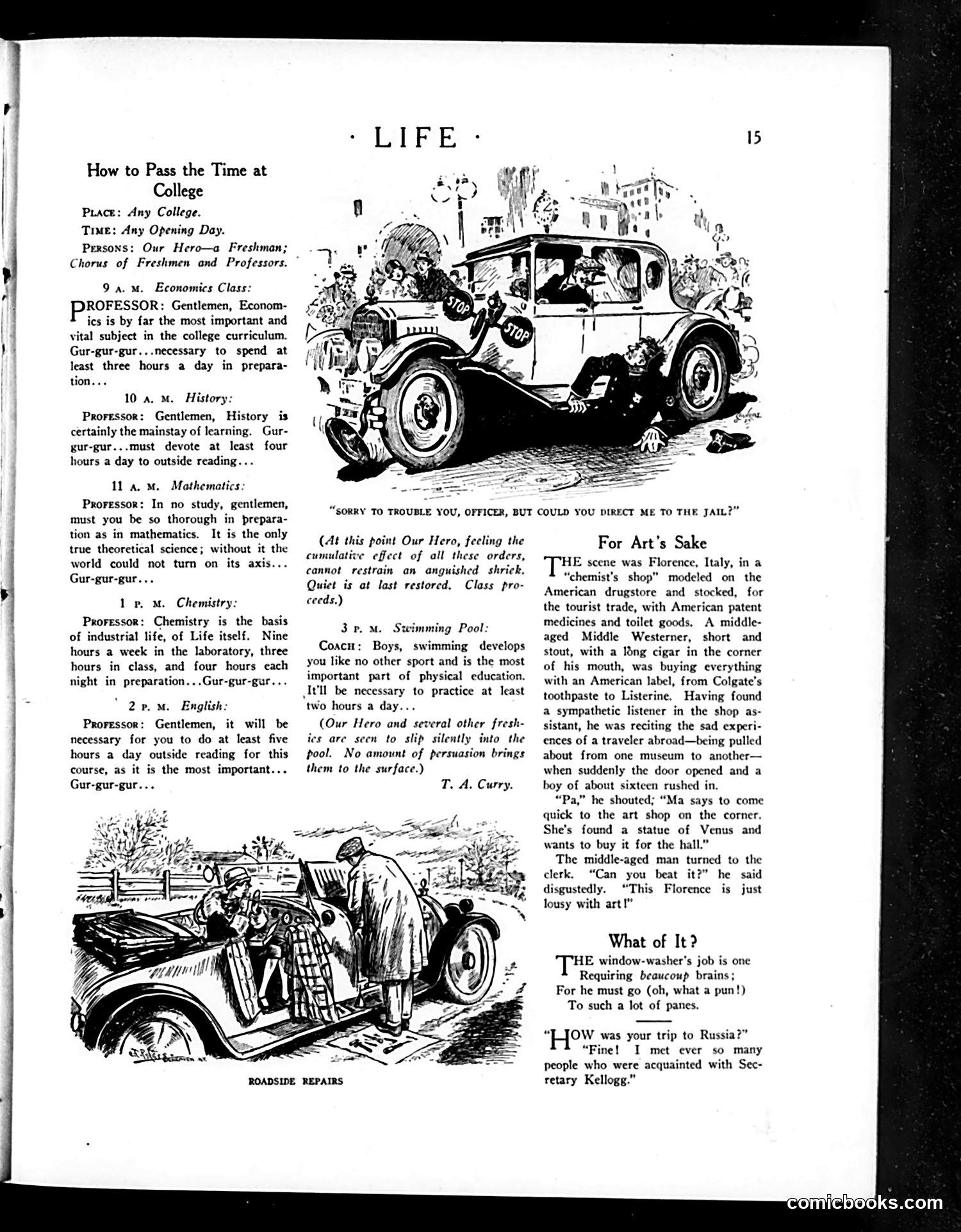
This page satirizes college life through a humorous daily schedule. The top cartoon depicts a car overloaded with freshmen and professors, captioned "Sorry to trouble you, officer, but could you direct me to the jail?" — mocking the chaotic collision of academic demands. The schedule ridicules excessive coursework: Economics requires three hours daily preparation, History four hours of outside reading, Mathematics demands theoretical rigor, Chemistry involves lab work, and English requires five hours of outside reading. Two additional cartoons illustrate student life: one shows roadside car repairs, suggesting financial or practical struggles; another depicts window-washing as manual labor. The satire targets the unrealistic workload imposed on college students, suggesting that following all professors' demands would lead to exhaustion or imprisonment — a commentary on early 20th-century educational excess.
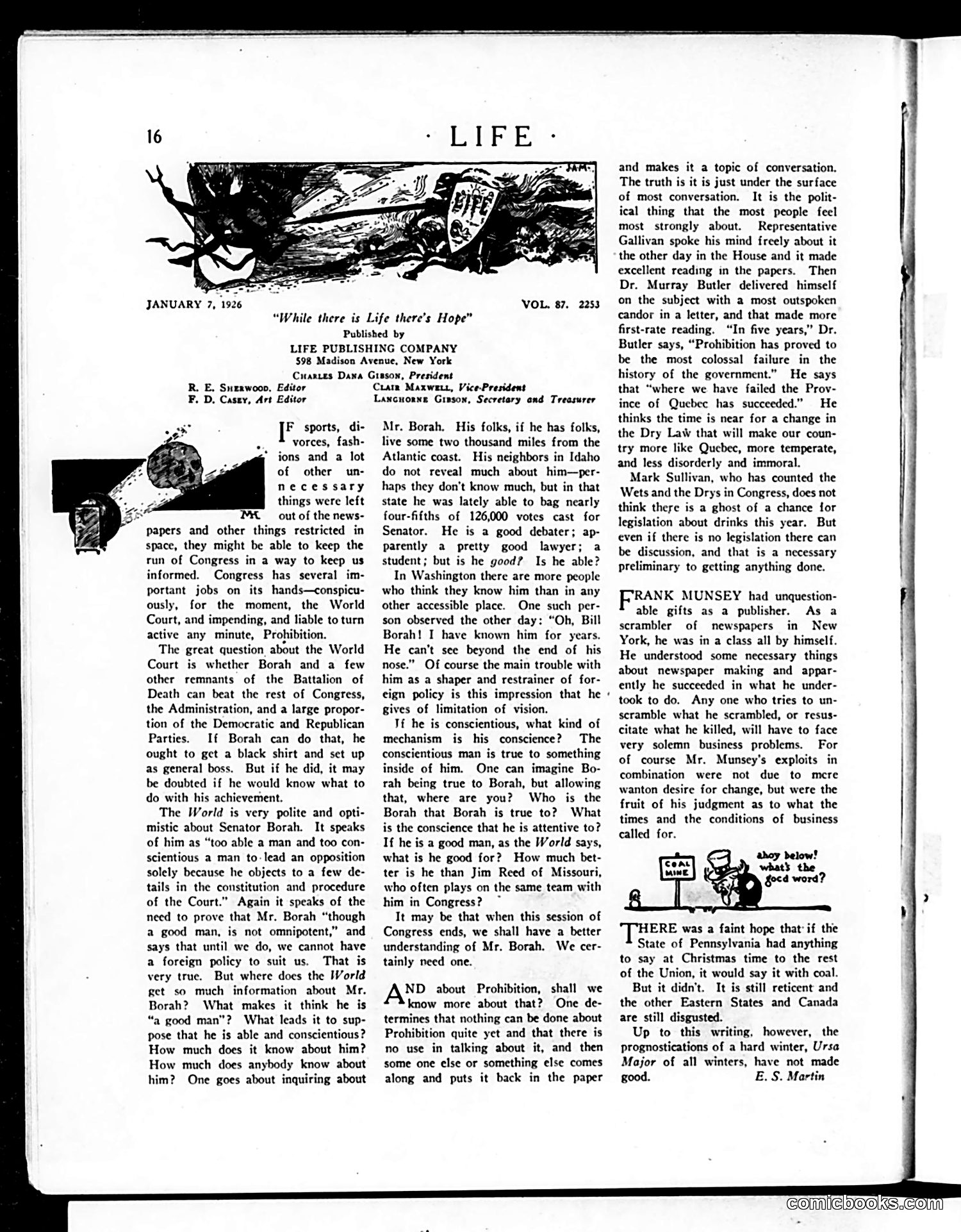
The main cartoon depicts a figure labeled "BIFF" striking someone, illustrating the article's satirical examination of Senator William E. Borah of Idaho. The text criticizes Borah as a "good" debater and lawyer but questions whether he possesses practical wisdom or foresight. The author argues Borah's limitations prevent him from effectively shaping foreign policy—he "gives limitation of vision." The piece uses Borah as a case study in how Congress lacks truly competent leadership. Below, a separate section discusses Prohibition's failure as government policy, referencing Dr. Murray Butler's assessment that it represents "the most colossal failure in the history of the government." The article questions whether legislative change might occur.
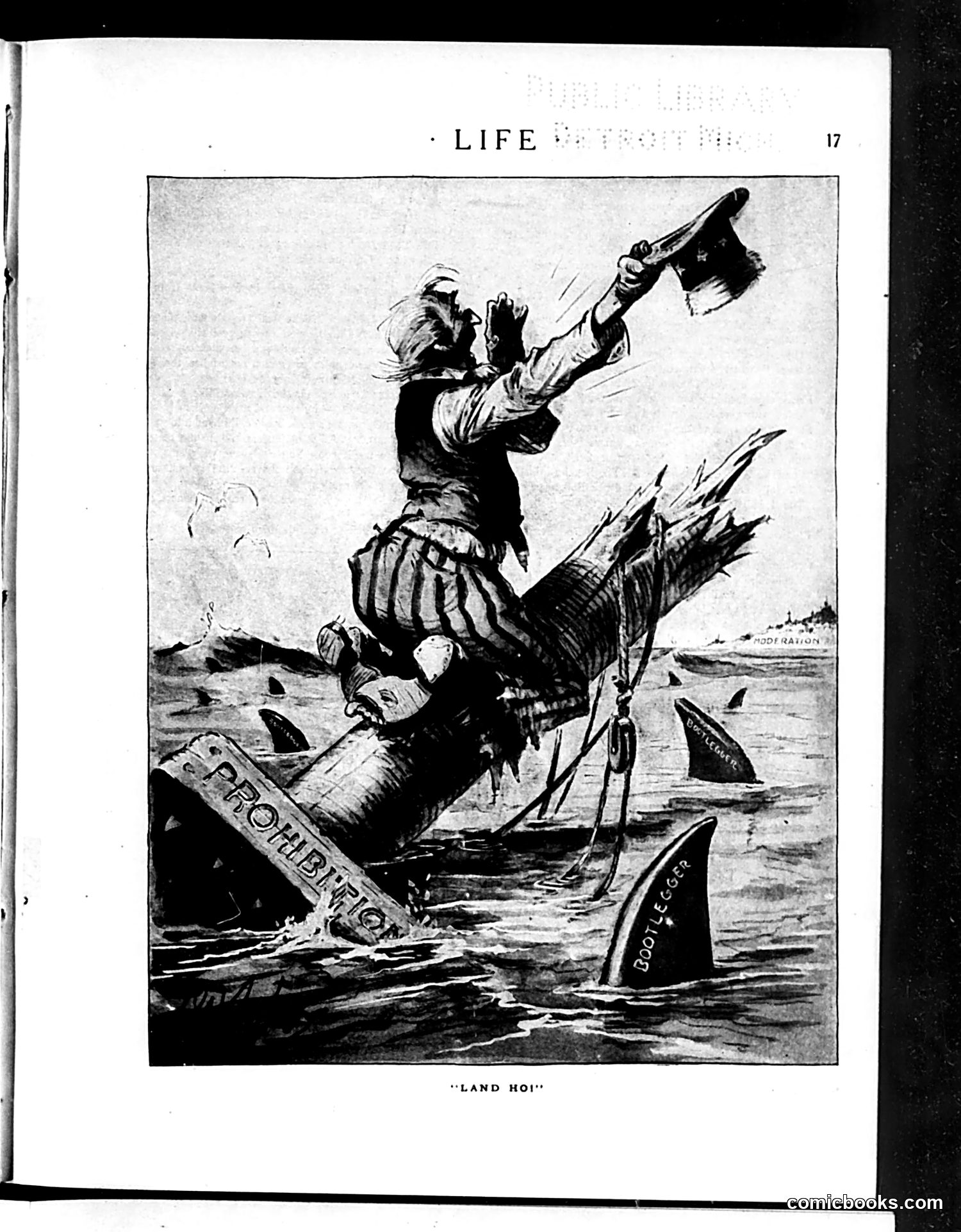
This cartoon depicts a sailor or explorer figure standing precariously on what appears to be a sinking vessel labeled "PROHIBITION," waving a flag while surrounded by sharks labeled "BOOTLEGGER." The figure is signaling frantically toward land, apparently trying to escape the dangerous waters. The satire critiques Prohibition (the 1920s ban on alcohol). The drowning ship represents the policy itself failing, while the circling sharks represent bootleggers profiting from illegal alcohol trade. The sailor's desperate "Land Ho!" suggests he's seeking rescue from a sinking policy. The cartoon argues Prohibition created more problems than it solved—enriching criminals while the policy itself collapsed under practical failure and public resistance.
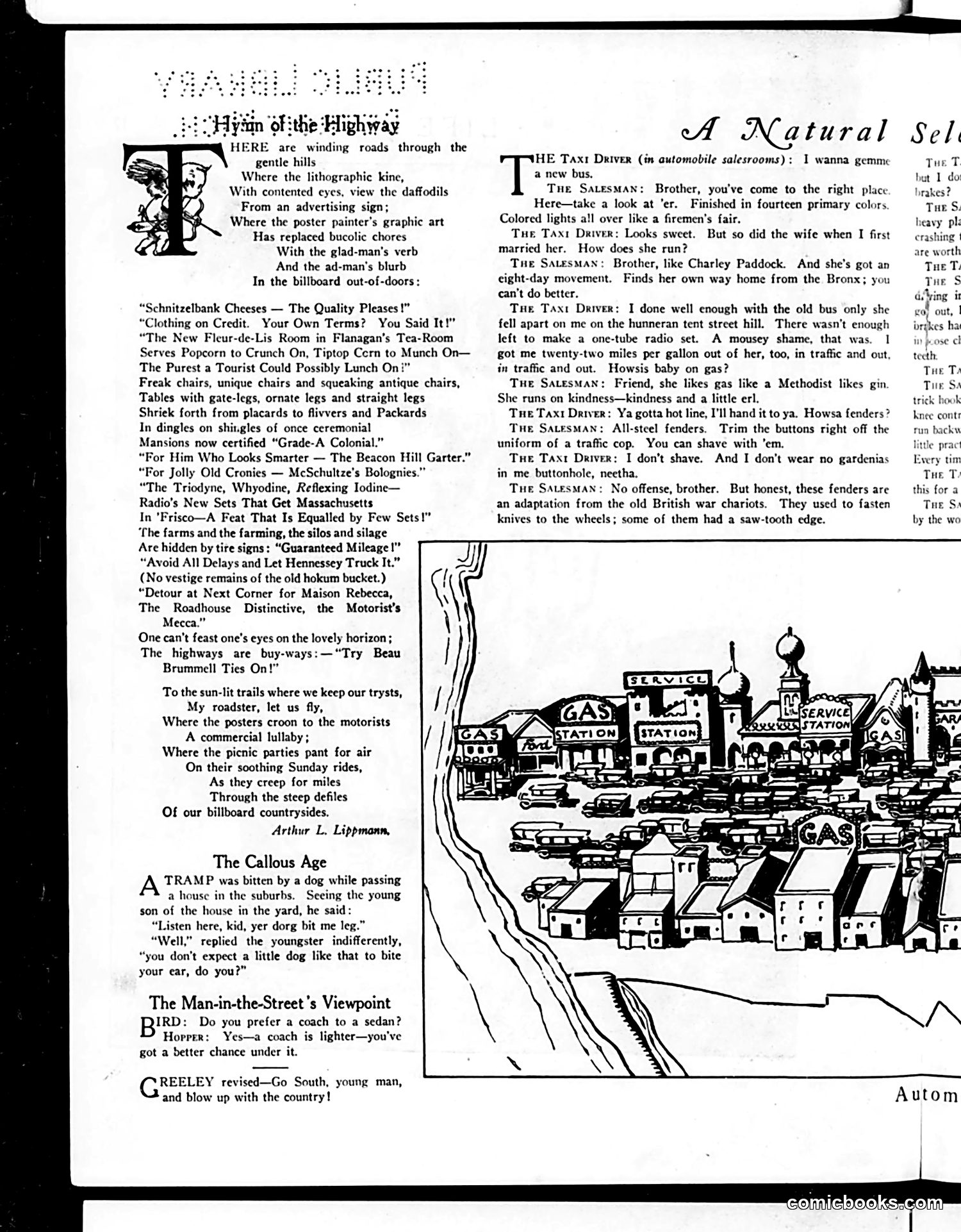
This page satirizes 1920s American consumer culture and advertising's invasion of the landscape. The main poem "Ruin of the Highway" mocks how billboards have replaced natural scenery—rural landscapes are now cluttered with garish advertisements for cheese, radio sets, truck services, and ties. The satirist (Arthur L. Lippmann) laments that motorists can no longer enjoy unspoiled countryside; instead they see commercial messages at every turn. The cartoon dialogue "A Natural Salesman" parodies exaggerated salesmanship through a taxi driver and car salesman's conversation. The salesman uses absurd hyperbole ("fourteen primary colors," "eight-day movement") and pretentious language to sell an obviously mediocre vehicle, while the taxi driver responds with deadpan cynicism. It mocks both aggressive advertising techniques and gullible consumer culture of the era.
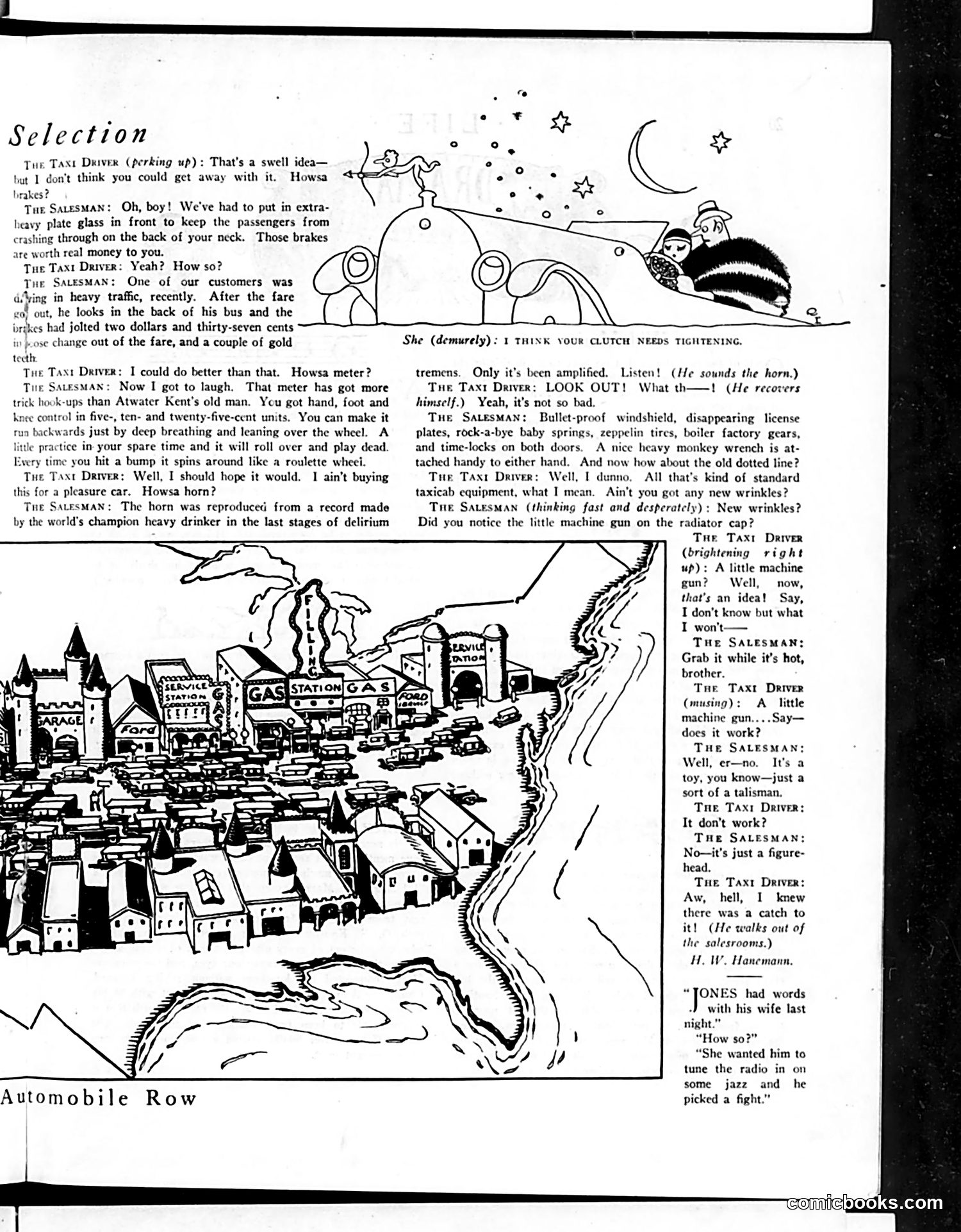
This 1920s-era humor piece satirizes both taxi drivers and aggressive automobile salesmanship. A salesman pitches increasingly absurd "features" to a skeptical taxi driver—reinforced brakes (justified by coins jolting loose from sudden stops), a rigged meter that "spins like a roulette wheel," and a horn so loud it sounds like a drunk man in delirium tremens. The joke escalates when the salesman claims the taxi has a machine gun on the radiator cap. The driver's interest perks up—until learning it's non-functional, merely decorative ("a talisman" or "figurehead"). Disgusted at being duped, the driver leaves. The satire targets both the gullible buyer and the con-artist salesman, reflecting post-WWI anxieties about fraud and commercialism. The fake machine gun—useless but tempting—represents empty promises in aggressive sales tactics of the era.
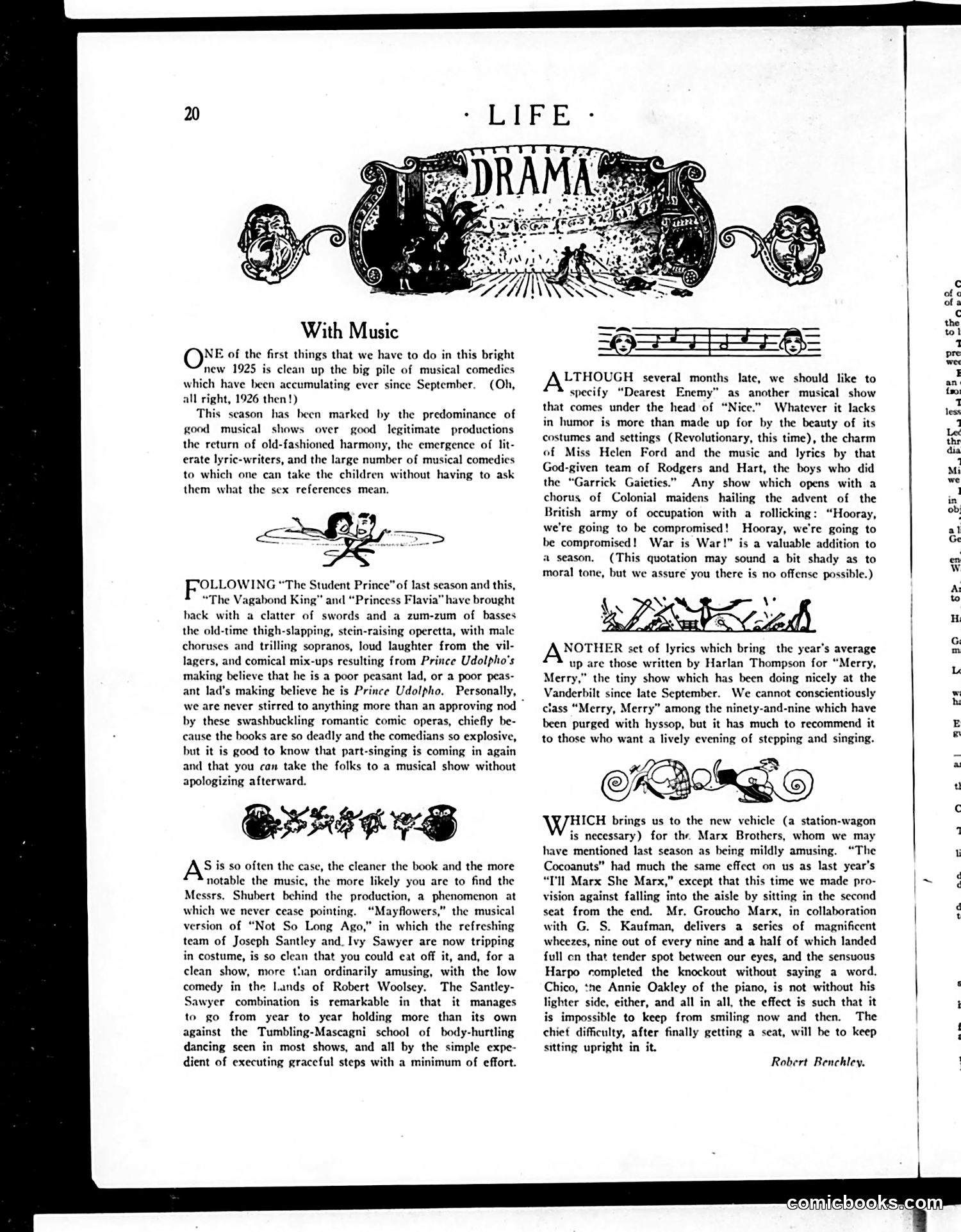
This theater review page discusses Broadway musical comedies of the 1925 season. The critic praises the return of "old-fashioned" operettas like *The Student Prince* and *The Vagabond King*, appreciating their romantic plots and male choruses, though finding the scripts "deadly." The piece celebrates shows with clean, family-friendly content—notably those produced by the Shuberts. Specific praise goes to *Dearest Enemy* (with music by Rodgers and Hart) for its Revolutionary War-era costuming and the charm of performer Helen Ford. The review also mentions *Merry, Merry* and a Marx Brothers vehicle, *The Cocoanuts*. The overall tone reflects 1925 Broadway: optimism about musicals as respectable entertainment suitable for children, appreciation of skilled lyricists, and the dominance of major producers like the Shuberts in shaping theatrical taste.
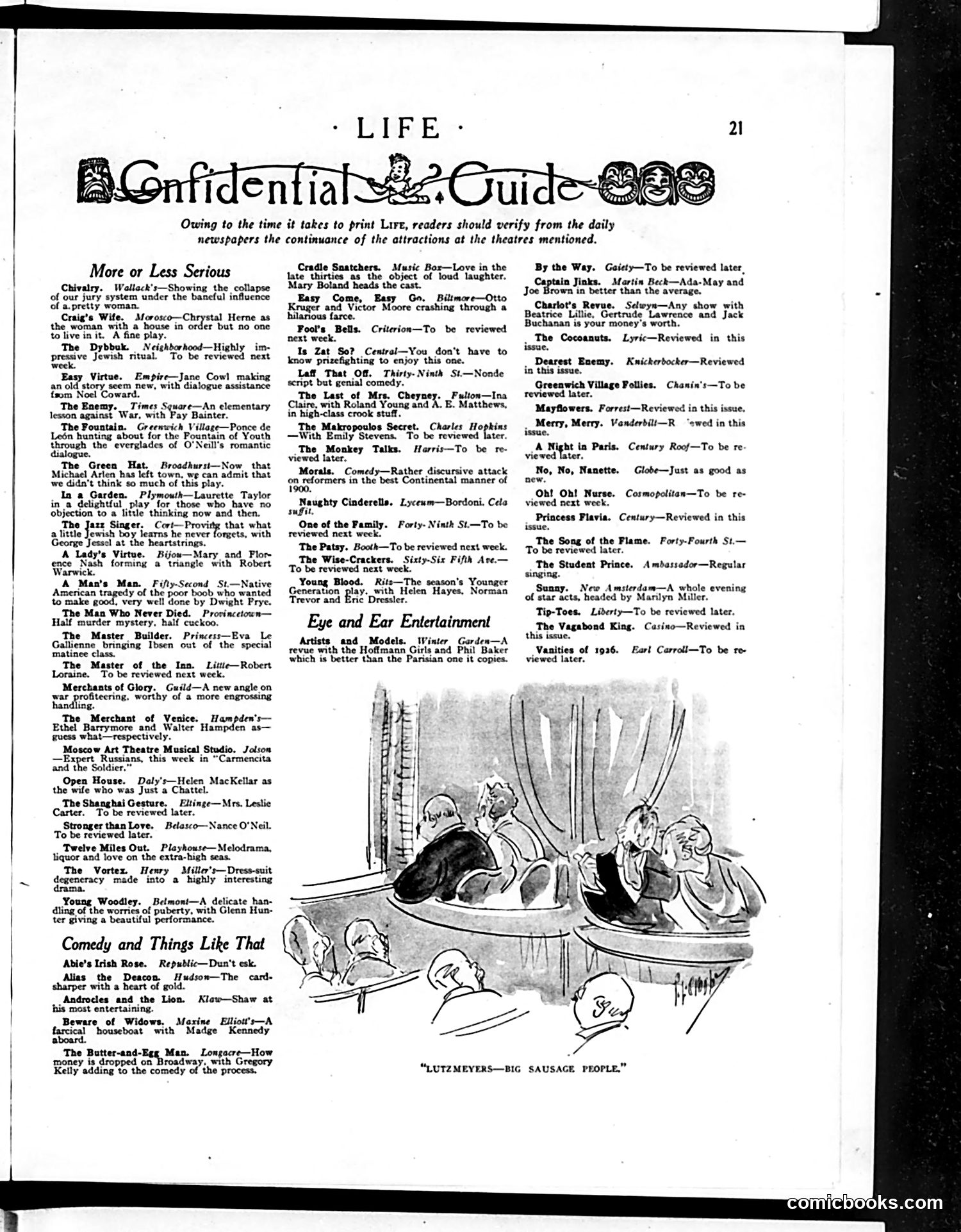
This cartoon illustrates a theater review section from Life magazine. The sketch shows two rotund figures in what appears to be a large sausage or hot dog, labeled as a reference to "Lutzmeyers"—likely a German delicatessen or sausage company. The joke plays on the name and the characters' portly appearance, creating visual humor through the pun of "big sausage people" literally depicted as people inside a giant sausage. The surrounding text comprises theater reviews of 1920s Broadway productions, with brief, witty critiques of plays ranging from serious drama ("The Dybbuk," "In a Garden") to comedies ("Abie's Irish Rose," "The Butter-and-Egg Man"). The cartoon serves as light visual entertainment within this theatrical guide.
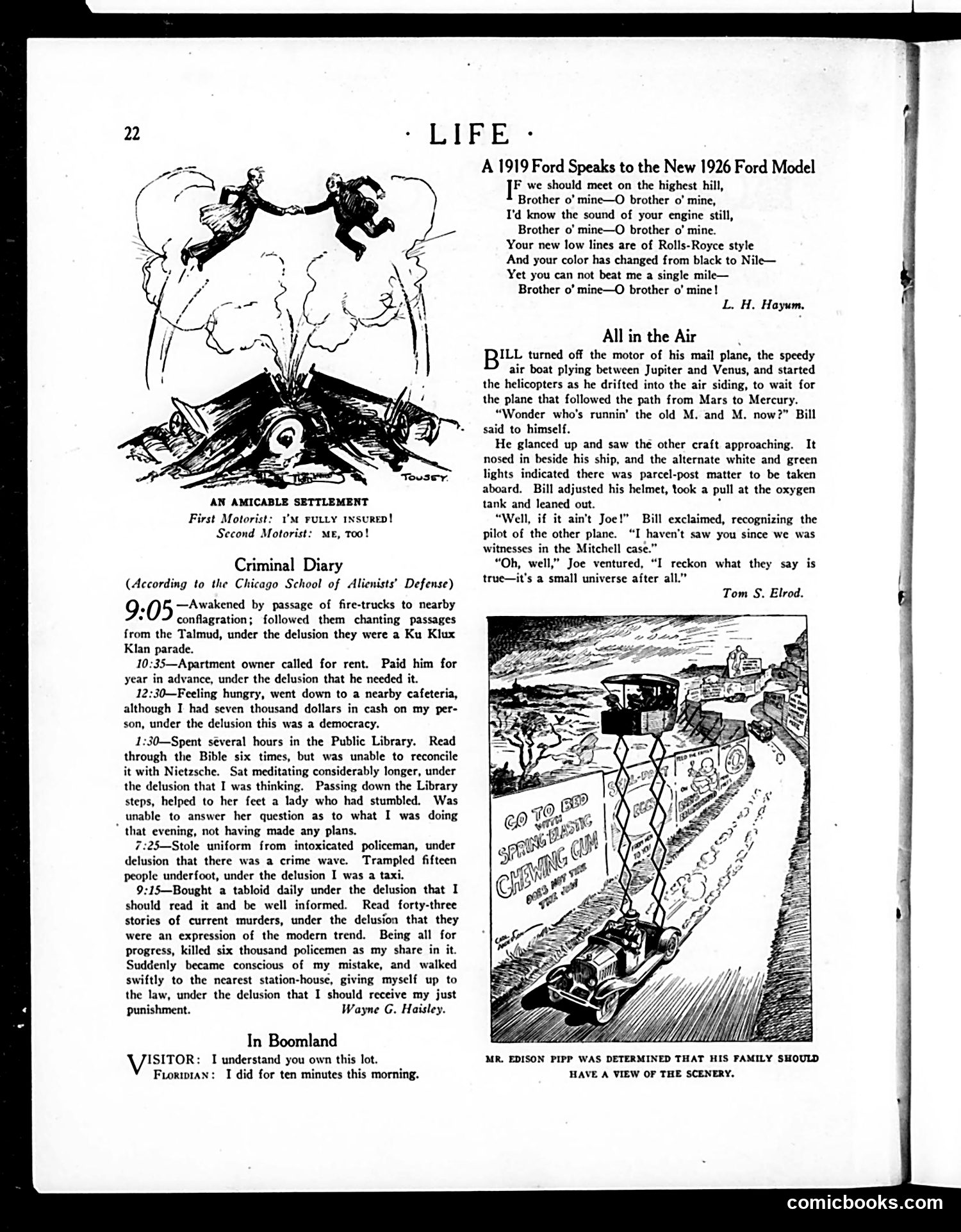
This page contains satirical humor typical of 1920s Life magazine: **"An Amicable Settlement"**: Two motorists in a car accident both claim to lack insurance—a joke about widespread uninsured driving and dishonesty. **"Criminal Diary"**: A sharp satire on the "Chicago School of Alienists' Defense"—a reference to psychological defenses used in actual criminal trials of the era. The humor lies in absurdly attributing heinous crimes (killing 6,000 policemen) to various "delusions" (mistaking fire trucks for KKK parades, confusing democracy with poverty). This mocks how emerging psychological jurisprudence was allegedly being exploited as legal excuses. **Ford comparison poem**: A 1919 Ford model addresses the newer 1926 model, boasting that despite the newer car's luxury styling, the older model still outperforms it—nostalgia mixed with class commentary. **"All in the Air"**: Science fiction humor set on interplanetary mail routes, playing with futuristic scenarios treated mundanely. **"In Boomland"**: A real-estate joke about rapid property speculation during the 1920s boom.
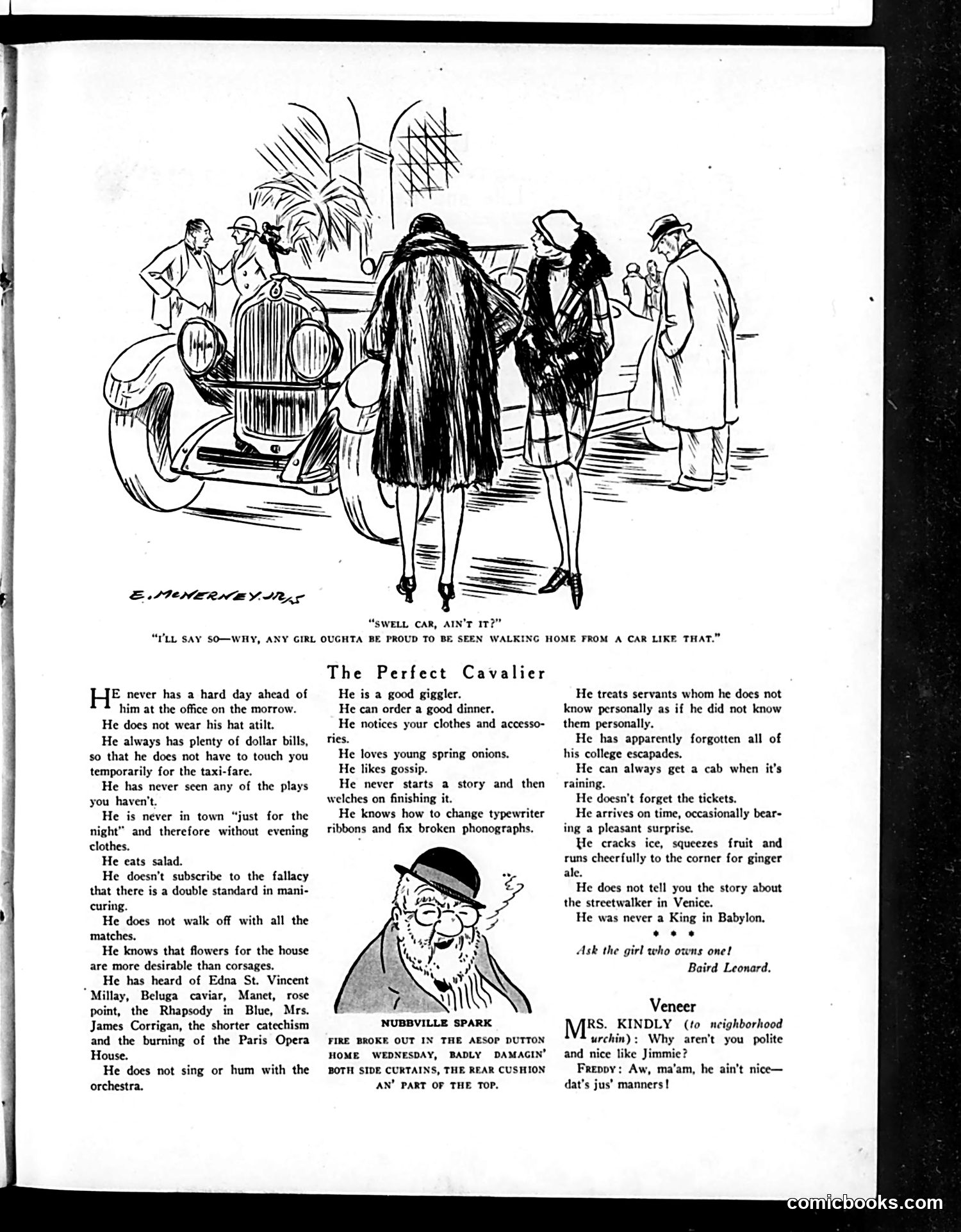
This page satirizes idealized masculinity and courtship standards of the 1920s-30s era. The main feature, "The Perfect Cavalier," humorously lists contradictory traits of the ideal gentleman—he's cultured (knows Edna St. Vincent Millay, caviar, Manet) yet practical (fixes phonographs), sophisticated yet considerate (notices women's accessories, brings surprises). The cartoon atop shows two women admiring a man's car, implying a woman's worth is tied to being "seen" with an attractive vehicle—mocking both male materialism and female social climbing. The "Veneer" dialogue joke reveals hypocrisy: a child is praised for politeness but explains he's merely performing manners, not being genuinely nice—satirizing how superficial gentlemanly behavior masks true character. Together, the page mocks the gap between performative sophistication and authentic character in Jazz Age dating culture.
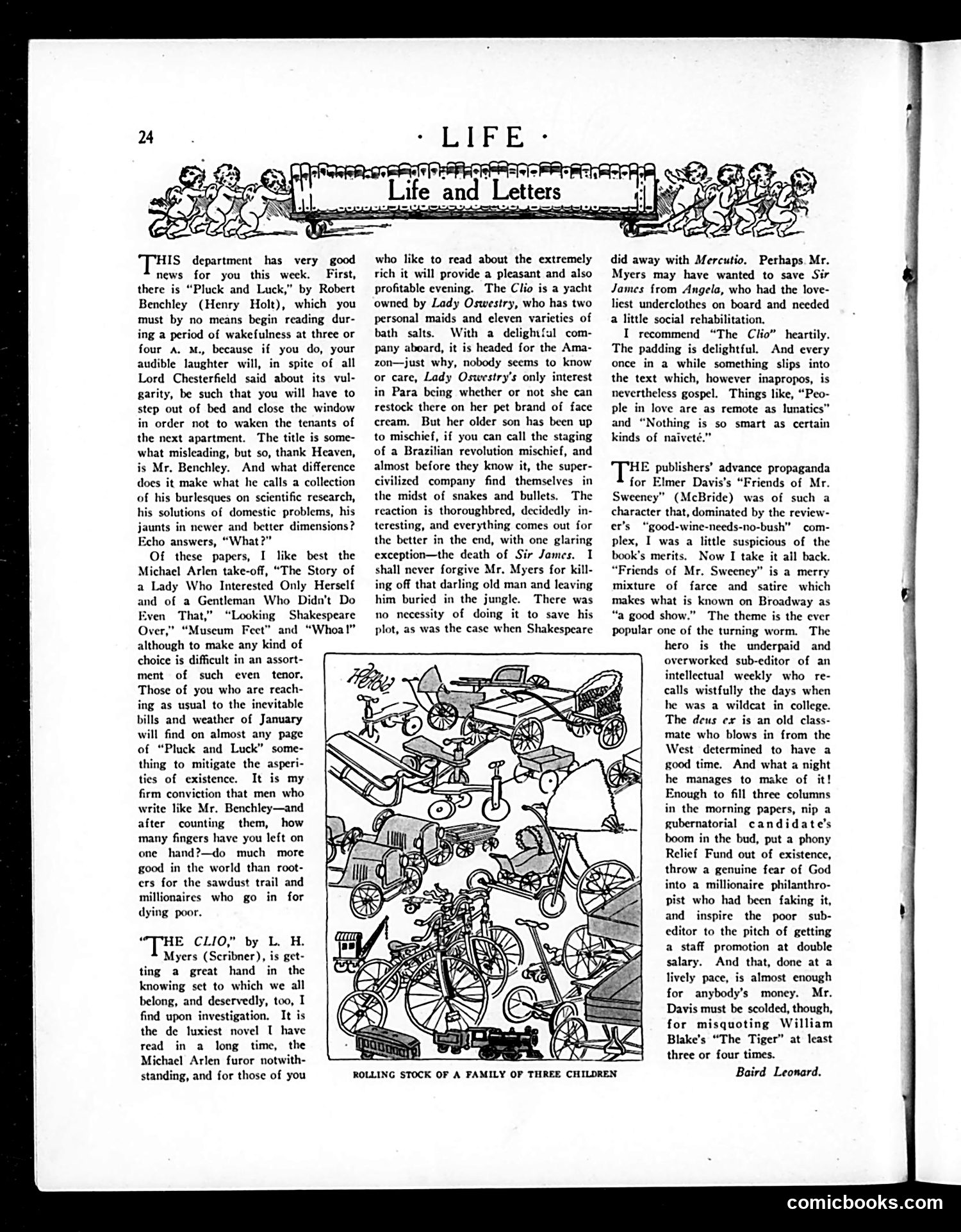
This is a **book review column** rather than political cartooning. The page discusses three novels: Robert Benchley's *Pluck and Luck*, L.H. Myers's *The Clio*, and Elmer Davis's *Friends of Mr. Sweeney*. The **central cartoon** illustrates "rolling stock of a family of three children"—a humorous drawing depicting the improbable array of wheeled toys and vehicles (bicycles, scooters, wagons, carriages) accumulated by one household. This visual joke complements the text's satirical tone about consumer excess and domestic absurdity. The reviews themselves are witty, employing satire to evaluate literature. The critic mocks the wealthy characters in *The Clio* (a yacht novel about the ultra-rich obsessed with trivial matters), and playfully critiques Benchley's scientific satires. The broader satirical point: Life magazine positions itself as arbiter of sophisticated, intelligent reading for its educated audience.
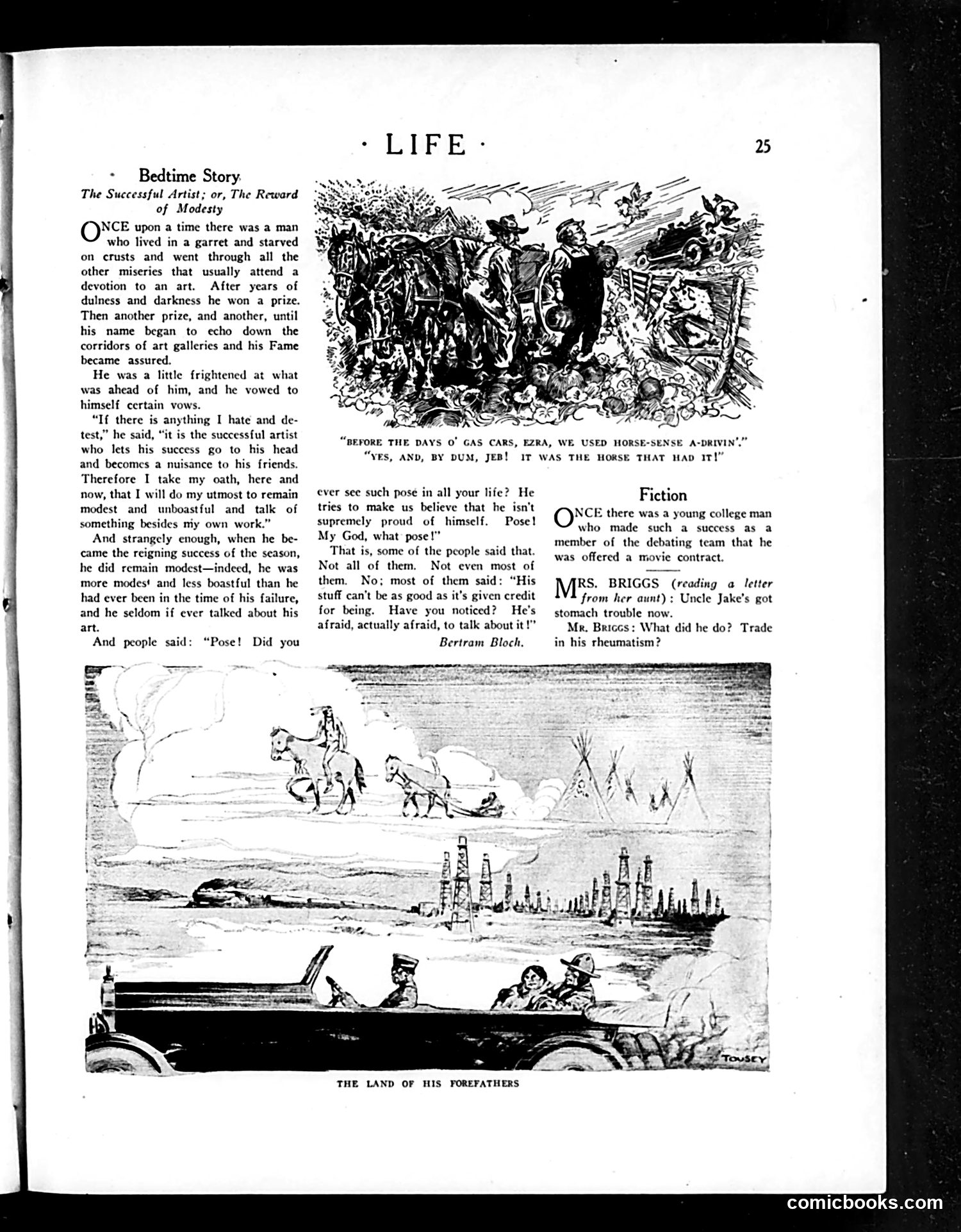
This page contains two distinct pieces of satire: **"Bedtime Story"** (top): A fable mocking social perception of success. An artist achieves fame but, keeping a vow of modesty, never boasts about his work. Rather than being praised for humility, society interprets his silence as affected *pose*—performative false modesty. Some assume his reluctance to discuss his art means the work itself isn't worthy of discussion. The satire targets how audiences distrust genuine modesty in successful people, assuming any restraint must be an act. **"Fiction"** (bottom right): A brief joke about a college debater turned movie star. **Illustrations**: The top cartoon depicts pioneers/settlers with horses and teepees contrasting with modern oil derricks, captioned with nostalgia for "horse-sense" driving versus gas cars—likely satirizing early automotive culture and the loss of practical judgment in modern life. The bottom illustration shows similar frontier-to-modern-era contrast ("Land of His Forefathers"). The page criticizes both artistic pretension and society's inability to recognize authentic humility.
This page reviews silent films being revived in 1920s New York through the International Film Arts Guild. The critic discusses three films: "Broken Blossoms" and "A Woman of Paris" (praised for visual storytelling), and "Time, the Comedian" (about Father Time as a mischievous character punishing a woman for past indiscretion). The key satire targets **D.W. Griffith's outdated filmmaking**. Though praised as cinema's pioneer who elevated movies from "nickelodeon class," Griffith has "stood still" while contemporaries like Chaplin and Lubitsch progressed. His fatal flaw: relying on title cards to explain action rather than letting the camera "speak for itself"—a technique newer directors had mastered. The cartoon illustrations (showing simple figures) ironically underscore this point about visual versus textual expression in silent film. The critic laments Griffith's creative stagnation despite his historical importance, using "atonement" language to suggest wasted potential.
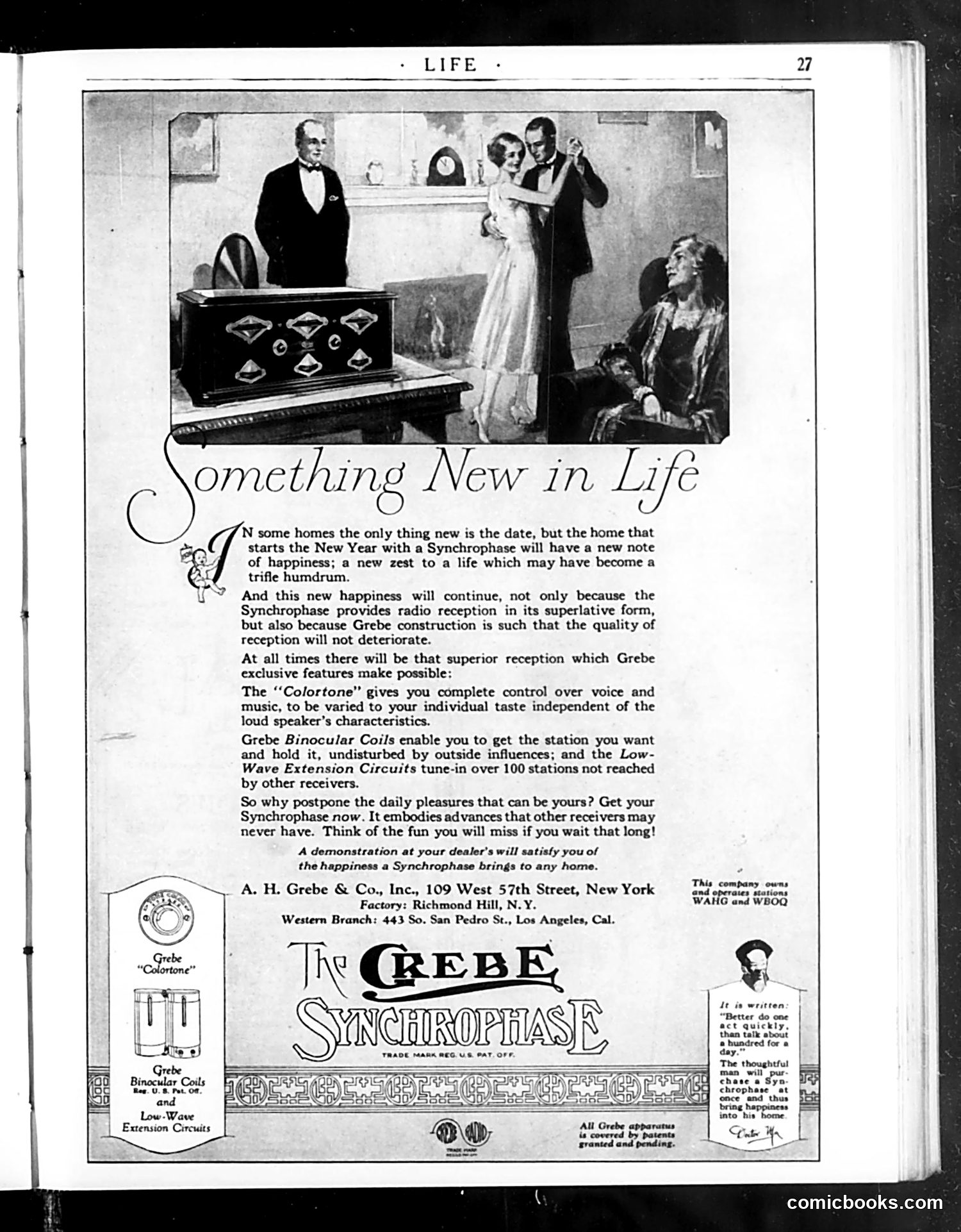
This is **not a political cartoon or satire**—it's a **full-page advertisement** for the Grebe Synchrophase radio receiver, published in *Life* magazine (likely mid-1920s, based on the radio technology). The illustration depicts a wealthy household gathered around a piano while a radio receiver plays music, suggesting that radio ownership brings social happiness and sophistication to the home. The ad's text emphasizes technical features (Colortone control, Binocular Coils, Low-Wave Extension) while appealing emotionally: it promises to cure "humdrum" lives and deliver "happiness" through superior reception. The advertisement reflects the era's enthusiasm for radio as a luxury consumer good and entertainment medium. The aspirational imagery—formal dress, elegant furnishings—targets middle-to-upper-class readers. At the bottom, a testimonial quotes something about "Better do one act quickly"—standard advertising rhetoric urging immediate purchase. This represents early radio-industry marketing in American consumer culture.
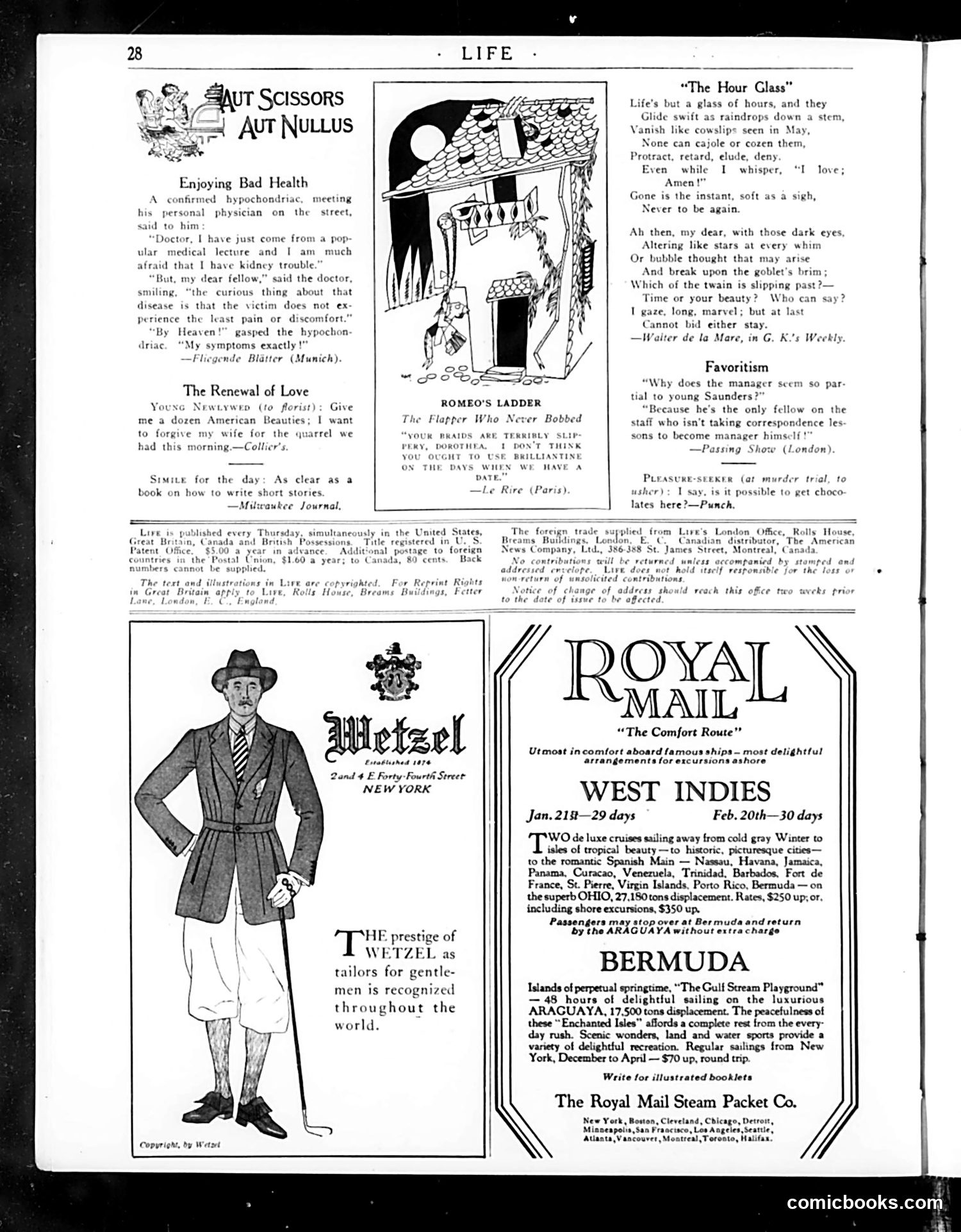
This page contains several short humorous pieces typical of Life's satirical format: **"Enjoying Bad Health"**: A doctor-patient joke about a hypochondriac so obsessed with imagined illnesses that when the doctor mentions kidney disease causes *no* pain, the patient exclaims his symptoms match perfectly—the irony being his psychosomatic complaints are entirely self-invented. **"The Renewal of Love"**: A newlywed buys flowers to apologize after a quarrel, the joke being that reconciliation requires such grand gestures. **"The Flapper Who Never Bobbed"**: A woman resists the 1920s trend of bobbed hair; her companion warns against using brilliantine on certain days, likely a veiled reference to social propriety or dating conventions. **"Romeo's Ladder"**: Appears to be a visual gag (image not fully clear). The page is primarily filled with **advertisements**—Wetzel tailoring and Royal Mail cruise lines dominate—making this essentially an advertising-heavy issue rather than substantive satirical content by modern standards.
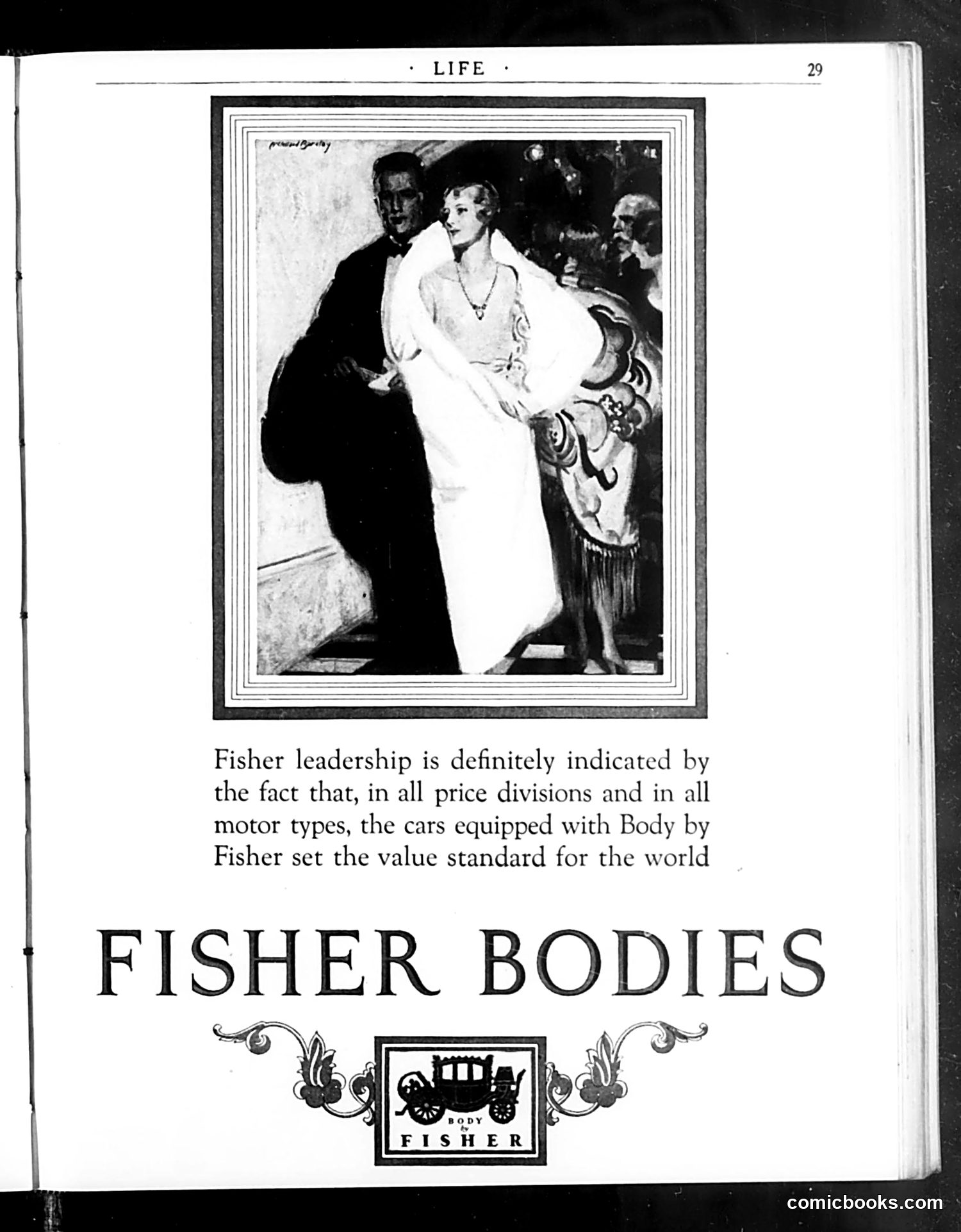
This is a **commercial advertisement**, not political satire. The page promotes Fisher Body Company, a major automotive supplier that manufactured car bodies for various manufacturers (particularly General Motors). The illustration depicts an elegant couple at what appears to be a formal social event, with a uniformed attendant visible. The image uses aspirational imagery—suggesting that Fisher-equipped automobiles represent luxury and social status. The text claims Fisher's dominance in the automotive market across all price ranges and vehicle types, positioning their product as the "value standard for the world." This is straightforward corporate advertising emphasizing quality and market leadership, typical of early-to-mid 20th century American magazine advertising that linked consumer products to social prestige and refinement.
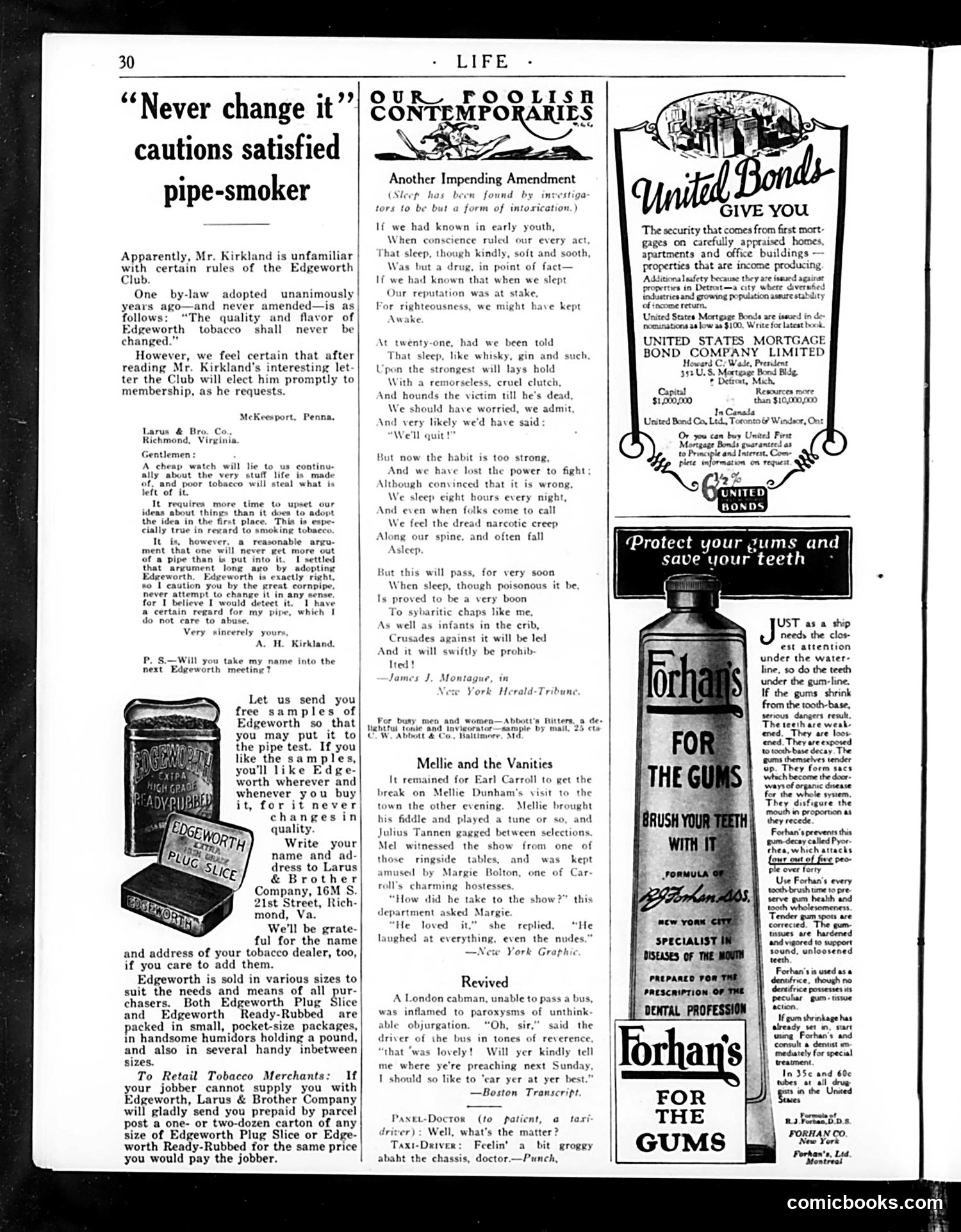
This page is primarily **advertising** for Edgeworth tobacco, framed as customer testimonials. The main "content" is a letter from Mr. A.H. Kirkland praising Edgeworth's consistency—he's delighted the company has never changed its product formula. The Edgeworth Club supposedly has a rule protecting the tobacco's "quality and flavor." The satirical section is **"Our Foolish Contemporaries,"** which mocks the trend toward prohibition amendments. It presents sleep as an "intoxicant" and suggests society will soon discover sleep is dangerous and campaign to prohibit it—a tongue-in-cheek commentary on overzealous reform movements. The poem's author (James J. Montague) satirizes how people discover vice in innocent things and demand regulation. A brief gossip item about "Mellie and the Vanities" mentions nightclub socialite activity. The page reflects 1920s advertising culture and anti-prohibition sentiment disguised as humor.
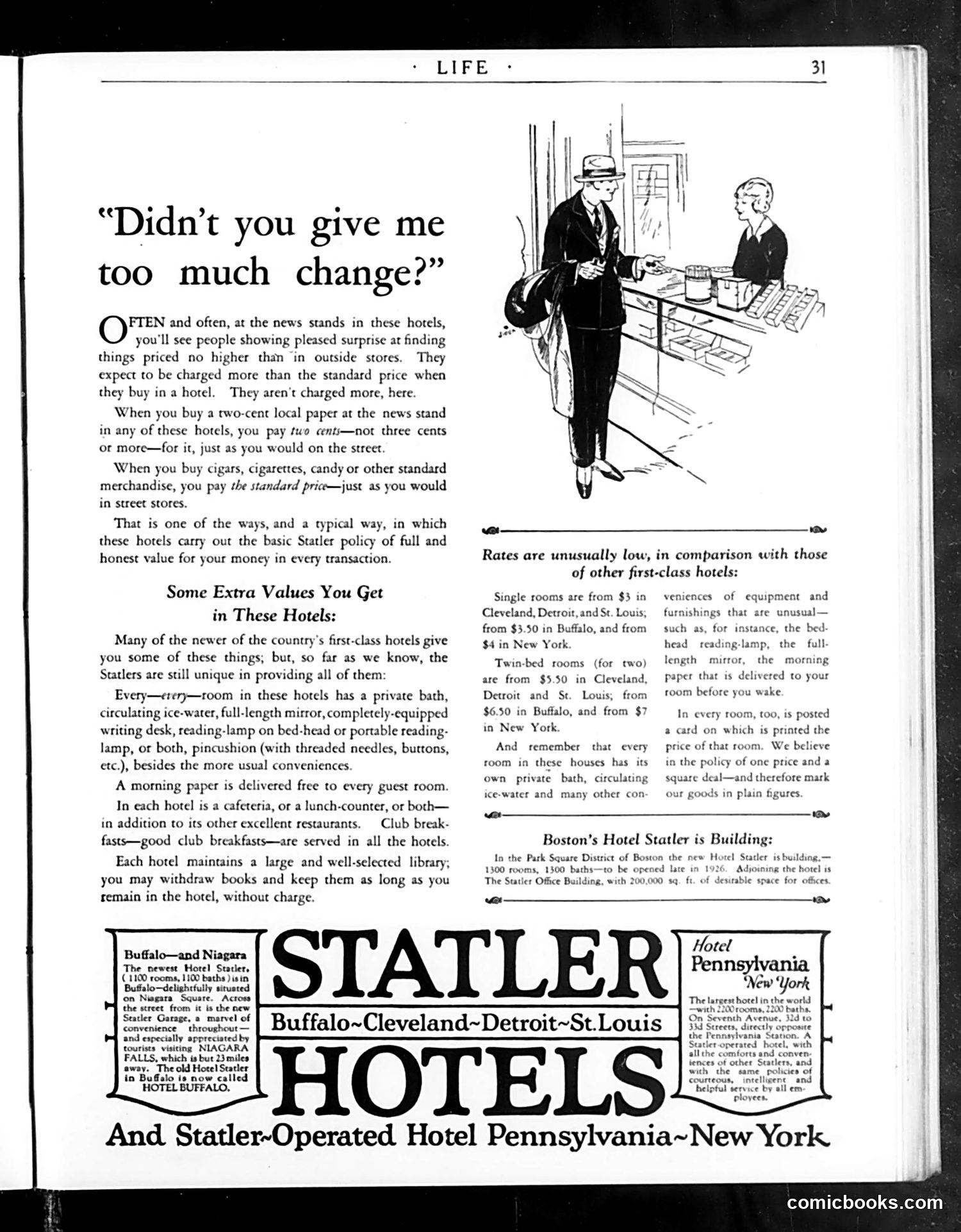
This page is **primarily an advertisement** for Statler Hotels, not political satire. The small cartoon at the top illustrates the hotel chain's main selling point: honest pricing. The cartoon shows a man at a hotel news stand surprised to receive correct change—a joke about the common expectation that hotels overcharge guests on incidental purchases (newspapers, cigars, candy). The caption "Didn't you give me too much change?" humorously suggests the customer expected to be *undercharged*, reflecting contemporary suspicion of hotels as exploitative. The advertisement emphasizes Statler's "Starter policy" of standard pricing and included amenities (private baths, free newspapers, libraries) as competitive advantages. This targets travelers accustomed to being gouged by hotels. The page lists multiple Statler locations and room rates ($3-$7), promoting their newly built Boston property. Rather than satire, it's straightforward early-20th-century hotel marketing exploiting customer distrust of the hospitality industry.
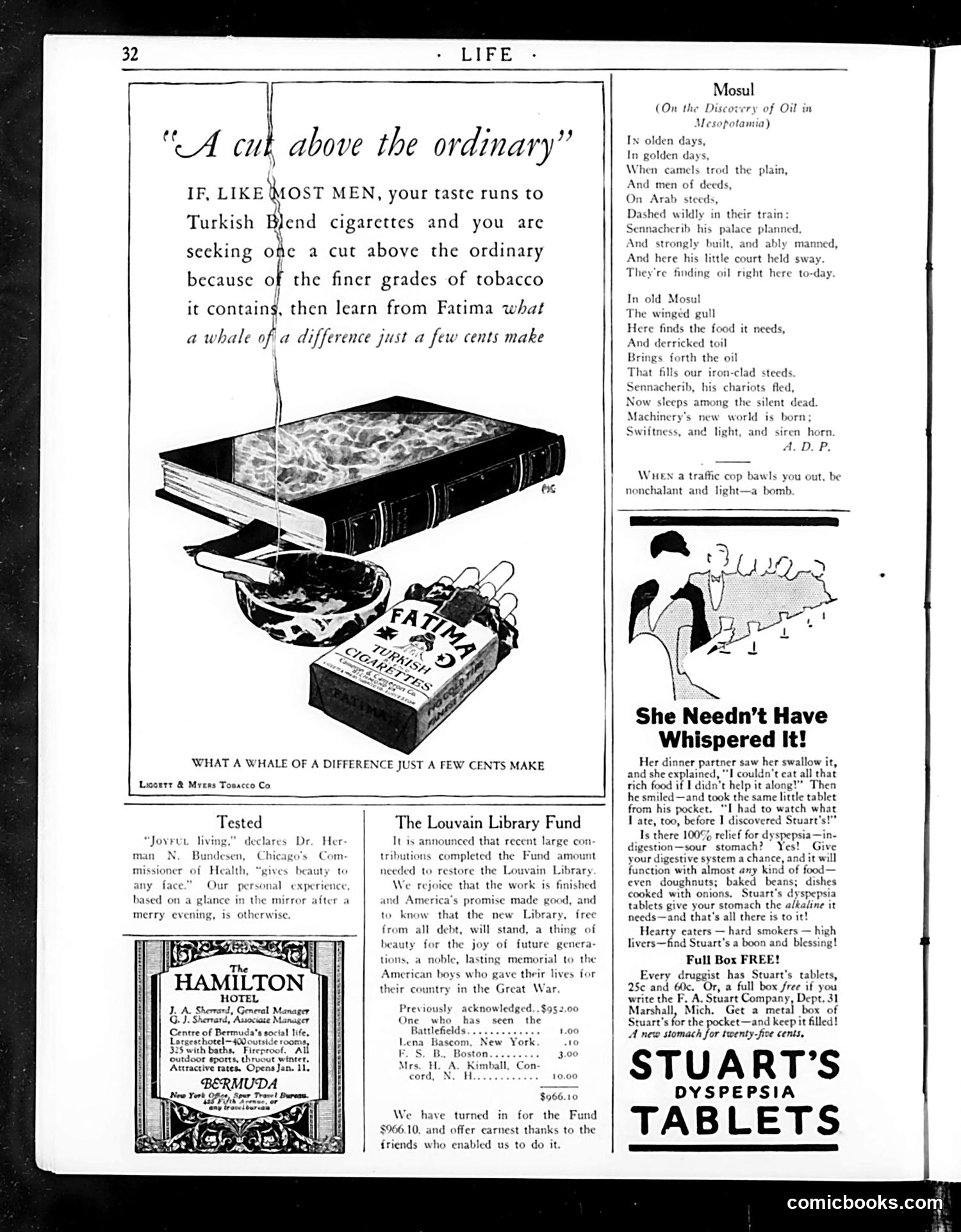
This page contains primarily **advertisements** rather than political cartoons. The main advertisement (top left) is for **Fatima Turkish Blend cigarettes** by Lorillard & Myers. It uses a visual pun showing a book opening to reveal tobacco leaves, with the slogan "what a whale of a difference just a few cents make"—suggesting that spending slightly more on premium cigarettes yields noticeably better quality tobacco. Below that is a hotel advertisement for the **Hamilton Hotel in Bermuda**. The right side contains **editorial content**: a poem about oil discovery in Mosul, Mesopotamia (modern Iraq), and notices about the Louvain Library restoration fund (damaged in WWI). Further down are two product advertisements: one for **Stuart's Dyspepsia Tablets** (digestive aid), using a humorous scene of two dinner companions discreetly taking the tablets. The page reflects early 20th-century consumer culture, particularly the marketing of patent medicines and luxury goods to middle-class readers.
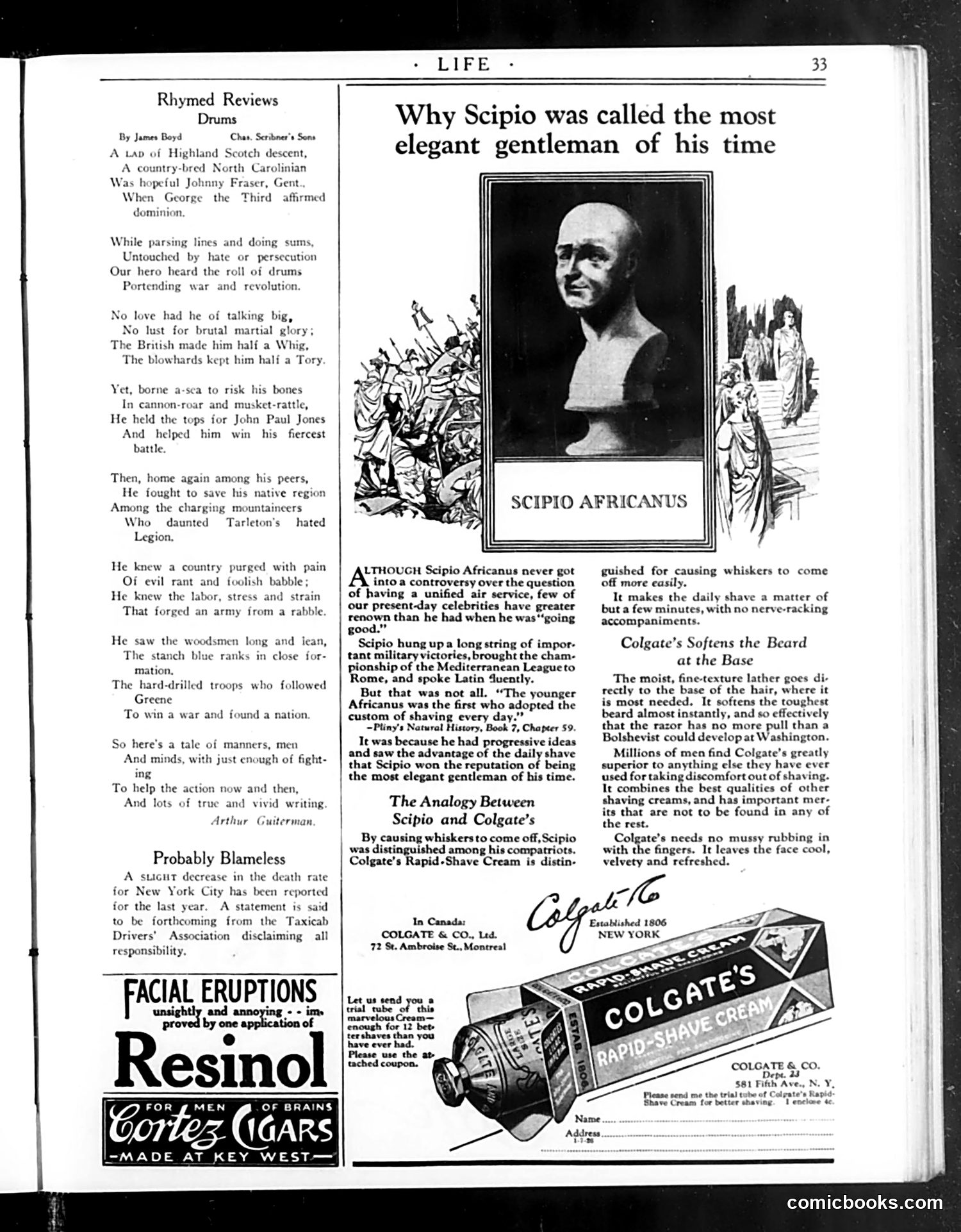
This page contains **mostly advertising** alongside a brief book review and historical comparison piece. The main content is a **Colgate's Rapid-Shave Cream advertisement** that uses an extended analogy: just as the Roman general Scipio Africanus (236-183 BCE) gained renown partly by adopting daily shaving—making him "the most elegant gentleman of his time"—Colgate's cream allows modern men similar daily grooming with ease and comfort. The advertisement's humor lies in treating shaving as a marker of civilized sophistication, elevating a mundane grooming product by comparing it to classical Roman achievement. The reference to a "Bolshevist" unable to develop as much pull as the razor suggests Cold War-era political messaging typical of the period. The page also includes a brief rhymed review of *Drums* by James Boyd (a historical novel about the American Revolution) and a short note on declining New York City death rates, with a taxi drivers' association humorously disclaiming responsibility. The **Resinol** cigar advertisement appears at bottom left.
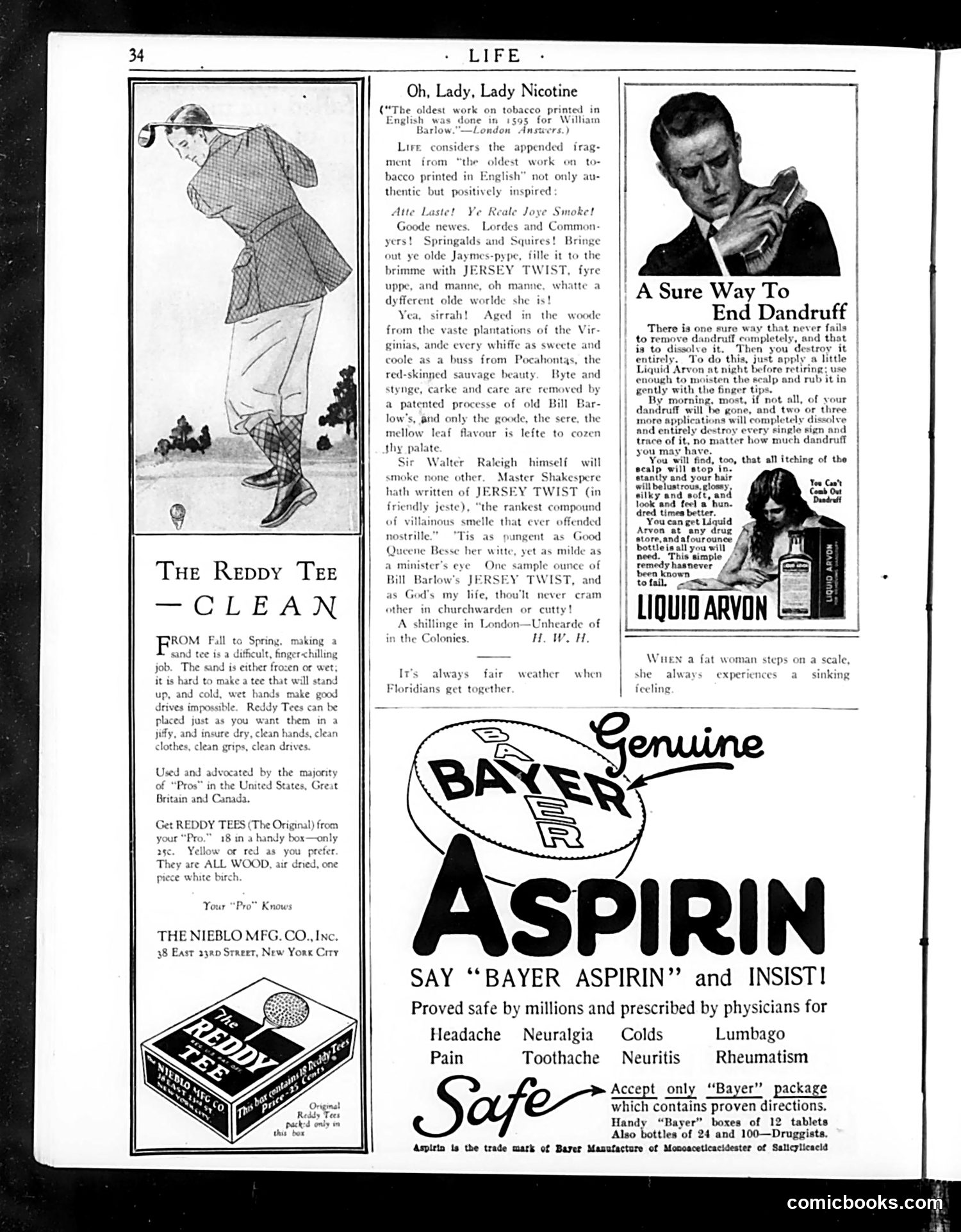
This page combines satirical content with period advertising from what appears to be the early 20th century. **The Main Satire:** "Oh, Lady, Lady Nicotine" is a humorous piece mimicking archaic English from a 1595 tobacco tract. It mockingly praises "Jersey Twist" tobacco in faux-Elizabethan language, attributing endorsements to Sir Walter Raleigh and Shakespeare. The joke plays on tobacco marketing's absurd historical claims and the romanticization of smoking through pseudo-literary authority. **Left Column:** An advertisement for "Reddy Tees" (golf tees), featuring a golfer with wet, sandy hands—a practical product solving a real problem. **Right Column:** Advertisements for Liquid Arvon (dandruff remedy), featuring a skeptical-looking man, and Bayer Aspirin, emphasizing medical legitimacy ("prescribed by physicians"). The page reflects early advertising's reliance on false authority, pseudo-historical appeals, and exaggerated claims—precisely what Life magazine satirized through the tobacco parody.
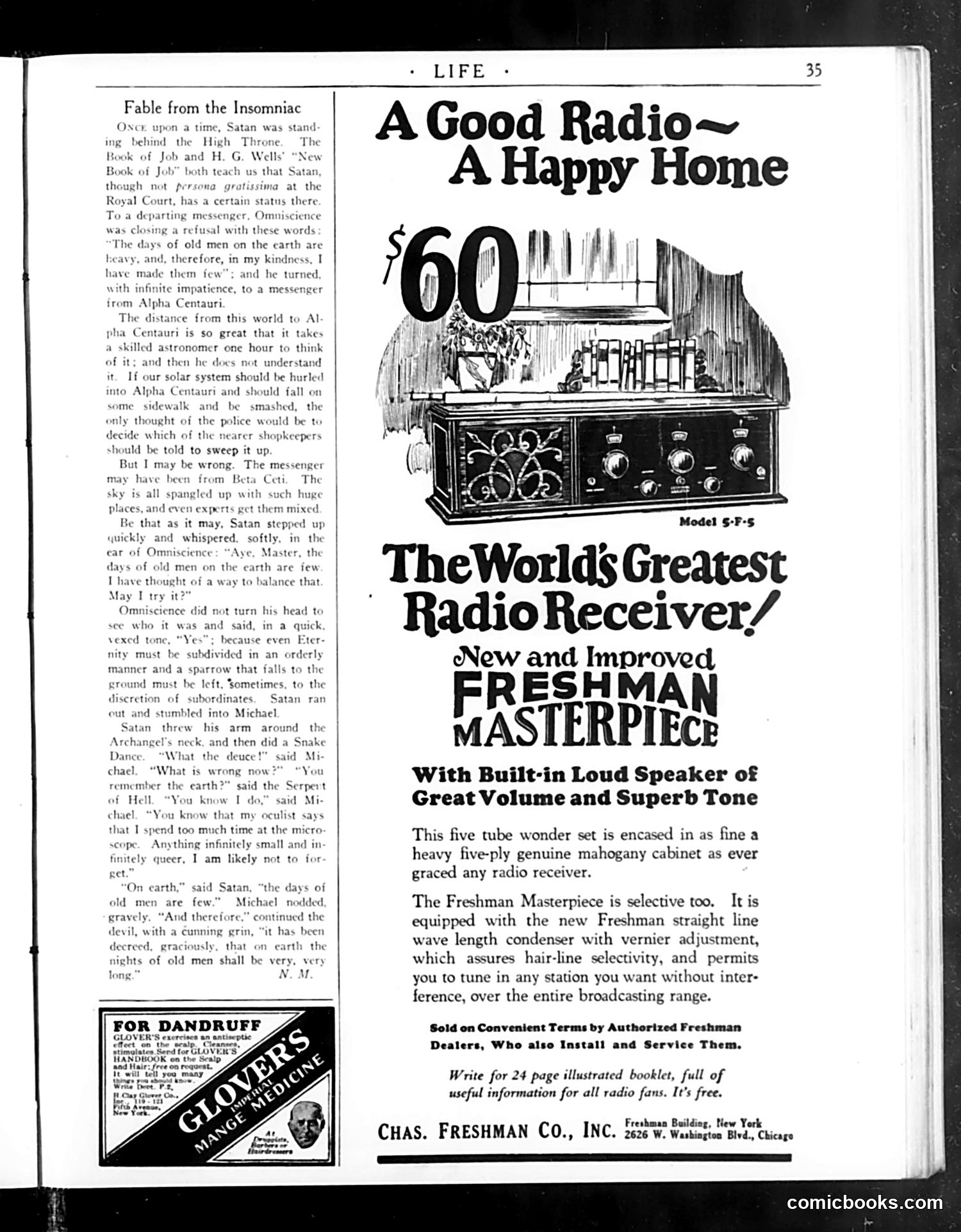
This page contains a philosophical short story titled "Fable from the Insomniac" alongside a radio advertisement—typical of Life's mixed content format. **The Fable:** The story is a satirical riff on the Book of Job, reimagining Satan negotiating with Omniscience. Satan tricks God into permitting him to lengthen old men's suffering on Earth by exploiting a technicality: God had already decreed their lives would be short, so Satan cleverly extends their *nights* instead. The joke plays on divine bureaucracy and Satan's cunning exploitation of loopholes—a darkly humorous meditation on human suffering and cosmic indifference. **The Advertisement:** The Freshman Model 5-F-5 radio receiver sells for $60, marketed as "The World's Greatest Radio Receiver." It emphasizes the mahogany cabinet, built-in speaker, and selective tuning capabilities—standard 1920s radio advertising. The page reflects Life's characteristic blend of literary satire and commercial culture, with the fable's existential bleakness contrasted against the optimistic promise that a good radio ensures "A Happy Home."
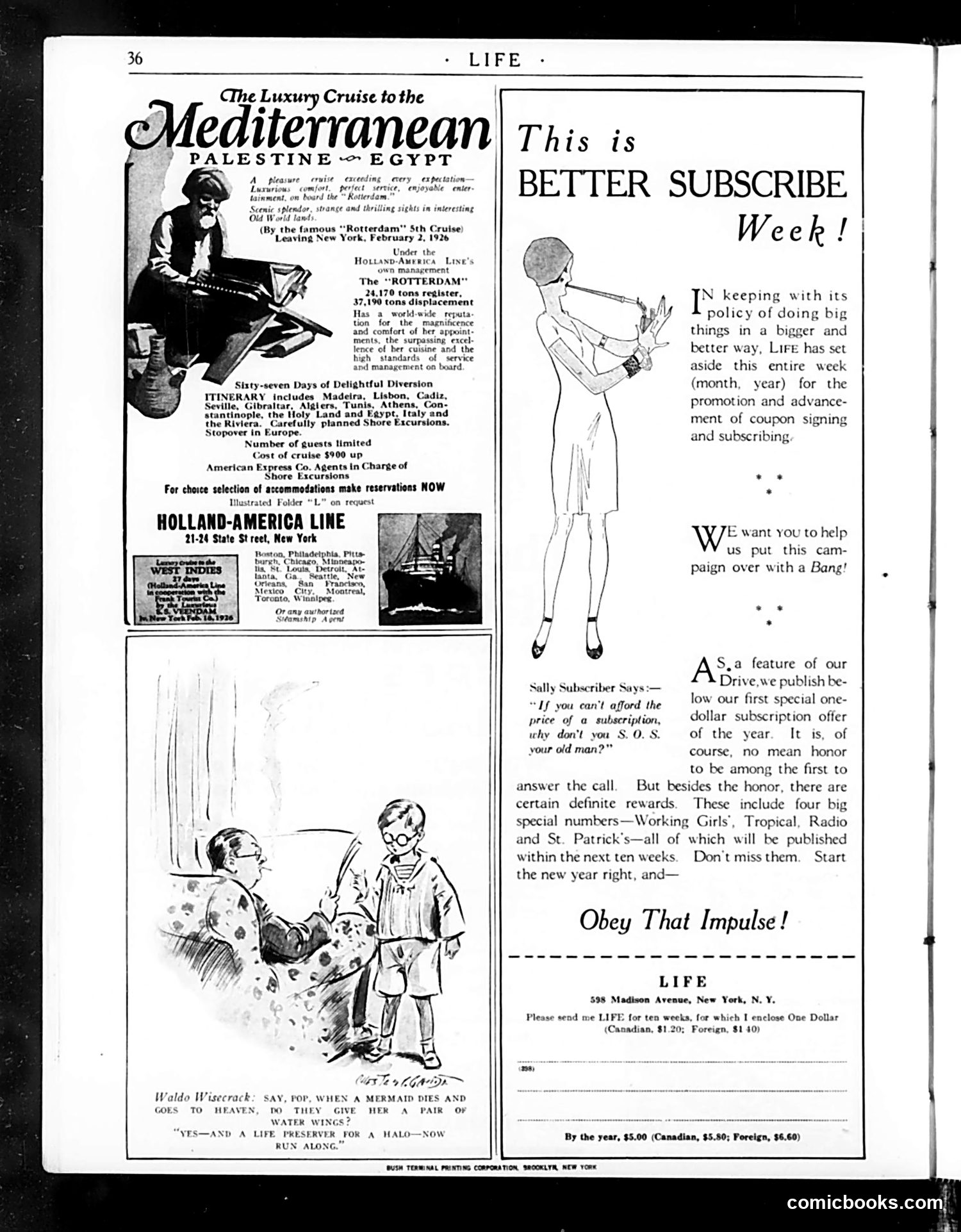
This page mixes advertising with humor typical of Life's satirical approach. **The Advertisements:** The top half promotes a luxury Mediterranean cruise aboard the "Rotterdam" ship, targeting affluent readers with promises of leisure and exotic destinations—reflecting 1920s travel aspirations. **The Cartoon:** At bottom, "Waldo Wisecrack" presents a child's joke about mermaids dying and receiving "water wings" as angel wings and a "life preserver for a halo." It's gentle, family-friendly wordplay rather than political satire. **The Subscription Campaign:** The right side aggressively promotes Life's $1 subscription offer, framing it as a New Year opportunity. The "Sally Subscriber" quote humorously suggests pressuring one's husband ("old man") to pay if affordable—reflecting period attitudes about women's financial dependence while actually encouraging subscriptions through humor. The page reflects 1920s consumer culture: luxury travel, humor targeting families, and media competition for readership during a prosperous era.
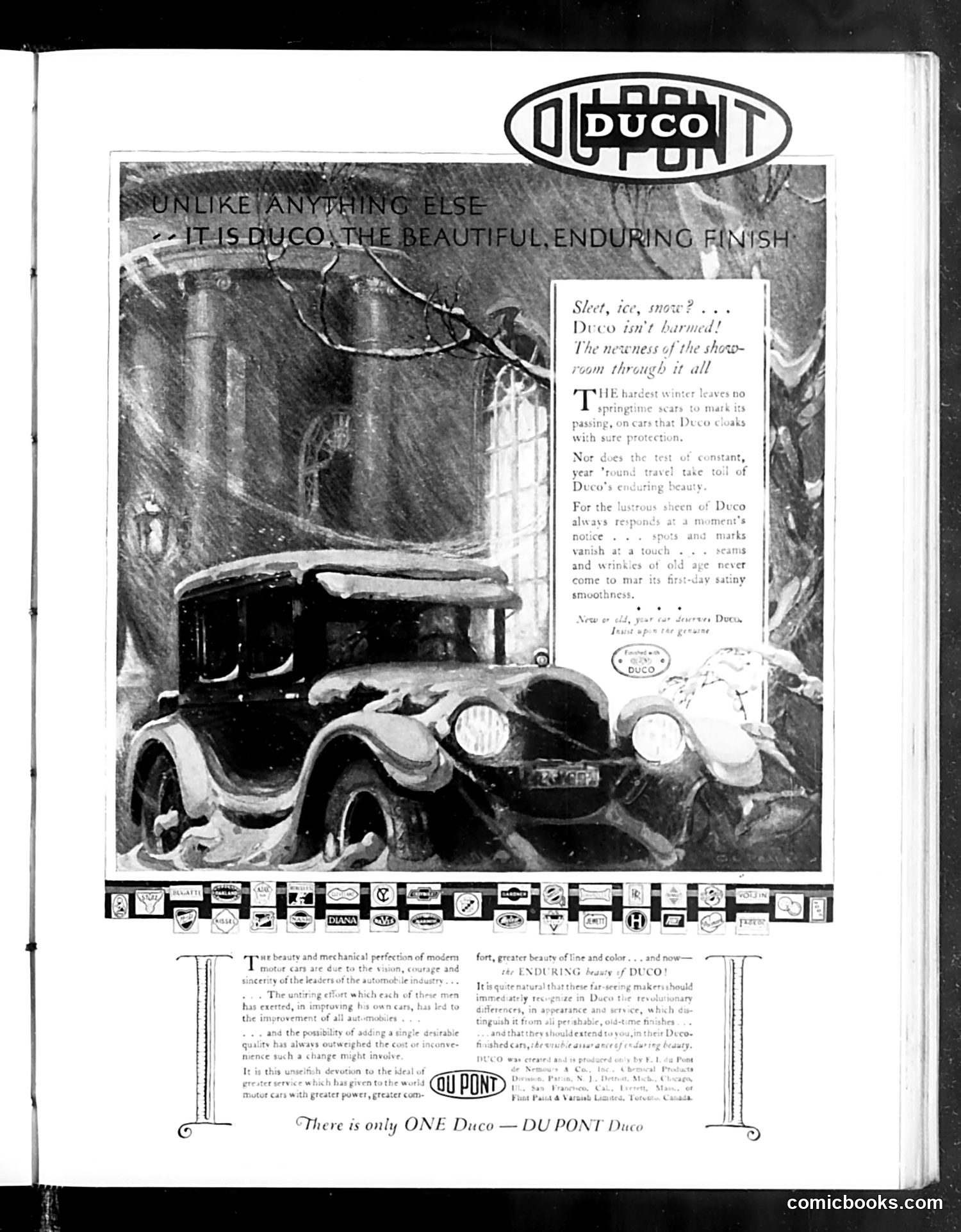
This is primarily a **product advertisement**, not political satire. It promotes DuPont's Duco automotive paint finish. The page shows a vintage car (appears to be from the 1920s) positioned in a snowy winter scene, demonstrating Duco's durability claims. The advertisement argues that Duco paint withstands harsh weather—"the hardest winter leaves no springtime scars"—and resists wear and aging better than competitors. The visual joke is subtle: the car, though exposed to severe conditions, maintains a pristine finish, proving Duco's superiority. The tagline "There is only ONE Duco—DU PONT Duco" emphasizes brand dominance. This reflects 1920s consumer culture, where automotive finishes were marketed as markers of quality and prestige. The ad targets middle-class car owners concerned with maintaining their vehicle's appearance and value.
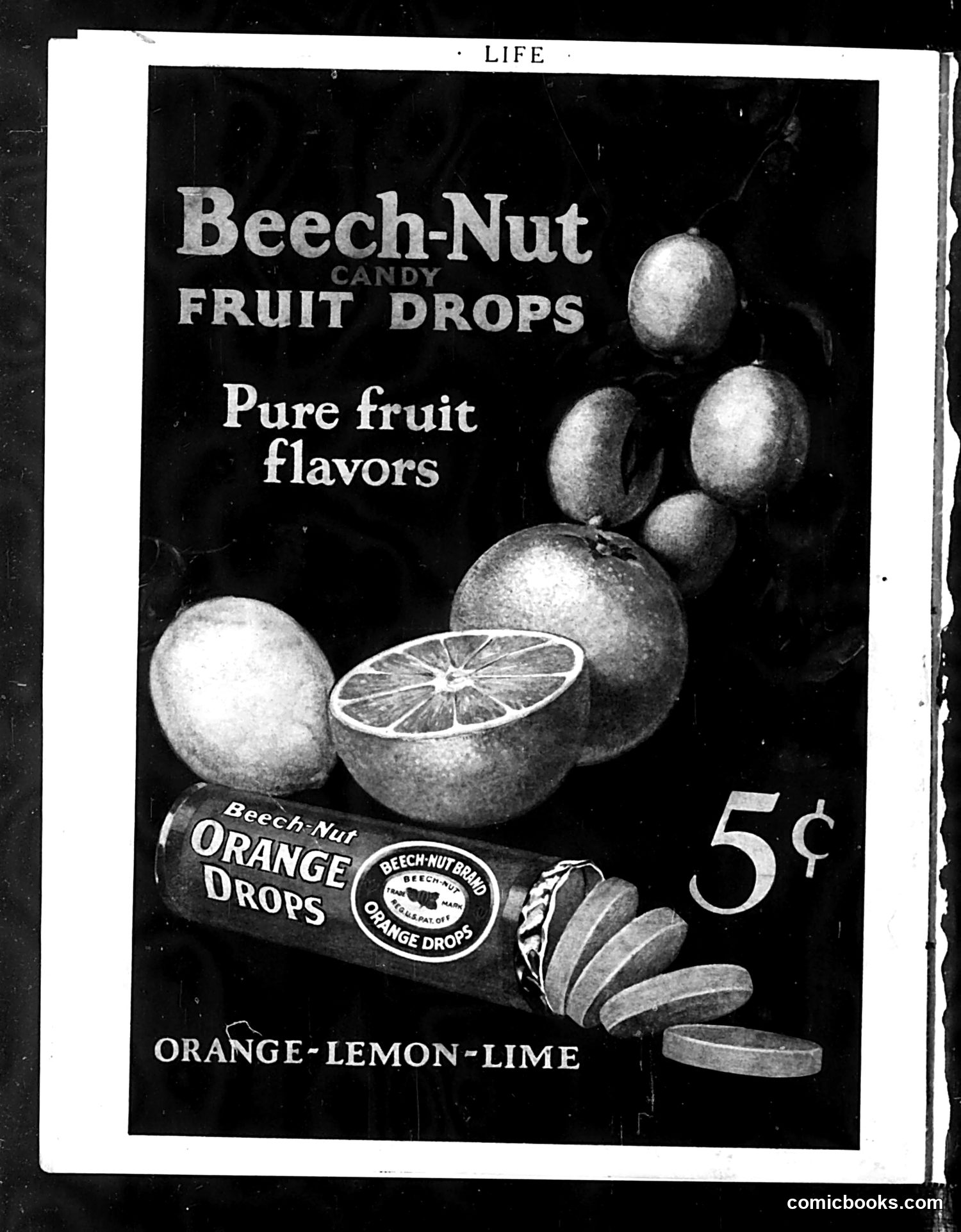
This is a **product advertisement**, not political satire or a cartoon. It's a full-page ad for Beech-Nut brand candy fruit drops, published in *Life* magazine. The ad promotes "pure fruit flavors" in orange-lemon-lime varieties, priced at 5 cents. Visual elements include photographs of citrus fruits (whole oranges and a cross-section showing the interior) and orange slices, alongside an image of the actual candy product in its wrapper. This represents typical early-to-mid 20th century advertising strategy: using realistic fruit photography to suggest natural ingredients and quality, while emphasizing the low price point. There is no political commentary, satire, or hidden meaning—it's straightforward commercial promotion.