
Life, 1926-01-07 · page 22 of 40
Life — January 7, 1926 — page 22: what you’re looking at
What you’re looking at
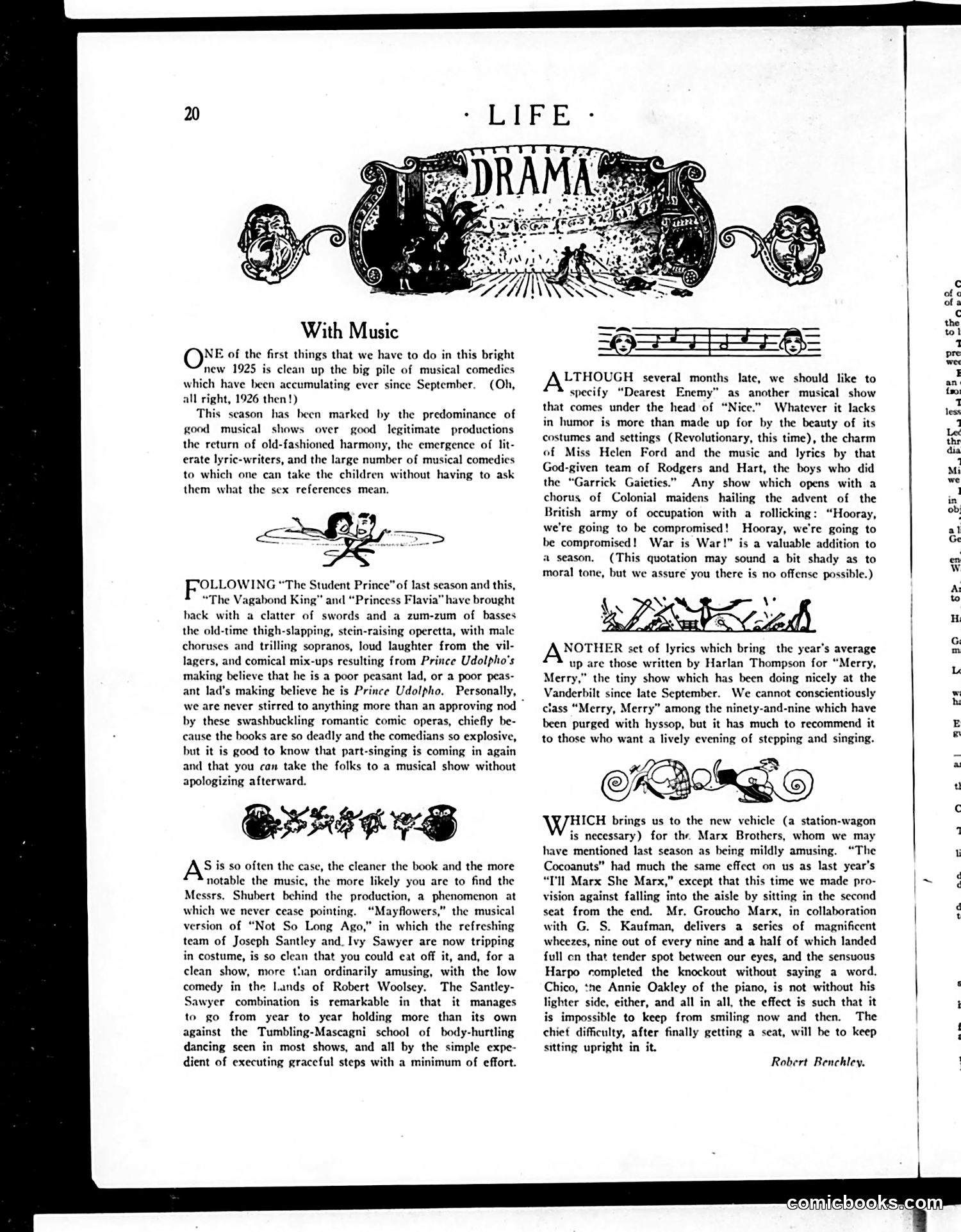
This theater review page discusses Broadway musical comedies of the 1925 season. The critic praises the return of "old-fashioned" operettas like *The Student Prince* and *The Vagabond King*, appreciating their romantic plots and male choruses, though finding the scripts "deadly." The piece celebrates shows with clean, family-friendly content—notably those produced by the Shuberts. Specific praise goes to *Dearest Enemy* (with music by Rodgers and Hart) for its Revolutionary War-era costuming and the charm of performer Helen Ford. The review also mentions *Merry, Merry* and a Marx Brothers vehicle, *The Cocoanuts*. The overall tone reflects 1925 Broadway: optimism about musicals as respectable entertainment suitable for children, appreciation of skilled lyricists, and the dominance of major producers like the Shuberts in shaping theatrical taste.
📄 Transcribed text from this page (OCR, searchable)
Machine-transcribed from the original scan — historical spelling and the odd misread are preserved.
With Music NE of the first things that we have to do in this bright new 1925 is clean up the big pile of musical comedies which have been accumulating ever since September. (Oh, all right, 1926 then!) This season has been marked by the predominance of good musical shows over good legitimate productions the return of old-fashioned harmony, the emergence of lit- erate lyric-writers, and the large number of musical comedies to which one can take the children without having to ask them what the sex references mean. ‘OLLOWING “The Student Prince” of last season and this, “The Vagabond King” and “Princess Flavia” have brought back with a clatter of swords and a zum-zum of basses the old-time thigh-slapping, stein-raising operetta, with male choruses and trilling sopranos, loud laughter from the vil- lagers, and comical mix-ups resulting from Prince Udolpho's making believe that he is a poor peasant lad, or a poor peas- ant lad’s making believe he is Prince Udolpho. Personally, we are never stirred to anything more than an approving nod © by these swashbuckling romantic comic operas, chiefly be- cause the books are so deadly and the comedians so explosive, but it is good to know that part-singing is coming in again and that you can take the folks to a musical show without apologizing afterward. GPEIG C®@ S is so often the case, the cleaner the book and the more notable the music, the more likely you are to find the Messrs. Shubert behind the production, a phenomenon at which we never cease pointing. “Mayflowers,” the musical version of “Not So Long Ago,” in which the refreshing team of Joseph Santley and. Ivy Sawyer are now tripping in costume, is so clean that you could eat off it, and, for a clean show, more than ordinarily amusing, with the low comedy in the Lands of Robert Woolsey. The Santley- Sawyer combination is remarkable in that it manages to go from year to year holding more than its own against the Tumbling-Mascagni school of body-hurtling dancing seen in most shows, and all by the simple expe- dient of executing graccful steps with a minimum of effort. LTHOUGH several months late, we should like to specify “Dearest Enemy” as another musical show that comes under the head of “Nice.” Whatever it lacks in humor is more than made up for by the beauty of its costumes and settings (Revolutionary, this time), the charm of Miss Helen Ford and the music and lyrics by that God-given team of Rodgers and Hart, the boys who did the “Garrick Gaieties.”. Any show which opens with a chorus of Colonial maidens hailing the advent of the British army of occupation with a rollicking: “Hooray, we're going to be compromised! Hooray, we're going to be compromised! War is War!” is a valuable addition to a season, (This quotation may sound a bit shady as to moral tone, but we assure you there is no offense possible.) NOTHER set of lyrics which bring the year's average up are those written by Harlan Thompson for “Merry, Merry,” the tiny show which has been doing nicely at the Vanderbilt since late September. We cannot conscientiously ciass “Merry, Merry” among the ninety-and-nine which have been purged with hyssop, but it has much to recommend it to those who want a lively evening of stepping and singing. ‘HICH brings us to the new vehicle (a station-wagon is necessary) for the Marx Brothers, whom we may have mentioned last season as being mildly amusing. “The Cocoanuts” had much the same effect on us as last year’s “Tl Marx She Marx,” except that this time we made pro- vision against falling into the aisle by sitting in the second seat from the end. Mr. Groucho Marx, in collaboration with G. S. Kaufman, delivers a serics of magnificent wheezes, nine out of every nine and a half of which landed full on that tender spot between our eyes, and the sensuous Harpo completed the knockout without saying a word. Chico, tne Annie Oakley of the piano, is not without his lighter side, either, and all in all, the effect is such that it is impossible to keep from smiling now and then. The chief difficulty, after finally getting a seat, will be to keep sitting upright in it. Robert Renchley. ce pgp ae pl sw Fa as