
Life, 1926-01-07 · page 18 of 40
Life — January 7, 1926 — page 18: what you’re looking at
What you’re looking at
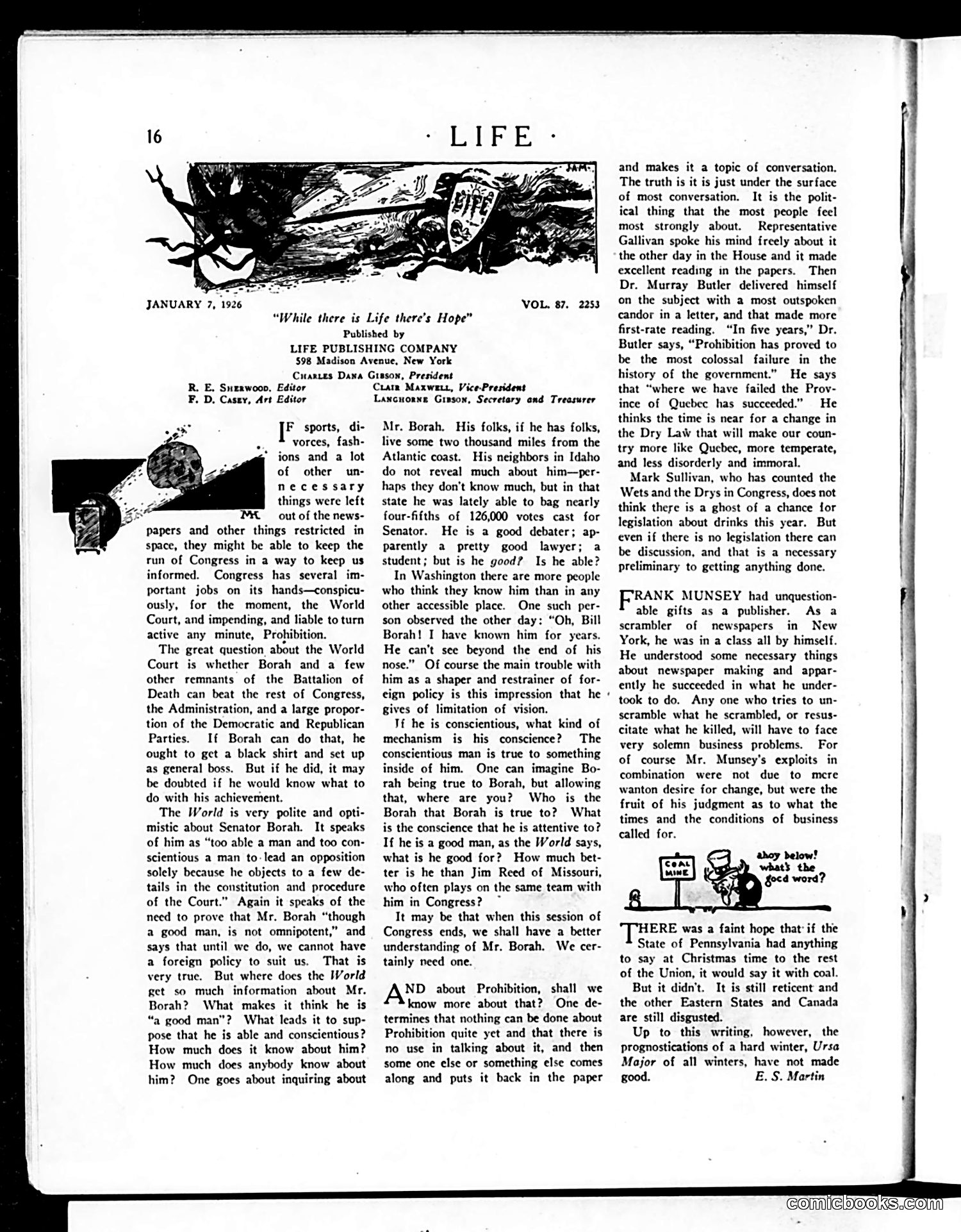
The main cartoon depicts a figure labeled "BIFF" striking someone, illustrating the article's satirical examination of Senator William E. Borah of Idaho. The text criticizes Borah as a "good" debater and lawyer but questions whether he possesses practical wisdom or foresight. The author argues Borah's limitations prevent him from effectively shaping foreign policy—he "gives limitation of vision." The piece uses Borah as a case study in how Congress lacks truly competent leadership. Below, a separate section discusses Prohibition's failure as government policy, referencing Dr. Murray Butler's assessment that it represents "the most colossal failure in the history of the government." The article questions whether legislative change might occur.
📄 Transcribed text from this page (OCR, searchable)
Machine-transcribed from the original scan — historical spelling and the odd misread are preserved.
JANUARY 7, 1926 VOL. 87, “While there is Life there’s Hope” Published by LIFE PUBLISHING COMPANY $98 Madison Avenue, New York Cuanres Dana Giason, President R. E. Snzawooo, Editor F. D. Casny, Art Editor F sports, di- vorces, fash- ions and a lot of other un- necessary things were left MT out of the news- papers and other things restricted in space, they might be able to keep the run of Congress in a way to keep us informed. Congress has several im- portant jobs on its hands—conspicu- ously, for the moment, the World Court, and impending, and liable to turn active any minute, Prohibition. The great question about the World Court is whether Borah and a few other remnants of the Battalion of Death can beat the rest of Congress, the Administration, and a large propor- tion of the Democratic and Republican Parties. If Borah can do that, he ought to get a black shirt and set up as general boss. But if he did, it may be doubted if he would know what to do with his achievement. The World is very polite and opti- mistic about Senator Borah. It speaks of him as “too able a man and too con- scientious a man to-lead an opposition solely because he objects to a few de- tails in the constitution and procedure of the Court.” Again it speaks of the need to prove that Mr. Borah “though a good man, is not omnipotent,” and says that until we do, we cannot have a foreign policy to suit us. That is very true. But where does the World get so much information about Mr. Borah? What makes it think he is “a good man”? What leads it to sup- pose that he is able and conscientious? How much does it know about him? How much does anybody know about him? One goes about inquiring about Crate Maxwent, Vice-President Lancuorng Grason, Secretary and Treasurer Mr. Borah. His folks, if he has folks, live some two thousand miles from the Atlantic coast. His neighbors in Idaho do not reveal much about him—per- haps they don't know much, but in that state he was lately able to bag nearly four-fifths of 126,000 votes cast for Senator. He is a good debater; ap- parently a pretty good lawyer; a student; but is he good? Is he able? In Washington there are more people who think they know him than in any other accessible place. One such per- son observed the other day: “Oh, Bill Borah! I have known him for years. He can't see beyond the end of his nose.” Of course the main trouble with him as a shaper and restrainer of for- eign policy is this impression that he + gives of limitation of vision. Jf he is conscientious, what kind of mechanism is his conscience? The conscientious man is true to something inside of him. One can imagine Bo- rah being true to Borah, but allowing that, where are you? Who is the Borah that Borah is true to? What is the conscience that he is attentive to? Tf he is a good man, as the World says, what is he good for? How much bet- ter is he than Jim Reed of Missouri, who often plays on the same team with him in Congress? ~ It may be that when this session of Congress ends, we shall have a better understanding of Mr. Borah. We cer- tainly need one. ND about Prohibition, shall we know more about that? One de- termines that nothing can be done about Prohibition quite yet and that there is no use in talking about it, and then some one else or something else comes along and puts it back in the paper and makes it a topic of conversation. The truth is it is just under the surface of most conversation. It is the polit- ical thing that the most people feel most strongly about. Representative Gallivan spoke his mind freely about it the other day in the House and it made excellent reading in the papers. Then Dr. Murray Butler delivered himself on the subject with a most outspoken candor in a letter, and that made more first-rate reading. “In five years,” Dr. Butler says, “Prohibition has proved to be the most colossal failure in the history of the government.” He says that “where we have failed the Prov- ince of Quebec has succeeded.” He thinks the time is near for a change in the Dry Law that will make our coun- try more like Quebec, more temperate, and less disorderly and immoral. Mark Sullivan, who has counted the Wets and the Drys in Congress, does not think there is a ghost of a chance for legislation about drinks this year. But even if there is no legislation there can be discussion, and that is a necessary preliminary to getting anything done. RANK MUNSEY had unquestion- able gifts as a publisher. As a scrambler of newspapers in New York, he was in a class all by himself. He understood some necessary things about newspaper making and appar- ently he succeeded in what he under- took to do. Any one who tries to un- scramble what he scrambled, or resus- citate what he killed, will have to face very solemn business problems. For of course Mr. Munsey's exploits in combination were not due to mere wanton desire for change, but were the fruit of his judgment as to what the times and the conditions of business “THERE was a faint hope that’ if the State of Pennsylvania had anything to say at Christmas time to the rest of the Union, it would say it with coal. But it didn’t. It is still reticent and the other Eastern States and Canada are still disgusted. Up to this writing, however, the prognostications of a hard winter, Ursa Major of all winters, have not made good. E. S. Martin