
Life, 1926-01-07 · page 27 of 40
Life — January 7, 1926 — page 27: what you’re looking at
What you’re looking at
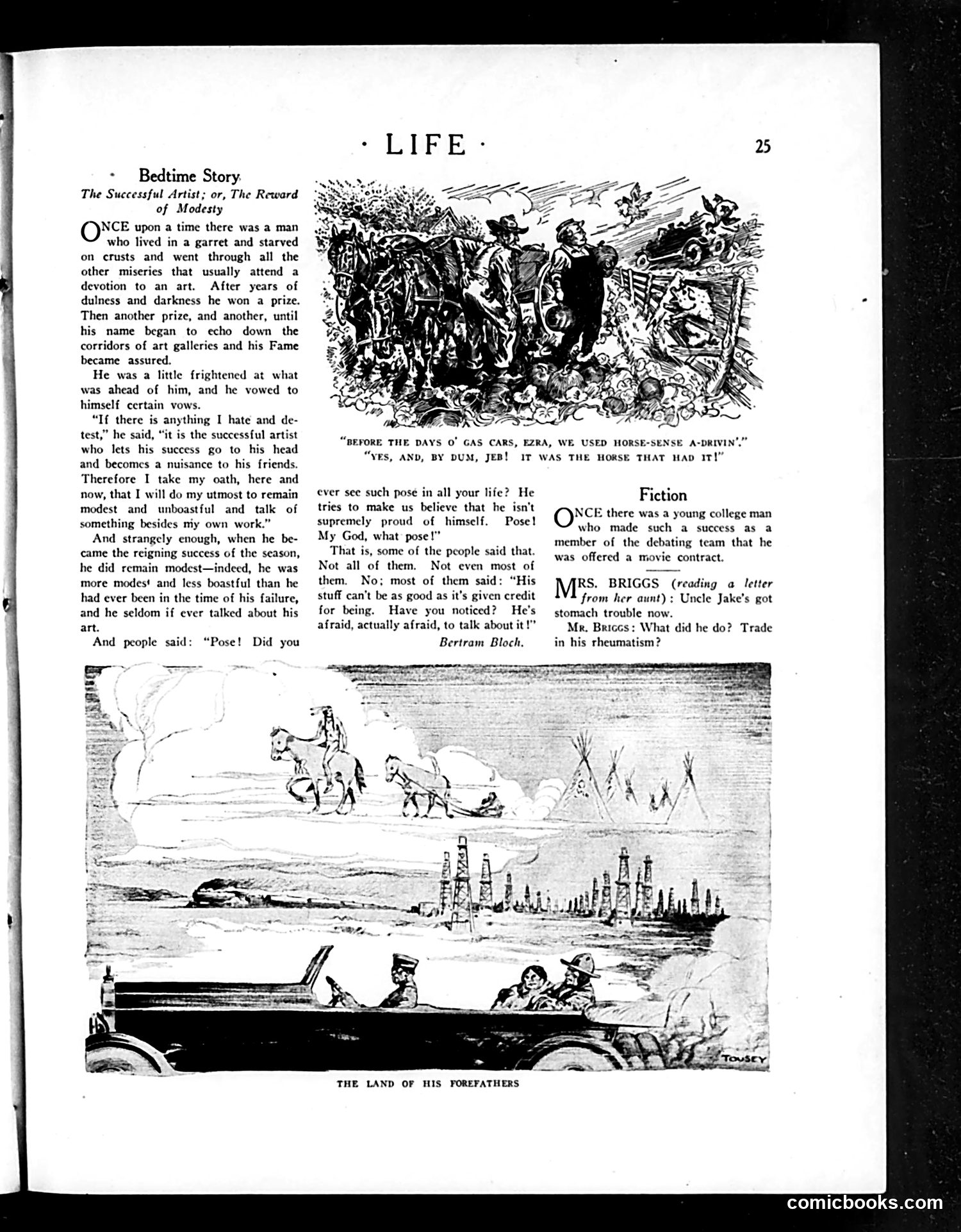
This page contains two distinct pieces of satire: **"Bedtime Story"** (top): A fable mocking social perception of success. An artist achieves fame but, keeping a vow of modesty, never boasts about his work. Rather than being praised for humility, society interprets his silence as affected *pose*—performative false modesty. Some assume his reluctance to discuss his art means the work itself isn't worthy of discussion. The satire targets how audiences distrust genuine modesty in successful people, assuming any restraint must be an act. **"Fiction"** (bottom right): A brief joke about a college debater turned movie star. **Illustrations**: The top cartoon depicts pioneers/settlers with horses and teepees contrasting with modern oil derricks, captioned with nostalgia for "horse-sense" driving versus gas cars—likely satirizing early automotive culture and the loss of practical judgment in modern life. The bottom illustration shows similar frontier-to-modern-era contrast ("Land of His Forefathers"). The page criticizes both artistic pretension and society's inability to recognize authentic humility.
📄 Transcribed text from this page (OCR, searchable)
Machine-transcribed from the original scan — historical spelling and the odd misread are preserved.
+ Bedtime Story. The Successful Artist; or, The Reward of Modesty O NCE upon a time there was a man who lived in a garret and starved on crusts and went through all the other miseries that usually attend a devotion to an art. After years of dulness and darkness he won a prize. Then another prize, and another, until his name began to echo down the corridors of art galleries and his Fame became assured. He was a little frightened at what was ahead of him, and he vowed to himself certain vows. “If there is anything I hate and de- test,” he said, “it is the successful artist who lets his success go to his head and becomes a nuisance to his friends. Therefore I take my oath, here and now, that I will do my utmost to remain modest and unboastful and talk of something besides niy own work.” And strangely enough, when he be- came the reigning success of the season, he did remain modest—indeed, he was more modes and less boastful than be had ever been in the time of his failure, and he seldom if ever talked about his art. And people said: =i = “Pose! Did you “BEFORE THE DAYS O° GAS CARS, EZRA, WE USED HORSE-SENSE A-DRIVIN’.” “Yes, AND, BY DUM, JeB! ever see such pose in all your life? He tries to make us believe that he isn't supremely proud of himself. Pose! My God, what pose!” That is, some of the people said that. Not all of them. Not even most of them. No; most of them said: “His stuff can’t be as good as it’s given credit for being. Have you noticed? He's afraid, actually afraid, to talk about it!” Bertram Bloch. THE LAND OF HIS FOREFATHERS IT WAS THE HORSE THAT HAD IT!” Fiction ONCE there was a young college man who made such a success as a member of the debating team that he was offered a movie contract. RS. BRIGGS (reading a letter from her aunt): Uncle Jake's got stomach trouble now. Mr. Briccs: What did he do? Trade in his rheumatism? comicbooks.com