
Life, 1926-01-07 · page 28 of 40
Life — January 7, 1926 — page 28: what you’re looking at
What you’re looking at
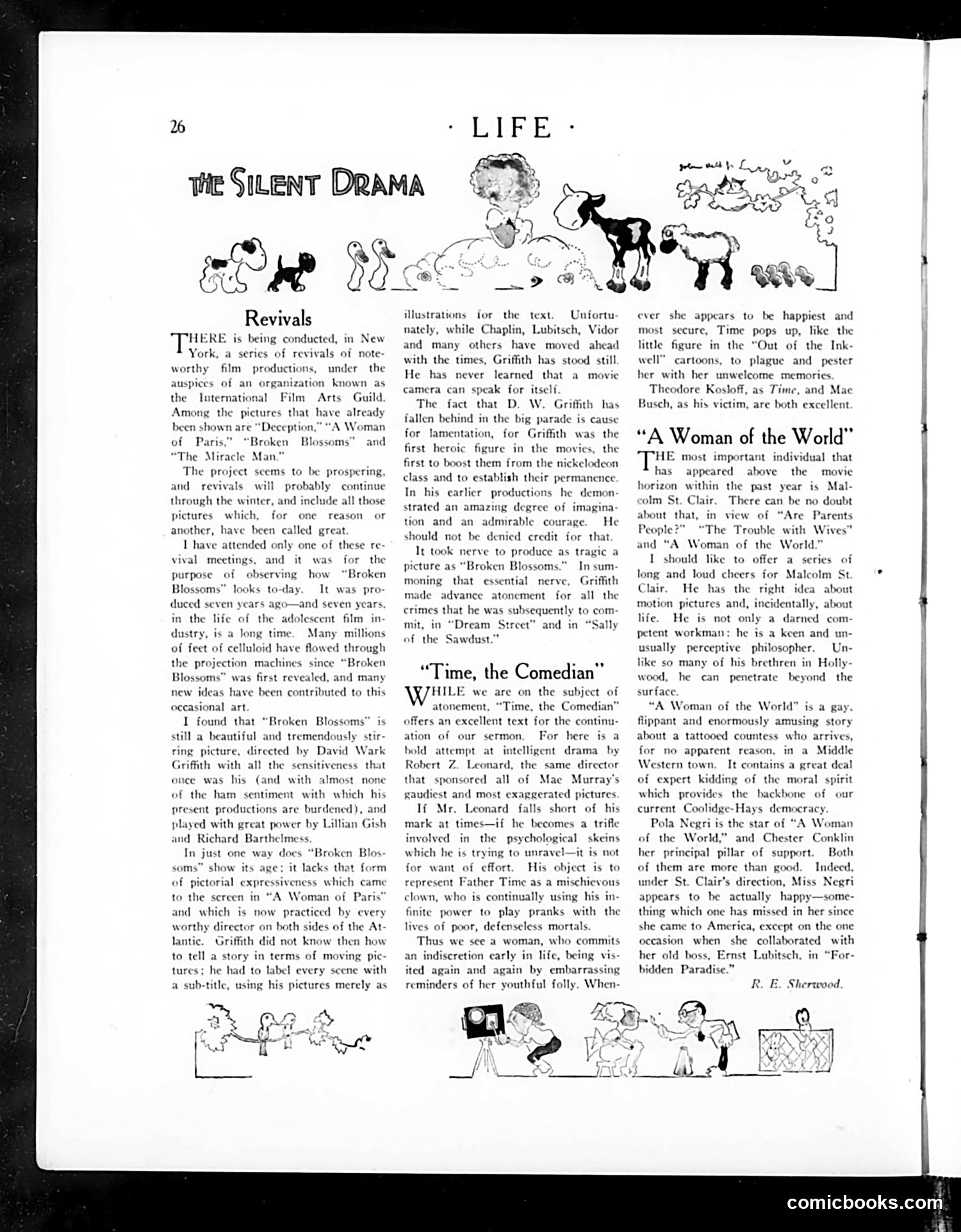
This page reviews silent films being revived in 1920s New York through the International Film Arts Guild. The critic discusses three films: "Broken Blossoms" and "A Woman of Paris" (praised for visual storytelling), and "Time, the Comedian" (about Father Time as a mischievous character punishing a woman for past indiscretion). The key satire targets **D.W. Griffith's outdated filmmaking**. Though praised as cinema's pioneer who elevated movies from "nickelodeon class," Griffith has "stood still" while contemporaries like Chaplin and Lubitsch progressed. His fatal flaw: relying on title cards to explain action rather than letting the camera "speak for itself"—a technique newer directors had mastered. The cartoon illustrations (showing simple figures) ironically underscore this point about visual versus textual expression in silent film. The critic laments Griffith's creative stagnation despite his historical importance, using "atonement" language to suggest wasted potential.
📄 Transcribed text from this page (OCR, searchable)
Machine-transcribed from the original scan — historical spelling and the odd misread are preserved.
26 ie SILENT DRAMA Revivals HERE is being conducted, in New York, a series of revivals of note- worthy film. p under the auspices of an organization known as the International Film Arts Guild. Among the pictures that have already “Deception,” “A Woman “Broken Blossoms” xductions, been shown are of Paris,” and “The Miracle Man.” The project scems to be prospering, and revivals will probably continue through the winter, and include all those pictures which, for one another, have been called great I have attended only one of these re reason or was for the oken was pro and it fg how “Bi lay. Tt vival purpose of Blossoms” looks to-¢ duced seven years ago—and seven years, meetings, obser adolescent film in dustry, is a long time. Many millions of feet of celluloid have flowed through the projection n Blossoms” was first revealed, and many new ideas have been contributed to this in the life of the achines since “Broken occasional art I found that “Broken B still a beautiful and tremendously. s! ring picture, directed by David Wark Griffith with all the sensitive once (and with of the ham sentiment with ssoms” is r- was his almost none which his present productions are burdened), and played with great power by Lillian Gish and Richard Barthelmess In just one way docs “Broken Blos soms” show its age; it lacks that form of pictorial expressiveness which came “A Woman of Paris” to the sereen in which is now pr worthy director on both sides of the At- lantic. Griffith did not know then how to tell a story in terms of moving pic- tures; he had to label every scene with a sub-title, using his pictures merely as and cticed by every illustrations for the text. Unfortu nately, while Chaplin, Lubitsch, Vidor and many others have moved ahead with the times, Griffith has stood still He has never learned that a movie camera can speak for itseli The fact that D. W. Griffith has fallen behind in the big parade is cause for lamentation, for Griffith first heroic figure in the movies, the first to boost them from the nickelodeon was the class and ) establish their permanence In his earlier productions he demon- strated an amazing degree of imagina tion and an admirable courage. He should not be denied credit for that It took nerve to produce as tragic a picture as “Broken Blossoms.” In sum- moning that essential nerve, Griffith made advance atonement for all the ‘om: Sally crimes that he was subsequently to mit, in “Dream of the Sawdust.” Street” and in “Time, the Comedian” AWHILE we are on the subject of atonement, “Time, the Comedian” offers an excellent text for the continu- ation of For here is a our sermon. hold attempt at intelligent drama by Robert Z. Leonard, the same director that sponsored all of Mac Murray's gaudiest and most exaggerated pictures If Mr. Leonard falls short of his mark at times—if he becomes a trifle involved in the psychological skeins which he is trying to unravel—it is not for want of effort. His object is to represent Father Time as a mischievous clown, who is continually using his in- finite power to play pranks with the lives of poor, defenseless mortals. Thus we see a woman, who commits an indiscretion early in life, being. vis- ited again and again by embarrassing reminders of her youthful folly. When- ever she appears to be happiest and secure, Time pops up, like the little figure in the “Out of the Ink- well” cartoons, to plague and pester her with her unwelcome memories. Theodore Kosloff, as Time, and Mae Busch, as his victim, are both excellent “A Woman of the World” HE most important individual that has appeared above the movie horizon within the past year is Mal- ‘olm St. Clair. There can be no doubt about that, in view of “Are Parents People?” “The Trouble with Wives” and “A Woman of the World.” I should like to offer a series of long and loud cheers for Malcolm St Clair. He has the right idea about motion pictures and, incidentally, about life. He is not only a darned com petent workman: he is a keen and un- usually perceptive philosopher, Un- like so many of his brethren in Holly- wood, he can penetrate beyond the surfa “A Woman of the World” is a gay. flippant about a tattooed countess who arrives, for no apparent Middle Western town. It contains a great deal of expert kidding of the moral spirit which provides the backbone of our current Coolidge-Hays democracy Pola Negri is the star of “A Woman 1 enormously amusing story reason, in a of the World,” and Chester Conklin her principal pillar of support. Both of them are more than good. Indeed, under St. Clair’s direction, Miss Negri appears to be actually happy—some- thing which one has missed in her since she came to America, except on the one occasion when she collaborated with her old boss, Ernst Lubitsch, in hidden Paradise.” or comicbooks.com